




Abstract
Artificial intelligence (AI) can enhance, enable, or replace traditional open innovation (OI) practices, changing the scope and efficiency of both outside-in and inside-out OI. This article provides a comprehensive framework to analyze AI’s influence on OI, supported by illustrative examples, and outlines the key implications for organizations and researchers. The co-evolutionary relationship between AI and OI will be a central focus in both research and practice moving forward.
Keywords
Since then, the concept of OI has had a significant impact on academic research, industrial practices, and public policy. 3 With present and future challenges requiring innovation on an unprecedented scale, OI will remain crucial in addressing these demands. 4 For OI to succeed, though, it will require active and purposeful management, which the scholarship on OI so far has substantially illuminated. We believe that the articles in this special issue will further advance OI research and practice by identifying critical strategies, organizational designs, and technologies that support OI.
As scholars and practitioners learn better how to use OI in managing the development of technologies, they must also explore how new technological advances challenge OI as we know it. It is clear that artificial intelligence (AI) will transform innovation processes and practices. OI will also need to transform if it is to remain relevant to current industry practices and procedures. AI influences OI in multiple ways—by enhancing established practices, enabling new ones, and possibly replacing some forms of OI.
In this article, we offer a framework for understanding AI’s influence on open innovation. First, we briefly discuss the OI research to date. Next, we introduce our framework and describe AI’s implications for OI, using several illustrative examples. We then conclude with a brief guide to the articles in this special issue.
The Emergence, Growth, and Impact of Open Innovation
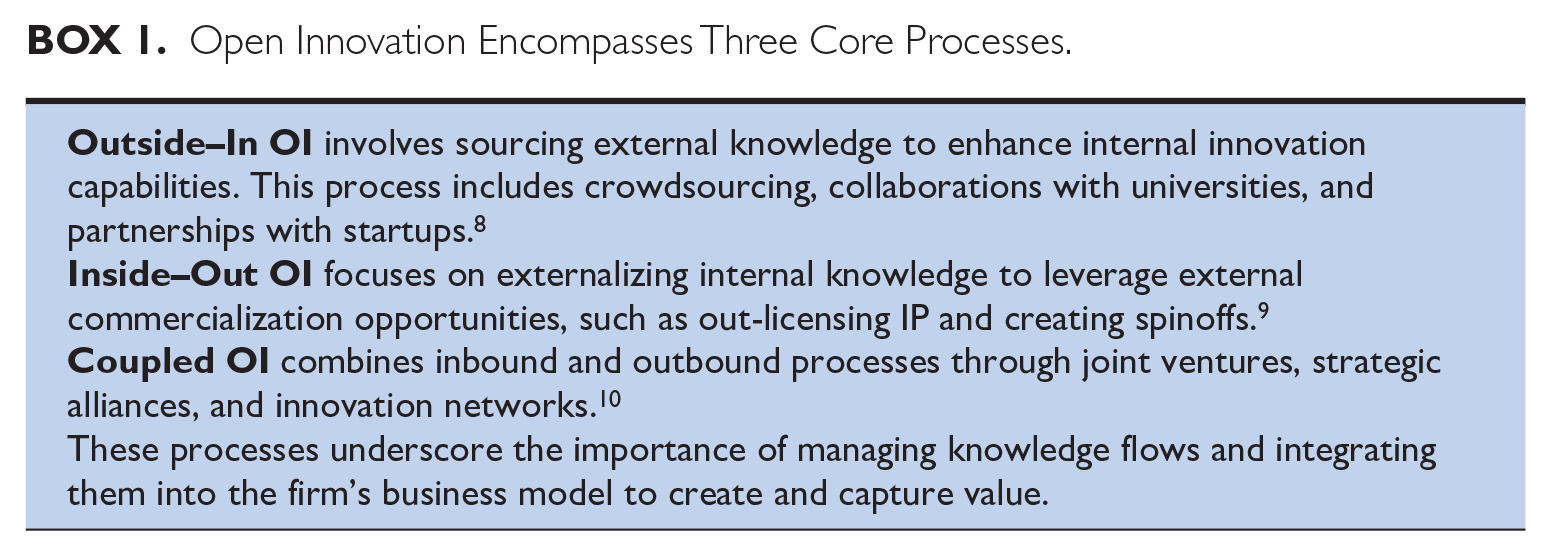
Chesbrough’s influential work made a shift in the thinking on innovation by emphasizing the strategic use of external and internal knowledge flows to enhance innovation processes. 5 Rather than considering an innovation model as fueled just by internal R&D, he viewed the OI funnel as porous, with information and knowledge flowing in and out of the organization. Early research on OI focused on defining the concept and demonstrating its utility across various industries, highlighting how companies could benefit from leveraging external sources of knowledge and commercializing internal ideas externally (see Box 1). 6 The breadth of this research now spans multiple domains and disciplines, reflecting OI’s wide applicability. 7
Open Innovation Encompasses Three Core Processes.
Laursen and Salter published one of the most influential articles on OI, studying its impact on innovation performance. 11 They demonstrate that firms benefit from a breadth of external knowledge sources, but there is a limit—when the costs of managing increasing external interactions start to outweigh the benefits. Similarly, Schäper et al. find an S-shaped relationship between OI and financial performance, such that while moderate levels of OI activities can significantly enhance performance, excessively high levels may lead to diminishing returns because of increased complexity and coordination costs. 12 This finding underscores the need for firms to balance their OI activities carefully to optimize benefits, 13 in some cases leading to the phasing out and closing of OI, which in itself has managerial challenges. 14
The research also reflects an increasing sophistication in understanding the different degrees, types, mechanisms, and contexts of OI. 15 In the context of outside–in OI, for example, research has identified several interdependent activities—including obtaining, integrating, and commercializing—and has found that absorptive capacity and organizational culture are critical for successful OI. 16 The use of digital tools and platforms can also promote OI, enabling more effective knowledge-sharing and collaboration across organizational boundaries. 17
In general, outside-in OI has been more studied and described than inside-out OI, but the latter has also attracted research attention. Chesbrough’s early work followed 35 research projects out of Xerox’s PARC facility and showed how the value of these projects greatly increased when they were able to find new business models to commercialize the technologies. 18 More recent work has studied technology spin-offs, technology out-licensing, and internal incubators to commercialize technologies outside of the current business. Governance issues have also been explored in greater detail. 19
Studies also show that OI’s impact is moderated by factors such as industry dynamics, firm size, and the specific innovation ecosystem. For instance, industries with rapid technological advancements and high competitive pressures are more likely to benefit from OI practices. 20 In addition, small and medium-size enterprises often face unique challenges and opportunities in implementing OI, necessitating tailored strategies to leverage external knowledge effectively. 21
Besides firm-level factors, research has increasingly considered both the human and the ecosystem levels of analysis to better elucidate OI’s full scope. 22 At the human level, the skills, motivation, and collaboration dynamics of individuals and teams engaged in OI activities are considered, with implications for the organization and culture-building with respect to OI. At the ecosystem level, an interplay between technological architectures and networks of diverse actors has been identified. Effectively managing those ecosystems requires a deep understanding of the interdependencies and value-cocreation mechanisms that drive collective innovation efforts, including technological design, governance structures, strategic alignment, and dynamic capabilities.
Beyond the academic studies, OI has had a profound influence on industry practice. Companies in various sectors have adopted OI principles to enhance innovation performance and competitive advantage. Early examples include Procter & Gamble’s Connect + Develop program and IBM’s InnovationJam. 23 Today, companies of all sizes and across the globe—including firms such as ASML, General Electric, Siemens, Samsung, and TSMC—have developed extensive networks for collaborative innovation, partnering with diverse stakeholders to drive technological advancements and market growth. There has also been a rise in OI-focused platforms such as InnoCentive and Kaggle, supporting the OI processes of other companies.
OI has undoubtedly had a tremendous impact on how technologies are developed and commercialized. However, with AI on the rise, innovation is changing, and open innovation is about to change with it.
How AI Changes OI
We know that the possibilities to effectively and efficiently collaborate in innovation are related to the characteristics of the technology being developed. 24 A high level of complementarity among different parts or components of a technology increases the need for coordination, pushing the innovation process toward integration. However, if the technology is modularized, with clear interfaces between different modules, the need for coordination is reduced, and multiple parties can more easily contribute to the innovation process. In other words, the characteristics of the technology that is being developed affect the level of integration required for development and commercialization. 25
The relationship goes both ways, however. Some technologies can be used to promote the innovation process itself, and they may shape opportunities to innovate with greater or lesser degrees of openness. For example, consider how information and communication technologies have contributed to global collaboration and have spurred innovation. 26
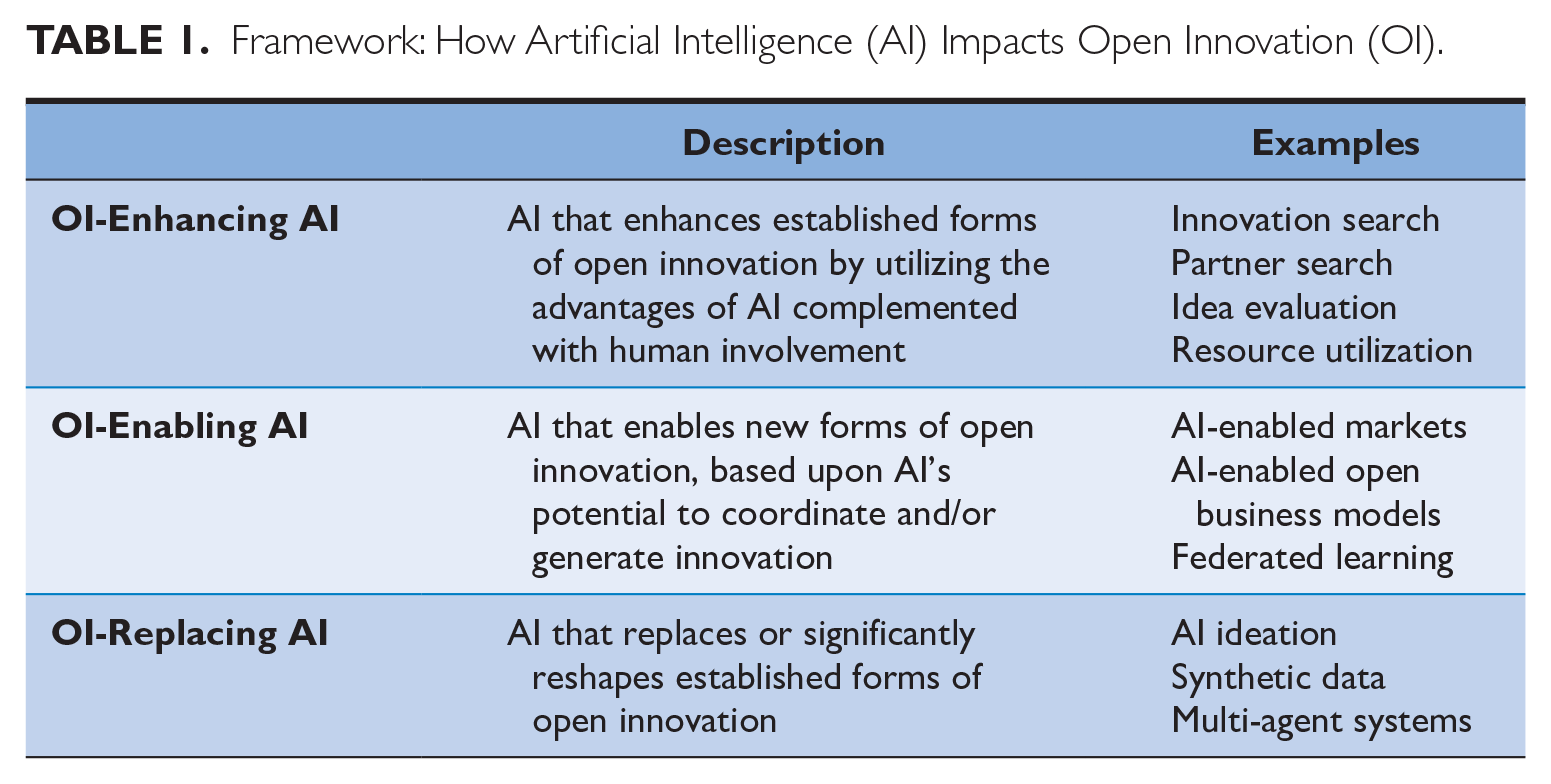
Just as communication technologies expanded the possibilities of collaborating with distant partners, AI now changes open innovation in several ways—by enhancing established OI practices, enabling new ones, and sometimes by replacing old OI practices (see Table 1). For example, AI can enhance the use of external sources of knowledge in the innovation process through natural language processing and sentiment analysis. 27 These techniques allow innovators to identify and access relevant knowledge much more rapidly. Once identified, AI-powered tools can simulate and evaluate the feasibility of new ideas quickly and accurately. With techniques such as predictive analytics and digital twins, AI can model various scenarios and predict the potential outcomes of different innovations. This capability allows organizations to test and refine many ideas—internal or external—in a virtual environment, reducing the need for costly evaluators, prototypes, and pilot projects.
Framework: How Artificial Intelligence (AI) Impacts Open Innovation (OI).
AI can also enhance inside-out OI processes. Most patents are neither utilized nor licensed, and many lapse before their legal expiration date. 28 AI processes can summarize patents in layman’s terms and also identify organizations likely to benefit from using that technology. Public research organizations and technology-transfer offices are two kinds of organizations that would improve the utilization of their technologies with AI.
But AI goes beyond merely boosting established OI practices. AI can also enable new forms of OI based on the technology’s potential to coordinate and/or generate innovation. Imagine a company’s AI agent coded to search for useful external technologies. Imagine a second company’s AI agent coded to respond to inquiries for access to its technologies. Then consider how these agents interact with each other in new types of AI-enabled markets and business models. The typical categories of OI therefore may need to expand to include new forms.
AI can also replace or significantly reshape established forms of OI, potentially leading to the phaseout of some OI types. 29 For example, AI can provide cost-effective and efficient ideation without relying on traditional methods that depend on human input, such as suggestion boxes, crowdsourcing, or partnerships with other organizations. The implication is that some modes of OI could disappear and be fully replaced by AI.
In summary, AI impacts open innovation by enhancing, enabling, or replacing some practices. We will now discuss these developments and how they relate to different forms of AI.
AI that Enhances Established OI Practices
Innovation search
Some AI can boost established practices in OI. One such practice is in the external search for new ideas and innovations, whereby AI can significantly expand the scale, reach, and precision with which ideas are identified. 30 AI can reveal unmet needs, pain points, and emerging preferences by analyzing customer reviews, social media interactions, and other textual data. These aspects of AI allow companies to develop ideas that directly align with consumer expectations. Unlike traditional suggestion boxes, which rely on voluntary input from customers or employees, AI can continuously and proactively gather insights from a broader audience, without additional effort.
For example, online communities can contain valuable ideas, which may be hidden in a vast amount of other information. Some online communities like Reddit are now licensing the data in their communities to train future AI models. 31 With properly trained AI, the ideas can be identified and extracted automatically. 32 Similarly, while patent analytics and intellectual property (IP) landscaping are well-established practices, with recent advancements in AI, such practices can provide much more valuable inputs to innovation processes in less time. For example, the IP analytics company Cipher, now acquired by LexisNexis, uses machine learning to provide analytics based on tens of millions of patents worldwide. Such analytics are useful for understanding competitors and bringing external knowledge into the internal innovation process. Yet another use-case of AI for searching and identifying ideas is in the sentiment analysis of customer feedback and reviews. AI lets companies analyze customer input more efficiently and effectively, feeding it into the innovation process. Instead of having customer feedback pile up with a limited impact on future products and services, companies can let customer data guide future developments.
Partner search
AI can also help to identify suitable partners for collaborating in innovation. The so-called Joy’s Law, attributed to Sun Microsystems co-founder Bill Joy, says that “no matter who you are, most of the smartest people work for someone else.” 33 Consequently, a critical firm-level innovation activity is identifying outside partners to access such talent and capabilities. Some companies—such as Sweden-based Monocl—have built businesses to support this activity by providing services for identifying worldwide talent and expertise that can support R&D processes. With developments in machine learning, the quality and reach of such services significantly improve. Another example is using existing scientific and patent records to see and explore the technological landscape. It is then possible to find previously unknown holders of knowledge that a firm can partner with, depending on the firm’s own capabilities.
Idea evaluation
Another established OI practice that AI can support is evaluating ideas. This practice, widely recognized in crowdsourcing, has the potential to evaluate ideas more broadly in an innovation funnel. 34 Crowdsourcing boosts internal innovation by involving many external contributors who solve problems or generate new ideas. 35 A key benefit is accessing experts from outside the company and from varied domains. 36 However, ideation often scales faster than the ability to evaluate the generated ideas. 37 The generation of ideas may be so extensive that expert evaluators become a bottleneck. AI can support this process by replacing and augmenting human evaluation. However, it is necessary to consider what AI does best and where humans are still preferable.
Recent research shows that AI is better at screening bad ideas than selecting the best ones. 38 Thus, AI can reduce the workload among expert evaluators by screening out a significant portion of the poor ideas, letting the human evaluators focus on finding optimal solutions among a smaller set of good ideas.
Another way to deal with the scarcity of expert evaluators is to distribute evaluations among external voters rather than using internal experts. A famous example is LEGO Ideas, which uses an external community to generate and filter ideas through voting. More specifically, crowdvoting can be supported by AI, but research shows that crowdvoters do not trust AI to do the job well. 39 Success cases and information about AI functionality seem to increase the adoption of AI among voters.
Moreover, AI can improve the efficiency of providing feedback to contributors, even when their ideas are not selected. Such feedback promotes healthy long-term relationships between companies and ideators. Without feedback, contributors whose ideas are not selected may react by opting out of future contributions, but with good feedback, such reactions are less likely. 40 Human experts’ time is scarce, so feedback cannot always be prioritized. However, boosting the feedback process with AI can significantly reduce the time expert evaluators need to provide feedback, thereby improving prospects for long-term success.
Resource utilization
Technology often drives greater specialization. And this specialization manifests with ever-more complex and expensive equipment to perform certain tasks. The rising cost of such equipment makes it too expensive for many organizations to own and operate them themselves. AI would enable the organizations that do possess such equipment to offer easy access to that equipment as a service. The National Molecular Foundry at Lawrence Berkeley National Labs and the semiconductor lab equipment at KL Leuven are two examples of organizations that facilitate access by industry to their highly specialized equipment and associated services. With AI, it would be far easier for companies to access these facilities, and also easier for the labs to reach out to prospective users of their equipment. In addition, the highly specialized equipment needed for some forms of AI also pushes organizations to use open innovation in the form of shared computing power for R&D purposes, such as in the case of quantum computers.
AI that Enables New Forms of OI
New markets
AI can also enable new markets where creators meet and match with users and customers, thus leading to new forms of open innovation. One such example is in the music industry, where AI has started to transform markets for music technology. For example, music creators seek expensive and rare guitar amplifiers to get the right guitar sounds for recordings and live performances on stage. Only a few guitar players are lucky enough to own such an amplifier, even fewer own a variation, and recording studios must prioritize the ownership of specific types of amplifiers because of financial and space constraints.
However, in recent years, AI technologies have started to change that dynamic. Companies like Italy-based IK Multimedia have developed AI that lets users “capture” digital versions of analog amplifiers. IK Multimedia’s TONEX platform uses neural networks to analyze and create virtual models of the sound of analog amplifiers, which can then be used in the company’s software or in small “stompboxes,” where multiple different amplifier models can be stored and used in the studio or on stage.
While digital processing has been around for a long time in the music industry, new AI technologies for creating virtual models have nevertheless revolutionized the equipment industry. AI has enabled a new market between creators of virtual guitar amplifiers and their users. The TONEX ecosystem (and other similar ecosystems) now connects thousands of owners of rare equipment, who capture the sounds of their amplifiers with TONEX AI and sell the digital clones on TONEX’s platform. Hence, owners of expensive equipment can capture value from it in new ways, and users have cheaper and easier access to the digital versions of the amplifiers they want.
New business models
AI can also create opportunities for new OI-based business models. Consider the case of the U.S.- and Sweden-based company RecordedFuture. The company analyzes internet and dark web information, using machine learning to identify trends and threats. The company’s offering includes providing customers with information about cybersecurity threats, supply chain disruptions, geopolitical trends, brand intelligence, and so on. This kind of activity that gathers, analyzes, and disseminates information from publicly available sources to provide valuable intelligence is sometimes called open-source intelligence, reflecting the openly available nature of the analyzed data. In this case, AI enables novel business models that are based on openly available knowledge resources and turned into proprietary intelligence. This phenomenon has been enabled by the rise of AI, and many similar examples are emerging.
Federated learning
Although emerging from different domains, OI and federated learning intersect through their commitment to decentralized knowledge and data-sharing. Federated learning is a machine-learning strategy whereby multiple entities collaboratively train a shared model while keeping their data localized and private. 41 Training occurs across numerous decentralized nodes, whereby only model updates are exchanged; therefore, data privacy is preserved and collaboration improves, partly mitigating the information paradox that historically has been a central challenge in OI. 42 Federated learning offers valuable lessons for OI, particularly utilizing decentralized collaboration while ensuring privacy and security. That approach allows collaboration across diverse data sources, letting organizations construct robust machine-learning models without revealing sensitive data. The practical implications are evident across various sectors. For instance, in healthcare, hospitals can employ federated learning to develop advanced diagnostic models without sharing patient data, aligning with OI by combining expertise from multiple institutions. In finance, banks can collaboratively develop fraud-detection models while maintaining customer privacy, leveraging federated learning within an OI framework. In IoT and smart cities, different organizations can work together to create smarter algorithms for urban management without pooling sensitive data.
AI that Replaces or Reshapes OI
AI ideation
In the past, ideas were tougher to generate, and organizations thought hard about how to use external ideas to fuel their innovation funnels. Today, AI sometimes replaces or reshapes OI by automating idea generation. Machine-learning algorithms can analyze vast amounts of data from various sources—including market trends, consumer behavior, and historical data—to identify emerging patterns and opportunities. AI can generate innovative ideas that align with market demands and future trends. This automated ideation process reduces the need for extensive brainstorming sessions and manual data analysis, saving time and resources. 43 Recent research suggests AI can generate ideas that are rated as more creative than those generated by “laypeople and creative professionals working under strong financial incentives.” 44 More findings on this topic will emerge in the next few years, but it’s now clear that AI can already do some ideation tasks. Therefore, humans’ role should be reconsidered, with a greater emphasis for people on implementing the ideas. 45 It’s also useful to rethink the sequencing of when and how humans should involve AI to get superior results. That may be more complicated than AI simply replacing OI, as AI can cause organizations to reshape how they work with externals. For instance, humans still have problems, feelings, and perceptions of reality that AI lacks. OI may then have to move from collecting ideas to collecting more unstructured information, or to designing ways for externals to improve their ideation (for instance, by helping them with toolkits for synthesizing large data troves).
Synthetic data
Synthetic data presents a compelling case for a shift from traditional OI practices to more secure, efficient, and scalable approaches that depend less on sharing proprietary information. Synthetic data, generated through algorithms and simulations, mimics real-world data without exposing sensitive information, thereby offering a novel alternative to OI.
One of the most pressing issues in OI is vulnerability to data breaches and intellectual property theft. Sharing data and collaborating can expose organizations to significant security risks. 46 Synthetic data offers a possible solution: it is a substitute that maintains the statistical properties of real data yet never reveals any actual information. As a result, companies can collaborate and innovate without fearing a compromise of their proprietary data. 47
In addition, synthetic data can overcome the limitations of data accessibility and availability. Obtaining high-quality data is often challenging and time-consuming. 48 Synthetic data can be generated on demand, tailored to specific research needs, and scaled infinitely. Those advantages ensure that innovators can access a continuous stream of relevant data without partnering with other entities. One example is healthcare, where patient data is highly sensitive and subject to strict regulations. OI in this sector often encounters significant barriers related to privacy concerns. By using synthetic data, healthcare companies can simulate patient records that reflect the diversity and complexity of real-world conditions without risking patient confidentiality, thereby enabling larger datasets to be used in faster and better development processes. 49
Synthetic data can also replace the need for OI in some traffic safety and autonomous vehicle development, which traditionally relies on extensive data from real-world driving scenarios. Traditional OI methods would involve sharing large datasets of driving behavior, road conditions, and traffic patterns, which can be cumbersome and raise privacy issues. Instead, automobile companies can now generate virtual environments that replicate real-world driving conditions with synthetic data. Those simulated datasets can be used to train and test autonomous driving algorithms, allowing for safer and more efficient development cycles. 50 For example, a company can create synthetic datasets to simulate rare but critical driving scenarios, such as sudden pedestrian crossings or complex traffic intersections, to enhance the safety features of its autonomous vehicles. Moreover, sensitive and private data from in-cabin monitoring can be replaced with synthetic data, such as the data generated by the startup company Devant. Synthetic in-cabin data can accelerate the innovation in safety technologies related to driver and passenger behavior—developments that could otherwise be inhibited by a lack of data that privacy concerns cause.
Multi-agent systems
Multi-agent systems, consisting of autonomous agents that interact and collaborate to solve complex problems, offer a novel approach that can replace traditional OI practices with more dynamic, efficient, and scalable methods.
One challenge with OI is in coordinating and managing diverse stakeholders. It requires effort to align various partners’ goals, resources, and timelines, leading to inefficiencies and conflicts. 51 Multi-agent systems are designed to operate autonomously and interact on the basis of predefined rules and protocols. No agent has the full global view, and the system is decentralized. That unique design ensures that each agent can contribute to the innovation process independently while maintaining coherence and alignment with the overall objectives, thereby addressing some of OI’s coordination challenges.
Multi-agent systems can handle complex, distributed tasks that require real-time decision making and adaptability. Integrating disparate ideas and technologies in traditional OI often involves significant delays and bottlenecks. However, multi-agent systems can dynamically adapt to changing conditions and continuously optimize strategies through interactions with other agents. The barrier to implementing this feature, through multiple autonomous chatbots, is now lower than ever. 52
In the logistics and supply chain industry, for example, OI often involves collaborations among manufacturers, suppliers, and distributors to enhance efficiency and reduce costs. Agents representing suppliers can autonomously negotiate prices and delivery schedules with manufacturers, while agents representing logistics providers optimize transportation routes in real time. Companies such as Amazon are already exploring multi-agent systems to enhance their supply chain operations, ensuring they can respond swiftly to fluctuations in demand and supply conditions.
Integrating open APIs (application programming interfaces) is crucial in connecting various AI agents within these systems. APIs enable seamless communication and data exchange among AI components, facilitating more efficient and effective interactions within the multi-agent ecosystem. APIs represent a multibillion-dollar market that grows rapidly every year. 53 Today, even teenagers build apps and services to develop valuable startups, piggybacking on existing APIs. 54 This could lead to “permission-less innovation,” enabling a surge of creativity for new products and services. 55
Concluding Discussion
We propose a framework for how AI changes OI through enhancing, enabling, and replacing. Drawing on recent developments in management and neighboring fields, the framework opens many questions for future research.
AI has already made great strides in generating better ideas than laypeople and experts. Ideas have never been more “dime a dozen.” 56 The enthusiasm for AI has swept over the innovation community, but there is concern about how the easy generation of content can create “botshit” that proliferates on social media. 57 Similarly, more general AI-generated content has its downsides, such as inattention. Simon’s observation that a wealth of information creates a poverty of attention has never rung truer, as people try to discern valuable content from mere noise. Another implication is deskilling. As AI takes over tasks traditionally done by humans, there is a risk that people may lose the pertinent skills as they come to depend on AI technologies, thereby reducing their capacity for critical thinking and problem-solving.
Ethical and IP questions about AI’s role loom. In December 2023, The New York Times sued OpenAI for copyright infringement, for using content without permission to train and recreate verbatim text phrases. OpenAI claims fair use, and that verbatim sentences are coincidental. In a similar fashion, artists are suing Midjourney and Stability AI, which create AI images and illustrations of incredible quality, 58 and the major record labels are suing AI music generators Udio and Suno for training their AIs on copyrighted music. 59 For traditional creators, those tools crowd out their work opportunities, but their past work is important in providing training data. Such lawsuits and others in this area will have wide implications for data use. There are also ethical questions about how customer data can be used. Consider the recent case of Adobe, wherein consumers interpreted changes to data policies as giving Adobe unconstrained access to customer data. This situation raised concerns about privacy and the potential misuse of consumers’ work, especially for confidential or proprietary information. After considerable backlash, Adobe took a clearer stance, saying that its policy would not involve local information. Many similar examples exist, as there is a tug-of-war between what data companies require to develop stronger models and the broader need for consumer protection.
Our framework provides a systematic way to think about how AI changes OI. On one hand, AI could mark the end of traditional OI models by streamlining and centralizing the innovation process, thereby reducing the need for human collaboration across organizations. Automated systems can independently generate, test, and refine ideas, which might sideline the collaborative ethos of OI. On the other hand, AI may provide new forms of OI by allowing new ways to connect people and organizations.
The future of innovation is likely in hybrid models that combine the strengths of AI-driven processes with human-led OI. Such models could leverage AI’s capacity for rapid ideation and data processing while harnessing human creativity, intuition, and ethical judgment. For example, AI could generate initial ideas or prototypes, which human collaborators then refine, contextualize, and ethically evaluate through OI platforms. An optimist would argue that this approach might further democratize innovation by allowing a wider range of participants to contribute meaningfully, even if they lack deep technical expertise. A pessimist might be concerned about centralized power, diminishing creativity, lack of agency, and IP issues. In the end, whether you’re an optimist or a pessimist, one thing is certain: the future of innovation will be dynamic, interactive, and unpredictable.
The remainder of this special issue shifts focus from AI to other timely and relevant topics in OI. Zobel and Falcke explore how new technologies enhance OI practices, particularly through digital features in corporate-startup collaborations where partner bonding is crucial. Randhawa, Vanhaverbeke, and Ritala address the legitimization of external technologies, demonstrating how “solution selling” and “issue selling” help organizations overcome adoption barriers in regulated industries like healthcare. Antoni, Dolmans, Giannopapa, and Reymen introduce the “Strategy Perimeter Framework” for the European Space Agency, tackling the challenge of managing stakeholder engagement in OI. Ho, Kazantsev, and Netland focus on the COVID-19 pandemic, identifying the “catalyst” role as vital for enabling multi-party OI. Dabrowska, Keränen, and Mention investigate internal organizational designs, highlighting how dedicated OI functions evolve alongside a firm’s OI capabilities. Harryson and Lorange examine OI extremes—from closed to open—using Tesla and Porsche as case studies, linking their OI strategies to firm-level strategy. Finally, Chesbrough reflects on 20 years of OI research and practice.
One observation Chesbrough makes in the concluding article ties back to the theme of this article: AI not only influences the future of OI, but OI is also crucial for advancing AI. This co-evolutionary relationship between AI and OI will be a central focus in both research and practice moving forward.
Footnotes
Acknowledgements
We wish to thank all authors who submitted articles to this special issue, out of which only a few could be selected for publication. We also thank all the reviewers, who provided excellent feedback that helped to improve each submission. We are also grateful to all the organizers of the World Open Innovation Conference, where some of the submitted articles were first presented and developed. Finally, we thank David Vogel, Kora Gonzales, Paul Lee, Gundars Strads, and the entire CMR office for their support with publishing this special issue.
Notes
Author Biographies
Marcus Holgersson is Professor of Industrial Management and Economics at Chalmers University of Technology (email:
Linus Dahlander is Professor of Strategy and Lufthansa Group Chair in Innovation, ESMT Berlin (email:
Henry Chesbrough is Adjunct Professor and Faculty Co-Director of the Garwood Center for Corporate Innovation at the Haas School of Business at the University of California, Berkeley. He is also Maire Tecnimont Professor of Open Innovation at Luiss Guido Carli University (email:
Marcel L. A. M. Bogers is Professor of Open and Collaborative Innovation at the Innovation, Technology Entrepreneurship and Marketing (ITEM) group at Eindhoven University of Technology. He is also Affiliated Professor of Innovation and Entrepreneurship at the University of Copenhagen and Garwood Research Fellow at the Haas School of Business at the University of California, Berkeley (email: