




Abstract
What drives the visibility of fake business news? We investigate this timely question by analyzing the framing and content of fake news targeting Fortune 500 companies. Our research reveals that fake business news employing episodic frames—characterized by highly dramatized and unambiguous information—gains more visibility than thematic frames, regardless of an organization’s reputation, its web or media visibility. Additionally, we find that fake news about corporate governance is particularly visible because it presents a detailed narrative about unmet organizational obligations, reducing the ambiguity of the message. In contrast, fake news about corporate social responsibility does not show this effect. These insights enrich existing literature by demonstrating that the visibility of fake news in social media depends not only on emotional dramatization but also on detailed portrayal. In the business context, fake news is an emotionally and cognitively driven phenomenon depending on stylistic and content frames to enhance its visibility.
Introduction
The increasing danger that fake news poses for businesses is well established (Binham, 2019; Booth et al., 2019; Roulet, 2020). According to Tandoc Jr. et al. (2018), the term “fake news” refers to news stories that appear to be true, but are false or misleading, mostly negative in nature, and tend to damage the interests of specific individuals or organizations. In the business domain, there have been numerous examples of incidents where fake news damaged the interests of firms. In May 2019, in the United Kingdom, Metro Bank used Twitter to counter false rumors that it was close to collapse. These rumors had been circulating on WhatsApp and Twitter and had caused the bank’s share price to drop by 11% (Binham, 2019). In another case, as Booth et al. (2019) report, a cosmetics company in the United States faced an onslaught of Twitter attacks falsely accusing it of testing its products on animals, resulting in a 20% drop in sales. Yet, although fake news stories about firms are notably impactful, there have been no research studies investigating which characteristics of such stories influence their visibility or shareability and therefore their impact (Tandoc Jr. et al., 2018).
Utilizing a framing perspective (Iyengar, 1994; Lee & Riffe, 2019; Price et al., 1997; Scheufele, 1999; Vliegenthart, 2012), we posit that framing of a fake news story determines its mode of presentation, thereby influencing its visibility. Iyengar (1994) distinguished between episodic and thematic framing, where an object is discussed in terms of specific, dramatized, and concrete instances (episodic) or in a broad (thematic) way. These are formal-stylistic frames in a story (Hänggli-Fricker, 2025) that detail how the story is presented. For example, inflation could be discussed in an episodic way through the case of a particular family’s struggles with rising food and rent prices or in a thematic way as a broader societal issue, including graphs and figures describing inflation. In the case of fake news, the false accusation that a major social media company such as Facebook/Meta was allowing the use of private photos without permission could be presented through a thematic frame by relating it to the general societal issue of privacy or through an episodic frame by providing a concrete portrayal of the impact of such a violation on a girl who attempted suicide after a photo of her naked was shared without permission. Prior research has used a framing perspective to evaluate how the business news coverage of an object differs across outlets (Lee & Riffe, 2019) and how a news story influences how readers think about particular issues (Scheufele, 1999). In this article, we investigate how framing influences the visibility of fake news about firms. We maintain that episodic frames will have a greater positive impact on the visibility of the fake news than will thematic frames. We expect this outcome because an episodic frame increases the concreteness of a story and therefore influences affectively how the public feels about a firm (Aarøe, 2011). It also lowers the ambiguity of the information conveyed, making it appear more truthful.
However, as Iyengar (1994) found, the influence of frames is not uniform across different issues, as these issues are convened via content that enhances certain framing mechanisms. Within the broader framing literature, this variance has to some extent been attributed to the emotional or cognitive resonance of issues (Giorgi, 2017). Topics of these issues convey content-related frames (Hänggli-Fricker, 2025), that detail what the story is about. Drawing on this literature, we maintain that certain topics have a greater level of emotional or cognitive resonance than others (Giorgi, 2017; McDonnell et al., 2017), thus increasing through framing the potential visibility of fake news on that topic. We expect topics such as corporate social responsibility (CSR) and corporate governance to have higher levels of emotional and cognitive resonance, respectively, to enhance the emotional or cognitive frames about the fake news, and thus to achieve higher visibility. We hypothesize that issues such as CSR that emotionally resonate with the firm’s audiences (Saxton et al., 2019) will achieve higher visibility and that the issue of corporate governance will do so because of its higher cognitive resonance (Giorgi, 2017).
Our contribution is threefold. First, we extend the existing body of literature on the visibility of firms in the news by honing in on the specific context of fake news. While previous studies on traditional news visibility have emphasized the significance of firm characteristics such as reputation, media presence, and web (algorithmic) visibility (Eisenegger & Imhof, 2008; Vogler & Eisenegger, 2021), our study suggests that these factors are less relevant for fake news than how the story is presented. Drawing on a body of literature including pivotal works by Iyengar (1994), Lee and Riffe (2019), Price et al. (1997), Scheufele (1999), and Vliegenthart (2012), Hänggli-Fricker (2025), we argue that the episodic frame of a fake news story significantly influences its visibility.
Second, we contribute to the nascent literature investigating the factors that influence the visibility of fake news, like topic valence or web visibility (Binham, 2019; Ferraro & Chipman, 2019; Tandoc Jr. et al., 2018). Our study shifts the focus from the political to the business sector. Also, our research uncovers the role of content-related frames, that is, topics such as CSR and corporate governance. Findings indicate that governance content-related frame significantly influences the visibility of fake news regardless of extreme valence and web visibility, as it lowers the deceptive and ambiguous nature of false information. Thus, our findings suggest that the visibility of fake news in the business realm, as opposed to the political sphere, relies not only on emotional dramatization but also on detailed portrayal.
Third, we contribute to a growing collection of studies that analyze which topics increase a firm’s visibility at the societal level (Dai et al., 2015; Dyck & Zingales, 2002; Eisenegger & Imhof, 2008; Lee & Riffe, 2019; Vogler & Eisenegger, 2021) and thereby indirectly contribute to the research investigating the impact of fake news on the social evaluation of firms in relation to their reputation, legitimacy, and trustworthiness (Barnett & Pollock, 2012; Bitektine, 2011; Pollock et al., 2019). The findings suggest that, within the context of fake news, a firm’s visibility tends to be more of a liability than an asset. Consequently, this visibility can potentially undermine the firm’s social evaluations.
The remainder of our article is structured as follows. In the next section, we briefly discuss framing theory (the episodic/thematic distinction) and the role of content. We then develop our hypotheses regarding the impact of episodic/thematic framing on the visibility of fake news stories and whether their CSR or governance content will intensify or weaken this impact. We test our hypotheses using a dataset that we developed on fake news about Fortune 500 firms between 2016 and 2022. After presenting and discussing our findings, we conclude by discussing their implications for further research and management practice, alongside the limitations of our work.
Literature Review
Fake News and Its Visibility
Fake news stories are produced by imitating news practices and are essentially “news stories that have [a] nonfactual basis but are presented as news” (Allcott & Gentzkow, 2017, p. 5), with the deliberate intention to “spread pseudo-journalistic false information” (Egelhofer & Lecheler, 2019, p. 97). 1 In the business domain, these stories tend not only to be misleading but generally negative in nature and aimed at damaging the interests of specific firms (Tandoc Jr. et al., 2018). Research suggests that not all fake news stories are equally effective in achieving visibility (Tandoc Jr. et al., 2018).
Although fake news stories imitate real ones, their visibility depends on different factors. The visibility of (real) news depends on the outlet’s prestige and size of readership, which assure publicity (Kiousis, 2004). According to Kiousis (2004), the visibility of a (real) news story additionally depends to some extent on the prominence that it receives in the news media (i.e., on which page it appears) and the valence of the news story (i.e., adopting a positive, negative or neutral tone), with negative news achieving higher visibility (Grabe & Kamhawi, 2006; Jonkman et al., 2020).
However, the visibility of fake news is mostly determined by the number of shares: “when a post is accompanied by many likes, shares, or comments, it is more likely to receive attention by others, and therefore more likely to be further liked, shared, or commented on” (Tandoc Jr. et al., 2018, p. 139). Such volume is achieved alongside the propagation of other related information on digital platforms using the measure of public salience, “which can be extended to behavioral variables (e.g., searches, page views, click-throughs, and re-tweets) in the web environment” (Ragas & Tran, 2013, p. 480). In the digital landscape, the shareability of fake news, as a dimension of public salience, indirectly depends on its prominence and valence, which are achieved differently than in the traditional news media landscape. Prominence in digital platforms is assured by algorithms that react to news stories that exaggerate events or include extreme views (Bazaco et al., 2019; Illia et al., 2022a; Zuboff, 2019). These algorithms often end up promoting fake news that can be quite extreme, as they are not limited by reality or reason (Clarke et al., 2020; Ferraro & Chipman, 2019). Prominence is also increased by the degree to which the user account publishing the fake news has both “quantity and proximity of connections in networks, unfolding in the potential to attract interaction mobilize audiences” (Dourado, 2023, p. 4). Valence is assured in digital settings by the lack of editorial rules. Given that today anybody can publish news online without editorial filters, extreme news can get published more easily and thus potentially have a greater impact. In the case of fake news, in which the portrayal of an object or issue is a false (but plausible) anecdote, the expression of valence can be very extreme (Guo & Vargo, 2020).
“Clickbait” describes strategies to lure users into clicking a link to a page to increase news visibility (Bazaco et al., 2019). This shareability of fake news depends directly on the degree to which the content imitates (real) newsworthy headlines and articles (Allcott & Gentzkow, 2017; Bourgonje et al., 2017; Egelhofer & Lecheler, 2019; Guo & Vargo, 2020) and stands out within an information-overloaded digital media landscape (see Egelhofer and Lecheler [2019] for details). The following content characteristics are crucial here: low facticity, journalistic format, the intention to deceive, and exaggeration. Low facticity refers to information that is “either wholly false or containing deliberately misleading elements incorporated within its content or context” (Bakir & McStay, 2018, p. 157), which allows the information to have a certain degree of connection to a real story despite its fabricated or false content. Journalistic format refers not only to traditional news media entries (e.g., news published online by The Wall Street Journal) but also to social media entries with some of the structural elements of a news story, such as a catchy headline or clickbait picture (Egelhofer & Lecheler, 2019). The intention to deceive refers to the frames used in a story that omit (or make salient) certain facts of the story. While framing of real news stories is limited to the facts of the story, in the case of fake news this is not so, as the “facts” are often manufactured to meet the needs of the frame and intention of the author, who intends to expose an object (e.g., a company) to undesired visibility (Dourado, 2023; Lappas et al., 2016). Frames can be constructed creatively to emphasize different aspects of real events beyond what would be considered reasonable, and even fabricate aspects of real events to make the article more attractive. Finally, exaggeration allows the author to catch users’ attention through sensationalism by using hyperbole, intense adjectives, superlatives, and neologisms (Bazaco et al., 2019).
Formal-Stylistic Frames: How a Story Is Presented
Framing has been studied in different disciplines. It originated in the political communications literature (Chong & Druckman, 2007), where frames are studied as “a central organizing idea or story line” (Gamson & Modigliani, 1989, p. 143), which enable “the selection, organization, and emphasis of certain aspects of reality, to the exclusion of others” (De Vreese et al., 2001, p. 108). Frames influence audiences’ understanding of a complex issue by simplifying and presenting only particular aspects of it. Framing has also been widely studied in the management literature (see Cornelissen & Werner, 2014 for a detailed review) to explore how corporations render events or occurrences meaningful (Fiss & Hirsch, 2005), present (or omit) certain product characteristics (Chang, 2008), articulate a specific vision (Fiss & Zajac, 2006) or justify, enhance or deny corporate actions (Coombs, 2022; Elsbach & Sutton, 1992; Vaara & Fritsch, 2022) to influence the interpretation of reality among key stakeholders. Framing has also been studied by management scholars to understand how stakeholders associate a company with a particular industry or strategic group (Deephouse & Carter, 2005), draw attention to a particular meaning to mobilize support (Benford & Snow, 2000; Snow et al., 2007), and build specific cognitive affective frames to influence the company’s reputation (Carroll & McCombs, 2003; Rindova et al., 2005).
Regardless of their different objectives and focus, framing involves the use of rhetorical devices such as metaphors, quotes, visual images, and caricatures (Nelson et al., 1997) to present particular information or aspects of the issue (or object), so that the audience will be predisposed in a specific way toward it (Iyengar, 1994; Zaller, 1992). According to De Vreese et al. (2001, p. 108), framing emphasizes certain aspects of reality, minimizing or excluding others so that the audience is influenced in a particular way. A frame not only renders information visible but also attributes meaning to it, since frames “define problems—determine what a causal agent is doing with what costs and benefits, usually measured in terms of common cultural values; diagnose causes—identify the forces creating the problem; make moral judgments—evaluate causal agents and their effects; and suggest remedies—offer and justify treatments for the problems and predict their likely effects” (Entman, 1993, p. 52).
Not all frames have the same level of impact (strength or resonance) on their audiences (Giorgi, 2017). Iyengar (1996) identified two kinds of frames, episodic and thematic, which have different levels of influence. These frames are considered formal-stylistic frames (Hänggli-Fricker, 2025), that shape how the story is presented. An article having a predominantly episodic frame discusses a topic (e.g., failures in a government social program) through concrete examples (e.g., within the story of state-funded home care; Iyengar, 1990). Such frames typically convey a dramatized portrayal of the problem (e.g., the elderly getting sick because of this lack) and a personification of it (e.g., elderly individuals affected). A story with a thematic frame deals with its subject in broad or abstract ways, presenting it (e.g., government social programs) through general facts (e.g., high-level statistics) that make salient the aspects that purport to be worthy of public attention. Prior research into the effect of episodic or thematic frames on their audiences has found that episodic frames are stronger than thematic ones in their influence on audiences (Aarøe, 2011; Druckman & McDermott, 2008; Gross, 2008; Iyengar, 1990). Episodic frames initiate in audiences a cognitive process of attribution of responsibility about the issue, inculcating a greater sense of duty to warn others (Iyengar, 1990, 1994). Researchers have also found that episodic frames elicit stronger emotional reactions (Aarøe, 2011; Druckman & McDermott, 2008; Gross, 2008).
Content-Related Frames: What a Story Is About
Iyengar (1994) found that the impact of frames varies across different issues, indicating that certain topics evoke greater emotional or cognitive responses than others (Giorgi, 2017; McDonnell et al., 2017). This variability suggests a strong interconnection between content and framing. Indeed, the substance of the story pertains to content-related frames (Hänggli-Fricker, 2025), which determine what the story is about. The latter makes salient the pertinent details about specific issues or generic aspects that are relevant across these issues. Although the news media tend to cove well-known firms (Graf-Vlachy et al., 2020), they generally focus on particular aspects such as senior managers and operations (Core et al., 2008; Eisenegger & Imhof, 2008; Westphal & Deephouse, 2011), corporate governance (Ang et al., 2021; Bednar, 2012; Dyck & Zingales, 2002), and CSR (Cahan et al., 2015; Du et al., 2010; Hawn, 2021; Lunenberg et al., 2016; Vogler & Eisenegger, 2021).
When the media cover business issues (Core et al., 2008; Eisenegger & Imhof, 2008; Illia et al., 2016; Westphal & Deephouse, 2011) such as products, services, performance, firm’s financial strength, leadership performance, and innovation (Graf-Vlachy et al., 2020), we do not expect such issues to resonate highly with audiences (Baron, 2004, Chapter 3). However, extant literature suggests that CSR and corporate governance have relatively high levels of resonance (Ang et al., 2021; Bednar, 2012; Capriotti, 2009; Core et al., 2008; Dyck & Zingales, 2002). CSR is an umbrella term that refers to a number of non-market firm activities broadly related to its environmental and social impact (Lee & Riffe, 2019; Vogler & Eisenegger, 2021), including rates of pollution, community relations, diversity practices, and citizenship. CSR attributes are evaluative in nature and can be used to make an audience morally evaluate a firm (Vu et al., 2020), sometimes independently of the tone in which they are discussed (Sheafer, 2007) and thus increase the news story’s visibility (Dyck & Zingales, 2002; Eisenegger & Imhof, 2008; Vogler & Eisenegger, 2021).
According to Windsor (2009), there are two competing perspectives on corporate governance. The first, drawing on agency theory and the separation of ownership and control (Berle et al., 1982), defines corporate governance rather narrowly as “the system by which companies are directed and controlled” (Cadbury, 1992, p. 15) for shareholder maximization. The second, broader, and more recent perspective on corporate governance is that it is “a set of stakeholder responsibility relationships in addition to the structure for ‘setting, achieving, and monitoring corporate objectives and performance’” (Mallin, 2011; Windsor, 2009, p. 307). In this article, we follow the second approach in our understanding of corporate governance items in news reports (Graf-Vlachy et al., 2020), such as board quality (Joe et al., 2009), board transparency (Graf-Vlachy et al., 2020), executive compensation (Core et al., 2008; Kang & Han Kim, 2017), and changes in governance (Bednar, 2012). These are covered more frequently than general business topics because they draw attention to whether the firm is governed to privilege a healthy business-society relationship for the common good of all societal stakeholders. Such issues have achieved a level of familiarity and cognitive resonance that influences audiences’ perception of a firm’s duties and obligations (Brewer & Gross, 2005; Stein et al., 2019). By discussing corporate governance issues and enhancing certain value-attributes about firm obligations and their accountability, the media can portray a firm in ways that resonate cognitively with their audiences (Carroll & McCombs, 2003; Giorgi, 2017).
Theoretical Development
The Impact of Formal-Stylistic Frames on the Visibility of Fake News
In line with the broader framing literature, we maintain that the type of formal-stylistic frames used will impact the visibility of fake business news. We argue that episodic frames will increase the visibility of fake business news more than thematic frames. There are two reasons why we expect this to be the case. First, according to Iyengar (1990, 1994), episodic frames have a positive influence on the attribution of responsibility to the actors in the story since they decrease the vagueness of the information conveyed. The more detailed the information, the less deceptive and ambiguous it is, and thus the more truthful the news seems (Egré & Icard, 2018; Grieve & Woodfield, 2023; Iyengar, 1990). For example, in the case of news about business fraud, an episodic frame, by conveying concrete examples of people involved and the drama of victims, decreases the vagueness of the article by attributing responsibility more directly to people within the organization and explaining more concretely the consequence of the firm’s misbehavior.
Second, episodic frames tend to be more emotional in their persuasive attempt (Aarøe, 2011; Gross, 2008) because concrete details that dramatize stories of individuals convey a persuasive moral and human portrayal of an object, issue, or event, enhancing emotional-affective response (Gross, 2008). This increases the probability of a fake news story being re-shared, since an effective portrayal of a new piece of information encourages people to start word-of-mouth communication sooner than later (Stieglitz & Dang-Xuan, 2013), and the spread of “fakeness depends a lot on whether the audience perceives the fake as real” (Tandoc Jr. et al., 2018, p. 148). We would expect fake news about business to have a similar effect. For example, false information about business fraud that provides details of managers being greedy and victims losing their life savings elicits an emotional response, making the news appear true, which in turn influences faster re-sharing. This enhanced emotional frame, in addition to our argument that episodic frames increase readers’ attribution of responsibility to the actors in the stories, should induce individuals exposed to episodic fake news about business to share these stories more frequently. Hypotheses 1 follows:
Hypothesis 1: Episodic frames will increase the visibility of fake business news more than thematic frames.
The Impact of Content-Related Frames on the Visibility of Fake News
Even if formal-stylistic frames are instrumental on their own in enhancing the visibility of an object, frames are also reflected in the choice of the topic narrating a specific issue (Hänggli-Fricker, 2025). Research conducted during the 2016 United States and 2017 French presidential elections (Audigane, 2018), and during the Brexit campaign in the United Kingdom in 2016 (Adams, 2018), confirm that content-related frames may matter for the visibility of fake news since not all topics of fake news have attained equal visibility in the political domain (Guo & Vargo, 2020; Vargo et al., 2018). We expect a similar finding in the business domain.
We maintain that fake business news discussing CSR will achieve higher levels of visibility than other topics for two reasons. First, media coverage of CSR has increased over time (Cahan et al., 2015; Hamilton, 2003; Lee & Riffe, 2019); if a fake news story about a firm addresses a topic that has increasingly been receiving more media attention, the fake story will also receive increased attention (Giorgi, 2017). Second, CSR topics such as environmental performance, diversity practices, and community relations tend to prompt both cognitive and emotional responses in individuals (Bundy & Pfarrer, 2015; Carroll & McCombs, 2003) to morally evaluate a firm (Vu et al., 2020). These responses and their associated moral evaluations enable the purveyors of fake news to frame stories in ways that engage more effectively in clickbait (Bazaco et al., 2019; i.e., exaggerate and deceive) and thus achieve greater visibility. Fake news about CSR can use lower levels of facticity (Bakir & McStay, 2018) because CSR topics can be framed in different ways, especially when one is willing to lie. Through emotionality, the writers increase the sensationalism of the frame (Bazaco et al., 2019), prompting extreme emotional reactions that lead to increased visibility through sharing. Compared to a general business topic, a highly emotional story further strengthens already highly emotional framing mechanisms (Aarøe, 2011). Hypothesis 2 follows:
Hypothesis 2: Fake business news discussing a CSR topic will achieve higher visibility than that discussing general business topics.
We also expect fake news on corporate governance to have higher levels of visibility than other topics. First, media coverage of corporate governance has become more prominent over the years (Cahan et al., 2015; Hamilton, 2003; Lee & Riffe, 2019) and, as above, one can expect fake news stories on a familiar topic to receive increased visibility (Giorgi, 2017). Second, as suggested by studies theorizing about media coverage of firms (Baron, 2004, Chapter 3; Capriotti, 2009), the media tend to cover news about governance topics (such as corruption, non-compliance, or non-transparency) extensively. Public opinion tends toward news documenting the set of strategic relationships and structures firms put (or fail to put) in place (Windsor, 2009) to reach their objectives in a responsible way without corrupt activity. This includes attempts to improve board quality (Joe et al., 2009) and transparency (Graf-Vlachy et al., 2020), policies on executive compensation (Core et al., 2008; Kang & Han Kim, 2017), and changes in governance (Bednar, 2012). Such details allow a news story to be framed as discussing the “state of mind” and intentionality of the organization (Godfrey et al., 2009; LaFave, 2000) regarding an object, issue, or event. For example, a story about a firm’s contribution to deforestation is primarily about governance when it describes the reward system (e.g., bonuses) incentivizing profit over the environment. Such governance content decreases the vagueness of the news about the role of the firm. Such cognitive (substantive) portrayal of a firm (Carroll & McCombs, 2003; Giorgi, 2017), compared to a general business topic, frames it in terms of obligations to be fulfilled (Brewer & Gross, 2005), decreasing ambiguity and strengthening a frame that also lowers such ambiguity. Since decreased ambiguity increases a story’s apparent truthfulness (Egré & Icard, 2018; Grieve & Woodfield, 2023), we expect news about governance topics to be shared more widely. Authors can frame corporate governance stories by invoking an organization’s lack of accountability toward its stakeholders (Mallin, 2011; Windsor, 2009, p. 307), enhancing cognitive resonance (Brewer & Gross, 2005), and increasing the visibility of the fake news.
Hypothesis 3 follows:
Hypothesis 3: Fake business news discussing a governance topic will achieve greater visibility than that discussing general business topics.
Methods
Database
We retrieved the Fortune 500 rankings for 2022, publicly available under subscription (https://fortune.com/ranking/fortune500), and used two lists of fact-checking websites (verified as of June 2022), to identify relevant fake news regarding these 500 companies. The first list was provided by the Research Centre at the City University of New York Graduate School of Journalism and comprised: Polifact, FactCheck.org, Washington Post Fact Checker, Snopes, Fact Check from Duke’s Reporter’s Lab, SciCheck, FlackCheck, Media Bias/Fact Check, NPR Fact Check, and Hoax Slayer. The second list was from Guo and Vargo (2020) study on fake news for the news media ecosystem: Checkyourfacts, Agence France-Presse, FactCheck.org, Fact Checker, Lead Stories, Media Bias/Fact Check, Our.News, Politifact, Snopes, and RealClearPolitics. From these two lists, we excluded sites inappropriate for our purposes because they were unclear as to whether the news was fake or true (e.g., FlackCheck, NPR FactCheck, and Snopes), the site was closed (e.g., Hoax Slayer), was a subsection of another fact-checking website (e.g., SciCheck is a subsection of FactCheck.org), focused on fact-checking of news about politics rather than business (e.g., Washington Post Fact Checker). We selected only sites that were high quality, in that they organized fake news on the basis of one or more of the following characteristics: a truth measure (information that is true, mostly false, or false), the classification of facts on the basis of reported evidence, and the source of the fake news (e.g., Facebook, Twitter, other channels), classification by topic. This resulted in six fact-checking websites that were used to build our database: Checkyourfacts, Politifact, FactCheck.org, Agence France-Presse Fact, Check from Duke Reporter’s Lab, and Media Bias/Fact Check.
We searched for fake news using the company name as the search term. No other parameters were used, as we wanted to include any year and any type of fake news about each company. We assigned each news story a unique numerical ID, source (website), company code (Fortune 500 ranking position), company name, year, month, channel (Facebook Twitter, news outlet, blog, or others), indicator of visibility of fake news (index of shares), title of fake news, text of fake news, image of the fake news (if available), and URL link.
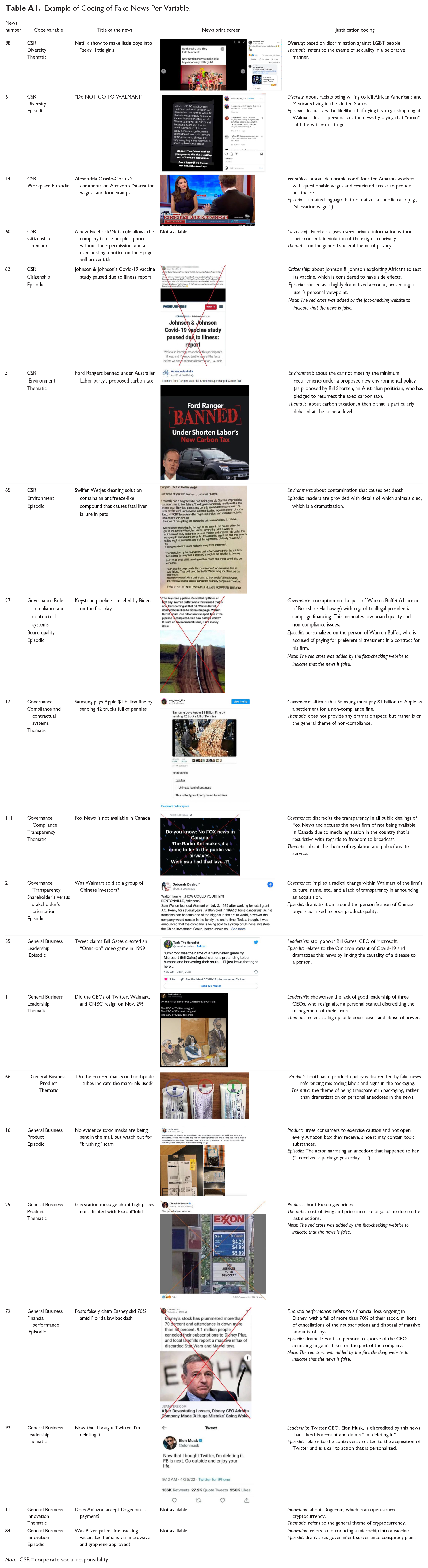
We collected 160 fake news stories targeting 56 companies from the Fortune 500 over a period of 12 years. As we had some missing values for the variables related to the visibility of fake news, we excluded from our dataset any fake news stories lacking this indicator, resulting in a final dataset of 119 fake news stories over a period of 6 years (2016–2022) concerning 55 of the Fortune 500 companies (see Table A1 for examples of the fake news stories included). This means that 11% of the companies in our dataset were a target of fake news in that period. This percentage is low, suggesting that the phenomenon of fake news is not so widespread in business as it is in political settings. However, this does not mean that fake news is not a threat to businesses, since a small number of very visible fake news stories can seriously damage a targeted firm (Guo & Vargo, 2020).
Variables
We extrapolated our variables from separate sources, to avoid multicollinearity. Our dependent variable was measured through an indicator available on fact-checking websites, where we could retrieve the shareability of each fake news story. All our independent and control variables were collected either by coding (based on a codebook; Neuendorf, 2017) or through other databases. In the first case, two coders worked independently to classify each fake news story. To ensure inter-coder reliability, we calculated both Krippendorff’s alpha (Krippendorff, 2013) and Scott’s pi (Craig, 1981) for all variables in the codebook. These tests yielded on average a .79 Krippendorff alpha and an average of .90 Scott’s pi, 2 indicating strong inter-coder reliability. For the remaining control variables, we drew on the Fortune 500 Most Admired Companies database (firm reputation), Factiva (media visibility), and Google Trends (firm web visibility).
Dependent Variable
Following Tandoc Jr. et al. (2018), we used the number of shares a fake news story received to develop our dependent variable, and to normalize it we used the natural logarithm (ln) of the number. The number of shares is counted up to the moment in which the fake news was published and signaled as fake by the fact-checking website.
Independent Variables—Episodic Versus Thematic Frames (Formal-Stylistic Frames)
Two coders analyzed each fake news story with the help of a codebook (Neuendorf, 2017). We followed the approach of Iyengar (1990) and classified the news stories as employing a predominantly episodic frame when a particular object was discussed in terms of specific, dramatized, and concrete instances (coded as 1) or a predominantly thematic frame when the particular object was discussed in a broad way (coded as 0). In other words, we used a categorical (dummy) variable to represent the episodic versus thematic frame in a news article. Examples of fake news coded for episodic and thematic frames are provided in Table A1.
Independent Variables—CSR or Governance (Content-Related Frames)
To test whether the content of different kinds of fake news stories influences their visibility, we coded the stories in relation to coverage of CSR topics (Vogler & Eisenegger, 2021) or governance topics (Dai et al., 2015), in two ways. First, we created two dummy variables in which the baseline of comparison is business topics. A story would be coded as 1 when discussing a CSR topic if it included one of the following attributes: diversity, environment community, or citizenship (coded as 1). Additionally, a story would be coded as 1 when discussing a governance topic if it included one of the following aspects: board quality, rule compliance and contractual systems, board transparency, compensation systems, changes in governance, or shareholder versus stakeholder orientation. All remaining fake news stories discussing any other business aspect were coded as 0, which constitutes the baseline zero code in both content variables. These business aspects include attributes of the firm’s functioning as a business, such as products, services, performance, financial strength, leadership, and innovation. We used these dummy variables in Model 3 to test Hypotheses 3 and 4, whether CSR or governance compared to other stories have a significant effect on visibility. To increase validity of our findings for Hypotheses 3 and 4, we also created one categorical variable with three categories (1 = business, 2 = CSR, and 3 = governance). We used this variable to re-test Hypotheses 3 and 4 in Model 4. However, this time we were testing CSR against business and governance against business.
Control Variables
We included two kinds of control variables in our analysis: firm-related control variables (firm reputation, firm media visibility, and firm web visibility) and fake news-related control variables (channel, valence).
Firm Reputation
The reputation of a firm may influence its visibility (Vogler & Eisenegger, 2021) and may mean it is punished more than others (Haleblian et al., 2017). Hence, reputation may also enhance the likelihood of the firm being targeted by fake news. Given this, we controlled for the firm’s reputation during the year of the publication of the fake news. We assigned to each firm a numerical value indicating its position in Fortune’s Most Admired Rankings database (from 1 to 500) for the year in which the fake news was published. For those firms that were not part of the first 500 most admired companies, we assigned a value of 501.
Firm Media Visibility
Based on data collected from Factiva (keyword: name of firm), we measured the firm’s media visibility by counting the number of times the firm’s name appeared in traditional news media articles during the year that the fake news story appeared. We investigated the largest US and UK newspapers, according to statista.com: New York Times, Washington Post, Chicago Tribune, Los Angeles Times, Wall Street Journal, Financial Times, New York Post, and USA Today.
Firm Web Visibility
Since shares of fake news may be influenced by the web visibility of the firm (Clarke et al., 2020; Ferraro & Chipman, 2019), we also controlled the web visibility of the firm in the year when the fake news story first appeared through the number of searches that the firm’s name had for the given year on the web. We used Google Trends for this.
The second kind of control variables, as mentioned above, is related to fake news: channel and valence.
Channel-Facebook: Fake news stories in our dataset were published on many channels such as Twitter, Instagram, TikTok, Weibo, YouTube, and Facebook. However, given that most of the stories were published on Facebook, and very few in other channels (distribution of fake news is not balanced across channels) we controlled through a dummy variable, “channel,” if the fake news story first appeared on Facebook (1 = yes) or another channel (0 = no).
Valence: This measures the tone (positive, negative, or neutral) of a news story (Kiousis, 2004) as extensive research has found tone related to visibility (Vogler & Eisenegger, 2021; Zyglidopoulos et al., 2012). We controlled for the valence of fake news through a dummy variable (1 = negative tone, 0 = neutral tone). Given that valence can take positive, negative, or neutral values, depending on the tone of the news story, we initially tried to classify our fake news into three groups. However, we failed to find any positive fake news stories within our sample and thus ended up with the above classification into negative and neutral. Hence, our variable represents the social media unpopularity of a firm (Deephouse, 2000) conveyed by fake business news. No predefined list of words was provided to coders. They qualified valence by reading the news stories, having been instructed to focus on coding the firm as the object of the valence and to identify negative versus neutral tone on the basis of the appearance (or not) of any adjectives or adverbs that qualified the firm. Furthermore, to ensure inter-coder reliability, we calculated both Krippendorff’s alpha (Krippendorff, 2013) and Scott’s pi (Craig, 1981). These tests gave the following results, Krippendorff’s alpha: .761 and Scott’s pi: .879.
Data Analysis
Given that our data points were news stories that were not independent of one another, as some dealt with the same company, we used bootstrapping Ordinary Least Squares (OLS) linear regression models with robust errors clustered at the firm level (MacKinnon, 2023). A simple regression model would not have allowed us to estimate efficiently the coefficients and their significance based on this group effect.
Table 1 details the descriptive statistics and the correlation matrix of variables in our regression model. We use the Spearman rank-order correlation since some of our variables are dichotomous. From our three main independent variables, only episodic (0.213, p < .001) and governance (0.211, p < .05) have a positive monotonic correlation with fake news visibility, whereas CSR does not (p < .098). Second, the firm’s reputation does not significantly correlate with the visibility of fake news (0.069, p > .05), implying that neither firms with good reputations nor firms with bad reputations tend to attract a higher level of fake news. Third, whether a fake news story appeared on Facebook correlates with the visibility of fake news (0.298, p < .001). Fourth, the two independent variables that significantly correlate with fake news visibility, that is, episodic frame and governance, have a positive relationship with other variables, suggesting that it may be worth exploring interaction effects. Episodic frame correlates with CSR (0.253, p < .001), governance (0.195, p < .05), and valence (0.346, p < .001). Meanwhile, governance shows a positive relationship with reputation (0.272, p < .001) and media visibility (0.214, p < .05).
Descriptive Statistics and Spearman Rank-Order Correlations.
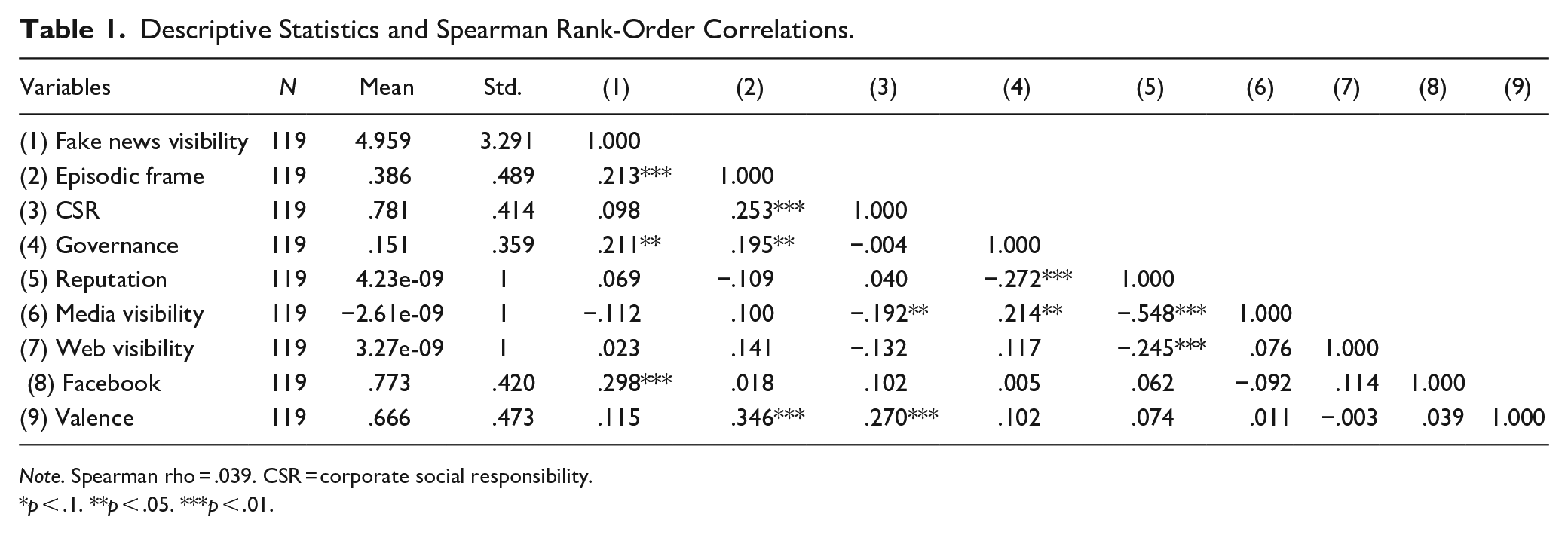
Note. Spearman rho = .039. CSR = corporate social responsibility.
p < .1. **p < .05. ***p < .01.
Results
Table 2 reports the results of the regression analyses. Model 1 is our base model, including the control variables, before testing our hypotheses. All control variables, except for Facebook and firm media visibility, were not significant. These results about controls indicate the following. First, the firm’s reputation (0.00, p > .05) is not significant, but the firm’s media visibility (−0.00, p < .05) is. Second, the web visibility of the firm (0.00, p > .05), which corresponds to the measure of prominence of an object in digital platforms, does not correlate with the visibility of fake news. This suggests that, compared to other objects, such as politicians, firms are not given enough visibility by social media algorithms to boost fake news stories about them further. Third, another variable that has been found to be relevant for the visibility of fake news in the political domain, valence (0.68, p > .05), is not important for firms, suggesting that fake news about firms is built in a different way than those of politicians facing an election. Fourth, Facebook was significant (2.43, p < .001) and kept its significance in all the subsequent models we tested. Even if social media channels cannot be compared to traditional media, these findings indicate that Facebook has emerged as influential in spreading business-related fake news.
The Impact of Framing and Content on Fake News Visibility.
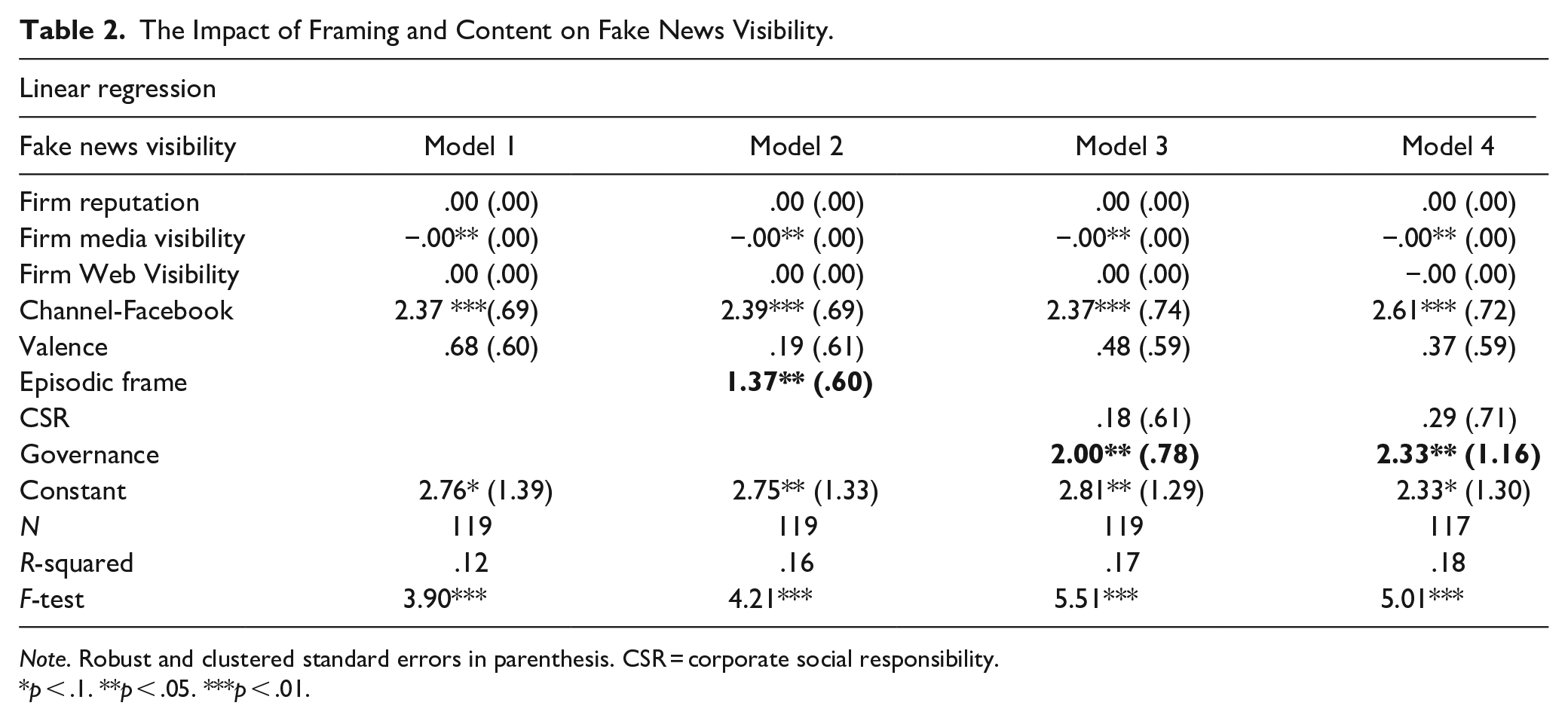
Note. Robust and clustered standard errors in parenthesis. CSR = corporate social responsibility.
p < .1. **p < .05. ***p < .01.
Model 2 tests the effect that the adoption of an episodic frame rather than a thematic frame has on the visibility of fake news. Hypothesis 1, predicting that the adoption of an episodic frame would have a positive effect on the visibility of fake news, is supported by our findings, as the relevant coefficient is positive and significant (1.37, p < .05), while all our controls, except for Facebook (2.39, p < .001), remain insignificant. These findings suggest that the dramatization and concrete anecdotes provided by episodic frames are a basic mechanism that powers the visibility of fake news concerning a firm, while the firm’s reputation (0.00, p > .05), media visibility (−0.00, p < 0.05), and web visibility (0.00, p > .05), along with fake news valence (0.19, p > .05), remain insignificant.
Model 3 tests the effect of the type of content—CSR or governance—on visibility using a dummy variable. Model 4, tests the effect of the type of content—CSR or governance against business news—using a categorical variable. Both models were tested to ensure that our findings do not depend on the way we operationalized the CSR and governance variables. Hypothesis 2, which suggests that fake news addressing a CSR topic will receive higher visibility, is not supported by our findings in either model (0.18, p > .05; .29, p > .05). Hypothesis 3, which suggests that fake news addressing a governance topic will receive greater visibility, was supported by our findings in both models (2.00, p < .05; 2.33, p < .05). Therefore, we feel quite confident that governance issues, rather than CSR issues, boost the visibility of fake news about a firm, and when this happens, the effect of dramatization through an episodic frame becomes less relevant. All controls, such as firm reputation, firm media visibility, firm web visibility, and fake news valence, remain insignificant, except for Facebook, which remained significant in all models (2.37, 2.39, 2.37, 2.61, p < .010).
We tested for multicollinearity for all these models and found that the maximum Variance Inflation Factor (VIF) across models was 1.83, while the average VIFs for the four models were 1.08, 1.13, 1.12, and 1.32, respectively. Therefore, we did not find a multicollinearity problem.
Additional Analysis
The correlations highlighted in Table 1 and our analysis above suggest that there could be potential interaction effects between our variables. First, we added the episodic variable to Models 3 and 4. When we added the episodic variable to Model 3, the coefficients and levels of significance changed as follows: episodic frame (1.81, p < .10), governance (2.22, p < .05), and CSR did not reach statistical significance, with an average VIF of 1.17 and a maximum of 1.26. For Model 4, the numbers were as follows: episodic frame (2.02, p < .05), governance (1.47, NS), and CSR, again non-significant. The average VIF for this model was 1.37, and the max was 1.95. The reduction in the significance of the governance variable when we include the episodic frame variable in Model 4 implies that there might be a significant interaction between the variable episodic frame and governance. We center the relevant variables before testing the interaction models (Aiken et al., 1991).
Table 3 reports the interaction effects of episodic frames with firm media visibility, Facebook, and content (CSR, Governance). Model 5 explores the interaction of media visibility with episodic frame and finds no significant interactions between these variables and the model has no multicollinearity issues (avg VIF = 1.42, max VIF = 2.23). Model 6 explores the interaction of Facebook and episodic frame and finds that while both retain their significance when the interaction term is added to the regression, the interaction term is not significant. Model 6 has no multicollinearity issues (avg VIF = 1.12, max VIF = 1.21). Model 7 investigates the interactions between episodic frame and CSR and governance, expanding from Model 3, where we capture CSR and governance through dummy variables. Model 7 finds no significant interaction between the episodic frame and the topic discussed in the stories (CSR, governance). No multicollinearity issues were found (avg VIF = 1.29, max VIF = 1.57).
Additional Analysis—Interaction Effects.
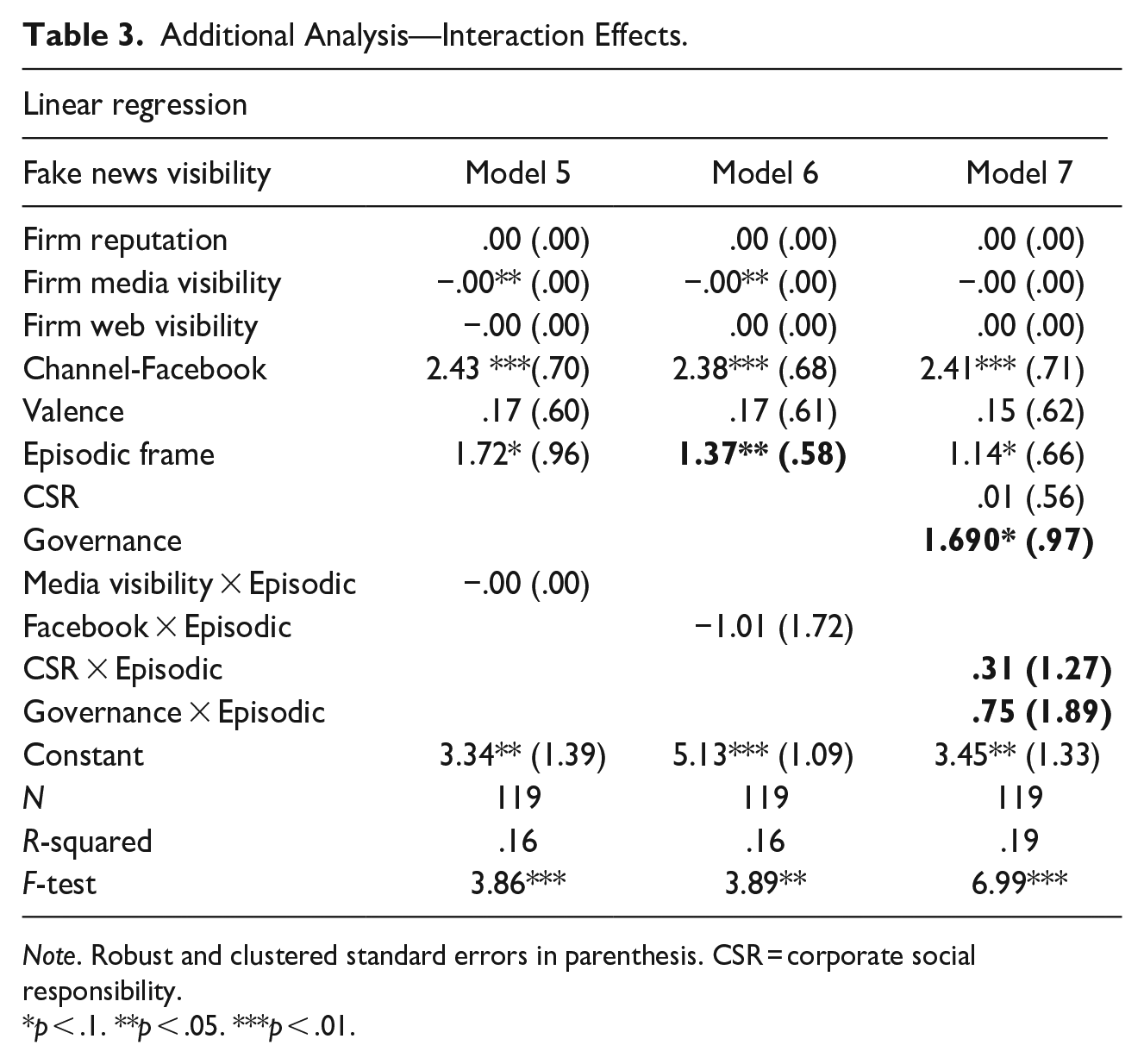
Note. Robust and clustered standard errors in parenthesis. CSR = corporate social responsibility.
p < .1. **p < .05. ***p < .01.
We tried to test for interaction effects expanding from Model 4, where we use a categorical variable to capture the news content but given that we could not center the categorical variable, the multicollinearity of the model was quite high (greater than 10, avg VIF = 5.03, max VIF = 18) so no usable results were found. For our purposes, then, we may conclude that we found no significant interaction effects.
Discussion
In this article, we explore the spread of fake news in the business domain by systematically analyzing the content of fake news targeting Fortune 500 firms. Our findings indicate that fake business news stories using episodic frames (rather than thematic frames) are significantly more visible. Furthermore, only fake news stories covering corporate governance (rather than purely business topics) have higher media visibility. Surprisingly, fake business news dealing with CSR topics did not achieve increased visibility. These findings make several contributions to the relevant literature investigating the impact and visibility of fake business news and its potential impact on social evaluations of the firm.
Theoretical Contributions
Formal-Stylistic Frames and the Visibility Fake Business News
Previous studies on the visibility of traditional news have highlighted the importance of firm characteristics like its media visibility and its online algorithmic visibility (Eisenegger & Imhof, 2008; Vogler & Eisenegger, 2021) but have not thoroughly explored whether these factors remain relevant in the context of fake news. Also, they have neglected to study how the news is portrayed while conveying fake news (Porshnev et al., 2021; Scheibenzuber et al., 2023). In our analysis, we find that an episodic frame, when included in fake news stories, significantly influenced their visibility, regardless of the firm’s media or web visibility. This suggests that the deceptive and manipulative aspects of fake business news are enhanced through concrete examples or anecdotes (Egré & Icard, 2018; Grieve & Woodfield, 2023), which create affective and dramatized portrayal (Gross, 2008).
These findings have significant implications from both a business and societal standpoint because they invite us to re-think the role of framing for firm’s visibility. Prior research has highlighted the positive role of episodic framing in enhancing the visibility of business news (Aarøe, 2011; Druckman & McDermott, 2008; Gross, 2008; Iyengar, 1990) across different media outlets (Lee & Riffe, 2019). However, these studies were conducted on articles published in the press. The press is known for its objectivity, fact-checking, and use of formal-stylistic frames within the limits of the facts of the story. However, as documented by our findings, most false stories circulate particularly on platforms like Facebook where false information can gain traction for businesses. In this context, formal-stylistic frames are used rather differently to meet the intention of the author who exposes an object such as a company to undesired visibility. Hence, we invite changing the way we think about the role of framing for business visibility since the frame can be construed more creatively than what theorized so far. Specifically, the power of episodic framing lies in enhancing both the emotional and rational appeal of new information, as it conveys a dramatized and emotional portrayal of the business along with concrete and detailed evidence. This power of episodic framing calls for further exploration, particularly within the realm of microblogging news where storytelling through concrete personal anecdotes is prevalent, and therefore is germane for such use of the frame. Understanding how these nuances shape the portrayal of businesses and influence the spread of information is crucial for businesses in navigating today’s complex digital media landscape.
Content-Related Frames and Fake News Visibility
Second, we contribute to the wider discussion about factors that make fake news visible. Extant research on fake news (Binham, 2019; Egelhofer & Lecheler, 2019; Guo & Vargo, 2020; Tandoc Jr. et al., 2018; Vargo et al., 2018) has widely analyzed other factors related to content, such as extreme valence in certain topics (Egelhofer & Lecheler, 2019; Guo & Vargo, 2020; Vargo et al., 2018) or web (algorithmic) visibility the object of the story (Clarke et al., 2020; Ferraro & Chipman, 2019). While these studies have primarily centered on the political landscape, where fake news gains traction during election cycles through algorithmic mechanisms sensible to the inclusion of specific topics during elections, our study has shifted the focus to the business realm. Contrary to expectations, our study reveals that a firm’s web visibility or a topic’s valence do not significantly influence the visibility of fake news in the business sector. This points to a notable distinction in how visibility of fake news about businesses is achieved compared to fake political news, as well as its apparently limited ability to exploit platform mechanisms, as businesses may not reach web visibility as politicians do during election periods.
On the other hand, we found that fake news stories with specific content-related frames make fake news about a business more visible. Corporate governance topics receive higher visibility compared to other content. This finding aligns with prior research emphasizing the increasing importance of corporate governance in media coverage (Cahan et al., 2015; Hamilton, 2003; Lee & Riffe, 2019) and in making a news story interesting enough to be covered in the traditional media landscape (Baron, 2004, Chapter 3; Capriotti, 2009). Surprisingly, we find that CSR, which might have been expected to receive greater levels of attention in microblogging channels such as Facebook, does not attract elevated visibility levels. This unexpected finding might imply that there is a certain level of cynicism associated with CSR topics (Illia et al., 2013) and that this cynicism extends into the fake news domain and thus CSR topics are not as relevant to the public as one might expect. Also, it may imply that CSR-based fake news underlies different emotional aspects than episodic-based fake news. Episodic emotionality (i.e., how the story is conveyed) is delivered by details that depict individual cases and discrete events that are tangible, whereas in CSR topics (i.e., what the story is about), the emotionality is intrinsic in the issue, and not paired with such concrete details.
From a business and society perspective, these findings shed light on the relationship between fake business news and the emotional versus cognitive resonance of content shared on microblogging channels. Surprisingly, it is not the moral and emotional topic of CSR that increases the visibility of fake news, but rather the use of precise and more detailed information about governing mechanisms at businesses. Governance details, such as board composition, transparency, and lack of compliance systems, can be used to make false stories look less deceptive and more truthful (Egré & Icard, 2018; Grieve & Woodfield, 2023) because they document the set of strategic relationships and structure (Windsor, 2009) that the firm has (failed to) put in place. These findings suggest that in the business domain, in contrast to the political one, the visibility of fake business news depends more on crafting factual content unlocking the framing mechanism of cognitive resonance, than emotional appeal conveyed via content-related frames. Further research in the realm of microblogging news, where emotions related to specific content and issues often play a significant role in the visibility of news, is necessary to fully understand this dynamic of fake business news. The latter seems to follow a rather less emotional dynamic than expected, at least as concerns what the story is about.
Firms’ Visibility, Fake News, and Social Evaluations
Third, our study adds to the literature examining the factors that enhance a firm’s visibility (Dai et al., 2015; Dyck & Zingales, 2002; Eisenegger & Imhof, 2008; Lee & Riffe, 2019; Vogler & Eisenegger, 2021). By doing so, it indirectly contributes to the broader research investigating how news coverage impacts the social evaluations of businesses in terms of their reputation, legitimacy, and trustworthiness (Barnett & Pollock, 2012; Bitektine, 2011; Pollock et al., 2019). Specifically, our contribution lies in highlighting that in the realm of fake news, visibility is not necessarily an asset for corporations but could be a liability that may threaten social evaluations. This invites scholars to study the relationship between visibility and social evaluations of businesses in a new way. In the past, visibility was considered a threat if linked to a negative portrayal of the business. However, in the context of fake news, even if they do not have an extremely negative valence, as was the case in our dataset, they can still achieve high visibility and potentially threaten the firm’s social evaluations via framing mechanisms. Future research could further analyze how visibility strengthens negative social evaluation of a firm, regardless of the negative valence in the content, because of the degree to which the content is deceptive or the style of the news is episodic.
Moreover, our contribution is emphasized by highlighting that a (pre-) existing social evaluation, such as a firm’s reputation, does not necessarily increase a company’s likelihood of being targeted with fake news. This suggests that within the context of fake news, social evaluations assume a distinct role compared to traditional media, where companies with high reputations typically garner more visibility (Eisenegger & Imhof, 2008; Vogler & Eisenegger, 2021).
A promising avenue for future research in the field of fake news and social evaluation appears to be centered on how a firm’s visibility is influenced by stories that provide specific and real examples, as opposed to solely dramatized accounts. This approach potentially mitigates deception and ambiguity in false information, as in the case of governance topic which provides clear attribution of responsibility to the company. Drawing on recent frameworks categorizing social evaluations based on their moral, emotional, and rational dimensions (Pollock et al., 2019), our study indirectly implies that social evaluations that are potentially most susceptible to the influence of fake news are those with a high affective component related to dramatization, such as celebrity, as well as those with a strong rational cognitive component, such as reputation and status. From a business and societal standpoint, these observations indicate that even if in principle fake news can potentially affect all social evaluations, some may be more affected by it. Although these insights are implied by our findings, further research is essential to empirically test these effects.
Managerial Implications
Our findings also point to specific actions that managers could take to protect their firms from fake news. First, managers should take very seriously fake news stories about them; yet not all fake news stories are equal in the harm they can cause. Particularly, stories presented in episodic frames and/or dealing with corporate governance topics tend to attain increased visibility, and thus have the potential to cause more harm. In other words, managers should pay attention to the way the story is told via drama and details, not only on what topic it is about; also they should be particularly careful if the topic is about governance.
Second, our work suggests a two-tier response to fake business news might be in order. Managers should take this very seriously and respond immediately to the fake news stories that are more likely to become more visible. They should not leave such stories unanswered or unrefuted, hoping that sooner or later these rumors will go away. Given the increased visibility potential of these fake news stories, managers should act as early as possible to “kill” them and set the record straight. However, other fake news stories that do not seem to receive high levels of visibility could be treated with silence. Given the fact that there are always limited resources in a firm’s arsenal and that a firm does not want to be seen to overreact every time someone says something fake about it, this two-tier strategy implied by our findings could provide managers with a way to prioritize the use of their resources in fighting the fake news about their firm.
Limitations
The current study is subject to limitations, as sample size and operational choices might have limited the scope of the findings. The study is based on a sample of fake news derived from six fact-checking websites targeting 55 companies over a period of 6 years from the Fortune 500 index. Although we drew evidence from multiple sources, utilizing available online tools, we acknowledge that as our findings are confined to the Fortune 500 index, they cannot necessarily be generalized to other populations of business organizations. Because the Fortune 500 index lists large corporations that draw global attention, one might argue that those firms are targeted particularly often through the production and dissemination of content that aims to harm their reputation. Framing patterns in other business indices might operate with different effects. Therefore, our findings should be revisited in future research projects to assess the reliability of our analysis while investigating the role of framing mechanisms in other business domains.
The study design focuses on the framing devices drawn from two primary streams of evidence: media studies and business. Our primary emphasis was on episodic frames (vs. thematic) combined with governance and CSR topics (vs. ordinary business topics) that constitute a significant starting point in investigating fake business news. Although this was a logical first step, there might be alternative matrices of framing devices or news attributes that particularly pertain to the business sphere. Future investigations should consider these theoretical concerns while expanding our understanding of the possible operationalizations of fake news.
Finally, another limitation of our work is that it deals with the media visibility of fake business news stories and does not investigate the potential further impact that the visibility of fake news has on the various social evaluations of the firm, such as reputation, legitimacy, and trustworthiness (Barnett & Pollock, 2012; Bitektine, 2011; Pollock et al., 2019). Our work is limited to fake news visibility, but further research should expand on this to investigate the potential impact of fake business news on a firm’s social evaluations. Our study provides the basis on which firms can discuss which characteristics of fake news stories are more likely to cause readers to wrongly attribute responsibility to them for a (falsely) reported event. Based on our findings on governance topics, further research could and should evaluate more precisely the long-term impact that fake news can have on firms when these include governance topics—or any other topic—since coverage of these topics naturally tends to lower the apparent ambiguity of the story and makes it more believable. Such research could contribute to business and society studies, by highlighting whether fake news stories circulate in digital collectives and discussing the intentionality of firms accused of particular misconduct (Illia et al., 2022b). Also, such research could investigate which social evaluations (i.e., reputation, legitimacy, status) may constitute a “buffer” for the spread and damage that fake news can have on firms.
An issue that is beyond the scope of our article is whether more visible firms become targets of fake news stories more often than less visible firms. Our finding that the traditional media visibility of the firm (although interestingly not its web visibility) was significantly correlated with fake news visibility and the established thesis that more visible firms are attacked by social movements and NGOs (Eesley et al., 2016; Pacheco & Dean, 2015) imply that the more visible firms are more often attacked through fake news. Future research should investigate how much the risk of being attacked by fake news increases with increased visibility.
Conclusion
Even if the phenomenon of fake business news does not seem to be widespread, it may still be dangerous for firms. Current detection systems for fake news focus on identifying information that is extremely negative, sensationalist, and boosted by the algorithmic visibility of the firm. Yet our study indicates that in the business domain, these features are not the main driver for the spread of fake news, as all fake news stories about business have these characteristics no matter how visible the stories may become. The drivers are an episodic frame and the topic of governance, influencing what audiences perceive about the intentionality of a firm and how they feel about it. Future research could explore new opportunities for theory building by expanding the framing literature in the business domain, studying more effective fake news detection systems for firms, and exploring how firms are affected by the rapid proliferation of fake news. The first may lead to new framing matrices with specified applications in the business sector. The second may lead to the definition of effective detection systems, while the third may lead to identifying fake news attributes that present new types of threats to corporate reputations.
Footnotes
Appendix
Example of Coding of Fake News Per Variable.
| News number | Code variable | Title of the news | News print screen | Justification coding |
|---|---|---|---|---|
| 98 | CSR Diversity Thematic |
Netflix show to make little boys into “sexy” little girls | Diversity: based on discrimination against LGBT people. Thematic: refers to the theme of sexuality in a pejorative manner. |
|
| 6 | CSR Diversity Episodic |
“Do NOT GO TO WALMART” | Diversity: about racists being willing to kill African Americans and Mexicans living in the United States. Episodic: dramatizes the likelihood of dying if you go shopping at Walmart. It also personalizes the news by saying that “mom” told the writer not to go. |
|
| 14 | CSR Workplace Episodic |
Alexandria Ocasio-Cortez’s comments on Amazon’s “starvation wages” and food stamps | Workplace: about deplorable conditions for Amazon workers with questionable wages and restricted access to proper healthcare. Episodic: contains language that dramatizes a specific case (e.g., “starvation wages”). |
|
| 60 | CSR Citizenship Thematic |
A new Facebook/Meta rule allows the company to use people’s photos without their permission, and a user posting a notice on their page will prevent this | Not available | Citizenship: Facebook uses users’ private information without their consent, in violation of their right to privacy. Thematic: on the general societal theme of privacy. |
| 62 | CSR Citizenship Episodic |
Johnson & Johnson’s Covid-19 vaccine study paused due to illness report | Citizenship: about Johnson & Johnson exploiting Africans to test its vaccine, which is considered to have side effects. Episodic: shared as a highly dramatized account, presenting a user’s personal viewpoint. Note: The red cross was added by the fact-checking website to indicate that the news is false. |
|
| 51 | CSR Environment Thematic |
Ford Rangers banned under Australian Labor party’s proposed carbon tax | Environment: about the car not meeting the minimum requirements under a proposed new environmental policy (as proposed by Bill Shorten, an Australian politician, who has pledged to resurrect the axed carbon tax). Thematic: about carbon taxation, a theme that is particularly debated at the societal level. |
|
| 65 | CSR Environment Episodic |
Swiffer WetJet cleaning solution contains an antifreeze-like compound that causes fatal liver failure in pets | Environment: about contamination that causes pet death. Episodic: readers are provided with details of which animals died, which is a dramatization. |
|
| 27 | Governance Rule compliance and contractual systems Board quality Episodic |
Keystone pipeline canceled by Biden on the first day | Governance: corruption on the part of Warren Buffet (chairman of Berkshire Hathaway) with regard to illegal presidential campaign financing. This insinuates low board quality and non-compliance issues. Episodic: personalized on the person of Warren Buffet, who is accused of paying for preferential treatment in a contract for his firm. Note: The red cross was added by the fact-checking website to indicate that the news is false. |
|
| 17 | Governance Compliance and contractual systems Thematic |
Samsung pays Apple $1 billion fine by sending 42 trucks full of pennies | Governance: affirms that Samsung must pay $1 billion to Apple as a settlement for a non-compliance fine. Thematic: does not provide any dramatic aspect, but rather is on the general theme of non-compliance. |
|
| 111 | Governance Compliance Transparency Thematic |
Fox News is not available in Canada | Governance: discredits the transparency in all public dealings of Fox News and accuses the news firm of not being available in Canada due to media legislation in the country that is restrictive with regards to freedom to broadcast. Thematic: about the theme of regulation and public/private service. |
|
| 2 | Governance Transparency Shareholder’s versus stakeholder’s orientation Episodic |
Was Walmart sold to a group of Chinese investors? | Governance: implies a radical change within Walmart of the firm’s culture, name, etc., and a lack of transparency in announcing an acquisition. Episodic: dramatization around the personification of Chinese buyers as linked to poor product quality. |
|
| 35 | General Business Leadership Episodic |
Tweet claims Bill Gates created an “Omicron” video game in 1999 | Leadership: story about Bill Gates, CEO of Microsoft. Episodic: relates to the Omicron variant of Covid-19 and dramatizes this news by linking the causality of a disease to a person. |
|
| 1 | General Business Leadership Thematic |
Did the CEOs of Twitter, Walmart, and CNBC resign on Nov. 29? | Leadership: showcases the lack of good leadership of three CEOs, who resign after a personal scandal discrediting the management of their firms. Thematic: refers to high-profile court cases and abuse of power. |
|
| 66 | General Business Product Thematic |
Do the colored marks on toothpaste tubes indicate the materials used? | Product: Toothpaste product quality is discredited by fake news referencing misleading labels and signs in the packaging. Thematic: the theme of being transparent in packaging, rather than dramatization or personal anecdotes in the news. |
|
| 16 | General Business Product Episodic |
No evidence toxic masks are being sent in the mail, but watch out for “brushing” scam | Product: urges consumers to exercise caution and not open every Amazon box they receive, since it may contain toxic substances. Episodic: The actor narrating an anecdote that happened to her (“I received a package yesterday. . .”). |
|
| 29 | General Business Product Thematic |
Gas station message about high prices not affiliated with ExxonMobil | Product: about Exxon gas prices. Thematic: cost of living and price increase of gasoline due to the last elections. Note: The red cross was added by the fact-checking website to indicate that the news is false. |
|
| 72 | General Business Financial performance Episodic |
Posts falsely claim Disney slid 70% amid Florida law backlash | Financial performance: refers to a financial loss ongoing in Disney, with a fall of more than 70% of their stock, millions of cancellations of their subscriptions and disposal of massive amounts of toys. Episodic: dramatizes a fake personal response of the CEO, admitting huge mistakes on the part of the company. Note: The red cross was added by the fact-checking website to indicate that the news is false. |
|
| 93 | General Business Leadership Thematic |
Now that I bought Twitter, I’m deleting it | Leadership: Twitter CEO, Elon Musk, is discredited by this news that fakes his account and claims “I’m deleting it.” Episodic: relates to the controversy related to the acquisition of Twitter and is a call to action that is personalized. |
|
| 11 | General Business Innovation Thematic |
Does Amazon accept Dogecoin as payment? | Not available | Innovation: about Dogecoin, which is an open-source cryptocurrency. Thematic: refers to the general theme of cryptocurrency. |
| 84 | General Business Innovation Episodic |
Was Pfizer patent for tracking vaccinated humans via microwave and graphene approved? | Not available | Innovation: refers to introducing a microchip into a vaccine. Episodic: dramatizes government surveillance conspiracy plans. |
Note. CSR = corporate social responsibility.
Acknowledgements
The authors would like to thank Giorgo Papagianaki, Pavlo Symeou, Regula Hänggli, our journal editor, and three anonymous reviewers, for their valuable feedback. We would also like to thank Katie Jones for proofreading and copyediting our article and Oumaima Rehane for help with the data collection.
Declaration of Conflicting Interests
The author(s) declared no potential conflicts of interest with respect to the research, authorship, and/or publication of this article.
Funding
The author(s) received no financial support for the research, authorship, and/or publication of this article.
