




Abstract
The volume of fake news in the digital media landscape is increasing, creating a new threat to organizations’ reputations. At the same time, individuals are more aware of the existence of fake news. It thus remains unclear how fake news affects evaluators’ reputation judgments. In this article, we draw on the distinction between first-order judgments (i.e., an individual evaluator’s reputation judgment) and second-order judgments (i.e., an individual evaluator’s belief about the reputation judgments of other evaluators). We integrate this distinction with insights from communication research and social psychology to theorize how fake news affects reputation judgments and behavioral intentions. Through three experimental studies, we show that the negative effect of fake news is larger for second-order reputation judgments and that this effect is greater for organizations with a positive reputation. Furthermore, our results indicate that although fake news has a smaller effect on first-order judgments, the latter adapt to second-order judgments and thereby affect behavioral intentions. This article contributes, first, to the micro-cognitive perspective on reputation formation by taking the first step in developing a comprehensive understanding of the intricate impact of fake news on reputation and behavioral intentions. Second, this article contributes to our understanding of the role of a good prior reputation as a buffer or a burden.
In May 2019, customers of Metro Bank in London demanded to withdraw their assets after misinformation spread via WhatsApp claimed that the bank was about to collapse (Edwards, 2019). In November 2022, a tweet from a fake Twitter account purporting to represent the pharmaceutical company Eli Lilly declared that the firm was going to make insulin free. Despite the message’s low credibility and the drugmaker’s otherwise strong reputation, the firm’s market valuation dropped by several billion dollars ( B.Lee, 2022). Not surprisingly, institutional actors and regulatory bodies such as the European Banking Authority (Jones, 2022) have devoted considerable time and resources to fighting so-called fake news (Kuchler, 2017), which is thought to cause irreversible damage to organizational reputations (Atkinson, 2019). However, despite the growing awareness about fake news, examples such as those above show that fake news continues to have a negative impact on individuals’ judgments of, and subsequent behavior toward, organizations, even when organizations have a good prior reputation.
The term “fake news” has permeated academic and public discourse in recent years (B.Kim et al., 2021). It describes a type of news that is “fabricated (but presented as if from legitimate sources) and promoted on social media to deceive the public for ideological and/or financial gain” (Pennycook et al., 2018, p. 1). In turn, organizational reputation is an overall favorable or unfavorable judgment about an organization that evaluators form based on information about the organization’s capability and/or character (Fombrun, 1996; Lange et al., 2011; Mishina et al., 2012; Ravasi et al., 2018). By influencing supportive or unsupportive behavior, organizational reputation is seen as an informal regulative mechanism through which organizations are held accountable (Logsdon & Wood, 2002). Indeed, studies have shown how “doing well” through “doing good” depends on “looking good”—and vice versa (Chun et al., 2019). The rise of fake news poses a risk of distorting this important mechanism by potentially rendering inaccurate the publicly available information on which evaluators base their reputation judgments.
Despite its importance, the question of how individual evaluators process and interpret potentially inaccurate information from a questionable source and how this affects their reputation judgments remains largely unexplored. To date, research on reputation formation has focused on how individuals form judgments based on information that originates from established and credible external sources, such as traditional news media (e.g., Deephouse, 2000; Graf-Vlachy et al., 2020; Rindova et al., 2007) and reputation rankings (e.g., Rindova et al., 2018). Conceptual approaches based on the micro-cognitive perspective on reputation formation explain how individuals process information from such established sources and form reputation judgments depending on the criteria and relevance they assign to that information (e.g., Barnett, 2014; Bitektine, 2011; Haleblian et al., 2017; Mishina et al., 2012; Ravasi et al., 2018).
However, the theoretical models from the micro-cognitive perspective tell us little about the impact of fake news on individuals’ reputation judgments and subsequent behavior. While the literature on social approval (Bundy & Pfarrer, 2015) has theorized how social media can influence judgments about organizations based on the strong feelings and intuitions that information from social media sources evokes (Wang et al., 2021), 1 less is known about how such information can affect reputation judgments. Moreover, the role of pre-existing reputation judgments in the specific context of fake news is not well understood. Reputation research has highlighted that a good prior reputation can act as either a buffer or a burden in the case of negative events (e.g., Baer et al., 2018; McDonnell & King, 2018; Zavyalova et al., 2016). Thus, the question remains whether a good reputation buffers an organization from the potentially negative effects of fake news or, conversely, whether it constitutes a liability. Accordingly, we ask: How does fake news about an organization affect individuals’ reputation judgments and behavioral intentions? And how does an organization’s prior reputation moderate these effects?
To address these questions, we draw on the distinction between first-order and second-order judgments (Bitektine et al., 2020; Haack & Sieweke, 2020), which distinguishes between the judgment an individual evaluator holds about an organization (first order) and the judgment an individual evaluator believes others hold about an organization (second order). As a first step, we integrate this distinction with communication theory on the third-person effect (Davison, 1983). Specifically, we theorize that the effect of fake news will be greater on second-order judgments than on first-order judgments. Second, building on this baseline hypothesis, we theorize that this differential effect will be larger for organizations with a good prior reputation. We argue that prior reputation functions as a diagnostic cue (e.g., Zavyalova et al., 2016) that applies differently to first- and second-order judgments. In a third and final step, we draw on research on the behavioral effects of social norms (e.g., Cialdini et al., 1991) and theorize that first-order reputation judgments adapt to second-order judgments, thereby influencing evaluators’ behavioral intentions. To test our hypotheses, we conduct three online experiments. The results are consistent with our predictions.
Our research makes two important contributions to the literature. First, we contribute to scholarly understandings of organizational reputation formation in a new media landscape populated by novel actors who increasingly disseminate inaccurate information, including fake news, about organizations, with consequences that are currently not well understood. While conceptual work has highlighted a general decline in the informational accuracy of digital media content (Barnett et al., 2020; Etter et al., 2019; Wang et al., 2021), to our knowledge, we are the first to theorize and empirically study the impact of fake news on individual reputation judgments and behavioral intentions. Specifically, we contribute to the micro-cognitive perspective of reputation formation (Ravasi et al., 2018) by integrating the distinction between first- and second-order judgments with theories from communication research and social psychology. Our research shows that although fake news has a smaller effect on first-order judgments, the larger effect of fake news on second-order judgments affects evaluators’ behavioral intentions through the adaptation of first-order judgments to second-order judgments. Second, by investigating the moderating effect of prior reputation on the effect of fake news, we contribute to the understanding of organizational reputation as a benefit or a burden (e.g., Zavyalova et al., 2016).
Organizational Reputation in the Context of Social Media and Fake News
Over the last decade, the emergence of social media has substantially changed the way in which organizational reputations are formed, maintained, and altered (Etter et al., 2019; Ravasi et al., 2018; Wang et al., 2021). While the individual process of judgment formation has not changed in principle—that is, evaluators form overall favorable or unfavorable judgments about organizations based on information about reputation dimensions such as capability and character (Bundy et al., 2022; Mishina et al., 2012)—the socio-cultural context of the information environment has undergone considerable shifts (Barnett et al., 2020; Etter et al., 2019). Specifically, the empowerment of a multitude of actors through digital media technologies has diminished the gatekeeping role of traditional news media. While traditional news media used to be the primary source of information for building reputation judgments, individuals are now increasingly exposed to online content. Such content is not produced by trained journalists following the professional routines of news production, but is created by a variety of amateurs or actors with ulterior motives that are not necessarily based on objectivity, fairness, factual accuracy, and other journalistic norms (Etter et al., 2019; Wang et al., 2021).
Due to significant changes in content production and distribution, researchers have argued that the factual accuracy of online information has declined significantly (Allcott & Gentzkow, 2017; B.Kim et al., 2021; Pennycook et al., 2018) and that this decline has negatively impacted organizations and their reputations (e.g., Albu & Etter, 2016; Etter et al., 2019; Veil et al., 2012).
While the motivations for producing and disseminating inaccurate and potentially harmful information may vary (e.g., Pennycook et al., 2018), research has shown that such information often spreads faster and more widely than content produced by traditional media (e.g., Allcott & Gentzkow, 2017; Gabielkow et al., 2016). The rapid spread and increasing prevalence of so-called fake news have led to increased awareness of the phenomenon (e.g., B.Kim et al., 2021). In fact, “fake news” has become an accepted and widely used term to discredit information as inaccurate and harmful (e.g., Van Duyn & Collier, 2019). Moreover, social media platforms and companies themselves have recently invested in flagging potentially inaccurate information (Gimpel et al., 2021; Kuchler, 2017), and myriad public and private institutions have launched educational campaigns to make individuals aware that information published online is not necessarily accurate (e.g., Gaozhao, 2021; B.Kim et al., 2021). Such initiatives may alert evaluators and influence their formation of reputation judgments when they are exposed to fake news.
In sum, while evaluators are increasingly exposed to potentially inaccurate information about organizations, they may have also become more sensitive to and aware of the inaccuracy of such information. In view of these developments, it remains to be understood how fake news may affect evaluators’ reputation judgments about organizations. In the next section, we introduce and extend the micro-cognitive perspective on reputation formation by distinguishing between first-order and second-order judgments as a basis for disentangling the influence of fake news on reputation judgments and subsequent behavior.
Evaluators’ First- and Second-Order Reputation Judgments
Although constructs such as reputation, legitimacy, or status are generally understood as collective-level evaluations, in recent years, there has been an increasing interest in understanding individual-level judgments in the field of social evaluations (e.g., Bitektine, 2011; Tost, 2011), with scholars recognizing that social evaluations are the result of the coalescence of perceptions and judgments made at the individual level (Bitektine & Haack, 2015; Ravasi et al., 2018). Regarding reputation formation at the individual level, the micro-cognitive perspective on reputation formation proposes that individuals process information about reputation dimensions, such as capability and character (e.g., Bundy et al., 2021; Mishina et al., 2012), from traditional media and other sources to form an overall reputation judgment (Bitektine, 2011; Bromley, 2000; Ravasi et al., 2018). As various scholars have recently argued, reputation judgments do not necessarily reflect accurate perceptions of organizations developed over a long period of time; they can also be emergent and contextual, especially in digital and social media settings (Etter et al., 2019; Mariconda et al., 2023; Pollock et al., 2019; Zavyalova et al., 2016). As discussed by Bitektine (2011), as soon as individuals receive information and cues about an unknown organization, they begin to form a reputation judgment. We adopt this individual-level understanding of reputation formation, which conceptualizes the formation of an overall favorable or unfavorable judgment as derived from information that individuals receive and process about an organization’s ability to create value (capability) and its integrity and trustworthiness (character).
In the context of efforts to develop and validate individual measures of reputation and the related social evaluation constructs of legitimacy and status (Bitektine et al., 2020), Haack and Sieweke (2020) suggest considering two types of individual-level judgments: “first-order judgments” and “second-order judgments.” In the context of reputation judgments, a first-order judgment refers to an individual’s private judgment about an organization and thus reflects their own assessment of an organization. Conversely, a second-order judgment refers to an individual evaluator’s belief about the reputation judgments of other evaluators in a particular reference group (e.g., a team, organization, platform, industry, field, or society at large). That is, individual evaluators hold beliefs about reputation judgments that exist at the collective level.
In recent years, the adjacent field of legitimacy research has made significant progress in developing a better understanding of the antecedents and consequences of first- and second-order judgments (e.g., Jacqueminet & Durand, 2020; Van den Broek et al., 2022). This distinction is relevant to reputation formation and our research question because it acknowledges that individuals are embedded in social contexts and often hold beliefs about the perceptions and judgments of other evaluators, which has been shown to have important behavioral consequences (Egan et al., 2014; Jachimowicz et al., 2018). Building on this distinction, we next theorize how fake news differentially affects first- and second-order reputation judgments, how a prior good reputation moderates this differential effect, and the implications of these effects for behavioral intentions.
Hypothesis Development
The Differential Effect of Fake News on First- and Second-Order Reputation Judgments
To elaborate on the differential effect of fake news on first- and second-order reputation judgments, we leverage insights from communication studies. In particular, we incorporate insights from the “third-person effect” (Davison, 1983) into our theorizing. The third-person effect describes people’s tendency to assume that (media) messages have a greater impact on other people than on themselves.
Over the years, research on the third-person effect has become very popular in communication studies (Bryant & Miron, 2004). Meta-analyses have found the effect to be consistent and robust across a variety of empirical contexts (David et al., 2004; Sun et al., 2008). The third-person effect has been found to be particularly strong in the context of messages about socially undesirable and negative topics, such as violence, pornography, misogyny, tobacco, and alcohol consumption (e.g., Sun et al., 2008). More recently, various studies have found the third-person effect in the context of fake news (Cheng & Chen, 2020; Chung & Kim, 2021; Jang & Kim, 2018; E. H. Lee et al., 2022). Such research has highlighted that the third-person effect is particularly strong when a person is presented with clear evidence that they are being exposed to fake news, such as a warning accompanying fake news (Chung & Kim, 2021). Therefore, even when fake news is labeled as such, individuals will still believe that others are more likely to fall for it and be more affected by it. In other words, individuals assume that they are less likely to believe fake news than others are, and they therefore assume that it has a greater impact on others judgments (Corbu et al., 2020).
Based on the research summarized above and the distinction between first- and second-order reputation judgments, we present a baseline hypothesis that serves as a foundation for our subsequent hypotheses. Specifically, we hypothesize that the third-person effect will also apply to the specific domain of reputation judgments. That is, when exposed to a particular piece of fake news, individual evaluators will assume that it has a greater effect on others than it does on themselves. Therefore, our baseline hypothesis suggests that evaluators’ first-order reputation judgments will be less affected by fake news than will second-order reputation judgments.
The Role of Prior Reputation
The reputation literature has emphasized the role of prior reputation in influencing how new information about an organization is processed by individual evaluators (e.g., Claeys & Cauberghe, 2015; Coombs & Holladay, 2006; Mishina et al., 2012; Sohn & Lariscy, 2015; Zavyalova et al., 2016). A key tenet of this body of research is that a prior reputation acts as a diagnostic cue that helps individuals process new information. Scholars have highlighted two key mechanisms in this sense: In some cases, a good prior reputation acts beneficially as a buffer, protecting organizations from the effects of negative information; in other cases, it acts as a burden, amplifying the effects of negative information (Rhee & Haunschild, 2006).
While previous research has attempted to reconcile the two perspectives by explaining when one or the other mechanism applies (Zavyalova et al., 2016), we argue that an organization’s prior reputation may play a different role in forming first-order versus second-order reputation judgments. Specifically, we propose that individuals will use an organization’s prior good reputation as contextual information when forming first-order reputation judgments after exposure to a fake news story (i.e., buffering effect). However, we also argue that they will give a prior good reputation less consideration when forming second-order judgments.
In hypothesizing this mechanism, we build on two related phenomena that have both been highlighted in social psychological research: the fundamental attribution error (FAE) and ego-enhancement. The FAE (e.g., Ross, 1977; Weiner, 1985) explains how individual evaluators make sense of their actions and interpretations relative to those of others. More specifically, according to the FAE, individuals tend to assume that their own actions and interpretations are a response to circumstances or contextual factors, whereas those of other individuals are mostly dictated by their own dispositions (i.e., other individuals do not take circumstances or contextual factors into account). In this sense, various scholars (e.g., Eveland et al., 1999; Gunther, 1991; McLeod et al., 2001) have drawn on the FAE literature to explain the mechanisms that qualify the third-person effect. At the same time, other scholars have suggested that the need to enhance one’s ego and self-esteem may lead individuals to perceive themselves as more sophisticated (Boyle et al., 2008; J. D.Brown, 1986), more objective, and less biased (Pronin et al., 2004) than others, and thus more capable of taking contextual influences into account when evaluating a given message.
Following this line of reasoning, we propose that when forming first-order reputation judgments, individuals will use an organization’s prior reputation as a diagnostic cue to process fake news. If the prior reputation is positive, the individual may infer that a fake news story is inaccurate and therefore discard its content. In this case, prior good reputation of the focal organization would thus have a buffering effect against fake news on first-order reputation judgments. Conversely, individuals would assume that others are less likely to consider contextual factors when evaluating a fake news story—in our case, an organization’s prior good reputation—and, at the same time, more likely to be influenced by fake news (Gunther, 1991; Sun et al., 2008).
In summary, we posit that an organization’s prior good reputation will serve as a diagnostic cue that allows individuals to deem information inaccurate because it is inconsistent with the organization’s reputation. At the same time, individuals will assume that others are less likely to recognize the diagnostic cue of prior reputation and thus are more susceptible to the effects of fake news. We therefore expect that a good prior reputation buffers the negative effect of fake news on first-order reputation judgments, but not on second-order reputation judgments.
The Relationship Between Reputation Judgments and Behavioral Intentions
Scholars contend that reputation is a central concept because it significantly influences the intentions and behaviors of evaluators. In doing so, organizational reputation serves as an informal regulative mechanism at the intersection of business and society through which organizations are held accountable (Chun et al., 2019; Logsdon & Wood, 2002). For example, a good reputation increases the likelihood that evaluators will invest in the company, recommend its offerings, or even pay a higher price for them (e.g., Ponzi et al., 2011; Rindova et al., 2005). Therefore, in addition to theorizing the impact of fake news on reputation judgments, it is essential to explore its behavioral consequences.
Previous research indicates that both first- and second-order judgments play a role in intention formation. While scholars largely agree that personal attitudes and judgments—that is, first-order reputation judgments—influence intentions and behavior (Ajzen, 1991; Fishbein & Ajzen, 2011), the effect of second-order judgments has been shown to operate through two pathways.
On the one hand, second-order judgments can directly influence behavioral intentions, over and above the direct behavioral effects of first-order judgments. Evidence from a variety of research areas shows that individuals form behavioral intentions based on what they think others think (i.e., second-order judgments), even when this assessment is inconsistent with their own attitudes, values, or beliefs (i.e., first-order judgments). For instance, Reit and Gruenfeld (2022) find that individuals are more likely to defer to a person whom they believe others respect more than they do. Crandall et al. (2002) show that the public expression of prejudice is highly correlated with the social approval of that expression, suggesting that the motivation to express prejudice is driven not by personal concerns but by perceived social norms. Similarly, research in sociology demonstrates that individuals actively enforce the support of a practice that they (falsely) perceive to be widely endorsed, even if they privately oppose it (Centola et al., 2005). As a result, scholars have argued that second-order, rather than first-order, judgments should be a primary target of policy interventions focused on areas such as encouraging energy-conservation habits among the public (Jachimowicz et al., 2018).
On the other hand, the literature hints at a mechanism that may explain the effect of second-order judgments on behavioral intentions. Research in social psychology has demonstrated that perceived social norms (i.e., perceptions of what others think is the appropriate behavior) influence personal attitudes and, subsequently, intentions and behaviors (e.g., Fishbein & Ajzen, 2011; Goldstein et al., 2008). In other words, individuals tend to behave consistently with their perceptions of what others think (i.e., second-order judgments) because they align their own judgments and attitudes with what they perceive to be the prevailing social norm (e.g., Davis & Rusbult, 2001; Goldstein et al., 2008). Such an indirect effect of second-order judgments on behavioral intentions has been found in diverse contexts, ranging from individuals’ green behaviors to car drivers’ willingness to adopt noise-reduction measures (Goldstein et al., 2008; S. H.Kim & Seock, 2019; Lauper et al., 2016). These findings are consistent with research showing that second-order legitimacy judgments (“validity beliefs”) influence first-order legitimacy judgments (“propriety beliefs”; Bitektine & Haack, 2015; Walker et al., 1988). For instance, individuals have been found to gradually adjust their propriety beliefs about economic inequality to the perceived validity of inequality (Haack & Sieweke, 2018). The underlying reason for this adaptation process is that most individuals seek to avoid deviance and behave in socially acceptable ways, and therefore constantly screen their environment to get a sense of the collective-level support for a given system, entity, or activity (Bitektine & Haack, 2015).
Building on these arguments and the literature, we expect second-order reputation judgments to affect behavioral intentions. Moreover, we expect that individuals’ first-order reputation judgments will be influenced by and align with their second-order reputation judgments. We expect such adjustment to mediate the relationship between second-order judgments and intentions.
Overview of the Studies
We conducted three experimental studies to test our hypotheses. The experiments involved participants from the UK panel of Academic Prolific, who participated in the study in exchange for financial compensation. Following best-practice recommendations (Aguinis et al., 2021; Cheung et al., 2017; Goodman & Paolacci, 2017; Sharpe Wessling et al., 2017), we increased the quality and reliability of the data collected by (a) monitoring reading and completion times; (b) assessing attention via attention-check items; and (c) preventing the possibility of cross-participation in the three experiments.
To create the stimuli of our experiments, we took inspiration from fake news stories shared online (Pennycook et al., 2021). We adapted these stories and their headlines to our context, mimicking their writing style in doing so (Di Domenico et al., 2021a). We also invented a realistic source name and verified that it was not coincidentally being used out in the real world at the time of the data collection (Di Domenico et al., 2021b). Moreover, our experiments’ fake news was presented in the same way as fake news would appear on Facebook (Di Domenico et al., 2021a). The fake news we used involved fictitious companies to minimize the effect of possible intervening variables and maximize internal validity (Highhouse, 2009; Viglia et al., 2021).
Study 1
Design and procedure
The aim of Study 1 was to test the differential effect of fake news on first- and second-order reputation judgments (testing H1) and the moderating role of prior reputation (testing H2). Three hundred individuals (Mage = 39.67 (13.8); female 70.7%) participated in a 3 (prior reputation: positive vs. negative vs. neutral) × 2 (fact-checking: warning vs. no warning) pre-test–post-test between-subjects experimental design. The pre-test–post-test experimental design included two measurements of both orders of reputation judgments, that is, before (pre-test phase) and after (post-test phase) participants’ exposure to fake news. In line with current experimental procedures (e.g., Mariconda & Lurati, 2015), we inserted a distraction task between the first measurement of the dependent variables (here, the two orders of reputation judgments) and the experimental manipulation (here, the exposure to fake news) to create a time lag between the two measurements of the dependent variables. The distraction task involved simple mathematical operations. Participants were randomly assigned to one of the experimental conditions.
First, participants were exposed to a brief description of an airline to manipulate organizational reputation. The airline was given a fictitious name to avoid recall bias. Participants were told that the description they had read was of a real company whose name was masked for privacy reasons. The company’s description was based on how past online newspaper articles and posts (e.g., Forbes and TheRoundup.org) have described airlines, as well as on how real airlines (specifically Southwest Airlines and Turkish Airlines) describe themselves on their own website, although these sources were masked according to the procedures outlined by Helm and Tolsdorf (2013). To offer a complete picture of the company, the manipulations involved descriptions that included elements regarding the capability and character dimensions of reputation. Capability refers to an organization’s experience and technical expertise in delivering value consistently over time, while character refers to the integrity and trustworthiness with which the organization does business (e.g., T. J.Brown & Dacin, 1997; Bundy et al., 2021; Mishina et al., 2012; Sohn & Lariscy, 2014). In real life, individuals are likely to encounter information on both reputation dimensions. Therefore, the stimuli we created about the company included both dimensions to better reflect natural settings and increase the realism of the stimuli, as well as the external validity of the experiment (Viglia et al., 2021).
The company description provided reputation cues that were either positive or negative depending on the experimental condition. All the reputation cues in the positive stimuli were positive (vs. negative in the negative condition) to create a strong positive (vs. negative) reputation, in line with our research design, objectives, and previous studies (Mariconda & Lurati, 2015). Specifically, in the positive (vs. negative) reputation condition, the airline was described as the big winner (vs. big loser) in annual airline rankings, with the following details: 75% (vs. 18%) of its customers were satisfied with its boarding process, and 85% (vs. 15%) were satisfied with the in-flight entertainment; it had recently announced a hiring spree due to its strong financial performance (vs. downsizing the workforce due to financial challenges); it had reduced its carbon footprint by 10% (vs. 1%) after setting a goal of a 15% reduction; and it was ISO certified (vs. not certified). The description used for the neutral condition reported more neutral and general information about routes, check-in services, in-flight entertainment, and pet-transportation policies. The neutral condition was included in this experiment to provide a baseline for our comparisons. Appendix A presents the stimuli used in the studies.
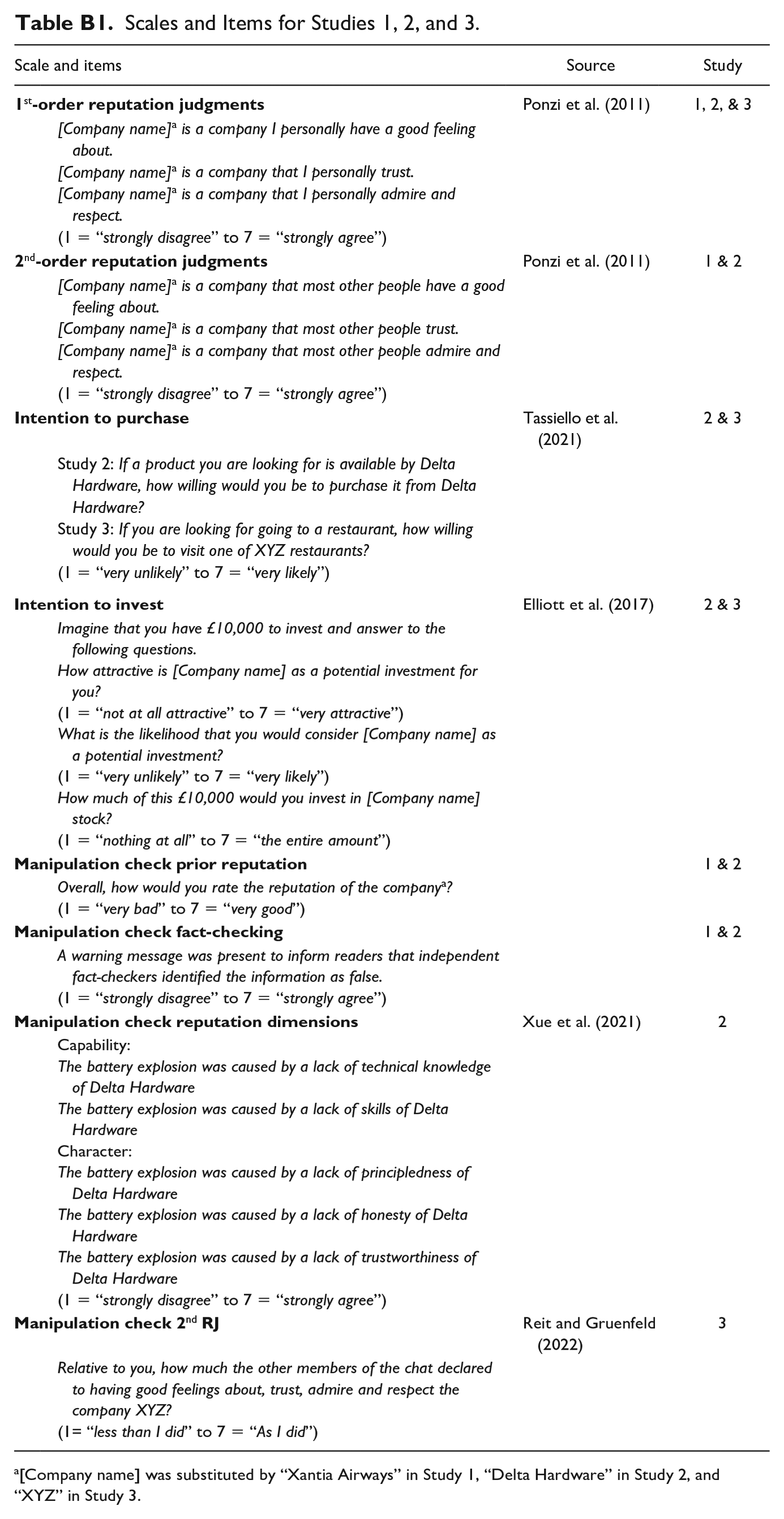
Following the manipulation, we measured participants’ first-order reputation judgments (hereafter, “1st RJ”; three items from Ponzi et al., 2011; Cronbach’s α = .976) and second-order reputation judgments (hereafter, “2nd RJ”; three items from Ponzi et al., 2011; Cronbach’s α = .989). Existing reputation scales do not capture the distinction between 1st RJ and 2nd RJ (Haack & Sieweke, 2020), so we slightly adapted the wording of a validated and widely used reputation scale (Ponzi et al., 2011) to account for this. The use of the scale formulated by Ponzi et al. (2011) was deemed suitable because it is consistent with our conceptualization of reputation as an overall favorable or unfavorable judgment, it has been validated with samples from multiple countries and stakeholder groups (Bundy et al., 2022; Ponzi et al., 2011), and it has already been successfully used in various studies investigating reputation (e.g., Deephouse & Jaskiewicz, 2013; Mariconda & Lurati, 2015). The full list of scales and items used in our article’s studies can be found in Appendix B.
Participants then completed the distraction task, and after that, they were exposed to the fake news, which was exactly the same for all conditions. We created the fake news story by taking an article that snopes.com (a well-known fact-checking website) had flagged as false and adapting it to refer to our fictitious airline and the context of our investigation. It was accompanied by a warning (vs. no warning) from fact-checkers identifying the news item as misinformation. In presenting the fake news story in this way, we followed the procedures suggested by Pennycook et al. (2021). We included the warning to explore whether the effects of fake news are contingent on participants’ awareness that the information they are presented with is false. The literature indicates that individuals may believe that others are more affected by fake news when there is clear evidence (e.g., a warning message) that it contains misinformation (Chung & Kim, 2021; Corbu et al., 2020).
After participants were exposed to the fake news story, we took a second measurement of the 1st RJ (Cronbach’s α = .975) and the 2nd RJ (Cronbach’s α = .978) using the same items employed in the pre-test phase. We then used the two measures for each reputation judgment to calculate changes in reputation judgments before and after the fake news by subtracting the first measurements from the second. Negative values indicate a deterioration of the reputation judgment. A nonsensical attention check was included: 25 participants failed it and were thus excluded from further analysis. All items were measured on a 7-point ascending Likert-type scale.
Manipulation checks were included to test the effectiveness of our manipulations. One item on a 7-point Likert-type scale (ranging from 1 = very bad to 7 = very good) measured the perceived reputation of the company. The analysis of variance (ANOVA) revealed a significant difference between conditions (F = 810.829, p < .001), with significantly higher means for the positive reputation condition, (M = 6.17 (.76)) and significantly lower means for the negative reputation condition (M = 1.54 (.76)). The neutral condition showed an average value in between the two conditions (M = 5.40 (.97)). A second manipulation check assessed the effectiveness of the second factor, that is, fact-checking. Participants were asked to indicate their agreement, on a 7-point ascending Likert-type scale, with the item “A warning message was present to inform the readers that independent fact-checkers identified the information as false.” The ANOVA confirmed the effectiveness of the manipulation (F = 405.736, p < .001; Mno_warning = 1.71 (1.28) vs. Mwarning = 5.67 (1.93)).
Results
We conducted a repeated-measure ANOVA to compare changes in 1st RJ and 2nd RJ. The analysis included prior reputation and fact-checking as between-subject factors to assess their moderating effects, thereby testing H1 and H2. The analysis revealed that 2nd RJ were more negatively affected by the fake news than 1st RJ (F = 8.889, p < .01, partial η2 = .032). Both orders of reputation judgments were negatively affected, with overall negative scores indicating a decrease in judgments after participants were exposed to the fake news. Specifically, the 2nd RJ were more negatively affected than were the 1st RJ and reported more-negative values (M1st_RJchange = −1.03 (1.42) vs. M2nd_RJchange = −1.19 (1.51), difference delta = −.16); the 2nd RJ decreased by 2.6% more than the 1st RJ did. This result supports H1.
The analysis also revealed a significant interaction effect with the prior reputation factor (F = 7.363, p < .01, partial η2 = .054). Figure 1 shows the results of the interaction between prior reputation and changes in reputation judgments. Specifically, when the prior reputation was positive, the 2nd RJ were more negatively affected than the 1st RJ, showing more-negative values (F = 12.408, p < .01, partial η2 = .127; M1st_RJchange = −1.04 (1.33) vs. M2nd_RJchange = −1.40 (1.24)). The positive condition showed the greatest difference between the 1st RJ and the 2nd RJ (difference delta = .36), meaning that when the prior reputation was positive, 2nd RJ decreased on average 6% more than 1st RJ after participants’ exposure to the fake news. Conversely, when the prior reputation was negative, changes in 1st RJ and 2nd RJ did not differ (M1st_RJchange = −.14 (.60) vs. M2nd_RJchange = −.004 (.77); F = 3.491, p > .05, partial η2 = .038). In the neutral condition, we also observed a significant difference between 1st RJ and 2nd RJ, with the latter decreasing on average 4.66% more than 1st RJ after the exposure to the fake news (F = 6.367, p < .05, partial η2 = .065; M1st_RJchange = −1.91 (1.55) vs. M2nd_RJchange = −2.18 (1.53); difference delta = .28).
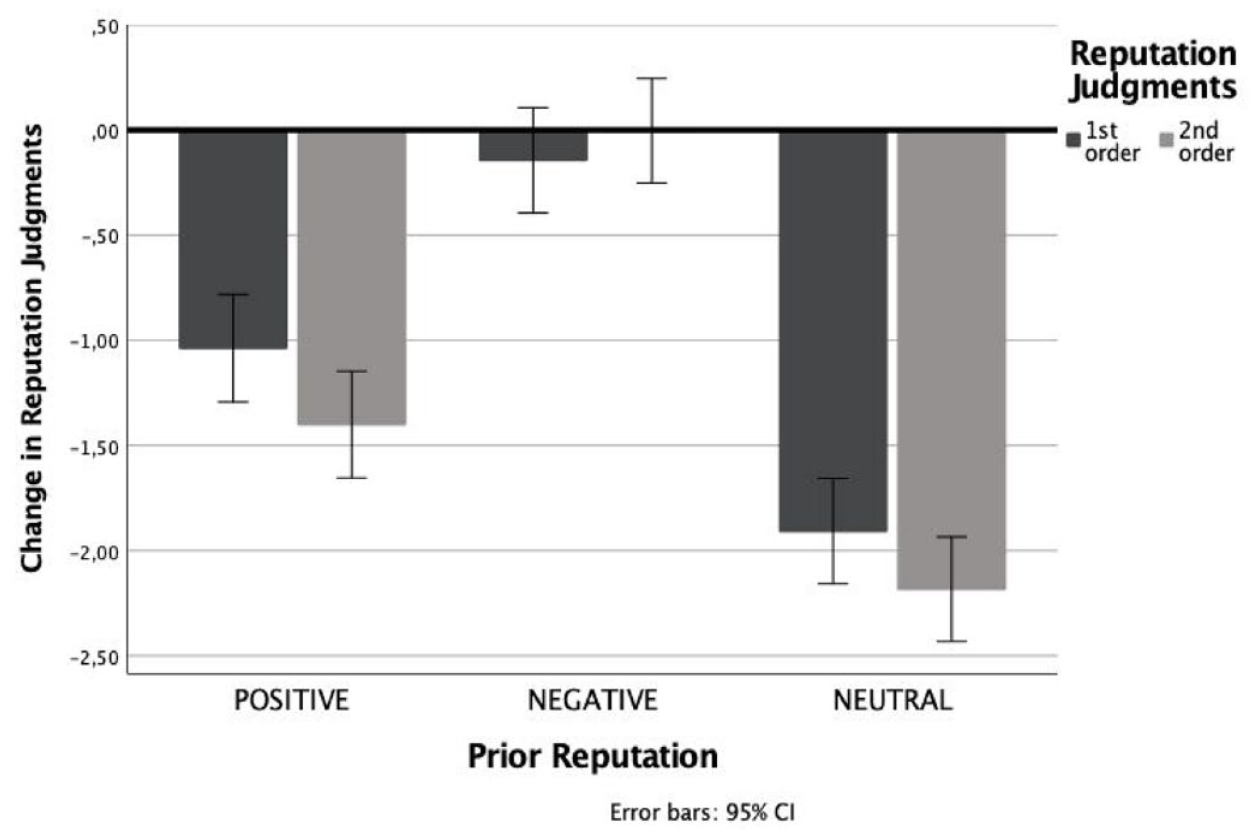
Changes in Reputation Judgments Between Conditions (Study 1).
Looking at the effect of fact-checking, we found a marginally significant interaction with change in reputation judgments (F = 3.281, p = .071, partial η2 = .012). We conducted further analysis to understand under which condition the fact-check warning affected reputation judgments and, therefore, to further disentangle its effect. When the fact-checking warning was not displayed, the change of 1st RJ vs. the change of 2nd RJ was not significantly different (F = .454, p > .05, partial η2 = .003). Conversely, when the warning was displayed (i.e., participants were aware that they were looking at fake news), the changes in reputation judgments were significantly different (F = 13.807, p < .001, partial η2 = .093): The change in 2nd RJ, M = −.98 (1.36)) was on average 4.5% more negative than the change in 1st RJ (M1st_RJchange = −.71 (1.27); difference delta = .27). This result is consistent with the current literature, which suggests that individuals tend to perceive others as more affected by fake news when these individuals are aware of being exposed to it (Chung & Kim, 2021; Corbu et al., 2020).
The results of Study 1 offer support for our prediction that fake news has a more detrimental effect on 2nd RJ than it does on 1st RJ (supporting H1). Moreover, the effect is greater when the fake news targets companies with a positive reputation (supporting H2), while the difference is not significant when the fake news targets companies with a negative reputation. Fake news about a company with a negative reputation does not contradict an individual’s previous perception but rather confirms what the individual already believes about the company. In other words, if a company is already expected to behave badly, the fake news does not violate expectations, but rather confirms them.
This study used a fake news story about a misdeed allegedly committed by a company. Misdeeds, unacceptable behaviors, and actions that reveal a company’s lack of integrity are likely to cause severe crises because they belong to the character dimension, that is, the company’s integrity and trustworthiness (Bundy et al., 2022). To generalize the results to other contexts and exclude the possibility that the observed effect is caused only by fake news involving the character reputation dimension, the next study uses fake news containing two elements: one related to the character reputation dimension and the other related to the capability reputation dimension. To increase generalizability, we also changed the type of company involved and the stimuli.
Study 2
Design and procedure
Study 2 aimed to provide further support for our prediction that fake news will cause a greater deterioration to 2nd RJ than it does to 1st RJ (testing H1), especially when the company has a positive reputation (testing H2). This study also sought to examine the direct effect of second-order reputation judgments on behavioral intentions (testing H3a).
A total of 400 participants (Mage = 41.85 (14.4); female 50.2%) took part in a 2 (prior reputation: positive vs. negative) × 2 (reputation dimensions: capability vs. character) × 2 (fact-checking: warning vs. no warning) pre-test–post-test between-subjects experimental design. Participants were randomly assigned to one of the experimental conditions. The procedures of the study were the same as in Study 1. In the pre-test phase, scenarios were used to manipulate prior reputation. The scenarios were adapted from those formulated by Barnett and Leih (2018) to manipulate an individual’s perceptions of corporate reputation. We described a fictitious tech company (Delta Hardware), and as in Study 1, we told participants that the description they had read was of a real company whose name was masked for privacy reasons. In the positive (vs. negative) reputation condition, the company was described as having excellent financial results (vs. mixed financial results and declining revenues and profits), as being considered a good long-term investment option by investors (vs. not being so considered), and as being recognized by stakeholders for its commitment to social and environmental causes (vs. criticized by stakeholders for its lack of commitment). The scenarios also informed the participant of a recent consumer survey in which 85% of respondents said they intended to buy Delta Hardware products again (vs. 85% of respondents who said they did not). Moreover, the company was described as successful (vs. not having an outstanding track record) in attracting and retaining talent, as committed to innovation (vs. having reduced its budget allocation for innovation), and as having been rated favorably (vs. poorly) in Fortune magazine’s World’s Most Admired Companies list. After presenting the scenarios to participants, we measured 1st RJ (three items from Ponzi et al., 2011; Cronbach’s α = .975) and 2nd RJ (three items from Ponzi et al., 2011; Cronbach’s α = .989).
A brief distraction task separated the pre-test phase from the post-test. Participants were then exposed to the fake news story, which was about a laptop battery that overheated and exploded (Sohn & Lariscy, 2014). We manipulated the reputation dimensions by changing the cause of the battery explosion. In both conditions, the fake news story was presented under the same headline (“Delta Hardware: Another laptop battery explodes leaving young man injured”) and image, but the sub-headline was different. In line with the current literature on reputation dimensions (Bundy et al., 2022; Sohn & Lariscy, 2014; Xue et al., 2021), to manipulate the capability dimension, we made the sub-headline refer to a technical accident (i.e., “Quality assurance failed to detect a technical problem which caused the battery to become overheated and explode”), and to manipulate the character dimension, the sub-headline linked the battery explosion to a misdeed committed by the company (i.e., “The company knew that the battery could overheat, but did not take steps to fix it to save money”). As in Study 1, the fact-checking factor was manipulated by including a box informing participants that the news story had been flagged as potentially false by third-party fact-checkers (vs. no box).
After presenting the fake news to participants, we measured 1st RJ (Cronbach’s α = .980) and 2nd RJ (Cronbach’s α = .877), just as we had previously done in the pre-test phase. We then used the two measures for each reputation judgment to calculate changes in reputation judgments before and after the fake news by subtracting the first measurements from the second. Negative values indicate a deterioration of the reputation judgment. We also measured behavioral intentions using one item from the study by Tassiello et al. (2021) to measure the intention to purchase and three items from the study by Elliott et al. (2017; Cronbach’s α = .960) to measure the intention to invest. A nonsensical attention check was included: 41 participants failed it and were therefore excluded from further analysis. All items were measured on 7-point ascending Likert-type scales.
Manipulation checks were included to test the effectiveness of our manipulations. One item on a 7-point Likert-type scale (ranging from 1 = very bad to 7 = very good) measured the perceived prior reputation of the company. The ANOVA showed a significant difference between conditions (F = 2361.117, p < .001), with higher scores for the positive reputation condition, M = 6.16 (.78), than for the negative reputation condition, M = 1.75 (.94). Therefore, the prior reputation factor was effectively manipulated. Another manipulation check was included to assess the effectiveness of the fact-checking manipulation. Participants were asked to indicate their level of agreement, on a 7-point ascending Likert-type scale, with an item stating that a warning message had accompanied the article. The ANOVA confirmed the effectiveness of the manipulation (F = 247.596, p < .001; Mno_warning = 2.03 (1.37) vs. Mwarning = 5.08 (2.20)). We conducted the manipulation checks of the reputation dimensions using a multi-item 7-point ascending Likert-type scale adapted from the work of Xue et al. (2021). Two items (Cronbach’s α = .800) assessed whether the capability dimension was effectively manipulated. The ANOVA confirmed the effectiveness of the manipulation (F = 14.209, p < .001), with higher scores for the capability condition, M = 4.04 (1.51), than for the character condition, M = 3.42 (1.61). Three items (Cronbach’s α = .825) were used to test the effectiveness of the character dimension manipulation. Again, we found a significant difference between conditions, with higher scores for the character dimension (F = 58.625, p < .001; Mcapability = 3.27 (1.45) vs. Mcharacter = 4.45 (1.48)), indicating that the character dimension was effectively manipulated.
Results
To test H1 and H2, we conducted a repeated-measure ANOVA comparing the means of changes in 1st RJ and 2nd RJ. Prior reputation, reputation dimensions, and fact-checking were included in the analysis as between-subject factors. Consistent with H1 and the findings of Study 1, the analysis revealed that the fake news story was significantly more detrimental to 2nd RJ than to 1st RJ (F = 25.863, p < .001, partial η2 = .07): we found that 2nd RJ (M = −1.29 (1.61)) declined on average 4% more than 1st RJ did, M = −1.05 (1.44), difference delta = .24.
The analysis also revealed a significant interaction effect with the prior reputation factor (F = 18.969, p < .001, partial η2 = .057). Figure 2 shows the results of the analysis. Further analysis shows that when the prior organizational reputation was positive, the 1st RJ were less negatively affected than the 2nd RJ (F = 41.042, p < .001, partial η2 = .174; M1st_RJchange = −1.87 (1.48) vs. M2nd_RJchange = −2.33 (1.57), difference delta = .46). Specifically, 2nd RJ decreased on average 7.67% more than 1st RJ did. Conversely, when the prior reputation was negative, the fake news had a limited negative effect on reputation judgments, with no significant differences between the two orders (F = .576, p > .05, partial η2 = .003; M1st_RJchange = −.23 (.73) vs. M2nd_RJchange = −.27 (.75)).
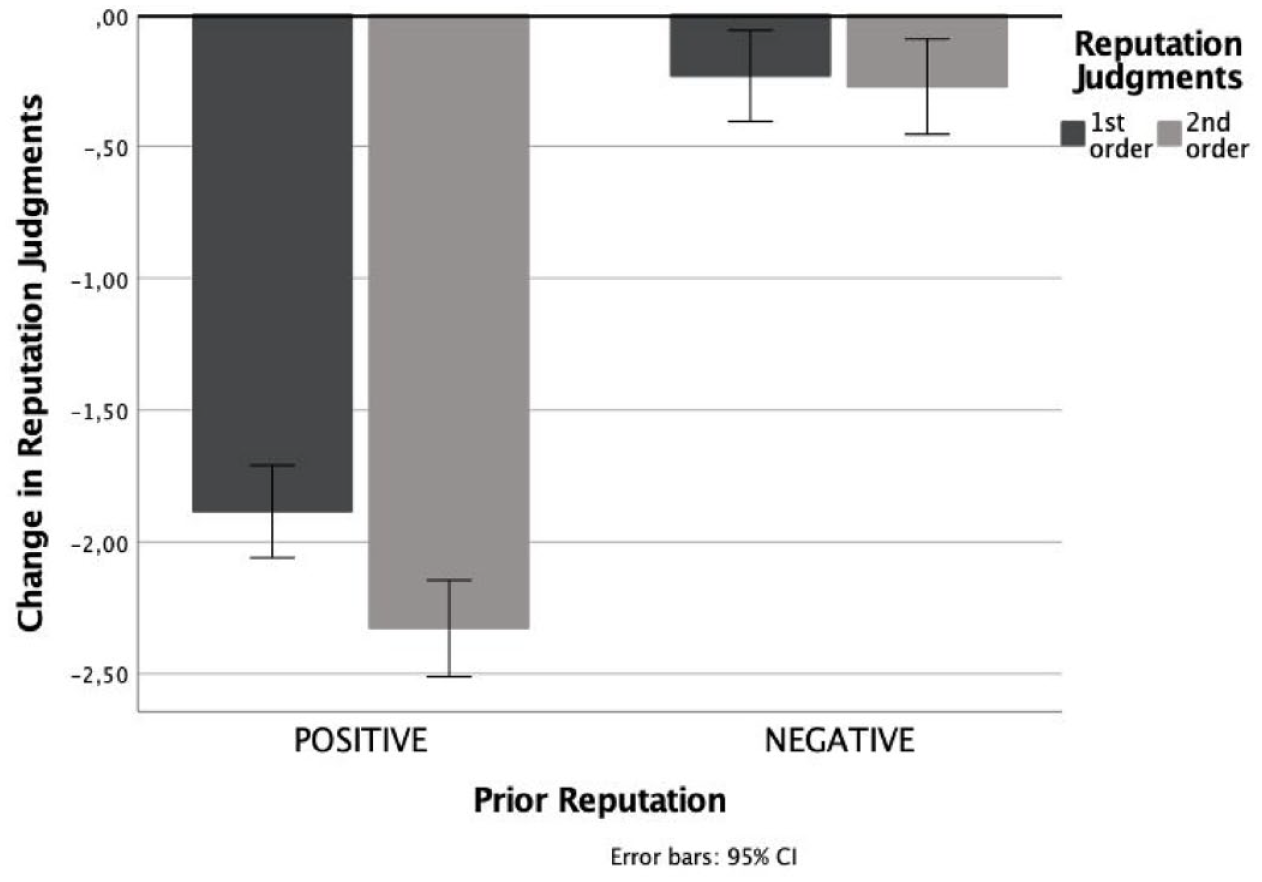
Changes in Reputation Judgments Between Conditions (Study 2).
The interaction with the reputation dimensions (capability vs. character) was marginally significant (F = 3.498, p = .062, partial η2 = .015). We conducted further analyses to disentangle the effect of reputation dimensions on reputation judgments. When the fake news concerned the capability dimension, the 2nd RJ were significantly more negatively affected than the 1st RJ (F = 31.944, p < .001, partial η2 = .138; M1st_RJchange = −.85 (1.37) vs. M2nd_RJchange = −1.20 (1.50), difference delta = .35); 2nd RJ decreased on average 5.83% more than 1st RJ did. A similar pattern was found when the fake news concerned the character dimension (F = 4.506, p < .05, partial η2 = .022; M1st_RJchange = −1.28 (1.47) vs. M2nd_RJchange = −1.42 (1.69)), with a smaller difference between the two orders of reputation judgments (difference delta = .14, corresponding to 2.33%). These results suggest that regardless of the reputation dimension involved in the fake news, the 2nd RJ were more negatively affected than the 1st RJ, consistent with H1.
Moreover, we found a non-significant interaction with the fact-checking factor (F = 2.354, p > .05). Despite this lack of significant difference, the means showed a similar pattern to Study 1: Both orders of reputation judgments had more negative values when the fake news story was not accompanied by a warning. Further analysis revealed that when the warning was displayed, the difference between the changes in 1st RJ and 2nd RJ was significant (F = 23.381, p < .001, partial η2 = .104). Specifically, 2nd RJ decreased on average 5.17% more than 1st RJ did after participants were exposed to the fake news story (M1st_RJchange = −.83 (1.39) vs. M2nd_RJchange = −1.14 (1.54), difference delta = .31), consistent with the results of Study 1. We also found a significant, but smaller, difference when the warning was not present: In these conditions, 2nd RJ decreased on average 3.17% more than 1st RJ did (F = 7.565, p < .01, partial η2 = .037; M1st_RJchange = −1.29 (1.44) vs. M2nd_RJchange = −1.48 (1.65), difference delta = .19). No other significant results were found.
Next, we tested the relationship between second-order judgments and behavioral intentions (H3a). We adopted the procedures of Reit and Gruenfeld (2022) and analyzed the relationships between reputation judgments and behavioral intentions using linear regressions. Starting with intention to invest, when both 1st RJ and 2nd RJ were included in the model, the relationship between 1st RJ and intention to invest was significant and positive (b = .645, SE = .062, t = 10.465, p < .001). Importantly, 2nd RJ were significantly and positively related to the intention to invest (b = .284, SE = .057, t = 4.946, p < .001). We conducted the same analysis for intention to purchase, finding similar results. When both changes in reputation judgments were included in the model, a significant and positive relationship was found between 1st RJ and the intention to purchase (b = .756, SE = .053, t = 14.352, p < .001). Moreover, we found a significant and positive relationship between 2nd RJ and intention to purchase (b = .271, SE = .049, t = 5.526, p < .001). Both analyses indicate that as reputation judgments increase, so do purchase and investing intentions. Moreover, the analyses show that first-order judgments are related to intentions, which is consistent with the literature suggesting that personal beliefs and attitudes influence behavior (Fishbein & Ajzen, 2011). Consistent with H3a, we also found in both cases that not only first-order judgments but also second-order judgments are directly related to intentions (supporting H3a), although the betas are smaller than first-order judgments.
The results of our second study provide further support for H1 and H2, showing that 2nd RJ are more negatively affected by fake news than 1st RJ. This effect is particularly relevant when the fake news targets companies with a positive prior organizational reputation: When the prior reputation is positive, the fake news presents information that is inconsistent with the reputation, generating a greater change in second-order reputation judgments. The results of Study 2 also increase our confidence that the results of Study 1 were not influenced by the specific nature of the fake news (i.e., the character dimension of reputation). Indeed, the results of Study 2 show similar effects for both the capability and character dimensions (here manipulated). Therefore, the results of Study 2 generalize the findings of Study 1, which only considered the character dimension of reputation.
Study 2 did not allow us to unequivocally identify the causal mechanism underlying the relationship between second-order judgments and behavioral intentions. Therefore, we conducted Study 3 to test whether second-order judgments, in addition to having a direct relationship with behavioral intentions, also have an indirect effect on behavioral intentions through the adaptation of first-order reputation judgments to second-order reputation judgments (H3b).
Study 3
Design and procedure
Ninety-nine participants (Mage = 32.46; 48.5% female) took part in a single-factor (2nd RJ: same vs. lower than 1st RJ) pre-test–post-test between-subject design. To manipulate 2nd RJ, we followed the design and procedures of Reit and Gruenfeld (2022) and exposed each participant to a fictitious context that presents others’ judgments (2nd RJ) as being similar to or lower than the participant’s 1st RJ.
At the beginning of the experiment, participants were informed that they were part of a study that required them to interact with other participants through a novel chat platform to discuss a company. To ensure the credibility and realism of the experimental context, we provided a cover story about this novel chat platform. Specifically, we asked participants to enter a username to be used in the chat, and we showed them some of the usernames of their supposed chat partners.
We then exposed the participants to our description of a fictitious company. We informed the participants that the company was a real firm whose name was masked for privacy reasons. The company was a restaurant chain that performed well financially, paid close attention to the quality of its ingredients and its customer experience, and was committed to innovation and sustainable initiatives, from working with local suppliers to reducing waste. Consistent with the previous two studies, this description, which covered both the character and capability dimensions, primed participants by presenting a positive corporate reputation. Immediately after participants had read this description, we presented a fake news story about the discovery of rat poison in food served in the company’s restaurants. The fake news story was inspired by Di Domenico et al. (2021a), and it was presented as such a story would appear on social media. Consistent with previous studies, we also presented a fact-checking warning. The company description and the fake news story were followed by the first measurement of 1st RJ, which was conducted using the same scale employed in our first two studies (Ponzi et al., 2011; Cronbach’s α = .964). Next, we told participants that we were interested in how people make sense of news about organizations, and we showed them both their own score from the measurement scale they had just completed and what we told them was the average score of the other members of the chat they would be joining. Following the procedure by Reit and Gruenfeld (2022), this information was used to manipulate 2nd RJ. Participants were randomly assigned to one of the experimental conditions. In the 2nd-RJ-same condition, participants were told that the other members of the chat had made the same reputation judgment about the company as they had. For instance: Now we’d like to tell you what the other members of the chat think about the company. The other members of the chat were also asked to indicate to what extent they have a good feeling about, trust, admire and respect the company on a scale from 1(completely disagree) to 7 (completely agree). You provided a score of 2. Like you, on average the other members of the chat also gave the company a rating of 2.
Conversely, in the 2nd-RJ-lower condition, when we showed each participant the average measurement-scale score of the other members of the chat they would be joining, the number we gave them was lower than the participant’s own score. For example: Now we’d like to tell you what the other members of the chat think about the company. The other members of the chat were also asked to indicate to what extent they have a good feeling about, they trust, admire and respect the company on a scale from 1 (completely disagree) to 7 (completely agree). You provided a score of 7. On average, the other members of the chat gave to the company a rating of 5, which is lower than yours.
Following the manipulation of second-order reputation judgments, we measured the dependent variables. Specifically, we asked participants to indicate their intention to invest in the company (Elliott et al., 2017; Cronbach’s α = .957) and to visit one of the company’s restaurants (Tassiello et al., 2021). Moreover, to assess the change in 1st RJ after the manipulation, we measured the 1st RJ for a second time (Cronbach’s α = .977). As in Studies 1 and 2, we calculated the change in reputation judgments by subtracting the first measurements from the second. We also measured participants’ intention to support or oppose the company based on what they had read. We informed the participants that the purpose of the chat was to discuss the company and that they would be divided into two groups, one supporting the company and one opposing it. Participants were asked to indicate which group they wanted to be in. To increase the credibility of the task, they were then asked to write a few sentences supporting or opposing the company (depending on which group they had chosen to join) to be posted in the chat.
A manipulation check in the form of an item adapted from the study by Reit and Gruenfeld (2022) was used to test the effectiveness of the manipulation. Specifically, participants were asked to indicate whether the other members of the chat gave the company lower or similar ratings on a 7-point Likert-type scale (1 = lower [i.e., 2nd-RJ-lower condition] vs. 7 = similar [i.e., 2nd-RJ-same condition]). The ANOVA confirmed the effectiveness of the manipulation (F = 18.868, p < .001): Participants in the 2nd-RJ-same condition reported significantly higher scores (M = 4.74 (2.10)) than participants in the 2nd-RJ-lower condition (M = 3.00 (1.83)). At the end of the study, demographic data were collected, and participants were debriefed about the true purpose of the study.
Results
First, we tested whether second-order judgments directly affect intentions and behavior. We conducted two ANOVAs with 2nd RJ (same vs. lower) as the independent variable and intentions to invest in the company and to visit one of its restaurants as the dependent variable. The analysis revealed that neither intention to invest (F = .326, p > .05) nor intention to visit one of the restaurants (F = 1.205, p > .05) varied across experimental conditions. Similarly, using logistic regression, we found that the 2nd RJ did not affect the decision to support or oppose the company (Chi-square = 3.401; df = 1; p > .05; B = −.788; Wald = 3.296; S.E. = .434; p > .05).
We then examined the effect of 2nd RJ on 1st RJ and, subsequently, whether the hypothesized adaptation of 1st RJ mediated the relationship between 2nd RJ and intentions. We conducted a repeated-measures ANOVA with the two measurements of 1st RJ as the within-subjects variable and 2nd RJ (same vs. lower) as the between-subject factor. Overall, we found that there was a significant decrease in 1st RJ after the manipulation (Mbefore = 3.74 (1.64) vs. Mafter = 3.58 (1.73); F = 4.744, p < .05; partial η2 = .047); 1st RJ decreased on average 2.29% (difference delta = .16) after the manipulation. We also found a significant interaction effect with the 2nd RJ factor (F = 4.076, p < .05; partial η2 = .040). More specifically, we found that in the 2nd-RJ-lower condition, the 1st RJ decreased significantly after the manipulation (Mbefore = 4.16 (1.43) vs. Mafter = 3.83 (1.69); F = 13.057, p < .01; partial η2 = .229). This result suggests that when 2nd RJ are lower than 1st RJ, the latter decrease, showing that 1st RJ adapt to 2nd RJ. Indeed, 1st RJ decreased on average 4.71% in the 2nd-RJ-lower condition (Delta = −.33). Conversely, in the 2nd-RJ-same condition, there was no significant difference (F = .011, p > .05, partial η2 = .000), indicating that participants did not change their 1st RJ. This result provides preliminary support for H3b, that is, 1st RJ tend to adapt to and converge toward 2nd RJ, with effects on behavioral intentions.
To test H3b, we used the Hayes PROCESS Macro (Model 4) with 10,000 bootstrapped re-samples. We included 2nd RJ as the independent variable (same RJ = 0; lower RJ = 1), intention to invest as the dependent variable, and the adaptation of 1st RJ as the mediator. The analysis revealed a significant indirect effect (b = −.1918; 95% CI: [−.5532, −.0044]), meaning that 2nd RJ affected intention to invest through the adaptation of 1st RJ. Conversely, the direct effect of the 2nd RJ factor on intention to invest was not significant (b = .4029, p > .05, 95% CI: [−.3254, 1.1312]). The same effect was found for the second measure of behavioral intention, that is, intention to visit one of the company’s restaurants. The results revealed that the 2nd RJ factor had a significant indirect effect on the intention to visit one of the restaurants through the adaptation of 1st RJ (b = −.1767; 95% CI: [−.6327, −.0028]). The direct effect of the 2nd RJ factor on the intention to visit one of the restaurants was not significant (b = .6137, p > .05; 95% CI: [−.1774, 1.4048]), again suggesting the role of 1st RJ adaptation. Finally, we tested the effect of the 2nd RJ factor on the decision to support or oppose the company, finding a non-significant mediating effect of 1st RJ adaptation on the decision (b = .1529; 95% CI: [−.0635, .6665]).
In summary, Study 3 suggests that individuals tend to align their first-order reputation judgments about a company targeted by fake news with their perception of others’ reputation judgments (i.e., second-order reputation judgments). Indeed, we found that second-order reputation judgments affect first-order judgments, which in turn influence intentions to invest and purchase, supporting H3b. Specifically, the greater and more negative the change in first-order judgments, the lower the intention to invest in the company or to visit one of its restaurants.
Discussion
To advance scholarly understandings of the impact of fake news on evaluators’ reputation judgments and behavioral intentions, we have drawn on the conceptual distinction between first- and second-order judgments and insights from both communication studies and social psychology. Our findings from three experimental studies demonstrate that fake news has a greater impact on evaluators’ second-order judgments than it does on their first-order judgments. This result confirms our baseline hypothesis, informed by research on the third-person effect, that an evaluator will believe that others are more affected by fake news than they are. Furthermore, our findings show that a prior good reputation reduces the negative impact of fake news on first-order judgments but has no buffering effect on second-order judgments. Finally, our findings suggest that both first- and second-order judgments contribute to the formation of behavioral intentions. Although the influence of first-order judgments appears to be stronger than that of second-order judgments (based on the regression results of Study 2), we found that they tend to adapt to second-order judgments (Study 3 results). Such alignment in evaluators’ judgments explains their behavioral intentions toward the focal company, for example, whether to buy its products and services or to invest in it.
Contributions
To our knowledge, this is the first article to examine the relationship between fake news, evaluators’ reputation judgments, and subsequent behavioral intentions. While prior research has mainly operated on the implicit assumption that evaluators form their judgments on information from credible and established sources, such as news media (Deephouse, 2000; Rindova et al., 2007) or rankings (Rindova et al., 2018), recent literature has highlighted changes in the digital media landscape that challenge this assumption (Etter et al., 2019; Wang et al., 2021). This becomes important—as our study confirms—because evaluators tend to believe that others are more likely to be influenced by questionable sources (i.e., fake news), and this belief has implications for evaluators’ reputation judgments and behavioral intentions. As such, our article makes two important contributions to the reputation literature.
First, we advance existing conversations in the micro-cognitive perspective on reputation formation (Ravasi et al., 2018). Extant models of reputation formation at the micro-cognitive level have considered how evaluators from different stakeholder groups and form judgments depending on the criteria and relevance they assign to available information (e.g., Bitektine, 2011; Ertug et al., 2016; Mishina et al., 2012) in specific organizational contexts (e.g., Bundy et al., 2021; Haleblian et al., 2017). Such a conception is not fully appropriate for studying the impact of fake news on reputation judgments and subsequent behavior. Fundamentally, while such models are highly valuable for their research contexts, they only consider how evaluators themselves evaluate organizations, that is, their first-order judgments. However, evaluators also develop beliefs about the reputation judgments of other evaluators in a given reference group. Integrating the distinction between first- and second-order judgments with insights from both communication research and social psychology allows us to develop a comprehensive understanding of the impact of fake news on organizational reputation and helps us to acknowledge that the relationship between fake news and reputation formation is more complex than one might have assumed.
On the one hand, the negative impact of fake news on organizational reputation may have been overestimated because evaluators’ first-order judgments, that is, their private reputation assessments, are less severely affected by fake news than are their second-order judgments. In this view, organizational reputation may be less vulnerable to fake news than is commonly assumed, for example, by the media (e.g., Atkinson, 2019). On the other hand, fake news may be more detrimental to the reputations of targeted organizations because of its impact on evaluators’ second-order judgments, which we have shown to be consequential for both first-order judgments—through a process of adaptation—and behavioral intentions.
Our research helps to lay the groundwork for an advanced understanding of how reputation is formed at the individual level. We thereby follow reputation scholarship that has called for a better understanding of how individual and (perceived) collective-level judgments influence each other (e.g., Ravasi et al., 2018). Our results suggest that individuals do not form their reputation judgments in a social vacuum, responding to a set of information cues, but also take into account (what they perceive to be) the judgments of others. Importantly, we show that not only do first-order reputation judgments influence intentions, but also second-order judgments do so through the adaptation of first-order judgments to second-order judgments. As such, second-order reputation judgments provide an analytical lens that links the individual and collective levels, offering a concept that promises to be useful beyond the context of our study.
Our article’s second contribution concerns whether and when a prior good reputation benefits or harms an organization in the case of a negative event (Zavyalova et al., 2016). The literature describing the effect of an organization’s reputation on evaluators’ reactions to a negative event has been equivocal. Some studies have identified a positive effect, showing that a positive prior reputation buffers an organization from the consequences of a negative event (e.g., Love & Kraatz, 2009). Conversely, there is evidence that a positive prior reputation is associated with a stronger violation of evaluators’ expectations as well as with greater media coverage in the aftermath of a negative event (e.g., Rhee & Haunschild, 2006). Our research shows that the differential effect of fake news on first- vs. second-order reputation judgments is stronger, when the targeted company has a positive prior reputation.
In light of our findings, the buffering effect of positive prior reputation is more present at the level of first-order judgments than at the level of second-order judgments. In other words, compared to second-order reputation judgments, positive first-order reputation judgments are more stable and are more effective as a diagnostic cue and cognitive filter against inconsistent information (e.g., Mariconda & Lurati, 2015). Somewhat paradoxically, however, the buffering effect at the level of first-order reputation judgments may not be sufficient to protect a company targeted by fake news. Our findings show that individuals, at least in part, adapt their first-order reputation judgments to their second-order judgments. This adaptation process may render the buffering effect at the level of first-order judgments merely temporary. Hence, an important implication of our research is that reputation scholars may benefit from studying buffering effects as a function of judgment type (first-order vs. second-order judgments), as well as the long-term stability of judgment-specific buffering effects.
Practical Implications
Recognizing that fake news may have a greater impact on second-order judgments than on first-order judgments also has important practical implications. In particular, as we discussed earlier, even if individuals are aware that the information being presented to them is false, the spread of fake news could trigger collective reactions, such as mass selloffs of company stock or bank runs. In other words, while individuals may recognize that a particular piece of news content is fake, they may still be wary of the judgments and reactions of other people, who, they may assume, will not recognize that the news is fake and act on the belief that it is true. In this view, even if people individually recognize that a news story is fake, they may publicly react as if the story were true.
This discrepancy has direct implications for managers’ crisis response strategies. According to our findings, managers and communication professionals can identify whether fake news targeting their firm/client affects first-order judgments, second-order judgments, or both and develop appropriate response strategies. In addition, managers can consider the potential impact of a given crisis response on both types of reputation judgments. For instance, merely emphasizing that the news in question is fake may be insufficient in terms of crisis response because evaluators may still believe that others will be influenced by the fake news. As a result, even if the fake news does not affect evaluators’ first-order judgments, evaluators may still develop and act on their second-order judgments, to the detriment of the organization affected by the fake news. In this view, an effective response strategy requires the development of communication strategies that rely on social proof, a psychological phenomenon wherein individuals mimic the actions and publicly expressed judgments of others when deciding on how to behave in a situation of ambiguity (Cialdini, 1993). Managers could leverage social proof to demonstrate that other evaluators’ reputation judgments and behaviors have not been influenced by the fake news about their firm. For instance, after being the target of fake news, a company could point to survey results or other sources of social proof (e.g., expert opinions or data related to increased sales and investment activity) showing that the company still has a strong reputation among key stakeholders.
Limitations and Future Research
This article has several limitations that provide opportunities for future research. First, our study design did not allow us to determine beyond doubt whether the interaction effect with prior reputation was driven by the valence of prior reputation (positive vs. negative) or by the degree of incongruence (low vs. high) between prior reputation and the reputation cue of the fake news story (Mishina et al., 2012). Our fake news manipulation was negatively valenced by default, meaning that the fake news portrayed the company in a bad light. Future research could examine whether the interaction with prior reputation is symmetric or asymmetric, that is, whether the interaction effect is of a similar magnitude when a prior negative reputation is paired with positively valenced fake news that portrays the focal company in a favorable light.
Second, although our studies used best practices in experimental design to improve external validity, future research could adopt more ecologically valid methods (e.g., field studies using qualitative or quantitative methods and field experiments). This would make it possible to test whether our results can be replicated when studying corporate reputation and fake news in a real-world context. To manipulate reputation in our studies, we provided participants with information about character and capability (e.g., Mishina et al., 2012). This choice was based on the rationale that individuals typically encounter information related to these two dimensions when forming reputation judgments. For methodological reasons, we always manipulated both dimensions in the same direction (either positive or negative), but in the real world, individuals will often encounter information sources that simultaneously contain positive and negative elements. Future research could therefore attempt to investigate whether and to what extent ambivalent reputation information and conflicting cues influence the way in which individuals react to fake news and form their first- and second-order reputation judgments. In addition, future research could examine how different types of reputation influence reactions to different types of fake news to understand whether previous findings regarding character and capability reputation (e.g., Bundy et al., 2021; Mishina et al., 2012; Sohn & Lariscy, 2014) also hold in the specific context of fake news. Finally, future research can examine the impact of fake news on reputation formation in the context of real organizations, for which reputations have been built over a longer period of time and are thus likely to be stronger than those in our vignette settings.
Third, in our research, we intentionally took a “generalized favorability” approach (Lange et al., 2011) to studying reputation judgments, and we did not explicitly test whether reactions to fake news differ for capability vs. character judgments (e.g., Mishina et al., 2012). Our study only examined the role of capability vs. character dimensions at the level of the fake news manipulations to which we exposed subjects (we found no relevant differences), but not in terms of the dependent variables. For instance, one could speculate that the differential effect of fake news on first- vs. second-order reputation judgments is stronger for character judgments than for capability judgments. This would be the case because character violations could be viewed as touching on aspects that are more relevant to “other people” than capability violations (i.e., violations of the social contract between a company and its stakeholders). In other words, all else being equal, the stronger effect of fake news on second-order (vs. first-order) judgments would be greater for character judgments than for capability judgments. At the same time, one might assume that the adaptation process that we have investigated in our article might be stronger for capability judgments than for character judgments, given the more “personal” nature of the latter. All these issues merit attention in future research.
Fourth, our research has examined the effects of reputation judgments on behavioral intentions (i.e., intentions to buy from and invest in a company), but such measures may be limited in their predictive power (Webb & Sheeran, 2006). We therefore encourage reputation scholars to use incentivized measures of actual behavior in addition to assessing judgments and behavioral intentions.
Finally, an important implication of our research is that reputation scholars need to systematically distinguish between first- and second-order reputation judgments. As Haack and Sieweke (2020) critically discuss, existing instruments for measuring reputation (and other social evaluations) conflate first- and second-order judgments, impairing their potential to advance an empirical research agenda that treats reputation as a multi-level construct (Ravasi et al., 2018). The need to distinguish between these two types of judgments applies conceptually and empirically not only to research on the reputational impact of fake news but also to other areas of reputation research, including the important debate over whether reputation constitutes a benefit or a burden (Zavyalova et al., 2016). Although we have adapted existing scales to distinguish between first- and second-order judgments, a concerted effort is needed to develop and validate a measurement instrument that systematically captures both types of reputation judgments.
Footnotes
Appendix A
Appendix B
Scales and Items for Studies 1, 2, and 3.
| Scale and items | Source | Study |
|---|---|---|
|
|
Ponzi et al. (2011) | 1, 2, & 3 |
| [Company name]
a
is a company I personally have a good feeling about. [Company name] a is a company that I personally trust. [Company name] a is a company that I personally admire and respect. (1 = “strongly disagree” to 7 = “strongly agree”) |
||
|
|
Ponzi et al. (2011) | 1 & 2 |
| [Company name]
a
is a company that most other people have a good feeling about. |
||
|
|
Tassiello et al. (2021) | 2 & 3 |
| Study 2: If a product you are looking for is available by Delta Hardware, how willing would you be to purchase it from Delta Hardware? |
||
|
|
Elliott et al. (2017) | 2 & 3 |
| Imagine that you have £10,000 to invest and answer to the following questions. |
||
|
|
1 & 2 | |
| Overall, how would you rate the reputation of the company
a
? |
||
|
|
1 & 2 | |
| A warning message was present to inform readers that independent fact-checkers identified the information as false. |
||
|
|
Xue et al. (2021) | 2 |
| Capability: |
||
|
|
Reit and Gruenfeld (2022) | 3 |
| Relative to you, how much the other members of the chat declared to having good feelings about, trust, admire and respect the company XYZ? |
[Company name] was substituted by “Xantia Airways” in Study 1, “Delta Hardware” in Study 2, and “XYZ” in Study 3.
Acknowledgements
We would like to thank Guest Editor Michael L. Barnett and three anonymous reviewers for their guidance and developmental feedback during the review process. We would also like to thank the participants of the 2022 Reputation Symposium organized by the Oxford University Centre for Corporate Reputation for their valuable comments and suggestions.
Declaration of Conflicting Interests
The authors declared no potential conflicts of interest with respect to the research, authorship, and/or publication of this article.
Funding
The authors received no financial support for the research, authorship, and/or publication of this article.
