



Abstract
To shield stakeholders from exploitation, society increasingly expects organizations to engage with stakeholders. While exploitation of stakeholders is of great concern, economic literature points to the costly nature of stakeholder engagement vis-à-vis alternative mechanisms that protect stakeholders, such as competitive markets. When the costs of stakeholder engagement outweigh the benefits, why would organizations engage with stakeholders? Through an analysis of the cooperative enterprise and a comparison with its capitalist counterpart, we theorize two additional reasons why stakeholder engagement is beneficial. First, we explain how stakeholder engagement facilitates long-term organizational resilience and protection of stakeholders in times of crisis, and second, we show how engagement is a decisive ingredient in answering non-economic value requirements of stakeholders. To conclude, we contribute to the broader stakeholder engagement and cooperative literature by stressing that engagement practices, and particularly democratic governance arrangements, are subject to design principles that sometimes favor stakeholders in capitalist firms.
As John Stuart Mill observed, “only through the principle of competition has political economy any pretension to the character of a science” (Mill, 1848, pp. 317–318). In perfect markets, competition is viewed as the ultimate measure to protect stakeholders against market power because the market provides them with exit options. The latter are alternative ways through which their needs can be met, and which shield them from unfavorable contractual conditions. However, as Mill (1848) hinted, markets are not perfect and the risk of stakeholder exploitation is high, particularly in the absence of exit options and complete contracting (Amis, Barney, et al., 2020; Bridoux & Stoelhorst, 2022a).
To protect against exploitation in markets characterized by power asymmetry, stakeholders organize themselves collectively. They compensate for a lack of exit options by creating voice options (Hielscher et al., 2014; Hirschman, 1970), which enable them to participate in the governance of organizations with which they contract, and influence their strategic actions. Thus, voice options grant stakeholders the right to participate in the governance of collectively held organizations with increased market power and act as a check on managerial discretion (Iliopoulos & Hendrikse, 2009), referring to managers’ latitude to steer their firms’ actions (Wangrow et al., 2015). In this regard, cooperative enterprises are often portrayed as stereotypical organizations that grant voice options to certain categories of stakeholders (Hansmann, 1999). Curiously, the functionality of cooperatives is thought to be conditional because governance participation only serves a purpose for stakeholders when exit options in the market are low. If the market begins to offer such options again, cooperatives have no reason to exist (Spear, 2004). Hence, whenever markets improve, competition increases, reducing the risk of stakeholder exploitation, and the function of voice options becomes obsolete, and even costly, because collective governance consumes time and energy (Heath, 2011).
Although economic wisdom rightly stresses the conditionality of cooperative forms of organizing and the voice options they grant, the literature documents several cooperative and noncooperative instances in which stakeholders are granted voice options despite the presence of sufficient exit options. For instance, cooperatives continue to emerge in markets that are considered competitive (Boone & Özcan, 2014); and in the noncooperative sphere, engagement practices that grant stakeholders some level of voice options have skyrocketed (Kujala et al., 2022; Passetti et al., 2019). From a transaction cost point of view, this is surprising because stakeholder engagement, which is “the practices that the organization undertakes to involve stakeholders in a positive manner in organizational activities” (Greenwood, 2007, pp. 317–318), increases decision costs for stakeholders, especially when coordination between heterogeneous and complex collectives of stakeholders is required (Bosse & Coughlan, 2016; Bosse et al., 2009; Hansmann, 1999; Jensen, 2002; Mitchell et al., 2016). When these costs are too high to bear, stakeholders may prefer the market principle of competition over engagement practices to feel sufficiently protected against exploitation (Hielscher et al., 2014), or shareholders may find ways to circumvent costly engagement practices with stakeholders (Sabadoz & Singer, 2017). For instance, Hielscher and colleagues (2014) predict that in some circumstances, stakeholder engagement practices may leave stakeholders worse off, and thus become dysfunctional. In the real world, engagement practices often exist where a critical revision might be needed. For instance, worker cooperatives grant members a say in recruitment policies, which may lead to nepotism, and hence a lack of competent workers (Basterretxea et al., 2019). In traditional firms, too much engagement with one stakeholder may lead to opposition and conflict with others (Wickert & de Bakker, 2018). Conversely, engagement practices are often absent in places where they should, perhaps, exist. Such is the case for remote stakeholder groups, such as employees in third-world producer countries who are largely left out of firms’ engagement projects (Reinecke & Donaghey, 2021). Extant literature lacks a potent explanation of why and to what extent engagement practices are necessary. Thus, our inquiry investigates the conditions under which it is functional for stakeholders to be protected by voice options and exit options simultaneously.
Just as the 2008 financial crisis put stakeholder relationships under severe pressure, the recent COVID-19 crisis has demonstrated society’s growing interest in stabilizing stakeholder relationships (Blustein et al., 2020), because these bonds have many beneficial effects for society (Post et al., 2002). However, since the beginning of stakeholder engagement practices, there have also been worries about their dark side (Kujala et al., 2022), about firms’ capacity to genuinely and effectively engage with stakeholders in the long run (Banerjee, 2008), and about the extent to which stakeholder interests are balanced as a matter of strategic choice and are thus fragile (Noorman et al., 2017). Voice options in cooperative governance are marked by formal co-determination (FitzRoy & Kraft, 1993; Hansmann, 1990), and engagement practices in capitalist enterprises often resemble dialogic exchanges, which are opportunities for the organization and stakeholders to share preferences and concerns with each other, but are not formalized and often lack binding power (Passetti et al., 2019). However, our question relates to current debate on how deeply stakeholder engagement needs to be embedded in structural governance arrangements, and how far governance should lean toward democratic decision-making to establish resilient stakeholder relationships (Heath & Norman, 2004; Moriarty, 2014), especially in times marked by more intense and frequent crises (Biggs et al., 2011).
We answer our question through theoretical consideration of cooperative enterprises. We identify the conditions under which voice options are functional in addition to exit options, and extend similar analysis to use of stakeholder engagement practices in capitalist enterprises. Through a proposition-based argument, we contribute to the literature by sharing three important insights. First, in competitive markets, cooperative stakeholders incur greater costs than their capitalist counterparts; however, their institutionalized voice options pay off in times of crisis because crises cause sudden reductions in (the value of) exit options, and the principle of co-determination shields stakeholders more effectively from power asymmetry than dialogic exchange. Second, stakeholders and society increasingly expect organizations to provide noneconomic value for them (Battilana, 2018), and the non-numerical and subjective nature of voice options makes them crucial tools to negotiate noneconomic value. While dialogic exchange often depends on managerial goodwill, cooperative stakeholders fare better in pursuit of noneconomic value because co-determination acts as a check on managerial decision-making. Third, we show that the comparative advantages for cooperative stakeholders are conditional: they may be compromised by democratic failure in cooperatives, or by the strength of stakeholder engagement practices’ accountability in capitalist enterprises. Thus, our study contributes to burgeoning interest in and critical examination of the democratization of stakeholder relationships (Battilana et al., 2022; Hielscher et al., 2014) by observing that stakeholder engagement comes with costs that are not necessarily a static given, but depend on governance design principles that deserve further research.
The Conditionality of Cooperative Organizing (and the Problem That Cooperatives Intend to Solve)
Cooperative Enterprises
Although considered to be an alternative form of organization (Luyckx et al., 2022; Nelson et al., 2016), cooperatives are by no means marginal: they constitute 4.3% of the world’s gross domestic product (GDP), representing a combined economy at least as big as that of France (United Nations, 2014). Cooperatives are value-driven, member-owned, and democratically controlled enterprises that seek to satisfy their members’ needs. Therefore, cooperative members typically wear “multiple hats” (Mamouni Limnios et al., 2018), as they engage in various relationships with their organizations, including transactional relationships as users of the cooperative to meet their needs, investment relationships as owners of the cooperative, and decision-making relationships as controllers in a democratically governed organization.
This last relationship is often understood as the principle of co-determination, and in theory is implemented through the democratic “one-person one-vote” principle, rather than voting power being equal to the proportion of shares held, as in capitalist enterprises (Peredo et al., 2018). Co-determination contrasts with popular engagement practices such as participatory management and stakeholder dialogues, which are generally based on dialogic exchange and left without formal binding power (Cooper & Owen, 2007; Passetti et al., 2019), as cooperative stakeholders are able to hold managers to account (Levi & Davis, 2008). Given these differences between capitalist and cooperative enterprises, members of a cooperative are often referred to as cooperative stakeholders rather than capitalist stakeholders, a distinction we use throughout this study (Hansmann, 1999; Heath, 2011).
Complicating the Role of Cooperative Stakeholders
Most scholarly research using the concept of stakeholders and taking the capitalist firm as the archetype for stakeholder taxonomies tacitly assumes that stakeholders form distinct and identifiable groups, such as investors, employees, suppliers, and customers (Clarkson, 1995; R. Freeman et al., 2018). Key to the stakeholder identification process is the salience model (Mitchell et al., 1997), which uses the attributes of power, legitimacy, and urgency to facilitate categorization of (usually primary) stakeholders. This model and its categorizations are often used as a lens to explain why managers prioritize certain stakeholders over others. Following these categorizations, several typologies have been proposed (Apostol & Näsi, 2010; Fassin, 2009), all of which make sharp distinctions between different primary stakeholders, including employees, shareholders, customers, and suppliers.
Given the “multiple hats” worn by cooperative members, these assumptions and taxonomies seem shortsighted and stem from a liberal economic view of stakeholders as individual market actors competing for resources (Mamouni Limnios et al., 2018). For example, in many dairy cooperatives, such as Arla in Sweden and Campina in the Netherlands, a single stakeholder group plays the roles of both suppliers (milk producers) and shareholders. Such arrangements generally apply to suppliers and shareholders in producer cooperatives, to customers and shareholders in consumer cooperatives, to employees and shareholders in worker cooperatives, and to all types of stakeholders in so-called multistakeholder cooperatives, which may combine suppliers, customers, and workers in a single firm. As shown in Figure 1, in all these cases of cooperatives, a single party encompasses the roles of at least two primary stakeholders.
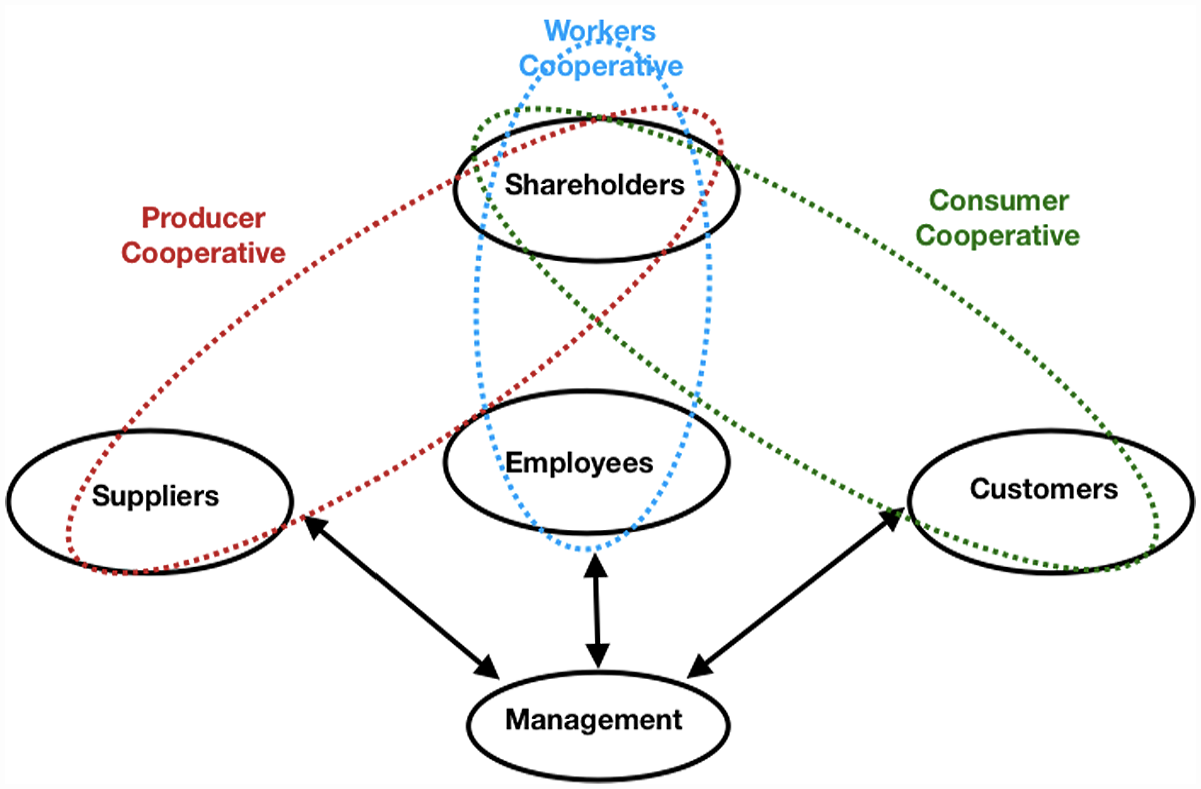
Cooperatives: Overlap Between Stakeholders and Shareholders.
When cooperative members play multiple roles, they must often balance multiple, conflicting interests simultaneously, with different incentives for action. For example, a milk supplier in a dairy cooperative may want its cooperative to offer good contractual terms on an ongoing basis but may also want the cooperative to pay dividends at the end of the year. This stakeholder is simultaneously supplier and shareholder. Since supplier-members of such agricultural cooperatives have a right to co-determination, managers are restricted and less able to make strategic decisions freely, impinging on their managerial discretion (Iliopoulos & Hendrikse, 2009). They cannot separate shareholders from suppliers, nor prioritize shareholders over suppliers, or one value requirement (e.g., good contractual terms for suppliers) over another (e.g., dividend distributions for stakeholders). Mintzberg (1973) carefully mapped managers’ roles based on an assumption that structural conditions largely define their behavior. Building on his work, Hambrick and Finkelstein (1987) and Wangrow and colleagues (2015) show that these structural conditions may consist of internal organizational factors such as governance culture, ownership types, or capital intensity. In this respect, cooperative researchers note that Mintzberg’s managerial roles are heavily influenced by the structural conditions of cooperative enterprises (Cook, 1994). This is because cooperatives are set up to maintain use-transactional relationships with their members, referring to the actual utility that members derive from the cooperative, in contrast to the financial-transactional relationships maintained by shareholders. Consequently, whenever two supposedly distinct stakeholders are united within the same party, managers lack discretion to split their attention between the two to make trade-offs. Following this strand of research, we contend that the cooperative predicament goes against the assumptions of stakeholder management in capitalist enterprises, in which managerial discretion is often considered to be broad, or restricted only by the relatively homogeneous stakeholder category of shareholders (Adams et al., 2011; Jones, 1995).
Exit or Voice
Among considerable theorization on the question of why cooperatives exist, the transaction cost literature has provided extensive explanations of their functionality (Hansmann, 1988; Hirschman, 1970). In the face of dominant market actors stifling competition, small and independent players face exploitation because they are unable to easily terminate contractual relationships and find better terms elsewhere. For instance, agricultural and retail markets have historically exhibited great asymmetry between suppliers and buyers (Rhodes, 1983). The former tend to consist of dispersed, numerous, and small-scale independent farmers, while the latter consist of a handful of retailers with substantial market power. Often referred to as a monopsony (Novkovic, 2008), these buyers can easily exploit individual farmers by threatening to end their contractual relationships. Hirschman (1970) called this phenomenon a lack of sufficient exit options: individual farmers cannot exert exit threats because buyers can easily terminate their contractual relationships with a large and dispersed population of farmers. 1
Throughout history, dispersed individual market actors have organized collectively into cooperatives to increase their market power (De Moor, 2019; Ostrom, 2010). Hirschman (1970) theorized that the mechanism that protects these stakeholders against exploitation is the voice option: the right to codetermine the firm’s strategic actions. Similarly to the agricultural sector, workers (Cheney et al., 2014; Dufays et al., 2020), freelancers (Charles et al., 2020), and consumers (Barros & Michaud, 2019) organize themselves into collective vehicles that grant them voice options to protect against exploitation when the value of exit options in the market is low.
Market asymmetries continue to exist and give rise to cooperative enterprises, but the cooperative form of organizing may lose its function when markets improve, allowing for more competition and hence fewer exploitation risks (Ben-Ner, 1984). Consequently, many cooperatives degenerate into capitalist firms to meet market demands (Storey et al., 2014). Hence, when markets improve and provide for sufficient exit options, the risk of exploitation decreases, and the market itself becomes the protective mechanism for stakeholders (Hielscher et al., 2014). Under such market conditions, stakeholders who are stuck in cooperatives may be dissatisfied with their voice mechanism because it provides them with no additional benefit or, worse, a costly governance arrangement.
The Cost of Democracy
Following influential work on the cost of decision-making in political communities (Buchanan & Tullock, 1965; Soltan, 1988), a vast literature illustrates that voice mechanisms in cooperatives are costly because organizing and deciding collectively consumes the time and energy of individual stakeholders (Hansmann, 1990). In particular, economists have stressed the higher costs and greater inefficiency in competitive environments of the cooperative form (Rey & Tirole, 2007) than more hierarchical ways of organizing (S. D. Williamson, 1987). Under competitive conditions, cooperatives do not always deliver anticipated benefits, owing to internal conflicts in democratic decision-making (Slade Shantz et al., 2019), isomorphic pressures (DiMaggio & Powell, 1983), and immobilization of large and heterogeneous member bases in terms of organizing dialogue and debate (Hansmann, 1999).
As shown in Figure 2, cooperative stakeholders pay a premium for their voice mechanism compared with stakeholders in capitalist firms. Hielscher and colleagues (2014) explain that if this premium does not compensate for the costs of being exploited, voice options are dysfunctional. Inspired by decision-making costs in political communities (Buchanan & Tullock, 1965), Figure 2 illustrates a scenario of competitive markets with limited risk of stakeholder exploitation owing to a high level of exit options, placing cooperative stakeholders at a disadvantage compared with capitalist stakeholders. In showing how the principle of co-determination increases decision-making costs, Figure 2 reveals that the functionality of cooperatives is conditional.
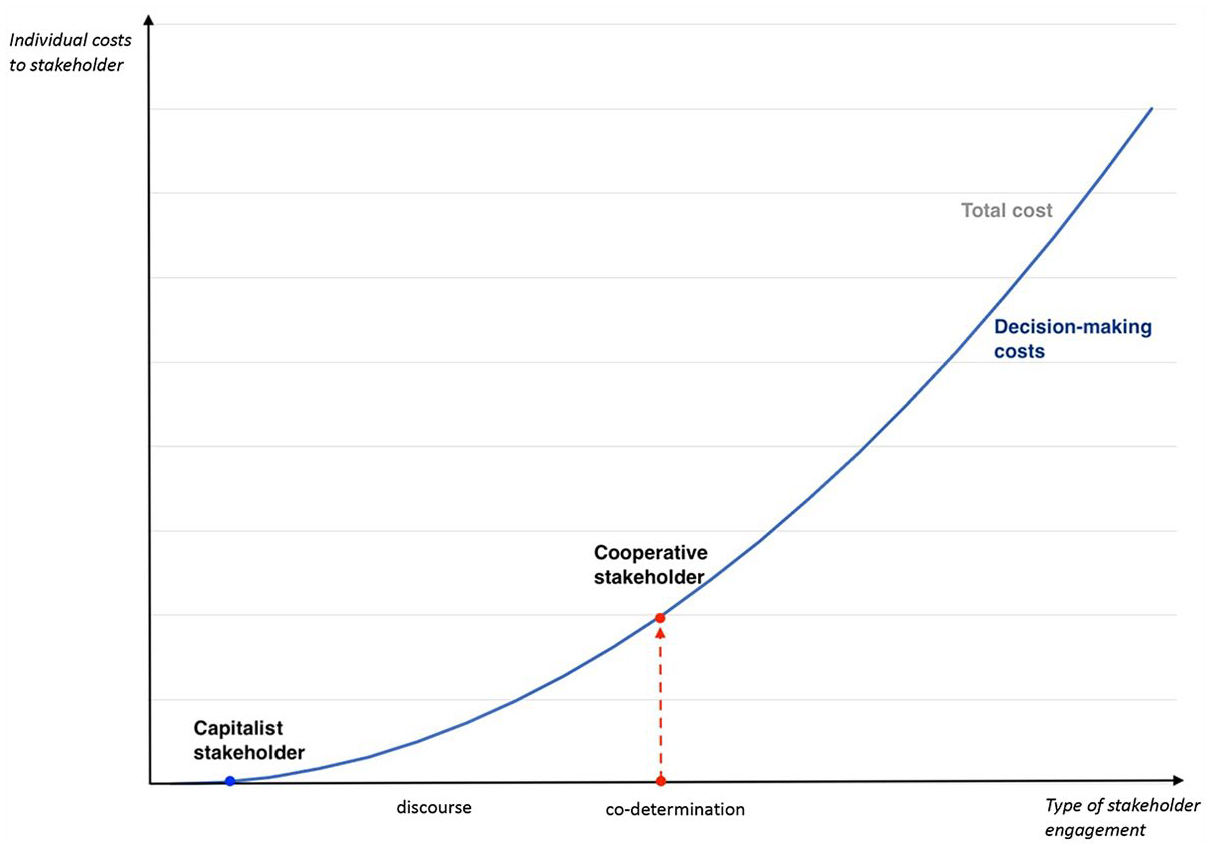
Individual Costs to Stakeholders in Environments With High Levels of Exit Options.
The conditionality of the cooperative form cuts across two variants of democracy, which Hielscher and colleagues (2014) label type I and type II democracy. Type I democracy is the degree to which a stakeholder is given voice in an organization (ranging from less formally binding types of dialogic exchange to more stringent types like co-determination), while type II democracy refers to the consent that stakeholders give to the meta-process of organizing, and thus whether they are satisfied. Concerning the conditionality of cooperative enterprises, in the sense of type II democracy, stakeholders only consent to voice options if the market does not provide for exit options. If there are valuable exit options in the market, stakeholders may consent to the capitalist form of organizing, without desiring the costly voice option. The burgeoning research on democratizing stakeholder relationships does not always take account of this factor (Sabadoz & Singer, 2017). Stakeholders who are stuck in cooperative organizations face higher individual costs, and thus cooperatives are less effective than non-cooperatives in protecting stakeholder interests. This reasoning leads us to our first proposition:
Proposition I: When there is one or more valuable exit option for stakeholders, cooperatives are less cost-effective for stakeholders than their capitalist counterparts. Hence, the value of the voice option depends on the value of the exit option(s), such that the value of the voice option decreases when the value of the exit option(s) increases.
2
Building on this proposition, our next propositions are based on instances in which cooperative stakeholders may be better off than their capitalist counterparts by combining voice and exit options.
Crises, Managerial Discretion, and Sudden Reductions in (the Value of) Exit Options
The Neglected History of Cooperative Resilience
Although cooperative stakeholders seem worse off than their capitalist counterparts in competitive markets, a rich literature maps cooperative organizations’ superior resilience and their stakeholders’ privileged positions in times of crisis, as recently illustrated by the COVID-19 pandemic (Billiet et al., 2021). Several empirical studies point to consistently higher survival rates of cooperatives compared with other organizational forms, and a more educated and productive workforce throughout the organization’s lifespan (Monteiro & Stewart, 2015). For example, Núñez-Nickel and Moyano-Fuentes (2004) show that agricultural cooperatives may be more likely to survive than other organizational forms in any economic context. Furthermore, while market instability causes unemployment peaks for capitalist enterprises, cooperative enterprises are credited with providing their employees with better job security than their non-cooperative counterparts (Cheney et al., 2014; Ingram & Simons, 2000). For instance, Carini and Carpita (2014) observe that employment in cooperatives in an Italian industry increased by 2.3% during the financial crisis (between 2008 and 2010), in contrast to a 4% decrease in employment in corporations in the same sector. Similarly, in Uruguay more stable employment has been mapped in cooperatives during crises (Burdín & Dean, 2009). Cooperatives may also impact less negatively on their surrounding social ecosystems in times of crisis, partly by lowering unemployment (Basterretxea et al., 2022). According to Stiglitz (2009), in requiring interactions between stakeholders and organizations, cooperative stakeholders’ voice options reduce information asymmetries, shielding them from exploitation (Stiglitz, 2009). Fiordelisi and colleagues (2022) confirm this reasoning in their quantitative study, showing that more overlap between stakeholders in banks reduces asymmetric information between borrowers, depositors, and shareholders, which leads to greater stability. Similarly, Cheney and colleagues (2014) find that easing information asymmetries facilitates fairer treatment of stakeholders and distribution of rents in cooperatives, resulting in stronger stakeholder bonds.
Co-Determination in Times of Crisis
For both cooperative and capitalist stakeholders, external crises often diminish the available exit options in the market because demand for products and services suddenly decreases (Eggers, 2020). 3 Stakeholders who are protected only by exit options are at serious risk, as explained in Figure 3, because alongside the sudden decrease in exit options, exploitation costs suddenly increase, and cooperative stakeholders are left with higher total costs than the premiums they normally pay. Figure 3 portrays this dynamic along the y-axis, showing that individual stakeholders’ potential costs of exploitation increase significantly due to the diminished value of exit options in times of crisis. 4
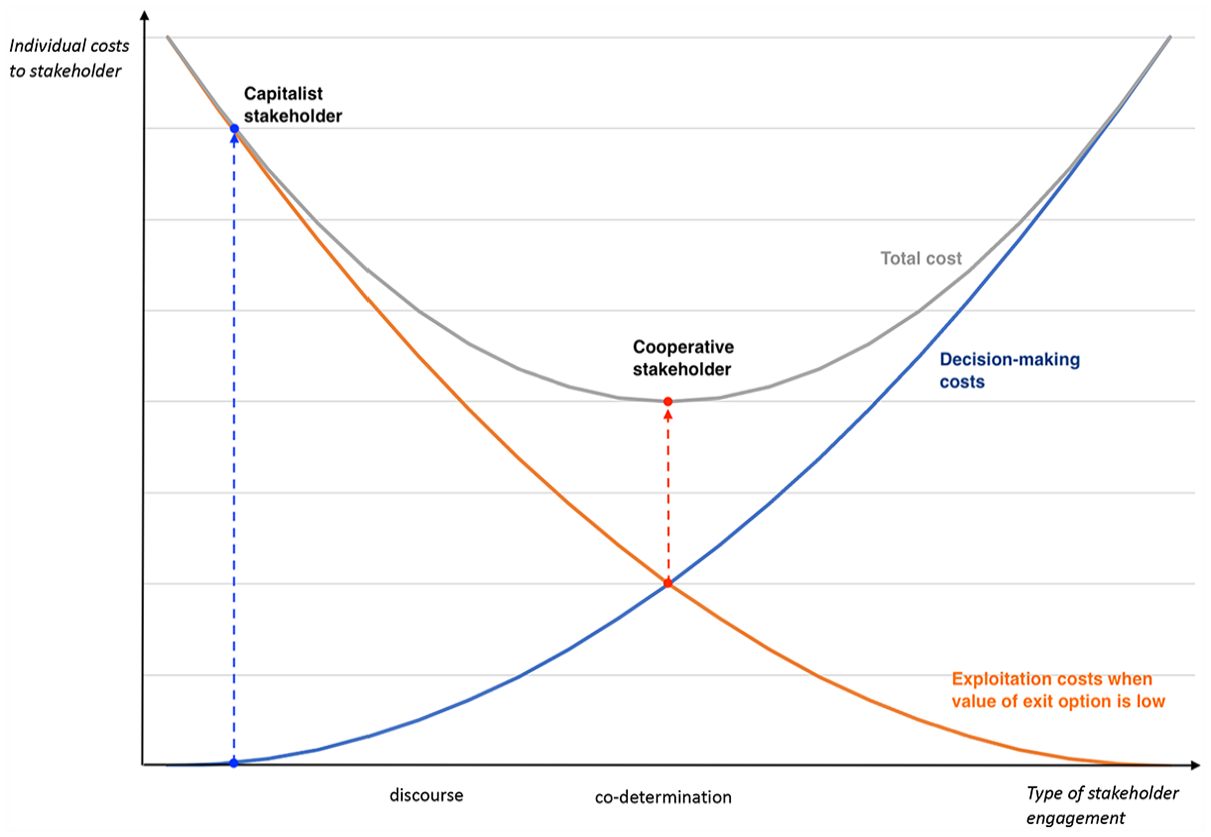
Individual Costs to Stakeholders in Times of Crisis.
The subtle but crucial difference between co-determination and dialogic exchange explains why voice options favor cooperative over capitalist stakeholders. 5 Co-determination offers accountability and confines the managerial scope of decision-making and hence acts as a substantial check on strategic decisions in favor of users of the cooperative. However, little research has considered situations in which stakeholder embeddedness is fragile, temporary, and dependent on external factors, as is the case for stakeholder engagement arrangements based on dialogic exchange. Carl Schmitt notoriously observed that in times of crisis, even the strongest institutional arrangements can be usurped by whoever has the last decision (Agamben, 2005). Following this logic, during crises, stakeholder engagement practices become superfluous, and managerial attention will be drawn to dominant stakeholders, who will try to minimize costs (Mitchell et al., 1997) by exercising exit threats or pulling out financial resources (Noorman et al., 2017). This causes managers to cherry-pick among stakeholders and satisfy the value requirements of those who appear most powerful at that moment (Banerjee, 2010). In most cases, it is the shareholders who hold this type of power (Mitchell et al., 1997).
Crises steer firms toward a narrower stakeholder orientation, thereby maximizing the benefits and well-being of a single stakeholder group. In the absence of co-determination by a stakeholder group playing multiple stakeholder roles, managerial discretion is broad (Finkelstein & Peteraf, 2007; Phillips, 2011), providing managers with more latitude in strategic options (Hambrick & Finkelstein, 1987). This affects how resources are allocated between parties jointly coordinating their actions (O. E. Williamson, 1963). Stakeholder engagement practices based on dialogic exchange are thus a double-edged sword: on one hand, they create arrangements for value negotiation between stakeholders that may prove beneficial for stakeholders even under authoritarian leadership (Krüger, 2023); on the other, they quickly destroy arrangements to favor the most powerful, jeopardizing the joint-value creation project. Adding accountability, as the principle of co-determination does, is one way to rob engagement practices of their voluntary nature (Cooper & Owen, 2007). Thus, external crises negatively affect stakeholders who are protected only by dialogic exchange, bringing us to our second proposition:
Proposition II: In times of external crises, cooperative stakeholders are better off than their capitalist counterparts.
Stakeholder Engagement and Negotiation of Noneconomic Value
Cooperatives and Use-Transactional Relationships
Although we believe that society has an interest in stabilizing stakeholder relationships in times of crisis, we do not claim that individual stakeholders deliberately choose for cooperative vehicles to be protected against exploitation at such times. The relatively low proportion of worker cooperatives in Western European regions, for instance, can be explained by the higher short-term gains obtained by stakeholders through higher wages in capitalist firms. However, conversely, the relatively fast growth of worker cooperatives can be explained by the noneconomic returns received by workers from cooperatives, such as employment stability and the right to participate (Clemente et al., 2012). We deploy several cases (Siggelkow, 2007) to illustrate that cooperative stakeholders are willing to accept voice options in addition to exit options in pursuit of noneconomic value.
In cooperative terms, cooperative purpose is often referred to in terms of use-transactional relationships because members primarily derive utility from cooperatives, rather than economic returns (Nembhard, 2002). For example, renewable energy cooperatives are a recent phenomenon that emerged from the premise that citizens are unsatisfied with how their energy is produced. Despite the presence of competitive energy markets providing cheaper energy, these cooperatives seek to provide energy that is locally and sustainably sourced (Bauwens, 2016). In other words, consumers pursue additional noneconomic value for products they could easily obtain from traditional market players. Mitzinneck and Besharov (2019, p. 384) illustrate how the voice mechanism in renewable energy cooperatives allows cooperative stakeholders to reach consensus on the values pursued, “irrespective of their individual equity share.” A second illustration comes from consumer cooperatives, and specifically cooperative supermarkets, in which members secure greater transparency in the food chain and a say in retailers’ internal organization, two values that even organic supermarkets do not always offer, even though they are not necessarily more expensive (Gauthier et al., 2019). Finally, worker cooperatives emerge when laborers prefer to re-invest capital into better current and future working conditions, rather than transferring residual profits to investors (Landemore & Ferreras, 2015), even if the wages of the highest performers turn out to be lower (Young-Hyman et al., 2023). Similarly, despite higher wages elsewhere, Bastida and colleagues’ (2022) recent study shows that members join worker cooperatives primarily for the two noneconomic values of equality and participatory governance to co-define the cooperative mission. Some workers simply want greater transparency in the organization’s management (Bathurst & Monin, 2010). While it is by no means argued that stakeholders generally favor noneconomic over economic value, our intention is to show that if stakeholders do so, then voice options are crucial mechanisms to safeguard these requirements, as outlined below.
Stakeholder Engagement and Different Value Requirements
Shareholders generally adhere to economic value, which is easily accessible and objectively measurable (Jensen & Meckling, 1976), whereas stakeholders’ noneconomic value requirements tend to be neither homogeneous nor easily quantifiable. These characteristics of noneconomic value make it difficult for managers to make trade-offs between the demands of different stakeholder groups (E. Freeman, 2010). This has given rise to a growing body of empirical work that maps the prevalence of stakeholders’ noneconomic value requirements. For example, consumers are increasingly paying attention to the social (Amis, Mair, & Munir, 2020; Crane et al., 2022) and environmental (Wright & Nyberg, 2017) flipsides of the products they buy, despite the availability of cheaper alternatives on the market. Similarly, employees are increasingly seeking job satisfaction beyond monetary value, such as work–life balance (Haar et al., 2014), long-term employment (Failla et al., 2017), and safety (Sherman et al., 2008).
The managerial perspective of stakeholder theory posits that managers should satisfy the various value requirements of stakeholders, and not only their economic value requirements (Harrison & Wicks, 2013). In this respect, a key contribution of the engagement perspective of stakeholder theory is that, given its heterogeneous and blurred nature, noneconomic value is best arrived at through permanent dialogue between stakeholders, rather than allowing the managerial perspective to get in the way (Amis, Barney, et al., 2020). Recognizing that noneconomic value is subjective, these dialogues should be firmly connected with appreciation of the stakeholders themselves (Bacq & Aguilera, 2022), almost unavoidably drawing on voice options as crucial safeguards in negotiating this value, especially when multiple values are involved (Battilana et al., 2022). Engagement practices in capitalist firms generally consist of spaces that allow dialogue between stakeholders to better align multiple and sometimes competing interests (Calton & Payne, 2003). These spaces vary in shape (Litrico & Besharov, 2018) and include “spaces of negotiation” (Battilana et al., 2015; Haug, 2013; Jarzabkowski et al., 2015; Kellogg, 2009), “herding spaces” (Litrico & Besharov, 2018), and “materiality analyses” (Cooper & Owen, 2007; Khan et al., 2016). We see the rise of such spaces of dialogue as part of a broader development of stakeholder inclusion in the decision-making process.
The functionality of stakeholder engagement practices has been widely discussed (Kujala et al., 2022), and many purported advantages have been described. For instance, vehicles for stakeholder engagement improve reciprocal understanding of stakeholders and their differing value requirements (Battilana et al., 2015; Polletta, 1999, 2014). Even real-life interactions, where people meet physically to establish social relations, help to construct common objectives (Haug, 2013): by getting together and discussing, stakeholders develop increased awareness of their interdependence in the process of joint-value creation (Ometto et al., 2019). Stakeholder engagement practices also allow exchanges of information on the utility functions of different stakeholders, enabling managers to better map their value requirements (Harrison et al., 2010), and facilitating their inclusion (Ometto et al., 2019). In their most advanced form, stakeholder engagement practices may act as facilitators of inclusion, because they embed the enterprise in a culture of conferences, overarching projects, and other initiatives that help supervise its direction and prevent the practices from degenerating (Ometto et al., 2019, p. 1035). Such efforts may go far and deep, and may strengthen competitive advantage and organizational sustainability in the long run (Rodriguez-Melo & Mansouri, 2011).
Dialogic Exchange or Co-Determination
For cooperatives, governance arrangements that steer the creation of noneconomic value are well-documented and deeply connected with the principle of co-determination. For example, Peredo and colleagues (2018) show how the indivisible ownership structure over which cooperative stakeholders have voice options decommodifies resources and restores their use-value, and hence concentrates economic resources in creating social value in ways that standard market forces do not. Similarly, the participative nature of collective governance arrangements has been shown to effectively steer organizations toward social or environmental value (Peredo & Chrisman, 2006). Haugh (2007) theorizes that stakeholder reflection is an essential ingredient for deciding firms’ strategic direction and value creation, and Di Domenico and colleagues (2010) illustrate how stakeholders’ continuous involvement in firms’ governance is crucial to defining what social value is created. Similarly, the accountability mechanism inherent in democratic representation is key to ensuring that cooperatives stick to their social mission (Ebrahim et al., 2014). Synthesizing several elements of governance, Ramus and Vaccaro (2017) show that engaging with stakeholders combined with the accountability mechanism is most effective for defining and embodying social value. However, unlike cooperatives which have democratic governance formally embedded in their legal form, engagement mechanisms in capitalist firms are based mainly on dialogic exchange rather than co-determination.
The accountability mechanism gives rise to an important difference between cooperatives and their capitalist counterparts. Although stakeholder engagement may take many forms, ranging from shareholder- to stakeholder-oriented practices, the literature suggests that without an accountability mechanism, discretion to define stakeholder strategy still belongs largely either to managers (Boesso & Kumar, 2016; Cooper & Owen, 2007) or to powerful stakeholders such as shareholders (Bridoux & Vishwanathan, 2018). In other words, despite empirical work mapping the purported benefits of embedding stakeholders in wider dialogues surrounding the organization, much stakeholder engagement remains a matter of strategic choice, and the value propositions resulting from dialogic exchange therefore seem to depend on managerial goodwill. For example, Noorman and colleagues (2017) show that stakeholder inclusion is deliberately balanced and restricted, making stakeholder relationships and their noneconomic value requirements relatively fragile. When managers in capitalist firms take decisions based on value distribution, their discretion allows them to prioritize or make trade-offs between the interests of primary stakeholders (O. E. Williamson, 1963).
Engagement Practices as a Strategic Choice
Originating as an enabler of a thicker kind of capitalist organizing, stakeholder theory was initially conceived as a managerial practice that depends largely on managerial choice (Kujala et al., 2022). Stakeholder theorists appreciate that managers consider dialogic exchange with stakeholders as a cost, because sharing power and uniting multiple objectives is potentially dangerous for the organization (Bosse & Coughlan, 2016; Bosse et al., 2009; Hansmann, 1999; Jensen, 2002; Mitchell et al.,1997, 2016) and stakeholder engagement to obtain information about their utility functions requires time and resources (Hall & Vredenburg, 2005). The more time and effort invested in engaging with stakeholders to identify their noneconomic value requirements, the higher these costs for the company (and hence for other stakeholders, such as shareholders), and the less likely that managers will be willing to pursue them. This contrasts with the logic of shareholder value, which offers managers an easily accessible shareholder utility function. Conversely, when managers engage in more inclusive decision-making, stakeholders face less risk of exploitation. After all, engagement ensures that the interests of various stakeholders are better taken into account (Wicks & Freeman, 1998). Although this is a balance that stakeholder capitalism attempts to achieve, inclusive managers leave stakeholders in a fragile position because managerial decision-making is subject to changeable internal and external circumstances (Wangrow et al., 2015).
Figure 4 illustrates the pursuit of noneconomic value. It pictures a dynamic along the x-axis, in which engagement with stakeholders increases in capitalist firms, enabling stakeholders to enforce their noneconomic value requirements and thereby reducing the potential costs of exploitation. However, this raises the costs of decision-making for stakeholders in capitalist firms, which brings us to our third proposition:
Proposition III: When pursuing non-economic value, stakeholders in cooperatives are better off than stakeholders in capitalist enterprises.
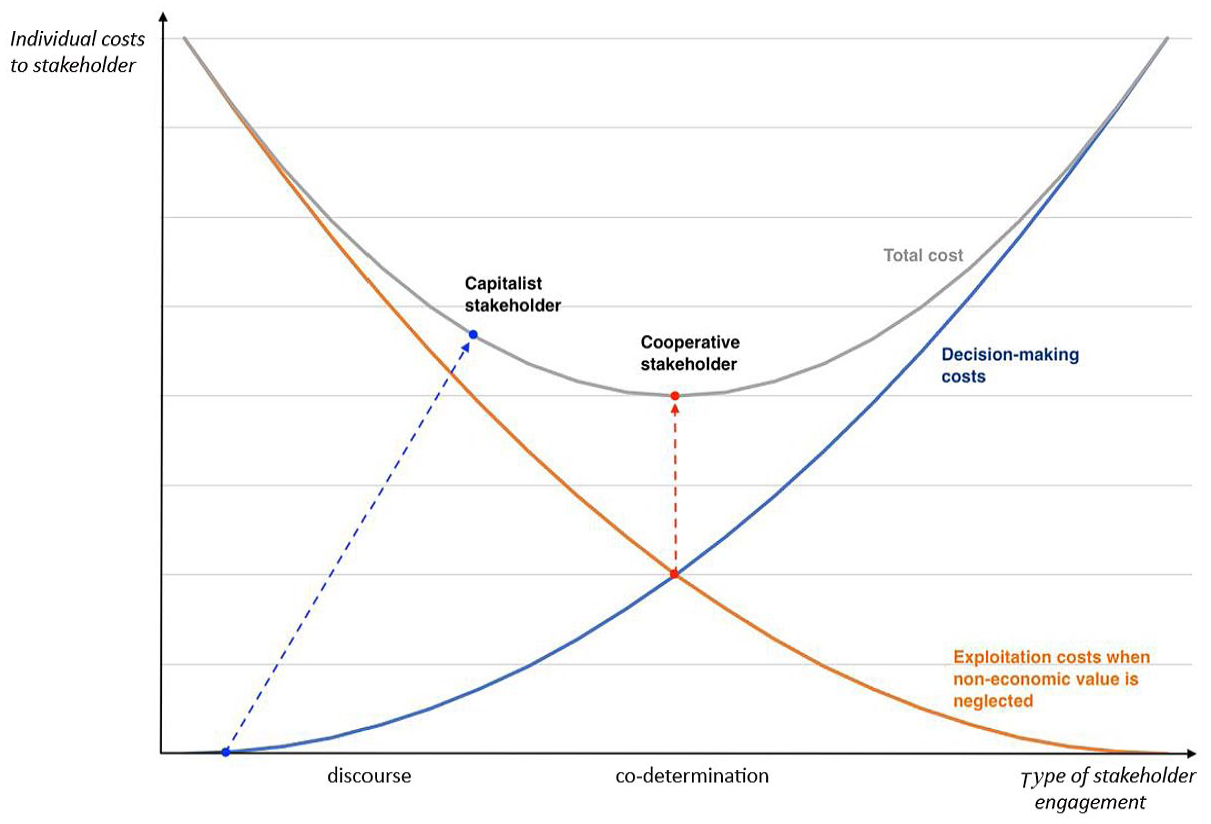
Individual Costs to Stakeholders, Taking Noneconomic Value Into Account.
In this section, we have discussed situations in which stakeholders’ costs are lower in cooperatives than in capitalist firms. Next, we refine these propositions by discussing two boundary conditions from the perspectives of cooperative and capitalist firms. In cooperatives, complex governance structures significantly increase the costs of decision-making for stakeholders, whereas in capitalist firms, formalization of dialogic exchange better protects stakeholders’ interests.
Heterogeneity, Efficiency, and Engagement
Democratic Failure in Cooperatives
Although we propose that voice options in cooperative decision-making generally reduce managerial discretion in favor of noneconomic value propositions, Figures 2 to 4 also illustrate that voice options that translate into overly complex governance arrangements increase decision-making costs. In any of these figures, this would mean a shift to the right on the x-axis. The literature identifies two fatal directions, resulting from too many overly complex stakeholder engagement practices on one hand, which we call managerial capture, and Babylonian confusion on the other. Regarding managerial capture, it has been argued that democratic organizations such as cooperatives may be subject to the iron law of oligarchy (Diefenbach, 2019), which tends to concentrate power in the hands of a few managers. While this trajectory is a possible path rather than an unescapable “law” (Diefenbach, 2019), oligopolistic boards easily cause cooperatives to drift away from their social objectives, often catalyzed by a persistent lack of member participation (Cechin et al., 2013; Österberg & Nilsson, 2009; Ruiz Jiménez et al., 2010). For instance, this may occur in large cooperatives in which only a few members are elected to represent a geographically dispersed group of members, as is the case for many agricultural cooperatives (Birchall, 2017). Interestingly, oligopolistic boards do not necessarily originate from lack of democratic procedures. Rather, the multitude of roles expected of members, and the various layers of democratic decision-making through which they have to navigate cause a lack of interest among members, which may lead to oligopolistic boards favoring individuals who manage this navigation better, while others “give up” (Fulton & Adamowicz, 1993). In a case documented by Barros and Michaud (2019), a large Canadian cooperative was captured by a managerial elite who took decisions that caused the cooperative to drift away from its mission, without being held accountable because they managed to bypass the formal structures of governance. Another, more specific case of managerial capture is where worker cooperatives’ recruitment policies fall prey to nepotism, leading to less competent and skilled workers, and thereby lowering the firms’ overall productivity (Basterretxea et al., 2019). Overinvestment in family relations and underinvestment in (social) capital are facilitated by dysfunctional decision-making structures that allow members to push hiring of family members and friends, regardless of their fit for the job. In summary, in the face of increasing heterogeneity, cooperative research has shown that the influencing and coordination costs of keeping managers and decision makers in check may increase to such an extent that governance failures occur (Iliopoulos & Hendrikse, 2009).
Babylonian confusion occurs when the multitude of roles and layers of decision-making do not favor a single managerial elite, but create a governance system that produces inconsistent decisions and sometimes can no longer produce strategic actions. Basterretxea and colleagues (2022) show how cooperative structures of decision-making may lead to too much discussion, which fosters slow decisions and unclear conclusions, and may lead cooperatives into bankruptcy. This worsens with increasing numbers of stakeholder groups or increasingly heterogeneous stakeholder interests. Studies also document that cooperatives may struggle to homogenize their members’ interests, and that democratic decision mechanisms, such as voting, may have to be canceled to avoid division among members (Soetens & Huybrechts, 2023). Other cooperative governance techniques, such as inverse hierarchies, have been shown to compromise the social value creation of worker cooperatives, resulting in low job satisfaction and disengagement (Basterretxea et al., 2019).
Our contention is that these decision-making costs and inefficiencies, which may result from organizing around voice options, are particularly high when complex design principles are combined, and especially in so-called multistakeholder cooperatives that combine more than two categories of stakeholders (Leviten-Reid & Fairbairn, 2011), owing to fundamentally divergent interests among different stakeholder groups (Thomas, 2004). This increases conflict between stakeholders and slows strategic decision-making (Hansmann, 1988; Pozzobon & Zylbersztajn, 2013), leaving cooperative stakeholders worse off than their capitalist counterparts. Thus, the first principle of our fourth proposition is:
Proposition IVa: The comparative advantage of cooperatives for stakeholders is lower when the complexity of engagement practices increases.
Formalizing Dialogic Exchange in Capitalist Enterprises
We note that the cooperative form is conditional and becomes obsolete when stakeholders find substitutes in the market (Spear, 2000). However, we also propose that dialogic exchange is not necessarily a valid substitute for co-determination rights when it comes to crises and sustaining noneconomic value because it lacks the principle of accountability (Cooper & Owen, 2007). Various governance arrangements have been developed that compete with cooperatives’ co-determination rights and steer organizations toward formalizing dialogic exchange. Among these are Germany’s co-determination laws, which require companies with more than 500 employees to let them elect at least part of the supervisory board of directors, thereby severely narrowing the scope for managerial discretion by adding an element of accountability (FitzRoy & Kraft, 1993). While these rights do not necessarily increase firms’ democratic capacity (Roe, 2000), statistical analyses of such cases show that stocks are valued less by shareholders, but employees enjoy longer and more stable periods of employment, as well as other noneconomic values (Gorton & Schmid, 2004). Similarly, unions around the world attempt to satisfy employees’ value requirements. While obvious synergies are expected, labor unions are unsurprisingly often considered to be in competition with worker cooperatives because both strive to accomplish the same needs but may do so at different individual costs to stakeholders (Monaco & Pastorelli, 2013, p. 184). Finally, far-reaching corporate social responsibility (CSR) approaches toward incorporating stakeholders into the decision-making process explicitly pursue the creation of noneconomic value (Bacq & Aguilera, 2022). This is illustrated in the recent transformation of Patagonia, which has been made accountable to a trust that seeks to pursue environmental value (Ind & Iglesias, 2022). Along similar lines, Battilana and colleagues (2022) argue that formalizing spaces of negotiation is key to protecting stakeholders’ interests. Some engagement practices are mandated by law, while others are voluntary or follow an evolving institutional path. We contend that the conditionality of cooperatives also applies to the provision of noneconomic value, which brings us to the second principle of our fourth and final proposition:
Proposition IVb: The comparative advantage of cooperatives for stakeholders is lower when the accountability of engagement practices in capitalist firms increases.
Discussion and Conclusion
Our study has produced several propositions that theorize the use of voice options beyond their common conceptualization as tools to protect only against exploitation in asymmetric markets. First, we have argued that cooperative stakeholders may be better off than their capitalist counterparts in times of crisis because sudden reductions in exit options leave capitalist stakeholders unprotected by voice, fragile, and dependent on managerial goodwill. Second, voice options in cooperatives are crucial tools enabling stakeholders to negotiate and claim noneconomic value because co-determination makes managers accountable to cooperative stakeholders, which dialogic exchange in capitalist firms is not always able to deliver effectively. Finally, we have nuanced our propositions by zooming in to the dark side of cooperative governance, where governance arrangements may grow so complex that exceedingly high decision-making costs lead to either elite capture or inconsistent decision-making. In either instance, capitalist stakeholders may be better off, especially when conventional stakeholder engagement improves, formalizes, and yields better results at lower cost. Although our theorization takes only a first step toward unraveling the function of stakeholder engagement practices in a society that increasingly expects resilient stakeholder relationships and generation of noneconomic value (Battilana, 2018), we make some important contributions for theorists and practitioners seeking to advance knowledge of stakeholder engagement and democratic governance.
First, our work provides a rationale for conceptions of cooperatives as less-efficient organizations (Heath, 2011) that nevertheless outlive their capitalist counterparts in various sectors, especially in times of crisis. Several previous studies explain cooperative enterprises’ high survival rates, especially during crises, by referring to their apparently strong stakeholder relationships (Birchall, 2012; Birchall & Ketilson, 2009; Boone & Özcan, 2014; Forcadell, 2005; Novkovic, 2008; Roelants et al., 2012; Schneiberg et al., 2008). In our study, we use stakeholder theory as a “heuristic” (Cheney et al., 2014) to trace these strong relationships back to the principle of co-determination, under which managers are compelled to take account of the interests of what stakeholder theorists would label multiple stakeholder categories. Curiously, cooperatives are far from the only vehicles characterized by overlapping stakeholders. Employees are also citizens of communities affected by crises, and financiers and managers are very often customers of their own organizations. The sum of these overlapping relationships is important at a societal level because, for instance, unemployment arising from a crisis also affects the communities in which employees live. Thus, resilient stakeholder relationships may have less negative spillover effects on society during crises. In this respect, Holt and Greenwood (2012) call the negative externalities for stakeholders following the 2008 financial crisis a “negative trickle-down” effect, and Joseph Stiglitz once referred to cooperatives as being an alternative to the predicate of trickle-down economics, because sustainable stakeholder relationships have positive spillovers in society (Voinea, 2016).
Second, since noneconomic value is neither interchangeable nor easily measured, we contribute to the stakeholder engagement literature by positing that voice options are more effective in negotiating noneconomic value requirements than leaving such assessments to managers. Within the broader governance literature, stakeholder governance arrangements remain undertheorized because they are considered mainly as functioning for the creation of economic rather than social value (Bacq & Aguilera, 2022). Several authors openly question what makes stakeholder engagement practices create and define value effectively (Banerjee, 2008; Kujala et al., 2022; Myllykangas et al., 2010; Passetti et al., 2019), and others note that the managerial perspective on stakeholder engagement often stands in the way of effective mapping and weighing of different stakeholders’ noneconomic value requirements (Amis, Barney, et al., 2020). Our analysis suggests that co-determination in cooperatives favors the use-transactional relationships that stakeholders long for, because voice options compel managers to assess stakeholders’ utility curves, which is necessary to uncover their subjective and nonquantifiable value requirements. While use-transactions in cooperatives are often narrowly defined in terms of social value, at a societal level we find myriad noneconomic value requirements that deserve greater attention, such as environmental responsibility (Wright & Nyberg, 2017) and work–life balance (Haar et al., 2014), which voice options may benefit.
Finally, we offer an important insight that flows directly from our last proposition, which is critical of the functionality of cooperative voice options. Stakeholder governance is often compared with and nudged toward formalized democratic governance (Battilana et al., 2022; Diefenbach, 2020; Felicetti, 2018; Hahn & Weidtmann, 2016; Moriarty, 2014; Turnbull, 1994). However, our lens is broader and more nuanced than stakeholder democracy accounts that regard democratic decision rights as the only logical conclusion of stakeholder theory (Moriarty, 2014). As our visualization of its function and cost suggests, stakeholder engagement is not functional under all circumstances, and its dark side may lead to undesirable outcomes (Hielscher et al., 2014; Kujala et al., 2022; Sabadoz & Singer, 2017). We have carefully considered the circumstances of crises and noneconomic value to account for the additional functionality of voice options in which, in the language of Hielscher and colleagues (2014), more type I democracy leads to more type II democracy. However, our proposition also suggests that circumstances alone are insufficient to explain the value of voice options. Excessive decision-making costs may also be the result of how stakeholder governance is designed, such as overly complex processes or unclear role assignments. A recent longitudinal study demonstrates that in competitive markets, worker cooperatives may even outperform their capitalist counterparts in generating economic value, as well as providing social benefits (Young-Hyman et al., 2023), suggesting that there are no trade-offs between the two as a result of effectively designed decision-making processes. In a similar vein, Boone and Özcan (2016) find that higher survival rates are possible if high coordination costs in cooperatives are compensated for by sufficient engagement of founding members, which must be well-organized and maintained. We sympathize with critical examinations (Sabadoz & Singer, 2017) of the burgeoning interest in stakeholder democracy literature (Landemore & Ferreras, 2015). However, we contend that this debate too often takes decision-making costs as unchanging and that the time has come to take this debate a step further. Thus, our future research agenda focuses on how voice options are designed.
Future Research Avenues and Boundary Conditions
Cooperatives are no magic cure-alls and do not guarantee a failure-free trajectory for stakeholders. To develop our theoretical consideration, we make several assumptions that confine the reach of our framework. While discussion of the resulting boundary conditions is beyond the scope of this article, they form a basis for future research. We suggest two avenues relating to technical aspects of our theorization, and one more substantial avenue grounded in deeper reflection on the implicit assumptions ingrained in our line of argumentation.
First, we take the cooperative organization as a vehicle through which to develop our arguments, and extend this to a simplified conception of the capitalist enterprise. Organizations come in many shapes and colors, with subtle but sometimes significant differences in the set-up of their property and decision-making regimes, including in noncooperative organizations (Fici, 2013). Stoelhorst and Vishwanathan (2024) have recently theorized property rights as effective ways to hold managers accountable, but for many social enterprises and cooperatives, property rights function very differently. For instance, social enterprises, ranging from low involvement for-profit enterprises to fully democratic not-for-profit enterprises, often employ formalized voice options to involve stakeholders in shaping the organization, but do not grant property rights (Mason et al., 2007; Serres et al., 2022). Systematic comparisons of organizational forms may generate insights into which internal organizational factors define managerial behavior and discretion (Hambrick & Finkelstein, 1987; Mintzberg, 1973). 6 In addition, in cooperatives and other collective enterprises, property rights are often nontransferable (Ostrom, 2000), and in family firms, similar restrictions have been observed (Sund & Bjuggren, 2007). Research on underlying transactional problems and their corresponding governance arrangements is therefore necessary to nuance the validity of our propositions, and to arrive at a theory to refine the phenomenon of voice options into complex “bundles of rights” that better reflect the multidimensionality of ownership and decision rights in all sorts of organizations (Peredo et al., 2018, p. 592). Revealing insights might be extracted from case studies focusing on cooperatives that develop into capitalist firms, or vice versa (Bathurst & Monin, 2010).
Second, our study does not consider in detail how voice options are translated into actual mechanisms of governance. A long-standing stream of literature has mapped various types of decision-making, revealing a rich tapestry of methods and traditions that operate according to a variety of design tools (Fung, 2006). While this stream is often dispersed, we hope that our theory might act as a compass to direct researchers to find techniques that lower the cost of decision-making and maximize the purported benefits of voice options for society, and for stakeholders who find themselves in the circumstances we have outlined. In this respect, to refine our argument, research would be most welcome on governance innovations designed explicitly to decrease decision-making costs. These might include the recent appearance of random selection rather than election of representatives in cooperatives (Pek, 2019), use of deliberative mini-publics to increase member engagement in cooperatives (Pek, 2023), and variations in board composition (Zattoni & Pugliese, 2019), as well as research that better maps failures resulting from badly designed governance arrangements or external pressures (Basterretxea et al., 2022). While empirical work on these mechanisms is vital, we also need concepts and measures that assess the quality of such innovations. For example, Bacq and Aguilera (2022) distinguish between discursive and correctional processes in governance arrangements, which each serve different purposes in creating noneconomic value.
Third, and perhaps most importantly, although the economic logic deployed throughout our theorization enables us to see clearly through the jungle of stakeholder engagement literature, we are aware that we have been looking at it from only one angle, grounded in assumptions that, despite our efforts, might not reveal a complete picture (Ghoshal, 2005). To fully determine why organizations engage with stakeholders, future research might adopt additional perspectives that challenge our own. For instance, we have viewed important concepts such as noneconomic value and resilience in times of crisis through the eyes of homo economicus, but critical readers might object that stakeholder engagement is not simply about weighing up costs, and that stakeholders do not necessarily consciously calculate. As a result, since our propositions depend heavily on the type of stakeholder or cooperative we envisage, which are often oversimplified in this article, we believe that different stakeholder relationships might be more fully explored using behavioral spin-offs of stakeholder theory (Bridoux & Stoelhorst, 2022b). Similarly, while we theorize from a rather liberal perspective the circumstances in which it is functional to have exit and voice options simultaneously, scholars might want to investigate empirically what reasons stakeholders actually express for joining cooperatives or wanting voice options, other than calculative reasons. Important frameworks that might help gain a better understanding of these reasons are those drawing on legitimacy, discourse, or even different ideologies (Banerjee & Bonnefous, 2011; Luyckx & Janssens, 2020).
Next, we implicitly assume that formalized accountability is paramount for keeping managers in check. However, we do not consider whether the phenomenon of trust and its antecedents might be an unexpected substitute (Friedel et al., 2023) because, even for cooperatives, the act of accountability in times of crisis is very difficult (Agamben, 2005). A promising research theme in this respect is how different levels of trust among stakeholders and managers impact on organizations’ strategic decisions in times of crisis.
Last, and perhaps most thought-provoking, even after formulating our propositions, we still assume that voice options remain conditional and lose their function whenever the environment offers substitutes. However, the reality of the last couple of decades might prompt us to reconsider this viewpoint. If instability and crises are becoming the new centers of gravity in our world (Biggs et al., 2011), why do we still tailor the normal in terms of the exception? Positing that exit options, not voice options, are conditional would require a paradigm shift, and might perhaps be a bridge too far. However, we hope that our research might also inspire those wishing to explore the extent to which stakeholder engagement (and the democratization of the firm) is or is not conditional.
Footnotes
Acknowledgements
The authors wish to thank several people for their support in developing our manuscript. First, they thank Coline Serres and Sylvia Dorado for their careful revision of their first draft during the SEE conference, and similarly to all participants and organizers of the 2022 Seminar in Stakeholder Theory at the Darden School of Business. Next, they thank Guido Palazzo, Luc Sels, Stefanie Friedel, and Jozef Cossey for their thought-provoking comments on their propositions. Very importantly, they thank practitioners, Lieven Vandeputte and Hannes Hollebecq from the Cera cooperative, for frequently acting as a sounding board in the development of their ideas. Finally, they are very grateful to their editor, Matthias Wenzel for his excellent guidance along the way, and three anonymous reviewers from whom they have received the most constructive feedback.
Authors’ Note
Frédéric Dufays is now affiliated to HEC Liège-ULiège, Liège, Belgium.
Declaration of Conflicting Interests
The authors declared no potential conflicts of interest with respect to the research, authorship, and/or publication of this article.
Funding
The authors disclosed receipt of the following financial support for the research, authorship, and/or publication of this article: This study was funded by FWO-SB Fellowship Adrien Billiet, grant/award number: 1S95420N; FWO-SBO project, grant/award number: S006019N; and KU Leuven C2-project, grant/award number: C24/18/004.
