




Abstract
Extant research on political corporate social responsibility (PCSR) has not yet addressed how the populist turn impacts PCSR theory and practice. This conceptual article analyzes how populism influences PCSR across a range of political environments. We draw on signaling and screening theories to develop a conceptual model that advances PCSR literature by proposing an information-centric approach. We highlight the necessity of high-quality information as an enabling condition for effective PCSR-related decision-making, and our model explains how the depreciation of information transparency under populism impacts PCSR strategy. We thus contribute to PCSR literature with a new information-based theorization by showing how PCSR depends on the political environment and by enhancing our understanding of the role of the state in the development of PCSR strategies.
The political corporate social responsibility (PCSR) literature has made great progress in articulating the enlarged political role of corporations (Scherer et al., 2016), whereby firms fill critical transnational governance vacuums to compensate for the shrinking role of the state (Matten & Crane, 2005; Scherer & Palazzo, 2011). Habermasian PCSR attributes this shifting political configuration to the “postnational constellation” (Habermas, 2001, p. 58), whereby globalization has accelerated transnational integration and diffused traditional nation-states’ authority. This new political situation has resulted in a globalized society and decentralized governance conditions, with the private sector playing a key role in the development of “new forms of global governance above and beyond the state” (Scherer & Palazzo, 2011, p. 903). To participate in governance processes, Habermasian PCSR advances that firms must be closely attuned to public discourse and engage in public will formation processes via deliberation to establish a discursive link between corporations, civil society, and the state (Scherer & Palazzo, 2011). However, the recent “populist moment” that has been witnessed globally and in a variety of manifestations (Devinney & Hartwell, 2020; Hartwell & Devinney, 2021a, p. 238) disrupts assumptions in the PCSR literature of a globalized society and its reductionist account of the state by pointing to an “inverted postnational constellation” (Azmanova & Dakwar, 2019, p. 494) and new “post globalization” context, focused on national policies and priorities (Flew, 2020, p. 20).
Populism, defined as a political approach that “considers society to be ultimately separated into two homogeneous and antagonistic groups, ‘the pure people’ versus ‘the corrupt elite,’ and which argues that politics should be an expression of the general will of the people” (Mudde, 2004, p. 543), has allowed populist leaders to claim political spaces (Mudde & Rovira Kaltwasser, 2013) and move from the political fringes to positions of power (Peruzzotti, 2017). From a discursive standpoint, populists disseminate mis- and disinformation (Bergmann, 2020; Hameleers, 2020), favor emotional discourse over factual reasoning (Bergmann, 2020; Macagno, 2022), and tend to destabilize information environments. Frequently, these discursive tendencies give rise to polarizing political debates (Müller, 2016) and democratic backsliding (Bauer & Becker, 2020; Peruzzotti, 2017), undermining deliberative democracy through the manipulation and appropriation of the public will (Marxsen, 2019; Sharon, 2019). Such trends can also be accompanied by contempt for intermediaries, such as civil society (Müller, 2016), and can weaken business power by creating suspicion toward a business through blame attribution, framing the private sector as “business elites” who conspire with other corrupted elites to serve their own interests at the expense of the people’s will (Feldmann & Morgan, 2022). Ultimately, populism “creates variance in the belief system of the population via reducing the perceived validity of information sources; and in this manner, existing, entrenched institutions can be subverted or dismissed altogether” (Hartwell & Devinney, 2021b, p. 9).
In many respects, then, populist disinformation and the anti-deliberative sentiment is antithetical to the spirit of PCSR, insofar as it challenges underlying assumptions of rational and inclusive democratic deliberation (Habermas, 1996). Rather it seeks to “actively instrumentalize these very communicative networks” (Azmanova & Dakwar, 2019, p. 499), rendering an “uncivil, illiberal, and one-sided public sphere” (Hameleers, 2022, p. 2).
Insights from the wider populism-business literature recognize that populism can “alter the rules of the game” for business (Hartwell & Devinney, 2021a, p. 248) but have largely focused on the strategic impact and responses of firms (Butzbach et al., 2020; Cumming et al., 2020; Feldmann & Morgan, 2022; Hartwell & Devinney, 2021a) and say little on how it impacts a firm’s social responsibilities. Similarly, while extant PCSR research has acknowledged that populist political shifts can make PCSR even more controversial than before (Korschun & Rafieian, 2019), such research has not substantially addressed how the populist turn impacts PCSR theory and practice. Current scholarship on PCSR has been criticized as being largely based on a passive state thesis (Eberlein, 2019; Kourula et al., 2019; Schrempf-Stirling, 2018) and for failing to consider in depth the role of different political environments (Eberlein, 2019; Korschun & Rafieian, 2019). Therefore, we ask: How does populism impact PCSR strategy across a range of political contexts?
To answer this question, we develop a new theoretical approach to PCSR focused on information quality in different political regimes. Populism as a political approach is strongly dependent on communication, prompting some to even characterize it as a “communication phenomenon” (de Vreese et al., 2018, p. 423). From this perspective, we examine how populist political communication, which is contingent on the use of media to disseminate and give visibility to misinformation, conspiracy theories, and fake news (Bergmann, 2020; Hameleers, 2020) impacts information transparency. By manipulating the quality of information, populist leaders have been able to distort political environments and policy areas and spread suspicion against any views that question populist ideals. Given the centrality of information as the key connector between populists and people, it is reasonable to expect that different types of information are likely to impact the private sector differently, with high-quality information environments leading to better-informed decisions regarding the private sector’s involvement in the public sphere and vice versa.
Therefore, we conceptualize how populist information impacts PCSR by drawing on signaling (Spence, 1973) and screening theories (Stiglitz, 1975). These two theoretical lenses are valuable as they emphasize the role of information asymmetries between two parties (populist actors and firms) and assess their impact on decision-making (Stiglitz, 2002). Subsequently, we develop a new information-centric, conceptual model that offers a nuanced account of how populism shapes PCSR responses in various political contexts.
Our conceptual model shows that democratic political regimes are more likely to be resilient to populist assaults on the information environment, thereby limiting the impact of populism on PCSR strategy. However, in authoritarian and hybrid settings the impact of populism on PCSR strategy is greater. Due to weakened information quality in these settings, firms become reliant on populist state actors for relevant policy-related information and either gradually or outrightly align with populist agendas. In the latter scenario, populism can transform PCSR into a short-sighted and irresponsible approach, potentially leading to “unintended” (negative) consequences (Frynas & Stephens, 2015, p. 483; Korschun & Rafieian, 2019).
Our study makes a theoretical contribution to the PCSR literature in a threefold manner. First, we enhance our understanding of Habermas’s deliberative communication approach in PCSR (Scherer & Palazzo, 2011; Scherer et al., 2016) by proposing an information-centric PCSR approach. We demonstrate how populism contributes to imperfect (unbalanced) information environments and compromises deliberative processes, and we highlight the necessity of high-quality information as an enabling condition for effective PCSR-related decision-making. Second, we develop a populism-PCSR framework that captures populism in different political contexts, namely, democratic, authoritarian, and hybrid. We demonstrate that the notion of “political” in PCSR cannot be used as a holistic, overarching term, but research needs to take a more detailed approach to accurately capture the different ways the private sector addresses governance gaps. Third, we enhance our understanding of the role of the state in the development of PCSR strategies, but via a populist lens, illustrating that states might not necessarily adopt the passive role assumed by previous studies but in fact might actively shape the formation of PCSR strategies.
Theoretical Background
Political CSR: An Evolving Concept
PCSR refers to the broadening role of the private sector’s responsibilities beyond the mere production of goods and services and toward activities previously undertaken by states (Matten & Crane, 2005; Scherer & Palazzo, 2011). According to PCSR scholars, globalization and the prevalence of neo-liberal economic models have weakened the role of traditional nation-states and have given rise to more decentralized governance conditions, whereby private actors can actively intervene in democratic regulation processes and control market transactions (Scherer & Palazzo, 2011). Thus, a “central, yet largely uncontested, assumption in PCSR is that of a zero-sum constellation of substitution between business and the state” (Eberlein, 2019, p. 1126).
Within this shifting landscape, the PCSR argument goes, the private sector has become poised to address pressing global governance vacuums (Matten & Crane, 2005; Scherer & Palazzo, 2011), leading to the private sector’s increased involvement in areas traditionally administered by the government, such as education and health care, human rights, environmental protection, and fighting corruption (Matten & Crane, 2005; Scherer & Palazzo, 2011; Scherer et al., 2016), among others. It is believed that this pursuit of the public interest by corporations is “often with the (explicit) aim of contributing to society or enhancing social welfare,” (Scherer et al., 2016, p. 276).
To achieve this, Habermasian PCSR advocates a “deliberative democracy” model (Habermas, 1996, p. 305) which acknowledges private actor contributions in the political sphere via discursive deliberative processes. It is argued that by engaging in formal deliberation (e.g., via multi-stakeholder initiatives), corporations can engage in public will formation processes to identify political problems and cocreate solutions in cooperation with civil society and state actors (Scherer & Palazzo, 2011). Some scholars contend that such approaches are beneficial for both society and private sector as they contribute toward the realization of common societal interests and grant firms moral legitimacy (Della Porta, 2019; Richter et al., 2021; Scherer & Palazzo, 2011), while others are more critical of the private sector’s enactment of deliberative processes (Rhodes & Fleming, 2020).
In this article, we do not take a prescriptive position on PCSR but rather adopt a descriptive approach that acknowledges that companies are active in such political spaces and that the normative appropriateness of such activity is highly conditional on both the political context and the mode of engagement by companies. Therefore, we adapt Scherer and Palazzo’s (2011) popular PCSR definition to reflect our more agnostic and less normative position to define PCSR as “those business activities that turn corporations into political actors, by engaging in public deliberations, collective decisions, and the provision of public goods or the restriction of public bads.”
An interesting insight from the literature that promises to offer some clarity on the appropriateness of PCSR is the recognition that the political environment could be an important mediating factor in PCSR (Korschun & Rafieian, 2019). Previous studies have established the importance of institutional environments in shaping CSR (Matten & Moon, 2008), but the literature on PCSR has not substantially examined the influence of the political environment. This has led to calls for more contextually situated PCSR research (Scherer et al., 2016), in addition to broader calls to better account for populism within management and business and society research (Cumming et al., 2020; Devinney & Hartwell, 2020). Populism, in this sense, represents a critical context for refining our understanding of PCSR.
The Populist Challenge to PCSR
The literature on populism is burgeoning in light of the current “populist moment” and the increasing number of populist leaders who have boosted their popularity by proposing that society is “ultimately separated into two homogeneous and antagonistic groups, ‘the pure people’ versus ‘the corrupt elite’” (Mudde, 2004, p. 543). Such political approaches have been perceived as a threat to democracy (Müller, 2016; Peruzzotti, 2017) because populists frequently undermine the rule of law and liberal institutions, and trigger democratic backsliding (Mounk, 2020; Pappas, 2019). Left unchecked, populism can place democratic nations on a trajectory toward regime hybridization (Peruzzotti, 2017). Therefore, populism represents a phenomenon that can profoundly affect political regimes.
A key aspect of populism’s success is how it manipulates, and even depreciates, information quality. Recent works highlight a conceptual affinity between populism and “communicative untruthfulness” via populist transmission of misinformation and disinformation (Bergmann, 2020; Hameleers, 2020, p. 148). Populists expound a preference toward appealing to people’s emotional, lifeworld experience over scientific, hard facts, or expertise (Hameleers, 2020; Macagno, 2022). This is compounded by the use of delegitimizing populist discourse and strategies (Macagno, 2022) that subvert valid information sources and proliferate fake news to augment populist claims and ultimately alter narratives and public perception (Hartwell & Devinney, 2021b). Considering that disinformation can undermine deliberation (McKay & Tenove, 2021), such political misinformation has the capacity to distort policy issues and impact collective public opinion (Kuklinski et al., 2000). In fact, by depreciating the information environment, populism has already succeeded in influencing policy debates on issues such as health care (Speed & Mannion, 2017) and sustainability (Fraune & Knodt, 2018). Similarly, delegitimizing populist narratives that promote business leaders as part of the political elite (Culpepper, 2021), and portray political CSR activities as evidence that government is “broken” (Rhodes & Fleming, 2020, p. 946), fuel further suspicion toward global corporations (Flew, 2020).
Through challenging traditional sources of business power, such as “expertise, membership in elite networks, and the unified voice of business associations” (Culpepper, 2021, p. 135), populism influences the terms and conditions under which the private sector undertakes quasi-governmental functions. It comes as no surprise then that the wider populism-business literature connects populism with political uncertainty and volatility within the business environment (de Sousa et al., 2021; Hartwell & Devinney, 2021a). These insights are particularly relevant in the context of PCSR, as the anti-elite narrative adopted by populism offers a counter to the prevailing PCSR narrative of private corporations engaging with stakeholders to address public problems. More widely, the discursive strategies employed under populism directly interfere with the discursive aspects of the deliberative democracy model that underpins PCSR (see Table 1).
Conceptual Tensions Between Deliberative Democracy (Context Of PCSR) and a Populist Democracy.
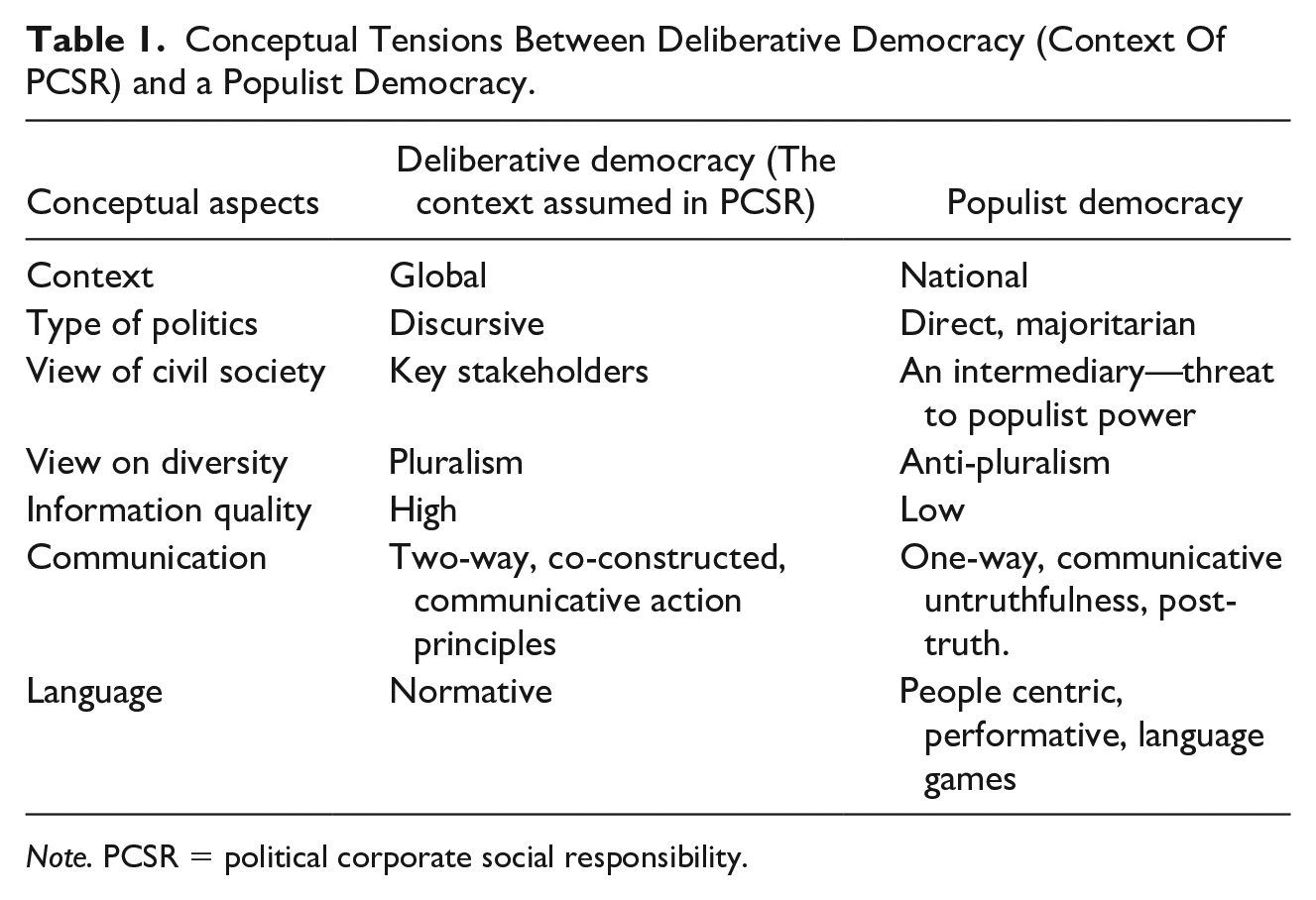
Note. PCSR = political corporate social responsibility.
Deliberative processes, for instance, which are often assumed by PCSR scholars to be effective means of ensuring an effective substitution of state functions by the private sector, are reliant on “high quality discursive spaces” (Della Porta, 2019, p. 606) and informed communication (Sharon, 2019). In contrast, populist information spaces are regarded as low quality, owing to the prevalence of mis- and disinformation (Hameleers, 2020), and “alternative facts” (Knight & Tsoukas, 2019, p. 183). Furthermore, PCSR seeks two-way deliberative communication so that meaningful and legitimate ways of substituting state functions can be co-constructed with stakeholders (Scherer & Palazzo, 2011). Through deliberation, PCSR aspires to emulate Habermas’s (1984) theory of communicative action of which truth is a core tenet. By contrast, elements of communicative untruthfulness in populist discourse (Hameleers, 2020) promote a disregard for truth norms (Osborne, 2021). In addition, PCSR employs normative language to justify the private sector’s involvement in the public sphere (Richter et al., 2021), while populism draws on antagonistic and binary discourse and adopts language games, seeking to delegitimize liberal narratives or norms (Knight & Tsoukas, 2019). This suggests deep-seated tensions between PCSR and populism.
For these reasons, within extant PCSR literature, there is speculation that populism could render CSR a more politically controversial activity, even if unintended, but with little discussion on how (Korschun & Rafieian, 2019). Along similar lines, Hartwell and Devinney (2021a) assume that populism will inadvertently shape CSR activities by influencing informal institutions associated with norms and cultural attitudes but do not elaborate the underlying mechanisms.
In sum, populism undermines many of the core assumptions behind political CSR and thus complicates PCSR strategy development. We, therefore, need new theoretical insight to help navigate populist contexts and build PCSR theory more appropriate for such contexts. To achieve this, we turn to information-based theories of signaling and screening to develop a new conceptual model of political CSR in the context of populism.
Signaling and Screening: Toward an Information-Based Theory of Political CSR
To assess the influence of populism on PCSR, we focus on information quality as this is a key component of how populism works and an intrinsic quality necessary for deliberation, the modus operandi of PCSR. We draw on signaling (Spence, 1973) and screening theories (Stiglitz, 1975) to develop a conceptual model that offers a nuanced account of how populism shapes PCSR responses in various political contexts. We develop our model (Figure 1) in two stages: First, we develop a core conceptual model, which explicates how populist signals are processed using a PCSR lens. The second stage is represented by an expanded conceptual model, which considers the moderating role of populism in different political regimes. Our model departs from conventional PCSR logics of a globalized world and instead assumes a national political context as a necessary boundary for our theorizing, given populism’s more inward national focus (Flew, 2020). From this model, we identify causal mechanisms and derive propositions leading to an information-based theory of how populist mis- and disinformation impacts PCSR decision-making in different political regimes.
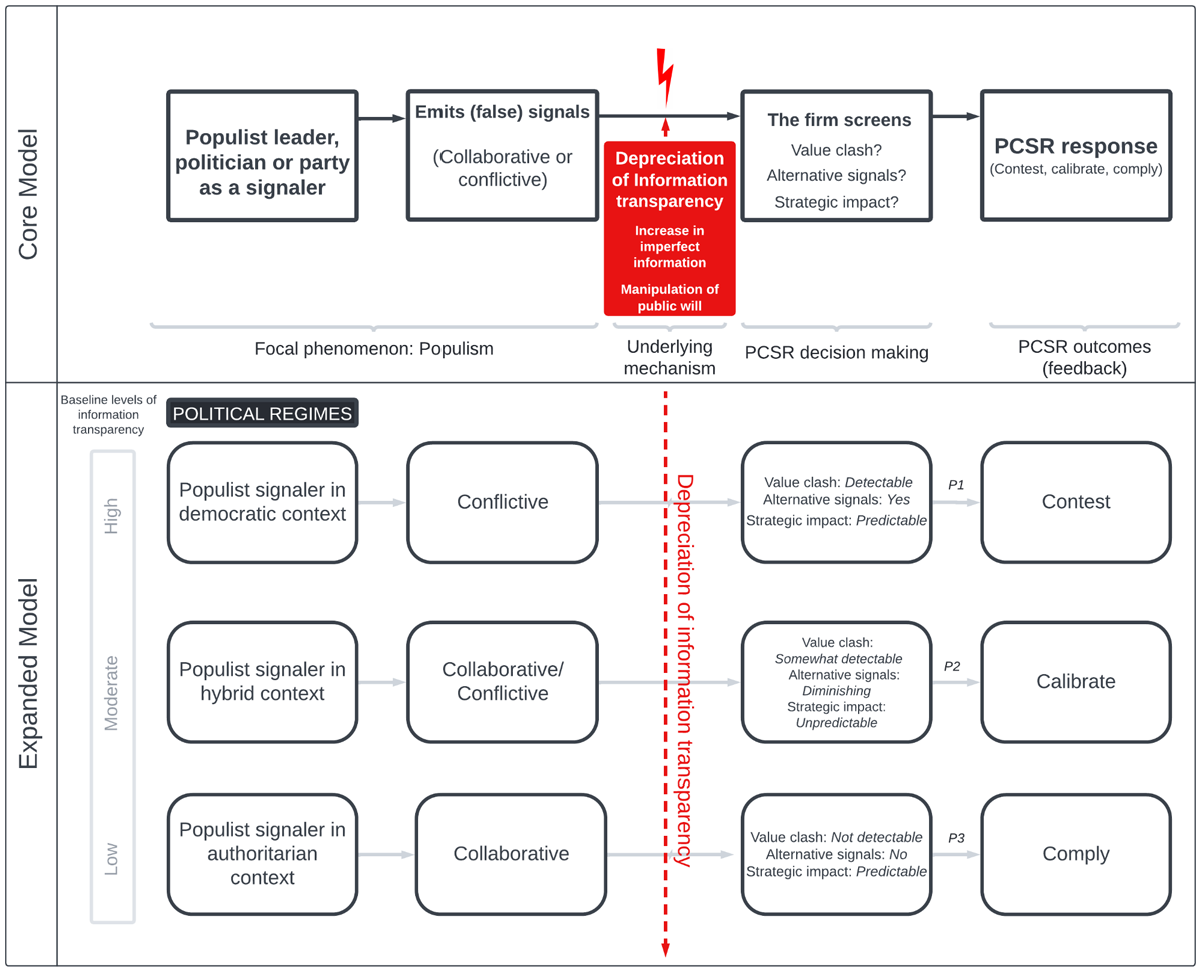
Core and Expanded Conceptual Map: How Populism Impact PCSR Across a Range of Political Regimes
Core Conceptual Model: Signaling and Screening Theories
The Signaler and the Signal
In the two left-hand boxes of the core model (Figure 1), we focus on information signaling under conditions of populism. Signaling theory seeks to explain situations where imperfect (or unbalanced) information conditions exist between two parties, known as information asymmetries, and how they can be resolved (Connelly et al., 2010). In political arenas, signaling theory is useful for examining the information asymmetry that exists between politicians (signalers) and firms as receivers who may be unaware of politicians’ intentions (Ridge et al., 2018). We posit that in populist spaces, populist politicians, leaders, or parties occupy the role of the signaler. As signalers are privy to private or unknown information, they deliberately and strategically release signals (i.e., information) to convey to receivers (Connelly et al., 2010; Spence, 1973).
Populists will then use their platform to emit false signals, which involves the intentional dissemination of dishonest information (Connelly et al., 2010; second box from the left in the model). Ordinarily, signalers will convey positive signals to minimize the information asymmetry that exists (Connelly et al., 2010; Spence, 1973). However, we suggest that populists strategically engage in false signaling, via the dissemination of mis- and disinformation (Hameleers, 2020). Such signaling might be conflicting or noisy to disrupt the status quo (de Sousa et al., 2021) or more collaborative to garner popular support and mobilize the people (Guan & Yang, 2020). The outcome of false signaling is a widening of information asymmetries and a depreciation in information transparency.
Depreciation in Information Transparency
In the middle box of the core model, we focus on the mechanism that underlies the effect of populism on PCSR, which we term “depreciation in information transparency.” We adapt Vishwanath and Kaufmann’s (2001, p. 42) definition of information transparency and define a depreciation in information transparency as the decreased “flow of timely and reliable economic, social and political information,” which may arise when “information is denied, irrelevant to the issue at hand, or if the information is misrepresented, inaccurate or untimely.” In populist contexts, information transparency will depreciate as a result of false signaling by populists. This, in turn, will affect PCSR in two main ways. First, depreciation in information transparency will lead to a more imperfect information environment. That is, acquiring the information needed for developing a PCSR strategy will be more complicated or difficult. This is because information asymmetries will disadvantage the receiver (the firm), impairing monitoring and accountability (Florini, 2002). A second outcome of reduced transparency is the manipulation of the public will. This compromises deliberative mechanisms, which are widely considered the modus operandi of PCSR (Sharon, 2019). Such manipulation has the capacity to impact perceptions of societal issues and the role of business, particularly when considering populist narratives linking businesses with “corrupted elites.” Taken together, the twofold consequences of a decline in transparency represent a major obstacle for PCSR strategy decision-making.
The Screening and Feedback Stage
In the two right-hand boxes of our core model, we focus on information screening and propose that the screening stage is conducted by the firm. Screening theory adopts the lens of the receiver who possesses the least information of the two parties and would benefit from the signaler’s information (Connelly et al., 2010). To mitigate information deficits, the receiver (firm) searches for signals and applies “screens” to categorize and filter them (Sanders & Boivie, 2004) to discern the quality and value of the signal and signaler (Riley, 2001). Firms, as receivers, will screen populist signals to decipher political intentions (Connelly et al., 2010; Ridge et al., 2018; Spence, 1973) or discern policy impacts to formulate an effective PCSR response (feedback).
The screening stage is fundamental to effective PCSR, as the decisions taken at this stage will have direct ramifications for PCSR strategy development. However, understanding the decision points (or filtering “screens”) used in PCSR screening is challenging, as scholarship on inputs for PCSR decision-making remains scant (Richter et al., 2021). Drawing on insights from various PCSR frameworks (Korschun & Rafieian, 2019; Richter et al., 2021), we posit that three “PCSR screens” are used to assess populist signals: (a) the firm’s values; (b) access to alternative signals; and (c) strategic impacts. We depict this trifecta of PCSR screens in the second box from the right of the core model, and we explain them below.
Firm Values
A firm’s internal values represent an important screen for assessing policy issues (Korschun & Rafieian, 2019). Acting as a moral compass, the detection of (mis)alignment between the firm’s values and the values reflected in the populist policy signal can shape a firm’s PCSR response (Korschun & Rafieian, 2019). If there is alignment between firm values and populist policy then PCSR strategy will likely align with policy, and if there is misalignment, then PCSR may run counter to policy. However, a firm’s ability to detect value (mis)alignment is reliant on the availability of accurate information, while imperfect information, often characterizing populist environments, can obscure potential value clashes, confounding a firm’s ability to form a PCSR response aligned with its values.
Access to Alternative Signals
Ideally, within a healthy signaling environment, multiple signalers exist, emitting signals simultaneously, which the receiver (the firm) must derive meaning from (Connelly et al., 2010). This screen refers to the deliberative component of PCSR decision-making, which represents PCSR’s modus operandi. In a PCSR context, this screen involves a firm’s access to diverse stakeholders for the purpose of information gathering and free and fair deliberation to discern public will. As PCSR decision-making is fraught with difficulty (Richter et al., 2021) and should not occur in isolation (Richter & Arndt, 2018), alternative signals enable firms to obtain vital perspective when deciphering and deliberating complex CSR issues (Richter et al., 2021) that may be the focus of populist signaling. Such alternative signals allow firms to identify the “materiality of the issue” under consideration (Korschun & Rafieian, 2019, p. 478) and highlight areas of normative urgency (Richter et al., 2021). In a populist context, however, both access and quality of alternative signals can be negatively impacted, hindering PCSR decision-making.
Strategic Impacts
Firms assessing populist threats will screen for strategic considerations, such as economic self-interest or export dependency, in the face of protectionism (Kinderman, 2020, p. 1) or impacts on labor (Butzbach et al., 2020). Such strategic implications could result in material impacts (loss or damage) related to profits and reputation and therefore represent an important PCSR consideration (Korschun & Rafieian, 2019). While PCSR scholars seek to disassociate PCSR from the pursuit of instrumental gains, in reality, there is overlap (Richter et al., 2021). Predicting strategic impacts is reliant on the availability of clear information and helps to inform PCSR decision-making.
Thus, the screening stage, summarized as an information-intensive processing stage, will shape the firm’s feedback, affecting their behavioral PCSR response (Basu & Palazzo, 2008; Richter et al., 2021). We illustrate this in the right-hand box of our core model as “PCSR response.” These responses will vary and are reliant upon high-quality information to screen effectively. Where screening is successful, a firm may respond more proactively against populist excesses (“contest” posture), and where screening results in ambiguity, firm responses may be more cautious (“calibrate” or “comply”). However, the nature of the firm response will depend on how populism affects information quality in specific political contexts. Therefore, we now move to explain our expanded conceptual model, which accounts for the impact of populism on PCSR strategies in different political regimes.
Expanded Conceptual Model: Populism, Political Regimes, and PCSR Responses
Populism has many faces and is manifested in various forms and contexts. Versions of populism have appeared in democratic as well as less-democratic countries. While populists may often favor more direct confrontation in democratic regimes, in hybrid regimes, they might adopt a “stabilization” facade (Robinson & Milne, 2017), or in authoritarian regimes, populism might even assume a collaborative character (Guan & Yang, 2020). Such variation in populists’ approaches is likely to have a dynamic impact on PCSR, suggesting that depending on the political regime, populists might impact PCSR differently.
The lack of linearity in the relationship between governments and CSR has also been proposed by earlier studies, albeit not in the context of populism (Brejnholt et al., 2022; Gond et al., 2011). Findings suggest that changes in social demands and governance conditions offer opportunities for governments to regulate and shape CSR content (Gond et al., 2011). Such scholars propose that different political contexts differently impact CSR, with insights indicating that regulatory states intervene less in shaping CSR, welfare or developmental states play a more active role in shaping CSR practice, and predatory states are less interested in CSR, but when involved they attempt to shape CSR content in a superficial and opportunistic manner (Brejnholt et al., 2022). We complement these insights with a “political regime” approach, building upon recent trends in PCSR scholarship that explore political regimes (cf. Maier, 2021).
Our expanded model, therefore, accounts for the moderating role of political regimes, enabling a nuanced analysis of populist signaling in different institutional settings, and its impact on PCSR responses. Wigell’s (2008) simple but effective political regime typology (i.e., democratic, hybrid, and authoritarian regimes) is used to capture these institutional differences. Compared with other approaches used in CSR research, such as the varieties of capitalism (VoC) model, applying Wigell’s (2008) typology is useful for three reasons. First, there are concerns that the VoC literature is “not sufficient to capture the complexities of modern forms of state-dominated economies” and is unable to account for states who are “active economic players” with authoritarian tendencies, such as Hungary (Sallai & Schnyder, 2021, p. 1313; Schmidt, 2009). Second, unlike VoC’s more static accounts of political economy which assume equilibrium (Fast, 2016), a political regimes lens is able to better account for transition and evolution within a political context, acknowledging the role of phenomena particularly pertinent to populist contexts, such as “democratic backsliding,” “degrees of democracy,” and “hybridization.” Third, a political regimes typology is better aligned with the populism literature, which is rooted in political science and uses the language and framing of political regimes (See Mounk, 2020; Peruzzotti, 2017; Robinson & Milne, 2017).
Wigell (2008) deconstructs regimes according to two dimensions: (a) electoralism, which refers to the availability of free, fair, competitive, and inclusive elections and (b) constitutionalism, which references the presence of codified rules that are enacted to uphold the rule of law, restrict the exercise of power, and protect civil liberties, including access to information. Table 2 illustrates how electoralism and constitutionalism vary among different political regimes.
Political Regime Dimension.
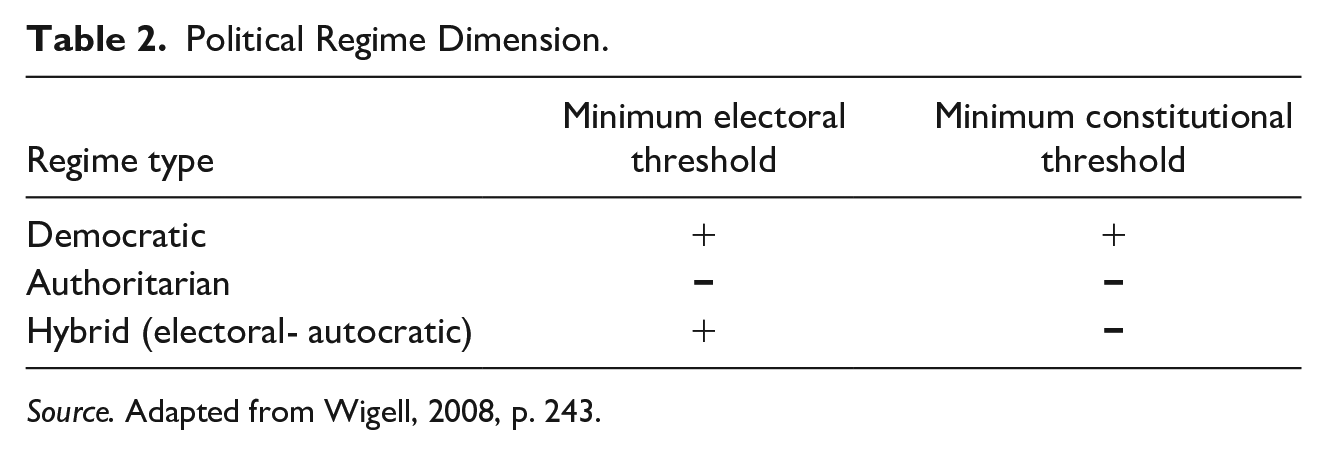
Source. Adapted from Wigell, 2008, p. 243.
The left part of our expanded model (Figure 1) illustrates the different types of political regimes and classifies the preexisting, baseline level of information transparency likely to be in place. While the model maintains that populists employ false signaling, it acknowledges that the differing institutional conditions within each regime will influence the nature and impact of populist signaling differently. We depict this in our model as conflictive and/or collaborative signaling (second box from the left).
Conflictive signaling relates to the use of disruptive politics (Bergmann, 2020), while collaborative signals are designed to portray positive state-society relations, to “sweeten” authoritarian undertones (Adaman & Akbulut, 2020). Consequently, when the context is considered, we propose that the impact of false populist signaling on PCSR screening will vary depending on whether value clashes are detectable by firms; whether there are alternative signals from other stakeholders; and whether the strategic impact is predictable. We depict these different PCSR screens in the second box from the right of our expanded model. These varying screening prescriptions will dictate a firm’s feedback, conceptualized as “PCSR response.” In the right part of our model, we summarize these response postures as: “contest,” “calibrate,” and “comply.”
To elaborate on the expanded model, we select the United States, Hungary, and China as critical examples that can help us answer our research question How does populism impact PCSR strategy across a range of political contexts? While these examples are indicative, we acknowledge the likelihood that differences or nuances might emerge in the model when applied to different countries within each context, owing to specific domestic institutional conditions.
How Populism Influences PCSR in Different Political Regimes:
Democratic Populist Settings and Populist Signals
We begin our analysis of different regimes by discussing how populism impacts PCSR in democratic regimes (top-left box in our expanded model). All such regimes show respect for minimum electoral and constitutional thresholds, while liberal democracies exceed them (Wigell, 2008). From an information perspective, democracies represent high-quality information environments with high baseline levels of information transparency, where accurate information signals prevail (Guriev & Treisman, 2019), the right to freedom of information is protected (Wigell, 2008), and democratic institutions enforce information quality while also lowering policy uncertainty (Bates, 2001). In fact, a functional information environment is vital to sustaining a democracy, which is reliant on a factually informed citizenry who can readily access information to evaluate public policy (Kuklinski et al., 2000).
Within a democracy, populist forces agitate the political arena, with “noisy politics” (Culpepper, 2021, p. 134), or “the politics of disruption” (Bergmann, 2020, p. 253), employing conflictive signaling that departs from more negotiation-based politics (de Sousa et al., 2021) (second top-left box in our expanded model). This is compounded by an unapologetic transmission of misleading information and post-truth claims (Bergmann, 2020; Hameleers, 2020). Thus, despite making promises on the premise of combating corruption and a lack of transparency, populists in fact further erode the very issue they seek to condemn (Fenster, 2017), thereby lowering information transparency levels. For instance, during Trump’s presidency, the U.S. corruption perception index ranking worsened (Transparency International, 2020), and democracy ratings plummeted (Systemic Peace, 2021).
PCSR Screening and Response in Populist Democratic Environments: Contest
Next, we emphasize how firms screen populist signals in democratic contexts (second top-right box in our expanded model). Despite the populist assault on information transparency levels, firms remain able to assess populist signals reasonably accurately. This is attributed to both a preexisting high-quality information environment and strong democratic institutional conditions, where checks and balances are robust and insulate against populist excesses (Weyland, 2020), eliminating the fear of reprisals. Similarly, the protection of civil and political rights (Reich, 2002) allows access to diverse stakeholders (alternative signals). This enabling environment permits somewhat high degrees of free deliberation and information exchange and facilitates firms’ ability to relatively accurately discern public will, determine value clashes, and strategic impacts.
Upon screening, if a normative value clash is detected, and a negative strategic impact anticipated, firms will likely “contest” or challenge populist excesses (top-right box in our expanded model). A contest PCSR posture involves a firm resisting or seeking to counter populist excesses, either individually or via collective action. This can manifest as assertive, or more tempered action (Korschun & Rafieian, 2019). The U.S. case offers a pertinent demonstration of how firms might “contest” against populist excesses.
Former U.S. president Donald Trump is widely recognized as a populist who assumed power (Bauer & Becker, 2020), and “serial distributor of mis- and disinformation” (Ross & Rivers, 2018, p. 2). On the issue of the U.S. elections, Trump made more than 3,000 false or misleading claims (Washington Post Fact Checker, 2021). Following concerns that Trump’s election-related tweets were implicated in the violent 2021 Capitol attack, Twitter Inc., acted by “contesting” and suspending Trump’s Twitter account: “We have permanently suspended the account due to the risk of further incitement of violence,” (Twitter, 2021). This demonstrates how normative imperatives, driven by values, such as protecting public safety, may prompt firms to “contest” populist excesses, via the withdrawal of their goods or service from populists.
Firms may also “contest” populist influence to protect public goods. On the issue of Covid-19, Trump made more than 2,500 false or misleading statements (Washington Post Fact Checker, 2021) and politicized vaccines, thus undermining public trust in vaccine integrity (Thomas, 2020). In response, nine major pharmaceutical companies collectively “contested,” issuing a joint statement on vaccine production, considered a public good, pledging to “Stand with science. . .. . .we believe this pledge will help ensure public confidence” (Pfizer, 2020). This demonstrates an appeal against populist misinformation and post-truth claims by emphasizing scientific principles to cultivate trust.
Clearly, not all firms within a democratic populist context will choose to pursue a PCSR strategy, as some firms will have other non-PCSR priorities. In fact, some firms may expressly support populist agendas if they perceive them to be ideologically value-aligned. For instance, the U.S. firm Black Rifle Coffee branded itself as “pro-America” and pro-Trump, while endorsing some of Trump’s controversial populist policies, such as the Muslim travel ban (Zengerle, 2021). Other firms may desist from contesting and acting with strategic intent, displaying loyalty if they anticipate significant strategic gains or costs arising from populist agendas (Feldmann & Morgan, 2021), very much like would be anticipated in the Corporate political activity (CPA) literature (Hillman & Hitt, 1999). In addition, some firms will maintain an indifferent or apolitical stance toward populist agendas. Therefore, in democratic settings, a firm’s positioning toward populism occurs on a spectrum and depends upon its priorities (PCSR or non-PCSR).
At this juncture, it is important to note that the democratic model is showing symptoms of fatigue (Jensen & Zámborský, 2019), making it prone to populist-induced democratic backsliding (Bauer & Becker, 2020). Thus, firms that “contest” may find themselves on the receiving end of populist ire, rendering PCSR as “politically controversial, even if it is not intended to be” (Korschun & Rafieian, 2019, p. 478). In fact, firms adopting a contest PCSR posture risk being delegitimized by populists or alienating some stakeholders (Feldmann & Morgan, 2021, 2022; Korschun & Rafieian, 2019). As democratic quality declines under populism, the risk associated with exercising a contest PCSR strategy increases. However, despite the populist challenge, consolidated democracies can self-correct from populist-induced backsliding through a counter-reaction by the citizenry toward democratic traditions (Mounk, 2020), with PCSR potentially playing a formative role. “Contesting” PCSR postures show some promise in populist democratic spaces, with the potential to amplify stakeholder concerns and counterbalance populist disinformation and polarization.
In sum, we propose that:
Hybrid Populist Settings and Populist Signals
The next political regime we discuss is the hybrid, which refers to regimes “that fulfill the minimum electoral threshold but not the minimal constitutional conditions,” (Wigell, p. 244) as civil and political rights are restricted and cannot be effectively exercised (Diamond, 2002; Gilbert & Mohseni, 2011; Reich, 2002; Robinson & Milne, 2017; Wigell, 2008). The political science literature is burgeoning with studies on hybrid or “pseudo-democratic” regimes (Diamond, 2002, p. 24), in states such as Hungary, Poland, and Turkey (see Robinson & Milne, 2017; Wintrobe, 2018). While hybridized regimes occur across a spectrum, varying in pace and extent, populism has an intimate relationship with hybridization, in many cases, inducing it (Peruzzotti, 2017; Wigell, 2008; Wintrobe, 2018). In fact, Wigell (2008) contends populist autocracies map closely with “electoral-autocratic (hybrid) regimes” (p. 244). Thus, political participation, although notable, is unfair and ineffective (Diamond, 2002; Gilbert & Mohseni, 2011; Reich, 2002; Wigell, 2008).
Similarly, hybrid information environments are characterized by diminishing levels and quality of information. This is because reliable information regarding policy changes is limited and compounded by a polarized political arena (Kenyon & Naoi, 2010), substantive tests for freedom of information are not met (Gilbert & Mohseni, 2011; Wigell, 2008), and public contestation is present but constrained (Cassani & Tomini, 2020). Consequently, hybrid environments have moderate levels of information transparency (middle-left box in the expanded model).
As populism takes hold in a hybrid setting, it stimulates a contraction of the political arena due to repressive political practices that marginalize opposition groups (Robinson & Milne, 2017) and a weakening of institutional architecture, critical media, and civil society (Peruzzotti, 2017). Thus, populism typically deteriorates hybrid information environments, prompting receding levels of information transparency. For instance, under Orban’s right-wing populist administration, Hungary has witnessed: “Distortions of the media and lack of public information, which lead to the impossibility of a meaningful public debate,” (Bárd, 2020, p. 88) and withdrawal of membership from transparency bodies, such as the Open Government partnerships (OGP, 2016).
Moreover, as hybrid environments are volatile, oscillating between elements of democracy and authoritarianism, populist signals can be contradictory, with both conflictive and collaborative elements (see second middle-left box in our expanded model). Conflictive populist signaling is antagonistic and capitalizes on democratic energies, using noisy politics to bring visibility to populist agendas (Feldmann & Morgan, 2021). Often, arbitrary legislative changes are introduced to reinforce populist agendas (Devinney & Hartwell, 2020). For example, the Orban administration targeted the U.S.-accredited Central European University (CEU) in Budapest via legislative modifications, which eventually compelled CEU to relocate operations (Bárd, 2020). Similarly, the Orban administration dismantled various governmental functions and initiated a takeover of different public sector areas using conflictive tactics to push out private sector firms (Stubbs & Lendvai-Bainton, 2020).
Simultaneously, populists in hybrid settings will also engage in collaborative signaling to obscure authoritarian undertones (Adaman & Akbulut, 2020), and justify undemocratic action (Robinson & Milne, 2017). This manifests as either business-friendly policies or the implementation of social policies to secure popular support (Özdemir, 2020). For instance, Orban’s success has been attributed in part to backing Hungarian business (Scheiring, 2019) and to favorable pro-business populist economic policies, designed to incentivize certain automobile and tech sectors MNCs (Bohle & Regan, 2021; Stubbs & Lendvai-Bainton, 2020).
PCSR Screening and Response in Hybrid Populist Contexts: Calibrate
Contradictory populist signaling complicates PCSR screening, in what is already a deteriorating information environment. In fact, Kenyon and Naoi (2010, p. 487) highlight that “firms in hybrid regimes report higher levels of concern over policy uncertainty” compared to other regime types. Thus, contradictory populist signals widen information asymmetries and hinder screening, causing firms to struggle to predict the strategic impacts of policy areas.
Similarly, widening information asymmetry makes potential value misalignment only somewhat detectable, as civil society space begins to contract. Indeed, while civil society organizations can resist populism in hybrid settings (Asavei & Kocian, 2022), they are also vulnerable to co-optation or repression (Toepler et al., 2020). This gradual contraction of alternative information signals renders PCSR screening increasingly difficult over time. We depict the variation in PCSR screens in the second middle-right box.
Over time, the uncertainty experienced in hybrid populist spaces will prompt firms to “calibrate” (or acclimatize) PCSR strategy with populist agendas (middle-right box in the expanded model). This occurs incrementally, as populist-induced hybridization is slow and gradual (Peruzzotti, 2017), although time spans vary, depending on the pace of change in the political environment. Thus, calibration is adaptive to pressure arising from the external environment (Richter & Arndt, 2018) and reactive to uncertainty around the consequences of actions (Basu & Palazzo, 2008).
Calibration can occur via co-optation or coercion. Cooptation occurs when firms anticipate or seek instrumental gain and calibrate their PCSR strategy with populist agendas. In Hungary for instance, the right-wing populist government has made private actors reliant on public contracts for income, modifying official channels of economic interest representation, and using laws and regulations to create dependence (Sallai & Schnyder, 2021). Consequently, populist policies have not deterred German MNCs from doing business with a populist right-wing government that protects their interests (Bohle & Regan, 2021). Such MNCs opt to calibrate using “quiet politics” (Bohle & Regan, 2021; Morgan & Ibsen, 2021), accommodating political demands and vice versa. While this arrangement minimizes information asymmetries and reduces policy uncertainty, it also risks reinforcing repressive populist agendas and sustaining the process of hybridization away from democracy. This casts doubt over the normative appropriateness of typical PCSR strategies under such conditions.
Similarly, the exercise of repression in hybrid settings (Wintrobe, 2018) may coerce firms into self-censure to avoid populist reprisals, thus limiting the scope and content of PCSR activities. For instance, in 2019 Coca-Cola was pressured to tone down its LGBTQ+ #loveislove campaign in Hungary (which depicted a homosexual couple) following boycott calls from the deputy of the ruling populist party, Fidesz, and a financial penalty from the Hungarian consumer protection division. Initially, Coca-Cola contested, issuing a statement emphasizing its normative position on equality and diversity. However, the company later replaced posters with less conspicuous LGBTQ+ rainbow symbolism. More recently, Hungary’s legislative bill banning LGBTQ+ information sharing with under-18s further restricted Coca-Cola’s autonomy to set its own local LGBTQ+ agenda. Thus, as policy areas become more politicized over time, the scope for autonomous PCSR strategy will gradually contract.
Whether there is any scope for a “contest” PCSR posture within a populist hybrid regime depends on several factors. For example, where public discontent is so high that there is a possibility for political change, firms could exploit this discontent to “contest,” particularly if such backsliding is in its infancy (Mounk, 2020). However, if opposition groups are weak, hybrid regimes will likely have greater longevity.
In sum, we propose that:
Authoritarian Populist Settings and Populist Signals
The next political regime we discuss is authoritarian. Such regimes, illustrated in the bottom-left box in the expanded model, do not fulfill the minimum attributes for electoralism and constitutionalism (Wigell, 2008). Characterized by heavily curated and constrictive information environments, authoritarian governments engage in selective and strategic information sharing and censorship (Reich, 2002; Wigell, 2008) and manipulate information with disinformation and propaganda, thus inhibiting citizens from challenging authoritarian politics (Wallace, 2016). Consequently, authoritarian information environments are opaque, with low baseline levels of information transparency.
In authoritarian regimes, leaders will readily employ populist rhetoric (signals) in their discourse on state-society relations (Guan & Yang, 2020), speaking in the name of “the people” (Miao, 2020) and will instrumentalize such rhetoric to secure directly controlled mobilization of the masses (Tang, 2016). Therefore, in such settings, populism typically assumes a pro-people collaborative character (Guan & Yang, 2020), a unifying façade, which serves as a replacement for elections and maintains weak institutions (Tang, 2016; Townsend, 1977; second bottom-left box in the expanded model). Paradoxically, while employing an ideological discourse aimed at domestically unifying “the people,” authoritarian regimes will simultaneously employ narratives to attract foreign direct investment (Pojani, 2018).
Such collaborative populism can be regarded as false signaling, as it portrays a (false) sense of state-societal synergy, which may not be the reality. Hence, once populism is employed in an already opaque authoritarian information environment, it exacerbates existing low levels of information transparency, resulting in “double opacity.”
PCSR Screening and Response in Authoritarian Populist Environments: Comply
Double opacity creates several challenges for PCSR screening. The populist rhetoric of authoritarian governments may signal desirable and sanctioned policy areas. PCSR issues that serve government agendas, or are considered politically neutral, are cherry-picked, promoted, or embellished by authoritarian governments, while salient yet politically charged policy areas are minimized. This has the following three effects: First, authoritarian governments will dictate issue salience, an approach that obscures potential value clashes. Second, as civil society actors are likely to be repressed or co-opted in authoritarian regimes (Toepler et al., 2020), the absence of independent alternative signals precludes free and inclusive deliberation (Maier, 2021). Without accurate alternative information signals to discern genuine public will, firms’ screening abilities will be significantly impaired. Third, the high visibility given to favorable policy areas allows firms to predict strategic impacts and identify incentivized policy areas (second bottom-right box in our expanded model).
By monopolizing the information environment, populist authoritarian governments capture the information pipeline, becoming the central actor in influencing firms’ PCSR policy. Indeed, the influence of the state in shaping CSR more generally in authoritarian settings has been well documented (Hofman et al., 2015; Parsa et al., 2021). In the context of PCSR, this is even more acute, with firms prompted to adopt a “comply” PCSR posture that effectively mirrors the policy agenda of the state to legitimize their operations (Zhao, 2012; depicted in the bottom-right box in the expanded model). However, Maier (2021) points to a contradictory moral context, arguing for caution when considering authoritarian governments’ demands, as they may clash with the scope of a firm’s own PCSR agenda. Hence, PCSR in authoritarian contexts has normative consequences due to “implications for stabilization of authoritarian rule” (Maier, 2021, p. 490).
In China, widely regarded as an authoritarian state (EIU, 2021), populism is employed by the Chinese government (Guan & Yang, 2020; Tang, 2016) as a communication tool to build a collaborative relationship with the people (Guan & Yang, 2020). However, in reality, Chinese populism is largely exclusionary (Guan & Yang, 2020) as “the authoritarian nature of Chinese politics monopolizes the definition of the people and its general will” (Miao, 2020, p. 284). This is significant as the Chinese government uses populism to promote a positive state-society narrative, portraying the illusion of “good governance” and prompting a sense of compliance from its “people” (Guan & Yang, 2020, p. 14). Here, the populist element is employed as a means of soft power to alter narratives on state-society relations (Guan & Yang, 2020) and is distinct from repressive hard power tactics associated with authoritarian regimes. Consequently, China’s politically controlled and non-independent civil society (Hofman et al., 2015) is in part attributable to populist elements (Tang, 2016). It is postulated that such populist narratives also shape PCSR dynamics in China toward compliance.
This monopoly over state–society narratives restricts alternative domestic signals and creates an information vacuum that heightens the risk that firms will inadvertently bolster populist state agendas that violate rights holders. Indicative of this is a central government policy, known as “Xinjiang Aid.” This was presented by the Chinese government as a voluntary labor reallocation program. Instead, reports suggest that China used the program to forcedly transfer thousands of minority Uyghur people from northwest China to factories supplying well-known international brands located across the country (Xu et al., 2020). In cases where foreign firms have acted on transnational information sources, they have been subject to reprisals. For instance, H&M’s statement on Uyghur forced labor in Chinese cotton production prompted a huge backlash in China, leading to boycotts and store closures.
Thus, to maintain a license to operate within populist authoritarian spaces, firms have a significant incentive to “comply” with the state. Hartwell and Devinney (2021a) recommend an apolitical stance but warn that silence or neutrality may be regarded as acquiescence. Either way, PCSR in populist authoritarian conditions is highly problematic. The “double opacity” induced by populism disrupts PCSR screening, likely prompting firms to “comply” or otherwise acquiesce to the state, which reinforces populist agendas and risks unintended consequences, including the potential for doing serious harm, such as human rights or other violations. In sum, populists’ collaborative signaling in authoritarian contexts depreciates further an already opaque information environment. Therefore, we propose that:
Discussion
Populism challenges several fundamental assumptions at the heart of PCSR theorizing. To develop a theoretical account of PCSR better suited to the context of populism, we have focused on information quality and have drawn on signaling and screening theories to conceptualize the influence of populism on PCSR strategy across three political contexts. In this theory-building article, we have developed a conceptual model that contributes to the PCSR literature by clarifying how information quality plays a key role in the development of PCSR strategies, how this relationship plays out in different political regimes, and how the state might undertake a more active role in the development of PCSR strategies than that assumed in the literature. Next, we elaborate on these theoretical contributions before discussing some of the limitations of our analysis, the avenues they pave for future research, and the managerial implications of our study.
An Information-Based Approach to PCSR
To date, PCSR research has primarily been founded on political theories of citizenship and deliberative democracy (Matten & Crane, 2005; Scherer & Palazzo, 2011). By refocusing PCSR on the populist moment, our work redirects PCSR theorizing toward a new information-based PCSR approach. We define the latter as an approach that is carefully attuned to the presence of mis- or disinformation in the PCSR strategy development process, and which emphasizes the role of high-quality information as a critical success factor, both in terms of access to information and also in terms of the accuracy, reliability, and richness of information acquired and used in PCSR deliberation and decision-making processes. Such conditions are not given in populist contexts. Our information-based approach to PCSR focuses on nation-states and political regimes, owing to populism’s ability to directly affect them. In articulating how populism impacts information transparency within different political and information environments, we highlight the critical role-played by high-quality information in effective PCSR strategy formulation.
This information-centric PCSR approach adds an essential, often overlooked dimension to extant PCSR research. While current research has been effective in developing frameworks for analyzing and evaluating the nature of deliberation and dialogue in PCSR practices (Dawkins, 2021), it has tended to neglect the nature of the broader information environment in which such communication takes place. While our contribution primarily speaks to the PCSR literature, we also make some contributions to signaling theory. We employ signaling theory to highlight how “false” signals can be strategically employed by populists to depreciate the information environment. This use of signaling theory differs from extant signaling literature which has concerned itself with signalers’ transmission of signals to help bridge information asymmetries for receivers and less so on negative scenarios where false signals might be deliberately employed. Through the use of signaling theory, our model allows consideration of PCSR under different conditions of imperfect, incomplete, or manipulated information, a reality very much reflective of the populist and post-truth era.
Identifying high-quality information as a key variable also allows us to sketch out boundary conditions to clarify when PCSR strategies might be appropriate and consistent with a democratic ideal. By locating logical inconsistencies between the critical requirement for high-quality information in PCSR and the information deficiencies in hybrid and authoritarian populist contexts, we show the challenges companies might face in developing PCSR strategies, irrespective of the deliberative principles underlying them. Our approach adds value to the Habermasian deliberative democracy approach by adding depth to the “how” dimension of PCSR (Richter et al., 2021), which to date has received scant attention in the literature. Such insights are important because the success of PCSR relies upon its ability to preserve the integrity of democratic deliberations (Mäkinen & Kourula, 2012).
Furthermore, by using an information-based approach, we highlight the importance of access to alternative information sources, such as civil society, that inform deliberative processes and highlight the dangers populism poses in this regard. While extant PCSR theory acknowledges that civil society actors “map, filter, amplify, bundle, and transmit private problems, values, and needs of the citizens” to policymakers (Scherer & Palazzo, 2011, p. 918), this reading overlooks the populist turn. In fact, populist polarizing discourses will likely bypass genuine or inclusive will formation and suppress critical functions of civil society (Müller, 2016), which can render communication of the “lifeworlds” as ideological or irrational, and make rational consensus unlikely (Marxsen, 2019). The result is a manipulated public that compromises “the very foundation of deliberative democracy” (Sharon, 2019, p. 368), putting deliberative practices, widely assumed in PCSR, at risk of becoming a conduit for manufactured public opinion (Sharon, 2019). Especially in hybrid or authoritarian populist settings, civil society actors are more vulnerable to populist discourses (Toepler et al., 2020). The limited access to independent alternative information sources in such populist contexts hinders the private sector’s ability to ascertain genuine public will, resulting in “comply” and “calibrate” PCSR postures, which are likely to bolster populist agendas.
A Context-Specific Framework of PCSR Strategy
Our second contribution is our suggestion that the notion of the political in PCSR cannot be used as a holistic, overarching term. Our context-specific framework of PCSR strategy, which is attuned to populism in different political contexts, demonstrates that different political regimes, such as democratic, authoritarian, and hybrid, give rise to distinct PCSR strategies. While the wider business and populism literature has begun to acknowledge the presence of institutional heterogeneity (Feldmann & Morgan, 2022), extant literature has tended to focus on single contexts (see Kinderman, 2020) and specific geographic regions or political regimes (see de Sousa et al., 2021), the strategic implications populism poses for local and global firms (Butzbach et al., 2020; Devinney & Hartwell, 2020), and firms’ strategic responses to populism (Feldmann & Morgan, 2022). Little attention is given to non-market strategies, such as PCSR. Our conceptual model addresses these deficits.
Our analysis shows that populism is likely to be manifested differently in various political systems influencing whether the core normative tenets of PCSR will apply and determining which PCSR strategies will likely be developed. We show that in democratic political systems, PCSR postures by the private sector have significant potential to be proactive in countering populist excesses through withdrawing services, countering disinformation, or adopting normative policy stances. In contrast, we show that in authoritarian or hybrid political systems, the private sector is more likely to adopt a more conciliatory, passive stance toward populist influence, due to manipulation or coercion. Considering that PCSR is concerned with private firms pursuing the public interest, governments often recognize “CSR as a potential policy tool” (Brejnholt et al., 2022, p. 481). We caution that in certain populist political contexts, where information environments are impaired, PCSR policies and outcomes may be targeted by populists, rendering them compatible with populism. In fact, firms may be called upon by populist governments to support populist agendas which are dressed as CSR initiatives that prima facie appear to pursue the public good.
Thus, we suggest that the way firms choose to adopt a political role and fill-in governance gaps is contingent upon the political context in which they operate. Such an insight contradicts the Habermasian view of PCSR, which has been promoted as a general and “globalist” universal theory predicated on Habermasian democratic ideals, and an enlightened view of society, that presumes free deliberation and rational discourse (Habermas, 1984, 1996; Scherer & Palazzo, 2011). Rather, our arguments are aligned with critical scholarship suggesting a conceptual incompatibility of PCSR in non-democratic settings (see Maier, 2021) and echoing wider concerns regarding a lack of contextuality in PCSR research (Westermann-Behaylo et al., 2015). Thus, we highlight the importance of greater context-specificity in PCSR theorizing, as the construction of what is considered “political” is institutionally bound and depends critically on context (Korschun & Rafieian, 2019; Matten & Moon, 2008).
Enhanced Understanding of the Role of the State in PCSR
Our third contribution to PCSR scholarship concerns the role of the state in the development of PCSR strategies. A key assumption in the PCSR literature is that the private sector takes over many of the responsibilities of the public sector as a result of a retreating state, in the case of developed countries, or inadequate state, in the case of developing countries (Matten & Crane, 2005; Scherer & Palazzo, 2011). Our framework extends PCSR theorizing beyond this usual framing, enhancing our understanding of the role of the state. While we are not the first to highlight that the role and functioning of the state and the resulting division of labor between government, business, and civil society differs among different institutional settings (Brejnholt et al., 2022; Gond et al., 2011; Matten & Moon, 2008), our work differs from existing accounts insofar as we explicitly assess this using a populist lens across a spectrum of political regimes. We suggest that in populist contexts, irrespective of the level of economic development of a country, the state assumes an active role and directly intervenes in the market. However, we acknowledge that the extent of state intervention also depends on the political regime, as certain political regimes have enabling environments that foster autocratic modes of government and capitalism, as witnessed in right-wing hybrid populist states such as Hungary (see Sallai & Schnyder, 2021). This contrasts with neoliberal conceptualizations of a passive state that have heavily influenced PCSR theorizing. We, therefore, join the stream of critical PCSR scholarship that articulates an enlarged role of the state (Eberlein, 2019; Frynas & Stephens, 2015; Kourula et al., 2019; Schrempf-Stirling, 2018). Consequently, our framework departs from the usual PCSR thesis of “substitution” for government roles and activities and elaborates a broader, pluralistic range of PCSR responses that better reflect the impact of populism while also raising important questions about the normative appropriateness of PCSR in some settings.
Limitations and Future Research Directions
Although our article offers some important theoretical contributions, it also has some limitations which could be addressed in further research. First, by adopting a political regimes framework (Wigell, 2008), we are unable to adequately account for the full institutional heterogeneity that might be relevant, particularly as PCSR can operationalize in a range of political and economic systems (Scherer et al., 2016). Future research could build on recent work (Butzbach et al., 2020) and focus on how populism impacts PCSR in alternative comparative economic systems, as elucidated in the “varieties of capitalism” literature which emphasizes liberal and coordinated market economies (Hall & Soskice, 2001). A further limitation of our research is that we do not consider different variants of populist ideology, such as right and left-wing populism, and their impacts on PCSR. While our model does not explicitly account for these differences, it offers a starting point for thinking about the populist impact on information quality in both variants. In particular, De La Torre (2019) asserts that both populism variants take an illiberal stance, appropriating conceptions of “the people.” Despite left-wing populism being regarded as more progressive and less exclusionary, it still excludes and polarizes the political arena and can deteriorate democratic quality in some contexts (Huber & Schimpf, 2016; Weyland, 2020). Future research could empirically investigate the specific policy impacts of right- and left-wing populism on PCSR.
Implications for Practice
Finally, we turn to the implications for practice. For CSR executives and practitioners, our framework helps create awareness of the challenges of operationalizing PCSR in different populist contexts and provides guidance on which strategies are most likely to be deployed in each context and why. Overall, our article highlights that firms should expect profound adjustments to PCSR strategy, content, scope, and communication under the populist influence.
For firms operating in populist democracies, our model suggests that managers should be prepared to develop PCSR strategies that might contradict the political narratives and priorities of ruling parties. Our analysis suggests that managers should be alert that populist ideologies can manipulate public opinion (Sharon, 2019), and endeavor to ensure balanced and diverse representation in PCSR deliberations (Patzer et al., 2018). If this cannot be achieved, the appropriateness of PCSR should be reevaluated. Alternately, in hybrid and authoritarian populist contexts, firms should increase investment in information-gathering resources before partaking in government-led PCSR calls, to avoid reinforcing populism. In understanding the conditions necessary for PCSR, firms can avoid short-sightedness, which usually leads to inauthentic PCSR approaches and accusations of corporate irresponsibility.
Conclusion
In this article, we reconstruct PCSR theory in the context of populism to advance a new information-based approach. Our PCSR model emphasizes that the institutional heterogeneity within which populism exists contributes to imperfect information environments, and highlights how political regimes can mediate the impact of populism on PCSR responses. As populism shows little sign of waning, this article advances an early contribution toward the development of a novel and interdisciplinary body of literature, related to “populism” and “business and society.” Undoubtedly, populism presents challenges to democracy, to our political systems, and to business and society theory and practice—challenging many of our previously taken-for-granted assumptions on the passive state thesis, information exchange, deliberative mechanisms, and civil society participation. However, it also offers a novel opportunity to rethink core theories like PCSR and opens up new space for theorizing. At a time when PCSR is being critiqued and/or rethought, populism, as a political reality, provides a critical context for helping us rethink what PCSR is, and how it might vary in different contexts.
Footnotes
Declaration of Conflicting Interests
The author(s) declared no potential conflicts of interest with respect to the research, authorship, and/or publication of this article.
Funding
The author(s) disclosed receipt of the following financial support for the research, authorship, and/or publication of this article: Funded by Innovate UK within the framework of the European Union’s Horizon Europe call “Protecting and nurturing democracies” 2022-2025. Views and opinions expressed are however those of the authors only and do not necessarily reflect those of Innovate UK or the European Union. Neither Innovate UK nor the European Union can be held responsible for them.
Author Biographies
 .
.