




Abstract
The notion of refugees as a viable source of labor to address skill shortages in the destination country’s labor market has rarely been the dominant discourse on refugee entrants. Bella’s1 lived experience as a professional woman who arrived as a Syrian conflict refugee to Australia in 2017 presents an outlier in refugee research and challenges conventional scholarly wisdom and public discourse. A combination of human capital, a purposeful use of networks, supported by her desire for recognition and a deep sense of self-worth allowed her to navigate the formalized and structured Australian business landscape. Accordingly, she was able to overcome the stigma of being a refugee: Less worthy of employment status in a position representative of her overseas skills and qualifications. In drawing on an outlier methodology and critical theory, we develop a more nuanced understanding of the agency of skilled and qualified refugee women drawing attention to lessons for business which typically takes a “one size fits all” approach to labor integration.
Bella’s Story: Contextualizing the Experience of Skilled Refugees Within the Australian Business Context
The narrative in recent scholarship and the popular discourse has been driven by a policy position and business, institutional, and broader social setting that clearly distinguishes between refugees and migrants in favor of the labor market attraction and settlement of the latter. The recent (non-binding) United Nations Global Compact on Refugees (UNHCR, n.d.) placed the spotlight on the divisions between refugees (as potential workers) and labor migrants. A refugee is defined as someone who is displaced and living outside their country of origin due to fear of persecution, conflict, and violence and, as such, seeks international protection in another country (UNHCR, n.d.). A migrant is seen as someone who leaves their country of origin for family reunion, work purposes, career development, better financial prospects, or adventure. Migrants are therefore deemed to be a superior choice for the main destination country’s labor market as they self-select to migrate: they have not been pushed to leave under harsh and traumatic circumstances and are often from nations that are less culturally distant and as such are deemed to effortlessly integrate into the destination society (Guo & Al Ariss, 2015; Zikic, 2015). The term self-initiated migrant is certainly emblematic of this supposed easy transition into the destination country business and societal setting on arrival.
As a consequence of such a binary framing, refugees are pitched, politically constructed, and some would argue stigmatized, as a homogeneous group who are on the one hand, welfare-dependent, a bleed on business and a burden to society, and on the contrary, are a vulnerable and marginalized group of workers channeled into precarious employment in low skilled sectors. Overall, the marginalization from the labor market is also seen to be inextricably linked to challenges surrounding integration into the broader society (Baranik et al., 2018; Dedeoglu, 2022; Hebbani & Khawaja, 2019; Kesici, 2022, challenging this perspective, see D’Angelo et al., 2020). This positioning negates the fact that refugees arrive in their destination country with an array of skills-sets and backgrounds, job readiness, different hopes, dreams, and concerns about their educational, workforce, and settlement futures (Betts & Collier, 2017; Betts et al., 2017a, 2017b). This diversity however remains largely unrecognized (Lam, 2018). Moreover, there is also a neglect of the differences in terms of refugee identity characteristics including, gender, age, ethnicity, religious affiliation, and sexuality and how these characteristics impact on decisions and outcomes when it comes to labor market participation and settlement (Lam, 2018; Newman et al., 2018; Pajic et al., 2018). Lam (2018, p. 103) notes a refugee-centered approach that captures intersectional characteristics will “forge improved service and business outcomes fostering ‘. . . a sense of admiration and respect for refugees’ experiences . . . (ensuring interaction) with public policies from the perspective of the least privileged.”
Added to this is also the refugees’ legal status which may result in variable—and often constrained—rights. While in some countries refugees have access to welfare rights and support in the process of finding employment, in others they may be pushed to the informal labor market with no rights at all (Betts, 2013). These differences in demographics, structural, business, and institutional factors certainly have a direct impact on the opportunities for and decisions of newly arrived refugees in navigating their employment outcomes, particularly within a largely regulated, formalized business, and labor market setting such as that which determines labor market entry in the Australian business context (Weller, 2015). This structure provides protections for workers and a level of transparency and accountability for incumbents and business stakeholders (Botero et al., 2003). While so, an unintended consequence of such a context is a lack of insight by and flexibility for businesses to create and open up jobs to a broader group of candidates. Moreover, businesses may also negatively assess particular skills, knowledge, and abilities as they are hamstrung by explicit and implicit rules and regulations and a “formulaic” approach to labor market outcomes (Bertola, 1999; Stähler, 2008).
Research has tended to focus on the importance of employment in swift integration (Ager & Strang, 2008; Campion, 2018); and the barriers to labor market entry (Guo et al., 2020; Hebbani & Khawaja, 2019; Lee et al., 2020; Newman et al., 2018; Tomlinson & Egan, 2002). This focus has been at the cost of success stories: that is, attention to individuals who swiftly break down the barriers to labor market entry; who thrive while driving their own opportunities; who use their skills and qualifications; who are promoted; and who actively seek strategies to engage in business and society. Indeed, as we discuss, the bulk of the scholarship neglects the active role refugees play in shaping their employment and settlement outcomes. By turning attention to a research outlier, we seek to capture this story and in doing so shed light on fresh methodological, theoretical, and empirical insights on professional women refugees.
Bella’s story captures the importance of refugee agency in facilitating positive labor market and settlement outcomes. In this article, we seek to address what we can learn from examining female refugee agency and the implications of and drivers for emancipation from being framed as a “refugee.” A by-product of this examination is the important role business and society can play in going beyond a “one size fits all” approach to employing and onboarding skilled and qualified refugees. This is indeed an invitation to business and society to engage in more innovative approaches to creating job opportunities for professional job-ready refugees.
Australia’s refugee resettlement program is the third largest in the world (Refugee Council Australia, 2019). In 2015, the Australian Government announced the once-off resettlement of 12,000 Syrian and Iraqi refugees in addition to the annual humanitarian (refugee) intake of just more than 13,000 (Collins et al., 2018). Bella arrived in Australia as part of this select group in 2017, escaping the Syrian conflict. The selection of these refugees is notable: they were mainly Christian and well educated (Collins et al., 2023).
Drawing on an outlier methodology, we turn attention to a singular example: a woman with skills, qualifications, and professional experience who plays an active role in utilizing formal and informal networks to navigate choices and emancipate from the stigma of being a refugee. In taking a deep dive into Bella’s story, we contribute to new insights on the business and societal implications of refugee agency and labor market integration.
In contrast to migrants, refugees are not considered as having agency to navigate both implicit and explicit career pathways and are seen as restricted in making decisions that go to shape their own destiny, especially in terms of being recognized for their skills and qualifications (Groutsis et al., 2015, 2016). In the main, attention is turned to intermediary operators from the business, government, and non-government domains who are seen as key to shaping an intransigent system which drives and determines the labor market decisions and outcomes for refugees (Groutsis et al., 2015; Hillmann & Toğral Koca, 2021).
Similar to investigations reflecting the gender bias in the experience of skilled and qualified migrant women (Groutsis, Vassilopoulou, et al., 2023; Knappert et al., 2018; Kofman, 2000; Lee Cooke et al., 2013; Liversage, 2009; Raghuram, 2008), research into the experience of professional refugee women is at best partial and reflects the gender bias shaping perceptions in business and society of this group (Hillmann & Toğral Koca, 2021). Refugee women now comprise 50% of the total number of those seeking safety in another country (UNWomen, n.d.). These new migration patterns underscore the need to explain, understand, and give voice to skilled refugee women’s lived experience in the destination country's labor market and the host country more broadly.
In short, there is a pressing need to challenge the “masculinist,” normative, and uni-dimensional approaches to understanding the labor market experience of professional refugees and particularly so female refugees. Accordingly, the contribution of the article is threefold. First, in theorizing refugee agency and emancipation, we contribute to what we see as a neglect in framing refugees as active agents in the destination labor market. Second, by employing an outlier methodology, we show how data outliers can be used as a source of research strength and as a means by which to establish fresh insights from a neglected piece of the scholarly puzzle. Third, empirically, we present work from a large data set while also drilling down into a specific “outlier” case providing voice to the experience of a professional refugee woman and as such we account for gaps in preexisting policies and institutional settings in the destination country.
As the “outlier” identified in our staged data analysis which we present below, Bella’s story challenges the framing of refugees—particularly women—as lacking skills, qualifications and agency. Bella was interviewed annually over 4 years (2018–2021) as part of a large-scale project on Syrian-conflict refugees involving some 250 families in the longitudinal study (Collins et al., 2018, 2023). Each year, the same families were interviewed and surveyed to gain insights into key markers of settlement: English language ability, employment, and belonging, among others.
Understanding Bella’s story involved an annual semi-structured in-depth interview which tracked her agency in shaping career decisions. Her story brings to light her purposeful use of both formal and informal networks, intentional relocation from Brisbane to Sydney, and settlement in an area that was not typified by newly arrived refugee communities. In short, Bella sought emancipation from the stigma of being a refugee. A clear agenda of her career context and a deep sense of self-worth underscored her belief in her professional status, skills, competencies, and education.
As a single mother, accompanied by her 4-year-old daughter, she seized the opportunity to flee her war-torn country for a better and safer future, under the Woman at Risk visa category (subclass 204). This visa category assists vulnerable women who are subject to amplified risk due to gender-based violence. These women are impacted more acutely as they do not have the protection of a male household head (UNHCR, 2013), arriving as “a single head of a household, unaccompanied, or accompanied by other family members” (Correa-Velez et al., 2020; UNHCR, 2013).
As a risk and systems analyst in banking and finance, she described her pre-migration life as “charmed” and successful. Her career in Damascus was fulfilling and exciting and what she described as an effortless pathway following the completion of her postgraduate studies at Damascus University. She continued in this line of work when she moved to Iraq prior to arriving to Australia. In Iraq she worked at what she described as the largest and most significant bank in North Africa, in a position of authority, utilizing her skills and qualifications.
This article seeks to contribute to insights surrounding professional female refugee agency by employing an outlier methodology and is structured as follows. First, we turn to an examination of theories surrounding refugee agency, self-recognition, and emancipation before examining the benefits and limitations of an outlier methodology. We then turn to present research findings while describing how we arrive at and define the research outlier. Following this, we present the case of Bella and then conclude with our discussion and key recommendations.
Refugee Agency, Self-Recognition, and Emancipation Within the Context of Work
Business and management scholarship has only relatively recently focused on the experience of refugees (Guo et al., 2020; Hebbani & Khawaja, 2019; Hesse et al., 2019; Lee et al., 2020; Newman et al., 2018; Szkudlarek et al., 2021), where instead to date, such research has largely been the preserve of migration scholars. Within migration scholarship, the focus on the agency is a strong theoretical theme (Bakewell, 2010; Groutsis, Kaabel, & Wright, 2023; Triandafyllidou, 2022; Wright et al., 2022). Refugees however are largely deemed to be devoid of choice and agency as they are forced to leave their country of origin (for exceptions see Mainwaring, 2016; Squire, 2017; Triandafyllidou, 2022). As argued by De Jong and Fawcett (1981, p. 45), forced migration is (not) a topic of interest and significance, with respect to individual decision making. Similarly, Betts (2009, p. 5) notes that forced migration is the “movement that takes place under significant structural constraints that result from an existential threat.” For refugee scholars then ascribing agency to this group is seen to negate the notion of threat which defines refugee status, where their movement is determined by imperative rather than choice.
We challenge this positioning because, as we see it, refugees do indeed make intentional and strategic choices about leaving their homeland; transiting to a third country and then settling in their destination country; they seek out the assistance of people smugglers, friends, legitimate intermediaries, and/or authorities; and they make the decision to move around in their destination country and to use their entrepreneurial and career capital in a bid to work in a commensurate position to their skills and qualifications (Mainwaring, 2016; Newman et al., 2018; Squire, 2017). As we see it, while a refugee’s decision to leave is motivated by threatening circumstances, they are nevertheless intentionally and strategically curating choices, acting on decisions, at particular points in time in direct response to preexisting and changing circumstances (Collins et al., 2018, 2023; Groutsis et al., 2016; Groutsis, Vassilopoulou, et al., 2023). Bella’s decisions capture recognition of her circumstances and the purposeful actions she took in search for emancipation. Her story provides an illuminating insight into her role in facilitating her transition in her new homeland, society, and business context.
It is fair to say that agency as a concept lacks a clear and ubiquitous definition. Squire (2017) notes there are two arms to agentic scholarship: the intentional and the strategic. For both threads, there is a constraint placed on one’s agency because of the structures within which it is bounded. The intentional actor is seen as undertaking a deliberate action with less weight placed on the conditions bounding the decision. For the strategic actor conditions are more complex than those of the intentional actor where they are presented as constrained or enabled by a strategically selective context and adapt their conduct accordingly. This is important in bringing to bear the decision-making capacity of people on the move and in understanding how people who migrate without capacity are not simply victims or criminals but complex strategic actors who make decisions and negotiate conditions that are far from easy (Squire, 2017, p. 261).
Where Squire (2017) claims the importance of going beyond a structuralist approach within which agentic intent and strategy play out, our work sits squarely within a structuralist framing. We agree with Squire who argues that an “agency-oriented approach” frames refugees as actors capable of generating change. We also see the strategic and intentional threads as intersecting at particular points in time: capturing the “messiness” of one’s agency.
For us, the work of Emirbayer and Mische (1998, p. 970) provides a broad, flexible, and loose conceptual framing for the term which is useful for guiding our understanding. Accordingly, agency involves temporally constructed intent and strategy by actors within different contexts. Where Archer (1995) sees the temporal dimension of structures as preceding the agentic capacity of actors, we see the interaction between actor and structure/s as part of a temporal-relational context of action: fluid and dynamic, supported by mutuality (Squire, 2017). Such conditions see the actor either accepting or rejecting current conditions based on information from formal and informal networks (Coe & Jordhus-Lier, 2011; see also Hay, 2002, pp. 122–127). These actions foster the reproduction and transformation of preexisting structures in response to the challenges and opportunities presented by changing circumstances.
We extend on the limited work surrounding refugee agencies by drawing on the work of critical theorist Honneth (1996; Groutsis et al., 2020). In doing so, we shed light on the implications of the actor’s agentic response incorporating an acceptance/rejection of pre-existing structures. To this end, we engage with Honneth’s (1996) notion of emancipation. Intent and strategy are at the heart of seeking emancipation from within preexisting structures. As Squire (2017, p. 261) notes, agency “implies a sense of free will, choice or autonomy—that the actor could have behaved differently and that this choice between potential courses of action was, or at least could have been, subject to the actor’s conscious deliberation.” Honneth’s work is important here as it allows us to bring to the fore how intentions/strategies are realized and the course of action taken where autonomy materializes allowing the actor to effect change and reshape their context (Nyers, 2015; Squire, 2017).
According to Honneth (1997, 2007), one intentionally rejects undesirable (extant) social structures, at particular moments in time, and it is this rejection that fuels and also sparks one’s desire for emancipation and recognition. Rooted in a subjective acknowledgment of injustice, Honneth (1997) sees the quest for recognition as a by-product of one’s need for action and emancipation (Deranty, 2013; Groutsis et al., 2020). That is, social recognition and a desire for emancipation inform individual autonomy and self-realization. Honneth engages with autonomy as a concept more deeply than scholars examining structure-agency where actors seek to act on achieving life goals unencumbered by internal or external inhibitors or fears (Honneth, 1996, p. 174). Honneth sees the actor’s demand for recognition as central to living a fulfilled and autonomous life where a sense of well-being is dependent on how others see them: how they are recognized. The alternative position is having a lack of rights, respect, imposed dehumanization, insecurity, silence, humiliation, or an erosion of human and social rights (Honneth, 1996; see also Beitz, 2001, p. 104). Bella’s complex sense of identity rooted in her rejection of her circumstances, her desire to be recognized and valued as more than a “refugee” but also her acknowledgment of being a refugee living and working in her new homeland—captures these principles.
According to Deranty (2013, p. 8) “Recognition in Honneth names not just the blanket concept covering different normative principles applying to different institutions. Recognition is also and indeed primordially the main feature of the social bond.” That is, at the heart of these principles is the active, purposeful, and strategic engagement with formal and informal networks.
For Honneth (2005), work is a site of emancipation, action, and recognition where actors are not only seen to contribute to the production and reproduction of their society, but also to their own identity and sense of self. As such, actors see themselves as mutually related to each other and to the structure of work (Honneth, 2010). Honneth argues that it is normatively imperative to act where the existing conditions of work do not allow one to feel valued and recognized for their contribution to the development of their society. Relating Honneth’s theorization to refugee agency within the context of work allows us to evaluate the implications of being recognized or denied recognition. The struggle for recognition begins where actors are restricted from understanding why they consent to particular (desirable/undesirable) structural conditions (Honneth, 2003, p. 130). The struggle for recognition is at the heart of emancipation and autonomy; and emancipation is at the heart of refugee agency.
For Bella, social bonds within and between personal and professional, formal, and informal arenas are key to her emancipation and recognition and her creation of a new life for her and her daughter. Honneth (1997, 2007) argues that the struggle for recognition is found in how societal norms are interpreted as guided by a desire for justice and for Bella this involves an escape from the stigma of being cast as a refugee and therefore less worthy of a position in the workforce utilizing her skills and more broadly viewed as a less worthy contributor to business and society.
The combination of these concepts, the role of agency, the bridging capacity of social bonds, and the desire for recognition and emancipation, provides useful guiding principles in regard to Bella’s intentional and strategic choices, interaction with, and interpretation of her circumstances. Her decisions are shaped and reshaped at particular moments in time based on the available opportunities in response to the challenging circumstances from which she seeks recognition and “freedom.” Her lived experience presents a small but extremely powerful voice to and lessons for the business community, highlighting how important it is to consider outliers to capitalize on unique skills and abilities.
In the next section, we detail our methodological approach before presenting findings from our large-scale quantitative data set which contextualizes why Bella was selected as a case in point. Bella is identified as an outlier who provides critical insights into refugee agency, recognition, and emancipation.
Methodological Approach
This article is situated within the context of a large-scale, 4-year study informed by a multi-method approach involving several data points including interviews, surveys, and document analysis. For the purposes of this article, we place the spotlight on the outlier in research findings which allows us to gain a deep understanding from someone who challenges the broad emergent patterns.
The outlier approach identifies what is different to the “norm” as derived from the overall aggregated results. By turning our attention to the outlier we not only shed light on new and fresh insights, but it becomes apparent that drawing conclusions by simply focusing on aggregate data runs the risk of losing meaning, nuance, and depth. In the case of the example presented business loses out on capitalizing on the skills and qualifications of job-ready talent (Hollenbeck et al., 2006) and society fails to create a context for belonging (Ager & Strang, 2008).
There is no consistent definition of outliers in the literature but there are some commonalities in the way in which they are presented. Outliers are invariably identified as a problem to be fixed or removed and are usually part of quantitative research outcomes (Aguinis et al., 2013; Osborne & Overbay, 2004). The outlier raises suspicions about the rigor of the research process, and they are seen as an anomalous aspect in the findings and are removed from the data to ensure the outcomes are not contaminated (Dixon, 1950, p. 488; Hawkins, 1980; Wainer, 1976).
As noted, by Osborne and Overbay (2004, p. 3) “Outliers can represent a nuisance, error, or legitimate data [but] . . . They can also be inspiration for inquiry” (see also Hitt et al., 1998). For us, they represent the latter and provide new meaning in the process of research inquiry while representing insights in “. . . a more global sense” (Osborne & Overbay, 2004, p. 3). Examining outliers contributes to theoretical and empirical insights (Hitt et al., 1998) with important lessons for the study of business and society.
To fully reap the benefits of studying outliers researchers must undertake a systematic approach which includes—defining them carefully; stating clearly how they have been identified as an outlier and why; and how they will be handled (Aguinis et al., 2013). Guided by this work, the research process comprised several stages. Stage 1 involved an examination of the quantitative data, aggregating the findings which included evidence for employment outcomes by year of arrival broken down by demographic characteristics. Stage 2 involved an analysis of qualitative findings and discussion between the chief investigators who undertook all the interviews and were able to identify “interesting” outliers (Gladwell, 2008). We detail the outcomes for each of these phases below. Evidence from Stages 1 and 2 allowed us to define the outlier carefully and confidently as those sitting outside the aggregated quantitative findings. Taken together, the research findings also allowed us to identify the outlier’s context and their responses, decisions, and actions within, and in response to their context. The insights surrounding refugee agency and the implications of this for business and society are directly informed by the outlier investigation.
This research approach has both strengths and weaknesses. In terms of the strengths, this approach allows us to shed light on new and creative ways of thinking about a particular issue: refugee settlement and agency, refugee employment, gendered outcomes. Second, this approach provides important evidence and lessons for theory, policy, and practice. In short, a deep focus on a singular voice and story as represented by an outlier provides powerful and unexpected insights.
Ironically, the strengths can also be deemed weaknesses. The evidence presented draws on an actor who is deemed to contaminate the data. This “contamination” is seen to undermine rigor. While the data are triangulated, attention is firmly focused on a single outlier as the voice of refugee agency, recognition, social bonds and networks, and emancipation. Moreover, the lessons for business point to capitalizing on the outlier’s skills and abilities, but the voice of business stakeholders is in the background. Complementing the research with their insights would provide further insight into the supports provided in the process of entry, onboarding, and career progression to benefit skilled and qualified refugees.
Research Findings, Analysis, and Identifying the Outlier
The multi-method research investigation was conducted over a 4-year period (2018–2021), with interviews and surveys of recently arrived refugee families from Syria, Iraq, and Afghanistan (the latter as control group) across metropolitan and regional areas in three of the key states of settlement: New South Wales, Queensland, and Victoria. In Year 1 (2018-2019), the research team interviewed 246 refugee families—131 Syrian, 84 Iraqi, and 33 Afghan—and surveyed 500 adults and 199 young people. By Year 3–4 (2020-21) unsurprisingly, we had a 30% attrition rate, interviewing 169 refugee families and surveying 326 refugee adults and young people. To benchmark findings, we drew on the Building a New Life in Australia (BNLA) question-set to develop survey questions which covered all aspects of settlement and integration while also collecting demographic data. Notably, participants were interviewed and surveyed where possible (with the exception of the pandemic) in their homes with the assistance of a bilingual research assistant. During the pandemic, interviews were conducted by zoom or phone, once again with the assistance of a bilingual research assistant. Interviews lasted from between 1 and 2 hours. At the close of each interview, surveys were conducted with the use of an iPad and were immediately uploaded into the Qualtrics survey data base.
Employment was cited as the key aspect of concern for the adult participants: a concern voiced at each stage of the research (year-on-year) and particularly so, for skilled and qualified respondents who feared inaccessible barriers to the labor market in a position representative of skills and qualifications. Significantly, the Syrian and Iraqi intake was carefully selected with a focus on educational and professional credentials. As noted in Figure 1, 47% of refugees surveyed from Iraq and 42% from Syria had prior tertiary education qualifications, compared with 32% of refugee informants in the BNLA and 39% of the Australian population. For the control group of Afghans only 9% of whom had a university education on arrival, nearly half (47%) of Afghan adult refugees had no schooling at all, compared with 6% of refugees from Iraq, 7% from Syria, and 16% from the BNLA.
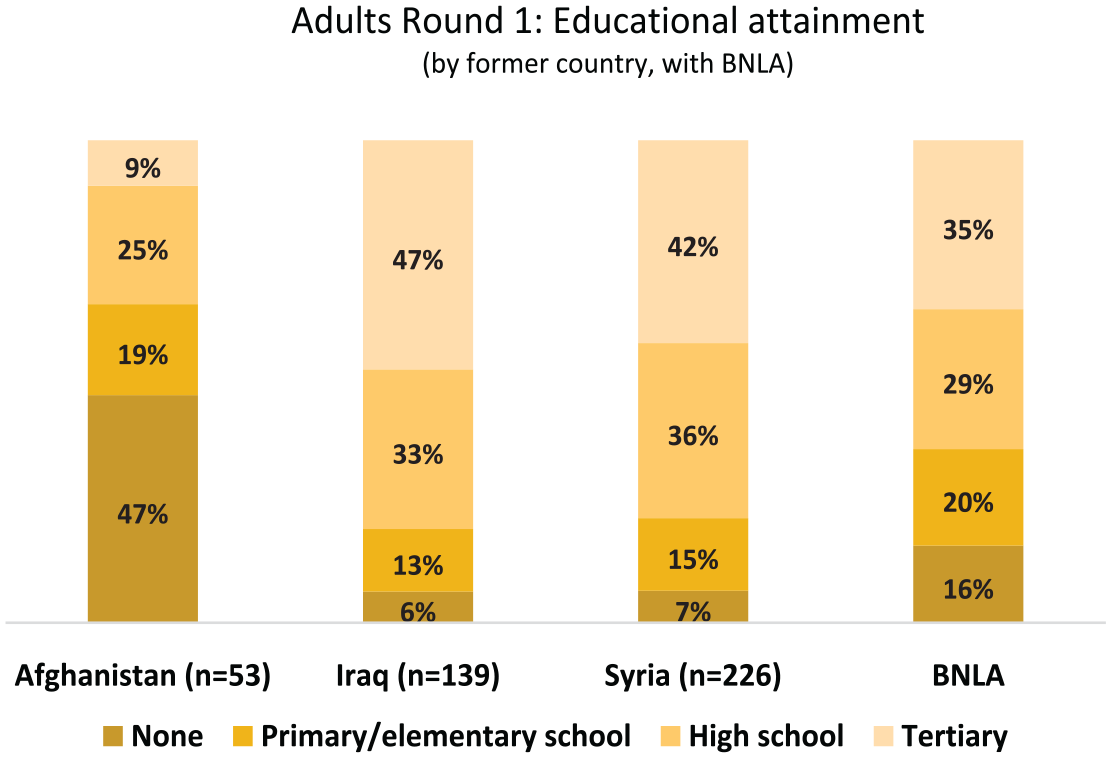
Educational Backgrounds of Refugees Surveyed.
Prior to arriving to Australia, many of the refugee adults in the Syrian-conflict intake had high-paying jobs in senior-level positions in business and finance, engineering, and health. Significantly, there was a gendered dimension to this professional status with the vast majority being men with women looking after the family home, children, and older parents.
Education level was found to directly influence labor market outcomes. Figure 2 shows that in Round 1 one-half of those refugees who arrived in Australia with a tertiary education degree found a job as did just under one-third (29%) of those refugees with high school education qualifications. Contrastingly, only 16% of those with a primary school education got a job by Round 1, while only a small proportion (3%) of those without educational qualifications were successful in gaining employment. Notably for Rounds 2 and 3, an increasing proportion of those refugees without tertiary education gained employment, while employment rates among the tertiary educated plateaued over time. One reason for the latter outcome could be that tertiary educated individuals moved out of transitory jobs, which they gained swiftly upon resettlement, and subsequently sought work in their pre-migration levels of skills, qualifications, and experience.
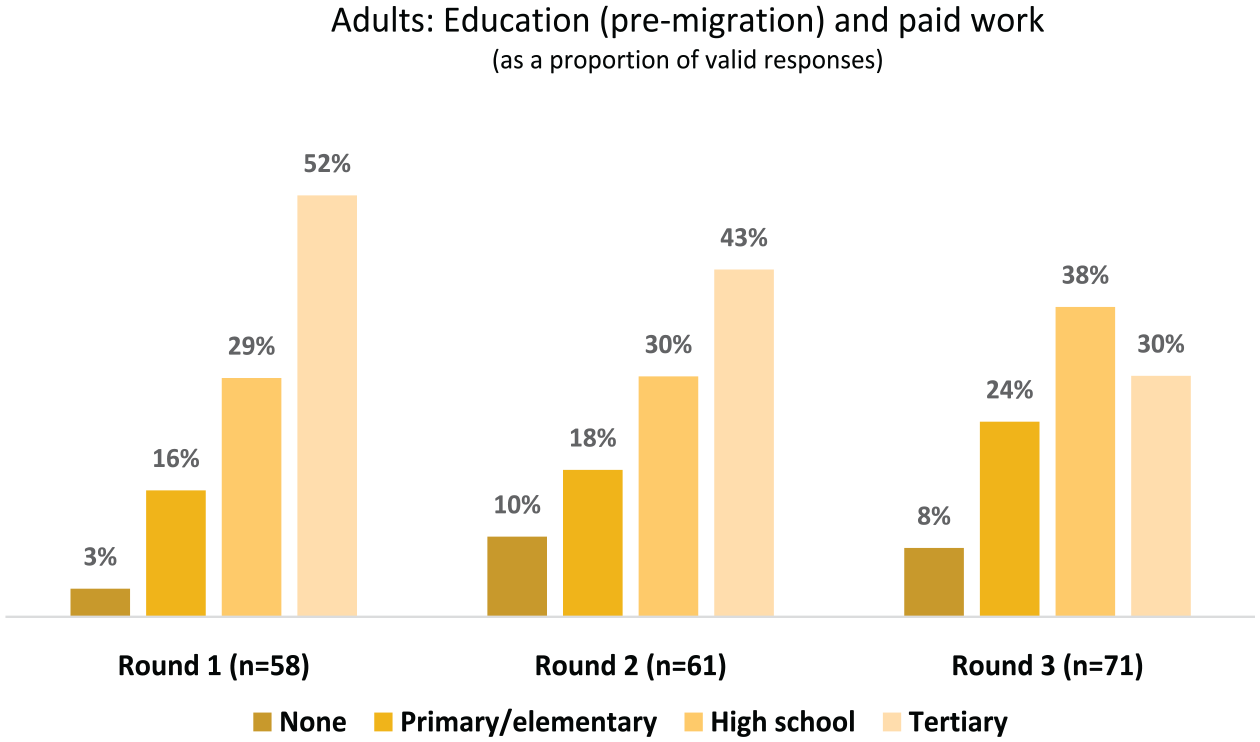
Adults Who Found Work by Pre-Migration Education.
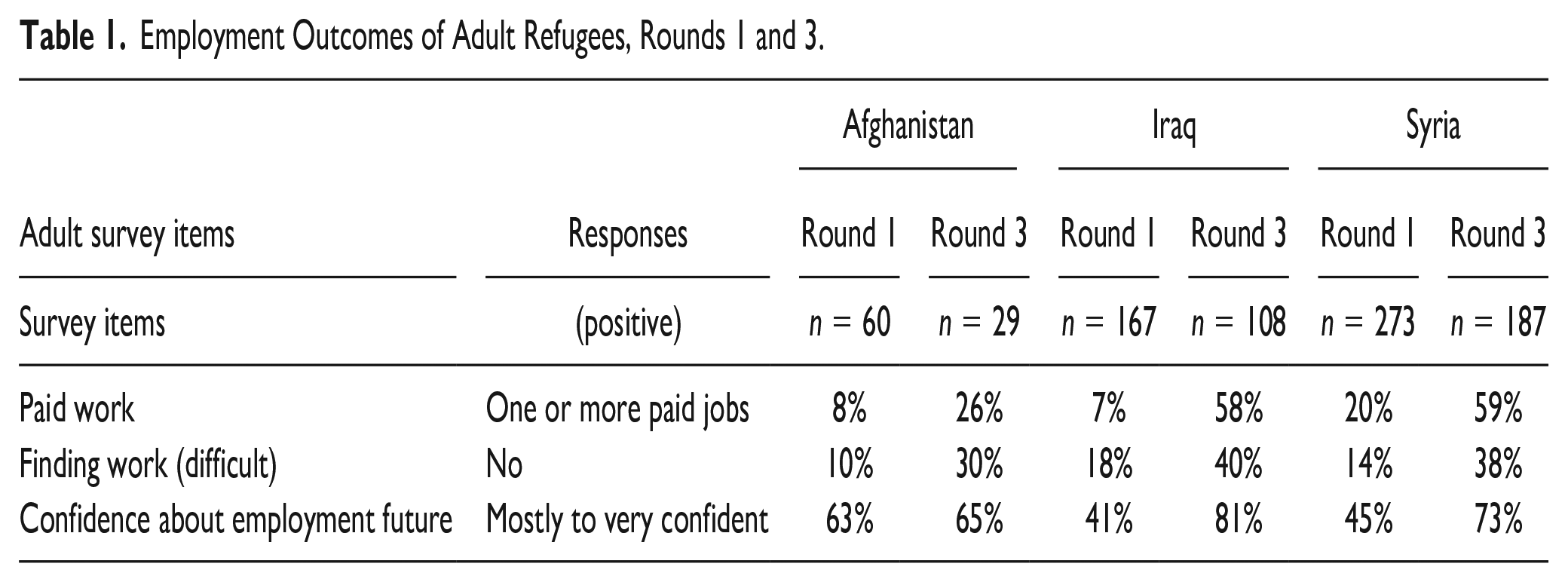
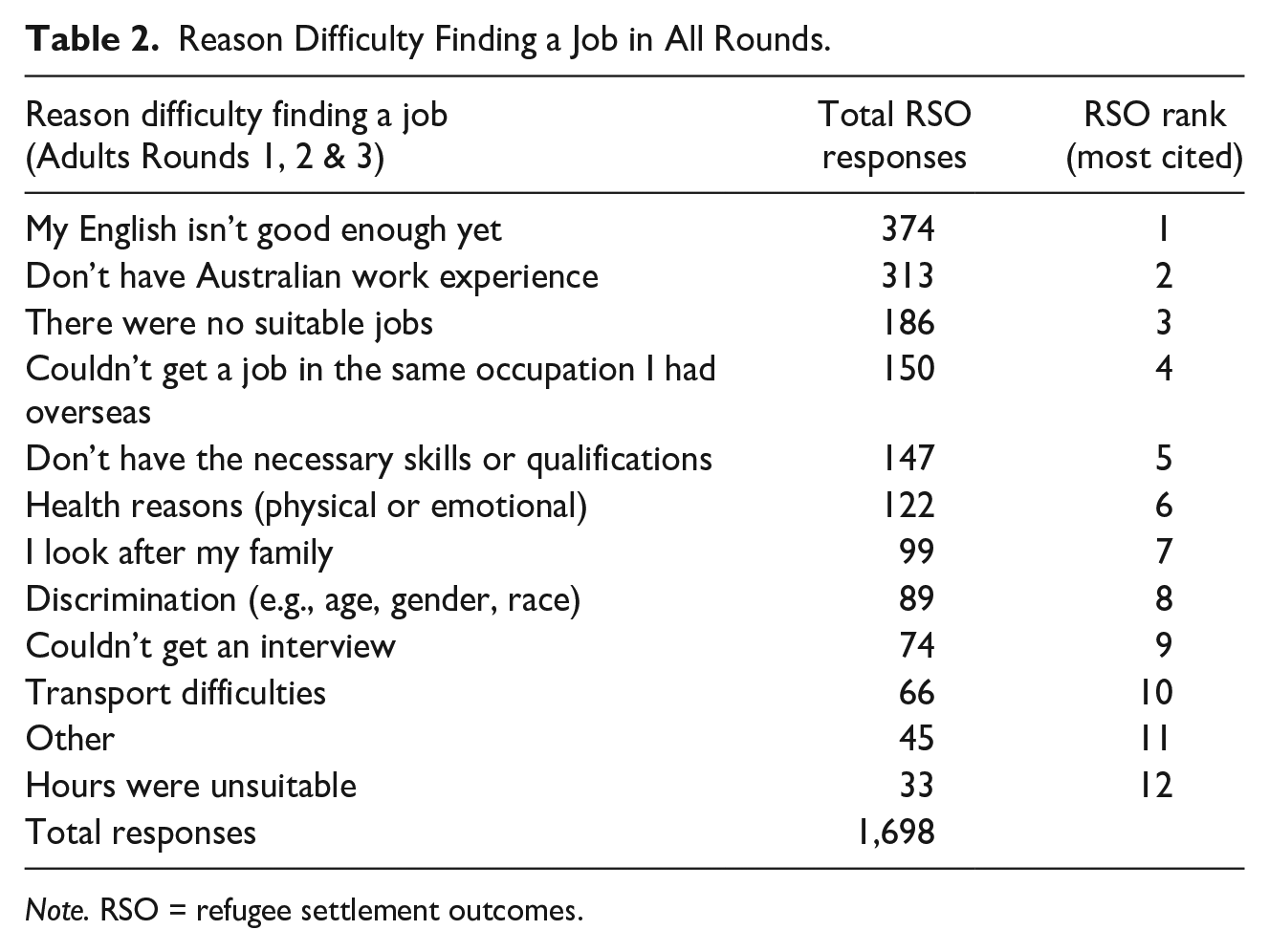
As noted in the bulk of the scholarship, once arriving to Australia, both skilled and low-skilled refugees experience significant barriers to entering the labor market. However, access to the labor market largely improves over time. For instance, the proportion of refugee adults surveyed who found it hard to get a job fell from 85% in Round 1% and 82% in round 2% to 62% in Round 3. Little difference was noted between male and female participants in terms of the difficulties experienced. Respondents across all three rounds said that the main barrier to obtaining employment was that they lacked Australian work experience. The lack of English was also consistently cited by refugees as a barrier to employment as were difficulties specific to professional accreditation and access to a position representative of skills and qualifications. Correspondingly, project participants noted that they lacked both formal and informal networks and did not understand the Australian labor market structure or workplace culture. Taken together, these factors resulted in the majority of the respondents not finding work in a similar position to that which they had pre-migration but confidence in accessing employment increased over time. These outcomes are depicted below in Table 1.
Employment Outcomes of Adult Refugees, Rounds 1 and 3.
In terms of the gendered dimension to finding work—difficulties were noted for both female and male project participants, with improvements in accessing work following each round of interviews/surveys as noted in the Figure 3 below.
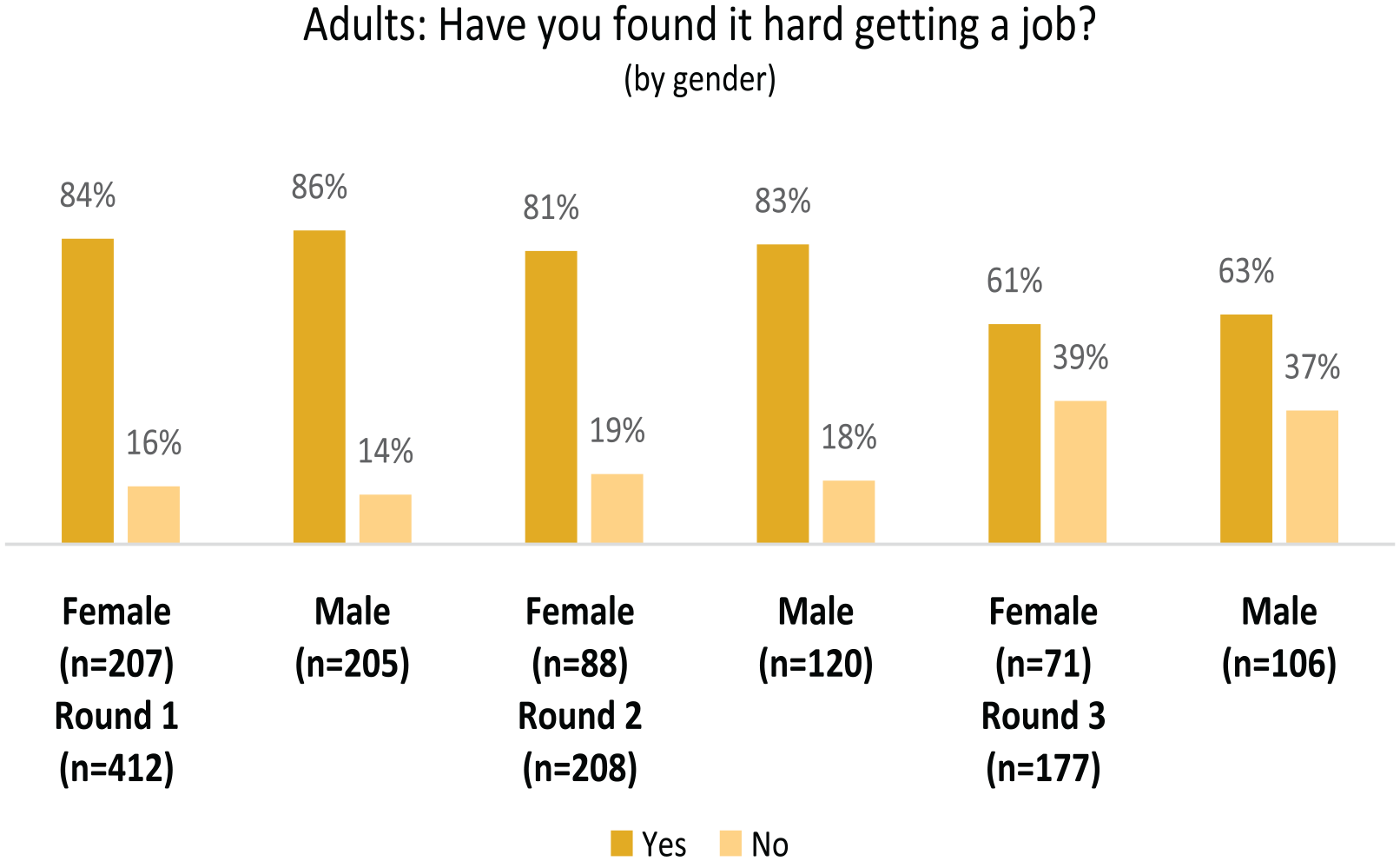
Difficulty Finding Employment by Gender.
The pre-migration experience of refugee settlers resulted in a gendered dimension to employment outcomes once in Australia. Figure 4 shows that the proportion of male refugees who found employment is more than double that of female refugees in Rounds 1 and 2 and slightly less than double in Round 3. In our interviews, we explored the gendered nature of employment in some detail. For both female and male project participants, the first few years of settlement in Australia saw them focusing on learning English and navigating their way around new systems and a new culture.
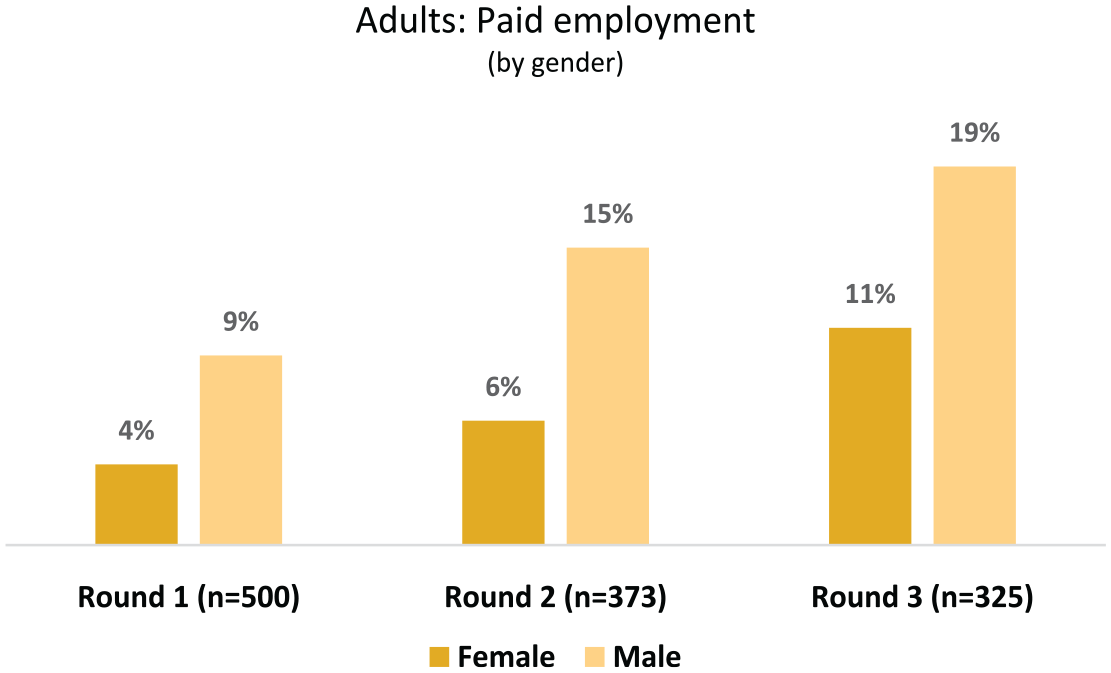
Refugee Employment Outcomes by Gender.
The reasons for experiencing difficulties in gaining employment are listed in order of significance in Table 2.
Reason Difficulty Finding a Job in All Rounds.
Note. RSO = refugee settlement outcomes.
In mapping the employment experience of recently arrived refugees broken down by gender, education, and pre-migration experience, we find emergent patterns. Women refugees were less likely to be working generally and less likely to be working in a professional capacity; on balance, both women and men refugees found it incredibly difficult to access employment—particularly in Rounds 1 and 2 and all experienced a suite of difficulties in accessing the Australian labor market; finally, respondents noted issues with a lack of Australian experience and a lack of formal and informal networks.
While these outcomes highlight that we need more innovative policies and programs to ease the pressure on newly arrived refugees more broadly, they also highlight that newly arrived refugee women and men are severely bounded by the business and labor market context to which they arrive and within which they must engage. The context reinforces and reproduces barriers to refugee employment, particularly for those arriving with skills and qualifications. Skilled refugee women are also less likely to be placed at the center of the analysis, the argument being that they have arrived—less educated and skilled than their male counterparts and part of a family unit with a male head of the home who works while the woman is the homemaker.
While these findings are important in contextualizing the experience of newly arrived refugees, hearing the voice of women refugees who have overcome the multiple barriers can certainly provide us with insights into how these women strategically and intentionally navigate the labor market to overcome barriers while also shedding light on the role of business stakeholders in facilitating access. Bella’s story identifies the self-recognition she has regarding her skills and abilities; her desire for emancipation from being stigmatized as a refugee; her deliberate choice to utilize the programs available to refugees; her response to feedback surrounding the barriers to employment; her use of formal and informal networks; and her ability to act on the feedback. Bella has been identified as a research outlier as she falls outside the emergent patterns indicated in the quantitative findings.
To capture the outlier in our research sample the chief investigators met fortnightly to discuss the emergent interview outcomes. The interviews provided us with nuanced insights into the progress, challenges, and opportunities experienced by the newly arrived refugees in their own words. Our discussions focused on the main patterns we observed emerging in the lives of the newly settled refugees. We also turned attention to the outliers we interviewed. That is, those individuals and/or families who sat outside the main emergent patterns which were also captured in the quantitative outcomes. Bella was one such individual: a woman, a professional with qualifications, pre-migration work experience and English language skills; a single mother who arrived under the Woman at Risk visa; and a professional refugee who gained swift employment once in Australia, most notably in a position representative of skills and qualifications. Turning to the case of Bella provides us with important insights into refugee agency, recognition, and emancipation.
The Case of Bella’s Agency and Emancipation: A Contribution to Business and Society
Once arriving and settling in her newfound homeland, located in Brisbane Australia, Bella very swiftly began sending out job applications related to her professional experience and education in banking and finance, while undertaking mandatory English language classes. Her efforts to enter the Australian labor market were met with persistent disappointment and rejection. Curious by the repeated negative response, she sought feedback and was informed that she was a “refugee who lived in the wrong postcode.” Once arriving to Australia, refugees have been resettled in specific areas. Bella noted that being identified as a member of a marginalized group living in an area which largely settled refugees weakened her opportunity to access a position in a professional capacity. In her view, there was a stigma surrounding where she lived which tainted her ability to be considered for professional employment. She was lumped in with what is perceived to be a high needs and challenging applicant. The honest but ill-conceived feedback influenced her intentional and strategic response to transform her settlement and employment future.
Buoyed by the encouragement of a very close friend who had settled in Australia as a refugee some years prior to her arrival, she contacted one of the most significant refugee intermediaries assisting professionals in gaining access to their pre-migration careers located in Sydney. Bella applied for and was accepted to participate in a 3-month paid internship with CareerCo, a refugee-focused social enterprise. With a client list that includes Australia’s largest companies in banking and finance, professional services firms, engineering and property development and management, to name a few of the key areas, this organization provides a stepping stone into Australian organizations for newly arrived refugees.
Avenues into the Australian labor market are highly formalized and structured, particularly for professional positions (Newman et al., 2018; see also Hillmann & Toğral Koca, 2021; Knappert et al., 2018). Certified and/or registered qualifications documents are required for some professions and while local experience is not a pre-requisite, there is a vast body of literature (Campion, 2018; Colic-Peisker & Tilbury, 2006, 2007; Delaporte & Piracha, 2018) that shows this is often employed as a reason for rejecting refugees in the recruitment and selection process. Evidently, highly skilled refugee women experience amplified barriers when it comes to accessing professional positions as the structural imbalance is far greater for them than their male counterparts (Hillmann & Toğral Koca, 2021).
CareerCo not only provides an orientation program for navigating the Australian workplace culture, but they also act as a circuit breaker in the process of navigating access into the Australian labor market. Following completion of an induction/orientation program at CareerCo, Bella was matched with an Australian bank to undertake a paid internship. Of her experience she noted: It was a good orientation for around 30 refugees. They did some practising for us—how we can build our profile on LinkedIn, how we can connect with people. They talk a lot about the business culture in Australia and business environment in general and then they give you opportunity to do an internship at BankCo. They find for me a position like my last position in risk.
The move from Brisbane to Sydney was financially straining and difficult but was embarked upon as a strategy to create a better life. To support herself and her child she worked nights as a cleaner—juggling getting settled in and supporting her transition in a new location and home: “my daughter sometimes she will come with me for a few hours and then my friends took her to their apartment and sometimes she was asleep with them. It was hard for her more than for me and it is like long hour work—yeah, it is need an effort.” She also made the decision to settle in an area some distance away from where newly arrived refugees were typically located. Armed with the knowledge that she resided “in the wrong postcode” she made the strategic choice to “try to make new connections” while breaking the cycle of populist perceptions of “refugees just take Australian taxes.”
She also saw opportunity in familiarizing herself broadly and deeply with the Australian organizational culture. Of this she said: “I did research because I didn’t grow up in Australia. I didn’t study here. I didn’t work her. . . . So when they will give you something to do it, it take for you an hour but maybe for me, it takes two hours as I don’t have insider knowledge.” While Bella had completed a MBA in Damascus, she enrolled in a Masters program once arriving in Sydney, treating her Australian studies as an opportunity to gain locally specific insights and knowledge.
The concept of strategic and intentional agency (Squire, 2017) and recognition as espoused by critical theorists such as Honneth within the context of work have rarely been employed. These concepts are useful as they speak to the centrality of value and worth which is mirrored in the support found in one’s new community by institutions and the key stakeholders within business and institutions (Turtiainen, 2018). Importantly, we are guided to an explanation and understanding of the experience of professional refugee women and the associated issues surrounding humanitarian settlement including: safety, belonging, work rights, health care, welfare and shelter. Relatedly, these normative facets of humanitarian settlement are also reflected in the defining characteristics of Honneth’s theory including, rights, solidarity, and love (Groutsis et al., 2020).
Bella’s story captures the tensions experienced at the business level where on the one hand she is recognized, valued, and included and on the contrary, she is treated with disregard, stigma, and a lack of humanity. Recounting her interactions with a team member, she spoke of how she was interchangeably referred to as “refugee girl,” “refugee woman” and “refugee” until one day she decided to speak up. Bella recounted her response to her colleague in the following way: “my name is not refugee girl, it is Bella. . . so please be kind and stop calling me that.” Bella went on to say that she pointed out to her colleague that other than Indigenous Australians we have all come from somewhere. She went on to say: I said to her that I came over to Australia by my high qualification. I have a Masters degree and I have more experience than you in the banking sector. I came over here with my high experience and qualification . . . So please be kind and stop bothering me. She say no, that’s fine but I forget your name. I told her you can ask once, twice, three times.
Bella was clear in who she is and clear in her intention to change the narrative surrounding who she was framed as. While the matter was resolved Bella went on to note the care and support she received from the human resources representative throughout her tenure at BankCo. She noted that she has been treated with dignity and respect and she has felt—in the main—safe and respected, visible, and recognized in what she described as a culture of inclusion. She observed that the human resources representative frequently checked in on her and in building a solid relationship with the representative she has been named a diversity champion for the multicultural network, a position she feels particularly proud of. Bella’s experience highlights the subtle yet powerful role actors at the business level can play in facilitating inclusion and a sense of belonging (Groutsis, Vassilopoulou, et al., 2023).
Since joining BankCo, Bella has been promoted and is now working in a new specialized area. Of this new opportunity she said: it’s totally new for me. It’s totally a new product for me, and it’s very complicated, because it’s related to regulatory and tax, and insurance, and disability. It was hard, honestly. It’s hard to find people to explain to you. It’s taken me a lot, because people in Australia, usually they work hard for five, six hours, continuous—for me I need to work double, because at night, I read, read, read as much as I can, to understand the same as my colleague.
This role has not been without its challenges as she explains that she has been judged for her swift promotion in spite of her lack of Australian experience. She wants to challenge this negative framing. She wants to highlight that she does indeed add value to her new homeland and workplace environment.
In the fourth year of interviewing Bella and upon reflecting on her identity, she revealed that her perceptions of who she is in her new context have changed. She now recognizes and values her Syrian, refugee and Australian identity. She no longer views being a refugee woman as a stigmatized “other.” Instead, she now feels immense pride for her achievements and for her ability to inspire others to achieve. Of this transformation in the relatively short time she has lived and worked in Australia she said: My identity, I am a proud Aramaic woman, grow up in a very lovely country named Syria, and chasing her dream now, as a proud refugee Australian woman. Like, first I was sad, like when they were pointing at me, like I’m refugee, because I have a name, and I want to stop this branding, but after all my achievement, I’m very proud to say, every time, I’m a Syrian refugee woman, from Aramaic ethnicity. I come here to chase my dream, and secure a fair life for my daughter.
She said that in embracing her identity as a refugee woman she is now called on to speak about her experience, her choices, the pursuit of her dreams and aspirations. She values this role and gains strength while giving strength to others. The business level has played a critical part in Bella’s strong sense of identity; rebuilding and integrating swiftly in her new homeland. Bella’s opportunity to be a spokesperson at the workplace level, highlights the value the business places on recognizing, valuing, and capitalizing on overseas skills and qualifications, regardless of where these are gained or the visa under which one has arrived and settled in the country.
Of her responsibility as a role model, Bella noted: It is an important part for me to inspire the people around me, because I face a lot of people. They need to hear these stories to make them feel like how they should be grateful, appreciate they grow up here, they study here, and to push them a little bit, like, look what I have done, how I chase my dream, and start achieve my dream, and you can do the same. I have been really touched, during my days in BankCo, and the people around me, they always say, like, you inspire me—you are very inspiring woman
Conclusion
This article has extended on the limited understanding of refugee agency within the context of work by also drawing on the work of critical theorist Honneth (1996). In doing so, we have shed light on the implications of the actor’s agentic response incorporating an acceptance/rejection of preexisting structures. In doing so, we have shown how intent and strategy are at the heart of seeking emancipation from within preexisting structures. Honneth’s analysis has implications more broadly for other kinds of agentic responses in the business context. Specifically, we posit that there can be an acceptance and/or rejection of preexisting structures as well as implications for stakeholders being recognized (or not) by a business beyond refugee women in a professional context. Of note is the important value this presents to both actors. This is a clear value add for business. In terms of the case in point, Bella’s experience highlights the important contribution she can make, thriving in her new homeland which has been supported not only by her strategic and intentional choices but also by the business level actions.
Bella actively and strategically made choices throughout resettlement. She crafted her employment experience while landing in her profession and thriving. What becomes patently obvious is the use of social bonds in spearheading her access to the labor market. Her experience shows that approaching the case of refugees as a high-needs group of potential workers overlooks the varied human capital capabilities of these individuals. It appears that business views refugee settlers through a singular lens and as such reinforce and reproduce a loss or an underutilization of skills and qualifications. A more clearly threaded together network is required to create a clear pathway for refugee employment.
In Bella’s case, she placed herself in the internship, she relocated, and she spoke up when stigmatized as a refugee. Without the assistance of local, informal community connections and that of formal intermediaries, she would not have turned her life around and access a position in the labor market commensurate with her pre-migration position. Her rejection of her status as a “refugee who lived in the wrong postcode” spearheaded her transition into the core labor market.
Throughout the phases of resettlement, she was indeed supported, but much of the success defining her lived experience of resettlement was driven by her. To neglect the skills and abilities of such talent is a loss to the business community and society more broadly. As an outlier in the findings, Bella’s case highlights the need for a more innovative and creative approach to program outreach post resettlement. Furthermore, Bella’s case is a warning to policy makers and business leaders alike to place the spotlight on outliers; to assess aggregated data outcomes with caution; and to resist the default position which sees outliers remove from quantitative outcomes. Indeed, the outlier methodology provides insights that are generalizable beyond Bella’s case.
Bella’s story demonstrates the decision-making process involved in her mobility and post-settlement labor market integration, and as such challenges the dominant wisdom in the scholarship that sees refugees as devoid of agency. She was very deliberate and determined in her active choices and in the pathway, she carved and is carving as she builds her career in banking and finance. As a refugee professional woman, her identity has gone through a transformation. Her reflections as stigmatized “other” have been overturned whereby, she now embraces her intersectional identity as a refugee, a Syrian woman, an Australian woman (Lam, 2018). She has drawn on these multiple identity characteristics to overcome the substantial hurdles that refugees with a professional background face in settling successfully in countries like Australia. Bella has reinvented herself as a role model for other refugee women who dare to seek freedom from unjust institutional, community, and workplace arrangements and discourses and who dare to dream.
Footnotes
Acknowledgements
The authors would like to thank the refugees who participated in the project. In the case of this article, we would particularly like to thank Bella for her story. We would also like to thank the reviewers and the editor who provided us with valuable and guided feedback throughout the review process.
Declaration of Conflicting Interests
The authors declared no potential conflicts of interest with respect to the research, authorship, and/or publication of this article.
Funding
The authors disclosed receipt of the following financial support for the research, authorship, and/or publication of this article: The authors disclosed receipt of the following financial support for the research, authorship, and/or publication of this article: The research was funded by the Australian Research Council ARC Linkage Grant (2017-20) LP 160101735 Settlement Outcomes of Syrian-conflict Refugee Families in Australia.
