



Abstract
Entrepreneurial agency—the individual power to change environments—is central to entrepreneurship research. Yet, from a social inequality perspective, beliefs in an entrepreneurial agency might differ based on the social class environments individuals are born into. Drawing on social cognitive theories, our findings across three data sets among students from Germany and entrepreneurs from the United States indicate that social class origins are associated with entrepreneurial self-efficacy (ESE) beliefs in adulthood. Exploring the underlying mechanisms, we find that students’ early entrepreneurial experiences in education and practice are indicative of reproducing the class gap in ESE. When individuals collect mastery experiences such as social mobility or entrepreneurial success, their lower social class origins turn out to be associated with enhanced entrepreneurial agency beliefs. We discuss the implications for further research on social class, inequality, and entrepreneurship.
Keywords
Transgressing individuals’ environmental constraints is a central element in entrepreneurship theory. Entrepreneurial action transforms environmental circumstances (McMullen et al., 2021; Schumpeter, 1934, 1955) and removes prior constraints as an act of emancipation from undesired, imposed structures (Calás et al., 2009; Laine & Kibler, 2022; Rindova et al., 2009). For instance, entrepreneurship research delineates how entrepreneurial action alleviates abject poverty and improves adverse life circumstances in emerging economies (Alvarez & Barney, 2014; Bruton et al., 2013; Kimmitt et al., 2020; Sutter et al., 2019), creates opportunities for individuals to break free from societal constraints such as stigma (Ruebottom & Toubiana, 2021), and disadvantaged gender roles (Alkhaled & Berglund, 2018; Jennings et al., 2016).
Yet, despite this promising evidence of entrepreneurship’s potential for individual social mobility in the face of structural disadvantages, we know little about the consequences of social inequality on individuals’ entrepreneurial agency. Generally, for children born into a middle-class family, the prospects of earning more than their parents have declined significantly over recent decades (Chetty et al., 2017). 1 Organizations rather reproduce than equalize differences in individuals’ social standing (Amis et al., 2020; Bapuji et al., 2020; Laurison & Friedman, 2016; Marens, 2018; Martin & Harrison, 2022; Pitesa & Pillutla, 2019; Rivera & Tilcsik, 2016). The current research in organizational literature highlights that social class origins affect later mobility within organizations by as comparative an effect size as gender and migration backgrounds (Ingram & Oh, 2022). Furthermore, social class backgrounds influence cognitive and behavioral mechanisms relevant to organizations (Côté, 2022; Kish-Gephart et al., 2023)—for instance, the willingness to compete (Almås et al., 2016), risk-taking (Kish-Gephart & Campbell, 2015), leadership behavior (Barling & Weatherhead, 2016; Martin et al., 2016), and overconfidence (Belmi et al., 2020). The pervasive influence of individuals’ social class origins has been subject to influential sociological theories such as Bourdieu’s concept of habitus—the internalization of class environments in individuals’ thoughts, feelings, and actions (Gray & Kish-Gephart, 2013). Given that social class origins are associated with different levels of environmental controllability (Kraus et al., 2009), prior entrepreneurship research has not yet distinguished between models of agency in situations of social inequality.
The objective of this study is to investigate how individuals’ social class origins influence the formation of their entrepreneurial agency beliefs. We extend Bandura’s social cognitive theory to the realm of social class origins and entrepreneurship to study how self-beliefs in entrepreneurial self-efficacy are affected by imposed, selected, and created social class environments. According to Bandura (1986, p. 1175), “persons are neither autonomous agents nor simply mechanical conveyers of animating environmental influences.” Social cognitive theories allow us to study how individuals’ actions reciprocally interact with their personalities and environments (Bandura, 1986; Fiske & Taylor, 1991; Smith & Semin, 2007). Among the explanations of what constitutes human agency mechanisms, “none is more central or pervasive than people’s beliefs about their capabilities to exercise control over events that affect their lives” (Bandura, 1989, p. 1175). To this end, self-efficacy beliefs inform the interplay between structural and agentic elements in human functioning. We argue that entrepreneurial self-efficacy beliefs—as a central element in entrepreneurial agency—are affected by individuals’ social class origins.
The study contributes to existing entrepreneurship research as it conceptualizes the formation of entrepreneurial agency beliefs through the lens of individually experienced social inequality—the social class individuals are born into. While prior research shows that entrepreneurial action can alleviate poverty (Alvarez & Barney, 2014; Sutter et al., 2019) and release environmental constraints (Calás et al., 2009; Laine & Kibler, 2022; Rindova et al., 2009), our study contributes to the discussion of the dualistic nature of entrepreneurial agency by investigating the complement to this relationship: how social environments (i.e., social class origins) alter individuals’ entrepreneurial agency beliefs. Accordingly, we explore mechanisms that indicate that those who need mobility the most face social barriers in their pursuit of entrepreneurial opportunities. At the same time, we show under which conditions individuals turn unequal starting conditions into distinct levels of entrepreneurial agency.
Most prior literature on entrepreneurship and inequality takes an economic stance (Atems & Shand, 2018; Bruton et al., 2021; Lewellyn, 2018; Packard & Bylund, 2018; Patel et al., 2021; Pathak & Muralidharan, 2018) examining the effects of entrepreneurial activity on the level of economic inequality in a society. Other research investigates economic inequality’s consequences on entrepreneurial entry from a labor market stance (Frid et al., 2016; Perry-Rivers, 2016; Schoon & Duckworth, 2012; Xavier-Oliveira et al., 2015). While these perspectives highlight that entrepreneurship can be both the solution to and the cause of economic inequality, little is known about the underlying mechanisms that prevent or enable individual social mobility in the pursuit of entrepreneurial opportunities. We enhance the discussion by providing explanations for a socio-cognitive micro-foundation to the entrepreneurship–inequality relationship.
By theorizing on specific challenges for individuals from lower social class origins in building entrepreneurial self-efficacy, we contribute to an emerging intersectional perspective on the unique challenges individuals with specific backgrounds and identities face in entrepreneurship (Bakker & McMullen, 2023; Miller & Le Breton-Miller, 2017; Neville et al., 2018; Patel et al., 2022; Thébaud, 2015). While the study’s focus is on social class origins, we discuss the implications for a shared agenda on inclusive entrepreneurship.
Social Class Origins and Cognition
Societies are stratified through hierarchies in which some groups experience and exercise superiority over others (Magee & Galinsky, 2008; Pratto et al., 2006). While discussions on what constitutes social classes can be approached from various perspectives (for a review, see Loignon & Woehr, 2018), we follow Côté (2011) in his definition of social class as “a dimension of the self that is rooted in objective material resources [. . .] and corresponding subjective perceptions of rank vis-à-vis others” (p. 47). Specifically, we focus on the mechanisms through which individuals’ exposure to social classes shapes their subsequent cognition and behavior. In his seminal work, Bourdieu (1984) develops a theory on how individuals translate the social class characteristics of their environment into internal patterns of thoughts, feelings, and actions. According to Bourdieu (1984), social structure distinguishably shapes the individuals’ “habitus,” that is, their practices, styles, and taste. Such social class differences influence how individuals perceive their self and others (Gray & Kish-Gephart, 2013). That said, Bourdieu’s concept of habitus represents a mediator between the structures that constrain individuals and their agency to alter their circumstances.
Interestingly, even if environments change, such class differences relatively likely persist as “social class is not simply a trait along which individuals vary, but is instead a social context that individuals inhabit in enduring and pervasive ways over time” (Kraus et al., 2012, p. 547). Accordingly, management scholars more recently renewed their interest in the concept of social class (for reviews, see Côté, 2011, 2022; Kish-Gephart et al., 2023) to investigate organizational behavior as a consequence of social class origins. For instance, controlling for the most common psychological traits and preferences, a representative sample of 14-year-old pupils in Norway shows significant differences in their willingness to compete depending on their parents’ social class backgrounds (Almås et al., 2016). That is, male pupils from lower social class backgrounds are less competitive compared with their counterparts from more privileged families. In this context, children’s different socializations pave the way for their later career trajectories (Barling & Weatherhead, 2016; Koppman, 2016). As a result, cognitive styles and leadership behaviors vary among employees within organizations depending on the employees’ social class origins (Martin et al., 2016).
Furthermore, early childhood environments shape the propensity to take risks later in life (Mittal & Griskevicius, 2014). This longitudinal effect holds even when examining the effect of CEOs’ perceived social class origins on their firms’ risk aversion (Kish-Gephart & Campbell, 2015). CEOs stick to these cognitive styles despite climbing up the social ladder. Ultimately, Pitesa and Pillutla (2019) raise serious concerns regarding the propensity of individuals from lower social class backgrounds to climb up the career ladder due to their own behavior and third-party treatment. Along this line, Ingram and Oh (2022) find a so-called “class ceiling” that prevents individuals born into lower social class families from attaining leadership positions in organizations in a way that is comparable with the effects of the organizational underrepresentation of female leaders.
While research on social class origins gains steam in management research, entrepreneurship research has largely remained silent on how being born into rich or poor families impacts entrepreneurial cognition and social mobility via entrepreneurship. Prior research on entrepreneurship and inequality on the macro-level discusses the role of institutions and economic growth (Patel et al., 2021), the effect of inequality on social entrepreneurship activity (Pathak & Muralidharan, 2018), and the consequences of entrepreneurial activity on inequality (Lewellyn, 2018; Packard & Bylund, 2018). Most studies that consider individuals’ socioeconomic conditions investigate their influence on the likelihood of entrepreneurial career entry (Audretsch et al., 2013; Schoon & Duckworth, 2012; Xavier-Oliveira et al., 2015), whereas less is known about the association of being born into different social class backgrounds with entrepreneurial cognition (for a recent exception, see Ge et al., 2022).
Based on previous studies on social class origins and cognition, our study develops social cognitive explanations that extend and contribute to extant macro-level research on inequality and entrepreneurship. Prior research on entrepreneurial agency reveals a unique relationship with the removal of environmental constraints and the transformation of structure which we want to elaborate next to develop our hypotheses.
Hypotheses
Bandura’s (1986) social cognitive theory proposes a triadic relationship among the environment, person, and actions constituting human agency. Although the social cognitive theory acknowledges the effects of environmental cues on cognitive processes, it differs from the structuralist perspective by stating that human agents have the leeway to alter their environments. In this manner, the social cognitive theory explains how personal agency and social structure “function interdependently rather than as disembodied entities” (Bandura, 2012, p. 15). Specifically, the social cognitive theory proposes that “the exercise of personal agency over the direction of one’s life takes varies depending on the nature and modifiability of the environment” (Bandura, 1997, p. 163).
Following Bandura’s seminal work, subsequent research has yielded significant insights into how entrepreneurs’ environment interacts with individual cognition and behavior (Boudreaux et al., 2019; De Carolis & Saparito, 2006; Michaelis et al., 2022; Pushkarskaya et al., 2021; Shepherd et al., 2009). Yet, most of the conducted research has overlooked the echoes of individuals’ initial environments and their interaction with individuals’ perceptions of more recent environments.
In their attempt to integrate previous entrepreneurship theories, McMullen and colleagues (2021, p. 1197) define the field’s common denominator to be entrepreneurial agency—understood as “transforming social structures via entrepreneurial action.” Accordingly, entrepreneurial agents are changing their environments as they “produce definite outcomes by getting circumstances and others to comply with [their] wants” (McMullen et al., 2021, p. 1200). While “rebelling against the status quo” via entrepreneurial actions can take myriad forms (Corbett et al., 2018, p. 941), a dominant social imagery is entrepreneurs’ means of improving their social and economic standing (Laine & Kibler, 2022; Schumpeter, 1955). Recent work on entrepreneurialism states that such a narrative of entrepreneurial agency increasingly becomes the norm in precarious employment relations (Eberhart et al., 2022). Prior studies on the relationship between poverty and entrepreneurship indicate how individuals can transgress their impoverished backgrounds via entrepreneurial action (Alvarez & Barney, 2014; Baker & Nelson, 2005; Bruton et al., 2013; Kimmitt et al., 2020). Thus, the entrepreneurial agency represents entrepreneurship as emancipation from prior constraints (Jennings et al., 2016; Laine & Kibler, 2022; Rindova et al., 2009; Ruebottom & Toubiana, 2021). That is, entrepreneurial agents “seek to disrupt the status quo and change their position in the social order in which they are embedded—and on occasion, the social order itself” (Rindova et al., 2009, p. 478). Yet entrepreneurial agency as structural transformation requires constrained individuals to envision and believe in a “possible world” created through entrepreneurial action (Dey & Mason, 2018; Emirbayer & Mische, 1998). We understand such beliefs in the entrepreneurial agency as individuals’ entrepreneurial self-efficacy, which is “people’s beliefs about their capabilities to exercise control over events that affect their lives” (Bandura, 1989, p. 1175) via entrepreneurial action.
People with different social class origins such as imposed environments differ in their experience of environmental modifiability (Kraus et al., 2012). That is, due to their underprivileged position in society, individuals born into lower social classes experience a lack of power to achieve goals without heavily relying on the support of the external environment (Stephens et al., 2014b). Their actions tend to be structurally dependent on external factors (Barling & Weatherhead, 2016). However, individuals from higher social classes experience an abundance of resources and higher levels of power, which allow for relatively high levels of environmental control (Kraus et al., 2009). Consequently, individuals from lower (vs. higher) social classes perceive lower (vs. higher) environmental control and rely on others (vs. the self; Snibbe & Markus, 2005; Stephens et al., 2007).
Due to the experienced “grip” of the environment on individuals’ choice and action, individuals develop respective cognitive styles to effectively interact with their social environments (Frankenhuis et al., 2016; Mittal & Griskevicius, 2014). For instance, growing up in harsh and unpredictable environments alters individuals’ perceptions of the efficacy of their choices versus environmental factors influencing life outcomes (Griskevicius et al., 2013). Consequently, individuals from lower (vs. higher) social class backgrounds are more likely to apply decisions oriented toward adapting to (vs. shaping) environments (Griskevicius et al., 2011a, 2011b). That is, individuals from lower social class backgrounds are more likely to align their choices with others and avoid unique and unknown choices (Snibbe & Markus, 2005; Stephens et al., 2007). Adaptation to uncontrollable environments, for instance, means shorter time horizons and higher impulsivity in decision-making (Griskevicius et al., 2013). These cognitive styles can be considered “contextually appropriate responses” to individuals’ situational contexts and are rational from an evolutionary theory perspective (Mittal et al., 2015; Pepper & Nettle, 2017, p. 7). Hence, based on whether the environment is characterized by scarcity or abundance, it strengthens (or hampers) lasting beliefs in environmental control in various situations later in life (Kraus et al., 2009; Stephens et al., 2012a; Taylor & Seeman, 1999).
Accordingly, the unequal distribution of resources and status in societies leads to different models of agency in coping with environments (adaption vs. control). Based on the established understanding of entrepreneurial agency as environmental control, we hypothesize that the fewer constraints individuals experience in their childhood environments (i.e., the higher their social class origins), the more likely they are to develop entrepreneurial agency beliefs—that is, the belief in exerting control over the environment via entrepreneurial action. Against this background, we expect that early social class environments shape individuals’ later perceptions of entrepreneurial self-efficacy.
The environments individuals enter over the course of their life can enhance or attenuate initial class-based differences. Bandura (1997, p. 163) concludes that “under the same potential environment, some people take advantage of the opportunities it provides and its rewarding aspects; others get themselves enmeshed mainly in its punishing and debilitating aspects.” A critical insight into organizational research on social class is that mechanisms within organizations can reinforce social inequalities (Amis et al., 2020; Gray & Kish-Gephart, 2013). Multiple studies show that entering environments that provide opportunities for social mobility (such as elite organizations or higher education) is not enough to overcome initial inequalities (Kish-Gephart et al., 2023; Laurison & Friedman, 2016). Instead, institutionalized routines and practices can reinforce social class differences (Gray & Kish-Gephart, 2013; Pitesa & Pillutla, 2019).
One of the most prominent examples of the perpetuation of social class differences occurs in education. Individuals from working-class backgrounds are not just less likely to enter but also are less likely to be successful in college (Berkowitz et al., 2017; Phillips et al., 2020). Cultural mismatches are central mechanisms of the reproduction of class differences in educational settings (Bourdieu & Passeron, 1977; Stephens et al., 2012b, 2014b). Students from working-class backgrounds struggle with academic settings as they feel that they do not belong there (Reay, 2018; Stephens et al., 2015), are challenged by stereotypical and incongruent perceptions of self (Croizet & Claire, 1998; Johnson et al., 2011), and experience negative responses from others (Gray et al., 2018; Rheinschmidt & Mendoza-Denton, 2014).
Intuitively, prior entrepreneurship research supports the notion that entrepreneurship education fosters beliefs in entrepreneurial agency (i.e., entrepreneurial self-efficacy) through related mastery experiences, vicarious role modeling, and social persuasion (Gielnik et al., 2015; Zhao et al., 2005). Entrepreneurship education has been shown to provide disadvantaged groups with the necessary tools to emancipate from constraints and comply with expectations in the field (De Clercq & Honig, 2011; Santos et al., 2019). Yet, prior studies also indicate a more complex relationship concerning the boundaries of who profits more or less from these educational interventions (Cochran, 2019; Cox et al., 2002; Shinnar et al., 2014; Wilson et al., 2007). For instance, Cochran (2019) shows that women face additional barriers due to role incongruities and group dynamics in entrepreneurship courses. We argue that individuals born in lower social class environments must overcome additional barriers in entrepreneurship to propel their entrepreneurial agency beliefs.
While successful entrepreneurship is broadly associated with norms of independence (Davidsson, 2015; McMullen, 2017; Schumpeter, 1934), individuals growing up in underprivileged environments learn to act through norms of interdependence (Stephens et al., 2012a, 2014b). Their imprinted childhood experiences of constrained personal control due to the lack of power and status are incongruent with the role expectations of entrepreneurs’ elevated willingness to bear risks and uncertainty (Kraus et al., 2012; McMullen & Shepherd, 2006). Growing up in more advantaged backgrounds enables safety nets that allow individuals to venture into the unknown and take risks (Kish-Gephart & Campbell, 2015). In the educational context, Stephens and colleagues (2012b, p. 1190) show that cultural norms of independence as a tradition of “bold students who assert their own ideas, thoughts, and opinions” results in decreased academic performance of students from lower social class origins. This negative effect of a reduced feeling of belonging for students from working-class backgrounds persists over time and increases the social class gap throughout college (Phillips et al., 2020).
Growing up in lower social class background generates awareness of the dependence on the support of others which increases the endorsement of communal values (Piff et al., 2010). Hence, cultural norms in educational settings that emphasize “a tradition of learning through community” (Stephens et al., 2012b, p. 1190) resonate more with students from lower social class origins (Dittmann et al., 2020; Phillips et al., 2020). The focus of entrepreneurship on the entrepreneur as an agent of change likely conveys an independent norm of autonomy that is in line with the cultural socialization of individuals from higher social class backgrounds. Instead, students from lower social class origins are more likely to cultivate norms that endorse the adjustment to contexts and the response to the need of others (Stephens et al., 2019).
Finally, breaking the rules might lead to severe consequences for individuals in vulnerable positions. Hence, individuals from lower-class backgrounds learn to follow norms of conformity, deference, and hierarchy (Piff et al., 2012; Stephens et al., 2014b). For instance, a common finding is that students from poorer backgrounds are less likely to challenge or even engage with authority figures such as professors in class (Jack, 2016; Stephens et al., 2014a). These interdependent values of following others (Snibbe & Markus, 2005; Stephens et al., 2007) run contrary to valued entrepreneurial norms such as creativity, differentiation from the status quo, and challenging existing rules.
Prevalent cultural understandings of an independent model of entrepreneurial competencies in gateway institutions increase the class gap in entrepreneurial agency beliefs. Educators following cultural norms of independence, associated with entrepreneurship as risk-taking, autonomous, and distinctive, likely evaluate competencies from students from lower (vs. higher) social class origins as less (vs. more) appropriate (Connor et al., 2021; Dittmann et al., 2020; Stephens et al., 2017, 2019). Such negative mastery experiences can increase the class-based differences in entrepreneurial self-efficacy for students from lower social class origins (Goudeau & Croizet, 2017) and reinforce the class gap in entrepreneurial agency beliefs (Bandura, 1986).
In sum, a large body of research has shown that prevalent cultural norms of independence in education reinforce initial class-based disadvantages (e.g., in management education, see Moergen & Kish-Gephart, 2023). As such, while gateway contexts could enable social mobility, cultural mismatches likely increase the barriers for individuals from lower social class origins. While we argue that the underlying norm in entrepreneurship is independence, we want to stress that there are existing entrepreneurship education programs that also endorse cultural norms of interdependence (e.g., social entrepreneurship education, Pache & Chowdhury, 2012) and are inclusive to individuals from disadvantaged backgrounds (Santos et al., 2019). However, across programs and educational institutions, we assume that based on the arguments above, students from higher versus lower social class origins benefit more from entrepreneurship education, reinforcing the class gap in entrepreneurial agency beliefs.
While these aforementioned predictions about the relationship between social class and entrepreneurial self-efficacy base their assumption on a rather static influence of social class origins (like in other categories such as gender and race), a more dynamic view acknowledges that individuals can experience upward (and downward) mobility over the life course (Phillips et al., 2020). From a socio-cognitive perspective, individuals can “create social systems that enable them to exercise greater control over their lives” (Bandura, 1997, p. 163). Responses to objective structural barriers can, thus, introduce new subjective environments. When individuals perceive social mobility and transition through social classes, they partly outgrow their initial environment and find themselves in a created environment that they have built (Martin & Côté, 2019). The perception of having climbed up the social ladder represents a nonessentialist worldview in which circumstances are not fixed but can be altered through agency (Tan & Kraus, 2015). By collecting experiences of agency, the upwardly mobile are likely to break free from social class imprints of lower self-efficacy (Martin & Harrison, 2022). We argue that upward mobility negatively moderates the association of social class origins with entrepreneurial self-efficacy such that the perception of having transgressed the individual class background is a mastery experience that is congruent with entrepreneurial agency.
Emancipation from prior constraints and experiencing social mobility might, in line with the concept of entrepreneurship as emancipation (Laine & Kibler, 2022; Rindova et al., 2009), represent a vicarious entrepreneurial experience that alters the belief in entrepreneurial agency specifically for those from disadvantaged family backgrounds. Perceived upward mobility and belonging to a new environment (Ostrove, 2007) represents an active mastery experience of breaking free from stigmatizing constraints (Gray et al., 2018; Stephens et al., 2015), which is in line with prior conceptualizations of agency through entrepreneurial action (Ruebottom & Toubiana, 2021).
Individuals being born into lower social class origins can unfold unique strengths and become effective entrepreneurs. Overcoming childhood adversities and individual challenges in life can fuel unique entrepreneurial competencies such as resilience and persistence (Miller & Le Breton-Miller, 2017; Yu et al., 2022). Research on social class in the organizational setting has shown that upwardly mobile individuals learn to bridge cultural norms and become more efficacious leaders compared with those from more privileged backgrounds (Martin & Côté, 2019; Martin et al., 2016).
Based on the arguments of social mobility to enhance the individually perceived controllability of social circumstances, we expect perceived social class transitions to be a mastery experience strongly altering beliefs in entrepreneurial agency. Specifically, we expect individuals from lower social class origins that perceive themselves to have climbed the social ladder also to perceive higher levels of entrepreneurial self-efficacy.
Materials and Method
We test our hypotheses in a representative sample of individuals at higher education institutions (HEIs) in Germany. We selected this sample for several reasons: (a) Individuals are in a transition phase from being embedded in their parents’ household to perceiving their own social class; (b) those individuals who enter an HEI despite their lower social class origin are confronted with specific challenges induced by the new environment; and (c) given that all HEI students gain the same educational title, and educational backgrounds are often representative of an individual’s social class (Jonassaint et al., 2011), their objective social class is expected to be aligned. Thus, the context allows us to uniquely study how childhood social structures alter cognitive perceptions of the self and how individuals’ selection of new environments and their beliefs of mobility influence their self-efficacy beliefs.
Data Collection
In a pretest, we investigated the connection between social class and the relevant entrepreneurial concepts through an in-class survey of 107 undergraduate students at a large and public HEI in Germany, which gave us the confidence to commission an online panel provider to build a representative sample of HEI students in Germany. Subsequently, we collected data at the start of 2019 through a nationwide personalized online survey administered to German higher education students to establish a representative picture of the German student population. A total of 1,224 students from public and private HEIs in all German federal states and from various fields of study completed the questionnaire and were financially compensated by a private panel provider for their participation. Based on a measure that captures respondents’ time per question, we excluded participants who showed poor response quality. As we aimed for a representative sample of students from German HEIs, we randomly drew a representative sample from our initial sample that matches the overall student population in Germany concerning gender, location in German federal states, types of HEIs, and funding.
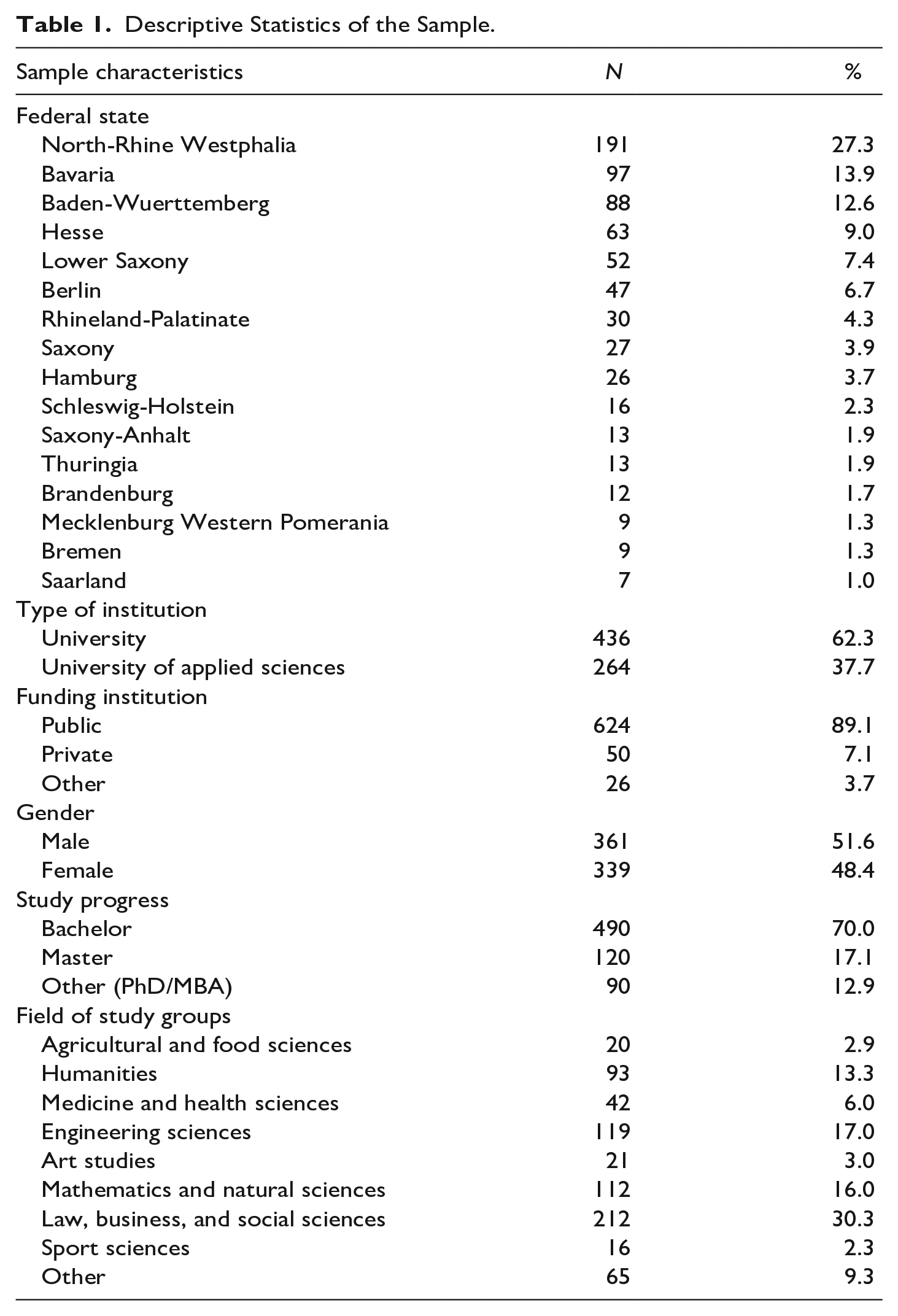
Table 1 lists the descriptive statistics of the sample. The final sample comprises 700 students distributed across HEIs from all 16 German federal states in line with what is known about the general population of German students in HEIs (DeStatis, 2019). Furthermore, the distribution of students’ enrollment in universities of applied sciences versus research-oriented universities, public versus private universities, and their gender follows the most recent representative quotas stipulated by the German Federal Statistical Office (DeStatis, 2019). The participants represent all subject groups, with most of them being enrolled in law, business, and social sciences (30.3%), engineering sciences (17.0%), mathematics and natural sciences (16.0%), and humanities (13.3%). Again, these numbers are mainly comparable with the general population of German HEI students (DeStatis, 2019).
Descriptive Statistics of the Sample.
Measures
The questionnaire items were translated from English to German. They were checked through back-translation by a researcher not involved in the study (Brislin, 1970) to ensure the measures were appropriate in the German context. In addition, all of the items were measured on a seven-point Likert-type scale, and constructs were deployed based on computations of the mean values of the corresponding items.
The items and the respective constructs (including the latent variables used only in the robustness and method variance checks) are listed in Appendix Tables A1 and A2. Table 2 lists the means, standard deviations (SDs), Cronbach’s αs, and two-tailed Pearson correlations of all the included variables (the correlations of the participants’ different fields of study are in the Appendix, Table A3). The correlations are not excessively high, and the values of the variance inflation factors are smaller than 1.2, meaning that they are below all thresholds (Neter et al., 1996), indicating discriminate constructs with no multicollinearity issues.
Means, Standard Deviations (SD), Cronbach’s Alphas (CA), and Correlations.
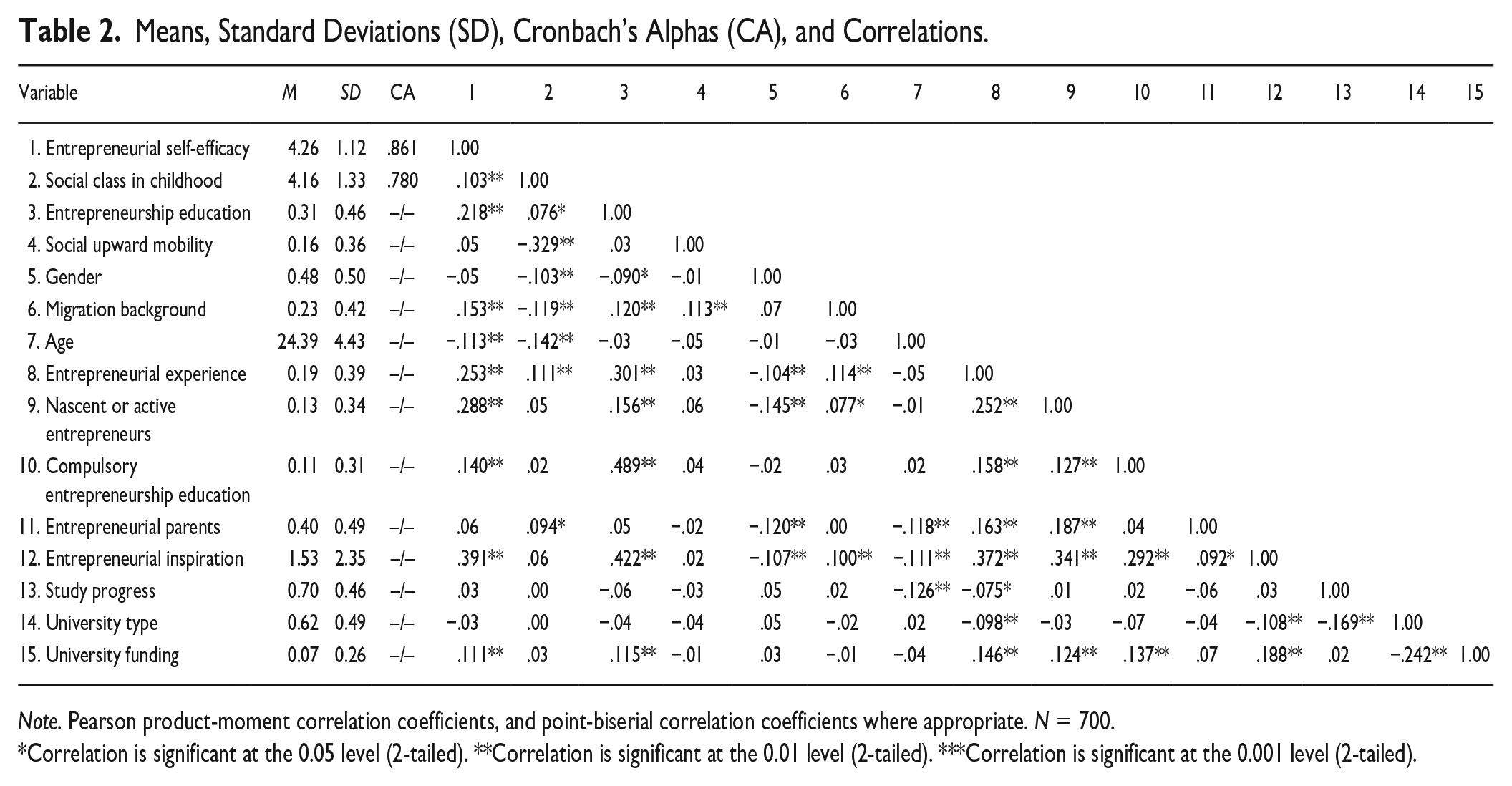
Note. Pearson product-moment correlation coefficients, and point-biserial correlation coefficients where appropriate. N = 700.
Correlation is significant at the 0.05 level (2-tailed). **Correlation is significant at the 0.01 level (2-tailed). ***Correlation is significant at the 0.001 level (2-tailed).
Dependent variable
Bandura (1986) proposes a task-specific measure instead of general measures of self-efficacy. Against the background of our sample, we measured entrepreneurial self-efficacy (ESE) in line with the four-item scale proposed by Zhao and colleagues (2005). To cover all stages of the entrepreneurial process, we included additional items from missing stages (McGee et al., 2009). Specifically, we added “Leadership and communication skills” (Liñán, 2008), “Networking skills and making professional contacts,” (Liñán, 2008), and “Managing a small business” (Kickul et al., 2009). However, we provided robustness checks, including analyses with the original scale from Zhao and colleagues (2005). Seven items capture the respondents’ perceived capability in different stages of the entrepreneurial process. Our measure based on Zhao and colleagues (2005) converges on the most popular ESE measure proposed by Chen et al. (1998; see also Newman et al., 2019). However, Chen and colleagues (1998) examine differences between entrepreneurs and managers, whereas Zhao and colleagues (2005) investigate ESE among students in an HEI context, which applies to the context of our study.
Independent variables
The childhood social class environment was measured based on the scale devised by Griskevicius and colleagues (2011a). Three items, namely “My family usually had enough money for things when I was growing up,” “I grew up in a relatively wealthy neighborhood,” and “I felt relatively wealthy compared to the other kids in my school,” query respondents about their perceived material conditions during childhood. This is one of the few acknowledged scales for measuring an individual’s material conditions during their childhood (Côté, 2011, p. 63) and has been used specifically to investigate how perceptions of environmental conditions influence later cognitive tendencies (Griskevicius et al., 2011b). Other subjective measures, such as the most prominent 10-rung ladder (Adler et al., 2000) or positions in a social class hierarchy (Jackman & Jackman, 1973), focus on rank order aspects rather than perceptions of the class environment. Subjective perceptions of social class are closely related to objective measures but are more relevant to individuals’ cognition (Adler et al., 2000).
To check the validity of the subjective measure, we drew on objective measures of social class by asking the participants about their parents’ educational backgrounds, family income, and job prestige. The measurement of these dimensions represents the most conventional way of assessing individuals’ objective social class (Côté, 2011; Loignon & Woehr, 2018). Therefore, we used the operationalization from Adler and colleagues (2000) and built four continuous categories for education (from high school degrees to higher degrees, including doctorate and law degrees), three continuous categories for occupational prestige (from blue-collar or service to professional or managerial), and nine continuous categories for annual family income (from under 20,000€ to higher than 160,000€). We followed the suggestion of Davis and Robinson (1988) that individuals identify with the highest levels of these dimensions in a household. Therefore, we calculated educational background and job prestige based on the highest manifestation of one of the parents.
Furthermore, we standardized the measures to combine them in a compound measure of objective social class (see Adler et al., 2000). The Pearson correlation coefficients show that the measure of subjective social class environment is strongly tied to the objective measures of an individual’s social class (0.481, p < .01, 2-tailed). Owing to the focus of the subjective childhood social class measure on perceived material conditions (Griskevicius et al., 2011a, 2011b), this measure shows the closest association with childhood family income (0.461, p < .01, 2-tailed).
To measure experiences in entrepreneurship education, we asked whether the respondents participated in an entrepreneurship course during their studies. If they did, we coded the respondents’ exposure to entrepreneurship education as one and zero otherwise. 2 As students can also acquire entrepreneurial competencies outside entrepreneurship courses (such as in university courses or seminars that are mainly centered around other topics and only partially cover entrepreneurship contents), we asked all participants how their studies in general increased their understanding of entrepreneurship. This variable covers the extent to which individuals perceived that the courses at the university in general enhanced their entrepreneurial understanding and is based on five items from Souitaris and colleagues (2007). As expected, the program learning correlates strongly (0.411, p < .01, 2-tailed) with participation. Indeed, most students increase their understanding of entrepreneurship during their studies. In all, 93% have acquired some additional understanding of entrepreneurship during their studies (program learning >1), whereas more than half of the participants tend to slightly agree with the statement that their studies increased their entrepreneurial competencies (M: 3.46; SD: 1.47; Median: 3.6).
To measure social upward mobility, the respondents were asked to choose a category for their socioeconomic situation in their childhood (vs. current) based on five categories, namely “lower class,” “lower-middle class,” “middle class,” “upper-middle class,” and “upper class,” which represent a rank-based measure of social class devised by Jackman and Jackman (1973; also see the application by Kish-Gephart & Campbell, 2015). Then, we calculated the difference between perceptions of rank in childhood and current social class perceptions. If the respondents perceived that they had moved at least one category (e.g., from “lower-middle class” in childhood to “middle class” currently), we coded them as perceived upward mobility (=1) and no upward mobility otherwise (=0). We used the dichotomous instead of the continuous variable as we were primarily interested in whether individuals have essentialist versus nonessentialist beliefs about their social class backgrounds (Tan & Kraus, 2015). Again, we checked how upward mobility was related to objective social class. As expected, it was negatively correlated (−0.439, p < .01, 2-tailed) because those from lower social classes were more likely to perceive social class mobility when entering HEI environments.
Control variables
Gender is used as a control variable in this study because prior research shows differences in ESE between men and women (Wilson et al., 2007). In addition, the model includes the respondents’ migration background as a dichotomous control variable because prior research has demonstrated that entrepreneurial activity differs between migrants and nationals (Kontos, 2003). The model includes the participants’ age as it might relate to students’ general experiences of self-efficacy. Prior or current entrepreneurial experiences might control for lived experiences, which could lead to higher ESE and is, thus, included in the following analysis: (a) entrepreneurial experience asks the participants whether they have generally collected entrepreneurial experiences in a start-up company in the past (Obschonka et al., 2010) and (b) student entrepreneurs measures whether the participants are currently nascent or active entrepreneurs. Furthermore, the model controls whether respondents participated in a compulsory or elective entrepreneurship education course as part of their studies to reduce concerns about self-selection bias and address the potential of reverse causality (Rideout & Gray, 2013). Of the 199 students who attended entrepreneurship education courses, 68 reported that their courses were compulsory.
In addition, the model controls for entrepreneurial role models in their parents and their HEI as they might increase students’ entrepreneurial self-efficacy. For entrepreneurial parents, the study asked whether at least one parent has been self-employed. To measure exposure to role models during studies, we followed the procedure of Souitaris and colleagues (2007, p. 578) in their measure of entrepreneurial inspiration and asked, “Do you remember any particular input during your studies that inspired you to consider becoming an entrepreneur?” In line with Souitaris and colleagues (2007), we multiplied the dichotomous answer with a scale of the degree of entrepreneurial inspiration based on such role model exposure: “To what extent did such events made you to seriously consider embarking on an entrepreneurial career?” (7-point Likert-type scale, 1 = not at all, 7 = to a large extent). Finally, the model includes various control variables of the HEI context in Germany. We included dummy variables of all seven fields of study (Agricultural and food sciences; Humanities; Medicine and health sciences; Engineering sciences; Art studies; Mathematics and natural sciences; Law, business, and social sciences; Sports sciences; and other fields of study). In addition, the model considered the Study progress, University type, and University funding.
Data quality tests
We employed confirmatory factor analysis (CFA) to investigate construct and discriminant validity. By implementing our three latent variables in a structural model, we obtained acceptable values of model fit (χ2 = 636.293; df = 87; goodness of fit index [GFI] = 0.88; Tucker–Lewis index [TLI] = 0.87; comparative fit index [CFI] = 0.90; root mean square error of approximation [RMSEA] = 0.095). All factor loadings are significant and higher than 0.51. The factor correlations are below 0.55.
To counter common method variance issues, we applied procedural remedies in our survey. First, to reduce social desirability bias, we ensured the participants’ anonymity through our panel provider who functioned as an intermediary between us and the participants and handled initial contact and payment. Second, to counter further item characteristic and context effects, we shuffled the scale format and type of questions and situated our three latent variables in different parts of the survey.
Furthermore, we implemented several statistical techniques to evaluate common method variance post hoc (Podsakoff et al., 2003, 2012). First, we applied Harman’s single-factor test, forcing all of the items of our three latent factors to extract only one factor in an unrotated solution. The single factor explains 37.46% of the variance. Second, we directed from a single latent factor to all of our items in the structural model. The model exhibited a poor fit (χ2 = 2,248.056; df = 90; GFI = 0.62; TLI = 0.52; CFI = 0.59; RMSEA = 0.185), possibly indicating that common method bias is of minor relevance in our model (Malhotra et al., 2006). Finally, we applied the comprehensive CFA marker technique based on Williams and colleagues (2010) to assess the variance accorded to our method. We used the 4-item latent factor “Prosocial Motivation” (Cronbach’s α = .91) proposed by Grant (2008) as a method marker variable owing to its theoretical independence from the substantive factors, its tendency to attract social desirability bias, and its same method characteristics as the other latent variables. In line with the marker technique, we ran several models to assess if and how our model is affected by common method variance (Table A8). A comparison of the baseline model with the constrained model (Model C) indicated that the marker variable might influence the substantive latent factors (delta χ2 = 52.132; p < .05). To test whether the marker factor influences the substantive latent factors equally, we compared the Model C with the unconstrained model (Model U). The result suggests that the marker variable influences the substantive indicators unequally (36.279, p < .05), and four marker variable factor loadings on ESE indicators are significant with values ranging from 0.14 to 0.23. All substantive indicators load significantly on their proposed factors with values between 0.46 and 0.86 (Table A10). To assess whether the marker variable affects correlations between substantive factors, we compared Model U with a restricted model (Model R). The chi-square difference test was not significant. In an additional step, we decomposed the effects of the substantive variables and the method marker variables to learn more about the magnitude and source of method variance (Table A9). They indicate that the method factor accounted for 0.41%, 5.09%, and 1.04% of the reliability of social class, ESE, and entrepreneurial learning, respectively. In conclusion, the marker variable influences the substantive indicators (unequally) but does not affect the proposed relationships in our model.
Results
Hypotheses Tests
To test our baseline hypotheses, we performed hierarchical ordinary least squares regression analysis. To test our proposed moderation, we performed a bootstrap analysis.
Our baseline hypotheses are listed in Table 3 Among the control variables in Model 1, migration background positively predicted ESE, practical experiences in start-up companies fostered perceived ESE, and being a nascent or active student entrepreneur was related to even stronger ESE beliefs. Finally, inspiration due to entrepreneurial role models during studies increased ESE beliefs.
Unstandardized Ordinary Least Squares Regression Coefficients for Entrepreneurial Self-Efficacy.
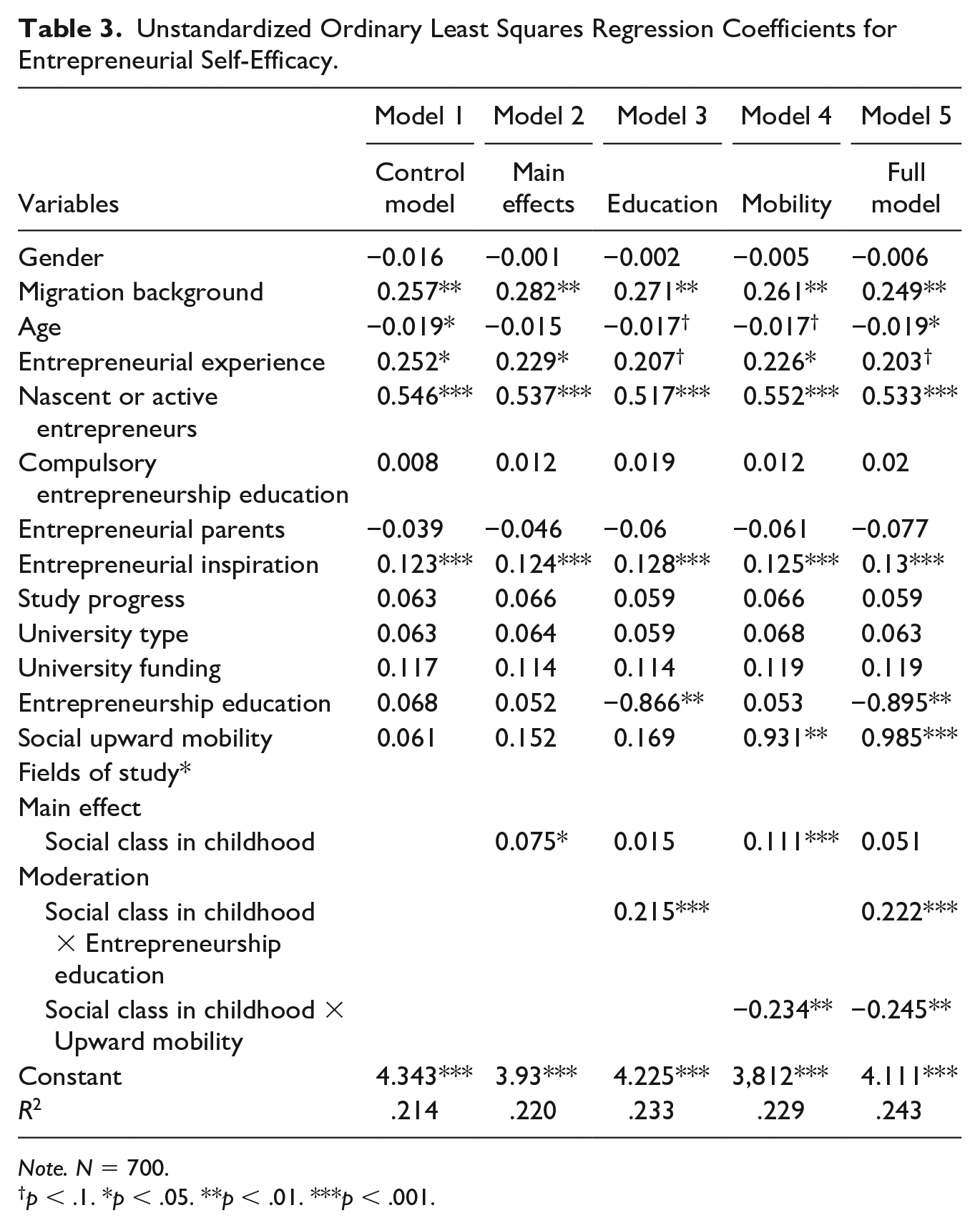
Note. N = 700.
p < .1. *p < .05. **p < .01. ***p < .001.
Model 2 reports the main association of perceived social class in childhood with ESE. It is positive and significant (b = 0.075, p = .017). This supports our baseline hypothesis (H1), which states that an imposed childhood social class environment is positively associated with ESE in adulthood.
The hypothesized interaction effect (H2) of participation in an entrepreneurship education program (selected environment) leading to enhanced cognitive imprints is reported in Model 3, as summarized in Table 3. It shows a positive and significant effect (b = 0.215, p < .001), lending support for H2. Furthermore, we calculated the lower and upper bootstrap confidence intervals for the interaction (both positive), which provided further support for H2. We have illustrated this effect in Figure 1.
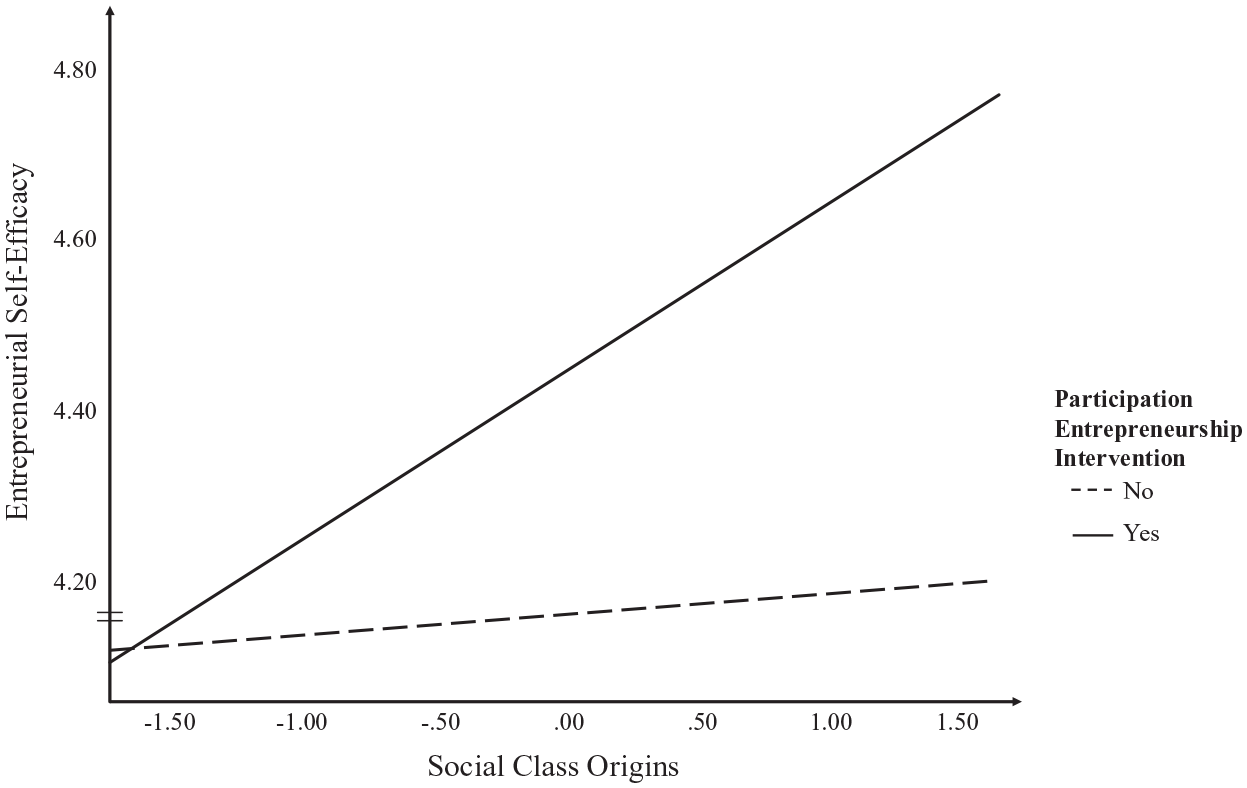
Influence of Social Class Origin on Entrepreneurial Self-Efficacy as a Function of Entrepreneurship Education.
The figure shows that the association of social class in childhood with ESE is positive for those who participated in an entrepreneurship education program, whereas the social class imprint on ESE is still positive but diminished for the individuals who did not attend any entrepreneurship education program. This finding is consistent with our theoretical reasoning that experiences of entrepreneurship education might differ for individuals from lower versus higher social class origins.
Model 4 in Table 3 examines our hypothesis that perceived upward mobility reverses the positive relationship of social class in childhood with adulthood ESE. This model yielded a significant and negative relationship between perceived upward mobility and ESE (b = −0.234, p = .005). The bootstrap analysis performed to identify confidence intervals (both negative) provided further evidence of the moderating effect of upward mobility on the relationship between social class origins and ESE. This supports our claim in Hypothesis 3 that perceived upward mobility weakens the relationship of social class in childhood with an individual’s ESE. In Figure 2, we illustrate this effect.
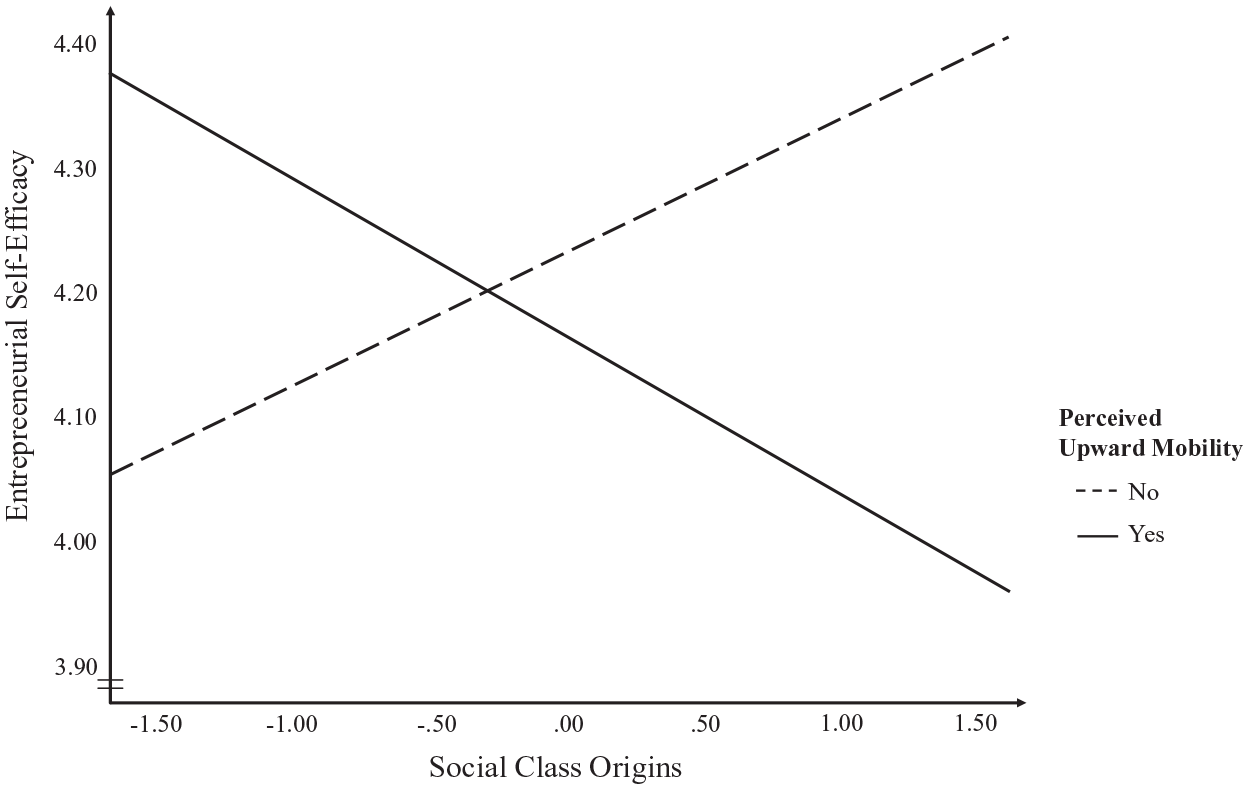
Influence of Social Class Origin on Entrepreneurial Self-Efficacy as a Function of Perceived Upward Mobility.
The figure specifically shows the circumstance in which the perception of upward social mobility strongly enhances ESE beliefs among individuals with lower social class origins. However, not perceiving social mobility enhances individuals’ former cognitive imprints on ESE based on their social class origins.
Finally, we calculate standardized coefficients to report the effect sizes of a standard deviation in social class origins on entrepreneurial self-efficacy for all our hypotheses. Holding all control variables constant, a 1 SD increase in social class in childhood is associated with an increase in entrepreneurial self-efficacy by 0.089 standard deviations (Hypothesis 1). Compared with other factors that have been shown to influence ESE in previous studies, we find that standardized coefficients of social class in childhood are comparable in weight to the effects of having a migration background (β = .107) or entrepreneurial experience (β = .081). The effect size in the model is stronger relative to the effects of being a woman, having entrepreneurial parents, or having participated in entrepreneurship education (all nonsignificant in the model with social class origins). Yet, having started a company has twice the effect of social class origins on entrepreneurial self-efficacy (β = .161), and being inspired by an entrepreneurial role model during studies is even three times as effective as variation in social class origins (β = .26). However, for individuals that participated in entrepreneurship education (Hypothesis 2: β = .405) or perceived upward mobility (Hypothesis 3: β = .262), standardized variation in their social class origins is more effective than any other factor in the regression model and can increase ESE by 10.6% and 6.8% compared with the baseline.
Robustness Tests
One potential concern with our study is whether the statistical results are valid and relevant from the perspective of the population of reference. We address this face validity concern by interviewing a student organization’s representative focusing on easing the transition for students from lower social class backgrounds in HEIs. This organization is “Arbeiterkind,” which works with 6,000 volunteers and 80 chapters all over Germany to make HEIs for first-generation students more accessible. Most volunteers are advanced students and graduates whose parents have no experience with the higher education system. Our informant is a first-generation student representing the local Arbeiterkind chapter at a large public university in Germany. The student is thus qualified to speak for the group of students from working-class backgrounds and is knowledgeable about the many challenges their fellow students face. Upon building a trusted relationship, the informant validated our overall research problem and also confirmed from their subjective experience that there are additional hurdles for students from working-class backgrounds in their confidence to pursue an entrepreneurial career. Furthermore, the sociocultural mismatch between individuals from lower social classes and their perceptions of the narratives of the entrepreneur in entrepreneurship education found approval, which increased our confidence in our results. We also discussed measures to address the issues resulting from our research concerning appropriate narratives of the entrepreneur.
Another concern is that the results are not robust to variations in the operationalization of our main constructs. To address this concern, we tested other measures for the proposed relationship and ran several subsample analyses to check the robustness of our findings. First, we tested the original ESE scale proposed by Zhao and colleagues (2005) and found that all hypothesized associations unfolded as in our final model.
Furthermore, we expect that perceptions of the current social class (Griskevicius et al., 2011a) predict ESE beliefs. Our tests indicated that perceptions of current social class are strongly associated with ESE beliefs (b = 0.115, p < .001). Moreover, the moderating effect of participation in entrepreneurship education (0.147, p < .05) performed as in our main model, and the moderating effect of upward mobility turns insignificant as the current social class measure partially already explains upward mobility (see additional data 1).
A test of the baseline (Hypothesis 1) with the categorical rank-based social class measure proposed by Jackman and Jackman (1973), indicated that both current (0.287, p < .01) and childhood social class (0.314, p < .001) yield a positive association for higher social class perceptions with ESE. Objective social class origins, including parents’ occupational prestige, family income, and education (Adler et al., 2000), are significantly associated with ESE beliefs (0.110; p < .05). Although the subjective and objective measures are closely tied, each of them explains additional variance dependent on the context, with subjective measures more likely to predict cognitive outcomes (see Adler et al., 2000). To further test this assumption, we added the objective measure to our baseline regression and found that Hypothesis 1 still holds.
Furthermore, we tested whether our results hold when using the more granular levels of upward mobility between individuals’ social class in childhood and their current social class (instead of our dichotomous variable). Using the continuous variable of upward mobility, we find that higher levels of upward mobility are significantly associated with higher levels of entrepreneurial self-efficacy for individuals from lower social class backgrounds (b = 0.100; p < .05).
In addition, in a separate regression, we tested whether a continuous variable on program learning in entrepreneurship interventions (Souitaris et al., 2007) would yield similar results as our dichotomous variable representing individuals’ participation in an entrepreneurship intervention. The program learning variable shows a similar performance mechanism: The higher the perceived entrepreneurial learning in individuals’ studies, the stronger the association of social class origins with ESE (b = 0.047, p < .01). Particularly, bootstrapping analysis and Johnson–Neymann analysis reveal that the enhancing relationship of social class origins with ESE only turns significant and increases starting from higher levels of entrepreneurial learning (see Figure A1 in the Appendix). To this end, we also tested whether estimating Model 3 with experience instead of education would lead to similar results. We find that experience is positively associated with an increase in the relationship between social class origins and entrepreneurial self-efficacy beliefs (b = 0.139; β = 0.231; p = .058). Yet, when adding our control variables, the relationship turns nonsignificant. Hence, we assume that entrepreneurial experience does not per se increase the class gap in ESE due to different levels of mastery experience. Accordingly, we reinvestigate the role of successful mastery experiences in our post hoc analysis.
Finally, there might be concerns about whether the study’s findings hold in subsamples of the general sample. To address this issue, we run several subsample analyses to test the robustness of our findings. First, to exclude the possibility of data censoring for a subsample of our population, we rerun Model 4 in subsample analysis that excludes the higher social class individuals (more than 1 SD above the mean, SC Childhood ≥5.49). The moderating association of upward mobility remained significant (b = −0.217, p < .05). To reduce concerns that the results on ESE are driven by students without entrepreneurial experiences, we conducted a subsample analysis in the group of nascent and active student entrepreneurs (91 of 700 students consider themselves either nascent or active entrepreneurs). The main effect of social class in childhood on ESE (b = 0.175, p < .05) and the moderating effect of entrepreneurship education remained significant (b = 0.285, p < .05) while upward mobility among the student entrepreneurs (as in our additional entrepreneur samples) turned insignificant. The same results apply to a separate subsample analysis with those participants who have collected entrepreneurial experiences in the past (e.g., by working in a start-up). In a final subsample analysis with all students who have collected entrepreneurial experiences in entrepreneurship courses (216 students), social class in childhood is strongly associated with ESE (b = 0.265, p < .001), and mobility strongly moderates the relationship between social class origins and ESE (b = −0.372, p < .01).
We also test the possibility that social class may interact with other characteristics of our sample. Specifically, we are interested in intersectionality, which we understand based on (Romero & Valdez, 2016, p. 1553; Valdez, 2011) as “a premise that multiple dimensions of identity and collectivity [. . .] intersect to create, maintain, transform, and reproduce the life chances of members who share similar social locations within a highly stratified society.” Building interaction terms for individuals’ gender, migration background, and class, we assess potential intersectionality in our correlation and regression analysis (Table 4). We find that women with a migration background are associated with lower levels of social class in childhood but higher levels of ESE. Being born in a higher social class environment and having a migration background positively correlates with ESE. Yet, when controlling for other factors in the regression, both interaction terms turn nonsignificant. Finally, women born into higher social class environments are positively associated with higher levels of ESE. This association holds in the regression analysis even when including additional control variables. We discuss these findings at the end of our study.
Summary of Intersectionality Post Hoc Tests.
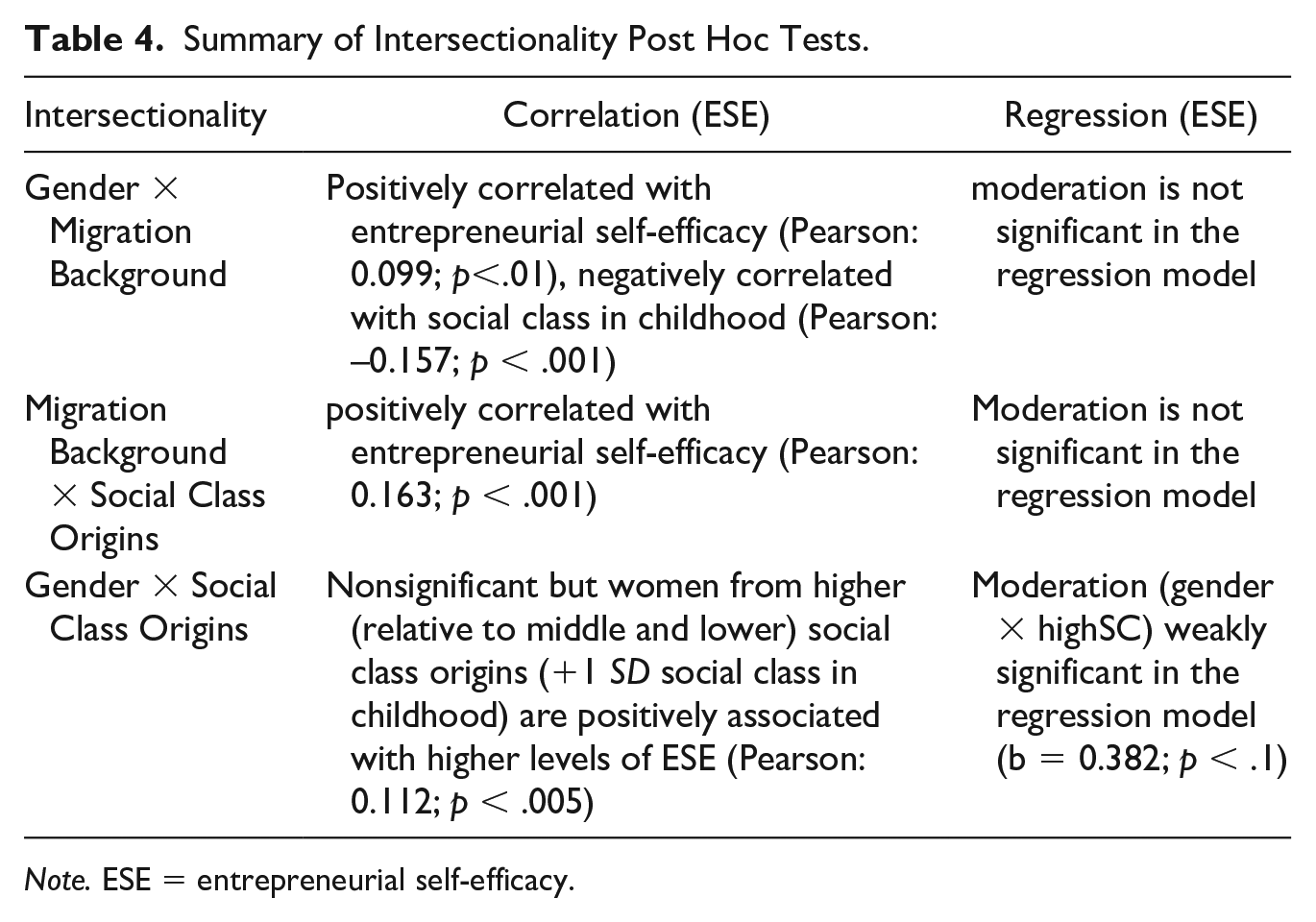
Note. ESE = entrepreneurial self-efficacy.
Post Hoc Analysis With Additional Data
We tested whether the association between social class in childhood and ESE holds in samples of entrepreneurs in the United States. First, we tested our main hypothesis with the same measures of social class in childhood and ESE but measured a rank-based measure of social class as adults at a second point in time. We find that social class in childhood is significantly and positively associated with ESE, while subjective social class in adults shows a stronger association with ESE. Second, we tested which dimension of the comprehensive McGee and colleagues (2009) ESE scale is associated with social class in childhood. Our results show that confidence in entrepreneurial leadership skills is significantly related to social class origins, and entrepreneurial success is a mechanism for individuals from lower social classes to turn their origins into strengths when it comes to forming ESE.
Additional Data 1
We aimed to test whether our main arguments also hold in a non-student population outside Germany. Against this background, we collected additional data inviting 188 entrepreneurs from the United States via the research platform Prolific. First, we chose this additional sample because the United States experiences higher levels of social inequality, which might alter how individuals make sense of their social status (Chancel et al., 2022). Second, active entrepreneurs might more appropriately evaluate their entrepreneurial self-efficacy based on experience. On average, the entrepreneurs in our sample are 40 years old, have 7 years of entrepreneurial experience, employ 13 employees in their business, and 44% are female.
We measure our participants’ subjective social class based on the ladder of Adler and colleagues (2000) at another point in time, namely, one week after collecting our control variables, to reduce the likelihood of method bias. Their subjective social class ranges from the lowest (=1) to the highest (=10) rank on the social ladder (Adler et al., 2000), while the mean is 5.64 and the median is 6 with an SD of 1.80. The participants’ entrepreneurial self-efficacy, social class in childhood, and objective social class were measured the same way as in our main study but one week before the subjective social class measure.
The correlation results (Table A4) indicate that all measures of social class are positively correlated with entrepreneurial self-efficacy. The regression results show (Table A5) that the U.S. entrepreneurs’ social class during childhood is weakly but significantly associated with their entrepreneurial self-efficacy (b = 0.094, p = .061). However, echoing the main study’s results, their recent subjective social class is strongly and significantly associated with their entrepreneurial self-efficacy (b = .124; p = .004) even if controlling for their social class during childhood (b = .109, p = .017). Moreover, the result indicates that perceptions of their recent social class cancel out the relationship between their childhood social class and their entrepreneurial self-efficacy (b = .051; p = .329), suggesting that an actualized perception of individuals’ social class (i.e., upward mobility) can cancel out the association of childhood social class with entrepreneurial self-efficacy.
Additional Data 2
In a third data collection effort, we aimed to test whether the reproducing mechanisms of the class gap in ESE that we found in students (i.e., mastery experiences via education, mobility, and experience) also hold for entrepreneurs. Inviting 202 entrepreneurs from the United States via the research platform Prolific, we tested proposed associations with the multidimensional entrepreneurial self-efficacy scale of McGee and colleagues (2009) and investigated possible differences to the general self-efficacy scale of G. Chen and colleagues (2001). Furthermore, we tested and controlled for other industry and firm variables such as environmental uncertainty (McKelvie et al., 2011), serial entrepreneurship (participants who founded more than one business), and years of entrepreneurial experience.
While we expected to observe a direct association of social class in childhood with the more comprehensive McGee and colleagues (2009) ESE scale (Cronbach’s α = .781), the relationship was positive but nonsignificant (Table A6). Yet, the multidimensional McGee and colleagues (2009) scale provides the opportunity to assess which aspects of entrepreneurial self-efficacy might be associated with social class in childhood. We find that social class in childhood is associated with the “Implementing-people” ESE (Cronbach’s α = .92) subdimension (b = 0.082; p < .05), which refers to the confidence in entrepreneurial leadership skills such as “Supervise employees” or “Inspire, encourage, and motivate my employees.” This finding relates to prior research by Martin and colleagues (2016), finding that being born in a more privileged family background increases overly optimistic self-views as a leader (with a detrimental impact on the leader’s effectiveness).
Our tests of whether entrepreneurship education and social mobility (as in the sample with students) also moderated the relationship between social class in childhood and ESE showed that the moderations do not hold for our sample of entrepreneurs. Yet, we expected for actual entrepreneurs (vs. students) that a more relevant mastery experience would be their entrepreneurial success. Accordingly, we assumed that the more individuals from lower social class origins overcome class barriers in entrepreneurship and experience entrepreneurial success, the more they feel confident about their social origins and entrepreneurial skills. Entrepreneurial success strongly moderates the association between social class in childhood and the full ESE scale (b = −0.094; p = .002), such that entrepreneurial success is associated with reversing the negative association between lower social class in childhood and ESE in adulthood. The moderation effect has the strongest effect size in the model (Table A7). This complements the finding in the main study on the moderating role of entrepreneurial experiences and education for those from lower social classes by showing that positive entrepreneurial experiences might decrease the class gap in ESE. Along this line, we tested whether the same results apply to general self-efficacy (Cronbach’s α = .922; Chen et al., 2001). While social class in childhood strongly predicts general self-efficacy (b = 0.109; p < .001), entrepreneurial success as a mastery experience is only associated with reversing the relationship between social class origins and ESE but not with general self-efficacy.
Discussion
Due to their various impacts on individuals’ lives, social class backgrounds receive increasing attention in organizational behavior research. The unequal distribution of wealth and status influences individuals’ agency to control and alter environments. Yet, to date, we have a limited understanding of how being born into lower or higher social class environments influences individuals’ agency beliefs in entrepreneurship. By integrating theories on social cognition, social class, and entrepreneurial agency, we show across three data sets among 390 entrepreneurs and 700 students that social class environments in childhood are systematically associated with entrepreneurial agency beliefs (i.e., entrepreneurial self-efficacy) in adulthood. Entrepreneurial experiences in entrepreneurship education and practice are indicative of reproducing the class gap in entrepreneurial self-efficacy, while vicarious mastery experiences such as social mobility and entrepreneurial success are associated with overcoming inequality and fostering entrepreneurial agency beliefs for those born into lower social class contexts.
Theoretical Implications
One of our main theoretical contributions is regarding entrepreneurial agency through the lens of social inequality. Prior entrepreneurship research is mainly based on agency theories assuming the controllability of the environment (Alvarez & Barney, 2014; McMullen et al., 2021). Integrating social class theory into the field of entrepreneurship, this study conceptualizes the formation of entrepreneurial agency beliefs through the lens of social inequality. This is important as it extends the dualistic assumptions of entrepreneurial agency by introducing different models of agency based on individuals’ social class environments (Stephens et al., 2014b). Social class origins (Bourdieu, 1984) mediate between environments and cognition as individuals’ patterns of thought and action display their internalization of prior external circumstances (i.e., habitus). While prior studies emphasize the role of entrepreneurship to transgress impoverished circumstances (Alvarez & Barney, 2014; Bruton et al., 2013; Kimmitt et al., 2020), our study argues that the cognitive consequences of exposure to lower social class contexts might produce additional constraints (i.e., diminished beliefs in entrepreneurial agency) that can hamper individuals from social mobility. In contrast, (entrepreneurial) mastery experiences help to overcome the potential disadvantages of initial social class environments.
Prior studies on the macro-level produce mixed results about whether entrepreneurship is a solution or a problem for increasing economic inequality (Atems & Shand, 2018; Bruton et al., 2021; Lewellyn, 2018; Packard & Bylund, 2018; Patel et al., 2021). By showing that individuals might turn structural disadvantages into advantages for entrepreneurship, we emphasize the socio-cognitive interplay between agency and structure. Our findings indicate the importance of vicarious mastery experiences of breaking free from constraints (i.e., social class upward mobility and entrepreneurial success) for generating entrepreneurial agency beliefs (Rindova et al., 2009). Recent discussions on entrepreneurialism indicate that societal beliefs in entrepreneurial agency reinforce inequality (Eberhart et al., 2022). As such, social mobility might not just provide the means to catch up with peers from more privileged backgrounds (Martin & Harrison, 2022) but enable entrepreneurs from lower social class backgrounds to develop unique forms of entrepreneurial agency that are based on the experience of transgressing social class contexts (Martin & Côté, 2019).
Finally, our study highlights a missing social class perspective in research on diversity in entrepreneurship (Jennings & Brush, 2013; Miller & Le Breton-Miller, 2017; Neville et al., 2018; Patel et al., 2022). While prior research in entrepreneurship has investigated categories and backgrounds (such as migration backgrounds and gender) that might hinder or propel individuals in the entrepreneurial process (Bakker & McMullen, 2023), less attention has been paid to the possibility of intersectionality in entrepreneurship that involves the interaction of other categories with individuals’ social class backgrounds (for an exemplary exception, see Valdez, 2011). Our explorative post hoc analysis indicates that the general association of individuals’ social class backgrounds with entrepreneurial self-efficacy remains significant even if controlling for the interaction with gender and migration background. A possible explanation of our finding might be that social class backgrounds capture many obstacles women and migrants experience in the entrepreneurial process. The results speak for the opportunities of research on female and migrant entrepreneurship to apply an intersectionality lens by considering individuals’ social class origins.
Prior literature has heavily discussed the ambivalent role of gender in the formation of entrepreneurial self-efficacy beliefs (Wilson et al., 2007). We find that women from higher social class origins are associated with higher entrepreneurial self-efficacy (relative to women from middle and lower social class origins). Specifically, women might face even more difficulties in the entrepreneurial process when they are from lower social class origins. At the same time, women might benefit from their identity in the entrepreneurial process when they are born into higher social class environments. These results indicate that, instead of research in silos, research on inclusive entrepreneurship benefits from an intersectional perspective (Bakker & McMullen, 2023) that integrates the unique experiences of individuals’ social class backgrounds.
Practical Implications
Our findings indicate that entrepreneurship education at higher education institutions is associated with increased entrepreneurial self-efficacy gaps between individuals from different social class origins. While this has manifold implications for higher education institutions and entrepreneurship education, the implications also apply to entrepreneurial practice.
First, higher education institutions can foster individuals’ perception of sociocultural belonging irrespective of their social class origin (Stephens et al., 2014b; Walton & Cohen, 2011). Educators in business schools might start to reflect how their own assumptions (e.g., of independence as cultural norm) unconsciously reproduce class differences in the classroom (Moergen & Kish-Gephart, 2023). For instance, Silverman and colleagues (2023) show that if educators communicate students’ lower social class backgrounds as sources for unique strengths, students subsequently start to increase their academic achievements. Shifting the evaluation of students’ competencies from the individual (i.e., independence) to the group level (i.e., interdependence) matches the unique strengths of students from lower social class origins and improves their academic results (Dittmann et al., 2020). Entrepreneurship education that highlights cultural values of interdependence (e.g., entrepreneurship as team-based, creating value for others, adjusting to the environment) is more inclusive to individuals from lower social class backgrounds.
Second, instead of shifting attention away from individuals’ different backgrounds, making sense of these differences might propel agency beliefs. For instance, Goudeau and Croizet (2017) show that generating awareness of advantages associated with class backgrounds restore performance differences in the classroom. To this end, a difference-education approach “can be empowering if students have the opportunity to learn about the significance of their backgrounds in a supportive, constructive, and identity-safe manner” (Stephens et al., 2014a, p. 950). In this brief intervention, the researchers invited participants to an hour-long panel discussion in which panelists share their college experience based on their social class backgrounds. Becoming aware of the class-based differences increased the performance of students from lower social class origins even two years later (Stephens et al., 2015). Entrepreneurship education programs that specifically address the situation of students from poorer family backgrounds might enhance their beliefs in the entrepreneurial agency through participants’ understanding of their specific situational constraints and respective mastery experiences (Santos et al., 2019). Integrating mentors and role models from diverse social class origins in entrepreneurship education might reduce differences in students’ class-based benefits from such interventions (Whitely et al., 1991).
Third, the exchange in networks of individuals from similar social class origins helps to work through entrepreneurial identity conflicts (Gray et al., 2018). Fostering student groups in which individuals from working-class backgrounds exchange their entrepreneurial experiences helps them to understand their barriers and achievements. Buddy programs for cross-class interactions with professors, where both meet regularly, can create a sense of belonging to the institution. The formation of relationships between alumni and students can develop a sense of being part of an in-group at the university independent of social class origins. In line with our results, building an identity as an upwardly mobile entrepreneur from a working-class background might be associated with increased confidence in students’ entrepreneurial competencies.
Finally, the results of this study indicate that mastery experiences (i.e., subjective upward mobility or entrepreneurial success) are associated with turning an apparent disadvantage (being born into underprivileged families) into a potential advantage. Policymakers and organizations should acknowledge the potential to enable these mastery experiences for individuals from lower social class backgrounds through interventions and programs. While these support programs have been partially established for female and migrant entrepreneurs, our results indicate that it is essential to apply an intersectionality lens that additionally considers individuals‘ social class backgrounds.
Limitations and Future Research
The limitations of our study provide opportunities for further research. First, while we show that subjective social class origins are associated with entrepreneurial self-efficacy across three data sets, the study results need to be interpreted with caution regarding causality. Future studies might consider combining data from different sources, such as subjective measures with archival data (Martin et al., 2016) or conducting experiments (Kraus et al., 2009). However, most prior research relies on survey-based measures of social class backgrounds as reliable manipulations of social class in experiments are challenging to achieve (Côté, 2011; Jetten et al., 2017). Future studies can test the moderating effects of environments on the relationship between social class origins and individuals’ self-efficacy beliefs. For instance, future studies can investigate how training environments, with, for example, a focus on social aspects (i.e., social entrepreneurship interventions; Howorth et al., 2012), influence the effects of social class origins on an individual’s entrepreneurial agency beliefs.
Second, our study shows that the experiences individuals collect in entrepreneurship education courses at higher education institutions might reproduce the class gap in entrepreneurial self-efficacy. While we control for whether these courses are compulsory, how much individuals learn, and to what extent students experience inspiration (Souitaris et al., 2007), we know less about the type of entrepreneurship course (e.g., small workshop-based entrepreneurship course vs. large anonymous script-based lecture). Future studies investigating the impact of entrepreneurship education on students from different social class backgrounds might aim at understanding the role of educational settings in entrepreneurship education by, for instance, conducting experiments in various types of entrepreneurship courses (Nabi et al., 2017).
The data used in our main study were collected in the German setting, a wealthy country with relatively low socioeconomic inequality compared with other countries. However, social class refers to relative differences in wealth and rank within a society, which differs from an investigation of objective poverty across countries. Furthermore, income inequality in society (e.g., measured by the Gini coefficient) does not necessarily indicate the importance of rank positions in a social hierarchy. For instance, in a new publication of Ingram and Oh (2022), Germany ranks 20 (out of 90 countries) regarding how strongly social class origins predict becoming a manager. The authors suggest that the magnitude of social class effects might also be based on a society’s cultural differences that give more or less weight to the individual status in a social hierarchy. That said, within our sample of German higher education students, we see a strong variance in the perception of their social class origins. However, future research could analyze the effects of social class origins on entrepreneurial concepts under more extreme conditions, such as in more unequal and objectively poor societies (e.g., in developing countries), where individuals’ social class origins might be even more likely to impact human functioning (Wilkinson & Pickett, 2009).
Finally, we equate entrepreneurial agency in line with McMullen and colleagues (2021) as individual control over the environment via entrepreneurial action. While our results indicate that individuals’ lower social class origins are related to lower beliefs in their entrepreneurial agency, further research might delve into the relationship with other forms of entrepreneurial agency. For example, Snibbe and Markus (2005) highlight that an alternative model of agency related to individuals from lower social classes is controlling the self versus controlling the environment. This might refer to better coping with setbacks such as entrepreneurial failure (Shepherd et al., 2009) or increased flexible goal adjustment.
Conclusion
While recent research indicates that the effect of social class origins on career mobility within organizations is comparable to the gender-based glass ceiling (Ingram & Oh, 2022), we know little about how being born into higher or lower social classes affects individuals in the entrepreneurial process. In our study, we shed light on how and why social class origins relate to individuals’ beliefs in their entrepreneurial agency. We discuss how different models of agency and mastery experiences reproduce or overcome this relationship and call for educational programs and entrepreneurial practices sensitive to participants’ social class backgrounds.
Footnotes
Appendix
Method-U Model Factor Loadings: Completely Standardized Solution.
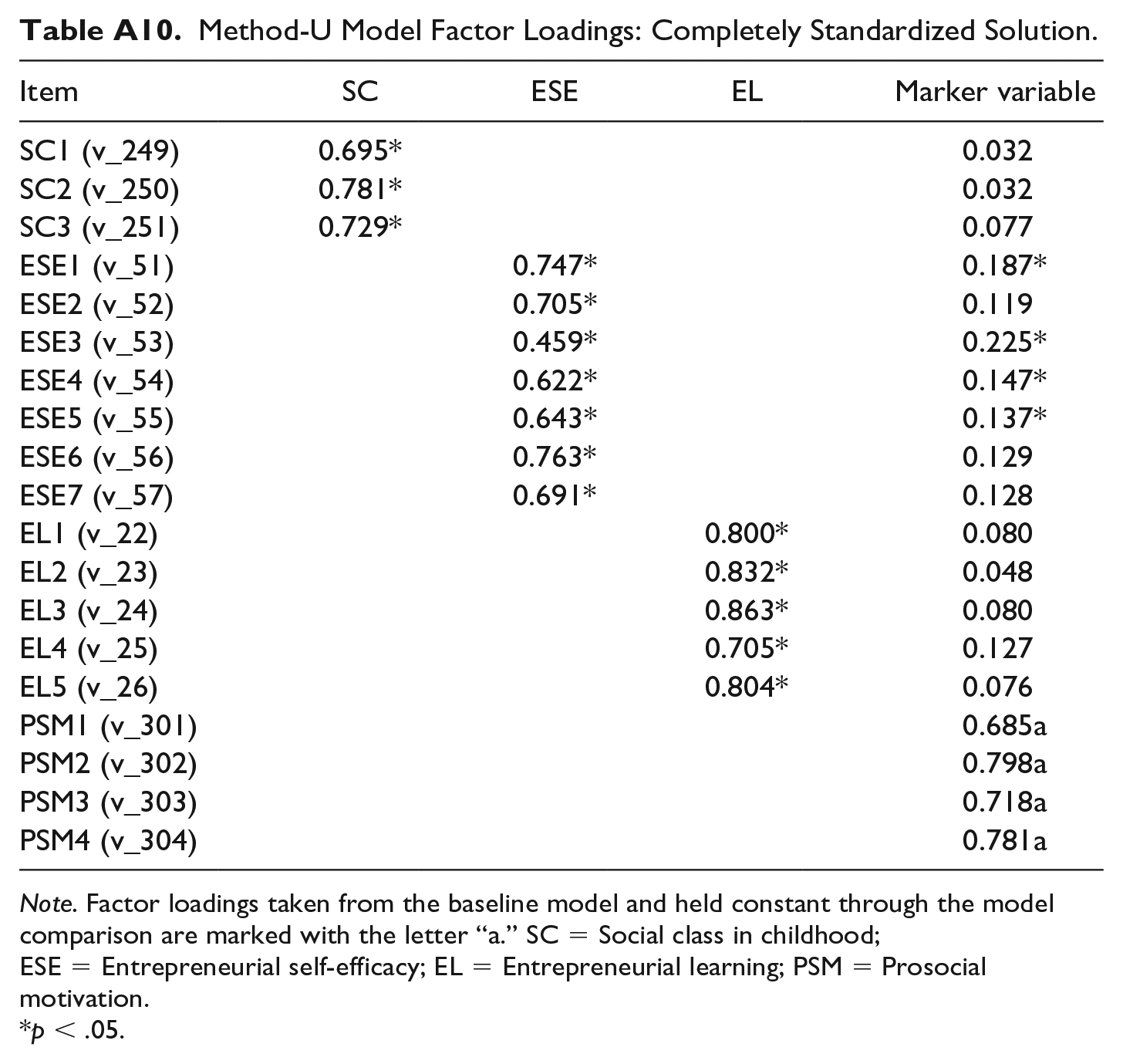
| Item | SC | ESE | EL | Marker variable |
|---|---|---|---|---|
| SC1 (v_249) | 0.695* | 0.032 | ||
| SC2 (v_250) | 0.781* | 0.032 | ||
| SC3 (v_251) | 0.729* | 0.077 | ||
| ESE1 (v_51) | 0.747* | 0.187* | ||
| ESE2 (v_52) | 0.705* | 0.119 | ||
| ESE3 (v_53) | 0.459* | 0.225* | ||
| ESE4 (v_54) | 0.622* | 0.147* | ||
| ESE5 (v_55) | 0.643* | 0.137* | ||
| ESE6 (v_56) | 0.763* | 0.129 | ||
| ESE7 (v_57) | 0.691* | 0.128 | ||
| EL1 (v_22) | 0.800* | 0.080 | ||
| EL2 (v_23) | 0.832* | 0.048 | ||
| EL3 (v_24) | 0.863* | 0.080 | ||
| EL4 (v_25) | 0.705* | 0.127 | ||
| EL5 (v_26) | 0.804* | 0.076 | ||
| PSM1 (v_301) | 0.685a | |||
| PSM2 (v_302) | 0.798a | |||
| PSM3 (v_303) | 0.718a | |||
| PSM4 (v_304) | 0.781a |
Note. Factor loadings taken from the baseline model and held constant through the model comparison are marked with the letter “a.” SC = Social class in childhood; ESE = Entrepreneurial self-efficacy; EL = Entrepreneurial learning; PSM = Prosocial motivation.
p < .05.
Acknowledgements
The authors thank the three anonymous reviewers and the associate editor, Professor Edinger-Schons, for their constructive and developmental feedback. The participants of the ECSB entrepreneurship education conference in Gothenburg are also greatly appreciated for their contribution to this research.
Declaration of Conflicting Interests
The authors declared no potential conflicts of interest with respect to the research, authorship, and/or publication of this article.
Funding
The authors received no financial support for the research, authorship, and/or publication of this article.
