




Abstract
We investigate what distinguishes social entrepreneurial ecosystems (SEEs) from entrepreneurial ecosystems (EEs) through appreciation of the importance of context—the multiplex of intertwined social, spatial, temporal, historical, cultural, and political influences. Community is incorporated as a key variable and hitherto overlooked dimension of the structure and influence of SEEs. We draw on extant literature and examples of a variety of SEEs to support our propositions and demonstrate why considerations of both context and community are critical to advance understanding of SEEs. We contribute to the study of SEEs by presenting a new conceptual framework and theorizing SEE as an evolving composite of interdependent actors who interact and collaborate across multiple levels to collectively generate positive externalities and drive sustainable solutions to social problems.
The “entrepreneurial ecosystem” (EE) concept has become pervasive in the scholarly and practitioner business literature (Audretsch et al., 2019; Hakala et al., 2020; Jacobides et al., 2018; Nylund et al., 2022). Broadly concerned with “the benefits and resources produced by a cohesive, typically regional, community of entrepreneurs and their supporters that help . . . ventures form, survive and expand” (Spigel & Harrison, 2018, p. 152), the term has recently found its way into discussions concerned with achieving social impact (Barki et al., 2020; Thompson et al., 2018). Running parallel is the discourse on ecosystems in an explicit social enterprise context (Hazenberg et al., 2016a, 2016b). However, as Roy and Hazenberg (2019) highlight, “academic literature on social entrepreneurship ecosystems has . . . largely failed to keep pace with policy and practice” (p. 14). A result of this imbalance is an underrepresentation of conceptual clarity around social entrepreneurial ecosystems (SEEs). This contrasts with considerable conceptual lucidity and detailed exposition on the conditions, elements, and outputs of EEs (Stam & van de Ven, 2021; Wurth et al., 2022). So far, there has been an inability to generalize in terms of potentially defining features of SEEs. For example, the European Commission (2015) notes, the conceptualisation of a social enterprise eco-system is based on commonly recognised features able to contribute to providing an enabling environment for social enterprise including the potential to address key constraints and obstacles. (p. xiii)
Yet, the question as to whether these “commonly recognized features” are the same as those of EEs remains unanswered. This leads to our overarching research question, “What, if anything, distinguishes SEEs from EEs?”
Understanding and theorizing any difference between SEEs and EEs matter. Strengthening enabling environments for social entrepreneurship, via better understanding of the SEE phenomenon, is vital for enacting solutions to social problems at the local, national, and global levels. The new post-COVID pandemic and heightened climate emergency era make this understanding all the more important (Bacq & Lumpkin, 2021). As such, probing the distinctiveness of SEEs in relation to their EE counterparts makes our article both relevant and timely.
Social entrepreneurship is a “contested concept” (Choi & Mujamdar, 2014) having been variously defined depending on whether the starting point is a business with a social focus, a not-for-profit organization engaging in business-oriented activity to achieve financial sustainability (Dees & Anderson, 2003), or something in-between (McMullen, 2018). Therefore, embedded in a focus on SEEs is the challenge of reconciling the variety of terms and definitions applied in the field (Saebi et al., 2019). Advantageously, the relative elasticity of construct that characterizes much social entrepreneurship scholarship offers both a guiding parameter and an opportunity to conceptualize a multi-actor, multicontext framework for SEEs. While social enterprises (i.e., organizations) and social entrepreneurs (i.e., individuals) are typically identified as the key actors within the umbrella activity of social entrepreneurship, we distinguish social entrepreneurship as a collective activity (Montgomery et al., 2012) rather than solely the actions of a “heroic” individual (Dey & Steyaert, 2010) and, aligning with Lumpkin et al. (2018), recognize the criticality of community to its understanding. Hence, we privilege a community focus when considering SEEs. In addition, we recognize that social entrepreneurship may occur in multiple forms of community—“geographical communities,” “communities of interest or solidarity,” “communities of identity,” and “intentional communities”—with each type exhibiting “various manifestations of social engagement” (Lumpkin et al., 2018, p. 26). We thus contend that different forms of community may be present within an SEE and that collective activity may vary according to social, spatial, temporal, cultural, and political contexts.
Our article starts with a discussion on the fast-developing scholarship on SEEs and elaboration on a concept central to understanding SEEs—social value, followed by discussion of the literature on EEs. This provides the backdrop to construct theoretical propositions. We then test these propositions through engagement with theory, comparing EEs and SEEs according to Welter’s (2011) when, who, where, and why contextual facets and drawing on examples to illuminate our points along the way. We culminate with a theorized, novel SEE framework and a holistic definition of an SEE. We thus consider that we make several contributions to the literature: Our interrogation of literature-informed propositions in relation to the contextual elements of SEEs and EEs provides a rich foundational base to understand the complexity of interactions within SEEs as well as the multidirectional interactions between actors in SEEs and EEs. Our comparison of SEEs and EEs, with its focus on the significance of contextual influences, also contributes to addressing the lacuna that Spigel and Harrison (2018) highlight: that “current use of EE theory lacks historical or contextual sensitivity” (p. 158). Our conceptual framework advances understanding of SEEs by demonstrating the intrinsic interrelatability of SEE dimensions, envisaging the ecosystem itself as a complex context linking communities of interdependent actors engaged in both dyadic interactions and collective processes of social value creation. It leads us to proffer a lucid definition of an SEE and proceed to signal pathways for future scholarship on SEEs. As such, we believe our article will spark valuable opportunities for inquiry along contextual-, community- and collective-centered lines.
SEEs: An Emerging Concept?
This section turns attention to the small, but rapidly emerging corpus of literature on SEEs. It commences the literature setting for our article.
In a recent review article, Gonzalez and Dentchev (2021) identify three categories of support provided by ecosystems to social entrepreneurs—“Fuel,” “Hardware,” and “DNA.” “Fuel” is the “the availability of resources, funding, qualified human capital, as well as access to a variety of supporting actors” willing to collaborate (Gonzalez & Dentchev, 2021, p. 326). In line with the evocative fuel analogy, the other two categories are built on, and rely upon, the fuel, which is an essential element of the SEE. “Hardware” is “the variety of tools, physical infrastructure and specialized services that enable [social entrepreneurs] to strengthen their business model and scale their social impact” (Gonzalez & Dentchev, 2021, p. 328). Especially important is the availability of both research and development and infrastructure arrangements, the latter referring to the social, political, economic, and cultural elements available in a particular place. It is the SEE’s DNA—“the presence of an entrepreneurial culture, such as supportive government and policies, and the visibility and recognition of [social entrepreneurs]” that creates the favorable conditions for establishment and development of social entrepreneurial activity (Gonzalez & Dentchev, 2021, p. 329). Roy and Hazenberg (2019) also employ biological metaphors, and terms such as “genetic” and “epigenetic” to explain how different SEEs can diverge due to the presence of environmental factors.
There is also an emerging SEE literature focused on the global south. This literature mainly frames social entrepreneurs as the key drivers within the ecosystem. Thus, in Morocco they are “drivers of growth” (Kebbaj et al., 2016) or, in India, “drivers of inclusive growth and sustainable development” (Ambati, 2020, p. 1) who can bring changes to the lives of communities living at the “bottom of the pyramid.” Another interesting feature of this literature is its focus on the importance of supportive ecosystems for particular groups of social entrepreneurs, particularly female social entrepreneurs—for instance in Botswana (Mamabolo & Lekoko, 2021) or India (Vohra, 2017) where there is the need for a “carefully nurtured ecosystem of producers, consumers, employees and partners” (Vohra, 2017, p. 136).
Benoît Lévesque (2016; who publishes in French) focuses attention on the complex arrangements that regularly comprise more mature SEEs, such as in Quebec (see also McMullin et al., 2021). He explains that although there are relatively few studies on SEEs, in reality the social economy has always considered itself as being part of a system consistent with distinct “rules, values and practices” (Lévesque, 2016, p. 12). From a historical perspective, he demonstrates how SEEs have been built based on a shared culture of values and cooperative principles. Indeed, a very recent research has shown how the sophistication and maturity of SEEs influence the probability of social entrepreneurs emerging in the first place, which, it is argued, largely depends upon a variety of environmental and economic and financial factors related to the stage of development of the country (Carriles-Alberdi et al., 2021). Interestingly, this research also confirms that social entrepreneurs are motivated differently compared with commercial entrepreneurs, not least in relation to the significance they place on (organizational) outputs and (societal) outcomes. As Crane et al. (2018) remind us, “Any shift from company-oriented output measures to community or ecosystem outcome and impact measures raises a host of conceptual, methodological, and practical problems” (p. 13).
Before proceeding further, we elaborate on a recent, growing literature strand focused on social impact (Barki et al., 2020; Gamble & Muñoz, 2021; Han & Shah, 2020; Roundy & Lyons, 2021; Thompson et al., 2018). These “social impact entrepreneurial ecosystems (SIEEs) are a subtype of entrepreneurial ecosystem” (Roundy & Lyons, 2021, p. 1). Thompson et al.’s (2018) Seattle, Washington region study of a social impact business 1 ecosystem shows bottom-up micro-level everyday activities and interactions of individuals rather than exogenous top-down action of government and powerful actors are instrumental to their formation and durability (Roundy & Lyons, 2022). Aligned to the emerging SEE literature, the social impact ecosystems literature includes in its ambit components generic to the development of SEEs (e.g., funding), namely, the development of the market for impact investment (Thompson et al., 2018), but additionally integrates organizational factors such as organization strategies and technology as an integral part of the ecosystem (Han & Shah, 2020). Our discussion that follows centers more on the systemic level of ecosystems. However, at the outset we acknowledge here the value of studying endogenous processes (Thompson et al., 2018) and the call for more attention to be paid to the micro dynamics and strategic organization of ecosystems (Roundy & Lyons, 2022).
Social Value Creation and SEEs
Choi and Mujamdar (2014) address the lack of definitional consensus on social entrepreneurship by contending that social entrepreneurship should be understood as a “cluster concept” of five subconcepts, namely, social value creation, the social entrepreneur, the social entrepreneurship organization, market orientation, and social innovation. Of these, social value creation is the all-encompassing subconcept (see their figure, p. 373). Aligning with them, we contend that social value creation is integral to SEEs and is a distinguishing SEE feature. However, “the concept of social value itself is a complex and ambiguous one” (Choi & Mujamdar, 2014, p. 367). Therefore, this section aims to avoid ambiguity by clarifying the nature of social value creation in relation to SEEs.
Social value generation derives from the skills and personal values of social entrepreneurs and the governance and legal form of the social venture (Hlady-Rispal & Servantie, 2018). It also involves the value proposition of the organization. Value proposition differences lie at the heart of the difference between social and commercial organizations (Austin et al., 2006). For social organizations, addressing social problems and hence realizing social change are the essence of their social value proposition, forming the basis of Chell et al.’s (2010) broad conceptualization of social entrepreneurship as “social value creating activity that can occur within or across the not-for-profit, business or government sectors” (p. 486). By contrast, the central driver of the value proposition of the commercial venture is “economic return and shareholder wealth” (Hlady-Rispal & Servantie, 2018, p. 68). Contrariwise, social entrepreneurship generates “social wealth” in addition to economic wealth (Zahra et al., 2009). Their simple equation neatly unravels social value as “SW Social Wealth = Social Value (SV)—Social Costs (SC)” (Zahra et al., 2009, p. 522).
As a foundation, we recognize that the social value creation process of social entrepreneurship involves entrepreneurial behaviors that generate positive externalities and create spillovers beyond those directly involved with the activity (Roundy, 2017; Santos, 2012). The ecosystem is thus critical to the success of the social venture (Shaw & de Bruin, 2013): We know that value creation arises “when the aggregate utility of society’s members increases after accounting for the opportunity cost of all resources used in the activity” (Santos, 2012, p. 337) and that when value flows between the various components in the ecosystem within which the social organization evolves, then this value is shared (Hlady-Rispal & Servantie, 2018, p. 64).
SEEs and EEs: Same, Different, or Both?
Having set the backdrop for our discussion in the previous two sections, we now turn to exploring the similarities and differences between SEEs and EEs. To provide a starting point, we adapt the seminal consideration of Austin et al. (2006) on the differences between social and commercial entrepreneurship, to ask, “Are SEEs and EEs the same, different or both?” To begin our investigation, we provide a literature overview on EEs.
As “ecosystem” terminology first appeared in business-related academic literature, its biological foundation (Moore, 1993) facilitated identification of characteristics that encouraged subsequent thinking, particularly the importance of interconnectedness, and the advantage the concept affords in facilitating a “complexity approach” to analyzing the roles of various actors and their interdependencies. Stam’s (2018) definition highlights the symbiotic interdependence of actors in EEs, enabling entrepreneurial activity in a geographic, place-based setting, albeit relying upon effective coordination: “. . . a set of interdependent actors and factors coordinated in such a way that they enable productive entrepreneurship within a particular territory” (p. 3). Meanwhile, Hakala and colleagues (2020) describe the dominant model narrative that underpins an EE as “designing regional elements to foster entrepreneurship” (p. 8).
While the heterogeneity of EEs is accepted as a consequence of the impact of context, scholarship has also distinguished EEs from related concepts such as clusters, regional innovation systems (Spigel, 2017; Spigel & Harrison, 2018), and entrepreneurial systems (Alvedalen & Boschma, 2017). Considerable scholarly attention has focused on the key elements of EEs, which are said to be complex and comprise a mix of elements, actors, and environmental conditions that may interact (Isenberg, 2011; Stam, 2018). Audretsch and colleagues (2019) refine descriptions of these elements to three key dimensions: economic, technological, and societal. In the case of an EE, composition may include human capital, markets, policy, finance, culture and supporting structures (Isenberg, 2010, 2011; Stam & van de Ven, 2021, p. 812) emphasize that “an entrepreneurial ecosystem consists of all the elements that are required to sustain entrepreneurship in a particular territory.” They set out their integrative EE model to comprise 10 interdependent elements, leading to and co-evolving with the outputs of ecosystem, namely, productive entrepreneurship. 2 Elements are grouped into two broad categories: “institutional arrangements” that comprise three of the elements, namely, formal institutions, culture, and networks, and “resource endowments” that comprise the other seven elements, namely, physical infrastructure, demand, intermediaries, talent, knowledge, leadership, and finance (Stam & van de Ven, 2021, p. 813, Fig.1). Leendertse et al. (2021) extend this figure to show “economic growth” as an outcome of an EE.
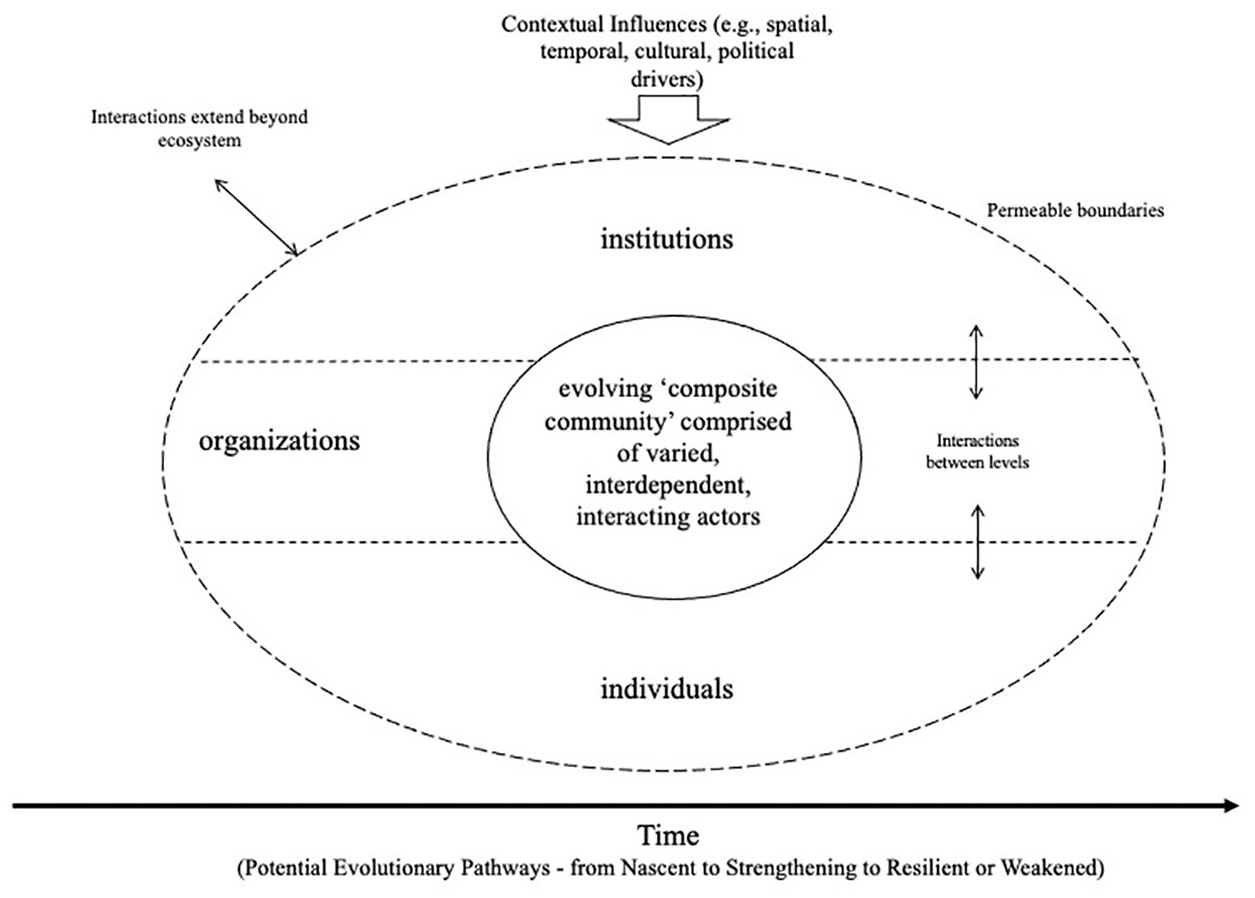
Social entrepreneurial ecosystem framework.
EEs are asserted to be dynamic and evolving in nature (Alvedalen & Boschma, 2017; Cantner et al., 2021; Cavallo et al., 2019; Mack & Mayer, 2016; O’Connor & Audretsch, 2022) and the interactions between actors and resources are key processes of the system. Engagement is shaped by both the distributed structure (Autio et al., 2018) and agency native to the ecosystem itself (Korber et al., 2022), and the activity emerging from the nexus of the two. These interactions may result in formal and/or informal social networks. Synergy between actors, and the networks, other institutions, and available resources that make up the elements of the EE, can help the ecosystem achieve its outputs/purpose that in turn feeds back into the elements of the system (Stam & van de Ven, 2021).
The foregoing discussion on EEs springboards three propositions:
We discuss these propositions via the dimensions of context drawing on Welter (2011). Hence, we examine the when, who, where, and why contextual dimensions of SEEs and EEs.
When?
The “when” dimension focuses on the temporal, historical, and evolutionary contexts of SEEs. SEEs are complex systems, characterized by evolutionary development, similar to their EE counterparts. Application of evolutionary theory helps explain how SEEs evolve in part as responses to social, political, historical, and regulatory influences (Hazenberg et al., 2016b). Differences in influence lead to divergence in the SEE (e.g., between countries or even regions). Hazenberg and colleagues (2016a) apply ecological metaphors to explain these disparities, noting that ecosystems may share similar environmental (“genetic”) factors to begin with, but that divergence may occur over time as “epigenetic” factors such as policy create “mutation” (whereby a new phenotype/species of social enterprise emerges). This approach is consistent with the epistemology that social enterprise, social entrepreneurship, and associated processes and ecosystems are socially constructed (Dey & Steyaert, 2010; Grant & Dart, 2014). Arguably, sustainable EEs should be grown “organically” (Mazzarol, 2014) and evolutionary development models of ecosystems through stages such as birth, growth/expansion, sustainment/leadership, and self-renewal/death have all been applied to EEs (Mack & Mayer, 2016), so similar application to SEEs is not surprising.
Hazenberg et al. (2016b), demonstrating the evolutionary nature of SEEs, show a temporal context may indicate “age” or maturity of the ecosystem or the stage of development, consistent with Spigel and Harrison (2018). Some SEEs may take longer to consolidate and grow; others may develop quickly. Likewise, some groups within the SEE may be more “advanced” either in size or influence than others at different times.
The advantage of locating the SEE within a temporal context is most obvious when comparing overlapping SEEs within a country/nation or taking a more granular/regional approach. Scholarship informed by historical institutionalism (Steinmo et al., 1992) applied to SEE development (Kerlin, 2013; Roy et al., 2015) has been able to trace path dependencies and identify the “critical junctures” that shape ecosystems. One such critical juncture is the recent decision by the Scottish Government to defund SENScot following a bidding process from two intermediaries: SENScot and Social Enterprise Scotland (Armour, 2022). SENScot’s ethos was considered to represent by far the majority of social enterprises in Scotland, shaped, in the main, by a collective community development model guided by the European social democratic ideal. This contrasts with the Anglo-American social entrepreneurship ethos represented by Social Enterprise Scotland. The Scottish Government’s action led to the demise of SENScot in July 2022 and a transition toward a supposed “enhanced” single intermediary. Hence, we see how factoring in the temporal dimension is critical to understanding how the prominence of actors in ecosystems can alter over time, and especially with a changing political context.
Who?
Who is, and how they are, involved is vital to understanding any distinctness between SEEs and EEs. As SEEs privilege communities and collective dynamics, it could be expected that action and agency within a community is distributed across a diverse range of actors (i.e., a form of devolved power and influence in contrast to that of an EE), where power may be accumulated or retained among a lesser number of individuals in a hierarchical rather than egalitarian arrangement. This devolved approach substantiates the position that social entrepreneurship is less the domain of a heroic individual (Dey & Steyaert, 2010) and more the shared endeavor of multiple actors: the collective contributes skills and knowledge to create social value through collaboration and coordination (de Bruin et al., 2017). Therefore, in the SEE, agency is dispersed throughout the community of actors, and the distribution of agency and interactions can act as a form of “path creation” (Garud et al., 2010) that is relational and allows actors to strategically shape and react to emergent contexts unfolding around them in real time.
Brown and Mason (2017) highlight the importance of considering the potential symbiosis of agency and structure within an EE if the complexity and dynamics of activity are to be grasped fully. Actors, institutional or individual, may be situated at different levels within the SEE and the arrangement and composition of these levels can be considered from multiple perspectives. Considering one level at a time (i.e., in isolation with little or no regard of interaction across levels) potentially limits SEE analysis, making understanding of antecedents and outcomes more difficult (Saebi et al., 2019). The most obvious approach follows the three prevalent levels of analysis identified in social entrepreneurship literature, namely, individual, organizational, and institutional (Saebi et al., 2019), and reflects the work of Motoyama and Knowlton (2017) on EEs.
An alternative perspective is to consider levels as “nested” layers of action/activity. Kaletka et al. (2016) apply an onion metaphor to identify four interrelated analytical layers within social innovation ecosystems with particular reference to context. They situate the context of roles as the inner level and then “peel” outward to the contexts of functions, structures, and norms. The metaphor represents the permeability and interdependency between each level.
Hazenberg and colleagues (2016a) demonstrate interaction across and between levels by identifying the influence central and local governments have had on Scottish and English SEEs via policy and funding mechanisms. Practitioners may be located on the “lower” level but can still be highly influential through practitioner-led member networks such as in the Scottish context with SENScot, which represent the essence of community we identify within SEEs. Networks, both formal and informal, may build in density as the SEE evolves over time and grow to accommodate actors from different levels within the SEE. The relationships between levels (which emerge from said interactions and networks) can either enable or inhibit value creation and affect the character of exchanges between stakeholders depending on management, fit to context, and efficacy (Hlady-Rispal & Servantie, 2018). These multilevel interactions also influence the degree of overall resilience within the ecosystem in terms of inputs and the potential sustainability of outcomes (Bertello et al., 2022; Roundy et al., 2017; Theodoraki et al., 2022).
Within the SEE, relationships and interactions may be driven by top-down or bottom-up influences. Top-down drivers typically include structural levers such as policy and regulation (Hazenberg et al., 2016b). Borzaga et al. (2016) demonstrate the criticality of bottom-up mobilization, for example, individuals frustrated by services provided by public and/or private institutions and established systems. This is especially relevant in the SEE context where impact is proven to occur at a “grass roots” level in terms of both individual agents and organizations. It is logical that this energy could permeate the SEE (if arranged hierarchically) from the bottom up. Dichotomously, it is assumed that top-down relationships tend to be formal, while bottom-up relationships may be less so.
Complementing the top-down and bottom-up approaches is change agents located in the “middle” of the SEE. Middle agents are often intermediary organizations whose activities strengthen SEEs and are instrumental in moving them from a nascent to a strengthening ecosystem (Spigel & Harrison, 2018). Fostering social procurement is one such activity. Thus, in the early stage development of social procurement in Victoria, Australia, intermediaries were key to linking social enterprise suppliers with corporate and government buyers (Barraket, 2020). Similarly in New Zealand, the intermediary Ākina partnered with a state-owned enterprise to develop a platform connecting business buyers with social enterprises that are in turn accredited by Ākina. Intermediaries may also become “system stewards” to foster social entrepreneurs from disadvantaged areas, such as we see in Brazil (Barki et al., 2020, p. 6) and/or in “underdeveloped” institutional environments, such as we see in China (Wei, 2022).
Depending on circumstances, intermediaries can affect multidirectional change: up, down, and sideways. These middle agents can occupy a range of roles, including enabler, mediator, or aggregator. They relate in a variety of formal and informal ways, depending on the network and circumstance, and are often critical to the development of SEEs. Although intermediaries are cited as one of the elements of EEs (Stam & van de Ven, 2021), it appears that intermediaries can play a far greater role in SEEs (Dey et al., 2016). For example, as the networks and actors within an ecosystem develop and mature, the need for coordination of resources increases. Intermediaries can act as capacity builders within the system to enable or inhibit collaborations and coordination. Developing an efficient and integrated SEE is especially important in countries where social enterprise is emergent, yet vital (Kebbaj et al., 2016).
Promotional activities of capacity builders are critical to the rapid growth of social enterprises, and potentially the overall catalytic power of the SEE itself. Intermediaries selectively articulate issues such as “inclusive exclusiveness,” “overcoming pressing problems through social change,” “pragmatic solutionism,” and exclude or downplay other more contentious views (Dey et al., 2016). Intermediaries can help build support and enhance the legitimacy and identity of the emerging social entrepreneurship movement, and thus support social entrepreneurship to become a more compelling and desirable form of organizing.
Multilevel actors, including individuals, organizations, and institutions, interact with each other to generate social value, which we contend is the raison d’être of the SEE. Potential actors may include grassroots entrepreneurs, funders, mentors, local government, education institutes, capacity builders, and government representatives and agencies. Although policy and associated regulatory frameworks and infrastructures are important components within any ecosystem, Mazzarol (2014) suggests that government’s role should be as facilitator, not leader. As such, entrepreneurial policies should have a relational (viz. Bhatt et al., 2021) rather than transactional focus (Mazzarol, 2014) although the actuality of this as a policy norm remains fuzzy and needs to be examined according to the “where” context.
Interactions between actors facilitate the formation of networks and communities within the SEE, as well as generating shared meaning, facilitating knowledge transfer, and stimulating positive spillovers. This focus differs significantly from an EE, which has the entrepreneur and their agency as its focal point (Roundy, 2017; Spigel, 2017). Consistent with mainstream commercial approaches, actors in EEs may seek to capture and control any value created for self-gain and/or profit-driven goals. This focus is less evident, or valued, in SEEs where social entrepreneurs adopt a logic of empowerment (Santos, 2012). It should be mentioned, however, that although much of the social entrepreneurship literature tends to implicitly (or even explicitly) de-politicize the act of social entrepreneurship (Jarrodi et al., 2019), to intervene and work together to address some aspect of local social vulnerability is typically a profoundly political act, involving choices that are political in nature (Cho, 2006).
Roundy (2017) considers the extent that EEs and social entrepreneurs influence each other, finding that the presence of social entrepreneurs in an EE increases diversity by introducing a greater variety of actors and funding sources, which, in turn, increases intrasystem resilience. The presence of social entrepreneurs may also draw attention to the ecosystem (e.g., in terms of media coverage) and increase the overall “attractiveness” of the ecosystem as social issues are addressed through socially entrepreneurial actions. This influence is consistent with the activities of capacity builders (P. Dey et al., 2016) but does not account for the distinctiveness of socially entrepreneurial behavior itself, nor the differing underpinning values and culture that stimulate social enterprise growth and the need for specific policy interventions to grow the social enterprise and social impact finance markets, and strengthen SEEs.
An implicit assumption of Roundy (2017) is that an SEE is nested within an EE rather than being an ecosystem in its own right. Admittedly, there are instances where multidirectional interactions occur between actors across the two ecosystems, catalyzing spillover benefits for both ecosystems and strengthening both, as with social procurement (Barraket, 2020). However, there is no rationale to suggest that such multiplier effects eventuate within a single ecosystem, rather than merely arising because permeable boundaries of two ecosystems (SEE and EE) enable dynamic interactions. The actors involved may remain within their own ecosystem.
Why?
Why the ecosystem happens—its purpose—is essential to its understanding. Roundy and Bonnal (2017, p. 145) assert that “the distinctive domain of social entrepreneurs is the purposeful generation of positive externalities,” while Santos (2012) describes such outcomes as the provision of “sustainable solutions” based on a logic of empowerment (in contrast to the more individual focused “sustainable advantage” sought by commercial entrepreneurs through a logic of control). A common encapsulation of the notion of positive externalities in the context of social entrepreneurship is social value creation, which Austin and colleagues (2006) identify as a central process. As Hlady-Rispal and Servantie (2018) observe, ecosystems may also enable value creation beyond that created by the social venture alone, in the sense that social entrepreneurs are less focused on capturing and retaining social value for personal gain; hence, increased opportunities exist for positive spillovers to third parties (Santos, 2012). Therefore, interactions between an interdependent network of actors generate and share value within and beyond a community. This contrasts with the “why” of EEs, which is the generation of horizontal knowledge spillovers and support of business model innovation (Autio et al., 2018). Furthermore, distinct from the community-driven social value creation of SEEs, EEs privilege individual entrepreneurial agency (Roundy, 2017; Spigel, 2017).
Where?
“Where” encompasses the sociocultural, spatial, 3 and institutional dimensions of context. The “dynamic interplay between co-operation and competition” in EEs (Hannah & Eisenhardt, 2018, p. 3163) will look, feel, and be experienced very differently in contexts where collectivism and community are prioritized over competition. It is difficult to build culture, or catalyze cultural change, via outside intervention (Spigel & Harrison, 2018) and so communities with established values and beliefs that are implicitly consistent with social entrepreneurship may find their SEEs easier to nurture. The specific responses to localized conditions that differentiate Scotland’s social enterprise development from the rest of the United Kingdom provide a clear example (Hazenberg et al., 2016b). Cultural identities and practices embedded in Scottish social enterprise regularly reflect the extreme rurality and isolation of many Scottish Highlands and Islands communities. They have experienced a long history of an approach to regional development that acknowledges a collective relationship of attachment to the land, and the centrality of community (Roy et al., 2015) that is in stark contrast to attempts to embed an individualistic “enterprise culture” across many other parts of the United Kingdom since the 1980s (Murray, 2019). Similarly, de Bruin and Read (2018), focusing on the historical and present-day influences of culture, suggest that heterogeneous societies comprising diverse cultures have greater potential for developing social entrepreneurship. Drawing on mātauranga Māori (the body of knowledge including cultural practices of Māori), they highlight how inclusion of alternative voices and restructured power relationships (i.e., beyond the dominant culture embedded through colonization) may enhance and enable co-production of social entrepreneurship processes. Many of the aspirations, values, and goals of social entrepreneurship are shown to mirror traditional Māori culture and values (de Bruin & Read, 2018) and can offer both synergy and stimulus to SEEs in New Zealand. Furthermore, B. Lévesque (2016), adopting a historical and cultural contextual lens, spotlights that regions like Quebec where cooperative principles and a solidarity economy are entrenched provide conducive conditions for SEE resilience and success. Such “geographical communities” and “communities of interest or solidarity” (Lumpkin et al., 2018) provide a firm foundation for SEE development.
Social enterprise is typically a local-level response to local challenges. SEEs are adept at capturing the interactions of actors within a localized context and specific regions may encourage like-minded people to form clusters and facilitate local sectoral specialization and knowledge spillover. Indeed, most social enterprise/entrepreneurship research considers community in terms of physical location, while scholarship on path creation has revealed how critical space- and place-specific conditions are to generating value (MacKinnon et al., 2019). Regardless of how it is framed, place is rooted in some form of community. This, in turn, is intrinsic to the architecture and understanding of SEEs.
Elements common to both EEs and SEEs at a macro level may, via micro enactment and upon more detailed disaggregation, manifest in distinctive ways according to whether they exist in an EE or SEE. Culture is an example of a key contextual element within the SEE. Culture is also identified as one of the elements of EEs (Stam & van de Ven, 2021). However, distinct from the individual orientation typically found in purely profit-driven EEs, culture often brings a collective focus to SEEs (Jeong et al., 2020). The influence of culture, and by association national and/or regional differences in shaping different approaches to social enterprise and entrepreneurship, is well documented (Bacq & Janssen, 2011; Kerlin, 2013). Culturally diverse approaches stem from different physical locations, as well as social and cultural norms, values, and beliefs that shape the operating environment. Culture has multiple dimensions and, as a variable of influence, affects not just the level of the structural system but also agency, interaction, and outcome. It may also dictate the norms and values that have currency both within the ecosystem and beyond. Cultural imperatives can be derived from the customs and beliefs of a specific ethnic group—such as that of Māori, the indigenous people of New Zealand—or it may simply be the shared outlook, beliefs, and attitudes of a community of actors (Pret & Carter, 2017; Spigel, 2017). Either origin of a cultural imperative adds depth to the understanding of SEEs, with the nexus of social and cultural dimensions of an ecosystem likely having a normative influence. They may influence perceptions of what is/is not legitimate, and thus influence behaviors (Dell et al., 2017). Although faced with different sociocultural contexts, actors such as social entrepreneurs use the rules, norms, and conventions present within a system to create value for, in, and beyond the SEE itself (Hlady-Rispal & Servantie, 2018).
Summary
Overall, we find support for Propositions 1 and 2. Thus, SEEs, like EEs, are complex, evolving systems (Proposition 1). In relation to Proposition 2—SEEs have the same key elements of EEs—generally, ecosystem elements are common to both EEs and SEEs, are relatively generic in character, and operatively exist more at a macro level: that is, they are architecture and componentry within which more micro discourse, enactment, and specificity of purpose may be embedded. They also tend toward the objective and measurable input (cf. subjective and interpretive), thereby facilitating identification while disguising the nuances of behavior that may occur within the ecosystem and, via processes of reciprocity, affect the system structure itself. However, as highlighted with our selective discussion of some of these generic elements, the community ethos, collective and cooperative cultural underpinnings, and the bottom-up and middle-out processes of SEEs translate into distinctive manifestations of the common elements of each ecosystem. Importantly, outcomes sought by SEEs orient to creating sustainable solutions for the common good. Proposition 3 is not supported with the outputs and the outcomes of SEEs and EEs differing. Furthermore, an SEE is too distinct in its own right to be simply “nested” in an EE, as implicitly suggested by Roundy (2017).
Table 1 outlines the differentiators of SEEs compared with EEs that extant scholarship imparts. 4
Differences Between an SEE and an EE.
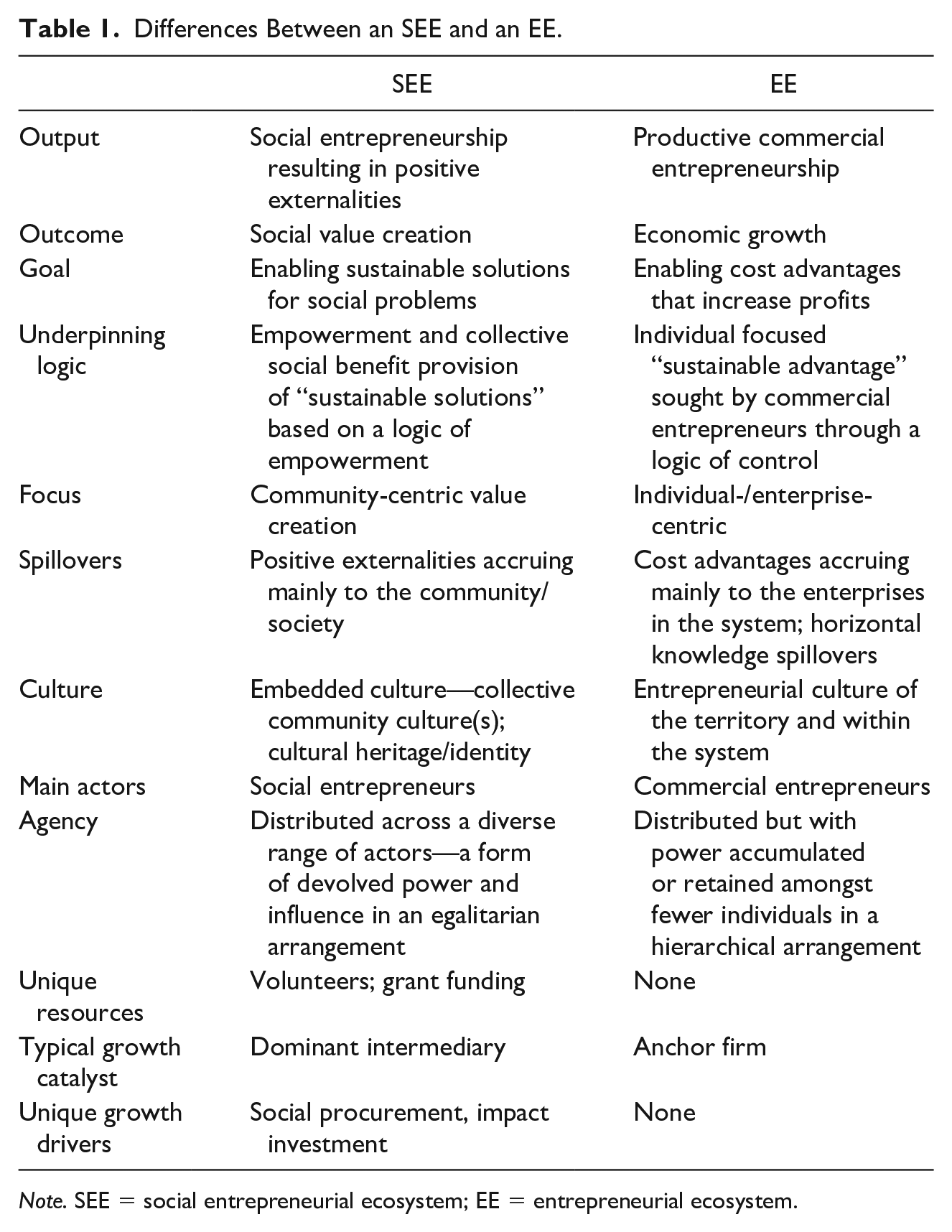
Note. SEE = social entrepreneurial ecosystem; EE = entrepreneurial ecosystem.
Toward a Contextualized Community-Centric Framework
In this section, we aim to draw on the insights of reviewed scholarship, including the foregoing discussion, to present a framework to guide contextualized, community-centered understanding of SEEs. We also aim to capture, and privilege, community commitment to creating positive externalities while recognizing the multiple actors and processes that operate over multiple levels. One or more type of community (Lumpkin et al., 2018) may be predominant in an SEE, with their activities and interactions overlapping to create what we argue to be a “composite community.” SEEs are dynamic, so time is an important consideration as the SEE moves through different stages, as is the contemporary sociocultural context the SEE is embedded in.
We present our framework in Figure 1. It is primarily built on the foundations of four extant conceptualizations in the EE and SEE literature.
Levels
First, we draw upon the three levels presented by Saebi et al. (2019) to show that ecosystems can be considered to exist at different “levels,” namely, individuals, organizations, and institutions. The boundaries between levels, and indeed the boundary between the SEE and other ecosystems, are permeable (portrayed by dashed separations and surround in Figure 1). The permeability of levels echoes our earlier discussion in relation to Kaletka and colleagues (2016) and their onion metaphor. The permeability between ecosystems is aptly illustrated by the convergence of SEEs with the social impact subtype of EEs (see “SEEs: An Emerging Concept?” section) when some actors and processes become common to both systems.
Time, Evolutionary Pathways
The second inspiration for our framework derives from Spigel and Harrison (2018), who provide a process theory of EEs. They capture the different life cycle stages of an EE, evolving from nascent to strengthening through to either resilient or weakened, portrayed in Figure 1 across the time continuum pathways of SEEs. Their process theory also reinforces that the boundaries of each ecosystem as permeable (or porous), and different types of actors within the ecosystem while distinct (e.g., high-growth firms, anchor organizations) can also cross-over with other ecosystems. Similarly, different types of processes are identified, resource flows, recycled resource flows, or resources into and out of the ecosystem. In their complementary schematic of ecosystem types, Spigel and Harrison (2018) recognize the influence of resource depth and relative network strength, which enables an extension of the oft-studied “strong” ecosystem, to also consider “weak,” “irrigated,” and “arid” ecosystem types. This facilitates the understanding of different contexts such as SEEs in countries with poorly functioning networks or limited resources. Moreover, access to resources and network strength may overlap, or be linked to, levels of political support/involvement and international/local focus, namely, according to the contextual drivers of the ecosystem.
Where Spigel and Harrison (2018) arguably fall short in terms of SEEs is their failure to take explicit account of the multiple levels of actors and interactions between levels. In this regard, application of a systems-level view to measure EEs 5 by Stam (2018), which has recently been neatly subsumed into Stam and van de Ven’s (2021) detailed exposition of the elements of EEs and their systems framework (see fourth section of the article for a description), holds promise. It is our third inspiration. Their complex systems approach can be considered compatible with the path creation processes previously identified in relation to SEEs. Furthermore, a “healthy” EE produces “entrepreneurship as an output and ultimately aggregate value as outcome” (Stam & van de Ven, 2021, p. 817) with both output and outcomes feeding back into the ecosystem. This perspective is compatible with SEEs. However, value creation as the outcome is not central to their ecosystem exposition. In addition, their “culture” element relates to entrepreneurial culture of a territory rather than the broader cultural context that we have contended can impact SEEs.
Contextual Influences
Hazenberg and colleagues (2016b) provide the fourth springboard for advancing our framework. Their social enterprise ecosystem typology and “grid” locates SEEs in terms of their local/international and private/state orientations in various European countries. It demonstrates how the positioning of an ecosystem is influenced by historical and environmental factors, as well as the nature of relationships between the different levels within the ecosystem. We suggest their approach could usefully be adapted to consider how more localized/regional ecosystems come together. Recognition of such contextual influences helps highlight differences between SEEs, which paves the way for understanding why and how such differences evolve (Hazenberg et al., 2016a).
Less tangible influences such as indigenous worldviews (Mrabure et al., 2021) may also influence the typology. Mrabure et al. (2021) distinguish indigenous, Western, and hybrid entrepreneurial orientations—which we envisage fit within the cultural context. Such acknowledgment would also account for the disparities in influence and enactment that may occur within a particular region or geographic space, rather than perpetuating a standardized or reductive approach to understanding place and space influences.
The individuality and idiosyncrasy inherent in capturing the cultural context may be enacted as a separate component within the SEE, or if deeply embedded, may exist as a “thread” within all constituent parts, such as, for instance, with cultural identities and practices in the rural Highlands and Islands communities in Scotland that are embedded in the development of social enterprises. The recognition afforded to crofting by the Scottish government and the purchase of land tied up in private estates for community usage have reasserted a collective relationship of attachment with the land that predated the Highland clearances (Mackenzie, 2006). This relationship stands in contrast to conceptions of private land ownership that accompanied modernity. It is characterized by understanding the relationship between land and its people as being grounded in its heritage and as a common resource for those belonging to it. Social entrepreneurship and the development of social enterprises under these conditions are required to negotiate a complex environment in responding to community needs. Pursuing courses that deliver a specific outcome, such as increased employment opportunities, must be achieved within the contexts of culture and place, rather than being transplanted on communities. However, Tapsell and Woods (2008) argue that these complexities also offer opportunities for innovation, when the cultural values and practices people have developed to sustain their communities are given recognition.
Community Core
Our SEE conceptualization, presented in Figure 1, presents a core of social and economic interactions and collaborations between communities of actors, encompassed by tangible influences such as policy settings. It also includes less empirically tangible, but no less important, historical, social, and cultural influences such as dimensions of indigeneity. As the SEE evolves, the core becomes a composite comprising multiple communities with interacting actors. These communities may have similar or different foundations such as geographical or intentional communities, or communities of identity, interest or solidarity (Lumpkin et al., 2018). They may emerge and consolidate also according to the prevailing context such as the “when” context of natural disaster as with the community-driven response and redevelopment in Christchurch region of New Zealand following the 2010 and 2011 Canterbury earthquakes. The redevelopment effort provided a fertile ground for the development of “intentional communities” (Lumpkin et al., 2018) with social enterprise activity creating a sense of community solidarity (Lewis, 2013). The Canterbury context also epitomizes path creation, as actors responded to catastrophic conditions.
Through community activity and interactions, positive externalities, such as knowledge spillovers, are generated and dispersed throughout a wide range of actors, groups, or communities beyond those directly involved in either the activity or the SEE itself. Thus, unlike the EE where entrepreneurs are key individual actors (Spigel & Harrison, 2018), within the SEE, the community of belonging that social entrepreneurs participate in is itself integral to successfully generating positive externalities (Roundy & Bonnal, 2017; Santos, 2012). This, in turn, may positively amplify the impact of either the socially entrepreneurial outcomes or the holistic efficacy of the SEE itself in driving sustainable solutions to social problems. Furthermore, this reciprocity factor may extend beyond the immediate SEE, to attract additional interest and resources into the sphere of the SEE and its constituent actors and arrangements. For instance, an initial flow of philanthropic grants into the SEE can signal legitimacy and attract more capital from commercial sources and commercially oriented impact investors (Lall & Park, 2022). In a similar vein, intermediaries may span across several SEEs by being an enabling agent of human capital development to grow the SEE talent pool or providing structural supports to enterprises in SEEs (e.g., facilitating social procurement).
A multiplex of contextual influences, such as spatial, temporal, cultural and political drivers, impact the SEE and exert different degrees of intensity at different times. Interactions between actors and/or levels in the SEE yield the means of generating and sharing positive externalities within and beyond the SEE. As complexity, diversity and density grow within the SEE, so does its “genetic pattern” (Hazenberg et al., 2016b; Roy & Hazenberg, 2019) and its community core evolves to encompass multiple sub- or micro-communities of various actors and interactions. Akin to the influence of an “anchor firm” in EEs (Spigel & Vinodrai, 2021), a dominant actor can span levels and interrelationships and constitute a core community of systemic influence in its own right. An example of the interrelationships surrounding a dominant intermediary in SEEs is Ākina, which became a key actor when it was tasked it with the delivery of the New Zealand government’s Social Enterprise Sector Development Program, which ran from March 2018–2021 (The Impact Initiative, n.d.).
The agency of “middle actors,” particularly intermediaries, appears to vary according to geographical context: the “where” dimension of context. In larger urban areas, they have scope to be more influential. By shaping discourse, they are also able to shape understanding of social entrepreneurship and subsequent practices, especially in nations where a social enterprise sector is embryonic (Kebbaj et al., 2016). Alternatively, drivers in other regions can be more localized, instead acting as “communities of identity” (Lumpkin et al., 2018) where individuals are working together to establish their own support networks and structures. A possible benefit from this type of place-driven approach is the potential for increased perceptions of legitimacy among SEE stakeholders due to the strength of collective ownership and energy—which in part further reinforces the significance of place-driven culture within the SEE itself.
We also emphasize here that disparity in community “size” implies only the potential impact differential to the system, rather than any hierarchical arrangement by virtue of relative size. The core and co-occupant communities of the SEE may also change in size and rates of dominance and influence within the system. The rate of evolution of the communities and the SEE itself will be dependent on facilitating (or inhibiting) contextual influences.
Summary
Bringing the various strands of our discussion together, we highlight that the framework we offer captures the multiplicity of contexts of SEEs and their essential community dimension while leveraging existing scholarship to avoid reinventing the conceptual wheel (de Bruin et al., 2017). Thus, we envisage an SEE as an evolving composite community of varied, yet interdependent, actors across multiple levels, which collectively generates positive externalities that contribute to sustainable solutions to social problems.
Concluding Discussion
Same, Different, or Both?
Clearly SEEs, like their EE counterparts, are heterogeneous and idiosyncratic. Comparing SEEs with EEs, we arrive at the conclusion that “same,” “different,” and “both” are all applicable descriptors. Each ecosystem has key elements, actors, and processes. However, the mix and power dynamics within each ecosystem are contextually dependent. In the case of SEEs, collective generation of positive externalities is a vital consideration, and the development and maintenance of communities for sustainable solutions to social problems are key. That is not to say that communities are irrelevant to the success of EEs—that would be gross oversimplification—but our focus differs from the more individual focus on entrepreneurs or firms and the activities typically found at the center of an EE. We contend that when community is taken as the focal point of the SEE, the nature of multilevel interactional character and processes are better recognized. Consequently, we contribute to the study of SEEs by delineating them as communities of interdependent actors who interact and collaborate across multiple levels in the generation of positive externalities and highlighting how processes within the SEE are affected by a multiplex of contextual influences and that context acts more powerfully on the collective than the individual agents.
A key area where SEEs and EEs are both same and different is through the dual criticality of the underpinning processes of collaboration and coordination. Coordination may include resource creation, recycling, and management of resource flows between actors (Spigel & Harrison, 2018). As with EEs, active management and coordination are crucial within the SEE, particularly given that not all actors within an ecosystem may have equal access to resources (McAdam et al., 2019).
Contextualization
Applying our contextualized understanding yields valuable insights. We underscore significant contextual influences of place, culture, and time, but also demonstrate the collective significance of agency and structure identified by Brown and Mason (2017) when the political economy perspective, essential to current understanding SEEs and EEs, is superimposed. Moreover, the contemporary “when” context of social enterprise and SEE development is inextricably intertwined with prevailing political agendas (Mazzei et al., 2021).
Temporal influences on SEEs can also be extended by viewing time through different conceptual lenses. Rather than accept the socioeconomic approach of time as an objective lineal concept, application of a more process-oriented, cultural historical perspective within the SEE recognizes socially constructed meanings and ideas that arise and change over time, either maintaining continuity or driving change, depending on context. The effect of cultural time perspectives provides valuable future research directions (M. Lévesque & Stephan, 2020). Recognition of cultural influences such as the indigenous orientation identified by Mrabure et al. (2021) may begin to address this imbalance, but such implementation within our proposed framework is not straightforward. Heterogeneity across cultures (Mrabure et al., 2021) requires adaption dependent on both place and culture.
We identify culture and place as significant contextual influences on communities within the SEE. It is difficult to build culture through outside intervention (Spigel & Harrison, 2018); hence with a dominant community focus, SEEs may have stronger cultures than their “mainstream” counterparts. They may also derive great catalytic power from the absorption of the culture and cultural norms of their relevant geographic domain, especially as the external facing boundaries of an SEE are arguably more permeable than that of an EE, and the system itself more responsive. SEEs may share similar institutional and/or legal foundations at a national basis, but environmental aspects such as culture and place may create purposive hybridity, whereby the resulting local or regional ecosystems are distinctive from each other. Differences between SEEs in Scotland and England demonstrate such variance (Hazenberg et al., 2016b). In New Zealand, multiculturalism and especially Māori culture and values offer synergies that can be coordinated to enhance the SEE (de Bruin & Read, 2018). Such action builds on Mazzarol’s (2014) recommendation to build on existing strengths within the environment to further SEE ambitions.
The conceptual framework we articulate provides for an expanded view on SEEs and recognizes how contexts influence their emergence, variability, and the dynamism and characteristics of subsequent community configurations. As such, our conceptualization begins to address the void in theorizing in terms of the creation, evolution, and impact of SEEs identified by Audretsch and colleagues (2019) as a necessary starting point for more critical analyses of ecosystems generally. Nonetheless, challenge to critique theoretically embedded assumptions has yet to be empirically applied and this will provide opportunities for further analysis and refinement.
While we have discussed the various components of ecosystem structure—levels, boundaries and so on—we have also indicated that a system-encompassing issue, such as a significant exogenous shock, be it a natural disaster, or a policy change, can drive a system to new pathways and change “DNA” (Gonzalez & Dentchev, 2021). An ecosystem must be malleable enough to cope with shocks and flexible enough to reshape and reorient according to need. Moreover, far-reaching changes to everyday activities and processes sparked by the COVID-19 pandemic have reinforced the value of strong (local) communities and the need for nimble actors, flexible enough to mobilize and negotiate system-wide action and nurture community well-being and resilience (Organisation for Economic Co-operation and Development, 2020). The COVID-19 disruption also reinforces the critical influence that process-oriented temporal drivers play in building and understanding SEEs. These temporal drivers deserve to be studied more thoroughly.
Recent work also provides a nuanced understanding of the role of “anchor firms” in affecting the dynamics of EEs (Spigel & Vinodrai, 2021). Given the similar level of importance within SEEs of anchor institutions firmly rooted within their locales, situations analogous to the context of their study could be found to investigate dynamics and fluidity over time within SEEs.
Practice Implications
While our primary focus is on theoretical implications, our study also has implications for practice. For regional policymakers looking to grow, or develop the efficacy of, locally contextualized social entrepreneurship activities, our study suggests that their emphasis should be on increasing opportunities for informal networking, empowering communities through funding and investment support, and supporting the role of intermediaries, particularly those that reflect and are acutely attuned to local cultures, heritage, and values. For national-level policymakers, our study raises awareness that the SEE is not an appendage of an EE but needs dedicated support that takes into account community and sociocultural imperatives. Furthermore, for policymakers in underdeveloped institutional environments (Wei, 2022), we highlight that dedicated attention needs to be paid to supplying the “fuel” (Gonzalez & Dentchev, 2021) for SEEs and fostering the exercise of agency of particular groups within communities of the SEEs (e.g., poor women in male-dominated societies). Overall, our holistic community emphasis shifts the spotlight away from social entrepreneurs as the only practitioners and turns it directly on “a multiple-practitioner perspective within the entrepreneurial ecosystem” (Champenois et al., 2020, p. 302). As such, we take the liberty here to echo the call of Champenois et al. (2020) that we as researchers should also envisage ourselves as practitioners in the ecosystem. Shocks, like the COVID-19 pandemic, heighten the need for all SEE practitioners to work together to ensure that SEEs move along the time continuum portrayed in Figure 1, to become resilient rather than weakened.
Looking Ahead
How various ecosystems—namely, EEs, SEEs, social impact entrepreneurial systems and business ecosystems—may overlap, interact, or be connected is yet to be considered. An additional question to be asked is, “Could SEEs operate as a bridge between such systems?” If so, the role of intermediaries as “middle agents” may become even more significant. There is also scope, to consider this aspect further in terms of the role and influence of a dominant intermediary.
Our focus on community, collaboration, and coordination did not fully acknowledge leadership, which Stam (2015, 2018) and Stam and van de Ven (2021) advocate as necessary for an effectively functioning EE. Questions on leadership are important to SEEs too (Jackson et al., 2018) and include, “Who provides leadership within the SEE? How is this process facilitated? Do intermediaries take on this role or do other individuals and organizations step up? What role does culturally specific leadership play?”
Answers to such questions lie beyond the scope of this article but raise several implications for future scholarship. For example, are “indigenous entrepreneurship ecosystems” adequately covered under the ambit of the conceptualization of SEEs we presented? And—like our point concerning exogenous shocks such as the COVID-19 pandemic—does the ecosystem metaphor adequately illuminate or obfuscate understanding of the effects of the ongoing climate crisis on communities, whether indigenous or not?
Finally, we acknowledge our SEE conceptualization is, arguably, theoretical speculation (e.g., with no strong empirical evidence) to verify the development of its “composite community” core or any generalizable evolutionary trajectories of SEEs. Nonetheless, such limitations provide opportunities for future scholarship. For instance, as Spigel (2017) and Stam (2018) highlight in relation to developing metrics for attributes of different EEs, there is need to develop SEE-related metrics. These measures are necessary not only to gauge objective and easily quantifiable impacts like social enterprise start-ups and social finance growth but also to capture more difficult to measure effects such as the positive externalities that different SEEs generate, including those that are specific to unique cultures, spaces, and places. In addition, there is need for longitudinal studies and quantitative data like the Startup Cartography Project (Andrews et al., 2022) that will enable similar analysis for SEEs, and the plotting of evolutionary trajectories of SEEs, along lines of Spigel and Harrison (2018) for EEs, as portrayed in our Figure 1 horizontal time axis. To conclude, we hope our study will be a springboard for firmly advancing the SEE discourse along contextualized, community-centric lines.
Footnotes
Acknowledgements
We would like to thank our Editor, Israr Qureshi, for his exceptional guidance and the anonymous reviewers for their detailed developmental and thoughtful feedback and patience with us over several rounds of revision.
Declaration of Conflicting Interests
The author(s) declared no potential conflicts of interest with respect to the research, authorship, and/or publication of this article.
Funding
The author(s) received no financial support for the research, authorship, and/or publication of this article.
