




Abstract
Stakeholder recognition constitutes a firm’s experience of affirmation and acknowledgment from stakeholders and is deemed essential for organizations to develop positive self-relations and a sense of themselves as morally responsible social actors. Through an in-depth case study, I show how a firm’s varied experiences of stakeholder recognition for its corporate social responsibility (CSR) efforts alternately facilitated and hindered the performativity of its aspirational CSR talk through two key processes: (a) a recognition-attainment process whereby the experience of stakeholder recognition helped turn aspirational CSR talk into “substantive” talk with the performative potential to catalyze other CSR practices; and (b) a subsequent recognition-commodification process induced by a perceived misrecognition that ultimately rendered such talk “ceremonial.” Elucidating stakeholder recognition as an undertheorized boundary condition of aspirational CSR talk, this study adds to performative approaches to CSR communication. It further contributes to research on recognition by demonstrating the explanatory potential of Axel Honneth’s notion of recognition in researching business and society interactions.
Keywords
Stakeholder recognition constitutes a firm’s experience of affirmation and acknowledgment from stakeholders. Recognition is deemed essential for organizations to develop positive self-relations and a sense of themselves as morally responsible social actors and has therefore been proposed to hold explanatory potential for the study of organizational conduct (Fassauer, 2016). Yet, its inception into business and society research is pending. This in-depth case study explores the interrelationship between a firm’s evolving experiences of stakeholder recognition and the performativity of its aspirational corporate social responsibility (CSR) talk over time.
Aspirational CSR talk, here defined as CSR communication that announces a firm’s ideals, intentions, and idealized self-descriptions of the future rather than reflecting its current CSR commitment, has been the subject of increasing attention in research on CSR communication in recent years (Christensen et al., 2013, 2021; Lauriano et al., 2021; Winkler et al., 2020). Scholars adopting a performative understanding of CSR communication (Schoeneborn et al., 2020) have argued that this communication can induce sufficient actionability and bindingness to support the future implementation of CSR (Christensen et al., 2013, 2021). Ascertaining which conditions are conducive to harnessing its performativity is thus a matter of significant relevance for research, as reflected in a growing number of empirical investigations into these boundary conditions (Girschik, 2020; Haack et al., 2012, 2021; Koep, 2017a, 2017b; Penttilä, 2020).
Among the key claims made in prior studies is that negative evaluations by external stakeholders constitute an important boundary condition for fueling the performative potential of aspirational CSR talk to support the implementation of substantive CSR activities (Haack et al., 2012, 2021). Such research has further argued that harnessing this performative potential depends on how aspirational CSR talk is “picked up” and processed by organizations themselves and their members (Christensen et al., 2021; Winkler et al., 2020).
Yet, very few empirical studies to date have focused on how firms and their members “pick up” on their CSR talk and how they subsequently engage with CSR (Girschik, 2020; Penttilä, 2020). And so far, no study has paid attention to how firms experience their stakeholders’ evaluation, specifically the affirmation and acknowledgment they receive from stakeholders for their CSR efforts, and whether this helps them to experience themselves as moral actors in society. Yet, this seems important to better understand when and how aspirational CSR talk may develop performativity, even in the absence of negative stakeholder evaluations. Consequently, I seek to answer the following research question: How does stakeholder recognition as a boundary condition shape the performativity of aspirational CSR talk?
To address this question, this article presents my investigation of the case of a partly state-owned European telecommunications corporation over a 6-year period from 2010 to 2016, including my analysis of data collected from interviews and non-participant observations conducted in 2015 to 2016 and from archival documents. Drawing on Axel Honneth’s notion of recognition (1995, see also Fassauer, 2016) allows me to demonstrate how a firm’s varied experiences of stakeholder recognition facilitate or hinder the performativity of its aspirational CSR talk. My analysis identifies two distinct recognition processes that, respectively, shaped the performativity of the company’s aspirational CSR talk: an initial “recognition-attainment” process that rendered the firm’s aspirational CSR talk more “substantive” in that it was gaining bindingness as to how the firm acted in CSR, and a subsequent “recognition-commodification” process that rendered this talk increasingly “ceremonial” in that it was perceived be inconsequential for how the firm acted in CSR.
With these findings, I contribute both to the growing debate among CSR scholars on the performativity of CSR communication (Schoeneborn et al., 2020) and the scholarship on aspirational CSR talk (Christensen et al., 2013, 2021; Koep, 2017b; Penttilä, 2020; Winkler et al., 2020). Whereas many studies on aspirational CSR talk have emphasized the importance of negative evaluations from stakeholders in fueling the performativity of aspirational CSR talk (Haack et al., 2012, 2021), my research indicates one determining factor in whether stakeholder evaluations fuel the performative potential of a firm’s aspirational CSR talk is how firms experience these evaluations. It further explores stakeholder recognition as a currently undertheorized boundary condition of aspirational CSR talk and highlights its ambiguous impact on the performativity of such talk.
My research also contributes to research on recognition (Fassauer, 2016; Fassauer & Hartz, 2016; Islam, 2012; Newlands, 2022) with the first empirical study of recognition processes in CSR communication. Prior research has mainly investigated recognition in relations between individuals within organizations. By empirically demonstrating along a processual model how a firm’s varied experiences of stakeholder recognition shaped the performativity of its aspirational CSR talk, my study underscores the explanatory potential of recognition in the study of organizational conduct in the business and society context.
On the Performativity of Aspirational CSR Talk
The performativity of CSR communication has gained increasing scholarly attention in recent years (Schoeneborn & Trittin, 2013; for a recent review, see Schoeneborn et al., 2020). Following speech act theory (Austin, 1962), performative views of CSR communication argue that the organizational communication of CSR concerns between a firm and its stakeholders can attain—under certain conditions—a sufficient degree of actionability and bindingness to influence how the organization conducts itself (Schoeneborn et al., 2020). From this perspective, communication is a key constitutive dimension of any organizational change (Ford & Ford, 1995).
In applying this perspective, Christensen et al. (2013, 2021) have developed the influential concept of “aspirational CSR talk” to help explain how future-oriented CSR communication that is largely ceremonial at the moment of being announced, can nonetheless turn into substantive CSR communication insofar as it develops a degree of actionability and bindingness conducive to the future enactment of substantive CSR practices (see also Schoeneborn et al., 2020). While speech act theory holds that any communicative act can gain some degree of performativity (Austin, 1962; Searle, 1979), aspirational CSR talk is especially likely to gain such potential because it explicitly conveys an organization’s idealized self-image and outlines actions deemed socially desirable to accomplish (Christensen et al., 2013, 2021). Yet, importantly, the performativity of aspirational CSR talk is inherently precarious in that it cannot be controlled in deterministic ways and thus its effects do not always play out as intended (Christensen et al., 2021). Consequently, scholars have turned their attention to ascertaining the organizational boundary conditions under which it can gain performativity and support a firm’s commitment to substantive CSR efforts.
According to Christensen et al. (2021), a key boundary condition determining whether declared aspirations gain performativity is that audiences respond to such talk. If a firm’s aspirational CSR talk elicits no significant response from its stakeholders, it is argued, such talk is unlikely to have any performative effect on a firm’s CSR implementation and can thus be considered to have “misfired” in its aim (Christensen et al., 2021; Winkler et al., 2020). Aligned, a growing number of empirical studies emphasizes the role of negative stakeholder evaluations in facilitating the performativity of aspirational CSR talk (Haack et al., 2012, 2021; Koep, 2017b; Livesey & Graham, 2007). Negative stakeholder evaluations are so effective in rendering aspirational CSR talk performative because such talk is a form of “moralized communication” (Schoeneborn & Girschik, 2021). When stakeholders respond to a firm’s aspirational CSR talk with criticism, protest or skepticism, this conveys a negative evaluation based on specific moral standards applied by these stakeholders. These critical responses can in turn initiate a process that may compel the firm to act more in accordance with its announced aspirations, to keep to its promises, and thus develop a substantive commitment to CSR (Haack et al., 2021). This argument accords with findings from broader research focused on how negative social evaluations shape organizational conduct (Roulet, 2020). Yet, aspirational CSR talk research is still very much a nascent field of study and debate, hence a recent call issued by Schoeneborn et al. (2020) for scholars to further “explore under which boundary conditions . . . CSR talk can gain performativity” (pp. 26–27).
Answering this call, my empirical case study focuses on a firm’s experience of its stakeholders’ evaluations of its CSR efforts and how variations in its experience of these evaluations over time shaped the performativity of its aspirational CSR talk. More precisely, I focus a firm’s varying experiences of stakeholder recognition. Recognition (Honneth, 1995) has been acknowledged as a driver of organizational conduct (Fassauer, 2016), the concept has yet to gain much traction in the study of CSR communication. Prior CSR research has drawn on similar concepts and theories related to recognition in arguing that businesses engage in CSR communication primarily because they strive for gaining legitimacy among stakeholders (Castelló et al., 2016), or in the hope of improving their reputation (Vogler & Eisenegger, 2021). This is in line with general management research that puts forth that positive social evaluations by stakeholders in the form of status or social approval can be of considerable consequence for organizational conduct (Bundy & Pfarrer, 2015; George et al., 2016).
Yet, I argue that extant concepts and theories somewhat privilege the role and perspective of external stakeholders for and in the evaluation process of organizational conduct. In contrast, drawing on Axel Honneth’s (1995) notion of recognition allows me to focus on a firm’s subjective experience of being evaluated by stakeholders and thus can afford valuable insights into when a firm experiences itself to be recognized by its stakeholders for its CSR efforts, and how this, in turn, motivates it to act upon its aspirations. Studying the performativity of aspirational CSR talk from a firm’s perspective is also appropriate because the degree of performativity of a firm’s CSR talk is necessarily dependent on whether and how that firm “picks up” on this talk (Christensen et al., 2021; Winkler et al., 2020). The few studies that have provided insights into how firms internally “pick up” on aspirational CSR talk (Girschik, 2020; Penttilä, 2020) are important for helping us understand how this facilitates changes in the ways firms organize CSR. Yet, they do not tell us much about how firms experience their stakeholders’ evaluation and how this experience affects their subsequent organizing of CSR. Addressing this gap is the overarching aim of this article. In the following, I will introduce the notion of recognition in further depth.
Introducing Recognition to the Study of CSR Communication
According to the social scientist and pioneering proponent of the concept of recognition, Axel Honneth (1995), experiencing affirmation and acknowledgment of others is fundamental for autonomous social actors to build integrity and morality. Such recognition is vital because the “only way in which individuals are constituted as persons is by learning to refer to themselves, from the perspective of an approving or encouraging other, as beings with certain positive traits and abilities” (p. 173). Social actors thus strive for recognition from others to achieve positive self-relations (Honneth, 1995), vying to elicit signals of affirmation and acknowledgment that may or may not be granted and that can always be withdrawn.
Research on recognition is generally fragmented across several disciplines, with conceptualizations of recognition ranging from subjective psychological approaches (Simon, 2020) to more relational, sociological orientations (Newlands, 2022). In general, however, all such conceptualizations understand for recognition to shape the conduct of a social actor, the actor must perceive and experience such recognition as desirable and conductive for their own self-perception and self-worth. For this to happen, such recognition must come from a “recognizer” whom the recognition-seeking actor considers a source of recognition that is worth gaining recognition from. Whereas Honneth’s own works have focused on how social groups such as social classes and movements experience recognition in society (Honneth, 1995), management and organization scholars have so far mainly applied his ideas in studying experiences of recognition among individuals in organizational contexts (Fassauer & Hartz, 2016; Islam, 2012; Newlands, 2022).
Recognition is a contextual phenomenon that can take various forms in different spheres of life. According to Honneth (1995), individuals may seek out and experience recognition in their families (in the form of love), in their communities (in the form of solidarity), and in their political context (in the form of rights). Importantly, all forms of recognition entail a degree of “motivational readiness” (Honneth & Margalit, 2001, p. 117), since the experience of recognition implies that actors acknowledge each other as moral actors “whose states are worthy of articulation, irrespective of differences in values and identities” (Islam, 2012, p. 39). Conversely, “misrecognition” can be experienced as outright rejection or take more subtle forms such as a perceived denial of deserved recognition (Honneth & Margalit, 2001). Social actors who experience misrecognition may nonetheless persist in seeking to elicit signals of recognition from their counterparts to gain confirmation for their identity claims (Honneth, 1995).
Gabriele Fassauer (2016) theoretically established the link between Honneth’s notion of recognition and organizational communication. According to her, recognition can be transferred to organizations because such entities are also social actors that can attain moral capacity and develop collective ways of handling moral issues, including CSR (Paine, 1994). According to Cooren (2020, p. 173), for example, CSR communication implicitly indicates “there is a collective entity that acts and can be held responsible.” As such, organizations can be considered moral actors serving as interaction partners for a range of stakeholders in their organizational communication (Fassauer, 2016). From this perspective, recognition is an evaluative dimension of organizational communication that expresses its stakeholders’ affirmation or rejection of the organization’s morality (Fassauer, 2016). An organization’s experience of recognition (or lack thereof) can thus alternately facilitate or impede certain kinds of conduct. Fassauer (2016) has theorized accordingly that the notion of recognition can explain why organizational communication may become performative for certain organizing practices but not for others.
In this study, I draw especially on these later theoretical insights. I define stakeholder recognition as a firm’s experience of affirmation and acknowledgment from stakeholders. I precede from the premise that firms seek out recognition in their CSR communication with different stakeholders and that a firm’s experience of such recognition in response to its aspirational CSR talk can determine whether or not such CSR talk develops actionability and bindingness for CSR.
Research Design and Methodology
Research Context
My interpretive research draws on a single case study of a large European telecommunications corporation. Founded as a state enterprise, “ComCorp” underwent partial privatization in the 1990s, with the state still holding the majority of the shares. At the time of data collection, ComCorp had approximately 20,000 employees and provided a variety of information and communications technology (ICT) services to individual clients as well as to small, medium-sized and large corporations in several countries. The firm also maintained and upgraded the national mobile phone and broadband infrastructure in its country of origin.
ComCorp first began to engage in aspirational CSR talk in 2010 and had become a nationally and internationally acclaimed front-runner in CSR by the time of my data collection (February 2015–February 2016). Initially, I approached the firm as a “typical case” of a company that had extended its CSR commitment over time since first engaging in aspirational talk. Once I entered the empirical setting in early 2015, however, I was somewhat surprised to learn that ComCorp’s representatives felt that the firm had an “undeservedly” low reputation among consumers, in spite of its growing commitment to CSR. According to them, the firm had to fight to gain stakeholder recognition in CSR.
The well-documented history of the firm’s CSR engagement, combined with my high level of access to the company and the personnel who organized its CSR and CSR communication, afforded a valuable opportunity to gain rich contextual insights into how the firm’s experience of stakeholder recognition toward its CSR efforts had shaped the performativity of its aspirational talk over time from the perspective of those involved. As such, ComCorp can be described as a “revelatory case” (Yin, 2013), which allows me to develop process theory on the impact of experienced stakeholder recognition on the performativity of aspirational CSR talk (Langley, 1999).
Throughout my empirical observations, ComCorp’s CSR activities were centrally coordinated and organized by a team of CSR managers integrated within the firm’s corporate communication division and reporting directly to top management. This team consisted of eight full-time CSR managers and several temporary workers, including freelancers, trainees, and apprentices. As is the case in many firms, ComCorp’s CSR strategies were determined by the firm’s top managers while the day-to-day internal organization of CSR was handled by its team of designated middle managers (Hunoldt et al., 2020). The CSR team was responsible for overseeing a diverse range of activities aimed at fostering the systematic integration of social, ecological, and economic concerns into ComCorp’s business practices, including through energy-efficiency projects, educational measures related to the responsible use of telecommunication technologies, and the provision of flexible working conditions for staff. In their internal and external CSR communication efforts, the members of the team worked closely with staff from other communication departments, including two internal communication managers and one manager from ComCorp’s marketing department.
Sources of Data
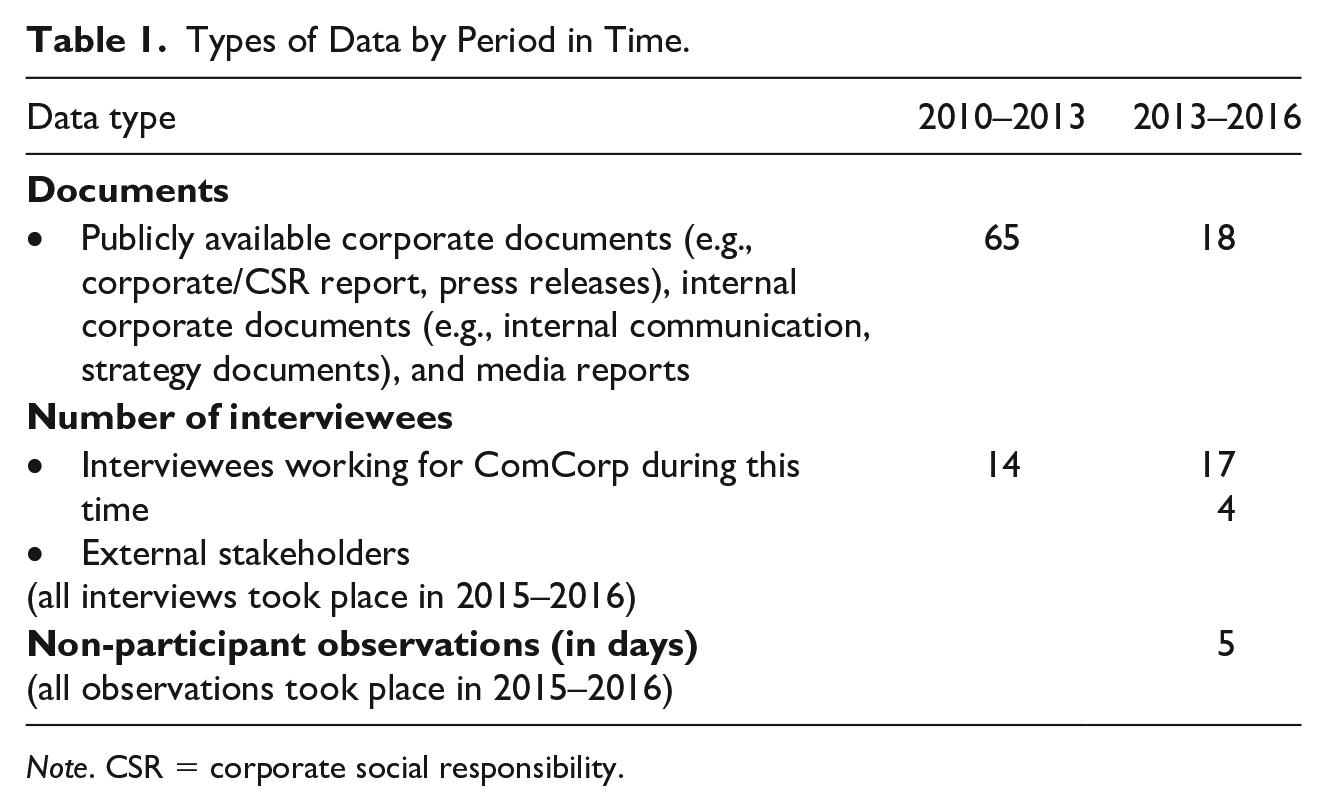
To gain insights into how ComCorp experienced its stakeholders’ responses to its aspirational CSR talk and subsequent CSR efforts, I collected data from interviews, non-participatory observations, and archival documents. (See Table 1 for an overview of all types of data by time period.)
Types of Data by Period in Time.
Note. CSR = corporate social responsibility.
Interviews
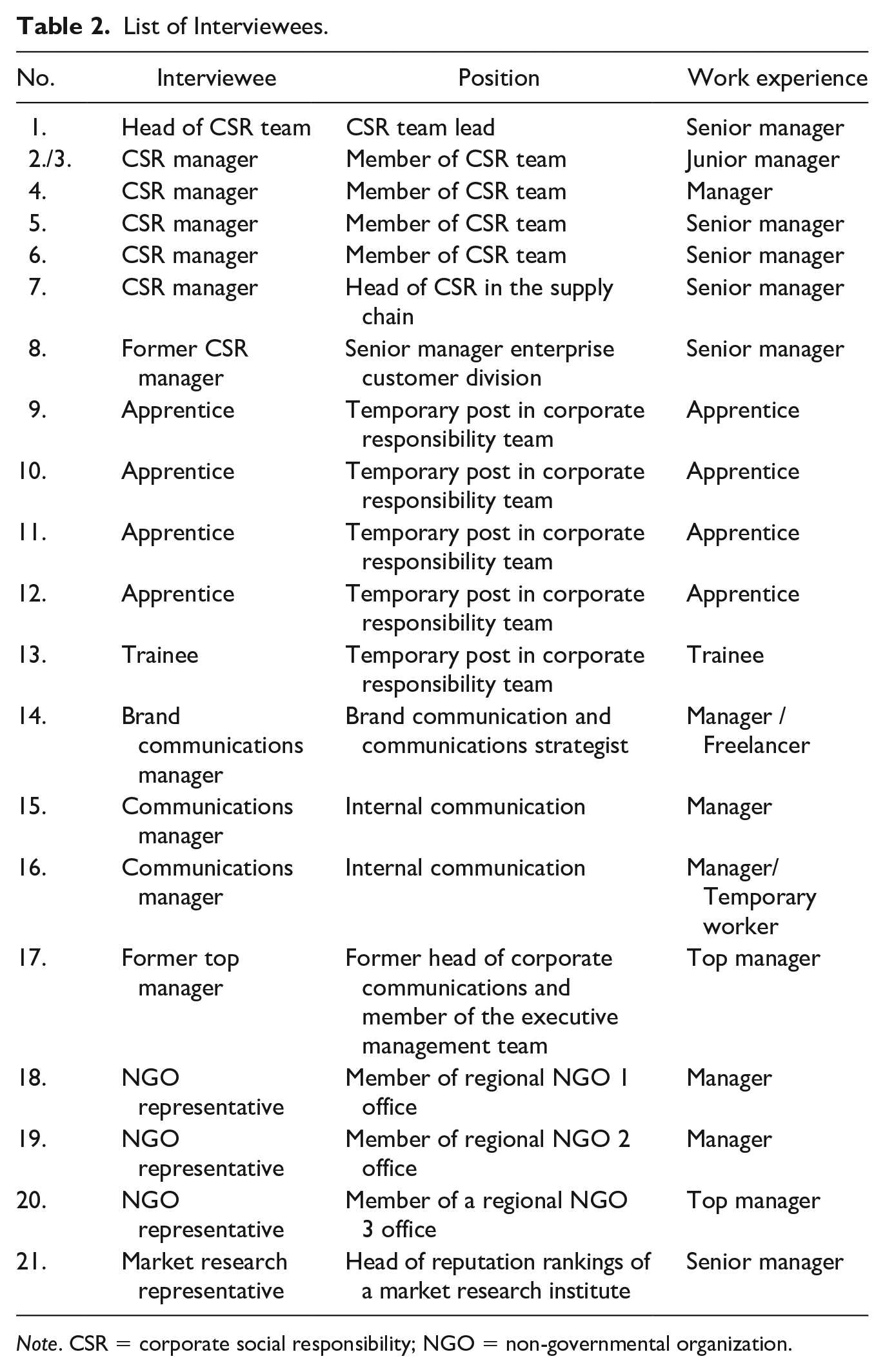
The primary data for this study comprise 21 interviews with individuals I purposefully selected as the actors most likely to provide in-depth insights into how ComCorp internally organized CSR (Glaser & Strauss, 1967). The interviews were conducted between February 2015 and February 2016 and lasted between 30 and 100 min each. All interviews were audio-recorded and later transcribed verbatim (see Table 2 for an overview).
List of Interviewees.
Note. CSR = corporate social responsibility; NGO = non-governmental organization.
Of the 21 interviews, 17 were conducted with ComCorp staff. These staff were mostly from the central CSR team and its close collaborators, all of whom were tasked with managing and coordinating the firm’s CSR activities. These internal interviewees included both current and former members of the central CSR team, as well as corporate communication managers and former members of the top management team who shared work assignments with the CSR team. The interviewees varied in their professional experience and in their positions in the company’s hierarchy, including members of ComCorp’s top management, senior and junior managers, trainees, and apprentices. Some had worked for ComCorp for many years, while others had only recently joined the firm. My initial review of the first round of interviews generated several follow-up questions about the firm’s external CSR communication, prompting a second interview with the manager most responsible for ComCorp’s external CSR communication.
I conducted most interviews face-to-face. Due to time constraints on the part of the interviewees, three participants were interviewed together at the same time and a further three interviews were conducted over the telephone following face-to-face interactions during my observations. In addition, I conducted four external interviews: one with a representative of a market research institute that produces nationwide CSR reputation rankings in the case firm’s home country, and three interviews with representatives of three different non-governmental organizations (NGOs). Although my primary focus was in exploring the case firm’s experience of stakeholder recognition, these four interviews yielded additional insights into how external stakeholders evaluated ComCorp in the context of CSR, thereby helping me further contextualize my findings.
Using a semi-structured interview guide to steer the course of each interview (Gubrium & Holstein, 2001) afforded me the flexibility to speak with the interviewees in an open-ended conversational manner. I typically asked the internal interviewees general questions about their daily activities in the workplace before turning to my main focus of interest in eliciting their views as to what motivated ComCorp to engage in CSR, what the goals of this engagement were, and what means the firm employed to achieve these ends. In the case of the external interviewees, I was asking how they experienced their interactions with the firm, and how they evaluated the firm’s CSR commitment. I also always posed specific questions about how the process of adopting CSR had evolved historically and what key events had marked this evolution.
Non-participant observations
Observing individual practices and interactions in the context of CSR can yield rich contextual insights and is especially fruitful when used to supplement interview data (Bass & Milosevic, 2018). Hence, I also carried out eight half-day sessions at ComCorp as a non-participant observer between February 2015 and February 2016. Over the 12-month period of this data collection, I was able to observe five meetings of the central CSR team, two internal CSR events for employees, and one presentation given by CSR managers to external stakeholders. These observations allowed me to gain a deeper understanding of ComCorp’s past and current CSR approach. Although reasons of confidentiality meant I was unable to audio-record my on-site observations, I thoroughly and systematically took notes of anything the participants said that struck me as significant in each context.
Archival data
To supplement and triangulate my interview and observation data, I collected both internal and publicly available archival data that ComCorp had published on its approach to CSR. In addition to annual reports, CSR reports, corporate videos, media releases, online content, newsletters, and social media content, these data also included internal CSR strategy roadmaps and presentations. These internal documents provided insights into the firm’s self-perception, including its CSR-related aims and goals. In addition, I extracted media reports on ComCorp and its CSR engagement from the Factiva database. These reports provided further indications of how the firm’s external stakeholders viewed and evaluated the firm and its CSR communication and efforts. They also allowed for triangulation of the interviewee’s accounts and my observations. My final selection of archival data comprised 83 documents. All of the different types of data I collected related to relevant developments within the 6-year period under investigation from January 2010 to February 2016. All material was translated into English.
Data Analysis
The idea that talk “does” things, the central premise of a performative view of communication (Austin, 1962), directed my processual and interpretive analysis of this case. I conducted this data analysis iteratively, constantly comparing my data with theory and vice versa, in three main steps.
I first approached my data in a fairly open-ended manner, engaging in a “free” reading of my empirical material. In this first step, I began by reconstructing the case history chronologically to develop a timeline that included key events and developments related to CSR. The point of departure of my analysis was ComCorp’s public announcement in 2010 that it aimed to become a leading firm in CSR by 2015. Early on in my analysis, I noticed that the firm’s initial aspirational CSR talk was intended to convey two distinct messages (a) a message communicating what the firm aimed to achieve in CSR and (b) a message announcing that the firm aimed to gain recognition from its stakeholders for its efforts in CSR. Several interviewees outlined how they felt that, in the past, the firm had made great strides toward achieving its goal of becoming a leading firm and CSR, and that they perceived that their firm was also partially recognized as such by others. Later, during my observations and during the interviews in 2015 to 2016, I further noted that a number of my interviewees were preoccupied with how ComCorp could gain greater recognition from consumers in the form of a better CSR reputation. In noting down these observations related to recognition as my “sensitizing construct” (Kreiner, 2016), my aim was to identify cues as to how and from whom ComCorp aimed to gain stakeholder recognition in CSR, whether or not the firm actually experienced stakeholder recognition, and how this might have influenced the firm’s approach to CSR. From this first step, I derived first-order codes reflecting the language of the informants.
In the second step of my data analysis, I was interested in systematically capturing how the firm’s varying experience of stakeholder recognition facilitated or hindered the performativity of the firm’s aspirational CSR talk in each phase. In this step, I derived second-order themes from the analysis and synthesis of first-order codes, further applying axial (second-order) coding to identify relations between these second-order themes. In so doing, my aim was to identify for each phase a process that represented the firm’s experience of recognition from its different stakeholders (or lack of experience thereof). I also investigated the outcomes that the identified recognition processes facilitated with regard to the degree of actionability and bindingness of the firm’s aspirational CSR talk. To that end, I probed the interview and observational data for indications as to whether the interviewees perceived the firm’s CSR communication, specifically its aspirational CSR talk as being supportive of their CSR implementation efforts in each phase. I also investigated the document data for evidence of the progression of the substantive CSR implementation over time. This step involved a regular review and discussion of the data, as well as connecting the insights with the literature on aspirational CSR talk and recognition theory.
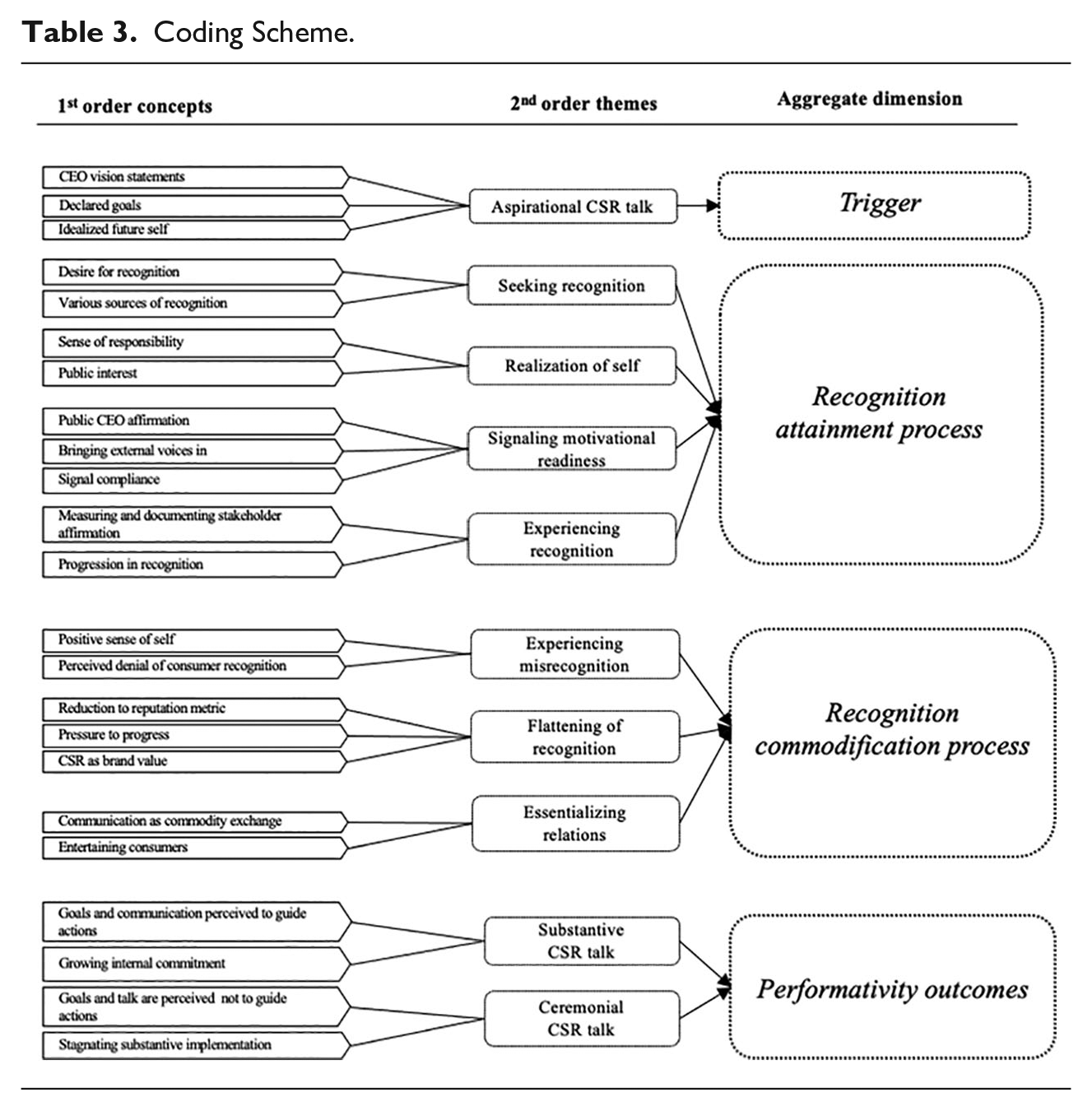
In the third and final step, the analysis involved sketching out what I saw emerging from my data. In line with established templates for process studies (Langley & Abdallah, 2011), I developed a three-level coding scheme to capture the relation between my first-order codes and second-order themes, as well as how I had synthesized them (see Table 3). I also developed a process model to illustrate the temporal trajectory of the case (see Figure 1). The online supplementary material provides an overview of the coding scheme with representative quotations for each code and theme.
Coding Scheme.
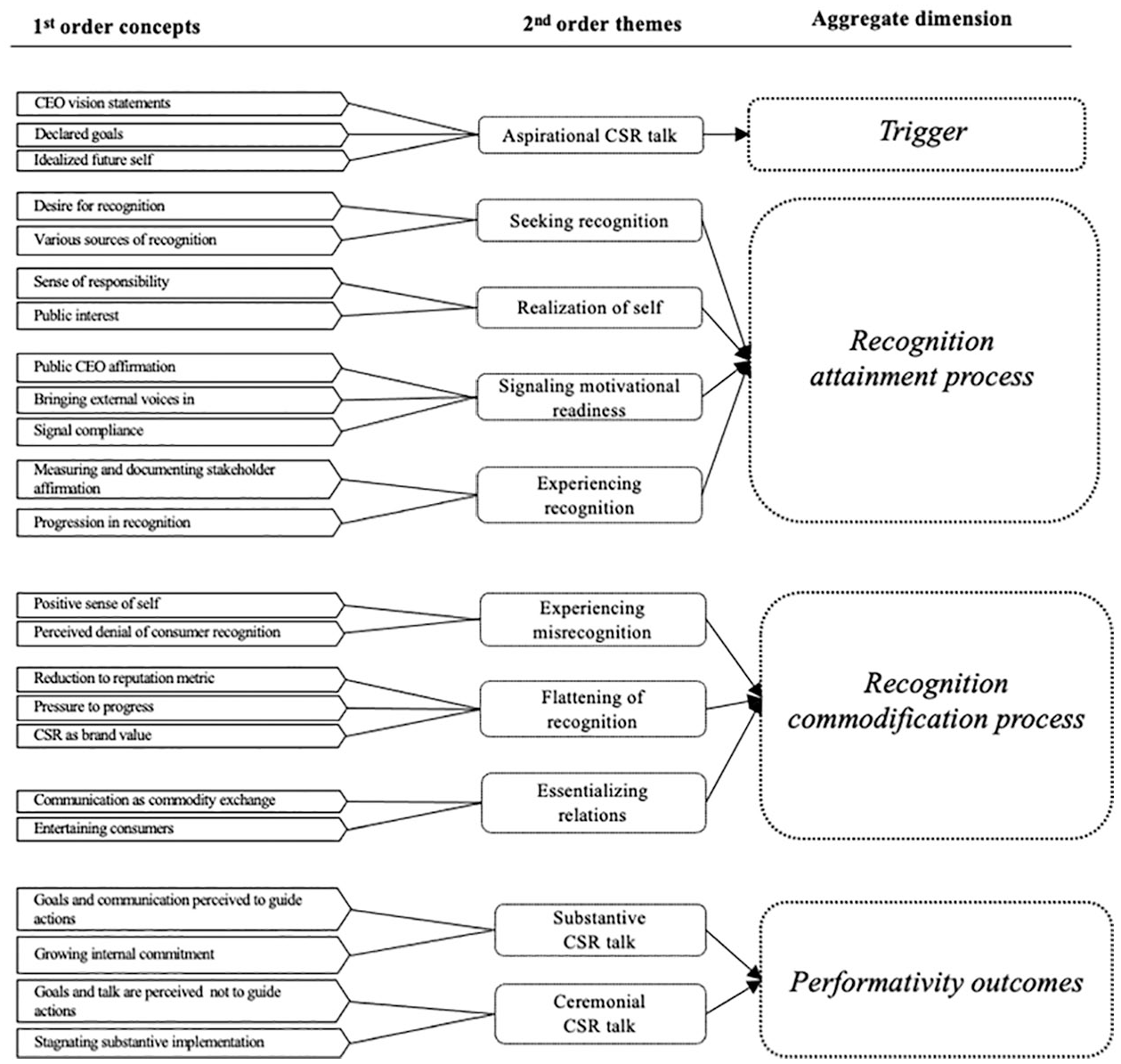
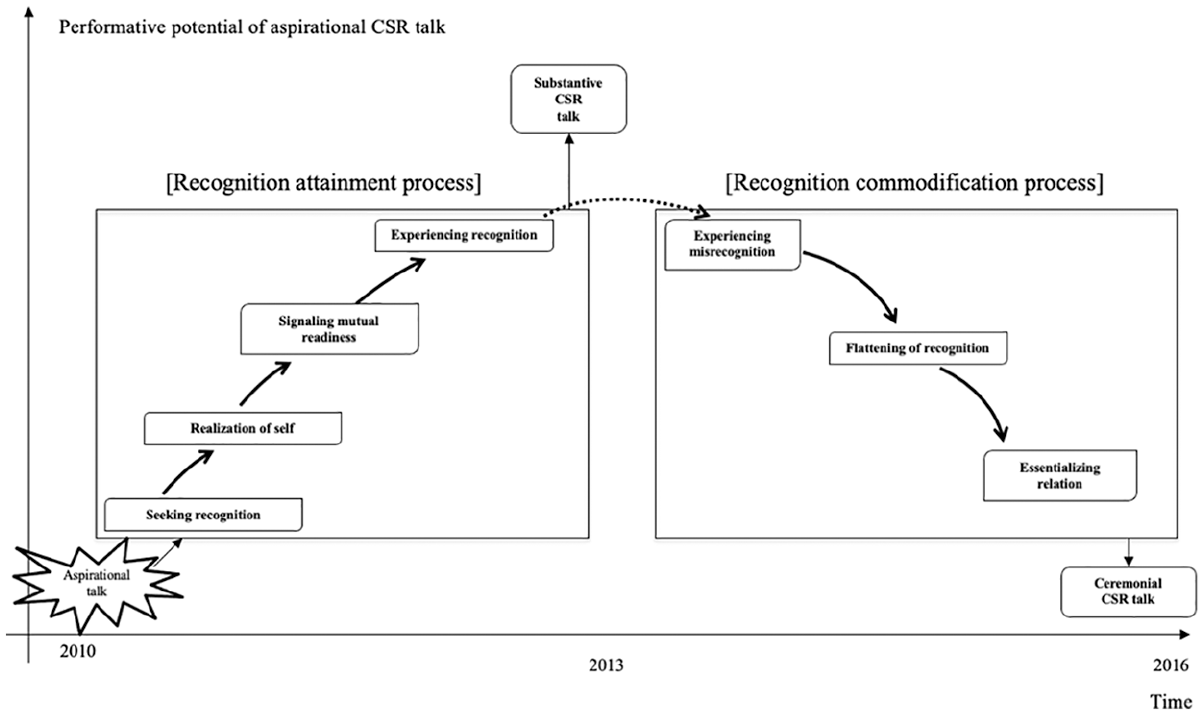
A process model of how recognition shapes the performativity of aspirational corporate social responsibility (CSR) talk.
Findings
In the following sub-sections, I present the themes and codes I derived from my analysis, citing representative instances of data from interviews, observations and documents. These findings informed my process model of how stakeholder recognition shapes the performativity of aspirational CSR talk (see Figure 1). Below I first present my findings in chronological order, dividing them into two main phases: 2010 to 2012 and 2013 to 2016.
Trigger
Aspirational CSR talk
In 2010, ComCorp’s CEO at this time announced his aspiration for the firm to become widely known and valued as a leading firm in CSR over the following five years. According to one interviewee, he had “had a clear strategy” (interviewee #8, former CSR manager): “He told us that he wanted the firm to become one of the ICT firms that shape the topic [of CSR].” The CEO’s vision statement was adopted and disseminated by other representatives of ComCorp. Some managers, including the head of the CSR team at that time, spoke publicly to the media about the firm’s declared goal to become and be seen as a leader in CSR in the firm’s country of origin: “Our goal is [to become] one of the most responsible corporations [by 2015]” (media report, 2013). To attract the attention of ComCorp’s external stakeholders to the firm’s present and future CSR commitment, the corporation communicated its aspirations externally, including in its 2010 annual report: “One of our principles in our mission statement [is that] ComCorp takes responsibility for sustainability and society at large: today and tomorrow” (corporate report, 2010). The public announcement of the firm’s idealized future self as a leading firm in CSR triggered the following process I call “recognition-attainment” process, which included the firm seeking out and subsequently experiencing stakeholder recognition, leading to the substantiation of its CSR talk.
Phase 1 (2010–2012): How a “Recognition-Attainment Process” turned Aspirational CSR Talk into Substantive CSR Talk
Seeking recognition
Grounded in the CEO’s aspiration, an internal corporate CSR strategy document was developed that identified CSR as a key concern in all divisions of ComCorp. This strategy document was made widely available throughout the firm (internal communication document, 2012). As outlined in a statement published on the firm’s intranet, for example, “the newly designed intranet webpage of the corporate responsibility strategy explains what each division does in order to make ComCorp one of the most sustainable firms in [its national context] and enable it to be recognized as such” (internal communication document, 2012; own emphasis). Internally it was clarified that the firm’s goal was to become equally “known” and “recognized” for its commitment to CSR among its stakeholders. Accordingly, based in the desire for recognition, the firm began communicating the goals it had set itself to its various stakeholders, announcing its commitment to live up to these aspirations and also conveying its rationale for setting itself these CSR goals.
In striving for stakeholder recognition of its commitment to CSR aspirations, ComCorp identified a wide and diverse range of stakeholders as potential “sources of recognition.” For a partially state-owned corporation and market leader such as ComCorp, providing telecommunication services and crucial infrastructures to a large proportion of businesses and individual consumers in its domestic market (and to a lesser extent abroad), even “society at large,” particularly within its country of origin, constitutes an important source of recognition. As one CSR manager (interviewee #5) declared, “It’s not that we have a 100% market share, but our share is large enough that we can talk to the public.” Beyond this general audience for its CSR efforts, ComCorp also sought recognition from civil society organizations, including a number of NGOs with whom the firm intended to foster close partnerships. Given the firm’s ownership structure, ComCorp also identified governmental agencies as a source of stakeholder recognition (interviewee #17, former top manager). ComCorp also sought affirmation and acknowledgment of its CSR efforts in the form of various sustainability and CSR-related ratings, rankings, and metrics, regarding these as a key source of recognition with the potential to support further substantive CSR efforts. According to one former CSR manager (interviewee #8), such metrics were perceived as helping the firm gain insights into how its CSR approach was evaluated by expert stakeholders (Morsing et al., 2008), including business analysts with an in-depth knowledge of CSR.
Realization of self
The firm’s quest for recognition in CSR build on the firm’s self-realization as a social actor that carries a special social responsibility, and who is, in turn, was worth being recognized by others. The ComCorp staff I interviewed evinced a strong perception that the firm’s ownership structure imposed a special “duty” on the firm to act responsibly: “ComCorp has a particular responsibility because it’s not a private corporation, but partially state-owned, and thus [CSR] is also a duty” (interview #11, trainee). The perceptions and information conveyed by the interviewees provided important contextualization of ComCorp’s stated aspiration of leadership in CSR and its perceived sense of responsibility as a moral actor in society, including the fact that CSR had already become a matter of general concern in the national public debate by the time ComCorp adopted its visionary CSR communication in 2010. ComCorp’s commitment to responsible business practices, especially as a partially state-owned corporation, was subject to growing public interest. As one former top manager observed (interviewee #17), “When you [feel] this special responsibility on a daily basis, which is basically imposed on you from the outside, then, of course, you concern yourself with [CSR] more.” Rather than perceiving such demand for more corporate commitment to CSR as a threat, several interviewees viewed these demands as favorable and useful for the agenda of ComCorp’s CEO at that time and all who shared his commitment to making ComCorp a corporation that would serve society; “the internal standing [of CSR] has massively evolved, and this upvaluation was only possible as a reaction to the societal reweighting of the topic” (interview #8, CSR manager).
Signaling motivational readiness
An important element in the process was that the firm began to signal its “motivational readiness” (Honneth & Margalit, 2001) toward its various stakeholders, showing it acknowledged them as worthy social actors with legitimate claims with regard to the firm’s conduct. The firm’s CEO made a point of publicly demonstrating his personal commitment to CSR, including by exchanging his company car for a fuel-saving vehicle and by challenging other corporate leaders at public events to think more sustainably (media report, 2009). As one manager later observed, the former CEO “was someone who could really represent [the ideas of CSR] externally, but also internally” (interview #4, CSR manager). From the perspective of many interviewees, including external stakeholders and observers of the company at that time, the CEO’s public display of affirmation for the topic of CSR signaled the firm’s commitment that CSR and societal demands for CSR mattered. The CEO’s proactive attitude gained praise from these stakeholders in return. For example, one NGO representative I interviewed adjudged that the CEO’s “long-term perspective and his very tactful way of doing things” had greatly supported the CSR team’s agenda of internally implementing CSR in ComCorp’s business practices (interview #20, NGO representative).
Notwithstanding the widely shared sense of duty among ComCorp’s members and the effective leadership of its CEO in communicating the firm’s CSR aspirations, my interviewees reported a number of obstacles that had to be overcome to add substance to these commitments. Initially, the CSR team had to campaign as “internal activists” (Girschik, 2020) for the internal integration of CSR: “in the CSR role, you are permanently a missionary,” commented one former CSR manager (interview #8). Accordingly, many of the CSR team’s projects focused on bringing signals of recognition in, aiming to convey to internal audiences within ComCorp the external social demand for CSR. For example, the team strove to ensure that the perspectives of external stakeholders were accounted for by bringing ComCorp’s top managers into direct conversation with top managers of other corporations. The team further made a point of continuously reminding other ComCorp members that the firm’s intensified commitment to CSR was an extension of its long-standing history of managing its ecological sustainability—a commitment for which ComCorp had gained recognition in the past, including in the form of sustainability certificates.
At the same time, the team continuously undertook efforts to signal to external stakeholders the firm’s willingness to comply with their demands. Signaling compliance involved building relationships between the team and civil society representatives, including through joint projects (interview #5, CSR manager). This also entailed that ComCorp’s external CSR communication became more “explicit” through the CSR team’s increasing use of “overt forms of communication” regarding its CSR efforts (Morsing & Spence, 2019, p. 1921), including a dedicated CSR blog, a CSR homepage, newsletters both for employees and external stakeholders, as well as occasional marketing communication campaigns with integrated CSR messages (internal strategy review, 2013). The CSR section within ComCorp’s annual corporate reports grew from only a few paragraphs in 2010 to over 30 pages by 2013, extending considerably beyond minimum standards for non-financial reporting. ComCorp now moved away from the terminology of “sustainability” and developed its own terminology under the umbrella term of “corporate responsibility” (annual report, 2010). Although the firm’s CSR goals featured prominently in its CSR communication, my interviewees noted that the core function of CSR communication in this early phase had been to report on the firm’s progress in CSR and signal that its commitments were coupled with actions. According to one CSR manager (interview #6), the principle followed by ComCorp was to signal compliance, meaning that “first you have to do something, then you can talk about it. First, there is the evidence, and if all goes well then you can move outside with it.” For the team at this time, actually implementing CSR thus took precedence over communicating CSR.
Experiencing recognition
Finally, the CSR managers I interviewed regarded it as a matter of considerable importance to measure and record the milestones and overall progress achieved by ComCorp in its aspiration to become a leader in CSR, and being recognized as such. As a consequence, measuring and documenting stakeholder affirmation of the firm’s CSR efforts became central to the CSR team’s activities, with managers documenting any signals of recognition of its CSR efforts from external expert stakeholders, especially in the form of sustainability rankings and other metrics. As explained by one CSR manager (interview #4), being able to “see results and . . . demonstrate results by the end of the year” helped the team respond to internal queries about the effectiveness of its efforts (e.g., “We invest so much time and . . . so much money, so where is the benefit then?” interview #4, CSR manager) and to justify the CSR budget allocation to influential internal audiences such as the top management. For these reasons, the CSR team and its affiliates also paid considerable attention to the firm’s CSR communication. In doing so, their aim was to “not only communicate about CSR” but also to use communication strategically to elicit signals of stakeholder recognition, to explain the firm’s progression in CSR, and to measure its success on the basis of key performance indicators (KPIs), hence “reports on progress and end-of-year-reporting” were seen by the team as crucial in following up on the firm’s CSR aspirations (interview #17, former top manager).
My interviewees from ComCorp described how these efforts also led to the internal realization of the firm’s increasing progression in stakeholder recognition. For example, ComCorp achieved high sustainability ranking positions both nationally and internationally in this phase and won several awards for its CSR and sustainability-related projects. As confirmed by my archival data, expert stakeholders in particular gave numerous positive evaluations of ComCorp’s CSR efforts. In a media report on ComCorp’s CSR performance in 1 year, for instance, it was announced that the firm “has once again scored top marks in three of the most important sustainability ratings and is now listed in the [telecommunication] sector of the Dow Jones Sustainability World Index [which] places ComCorp among the top 10 companies worldwide to be represented in the global index” (media report, 2013). Similarly enthusiastic accounts appeared in the national press, as in the following appraisal (media report, 2012): “In this country, no corporation is fit to hold a candle to ComCorp [in terms of sustainability]. Its strong position for years has been underpinned in an international comparison.” Within the firm, the CSR team interpreted these positive appraisals as signals of expert stakeholder recognition of the firm’s progressing CSR efforts. According to some CSR managers I interviewed, achieving external recognition in the form of high positions in CSR ratings further “certified our credibility” and was perceived as a great success, in turn fueling further internal commitment to CSR (interview #8, former CSR manager).
Substantive CSR talk
My data analysis confirms that, overall, the “recognition-attainment” process that the firm went through since its public declaration of its CSR aspirations, had served to support an increase in the firm’s substantive CSR commitment by 2012. The CSR managers I interviewed confirmed that the firm’s publicly declared aspirations and the recognition it received from external stakeholders had supported them in fostering the internal implementation of CSR. As one manager reflected, the firm’s aspirational CSR talk gave the team “something to hold on to—something you could refer to when engaging with the top management—and that helps you not just in the next year but also beyond” (interview #1, CSR manager).
From 2010 until the end of 2012, CSR grew from a niche topic into a topic of broad interest and relevance to financial performance: “In terms of content, we have definitely moved away from [the idea of simply] ‘do-no-harm’ CSR” (interview #5, CSR manager). For example, the firm now aimed at closer integration of its corporate strategy with its CSR strategy to generate “market opportunities” through its CSR commitment (corporate report, 2012). In addition, the firm made substantive structural changes at this time, with one of ComCorp’s group divisions being renamed to include the term responsibility, thereby positioning the topic of CSR prominently within the firm’s structure and in direct reporting line to the top management. From an external perspective, one NGO representative I interviewed noted approvingly that CSR had become part of ComCorp’s “DNA, I suppose,” and that the firm had become a “de facto” protector of the climate (interview #20, NGO representative). From this, I conclude that the firm’s aspirational CSR talk had gained in performativity in the period from 2010 to 2012 and thus turned into substantive CSR talk.
Phase 2 (2013–2016): How a “Recognition-Commodification” Process fueled Ceremonial CSR Talk
Experiencing misrecognition
The interviewees outlined that in 2013 ComCorp had at least partially achieved its aspiration to become a CSR leader by 2015. In their view, the firm had made good progress, with CSR gaining in relevance for all divisions throughout the company (interview #5, CSR manager). Comparing ComCorp’s CSR efforts to those of other firms, one CSR manager (interview #4) argued that “the way we do things around here and the way we handle our resources and our social initiatives—and we do a lot—is at the same level as [Company 1 and Company 2].” In this sense, the firm had gained a positive sense of self, which was fueled by its previous experience of stakeholder recognition.
Much to the frustration of ComCorp’s CSR managers, however, ComCorp failed to improve its national CSR ranking for the first time since announcing its aim to become recognized as a CSR leader 3 years earlier. It failed to progress in the listing of the 10 top-rated firms according to a national ranking based on how individual consumers evaluated the CSR performance of different firms (internal strategy document 2014). This stagnation in external measurements of ComCorp’s performance could arguably be attributed to the increasing competition the firm faced in striving for a good reputation in CSR. As one external interviewee observed, “in our country, we are in the fortunate position [to] have many companies that are highly valued, that have a good [CSR] reputation” (interview #21, market research representative). Yet, the stagnation from 2013 was perceived as an indication that the firm failed to make progress toward fulfilling its aspirations. More precisely, the CSR team interpreted this stagnation as a signal that the firm’s consumers did not value its commitment to CSR and thus “denied” the firm the recognition it deserved: “We have learned that . . . corporate responsibility does not interest [consumers],” concluded one CSR manager in frustration (interview #6). In other words, the firm perceived itself to be “misrecognized” by consumers, since its ranking position did not match its self-perception as an (emerging) leading firm in CSR.
Flattening of recognition
The misrecognition experience weighed heavily on the firm’s CSR managers. Whereas they had considered the national CSR reputation ranking and other metrics as initially useful for reporting the firm’s CSR success to top management and for demonstrating to influential decision-makers that external stakeholders recognized ComCorp’s success in CSR, their sentiments changed once the firm’s progression in the reputation ranking stagnated. As one CSR manager explained, the fact that this ranking was included “on the corporation’s final scorecard” representing the work of the CSR team and its affiliates meant that this ranking “must improve no matter what else we do” (interview #3, CSR manager). Rather than viewing stakeholder recognition of ComCorp’s CSR efforts as an end that could be gained through the development of mutually affirmative relations with its stakeholders, the attainment of such recognition was now increasingly reduced to a single metric that the CSR team felt they needed to manage strategically, including to uphold the importance of the topic for the firm, as well as team’s own internal position. In this sense, the emphasis placed on ComCorp’s national CSR reputation ranking served to “flatten” its construction of stakeholder recognition.
In the managers’ view, the firm’s commitment to CSR had real potential to help ComCorp attain a competitive advantage within and beyond the telecommunications industry: “We wanted to make [CSR] a brand value” (interview #8, former CSR manager). However, the firm seemed unable to harness this potential brand value, with interviewees citing the firm’s stagnating CSR reputation rankings as evidence that ComCorp was not managing to communicate its achievements to consumers. Despite the pressure imposed on the CSR team by the emphasis on ComCorp’s national CSR reputation ranking, some members of the team I interviewed in 2015 were alarmed by a recent proposal from other organizational members to stop using this ranking as a KPI for the firm’s and the team’s performance in CSR. They feared that implementing such changes would weaken its internal political power: “If that KPI goes,” one CSR manager worried (interview #3, CSR manager), the team would no longer be able to report directly to the top management, which would significantly weaken the topic of CSR within the firm altogether.
Essentializing relations
As a result, the CSR team ultimately decided to rethink the firm’s relationship with its consumers in their efforts to position ComCorp as a leading firm in CSR. In the first years, the firm’s purpose in communicating the changes it had made in CSR had been to demonstrate to its stakeholders that the firm was striving to live up to their expectations and thus build positive relations with these stakeholders. Over time, however, the purpose of CSR communication increasingly shifted. ComCorp’s CSR communication with its stakeholders was increasingly reduced to what can be called a commodity exchange from which consumers could gain entertainment, and the firm a better reputation. This became particularly apparent when a new company-wide CSR communication strategy aimed at using communication in various ways to improve ComCorp’s reputation among consumers as a CSR leader was fully adopted in 2014 (internal strategy document, 2014). This new strategy set out how the firm would publicly communicate its revised aspiration to become a CSR leader by 2020 and the six goals it would need to achieve to fulfill this aspiration (internal strategy document 2015). According to this strategy, the overarching purpose of communicating with consumers would thenceforth be to turn ComCorp’s CSR commitment into a competitive advantage by building a recognizable brand and a better reputation among consumers (internal document, 2014): “ComCorp wants to become a corporate sustainability leader . . . by 2020. This should enable it to create a distinct brand.”
The idea behind this shift was to “kill two birds with one stone” by gaining consumer recognition and thereby upholding the internal interest in CSR. Accordingly, the firm’s external CSR communication now prioritized creating positive associations with CSR and thereby internally demonstrating the competitive advantage the firm could gain from continuously committing to CSR. In their reflections on potential ways to help ComCorp fulfill its rephrased and renewed CSR aspirations, some of the CSR managers I interviewed in 2015 argued that CSR talk ought to focus more on entertaining consumers rather than on constantly reporting the firm’s CSR activities: “When it gets too technical, too scientific, you realize it won’t get read much. Nice videos, nice picture galleries . . . these formats run well [on the CSR webpage]” (interview #4, CSR manager).
In line with the firm’s revised strategy, the CSR team now set about exploring communication formats to deliver CSR messages they hoped would be found appealing and relevant by the firm’s stakeholders, with a primary focus on engaging and entertaining consumers. At one point during my field observations, for example, the team debated whether to create a national TV show dedicated to promoting and sponsoring sustainable entrepreneurship initiatives (meeting protocol, 2015). Such ideas were ultimately discarded, however, when the budget for CSR communication was cut. This budget reduction was the cause of considerable frustration for some of my interviewees, several of whom remarked on the disparity between the firm’s goal of becoming recognized as a CSR leader and the limited means now available for achieving this goal. This disparity imposed significant pressure on the CSR team. For while the team had announced they were working to achieve a high CSR reputation ranking, they felt this would be “really difficult” if they did not have the budget to communicate the firm’s CSR messages to consumers “through ATL [above-the-line advertising]” (interview #3, CSR manager).
To compensate for these new budget constraints and consequent lack of advertising formats available to the team to convey the firm’s CSR talk to consumers, the team intensified its use of social media as well as planned and partially executed a series of image-promotion campaigns highlighting the firm’s CSR “success stories.” The social-media posts now included sweeping promises such as “The dreams of yesterday are the possibilities of tomorrow!” Aiming to prove the firm’s social engagement in particular and its CSR credentials more generally (internal strategy document 2015), other posts highlighted specific achievements. In another initiative to gain consumer recognition, the CSR team planned to introduce its own CSR logo to advertise its sustainable products among consumers (internal communication document, 2015).
Ceremonial CSR talk
By the time my observational fieldwork was coming to an end in early 2016, the “recognition-commodification” process I had observed had resulted in ComCorp’s aspirational CSR talk becoming increasingly ceremonial in character. The firm’s CSR team members reported that the new direction of the firm’s CSR communication strategy and its refined goals had not really helped their efforts to induce ComCorp to undertake substantive CSR implementation. This was partly because these managers had not been directly involved in the development of the new communication strategy: “In the beginning, we had to discuss these goals because [we] were not involved in the goal-setting” (interview #4, CSR manager). Instead, the communication strategy had been developed by the former head of the CSR team mostly in collaboration with the marketing department.
In addition, some interviewees reported that the firm’s latest decision to divide its overall aspiration to CSR leadership into six sub-goals had caused “setbacks” in their efforts to tell an “overarching story” about ComCorp’s CSR ambitions to its external shareholders and thus gain their recognition (interview #8, former CSR manager). Conversely, other interviewees declared that having a certain set of goals could be helpful, at least in theory, in drawing public attention to the firm’s CSR commitment. While one CSR manager (interview #4) informed me that “technically, we only work on measures and goals that ‘pay into’ these goals,” the same manager quickly went on to outline that these goals were defined so flexibly—or “rubber-band-like”—that any corporate action could be associated with them. From the CSR managers’ perspective, therefore, these goals were not helpful in guiding their decisions as to which substantive CSR measures to implement to accomplish the firm’s CSR aspirations.
The data I collected provided additional tentative evidence that ComCorp had made little progress in its CSR implementation between 2013 and the end of my field observations in February 2016. While internally the firm had implemented some CSR policies such as flexible working hours (annual report, 2015), and externally it continued to support responsible business practices in its supply chain and remained committed to collective-action initiatives beyond the telecommunications industry, I observed no evidence of significant advancement in the firm’s commitment to CSR between 2013 and 2016. To the dismay of some CSR managers, for example, the firm had yet to introduce the kind of binding CSR-related KPIs (interview #5, CSR manager) that would have indicated further advancement of the CSR implementation. Furthermore, the head of the CSR team (interview #1) remarked that the “motivation of the [new top] management [to talk publicly about CSR] isn’t high.”
In the course of my field observations, I also gained the impression that many members of ComCorp were growing weary of CSR. At an internal CSR event, I observed, for instance, an apparently exasperated attendee sighing theatrically at the mention of a long-running company-led initiative for recycling mobile phones, prompting chuckles from other employees (field notes, 2015). This observation supports my overall conclusion that ComCorp’s aspirational CSR talk, which had initially gained performativity in the period from 2010 to 2012, had, fueled by what I call a “recognition-commodification” process, ultimately come to be an increasingly ceremonial CSR talk that was no longer supporting the firm’s substantive implementation of CSR.
Discussion and Conclusion
Stakeholder Recognition as an Undertheorized Boundary Condition for the Performativity of Aspirational CSR Talk
This article builds on and adds to a growing body of scholarship that applies a performative view of CSR communication (Schoeneborn et al., 2020) to examine the role of aspirational CSR talk in facilitating or hindering a firm’s substantive commitment to CSR (Christensen et al., 2013; Haack et al., 2012; Koep, 2017b; Penttilä, 2020). My analysis of ComCorp seeks to explain how a firm’s experience of stakeholder recognition as a boundary condition facilitates the performativity of aspirational CSR talk.
I offer two main contributions to performative approaches in research on CSR communication and the theorization of aspirational CSR talk. First, based on my findings, I theorize that a firm’s experience of stakeholder evaluations toward its CSR engagement matters for the performativity of aspirational CSR talk. Previous empirical studies of aspirational CSR talk have suggested that negative stakeholder evaluations play a key role in rendering aspirational CSR talk performative and thus facilitating its conversion into substantive CSR talk (Haack et al., 2012, 2021). My analysis emphasizes that a firm’s experience of stakeholder evaluative responses (including a perceived lack thereof) potentially matters for the performativity of aspirational talk just as much as the actual evaluations of stakeholders. This finding is consistent with a key tenet of recognition theory that suggests whether or not an actor experiences being recognized by others depends on whether such recognition comes from sources the actor considers worthy of bestowing recognition, including moral authorities from whom that actor seeks recognition from, as well as on the extent to which the recognition given matches the actor’s self-perception and identity claim (Honneth, 1995; Honneth & Margalit, 2001).
Studying a firm’s perspective and varied experience of stakeholder recognition, and exploring a firm’s subsequent organizing in CSR, my study adds additional important insights into the interorganizational dynamics that aspirational CSR talk may set in motion. Previously, a longitudinal case study by Penttilä (2020) has investigated how aspirational CSR talk can drive internal strategic decision-making and ultimately render such talk substantive. In a study on the role of “internal activists” in shaping CSR, Girschik (2020) has also demonstrated how external CSR communication can enable CSR managers to reframe corporate social responsibilities, thereby changing internal organizing processes and thus facilitating the CSR implementation. In contrast to these studies, my study demonstrates how, despite a firm’s initial CSR implementation efforts, aspirational CSR talk may lose its supportive performative potential over time. This can happen if envisioned stakeholder evaluations toward such CSR commitment do not match internal perceptions of how well the firm is progressing toward its goals in CSR. My study consequently outlines how internal organizing efforts for CSR may be challenged when a firm does not experience the desired response from external stakeholders.
Second, my study further contributes to the debate by highlighting stakeholder recognition as a hitherto underexplored boundary condition for the performativity of aspirational CSR talk (Christensen et al., 2021). Drawing on Axel Honneth’s notion of recognition (Honneth, 1995; see also Fassauer, 2016), my study shows that a firm’s experience of whether or not it had gained its desired affirmation and acknowledgment of its CSR efforts from perceived “authoritative” stakeholders can facilitate performativity of its aspirational CSR talk. The “recognition-attainment” process I identify in the first phase of this case study suggests that a firm’s desire for stakeholder recognition and its subsequent positive experience of such recognition from targeted stakeholders, in this case, expert stakeholders, is a process that can indeed become conducive to the performativity of aspirational CSR talk. As my data analysis of the second phase of the case shows, however, a perceived denial of recognition from stakeholders (in this case consumers), through a “recognition-commodification” process can have the contrary effect of reducing the performative potential of aspirational CSR talk, even when a firm has a strong internal motivation to act upon its aspirations, thus amounting to a “misfire” in the communications performativity (Christensen et al., 2021).
The two contrasting recognition processes outlined above somewhat speak to the “vicious and virtuous circles of aspirational talk” proposed in previous research (Winkler et al., 2020). Scholars have theorized that the ways in which stakeholders respond to a firm’s aspirational CSR talk play a key role in determining whether vicious or virtuous circles ensue from such communication, proposing that whether or not aspirational talk leads to the acceptance or rejection of CSR in business practice depends on whether internal stakeholders like employees accept or reject the firm’s aspirational claims. My research empirically confirms that aspirational CSR talk can facilitate both ”virtuous” and “vicious” processes of organizing in CSR. However, importantly, my findings emphasize that whether or not aspirational CSR talk leads to vicious or virtuous organizing dynamics also depends on whether the firm’s audience responses to its aspirational CSR talk and subsequent engagement in CSR match its own self-perception. A firm’s experience of recognition can initiate a “recognition-attainment” process that supports the performativity of aspirational CSR talk, while a perceived misrecognition along a “recognition commodification” process can diminish its performativity, turning it into ceremonial CSR talk. Taken together, my study thus serves as a cautionary tale regarding the ambiguous and potentially counterproductive impact of stakeholder recognition on the performativity of aspirational CSR talk.
Introducing Recognition to the Study of Business and Society Interactions
The third main scholarly contribution of this study lies in the introduction of recognition to research on organizational communication in the context of business and society interactions. Drawing on the pioneering work of Axel Honneth (1995), scholars have demonstrated the fruitfulness of using recognition to explain individual conduct in various organizational contexts, including in the finance industry (Fassauer & Hartz, 2016), human resource management (Islam, 2012), and the platform economy (Newlands, 2022). Such studies on recognition typically approach organizations as “sites” of individual experiences of recognition.
Building on Gabriele Fassauer’s (2016) theorization of the applicability of recognition to the study of organizational communication, my empirical study demonstrates that recognition can similarly be helpful for explaining organizational conduct, particularly in business and society interactions. In presenting the first empirical study to apply the concept of recognition on CSR communication and by developing a dynamic process model, I hope to encourage broader acceptance and application of Honneth’s work on recognition in business and society research.
As my study demonstrates, firms can attempt to gain recognition from different stakeholders at different points in time, arguably reflecting the fact that the concept of recognition, like CSR itself, is highly context-dependent (Smith & Neill, 2012). This implies that a firm’s sources of recognition in the context of CSR are greatly influenced by specific historical and cultural circumstances. These circumstances thus provide the context for stakeholders’ moral expectations of an actor’s conduct, including their conduct in the sphere of CSR. Thus, while my study confirms that consumers are viewed as an influential source of recognition for contemporary European firms, it also shows that these firms are likely to compete with multiple firms for signals of such consumer recognition, raising the risk of their failing to elicit or to experience such desired recognition. This heightened competition reflects the institutionalized nature of the concept of CSR in European and other Western countries that constitute communicative spaces now almost “saturated” with CSR communications by firms proclaiming their commitments to fulfilling their social responsibilities (Vollero et al., 2022). Given this context, I argue that certain companies may find it more difficult than others to experience consumer recognition.
Insofar as consumer recognition is construed by CSR managers within firms as reflecting a firm’s alignment with broader societal demands for CSR, the positive experience of such recognition may also help motivate others within these firms to extend their commitment to CSR (see also Girschik, 2020). Accordingly, my study indicates that gaining positive signals of consumer recognition can be crucial for advancing and sustaining the performative effects of a firm’s aspirational CSR talk. The practical question arises however, as to how (European) firms can most effectively elicit signals of consumer recognition to harness such performative potential. As my study indicates, this question involves a dilemma. On the one hand, businesses are keenly aware they need to be careful not to “oversell” their commitment to CSR to avoid being accused of “greenwashing” (Laufer, 2003) and reducing their consumers’ desires to purchase the firm’s products (Sen & Bhattacharya, 2001). On the other hand, “reputation management” has become an increasingly important practice in CSR communication practice (Vogler & Eisenegger, 2021). Managers aiming to elicit signals of consumer recognition thus need to design CSR campaigns in such a way as to draw attention to a firm’s CSR commitment in non-obtrusive ways. One way of doing so may be the application of new digital communication technologies (Maltseva et al., 2019).
I see ample additional opportunities for future research on recognition in the context of CSR and CSR communication. For example, scholars could study in greater depth how firms select, measure and assess stakeholder recognition. In the case of ComCorp, the firm’s CSR managers increasingly came to rely on a national CSR reputation ranking metric as a means of measuring and assessing consumer recognition, leading to a problematic “flattening” of perceived consumer recognition and a “recognition-commodification” process that rendered its CSR talk ceremonial. These insights invite future research aimed at further investigating how businesses “construct” stakeholder recognition and how the increasing proliferation of sustainability metrics shapes a firm’s experience of stakeholder recognition in the context of CSR (Slager et al., 2021 for a critical commentary see Brankovic, 2022).
As an alternative avenue for future research, scholars might usefully investigate recognition dynamics at the “micro-level” of CSR (Girschik et al., 2022). By drawing on findings from previous studies of how recognition shapes the social conduct of individuals (Fassauer & Hartz, 2016; Islam, 2012; Newlands, 2022), such research could focus on intraorganizational recognition dynamics between CSR professionals and other groups of employees (see also Kok et al., 2019), and how these “scale up” to influence how a corporation engages in CSR. Such an approach could provide crucial insights into how recognition dynamics enable or hinder the integration of CSR into business practices.
Limitations and Opportunities for Future Research
The limitations of my study provide still further opportunities for future research. One such limitation stems from the focus of this study on the ways the case firm experienced and constructed stakeholder recognition, meaning I relied primarily on the accounts provided in interviews with a specific group of individuals (i.e., the firm’s CSR managers and their close affiliates). In addition to triangulating these retrospective and subjective individual accounts with archival data and with my own non-participant observations, I also interviewed a limited number of external stakeholders to compare internal and external accounts. Despite these precautions, I believe future research would benefit from exploring recognition dynamics in CSR communication by including a broader set of stakeholder evaluations and perceptions.
Another limitation of this study is that it relies heavily on retrospective constructions of how experiences of stakeholder recognition shaped the performativity of the case firm’s aspirational CSR talk. By covering an extended time period (2010–2016), I was able to gain and present a contextual understanding of the performativity of aspirational CSR talk. However, scholars could fruitfully make use of process research based on real-time data to gain greater insights through an empirical investigation of the temporality of performative CSR communication and the ongoing relationships between past, present and future CSR communication practices (Christensen et al., 2020).
Finally, while this study draws on a single case of a European corporation to unearth rich and highly contextualized insights into the performativity of aspirational CSR talk and its boundary conditions, the generalizability of my findings remains bounded to prevailing understandings of CSR and recognition dynamics within the European context of business and society. Future research could thus usefully study these dynamics in non-European contexts, especially in the Global South (Ozkazanc-Pan, 2019), to enhance our knowledge of how these dynamics play out in CSR in different geographical contexts.
Supplemental Material
sj-docx-1-bas-10.1177_00076503221114795 – Supplemental material for From the Substantive to the Ceremonial: Exploring Interrelations Between Recognition and Aspirational CSR Talk
Supplemental material, sj-docx-1-bas-10.1177_00076503221114795 for From the Substantive to the Ceremonial: Exploring Interrelations Between Recognition and Aspirational CSR Talk by Hannah Trittin-Ulbrich in Business & Society
Footnotes
Acknowledgements
I thank the handling editor Thomas Roulet for his guidance and the three anonymous reviewers for their remarks on earlier versions of this article. Previous versions of this article have been presented at the European Group of Organizational Studies (EGOS) Colloquium 2015; the CSR Communication Conference 2015, and as well as the Academy of Management Annual Meeting 2017. I also recognize Dennis Schoeneborn, Matthias Wenzel, Andreas G. Scherer, Sarah Glozer, Eero Vaara, Florian Überbacher, Consuelo Vasquez, Peter Winkler, and the LOST (Leuphana Organization STudies) Group for their fruitful comments regarding earlier drafts. Finally, I thank Lena Kostuj for helping me prepare the manuscript, Matt Jones for the language editing, and my interviewees for sharing their time and insights with me.
Declaration of Conflicting Interests
The author declared no potential conflicts of interest with respect to the research, authorship, and/or publication of this article.
Funding
The author received no financial support for the research, authorship, and/or publication of this article.

Supplemental Material
Supplemental material for this article is available online.
Author Biography
References
Supplementary Material
Please find the following supplemental material available below.
For Open Access articles published under a Creative Commons License, all supplemental material carries the same license as the article it is associated with.
For non-Open Access articles published, all supplemental material carries a non-exclusive license, and permission requests for re-use of supplemental material or any part of supplemental material shall be sent directly to the copyright owner as specified in the copyright notice associated with the article.
