




Abstract
Refugee concerns may be perceived as controversial or outside the business domain, yet some corporations publicly engage these issues in corporate social responsibility (CSR) initiatives. This article relies on institutional and constitutive approaches to CSR to explore why organizations might declare their engagement in refugee issues, and utilizes decoupling to explore the relationship between reported CSR policy and CSR activity. We utilize a mixed-method, content analysis approach to draw on Fortune Global 500 CSR reports between 2012 and 2019, a period in which refugee activity increased around the world. Our research suggests that few corporations offer refugee programming and fewer still feature programs that are “coupled” with either CSR policies or impacts. We introduce a typology that depicts these corporations as reactionary, recurring, relevant, or revelatory, and offer constitutive implications for CSR programming in response to other emerging social issues.
Keywords
Although the magnitude of the refugee crisis demands the attention of management scholars, business leaders (Wang & Chaudhri, 2019), and cross-sector partnerships (Hesse et al., 2019), corporate involvement in the refugee crisis has not materialized into a coordinated response (Wang & Chaudhri, 2019). Individual organizations may also be reluctant to communicate any engagement in response a controversial issue such as refugee needs (Neuman, 2018), especially when managerial decisions on corporate social responsibility (CSR) reporting are subject to public scrutiny (Antonini et al., 2020). However, given that CSR activity has been primarily studied in terms of limited social issues (O’Connor & Gronewold, 2013), the study of CSR reporting in response to refugee concerns offers an opportunity for exploring corporate involvement in “emerging social issues” that are controversial or for which there is no public consensus (Wang & Cooper, 2022). Moreover, the humanitarian nature of the refugee crisis provides an opportunity to revisit questions of whether CSR policies and programs need to be “coupled” in that they should result in any kind of impact for vulnerable populations—or whether this is beyond CSR goals (Rangan et al., 2015).
In response to Business & Society’s call to conceptualize, theorize, and measure the contributions of business to refugee crises, we propose the exploration and evaluation of refugee programming as indicated by CSR reporting. This research relies on institutional and constitutive approaches to suggest CSR programming as indicative of corporate values and action and questions the role of coupling these values and actions in CSR reporting.
This research offers several contributions for management scholars interested in CSR, decoupling, and refugee issues. First, we offer some insights as to why—and why not—corporations would choose to report on their response to issues such as the refugee crisis, which may fall outside of a corporation’s domain. Second, we depict CSR de/coupling in institutional and constitutive terms, suggesting implications for how corporations communicate their CSR efforts in response to other emerging social issues. Third, we introduce a typology that depicts corporations’ CSR programming in terms of program coupling and corporate commitments over time. We characterize these corporations as reactionary, recurring, relevant, or revelatory, and suggest constitutive implications for communicating CSR involvement.
This article is organized as follows. We first review corporate reporting of CSR activities, drawing on literature that emphasizes CSR as a form of institutional messaging as well as a form of corporate action. We then take a closer look at CSR construed as “talk” and “action,” and explore de/coupling as a framework for exploring the relationship between the two. Finally, we introduce our mixed method, content analysis approach, which draws on the 131 Fortune Global 500 companies that reported refugee programming between 2012 and 2019.
Literature Review
CSR encompasses the voluntary and strategic behaviors corporations engage in response to societal demands and stakeholder expectations (Du et al., 2010). CSR practices may provide financial and associational benefits (Du et al., 2010), but also serve as a response to citizen interests and demands. For example, Colleoni (2013) argued that “citizens are increasingly demanding that the corporations justify and legitimate not only their economic actions, but also their social and environmental actions in the general public sphere” (p. 229). Refugees represent a particular type of emerging social issue (Wang & Cooper, 2022) on which political and public opinions remain divided (Neuman, 2018) and indeed, businesses may face opposition in advocating for refugees (Business & Society call for papers, n.d.). Although such division may explain why no comprehensive corporate response has emerged (Wang & Chaudhri, 2019), prior literature offers an explanation for why individual organizations might engage refugee issues in CSR reporting.
Corporate Responses to Refugees
Research suggests that corporations may focus on particular social issues because of perceived alignment between the corporation’s industry and CSR practices, or because the media highlights issues worthy of corporate attention. Refugee issues intersect with both lines of thinking. Corporations may choose to focus their CSR activity in an area that is directly relevant to their industry (Shumate & O’Connor, 2010); for example, the oil industry typically emphasizes environmental CSR initiatives (O’Connor & Gronewold, 2013). Within the technology and telecommunication sector, corporations have developed CSR initiatives that rely on new technologies to aid refugee settlement or match refugees with employment opportunities (Wang & Cooper, 2022). Still, it appears that fixed industry patterns for addressing refugee needs are not yet evident, as refugee needs may be perceived as too broad for any one industry to address. Indeed, the call for papers for this special issue (n.d.) acknowledges that refugee issues may be outside the business domain.
Beyond industry interests, corporations might also direct their CSR efforts toward social issues that receive media attention (Vogler & Eisenegger, 2021; Yang et al., 2020). Although research suggests that controversy can be a deterrent for a corporation’s CSR work (Shabana et al., 2017), other research suggest that some organizations are interested in controversial issues even if they fall outside of advocacy fit (Parcha & Kingsley Westerman, 2020; Vogler & Eisenegger, 2021). This indicates that some corporations might pursue issues such as refugee needs that receive public attention or media coverage (Yang & Saffer, 2019; Zhang & Dong, 2021), even if they are not necessarily directly related to corporate work. Organizations that are perceived as industry leaders because of their prominence or size may also feel more freedom to deviate from expectations (Lammers & Barbour, 2006) by engaging a different social issue from their peers, or a social issue on which there is no broad consensus.
CSR communication in response to emerging social issues may be understood as an organizational response to competing social and institutional demands (Cho et al., 2015). Having suggested that industry fit or media coverage might lead corporations to engage an emerging social issue such as refugee support, we next explore the institutional and constitutive significance of reporting their CSR activities.
CSR Reporting as an Institutionalized Practice With Constitutive Power
Lammers and Barbour (2006) suggest that institutionalization occurs through communication, which explains how some practices become commonplace across organizations. Researchers have applied this approach to CSR to position corporations as institutions (O’Connor & Shumate, 2010) and explore industry trends across corporate–nonprofit partnerships in CSR (Shumate & O’Connor, 2010).
Researchers also suggest that CSR reporting is an institutionalized practice (O’Connor et al., 2017; Wang & Cooper, 2022). CSR reports align corporate messages and values, communicate these messages to internal and external audiences, and convey organizational legitimacy (O’Connor & Shumate, 2010). The act of CSR reporting not only allows for corporations to position themselves in a broader organizational or industry environment but also provides protection against disturbances within their environment (Shumate & O’Connor, 2010).
As with the institutional perspective, constitutive views place organizational communication in a central role. In this view, communication is not something that simply occurs within the organization, but rather, constitutes the organization itself. In the introduction to a recent special issue of Business + Society, Cooren (2020) summarized this view:
Although communication is often reduced to something superficial and secondary to action . . . recent publications rightly remind us that communication should, in fact, always be considered a form of action (Christensen et al., 2013, 2016; Schoeneborn & Trittin, 2013; Trittin & Schoeneborn, 2017) that has constitutive power (p. 177).
Cooren went on to focus on the value of a constitutive approach to CSR as a specific practice, warning against “the reduction of communication to a mere instrument used by corporations to disseminate information about CSR practices,” but instead suggesting that communication fills “a prospective, anticipatory, and even formative role for CSR” (p. 177). In arguing that communication plays a constitutive role, communication has the power to create, maintain, and transform CSR (Schoeneborn et al., 2020). Researchers sympathetic to this view have used constitutive frames to explore CSR in terms of “talk” versus “action.” Because a constitutive perspective suggests that communication has the power to organize (Cooren, 2004), talk and action are interrelated in that talk is action (Christensen et al., 2021; italics original).
This view has ramifications for CSR reporting in that corporations are expected to “walk the talk” in that they uphold their values with specific practices (Christensen et al., 2020). Schoeneborn and colleagues (2020) further suggest three formative views that deviate from the representational view (e.g., “walking the talk”) on the relationship between CSR communication and practices: walking-to-talk, talking-to-walk, and t(w)alking.
In walking-to-talk, the performance of CSR activities takes place prior to communicating these activities through reports or press releases. In this approach, “CSR walk precedes CSR talk but that CSR talk further informs and shapes CSR walk” (Schoeneborn et al., 2020, p. 13). As in the case with walking-to-talk, the talking-to-walk approach also recognizes a distinction between CSR communication and CSR practices. CSR talk may represent aspirational approaches (Christensen et al., 2013) in which discussions about CSR may lead to specific practices that bring these CSR goals into reality. The talking-to-walk approach evokes a constitutive view in that talk gives rise to action (Schoeneborn et al., 2020). Finally, in (t)walking, CSR walk and CSR talk occur at the same time.
Research describing CSR as an institutionalized practice typically refers to CSR in terms of rationale statements, people and places involved (O’Connor & Gronewold, 2013; O’Connor & Shumate, 2010; O’Connor et al., 2017), or corporate partnerships (Yang & Liu, 2018). There has been comparatively little investigation of the detail in which corporations communicate their CSR activity or CSR programming, which refers to what corporations report doing to address a social issue through CSR (Wang & Cooper, 2022). An investigation of CSR programming may extend theoretical knowledge on constitutive frameworks. Although Christensen and colleagues (2021) argue that CSR represents an “ideal context” to explore the relationship between organizational talk and action (p. 409), we further suggest that CSR program reporting offers an opportunity to bridge this gap by focusing on activities and impact (the “action”) alongside CSR policies (the “talk”).
The distinctions between talk and action call to mind various concepts that have been previously identified by various researchers in a CSR context (Schoeneborn et al., 2020) which may be broadly classified under the umbrella of decoupling. CSR communication may reflect the institutional environment or offer constitutive implications for that corporation, but the literature surrounding the decoupling debate is a reminder that questions about what and whom CSR programs are for are still up for debate.
Decoupling in CSR Reporting
Decoupling has been suggested as a means of exploring whether CSR is a ceremonial or substantive process in corporations (Graafland & Smid, 2019). Decoupling may take two forms. The first, policy-practice decoupling, refers to linkages between corporate policies and implementation, and the second, means-end decoupling, refers to linkages between the implementation of corporate programs and program results (Bromley & Powell, 2012). Substantial CSR suggests a relationship between expressed policies and the implementation of those policies. Ceremonial CSR is that in which corporate policies, implementation, or impacts are “decoupled,” that is, there is divergence between the goals or values expressed in their statements and whether those values are realized in their work. This captures the reality that companies may engage in CSR to comply with societal demands and stakeholder expectations (Du et al., 2010) rather than for social benefit. To conceptualize CSR as a commitment to social action without accountability or evaluation leads to “disconnect” that may elicit confusion or controversy as stakeholders question what the corporation intended (Christensen et al., 2021).
However, researchers are sympathetic to the institutional pressures that make it difficult to report corporate activities. Decisions around CSR are politically risky and subject to public scrutiny (Antonini et al., 2020). The institutional pressures that prompt a corporation to engage in CSR reporting in the first place set up tensions between corporate “walk” and “talk” that often results in hypocrisy (Cho et al., 2015), whether or not this intentional. Researchers also report different corporate strategies that may skirt the decoupling debate by engaging in “greenhushing” (described by Font et al., 2017, as a moral muteness that serves as an alternative to hypocrisy by communicating fewer CSR activities) or “counter-coupling” that enables corporations to adopt some lower-stakes strategies (e.g., talking about a social issue) to pacify less powerful stakeholders while directing more resources to address demands from more powerful stakeholders (Lipson, 2007).
In recognition of competing stakeholder demands and institutional expectations, some researchers have argued for changes in CSR reporting. These include greater transparency (Higgins et al., 2020), allowing corporations to be more aspirational in their CSR communicating rather than simply reporting on what they did (Cho et al., 2015). Others suggest engaging with the realities of these demands, such as communicating the boundaries that indicate the limits of the organization’s accountability (Antonini et al., 2020; Miles & Ringham, 2020), or acknowledging the pressures corporations face (Higgins et al., 2020) in writing these reports.
Others argue that stakeholders simply expect too much from corporations. Rangan and colleagues (2015) argue that the only purpose of CSR is to align social and environmental activities with business purpose and values, not to create shared value or enhance the corporation itself. This perspective raises questions for those issues that may fall outside of the domain of most businesses, such as refugees, given that they may not easily align with many business interests.
In light of these questions regarding the role of CSR reporting, and in response to Business & Society’s call to conceptualize, theorize, and measure the contributions of business to refugee crises, we propose the study of exploring and evaluating corporate refugee programming as expressed in Fortune Global 500 CSR reports at the height of the recent, global refugee crisis. Given that prior research suggests that CSR activities align with industry (O’Connor & Gronewold, 2013; Shumate & O’Connor, 2010) and that CSR should be aligned with corporate policy or interests (Rangan et al., 2015), we first ask:
Given the real and varied needs of refugees and questions over whether CSR activities actually serve the populations they claim to impact (Graafland & Smid, 2019), we suggest a further exploration of decoupling. Moreover, because decoupling evokes both institutional pressures and constitutive relationships between corporate walk and talk (Cho et al., 2015), CSR reporting provides an opportunity to further explore the broader implications of this practice:
Method
We relied on a mixed-methods approach to content analysis on data drawn from Fortune Global 500 companies between 2012 and 2019. The type and timing of our data collection were informed by our theoretical frameworks. Given that refugee issues may not be as readily discussed in CSR reporting compared with other issues (e.g., environmental sustainability), we suspected that organizations that lead in size, prominence, or perceived status as an industry leader as suggested by the concept of institutional hierarchy (Lammers & Barbour, 2006). Therefore, we opted to focus on Fortune Global 500 companies, given that they are likely to be perceived as corporate leaders. We collected data over multiple years because studies that examine institutional practices benefit from studying an issue over time (Lammers & Barbour, 2006), and because media attention might influence CSR efforts (Vogler & Eisenegger, 2021; Yang et al., 2020; Zhang & Dong, 2021), we chose a period of time in which the number of worldwide refugees increased dramatically (United Nations High Commissioner for Refugees, 2021). This period captures the years leading up to and following events that highlighted the global refugee crisis (e.g., the photo of Aylan Kurdi in 2015 that focused international attention on the plight of Syrian refugees, see Trilling, 2019), as well as political events were perceived as being responses, in part, to issues of migration (e.g., the U.K.’s “Brexit” referendum and election of Donald Trump to the U.S. presidency in 2016). Finally, our framework prompted us to focus on CSR reports as institutional messaging that highlight organizational activity and values (O’Connor & Shumate, 2010). CSR reports are indicative of organizational values and that they convey deliberate messages to stakeholders as well as programming or programming patterns (O’Connor & Gronewold, 2013; O’Connor et al., 2017) that may suggest a relationship between organizational talk and action (Christensen et al., 2021).
Sample and Procedure
We reviewed the Fortune Global 500 lists and extracted the corporations that appeared at least twice (n = 617) between 2012 and 2019. Corporations represented 28 countries and were consolidated into regions: Europe (n = 68), North America (n = 33), Asia (n = 30), and Middle East (n = 1). CSR programming data of these sampled corporations were collected from their CSR annual reports. We then developed a codebook to identify whether a CSR report included refugee relief programs through two steps: first we used the keyword “refugee” to filter all the reports that did not mention refugee at all and then we used the additional keywords to detect the relevance to refugee issues (“migration,” “humanitarian,” and “human rights.”) These keywords were developed through Google Trends that generated related topics and search queries (Mellon, 2014). After a training period in which three undergraduates coded the same reports and reviewed this sample with the two authors, the coders returned to list of corporations for which there were available reports and determined whether they contained any programming relevant to refugees. Ultimately, the final sample consisted of 262 reports from 131 companies between 2012 and 2019.
We used provisional coding, which is compatible with content analysis and mixed-methods approaches (Saldaña, 2013). Provisional codes are developed from prior research as well as this study’s research questions or conceptual framework (Saldaña, 2013); we derived categories of codes from prior research that suggested why corporations engage in CSR (Garriga & Melé, 2004) or whether there are certain policy issues that inform their motivations (Jackson et al., 2020; O’Connor et al., 2017). However, researchers are encouraged to exercise flexibility during analysis. After establishing a provisional codebook, we brought in a research assistant with less familiarity with the conceptual frameworks to code a sample alongside the first author, serving as a “reality check” for provisional codes (Saldaña, 2013, p. 146). The first author worked with a research assistant to further refine categories through several rounds of coding and in these conversations suggested some nuance, for instance, between companies that indicate that they practice CSR because they believe they are responsible for contributing to a better world (thus coded as “responsibility”) and companies that suggest that they practice CSR in part because they are aware that produce waste, consume resources, or otherwise contribute to a problem (Shabana et al., 2017; we created a new code, “culpability” to better distinguish from responsibility). The first author served as the editor for the codebook (Saldaña, 2013).
Having developed the categories from prior literature and having refined these codes through initial coding and conversation, the first author and research assistant coded 13% of the 2012–2016 cases in common and calculated intercoder reliability using Krippendorff’s alpha (73.6% for CSR policy issues and 66.4% on CSR motivations). Later, the coding shifted to two trained research assistants, who coded 18% of the 2017–2019 cases in common. Intercoder reliability was acceptable (78.8% for policy issues coding and 63.3% for motivations).
We conducted magnitude coding (Saldaña, 2013) to assess policies, programs, and impact as strong, weak, or absent based on Graafland and Smid’s (2019) decoupling categories. The first author and research assistant calculated intercoder reliability on 13% of the 2012–2016 sample (70.6% agreement on policy–program decoupling and 47.5% agreement on program–impact decoupling). Among the 2017–2019 sample, the intercoder reliability was 87.4% for both decoupling coding. All coding was completed via Google Sheets, which allowed the research team to coordinate remotely during the COVID-19 pandemic.
Measures
We coded for both report-level and corporation-level measures, drawing primarily on provisional codes (Saldaña, 2013) derived from prior literature as a starting point and modifying codes as coding was underway. We describe each of these below, including more inductive processes of code modification.
Report-level measures
We extracted several types of information from the CSR reports that were sampled as relevant to the global refugee crisis. First, we reviewed the CSR policies for each corporation that sponsored refugee programming. We explored different theoretical frames (Garriga & Melé, 2004) before developing and modifying a list of motivations for engaging with CSR and details on any social issues mentioned in the CSR policies themselves (Tables 1 and 2). Second, we then conducted magnitude coding (Saldaña, 2013) to classify policy as strong, weak, or absent, drawing on criteria developed in Graafland and Smid’s (2019) framework. Strong policies were characterized by the presence of a detailed written policy statement as it pertains to multiple areas/social issues and rationale for engaging in CSR. Weak policies had limited or no details with respect to social problems and rationale, and absent policies indicated that no CSR policies could be located. Third, we reviewed whether CSR programs included information on specific populations served, details with respect to the interventions or the program focus, the presence of partners (e.g., NGOs, government agencies, and corporations; see O’Connor & Shumate, 2010; Yang et al., 2020), and program location.
Summary of Corporate Social Responsibility (CSR) Policy Issue Areas by Sector.
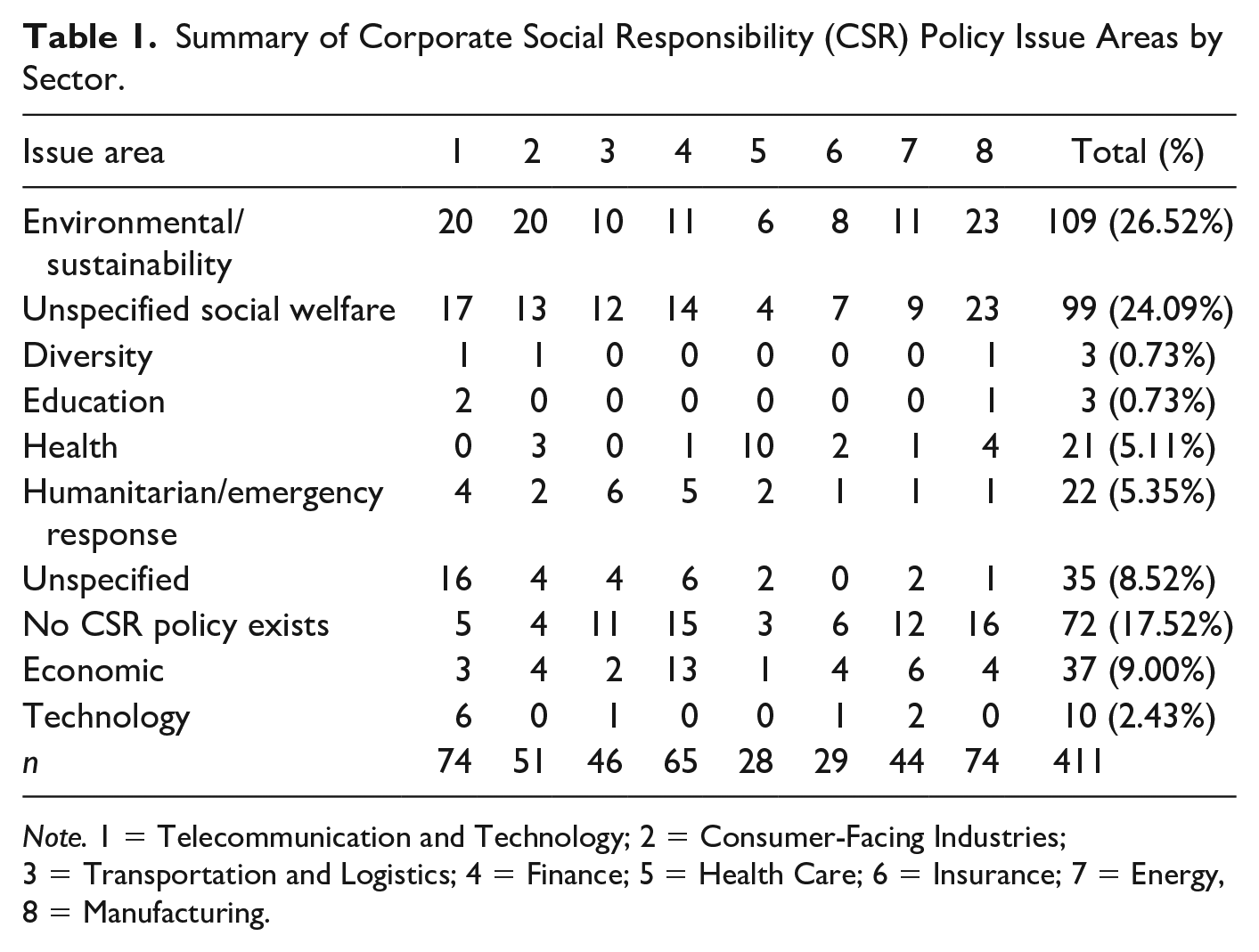
Note. 1 = Telecommunication and Technology; 2 = Consumer-Facing Industries; 3 = Transportation and Logistics; 4 = Finance; 5 = Health Care; 6 = Insurance; 7 = Energy, 8 = Manufacturing.
Summary of Corporate Social Responsibility (CSR) Motivations by Sector.
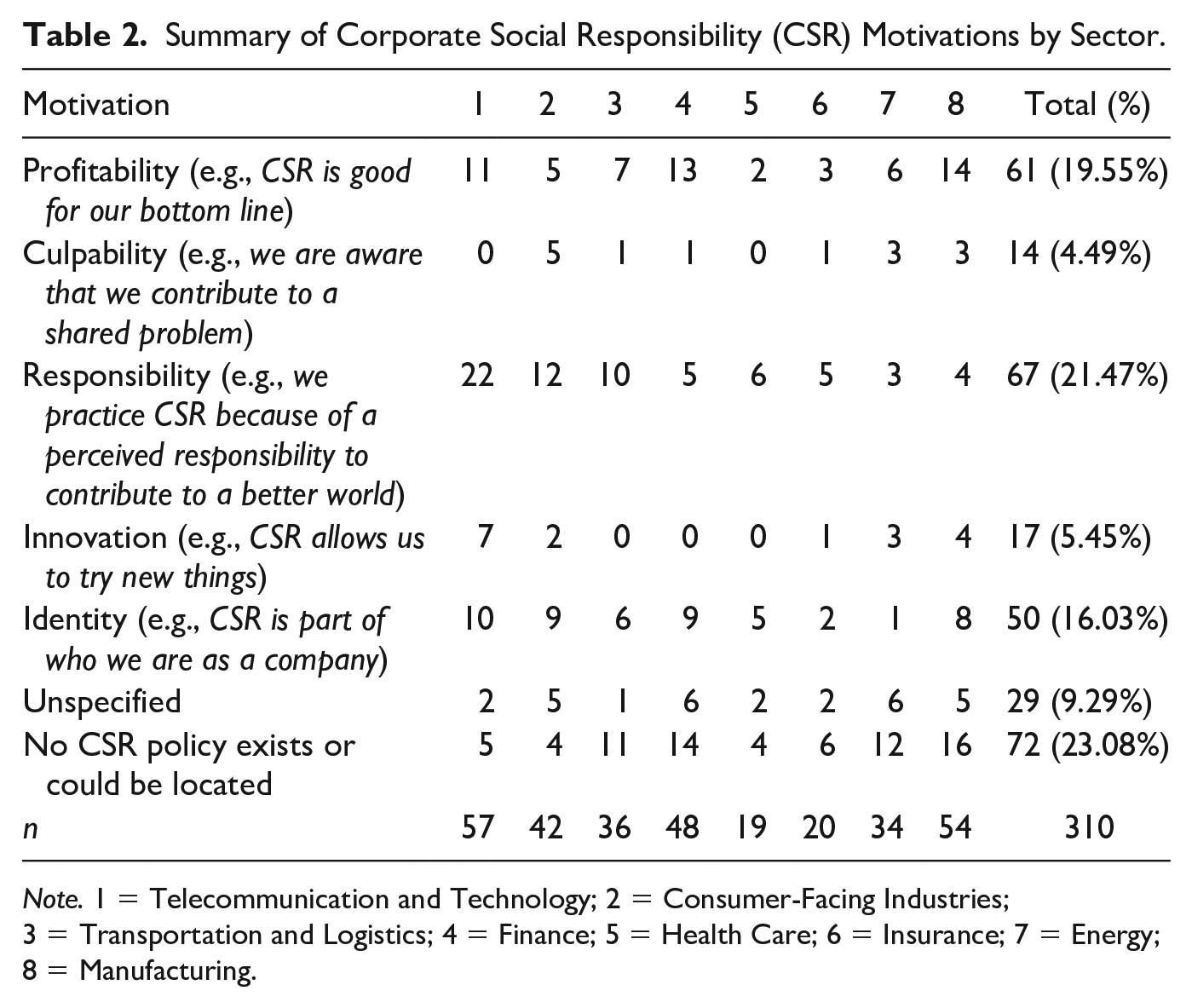
Note. 1 = Telecommunication and Technology; 2 = Consumer-Facing Industries; 3 = Transportation and Logistics; 4 = Finance; 5 = Health Care; 6 = Insurance; 7 = Energy; 8 = Manufacturing.
Detailed information about CSR programs entails the quality of corporations’ effort in addressing social issues (Graafland & Smid, 2019) and signal their strategic communication practices (O’Connor et al., 2017). We noted that strong programs included details pertaining to all or most of the following: populations targeted, clear regions of operations and organizations served, populations served, and organizational partners. Weak programs included only one of the above areas (e.g., “we provide medical supplies to refugees”) without further specification. If a CSR report did not include any information about a program, we coded this as “No program details” (e.g., “we helped refugees”). We also coded each entry for program impact, or whether the corporation indicated that they saw some difference as a result of the services or products provided. Strong impact refers to those reports that stated objectives or goals of refugee programming and indicates they were fulfilled, numbers of refugees served, any changes observed as a result of services provided, and a timeline in which programming took place. Weak impact referred to those reports that included rough numbers of services or products provided to refugees with limited other information. No evidence of impact refers to reports that excluded these details. Although we would note that this does not mean that there was no impact, it does indicate that the CSR report did not include it.
In addition, we noted the year in which the refugee programming was documented. Although research that focuses on institutionalized practices—such as CSR—benefits from study over time (Lammers & Barbour, 2006), reporting time is often difficult for researchers to operationalize (O’Connor et al., 2017). Therefore, we relied on a more inductive approach to time in our study. Rather than focusing on studies from year-to-year during a period of increased refugee activity (United Nations High Commissioner for Refugees, 2021), we considered the role of media in highlighting this issue (Yang & Saffer, 2019; Zhang & Dong, 2021) and the suggestion that international media coverage of refugee issues increased in late 2015 (Trilling, 2019). Therefore, we split our time period into three periods intended to capture the years leading up to and following peak coverage. Of the 262 reports that contained refugee programming, 72 reports appeared in Period 1 (2012–2014), 133 reports appeared in Period 2 at the height of media coverage of the crisis (2015–2016), and 57 reports appeared in Period 3 (2017–2019).
Corporation-level measure
To capture the information at the corporation level, industry sector was coded to capture the market information in which a corporation operates. This variable is often linked to CSR involvement in particular social issue interest areas (O’Connor & Shumate, 2010). All the sampled corporations were coded into eight sectors: Telecommunication and Technology (n = 21), Consumer-Facing Industries (including retailer, consumer food products, apparel, food and drug stores, n = 17), Transportation and Logistics (n = 12), Finance (n = 20), Health Care (n = 11), Insurance (n = 12), Energy (n = 18), and Manufacturing (n = 21).
Analysis
We took a mixed-methods approach for the purposes of better understanding corporate reporting of refugee programming. After creating our codebook to extract CSR program descriptions, we reported the frequency of each social issue area and the frequency of each motivation category in RQ1. The frequencies were also reported for these variables by sector. To answer RQ2, we reported the frequency related to the coupling between policies and programs as well as programs and impacts. We also reported the frequency of the coupling by sector.
As noted in this methodology, the first two research questions rely primarily on codes developed from prior research and a quantitative approach to calculating the results. However, qualitative researchers suggest that questions of frequency can lend themselves to more qualitative exploration (Saldaña, 2013). Greene (2007) highlights a mixed-methods approach referred to “development” in which methods are implemented sequentially and the results of one method in form the development of another method. Greene notes that “findings and interpretations could be significantly enriched by returning to the results of the first method, after the second method is implemented, and conducting some kind of integrated analysis of both sets of data together” (p. 102). To explore the implications of our findings (RQ3), we revisited the program descriptions to explore those organizations for which their refugee programming was coupled with policies and/or impacts. We followed Saldaña’s (2013) recommendation that, rather than coding for themes, themes may instead emerge from previous coding. We re-read the CSR program descriptions in light of the codes we had previously developed, seeking further understanding of what “coupled” or “decoupled” CSR practices looked like in their full description. Per Saldaña (2013), we created memos about the texts themselves and examined patterns of coupled or de-coupled programs as they appeared across several corporations from year-to-year as we focused on implications of reporting refugee programming (RQ3).
Results
To answer RQ1, we explored how corporations with refugee programming characterized their refugee programs in terms of reported frequencies for each policy issue area and motivation categories. The results showed that overall corporations with refugee programs tended to focus on the following issues (ranked by frequency): environmental/sustainability (n = 109, 26.52%), unspecified social welfare issues (n = 99, 24.09%), economics (n = 37, 9%), humanitarian/emergence response (n = 22, 5.35%), health (n = 21, 5.11%), technology (n = 10, 2.43%), diversity (n = 3, 0.73%), and education (n = 3, 0.73%). We coded 17.52% of these programs as no CSR policy existing (n = 72) and the remaining 8.52% as unspecified (n = 35).
To further uncover the patterns related to CSR policy, we reported the frequency of each area by sector (Table 1). Policy issue patterns by industry sector also showed distinct differences. Manufacturing companies had the most programs coded in environmental/sustainability (followed by telecommunication and technology companies and consumer-facing companies), health care sector had the most programs coded in health, insurance companies had the most programs coded in humanitarian/emergency response, finance companies had the most programs coded in the economic issue area, telecommunication and technology companies had the most programs coded in technology, and transportation and logistics companies had the most programs coded in humanitarian/emergency response.
Regarding motivations, responsibility (n = 67, 21.47%) and profitability (n = 61, 19.55%) were the top two categories identified from the coding, followed by identity (n = 50, 16.03%), innovation (n = 17, 5.45%), and culpability (n = 14, 4.49%). We coded 23.08% of the programs as no CSR policy exists or could not be located (n = 72) and 9.29% as having unspecified motivation (n = 29). To further unpack the patterns related to motivations, we reported the frequencies by sector (Table 2). Results showed that manufacturing companies had the most programs coded as profitability (followed by finance companies and telecommunication and technology companies); consumer-facing companies had the most programs coded as culpability (followed by energy companies and manufacturing companies); and telecommunication and technology companies had the most programs in responsibility, innovation, and identity.
To answer RQ2, we first reported the finding about policy-program coupling coding. We found that only 12.60% of the sampled reports (n = 33) were coded as coupled. The highest percentage of these reports fell into the weak policies and weak programs (25.57%, n = 67), followed by strong policies and weak programs (17.56%, n = 46), no policy and weak programs (15.65%, n = 41), weak policies and strong programs (8.40%, n = 22), no policy and no program detail (7.63%, n = 20), no policy and strong programs (6.87%, n = 18), weak policies and no program detail (3.44%, n = 9), and strong policies and no program detail (2.29%, n = 6). As shown in Table 3, telecommunication and technology companies had the most programs coded as coupled, followed by consumer-facing companies and transportation and logistics companies.
Policy-Program Coupling by Sector.
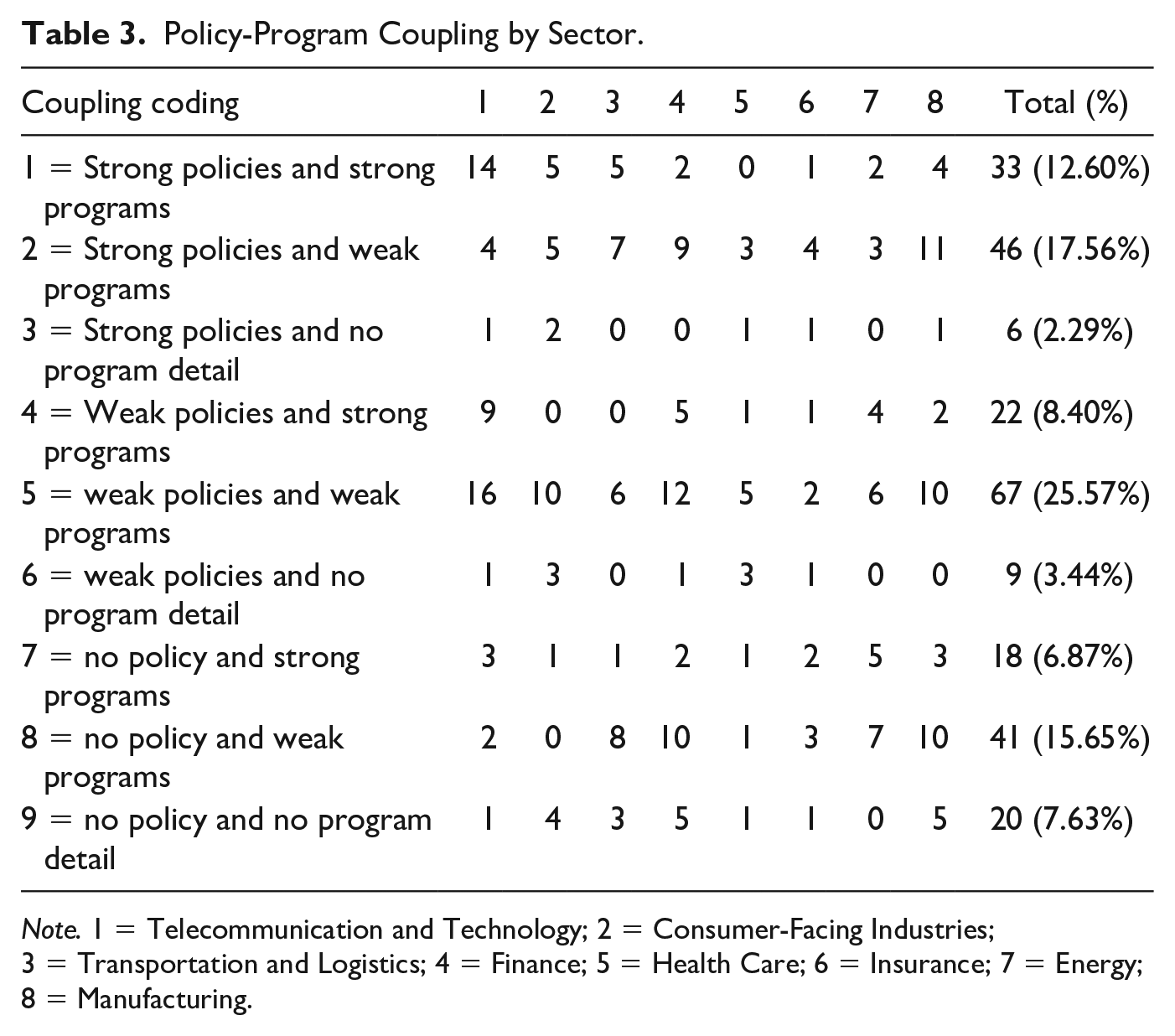
Note. 1 = Telecommunication and Technology; 2 = Consumer-Facing Industries; 3 = Transportation and Logistics; 4 = Finance; 5 = Health Care; 6 = Insurance; 7 = Energy; 8 = Manufacturing.
Findings on the program-impact coupling found a similar pattern as in the policy-program coupling. The results showed that only 13.36% (n = 35) were coded as coupled. The highest percentage of these reports fell into the weak program and no support for impact (38.55%, n = 101), followed by weak program and weak support for impact (17.18%, n = 45), no program detail and no impact (12.98%, n = 34), strong program and weak support for impact (8.02%, n = 21), strong program and no support for impact (7.63%, n = 20), weak program and strong support for impact (1.91%, n = 5), and no program detail and weak/adequate impact (0.38%, n = 1). No program was coded as no program detail and strong impact. The results showed that telecommunication and technology companies (followed by consumer-facing companies and manufacturing companies) still remained to be the most coupled (Table 4).
Program-Impact Coupling by Sector.
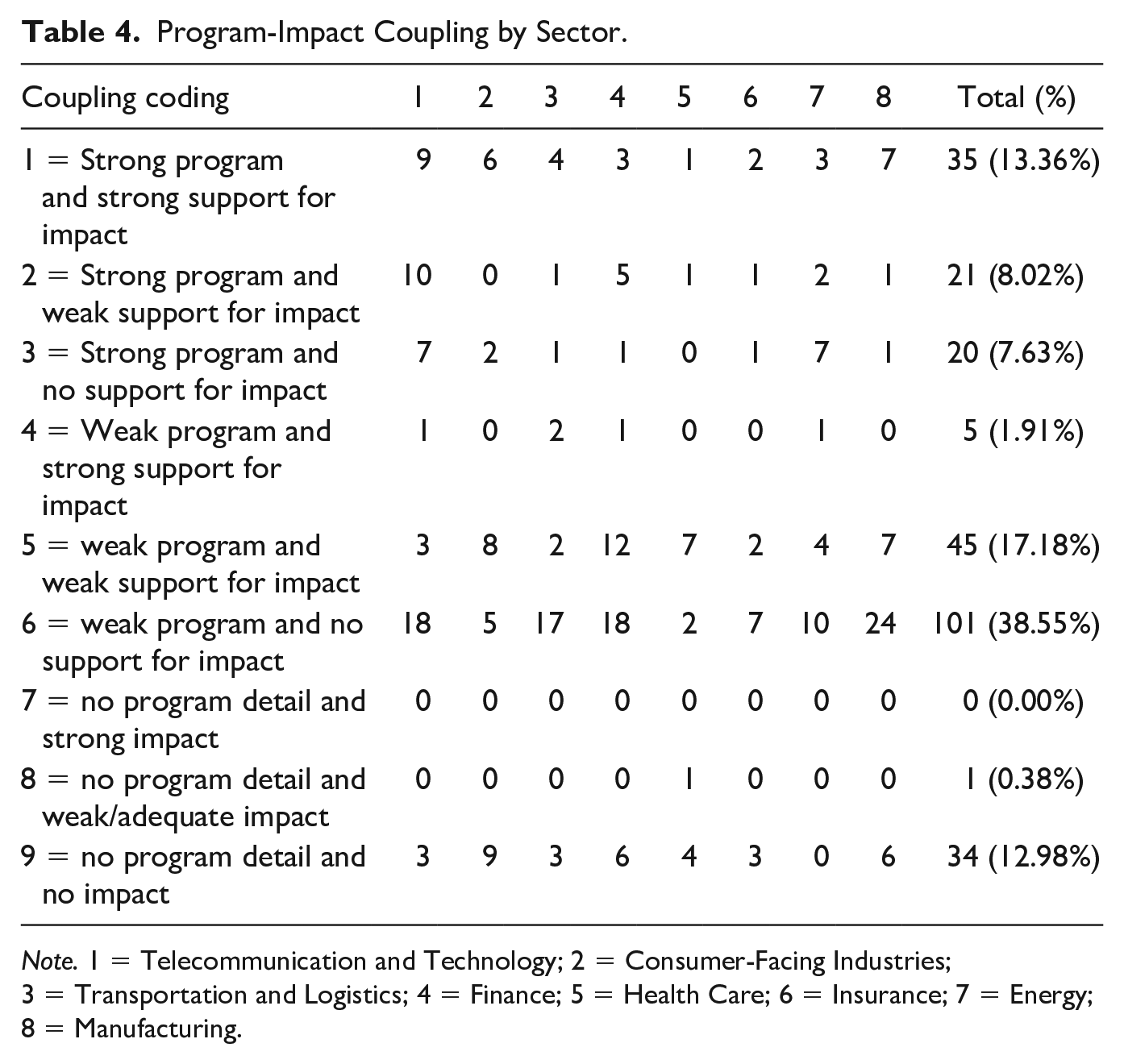
Note. 1 = Telecommunication and Technology; 2 = Consumer-Facing Industries; 3 = Transportation and Logistics; 4 = Finance; 5 = Health Care; 6 = Insurance; 7 = Energy; 8 = Manufacturing.
We focused on constitutive implications of decoupling in CSR program reporting (RQ3) by focusing on the relationship between talking (policies) and walking (programs and impacts) over time. Our analysis prompted us to develop a 2 × 2 matrix (Table 5) in which we could classify corporations with refugee programming according to whether they had (a) refugee programming across multiple years and (b) coupling across strong programs and policies and/or impacts. These categories constituted reactionary, recurring, relevant, or revelatory programming in response to refugee needs (Table 5).
Program Typology in Response to Emerging Social Issues.
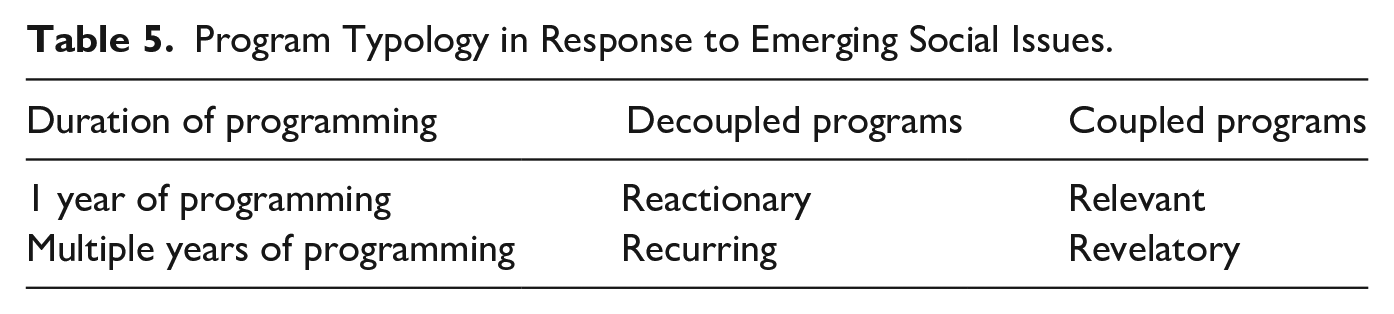
Reactionary refers to those corporations that described refugee programming in only a single year of data collection and had decoupled programs from policies and impacts. This was the majority of our sample (n = 53). Twelve of them were from the energy sector, nine from consumer-facing industries, eight from finance, six from health care, six from insurance, six from manufacturing, and five from telecommunication and technology. Text was brief, often a single sentence, to mention a program. For example, Aetna described a single refugee program in 2016 as delivering mindfulness programming to a school with refugees. Oracle mentioned working with the Red Cross to organize a football tournament with the Red Cross for youth refugees in 2012, and Møller-Mærsk described making “donations of around $300,000 USD to displaced in Syria and neighboring countries” in 2015.
Recurring refers to corporations in which programming was decoupled, but present across multiple years within our sample (n = 50). In terms of sector distribution, 10 of them were from finance, 10 from manufacturing, nine from telecommunication and technology, six from transportation and logistics, five from consumer-facing industries, four from health care, four from insurance, and two from energy.
In many ways, recurring programs were similar to reactionary programs. Descriptions were often brief and did not elaborate on key details, such as the nature of the programming, the location of the program, or what the program achieved. However, perhaps because recurring programs occurred over multiple years, many corporations indicated that they were involved with other organizational partners. Adecco Group is one such example in that described working with a Canadian NGO partner to provide learning and training opportunities for refugees in three of their annual CSR reports leading up to and including 2016. In addition, Walgreens noted an ongoing partnership in which they provided medical supplies to aid organizations serving refugees. Nestlé described a 5-year partnership with International Federation of Red Cross and Red Crescent Societies to facilitate donations to refugees. Showa Shell represents another example of multiple years of working with an NGO partner, albeit with a different focus. In their case, they provided free office space to an international refugee organization as opposed to direct refugee programming.
Relevant referred to corporations with coupled programs (either policy-program or program-impact), but only in 1 year (n = 14). In terms of sector distribution, three of them were from manufacturing, three from energy, two from insurance, two from transportation and logistics, two from telecommunication and technology, one from consumer-facing industry, and one from health care.
Compared with other CSR programming, organizations with relevant programming featured detailed descriptions of their programs (e.g., service populations, regions, and partners) and impacts (e.g., numbers of people served, changes as a result of service, timeline). Consider this example from Novartis in 2016 in which they described extending a program to refugee populations:
[We developed] Novartis Access, an innovative model for providing treatment for chronic diseases in lower-income countries for only USD 1 per treatment per month. In 2016, the firm made shipments to Kenya and Ethiopia, and signed a new memorandum of understanding in Rwanda. We partnered with the International Committee of the Red Cross to treat high blood pressure and diabetes among Syrian refugees in Lebanon. In total, they delivered more than 120,000 treatments, each providing a one-month supply of medicine (p. 4).
Some organizations reported refugee programming in multiple years but did not report coupled programming in each year. Volvo offered refugee programming in multiple years (2013, 2015), but only one of those years featured programming that was coupled with policies or impacts. In 2015, for example, Volvo mentioned that they donated money to the UN High Commissioner for Refugees. But Volvo provided a more detailed entry in 2013 that consisted of jointly funding a project with Oxfam “in Ethiopia to improve water and sanitation facilities in a refugee camp for or approximately 25,000 people” (p. 47).
Revelatory referred to corporations with coupled programs (either policy-program or program-impact) across multiple years within our sample (n = 14). In terms of sector distribution, five were from telecommunication and technology, two from consumer-facing industries, two from transportation and logistics, two from finance, two from manufacturing, and one from energy.
Lufthansa provided detailed examples of their mentoring and educational initiatives for refugees. CSR reports indicated when and where schools opened, how they were financially supported from year to year, and the number of children that attended. Lufthansa also distinguished between those activities that were facilitated by an organizational alliance and those that incorporated Lufthansa employees (e.g., weekly language lessons).
L.M. Ericsson also illustrated how it built on its programming from year to year. In 2015, Ericsson devoted an entire page of their report to describing their work as the lead technology partner to Refugees United (REFUNITE). Ericsson details the online family reconnection platform they developed for refugees, the eight countries that deployed the platform, and their goals for the number of people they want to register on the platform. The report goes on to explain that the refugee crisis worsened in 2015, and as a result, “in 2015, the platform had approximately 414,000 registered users—an increase from approximately 350,000 in 2014” (p. 50). This example gives us a good illustration of coupling, but also highlights the technology industry’s ability to serve refugees with its products or applications.
Discussion
Past research suggests that there is no widespread corporate response to refugees (Wang & Chaudhri, 2019). This is perhaps due to political and public division on refugee issues (Neuman, 2018), which is typical of emerging social problems (Wang & Cooper, 2022). Yet, these findings do contribute to broader questions of how and why corporations choose to share their engagement in response to such issues. In particular, we suggest that these findings offer some insights as to why corporations may choose to disclose their CSR work—or not—and suggest that a de/coupling framework offers a broader lens to explore CSR reporting as both a result of institutional expectations as well as a vehicle for constitutive possibilities.
Our findings suggest that among leading organizations (e.g., Global Fortune 500 companies), relatively few of them disclose refugee programming in their CSR reporting. What we do see suggests that corporations with refugee programming represent various industries and, of those that have publicly available CSR reports, tend to articulate standard policy issues (e.g., environmental sustainability, or otherwise unspecified social welfare) and motivations (e.g., profitability and responsibility) as opposed to niche issues that might lend themselves specifically to refugee concerns (e.g., humanitarian or emergency response). These findings, along with the observation that more organizations reported refugee programming when refugee issues were frequently in the news (Trilling, 2019), add further support to prior research that suggests corporations might engage controversial or timely issues outside of the corporation’s advocacy domain if they perceive some benefit (Parcha & Kingsley Westerman, 2020; Vogler & Eisenegger, 2021; Yang et al., 2020). We found that technology companies were not only among the most engaged in CSR programming, echoing recent findings (Wang & Cooper, 2022) but also had the most coupled programs. Such companies may rely on CSR communication to obtain legitimacy (Zhang & Dong, 2021) in reporting coupled programs in response to the crisis, or position themselves as industry leaders by extending beyond the institutional expectations dictated by industry-advocacy fit (Lammers & Barbour, 2006; O’Connor & Shumate, 2010).
In many ways, the findings in response to RQ1 and RQ2—limited corporate engagement on an emerging social issue, widespread decoupling, limited depictions of policies, programs, and impacts—echo prior research that suggests institutional approaches to CSR reporting that reflect a rational purpose (Du et al., 2010) and industry-advocacy fit (Shumate & O’Connor, 2010). Limited or decoupled reporting might likewise be seen as indicative of competing institutional demands (Cho et al., 2015) or ceremonial CSR programming (Graafland & Smid, 2019). But if we take seriously the claims that communication plays a constitutive role in organizations, and more specifically that communication can transform CSR (Cooren, 2020; Schoeneborn et al., 2020), then the corporations that include refugee program reporting do offer insights for a broader organizational population. Decoupling can thus be viewed as institutional response—or as a constitutive possibility.
Conflicting demands (Cho et al., 2015) and public scrutiny (Antonini et al., 2020) have prompted a variety of intentional and unintentional strategies for communicating CSR activities. These include hypocrisy (Cho et al., 2015), greenhushing (Font et al., 2017), or counter-coupling (Lipson, 2007) in addition to policy-program or program-impact decoupling (Bromley & Powell, 2012; Graafland & Smid, 2019). But instead of being ceremonial or substantive (Graafland & Smid, 2019), CSR reporting could be viewed as constitutive. Schoeneborn and colleagues (2020) note that talk can further inform and shape the CSR walk—that communicating about CSR activities can ultimately transform CSR itself. The value of engagement in this arena may be to individual organizations who engage emerging social issues as opposed to institutional fields organized by industry or region. What, then, are these organizations constructing as they engage these issues? What are they contributing to broader business discourse—and how might this discourse be shaping the corporation itself?
Corporations that feature coupling—relevant programs that feature programs coupled with policies and/or impact, but are offered only a single year or revelatory programs that are coupled over multiple years—are perhaps uniquely positioned to alter the discourse on CSR. Given the nature of our data collection, it is unclear as to whether revelatory programs are really better implemented or just more detailed in their reporting. Still, it seems that the appeal of this detailed approach is that they may allow organizations to position themselves as nimble or agile enough to enact quality programs in response to pressing needs, even if those needs are outside their primary CSR interests as suggested by the minimal time commitment. As prior literature suggests that strong CSR policies result in stronger programs, and strong programs result in stronger impacts (Graafland & Smid, 2019), detailing these policies may indeed have the ability to transform CSR (Schoeneborn et al., 2020) even if the commitment is short-term.
Revelatory programs are offered over multiple years and coupled with CSR policies and/or impacts. In using this term, we suggest that corporations are indeed revealing something about their values—and may be taking a risk in the process (Antonini et al., 2020). If, as recent research suggests, corporations benefit from declaring CSR efforts on topical or controversial issues (Parcha & Kingsley Westerman, 2020; Vogler & Eisenegger, 2021; Yang et al., 2020), then corporations that engage emerging social issues may indeed be positioned to tout themselves as leaders or innovators—or demonstrate a particular sensitivity to public interests.
Sensitivity to public interest also offers an opportunity for corporations with “decoupled” programs. For example, “reactionary” suggests corporate involvement in refugee concerns may not be part of a broader CSR strategy or a perceived industry-mission fit, but rather a reaction to an issue that, at least for a time, was heavily covered by the media. That the majority of refugee programs were included in CSR programming during a period of heavy media coverage (Trilling, 2019) suggests that for many corporations, the brief addition of a refugee program may communicate awareness of a present and yet temporary need. This could elicit criticism if decoupled programs are viewed negatively, or if corporations are seen as deviating from their CSR goals (Rangan et al., 2015) or expertise. But such decoupling might also offer an opportunity if corporations take on an emerging social issue perceived to be of public interest. That corporations pilot programs in response to the issue may illustrate an extension of counter-coupling in that corporations adopt some strategies to appease certain stakeholders (Lipson, 2007). Whereas counter-coupling is typically associated with lower-stakes strategies, programming—even decoupled from policies or impacts—suggests a more active strategy that applies a concentrated use of corporate resources at a pivotal time when an issue is of public interest. This approach may extend beyond the “either-or” classifications of CSR as substantial or ceremonial (Graafland & Smid, 2019) and instead open up other possibilities for corporate engagement on social issues that continue to evolve. Although CSR reporting may be viewed in terms of responding to institutional pressures (Cho et al., 2015), changing the practice may alter the institutions themselves.
A more nuanced view of decoupling may also offer corporations more freedom in their “talk.” Prior researchers have argued for more transparency regarding CSR programming and corporate pressures (Higgins et al., 2020) or the boundaries of CSR responsibilities (Antonini et al., 2020; Miles & Ringham, 2020) with the idea that corporations can then be more aspirational in their CSR (Cho et al., 2015; Christensen et al., 2013). These arguments suggest an alternate approach to CSR programming in response to emerging social issues, in which corporations may communicate why they are engaging the issue as well as their limitations or interests in further engagement. Such claims also invoke a talk-walk linkage in which the nature of what is reported—and how—may also alter the broader practice of CSR.
This research offered three contributions to the study of corporate responses to refugees and CSR in response to emerging social issues. First, this research offered some insights as to why corporations may report on their response to emerging social issues such as the refugee crisis, which may be characterized by present-day political and public disagreement (Neuman, 2018; Wang & Cooper, 2022) or fall outside of a corporation’s domain. Our findings showed limited patterns in refugee CSR reporting, suggesting that industry fit or corporate policy did not necessarily inform CSR reporting on refugee issues. This echoes prior research that suggests that no widespread corporate response has occurred in response to the refugee crisis (Wang & Chaudhri, 2019). However, some individual organizations chose to detail programming, especially during a period of time in which refugee issues appeared in the news (Trilling, 2019). This evokes recent research that suggests organizations may engage timely or controversial issues even if they fall outside of advocacy fit (Parcha & Kingsley Westerman, 2020; Vogler & Eisenegger, 2021), and, in particular, that some corporations might pursue issues such as refugee needs that receive public attention or media coverage (Yang & Saffer, 2019; Zhang & Dong, 2021).
Second, this research offers insights on CSR and decoupling by building on prior research that depicts CSR as institutionalized (O’Connor et al., 2017) as well as constitutive in that it represents action (Cooren, 2020) and transformation (Cooren, 2020; Schoeneborn et al., 2020). We utilized a decoupling framework, which has previously been described in institutional (Graafland & Smid, 2019) and constitutive terms (Schoeneborn et al., 2020) to position CSR program reporting as connecting CSR “talk” (e.g., policies) and “walk” (programs and impacts). Although decoupling draws criticism (Graafland & Smid, 2019), we suggest that a constitutive view of decoupling may offer a more nuanced view of how corporations engage emerging social issues outside of their domain and offer some opportunities for organizational innovation in CSR reporting.
This study also extends prior research on decoupling to an emerging social issue area. Graafland and Smid (2019) note that there are relatively few empirical studies on decoupling, and although their own study represents a significant contribution to research on decoupling, it focused primarily on environmental policies and some social policies (e.g., discrimination, working conditions). In contrast, our focus on CSR program reporting in response to an emerging social issue (e.g., the refugee crisis) is somewhat unusual. Although many companies have articulated CSR policies or programs on environmental issues, it is less likely that corporations would have directed CSR attention toward emerging social issues—and yet we suggest that our findings here have relevance for other social issues. We might consider, for example, events in recent months and years in which corporations were prompted to respond to emerging movements (Black Lives Matter, #MeToo) or concerns (e.g., mental health concerns brought on by the COVID-19 pandemic). As with refugees, we would not necessarily anticipate that most corporations would have existing policies or programs that are specific to these concerns, and yet some would initiate some CSR activity as stakeholders express an interest in these issues. Our findings—and specifically, our typology—may offer some insights for how corporations engage these issues.
Third, and relatedly, we introduce a new typology for exploring constitutive implications of CSR program reporting. Specifically, we consider the presence of program coupling as well as a corporation’s time commitment to suggest categories for corporate positioning in response to emerging social issue areas. As recent research suggests that corporations could benefit from engaging prominent social issues regardless of industry fit (Parcha & Kingsley Westerman, 2020; Vogler & Eisenegger, 2021; Yang et al., 2020), our categories of reactionary, recurring, relevant, and revelatory programming further suggest ways in which corporations position their involvement—and how that public positioning may further inform their CSR efforts. This typology contributes to the literature of CSR by offering practical utility (Crane et al., 2016) for business scholars and practitioners to describe the implications of CSR research and to evaluate the constitutive power of CSR practices.
There are several limitations of this study that would benefit from further research. We have focused on CSR programming as depicted through formal reporting. This allowed us to investigate the importance of corporations’ public communication of their CSR programming. Although we draw on institutional arguments to suggest why CSR reports are relevant for uncovering programming patterns, additional data sources (e.g., social media) or other methodologies (such as interviews and surveys) might turn up other programs and impact, or lend itself to additional findings or further investigation of how stakeholders evaluate these efforts. Also, given the volume of data, we chose to examine CSR policies and reports from those corporations that had some form of refugee programming, but observing corporations with refugee programs against a broader sample (e.g., all of the Global Fortune 500 companies featured in this time period) would lend further insights. This would also enable the identification of companies for which refugee issues are salient but do not document any refugee programming. Further scrutiny of the sample might lend other researchers to focus on broader ranges of or more sophisticated usages of time, managerial influence, or the role of other institutions (e.g., United Nations) in shaping goals or standards that some corporations might choose to engage.
Conclusion
The call for papers for this special issue suggested that the refugee crisis should prompt reflection about “the role of business in domains for which they do not necessarily bear direct responsibility” (n.d., p. 2) as well as the boundaries between business and society with as the public expects corporate engagement in social issues (Colleoni, 2013). We suggest that refugee programming offers the opportunity to think about corporate positioning in response to emerging social issues and that an emphasis on de/coupling offers constitutive implications for CSR reporting.
In focusing on CSR programming in response to refugee concerns, we focus on an issue about which there is widespread disagreement among stakeholders. But recent constitutive turns in CSR scholarship remind us that stakeholders will always disagree (Cooren, 2020) and that organizational responses to stakeholder concerns in spite of these disagreements is meaningful (Christensen et al., 2013). As Cooren (2020) notes, corporations that want to avoid accusations of greenwashing must realize that what they are and what they do are dependent not only on their outgoing communication. Instead, they are co-constituted through stakeholder discussion and negotiation. The extent to which programs are reactionary, recurring, relevant, or revelatory is in part a reflection of how corporations respond to public or media stakeholders. But these in turn have the potential to alter the corporations themselves as they negotiate expectations with these stakeholders. Specifically, we must consider whether it is enough for corporations to acknowledge an emerging issue—as would be the case in reactionary programming—or whether we expect corporations to detail their programs and document any evidence of impact.
Footnotes
Acknowledgements
The authors thank Yunling Ding, Michael Harris, Katherine Harville, Darylynn Horton, Tabitha Kinneer, Joann Lee, Basia Marotta, Kelly O’Brien, Jennie Schumacher, and Jane Jiaying Shi for their work in data collection and coding. In addition, the authors thank the editors of the special issue and the anonymous reviewers for their helpful feedback.
Declaration of Conflicting Interests
The authors declared no potential conflicts of interest with respect to the research, authorship, and/or publication of this article.
Funding
The authors disclosed receipt of the following financial support for the research, authorship, and/or publication of this article: This project was supported by funding from DePaul University, Northwestern University, and University of Kentucky.
