




Abstract
Chief executive officers (CEOs) engage in activism when they take public stances on sensitive socio-political issues. In this study, we address the less-explored activities that constitute CEO activism beyond single stances as the activism is maintained over time. The data cover 6 years of campaign and media materials from a case company with several CEO-initiated activist campaigns. Our findings from an inductive analysis contribute to CEO activism theorizing in three ways. First, we extend CEO activism conceptually by identifying five underlying activities that support a public stance: anchoring motivations, modeling action, taking agency, enduring criticism, and normalizing activism. Second, we bridge individual- and organization-level analyses by depicting how a CEO involves a company in activism through activities that justify interrelated topic frame and role frame. Third, we develop a processual model that includes the pre-stance, stance-taking, and post-stance phases and explains how the underlying activities are interrelated and follow a pattern that serves to maintain CEO activism. Accordingly, CEO activism includes activities, through the pre-stance, stance-taking, and post-stance phases, whereby a CEO deliberately engages personally and through a company in public debate about sensitive socio-political issues and the role of businesses in addressing them.
When CEOs take public stances on debated political decisions and campaign for or against sensitive socio-political issues, they engage in a form of activism (Branicki et al., 2021; Chatterji & Toffel, 2019; Dodd & Supa, 2014; Hambrick & Wowak, 2021). Currently, we are witnessing an increasing number of executives who make public statements or sign petitions to announce their support or opposition to issues for which public disagreement prevails, such as racism, sexual minority rights, climate policies, indigenous rights, and immigration (Branicki et al., 2021; Chatterji & Toffel, 2019; Dodd & Supa, 2014). The ramifications of such activities on companies, politics, and society are discussed intensely (e.g., “The Political CEO,” 2021), as CEO activism often divides audiences into opposite groups: Those who are “with” and those who are “against” the stance (Hambrick & Wowak, 2021; Voegtlin et al., 2019). CEOs’ engagement in socio-political issues is also constantly evolving into new topic areas—just recently, hundreds of CEOs signed a public letter to oppose the oppression of voting rights in the United States (Gelles & Sorkin, 2021).
Although controversy and conflict are not new to research areas focusing on businesses as societal actors, it has been unusual for top management to deliberately seek public positions where they create controversy on their own accounts. Rather, business actors are usually targeted by activists (Delmas & Toffel, 2008; den Hond & de Bakker, 2007; Rehbein et al., 2004) and may deliberately attempt to keep their businesses out of contested socio-political debates by explicitly stating that they are apolitical or neutral (Haski-Leventhal et al., 2017; Morsing & Roepstorff, 2015). Business actors have, however, taken political roles in the sense that they assume state-like governance responsibilities as meant in political corporate social responsibility (PCSR; Frynas & Stephens, 2015; Scherer et al., 2016) or taken strategic action—oftentimes preferably behind the public eye—to influence public policy that affects them, conceptualized as corporate political activity (CPA; Rudy & Johnson, 2019). Mäkinen and Kourula (2012) have even pointed out how corporate social responsibility (CSR) is always influenced by political background theories—hence, what is perceived as responsible is never neutral as such. However, while both PCSR and CPA have provided fruitful backgrounds for studying the political roles and agency of business actors, there are also calls and attempts to distinguish CEO activism conceptually as an activity that is specifically about CEOs’ public stances on issues not directly related to a company’s business and divisive public responses of support and opposition (Chatterji & Toffel, 2019; Lee & Tao, 2021; Voegtlin et al., 2019).
Our study is positioned in the literature on CEO activism and the emerging analyses of organization-level activism in management studies. Within these streams, scholars have presented valuable first insights into the corporate intentions and strategic implications of CEOs speaking out, such as responses from key stakeholders (Bhagwat et al., 2020; Chatterji & Toffel, 2019; Dodd & Supa, 2014; Voegtlin et al., 2019). Yet, the definitional landscape is just forming, and most research is based on one-time events (Bhagwat et al., 2020; Branicki et al., 2021; Chatterji & Toffel, 2019; Dodd & Supa, 2014; Voegtlin et al., 2019). The focus of existing research has been mostly on why CEOs engage in activism and what the (strategic) outcomes of such activism are, while not much is yet known about the details of stance-taking as an activity and how CEO activism is maintained when CEOs take stances repeatedly and consequently pursue continuous public positions as activists.
In this article, we investigate the underlying activities that maintain CEO activism over time and thus aim to extend current understanding from the stance-taking activity to more subtle activities that support stances. Our study is based on the public stances of the CEO of Finlayson, a mid-sized Finnish company operating in Northern Europe, over 6 years. We analyze repeated activities inductively across several campaigns and statements and focus on the activities performed by the CEO as the stances are expressed and discussed in public. We believe that such insights are of increasing importance to help understand new complexities for CEOs who choose to take stances on sensitive socio-political issues, as few companies have experience with the implications of continuous socio-political statements in public and the kind of engagement and commitment this entails. Our empirical analysis of maintaining CEO activism over time results in a processual explanation that highlights the perseverance it takes to maintain activist topics and roles.
Based on our empirical findings, we make three contributions to the literature on CEO activism. First, we extend the conceptual understanding of CEO activism beyond stance-taking by identifying five underlying activities that support CEOs’ public stances on socio-political issues. Second, we bridge individual- and organization-level analyses by depicting how a CEO involves a company in activism through activities that justify interrelated topic frame and role frame. The topic frame relates to justifications of the socio-political issue and why it is important to address, while the role frame relates to justifications of why the CEO and the company are suitable actors to address socio-political issues. Third, we develop a processual model that breaks down the cycle of CEO activism into the pre-stance, stance-taking, and post-stance phases, and explains how the different activities are interrelated and follow a pattern that serves to maintain CEO activism. Accordingly, our study shows how CEO activism includes activities through the pre-stance, stance-taking, and post-stance phases, whereby a CEO deliberately engages personally and through the company in public debate about sensitive socio-political issues and the role of business in addressing them.
Activism by Business Actors: Individual- and Organization-Level Analyses
As the theoretical background for our study, we draw from the CEO activism literature and add further insight from emerging analyses of organization-level activism by business actors in management studies. We first introduce CEO activism and then discuss the potential relevance of understanding the intersection of individual-and organization-level activism. We then specify the research gaps to which our study responds.
CEO Activism as Individual-Level Analyses of Public Stance-Taking
CEO activism has been defined as corporate leaders speaking out and actively participating in public debate about controversial socio-political issues (Branicki et al., 2021; Chatterji & Toffel, 2019; Hambrick & Wowak, 2021). In practice, CEO activism has been connected to events such as top executives making public statements, either individually or collectively, or signing petitions to address racism, sexual minority rights, climate policies, indigenous rights, and immigration, among other topics (Branicki et al., 2021; Chatterji & Toffel, 2019; Dodd & Supa, 2014).
To make sense of CEO activism and its possible implications for companies and society, scholars have started to build insights into what CEO activism means, who is doing it, and why. There is evidence that CEOs’ public activist stances can influence purchase intentions and attitudes about the company, and can even shape public opinion on the topic of the stance (Chatterji & Toffel, 2019; Dodd & Supa, 2014). The potential implications have also been explored from the perspective of employees, and evidence points to the direction that CEO stances can help to attract talent (Voegtlin et al., 2019) and that employees perceive CEO stances positively especially when they prioritize ethical and transformational leadership (Lee & Tao, 2021). Alignment with customers and employees has also been highlighted in a theoretical model by Hambrick and Wowak (2021), not least because activism is often greeted with divisive responses and can alienate stakeholders (see also Dodd & Supa, 2014; Voegtlin et al., 2019). From a critical perspective, scholars have raised concerns that CEO activism does not always serve societal purposes and that its morality can be questioned, especially if CEOs join bandwagons for relatively safe causes (Branicki et al., 2021).
Although it is not a new idea that CEOs have political interests and agency, CEO activism can challenge some of the existing notions of political activity in the corporate context (Chatterji & Toffel, 2019; Lee & Tao, 2021; Voegtlin et al., 2019). First, while CEO activism involves attempts to influence policymaking similarly to CPA (cf. Branicki et al., 2021; Chatterji & Toffel, 2019; Hillman et al., 2004), the causes advocated in CEO activism are not those stemming from companies’ strategic interests, as suggested in CPA (cf. Hillman et al., 2004; Rudy & Johnson, 2019). Rather, the causes concern urgent societal debates that may not directly relate to the company’s own activities and products (Branicki et al., 2021; Chatterji & Toffel, 2019). The second difference from CPA is that CEO activism is characteristically public, meant to be seen and heard (Hambrick & Wowak, 2021), which means that attempts to influence political processes by engaging in CEO activism are not done behind the scenes, as in corporate lobbying (Rudy & Johnson, 2019). Third, when compared with PCSR, CEO activism has a similar aspiration to influence social and normative environments (Branicki et al., 2021; Hambrick & Wowak, 2021), yet it does not follow the idea of companies adopting state-like roles in providing public goods or their participation in (cross-sector) governance processes (cf. Rasche, 2015; Scherer & Palazzo, 2011; Scherer et al., 2016). Rather, the political activity in CEO activism resembles the actions of social movements and advocacy organizations (Branicki et al., 2021).
Research on CEO activism is starting to accumulate in management studies, and as a result, there is already some level of agreement on how to define CEO activism as speaking out or participating in public debate even when the socio-political issue is not directly related to the business (Bedendo & Siming, 2021; Branicki et al., 2021; Chatterji & Toffel, 2019; Hambrick & Wowak, 2021). There are, however, a multitude of different theoretical backgrounds applied, ranging from nonmarket strategy (Chatterji & Toffel, 2019) to firm value (Bedendo & Siming, 2021), stakeholder theory (Bedendo & Siming, 2021; Hambrick & Wowak, 2021), and social activism (Branicki et al., 2021). Empirically, the focus has been on actual or fictive CEO statements in the form of interview extracts, collective letters, or personal posts, often concerning a single event or issue (Branicki et al., 2021; Chatterji & Toffel, 2019; Voegtlin et al., 2019).
In essence, CEO activism is currently conceptualized as something highly personal—yet examples from practice show that CEO stances can include references to what the organization stands for or “thinks” about an issue: for example, when Apple’s CEO Tim Cook made a statement on immigration legislation, he said he stands up “on behalf of Apple,” and used phrases like “we strive,” “we will never tolerate discrimination,” and “[o]ur message, to people around the country and around the world, is this: Apple is open” (Cook, 2015, see also Chatterji & Toffel, 2019). Although Cook was proactive in involving his company in a public stance, in other instances, CEOs might be called out for misalignments between their stances and the actions taken in their own organization to make the needed structural and cultural changes; for example, regarding Black Lives Matter (see Knight, 2020).
These possible intertwinements between individual-and organization-level activism have not been explicitly addressed in empirical research, although they have been noted to some degree. For example, scholars have made observations that it can be the company “speaking out” even if the public remarks are made by the CEO (Korschun et al., 2019; Vredenburg et al., 2020), or that a statement made by a CEO is attached to the entire company in the eyes of the public (Dodd & Supa, 2014). To shed more light on the organizational level, we next take a look at how management scholars have addressed activism done by companies, and how activism on the organizational level may relate to the phenomenon of CEO activism.
Emerging Organization-Level Analyses of Public Stance-Taking
Recently, management scholars have started to investigate socio-political activism as an organization-level activity done by companies (Burbano, 2021; Gulbrandsen et al., 2022; He et al., 2021; Villagra et al., 2021). Both CEO and company activities have been defined similarly as taking a stance or speaking out in public, and also organization-level activism by companies revolves around the same sensitive socio-political issues, such as racism, sexual minority rights, climate policies, and immigration (Burbano, 2021; Chatterji & Toffel, 2019; Hambrick & Wowak, 2021; Korschun et al., 2019; Villagra et al., 2021). A recent example of organizational-level activism is 1,100 companies stopping their advertisements on Facebook to demand better prevention of racism and hate speech on the platform (He et al., 2021; see also Villagra et al., 2021).
Despite the aforementioned similarities, there is not much consensus on how to situate organization-level activism and CEO activism in comparison to each other. Terms such as corporate activism (Gulbrandsen et al., 2022; Villagra et al., 2021) and corporate socio-political activism (Burbano, 2021; He et al., 2021) have been suggested as umbrella terms for any type of activism done by a business actor (CEOs, companies, or brands) but also as terms that set organization-level agency apart from other types of involvement (see Gulbrandsen et al., 2022; Villagra et al., 2021). As organization-level concepts sometimes include and sometimes exclude CEO activism, it is not clear whether corporate activism and CEO activism can be used as synonyms (cf. Burbano, 2021), especially some scholars argue that organization-level activism cannot convey the same personal commitment as CEO activism (Chatterji & Toffel, 2019, p. 162), or that CEO activism lacks a connection to company practice as it is “strictly an act of communication, or speaking out, involving little or no out-of-pocket cost” (Hambrick & Wowak, 2021, p. 34).
Compared with management studies, organization-level concepts have been more common in marketing and communication research because organization-level activism often involves marketing-like campaigning or other means of attaching a cause to brand communications (Hoffmann et al., 2020; Kim et al., 2020; Vredenburg et al., 2020). While understanding these actions as new marketing and communication styles have relevance as such (sometimes referred to as brand activism, see Moorman, 2020; Vredenburg et al., 2020), Gulbrandsen et al. (2022, p. 109) argue that perceiving activism on the organizational level as “just” marketing can result in blind spots and prevent the much-needed analyses of corporate politicization that reposition companies as actors “not only reacting to political pressures but exerting such pressures of their own.”
Such blind spots can occur especially because advertisements and campaigns are not the only way to take a stance as a company, as organization-level activities may include activities such as providing support to social movements or publicizing stance-related company policies, such as establishing gender-neutral bathrooms or introducing gun prohibitions (Bhagwat et al., 2020), or collectively boycotting certain actors (He et al., 2021; Villagra et al., 2021). Thus, activism by business actors on the organizational level may turn out to be a much more diverse activity than a new marketing strategy, especially as the phenomenon is constantly expanding to involve new topics, practices, and companies that start to engage.
Research Gaps
In light of the reviewed literature, we identify three important gaps in extant CEO activism research. First, existing research has focused on the most visible part of CEO activism, namely public stance-taking, which is the focal element in the definitions that describe the phenomenon (Branicki et al., 2021; Chatterji & Toffel, 2019; Hambrick & Wowak, 2021). These studies have generated valuable information on the types of issues addressed in CEO stances and the different ways to take a stance. However, the focus of existing research has been on how CEO stances result in different responses from key stakeholders, such as customers or employees, with varying strategic implications (Bhagwat et al., 2020; Chatterji & Toffel, 2019; Ciszek & Logan, 2018; Dodd & Supa, 2014; Hydock et al., 2020; Voegtlin et al., 2019). As such, research to date has generated knowledge on what responses CEOs can expect when they take stances and why it might be beneficial or detrimental for a corporate strategy to engage in activism. What remains unknown is CEO activism as a detailed form of activity and whether there are possible further activities beyond stance-taking involved or connected to CEO activism. Although the public stance is the visible outcome of CEO activism, the possibility of underlying activities that CEOs might need to take before, during, or after the stance can explain not just whether a stance is made but also how to assess stances as nuanced activities.
Second, while literature from both CEO-and organization-level activism echoes the centrality of public stance-taking on issues not directly related to the company’s business, and divisive responses of support and opposition that follow (Chatterji & Toffel, 2019; Dodd & Supa, 2014; Hambrick & Wowak, 2021; Hydock et al., 2020; Korschun et al., 2019; Voegtlin et al., 2019), the definitional landscape is still taking shape. Individual and organizational research streams draw from different traditions: The individual-level analyses rest mostly on management and strategy theories (Chatterji & Toffel, 2019; Hambrick & Wowak, 2021; Voegtlin et al., 2019), whereas the organizational-level analyses rely mostly on marketing and communication theories (Dodd & Supa, 2014; Hoffmann et al., 2020; Vredenburg et al., 2020). Despite addressing the same kind of sensitive socio-political issues, the two research streams have not interacted much with each other. Concepts describing individual and organizational levels are sometimes used interchangeably (cf. Burbano, 2021), and studies may use data from one level to assess activism on the other (e.g., CEO stances as stimuli for assessing organization-level activism, see Dodd & Supa, 2014; Hydock et al., 2020). As such, we know remarkably little about whether and how the two levels meet, yet top management is in a position to drive or curb the responsibilities taken and the societal positions assumed by their companies (cf. Maak et al., 2016; Wernicke et al., 2022).
Third, most studies on both CEO activism and organization-level activism have explored activism as a one-time event (Bhagwat et al., 2020; Branicki et al., 2021; Chatterji & Toffel, 2019; Ciszek & Logan, 2018; Dodd & Supa, 2014; Hydock et al., 2020; Voegtlin et al., 2019). Very few studies have addressed the question of what activism means in the business context as an activity over time, and these studies mainly originate from marketing and communication research [see the analysis by Aronczyk (2013) on Lush Cosmetics, Koch (2020) on Oatly, and Moscato (2016) on Patagonia]. As such, we face many unanswered questions not only on CEO activism as a detailed process, but also on how activism is repeated and maintained over time (on an individual or organizational level) and what such longevity potentially means for the societal role that a business takes. Studying the details of how CEO activism “works” and how it works repeatedly from a process perspective (cf. Langley, 1999; Langley et al., 2013) can reveal important insight into CEO activism as an activity that deliberately invites controversy not once but recurrently, and understanding the repetitiveness of the activity may help unravel the dedication invested in CEO activism to drive societal change.
To address these gaps in existing research and to generate insights that strengthen the conceptual and theoretical understanding of CEO activism and organization-level activism, we formulated our study as a qualitative process study. Our study is guided by the following research question:
We approach this research question by studying repeated activities rather than one-time events and focus on the activities taken by a CEO as their stances are expressed and discussed in public. We aim for a detailed description and stay mindful that such activities may also have some relevance at the organizational level. Next, we introduce the case company in detail, along with a description of the methods and data.
Methods and Data
To investigate the underlying activities of CEO activism and how they unfold over time, our empirical study adopts an inductive process research methodology. We focus on the CEO of a single company, Jukka Kurttila, from a Finnish textile and design company Finlayson. The CEO has become known for public statements on socio-political issues, and under his leadership, the company has conducted several campaigns and initiatives dubbed activism (Ollikainen, 2018; Pöntinen, 2017). Thus, Finlayson and its CEO provided a context to collect data not on a single case of CEO activism but on multiple events that were further discussed and elaborated on in public after their launch, which we organized as process data with records of arguments and justifications given at the time (Langley, 2009, p. 411). We focus on public materials, as they provide a record that unfolded without researchers’ interference and appeared in public, as they were originally meant for audiences to receive and interpret. After introducing the CEO and case company, we explain the data that covers a period of 6 years, and the detailed steps of analysis.
Description of the Case Company and CEO
Finlayson is a mid-sized Finnish designer and manufacturer of interior textiles that was established in 1820. Except for its production sites in other European countries and Asia, Finlayson mainly operates in the Finnish market and has stores and distributors broadly spread across the country (Finlayson, 2018). The company employs approximately 160 people in Finland (“Yritys- ja taloustiedot,” 2020). As such, the company is well known nationally as a visible brand.
In 2014, Finlayson was acquired by three new owners, of which one, Jukka Kurttila, became the CEO. Before his new role as CEO of Finlayson, Kurttila had made a long preceding career in advertising. The change in ownership and Finlayson’s top management was the starting point for a more vivid style of branding and corporate communication that quickly started to include public stances on socio-political issues (Ervasti, 2016; Niipola, 2016; SETA, 2015). Finlayson also began to gain prominence for its actions in support of broader sustainability (Alkula, 2020; Sustainable Brand Index, 2019) and the new CEO was selected as fifth on the list of Top 20 Responsible Leaders in Northern Europe in 2017, ranking the highest among Finnish leaders (Nordic Business Forum, 2017).
From a cultural perspective, Finlayson and its CEO’s public stances on debated socio-political issues such as immigration and sexual minorities make an exception to the Finnish CSR tradition that typically follows the principles of consensus-building, cooperation, and humility (Mäkinen & Kourula, 2014; Olkkonen & Quarshie, 2019; Strand et al., 2015). Furthermore, and importantly for the empirical study, the CEO has demonstrated continuity in his stances on socio-political issues instead of one-time incidents, which allows us to study CEO activism over time.
Data Gathering
We focused the data collection on CEO-initiated campaigns or statements that we identified from public materials. The dataset consists of four types of materials: (a) Facebook posts on Finlayson’s account that announce the campaigns or statements related to contested socio-political issues (see criteria below), (b) press releases that relate to the campaigns or statements (when available), (c) public media materials that elaborate on the campaigns or statements in public, and (d) supplemental materials related to campaigns or statements.
The Facebook posts were collected directly from Finlayson’s main account for the years 2013–2018, resulting in a total of 882 posts. The company account was selected because, upon initial scanning, it was the main channel where CEO-initiated campaigns were published, as opposed to the CEO’s personal accounts on Facebook and Twitter (roughly 25 public posts in each channel during the 6 years). All posts were screened for their relevance to contested socio-political issues that were the focus of our interest. A socio-political issue was defined as an issue with societal relevance and contestation that is not directly connected to Finlayson’s CSR activities as a design and textile company (cf. Chatterji & Toffel, 2019; Dodd & Supa, 2014; Hoffmann et al., 2020; Kim et al., 2020). To distinguish between socio-political issues and “normal” CSR topics, we followed the conceptualization and examples of Nalick et al. (2016) and Bhagwat et al. (2020), who highlight vivid public debate and lack of consensus around topics that fall under partisan socio-political topics. We were also guided by Snow and Benford’s framework (Benford & Snow, 2000; Snow & Benford, 1988) from social movement research that defines the key elements of activist messages: defining the problem and attributing blame (diagnostic), articulating solutions (prognostic), and urging others to act (motivational).
The initial categorization of the Facebook posts is presented in Figure 1. The figure shows that socio-political issues started to appear in Finlayson’s posts at the beginning of this analysis period in 2014 as the company moved under new ownership and a new CEO.
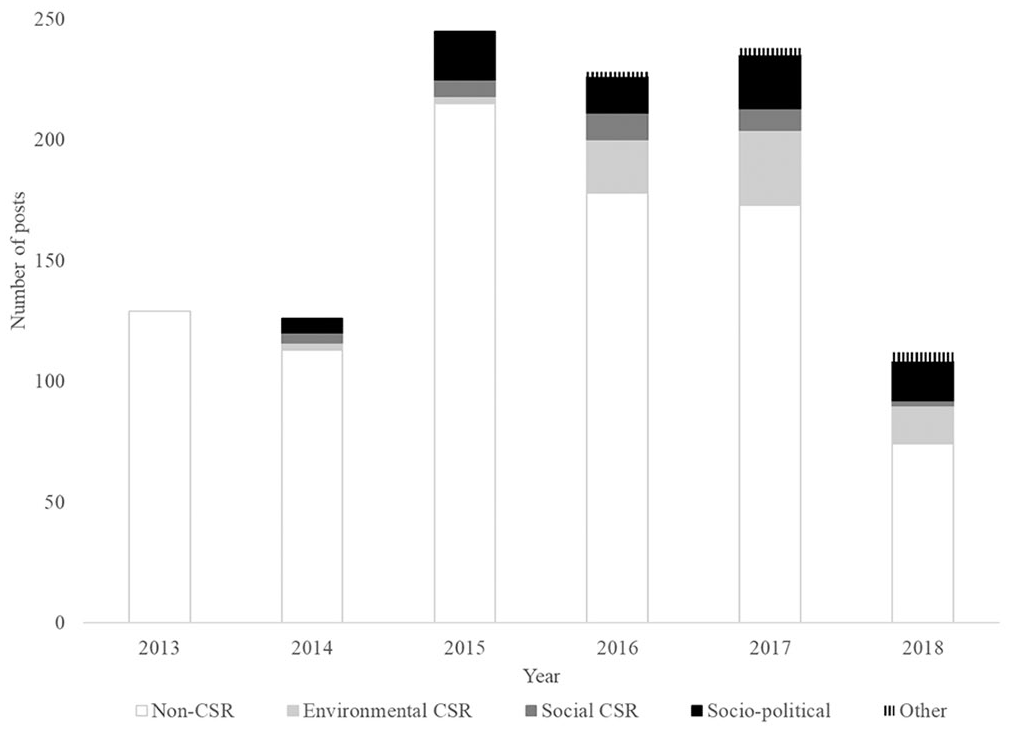
Finlayson’s Facebook posts from 2013 to 2018.
The Facebook posts categorized as “socio-political” guided subsequent data gathering, as these posts were further analyzed to identify campaigns or statements that related to CEO activism. A total of 10 campaigns or statements related to socio-political issues occurred during the 6 years, of which we omitted three external campaigns (national Pride campaigning for sexual minority rights, an initiative for same-sex marriage law, and an initiative for stricter CSR law). The remaining seven campaigns or statements were all CEO-initiated and thus fit our interest in studying CEO activism as repeated activities over time. We collected all available press releases for the campaigns or statements, and then used the name of the campaign or event as a search term to gather media materials from four prominent media outlets in Finland: the largest national daily (Helsingin Sanomat), the Finnish national public broadcasting company (YLE Online News), the largest national business newspaper (Kauppalehti), and a professional magazine focused specifically on marketing communication (Markkinointi & Mainonta). We chose to use these outlets directly instead of media databases because such databases have only limited content in Finnish. Furthermore, as our analysis does not focus on the extent of media coverage, but rather on content related to how the campaigns and statements are discussed in public, these central outlets served our purposes well.
After completing the media search, we further omitted one campaign that was mentioned in just one media article and did not involve any additional materials, resulting in a final sample of six events. Finally, the data were supplemented with other possible campaign materials, such as websites and mentions in Finlayson’s corporate responsibility reviews (published since 2016; see Table 1 for the complete data set).
Finlayson’s CEO-Initiated Activist Campaigns and Statements 2013–2018 and Analyzed Data.
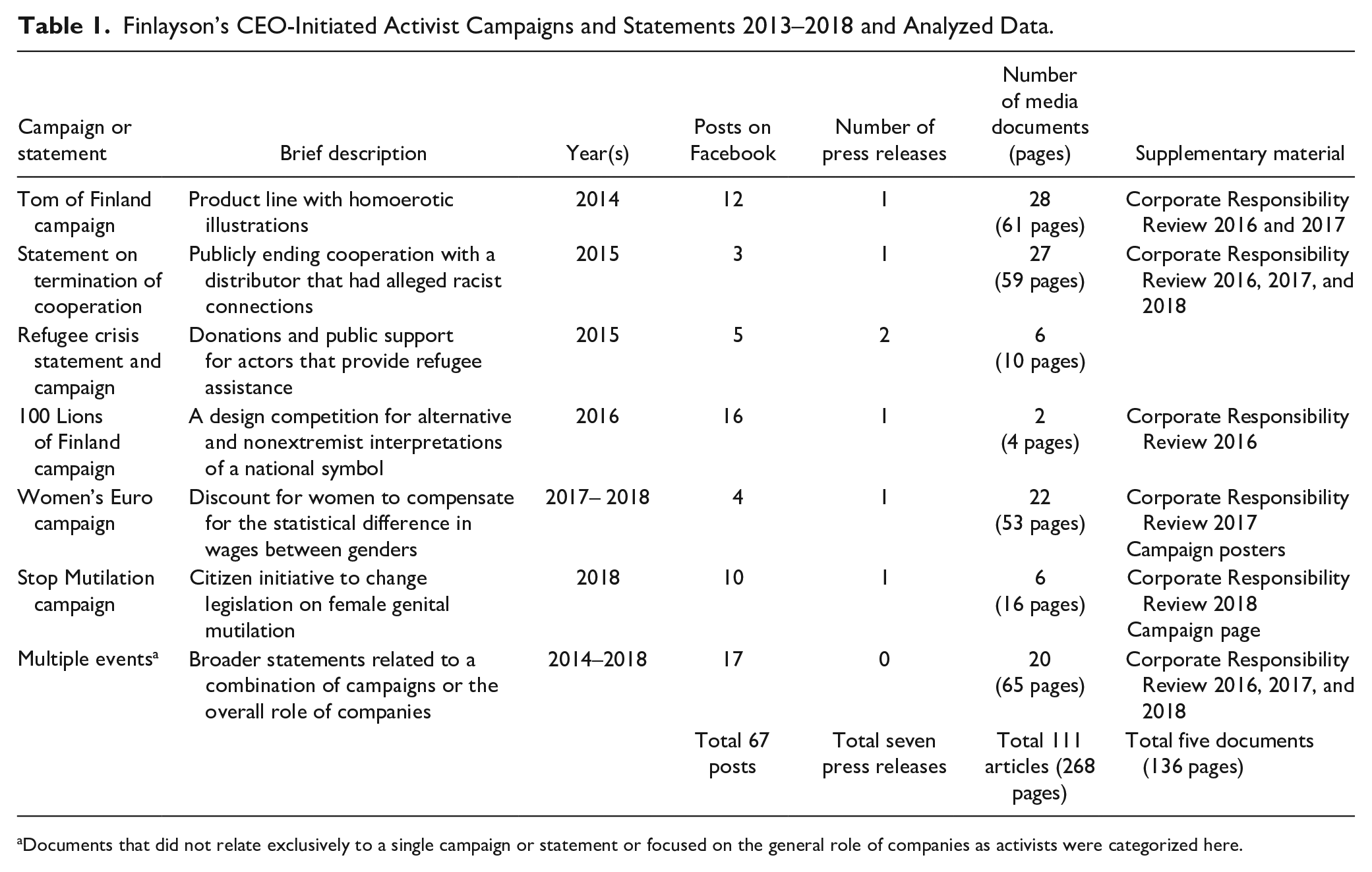
Documents that did not relate exclusively to a single campaign or statement or focused on the general role of companies as activists were categorized here.
We refer to the data in the text citations using the acronym of the source—Facebook posts (FB), press releases (PR), corporate responsibility reviews (CR), Helsingin Sanomat (HS), YLE Online News (YLE), Kauppalehti (KL), and Markkinointi & Mainonta (M&M)—and the date (e.g., “YLE, August 30, 2017”).
Analysis Methods
To analyze the data, we organized it temporally and conducted two rounds of inductive coding. First, we organized the data as a whole (Facebook posts, press releases, media materials, and supplemental materials) based on the campaign or statement to which the material referred. We then started to organize the data to form a simple timeline that depicts a cycle of events as they unfold in public by making comparisons between the campaigns or statements (Langley, 1999; Langley et al., 2013). Such a temporal perspective allowed us to investigate the data not only as individual events of CEO activism but as repeated patterns of activities (cf. Jarzabkowski et al., 2017) that also extend to the aftermath of expressing a stance when public discussion follows. The media materials further revealed that the publication of stances and the discussions that followed were not the only temporal aspects in our data, as the arguments expressed touched upon actions both preceding and following the stance—meaning that the materials also looked backward from the stance to explain how it originated and what was behind it. Thus, we organized the data in three temporal brackets: the pre-stance phase, the active stance-taking phase, and the post-stance phase, which formed the initial basis for our processual model.
Next, we coded the data more closely to enrich the timeline with an understanding of what is going on in each phase and what allows movement from one phase to another (cf. Cloutier & Langley, 2020; Langley, 1999). First, we coded the data with a focus on what is being said in each temporal phase, and second, with an interest in what kind of (discursive) activities the CEO Jukka Kurttila is engaging in during each phase and between them. In the first round of inductive coding, we focused on parts that used a direct voice from the CEO or the company (either direct interview quotes or phrases like “Kurttila thinks. . .” or “According to Finlayson. . .”). This round of coding revealed that, especially when the stances were under public scrutiny, it is not only the campaign topic that is being argued and justified but also the broader societal role of the company when such a topic is addressed. This led us to explicate the topic frame and role frame in the model.
Finally, to shed further light on what was going on in the cycles and what it takes to maintain them, we focused the second analysis phase on what it is being “done” when the CEO talks about their activism in public, rather than what is being said, coding with words that reflected actions (Charmaz, 2014; Jarzabkowski et al., 2017). In practice, our second inductive coding focused on any activities discursively expressed in speech that were connected to the direct voice that the first round of coding was based on. For example, after one of Finlayson’s campaigns faced repercussions, but Finlayson’s CEO doubled down on their campaign’s message, we coded it as “continuing despite negative feedback.” We then grouped similar activities into larger categories, and finally into aggregate-level activities (cf. Gioia et al., 2013, reported in Appendix) that we compared with temporal elements and placed on the timeline. With this approach, we were able to analyze how CEO activism unfolds as a temporal process, and how the key activities identified in our analysis support the public stance-taking phase with references to pre-stance and post-stance phases and are purposively extended to the organizational level at certain points of the process.
Empirical Findings
To start introducing the results, we provide a short descriptive overview to unpack the topics and stances made in the six CEO-initiated events of activism. Then, we move to the main processual analysis of CEO activism that identifies repeated activities.
An Overview of Activism Initiated by Finlayson’s CEO
Finlayson’s CEO addressed three broad socio-political issues during the analysis period: sexual minority rights, racism and extremist nationalism, and gender equality. In addition, the broader issue of the societal role of companies is addressed across campaigns and statements. In Table 2, we summarize these issues and provide a short depiction of what each campaign or statement was about.
Descriptive Summary of Issues in Finlayson’s CEO-Initiated Campaigns and Statements From the Data.
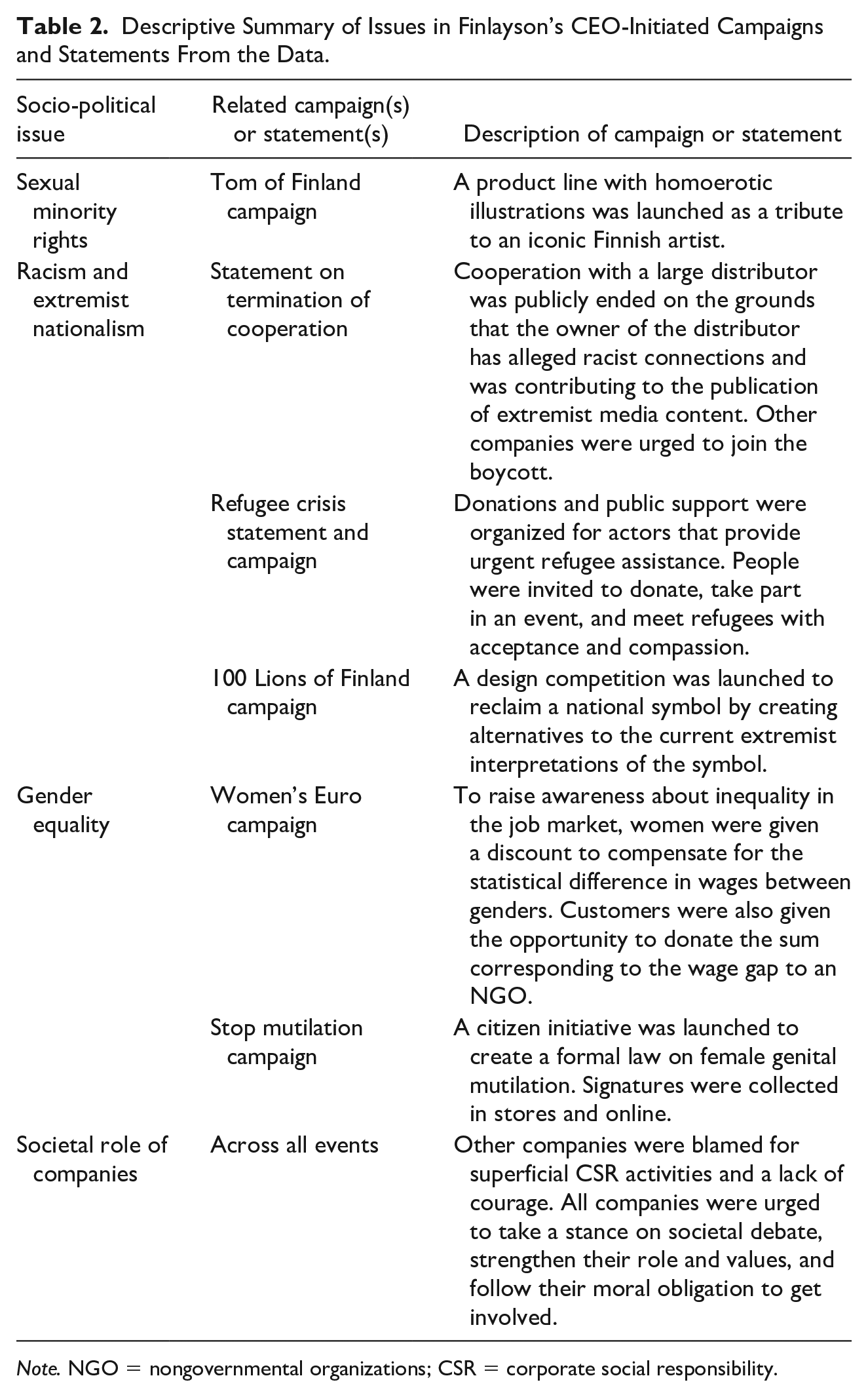
Note. NGO = nongovernmental organizations; CSR = corporate social responsibility.
In Finlayson’s materials, the CEO introduces the socio-political issues as urgent problems. Especially when the issue is legislative, there is an explicit legal shortcoming that is argued to need urgent rectification. In the case of female genital mutilation, CEO Kurttila explains in a press release why he personally initiated a citizen petition to change the law: “Assault is not at all a sufficient term to describe the harm done to girls. All parents do not necessarily perceive mutilation as violence against a child, and that is why the current model is not enough” (PR, April 4, 2018).
Another clear example of explicit problem identification is when the CEO openly blames one of Finlayson’s distributors for its involvement in publishing a racist news outlet:
The owners of [the distributor] are behind [a publication with alleged racist connections]. This publication distributes obnoxious and narrow-minded propaganda. The decision was not easy financially [. . .] but we do not want to collaborate with companies whose values differ so radically from ours. (PR, April 24, 2015)
For some issues, the problem is introduced as a broad structural challenge. In terms of racism, for example, the CEO makes general remarks about a “growing atmosphere of hate” (PR, December 4, 2015).
The campaigns and statements also bring forth proposed solutions to the identified problems. In some campaigns, the proposed solutions are somewhat traditional CSR activities, such as raising awareness and offering support and resources to nongovernmental organizations (NGOs; PR, August 24, 2017). However, more unconventional solutions are also proposed, such as petitions, boycotts, and even protests. A protest occurs when the CEO and, by extension, his company introduces illegal gender-based pricing in the Women’s Euro campaign by offering a lower price for women to compensate for the statistical difference in wages. In media interviews, the CEO openly admitted that their campaign broke Finnish legislation that prohibits pricing based on gender: “Of course we are breaking [the law], yes we know it. This must be breaking the Equality Act, but this is a conscious and intended risk” (HS, August 24, 2017).
Eventually, Finlayson received a public notification from the Equality Ombudsman for the Women’s Euro campaign (YLE, August 30, 2017). Upon sanction, the campaign was modified, but only to the extent that it met the law. The original wording was kept visible in the campaign materials by simply striking through any words that implied gender-based pricing (e.g., striking through “women pay 0.83€ for every purchase of one euro” and writing “everyone pays 0.83€ for every purchase of one euro” on top, with both texts visible). After the sanction, the CEO continued to assert in public that Finlayson will not give up on the message of the campaign, as they “don’t want the law to stop us from talking about an injustice” (HS, August 24, 2017).
Across the campaigns, the CEO mostly refers to himself as a business owner who can take action and to his company as an active actor. He suggests solutions that he can take forward either as an individual or via his company. However, there are also direct calls to action for others relating to donations, competitions, boycotts, and petitions. For most activities, the CEO first engages his company in the action and then invites others to follow his lead. For example, Finlayson both donates and encourages others to donate to NGOs (PR, November 19, 2015; FB, March 8, 2018), and, in some campaigns, provides very detailed instructions on how to act and invites others to join:
Which kind of a lion would you carry with pride? Come to design the offspring of the Finnish Lion. (FB, December 11, 2016) Already 40 000 Finns have signed the citizen initiative to prevent girls’ genital mutilation with a specific law. Now it’s time to collect the missing 10 000 names, so sign the initiative and also invite your friend! (FB, August 16, 2018)
Across the campaigns, the CEO persistently makes repeated calls to action to other companies to follow their lead as activists. As examples, other companies are invited to follow Finlayson in boycotting a questionable distributor (PR, April 24, 2015; HS, April 24, 2015), and to “take stances more actively than now and influence the societal climate” (KL, July 28, 2015). As such, Kurttila is rather explicitly and repeatedly calling on other companies to adopt an activist role and integrate it into their CSR efforts. As such, the societal role of companies is an additional socio-political topic addressed across campaigns.
To summarize, Kurttila’s CEO activism includes stances for progressive issues, such as sexual minority rights, and against discriminating practices, such as racism. Although one could argue that the issues addressed are aligned with the Nordic ideals of equality (Strand et al., 2015; Witoszek & Midttun, 2018), the campaigns and statements invoked extreme negative responses, such as hate mail, boycotts, and even death threats, as reported by the CEO in media interviews (M&M, November 2, 2017; YLE, January 9, 2017). Although responses of both support and opposition are typical for any activism (cf. Atkinson, 2017; Benford & Snow, 2000), the divided reactions stem not only from the topics that the CEO addresses, and whether those topics are greeted with agreement, but at least as much from the public role in which the CEO puts the company in these events.
Moving on to our inductive analysis that focused on the underlying activities of CEO activism, we take a closer look at what the CEO “does” discursively when he takes stances on socio-political issues through the company, and what kind of repetitive patterns these activities form over time.
Repeated Activities That Maintain CEO Activism
As our analysis covers 6 years of activist campaigns or statements, the data include several cycles of a CEO addressing socio-political topics. Therefore, we first outline these cycles and how they take place, and then introduce our inductive findings that focus on the underlying activities. Although our data cover materials starting from the launch of the campaign or the release of a statement and extending to the public discussion that follows, the data do not explicitly cover the time preceding the stance. However, it provides some insight into why the CEO comes out with a stance to the extent that such motivations are publicly stated. Thus, the first temporal aspect of our data is the pre-stance phase, which relates to the decision to take a stance. The second phase is the active stance-taking phase when the CEO stance is published, which in Finlayson’s case always involves the company. In the third phase, CEO activism moves to a post-stance phase, where the stance is exposed to public scrutiny, and the CEO further justifies not only the original stance, but also the overall societal role taken in the stance.
What we note here is that in every cycle of CEO activism, the public stances on different issues lead to broader discussions about the public role of companies and whether it is acceptable for companies to act as Finlayson and its CEO do. As an example, the CEO declares it “odd to think that consumers and politicians need to do societal acts, but that companies should not have their own opinion and will” (YLE, January 9, 2017), that “[c]ompanies should not stand silently and only observe what is going on in the world” (M&M, December 18, 2015), and that companies fail to act on societal issues if they fear negative comments (KL, September 15, 2019). Notably, the CEO willingly engages in these discussions about companies’ societal roles and takes clear stances on what this role should be. Hence, throughout the cycles, the CEO discusses and justifies not only the topics of activism but also the role he and the company play as active partakers of public debate. As such, the discussions and justifications of CEO activism happen in relation to two frames: One that deals with the socio-political issue at hand in Finlayson’s CEO-initiated campaigns, and one that deals with the role of business actors in relation to socio-political issues.
To make this distinction between the topic and role explicit, our model distinguishes the topic frame that relates to the CEO’s justifications of the socio-political issue and why it is important to address, and the role frame that relates to the CEO’s justifications of why the CEO and the company are suitable actors to address the socio-political issue. Although the content of the topic frame changes from one cycle to another, the role frame is repeated across campaigns. As our study focuses on activities, analyzing frames is not our core focus—but frames are important for interpreting meanings and assessing situations (see Cornelissen & Werner, 2014), and hence we highlight the difference between these frames and how the underlying activities support the stance in relation to both, as we come to discuss in detail.
We combine the results of the inductive analysis in Figure 2, which lays out the temporal aspects and depicts the repeated underlying activities in Finlayson’s CEO-initiated campaigns and statements that keep the cycle going through the pre-stance, stance-taking, and post-stance phases, and onwards to new cycles. We identify five inductive activities that are central to how CEO activism is maintained in Finlayson’s campaigns and statements over time: anchoring motivations in the pre-stance phase, modeling action and taking agency in the stance-taking phase, and enduring criticism and normalizing activism in the post-stance phase. These activities represent recurrent patterns in CEO activism beyond individual campaigns. As depicted in the figure, some of these discursive activities are clearly done on the individual level with the voice of the CEO, while some activities carry the organization’s voice either directly or by the CEO talking on behalf of the company (with expressions such as “we,” “for us,” or “our company”). Thus, the CEO is extending his activism to the organizational level as he takes stances through his company. Although we acknowledge that these five activities can be difficult to pin down exclusively to a specific phase, the model depicts where the activities become crucial for maintaining CEO activism and moving from one phase to another.
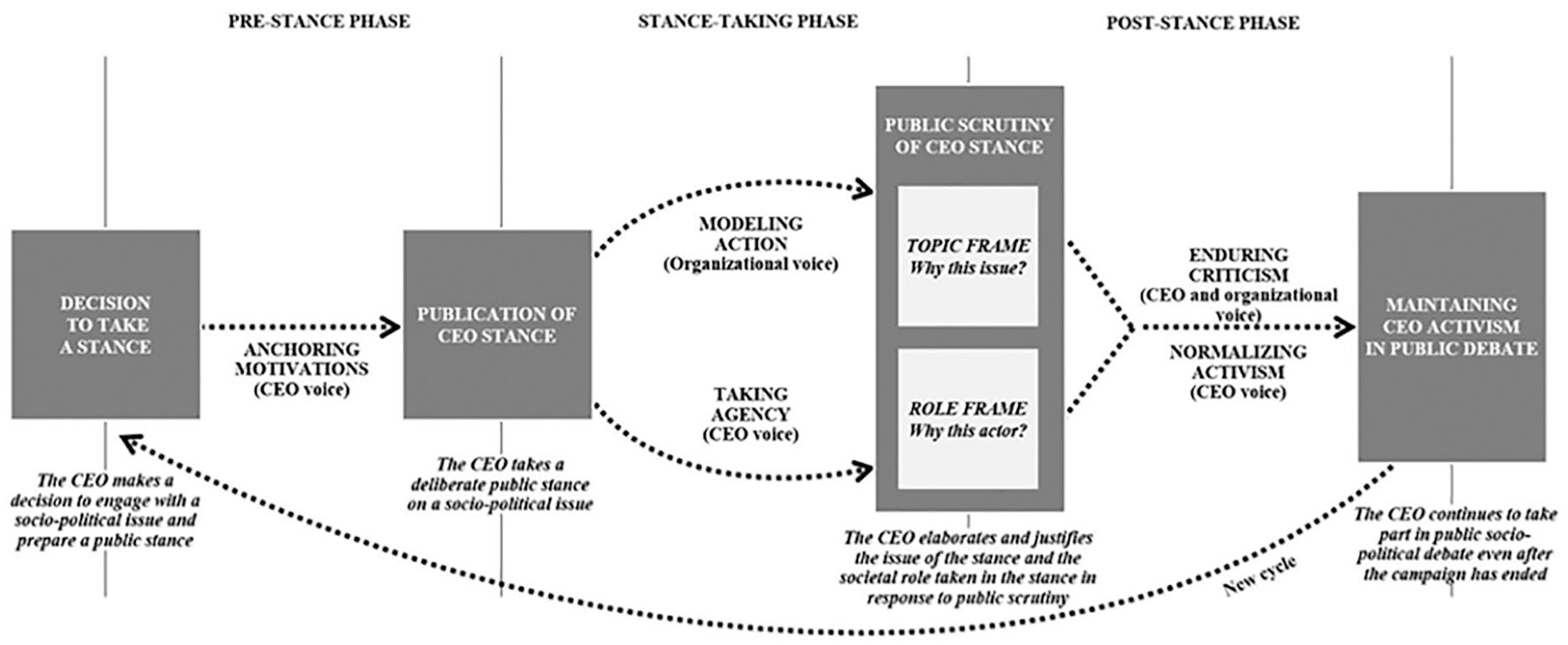
Processual model of maintaining CEO activism with repeated activities.
Below we present the findings in detail for each underlying activity. The data structure as a whole, with more illustrative example quotes, is presented in Appendix.
Pre-stance phase: Anchoring motivations
The pre-stance phase starts with a decision to engage with a socio-political issue, which is expressed through phrases such as “Finlayson has decided to end all cooperation” (PR, April 24, 2015). The CEO publicly discusses the origins of the decision when the socio-political issue is first explained and justifies it as an urgent problem. In this way, the CEO’s public argumentation stretches to the pre-stance phase, as he offers explanations of why he—and his company—decided to engage with the topic. These remarks explain what preceded the actual stance-taking phase by providing insight into why that topic is of such importance that a stance is eventually taken.
Recurringly, the CEO uses his own voice to report personal values that drive his activism, and on some occasions, he speaks on behalf of the company to justify the campaigns, acknowledging the company’s history related to tolerance and courage. We conceptualize this activity as anchoring motivations as it attaches CEO activism to the CEO’s personal values and further to the company values. Anchoring motivations is often part of the very first messages in which the issues and problems related to them are introduced, as visible in the examples below in which the CEO discloses personal motivations behind the launch of the Women’s Euro and Stop Mutilation campaigns:
The campaign was born thanks to my wife. She was legitimately irritated that women’s euro is less than men’s euro still in Finland in the 2010s. We decided at Finlayson that at least we can do something on our part. (PR, August 24, 2017) As a father of two daughters, I came to realize that as the only Nordic country, we do not have a separate law that would prevent the mutilation of girls. (PR, April 4, 2018)
Furthermore, the CEO anchors socio-political issues to his own values in media interviews when he describes the broader personal importance of the issues addressed:
I was celebrating the New Year in Oslo, and I admired how natural the relationship was between the Norwegians and their national symbols. I realized that I could not put on the Finnish lion. I became sad. (HS, December 4, 2016) “That’s enough!” After reading an antisemitic writing in [a publication with alleged racist connections], Kurttila calls his co-owners. He suggests ending cooperation with the retailer store Kärkkäinen due to its connections to [the publication]. (KL, December 26, 2015)
When anchoring is done to company values, the CEO is talking on behalf of the company to explain how the values of the owners (him being one of them) drive Finlayson’s activism as a company. The same is done concerning individual events and the company’s broader overall role as an activist company:
We have morals and our values include tolerance. It is not enough to blabber about in ceremonial speech (M&M, December 18, 2015). We want Finlayson to have a clear stance on issues, and we have the balls to bring this issue [=values of the distributor] up. We consider it a serious problem if this type of hate writing is allowed to continue in Finland (KL, December 26, 2015). Traditionally, companies take a stance only on issues related to their industry, but for us, it is important to engage in concrete acts following our values (PR, April 4, 2018).
The examples above on anchoring motivations portray the CEO’s personal motivations as a strong driver of the activism taken. In one media interview, the CEO explicitly describes how he makes decisions to engage in new and possible controversial issues by assessing whether the issue matches with the company values and his personal values, and affirms: “If my answer to both is yes, I know that I am able to defend the issue against anybody” (YLE, October 29, 2017).
Essentially, anchoring motivations is an activity that provides an origination point for the stance, and primes the stance as an intrinsically motivated activity, driven by the CEO. As anchoring is expressed when the stance is made public, it is an activity that ties the stance to existing values and forms the guidance to act. Thus, anchoring motivations bridge between what was and what is happening now, making it possible for the CEO to embark on the divisive journey that is initiated in the next phase when the stance is made public.
Stance-taking phase: Modeling action and taking agency
Publication of the activist stance is a shift that moves CEO activism to the active stance-taking phase. In our data, the campaigns are run and statements are made by the company in the stance-taking phase, but the CEO’s personal motivations are echoed in campaign materials published by Finlayson. The CEO also actively justifies, explains, and defends the stances in public, repeatedly one cycle after another.
We identify two repeated activities related to the stance-taking phase: modeling action and taking agency. Both activities are closely related to how the CEO positions the company as an unconventional activist company and puts Finlayson’s resources to use in an attempt to take action on socio-political issues. Furthermore, the CEO justifies the company’s public position early on because the company is purposively adopting a role as an activist company that addresses socio-political issues.
Modeling action relates to the actions that are initiated to mitigate the identified problems. In terms of agency, modeling action is an activity that done through the company, by using the voice of the company: “Finlayson has decided to end all cooperation with [a distributor] (PR, April 4, 2015)” and “Finlayson starts a campaign (PR, August 24, 2017).” Even when a private person (the CEO) is needed to initiate a citizen petition, the petition is launched as an effort of the company: “Finlayson decided to initiate a citizen petition and start collecting signatures” (PR, April 4, 2018). Although the actions that are modeled vary, the modeling continues throughout the analysis period.
As many of the issues addressed are structural challenges, it can be difficult for any single actor to implement an immediate solution. Thus, most of Finlayson’s actions could be seen more as symbolic than as major improvements, but we argue that their importance lies in how they serve as model actions that could, if implemented by enough actors, work toward solving challenges. The CEO also recognizes the limits of the company’s agency concerning broad socio-political issues yet simultaneously aims to maximize the potential of their example by bringing the issues forward:
Of course, we are not expecting to be able to solve this defect [of the gender wage gap] alone, but we think it is important to bring the issue up over and over, so that someday a solution will be found. (PR, August 24, 2017)
By placing modeling action in the stance-taking phase, we highlight it as an activity that supports the stance by immediately accompanying it with some form of (material) action from the company’s side. By modeling action, the CEO proactively provides an answer to the first immediate critique that likely follows the shift to the public stance-taking phase, which the question of what the CEO or the company is actually doing to solve the socio-political challenge. It is also a deliberate move from the individual level to the organizational level, as the CEO involves the company in taking action to the extent possible with the resources in use. This later helps the CEO continue the discussion around the topic frame in the post-stance phase, as the modeled actions are evidence that the CEO is not just talking about the issue but is also attempting to do something about it through his company.
The second repeated activity in the stance-taking phase is taking agency. This activity is a continuation of how the CEO justifies the company stances as internally motivated (as explained in “anchoring motivations”) and proposes an activist company role as a possible solution for tackling socio-political challenges. Namely, the CEO positions Finlayson as a change agent driven by values and thus pushes for agency for a company that is willingly addressing different socio-political issues:
Our task is to challenge people to think, Kurttila states. (YLE, October 29, 2017) Kurttila thinks it is fair that the company takes a stance on issues. According to the CEO, it is a sign of transparency and openness. (KL, December 26, 2015)
The stance-taking phase reinforces companies’ societal roles as an undercurrent to Finlayson’s activist topics, as the role frame becomes one of the “issues” for which the CEO advocates across all events. For example, in the case of the Women’s Euro campaign, the discussion about the activist company role continues significantly longer than the discussion about the topic, and the campaign is repeatedly brought up as an example in which Finlayson broke its neutral company role by defying the law (HS, December 9, 2017; YLE, December 22, 2017). Taking agency also becomes reinforced in relation to accusations of using activism as “just a pretty word for marketing” (M&M, February 22, 2018) or as a deliberate publicity stunt to gain visibility (M&M, April 8, 2016). Namely, the CEO responds by justifying his own and the company’s agency, and persistently challenges the idea that businesses could somehow isolate from society and simply “observe” (M&M, December 18, 2015) or “externalize themselves” from society (KL, July 28, 2015). As such, the CEO advocates that companies can act in ways that do not aim to raise as little criticism as possible:
Are companies somehow such that they can just hover somewhere in between and do what others tell them to? Finnish companies have a central role when discussing what Finland looks like and how it should be here. (YLE, January 9, 2017) Our message is that Finnish companies are fearful for no reason if they get a few [negative] comments on social media. It is the big picture that counts, not those few comments. (KL, September 15, 2019)
Temporally, taking agency is a discursive activity done in the stance-taking phase, and it contributes to why the CEO later has to defend both the topic frame and the role frame when the stance is under public scrutiny. In essence, taking agency in the stance-taking phase becomes a firm foundation on which the CEO builds in the post-stance phase when defending the activist role over time. When the stance-taking phase involves a clear position on the company’s role, the CEO reinforces that the stance is deliberate even when it is likely to provoke divisive responses and that the CEO is purposively engaging the company in the stance.
Post-stance phase: Enduring criticism and normalizing activism
In the post-stance phase, the stances made by the CEO under Finlayson’s name are under public scrutiny, and the CEO must respond in public to further queries, both in terms of the issues that the stances address and in terms of the activist position taken on them. This means that the CEO, as the spokesperson engaging in public discussion, has to manage the discussion concerning the topic frame and the role frame in the post-stance phase. As described above, the interrelatedness of the topic frame and role frame is partly acknowledged already when the stance is made, but the post-stance phase involves further responses to public scrutiny after coming out with a certain activist campaign or statement and in so doing positioning as a societal actor.
Our analysis highlights two activities in two post-stance phases that enable the CEO to keep up the public discussion in relation to the two frames and eventually move forward to the next cycle. We conceptualize these activities as enduring criticism whereby the CEO is repeatedly accepting and re-inviting the divided responses to Finlayson’s campaigns and statements, and normalizing activism that relates to the CEO making calls to action to other companies and advocating for activism as a legitimate means to take part in public discussion as business actors.
In terms of the topic frame, enduring criticism is visible in how the CEO is not discouraged by the divided positive and negative reactions that follow the stance-taking phase but endures the negative responses and tough questions related to the issues addressed and the role taken. For example, the CEO explicitly doubles down on Finlayson’s stances and vouches to continue despite the negative feedback, even to the extent that he declares the company to “have the balls to bring this issue [=values of the distributor] up” (KL, December 26, 2015). A similar persistence is shown in the Women’s Euro campaign, when the CEO comments that “the different reactions show . . . that there is work to be done for equality” (M&M, September 8, 2017) and vows not to give up on the spirit of the campaign even when they receive a notification from the Ombudsman for Equality for illegal pricing:
We will not give up on the spirit of the campaign; we are holding on to it very forcefully. We are sorry that the law is interpreted this strictly. (YLE, August 30, 2017) We don’t want the law to stop us from talking about an injustice, Kurttila said on Thursday. (HS, August 24, 2017)
Especially as Finlayson runs the Women’s Euro campaign again the following year, despite the threat of a new sanction, Finlayson’s actions resemble civil disobedience, where existing laws can be challenged for a good cause (cf. Taylor & Van Dyke, 2004). The company and the CEO also repeatedly reinvite the controversy with new campaigns and statements that constantly broaden the repertoire of the issues in which they engage.
The same endurance of criticism applies to discussions around the role frame. When speaking broadly about the company’s role and its activities, the CEO talks on behalf of the company, stresses that the company is aware that they can “create animosity” (CR, 2016), and indicates that they are not afraid of negative feedback, as it is simply a part of taking stances on socio-political issues:
When we have tried to act in a responsible manner, against racism, for example, we have been targeted by hate speech. This is of course disappointing, but also to be expected. We will not let hate speech discourage us (CEO’s letter in CR, 2016).
The CEO even takes negative feedback as a sign that Finlayson is “doing the right thing” (KL, September 15, 2015) and that they are not alone in facing the negative feedback:
We realized what power lays in doing things differently. And, in fact, our own fans silenced out a boycott group. (KL, September 15, 2015) These projects have helped me notice that there are a lot of unnecessary fears in the corporate world. (M&M, November 2, 2017)
When repeated, enduring criticism becomes an important activity that supports both the topic frame and the role frame, as it portrays the determination to keep pushing forward, both in terms of the topics and the activist role. As such, enduring criticism is about not being discouraged but also about accepting that divided responses will follow—and that such divided responses may result from addressing a certain topic and from taking a certain societal role as a CEO and a company in the debate. Contrary to a strategy that would try to solve or silence public criticism of his actions, the CEO chooses to double down and continue. Accepting such divisiveness paves the way for future stances, as it makes it possible for the CEO to keep addressing (the same or other) socio-political topics, and keep up the chosen role. Enduring criticism also brings the CEO’s voice and the company’s voice together when the CEO talks on behalf of the company, as shown above in the examples where the CEO expresses the determination of the company to “not give up on the spirit of the campaign,” being “sorry that the law is interpreted this strictly,” and not wanting “the law to stop us” (HS, August 24, 2017; YLE, August 30, 2017).
The second key activity in the post-stance phase is normalizing activism, which is done mostly directly with the CEO’s own voice. Irrespective of the issue addressed, normalizing activism manifests in how the CEO is repeatedly pulled into debates about what a CEO or a company can or cannot do as a public actor, whether Finlayson’s activities are crossing lines, and what the overall societal role of companies is in polarizing societies where values are debated ever more intensely. Eventually, Finlayson’s role as an activist becomes a much larger topic than any individual issue or event. Notably, there are no interviews where the CEO attempts to circumvent or limit the conversation only to the campaign topic at hand—rather, such discussions about the broader role are readily engaged to the extent that the CEO repeatedly calls on other companies and explicitly advocates for activism as a legitimate form of action for business actors:
In Kurttila’s opinion, some Finnish companies would need a more rebellious spirit, passion, and vision. (YLE, January 9, 2017) We also encourage other companies to clearly show their responsibility with concrete actions. (PR, April 24, 2015) “In Finland, we can pretty well take a stance on which issues are right and which are wrong.” That is why Kurttila wonders why big Finnish design companies are not taking stances on anything. ‘It’s just icy silent on that end.’ (YLE, October 29, 2017)
In this effort, the CEO shows determination, as our data does not include much evidence that he is successful in mobilizing other companies, although he appeals not only to the societal potential of companies as societal actors and the duty to “influence the societal atmosphere” (KL, July 28, 2015) but also to business rationales, as he notes that activism can also have positive business implications (CR, 2016; KL, December 26, 2015; M&M, November 2, 2017; YLE, March 29, 2017). One eventual success came from the boycott of a former distributor, as several years after the original statement, a large reportage on the distributors’ connections to extreme nationalists was revealed, which encouraged seven other companies to follow suit (HS, January 2, 2018). It is also worth pointing out that normalizing activism becomes more explicit over the analysis period. Although in the first campaign, the CEO can be interpreted to even downplay the socio-political relevance of the campaign, as he states that there should not be anything special about “selling a gay icon and [children’s characters] side by side” (KL, November 21, 2014), in later campaigns the CEO readily acknowledges the divisive nature of his actions and defends them with a “duty to talk about this deficit regardless if someone’s feelings are hurt” (KL, August 24, 2017).
When normalizing activism becomes a repeated activity, it supports both the topic frame and the role frame, especially as it repeats the same calls to action to other companies across a variety of topics. As the topics that Finlayson addresses accumulate over the years, normalizing activism becomes an activity that accompanies different topics, supports Finlayson’s role in addressing them, and paves the way for future stances, as activism is repeatedly reinforced as something that also other companies can and should do.
Discussion: Activities, Frames, and Phases That Maintain CEO Activism
Our findings from the empirical study that addressed the puzzle of the underlying activities of CEO activism over time make three main contributions to CEO activism research. First, we extend the conceptual understanding of CEO activism beyond stance-taking by identifying five additional activities that support public stances on socio-political issues. Second, we bridge between the largely isolated streams of individual-and organization-level focused research by depicting how the CEO involves the company in activism through activities that justify interrelated topic and role frames. Third, we develop a processual model that breaks down the cycle of CEO activism into the pre-stance, stance-taking, and post-stance phases and explains the shifts between the phases as well as how the different activities are interrelated and follow a pattern that serves to maintain CEO activism.
We elaborate on each contribution in detail below, followed by a discussion of the study’s limitations, avenues for future research, and managerial implications.
Defining CEO Activism: More Than Taking a Stance
First, our empirical study contributes to CEO activism by extending its focus from the CEO’s public stance by adding novel empirical insights into the underlying activities that support stance-taking. We identify five activities that repeatedly anchor motivations, model action, take agency, endure criticism, and normalize activism when the CEO takes stances and justifies them in public.
Our observations advance insight into CEO activism as they extend beyond the most visible part of the phenomenon, public stance-taking and show that there are underlying activities taken before, during, and after the stance. The deliberate publicity of CEO activism has been emphasized as one of the distinct characteristics of the phenomenon when comparing it to (P)CSR or CPA (Hambrick & Wowak, 2021), and public scrutiny has been suggested to intensify when CEO activism deals with issues of high moral intensity and low business relatedness (Branicki et al., 2021). Our results unpack how a CEO supports stances in this publicity and public scrutiny with underlying activities in different phases of the public process.
Furthermore, previous research has implied that CEO activism might induce indirect costs similar to any symbolic action, despite the seemingly low effort and resources needed to make a public stance (Hambrick & Wowak, 2021). In addition, a recent study by Branicki et al. (2021) has called for a need to understand CEO activism as a heterogeneous phenomenon, as there are multiple ways to engage in CEO activism, with different levels of vividness, risk, and morality. The five activities identified in our study can explain in more detail the scope of responsibility, commitment, and time invested when CEOs take stances on societal matters and position themselves as activists. We suggest that this is also an important contribution to managerial practice, as it is possible that CEOs do not acknowledge these new responsibilities as they involve considerably different activities when compared with the more established forms of (political) activity described in PCSR and CPA. We argue that in addition to being very public and involving issues not directly related to the company’s business activities (Branicki et al., 2021; Chatterji & Toffel, 2019), being followed by divisive responses (Dodd & Supa, 2014; Hambrick & Wowak, 2021; Voegtlin et al., 2019), CEO activism is about repeated underlying activities that make both the issue and the activist role worth defending.
Extending CEO Activism From the Individual to the Organizational Level
Second, our findings contribute to CEO activism by pointing to the importance of CEO activism occurring in an organizational context, as our data show how the CEO involves the company in activism by activities that justify interrelated topic frame and role frame. We extend previous CEO activism studies that have emphasized the activities of the CEO and his or her personal motives for engaging (Chatterji & Toffel, 2019; Hambrick & Wowak, 2021), as we provide important details on how CEO stances emerge in close liaison with personal and company values. We also further explain how CEOs make their stances not as private persons but from their corporate positions (cf., Branicki et al., 2021; Hambrick & Wowak, 2021). Our analysis shows how the CEO uses both an individual voice to make stances, with expressions such as “I want” or “I realized,” but also uses his capacity as CEO to talk on behalf of the company with expressions such as “we,” “for us,” or “our company.” Furthermore, our results show that even when activism is clearly CEO-initiated, campaigns can be run under the company name, and the company can serve as a resource through which the CEO can take corrective action concerning the socio-political issues addressed in the campaigns. Although the idea that substantial activities can strengthen CEO activism beyond symbolic action has been suggested in extant research (Hambrick & Wowak, 2021), and that the organization can be purposefully involved in the issues by the CEO (Branicki et al., 2021), we provide empirical evidence of how CEO activism can materialize also through organizational activities.
Our findings further point to the importance of maintaining activism by repeatedly engaging with two interrelated frames: a topic frame that relates to justifications for the socio-political issue and why it is important to address, and a role frame that relates to justifications for why the CEO and company are suitable actors to address the socio-political issue. The CEO sets an agenda on a sensitive socio-political issue through the company, and this activism spurs intense public reactions and leads to broader public discussions, challenging the company’s legitimacy to engage in such debates. In these situations, the CEO’s personal support and engagement in justifying the company’s role as an activist is itself important for the activism to continue. Our analysis provides detailed empirical documentation and analysis that shows how activities extend into the organizational level in the topic frame, while individual-level activities are more dominant in the role frame. Importantly, acknowledging the difference between the topic frame and the role frame adds detail to previous research on CEO activism that has addressed a variety of topic frames for socio-political topics that are taken up by CEOs (Dodd & Supa, 2014; Hambrick & Wowak, 2021), but has largely ignored the role frame. The interrelatedness of topic and role frames can also add detail to understanding CEO activism as a public phenomenon where media attention is both a goal and a challenge due to divided responses (cf. Branicki et al., 2021; Chatterji & Toffel, 2019; Hambrick & Wowak, 2021).
Previous studies have typically focused on activism by either a CEO or a company, yet the issues addressed are clearly similar. There is also empirical fuzziness in terms of whether the events studied concern purely individual or organizational activism (Chatterji & Toffel, 2019; Dodd & Supa, 2014; Hydock et al., 2020). Our findings challenge the rigidity of the division into individual and organizational research “camps” and instead suggest bridging them by demonstrating that CEO activism can be implemented and supported by organizational-level activities. These findings can also inform the emerging stream of organizational-level activism in management studies, warrant a further understanding of the intersections between individual-and organizational-level activism, and help to develop the conceptual landscape and the meaning of terms like “corporate activism” beyond their relevance as marketing or communication tactics, but as possible acts of (re-)positioning companies as societal actors (cf. Gulbrandsen et al., 2022).
Although our study focused on a medium-sized company where the CEO is influential as an owner-manager (cf. Spence, 2016), and the CEO had prior understanding of publicity from his previous career as an advertising professional, it is probable that the CEOs of larger companies also need to demonstrate some form of action even when they take stances as individuals (see Knight, 2020 about action in relation to commitments toward racial justice). It is possible to demonstrate such action through the companies they are leading. Furthermore, a top-level spokesperson is often needed to address questions that emerge in public, even when stances are taken by a company or brand. We believe the simultaneous support and justifications to topic frame and role frame are important findings for understanding how a CEO and a company may be able to maintain activist positions over time, despite divisive responses from the public. After all, top management is in a position to drive the responsibilities and societal positions of a company (cf. Maak et al., 2016; Wernicke et al., 2022).
Processual Model of Maintaining CEO Activism
Our third contribution is the synthesis of our empirical findings in the form of a processual model of CEO activism. The model explains how the different activities and frames of CEO activism are interrelated and follows a pattern of three phases that serve to maintain CEO activism, as visualized in Figure 2. We identify how the maintenance of CEO activism is a process that extends from the pre-stance phase to the active stance-taking phase and finally to the post-stance phase.
In the model, we place the five activities that support stance-taking and show how the activities collectively play an important role in constituting CEO activism as they are repeated over time and pass important shifts. The first shift into corporate activism happens when the CEO decides to engage in a socio-political issue. The second shift occurs when the CEO takes a public stance, which is supported by personal and organizational commitment. The third shift is defined by the CEO responding to the public scrutiny of the stance, that is, the public questioning the choice of the socio-political issue (i.e., the topic frame) and the legitimacy of the CEO to engage in this issue (i.e., the role frame). Finally, the fourth shift happens as the CEO continues to engage in socio-political debate even after a campaign has ended; he does not see activism as a stand-alone event but as a long-term commitment to societal impact.
Maintaining CEO activism calls for commitment and willingness to defend the stance taken on sensitive socio-political issues both retrospectively and prospectively, and to discuss such issues and the company’s role in society much more broadly than the company’s business and products themselves invite the CEO to do. Our model also emphasizes that the cycle of CEO activism extends beyond the active stance-taking phase. As we argued above, previous research has focused on stance-taking and provided very little information on CEO activities beyond the immediate stance. Although some studies have taken interest in the reactions to CEO activism, such as by consumers and employees (Chatterji & Toffel, 2019; Dodd & Supa, 2014; Voegtlin et al., 2019), the activities of the CEO after the stance have remained largely unknown. Similarly, while some studies have addressed the motivations that affect CEO activism—that is, what happens in the pre-stance phase (Branicki et al., 2021; Hambrick & Wowak, 2021)—the process as a whole and its important shifts have remained unconceptualized.
Our third contribution concludes that CEO activism includes activities through the pre-stance, stance-taking, and post-stance phases, whereby a CEO deliberately engages personally and through the company in public debate about sensitive socio-political issues and businesses’ role in addressing them. Hambrick and Wowak (2021) concluded that CEOs take up activism when it aligns with stakeholders ideologically, and it can bring about even greater alignment as a consequence. Presumably, such greater alignment results only when CEO activism is perceived as a genuine effort, whereas failed attempts at CEO activism can cause the opposite effect (cf., Korschun et al., 2019). As such, our results shed light on how CEO activism is successfully repeated over time, supported by underlying activities through shifts between phases. Our study shows that the justifications are already built in the pre-stance phase, the stance is followed by active engagement in both topic and role frames, and multiple activities are undertaken to support the cycle from the pre-stance phase to the post-stance phase, which ultimately makes it possible to embark on a new cycle. By initiating new cycles, the CEO deliberately invites controversy not once, but continuously, and the repetitiveness of the activity displays dedication to driving societal change.
Limitations and Future Research
This study is based on public campaigns and media materials, which means our findings do not provide insight into the actual planning and decision-making processes relating to CEO activism that takes place behind the public eye. As such, while we touch upon motivations and divided responses to CEO activism, we have studied the extent to which they appear in public materials, and the activities and frames presented in the analysis describe what is “done” relying on what was expressed in publicly made arguments and justifications. This can mean that there are potentially more activities to unravel, or that some activities might result from interactions with internal or external stakeholders or their reactions, which we did not analyze in this study. Furthermore, the study is based on a single case company and CEO from the Finnish political and cultural context. Therefore, our results are likely to apply best in contexts similar to the Nordics.
Our findings raise several interesting avenues for future research. First, we call for more research to further understand the interrelated topic frame and role frame of CEO activism. Our empirical study shows how CEO activism leads to broad discussions about CEOs and companies’ societal roles and political agency, for which CEOs may not be prepared even if they have previously engaged in other political activities such as PCSR and CPA. CEO activism easily raises skepticism, and we suggest that future research address the question of whether, for example, disengagement from the role frame poses challenges for maintaining activism. We see such questions as important, especially for enabling CEO activism beyond “one-time” incidents.
Second, as the conceptual landscape of activism done by CEOs and companies is developing, analyses of companies of different sizes and structures can reveal further insights into where individual-level activism and organization-level activism meet rather than differ, and how CEOs might take activism beyond personal stances by using the company as a vehicle for broader activities. Concerning these questions, there are critical avenues to explore, as previous research has taken note of how CEOs’ involvement in social causes is not automatically moral (Branicki et al., 2021), and how top managements’ push for social causes on the organizational level can put frontline employees in difficult situations as they are the ones that directly face the divisive responses from customers (Sabadoz & Singer, 2017). There are also conceptual debates to solve for future research, as organizational-level concepts, such as corporate activism or brand activism, have mainly been in use in marketing and communication studies, while management scholars have been more involved in studying CEO activism. Our study indicates that it might be difficult to completely separate the two and that there can be deliberate moves in agency from one level to another, which calls for a deeper understanding of both levels in management studies.
Finally, our findings call for an extended understanding of CEO activism as a process over time. Future research should continue to explore the temporal aspects of CEO activism, especially as studies that extend beyond the immediate stance-taking phase are currently rare.
Managerial Implications
Our study brings new insights into the complexities for business actors who decide to engage in society as activists. First, our analysis shows how an activist CEO deliberately puts himself and the company in the public light and invites controversy by taking stances on sensitive socio-political issues. The controversy that follows concerns not only the sensitive socio-political issues addressed in CEO activism but also the contested legitimacy of CEOs and companies as activists: What rightfulness does a CEO have to interfere with socio-political issues? Our study suggests that CEOs need to have their talking points prepared, both for the topic of their activism and their legitimacy as activists, and align them so that they support each other.
Second, our study brings attention to new responsibilities for managers, as CEO activism is a more complex process than simply announcing a stance on a sensitive socio-political issue in public. Although CEO activism can be criticized as an easy activity with little resources needed, our results paint a picture of CEO activism as a process that requires engagement much longer than just the immediate moment when the stance is taken. Managing that process with underlying activities takes both time and commitment on top of the courage needed to be a CEO activist.
Third, our findings point to how the managerial challenge in CEO activism includes a willingness to “go first,” break new ground on socio-political issues that no other CEO or company has done before, and engage in socio-political action that may be borderline illegal.
Fourth, top management may consider whether their engagement in activism is a one-time event or if activism is a more integral part of whom the company is—if the CEO “does” activism or “is” an activist. Similarly, CEOs may want to consider the level of materiality they add to their symbolic stances, as our study shows how a CEO may take action through the company and accordingly commit the company to an activist stance. We think the chosen breadth and depth of activism have implications for how authentic CEO activism is perceived and, ultimately, for the type of societal betterment that CEO activism can bring about.
Conclusion
CEOs are increasingly engaging in activism by taking public stances on debated political decisions and campaigning for or against controversial socio-political issues. To understand how this deliberately confrontational activity is maintained over time, we offer a detailed analysis of a CEO repeatedly engaging in corporate activism over several years. Based on our findings, CEO activism is maintained with underlying activities that support the focal stance-taking activity. These activities—anchoring motivations, modeling action, taking agency, enduring criticism, and normalizing activism—become important in different parts of the process starting from the pre-stance phase, and continuing to the active stance and post-stance phases as CEO activism is maintained over time. Accordingly, CEO activism includes activities through the pre-stance, stance-taking, and post-stance phases, whereby a CEO deliberately engages personally and through the company in public debate about sensitive socio-political issues and businesses’ roles in addressing them.
Although previously conceptualized as a highly individual phenomenon, CEO activism can be purposively extended to organization-level activities, as shown in the interrelated topic and role frames between the CEO and the organization. The topic frame relates to justifications on the socio-political issue and why it is important to address, and the role frame relates to justifications on why the CEO and company are suitable actors for addressing the socio-political issue. We hope these findings will inspire future research and theorizing on CEO activism and inform managerial practices as more CEOs engage in activism and will have to navigate the divided responses that follow.
Footnotes
Appendix
Acknowledgements
We would kindly like to thank Jannica Jääskeläinen for her assistance with the initial data collection and analysis.
Declaration of Conflicting Interests
The authors declared no potential conflicts of interest with respect to the research, authorship, and/or publication of this article.
Funding
The authors disclosed receipt of the following financial support for the research, authorship, and/or publication of this article: For financial support, we express our gratitude to the Academy of Finland [grant number 331576] and to Misum, Center for Sustainable Markets, Stockholm School of Economics.

