




Abstract
Entrepreneurship is the dominant form of enterprise in conflict-affected settings, yet little is known about the role of entrepreneurship in peacebuilding. In response, this article undertakes a review of entrepreneurship in conflict-affected regions to integrate research from business and management with research from political science, international relations, and parallel domains. Three views of entrepreneurship emerge—the destructive view, economic view, and social cohesion view—showing how entrepreneurship can concurrently create conflict but also potentially generate peace. The article identifies new avenues for pro-peace entrepreneurship: namely, through personal transformation, social contributions, inclusive interactions, conflict trigger removal, intergroup policy persuasion, and acting as legal champions. This article also discusses several pathways forward for business-for-peace research alongside additional implications for the deployment of business-based support programs in conflict settings.
Entrepreneurship is seen as a force for good across a range of social domains, including poverty reduction (Bruton et al., 2013), addressing gender imbalances (Rindova et al., 2009), and meeting broader development needs (McMullen, 2011). Yet, the role of entrepreneurship in conflict and peace remains largely unknown. Of the studies that have discussed the topic, differing views have been proffered, with political science and international relations scholarship largely critical of business’ role in conflict zones, often citing the ways in which entrepreneurial activity can foster conflict (Mehlum et al., 2002; Schuberth, 2015), while business and management scholars view entrepreneurship as a means to achieve peace alongside other social welfare benefits (Branzei & Abdelnour, 2010; Langevang & Namatovu, 2019; Strong, 2009).
In the domain of business and management, business-for-peace (B4P) has led the debate on how the private sector can engage in peacebuilding, supporting the idea that business activity can support peaceful ends (Fort, 2007; Fort & Schipani, 2007; Oetzel et al., 2009; Oetzel & Miklian, 2017). Despite entrepreneurship making up the lion’s share of private-sector activity in conflict zones, B4P has been traditionally housed within a framework centered on multinational corporations (MNCs), overlooking scholarship from other domains that examines entrepreneurship and small businesses. B4P scholarship, accordingly, has drawn criticism for failing to understand the complexity of local-level businesses in conflict (Calvano, 2008; Ganson et al., 2021; Musa & Horst, 2019). As a result, B4P is yet to adequately address the role of entrepreneurs in peacebuilding, leaving a theory and practice gap that is fundamental to the broader business and peace debate.
To address this omission, the article undertakes a literature review to examine both the normative and the descriptive role of entrepreneurs in fostering peace, with the goal of critically examining B4P claims relevant to entrepreneurship. To do this, the review integrates parallel domains, which include consolidating diverse contributions from business and management (e.g., entrepreneurship, marketing, and economics), while drawing on research from political science, international relations, geography, hospitality, and assorted conflict-related studies, with this body of nonmanagement articles offering a more critical view of the role of entrepreneurship in peace. The article starts by providing an overview of the B4P field and its assertions, underlining the omission of entrepreneurship. This is followed by the method section of the article that details the search method used for the literature review. The findings then provide three views of entrepreneurship in conflict and peace: destructive, economic, and social cohesion. This leads to the discussion section, which details how these three views extend B4P theory by offering several new insights on how entrepreneurship engages with peacebuilding. We conclude with policy implications and directions for future research.
Business-for-Peace and Entrepreneurship
Conflict has a seismic impact on the global community, with the cost of conflict and violence estimated at US$14.76 trillion (2019)—or roughly 10.5% of global GDP (Institute for Economics and Peace, 2021). Conflict can occur at the interstate or intrastate level: both between and within nations. In the wake of conflict, peace in its most elemental form (referred to as “negative,” “cold,” or “limited” peace; see Arieli & Cohen, 2013 and Oetzel et al., 2009) is achieved by the cessation of violence, typically through formalized political agreements. When this form of “limited” peace is achieved, the threat of violence remains high and acts of sporadic violence may continue, which then threatens to escalate back into full-scale conflict (Arieli & Cohen, 2013; Bull & Aguilar-Støen, 2019; Junne & Verkoren, 2005). Limited peace can transition to sustainable peace only when stability is realized at both the societal and the community levels (Bull & Aguilar-Støen, 2019; Dunfee & Fort, 2003). Sustainable peace is achieved through inclusive processes such as the promotion of democracy, transparent government, poverty eradication, sustainable development, and the rule of law (Bull & Aguilar-Støen, 2019). These processes and the underlying conditions that support them cannot be created by any single actor but typically involve a combination of stakeholders—including politicians, government, humanitarian actors, and businesses (Hermes & Mainela, 2014).
Business-for-peace (B4P) is a field that emerged to explore how business can contribute to sustainable peace. Theory on B4P began with foundational work at the turn of the millennium (Banfield et al., 2005; Nelson, 2000), which coincided with several United Nations (UN) initiatives. In 2010, the UN Global Compact established guiding principles on business in conflict-affected zones (United Nations Global Compact, 2010), with the UN Secretary-General’s 2012 report Peacebuilding in the Aftermath of Conflict calling for the private sector to deepen its involvement in peacebuilding (United Nations Secretary-General, 2012). This has been translated into the Principles for Responsible Management Education initiative, with the established working group on B4P seeking to address the gap between management education and peaceful business (United Nations Principles for Responsible Management Education [PRME], 2014). In line with these developments (O. F. Williams, 2008), and building on work from Nelson (2000), Fort and Schipani (2007) first detailed the essential arguments for why and how business can engage in peacebuilding. They posited that ethical businesses could be pro-peace through specific activities, which were further developed by Oetzel and colleagues (2009) into several assertions that link business activity to peace. These authors claim that business can foster peace in five ways, which are often referred to as the five pillars of B4P that in turn summarize the B4P literature (O. F. Williams & Park, 2019)—economic development, track-two diplomacy, promoting the rule of law, contributing to a sense of community (Fort & Schipani, 2007), and engaging in conflict-sensitive practices (Oetzel et al., 2009)—which have been applied to various business and conflict studies (Forrer & Katsos, 2015; Joseph et al., 2020; Katsos & AlKafaji, 2019). The pillars are not prescriptive and remain largely aspirational. However, a defining factor of the assertions is that to date they have remained MNC-centric, which has widely overlooked the role of entrepreneurship and local business activity in peace and conflict as noted in Table 1.
The Five Pillars of Business-for-Peace (Adapted From Oetzel et al., 2009).
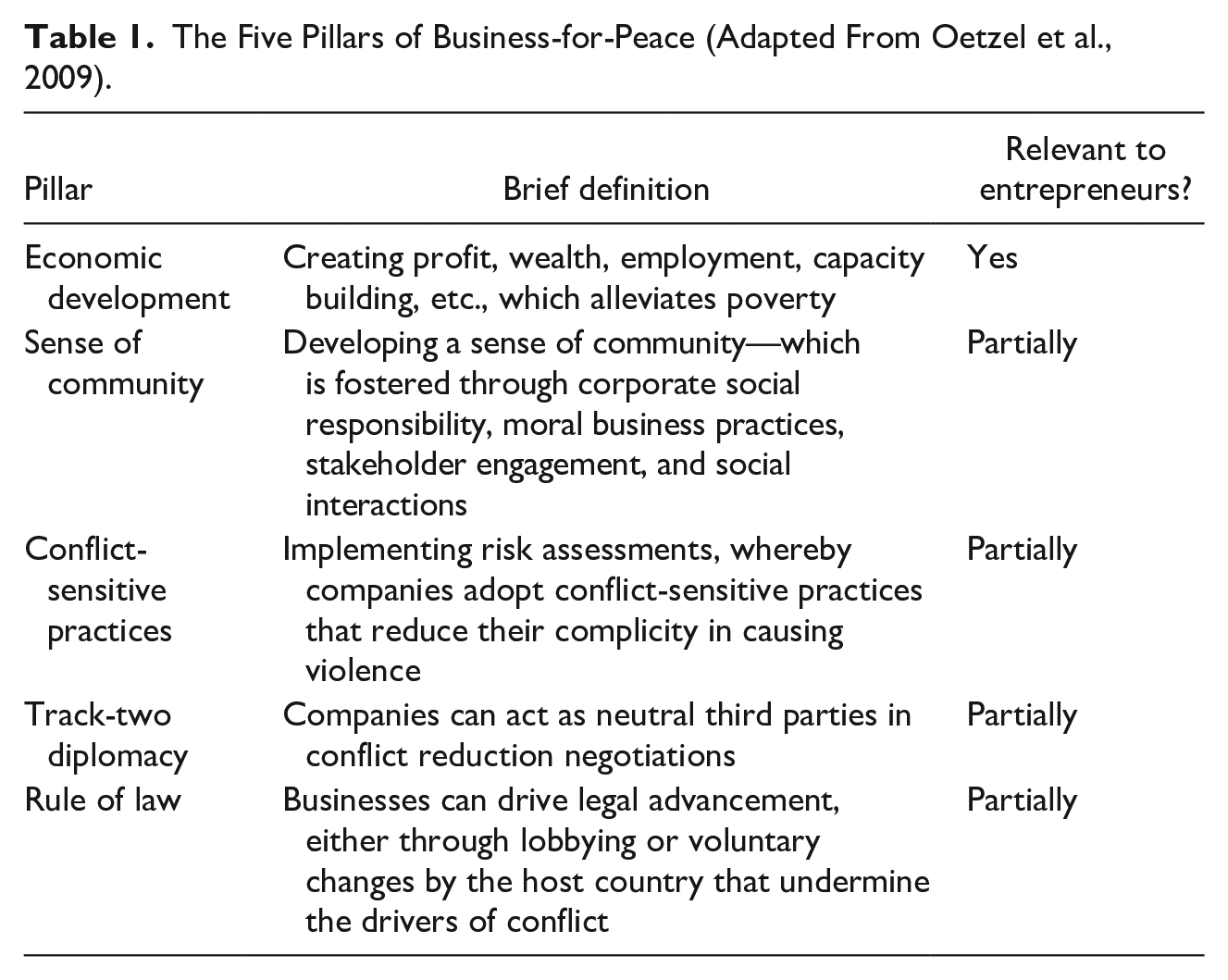
Of the original five pillars, economic development is the cornerstone of B4P scholarship in business. The claim that economic growth reduces violent conflict (Fort & Schipani, 2004) posits that poverty is one of the fundamental drivers of conflict. However, this claim has drawn criticism (Frynas, 2005) with its critics noting that wealth creation in conflict zones predominantly goes to business and political elites (Galtung, 1996), who often overlap in such settings. In response, proponents make two additional claims. First, economic development must be ethical to foster peace (Fort, 2007, 2009, 2016), and second, it is the spillover effects of economic activity that are linked to pro-peace outcomes (Fort & Schipani, 2007; Oetzel et al., 2009). These spillover effects include capacity building and training, employment (Milliken et al., 2015), the provision of goods and services, technology transfer (Spencer, 2008), foreign direct investment (Buckley & Ghauri, 2004), knowledge sharing (Daou et al., 2019), and infrastructure development, much of which can be categorized as broader stakeholder value. Economic development and peace have been linked to MNCs operating in conflict zones (O. F. Williams, 2008), but they also have a strong connection with entrepreneurship and local business activity (Miklian & Medina Bickel, 2020).
The second assertion, sense of community, addresses how business can create a sense of community through corporate social responsibility (CSR) oriented practices among stakeholders. This can create a social license for operating in host countries and involves protecting and promoting minority interests, thus facilitating a series of social benefits that flow into the wider community (Oetzel et al., 2009). The motives for building a sense of community can be instrumental and/or relational and/or moral (Aguilera et al., 2007; Getz & Oetzel, 2009; O. F. Williams, 2008), leaving the scope of “community building” broad by definition and something that can be enacted by both local and foreign companies. However, this pillar is predicated on an independent company building trust in a host community, a view that more closely aligns with the social interactions of an MNC operating in a conflict zone. Accordingly, the pillar has not featured in B4P studies that focus on entrepreneurship. Instead, such studies have adopted social cohesion as the locus of how businesses build community, which prioritizes the direct interactions that businesses have with diverse groups in conflict settings (Joseph et al., 2020; Katsos & AlKafaji, 2019; Miklian & Medina Bickel, 2020).
Third, conflict-sensitive practices and risk assessments concern businesses operating in conflict zones adopting practices that reduce their complicity in fostering violence (Oetzel et al., 2009). It recognizes that although the majority of businesses by default take a neutral noninterference position, they can become complicit in fostering violence through indirect mechanisms (Ganson et al., 2021; Miller et al., 2019). This outcome can be avoided through risk assessments and adopting conflict-sensitive practices in the form of international guidelines that reduce violence and have positive impacts on the wider business community. Within B4P, cases of local companies undertaking the same processes and creating similar downstream effects show limited evidence (Oetzel & Getz, 2012), with some studies suggesting that risk assessments are not applicable outside of normal economic considerations (Katsos & AlKafaji, 2019). Therefore, a link between entrepreneurship and conflict-sensitive practices is yet to be adequately theorized.
Track-two diplomacy examines the role that companies can play as a mediator in nonbinding and informal peace negotiations (Fort & Schipani, 2007) as a neutral third party (Westermann-Behaylo, 2009). Illustrations of this role include MNCs conducting interstate negotiations (Getz & Oetzel, 2009) but also host-country businesses building collectives to foster peace within conflict settings (Oetzel et al., 2009). Its original conception accounted for the role of local actors (Oetzel et al., 2009) and could therefore offer descriptive value in understanding entrepreneurship and peacebuilding. Despite this, several studies have indicated little to no presence of track-two diplomacy among local enterprises (Katsos & AlKafaji, 2019; Katsos & Forrer, 2014), and efforts to explore corporate diplomacy and peace are generally focused on MNCs (Westermann-Behaylo et al., 2015), creating doubt about the relevance of the pillar to entrepreneurial ventures.
Finally, the rule of law pillar states that to build trust with local partners (government, or subsidiaries), businesses need to have confidence that the rule of law is followed. Host countries can build trust with MNCs by adopting new standards, regulations, and laws that, if enforced and complied with, attract businesses to a conflict-affected region. Alternatively, businesses can push host-country actors to adopt, for example, new legal precedents (e.g., codes of conduct, labor standards, environmental standards, human rights priorities, and anticorruption mechanisms) that become norms in the host country (Fort & Schipani, 2007; Oetzel et al., 2009). The initial conceptualization of this pillar cast doubt on whether individual and small-scale businesses could have any impact on peace unless they collectively pursued legal reform (Oetzel et al., 2009). What remains unknown is how entrepreneurs with a limited economic footprint influence or help promote the rule of law in the wider economic ecosystem, with examples presented to date providing only limited evidence of the possible link (Katsos & AlKafaji, 2019).
Remaining Research Gaps
In summary, B4P scholarship shows an implicit connection to entrepreneurship through the economic development brought about by business activity, while it is unclear how the remaining pillars connect to entrepreneurs in conflict zones. Unlike MNCs, entrepreneurship differs greatly in its interaction with conflict settings, as entrepreneurs (a) have a smaller economic footprint and (b) are owned and managed by actors who are affected by and located within the conflict, with prior studies showing that the B4P assertions have often failed to hold true among these actors. Katsos and Forrer’s (2014) examination of Green Line trading in Cyprus found no presence of a peace impact through either track-two diplomacy or risk assessments, while Joseph and colleagues (2020) also found no evidence of track-two diplomacy among local businesses in Lebanon. Furthermore, entrepreneurs themselves may represent elite groups that are connected to conflict (Galtung, 1996; Miklian, 2019; Musa & Horst, 2019), which may change their behaviors toward conflict as compared with MNC actors. This variance requires a tailored exploration of entrepreneurs’ role in peace and conflict as several major questions remain unanswered.
First, and central to B4P, is the normative question of whether or not entrepreneurs should play a role in fostering peace. Business and society scholarship has posited that businesses such as MNCs have a responsibility to, at a minimum, help alleviate conflict (Fort, 2016; Jamali & Mirshak, 2010; Miklian & Schouten, 2019; Miller et al., 2014; Oetzel et al., 2009), but whether this applies to local actors remains to be seen. Second, there is the descriptive question of whether entrepreneurial activity links to peace. With the existing B4P pillars showing little connection to entrepreneurship, these points of inquiry remain unresolved.
To address these issues, this article aims to examine the conceptual link between entrepreneurship and peace within the existing B4P framework. With a growing body of work on entrepreneurship and peace in business and management subfields (Chandra, 2017; Fajardo et al., 2019; Tobias et al., 2013), and established works in parallel fields such as political science and international relations, the article draws on extant scholarship to inform B4P and examine its pillars within a wider theoretical framework. This necessitates an inclusive, systematic review of the role that entrepreneurs play in peace and conflict, as the existing B4P literature alone is limited in its ability to conceptualize this link.
Method for the Literature Review
The review examines the role of entrepreneurship in peace and conflict by drawing on parallel domains to address the following research questions:
This article focuses on entrepreneurs who identify and exploit economic opportunities (Shane & Venkataraman, 2000). Entrepreneuring involves processes at the individual, family, team, household, and firm levels (Fitz-Koch et al., 2018) that can drive changes in markets and the broader society (Wadhwani et al., 2020). Entrepreneurial activity is often viewed as bringing about universally positive benefits, such as reducing poverty and transforming communities (Joseph et al., 2019; Sutter et al., 2019; Tobias et al., 2013), with the negative elements of entrepreneurship being present yet largely understudied (Desai et al., 2013). Entrepreneurial activity through micro-, small-, and medium-sized enterprises constitutes an estimated 90% of firms and 70% of global employment (United Nations, 2019), making entrepreneurship central to the global peacebuilding agenda (Goovaerts et al., 2006; Kanagaretnam & Brown, 2005; United Nations Global Compact, 2010).
Identifying the Sample of Articles
The time period of the review was aligned with contemporary conflict dynamics. Since World War II, the nature of conflict has undergone dramatic change. Large-scale conflict among states has diminished, and the total number of battle-related deaths since 1946 has continued to decline (Roser, 2016; United Nations, 2019). Despite this trend, the total number of active civil conflicts involving domestic and foreign actors has been rising (Roser, 2016). These conflicts are largely conducted by non-state actors such as political militias, criminal organizations, and international terrorist groups (United Nations, 2019). This increased internationalization and complexity has make conflicts longer lasting and more difficult to solve (Dupuy et al., 2017). These protracted conflicts now account for 80% of humanitarian needs (World Bank, 2020), forming unique challenges around food security, displacement, and climate change (Food and Agriculture Organization of the United Nations [FAO], 2017). Because business perspectives, opportunities, activities, and outcomes are widely shaped by surrounding socioeconomic factors (Fitz-Koch et al., 2018; C. C. Williams & Gurtoo, 2016), the review sought to include works from the 1946–2020 time period, although the majority of items were published between 2010 and 2020.
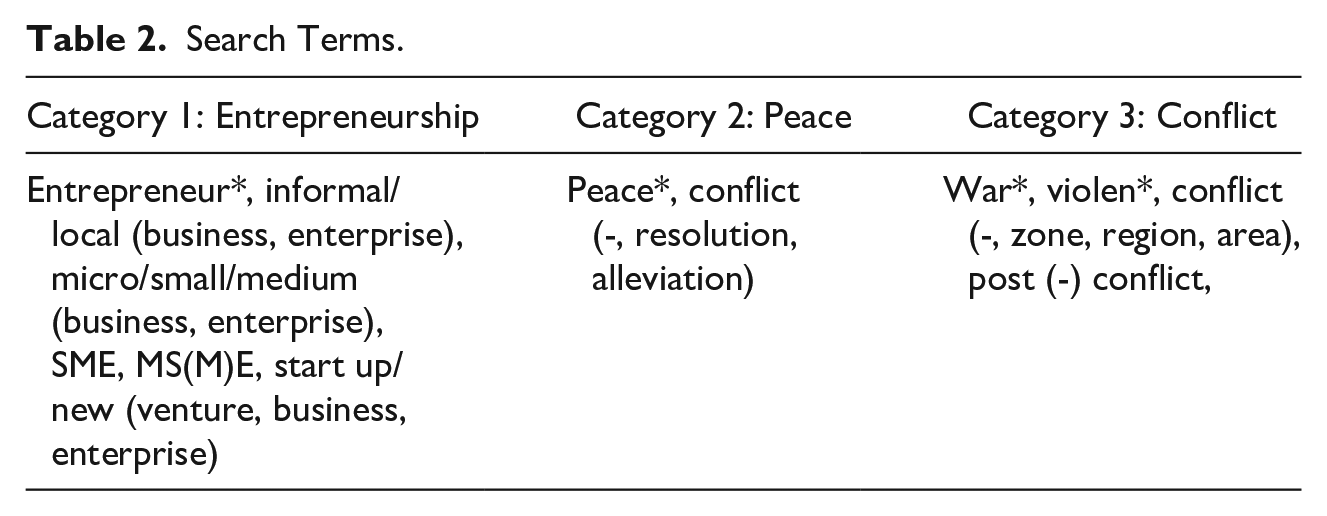
The aim of the review was to integrate diverse works into the B4P debate on entrepreneurship and peace. Therefore, we sought to gain insights from the dominant views that have spanned parallel fields of study. To achieve this goal, we sourced articles using several steps. First, we searched titles, abstracts, and keywords in the Web of Science and Scopus databases using key terms associated with entrepreneurship, peace, and conflict (Table 2). Multiple search iterations were run, using Category 1 terms associated with entrepreneurship, with Category 2 terms associated with peace, and Category 3 terms associated with conflict. This broad-based search generated 1,834 items.
Search Terms.
We then applied several exclusion criteria to ensure the quality and relevance of the research items. To ensure that the most influential and rigorous scholarly works were included in the review, we eliminated books, book chapters, and conference papers, leaving only peer-reviewed journal articles. Second, following the guidance of other entrepreneurship-focused review papers (Fitz-Koch et al., 2018), we only included articles that had been cited more than 10 times or at least once in the last 3 years. The only exceptions to this rule were made for two special issues: first, Conflict, Security and Development, which published a 2019 special issue on “Bringing Business up to the Mainstream—and Down to the Local,” and second, the Journal of Small Business & Entrepreneurship, which published a 2011 special issue on “Small Business, Entrepreneurship and Violent Conflict in Developing Countries.” These special issues were included in the analysis because they were both focused on building the broader B4P field vis-à-vis entrepreneurship and (small) local business. Finally, the authors examined the remaining articles to ensure that they had a significant focus on entrepreneurship and peace. Articles that only referred tangentially to the topic were excluded, which omitted unrelated topics (e.g., managerial conflict, the private health sector), in addition to more nuanced exclusions (e.g., articles that discussed entrepreneurship and poverty reduction, without peace, or business growth factors). Once these were removed, 78 articles remained in the review.
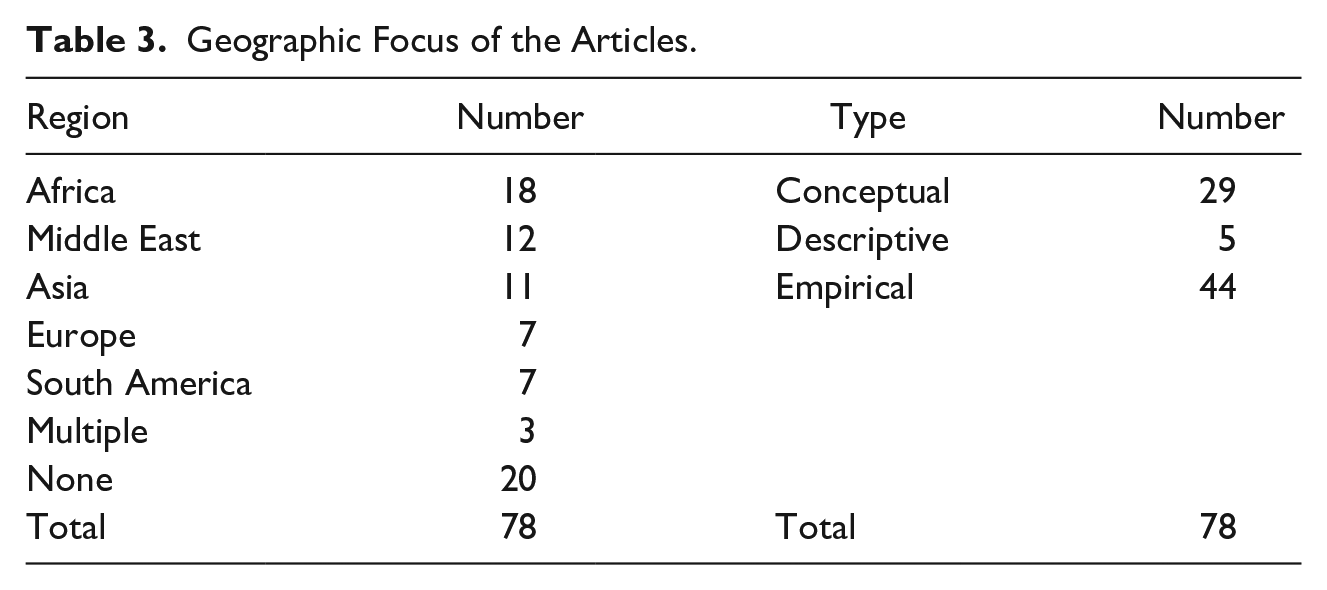
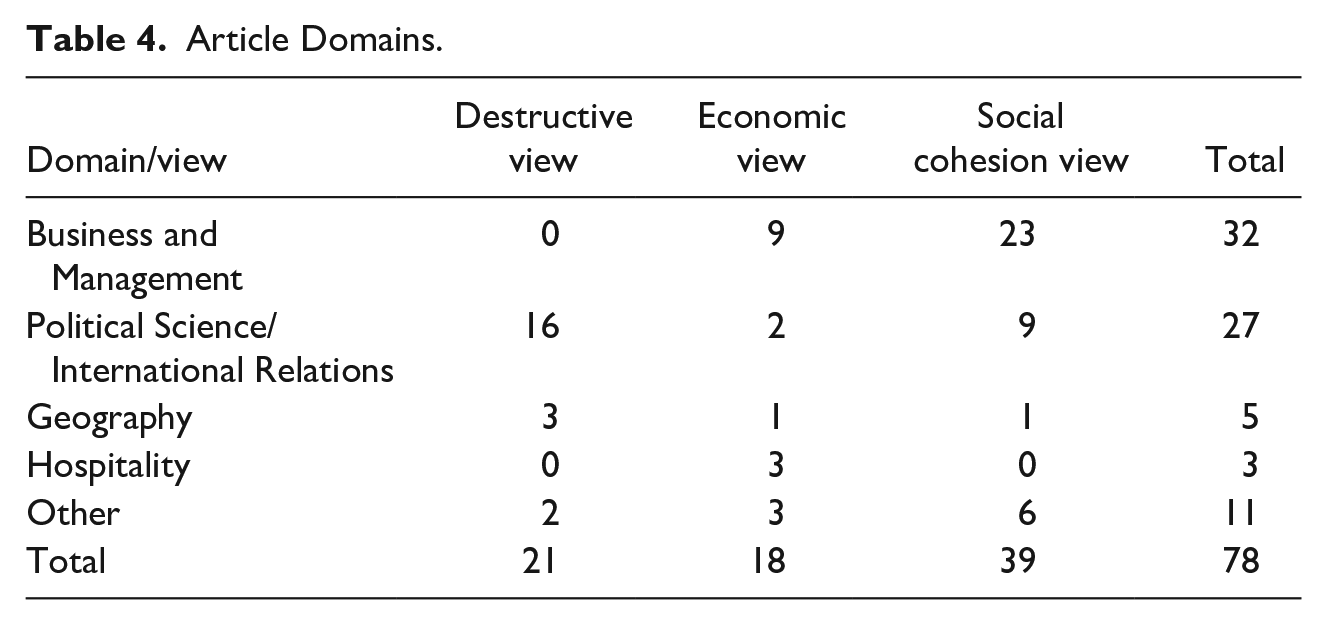
The research settings for the articles were spread across various regions, primarily represented by articles concerning entrepreneurship and peace in Africa, Asia, South America, and the Middle East, with empirical papers representing just more than half (56.4%) of the total articles (Table 3). The contributions came from varying domains (Table 4), the majority of which originated from business and management, followed by political science/international relations.
Geographic Focus of the Articles.
Article Domains.
Notably, there has been a sharp increase in the number of contributions for the last decade, with only 14 articles in the review published from 1946–2009 and the remaining 64 published between 2010 and 2020. The reasons for this increase are beyond the scope of this review; however, this shift coincides with a multilateral push since the turn of the millennium to engage businesses in addressing conflict and humanitarian concerns (see, for example, PRME, 2014; United Nations Development Program [UNDP], 2004; United Nations Global Compact, 2010; United Nations Secretary-General, 2012), which ran alongside key academic contributions on the topic that paved the way for much of the business and peace research seen today (Fort & Schipani, 2007; Nelson, 2000; Oetzel et al., 2009).
Analysis
The analysis was guided by contemporary literature reviews in related management fields (Fitz-Koch et al., 2018; Schrempf-Stirling & Van Buren III, 2020; Sutter et al., 2019). Content analysis was used to draw thematic meaning from the articles through formulating an extensive codebook that was used to classify and draw meaning from the research items. First, an initial codebook was formed with basic demographic characteristics—including the article details, article type (conceptual, descriptive, empirical, see Schrempf-Stirling & Van Buren III, 2020), and region (Sutter et al., 2019). Second, at least two authors independently coded each article, iteratively developing the central research themes and organizing framework. The themes that emerged showed two elements: (a) the presence of the “existing assertions” that prior works on the B4P pillars had already discussed and (b) new elements that had not been accounted for in prior theory. Several new elements emerged across all pillars (e.g., under the economic development pillar, “social contributions” and “personal transformation” were identified), and these are explained further in the Findings section. Following this, articles were organized based on how they viewed entrepreneurs’ impact on peace and conflict, with articles viewing entrepreneurs’ impact as destructive (the destructive view), generating economic value (the economic view), or fostering social cohesion (the social cohesion view). The organizing framework (Table 5) sorts articles based on the three views and shows the frequency of each theme within the three categories.
The Views of Entrepreneurship in Peace and Conflict.
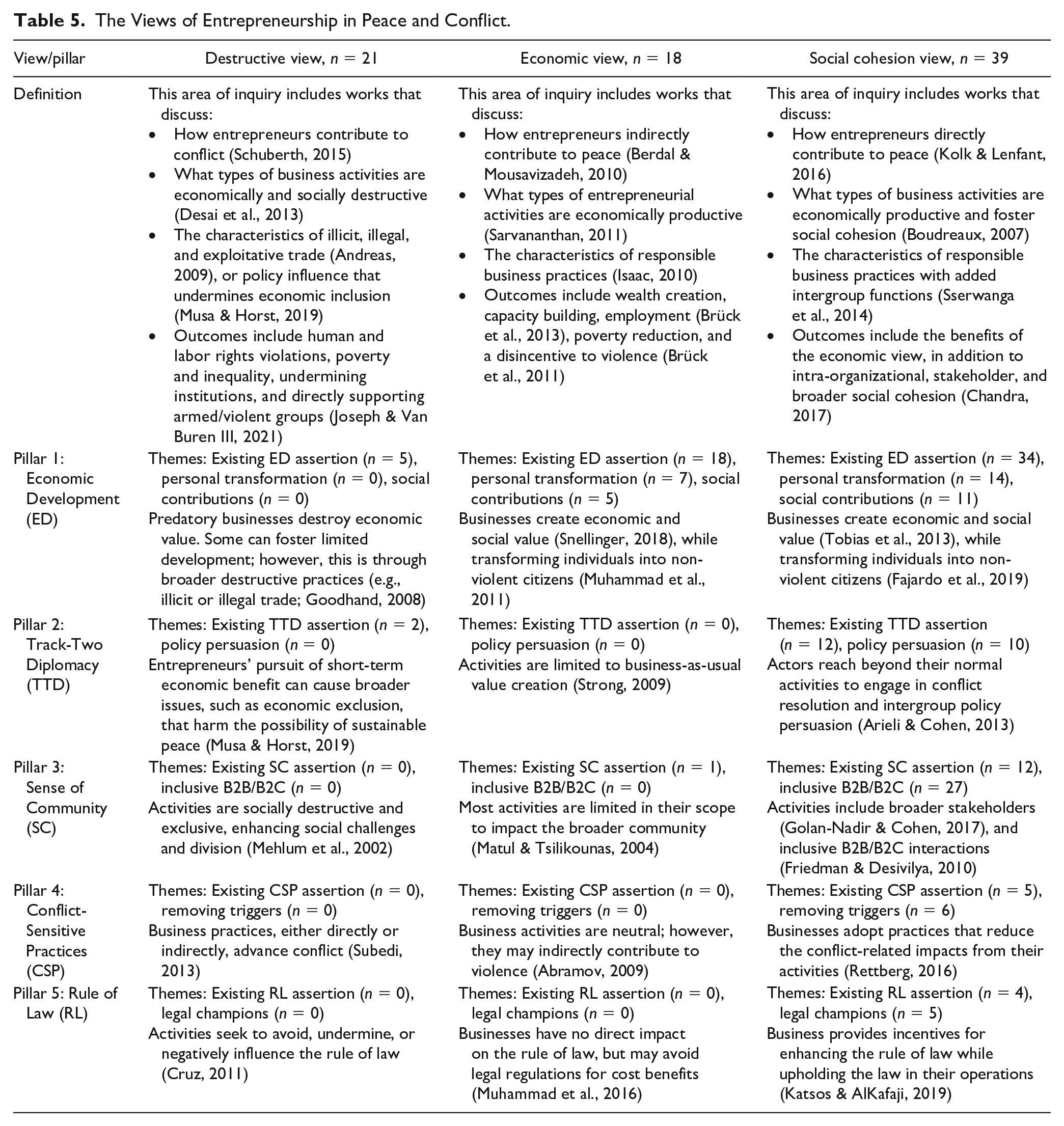
Discrepancies in coding were consolidated by discussion and subsequent unanimous vote among the authors, resulting in the classification and analysis of all research items according to the organizing framework (Table 5).
Findings
The analysis found (cf. Table 5) three distinct groups of articles that depicted the role of entrepreneurship in peace and conflict: the destructive view (n = 21), the economic view (n = 18), and the social cohesion view (n = 39). An examination of the three views reveals several new insights for B4P while also providing normative and descriptive commentary on the role of entrepreneurship in peace and conflict (cf. Figure 1).
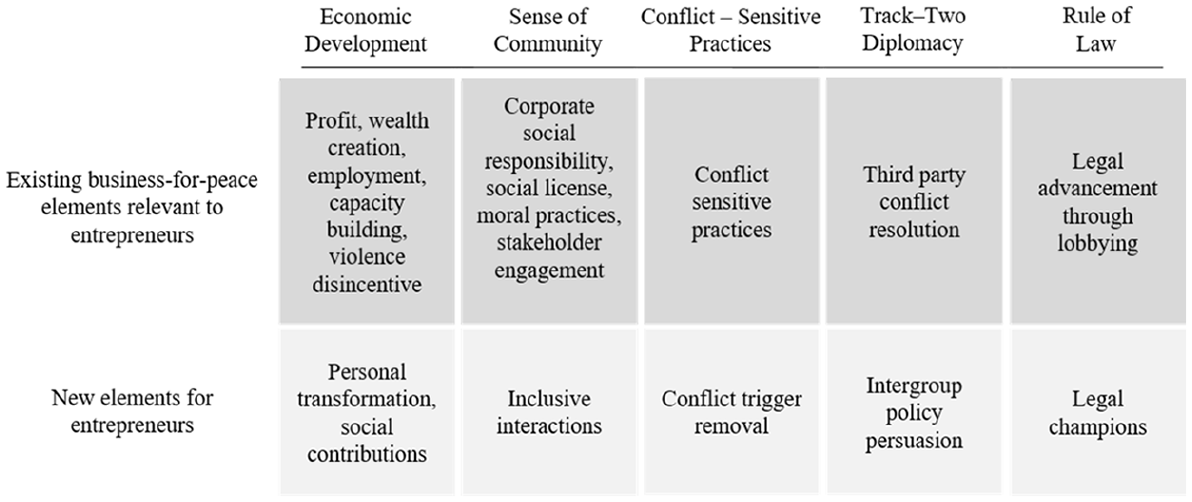
The pillars of entrepreneurship and peace.
In delineating the three views, articles were grouped based on the predominant instrumental outcome of entrepreneurship featured in the article. Prior studies have sought to classify businesses through frameworks that integrate peace with business from a motivational perspective—for example, peace entrepreneurs, instrumental entrepreneurs, and ethical companies (Fort, 2016), detailing self-interest versus moral reasons (Rettberg, 2016). Not only do we believe that there is a lack of individual-level empirical support to justify claims concerning the motivation of entrepreneurs, but the review demonstrated consistently that entrepreneurs can pursue peace for concurrent ethical and instrumental reasons (Bull & Aguilar-Støen, 2019; Golan-Nadir & Cohen, 2017; Rettberg, 2016), challenging the usefulness of binary frameworks. With peace and conflict being the focus of the present review, we prioritized the peace and conflict outcomes of entrepreneurial activity in our framing, explicating ethical variance under these headings. This instrumental focus, therefore, found the portrayal of entrepreneurship to fit into one of three categories: destructive (conflict causing), fostering economic growth, or promoting social cohesion. The views, and their themes, are discussed subsequently.
View 1: Destructive View
This group of articles predominantly detailed the destructive role that entrepreneurs can play in conflict settings through fostering inequality, human rights violations, illegal activity, poverty enhancement, economic destruction, enhancing division, supporting armed groups, undermining institutions, and illicit trade. Notably, this view was overrepresented by non-business contributions, namely, the political sciences (16 of 21 articles), and underrepresented by business and management studies (0 of 21 articles; see Table 4). The destructive view represents activities that widely undermine the economic pillar of B4P by depriving local residents of productive capabilities (Desai et al., 2013) and fostering economic inequality, both of which enhance poverty and foster the underlying drivers of conflict:
The illicit business side of armed conflict can involve clandestine exports to fund combatants, reselling looted goods on the black market, smuggling weapons and other supplies, sanctions evasion and embargo busting, theft and diversion of humanitarian aid, and covert trading with the enemy (Andreas, 2009, p. 33).
Destructive behaviors can include the actions of local business owners and managers; however, more common is the existence of alliances among businesses that coordinate destructive behaviors. Examples include organized crime (Ahmad, 2015; Mehlum et al., 2002; Schuberth, 2015), business elites (Miklian, 2019; Musa & Horst, 2019), strongmen (Rolandsen, 2019), military actors (Miklian, 2019; Solingen, 2007; Verweijen, 2017), conflict entrepreneurs (aka “conflict profiteers”; Brinkerhoff, 2011; Korf, 2005), and illicit traders (Andreas, 2009). When pursuing their own economic benefit, which is often viewed as short-term and exploitative, destructive entrepreneurs behave in a way that creates social and economic destruction for others in society.
At the micro level, entrepreneurs can engage in socially irresponsible behaviors, petty corruption (Nystrand, 2014), and exploitation (Mehlum et al., 2002). Much of this activity takes place in the informal sector, with conflict zones incentivizing participation in the informal economy (Muhammad et al., 2011). The informal sector demonstrated a link to higher levels of destructive behavior (Rettberg et al., 2011). This can drive profiteering and short-term opportunity exploitation and thus increase division and inequality to the detriment of broader society, meaning that:
. . . the gains made by conflict entrepreneurs and war winners feed grievances caused by perceived discrimination, exclusion, and inequality among ethnic groups (Korf, 2005, p. 214).
Long-term capability deprivation in the broader society leads to diminished organizational capabilities and associated resources used for economic production. This deprivation, in turn, drives actors toward nonproduct profit-making activities (Rettberg et al., 2011) and when institutionalized can result in a vicious conflict economy (Andreas, 2009; Schuberth, 2015). In such environments, corruption becomes institutionalized and accepted as a normal way of doing business (Nystrand, 2014) to the detriment of prospects for sustainable peace.
At the meso level, business elites have used their collective influence to restrict broader social and economic advancement, commonly for their own self-interest (Bull & Aguilar-Støen, 2019; Goodhand, 2008; Hagan et al., 2015; Musa & Horst, 2019) but sometimes also to support terrorist ideologies (Ahmad, 2015) or criminal-political ends (Brinkerhoff, 2011; Schuberth, 2015). An example is Myanmar (Miklian, 2019), where elites linked to the military dictatorship were the primary partners of foreign investment that followed its nominal end in 2011. By seizing control of public assets, an instant elite class of businessmen was established, doing little to channel such benefits to the poor in the country. Although the joint activity of elites can be destructive, the conundrum is that they can generate short-term and fragile “peace,” which comes with economic benefits—often when it is in their own self-interest. Musa and Horst (2019) also demonstrated this phenomenon in the case of Somaliland, whereby elites helped foster peace but also restricted private-sector advancement, blocked access for foreign companies, and engaged in tax avoidance for their own benefit.
View 2: Economic View
This group of articles focused on the positive trickle-down effects that economic activity can have on alleviating conflict and the drivers thereof. Notably, business and management scholarship were predominantly represented in this view (9 of 18 articles), with minor contributions from other fields of study (Table 4). Unlike the destructive view, the value that is created under this view is posited to come about through responsible economic practices and therefore is not created in a way that detracts from other social groups. In line with Oetzel et al.’s (2009) view of economic development and B4P, ethical economic activities create trickle-down effects that contribute to peace such as increasing wealth, capacity building, and the prospect of economic advancement as a disincentive toward violence as well as an incentive to maintain peace (Brück et al., 2011, 2013; Desai, 2011). On this point, Brück et al. (2011) is instructive:
[Entrepreneurship] can have a dampening effect on conflict when, for example, the private sector entrepreneur provides jobs to young men who may otherwise join a rebel movement (Brück et al., 2011, p. 164).
Responsible economic activity is closely linked to the institutional environment, with the destructive view associated with weak institutions and high levels of corruption, whereas operating environments that offer entrepreneurs secure property rights, contract enforcement, and low barriers to entry dissuade destructive behavior and foster productive economic growth (Strong, 2009; Zhang, 2010). When local officials and businesses work together, post-conflict zones can be developed in an ethical fashion (Abramov, 2009), creating profitable opportunities that have downstream benefits (Zhang, 2010). The humanitarian sector, as well as specific interventions such as micro-finance programs, can also play a role in fostering growth within an ethical framework (Berdal & Mousavizadeh, 2010).
The mode of economic activity through entrepreneurship can be opportunity based and provide avenues for wealth creation (Strong, 2009; Zhang, 2010). The businesses most able to grow their economic and social footprints generate the trickle-down effects of economic activity mentioned in B4P scholarship. In place of B4P, theoretical frameworks such as transformational entrepreneuring can be used to describe the downstream effects that have positive impacts on surrounding communities (Kolade, 2018; Tobias et al., 2013). Such pro-peace effects are achieved through exploiting opportunities, pivoting, and innovations tailored to conflict settings—such as using a site’s conflict history for tourism purposes (Zhang, 2010) or redesigning supply routes to avoid extortion from local gangs (Jha, 2018).
Although opportunity-based innovations were cited, the review also revealed that necessity-based entrepreneurship is more common (Cañares, 2011; Muhammad et al., 2011). This type of business is performed for subsistence only and is done out of income necessity, lack of employment opportunities, or (in some cases) women taking up entrepreneurship as their husbands were killed or injured in fighting (Muhammad et al., 2011). Necessity-based business activities can be a response to the outbreak of violence (Branzei & Abdelnour, 2010); however, the benefits of short term “survival” enterprises may jeopardize long-term economic growth and broader trickle-down impacts (Bullough et al., 2014) and also not offer the benefits for sustainable peace that larger and more stable local businesses can.
The economic development pillar and personal transformation
The economic view supports the pro-peace elements highlighted in the economic development pillar of B4P; however, the review also revealed two new elements not mentioned in prior theory (Figure 1). The first, personal transformation, describes individuals who were previously engaged in violent conflict, undergoing personal transformation through their engagement in entrepreneurship and other forms of local business (Brück et al., 2013; Chandra, 2017; Fajardo et al., 2019; Joseph et al., 2020; Kolade, 2018; Kolk & Lenfant, 2016; Rettberg, 2007). This engagement provides an alternative to lure actors away from continuing the conflict cycle. In concluding a study of entrepreneurship in Boko Haram-affected Nigeria, Kolade (2018) observed that:
Thus, entrepreneurship is seen as a critical instrument to transform the status of youths as outsiders and fringe elements, into economically and civically empowered citizens with stakes in the peace and progress of society. In other words, entrepreneurship transforms otherwise disillusioned and potentially destructive youths into active stakeholders and co-custodians of public good (Kolade, 2018, p. 759).
Furthermore, the development of successful enterprises can provide examples to empower others to engage in productive, rather than destructive, entrepreneurship. As noted by Bullough et al. (2014) in their study of entrepreneurial behavior in Afghanistan:
The men and women who believe in their abilities and are tough enough to persevere are transformational examples who can inspire and motivate others to engage in businesses that grow and develop their communities (Bullough et al., 2014, p. 492).
Actors who underwent personal transformation were typically ex-combatants (Fajardo et al., 2019; Rettberg et al., 2011) or militia members and ex-criminals (Rolandsen, 2019) who became peaceful members of society and responsible citizens. To facilitate this transformation, a process of capacity building by a third-party actor was often involved, which generally included employment (Chandra, 2017) and training (Anugwom, 2011).
The economic development pillar and social contributions
The second new element that the review offers for the economic development B4P pillar highlights the social contributions of entrepreneurs within conflict zones (Figure 1). The review demonstrated how these actors make direct, often informal, social contributions to their communities (Brück et al., 2011; Golan-Nadir & Cohen, 2017; McSweeney, 2020). This can be done through direct philanthropy (McSweeney, 2020), representing a mechanism of localized wealth-sharing that can include infrastructure contributions or direct support for those affected by conflict (Muhammad et al., 2011), all of which advance economic equality. Social entrepreneurs, who purposefully target value creation for a social cause in society, are commonly cited under this category:
. . . some entrepreneurs, called social entrepreneurs, make it the explicit goal of their activity to improve the welfare of citizens affected by violent events, illness, poverty, and crime (Brück et al., 2011, p. 165).
Conflict environments can encourage social contributions from entrepreneurs who respond to the institutional voids created by ongoing violence (Brück et al., 2013). In their examination of Afghan entrepreneurs, Muhammad and colleagues (2011) cited the preference for entrepreneurs to favor nontraditional sectors, such as health, social welfare, and education, citing one participant, Saleem, who sought to generate social contributions out of the surrounding difficulty:
I graduated in difficult times where I was supported only by mother and younger brother. In return, I had to feed them by providing home tuition to school children. Utilizing that experience, I opened a primary school where we provide quality education at competitive rates (Muhammad et al., 2011, p. 439).
There is some evidence that social contributions can be enhanced through collaborative mechanisms. When entrepreneurs are linked to, for example, public/private partnerships or nongovernmental organizations (NGOs), these contributions can multiply (Abramov, 2009).
View 3: Social Cohesion View
The third view, social cohesion, was the predominant form of expression concerning entrepreneurship in peacebuilding. This was predominantly represented in business and management studies (23 of 39 articles), with notable contributions from political science and international relations (nine of 39 articles; see Table 4). The social cohesion view demonstrated how entrepreneurs can go beyond economic and social value creation to promote cohesion among social groups that are, or were, previously in conflict. The nature of this activity can be closely aligned to the four remaining B4P pillars (track-two diplomacy, sense of community, conflict-sensitive practices, and rule of law), which have a more direct impact on peace compared with the indirect trickle-down benefits of the economic view. For each of the existing B4P pillars, an entrepreneurship-specific extension was uncovered in the review and is further discussed.
The track-two diplomacy pillar and intergroup policy persuasion
For entrepreneurs and local businesses, examples of traditional track-two diplomacy were cited (Berdal & Mousavizadeh, 2010; Musa & Horst, 2019; Rettberg, 2007, 2016; Rettberg et al., 2011), whereby influential business actors would intervene, or be involved with, actions to reduce direct instances of violence. Cases included private sector actors in Kenya intervening to stop violence in the 2007–2008 elections:
[t]he Kenya case. . . notes how businesses genuinely engaged to reduce election violence (Ganson, 2019, p. 215).
Furthermore, entrepreneurs can play a role in influencing policy that maintains trade and contact among previously warring groups, termed here as intergroup policy persuasion. Actors who engage in this activity have been termed “policy entrepreneurs” who can be (among others) business actors that in conflict settings influence policy to normalize relationships between previously warring groups, as demonstrated by entrepreneurs in Israel and Palestine:
Policy entrepreneurs in the private sector are not merely business entrepreneurs, rather they are business people, usually affiliated with large and medium size businesses, who try to influence or change policy outcomes to serve their interests . . . These entrepreneurs focus on promoting interests based on cross-border initiatives and interactions to maximize personal economic benefits (i.e., expanding markets, decreasing transaction costs, etc.) (Arieli & Cohen, 2013, p. 242).
Private sector actors who engage in policy persuasion do so through specific and coordinated action, possessing political influence that reaches beyond the bounds of normal business activities. Following the Northern Ireland peace accords, Sir George Quigley was among several private-sector actors to engage in policy persuasion, playing a key role in establishing the Joint Business Council that played a major role in establishing cross-border trade links and lobbying for policy change:
Sir George Quigley is one of a number of individuals who made an outstanding contribution to cross-border cooperation through the application of business expertise combined with political acumen (Hayward & Magennis, 2014, p. 169).
The motivation in this domain to influence policy was predominantly instrumental (Golan-Nadir & Cohen, 2017; Musa & Horst, 2019; Rettberg, 2016), with conflict in the form of kidnapping, extortion, physical destruction, and general insecurity increasing costs and barriers for local business actors (Rettberg, 2007). Moral reasons for peace were cited; however, these were often considered secondary in importance (Golan-Nadir & Cohen, 2017; Hayward & Magennis, 2014). The nature of this influence was often performed discreetly due to political sensitives and the controversial role surrounding the interaction between business and politics (Barbara, 2006; Golan-Nadir & Cohen, 2017; Hermes & Mainela, 2014). The mechanisms used were varied, ranging from direct policy lobbying (Golan-Nadir & Cohen, 2017), inclusion of private sector actors in negotiating teams (Rettberg, 2007), establishing joint financial initiatives or representative groups (Arieli & Cohen, 2013), or advancing CSR narratives and public statements for peace (Ben-Porat, 2005; Bull & Aguilar-Støen, 2019). Although there was success shown in influencing policy that fostered intergroup cohesion, the ability of business actors to challenge the hegemony in their local settings to bring legitimacy to peace-writ-large has been questioned (Ben-Porat, 2005).
The sense of community pillar and inclusive B2B/B2C interactions
Community development through CSR practices were featured in the review, with CSR programs cited as being done both to foster peace and to allow businesses to operate within conflict environments:
Entrepreneurs who strictly adhere to the principles of CSR and help to build peace at the local level might be better able to shield their business from the negative effects of war than those who simply accept the formal and informal rules of the game at the national, regional, and local level (Rettberg et al., 2011, p. 193).
However, more frequently, entrepreneurs promoted a sense of community through inclusive business-to-business (B2B) and business-to-customer (B2C) interactions, generated through normal daily processes that were then observed as pro-peace (Anugwom, 2011; Chandra, 2017; Fajardo et al., 2019; Golan-Nadir & Cohen, 2017; Jha, 2018; Kolade, 2018; Svensson & Seifried, 2017; Tobias & Boudreaux, 2011; Tobias et al., 2013). Pro-peace engagements occurred when managers and owners were “inclusive,” refusing to exclude outgroups from their business activities (Friedman & Desivilya, 2010; Joseph & Van Buren III, 2020, 2021; Mor Barak, 2020). This was done through daily business interactions that facilitated social cohesion at the community level, as described by Chandra’s (2017) example of Retro Café in Indonesia, which sought to employ, train, and demobilize ex-terrorist combatants:
Not only does Retro Cafe serve as an “exit point” for ex-terrorists, it also serves as what the founder calls an “open tent” . . . where employees can meet people of all walks of life, from police and anti-terror officers, judges, ethnic Chinese, Christians, Hindus, Buddhists, and Westerners (all possible “enemies”), to religious hardliners (Chandra, 2017, p. 667).
Within states, divides can exist between ex-combatants and the wider community to which entrepreneurship offers a meeting point that can help disband such boundaries through interaction and advancing engagement (Fajardo et al., 2019). B2B/B2C interactions can also go beyond community-level tensions and take place at an interstate level despite residual political tension, such as the tourism industry between China and Taiwan (Guo et al., 2006) or on the Korean peninsula (Cho, 2007). Such contact facilitates pro-peace orientations as demonstrated between Hutu and Tutsi coffee farmers in Rwanda:
Overall, meaningful contact with members from the other group was significantly correlated with low distrust and conditional forgiveness among our survey participants; hence, the survey results provide initial support for the theory-based link between contact and positive intergroup attitudes (Tobias & Boudreaux, 2011, p. 236).
On some occasions, these interactions can also lead to subsequent peace-focused initiatives that go beyond social engagement alone. When examining Israeli entrepreneurs, Golan-Nadir and Cohen (2017) describe how:
On the micro level, these entrepreneurs use their abilities as networkers to create “business-to-business” and “people-to-people” connections with the Palestinian side. Such private initiatives have led to the establishment of two institutions that promote peace through business alliances (Golan-Nadir & Cohen, 2017, p. 31).
Fostering inclusive intergroup contact has become essential to cross-border business-peace initiatives (Hayward & Magennis, 2014) and NGO programs. Exemplars include the collective coffee trade in Rwanda, with collectives established with the support of NGOs to build shared processing sites that promote Tutsi and Hutu integration and collaboration in the industry (Tobias & Boudreaux, 2011; Tobias et al., 2013), and the Footprints-of-Peace project run within the Columbian coffee industry, which established similar communal goods to generate income distribution and collective supply chains (Miklian & Medina Bickel, 2020).
The conflict-sensitive practices pillar and removing conflict triggers
Several cases of conflict-sensitive practices among entrepreneurs were found, which included adopting codes of conduct to reduce the impact of private sector activity on conflict (Rettberg, 2016; Svensson & Seifried, 2017). In these cases, entrepreneurs can join initiatives that promote conflict sensitivity, such as various trade associations (Ganson, 2019) or UN initiatives such as membership in the UN Global Compact. The latter, for example, promotes guidance on conflict-sensitive practices as observed by Rettberg (2016):
UN Global Compact member companies, for example, tend to stand out among their domestic equals in terms of investing time and material and human resources in CSR (Rettberg, 2016, p. 487).
What was more commonly seen, however, was entrepreneurs removing conflict triggers from within their businesses through a series of internal, often informal, management practices (Chandra, 2017; Fajardo et al., 2019; Katsos & AlKafaji, 2019; Svensson & Seifried, 2017). This includes organizational design elements to which the goals of profit, social value creation, and peace are integrated into a business’ culture (Svensson & Seifried, 2017). This results in a series of policies aimed at removing conflict triggers between staff and stakeholders. Katsos and Alkafaji (2019) cited examples of how company managers in Iraq would manage the sectarian divisions among their staff, such as forbidding the discussion of religion or sects at work and training programs to resolve conflict between staff:
Company managers noted that they found capacity building as a useful tool for peace promotion . . . One way was through internal company training programs that ostensibly focused on teambuilding and also included large elements of conflict resolution (Katsos & AlKafaji, 2019, p. 46).
Chandra (2017) noted similar practices, with managers setting the internal relationships of their enterprises on “purely business” bases, forbidding discussion of ideological issues. These practices were not only conducted by managers looking to remove conflict triggers among their staff, but also by ex-combatants trying to make their way as entrepreneurs. As Tatiana, a former militant turned entrepreneur in Columbia demonstrated while initially she intimidated potential clients she later softened her attitude and changed her fashion to remove the fear that stakeholders had of her:
Finally, I tried out a new look, and immediately felt people’s positive reaction (Fajardo et al., 2019, p. 376).
Furthermore, entrepreneurs can adopt varying strategies to remove themselves from direct conflict, allowing them to continue operating within hostile environments. As described by Anugwom (2011) in discussing how female entrepreneurs navigate among militia activity in the Niger Delta region:
Women entrepreneurs are considered safe by the militants who are wary of betrayal and live a life of constant relocation of camps and base of operation. Women new to the trade whose business takes them to the interiors are usually accompanied by the older traders who act as some sort of surety and assurance to the militants that the new women can be trusted (Anugwom, 2011, p. 249).
For entrepreneurs located in a conflict zone, these practices can be a matter of business necessity, as unlike MNCs that can select from local or international staff to fill their ranks, local managers, and owners must find staff among the local groups involved in conflict—making conflict resolution necessary to ensure that violence doesn’t disrupt their normal business operations.
The rule of law pillar and legal champions
The rule of law played some role in the review, albeit limited in comparison to the other pillars. Several of the foundational papers on B4P advocated that entrepreneurs and local businesses could play a role in advancing the rule of law through external validation and applying their influence (Fort & Schipani, 2007; Oetzel et al., 2009; Oetzel & Getz, 2012). However, evidence for this role based on the present review was limited. Bull and Aguilar-Støen (2019) demonstrated how business elites in Guatemala and El Salvador sought to promote the rule of law:
In the midst of a cascade of corruption revelations in both countries the business elites, in other words, have moved from portraying themselves, the entrepreneurs, as embodying the spirit of the nation that may be revealed as state hindrances have been removed, to being the main protagonists of social dialogue, democracy and state institutions based on the rule of law and technical capacity (Bull & Aguilar-Støen, 2019, p. 128).
However, these examples were limited, and more frequently, entrepreneurs would support the rule of law by acting as exemplars and influencing others. These legal champions follow the rule of law despite their widely corrupted operating environments and in turn they influence others to do the same (Ganson, 2019; Joseph et al., 2020; Katsos & AlKafaji, 2019; Nystrand, 2014). This includes companies taking direct measures to avoid potentially corrupting scenarios, as described by Katsos and AlKafaji (2019) in their examination of local businesses in Iraq:
The corruption [in Iraq] was described as endemic to almost every ministry and federal government department. This was a main reason that some businesses had a policy that refused to do direct contracts with the government (Katsos & AlKafaji, 2019, p. 48).
Legal champions can, however, be rare within highly corrupted environments. In Nystrand’s (2014) study of 12 business owners in Uganda, only one business in the study refused to engage in any form of corruption. The precarious relationship that entrepreneurs have with the rule of law was further illustrated by the destructive characteristics highlighted in the review, as it was shown that conglomerates can undermine legal reform by, for example, lobbying to maintain protectionism (Musa & Horst, 2019). But more commonly, smaller scale actors consistently violate the rule of law, often out of fears for survival. This can include paying bribes to access trading sites (Rolandsen, 2019), access government documents (Nystrand, 2014), or for personal safety (Jha, 2018; Miklian & Medina Bickel, 2020). Muhammad et al., (2016) demonstrated how entrepreneurs in Afghanistan needed to negotiate with the Taliban to survive:
Some entrepreneurs have succeeded in financial terms, and, importantly, in their own terms, through a proactive strategy where they quickly acquiesced to the aggressors . . . during the conflict period they earned profit, gained bigger market share; and made valuable contributions to the local community, thus offsetting the potential criticism that overall he was contributing to a negative situation . . . The alternative would have been to close their businesses, which was a driver to overcoming any qualms about this course of action (Muhammad et al., 2016, p. 78).
Therefore, although rare cases of legal champions were cited, more frequently entrepreneurs were shown to engage in indirectly supporting conflict institutions as a means for survival (Anugwom, 2011; Jha, 2018; Muhammad et al., 2016; Rolandsen, 2019).
Discussion and Future Research
The present review demonstrated how entrepreneurs can concurrently foster both peace and conflict (Andreas, 2009; Arieli & Cohen, 2013; Austin & Wennmann, 2017; Brück et al., 2011; Joseph & Van Buren III, 2021; Rettberg et al., 2011; Rolandsen, 2019). This observation challenges the idea that supporting entrepreneurship in conflict zones is inevitably pro-peace, which further challenges the “win-win” logic often promoted through B4P and the UN Global Compact (Marijnen & Schouten, 2019). Compared with MNCs, entrepreneurs experience greater exposure to conflict dynamics (Musa & Horst, 2019; Nystrand, 2014), which affects the normative, descriptive, and instrumental outcomes of business activity. As issues of peace and conflict cannot be solved by any single actor (Hermes & Mainela, 2014), the review has shown that the associated peace and conflict implications cannot be separated from meso- (e.g., conglomerates vs. organized crime) and macro-level (e.g., policy, political economy) dynamics that have a direct impact on entrepreneurial activity. Within this framework, the review provides several insights for how entrepreneurial activity can advance peace, furthering the existing pillars of B4P theory.
The Normative Inquiry
In line with the broader business and society literature, the present review draws similar conclusions on the normative role of entrepreneurs in conflict zones yet introduces varying insights on how this is achieved. Business and society scholarship has posited that businesses have a responsibility to, at a minimum, help alleviate conflict (Fort, 2016; Miklian & Schouten, 2019; Miller et al., 2014; Oetzel et al., 2009), which we find to be equally applicable to entrepreneurs (Gunduz et al., 2006) due to their ability to either enhance peace or to exacerbate conflict. Yet unlike the broader literature on CSR that links responsible economic activity to peace (Fort & Schipani, 2004; Nelson, 2000; Strong, 2009) widely through a “do-no-harm” framework (Miller et al., 2014), we argue that entrepreneurs’ increased embeddedness in the local context means that greater engagement in the intergroup elements of conflict is required of them. While MNCs can maintain a degree of separation from a social conflict and exit the conflict at will, entrepreneurs (by some combination of birth, place, religion, affiliation, etc.) are inherently connected to the conflict, with most unable and/or unwilling to exit. This makes engagement in the intergroup dynamics of a conflict unavoidable for entrepreneurs, with the present article stressing the essentiality of social cohesion patterns to advance peace. This view concurs with a growing number of studies claiming that ethical economic conduct, without accounting for intergroup dynamics, is insufficient in reducing violence (Ganson et al., 2021; Joseph et al., 2020; Miller et al., 2019). Here we note that the economic view primarily strips entrepreneurs of their connections and inherent embeddedness to community-level conflict dynamics and the broader political economy, and future studies that examine the normative mode of entrepreneurs vis-à-vis peace, therefore, should apply caution in narrowing their examination of any one element in isolation to account for such complexity.
At the micro level, the idea of entrepreneurs advancing social cohesion aligns with the notion of housing such business activities within a CSR-oriented framework (Miklian & Medina Bickel, 2020; Oetzel et al., 2009; Rettberg, 2016). However, CSR, we posit, is the wrong frame to understand the role of entrepreneurs in conflict zones, arguing for a greater engagement in the broader social dynamics of conflict. While CSR for MNCs largely deals with eliminating indirect contributions to conflict and progressing social contributions, entrepreneurs’ roles in peace and conflict are more direct and fostered through intergroup engagement. Destructive entrepreneurs can directly engage in economic raiding, violence, and illicit practices that erode value in the local community, while social cohesion entrepreneurs can have a direct impact on peace at the community level by demobilizing individuals, building inclusive community ties, and directly contributing to those affected by conflict. Within this framework, it is unlikely that entrepreneurs can resolve conflicts on their own, but they can help to stabilize regions in conflict, with peace unlikely to be sustainable without the support of other local business actors, making entrepreneurship and broader local business allies to peace (Ben-Porat, 2005; Berdal & Mousavizadeh, 2010; Rettberg, 2007).
Similarly at the meso level of analysis, entrepreneurs’ pro-peace or conflict-causing role is largely a function of their social engagements with the broader political economy. The review demonstrated that business elites and business conglomerates have significant capacity to drive change, both through direct track-two diplomacy and by influencing pro-peace intergroup policy change. The review, however, showed that post-conflict zones with strong institutional environments, such as Northern Ireland, have a greater propensity to champion the link between business and peace than those with weaker environments (Ben-Porat, 2005; Hayward & Magennis, 2014; Oetzel et al., 2009; Strong, 2009), and the relevant question concerning entrepreneurs is how they use their influence to either help build or detract from the formation of such institutions. Furthermore, the review highlighted meso-level initiatives in which entrepreneurs can engage to incentivize broader pro-peace activity, such as (a) disarmament, demobilization, and reintegration programs using local business vectors (Fajardo et al., 2019), (b) educational programs that dissuade engagement in illegal activities (Muhammad et al., 2011), and (c) the normalizing of CSR to create societal transformation (Bull & Aguilar-Støen, 2019).
Future research concerning entrepreneurship, peace, and conflict must therefore be multileveled. Naturally, the business and management field’s focus almost exclusively has been on organizational-level dynamics, but at the cost of overlooking entrepreneurs’ engagement in the broader political economy. Although there is recognition of entrepreneurship as a socially constructed phenomena (C. C. Williams & Gurtoo, 2016), leading business and management studies examine entrepreneurship as an isolated phenomenon (Branzei & Abdelnour, 2010; Bullough et al., 2014) that can directly and indirectly lead to theoretical bubbles such as the “economic view,” which are largely redundant in explicating peace. Future research on the position of entrepreneurship in peace and reconciliation processes is therefore required to not only consider its economic and social cohesion benefits but also consider the place of entrepreneurship in wider institutional frameworks that can largely influence the direction of entrepreneurial activity toward either positive or negative ends.
The Descriptive Inquiry—Advancing the B4P Pillars
To address the ways in which entrepreneurs can foster peace, rather than conflict, the review integrates varying literature into B4P to offer several new theoretical insights. This contribution addresses the differing size, scope, and conflict exposure of entrepreneurs compared with MNCs. Figure 1 illustrates these advances.
The foundational element of B4P is the economic development pillar, and the present review has shown the importance of economic development and its associated downstream effects (namely, capacity building) in linking entrepreneurs to peace. Entrepreneurs are able to generate these benefits, despite conflict zones presenting acute challenges to starting and growing a business (Hiatt & Sine, 2014). In addition, several new insights, including personal transformation and social contributions, also emerged from the review. B4P scholarship has traditionally positioned economic opportunities as a disincentive against violence—best understood transactionally—to which a loss of income, or conversely, the lost possibility of wealth creation, tips the decision- making of an individual business owner toward peace rather than conflict. Although the present review does not contest this view, it goes one step further by demonstrating that personal transformation is more foundational and sustainable in securing peace, particularly in repurposing ex-combatants in post-conflict environments. Personal transformation directly reduces the number of combatants in a conflict zone while integrating these actors into society—and as a result, fosters harmony at the community level.
Second, conflict-zone economic activity is often criticized as benefiting local elites, especially in contexts where business and government elites overlap or intersect with each other. While MNCs can potentially counteract this by employing local workers and setting fair labor conditions (Katsos & AlKafaji, 2019), entrepreneurs can make direct social contributions to reduce economic inequality, often through philanthropy. Unlike formalized, MNC-centric CSR in the current B4P literature, these contributions are informal and directed toward those in need at the community level, demonstrating their embeddedness in the conflict setting. This is connected to the idea of capacity building as “philanthropy” in the original conception of the economic pillar (Oetzel et al., 2009), with similar motivations cited for capacity building in the review (Chandra, 2017). Although MNC contributions have the potential scope for greater impact, contributions from entrepreneurs are directed toward those most vulnerable in society due to the former’s connections to those affected by conflict.
Building a sense of community also emerged as a strong theme from the review. However, entrepreneurs’ engagement in building community differs greatly from current B4P theory, which states that a sense of community is built through CSR and ethical practices and thus both generates a social license to operate and helps with stakeholder engagement. Posited on the role of a foreign actor engaging with diverse groups in a conflict zone, this pillar is currently conceptualized in terms of formalized practices that both justify the business’ presence and contribute to social cohesion. In contrast, the starting point for entrepreneurs differs greatly, whereby owners of such enterprises belong to a social and/or ethnic and/or religious group either by choice or by birth that is/are often in conflict with other groups. Entrepreneurs can therefore choose to operate freely within their own groups, but doing so exclusively maintains social divides that are only overcome when they choose to conduct business operations across social groups and associated divisions.
In contrast to extant B4P theory, the pattern exhibited by entrepreneurs is less about formalized business practices and more about the motivational position of inclusion, which results in B2B and B2C interactions that reduce intergroup bias and discrimination as well as foster community cohesion. Based on intergroup theory, B2B/B2C interactions alone may not suffice in this regard, but they should be based on equal status, cooperation, and common goals (Allport, 1954; Tobias & Boudreaux, 2011)—conditions that can be present among base-of-the-pyramid businesses (Tobias et al., 2013). The focus of these interactions is therefore on changing mindsets (Miklian & Medina Bickel, 2020), which starts with the entrepreneur and is facilitated through the B2B/B2C networks that form during business activity.
Concerning conflict-sensitive practices, current theory states that MNCs adopt such practices through international norms and codes of conduct (Oetzel et al., 2009). Although there was some evidence of this in the review, for entrepreneurs, conflict-sensitive practices are more focused on removing the localized triggers of conflict—again, representing a local business’ inherent immersion in the conflict environment compared with an MNC operating in the same context. Previously, this type of activity has been noted under B4P pillars such as track-two diplomacy, as MNCs play a mediating role to foster collaboration among local staff members who may be divided along sectarian lines (Fort & Schipani, 2007). However, it is argued here that because entrepreneurs by definition are embedded in the local conflict, removing conflict triggers is not a diplomatic initiative but rather an essential practice to ensure that the sectarian, tribal, ethnic, and religious divides that drive conflict do not interfere in business practices, and concurrently that entrepreneurs do not buttress or enhance these divisions. Removing conflict triggers through inclusive human resource processes was demonstrated through the review and is further supported by prior work that advocates for the pro-peace benefits of such approaches (Lee & Reade, 2015; Reade, 2015; Reade et al., 2019).
The review also confirmed that entrepreneurs, particularly those who are business elites, engage in direct track-two diplomacy, which can play a role in reducing short-term acts of violence. Furthermore, the review demonstrated that these elites can also influence intergroup policy change for maintaining cross-border or internal trade among warring groups. Although omitted from the formal conception of the pillar (Oetzel et al., 2009), this idea aligns with conceptualizations of track-two diplomacy that acknowledge mediated relationships, which extend even as far down as the intra-organizational level (Fort & Schipani, 2007). Although at the macro level policy reform does not change the behavior of violent conflict actors, it can allow for continued intergroup interactions at the community level. Therefore, the loci of business’ intercession in policy reform is to ensure continued cooperation between businesses and customers on opposing sides of a political struggle.
In this vein, local (and indeed, MNC) business practices that institutionalize divisions and end such trading can harm these bonds, whereas policy that fosters this activity creates a level of sub-state peacebuilding. Viewing conflict as a multilevel issue (Kavanagh, 2011)—not only among armed groups but also as a function of the biases and discriminatory practices within and across communities—potentially can bring about a form of diplomacy that results in peace among opposing sides. Our review argues that intergroup policy influence is the result of specific, coordinated action by a unique subset of business actors and more closely aligns to an extension of diplomatic efforts, rather than being a typical spillover effect of economic development that is engaged in by the majority of businesses.
Finally, the original conception of the rule of law pillar in B4P had little connection to entrepreneurs. Although there was some evidence of business conglomerates advocating for legal reform (Bull & Aguilar-Støen, 2019), what was more frequently demonstrated in the present review was entrepreneurs’ refusing to engage in corruption, bribery, and other unethical practices. In this way, these actors become legal champions in business ecosystems where the rule of law has been typically subverted (Joseph et al., 2020; Katsos & AlKafaji, 2019). The concept of legal champions represents an extension of prior theory more suitable to entrepreneurs; however, what the present review did not address was the extent to which legal champions influence the surrounding environment. Such behaviors reduce the support of conflict actors and have direct effects on an individual business’ supply chain; however, the wider indirect effects of such actions remain unknown.
In summary, the article consolidated extant research from diverse domains to establish a degree of consensus on the instrumental mechanisms through which entrepreneurial activity can foster peace. Future research, however, is needed to better understand the types of entrepreneurs who use these mechanisms and who choose to engage in pro-peace activity over and above the destructive patterns that can characterize many conflict settings. To this end, scholars have drawn conclusions surrounding entrepreneurs’ motivational dispositions for engaging in peace (Rettberg, 2016), while others have linked these dispositions to organizational characteristics (Kolk & Lenfant, 2016). In settings as complex as conflict zones, answers may lie in understanding competing logics, tensions, and hybrid demands, which cut across isolated areas of organizational analysis to refocus the examination on the common forces that are driving organizational behavior. To understand these demands, more complex methodological approaches are required from peace and conflict scholars, moving away from single case study examinations toward methods that can extrapolate the multileveled factors that drive such patterns.
Conclusion
The review bridges the gap between current B4P theory and the growing number of contributions being made over the last decade to understand the relationship between entrepreneurship and peacebuilding. With modern-day conflicts now more complex and longer lasting (Dupuy et al., 2017), academic research on the interaction between entrepreneurship and peace will continue to increase as scholars explore durable solutions for sustainable peace. The review has sought to make the broad field of B4P more inclusive of this research by extending its existing pillars: the economic pillar (social contributions, and personal transformation), conflict-sensitive practices (conflict trigger removal), rule of law (legal champions), sense of community (inclusive B2B/B2C interactions), and track-two diplomacy (intergroup policy change; see Figure 1). These extensions account for the unique contextual dynamics that entrepreneurs face and open the door for further contributions to the interplay of business and peace while also helping to theoretically advance B4P, which conceptually has stagnated due to its lack of local-business contextualization.
Furthermore, the article hosts several practical implications that are essential for the role of entrepreneurship in peace. In conflict zones, the humanitarian sector uses business-based entrepreneurial programs to support stability, as entrepreneurship is widely claimed to reduce the impact of war, support post-conflict reconstruction, and promote development (UNDP, 2004). Increasingly these initiatives are preferred over direct aid (Berdal & Mousavizadeh, 2010), with programs usually including direct finance for entrepreneurs, equipment support, or capacity building initiatives. However, despite their prominence, these programs often fall short of meeting their objectives (Bhatt & Tang, 2001; Gueyie et al., 2013; Hartarska et al., 2013; Morduch, 2000). This has increased calls to expand the measurement of such initiatives beyond economic indicators alone.
When selecting beneficiaries for these programs, the sector typically uses a combination of vulnerability criteria alongside some growth predictors. The pro-peace elements of an entrepreneur and the entrepreneur’s business practices are not accounted for, which is problematic as the humanitarian sector could be unintentionally supporting businesses that either directly, or indirectly, stoke intergroup conflict (Miklian, 2019; Miklian & Schouten, 2019). Our article highlights the pro-peace elements of businesses, which can be translated to (a) advanced beneficiary selection criteria (e.g., the sector can scan businesses for pro-peace elements before providing them support) and (b) tailored programming to support pro-peace dynamics (e.g., encouraging intergroup collaborations). In addition to the theoretical advancements proposed in the article, the practical implications offer an avenue to better support the pro-peace elements of entrepreneurship in conflict zones.
Footnotes
Acknowledgements
The research was completed in conjunction with the Business-in-Conflict Research Group at the American University of Beirut (BICAR).
Declaration of Conflicting Interests
The authors declared no potential conflicts of interest with respect to the research, authorship, and/or publication of this article.
Funding
The authors disclosed receipt of the following financial support for the research, authorship, and/or publication of this article: The work in this paper was supported, in part, by the Open Access Program from the American University of Sharjah.
Author Biographies
