




Abstract
Despite emerging study of business initiatives that attempt to support local peace and development, we still have significant knowledge gaps on their effectiveness and efficiency. This article builds theory on business engagements for peace through exploration of the Footprints for Peace (FOP) peacebuilding project by the Federación Nacional de Cafeteros de Colombia (FNC). FOP was a business-peace initiative that attempted to improve the lives of vulnerable populations in conflict-affected regions. Through 70 stakeholder interviews, we show how FOP operationalized local peace and development in four conflict-affected departments of Colombia, and examine FNC’s motivations for and effectiveness of its peacebuilding activities. Our main finding is that FOP’s success supported several existing theories on business engagement in peace both in terms of peacebuilding by business and for local economic and societal development, providing evidence in support of development–business collaborations and local peacebuilding by business under certain targeted circumstances. We relate these findings to existing literature, highlighting where existing business-peace theory is supported, where FOP challenged assumptions, and where it illuminated new research gaps. These findings serve to take business-peace theory forward and improve our understandings of what can constitute success for business-peace initiatives in Colombia and possibly other conflict-affected regions.
Keywords
The multidisciplinary study of business, peace, and development is expanding rapidly. We know much more about the value of business participation in sustainable peace and local development (or business-peace; Bond, 2014; Carroll, 2016; Ford, 2015a; Forrer & Fort, 2016; Ganson & Wennmann, 2016; Oetzel & Breslauer, 2015; United Nations Global Compact [UNGC], 2013). Simultaneously, practitioners and multilateral bodies are calling for the business community to deepen its involvement in postconflict peacebuilding (Alleblas, 2015; Ford, 2015b; Iff & Alluri, 2016; MercyCorps, 2011; UNGC, 2016) through initiatives like the Responsibility to Protect, UN Sustainable Development Goals, Business and Human Rights Framework, and UNGC.
Regarding the practical value of business and peace, recent research has informed key tenants of how the private sector contributes to peace and development. For example, the role of the CEO is essential in business-peace success (Fort, 2015), firms can enjoy reputational rewards for peacebuilding action in fragile local communities that can be just as valuable as traditional mitigation of reputational risk measures (Ganson, Miklian, & Schouten, 2016; Oetzel & Breslauer, 2015), and the investment community is an interested but underutilized asset for peacebuilding and development aims (O’Connor & Labowitz, 2017). In support, quantitative studies explore the impact of firms operating in conflict (Darendeli & Hill, 2016; Oetzel & Breslauer, 2015), and case studies often focus on business actors attempting to bring development and peace dividends (Forrer & Katsos, 2015; Kolk & Lenfant, 2016; Miklian & Rettberg, 2017; Miklian, 2017a).
But business-peace initiatives can also do more harm than good. For example, liberalized economic opening after conflict or repression can be as likely to generate conflict as peace (Midtgard, Vadlamannati, & de Soysa, 2017; Sorens & Ruger, 2014), business engagement in human rights is often undermined by its nonpunitive “checklist” or “guideline” reporting nature (O’Connor & Labowitz, 2017), philanthropic efforts like building schools or hospitals can lead to conflict as businesses usurp local government roles (Miklian & Schouten, 2013), and bodies like the UN can engage in “bluewashing” if initiatives are based only in corporate self-reporting that is not independently verified. Many managers are also skittish about peace action, viewing it as the provenance of government (Ganson & Wennmann, 2016).
However, we still have significant knowledge gaps. For example, typologies of existing business-peace actions and claims (Miklian, 2017c; Oetzel et al., 2010) tend to coalesce around broad impact categories: expansion of economic engagement and growth, local development initiatives to build local capacity and reduce local conflict, importing norms and accountability structures, and undertaking direct diplomatic efforts. Other issues cut across these categories, including that of motivation (Why do firms undertake business-peace action?) and integration (How do firms “do” peace, and who drives this agenda?). But we still lack clarity on the specific conditions that make such ventures more likely to succeed or fail. These may include knowing the importance of a local community or local government role in a business-peace project, the role of firm reputation in a society, the importance of the structure, sector, and nationality of the firm, how integrated the peace project is to a firm’s operational components and profitability, and the value of partnership with established peacebuilding actors. As the private sector becomes significantly more active in global peacebuilding (United Nations Development Programme [UNDP], 2015), it is essential to study these gaps to determine where business-peace interactions are indeed ingenious initiatives that truly help bring peace, where they are well-intended but ultimately ineffective tools, and where they are simply “peacewashing” the exploitation of vulnerable populations for the sake of improving corporate security and access.
To encourage further theoretical refinement on business and peace initiatives, this article examines these questions through exploration of the Footprints of Peace (Huellas de Paz, or Footprints for Peace [FOP]) project by the Federación Nacional de Cafeteros de Colombia (FNC). The FNC is one of Colombia’s largest and most important businesses, an association of 500,000 coffee producers founded in 1927. FNC members have worked and lived in many of the most violent conflict zones between the government and illegal armed groups such as the Fuerzas Armadas Revolucionarias de Colombia (FARC), with over 160,000 members killed or displaced by the war since 1967. In response, the FNC implemented several peacebuilding programs to attempt to reduce local conflict, the largest of which was the internationally funded FOP project from 2011 to 2015. The project’s conclusion has provided an opportunity to assess how FOP’s efforts to build local peace with vulnerable communities in some of Colombia’s most violent regions relate to business-peace assumptions.
This article aims to build business-peace theory, exploring the FNC’s motivations to undertake peacebuilding activities and how FOP’s integrated outcomes confirm and challenge existing theory. As a theory-building exercise, we were intrigued by several of the research gaps as illustrated above, and the primary phenomenon that we wished to explore was as follows: Can we better ascertain the characteristics and conditions for successful business-peace initiatives? The FOP case was used as a data point to help guide forward theory and case studies on business and peace, particularly in their deeper societal consequences. Thus, we also aim for this article to build knowledge on business-peace actions in Colombia specifically.
This article first offers a brief background of the business–peace–conflict relationship in Colombia, incorporating relevant theory and the role of the FNC and FOP’s inception, goals, and strategy. After a “Method” section, stakeholder interviews are presented to show how FOP operationalized local peace and development in conflict-affected departments of Colombia. FOP’s theoretical value is then discussed by showing how it supports five existing business-peace arguments, and how it uncovers three business-peace research gaps that can encourage new business-peace theory and empirical work. Principally, the success of FOP as a business-led local peacebuilding and development initiative provides evidence in support of development–business collaborations and local peacebuilding by business under certain targeted circumstances.
Conflict, Peace, and Business in Colombia
The November 2016 peace agreement between the Government of Colombia and FARC formally supplanted a 50-year conflict with a durable peace. The 310-page deal required 4 years of complex negotiations, and significant postconflict peacebuilding efforts will be required. In ways more extensive than other peace negotiations, Colombia’s business community has played an important, if undulating, role, working in their capacities as leaders of powerful national entities to help build peace. For example, in the 1990s, some business leaders supported peace negotiations in the hopes of bringing a “peace dividend” to the country (Rettberg, 2004), while others actively undermined negotiations for personal gain or their allegiance to paramilitaries (Beittel, 2015). The most successful business-peace actions in Colombia have tended to involve business collectives or cooperatives as opposed to private firms or publicly traded conglomerates (Novick, 2012), echoing findings of other studies in Africa (Ganson & Wennmann, 2016) and Asia (Miklian, 2017a).
There is a rich scholarship on the political economy of conflict and business in Colombia, often through the lens of the drug trade or other informal economies (Richani, 2013; Thoumi, 2002), or negative implications of the oil and gold sectors (Idrobo, Meija, & Tribin, 2014; Masse & Munevar, 2016). Business openings for conflict reduction and peacebuilding have emerged, including the peace potential of gas and mining extractive firms (Rettberg, 2015). Firms have begun to employ internationalized conflict-sensitive business practices like adherence to the UNGC guidelines and the Guiding Principles on Business and Human Rights (Guáqueta, 2013), implementing multifaceted strategies that assign value to stability, philanthropy, and profit (Rettberg, 2016). These actions fit within arguments that business engagement in local development can facilitate local capacities for peace (Hoben, Kovick, Plumb, & Wright, 2012; Westermann-Beyhalo, Rehbein, & Fort, 2015).
But as conflict can be both cause and consequence of rural poverty (Lemus, 2014), nonextractives in rural areas also warrant study as constituting the firms, products, and jobs that tend to have more substantial impacts upon conflict-affected communities. Rural business opportunity structures can build peace by lifting populations out of impoverished situations that otherwise encourage the joining of conflict or criminal actors. Consumer goods and agriculture are also business-positive sectors for peace, including the role of coffee as a potential peacebuilding crop (Kolk, 2013; Kolk & Lenfant, 2016; Tobias & Boudreaux, 2011). Business-peace literature tends to be supportive of these typically incremental and tangential efforts by business to address root drivers of conflict (Ballentine & Haufler, 2009; Wenger & Mockli, 2003), but little systemic analysis of how such projects truly influence interactions within conflict communities has been done. Furthermore, most studies of coffee and conflict in Colombia have focused upon coffee’s relationship to the generation or promotion of violence (Berquist, 1986; Miklian & Medina Bickel, 2016; Rettberg, 2010).
In assuming the effusiveness and value of these claims, peacebuilding actors have amplified community participation and employment opportunities in their rural Colombia aid and development projects. Be it reintegration of former combatants (Kaplan & Nussio, 2018), land rights, and conflict displacement (Burnyeat, 2013) or organically driven local efforts to build “infrastructures” during conflict (Pfeiffer, 2014), the prioritization of local community participation in business-peace by development actors is robust. To wit, the European Union allocated EUR100 million for Peace Laboratories since 2003 (Castaneda, 2012), and the U.S. Agency for International Development will spend US$187 million in 2017 to “strengthen Colombia’s capacity to implement a sustainable and inclusive peace,” through democratic institution building, reconciliation among victims and ex-combatants, and rural economic growth (United States Department of State, 2016, p. 93).
These advances mirror global calls by international organizations for more engaged private sector involvement in the pursuit of peace and development, specifically under UN Sustainable Development Goal No. 16: Peace, Justice and Strong Institutions (UNDP, 2015; United Nations Security Council [UNSC], 2009). Both trends complement external and internal pushes for firms to improve their ethical footprint in operational areas through social integration. FNC’s FOP project encapsulated all of these trends: international–national business and aid cooperation, the interlinkages of peace and sustainable development, varied effectiveness and efficiency in different implementation areas, the value of business participation in peace project, and the role that such projects can play in local community peacebuilding over time. Reflecting upon our research framework, we ask more concretely, “What are the impacts of private sector peace contributions in fragile, violent, and/or conflict settings, and what are the most significant interrelational effects of business action for peace?” We turn to the FNC/FOP case to explore this question.
The FNC: History, Growth, and Internationalization
The FNC (2010) defines itself as “a guild-like institution composed of ID-certified coffee growers (that) aims to guide, organize, promote and regulate Colombian coffee ensuring the welfare of (its) farmers.” Founded in 1927, the FNC was established to represent all of Colombia’s coffee growers and employs 500,000 member farmers. The FNC is a unique public and private institutional alliance in which a government-created and employee-managed and funded entity is a prominent political and economic actor (Reina, Silva, Samper, & Fernandez, 2008). The FNC’s public associations promote conflict resolution, diversity, plurality, equality, and the relevance of forgiveness in violence-affected communities.
The FNC became intertwined in Colombian peace and conflict concerns owing to its societal importance and potential for rural electoral leverage. By the 1940s, the FNC was targeted by all of Colombia’s major political parties as coffee exports became the biggest component of the national tax base (Pécaut, 2012). This shift paralleled the growth of intense partisan confrontations within Colombia, polarizing citizen identity patterns and state institutions as political parties tried to expropriate the FNC for political gain. The National Coffee Fund became a major source of development funding as the FNC built roads and provided electricity to villages. In the 1970s and 1980s, the FNC expanded as a conglomerate, with airline and retail bank divisions.
Despite its profession to be apolitical, the FNC has often walked a fine political line—experiences that it has drawn upon in conflict settings. 1 By the 1990s, thousands of coffee growers across Colombia began to abandon their farms as violence between guerrilla and paramilitary groups spiked. More than 160,000 coffee farmers were displaced, exacerbating risks of violence from illegal crops like coca and ruining coffee farms (Ibañez, Mora, & Verwimp, 2013). In response, the FNC facilitated a democratic microenvironment by improving negotiation capacity and establishing local-scale economies, providing an institutional backstop against localized violence (Ibañez et al., 2013; Lozano, 2011). These experiences were formative in the FNC’s belief that it can and should be a local peace actor, spending US$3 million since 2005 on local peacebuilding reconciliation, mediation, and reconstruction, including the hiring of ex-combatants at regional offices and FNC headquarters as “strategic social capital that represents a model of peace” (FNC, 2013).
The FNC has since undertaken peacebuilding initiatives across Colombia in partnership with the Office of the High Counselor for Peace, Ministry of Defense, and Office of the High Counselor for Reintegration. 2 The FNC’s social investment and corporate social responsibility (CSR) departments have conducted peace-positive development programs with international partners including the European Commission, UNDP, Illy Foundation, and Nestlé. 3 In 2015, the FNC was the honorary guest of the “Coffee and Peace” U.S. diplomatic mission, and presented as a key peacebuilding actor to American legislators and governmental agencies. Most FNC development partnerships are public-private ventures, where FNC provides local knowledge and facilitation to conflict-affected communities, and international organizations offer funding and project design. Concurrently, the FNC implemented a company-wide “peace model of human development” with three social strategy pillars: democracy, participation, and pluralism. 4
As FNC became known for engagement in international peacebuilding cooperations, they were approached in 2001 by the Spanish Agency for International Development Cooperation (AECID) for small-scale development collaborations, often in partnership with Spanish nongovernmental organization (NGO) Humanismo y Democracia (H + D). By 2008, H + D, the FNC, and AECID sought to scale up their joint initiatives, bolstered by the FNC’s interest in applying Triple Bottom Line and other best-practice corporate goals to the community level. 5 These discussions became the Huellas de Paz (Footprints of Peace) project. From 2011 to 2015, this US$9 million initiative, jointly conceived by FNC and H + D and financed by AECID, aimed to assist 50,000 disadvantaged persons suffering from conflict-related grievances in four of Colombia’s 32 departments (Fariñas, 2016).
Method
The method used is a case study qualitative methodology. Questions are designed to extract knowledge about existing business-peace theoretical assumptions, and imply where new theoretical ground emerges. Qualitative case study opens new scholarly avenues of testable support for business-peace questions beyond the growing quantitative literature, and can be a strong methodological fit to understanding business–society interactions and the motivations behind decision making in such cases (Bass & Milosevic, 2018). It is a balanced and agency-positive method to interview individuals in vulnerable communities, who are often under pressure to give answers that they think the interviewer might want to hear (or that authorities might want to hear), especially when questions are closed or asked in a leading manner (Denzin & Lincoln, 2008; Liamputtong, 2007).
Furthermore, we employ Donini’s (2007) “perspectives” approach to qualitative case study, which stresses longer open-ended interviews to better tease out perspectives of and engagement with political processes and better decipher citizen interactions with more powerful political entities, including conflict actors. Learning citizen perspectives thus provides insight into the actions that are taken and informed by such perspectives, and can better illuminate patterns of communal and societal consensus. It is designed to help the researcher better ask and answer “what works” when studying vulnerable populations, in a manner that reduces reliance upon prescripted assumptions. Beyond related qualitative methods, this approach does not utilize respondent coding, clustering/visualization techniques, or begin with testable research questions. Its value (like that of grounded theory methodologies) lies in building theory by using generative questions to pursue potentially unexpected responses to better understand what local communities find most valuable in their own words.
Seventy semistructured interviews were conducted of 20 open-ended questions in three stages at seven sites from January to September 2016. See Appendix A for questionnaire. Farmers, conflict victims, government officials, FOP project principals, conflict actors, and other relevant stakeholders were interviewed, with follow-up interviews of key respondents for quality control. Sites were selected to draw upon a representative cross-section of FOP participant lifestyles and local conflict environments across the hundreds of FOP implementation sites. Snowball technique was employed within sites, with multiple visits conducted to triangulate findings and avoid projecting bias to one set of actors or interviews. Respondents are anonymized and locations generalized to the department level for protection. Interviews were set through a first approach facilitated by local guides familiar with coffee techniques and coffee growers in each municipality. Then, local guides approached local FOP trainers and community leaders, who contacted neighbors, beneficiaries, trainers, and others related to FOP of an upcoming visit by academic researchers. After the first trainer interview, requests to reach other beneficiaries or trainers were made in a snowball fashion, henceforth from the second interviewee in each region. 6
This article offers quotes where relevant to present respondent tenor and context, and show how participants saw their actions as contributing to business-peace aims. Quotes were selected on the basis of presenting representative data regarding local understandings of political processes. While generalizability is a concern (Ritchie & Lewis, 2003), this approach distills a more vivid humanization of findings on complex livelihood interactions. Interviews were conducted in Spanish, translated by authors, and lightly edited for clarity. 7 As a robustness mechanism, this study adhered to the COnsolidated criteria for REporting Qualitative research (COREQ), the PLoS ONE standard for qualitative studies (Tong, Sainsbury, & Craig, 2007). Theoretical framework and study design fit COREQ requirements, designed to best ensure transparency and replicability of findings. See Appendix B for 32-point criteria and study framework details.
Alternative explanations for findings were also reflected upon. First, it was considered if the FOP project was not truly a success; perhaps interviewees simply told us what we wanted to hear, or fieldwork regions were outliers. Given FNC’s significant role in fieldwork communities (often greater than that of government or conflict actors), this was a concern. In response, we conducted a large number of interviews to reduce the likelihood of inaccurate representation, worked independently of FNC facilitators, and took multiple site visits to diverse areas with varied conflict dynamics. The emergent importance of local trainers highlights that FOP could indeed have failed in different unresearched departments, but such findings would in fact strengthen the lessons presented here (see next section), and which strategies could be replicable.
In addition, it was considered that the conflict’s gradual ebbing since 2010 may have suggested that FOP was more impactful than it truly was. Although conflict reduction helped FOP gain deeper access into communities and hold events more openly (see next section), the erosion of progress since FOP’s conclusion reiterates that conflict cessation alone is not enough to build peace. In addition, peace with FARC is formalized, but conflicts with other insurgent groups, paramilitaries, and criminal actors continue to disrupt other communities, tempering the narrative that a postconflict environment has arrived to rural Colombia. That said, FOP could signal the value of initiating business-peace projects before formal peace deals are signed to create positive local momentum.
FNC’s role in FOP was also problematized, considering if it was not as substantial as perceived, if foreign partners and/or funding were what made the project a success, or if success was simply a function of project design like other development aid peacebuilding projects and not due to the business component specifically. During interviews, foreign partners were rarely discussed. FNC was seen as the project implementer and FNC’s reputation alone was on the line. There was also a correlation between regional insecurity and FNC involvement; generally, the riskier the municipality, the more likely that FNC was the only active FOP partner. As no other international NGOs were conducting peacebuilding or development projects in these regions at the time, there is no direct counterexample, but the assertion that FNC’s business reputation and capabilities were integral to FOP’s success appears significant.
Decoding Footprints of Peace as a Business-Peace Venture
Through its project pillars, FOP intended to offer a multidimensional design with a multiscale effect. Founded in the idea of social equilibrium and reintegration of conflict-affected communities, FOP’s primary contributions intended to unite communities through communal goods like potable water, income generation, and environmental stability (Fundación Humanismo y Democracia [HMASD], 2017a). Program architectures intended to materialize peacebuilding initiatives from a multiscale approach. Thus, societal, environmental, and economic assistance, with a transverse gender approach, instituted FOP’s working core. As a peacebuilding initiative, FOP was carried out in four of Colombia’s 32 departments. From 2001 to 2016, Antioquia, Cauca, Nariño, and Valle del Cauca registered one third of Colombia’s conflict casualties (see Figure 1 and Table 1).
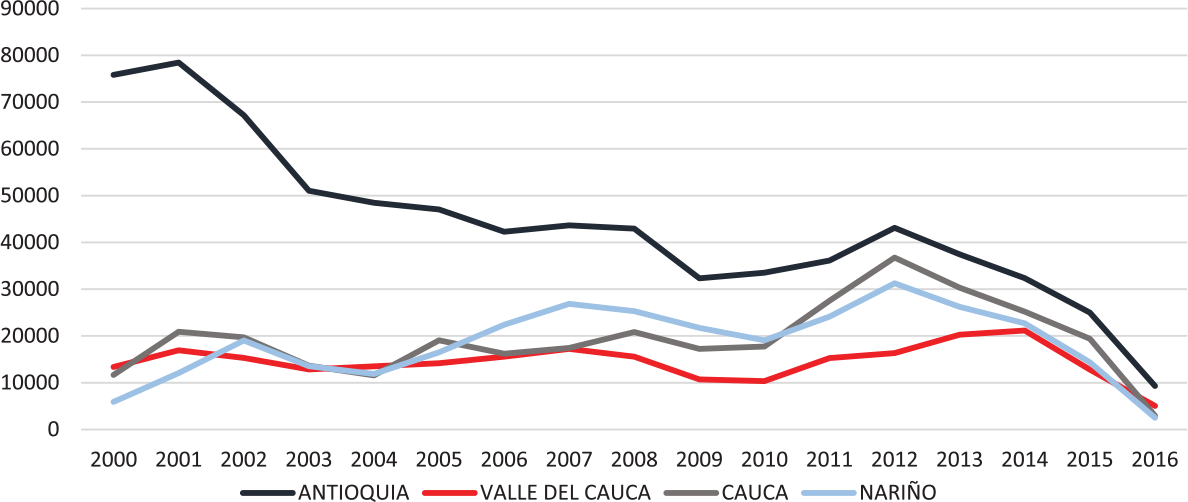
Victimization occurrence by year (reported cases) in FOP operation departments.
Victimization Occurrence by Year (Reported Cases) in FOP Operation Departments.
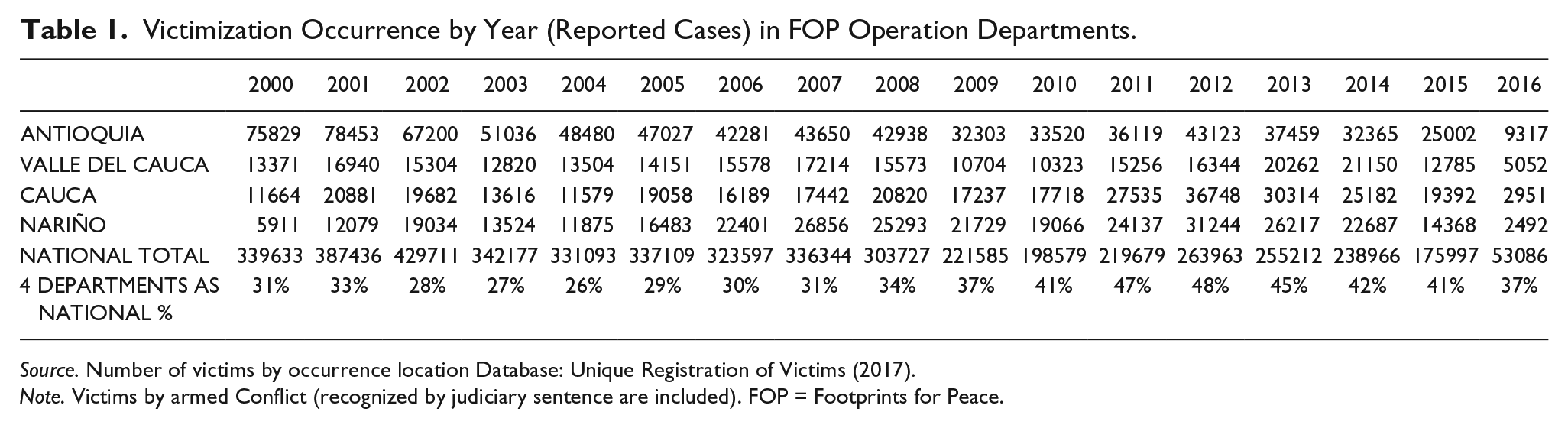
Source. Number of victims by occurrence location Database: Unique Registration of Victims (2017).
Note. Victims by armed Conflict (recognized by judiciary sentence are included). FOP = Footprints for Peace.
Conflict-affected municipalities registered a variety of victimizations, as war and the threat of violence were a personal experience for most FOP beneficiaries: As soon as we moved to this house, the (paramilitaries) were here. I remember that people used to come by, ten or twelve big guys. It was a very hard time, you instantly feel intimidated, my neighbor was killed . . .
8
Engagement with conflict actors was commonplace and expected, even for farmers who would have preferred to stay neutral: Our neighbor was killed, he was a paramilitary head . . . he was kind of a good person, he tried to help us out. He did blackmail us (though), we had to give him monthly payments of 20,000; everyone else did it too. And the bullets passed through all this area, like whistling. We closed the doors and stayed inside, it was all night long . . . it was such a horrible harm for the people, thank God they liked us, (but) we walked into the lion’s den.
9
Those with more resources were targeted more extensively: 17 years ago, a guerrilla persecution (FARC) took over. They came to town harassing the people. One day we heard gunshots coming from the coffee plantations . . . it lasted two or three hours. Then, we heard some steps on the road, it was a (FARC) troop who said: “comrade, get out, we need a car! Come here immediately, we need you” . . . I was afraid (but) they thought that the army was coming. I went out wearing my pajamas, and when I went back I remember I was driving like the A-Team. I got back home safe, but I was told that they killed two police officers that night. 15 days later the AUC (Autodefensas Unidas de Colombia) appeared. One guy showed up covering his head, interrogating me. The guerrilla never came back again, but they (AUC) were here for 4-5 years. Oh my sweet mother of God, they disappeared so many people, they had their own lists, any person on it was vanished . . . they raped women, they robbed too. They slept in my house, in the hall. Neighbors went missing. I do consider myself a victim, it psychologically affected me and my family-they stole my pigs, my chickens, everything. After (the AUC) left, the guerrilla (FARC) came back again. They came from the mountains killing AUC whistle-blowers, they killed the local drivers. You can say that I’ve been lucky because I know how to live . . . I asked the local mechanic to mess up my car preventing the AUC from putting me in charge of their transportation. The paramilitaries had communication with the army, and they distributed our territories between them . . . I had 300 chickens and they took them all (and) asked for money from the coffee too. But after FOP it was more like a union here. There was a lot more integration. I knew the people from my village but not from other areas at first, and I got to know people from (nearby villages).
10
Hence, in FARC-controlled regions, FOP activities were more tailored to addressing conflict. A trainer in Antioquia noted, When I was a little girl, we lived in fear because we knew that when they (AUC) came here they would wipe us out. (FOP) definitely was a radical change because I didn’t dare to have any kind of social job before. (FOP people) told me, like some people say: “We’re going to take you out of your bedroom” (to be active in society again).
11
FOP’s Design and Implementation Structure
FOP was designed to use a precise implementation methodology. All tactical approaches were backed in educational booklets and their corresponding trainer’s guide. In terms of the assistance provided by the FOP team, a constant contact to FNC social workers and the so-called “extensionists,” or engineers, smoothed queries that arose during the program. The programmatic pillars (FNC, 2015) were as follows:
A. Economy
This module supported more efficient and competitive coffee production and better nutrition for beneficiaries and their families through material aid and trainings. Educational sessions focused on best practices, enterprise strengthening techniques, and dietary assistance. Material provision such as coffee seeds and/or trees and homegrown gardens complemented FOP’s training on cultivation techniques (HMASD, 2017b).
B. Environment
Recognizing communities as influence areas of hydric resources, this pillar sought to empower a better coexistence of the communities with natural resources. FOP’s focus was on drainage systems and reutilization capabilities along with educational trainings.
C. Social
The largest and most comprehensive pillar was social, designed to encourage community conflict resolution through democratic and peaceful means. This module employed a top-down cascade methodology that passed on trainings and lessons from one focal group to another. First, FOP primary designers trained 30 people in social pedagogy, “institutionality,” and grassroots conflict resolution approaches. Second, those trainees subsequently oversaw the teaching of 350 local trainers as local FOP representatives. Finally, these intermediaries passed lessons to the thousands of beneficiaries that the program encompassed. This pillar was mostly based in a peaceful conviviality module. 12
During the planning stage, FNC developed a list of potential trainer candidates from their farmer database, consulted with H + D on strategic direction and priority impact regions, and approached farmers with offers to participate as trainers. Respondents considered local trainers essential to FOP’s success as trust and legitimacy barriers were tackled by the engagement of community members as local trainers (AZAI Consultores, 2013). A trainer in Valle del Cauca detailed her efforts: A big box with all the class material was delivered to me. I went house to house handing out books to each of the beneficiaries. I would say “dear neighbor, take a look at this, examine it and learn it!” and they accepted the duty. We began with 2 sessions a month (and) each subject was discussed in 2 sessions. We trainers agreed how to teach and the subjects to take.
13
Educational booklets used metaphors, drawings, and games based on everyday life situations. The peace module was presented as a “journey” with three stops: unlearning violence, living in reconstruction, and learning more peaceful interaction (Grisales, Parra, & Rodríguez, 2012). This module encouraged participants to promote societal change as individuals. Breathing and meditation sessions, letter writing, and self-identification activities were used to address painful conflict memories and build personal forgiveness. Booklets identified types of violence, mistreatment, and conflict through daily life situations with a positivist bent. No teachings about conflict history or national conflict elements were used; instead, theatrical plays, dances, and games were offered to strengthen social interactions.
A trainer in Antioquia notes the sense of empowerment and hope that was facilitated by FOP’s conviviality trainings: The coaches were very dynamic. I had a great time: the workshops, the resolution of conflicts, the values, living with other teachers from other municipalities. We were asked to recreate our own life histories; it was so beautiful . . . I still remember that uniqueness, that affection.
14
A woman internally displaced at 12 years old when her father was shot and burned to death in a car by FARC spoke of how FOP changed her family: It was an excellent project . . . I can see changes in my husband. Before FOP, he wasn’t very much at home, he stayed until the night working in the plantations (and) he wasn’t very sociable either. Today, he’s the local counselor of the rural committee. There is nothing in war; killings and massacres are meaningless. I would personally forgive my dad’s murderers—people have to give a chance for change. I think about forgiveness. FOP, through its training sessions, made me think about reconciliation. We can make it.
15
Another recipient focused on how FOP helped challenge local gender assumptions: I didn’t know much about coffee, but in the last six years of cultivating I’ve conquered a lot. But it hasn’t been easy: “This is because she’s a woman”—that’s what some men said when they realized I ran this farm. I used to be guided by men, but (after the trainings) this farm is highlighted as a model, and people call me: “the woman who made herself someone of personal growth.”
16
The program also spurred local innovation through knowledge building: The effect can be seen—We’re better organized now. My mom doesn’t know how to write or read. With FOP, I started selling coffee and plantains. Our finances are better; the results are evident. I even learned numbers (accounting).
17
FOP had several limitations. Attendance was a challenge for local trainers and FOP assistance staff. Thus, economic and environmental material aid, such as drainage systems or postharvest coffee equipment, was delivered only when beneficiaries successfully attended training sessions. Skepticism of FOP itself was also a challenge, as one housewife illustrated: My husband said that (FOP) was a waste of time because they (nonlocals) promise, but always break their word. He never attended the trainings. Well . . . I attended because of the coffee plantation. My friends said it was all a lie in order to not give us anything but at the end they delivered materials to us. Sometimes they had good topics like the coffee issues and how to handle cultivation, but some bad and boring topics (water and environmental issues) made us lazy.
18
A minority of farmers skipped meetings or exited the program altogether as FOP constituted a costly trade-off between attending monthly daylong sessions versus tending to farm duties. This dilemma worsened when FOP materials did not suit beneficiaries’ needs: I’ve always been engaged in community issues, but . . . my attendance didn’t last long, I attended the sessions for just 6 months. When it has to do with peace, it can’t be boring, it was just because I had no real interest. It seemed like just another project to me. They did call me a lot, trying to put me back on track (but) I said no because of my farm’s duties. To be honest, I didn’t take it seriously.
19
Finally, access of FOP personnel to all local communities diverged from a homogeneous strategy due to emerging levels of threats across regions. In some FARC-controlled areas, H + D played a smaller role for reasons of staff security.
Findings
Returning to our main question, “Can we better ascertain the characteristics and conditions for successful business-peace initiatives?” respondents forwarded three key narratives about FOP’s operation regarding possible characteristics and conditions for success. First, FNC’s positive reputation as an implementing agent before the project began was paramount. FNC was already a trusted member of the community, so participants were willing to try the new initiative, and many felt privileged to be selected. H + D led project design, but it was presented to participants as an FNC initiative. To wit, less than 10% of interviewees met an H + D representative, but 100% knew their FNC representative. This reputational element was essential in FARC-controlled areas, where H + D representatives did not go and violence against actors perceived to have allegiances with the government or paramilitaries was pervasive. FNC’s long-established pro-poor reputation allowed access for a limited set of operations, as FARC commanders trusted that FOP would improve the lives of the local poor without also forwarding hidden motives. FARC representatives did not see FOP as challenging their governance mandate, but only as a business antipoverty initiative.
Positive opinion might be correlated with contextual macro factors such as violence rates. All visited municipalities, like Colombia in general, had seen reduced violence over the past decade. Nonetheless, during FOP implementation, from 2011 to 2015, there was an increase in the numbers of victims registered in most places subject of this research. This situation may suggest that the decreased number of victims may correlate to FOP’s presence, although more research is needed to make definitive conclusions about such situations. Furthermore, there is a loose correlation between areas where an armed group was more active and the proportion of positive assertions of FOP. Consequently, peacebuilding projects like FOP may have more significant impact in postconflict scenarios than in active conflicts (see Figures 2 and 3, and Table 2).
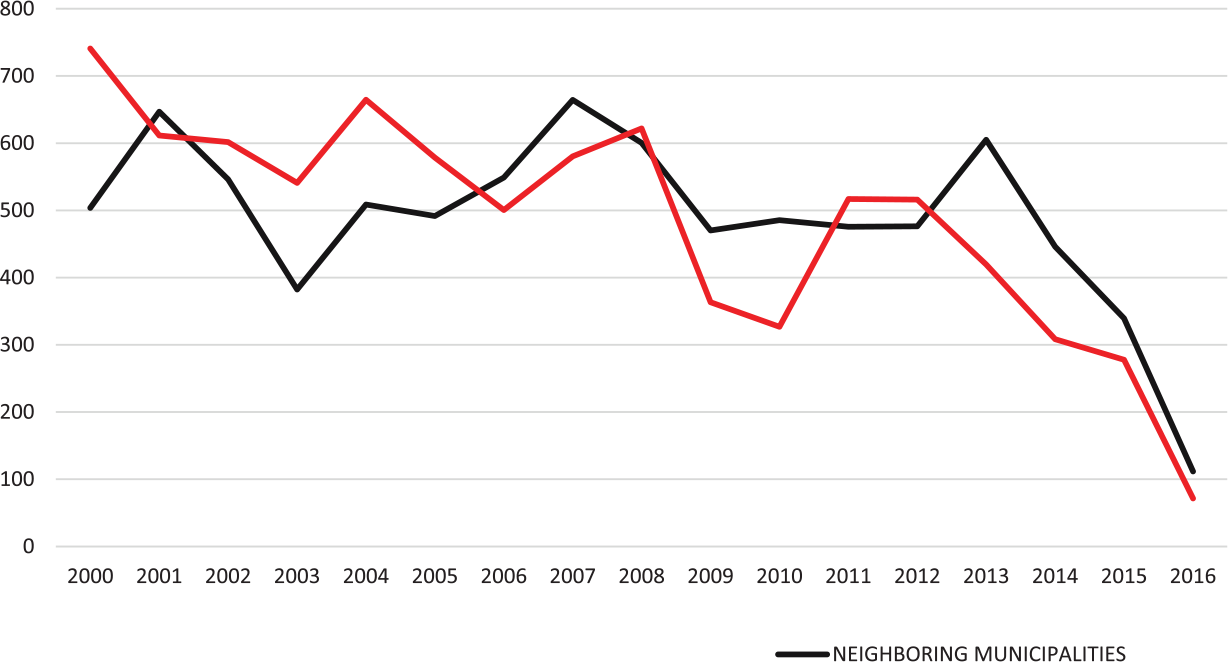
Occurrence of victimization (reported cases) in FOP visited municipalities versus their neighboring municipalities—Average.
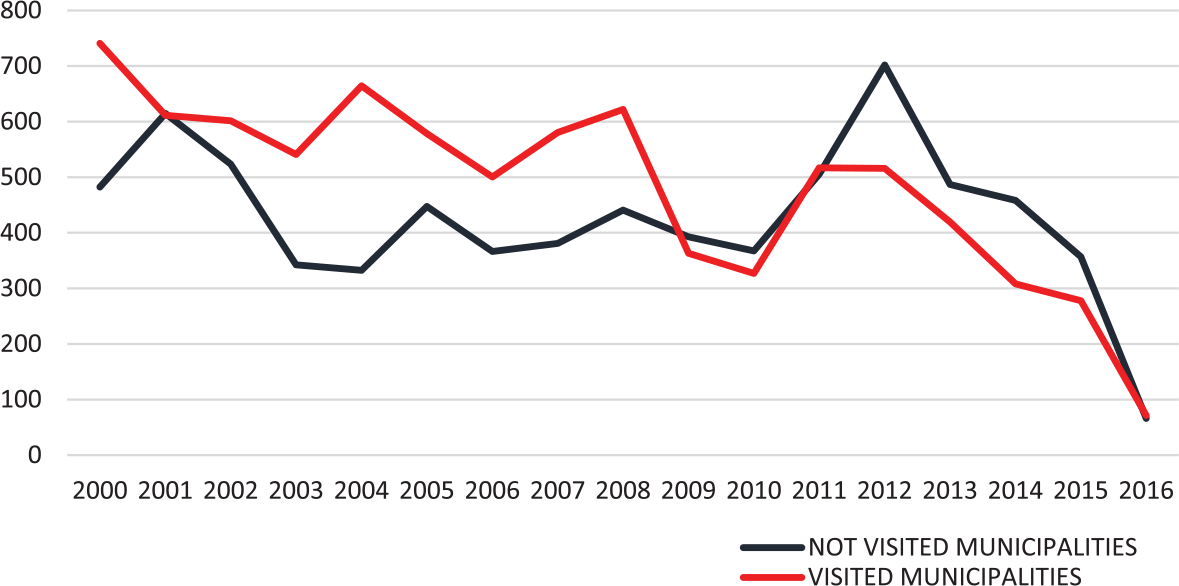
Occurrence of victimization (reported cases) in visited versus not visited FOP municipalities—Average.
Neighboring Municipalities of Visited Areas Where FOP Did Not Operate.
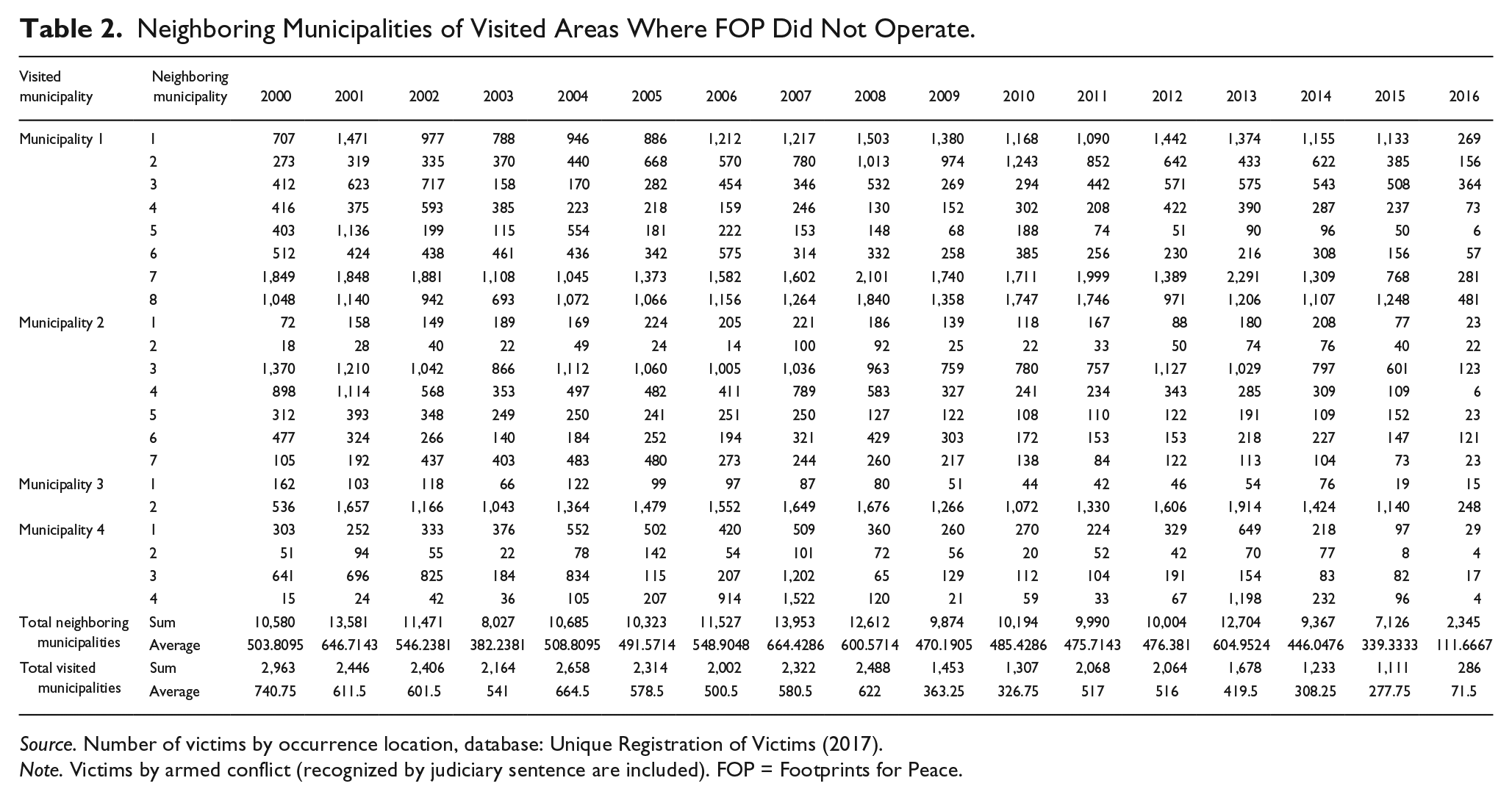
Source. Number of victims by occurrence location, database: Unique Registration of Victims (2017).
Note. Victims by armed conflict (recognized by judiciary sentence are included). FOP = Footprints for Peace.
Second, FOP was designed more to break down societal and interpersonal barriers (e.g., gender, class, age, and domestic violence) than to reduce violence among conflict actors. This focus on family-level and village-level violence had two practical consequences. It allowed FOP to sidestep complex conflict equations and maintain a veil of neutrality in a highly politicized conflict environment. It also allowed beneficiaries to personalize FOP’s peace lessons in a way that would likely have failed had it attempted to reduce violence between the FARC and government, or between paramilitaries and the community. FOP was in essence a postconflict peacebuilding initiative couched in community reconstruction that was launched before formal hostilities ceased between FARC and the government, and after major demobilization operations of different paramilitaries groups took place, exploiting a lull in violence to gain traction.
Third, local FNC workers were vital to FOP’s success in their role as implementing agents. In one municipality, even 2 years after FOP’s completion, trainers and beneficiaries still remembered the local agent fondly. In contrast, another municipality had a different trainer in charge; few of the beneficiaries or local trainers referred to her, and impressions of FOP were weaker. This was a substantial explanatory factor for the divergence in responses between municipalities concerning FOP’s perceived impact. In areas of higher conflict presence, despite attempts to promote an “economic productive approach,” FOP languished due to local capacity weaknesses and a fractured chain of communication between FOP leadership and local communities, leading to trainings that had minimal local value. Trainers had difficulty impressing the importance of long-term economic thinking due to short-term demands of conflict, and farms remained unproductive upon FOP’s conclusion, in contrast to richer municipalities where many farmers are now producing and distributing coffee under their own label.
Decoding Footprints of Peace As a Business-Peace Venture
FOP attempted to build local peace by reconciling social cleavages at the communal level. Reconciliation was pitched as an individual act of resilience for conflict situations. To wit, 64% of respondents said that FOP improved local social fabrics (including increased dialogue, social cohesion, integration, communication, and brotherhood), and 80% said that FOP generated at least one positive economic outcome in the local community, mostly for coffee production skills. As a beneficiary expressed, In terms of peace, I would say that FOP did have a positive effect. I have new friends now—yayaya! We became like a family. We spoke of things that we never talked about with other people before. Let me tell you, a peacebuilding initiative means giving work to people, that’s the starting point. It really affected me, (now) I want to treat my family well, leaving behind bad memories. FOP helped me a lot in that matter. I learned how to communicate with my husband and daughter. Before FOP it was just yelling.
20
FOP’s positive impression was echoed by a beneficiary in the same village: When the paramilitaries were here . . . they killed a lot of civilians without reason, everyone was scared of them. Anyone who had problems with them was killed. FOP helped us . . . realize that there are better paths for our lives. While you still see illegal groups here, it’s better to work than join them. With this kind of project people get excited about working. You are free and that’s good, you don’t have to be (in guerilla groups). For me “peace” means work . . . we received 2,000 new coffee trees that really benefited us.
21
FOP built upon the Community Action Council (JAC), Colombia’s lowest level legal structure that facilitates civic engagement in local policy making. Many FOP trainers previously held JAC positions, easing their ability to build social bonds. For example, in one community, respondents repeatedly stressed the importance of communication between JAC and FARC for FOP’s success. But while beneficiaries in prosperous coffee municipalities got social, environmental, and economic benefits, FOP implemented a narrower working agenda in regions deeply affected by conflict. A trainer in an FARC area noted their explicit approval of FOP’s operation: The hard time was between 98-99 until 2003, (when) the paramilitaries were here. They killed anyone walking . . . we couldn’t even keep our clothes, they took them with, they were killing people all the time. (So) I I’m fond of the guerilla. We were in a community meeting (with FARC) and they told us that there wasn’t any problem to run FOP, they didn’t oppose it. I had to sell them the idea of community workshops and trainings, we were going to be taught as human beings, as social leaders . . . Well let’s say I’m a peacebuilder, because I live happy and I always try to treat other people well, giving advice and taking care of them. Sometimes, you think you aren’t able to do it, but according to what (FOP) taught us if you breathe and think then you can find a solution. It means forgiving from deep in your heart not just by saying “I’ve forgiven”; you have to truly mean it.
22
From Findings to Building Theory: Three Promising Avenues
Three main narratives about FOP’s impact upon local peace and development can be abstracted. First, FOP was seen to offer conflict victims an actionable toolkit for how to personally move beyond painful conflict experiences and also offered trusted guidance for employing these tools through local trainers. Given localized variances of how individuals and communities are affected by conflict, it can be a significant challenge to make large programs standardized enough to be coherent and implementable but specific enough to be useful. Respondents often said that rebuilding after conflict is grounded in forgiveness and reconciliation within themselves and their communities over engaging conflict actors to draw out confessions, concessions, or punitive justice. With few respondents untouched by conflict, FOP’s lessons were welcomed enthusiastically.
Second, as is typical in communities attempting to rebuild from conflict, the government was mostly absent as a source of local grievance resolution or protection, often viewed instead as a malevolent war actor. Farmers in Valle del Cauca lauded FOP’s role in filling the gap as community bridge-builder and how the municipality is now collectively working to fill governance gaps: My community is united, responsible and humble. Before FOP, well . . . we were more problematic than we are now. We learned that a conflict isn’t solved by using a machete, the solution lies in my hands . . . each of us got to know our inner side better, we were trained to work for the community. Something of that remains in my heart and it is forgiveness . . . My perspective about the conflict has changed, before (FOP) there was a lot of harassment. But by negotiating, everything is better.
23
There has been a positive change after FOP; it wasn’t that much focused on money but on the inside (of people) instead. With FOP I woke up my human side, I got to open myself with my neighbors and the whole rural area in which I live.
24
Before FOP, our community was very detached, (but) FOP helped to establish friendships. We became closer to each other over time; it was very good, the people willingly started looking out for the initiative. We realized that the local teachers are there for us. Things can positively change. For the last five years we started taking care of our public goods such as the roads and schools . . . Peace is not just something coming from the government but from neighbors too.
25
However, no respondents said that government actors impeded FOP, perhaps as a result of FNC’s unique institutional and reputational status. The FNC was a business that local communities respected due to their long-standing profitability, and FOP trainers tried to integrate local government through roundtables to disseminate knowledge. However, most local government actors remained unengaged. Unpacking the relationships between local government, business, and development agencies for business-peace activities is worthy of forward study.
Third, FOP successfully merged the bookend goals of peace and development in areas where trainers were active, but this dual pillar strategy was less successful where trainers were less engaged and end-line beneficiaries did not see results. An issue common to large development aid projects, FOP’s leaders and beneficiaries had too many layers of staffing between them to ensure uniform success across municipalities. FOP leadership also felt that the FNC’s focus on incentivizing productivity meant that it was hard to present findings in a way that executives found valuable. 26 As a result, in some municipalities FOP’s promise to improve peace and development went unfulfilled, adding to a sense of disillusionment. However, these feelings did not carry over into blame or negative impressions about the FNC as it was still seen as a business organization first and foremost, perhaps providing an avenue into comparative study between business and development actors to learn where comparative strengths lie. Although extensively studied in aid project assessments, business-peace theoretical work is still weak in explaining why and how such connections matter to peace and development.
Building Business-Peace Theory Through FOP’s Peacebuilding Lessons
How has FOP helped build business-peace theory, and which avenues are most promising for future study? Our findings provide empirical support for five existing business-peace arguments, and show how three existing knowledge gaps can be narrowed in future research, predicated upon the limitations of both the literature as a whole and the FOP case in particular. This section concludes with a discussion of impact and efficiency.
Key Contributions: Strengthening Five Business-Peace Arguments
First, businesses can indeed help to build peace under certain circumstances. Although the argument that firms can address conflict drivers through community development, economic engagement, and reconciliation-based peacebuilding is a popular truism (Ballentine & Haufler, 2009; Miklian, 2017b; Wenger & Mockli, 2003), critical scholars are more skeptical. Setting aside the institutional implications of encouraging businesses to be peacebuilding partners (Miklian & Schouten, 2014), the FOP case shows that positive change is possible in business-peace projects, and may be replicable. This positive impact was predicated upon specific characteristics of implementation, project design, and business reputation. More importantly, at the managerial level, FNC looked beyond risk to see how FOP could offer reputational rewards, similar to how some government entities see peacebuilding activities (Gilad, Alon-Barkat, & Braverman, 2016), and how progressive CSR can improve public perceptions of firms (Sirsly & Lvina, 2019). Further study of such relationships at the company level of analysis would yield additional insights regarding the uniqueness of this finding.
In addition, the notion that a reduction in violence numbers constitutes a “success” in peacebuilding is contentious—especially when working with vulnerable communities that are prone to suppression. FOP’s impact was less in violence reduction and more in long-term community rebuilding. Thus, the “testable” element of FOP as concerns violence is narrowed to a given community’s likelihood of returning to or supporting violence in the medium- to long-term future. For such an endeavor, changing mind-sets can be the intended impact in and of itself, and local attitude changes can reflect improved interpersonal relationships.
Second, the degree of investment by the local community correlated positively with the degree of success, as seen in FOP’s variable impact across departments. Peacebuilding critics often call for local ownership of project design and implementation to increase accountability (MacGinty & Richmond, 2013). Indeed, local trainers were a major factor in the FOP’s success, with their own reputations just as much on the line as FNC’s. This investment was facilitated by FNC’s organizational structure and extensive member database. A more top-down corporation with shallower local ties may find it harder to incorporate such a model or justify its cost to management and shareholders. FNC was willing to leverage the legitimacy of its formidable 80-year business brand to build local peace by taking calculated reputational risks that it saw as being not only good for peace but also good for business, as in improved supply chain communication with their farmers. Interactions between the conditions for business-peace effectiveness and corporate reputation are thus priority areas for further research.
Third, cooperations between businesses and international development agencies can succeed under certain conditions. FOP showed the importance of making community–business relationships a partnership among equals (Aaron & Patrick, 2013; International Alert, 2015). However, FOP was unlikely to have existed without foreign funding. H + D’s design assistance incentivized local involvement in a way that was complementary to FNC’s aims, and international partners contributed value-added elements. AECID’s funding was not used as handouts or tools for local power consolidation, but implemented on a merit and need basis as guided by local communities. As many unsuccessful or ineffective business-peace ventures have been unilateral activities by firms, the value of this cooperation bears notice. Furthermore, the FNC’s role as a conduit for successful implementation of a foreign peacebuilding and development initiative could help guide more robust testing of business-peace collaborations between firms and development agencies, noting that social alliances that intentionally place profit as a second-order priority may in fact be the essence of business-peace success.
Fourth, FNC’s established relationship with local power structures helped positive project implementation by allowing access in conflict settings, specifically with FARC. FOP did not formally engage with conflict actors, but no respondents were targeted as a result of FOP involvement, nor did conflict actors see FOP as a threat. In fact, FARC leaders saw the FNC as providing a positive role in local communities through FOP—a luxury unlikely to be afforded to a traditional corporation or foreign aid organization working on local governance or empowerment initiatives. FOP staff recognized the necessity of obtaining local permission from conflict actors to operate safely, and obtained this permission with FARC without needing to deliver financial concessions. While the FNC’s unique guild structure encourages operational prioritizations beyond profit, FOP architect Carlos Ariel Rodriguez believes strongly that any corporation could run an FOP-like program if it has the institutional will and long-term capacity to do so, a belief shared by the authors. 27 Additional research on comparable business case studies—both corporations and cooperatives—would shed light on the feasibility of such claims.
Fifth, FOP showed what business-peace projects can offer to businesses themselves for improvement of community relations, reputational gains, and profit. Reflecting on the business case of FOP as a business-peace activity, the FNC did not envision FOP as a CSR or corporate peacebuilding side project, but as an initiative integrated within operations to support constituents. FNC had a reason to be in these specific communities and a reason to be invested in peace, and this engagement solidified their local legitimacy as a peace broker. The “business” part of FOP’s “business-peace” derives from three related components: FNC led the initiative, the FNC’s business structure and machinery were foundational to operation, and the FNC’s business reputation opened local doors necessary for the project’s success.
Taking the inverse, prioritizing the profit motive may make business-peace initiatives less likely to succeed. They are typically pitched internally as “good for business” (and should support follow-on effects for such), but if the main point of a business-peace initiative is increased profit or reduced risk—thus constituting something that a firm would likely do regardless—then its effectiveness may be detrimental in nature. Time-series analyses of FOP and similar initiatives could better determine the long-term peace value of such projects, and more clearly contextualize the conditions for success in the business case for business-peace activities as is done for CSR by Barnett (2019) and corporate philanthropy by Su and Sauerwald (2018), among others.
Future Directions and Limitations: Three Business-Peace Knowledge Gaps
The FOP case also illuminated several new knowledge gaps within business-peace literature. First, we know little about how a firm’s mechanics influence the efficiency and success of its business-peace actions, such as its preexisting reputation and overall size. What considerations are at play when a firm is perceived as benevolent (or perhaps more often malevolent) before project inception, and how should this factor into project design? Although the evidence here supports the argument that firms with positive local standings are more likely to implement positive business-peace initiatives, comparative study is needed as there were no other international agencies or large-scale businesses operating in these regions to provide a clearer picture of the importance of FNC’s preproject reputation upon FOP’s success, and firms with negative reputations have not attempted anything this expansive in Colombia. It may be the case that parallels between FNC and other firms elsewhere in the world will have less to do with the structure of the firms themselves and more to do with their overall level of power in society through employment, tax bases, or other (e.g., beer companies in Africa). For our purposes, the FNC’s uniqueness rested in its managerial-level investment of FOP, which was perhaps greater than a typical corporation might have offered.
The FNC’s size enabled FOP to undertake an ambitious program to reduce underlying conflict drivers like poverty, social divisions, and unemployment. However, business-peace initiatives may not enjoy the same economies of scale that other business strategies benefit from. Locational elements play a significant role, evidenced by FOP’s differences in scale and intent from areas heavily conflict-affected to those that saw less violence. For example, isolated municipalities typically had a higher FARC presence and this isolation impacted upon which FOP activities were determined to be more urgent by the local community (e.g., peacebuilding) and which were abandoned altogether (e.g., environmentalism). For peacebuilding modules, the deeper FOP tried to engage with less-accessible communities, the more resources that were needed per person helped. Repurposing the wealth of studies that explore business development in inaccessible areas (particularly the Creating Shared Value literature as in Porter & Kramer, 2011) to business-peace assessments could provide extended insight. That said, even the best business-peace activities are simply one of hundreds of actors and projects in complex conflict ecosystems, and no one business is likely to “make peace” alone. One analogy could be that of businesses participating in the Extractive Industries Transparency Initiative to limit corruption, where a series of individual business actions can foment broader positive change, especially for those firms that prioritize engagement with local communities as opposed to policy makers.
Second, we have little guidance about how to concretize gains after business-peace projects are completed. FOP laid an actionable groundwork for how businesses can formalize local development and community-building projects into peacebuilding initiatives, but the project’s abrupt end and lack of continued momentum has eroded FOP’s value-added elements. FOP representatives consistently tried to get local government actors more involved to bridge a postproject transition into government support. However, they were unsuccessful for several reasons, including a lack of interest in social peacebuilding over infrastructure or other “concrete” activities, high turnover in municipal positions, little “value-added” for their offices, and a lack of funding. FOP leaders considered the inability to continue their lessons after the project period to be their biggest failure (see Note 26). Theoretical study of transition models for successful business-peace projects to continue organically is a priority area, as is the lasting power of business-peace projects more generally through both qualitative and quantitative assessments.
Related, theorizing residual impact in business-peace sustainability is less considered. Quantitative peacebuilding baselines are hard to establish as peacebuilding is unpredictable, it takes time, and it takes concerted effort that often has no established financial or risk incentive, at least as traditionally understood. Future qualitative studies could explore the value of sustainable maintenance of project activities and their comparative residual impact on local peacebuilding as this is underresearched in both the business and international development communities. Preliminary quantitative studies on impact in the CSR realm (Graafland & Smid, 2019) are an encouraging guide, and cross-disciplinary research would be insightful. Scholars of extractive firms in particular may benefit, as such firms tend to have a stronger vested interest in a given community and are less able to shift operations based on risk/opportunity/need.
Third is the role that definitions play in business-peace discussions. A significant debate has formed over the nature of “peace” for business and what “peacebuilding by business” or “sustainable development by business” can and should entail (Miklian & Hoelscher, 2018; Oetzel & Miklian, 2017; Tregidga, Milne, & Kearins, 2018). However, FOP had no working definition of “peace,” and instead let the trainings guide beneficiaries to discover their own interpretations and most valuable individual forward pathways for defining peace. FOP emphasized sustainable peaceful development, and incorporated social, cultural, political, and economic markers into its operational framework. One key challenge of engaging in this space is that “business-peace” literature is growing, but still often compartmentalized into its home fields of international relations, business ethics, management, development studies, or the like, so direct theoretical engagement nearly always leaves someone out. This issue will become less relevant as business-peace literature matures, and more research is needed on the role of definitions in business-peace activities, how definitions vary between business and peacebuilding scholarly communities, and the impact of such variation for both theory and project implementation.
A unique advantage of this article’s methodology was in its ability to explore the role that perceptions play in local action. With “peace” itself being ambiguous and context-specific, building a perception of peace as a method for community reconciliation can be just as valuable as concrete activities to build peace—and possibly even more so. In building positive peace perceptions, FOP gave local communities a tangible bridge to build peace themselves, in whatever way that they found to be the most effective. This allowed FOP to remain flexible enough to vary its local teachings at the municipality level, while retaining a sense of overall project coherence to enable comparative progress. Also, interviewees felt that the focus on women as community implementing agents increased FOP’s effectiveness, correlating positively with other community projects in rural Colombia (Sandvik & Lemaitre, 2013).
That said, defining success through peacebuilding “efficiency” is hard to assess. Projects of FOP’s scale and geographical diversity are unlikely to help all intended beneficiaries. And the bigger the project, the harder it is to be efficient given the varied needs of local populations, especially in countries like Colombia where needs can vary dramatically from valley to valley. FOP was a successful business-peace project, but it also defined “peacebuilding” work in conflict areas without engaging conflict actors directly. This unorthodox approach prioritized peace engagement with local communities at the village and family level but had little effect upon conflict dynamics. Further study of the relationship between perceptions and actualities of peace and peacebuilding can help improve theoretical bases for testability of such business-peace initiatives, not least to help scholars determine if they are in fact contributing to peace at all.
The FNC’s FOP peacebuilding project provided a window into the increasingly complex nature of contemporary business-peace activities, and the multifaceted calculations that firms take when engaging in peacebuilding and development partnerships. Our exposition was designed to provide evidence that further refines business-peace studies and to better define issues of effectiveness and scope for scholars, businesses, development practitioners, and policy makers looking to better understand the purpose, consequences, and ultimate utility of business-peace ventures. Further study will improve our understandings of and testable guidance for the roles that businesses can and should play in peacebuilding, ideally carving out more rigorous frameworks for aspirational—but yet achievable—roles for firms to contribute to durable peace.
Footnotes
Appendix A
Appendix B
COREQ Framework Assessment.

| No | Item | Guide questions/description |
|---|---|---|
| Domain 1: Research team and reflexivity | ||
| Personal characteristics | ||
| 1. | Interviewer/facilitator | Authors, accompanied by local guides as facilitators where needed, who provided assistance and access as trusted local members of certain communities. |
| 2. | Credentials | Author 1: PhD. Author 2: BA, previous PhD-level research. |
| 3. | Occupation | Author 1: Senior research fellow, Author 2: Research assistant |
| 4. | Gender | Author 1: Male, Author 2: Male. |
| 5. | Experience and training | Author 1 has 10 years of extensive field experience in conflict and crisis regions, specifically of qualitative interviews in vulnerable communities. Author 2 has 1 year of local expertise in peacebuilding. |
| Relationship with participants | ||
| 6. | Relationship established | No relationship with communities prior to study commencement. |
| 7. | Participant knowledge of the interviewer | Each interviewee was given a brief introduction of the affiliation of the interviewers, description of the project and its aims, assurances that interview data and responses would be kept anonymous, and opportunity to withdraw at any time. |
| 8. | Interviewer characteristics | See No. 7 and “alternative explanations” in “Method” section. |
| Domain 2: Study design | ||
| Theoretical framework | ||
| 9. | Methodological orientation and theory | Qualitative methodology was employed, specifically a perspectives method that is pinned to both grounded theory and ethnography and uses content/contextual analysis. See “Method” section for more. |
| Participant selection | ||
| 10. | Sampling | Regions were selected based upon diversity and access at the village level (primarily degree of current violence) and intended to signify a representative cross-section of FOP operational area. Individual participants were selected on the basis of snowball technique, facilitated by local guides. |
| 11. | Method of approach | Face-to-face. |
| 12. | Sample size | 70 participants in seven locations over three field visits. |
| 13. | Nonparticipation | 2 refusals in total due to disinterest in discussion. |
| Setting | ||
| 14. | Setting of data collection | Data were collected in coffee villages in several departments of rural Colombia. Interviews were in homes, at cafes, in farm fields, and other places where applicable and available. |
| 15. | Presence of nonparticipants | Local guides were occasionally present and authors attempted to interview without their presence as often as possible to encourage more candid replies. Findings reflected minimal difference between interviews in which said nonparticipants were present and those in which they were not present. |
| 16. | Description of sample | 36 coffee farmers and 25 additional actors involved with FOP’s design, implementation, and action as noted in “Method” section. Balanced male/female ratio; and most respondents were between 30 and 60 years of age. |
| Data collection | ||
| 17. | Interview guide | Questionnaire provided by authors upon request. One pilot study done to refine questions. Otherwise, no guides or prompting given, as no definitive answers were needed due to methodology. See Appendix A for English translation of questionnaire. |
| 18. | Repeat interviews | No repeat interviews were conducted. |
| 19. | Audio/visual recording | No A/V recording was done, as is typical for sensitive issues such as peace, conflict, and violence research. |
| 20. | Field notes | Field notes made during each interview and written up more fully at the end of each day. |
| 21. | Duration | Each interview was typically 1 hr in length. |
| 22. | Data saturation | Partial saturation. Many interviews began to overlap in given communities, but given the personal nature of conflict dynamics, the saturation point can be difficult to definitively measure. |
| 23. | Transcripts returned | Transcripts were not returned to participants for correction due both to time and literacy issues. During interviews, responses of particular import were often asked twice to confirm responses. |
| Domain 3: Analysis and findings | ||
| Data analysis | ||
| 24. | Number of data coders | Author 1 and Author 2 jointly processed the data. |
| 25. | Description: Coding tree | NA per method. |
| 26. | Derivation of themes | Themes were collated in advance from existing business-peace literature, then derived from data for presentation and discussion. |
| 27. | Software | NA |
| 28. | Participant checking | A limited number of participants provided feedback on findings. |
| Reporting | ||
| 29. | Quotations presented | Participant quotations were presented to illustrate themes and findings, and each quotation was identified after being made anonymous. |
| 30. | Data and findings consistent | There was a strong correlation between the data and findings, and potential alternative explanations for such were studied. |
| 31. | Clarity of major themes | Major themes developed through interviews, and are discussed more extensively in the final two sections of the article. |
| 32. | Clarity of minor themes | Minor themes also arose and are discussed more extensively in the final two sections of the article. |
Note. COREQ = COnsolidated criteria for REporting Qualitative research.
Appendix C
Declaration of Conflicting Interests
The authors declared no potential conflicts of interest with respect to the research, authorship, and/or publication of this article.
Funding
The authors received no financial support for the research, authorship, and/or publication of this article.
