




Abstract
Building a coherent discourse on professionalism is a challenge for corporate social responsibility (CSR) practitioners, as there is not yet an established knowledge basis for CSR, and CSR is a contested notion that covers a wide variety of issues and moral foundations. Relying on insights from the literature on micro-CSR, new professionalism, and Boltanski and Thévenot’s (1991/2006) economies of worth framework, we examine the discourses of 56 CSR practitioners in South Korea on their claimed professionalism. Our analysis delineates four distinct discourses of CSR professionalism—strategic corporate giving, social innovation, risk management, and sustainability transition—that are derived from a plurality of more or less compatible moral foundations whose partial overlaps and tensions we document in a systematic manner. Our results portray these practitioners as compromise makers who selectively combine morally distant justifications to build their own specific professionalism discourse, with the aim to advance CSR within and across organizations. By uncovering the moral relationality connecting these discourses, our findings show that moral pluralism is a double-edged sword that can not only bolster the justification of CSR professionalism but also threaten collective professionalism at the field level. Overall, our study suggests paying more attention to the moral relationality and tensions that underlie professional fields.
A growing stream of studies investigates the individual micro-foundations of corporate social responsibility (CSR)—henceforth “micro-CSR”—by studying how actors perceive, react to, and engage with CSR initiatives (Aguinis & Glavas, 2012; Gond et al., 2017; Gond & Moser, 2021; Risi & Wickert, 2017). What is largely absent from micro-CSR research, however, is a close examination of the (inter-)individual dynamics underlying the construction of CSR practitioners’ claims of professionalism. These claims are worthy of analysis because CSR practitioners do not have a well-established knowledge base (Brès et al., 2019) and may therefore struggle to justify why they, rather than other experts, should be trusted to deal with CSR issues. Moreover, CSR covers a broad range of issues (Brès et al., 2019, p. 252) and embeds multiple, potentially conflicting moral principles (Bansal & Song, 2017; Demers & Gond, 2020), which may weaken the construction of a consistent claim of professionalism. We thus ask, How do CSR practitioners morally justify their claim of professionalism?
To address this question, we combine insights from studies of CSR practitioners (Risi & Wickert, 2017; Tams & Marshall, 2011), “third-wave” studies about new forms of professionalism (Anteby et al., 2016), including issue professionalism (Henriksen & Seabrooke, 2016; Spillman & Brophy, 2018), and key concepts from the economies of worth framework (Boltanski & Thévenot, 1991/2006; Cloutier et al., 2017). Because the economies of worth theory focus on how actors justify their decision or action on moral grounds and recognize the pluralism of moral worlds (Boltanski & Thévenot, 1999), it can help identify how multiple and potentially competing “moral worlds” are used by CSR practitioners to justify their claims of professionalism and how such moral pluralism fuels tensions between competing claims.
Empirically, we focus on the emergence of the field of CSR in South Korea (henceforth, Korea), where CSR has been less established but fast-growing outside Occidental contexts (Brès et al., 2019). This context provides a unique opportunity to analyze competing discourses about CSR professionalism in vivo while they are being framed. Our analysis of CSR professionalism discourses in Korea reveals the patterns of moral convergence and contradictions between the discourses’ shape CSR professionalism dynamics.
Our theoretical contribution is threefold. First, we advance micro-CSR research (Gond & Moser, 2021; Risi & Wickert, 2017) by moving analyses of CSR practitioners’ struggles away from organizational settings and into the CSR field at large and by clarifying the moral micro-foundations of their claims of professionalism. In so doing, we conceptualize CSR practitioners as “compromise makers” who combine morally distant justifications within their own professionalism discourse to advance CSR across organizations and promote their distinct moral views on CSR, depending on their type of expertise.
Second, our results contribute to studies about emerging forms of professionalism through discourse (Spillman & Brophy, 2018), issues (Henriksen & Seabrooke, 2016), and relations within and outside a given field of expertise (Anteby et al., 2016; Eyal & Pok, 2015; Liu, 2018). We show that CSR practitioners prefer to relate to outsiders (e.g., social workers or activists) than with their peers who do not share their moral worldviews and suggest that moral pluralism inherent to CSR operates as a double-edged sword: It enables CSR practitioners to draw on a broad range of moral justifications but it also generates contradictions that undermine their collective claim of professionalism. This result has implications for aspiring professionals in other emerging fields of expertise.
Third, our analysis extends current organizational analyses of the economies of worth (Cloutier et al., 2017; Cloutier & Langley, 2013; Demers & Gond, 2020) by leveraging the underused Boltanski and Thévenot’s (2006) “matrix of critiques” to uncover the CSR field’s patterns of moral worlds, how they relate to one another, and how such web contributes to shaping field dynamics.
A Rise of CSR Practitioners Fraught With Tensions
Shifting away from the organizational level of analysis, micro-CSR studies have started to investigate how individuals perceive, react to, engage with, and contribute to implementing CSR initiatives across and within organizations (Aguinis & Glavas, 2012; Gond et al., 2017). Sociological approaches to micro-CSR, in particular, focus “on the discursive, political, and identity aspects of this process, as experienced by CSR managers, practitioners, and other professionals” (Gond & Moser, 2021, p. 7). The central role of CSR practitioners has been documented in a variety of organizational settings. Within organizations, we have witnessed the rise of a variety of in-house CSR practitioners (Tams & Marshall, 2011), referred to as “sustainability managers” (Carollo & Guerci, 2018), “sustainability practitioners” (Mitra & Buzzanell, 2017), “CSR managers” (Wickert & de Bakker, 2018), or “climate change experts” (Wright & Nyberg, 2012; Wright et al., 2012). These micro-CSR studies also teach us that, across organizations, CSR ideas and practices are diffused thanks to the work of CSR consultants (Brès & Gond, 2014; Wickert & de Bakker, 2018).
Although most studies have focused on just one type of CSR practitioner (see however Nyberg & Wright, 2013), they converge to portray all CSR practitioners as experiencing tensions inherent in the social and environmental purposes of their work, which are at odds with the corporate search for profit (Mitra & Buzzanell, 2017). This forces them to navigate paradoxical tensions (Ghadiri et al., 2015), deal with emotions and passions to convey their message (Wright & Nyberg, 2012), redefine their identity, and employ a variety of coping strategies to assume their hybrid role of “activists in a suit” (Carollo & Guerci, 2018). Studies of tactics deployed by these practitioners highlight the continuous struggle they face to implement CSR (Mitra & Buzzanell, 2017), in spite of corporate insiders’ skepticism (Girschik, 2020; Wickert & de Bakker, 2018; Wright et al., 2012).
Competing Issue Professionalism Discourses in Search of Moral Foundations
Spillman and Brophy (2018) suggest that scholars should approach professionalism as a discourse imbued with “cultural claim-making about work” (p. 155). These claims are not static (Evetts, 2011), but they remain crucial for any new group of aspiring professionals who needs to produce a coherent normative discourse to justify why their judgment should be trusted more, about a given set of issues, than that of others. If credible, this discourse will provide them with the “potential for defining social reality” in the area where they operate (Macdonald, 1995, p. 8). Brint (1994) argues that we live in an age of “expert professionalism” that focuses on assertions related to superior technical proficiency rather than claims about the public welfare (p. 203). Nonetheless, claims of professionalism are never entirely devoid of moral foundations because of the “moral potential inherent to the social relationships affected by expertise” (Brint, 2015, p. 33; Spillman and Brophy, 2018).
The case of CSR practitioners is especially relevant as the issues they deal with are politically and morally loaded (Bansal & Song, 2017), and the notion of CSR is sufficiently ambiguous to allow for a wide range of normative positions (Demers & Gond, 2020). Their discourses on professionalism can be analyzed in light of “issue professionalism” (Henriksen & Seabrooke, 2016), a concept that entails claiming technical expertise about a given issue, such as post-crisis financial reform (Seabrooke & Tsingou, 2014). Claims of issue professionalism rest on a proven and prolonged commitment to a specific issue (Eyal & Pok, 2015), which is substantiated more through one’s career choices and the issue-specific personal networks to which one belongs than through one’s formal training or professional designation. This relational aspect is the main focus of interest in “third-wave” studies on professionalism (Anteby et al., 2016, p. 212; Liu, 2018; Pollock & Williams, 2015; Švarc, 2016), which concentrates on the interpersonal dynamics that shape aspiring professionals’ discourse and expertise through collaboration (or competition) with others outside and within their own area of expertise.
According to Henriksen and Seabrooke (2016), issue-professionals may compete on how specific issues should be handled and who should be allowed to work on them. This is all the more credible where CSR practitioners are concerned as CSR covers a large variety of fragmented issues, with distinct bodies of knowledge (Brès et al., 2019; Risi & Wickert, 2017). Thus, depending on her technical background and axiological preferences, one CSR practitioner could advocate for climate change as a matter of priority (Wright et al., 2012), while another could advocate for diversity or human rights. Such discursive conflicts are not likely to be settled easily. The variety of issues covered under the CSR umbrella, their different political connotations, and the potential incommensurability of their moral justifications are likely to complicate the construction of a coherent discourse on CSR professionalism.
Economies of Worth Perspective on Moral Pluralism in Professionalism Discourses
To analyze the plurality of moral foundations involved in CSR practitioners’ competing discourses of professionalism, we rely on the economies of worth framework developed by Boltanski and Thévenot (1991/2006). This framework fits our research purpose, as it has been tailored to analyze the plurality of moral foundations used by actors to justify their viewpoints in contexts of disputes or controversies (Cloutier & Langley, 2013; Demers & Gond, 2020) and can therefore help identify the moral underpinnings of discourses used by actors as well as the relationships between them (Boltanski and Thévenot, 2006). 1 This analytical tool is well suited in CSR contexts. It was used to analyze the moral arguments used by stakeholders to justify their positions in controversies related to nuclear power plant accidents (Patriotta et al., 2011) or shale gas extraction in Québec (Gond et al., 2016), and to study how CSR strategies are morally justified within ecologically challenged organizations (Demers & Gond, 2020; Nyberg & Wright, 2013).
Mapping Moral Foundations: Common Worlds
Central to the analysis of Boltanski and Thévenot (2006) is the notion of “orders of worth” that are higher moral principles operating as organizing principles that regulate one of the social “common worlds.” 2 Together, these principles form a grammar of justification that can be used across organizational settings and operate as a “cultural toolkit” (Cloutier & Langley, 2013) that provides actors with the moral agency (Demers & Gond, 2020). In the original framework, Boltanski and Thévenot (2006) rely on their prior empirical studies of ordinary disputes (Boltanski & Thévenot, 1989) and classic texts of political philosophy to map six distinct “common worlds” (Boltanski & Thévenot, 1999). The civic world is dominated by the collective search for the common good. The industrial world values above all the search for efficiency as well as technical expertise. The market world is regulated by the search for profit or self-interest. The domestic world values family or national belonging, as well as respect for traditions. The inspired world values creativity and the inner self. Finally, the world of fame values reputation and public recognition. Through the years, this grammar of justification has been updated and extended to integrate the green world, which values the ecosystem and balanced relationships among humans, fauna, and flora (Lafaye & Thévenot, 1993/2017), and the project-based world (Boltanski & Chiapello, 2005), which values flexibility and connection. Each world is organized according to a higher moral order and is characterized by specific objects (e.g., measurement tools in the industrial world) and human beings (e.g., ecologists in the green world), as well as tests to evaluate worth (e.g., creativity in the inspired world) and related forms of proof of worth (e.g., awards in the world of fame; see Supplemental Appendix A for details).
Mobilizing Moral Foundations: Building Justifications, Critiques, and Compromises
Boltanski and Thévenot’s (2006) analysis focuses on “the critical operations that people carry out when they want to show their disagreement without resorting to violence, and the ways they construct, display, and conclude more or less lasting agreement” (p. 25). Moments of dispute correspond to “critical situations” when collective action is suspended, and actors must reach a form of agreement (Boltanski & Thévenot, 1999). To explain why a given situation is fair or not, actors need to abstract from this situation and reach a higher level of generality by relying on higher moral principles that justify their position. Accordingly, actors engage in justification—activities that establish the moral worthiness of their claims (Jagd, 2011)—and critique, which parallels justification in that it also adopts a moral viewpoint on a situation (Cloutier et al., 2017). Actors’ critique and justification during a dispute or controversy usually involve reliance on, and combinations of, multiple worlds.
Reaching agreement, however, can be a complex endeavor. When actors agree on the world (e.g., industrial) within which they may resolve a dispute (e.g., defining an accident as a technical problem), they can evaluate the situation according to the moral principles governing this world and bring in the relevant beings (e.g., experts, engineers), objects (e.g., evaluation tools), and forms of proof (e.g., statistics, tests). This allows them to agree on the fairness of the dispute resolution (Cloutier & Langley, 2013). However, situations where the appropriate world in which to settle a given dispute is not agreed upon may result, at best, in a compromise (i.e., an attempt to find “a common good that transcends the two different forms of worth in presence but including both of them”; Boltanski & Thévenot, 2006, p. 278).
Bringing together several worlds to justify a professionalism claim usually results in a fragile situation, in the sense that it remains open to critique. For instance, the sustainability strategy of a corporation—usually a compromise between the green and market worlds—is often seen as lacking from the moral standpoint of each of the worlds involved— “too costly” for short-term-focused investors, “not green enough” for ecological activists (Demers & Gond, 2020).
Accounting for Professionalism Discourses’ Moral Contradictions: The Critical Matrix
To analyze the moral pluralism inherent in discourses of CSR professionalism and their internal tensions and compatibilities, we rely on a conceptual tool offered by Boltanski and Thévenot (2006), the critical matrix, which summarizes how criticisms develop across different worlds (p. 19) and therefore specifies “the constraints of justification” weighting on actors (p. 235). This tool can help reveal their positioning within an order of worth based on the criticisms they receive. The critical matrix draws the patterns of relationships between the various worlds and presents how each world typically criticizes the others (Boltanski and Thévenot, 2006). For instance, from the inspired world perspective, supporters of the market worlds are driven only by money, whereas from an industrial world perspective, the inspired world lacks any form of reliability. Although the critical matrix represents a powerful analytical tool to unpack how patterns of contradicting worlds generate tensions within and across organizations, it has rarely been operationalized in prior research, beyond Brandle and Schneider’s (2017) reliance on it to conceptualize moral tensions. We argue here that the critical matrix can help uncover the underlying moral relationality and structure of CSR practitioners’ various professionalism discourses. We refer here to the semiotic sense of relationality (i.e., a web of entities related to each other such that they shape and define each other; Greimas & Courtés, 1979/1982), and aim at unpacking how relations between competing moral worlds co-define each other to shape professionalism discourses. We, therefore, mobilize the conceptual apparatus of worlds, justification, critique, and compromise and matrix of critiques, with the aim of investigating the moral foundations of CSR professionalism discourses and highlight potential contradictions between them.
Context, Methods, and Data
Research Context: The Professional CSR Field in Korea
Unlike countries where the CSR field is already established, Korea does not currently have any leading, formal CSR professional association or network. CSR as an explicit form (Matten & Moon, 2008) was introduced during the Korean local financial crisis and reform under the International Monetary Fund intervention in the late 1990s. The term “CSR” was associated with “American” or “advanced” business philosophy or practices.
However, social and environmental contributions by Korean companies already existed well before the importing of “CSR.” The pre-explicit CSR period in Korea can be characterized by (a) the environmental management system and policy from the government and (b) the “social contribution” activities of chaebols—family-owned conglomerates— in the early 1990s. Corporate environmental responsibility was managed through the policies of the Ministry of Environment from 1994 to push Korean firms to meet international requirements (Shin, 2016). 3 In the early 1990s, chaebol companies established corporate foundations and/or philanthropic programs to address severe public criticism of the chaebol structure, in which such companies were strengthened through accumulating wealth and passing it on to their descendants (Shin, 2016). Chaebols should share their wealth with society and show paternalistic care for their employees and local citizens were considered self-evident and expected to compensate for the hard work and sacrifices made by Korean citizens. Thus, the beginning of CSR in Korea can be traced to the prioritization of corporate philanthropy in local communities to avoid public criticism (Chapple & Moon, 2005). Some chaebol companies had groups of employees or hired social workers who worked directly under the CEO and whose role consisted only of taking care of social contribution activities in the 1990s.
After the 1990s, many Korean firms developed more explicit CSR initiatives—they started adopting CSR reporting systems following global guidelines such as the Global Reporting Initiative and reacted to the government’s announcement of the country’s participation in the ISO 26000 international standards and the launch of the Dow Jones Sustainability “Korea” Index. Since CSR became increasingly critical in the Korean business context, many companies have established new designated teams to deal with CSR issues by hiring new CSR recruits and merging them with people working on social contribution activities. A growing number of CSR service firms also appeared in the 2000s. Despite this significant growth of the field, no formal CSR professional association to federate CSR practitioners has yet emerged in Korea. Therefore, in this context, it can be expected that Korean CSR practitioners seek to construct their own individual professionalism discourses, at the risk of appealing to inconsistent, or even contradictory, moral arguments.
Data Collection
Our main dataset consisted of 56 semi-structured interviews with 39 organizations that identified themselves as CSR practitioners, which we conducted in 2012 and 2013. After five exploratory interviews (four corporate CSR managers in two companies and one CSR consultant from a local CSR firm) in September 2012, we expanded our interview pool using “snowballing” (Lincoln & Guba, 1985). In total, our interview dataset consists of four different types of CSR practitioners according to their organizational backgrounds such as a corporation with its in-house CSR team, a CSR service firm, a governmental agency, or a not-for-profit organization (NPO; see Supplemental Appendix B for details).
Interviews proved an appropriate methodological choice (Alvesson, 2003) as they allowed the lead author of this study, a native Korean speaker, to become close to CSR practitioners, build trust and create a space where interviewees felt free to deploy their discourse on professionalism and explain its moral underpinnings in complete confidentiality. Each formal interview lasted 30 to 70 min and was recorded (except for seven interviews, in which we were allowed to take detailed notes) and then transcribed. 4 In addition, to enhance the credibility of our empirical story, we complemented the interviews with five additional data sources. Table 1 presents an overview of all our data sources and their use in our analytical protocol.
Data Inventory.
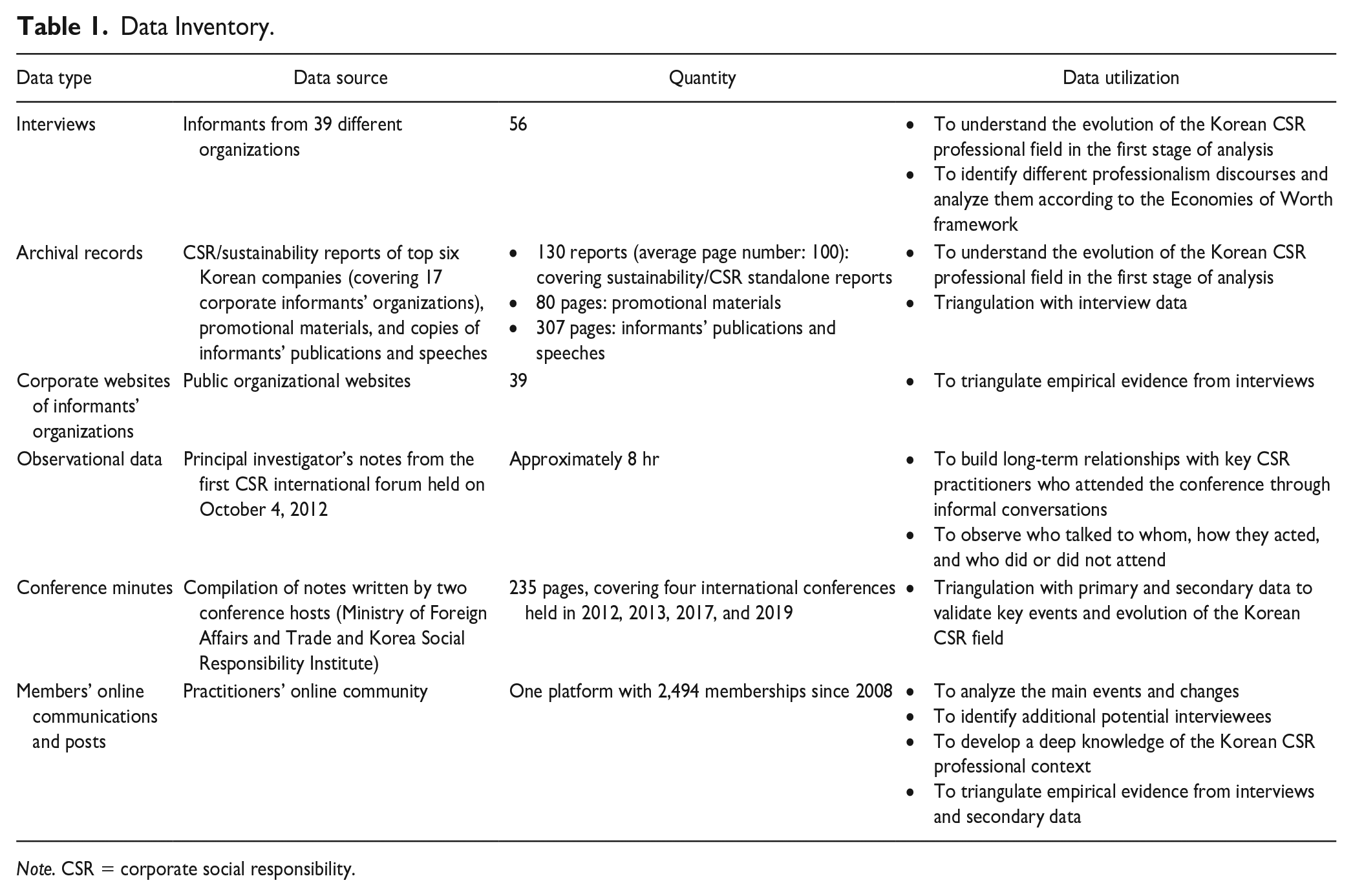
Note. CSR = corporate social responsibility.
Data Analysis
Our analytical strategy follows an overall “abductive” logic (Behfar & Okhuysen, 2018). First, we inductively investigated all our datasets to develop an understanding of the Korean CSR field from the early 1990s, when corporate social contribution activities emerged as an organizational effort by chaebols, until today. This analysis informed our presentation of the Korean CSR professional context.
With our background knowledge of the Korean CSR professional context from the first stage of analysis, we moved to the second stage of inductive analysis and focused on the discursive claims from Korean CSR practitioners in relation to CSR, the CSR field, and CSR professionalism. We then grouped these discourses based on similarities and differences in their constitutive arguments. This process revealed a pattern of four distinct discourses, each providing a coherent take on the definition of CSR, key assumptions, and an interpretative baseline about what CSR is and means, and CSR practitioners’ self-identification. We realized that our interviewees spontaneously justified their approach to CSR and their definition of what a “good” CSR practitioner could be by referring to their opposite—those who cannot be regarded as true CSR practitioners. These distinctions led us to identify more clearly to which discourse group each informant belongs, not only from his or her own point of view but also from those of others. We then completed this process with an analysis of the backgrounds of the supporters of each discourse. As a result, we confirmed four CSR professionalism discourses: strategic corporate giving, social innovation, risk management, and sustainability transition.
To pinpoint the moral foundations of each discourse, we then moved on to a deductive approach, which constitutes the third step of our analysis. We focused on the arguments that could be qualified as forms of moral “justification” or “critique” in the sense of Boltanski and Thévenot (2006). In line with prior uses of this framework (Demers & Gond, 2020; Patriotta et al., 2011), we coded all the interview excerpts supporting moral justifications or critiques according to the “grammars” formed by the eight moral worlds identified in our literature review on economies of worth, relying on a consolidated set of extant descriptors of these worlds (Gond et al., 2015; Supplemental Appendix A). Table 2 presents specific descriptions of each moral world and how we interpreted it in the context of Korean CSR practitioners’ discourses. As seen from Table 2, we examined the predominant moral foundations and the relationships among those moral foundations from each discourse group.
Summary Descriptions of the Common Worlds and Their Meanings in the Research Context.
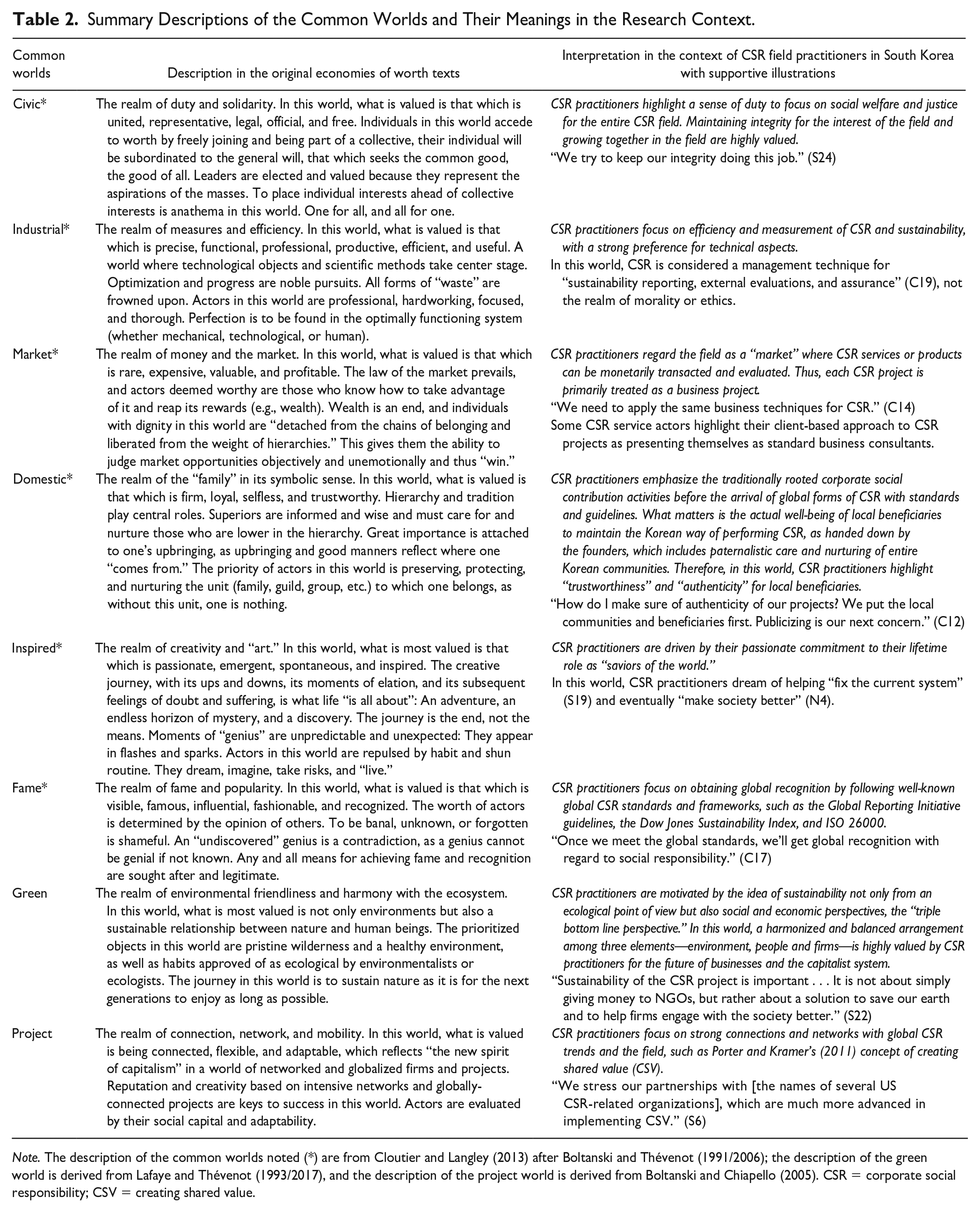
Note. The description of the common worlds noted (*) are from Cloutier and Langley (2013) after Boltanski and Thévenot (1991/2006); the description of the green world is derived from Lafaye and Thévenot (1993/2017), and the description of the project world is derived from Boltanski and Chiapello (2005). CSR = corporate social responsibility; CSV = creating shared value.
Unsurprisingly for professionals aiming to develop a market in an emerging field, we found that all four of the professionalism discourses on CSR that we identified are related to the market world, positively or negatively and to different degrees. We unpack how other (more or less dominant, or subordinate) worlds were combined or hybridized with the market world specific to each distinct discourse on professionalism. This analysis allowed us to identify the types of compromises between established moral worlds that correspond to our four discourses of CSR professionalism. We were then able to develop Table 3, which describes the features of those discourses and specifies the moral worlds from which they are derived, as well as the compromise they form about the nature of CSR.
Four Types of CSR Professionalism Discourse.
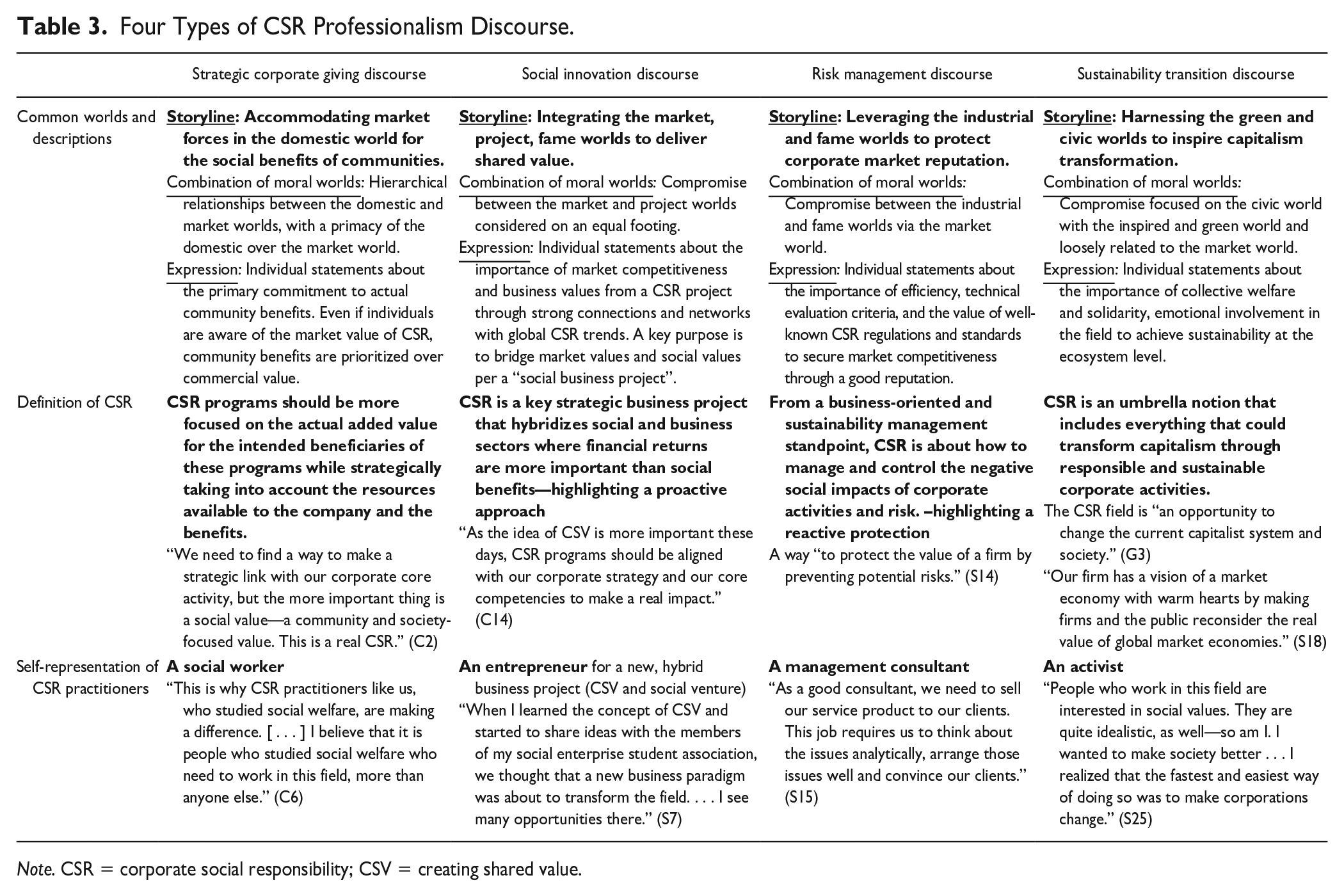
Note. CSR = corporate social responsibility; CSV = creating shared value.
Our fourth and final stage of analysis consisted of following the logic of Boltanski and Thévenot’s (2006) matrix of critique. Exploring the moral relations among the various approaches to CSR professionalism from the previous stage of analysis allowed us to shed light on potential contradictions among them. Our interviewees’ justification of the superiority of their own approach to others was useful to spot these contradictions. We adopted the point of view of each discourse (in turn) and examined how it included a moral critique of the other three alternative discourses and how it defended its own moral superiority. Table 4 summarizes our matrix of critiques across the four discourses as a result of this analysis.
Matrix of CSR Professional Discourse Critiques (and Justifications in Diagonal).
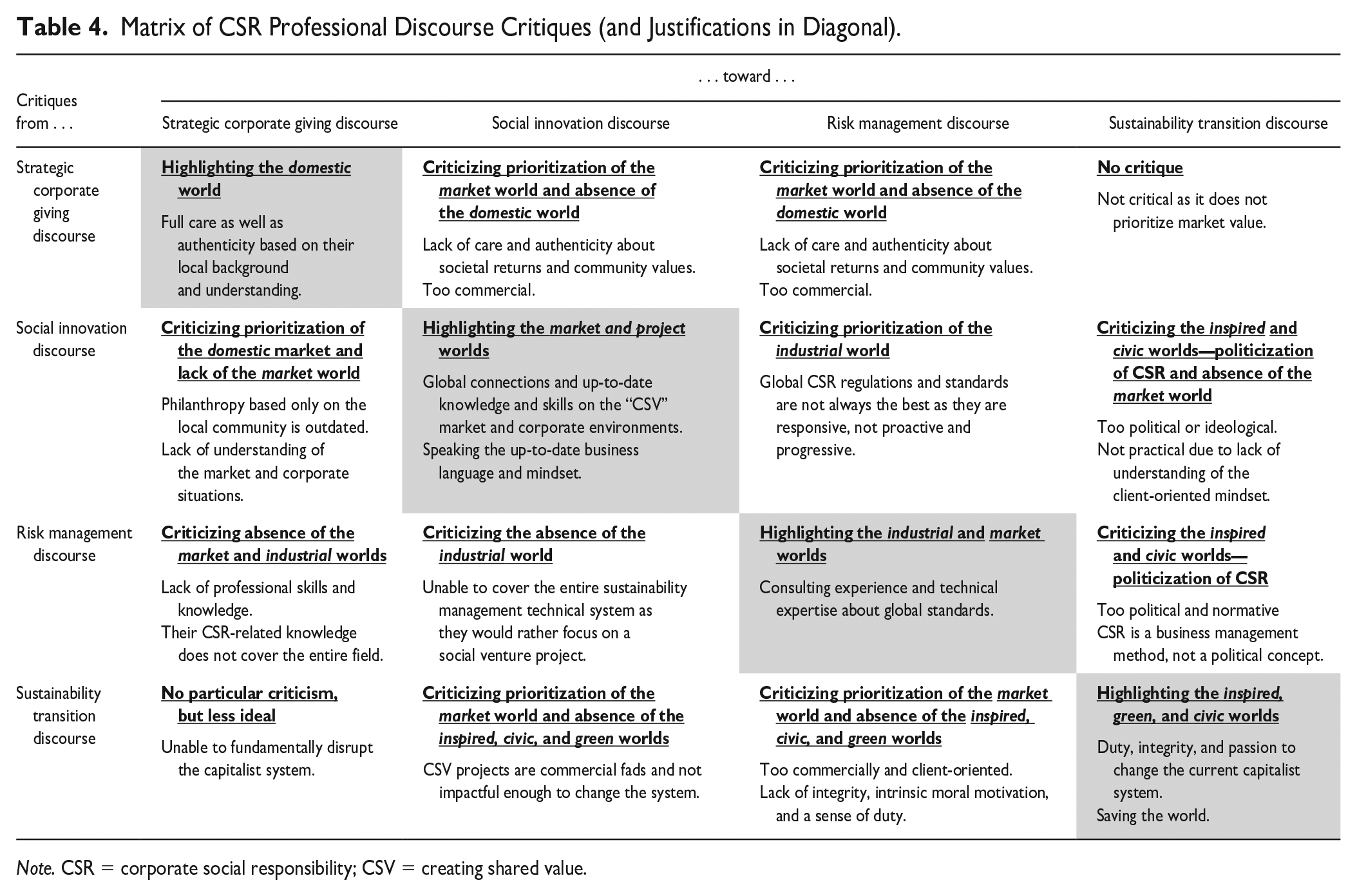
Note. CSR = corporate social responsibility; CSV = creating shared value.
Unpacking the Moral Bases of CSR Professionalism Discourses
We identified four discourses of CSR professionalism—strategic corporate giving, social innovation, risk management, and sustainability transition—and found each of them to be grounded in a combination of moral worlds and to form specific compromises about the purpose of CSR and the role of CSR practitioners.
The Strategic Corporate Giving Discourse: Accommodating Market Forces in the Domestic World for the Social Benefits of Communities
The strategic corporate giving discourse relies on a commitment to community benefits, in line with the tradition of social and community activities provided by chaebols’ founding families yet integrates an understanding of the market value of CSR. Although predominantly derived from the domestic world—where traditions, trustworthy and proximity are highly valued—this professionalism discourse also accommodates the market world as necessary evils.
Interviewees using the strategic corporate giving discourse (18/56, or 32%) share the view that CSR initiatives should reflect that companies belong to the broader society, in line with the local historical legacy in Korea. A majority of them (13/18, or 72%) are in-house corporate CSR managers and their average tenure is 8.39 years. For them, CSR initiatives should primarily focus on the well-being of their intended beneficiaries mainly in Korea (the domestic world), although they acknowledged a commercial dimension to CSR (the market world).
CSR is a way to achieve our corporate business value, which is to make our societal stakeholders happy with our corporate resources. And doing good may help our business too although it is an additional benefit. The social value of each CSR program should come first. (C8)
This discourse prioritizes the domestic world by prioritizing CSR’s social benefits over its potential economic benefits—each CSR project should have an actual positive impact on local communities. Our respondents who embrace this discourse stress this point when discussing criteria for evaluating CSR projects.
How satisfied our beneficiaries were with our CSR programs or how much our CSR programs actually helped them is the basis of our evaluation . . . (C12)
Although grounded in the domestic world, this discourse also often relies on the market world, according to a CSR business case approach. Our respondents who use this discourse are well-aware of the financial reality of for-profit organizations and understand that companies decide to invest in one specific CSR project instead of another based on the reputational return that they expect to achieve. They also admit that they have no choice but to accept this strategic function of CSR if they wish for CSR programs to remain alive at their employer organizations and to secure investment in CSR from top management. This pragmatic market taming of domestic values reflects the position of most in-house corporate CSR managers, which is not independent of their employer organizations—they accept the top management’s instrumental approach to CSR. Thus, they adhere to a “domestic first, market second” hybridization of moral worlds.
Such a hierarchical hybridization between the domestic and market worlds appears in these practitioners’ self-presentation discourses—“socially oriented CSR practitioners.” Some even use the phrase “social workers in business.” Some of them (10/18, or 56%) stress their educational background in social welfare or public policy. Nine of them (50%) held a social worker license or were in the process of obtaining one. They started their CSR career within their companies or from domestic NPOs and nongovernmental organizations for domestic social contribution activities when corporate social contribution projects began in Korea to ease public criticism after the 1997 domestic crisis. One informant (C6), who has been working for the same company for more than 10 years at the time of the interview, still identifies herself as a social worker. As shown below, the supporters of this discourse believe that their social concerns are precisely what makes them good at their job.
This is why CSR practitioners like us, who studied social welfare, are making a difference. [. . .] I believe that it is people who studied social welfare who need to work in this field, more than anyone else. (C6)
The Social Innovation Discourse: Integrating the Market, Project, Fame Worlds to Deliver Shared Value
In contrast to the strategic corporate giving discourse, the social innovation discourse combines moral principles from both the market world and the project world. The importance of a CSR project’s market competitiveness and business value (the market world) is clearly manifested in the idea of “creating shared value” (CSV)—a concept coined by Michael Porter and Mark Kramer (2011) to capture how business and society can reinforce each other. Moving beyond the domestic world, this discourse values the importance of connections to famous foreign institutions or persons in the global CSR field (the fame world), which is believed to be a new approach to CSR in Korea to deliver the connectivity ideal inherent in the project world. The following quotes are representative.
All social businesses ultimately remove “social” from their names because social businesses also need to pursue profits as much as possible, like normal businesses, to be sustainable. (S8) Our team was working with BCCCC [Boston College Center for Corporate Citizenship] for our initial CSV initiatives and projects. We go there twice, and they came to us once to collaborate with us. (C14)
Our interviewees who hold this discourse (9/56, or 16%) approach CSR as a “new business opportunity,” or a “market” with potential corporate value, treating each CSR project as an independent business project that could generate various types of mutually reinforcing benefits (not only social advantages but also economic advantages for the organization). More than half of these practitioners are CSR service specialists (5/9, or 56%), and their average length of tenure is 4.28 years, which is the shortest among our four discourse respondent groups. They extensively use trendy business notions and acronyms, such as “social enterprise,” “social venture,” “impact business” and “CSV,” which reflects the relatively shorter average length of tenure than other discourse groups. Unlike the supporters of the prior discourse, CSR practitioners holding the social innovation discourse favor the reliance on assessment schemes that monetize the social impacts of CSR projects: If you think about each of our CSR projects as a social venture, it would be easier to evaluate the performance of social enterprises than the performance of simple corporate philanthropic activities because social enterprises are also for-profit organizations anyway. Therefore, we evaluate them by looking mainly at their financial performance. (C16)
The dual embeddedness in the market and project worlds is also discernible in they introduce themselves as “(impact) entrepreneurs” working in a new, hybrid business field, whose job is to understand and actualize the commercial potential of “CSV projects” while ensuring that they have a positive social impact. Their discourse does not always sound much different from that of traditional entrepreneurs, as exemplified by S7, who has created her own CSR services company with colleagues she met in business school during her master’s studies in business administration.
Personally, I like solving problems. . . . When I learned the concept of CSV and started to share ideas with the members of my social enterprise student association, we thought that a new business paradigm was about to transform the field. . . . I see many opportunities there [CSR as an industry]. (S7)
The Risk Management Discourse: Leveraging the Industrial and Fame Worlds to Protect Corporate Market Reputation
The risk management discourse highlights the importance of the efficient and technical approach to sustainability “management” to protect corporate reputation. This discourse is grounded in three moral worlds—the industrial world where technical evaluation and performance as well as professional efficiency are highly valued, the fame world where recognition and reputation matter, and the market world. The discourse values efficiency and measurement of CSR and sustainability (the industrial world), particularly through globally well-recognized rankings, scores, and frameworks (the world of fame). Such a compromise between the industrial and fame worlds involves a reactive business-oriented sustainability management approach to protect corporate market reputation (the market world).
CSR practitioners who embrace the risk management discourse (14/56, or 25%) interpret CSR as a “business or management technique” to “protect the value of a firm by preventing potential risks” (S14). They stress the importance of “efficient and effective deliverables” (the industrial world) for key audiences, such as “the public” and “client firms.” A majority (9/14, or 64%) of them work for professional service firms by ensuring various CSR and sustainability management templates and techniques implemented in their client firms with an average tenure of 9.36 years. They argue that they need to monitor social and environmental risks by complying with CSR-related laws and regulations. This compliance-based view emphasizes complying with relevant regulations rather than seeking justice through giving back to the community: “sustainability is not about equality or some philanthropic activities that firms should do” (S11). They believe CSR can be handled effectively as long as clear standards are created and CSR performance can be evaluated through precise criteria, such as those provided by the ISO 26000 (S14). The focus on internationally well-known frameworks shows that the discourse also relies on the world of fame through concern for corporate reputation via CSR rankings, scores, and global standard compliance. They highly value measurable evaluation methods and techniques that produce predictability and enhance recognition through corporate inclusion in prestigious CSR rankings, indices, and league tables.
External evaluation is important for us who are doing sustainability management. We treated the DJSI (Dow Jones Sustainability Index) as the most crucial evaluation performed by an external institution. (C17)
The market world bridges the fame and industrial worlds from their discourses. Efficient management and implementation of CSR involve delivering what clients want, provided this is in line with hard and soft regulations. Business knowledge, analytical, and communication skills are considered key to obtaining clients’ buy-in to CSR projects. The risk management discourse supporters consider having such skills more valuable than actually caring about CSR initiatives. The ability to convince clients is seen as the most important asset of a “good” CSR practitioner. For them, CSR and sustainability projects are not intrinsically good; they are instrumentally good for winning contracts overseas.
The Sustainability Transition Discourse: Harnessing the Green and Civic Worlds to Inspire Capitalism Transformation
In contrast to the prior three professionalism discourses that rely strongly on the market world, the sustainability transition discourse claims the importance of collective welfare and solidarity and seeks to mobilize CSR practitioners’ individual passion and dedication to sustainability, being away from the market world. This discourse combines moral foundations from the civic, green, and inspired worlds. CSR is first and foremost regarded as aiming to achieve collective well-being, including profit for the company, but also the welfare of corporate stakeholders and even society as a whole, thanks to a focus on civic values such as social justice. This discourse also argues that collective well-being should be achieved through forward-looking, proactive, and integrated sustainability management respectful of the ecological context (the green world). Third and finally, this discourse involves massive enthusiasm and creativity from practitioners to achieve a reformed, more just and less destructive capitalist system (the inspired world).
Fifteen of our respondents (15/56, or 27%) hold this discourse. They regard CSR mainly as an umbrella notion, referring to a large range of activities that contribute to the transformation of capitalism and have the potential to address the inequities caused by companies’ industrial and commercial undertakings. A majority of them (8/15, or 53%) are working in CSR service firms to serve their corporate clients with an average tenure of 8.4 years. They view CSR as a manifesto that emphasizes the role companies could play in helping “improve capitalism” (S18) and “change society” (G3) for the better. Accordingly, they approach CSR as a purposive way to change our society and reform, if not revolutionize, the current capitalist system.
Interviewees who hold this discourse have no interest in clarifying the distinction between “CSR” and “sustainability,” even though they typically favor the “sustainability management” terminology, nor are they interested in finessing the boundaries among different CSR-related concepts. Instead, they convey the importance of challenging existing business conventions and finding ways to reform capitalism gradually, from the bottom-up, by altering how trade organizations operate, rather than by waiting for the government to impose new regulations. They also embrace any CSR-related theories and ideas, as long as they help increase businesses’ sensibility to their social responsibilities and expanding CSR activities: “To be frank, having the best market share does not mean much. What we need to do is to grow the CSR arena together” (G3). They value fairness and collective welfare at the societal level (the civic world) but consider regulations and laws secondary to the ideals emanating from the green and inspired worlds.
A common denominator of their self-presentation is their strong social and political involvement, which is rooted in the civic and inspired worlds. Seven of the 15 interviewees spontaneously declare their left-wing political preferences and regard the current social system as defective and inequitable. Many of them are actively involved in socio-political movements or have been social activists at one time or another in their lives. Forty percent of our interviewees in NPOs and 50% of our interviewees in governmental agencies use this discourse. They present themselves as CSR specialists whose primary responsibility is to not only make a difference in how businesses operate but also, more importantly, contribute to changing the current socio-economic system.
Exploiting Moral Pluralism to Build Professional CSR Discourses
Overall, our first findings show that CSR practitioners build competing discourses of CSR professionalism by relying on distinct combinations of moral worlds. Although the market world overlaps the strategic corporate giving, social innovation, and risk management discourses, it is not prioritized to the same extent across these discourses—while dominating in the latter two, it constitutes only a “background element” in the former. Similarly, the civic, green, and inspired worlds that form the basis of the sustainability transition discourse are more distant in other discourses where the market world prevails. Because of their different moral underpinnings, these four discourses on CSR professionalism may compete with rather than complement each other. The next section explains how.
Moral “Relationality”: CSR Professional Discourses’ Justification and Critique
Justification of and Critiques From the Strategic Corporate Giving Discourse: Searching for Authenticity and Being Concerned About Excessive Commodification
Some CSR practitioners using the strategic corporate giving discourse justify their superiority in the CSR field by underscoring their pride in caring for local beneficiaries of CSR programs. Authenticity is an essential prerequisite for becoming a good CSR manager: I believe that there should be authenticity at the root of any corporate contribution activity. Even if CSR projects are well presented and sold to the public and efficiently managed . . . without sincerity, they mean nothing. (C6)
They also highlight their trustworthiness based on their personal network of local contacts and prior experience in the social sector, which is more important in their view than knowing how to write nice CSR reports.
Our network and know-how in the social and public sector push us to take real action, not just do paperwork all day . . . We start by doing concrete things before writing reports. What makes our CSR projects feasible is our networks of contacts in the social welfare sector. (S2)
These practitioners question the genuineness of other CSR professionalism discourses grounded in alternative moral worlds. They worry that CSR could become too business-oriented, as a growing number of “opportunists” accelerate the commodification and marketization in the field. Relatedly, they question the priority given by “bad” CSR specialists to purely commercial concerns over helping companies achieve actual and lasting positive impacts on the local community, such as the ones embracing the social innovation and risk management discourses.
Even though I generally agree and understand that CSR should generate values both in business and society, I know the social aspect more and focus on it more than the economic value in CSR, unlike others who use Porter’s CSV, which is more business oriented. (C2)
However, we could not find any particular critical stand toward the sustainability transition discourse as it, too, downplays market value.
Justification of and Critiques from the Social Innovation Discourse: Speaking the New Language of Business to Move beyond Outdated or Ideological Takes on CSR
CSR practitioners holding the social innovation professionalism discourse stress the importance of a business-oriented mind-set and an up-to-date business vocabulary to become a good one. They view the social elements of CSR as easier to grasp: We do not know less about the social side, but we can do better since we know about the business side. To plan and execute CSR projects, a person who knows the business can do better by learning the social side. It is more difficult for a person who knows the social side and attempts to learn the business side. (C14)
These practitioners claimed superiority rests on their global connections with global institutions and scholars who developed the idea of CSV and on their knowledge of up-to-date issues in the global CSR field. Due to their high dependency on the market, project, and fame worlds, they tend to overlook CSR practitioners who ignore global CSR trends and who prefer to focus instead on social concerns about the local beneficiaries of CSR projects (the domestic world). We often found that proponents of the social innovation discourse compare themselves favorably with CSR practitioners who hold the strategic corporate giving discourse by criticizing their local community-based methods as outdated and their lack of understanding of the market and corporate situations. The following excerpt illustrates this criticism.
I know that they are good people and have more experience in this [CSR] sector than us. However, they are limited in their capacity to understand corporate situations. [. . .] They understand strategic CSR projects, related to the core business of a company, in a much too simple way. It is not that simple. It is necessary to analyze a value chain and link CSR activities to that value chain or align it with the corporate vision, but they only deal with such linkage very weakly, at best. (S7)
Similarly, CSR practitioners holding the social innovation discourse do not completely belittle the importance of producing collective social welfare from CSR projects (the civic world). They believe that the cause and intention of the sustainability transition discourse are harmless given its ultimate goal. However, they believe highlighting the political and societal aspects of CSR can create a great deal of confusion as to its raison d’être. One local CSR service practitioner (S4) explicitly expressed her discomfort in the politicization of CSR focusing on collective social welfare: “I am not a communist [. . .] It (CSR) is not about [political] ideology” (S4). Hence, social innovation discourse supporters want to neutralize the societal and political nature of CSR while placing more weight on its business and market aspects.
Given their moral roots in the market world, these experts’ criticism is less likely to target the risk management discourse. However, practitioners who use the social innovation discourse make it clear that they do not approve of using global CSR standards for the sake of being highly ranked in famous CSR league S6; S7; S8, as supporters of the risk management discourse do. Their goal is to create a shared impact on both business and society. Despite their knowledge of such standards, they do not use them because they refer, in their eyes, to a “defensive CSR, neither making any proactive and progressive impact nor helping us hybridize what business and society need” (C14).
Justification of and Critiques From the Risk Management Discourse: Claiming Established Technical Expertise, Warning Against Overly Broad or Political Views on CSR
Relying on the industrial and fame worlds, practitioners who adhere to the risk management discourse justify their expertise by highlighting the length of their work experience with CSR projects and with well-known CSR standards and guidelines.
I see myself as a CSR practitioner or a CSR professional because I have worked for a long time and have a lot of experience. [. . .] I’ve watched and participated in the development of this [CSR] field in Korea, and, for all these years, dedicated myself to working in this area. (S14)
Among our respondents, risk management discourse supporters have the longest average length of employment in CSR (9.36 years). Thus, they tend to claim that they are part of the “first generation” (S15) that has witnessed the evolution of the Korean CSR field since its very inception.
Moreover, respondents using the risk management discourse tend to discredit competing practitioners who claim that their CSR knowledge and skills are “exclusive” or “cutting edge” by arguing that there is no specific knowledge or skills in CSR and that if there were, they would be easily learned. “Anyone can acquire such knowledge and skills within six months of taking office” (S17). As a corollary, they criticize CSR practitioners who focus on the social aspect of sustainability (e.g., corporate philanthropy and social innovation) because, in their view, this aspect is only one component of the broader, multi-faceted sustainability concept. They claim that they are the only ones who fully grasp what CSR means; the others are either mistaken or possess an incomplete understanding of this notion.
If you talked to [name of a person who shares the interviewee’s risk management perspective on CSR] within our company, that would be sufficient. He would cover the entire field from the sustainability management perspective, not simply focusing on corporate philanthropy. However, I do not think you need to talk to [names of two other individuals with the strategic corporate giving discourse] [. . . ] they will tell you only philanthropy- and society-focused stories. (C17)
Just like social innovation discourse users, CSR practitioners holding the risk management discourse refuse any political interpretations of what they do.
Justification of and Critiques From the Sustainability Transition Discourse: Saving the World, Dismissing Superficial CSR Initiatives and CSR Fads
Practitioners who draw on the sustainability transition discourse emphasize the intrinsic moral quality of their motivation and passion for CSR. This justification is rooted in the inspired world and denotes idealism. These practitioners emphasize that one must always feel free to tell the whole truth, even if it is painful, and shake up the status quo to trigger real (as opposed to superficial) change for sustainability (in line with the green world) and collective social welfare (in line with the civic world).
Some companies have asked us to write or certify their CSR reports and engage our name and reputation. They offered a lot of money, but we do not do that. We ask our clients to grant us independence and autonomy and to allow us to intervene, where CSR issues are concerned, everywhere we see fit in their business activities. We only work with clients who share these values with us. (S23)
Overall, sustainability transition discourse users believe that different approaches and discourses help the entire CSR field grow as “the field needs various perspectives and cases” (S25). However, they strictly criticize business-focused opportunistic CSR practitioners without integrity. Interviewee S23 complains that many competitors have entered the CSR field simply for a business opportunity and only help organizations publish nicer CSR reports or comply with CSR standards. According to her, such a commercial take on CSR will never trigger the radical changes that are most needed. “Opportunistic CSR consultants,” she claims, have no interest in challenging their customers, and they should be criticized for that. Instead, they applaud CSR projects that can trigger disruptive change at the scale of the capitalist ecosystem and dismiss projects that focus solely on local communities.
The sustainability transition discourse requires approaching one’s mission in CSR with not only passion but also a great “sense of duty” (S21), as the goal is to fix the current capitalist system. One should live a life that reflects one’s convictions; otherwise, one cannot be trusted to be a real CSR expert. This probably explains why social and political activists are overrepresented among those who favor this discourse. The latter point out that, unlike themselves, many CSR practitioners focus predominantly on growing their business, and this causes them great concern.
I see so many service firms approach CSR only from the perspective of the firms that hire them! That is not ethical, although I understand that it’s how they survive. (S21)
Occasionally, named individuals were criticized for being unable to discern right from wrong in the CSR domain.
Many CSR consulting firms offer to write a CSR report on behalf of their clients [. . . ] I do not want to see the field grow in that way—it is not right. But I know some of the service firms that lead this cheap trend. (G3)
Promoters of the sustainability transition discourse also lament that more client-oriented CSR practitioners use new and fashionable concepts, such as “CSV,” which they view as another empty signifier. They believe that the social innovation discourse can hardly produce fundamental change. They are not particularly critical of the strategic corporate giving discourse, as both discourses share the same critique of the dominance of the market world in CSR. However, according to proponents of the sustainability transition discourse, the current capitalist system needs radical change. They, therefore, consider the aspirations of proponents of the strategic corporate giving discourse to be neither ambitious nor disruptive enough.
Discussion: Implications and Boundary Conditions
We began this article by asking how CSR practitioners morally justify their claims of professionalism. To answer this question, we drew on Boltanski and Thévenot’s (2006) economies of worth framework. We found that CSR practitioners combined distinct moral worlds to justify four distinct discourses of CSR professionalism: strategic corporate giving, social innovation, risk management, and transition to sustainability. We also found that these distinct moral worlds created significant tensions and contradictions among these four discourses. These findings have important theoretical implications, which we highlight in the following section, before providing conditions for their generalizability outside the Korean context.
Moral Compromise-Making as Core to CSR Professionalism Micro-Dynamics
Our study first contributes to the growing stream of micro-CSR studies dedicated to CSR practitioners (Brès et al., 2019; Gond & Moser, 2021; Risi & Wickert, 2017). Prior studies usually focused on a given type of CSR practitioner to unpack the micro-level identity tensions and identity work resulting from efforts to advocate for CSR in a variety of business contexts (Girschik, 2020; Mitra & Buzzanell, 2017). Our analysis advances this line of research by focusing on a more diverse set of CSR practitioners operating across organizations in a national CSR field and by unpacking how their diversity of positions and identities allows them to deal with the multiple and potentially conflicting moral orientations.
We found that CSR practitioners, in their attempts to portray themselves as relevant professionals, operate as experts of justification, engaged in continuous “compromise-making,” forming or embracing discourses that creatively combine different moral worlds, usually regarded as incommensurable, to shape a distinctive discourse of CSR professionalism (see Table 3). This result echoes the findings of Demers and Gond (2020) and Nyberg and Wright (2013), who highlight the mobilization of a diversity of moral worlds within organizations. However, we move further by suggesting a more complex and nuanced picture than the identity work strategies or the corruption of green and civic values thus far identified. Our framework (Figure 1) reveals the central role played by the market world as a moral lingua franca connecting multiple discourses of CSR professionalism, as this world operates as a common denominator of three of the four discourses identified in this study.
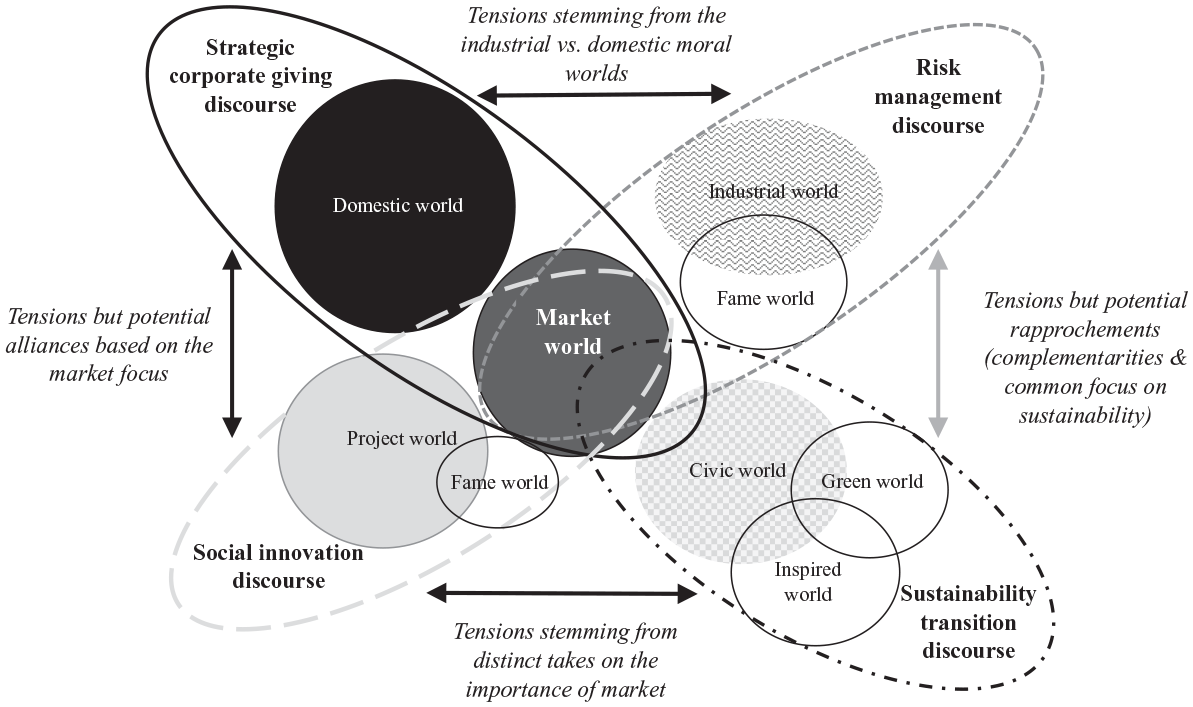
Overlapped moral worlds of the CSR professionalism discourses.
On one hand, this can account for the dominance of the business case rhetoric in the CSR field (Carroll & Shabana, 2010) and explain why CSR practitioners have not always been the “change agents” CSR scholars expected them to be, because of this market anchoring (Vogel, 2005). On the other hand, our results show that such a market orientation is not only a worrying sign of CSR commodification (Kaplan, 2020) but also potentially a way of bridging diverse discourses of CSR professionalism that may open up the business world to a broader range of approaches to social and environmental issues. However, how (and how much) the market world is manifested in each one is a key source of tension or compatibility between these discourses.
Beyond the market world, the loose common moral bases underlying the four discourses of CSR professionalism make some of these discourses somewhat related and others frontally incompatible. Figure 1 shows where these discourses partially overlap or clash, and suggests potential frictions or alliances between their supporters, who can be viewed as distinct groups of CSR practitioners. We suggest opening up and closely scrutinizing distinct categories of CSR practitioners in future research, as the ideological and moral fragmentation of this emerging professional field may be revealed as even greater than previously assumed (Brès et al., 2019) once these practitioners’ discourses are brought together and compared. Future research could leverage this insight and extend our analysis to a broader set of CSR practitioners across companies and industries (e.g., responsible investment, auditing) to clarify how distinct configurations of CSR practitioners promote specific moral views on CSR depending on the jurisdiction or field considered.
Moral Pluralism as a Double-Edged Sword for Professionalism Discourses
Our second contribution is to the analysis of emerging forms of professionalism (Brint, 2015; Evetts, 2011; Pollock & Williams, 2015; Švarc, 2016). We confirm that professionalism can be approached as a discourse imbued with values (Spillman & Brophy, 2018) that are contingent upon how those who are committed to resolving certain “issues” (e.g., CSR-related issues) understand them (Henriksen & Seabrooke, 2016). We also provide evidence that supports Brint’s (2015) view that the shift from a social trustee model to an expert model of professionalism is not equated with the disappearance of moral justifications. However, we add that moral justifications underlying contemporary professionalism discourses do not only depend on the type of profession considered, since important differences can also be observed within a given area of activity such as CSR.
This finding leads us to claim that third-wave, “relational lens” studies of occupations and/or professions (Anteby et al., 2016) should focus more on the normative reasons that motivate competitive or collaborative relations among practitioners in a given field and between practitioners and outsiders. Our study suggests that the alliances that CSR practitioners build to substantiate their claims of professionalism tend to be with outsiders rather than with their own kind: They prefer forming symbolic alliances with and emulate the type of expertise exemplified by other occupational members who they think share the same moral preferences. CSR practitioners who support the strategic corporate giving discourse “build bridges” (Liu, 2018, p. 53) with social workers; CSR practitioners who support the social innovation discourse build bridges with entrepreneurs. CSR practitioners who support the risk management discourse build bridges with management consultants, and CSR practitioners who support the sustainability transition discourse build bridges with social or environmental activists. Analogous patterns of symbolic alliances with outsiders of jurisdiction have also been observed outside CSR: Pimentel et al. (2021), for instance, show that cryptocurrency auditors see themselves as closer, culturally, to the hacking community than to their own community of auditors. This situation is worth acknowledging because more established professions and occupations have traditionally relied on strong and coherent cultural systems (Anteby et al., 2016, p. 187) to shape their distinctiveness and secure their unique position in society. Such strong axiological coherence is not always observed in emerging forms of professionalism.
Moreover, the type of moral pluralism that we have documented can function as a double-edged sword for aspiring professionals (in CSR or elsewhere). On one hand, at the individual and organizational levels, pluralism stimulates the moral agency of each of CSR practitioners, as it provides them with a wide range of moral arguments from which they can draw in their attempt to convince skeptical business leaders of the importance of CSR projects. At the field level, this plurality can also be useful insofar as it maintains the availability of a broad set of moral worlds that could each contribute, in different ways, to establishing the societal relevance and legitimacy of the new expertise. An example of this in a field other than CSR is Harrington’s (2019) study of the legitimizing discourse used by wealth managers, who are vilified for enabling the ultra-rich to avoid paying their fair share of taxes. She argues that these practitioners use a variety of (more or less debatable) moral arguments to explain why their work is noble and useful to society.
On the other hand, moral pluralism may also create tensions. At the individual level, our analysis of the matrix of critiques (see Table 4) shows that different moral anchoring in the context of disputes about issue professionalism may generate “practical conflicts” (Nagel, 1979, p. 134) between priorities pointing to incommensurable moral worlds. In such a context of moral fragmentation, practitioners who nevertheless “still have to do something—even if it is only to do nothing” may fall into arbitrary value judgment (Nagel, 1979, p. 134). At the organizational and field levels, the multiple coexisting moral worlds supported by practitioners operating within the same emerging jurisdiction can generate contradictions and confusion, undermining their claims of professionalism. This double-edged sword of moral pluralism raises new questions: How can practitioners in an emerging area of expertise most productively use the tensions between moral worlds that we highlighted at the individual, organizational and field levels? Further case studies will be needed to provide insight into this important question.
Moral “Relationality” as a Field Structuring Force
Third and finally, our study advances organizational studies of economies of worth (Cloutier et al., 2017), and particularly those focused on CSR (Nyberg & Wright, 2013) and professional fields (Ramirez, 2013). Although the economies of worth framework are useful to connect individual practices to societally relevant moral worlds when studying how individuals engage with organizational CSR discourses or initiatives (Demers & Gond, 2020; Nyberg & Wright, 2013), it has largely neglected the field level of analysis, in contrast to the institutional logics theory (Cloutier & Langley, 2013).
Our focus on CSR practitioners engaging in a CSR professionalization project contributes to addressing this gap in knowledge by uncovering the moral relationality underlying competing professional discourses. In particular, our results show how the underused “matrix of critiques” from Boltanski and Thévenot (2006) can help describe the underlying moral pattern of professional fields by revealing the areas of tensions and convergence between competing discourses. Such a pattern of moral relationality can contribute to explaining professional fields’ fragmentation and structuration.
Boundary Conditions and Future Research
Although the Korean field of CSR provided us with an ideal case through which to capture the moral relationality underlying discourses of CSR professionalism, and the economy of worth’s critical matrix was a fitting conceptual tool, our focus on a unique empirical setting and reliance on a culturally loaded theoretical framework invites discussion of the transferability of our findings. Specifically, we now evaluate two boundary conditions of our results, which could be analyzed in further research.
The first boundary condition of our findings relates to our focus on the field of CSR in Korea as our empirical context. Even though the Korean CSR field was a convenient case to uncover the moral justification inherent to discourses of CSR professionalism, it remains a specific National Business System (NBS), with peculiar features about CSR, such as, for instance, traditionally high involvement of the government in CSR (Gond et al., 2011). Comparative studies of fields of CSR practitioners in NBS with similar (e.g., France) or distinct (e.g., Australia) features in this regard could help identify whether such governmental interventionism contributes to shaping the dynamics of moral relationality we uncovered.
The second boundary condition of our analysis relates to our use of a framework grounded in the Westernized, European cultural context to investigate professional discourses in an Asian country. Reflecting a “cultural repertoire” take on morality (Silber, 2016), the economies of worth framework can be flexibly contextualized to national cultural situations to reflect how individuals justify their discourses or actions, as shown by prior cross-cultural analyses of environmental crises (Fourcade, 2011) or racism, sexual harassment, criteria for proper journalism, publishing policies between France and the United States (Lamont & Thévenot, 2000). However, future studies taking place in Asian contexts or the Global South could challenge more straightforwardly the universalism inherent to the six “common worlds” molded by Boltanski and Thévenot (1999) after foundational European political science texts. This process could further expand the concept of a “national repertoire of evaluation” (Lamont & Thévenot, 2000) and move this stream of research beyond its Eurocentric focus while enriching its description of “common worlds” through a broader range of non-European philosophical sources.
Supplemental Material
sj-pdf-1-bas-10.1177_00076503211018666 – Supplemental material for The Moral Relationality of Professionalism Discourses: The Case of Corporate Social Responsibility Practitioners in South Korea
Supplemental material, sj-pdf-1-bas-10.1177_00076503211018666 for The Moral Relationality of Professionalism Discourses: The Case of Corporate Social Responsibility Practitioners in South Korea by Hyemi Shin, Charles H. Cho, Marion Brivot and Jean-Pascal Gond in Business & Society
Footnotes
Acknowledgements
The authors wish to thank the CSR practitioners in South Korea who shared their career journey with us. We also thank Associate Editor Christopher Wickert and three anonymous reviewers for their thoughtful editorial guidance and highly constructive comments, suggestions, and support to help improve our paper. Last but not least, we are grateful to Céline Baud and the participants of the 2014 Chamonix PhD Seminar, the 2015 Business & Society PhD Workshop, the 3rd French Congress on Social and Environmental Accounting Research, the 32nd EGOS Colloquium’s Paper Development Workshop (CSR & Communication for the Special Issue of Business & Society), the 34th EGOS Colloquium (Sub-theme 37: Opening the Black Box: Advancing Micro-level Perspectives on Corporate Social Responsibility), the 1st CSEAR Ireland Conference, the 28th International Congress on Social and Environmental Accounting Research, the 4th French Congress on Social and Environmental Accounting Research, the 3rd Qualitative Accounting Research Symposium, and research seminars at the University of Exeter and the University of Essex for their valuable comments and feedback.
Declaration of Conflicting Interests
The authors declared no potential conflicts of interest with respect to the research, authorship, and/or publication of this article.
Funding
The authors declared the following potential conflicts of interest with respect to the research, authorship, and/or publication of this article: Hyemi Shin acknowledges the financial support provided by the ESSEC Business School PhD program. Charles Cho also acknowledges the financial support provided by the ESSEC Research Centre (CERESSEC), the Erivan K. Haub Chair in Business & Sustainability at the Schulich School of Business, and the Global Research Network program through the Ministry of Education of the Republic of Korea and the National Research Foundation of Korea (NRF-2016S1A2A2912421).

Supplemental Material
Supplemental material for this article is available online.
Notes
Author Biographies
References
Supplementary Material
Please find the following supplemental material available below.
For Open Access articles published under a Creative Commons License, all supplemental material carries the same license as the article it is associated with.
For non-Open Access articles published, all supplemental material carries a non-exclusive license, and permission requests for re-use of supplemental material or any part of supplemental material shall be sent directly to the copyright owner as specified in the copyright notice associated with the article.
