




Abstract
A flourishing literature assesses how sustainable business models create and capture value in socio-ecological systems. Nevertheless, we still know relatively little about how the organization of sustainable business models—of which cross-sector partnerships represent a core and distinctive mechanism—can support socio-ecological resilience. We address this knowledge gap by taking a complex adaptive systems (CAS) perspective. We develop a framework that identifies the key strategic, institutional, and learning elements of partnerships that sustainable business models rely on to support socio-ecological resilience. With our analytical framework, we underpin the importance of assessing sustainable business initiatives in terms of their impact on resilience at the level of socio-ecological systems, not just of organizations. Therefore, we reveal how cross-sector partnerships provide the organizational support for sustainable business models to support socio-ecological resilience. By combining the key features of CAS and the key elements of partnerships, we provide insight into the formidable task of designing cross-sector partnerships so that they support socio-ecological resilience and avoid unintended consequences.
Keywords
A myriad of business models nowadays aim (or claim) to be sustainable by creating social and environmental value and delivering net-positive impacts to society and the natural environment. Such “sustainable” business models describe, analyze, manage, and communicate how value is created and captured “while maintaining or regenerating natural, social, and economic capital beyond its organizational boundaries” (Schaltegger, Hansen, & Lüdeke-Freund, 2016, p. 6). Yet, the resilience of socio-ecological systems, which has been defined as “the buffering capacity of a system to cope with change and unforeseen disturbances while safeguarding the ecological systems on which human activity depends” (Williams et al., 2021, p. 96), is considered globally at risk. Even if companies increasingly claim that they have sustainable business models (Schaltegger, Hansen, & Lüdeke-Freund, 2016), socio-ecological problems such as climate change, biodiversity loss, and global inequality are worsening, not improving (Whiteman et al., 2013). Hence, there seems to be a disconnect between what organizations promise to contribute through “sustainable” business models and their actual impact on the resilience of socio-ecological systems. In this article, we aim to explain this disconnect by conceptually investigating the linkages between sustainable business models and socio-ecological resilience.
Socio-ecological resilience represents one of the most important and urgent themes of our era. Several disciplines including management and organization studies (Whiteman et al., 2013; Williams et al., 2021; Winn & Pogutz, 2013) have started putting it at the forefront of their research agendas (Branzei et al., 2017). There is a rich literature on socio-ecological resilience, particularly in the environmental sciences, which has improved our understanding of the capacity of socio-ecological systems to absorb and adapt to unforeseen disturbances (Carpenter et al., 2001; Folke, 2006; Walker et al., 2004). However, this literature’s main focus has been on explaining resilience of the socio-ecological system as such, not on the influence of organizations on such resilience. Within the sustainable business literature so far only a few studies have considered what it means for organizations to make a contribution to socio-ecological resilience (Clément & Rivera, 2017; Haffar & Searcy, 2018; Hahn et al., 2015). Most studies have instead focused on the impact of sustainable business initiatives on organizational-level outcomes such as social, environmental, and economic performance, not on the system-level outcome of resilience (Hahn et al., 2015; Williams et al., 2021). Although the need to consider the linkages between organization-level initiatives and socio-ecological resilience has been acknowledged, it is not clear how sustainable business models could be organized so that they support or at least limit their impact on socio-ecological resilience.
To address this gap, we focus on a key organizational component of sustainable business models that explains how they create social and environmental value for a broad group of stakeholders: cross-sector partnerships. While “partners’” form a key component of any business model (Osterwalder & Pigneur, 2010), what makes sustainable business models distinctive is their reliance on collaborating with partners from public and nonprofit sectors, such as governments and nongovernmental organizations (NGOs) (Boons & Lüdeke-Freund, 2013; Rohrbeck et al., 2013; Stubbs & Cocklin, 2008). The literature on cross-sector partnerships investigates the organizational processes through which multiple stakeholders across sectors jointly seek to address (global) sustainability issues (Clarke & Crane, 2018; van Tulder et al., 2016). In contrast to business actors, public and nonprofit actors are more likely to have the understanding and protection of socio-ecological systems as their core mission. By collaborating with public and nonprofit sectors, business actors can leverage unique knowledge and skills regarding the management of socio-ecological systems. We posit that insight into the nature of the cross-sector partnership component of sustainable business models will advance our understanding of the way in which such business models could be designed to better support socio-ecological resilience. Hence, we formulate the following research question:
To understand how sustainable business models could support socio-ecological resilience through the specific design of their partnership component, we adopt a complex adaptive systems (CAS) perspective. As previously applied in environmental sciences (Olsson et al., 2004; Walker et al., 2004) and business management (Inigo & Albareda, 2016; Winn & Pogutz, 2013), CAS theory defines the nature of the interdependencies and interactions among agents within a system as well as those between the agents and the system. CAS is a useful theory to relate the partnership component of sustainable business models to the notion of socio-ecological resilience for two reasons. First, CAS theory allows conceptualizing the internal complexity of cross-sector partnerships that arise from the interdependencies and interactions among the partners involved. Although heralded for their potential to stimulate collaboration, cross-sector partnerships also generate coordination problems. That is, partners’ actions should reinforce each other, but they can also conflict. CAS theory shows how interdependencies and interactions between partners can be managed. Second, CAS theory creates insights into the link between cross-sector partnerships and socio-ecological resilience. Cross-sector partnerships might have been set up to improve socio-ecological resilience, but, as it is a system-level outcome, the impact of partnerships will not be unequivocal. Many other factors also influence socio-ecological resilience and either reinforce or cancel out the impact of cross-sector partnerships. CAS theory shows what challenges arise when individual (or a subsystem of) agents try to have impact on a system-level outcome such as resilience and how these challenges can be managed to avoid unintended consequences.
By developing a CAS perspective on the relationship between cross-sector partnerships and socio-ecological resilience, we underpin the importance of analyzing sustainable business initiatives in terms of their impact on resilience at the level of socio-ecological systems, not just of organizations (Williams et al., 2021). We extend previous studies by showing in detail how cross-sector partnerships provide the organizational structure for sustainable business models to support socio-ecological resilience (Heuer, 2011; Seitanidi, 2008; Winn & Pogutz, 2013). We do so by combining the key features of CAS (i.e., complex, adaptive, and systemic features) with the key elements of cross-sector partnerships (i.e., strategic, institutional, and learning elements) into an analytical framework. The framework reveals in what ways cross-sector partnerships can organize their resource and activity interdependencies to sustain value creation in socio-ecological systems; organize themselves according to the multiple underlying logics, values, and identities of their agents; and organize their individual and organizational learning processes. Hence, it provides insight into the formidable task of designing cross-sector partnerships so that they support socio-ecological resilience and avoid unintended consequences.
To advance our CAS perspective on cross-sector partnerships, we first synthesize the definition of socio-ecological resilience in relation to CAS (section “Socio-Ecological Resilience and CAS”) and discuss the role of cross-sector partnerships as a core organizational component of sustainable business models (section “Sustainable Business Models and Their Cross-Sector Partnership Elements”). Subsequently, we develop our analytical framework by combining the key features of CAS and the key elements of partnerships (section “Key Elements of Cross-Sector Partnerships from a CAS Perspective”). We then explain why sustainable business models that design and align their partnerships’ strategic, institutional, and learning elements in awareness of CAS are more capable to support socio-ecological resilience (section “Linking Sustainable Business Model Partnerships to Socio-Ecological Resilience”). Finally, we delineate our conceptual article’s main contributions and implications (section “Discussion and Conclusion”).
Socio-Ecological Resilience and CAS
This section reviews and relates the concepts of socio-ecological resilience and CAS building upon environmental sciences and, when available, management studies. Until recently (Whiteman et al., 2013; Williams et al., 2021; Winn & Pogutz, 2013), management studies did not consider socio-ecological resilience as the focus of investigation. A richer strand of management studies applied the notion of CAS, yet mostly outside of the sustainability debate (Boisot & Child, 1999; Breite & Koskinen, 2014; Colbert, 2004). By reviewing and relating these two concepts, this section prepares the ground for discussing how sustainable business models can support socio-ecological resilience through the specific design of their partnership component.
Socio-Ecological Resilience
The concept of resilience has been increasingly used to understand the dynamics of socio-ecological systems (Folke, 2006). At a systemic level, resilience has been defined as the “capacity [. . .] to proactively adapt to and recover from disturbances that are perceived within the system to fall outside the range of normal and expected disturbance” (Boin et al., 2010, p. 9). According to established interpretations stemming from the fields of ecology and social sciences (Carpenter et al., 2001; Folke, 2006; Walker et al., 2004), resilience can be interpreted through two dimensions. First, the amount of disturbance a system can absorb while remaining within the same balancing state, and, second, the degree to which the system is capable of self-organization, learning, and adaptation.
The field of ecology has focused mostly on the first dimension of socio-ecological resilience: the capacity to absorb disturbances. From an ecology perspective, this “absorbing” or “buffering” capacity of the system can be measured in terms of the persistence of the relationships within a system despite remarkable fluctuations of some of its agents (Holling, 1973). For example, the system of a forest can be considered resilient to the extent that it can absorb fluctuations in heat or precipitation, in the short run, while eventually bouncing back to the initial state, in the longer run. The second dimension of socio-ecological resilience was established in the early 2000s when social scientists engaged in multidisciplinary work with ecologists in developing the so-called adaptive ecosystem management perspective (Berkes et al., 2003; Gunderson & Holling, 2002). From this social perspective, resilience can be observed as a capacity to adapt to disturbances (Norberg & Cumming, 2006; Smit & Wandel, 2006). This adaptive capacity takes place as actors engage in a “recombination of evolved structures and processes” in response to external changes (Folke, 2006, p. 259). This perspective suggests that organizations (including, for example, partnerships in sustainable business models) need to learn and change in anticipation of disturbances occurring in the socio-ecological systems in which they are embedded (Berkes et al., 2003; Kinzig et al., 2006).
In relation to these dimensions of socio-ecological resilience, threatening factors involve changes that may alter the relationships within the socio-ecological system in irreversible ways, even in the long run. From the perspective of cross-sector partnerships, or other subsystems within the broader socio-ecological system, these disturbances may either be exogenous or endogenous. Exogenous disturbances entail natural fluctuations (e.g., rising temperatures) or social fluctuations (e.g., greenhouse gas emissions or the introduction of a new policy, Orr et al., 2018) that may cause the system to reach a “tipping point,” that is, “the moment of critical mass, the threshold, the boiling point” that risks to shift relationships within an ecosystem in irreversible ways (Gladwell, 2000, p. 12). Conversely, endogenous disturbances refer to actions undertaken within the partnership that may cause a disruption in the external system, such as tensions or conflicts among partners (e.g., a public actor introducing a regulation that clashes with the interests of a private actor, Orr & Donovan, 2018) or the unintended consequences of an undiscussed partnership intervention (e.g., introducing a car sharing service that disrupts the local system of transport and public safety, Dreyer et al., 2017).
CAS
The notion of CAS has been widely used to interpret the dynamics that may influence socio-ecological resilience, first in the field of systems theory (Kauffman, 1995; Nicolis & Prigogine, 1989) and later in environmental sciences (Olsson et al., 2004; Walker et al., 2004). More recently, the notion of CAS has been used in management studies to describe and explain how a wide range of organizations, such as companies, communities, or supply chain partnerships (Boisot & Child, 1999; Inigo & Albareda, 2016; Orr et al., 2018), interact with their external environments, including their socio-ecological systems (Whiteman et al., 2013; Winn & Pogutz, 2013). In what follows, we describe the features of CAS that have been used in management studies to conceptually link sustainable business models, cross-sector partnerships, and socio-ecological resilience.
As a first step, we synthesize and exemplify the distinctive features of CAS. First, CAS are complex. Complexity refers to the large number of agents, their partial independence, and the multiple layers of interdependence in a system. For example, the global biosphere involves myriad human and natural agents (Winn & Pogutz, 2013). These agents are partially independent: Humans do not directly depend on their interaction with other natural agents, such as water, land, plants, or animals, nor on the interaction with the majority of other humans. At the same time, when looking at the system as a whole, all humans indirectly depend on each other and on all other natural agents in innumerable ways (Whiteman et al., 2013). Water or land scarcity constrains humans’ access to nutritious and affordable food while socioeconomic inequality creates disturbances that ultimately affect their safety.
Second, CAS are adaptive. The notion of adaptiveness highlights that CAS are self-organizing, path-dependent and dynamic. Given their partial independence, human agents either individually or collectively (e.g., organized in subsystems, such as families, friends, companies, or even countries) change how they organize themselves depending on changing conditions in the overall system surrounding and interacting with them (Whiteman et al., 2013). Subsequently, patterns emerge from the interactions among these agents, which are giving life to novel routines, structures, and logics (Dooley, 1997). These emerging patterns either develop into new resources and competencies that create value for organizations if recognized and cultivated (Jones & Corner, 2012) or lead to tensions when ignored or suppressed (Schad & Bansal, 2018). Organizations need to be aware of these dynamics of emergence to prevent and absorb shocks that may arise within their boundaries (B. B. Lichtenstein et al., 2007).
Finally, CAS are systems. This systemic nature of CAS entails nonlinear, recursive, and modular sets of relationships among multiple agents. When agents collaborate to innovate in an innovation ecosystem, the outcomes emerge from innumerable interaction effects among agents, such as funders, researchers, policymakers, consumers, and civil society (Inigo et al., 2017). These outcomes are inherently nonlinear due to multiple interaction effects. Given the presence of interaction effects, a small action may generate a remarkable chain of reactions (i.e., ripple or butterfly effects). Conversely, even remarkable efforts (e.g., large business investments or policy changes) may generate no apparent or perceived effects (B. M. Lichtenstein, 2000) when these interaction effects in the system act as bottlenecks. Due to the interaction effects, it is impossible to disentangle the causes and effects of specific phenomena or actions in the system because the effect may influence or be perceived as the cause (Kurtz & Snowden, 2003). It is challenging to make claims that any isolated investment has influence on the rest of the system. These nonlinear relationships in the system also relate to the modularity of CAS; that is, the fact that agents are organized in strongly interdependent subsystems, yet poorly connected to each other (Schilling, 2000). Given their modularity, human agents tend to be closely interdependent in specific groups (e.g., families, group of friends, companies, professions, partnerships, or countries) and poorly connected to other groups. These multiple, self-organizing, and nonlinear processes—developed on the basis of the existing status and memory of interdependent agents—make the system dynamics difficult for agents to predict.
These features of CAS have important implications for understanding and predicting how the specific design of the partnership component of sustainable business models can support the resilience of socio-ecological systems. From a CAS perspective, all interactions among agents over time, including the evolution of cross-sector partnerships as a form of interdependence among agents, can be seen hierarchically as subsystems within larger systems (Schad & Bansal, 2018). Cross-sector partnerships are embedded in CAS and configured as subsystems that involve multiple sub-subsystems (see Figure 1). They involve sets of interdependent and partially independent organizations (e.g., a focal company, customers, government or nonprofit partners, and investors) that involve individual agents who self-organize and interact within these organizations as well. Cross-sector partnerships can thus be seen as subsystems embedded in (and part of) broader socio-ecological systems (Schad & Bansal, 2018; Williams et al., 2021). Insight into how sustainable business models allow different interactions and interdependencies among partnering organizations to emerge contributes to our understanding of how they collectively manage to support the buffering capacity and adaptation of the socio-ecological systems (Folke, 2006).
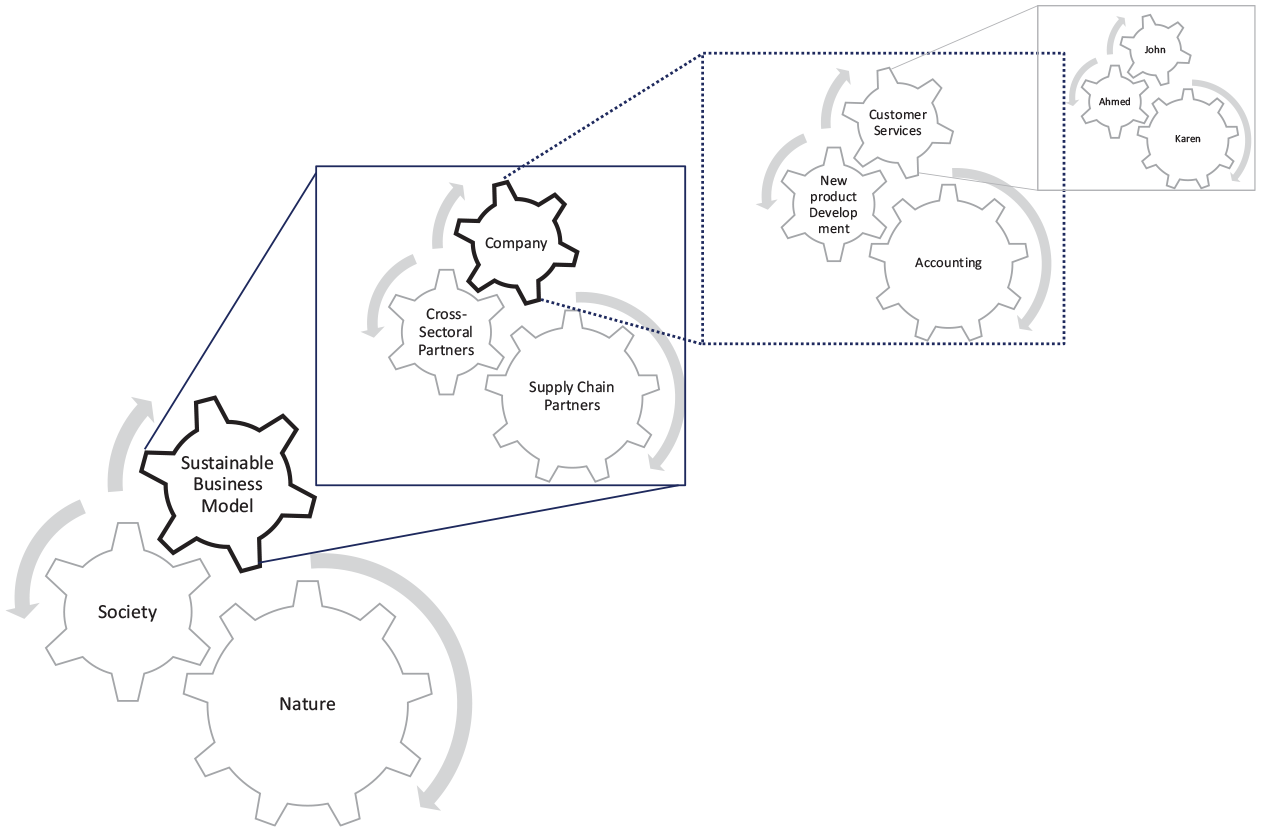
Sustainable business models and cross-sector partnerships embedded in socio-ecological systems.
Sustainable Business Models and Their Cross-Sector Partnership Elements
Cross-Sector Partnerships as Organizational Mechanisms of Sustainable Business Models
We argue that cross-sector partnerships represent a core component and distinctive organizational mechanism through which sustainable business models create social and environmental value in support of socio-ecological systems. We base our view on two well-established literatures, one on sustainable business models and the other on cross-sector partnerships. Sustainable business models represent an organized system of interconnected and interdependent activities and actors which, together, have potential to generate positive impact for sustainability (Boons & Lüdeke-Freund, 2013). To achieve their sustainability aspirations, sustainable business models depend on “collaboration across a wider set of stakeholders in an industrial system” (Bocken et al., 2015, p. 67) and must consider the effects on the plurality of agents embedded in their socio-ecological system (Pedersen et al., 2019; Upward & Jones, 2016). The cross-sectoral nature of the partnership component of sustainable business models clearly sets them apart from other business models where companies mainly collaborate with their supply chain actors or other industry players to create economic value (Osterwalder & Pigneur, 2010). In sustainable business models, companies tend to partner with public and nonprofit actors to create or prevent the destruction of social or environmental value (Stubbs & Cocklin, 2008).
The literature on sustainable business models explicitly refers to partnerships among stakeholders from different sectors as a key organizational component for the creation and capture of value in the broader socio-ecological system. As Rohrbeck and colleagues (2013) put it, sustainable business models inherently require “multiple organizations to work together and pool complementary assets” (p. 3). More specifically, they “differ in type (industry, public research and nonprofit), in their position in the value chain (manufacturing, service, etc.) and industry (energy, ICT, etc.),” and in creating a value-creating or value-capturing system (p. 5). What distinguishes sustainable business models from the traditional business models is not only their aspiration to create social and environmental value for a wide range of stakeholders but also the collaboration among stakeholders with diverse backgrounds and values (Boons & Lüdeke-Freund, 2013; Pedersen et al., 2019; Stubbs & Cocklin, 2008).
Complementarily, the literature on cross-sector partnerships has widely investigated the organizational processes of interaction among multiple stakeholders to create and capture value (Van Tulder et al., 2016). This literature specifies how cross-sector partnerships engage and deliver value to the involved actors (Clarke & MacDonald, 2019; Dentoni et al., 2016), the intended beneficiaries (Le Ber & Branzei, 2010; Trujillo, 2018), and the socio-ecological systems in which they are embedded (Clarke & Crane, 2018; Van Tulder & Keen, 2018). This literature has recently suggested that cross-sector partnerships create value to participants through the development of organizational capabilities (Dentoni et al., 2016) and by gaining organizational, human, and physical resources (Clarke & MacDonald, 2019). Furthermore, cross-sector partnerships create value to their beneficiaries by including their voice in deliberation and decision-making processes (Le Ber & Branzei, 2010), thus expanding their capacities for collective action (Trujillo, 2018). Finally, cross-sector partnerships create value in their ecosystem by developing organizational mechanisms that take the complex nature of the encountered problems into account (Clarke & Crane, 2018; Van Tulder & Keen, 2018).
Cross-Sector Partnership Elements of Sustainable Business Models
Despite their complementarity, the two strands of literature do not delineate how they consider and act upon the nature of CAS, thereby limiting threats to socio-ecological resilience. This represents a remarkable knowledge gap, considering that many studies suggest that the resilience of socio-ecological systems is being seriously compromised (Whiteman et al., 2013; Winn & Pogutz, 2013). Based on these two parallel literatures, we identify three key elements of the partnership component of sustainable business models that can be designed and aligned in awareness of the nature of CAS. In the following, we refer to these as strategic, institutional, and learning elements of cross-sector partnerships.
First, strategic elements of cross-sector partnerships refer to the processes of value creation and capture among multiple agents, including their impacts on the socio-ecological systems surrounding them. The literature on sustainable business models (Abdelkafi & Täuscher, 2016; Bocken et al., 2013; Joyce & Paquin, 2016) and cross-sector partnerships (Clarke & Fuller, 2010; Clarke & MacDonald, 2019; Stadtler & Van Wassenhove, 2016) explain how cross-sector partners create value in socio-ecological systems through their resource and activity interdependencies. For example, the interdependency of the phone company Telenor and the microfinance organization Grameen Bank is based on the complementarity of the former’s technological resources and the latter’s knowledge and networks in the Bangladeshi context (Seelos & Mair, 2007). Through these interdependencies, cross-sector partners mitigate uncertainty and limit unintended consequences for the environment where they try to deliver positive outcomes (Dahan et al., 2010). Along with building interdependencies among partners, creating value in socio-ecological systems also requires deep understanding of how sustainable business models interplay with (Abdelkafi & Täuscher, 2016) and influence (Joyce & Paquin, 2016) the agents outside the boundaries of the partnership. For example, Bocken and colleagues (2013) illustrated how cross-sector partners in Europe that were trying to create sustainable value mapped not only their own resource interdependencies but also the resources and networks of other agents in the socio-ecological system. More recently, van Hille and colleagues (2020) illustrated how cross-sector partners considered how nature acts as a key agent that influences the value creation process in socio-ecological systems by regenerating tea plantations and its agroecological systems.
Second, institutional elements refer to organizational arrangements meant to navigate the interplay of heterogeneous and sometimes conflicting logics, values and identities that sustainable business models experience in their cross-sector partnerships. These institutional elements have been widely analyzed both in the sustainable business models (Laasch, 2018, 2019; Ocasio & Radoynovska, 2016; Randles & Laasch, 2016) and the cross-sector partnerships literature (Ashraf et al., 2019; De Lange et al., 2016). Partnerships often involve a careful combination of formal and informal structures to regulate interactions among partners (Cohen & Winn, 2007). For example, multinationals and NGOs mutually co-evolved their initially conflicting logics into compatible logic differences (De Lange et al., 2016). Cross-sector partners used what Brown and Eisenhardt (1997) called “semi-structures”: formal arrangements that deliberately leave space for informal adaptation processes (De Lange et al., 2016). When these organizational arrangements support partnerships to embrace multiple logics, they can effectively address complex socio-ecological issues (Ferraro et al., 2015) and generate pervasive change in socio-ecological systems (Laasch, 2019). Yet, when they fail to do so, they risk triggering dynamics of exclusion and oppression (Martí, 2018). Institutional elements of cross-sector partnerships help to focus on the “fundamental role of values and normative orientations as motivational forces and guides for innovation processes” in sustainable business models (Breuer & Lüdeke-Freund, 2017, p. 27).
Third, learning elements of cross-sector partnerships refer to the processes of experimentation and sensemaking that develop into knowledge and capabilities among multiple agents. Learning elements have been widely investigated, both in the sustainable business model (Martins et al., 2015; Sosna et al., 2010) and the partnership literature (Dentoni et al., 2016; Ryan & O’Malley, 2016). Frequent and widespread experimentation in cross-sector partnerships supports processes of innovation and change among (Berends et al., 2016) and within partnering organizations (Dentoni et al., 2016; Martins et al., 2015; Sosna et al., 2010), especially in uncertain contexts (Andries et al., 2013). When carefully considered, learning in cross-sector partnerships can shape outcomes through the building of more collaborative practices and a stronger vision alignment (Roome & Louche, 2016; Schaltegger, Lüdeke-Freund, & Hansen, 2016). As Schaltegger, Hansen, and Lüdeke-Freund (2016) underline, much remains to be explored about how learning theories at the organizational and individual level “explain the transformation of business models of established firms,” through “learning-action networks and cooperative arrangements, but also political power struggles between stakeholder groups” (p. 8). To support the design of learning elements of cross-sector partnerships, Inigo and colleagues (2017) identified the dynamic capabilities that played an essential role for a set of Basque companies to adapt their established partnerships. Furthermore, Kurucz and colleagues (2017) and Nicholson and Kurucz (2017) developed a framework to develop relational leadership competencies for agents involved in cross-sector partnerships.
Although scholars in the fields of sustainable business models and cross-sector partnerships seem to agree that these three elements of cross-sector partnerships need consideration and alignment to deliver and create social and environmental value (Bocken et al., 2013; Schaltegger, Lüdeke-Freund, & Hansen, 2016), the extant literature does not inform how their design could influence socio-ecological resilience. In the next section, we therefore relate these three elements of partnerships to the three key distinctive features of CAS.
Key Elements of Cross-Sector Partnerships From a CAS Perspective
To conceptually analyze how the design of cross-sector partnerships helps to shape the influence of sustainable business models on socio-ecological systems, we combine the three partnership elements we identified (in section “Sustainable Business Models and Their Cross-Sector Partnership Elements”) with the three key features of CAS (in section “Socio-Ecological Resilience and CAS”). This conceptual juxtaposition leads to our analytical framework (see Table 1), where the three columns represent the complex, adaptive, and systemic features of CAS and the three rows refer to the strategic, institutional, and learning elements of partnerships. We first present each row of the framework in the following three sections.
Analytical Framework: Strategic, Institutional, and Learning Elements of Cross-Sector Partnerships From a CAS Perspective.
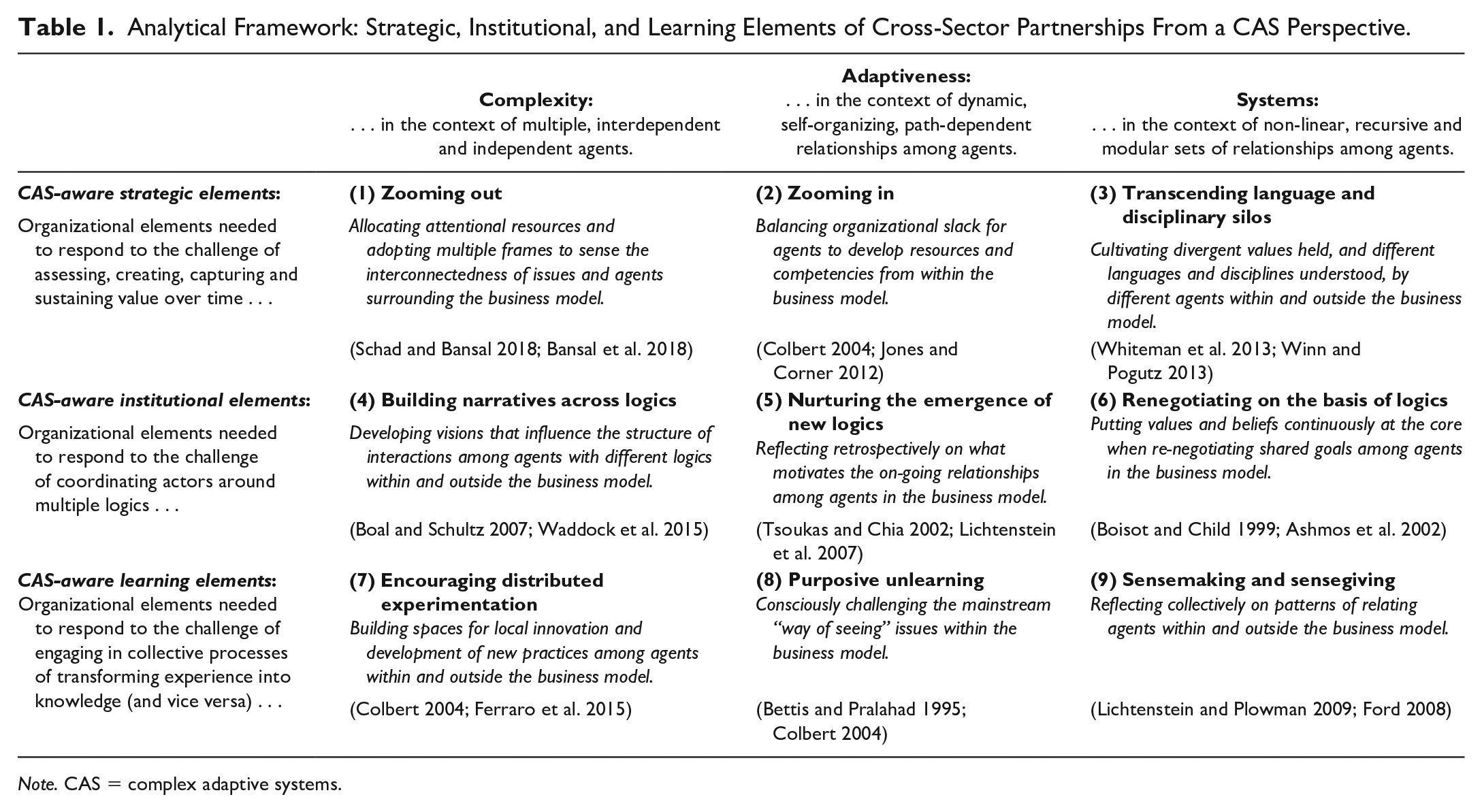
Note. CAS = complex adaptive systems.
Strategic Elements From a CAS Perspective
The first row of the framework depicts how the strategic elements of partnerships can take into account and act upon the nature of CAS (see Table 1). From a CAS perspective, the leading question for designing the strategic elements of partnerships entails: When aware of the nature of CAS, how would cross-sector partnerships organize their resource and activity interdependencies to sustain value creation (and limit value destruction) in socio-ecological systems? As we discuss below, CAS theory suggests that partners need to zoom out, zoom in, and transcend language and disciplinary silos (see Table 1, top row).
First, from a CAS perspective, partners that collaborate in sustainable business models are fundamentally challenged in assessing the value that they create or destroy beyond the partnership boundaries because they are embedded in complex networks of multiple, interdependent, and independent agents. Partners actually know very little about the indirect consequences of their actions for the socio-ecological system. This challenge is acute, for example, for partnerships aiming to produce sustainable outcomes to restore depleted natural ecosystems (Whiteman et al., 2013) or to stabilize socio-political turbulence in fragile contexts (Kolk & Lenfant, 2015). Along with the challenge, though, the nature of CAS may provide opportunities for partners. By coordinating purposively with other agents at, or outside the boundaries of the partnership, they can indirectly, yet purposively influence changes in the overarching system. CAS theory suggests that cross-sector partners need to purposively engage in zooming out (Schad & Bansal, 2018). Zooming out refers to allocating attentional resources and simultaneously adopting multiple frames necessary to sense the interconnectedness of issues and agents surrounding and interacting with the organization. When unraveling the broader interconnectedness of agents in a system (i.e., seeing the forest beyond the trees, Schad & Bansal, 2018), organizations gain a broader strategic perspective on competition and cooperation, as predator and prey may become allies in complementing each other’s resource endowments (Bansal et al., 2018). To engage in zooming-out practices, organizations first need to allocate resources (e.g., communication channels, time) to gather and interpret information on the continuous changes in the external environment (Bansal et al., 2018). Second, cross-sector partners need to adopt complex frames to interpret the interrelatedness of relevant elements in socio-ecological systems that surround them (Hahn et al., 2014; Schneider et al., 2017). Valente (2010) suggests that “the increasing recognition of the interconnectedness of social, ecological, and economic issues [. . .] implies the need for frameworks and tools that comprehend and incorporate complexity rather than frameworks that gravitate toward simplicity and reductionism” (p. 469).
Second, according to CAS theory, all organizations also face internal change forces—which may cause instability and disruption—given the dynamic, self-organizing, and path-dependent relationships among agents in CAS. The dynamics of these internal forces have implications for cross-sector partners, because self-organizing processes among agents could build synergies or clashes between them. Depending on how these self-organizing forces are recognized and coordinated, they constitute either a critical resource or a liability for cross-sector partnerships. To uncover the tensions emerging among agents and to generate valuable resources (Colbert, 2004; Rycroft & Kash, 2004), Schad and Bansal (2018) suggest organizations to engage in zooming-in practices. Zooming in entails unveiling the tensions and synergies that continuously emerge among agents within the organization. By zooming in, cross-sector partners gain an “understanding of the dominant processes that lead to the emergence of systems changes” (Schad & Bansal 2018, p. 17). If aware of this CAS feature, cross-sector partnerships build unique competences from within through co-agency as a process of emergence (Inigo & Albareda, 2016). To intentionally engage in zooming-in practices, Colbert (2004) suggests that organizations should concede some organizational slack, leaving resources, such as people’s time or organizational space, purposively unused. Slack gives room to cross-sector partners to discover inner and emergent tensions or competencies.
Third, given the nonlinear, recursive, and modular sets of relationships among agents, CAS theory suggests that cross-sector partners are challenged to build collaborations, despite fuzzy and unstable incentives and perceptions of what the collaborative outcomes may be over time. As small actions may unexpectedly cause remarkable consequences, depending on the complex interplay of factors in the ecosystem, partners need to continuously reconsider, and, if necessary, suspend the expectations of impact that lead their actions. If they do not take the time and the space to reconsider, they face risks of unintendedly making the problems that they seek to address even more acute (Ferraro et al., 2015). Under these circumstances, CAS theory suggests designing partnerships that support transcending language and disciplinary silos. To do so, cross-sector partners can establish processes of deliberation and decision-making that purposively give voice to agents with heterogeneous backgrounds, languages and disciplines. Transcending language and disciplinary silos entail cultivating cross-disciplinary discourses, nurturing multidisciplinary perspectives, and drawing on the diverse capabilities of practitioners who develop new approaches on the ground (Winn & Pogutz, 2013). With the support of their cross-sector partners, companies would need to increasingly get out of their comfort zone to re-assess their footprint in socio-ecological systems in terms of chemical pollution, climate change, fresh-water use or biodiversity loss measures (Whiteman et al., 2013). In terms of decision-making processes, partnerships would need to develop voluntary, self-regulating approaches (Breite & Koskinen, 2014; Pathak et al., 2014). As partners’ incentives and expectations of impact may change unexpectedly, these approaches should take into account the heterogeneous stakeholder perceptions of fairness (Winn & Pogutz, 2013). These perceptions are likely to vary widely, especially among poorly connected, yet potentially complementary stakeholders in a system (Manning & Reinecke, 2016). In recent years, for example, companies involved in trading and manufacturing palm oil had to reform their decision-making routines and bylaws in the Roundtable for Sustainable Palm Oil (RSPO) partnership to better involve complementary, heterogeneous agents embedded in the socio-ecological system (Dentoni, Bitzer, & Schouten, 2018).
Institutional Elements From a CAS Perspective
The second row of the framework articulates how the institutional elements of cross-sector partnerships can take into account and act upon the nature of CAS (see Table 1), thus supporting sustainable business models to influence the socio-ecological systems they are embedded in. Here, the leading question for the design of institutional elements of cross-sector partnerships from a CAS perspective involves: When aware of the nature of CAS, how would cross-sector partnerships organize themselves according to the multiple underlying logics, values and identities of their agents
First, as CAS involve multiple, interdependent and independent agents, the behavior and structure of cross-sector partnerships emerge from myriad interactions among the multiple agents involved (Boal & Schultz, 2007). Under CAS assumptions, a focus on changing technologies and structures (as suggested for example by Ramus et al., 2017) would not suffice to coordinate agents driven by multiple heterogeneous institutional logics. From a CAS perspective, hierarchical authority and control in partnerships would be useless because emergence among interacting agents in and around organizations simply occurs. This raises the question what leadership would entail in partnerships. A partial answer suggests that leaders would be more effective “by influencing the tags that produce the structure of interactions among organizational agents” (Boal & Schultz, 2007, p. 411) rather than seeking to build organizational structures themselves. Through dialogue and storytelling, leaders can narrate a vision that inspires and influences how partners interact and construct shared meanings of their past, present and future collective actions (Waddock et al., 2015). The use of dialogue and storytelling with agents within and outside the partnership allows building narratives that transcend multiple logics that coalesce in and around their boundaries (Laasch, 2018, 2019). These narratives involve conveying and communicating visions that influence the structure of interactions among agents with different logics. Without using hierarchical authority, narratives act as triggers and catalyzers of self-organized actions and interactions among agents within and outside the partnership. For example, over the past 15 years in global food and agriculture, leaders of various partnerships promoting vegetarian and vegan diets were able to build a narrative around the production and distribution of sustainable alternative protein sources for human consumption without any structured interaction (Dentoni et al., 2017).
Second, given the dynamic, self-organizing, and path-dependent relationships among agents in CAS, cross-sector partners may spontaneously and continuously reorganize their interactions (Tsoukas & Chia, 2002). From the actions and interactions occurring among agents, structural change emerges through self-renewal and it produces a history of organizational becoming and change (Dooley, 1997). Partners progressively realize or discover from the tensions that they face in action (Chia, 2014) that their interactions are driven by novel or shifting logics. For example, through experimenting and making sense of their outcomes, partners in many local food communities (such as community gardens or organic food associations) across Europe realized and changed the underlying values driving their actions, even over short periods (Dentoni, Pascucci, et al., 2018). Drawing implications for cross-sector partners, the emergence of new logics gives new energy to or draws energy from the interactions that constitute the collaboration. Building on these CAS assumptions, we propose that cross-sector partners aware of the nature of CAS would nurture the emergence of new logics and reflect retrospectively on what intrinsically motivates the on-going relationships among cross-sector partners. How can the partnership support these practices? First, through frequent interactions, partners could establish new motives and modalities of interaction and collaboration (Ashmos et al., 2002). Second, they could activate “internal” attentional resources—such as slack specifically dedicated to “make room” for deeper reflexive processes—outside the established routines that hinder deeper processes of reflection and paradigm-shift. Third, as they engage in deeper reflection processes, partners make sense retrospectively and collectively of why they engaged in interactions and reactions to discover the institutional logics that drive them from the bottom up (B. B. Lichtenstein et al., 2007).
Third, given the nonlinear, recursive, and modular sets of relationships among agents in CAS, competing logics among cross-sector partners risk leads to outbursts of tensions and conflicts in different ways and patterns. To avoid unintended consequences from these outbursts, CAS theory suggests leaving room in organizations for uncodified information to diffuse among members, negotiate horizontal coordination, as well as personal, nonhierarchical relationships (Boisot & Child, 1999). To avoid oversimplistic frames of codified information within its boundaries (e.g., catchy vision statements or grand plans that may not resonate with agents involved in a partnership), organizations aware of CAS would organize more like a clan than a firm (Boisot & Child, 1999). Accordingly, cross-sector partners aware of CAS would continuously renegotiate their goals and activities on the basis of the heterogeneous logics to pursue a meaningful influence on the socio-ecological systems they are embedded in. By continuously renegotiating their values and beliefs, cross-sector partners would more effectively prevent and absorb the nonlinear, recursive, and modular dynamics involved in CAS (Boisot & Child, 1999). To practice these continuous renegotiations of logics, partners may solicit each other to articulate deeper meanings as they act and interact (Colbert, 2004). They give priority to full engagement of all agents involved, for example, by investing time in sharing information across all levels of the partnership rather than seeking rapid and cost-effective decision-making processes (Colbert, 2004). Finally, if aware of the nature of CAS, more powerful agents in cross-sector partnerships would voluntarily avoid exerting their power to avoid unintended outbursts of conflict and instead promote participatory processes of interaction (Accard, 2019) to stabilize partners’ interactions and mitigate the risks inherent in nonlinear, recursive, and modular socio-ecological systems (Ashmos et al., 2002).
Learning Elements From a CAS Perspective
The third row of the framework synthesizes how the learning elements of cross-sector partnerships can take into account and act upon the nature of CAS (see Table 1). The leading question that partnerships need to address to design learning elements to influence the socio-ecological systems would entail: When aware of the nature of CAS, how would cross-partnerships organize their individual and organizational learning processes? CAS theory suggests that cross-sector partners would enhance distributed experimentation; engage in purposive unlearning processes; and encourage sensemaking and sensegiving.
As CAS involve multiple, interdependent, and independent agents, cross-sector partners inherently lack the knowledge how to coordinate with most of the other agents outside their boundaries that, directly or indirectly, influence their sustainability aspirations. Under these conditions, learning from many small-scale local experiments (Andries et al., 2013) is critical to assess what works and what does not in the plethora of local contexts where the partnership realizes its outcomes (Ferraro et al., 2015). Conversely, cross-sector partners would avoid large-scale, top-down, context-unspecific interventions that may impact different agents in the system with unintended and poorly understood effects. When facing complex sustainability challenges (Ferraro et al., 2015), CAS theory suggests organizations to encourage distributed experimentation. This refers to “iterative action that generates small wins, promotes evolutionary learning, and increases engagement, while allowing unsuccessful efforts to be abandoned” (Ferraro et al., 2015, p. 376). The notion of distributed experimentation implies that the most suitable idea in a local context will survive and thrive. For example, the business models used to scale the use of alternative energy and reduce greenhouse gases, such as those involving wind and bio-fuel energy in the United Kingdom (Parkhill et al., 2015), entailed many small local experiments within partnerships among municipalities, house owner associations, and energy companies. Through observation, reflection, and extensive communication among agents within and across multiple local experiments (Jalas et al., 2017), agents learn from each other in real time. Along this engaged process of learning, given their embeddedness in dynamic, self-organizing, and path-dependent relationships among agents, cross-sector partners aware of the nature of CAS would strive to rapidly interpret the outcomes of the many small-scale experiments that they run. Conversely, they may fail to learn if, during and after engaging in distributed experimentation, the partners do not go through a process of reflection that is open to multiple interpretations (Bettis & Prahalad, 1995). To interpret which local experiments may have realized a small win or a small loss, partners would seek a diversity of lenses, or mental models, to make sense of these outcomes (Becker, 2010). Cross-sector partnerships aware of CAS would thus continuously challenge their dominant logic when interpreting the outcomes of their experiments. They would engage in purposive unlearning processes to stimulate organizational intelligence and adaptive learning (Bettis & Prahalad, 1995). The business model literature provides rich examples of how partners unlearn when they face external challenges or internal tensions (Mehrizi & Lashkarbolouki, 2016; Sosna et al., 2010). In the case of a partnership led by a dietary product retail store (Sosna et al., 2010), partners were confronted with rapid changes that increase their “repositories of knowledge.” These changes prompted “managers to re-conceive situations beyond their previous cognitive structures, and this increased knowledge leads them to develop more complex cognitive schema to deal with their future decision-making” (Sosna et al., 2010, p. 392). To purposively unlearn, CAS theory suggests, first, that partners honor their errors made by encouraging reflective practices—for example, promoting incentive schemes that honor what they would collectively sense to be remarkable learning experiences (Becker, 2010). Second, they invite dialogue on alternative approaches through virtual or physical platforms for discussion (Colbert, 2004). Finally, partners provide organizational support and training during the process of unlearning (Cegarra-Navarro & Dewhurst, 2006), because “unlearning must be a prior consideration and not an afterthought” (Becker, 2010, p. 263) to effectively facilitate learning and collaboration.
Finally, given the nonlinear, recursive, and modular nature of their environment, cross-sector partners may struggle to realize whether some outcomes are to be considered negative, positive, or just partial, as heterogeneous partners inherently look at different facets of the same outcome (Kurtz & Snowden, 2003). Even when a general sense of satisfaction (or frustration) permeates the outcome of an experiment, CAS theory posits that it would be hard to pinpoint the specific drivers for that outcome, nor to univocally disentangle causes and effects related to that outcome (B. M. Lichtenstein, 2000). In these situations, partnerships aware of the nature of CAS would engage in processes of sensegiving and sensemaking to collectively interpret the partial, in-becoming organizational outcomes (Wesley et al., 2013). Sensemaking refers to developing a coherent story that helps agents interpret partial outcomes in becoming (Plowman et al., 2007; Wesley et al., 2013). Following this interpretive work, sensegiving entails visioning a way forward for the partners involved to collectively deal with these outcomes (Gioia & Chittipeddi, 1991). When faced with complex issues of wetland management (Wesley et al., 2013), for example, partners involved in a Biosphere Reserve in Sweden during the 1970s “embarked on an exercise to thoroughly map historical and present-day land use practices, creating a system wide picture” (i.e., sensemaking) and then took “steps to disseminate this understanding of the ecosystem through a series of exhibitions” and one-to-one meetings, giving “new meaning to the wetlands as water rich rather than water sick” (Wesley et al., 2013, p. 27). According to CAS theory, cross-sector partners can effectively engage in sensemaking and sensegiving retrospectively (Kurtz & Snowden, 2003). Although causes and effects of partial outcomes are not predictable in advance, they can be examined backward in time with stakeholders, to collectively understand cause-and-effects and feedback loops when seeking to understand past patterns (Snowden & Boone, 2007). Yet, for this retrospection to happen, resources for convening need to be allocated in terms of regular communication and interaction among partners (Seidl & Werle, 2018). For the partners involved, this process of retrospection involves an artful use of language and symbols to give meaning to unfolding events and fostering the development of a shared understanding (B. B. Lichtenstein & Plowman, 2009). How partners collectively engage in sensemaking and sensegiving processes depends on the psychological traits of the agents involved—such as their congruence between real and ideal self and their ability to embracing a variety of conflicting issues (Akrivou & Bradbury-Huang, 2011).
Linking Sustainable Business Model Partnerships to Socio-Ecological Resilience
In this section, we discuss when and how sustainable business models may support or at least limit threats to socio-ecological resilience when the partnership component at the core of these models takes into account and acts upon the nature of CAS (see Figure 2). Due to the nature of CAS, the literature on socio-ecological resilience suggests that socially organized subsystems—such as cross-sector partnerships—help to stabilize the system when they are able to self-organize, learn, and adapt (Folke, 2006; Gunderson & Holling, 2002). Accordingly, we argue that sustainable business models limit threats to socio-ecological resilience when they align their strategic, institutional, and learning partnership elements by taking into account and acting upon the nature of CAS.
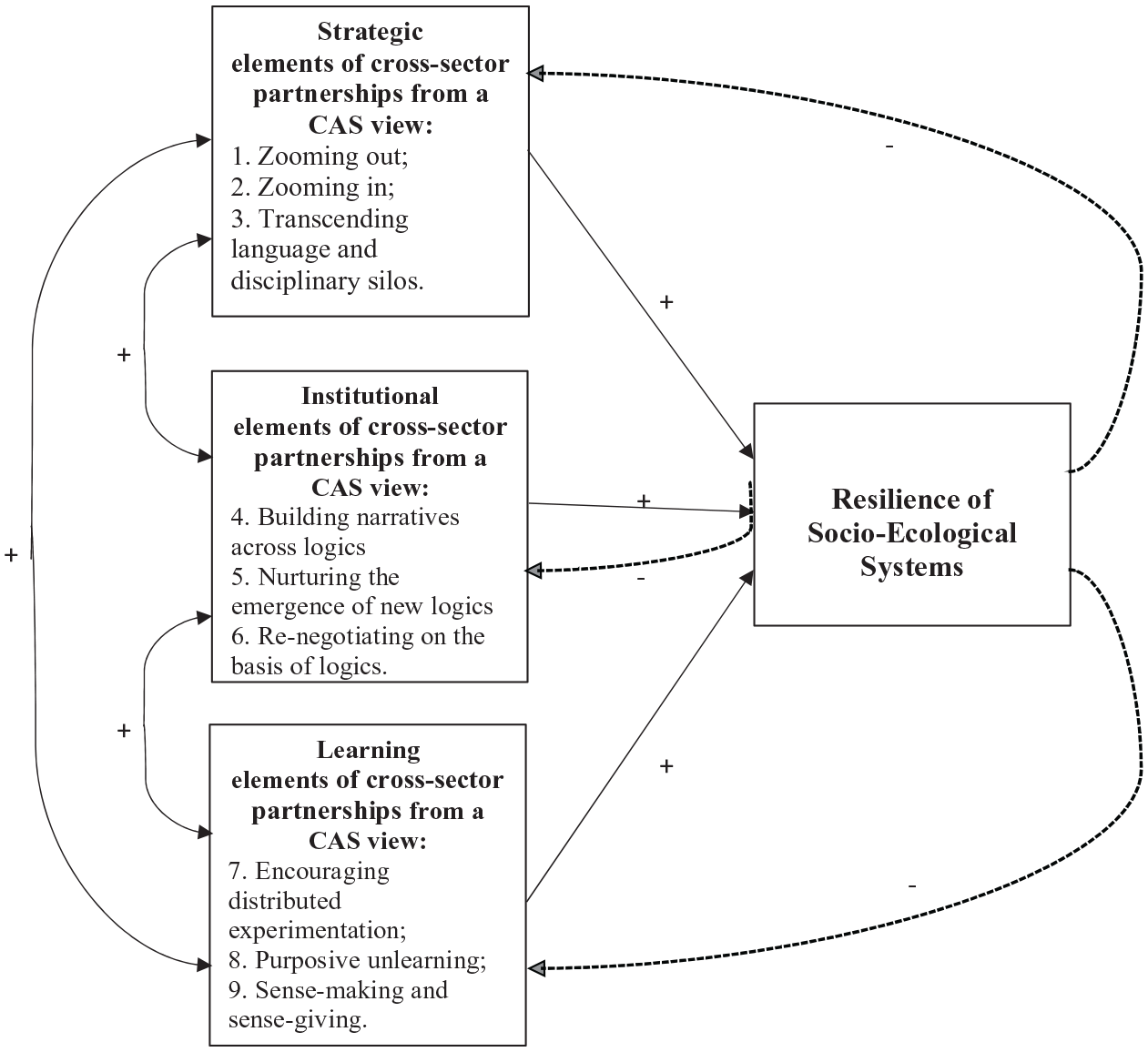
Theoretical framework relating strategic, institutional and learning elements of cross-sector partnerships to socio-ecological resilience.
First, if considering and acting upon the nature of CAS, the strategic elements of cross-sector partnerships would support sustainable business models in responding and adapting to exogenous and endogenous threats to resilience. They do so by sensing the interconnectedness of issues and agents surrounding them (i.e., zooming out) as well as the emergence of tensions, resources, and competencies from within (i.e., zooming in) through the use of multiple linguistic and disciplinary frames (i.e., transcending language and disciplinary silos). An example of investing dedicated resources for zooming in and out and by fostering novel debates among previously disconnected partners may be provided by three cross-sector partnerships in Central Africa described by Kolk and Lenfant (2015). According to the authors, the members of these partnerships—global and local value chain actors, government officers, international NGOs and local communities—made the purposive effort to understand and connect subsystems that were disconnected or poorly communicating with each other. These subsystems were, among others, the coffee value chain, the mining activities, the on-going rebellion, as well as the local and global political sphere. While indirectly affecting each other, these subsystems were poorly communicating and failed to understand each other. By investing resources in bridging across previously disconnected subsystems, these cross-sector partnerships were able to support stability in a fragile socio-ecological setting—for example, by encouraging reconciliation, reintegration, respect for (legal and contractual agreements), and capacity-building (Kolk & Lenfant, 2015).
Second, the institutional elements of cross-sector partnerships help sustainable business models to limit threats to resilience by working purposively on their institutional logics. Imposing one dominant logic through command-and-control may cause internal conflict, unintended consequences, and myopia in foreseeing external issues. Conversely, by building narratives that transcend multiple logics, nurturing the emergence of new logics, and renegotiating on the basis of logics, a partnership can foster deeper dialogue among its members, question and rediscuss goals and activities, and change strategic intent when necessary. For example, by engaging in deep discussions on values through the realization of activities and artifacts with their cross-sector partners, a company achieved pervasive adaptation and renewal of the network of actors in which it was embedded (Laasch, 2019). This example represents how a sustainable business model limited the threats to socio-ecological resilience by designing its institutional partnership elements in ways that considered the nature of CAS.
Third, the learning elements of cross-sector partnerships are vital for sustainable business models to limit threats to socio-ecological resilience. By engaging in many small-scale experiments (i.e., distributed experimentation), partnerships have the chance to realize what works and what does not work in the local context where they operate, thus preventing unintended consequences (Ferraro et al., 2015). For example, through many small-scale experiments involving farmers, civil society organizations, and municipalities, many food-provisioning business models have been recently emerging in Spain and Italy (Dentoni, Pascucci, et al., 2018). This distributed experimentation allowed quickly adjusting the business model after realizing that some activities were more fitting than others to the local socio-ecological conditions (e.g., the soil, the weather) or the social context of their members (Dentoni, Pascucci, et al., 2018). By purposively challenging the dominant logic and opening up to multiple interpretations (i.e., purposive unlearning), partnerships can recognize issues that could threaten the socio-ecological system either from within the partnership (Martí, 2018) or from outside (Orr & Donovan, 2018). For example, by partnering with community members and local religious leaders through village committees, Martí (2018) shows how a microfinance institution in Bangladesh was able to rapidly adapt its business model and limit unintended consequences for the poorest of the poor. Finally, engaging in deliberate processes of sensemaking and sensegiving provides opportunities to partnerships to continuously interpret patterns of change within and outside their organizational boundaries (Kurtz & Snowden, 2003). These learning processes increase the likelihood that partners detect and act upon threats to socio-ecological resilience, thus supporting their business model to more deliver more certain and sustainable outcomes.
Finally, given the features of CAS, we argue that socio-ecological resilience may generate self-balancing mechanisms with the identified elements of cross-sector partnerships (see the negative feedback loops in Figure 2). Eventually, realizing that socio-ecological resilience is under threat would stimulate cross-sector partners to consider more seriously the nature of CAS. For example, the visible effects of coastal disasters in South Asia over the past decades have triggered local companies’ awareness of the nature of the socio-ecological systems influencing them (Adger et al., 2005). Likewise, several European governments and countries initiated the Basel Convention Partnership on Plastic Wastes after realizing that plastic waste irremediably affects the nature of our oceans (International Institute for Sustainable Development [IISD], 2019). These examples corroborate the notion that all subsystems—including organizations like cross-sector partnerships—may adapt in response to perceived stresses or shocks (Chapin et al., 2009). Nevertheless, future adaptation of sustainable business models will depend on how rapidly cross-sectoral partners realize the past degree of socio-ecological resilience (Linnenluecke et al., 2012). Increased understanding of limited socio-ecological resilience may not develop as rapidly as the threats to resilience themselves, leaving organizations unprepared to face these new threats to socio-ecological resilience (Cutter et al., 2009). This temporal dimension of adapting sustainable business models, which should occur before new threats to socio-ecological resilience manifest themselves (Walker & Westley, 2011), makes the design of their strategic, institutional, and learning partnership elements not only important but also urgent (Linnenluecke et al., 2012).
Discussion and Conclusion
Contribution to Theory on Cross-Sector Partnerships and Sustainable Business Models
In this article, we developed a framework based on CAS theory that analyzes how cross-sector partnerships as a core and distinctive mechanism of sustainable business models can support socio-ecological resilience. The framework combines the key features of CAS and the key strategic, institutional, and learning elements of partnerships that sustainable business models rely on to support socio-ecological resilience. Our CAS perspective corroborates the notion that sustainable business models distinguish themselves from other business models by relying on cross-sector partnerships to create social and environmental value (Boons & Lüdeke-Freund, 2013; Pedersen et al., 2019; Stubbs & Cocklin, 2008). Although business models, in general, have been conceptualized as subsystems—bound by interrelated sets of resources and activities (Foss & Saebi, 2018; Massa et al., 2018; Zott & Amit, 2010)—a CAS perspective highlights that business models are subsystems within a broader socio-ecological system. From this perspective, a business model aiming to be sustainable needs to engage in cross-sector collaboration to negotiate and make sense of how to create value in socio-ecological systems (Bocken et al., 2015; Boons & Lüdeke-Freund, 2013; Rohrbeck et al., 2013; Schaltegger, Hansen, & Lüdeke-Freund, 2016; Stubbs & Cocklin, 2008). Organizing through cross-sector partnerships is critical for sustainable business models to fulfill the promise of addressing socio-ecological problems such as climate change, biodiversity loss, and global inequality.
Our article’s first main contribution is that we consider socio-ecological resilience as the main outcome to analyze the effectiveness of sustainable business initiatives and by adopting CAS theory explain what the consequences are of doing so. We reinforce the idea that sustainable business initiatives should be assessed in terms of their impact on the level of socio-ecological systems instead of the level of the organization only (Hahn et al., 2015; Williams et al., 2021). Although extant studies argue that sustainable business models’ purpose is to create social and environmental value (Aguiñaga et al., 2018; Bocken et al., 2015; Boons et al., 2013), such value often boils down to improvements in organizations’ social and environmental performance. We argue that support for socio-ecological resilience is a more adequate outcome measure because it better aligns the promise of sustainable business models’ contribution to addressing socio-ecological problems and their actual impact.
Our perspective also highlights the challenge of assessing the impact of an organizational-level sustainability initiative such as a sustainable business model on a system-level outcome such as socio-ecological resilience. Although existing studies have tried to conceptualize value creation (Evans et al., 2017; Joyce & Paquin, 2016) and the delivery of net-positive impact (Dyllick & Muff, 2016) in socio-ecological systems, CAS theory suggests that defining and assessing a business model’s value creation and impact—similar to any other agent or subsystem of agents in a system—is quite simply impossible. The involvement in CAS of multiple, interdependent, and independent agents does not allow for distinguishing their impact from those of other agents acting simultaneously within the same socio-ecological system. Due to the dynamic, self-organizing, and path-dependent nature of interdependencies among agents, no impact can be claimed beyond partial and unstable outcomes, which may change unexpectedly and unwittingly over time. The nonlinear, recursive, and modular configuration of agents in the system implies that impact can easily be contested, because disentangling causes from effects is problematic. We argue, therefore, that sustainable business models can, at best, be expected to support socio-ecological resilience but not to have a direct impact at the system level.
As our second main contribution, we extend previous studies by showing in detail how cross-sector partnerships provide the organizational structure for sustainable business models to support socio-ecological resilience (Heuer, 2011; Seitanidi, 2008; Winn & Pogutz, 2013). Our framework presents the strategic, institutional, and learning elements that allow cross-sector partnerships to organize the resource and activity interdependencies, the multiple underlying logics, values, and identities of their agents, and the learning processes. It sheds a new light on the ways in which cross-sector partnerships can design their organizational processes in relation to the complex socio-ecological issues that they seek to address (Dentoni, Bitzer, & Schouten, 2018; Ferraro et al., 2015; Kolk & Lenfant, 2015). Consistent with the partnership literature, we concentrate on designing and aligning organizational elements in relation to key dimensions of complexity. Taking a CAS perspective rather than an issue-centered view (Ferraro et al., 2015) broadens the scope of the partnership elements that require design and alignment as it not only considers institutional elements (Dentoni, Bitzer, & Schouten, 2018) but also strategic and learning elements.
By considering the partnership elements through the lens of CAS theory, we also extend the literature that relates business models (Andries et al., 2013; Sosna et al., 2010), including those aiming to be sustainable (Abdelkafi & Täuscher, 2016; Bocken et al., 2015; Laasch, 2018; Martí, 2018), to different facets of complexity in socio-ecological systems (Boons et al., 2013). We build on studies suggesting that sustainable business models need to understand the complex interplay among multiple interdependent actors in socio-ecological systems (Abdelkafi & Täuscher, 2016; Cosenz and Noto 2018). We highlight the need to consider the internal complexity of sustainable business models that arise from the interdependencies and interactions among agents within the cross-sector partnership. As such, our framework reiterates studies suggesting that the more complex a cross-sector partnership’s external environment, the more complex it needs to be in terms of establishing new processes and structures (De Lange et al., 2016; Ryan et al., 2012; Schneider et al., 2017). For example, our framework underlines the need for finding a normative synthesis between the multiple logics and values that cross-sector partners put forth (Breuer & Lüdeke-Freund, 2017; Laasch, 2018, 2019) and for learning in rapid, distributed cycles of experimentation and sensemaking (Andries et al., 2013; Sosna et al., 2010). The nonlinear, recursive, and modular configuration of agents involved in a partnership means that for them to collectively support a system-level outcome like resilience, they need to constantly realign the strategic, institutional, and learning elements of partnerships to avoid unintended consequences on the level of socio-ecological systems (Martí, 2018).
To summarize, then, our article advocates for the need to assess sustainable business models in terms of their support for socio-ecological resilience. Yet, it also underlines the complexity involved in doing so. Our framework suggests how this challenging task of designing cross-sector partnerships, while being aware of CAS, can best be managed to most effectively support socio-ecological resilience and avoid unintended consequences.
Managerial Implications and Directions for Future Research
This article makes organizational decision-makers aware of the complexity of having a positive, or limiting a negative, impact on the resilience of socio-ecological systems. No matter how good the intentions, the complexity of socio-ecological problems means that sustainable business initiatives run the risk of not having the intended impact or making things worse even due to unintended consequences. Our CAS framework helps decision-makers to cope with this complexity by informing them how to design the partnership component of their sustainable business models to better support socio-ecological resilience. By aligning partnership elements (i.e., strategic, institutional, and learning elements) with the nature of CAS, decision-makers claiming to design and implement sustainable business models have the opportunity to limit both exogenous threats (e.g., environmental or socio-political disturbances such as the negative effects of climate change or an adverse policy decision that may affect an economic sector) and endogenous threats (e.g., tensions or conflicts with pervasive negative effects on the ecosystem as well as unintended consequences) to socio-ecological resilience.
A limitation of our study is that it does not shed light on the conditions and incentives needed to do so. For example, do decision-makers have the private interest to voluntarily relax exerting their power for the sake of making a partnership better able to interpret possible threats to socio-ecological resilience using multiple frames and perspectives? Or, would decision-makers have the incentive to renegotiate their logics when establishing goals and activities of their partnerships? In our framework, we assume that being aware of the nature of CAS and of the threats to socio-ecological resilience would automatically lead cross-sector partners to act upon them. However, behavioral theories show that awareness often does not suffice to meaningfully influence practice; stakeholder pressures and power imbalances could hinder developing and aligning the elements in practice. More generally, while CAS theory often implies rejecting command-and-control approaches to manage organizations—including cross-sector partnerships—it has been recently criticized for taking little account of the power dynamics (Cleaver & Whaley, 2018). To make our CAS view more robust, we invite scholars to investigate the power dynamics that underlie designing or adapting the partnership component of sustainable business models for socio-ecological resilience.
Footnotes
Acknowledgements
The authors thank the managing editor Prof. Esben Rahbek Pedersen, the other co-editors of the Special Issue titled “Collaborative Cross-Sector Business Models for Sustainability” (Prof. Florian Lüdeke-Freund, Prof. May Seitanidi, and Prof. Irene Henriques), and four anonymous reviewers for their helpful guidance.
Declaration of Conflicting Interests
The authors declared no potential conflicts of interest with respect to the research, authorship, and/or publication of this article.
Funding
The authors disclosed receipt of the following financial support for the research, authorship, and/or publication of this article: The authors acknowledge The Dutch Scientific Organization (NWO) and the Consultative Group on International Agricultural Research (CGIAR)’s Climate Change, Agriculture and Food Security (CCAFS) 4th Global Challenges Program (GCP) for their generous funding of our project “Organizing business models for SMAllholder farmer REsilience” (OSMARE), which involved co-authors Domenico Dentoni and Rob Lubberink.
Notes
Author Biographies
