



Abstract
Despite contrary evidence, attendance remains a measurement of success in remote First Nations education. This motivation, in part, derives from the Australian Government’s ‘Closing the Gap’ policies, which in the past included attendance targets for First Nations students. These assumed that increased school attendance led to improved school outcomes. Our article provides an account of what students, school staff and community members living, working and studying in remote and very remote communities say leads to increased school engagement and attendance. We argue concerns about school attendance are more often about poor engagement in learning at school than they are about the proportion of children and young people attending school on any day. The factors that either encourage or negatively impact attendance/engagement are discussed, including school environment, leadership, governance, teachers and teaching, student and external factors, systemic and policy issues. The findings have implications for schools, systems, policies, and funding priorities.
Keywords
For over a decade in Australia, there has been concern about First Nations students’ school attendance and how education policy and practice may address this. Attendance data has been used to draw a correlation between absence and student academic achievement (Wilson & Wilks, 2013), although attendance is more likely to be an indicator of student engagement (Reschly & Christenson, 2022). Furthermore, engagement in learning is arguably more important for educational outcomes than attendance (Guenther, 2013; Waller et al., 2018). Student engagement at school can ‘improve academic performance and promote attendance in school while inhibiting risky or negative youth behaviours’ (Allen & Boyle, 2022, p. 134). In this article, we explore the connection between attendance and engagement in the context of First Nations education in remote Australian communities.
Our focus on remote First Nations schools arises from the relatively low attendance rates, the low levels of secondary school completion and the high rates of dropout (or disengagement) in those schools (My School data, 2011–2023). By ‘remote First Nations schools’ we mean those schools that have high proportions of First Nations student enrolment – typically greater than 80%, and which are located in geographic areas and that the Australian Bureau of Statistics (ABS) defines as remote or very remote (Australian Bureau of Statistics, 2023). The schools we included in our research are overwhelmingly located in very remote areas. Attendance rates for schools in remote and very remote areas with a high proportion of First Nation students are much lower than remote and very remote schools with few First Nation students. Between 2011 and 2019 attendance rates for very remote schools with more than 80% First Nations students declined from 73 to 63% (see Figure 1). These falls may reflect the cumulative impact of policies such as the introduction of Direct Instruction (see Guenther & Osborne, 2020; Steele & Oliver, 2024 for discussion), and in the Northern Territory, the introduction of an attendance-based funding model in 2015 (see Deloitte Access Economics, 2022). The reduction also points to a reaction against strategies designed to improve attendance such as the School Enrolment and Attendance Measure (Goldstein & Hiscox, 2018) and the Remote School Attendance Strategy (Guenther, Osborne, et al., 2022). School attendance rates for very remote schools, pre- and post-pandemic. Source: My School data, 2011-2023, https://myschool.edu.au/. Attendance figures were not reported for 2020 due to the pandemic.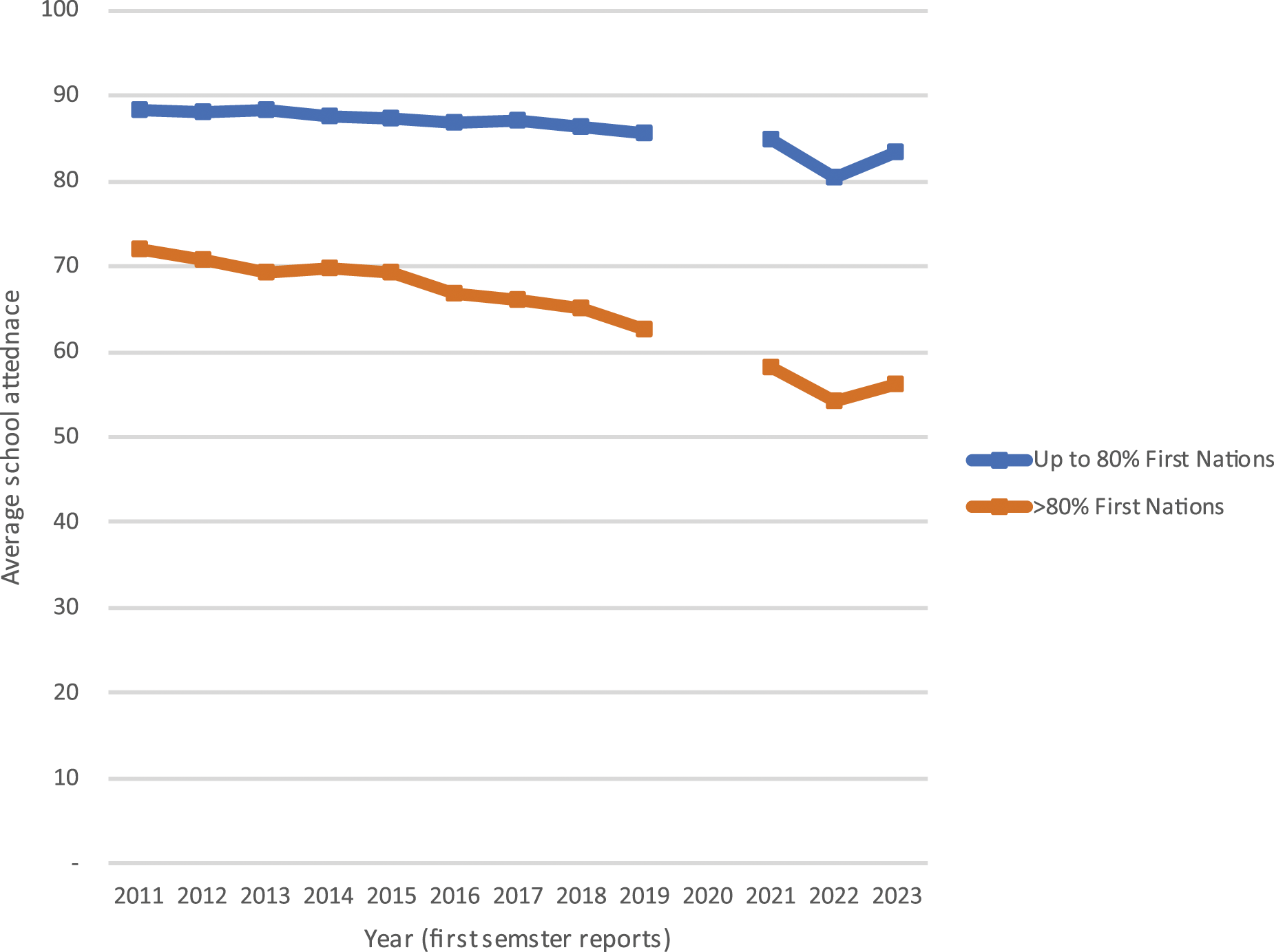
The connection between attendance and engagement is undisputed, what requires interrogation is the long-established belief that attending school leads to increased outcomes. We question whether engagement can be measured simply by attending school, whereas engagement requires a deeper interaction between the school and the student. Over the past decade researchers have continually signalled the need to shift the attention from attendance to engagement (Krakouer, 2016; Lowe et al., 2023). Ladwig and Luke (2014) state ‘we find that reforms and policies around attendance have not and are unlikely to generate patterns of improved achievement’ (p. 171). Engagement and attendance are not the same – a student who attends is not necessarily engaged in learning – but measuring attendance as a proxy for engagement is something that some governments and departments of education have done (Australian Institute for Teaching and School Leadership [ITSL], 2019; Council of Australian Governments [COAG], 2021, New South Wales [NSW] Department of Education, 2022), possibly because other measures of engagement are more difficult to quantify at scale. He et al. (2021) also call for exploration of the factors that lead to non-attendance. What is apparent is that the contributing factors are complex and entrenched (Niddrie et al., 2018). Extending this sentiment Prout Quicke and Biddle (2017) call for greater understanding and recognition of socio-cultural patterns that impact engagement and attendance in remote communities. However, few studies have explicitly explored the relationship between engagement of young people in remote communities and why they are disengaged with schooling that they do not attend. Therefore, in this research aims to determine: Why First Nations students choose to attend and engage in school?
We could equally ask why students do not attend or engage in school, but this plays into the deficit discourse that surrounds First Nations students. We also acknowledge the further complicating factor of retention: Attendance and engagement cannot be understood without also considering this as the constructs are overlapping (even though how they are measured is less than clear cut). However, in this paper we focus primarily on engagement and attendance.
Background literature
Although there is a dearth of studies that seek to disentangle engagement and attendance, a review of the literature shows that several factors have been identified as contributing in positive ways to both. These include cultural, family, and community connections, teaching, teaching and institutional factors, and policy and funding mechanisms, as discussed below.
An educational initiative known as ‘On Country Learning’ connects cultural and community ties to schooling, which seems to enhance the engagement of Indigenous students (Fogarty & Schwab, 2012; Jackson-Barrett & Lee-Hammond, 2019). This has been discussed in several studies (e.g. Guenther, Ober et al., 2022; Schwab & Fogarty, 2015; Van Gelderen & Guthadjaka, 2019) with some explaining that positive outcomes occur because this pedagogy connects student learning with their cultural identity and sense of belonging (Harrison & Skrebneva, 2020; Wheatley, 2018).
Heritage language and bilingual programs have been reported as having a similar effect (Osborne et al., 2020). In addition, learning through the use of and by explicitly teaching first (home) language has a positive impact on English literacy achievement (Angelo et al., 2022; Wilson et al., 2018). This is particularly the case in remote communities where children enter school with ‘very little awareness and understanding of Standard Australian English’ (Wigglesworth & Billington, 2013, p. 238) and, therefore, building on their knowledge of home language supports their learning of and through English. It also supports the development of positive self-identity which, in turn, has been shown to be associated with positive educational and employment outcomes (Kickett-Tucker & Coffin, 2011; Shay & Wickes, 2017).
Remote school cultural programs that support and embed local knowledge systems through the inclusion of local community people cultivate positive opportunities that promote student wellbeing (Lowe et al., 2021; Moodie et al., 2021) and increased engagement. Lowe et al. (2021) highlight families’ desires for children to have access to cultural and language programs that ‘revive and maintain their language and cultural practices’ (p. 78) to help maintain student wellbeing and cultural safety. Similarly, Moodie et al. (2021) describe the importance of remote schools valuing local knowledge systems as such practices have a positive flow-on effect on students’ wellbeing. However, programs must be intentional and designed in conjunction with community members associated with the schools (Clarke & Denton, 2013; Osborne, 2013).
The important role that First Nations families play in contributing to school engagement and attendance has also been discussed (Burton & Osborne, 2014; Guenther et al., 2014; Melvin et al., 2019; Minutjukur & Osborne, 2014; Osborne, 2014). Families provide the foundations necessary for their children’s future, not just in terms of schooling, but for engagement in community, culture, ceremony, language and connection to Country (Burton & Osborne, 2014; Minutjukur & Osborne, 2014; Osborne, 2014). Therefore, one of the potential solutions for improving engagement that has been identified is providing adult education, training and literacy learning in remote communities. This is the logic behind the Yes I Can adult literacy campaign, which seeks to improve adults reading skills (Williamson & Boughton, 2020).
The contribution of teachers has also been acknowledged as supporting attendance and engagement. They make a difference in schools, not just because of their teaching methods, but through their student, parent and community relationships (Guenther et al., 2015). However, their attitude toward people in the communities where they are teaching and their positionality within settler colonial structures of education (Weuffen et al., 2022) can impact these relationships in both positive and negative ways. It has been reported that non-local teachers and principals can be effective in remote schools if they are prepared to learn, build supportive relationships with students and families, and are self-reflexive and non-judgemental in their work within what can be considered a foreign place (Lowe, Bub-Connor, & Ball, 2019; Lowe, Harrison, et al., 2019; Schulz, 2014). Sarra (2011) indicates that ‘teachers must be encouraged and supported to go beyond their classroom to develop more contextual knowledge [to facilitate] better Indigenous student outcomes’ (p. 162). While Sarra writes from a primary school-aged perspective, building positive First Nations student identities also applies to secondary cohorts. Together these teacher attributes can enhance engagement and attendance.
Preparation of teachers for work in remote schools is also important. Halsey (2018), in his discussion about teachers and teaching for rural, remote and regional (RRR) schools recommends that in ‘RRR contexts, challenges and opportunities [should be] explicitly included in the selection and pre-service education of teachers’ (p. 45). Increasing the number of local Aboriginal teachers may go some way to addressing these challenges (Guenther et al., 2016; Gutierrez et al., 2021; Miller & Armour, 2021; Wilson & Wilks, 2013) but currently, there are limited programs and resources to attract the number of teachers that are needed.
Very remote educational workforce, based on place of usual residence census data, 2016 and 2021, selected school and pre-school occupations.
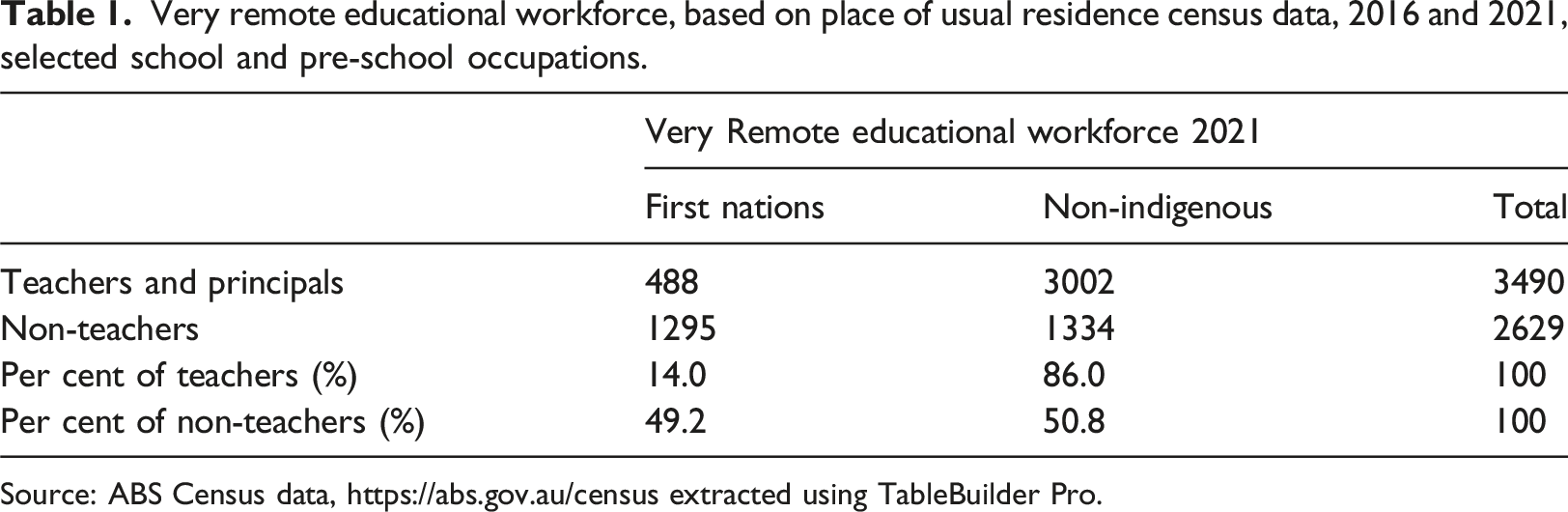
Source: ABS Census data, https://abs.gov.au/census extracted using TableBuilder Pro.
There have been many calls for increased numbers of local staff in remote schools. These staff can connect with students through their shared first language and in a culturally appropriate manner, which in turn foster interactions that are critical for student engagement and retention (Gutierrez et al., 2021; Miller & Armour, 2021; Wilson & Wilks, 2013). Furthermore, they can facilitate team teaching approaches that build upon the skills and knowledge of both First Nations and non-Indigenous staff (Poetsch, 2020) such as through both-ways/two-way strategies, pedagogical approaches lauded for their positive teaching practices (e.g. Bat et al., 2014) which has ‘mutual benefit’ for non-local and local educators. In fact, Guenther et al. (2016) found that local non-teaching staff in schools are positively associated with attendance rates.
Positive learning environments for First Nations children is another key factor that has been identified as contributing to improved engagement and attendance. In their review of the literature Milgate and Giles-Browne (2013), identified six factors that create a positive and effective school, namely, ‘cultural environment, quality teachers, community engagement, student health and wellbeing, curriculum and school leadership’ (p. 1–2). Sarra (2011) also adds the importance of affirming cultural identity and creating environments underpinned by high expectations. Miller and Berger (2022) describe how the ‘school environment was often a traumatic place for parents or family members of First Nations students’ (p. 493) and so they recommend that First Nations culture must be incorporated into the classroom and school environment. This allows students and their families to feel safer, welcomed and connected and hence are more likely ‘to report their positive schooling experiences’ (p. 493). As noted above, this can be further enhanced by the explicit inclusion of culture and language, and through building strong support for positive relationships (Lowe et al., 2020, 2021; Osborne et al., 2020, 2022). An additional factor is the physical environment of the school, including careful design of spaces in ways to support student wellbeing (Whettingsteel et al., 2020). There is a clear need for local staff to be part of self-determined school decision-making processes to facilitate positive school environments that reflect the aspirations of local communities (Spencer et al., 2022; Stanley, 2024; Thomas, 2022).
Other researchers recommend the need for trauma-informed pedagogy in schools. For instance, Tujague and Ryan (2023) provide an in-depth account of cultural safety in trauma-informed practices, providing a First Nations perspective on the effects of trauma. To address such issues, a three-year study was undertaken by Harrison et al. (2023) on the impacts of teaching about the experiences of trauma on students studying to become teachers. They noted the ‘reflexive power of narrative’ (p. 192) that goes beyond teaching about traumatic events such as the Stolen Generations to effect change in both First Nations and non-Indigenous students.
Research to date indicates that various approaches, support structures and initiatives may support positive engagement and improved school attendance. Despite this body of literature many questions remain about the myriad of factors that impact First Nations students and their families. This requires further investigation, particularly with respect to how the constructs of engagement and attendance coalesce. The current study attempted to do this by investigating solutions from a strengths-based perspective informed by those stakeholders living, working and studying in these remote school contexts.
Research questions
The following questions guided the research underpinning this article: 1. What factors impact student attendance and engagement in remote and very remote schools in Australia? 2. What targeted educational support structures, practices and strategies lead to improved student attendance and engagement in remote and very remote schools in Australia?
The answers to both questions are based on perceptions of those we interviewed, and we note the answers we provide may not be generalisable to all remote contexts.
Researcher positionalities
The team who undertook the current research consisted of two First Nations and six non-Indigenous researchers and 26 First Nations community-based researchers who brought their own ways of being, doing and knowing to the task, ensuring the research instruments were culturally appropriate for remote and very remote communities. The authors of this article include a senior First Nations researcher and three non-Indigenous academics. Collectively, the authors have lived and worked in or with remote communities for more than 70 years.
Methodology
Data presented in this article draws on research conducted for the Australian Government Department of Education during 2023 in the Northern Territory and Western Australia by a team of researchers from Batchelor Institute, Curtin University, and the University of Notre Dame. The Researching school engagement of Aboriginal students and their families from regional and remote areas project was funded under the Department’s Emerging Priorities Program. Project – see reports link Final Report (remoteschoolengagement.au). This project explored the impact of the pandemic, and the factors that contribute to retention, attendance and especially engagement within the context of schooling. The results are reflected in the current paper. We acknowledge and, in fact, include data about learning that also can be achieved outside of schools (i.e. On Country). The research was undertaken in Independent and Catholic schools in remote locations in Northern Territory and Western Australia, where many remote and very remote schools are located. Unfortunately, we were not granted access to government schools in this territory and state.
The research in this larger project was undertaken using surveys and yarning techniques as data collection tools, but for the purpose of this article, we draw only on the qualitative findings from interviews and group yarns. Key to this research is that it involved research methodologies and approaches that reflect indigenist perspectives – undertaken using culturally appropriate methods and more than that by the people who are directly impacted by the outcomes of educational achievement in remote and very remote communities. That is, this research was not undertaken ‘on’ First Nation peoples, but rather ‘with’ them as key players in the process.
In this study, we prioritised Indigenous ways of communicating in culturally prescribed, cooperative, humorous, and respectful ways (Walker et al., 2014) and this was the foundation for data collection. Hence, yarning and storying were utilised during the data collection. This helped ensure the research design was culturally safe, enhancing the validity of the data. Yarning, the oral tradition of storytelling (Bessarab & Ng'Andu, 2010; Ober, 2017) is a feature of Indigenous social engagement, and it aligns strongly with Indigenous methodologies. It is a style of communicating, relating, coming together, and connecting as an important way of sharing through stories. Other strategies used for data collection in this study included the Kapati Method (Ober, 2017) which draws on a narrative inquiry approach. Not only were these methods used by the research team, but importantly by the community-based researchers who were trained in these ways by the team. To provide some overall consistency and especially to provide support for the community-based researchers, semi structured interview schedules were available to guide the conversational processes.
Community-based researchers were critical not just to data collection but also to the overall implementation of the research plan in the selected remote communities in the Northern Territory and Western Australia. They were involved in activities including interview design and data collection. Eleven senior students from Wongatha Christian Aboriginal Parent Directed (CAPS) School in Western Australia were also involved as co-researchers, conducting interviews with community and family members.
As a result of this process the data set included 139 interviews undertaken by the research team and by trained community-based researchers. These were conducted with 28 Elders and community members, 50 school staff, 13 principals or school leaders, and 48 students at various remote locations in the Northern Territory and Western Australia. Rich data descriptions resulted from the longer yarning sessions that occurred at four case study sites, namely, Nawarddeken Academy, Yiyili Community School, Yipirinya and Wongutha CAPS School.
All yarns and interviews were audio-recorded, except in a few cases where the participants preferred not to be recorded, in which case detailed notes were taken. Audio recordings were transcribed and analysed in NVivo qualitative analysis software. A thematic analysis approach (Braun & Clarke, 2022) was used to create codes, based on recurring patterns in the data. Members of the academic team were responsible for coding the data they had collected or the data from where they had overseen the work of community-based researchers. The team came together for an analysis workshop to ensure consistency of coding and analysis.
Ethics
Ethical Approval was granted by the Northern Territory Menzies School of Health Research Human Research Ethics Committee, and the Human Research Ethics Committees from Curtin University and the University of Notre Dame (Australia). Ethics clearance was granted from Australian Independent Schools (Northern Territory), Australian Independent Schools (Western Australia), and Catholic Education in both the Northern Territory and Western Australia.
Findings
The findings presented here represent the views expressed by our research participants. In this way, our data does not demonstrate ‘what works’ to improve engagement and attendance in remote schools. Instead, it reflects what people think may help young people to engage in learning at schools and, in turn, foster greater attendance. In broad terms, these perceptions mirror the literature discussed earlier in the article, with some nuances that emerged from the identification of themes during the data analysis. These themes included: school environments, teachers and teaching, governance, leadership, On Country learning, relationships, and family support. The findings are presented according to the themes below.
School environments
Participants believed that engagement was strongly related to a positive school environment – one that recognises, respects, and includes the language and culture of the learners and their community. According to participants, a positive school environment also involves the community in the school and promotes the employment of local staff. In our school, we’ve identified culture, family, inclusion and relationships, those things as being the most important things to us so we resourced them. (Principal, Northern Territory)
The staff also work to ensure adequate and appropriate resources are available within the school. Several participants also linked positive engagement with the care and support provided to students and the respect they receive in school. Emanating from positive school environments, participants also nominated positive learning experiences as vital for student engagement. First and foremost, a high proportion of participants supported two-way learning. What I believe, what (our) School is for our kids is to learn two-way. Western way and our way, the Aboriginal way… That’s our way of Elders, past and present, want us to do here at (our school), to teach our kids two-way and keep it strong (language and culture) and by maintaining it here at the school. (Language Teacher, Northern Territory)
Related to this is the encouragement of community involvement, such as bringing the community into the school and the school into the community and having the school as a community hub. Participants described how this meant ensuring positive and respectful interactions between the school and the community. Some highlighted the importance of ‘listening’ to the community, giving an example from a previous period at the school where this was achieved well. (A previous principal) came here and this was his mission statement, to listen to the community voices. He talked to them about what they wanted - us actually teaching kids in school. (Local staff, Western Australia).
Teachers and teaching
Much of the discussion about teachers and teaching centred on the role of local staff as teachers: the imperative for including local staff (teachers, other educators, and general staff) within the school. Hands down, the number one strength are our local staff. They're the backbone of it, they're the heart and soul of it… They're the most resilient people I know. (Principal, Northern Territory)
This sentiment was supported by another principal who described how at her school, to give local staff due respect, they were called teachers, not assistants nor First Nations workers: Even this title of teacher reflects the respect and understanding of importance of local staff and what they offer; and considerable responsibility is given to these ‘teachers’. (Principal, Western Australia)
Given their key role within remote schools, several participants – school leaders, teachers, and students – expressed their frustration about the lack of First Nations teachers, the lack of support structures to train more, and the pay and conditions for, local staff who were not registered teachers, but who were in a teacher’s role. Our governments need to address this in terms of providing ongoing, in-depth, on the ground local support and training for local people to be able to work alongside their mob. (Principal, Western Australia)
There was a desire among many local staff to become qualified teachers, to take on the responsibility for classroom teaching and learning how to do this in ways informed by western (Balanda) teaching approaches: We really need more education in Balanda. We really need to learn more about Balanda things so we can make it all like how like Balanda people do. (Local staff, Northern Territory)
Several schools we visited were actively supporting staff with training. Those involved saw benefits for students and local staff, as demonstrated in the following exchange during a yarn: Q: Do you think that’s helped with not only getting the students involved obviously but obviously staff retention? R1: For sure. They want to come and do a certificate, it’s good doing a certificate and teaching sometimes. R2: It’s not only thinking about the students’ future, the staff future as well. You know, building them up for their futures. (Local staff, Northern Territory)
While local workforce development was seen as important, it was recognised that students in remote locations need both local and non-local teachers. We heard repeatedly from community members that their primary concern was for children to engage in meaningful learning. This requires a well-trained local workforce and non-local teachers who are willing to listen and learn from each other and work together collaboratively.
Governance
Participants claimed that good school governance also leads to improved attendance and engagement, noting that it is difficult to disentangle the impact of good governance from good teaching, good teachers and good leadership. Good governance shapes a vision for the school and sets the standards for an environment that is conducive to engaged learning. Several participants suggested that positive governance happens when there is a school council that involves representative local decision-making, and importantly where local voices were heard, welcomed, and listened to and implemented: There’s one person from each community, each outstation, is on the school board and they don’t have a meeting until one person from each outstation is present. (Community member, Western Australia)
For some this occurred when there were strong relationships with community members, school leadership, and teachers, and when due respect and acknowledgement is given to Elders, deferring to their vision and direction. So this is what I’ve sort of developed with the board and with [local language teacher] over the years and for the first time we presented it to the teachers at the beginning of this year. The vision of the school by the Elders who have all passed away now was land, law, family, and they're spelling law like that deliberately because the lore is more about men’s and women’s business and this is more about the kinship and protocols and stuff. (Principal, Western Australia)
Underpinning positive governance and the related decision-making processes was the idea of working together with a shared belief in the value of education and learning and the transformative impact of education. Many participants recognised that the translation of these decisions into school practices could only occur with the retention of good teachers and their use of positive teaching approaches.
Leadership
Positive leadership was described by the participants as contributing to and fostering engagement. This occurs as good leaders create an environment that can make learning enjoyable and safe for students. Positive leaders encourage young people to want to learn. Participants also indicated that within remote communities, good leadership was not the responsibility of one person alone, but instead was deemed to occur as part of a team approach (e.g. building teams), and especially working together in collaborative ways involving co-leadership and local leadership: Strong leaders, both Balanda (non-local) and Bininj (local) working together can see that kind of through to fruition. (Teacher, Northern Territory)
Some participants described how it can also involve working with people outside the school, but also with community and elders, and local teachers setting the direction for the school: From the cultural side of it, we’ve got some really significant Elders in the school and also we’ve got language teachers in the school, not assistant teachers, language teachers. (Principal, Northern Territory)
On Country Learning
Earlier, we noted the significance of language and culture as part of a positive school environment. Coupled with this, many of the schools we visited had On Country learning programs, where local traditional knowledge and skills were taught, mostly by community Elders. When I first worked at [School name], it was just not enough, I didn’t get like more knowledge, like Bininj [local] knowledge, it was just Balanda knowledge. It’s using my Bininj culture, that’s why I really need this academy school, because a lot of knowledge that we can learn about it, like language, food and things like art and going out on country, seeing place names and all that. (Local staff member, Northern Territory)
Our observations of On Country learning, along with comments from those we yarned with, suggests that On Country learning is more engaging for children than when learning occurs only within the classroom: I’d really like to see that they do more On Country learning because kids are getting tired of the way sitting in class looking at a blackboard, a whiteboard, whatever the colour of the board. When I was a kid, it was a blackboard with chalk. That’s boring, you know. Learning can be anywhere. You can sit under the tree near the billabong, you know. Kids in there, they say in nature too, kids are more focused. (Community member, Northern Territory)
It was important for many of the participants that the learning that happens On Country is treated as valuable, of similar if not more important to what happens in the classroom: What we did learn out there is used and valued in the classroom. (Community Elder, Northern Territory)
Relationships
The quality of relationships determines how well the school connects with the community, students, and the wider world. Respondents believed that strong relationships made a difference to students’ engagement in learning. One Western Australian principal commented that from the top down (the principal to the cleaner) there is an ‘intentionality to really connect with the students, valuing and respecting students’ And there is also the same with Aboriginal staff – showing and including them – and then encouraging them to continue to connect with the students from the cultural and linguistic standpoint. This intentionality has a direct purpose: When we first started, I mean, here in [community] we were pretty lucky but over in some of the other schools, the attendance data wasn’t so strong to be honest. There was a core group of kids who were coming all the time but there were those periphery kids that were kind of dropping off. And so as staff stayed and as time went along, it’s those relationships, you know. Teachers were building those relationships with those kids. It was around trust, it was around respect, it was around understanding each other and the genuine kind of connections that were coming through. So kids were seeing that teachers wanted them to be there, kids wanted to be there because they were engaging, they were having a great time but also too, they were not intimidated by the learning. (Non-local teacher, Northern Territory)
According to our participants allowing time, building trust and showing respect and ultimately creating a space where children wanted to be, are all part of the relationship building process. This, in turn, results in the kind of learning that is engaging.
Family support
Numerous responses from the participants highlighted the important role that family has in encouraging student attendance, and, in turn, this occurs because family members value education. They are supported by families. They are there. They are not long away. That is a strength. The whole families, the whole community are communicating and talking (about education). (Community member, Northern Territory) I guess what they want to do, most kids, you know, they're learning from a younger age right through kindy, whatever, it’s mainly the family support, you know. They have family support and encourage them to go to school every day. (Community member, Western Australia)
Some participants who were parents and family members described what they do to encourage student attendance, for example: I started to drop them off (and say) It’s good to go to school, it’s good to learn, you get to learn more things. (Community member, Western Australia) I see most of the parents that bring their kids along, you know what kids are like, especially out in remote schools, the parents follow them and bring them along, just, maybe a minute or two spent there and they watch. (Local staff, Western Australia)
Discussion and implications
Our research findings pointed to the importance of several elements that together support students’ attendance and engagement. The perceptions of our participant who live, work and study in remote communities were consistent, pointing to the priority for a safe school environment in remote First Nations community contexts, with schools and school staff members being key to providing a nurturing space. Further, relationships between students and staff and between staff and families, underpin the supportive environment (Guenther et al., 2015; Lowe et al., 2020, 2021; Osborne et al., 2020, 2022). Participants also indicated that learning environments need to be supportive, and be places where culture and language are embraced, where community members are listened to and heard, and not places where First Nations peoples feel humiliated or shamed. Such learning environments can also be outside of school and, in fact, many participants recommended On Country learning as a site that promotes learning and student engagement. This aligns with another recommendation which emerged from the participants, specifically the need to involve and employ more local First Nations staff. This finding is consistent with the literature (Gutierrez et al., 2021; Miller & Armour, 2021; Wilson & Wilks, 2013) and recognises the contribution they make in terms of pedagogy and promoting greater understanding of non-local staff.
In addition, the data revealed the need to encourage greater community involvement, leadership, and governance, findings also reflected in recent literature (Miller & Berger, 2022). Unfortunately, we heard reports that in too many remote schools the principal acts as a de facto school council, effectively removing the possibility of community involvement. Local leadership through co-principals is one way we observed during our data collection that can help contribute to this outcome and a further recommendation for the structuring of leadership in schools.
Two-way learning and On Country learning were listed as key approaches to engage remote First Nations students. Participants also described the need to provide hands-on-learning, learning that is holistic and that matches the students’ needs. Learning also needs to be relevant to who they are and where they live. Such learning experiences should involve integrated learning, awareness of learner cultural identity, and teaching approaches that recognise and involve culture and the students’ first language(s). Participants described the need for teaching English alongside first language(s). This finding is also reflected in the literature. Several studies highlighted how crucial it is to promote a sense of pride in one’s cultural identity and language, for students not to feel that these things are somehow an impediment to success at school or that they are not valued (Guenther, Ober et al., 2022; Harrison & Skrebneva, 2020; Van Gelderen & Guthadjaka, 2019; Wheatley, 2018). Aligned with this and coming from all respondents was the recommendation that First Nations language teaching be prioritised. It was also clear that many highly valued the integration of cultural content into mainstream curricula.
What would it take to engage remote first nations young people at school?
We note again that our findings reflect the beliefs and perceptions of respondents. While the suggestions offered above are all doable, they still may not guarantee improved attendance or engagement in learning. We note, too, that what works in one community school does not necessarily work in every community school. The above discussion draws from some unstated assumptions, which perhaps need to be unpacked before a comprehensive remote engagement strategy can be developed.
The suggestions assume that funding or resourcing for remote schools is adequate for the task. The issue of school resourcing was not prevalent in our data and staff and community members rarely mentioned school funding as an issue. For many participants, funding is an invisible factor. However, principals did comment on the pressures they felt to meet community expectations and find the money needed to meet the needs of students, staff and families. To engage young people in learning, schools must be the place of choice for students to be. Adequate funding allows for rich learning opportunities, for specialist support services, for fit-for-purpose infrastructure, for local workforce development, and for sporting and arts-based programs.
Another issue that was unvoiced by participants was non-local teacher preparation. Given that the non-local workforce is likely to be younger and less experienced than teachers in urban areas, what happens at university is foundational for their early experiences teaching in remote schools. Being able to access university courses in regional centres has long been seen as an imperative for improving outcomes in remote and regional schools (Halsey, 2018; Kinnane et al., 2014; O'Kane et al., 2024) and remain unresolved.
A third issue that did not attract much attention in our data is about access to secondary schools in remote communities. Our analysis of My School data suggests that of the 174 very remote schools in Australia with more than 80% First Nations students, only half (87 schools)) offer Year 12 (2022 My School data available from https://myschool.edu.au/). Of these, only 14% (24 schools reported completions and 9% (16 schools) reported Year 12 certificates. A further three remote schools also reported that students graduated with Year 12 certificates. How can they attend if there is no school for them to go to? There is often an assumption that to complete year 12 young people must go away to a boarding school.
A further area that requires some further interrogation is the omission of the participants reflecting upon the role of English. Whilst they strongly recommended the inclusion of home language and culture, there was less explicit recognition given to the role of teaching Standard Australian English and, whether or not this contributes to (dis)engagement because of possible issues around communication and comprehension in the classroom. Given the fundamental role of language to teaching and how English is predominantly used as the language of instruction by non-local teachers, it is surprising that this was not represented to a greater degree in the data.
Taken together, the question that emerges from our findings is: what will it take for students to attend and engage in school? We suggest that apart from the practical strategies suggested by our respondents, there is also a need for equitable access to secondary and tertiary education, and that requires adequate funding for educational infrastructure, for teachers’ professional learning, for local workforce development, for specialist services including appropriate language programs that support and are attractive to young people.
Limitations
One of the disappointing aspects of this research was our inability to engage with government schools. While we expect many of the issues that arose in the independent and Catholic schools we worked with would be the same, we suspect that there would have been some nuanced findings that do not appear in our data.
We also recognise that while we consulted with communities once we had received notification that our application was successful, the two weeks we had to prepare the grant application did not allow for proper consultation about what schools and communities wanted from this research. We did, however, have pre-existing relationships with our case study school sites as we had previously worked at each of these. The relationships and previous research gave us a fair understanding of what the parents, elders, and other community stakeholders might want to see come out of this research, but we acknowledge that collaboration ideally should commence at the beginning of the research.
Finally, we acknowledge that our positionalities and long involvement in remote education and research may result in a perception of bias. However, we do not claim to be objective in our research methodology. Rather the research we undertook is inherently subjective, consistent with qualitative research and Indigenist paradigms.
Conclusions
This research gave remote school stakeholders – parents and other community members, local and non-local teachers, local school staff, principals and students a voice. This was achieved primarily with community-based researchers. The emerging evidence pointed to ways school attendance and engagement can be improved.
The data highlights the fact that attendance, on its own, is not an issue and instead the concerns are about (dis)engagement from school and from learning (i.e. when students are engaged they are more likely to attend). Both constructs continue to be affected by several interconnected factors. With a clear recognition that one size does not fit all, we describe the importance of First Nations-led and governed systems that recognize and prioritize local language and culture, with the employment of local staff and On Country learning which can lead to the enhanced engagement of students. Highlighted in our findings is the importance of a well-trained local workforce, along with the need for more personalised approaches to teaching and learning that consider students’ needs. Local and non-local teachers and other school staff have an important role to play, not only in what and how they teach, but in how they relate to students and community members. Teachers who encourage and support young people with their aspirations, will have a positive influence helping young people to stay at school. The evidence also points to the value of family support in engaging students in learning at school.
The various recommendations emerging from our research might not come as a surprise to those who have experiences working in remote schools. However, we heard many examples from respondents who suggested that several of these strategies are not currently being adopted in remote schools. There is much work to do in these remote contexts and more research is required to further explore the interconnection between attendance and engagement, and particularly the implementation of strategies purported to make a difference. Underpinning this work are the foundations of adequate funding and resourcing, appropriate teacher preparation, and equitable access to high quality learning in remote schools.
Footnotes
Acknowledgements
Batchelor Institute and Curtin University acknowledges the Traditional Custodians of the land, sea, waters and communities throughout Australia where we live and work. We pay our respects to them, their cultures and their Elders, past, present and future.
Declaration of conflicting interests
The author(s) declared no potential conflicts of interest with respect to the research, authorship, and/or publication of this article.
Funding
The author(s) disclosed receipt of the following financial support for the research, authorship, and/or publication of this article: This work was supported by the Australian Government Department of Education funded under the Department’s Emerging Priorities Program.
