




Abstract
This qualitative case study uses a boundary crossing lens to explore pre-service teachers’ professional experience through their own perspectives and those of their mentor teachers. A constant comparative method was used to analyse multiple sources of data, including in-depth interviews, field observations, feedback sessions, and reflection meetings. Data analysis revealed three major themes and nine subthemes. These themes illustrated the way the pre-service teachers experienced boundary crossing throughout the professional experience, including (1) navigating collaborative and hierarchical relationships, (2) integrating converging and diverging epistemologies, and (3) engaging in identity work. The study details the subthemes by giving voice to converging and opposing perspectives and reveals the complexities inherent in boundary crossing. Implications for leveraging the professional learning of pre-service teachers echo previous studies and herald the need for considering multiplicity and hybridity in any bridge-construction endeavours across universities, schools and the spaces in between.
Keywords
Introduction
Researchers have long argued that the Initial Teacher Education (ITE) experience relies unequivocally on the relevance and quality of professional classroom experiences (Darling-Hammond, 2009; Qin et al., 2023; Zeichner, 2010), during which pre-service teachers (PSTs) get first-hand experiences in what may be one of their first opportunities to integrate theory and practice (Chan, 2019). As a highly valued component of ITE, professional experience or the practicum is expected to provide PSTs with opportunities to integrate what they have learnt in their coursework in actual classroom settings. However, the transition into the school environment and bridging this gap between theory and practice remains a challenge. Throughout their history, Australia’s models of ITE have faced persistent criticism for their fragmented and disconnected approach to structuring their programs, leading to concerns about the coherence and effectiveness of teacher preparation (Mayer et al., 2017; Nguyen, 2017). This challenge is not unique to the Australian context, as researchers have also commended the need to create ‘new hybrid spaces in university teacher education where academic, school-based, and community-based knowledge come together in less hierarchical and haphazard ways to support teacher learning’ (Zeichner et al., 2015, p. 124). In response to this issue, there has been an increasing trend towards restructuring ITE around a sustainable and effective school-university partnership professional experience (Chaaban & Sawalhi, 2020a; Manton et al., 2020). While the literature is replete with instances of successful university-school partnerships, in other cases, the situation remains such that ‘the theory-practice divide is often bemoaned, sometimes addressed, but rarely bridged’ (Taylor et al., 2014, p. 3). This echoes the need to explore how PSTs navigate learning through their professional experience.
As recognition for the importance of professional experiences grows, the stakes become higher for making these experiences count for PSTs in terms of their professional learning (Chaaban & Sawalhi, 2020b; Chan, 2019). Therefore, several scholarly works stipulate the significance of hybrid spaces where the main brokers, including university-based teacher educators, school-based mentor teachers (MTs), and PSTs come together to share and negotiate diverse meanings (Qin et al., 2023; Wang et al., 2022). As a professional learning process, boundary crossing in these spaces signifies autonomous individuals crossing and returning, sharing and co-creating meanings based on the differences of their prior experiences, identities, and practices (Thomson et al., 2022). Such differences are not necessarily condemned but celebrated as opportunities for learning and considered necessary for stimulating productive dialogues (Thomson et al., 2022). Such boundary crossing thus refers to the act of navigating and integrating multiple, often distinct, social, cultural, and professional boundaries. In ITE, these boundaries typically arise between the university and the school contexts, which typically have different norms, expectations, and practices.
To date, the existing literature has shed light on how PSTs navigate the challenges they face during their professional experiences (Chaaban, Wang, & Du, 2021; Chaaban & Sawalhi, 2020b; Ellis et al., 2020; Ferns et al., 2023). Traversing various spaces is an inevitable part of their professional learning, therefore, it is no surprise that considerable research attention has been paid to their boundary crossing experiences situated in both university and school settings (Deng et al., 2018; Qin et al., 2023). The perspectives of MTs who share this hybrid space have received less research attention (Taylor et al., 2014), specifically in research that employs different perspectives (Chaaban, Wang, & Du, 2021). Therefore, this paper reports on a qualitative case study focussing on the perspectives of seven PSTs and their MTs in an Australian context. Drawing on the notion of boundary crossing, and informed by extant literature on professional learning, this study integrated dual perspectives on the way PSTs managed boundary crossing and how such experiences influenced their professional learning. Particularly, we explored the way PSTs navigated conflicting expectations, negotiated various relationships, practiced professional agency, and developed teacher identities during the professional experience.
Boundary crossing in ITE
If we agree with the assertion that ‘all learning involves boundaries’ (Akkerman & Bakker, 2011, p. 132), then theoretical propositions from situated learning theory (Korthagen, 2010; Wenger, 1998) and third space theory (Bhabha, 1994; Gutiérrez, 2008; Soja, 1996) become relevant to the exploration of PSTs’ professional experiences on the field. Several studies have shown the challenges PSTs face during their professional experiences as they encounter socio-cultural differences, such as conflicting pedagogical beliefs, values, and practices across the boundaries of the school and university settings (Chan, 2019; Wang et al., 2022). These differences expose PSTs to contradictions and dilemmas, such as conflicting expectations from MTs and teacher educators, which may lead to the discontinuity of actions and interactions in particular spaces (Chaaban, Wang, & Du, 2021; Qin et al., 2023). In this case, several researchers have raised concerns that PSTs transfer little of what they had learnt during their professional preparation to their practicum experiences or later employment (Korthagen, 2010; Qin et al., 2023). Meanwhile, others have framed these issues in terms of the divide between theory and practice (Chaaban, Wang, & Du, 2021) or the predominance of academic knowledge over practice-based knowledge (Daza et al., 2021).
The boundary-crossing literature, by contrast, presents an alternative to these mainstream perspectives, such that overcoming discontinuities are appreciated as learning opportunities for individuals. Rather than trying to eliminate socio-cultural differences, individuals engage in dialogue, negotiation and integration of ‘ingredients from different contexts to achieve hybrid situations’ (Engeström et al., 1995, p. 319). This notion closely aligns with third space theory, which emphasises the creation of hybrid spaces that transcend traditional boundaries. In these third spaces, PSTs can blend academic and practical knowledge, thereby transforming potential conflicts into opportunities for new learning and identity formation (Bhabha, 1994; Gutiérrez, 2008; Soja, 1996). Through dialogical engagement, individuals acquire new forms of knowledge and skills, as well as the development of social relations and memberships across epistemic communities (Daza et al., 2021; Wang et al., 2022). This engagement reflects the essence of third space, where traditional identities, roles, and relations are blurred, thus creating innovative learning environments that challenge conventional educational structures (Zeichner, 2010).
Daza et al. (2021) contend that crossing institutional boundaries requires participants to ‘promote horizontal forms of knowledge rather than vertical forms that have long prioritized academic expertise’ (p. 3). Framing professional experiences in this way challenges traditional epistemology that disconnects academic and practical knowledge (Qin et al., 2023) and situates each within a separate space (Wang et al., 2022). This perspective is echoed in third space theory, which rejects binary discourses in teacher education and fosters a more integrated approach to learning (Zeichner, 2010). That is, instead of simply bridging the theory-practice gap, third space theory offers a new paradigm in which university- and school-based learning come together in a space of mutuality, hybridity, and collaboration, which enable PSTs to reconceptualise the boundaries between these traditionally separated domains (Forgasz et al., 2018).
The process of facilitating boundary crossing during the professional experience is particularly complex, as MTs and teacher educators compete as brokers (Chaaban, Wang, & Du, 2021; Nguyen & Loughland, 2017; Thomson et al., 2022). While establishing university-school partnerships has been heralded as an effective strategy, issues of sustainability and effectiveness impinge on their impact on PSTs’ professional learning (Daza et al., 2021; Ferns et al., 2023; Taylor et al., 2014). For instance, it has generally been the case that MTs do not take an active role in ITE, and merely see their roles as providing teaching space to PSTs (Wang et al., 2022). Teacher educators, having the upper hand on ITE curriculum, have few incentives to invest in coordinating professional experiences, leaving the task of supervising PSTs to yet another division of clinical teacher educators (Zeichner, 2010). Accordingly, the complexity of university-school partnerships requires intensive time and effort dedicated to cross-institutional knowledge sharing structures and cultures that support professional learning (Ellis et al., 2020; Lillejord & Børte, 2016). In their absence, the act of balancing school-based and university-based knowledge becomes problematic for PSTs, who must draw on their professional agency to support boundary crossing in acts of self-brokering (Chaaban, Qadhi, & Du, 2021; Thomson et al., 2022). Without delving into the nuances of this theory (see Forgasz et al., 2018), third space theory posits that such partnerships and professional experiences should not merely juxtapose academic and practical knowledge but should integrate them in ways that create new, transformative learning spaces. The third space enables PSTs to navigate and negotiate the boundaries of these two worlds, fostering the development of professional identities that are neither purely theoretical nor practical but a hybrid of both (Qin et al., 2023).
In addition to individuals, Akkerman and Bakker (2011) assert that objects, such as artefacts and events, can also play a mediating function in boundary crossing. In the case of ITE, lesson plans, observation reports, feedback sessions, and reflection meetings may constitute boundary objects, so long as they articulate meaning, address multiple perspectives and support collective learning (Thomson et al., 2022). Accordingly, what makes these artefacts count as boundary objects is that they are ‘organic arrangements that allow different groups to work together, based on a back-and-forth movement between ill-structured use in cross-site work and well-structured use in local work’ (Akkerman & Bakker, 2011, p. 141). Therefore, it is stressed that these objects must support communication and collaboration among individuals and should be examined at the nexus of perspectives.
Affordances and constraints of professional experiences
The affordances of boundary crossing carry much potential for PSTs’ professional learning. According to situated learning theory (Wenger, 1998), PSTs embrace new perspectives in their professional practice and undergo positive transformation as they move across different communities and integrate multiple memberships into a nexus that they find particularly meaningful for their work (Wenger, 1998). Qin et al. (2023) document several affordances from the professional experience, such as improving PSTs’ sense of efficacy and preparedness for teaching, developing their pedagogical repertoires, and transforming their agentive roles, while shaping school-university partnerships.
Akkerman and Bakker (2011) further identify four learning mechanisms which can be triggered through a boundary-crossing event. These include identification (i.e., the process of questioning the core values and identities of the different spaces separated by the boundary), coordination (i.e., the process of understanding and bridging ambiguous practices from different spaces), reflection (i.e., the process of re-examining and expanding one’s practices in light of input from different spaces), and transformation (i.e., the process of reconstructing professional identities to inform professional practices). Akkerman and Bruining (2016) emphasise that these mechanisms should not be seen as hierarchical, nor should one mechanism be considered as superior or more favourable than the others. Instead, the appropriateness and usefulness of each mechanism depend on the specific context in which they are applied. It is worth noting that boundary crossing alone does not guarantee the occurrence of professional learning (Thomson et al., 2022).
In such cases, certain constraints may hinder PSTs’ professional engagement in the professional experience. In Daza et al.’s (2021) scoping review, the authors discuss relational issues and tensions of development and sustainability. A major challenge inherent in boundary crossing is the need to recognise and cope with power differentials, group memberships, and social networks (Qin et al., 2023). Relational tensions foreground the concerns of whose knowledge has more value in the professional experience (Daza et al., 2021), as PSTs are commonly expected to adopt existing classroom practices and established curriculum, and follow MTs’ instructions (Chaaban & Sawalhi, 2020a; Chan, 2019). PSTs have also been found to face ethical dilemmas and tensions between classroom authority and the ethics of caring, and between acting as a community member or an outsider, while also experiencing conflicting pedagogies (Deng et al., 2018). Co-constructing and sustaining structures and cultures that foster knowledge sharing are also challenging and require continual negotiations among participants and across institutions (Daza et al., 2021). Even if such conditions can be met, schools are highly complex spaces, have excessive teaching loads, time restraints, and curriculum requirements which hinder MTs from performing their roles (Chaaban, Wang, & Du, 2021; Chan, 2019).
Despite these constraints, the professional experience opens new pedagogical possibilities, and it is worth exploring how PSTs navigate these experiences. Therefore, drawing on multiple sources of data, this study provides a holistic understanding of PSTs’ professional engagement within and across multiple spaces. The study was guided by this research question: How do pre-service teachers navigate boundary-crossing experiences from dual perspectives?
Methodology
Research design and participants
This study employed a qualitative, interpretive case study design. Case studies allow in-depth explorations and contextualised descriptions of participants’ perspectives on complex phenomena, such as boundary-crossing experiences, in a non-reductionist and holistic way (Creswell, 2009). This approach further allows for a nuanced understanding of how PSTs navigated the distinct epistemic communities of the university and the school, and how they engaged in dialogic processes to integrate theoretical knowledge from their university coursework into their practical experiences in schools.
Data were collected from three sources, including in-depth interviews, field observations and feedback sessions, and reflection meetings. These data sources were chosen to capture the multifaceted nature of boundary-crossing and to observe how dialogic engagement facilitated the negotiation of knowledge across university and school contexts, providing insights into PSTs’ and MTs’ perspectives on how theoretical discourses from the university were carried into and recontextualised within the school environment, and highlighting the tensions and opportunities in maintaining these epistemic discourses in a different situated context.
Demographic Data of Participants (Pre-service Teachers).
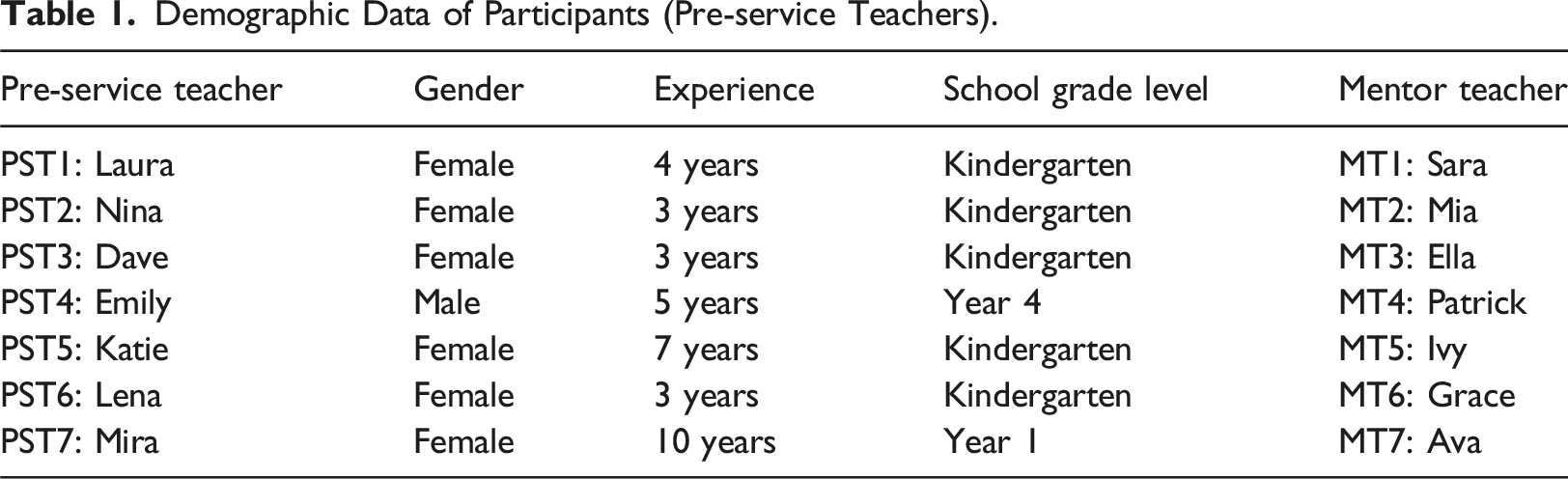
The larger research project included a group of 21 PSTs at both primary and secondary levels from the Master of Teaching cohort. They were required to complete three blocks of professional experience across two years. The PSTs participating in the project were in the second semester of their first year of a Master of Teaching program. The research took place during the PSTs’ first professional experience, which consisted of a 20-day block.
Data collection
Upon ethical approval from the University’s Human Research Advisory Panel (No 15026) and NSW Department of Education (SERAP, 2012134) informed consent was obtained from the participants (PSTs and MTs). In this study, we adopted a constructivist worldview, emphasizing that knowledge emerges through the interactions between the researcher and participants. Data were collected by the second author, who played a dual role as both an outsider and insider. As an outsider, she observed and interpreted participants’ experiences without directly engaging in their teacher education program. However, her extensive experience in teacher education provided an insider perspective, enabling her to seek additional information as needed.
To ensure the study’s trustworthiness, the researcher collected various data sources over five weeks of prolonged interaction, ensuring clear communication and repeated member checking. This approach allowed multiple opportunities for clarification to happen and thus assist in producing richer and more reliable data. More specifically, during the professional experience, the second author attended field observations and feedback sessions facilitated by the MTs, which were recorded and transcribed for further analysis. After two such sessions, a one-on-one reflection meeting was conducted with the PSTs to document their perspectives on the observed lessons. In turn, semi-structured individual interviews with the PSTs and their MTs were facilitated at the end of the professional experience to document their overall perspectives. For the PSTs, the open-ended questions considered their relationships, professional practices and learning trajectory. The focus of the interview with the MTs was to describe their roles and expectations, their relationships with the PSTs and their professional learning.
Data analysis
The data was analysed in two phases: an inductive, bottom-up approach was followed by a deductive, top-down method by drawing on the analytical tools from Akkerman and Bakker’s (2011) review study. In the initial inductive phase, a constant comparative method was used, which entailed recursive and iterative data analysis (Glaser & Strauss, 1967). The interview transcripts were read repeatedly to identify critical episodes of boundary crossing and boundary objects as described by the participants. These episodes were coded according to the meanings they conveyed about the boundary-crossing experience. The identified codes were then condensed and categories began to emerge, constituting commonalities and differences in the boundary-crossing experiences. In the subsequent deductive phase, we analysed these categories and reduced them into themes using Akkerman and Bakker’s (2011) theoretical conceptualisation of the four forms of learning mechanisms. Careful not to impose these forms onto the data, our analysis sought to identify other forms of learning mechanisms that better suited the way different actors engaged in professional learning. Throughout the analysis, careful attention was given to the unit of one PST and his/her corresponding MT to show the interactions and interrelationships occurring on this front.
Findings
Themes and Subthemes Identified.
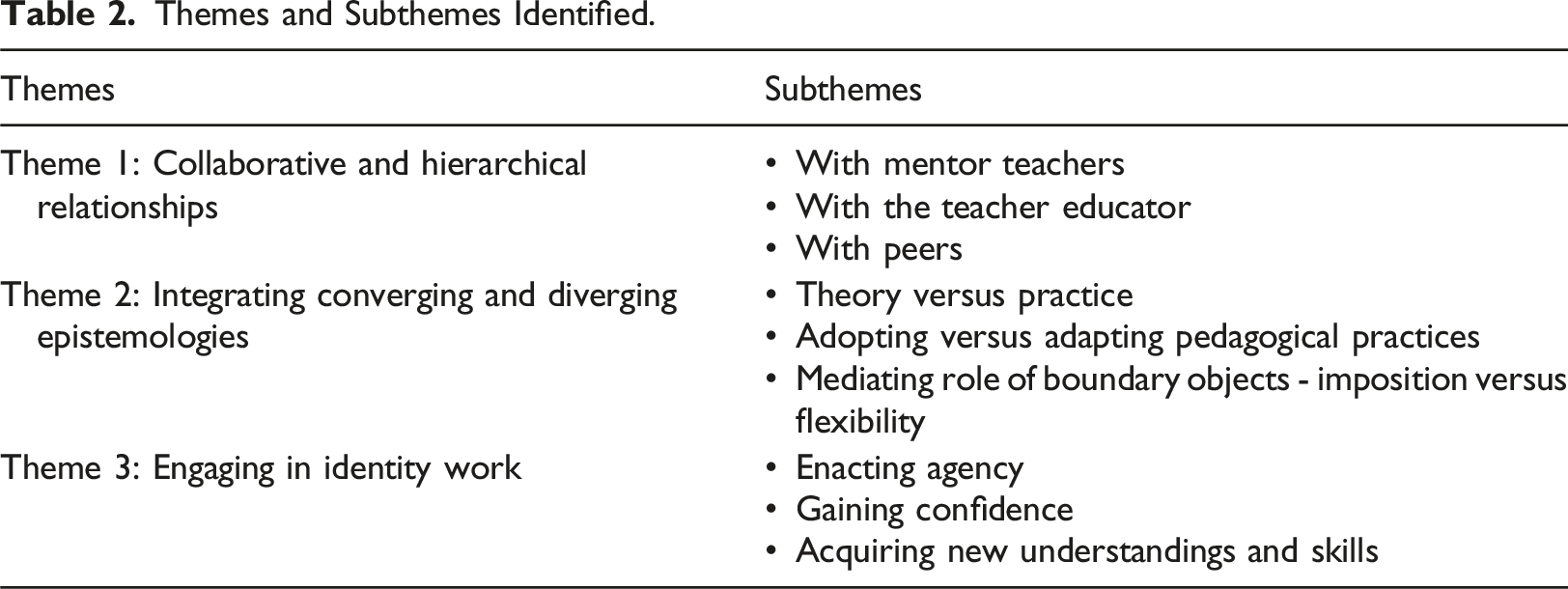
Theme 1: Collaborative and hierarchical relationships
This theme encompasses the relationships that the participating PSTs developed in their boundary crossing, including collaborative and hierarchical relationships with their MTs, teacher educator and peers.
With mentor teachers
Most PSTs (N = 6) enjoyed positive relationships with their mentors, yet such relationships were contingent upon the roles taken up by their MTs. These varying roles, including mentor as boundary keeper, facilitator, co-teacher and master, influenced the nature of MT-PST relationships.
First, several MTs (N = 4) and PSTs (N = 3) discussed a boundary keeping role, described as the responsibilities and actions taken by MTs to help PSTs integrate into the established norms and practices of their schools and classroom environments. Guided by the memories of their previous professional experiences, these MTs described the difficulties they encountered and their intentions to ease their PSTs’ introduction into the classroom. The example from Mia’s (MT2) first professional experience shows this empathy and conscious efforts: From my own experience, feeling like I’d been left in the deep end at the start, it would be an honour to be able to support those new teachers. I remember finding my first practicum quite daunting, I mean all your pracs are daunting at first, but obviously the first one is quite scary.
As part of the boundary keeping role, Sara (MT1) described introducing her PST into the school community, which was reciprocated in Laura’s (PST1) feeling ‘very much part of the school community…and the classroom’. Further, this role entailed allowing PSTs ‘lots of opportunities to jump in front of the class’ (Patrick, MT4) and ‘gradually supporting them to understand the whole process’ (Mia, MT2). In agreement, Mira (PST7) expected her MT to ‘encourage [her] to take on more teaching, but also being sensitive to whether it was too much’, and Laura (PST1) appreciated the ‘scaffolded support at the beginning… before giving [her] more free reign’.
Second, the MTs (N = 7) unanimously agreed on performing a facilitation role, which entailed encouraging PSTs to conduct observations of their lessons, communicate openly about their concerns, provide timely feedback and prompt them to engage in reflections. Patrick (MT4) gave a general description of his role as: ‘I’m giving her advice, I’m giving her suggestions and I’m being a role model’, while Sara (MT1) stated her ‘role is to demonstrate and model strategies that [she] employs in teaching’.
In turn, the PSTs also expected and found their MTs to be ‘really good role models’ (Mira, PST7) in facilitating dialogic learning processes. Throughout such facilitation, the PSTs expressed appreciation for ‘very detailed and specific feedback’ (Mira, PST7). Nina’s (PST2) description captures the benefits of such feedback as follows: She gave me really detailed feedback all the time, and it was made easy for me to make changes, and whenever there was a weakness in my teaching, she enabled me to work through it and make that into a strength.
Such feedback was further accompanied with ‘emotional support’, which was also considered an aspect of mentoring that ‘often gets overlooked’ (Nina, PST2) with respect to the diverse learning processes it can trigger. In agreement, Emily (PST) described how her MT focused on the ‘really good things that went on in the class’, and how ‘it was never negative’ because ‘he’d always spin it into a positive’.
A third and equally common role depicted by the majority of MTs (N = 6) was that of a co-teacher. They discussed the reciprocal learning processes prompted by co-teaching with their pre-service teachers, including becoming ‘more conscious’ about their teaching, ‘putting more thought into the lessons’ (Ava, MT7) and ‘bringing out the best of [their] ability’ (Patrick, MT4). Sara (MT1) extended these benefits to her students, such that ‘having an extra pair of hands’ enables her to ‘single out student who might need extra one-on-one time’. Grace (MT6) further acknowledged the opportunity to learn from team-teaching in the following comment: I think you can always learn a lot from people who are very different from you. So, I’ve been very conscious of trying to deliver things to [Lena] in a way that she works, so she’s been helping me be more structured in that way as well.
In turn, the majority of PSTs (N = 6) reciprocated the importance of co-teaching with their MTs for their professional learning. Nina’s (PST2) comment reveals a relational form of learning with her MT, as follows: So, when we do this stuff (i.e., teaching) together, it feels like we’re on an equal level… even though she is so accomplished, and obviously she’s a teacher and I’m a student, I feel like we’re on the same kind of social level and that makes it a lot easier.
A final role depicted in one case was that of a master-apprentice. As a master, Ella (MT3) expected Dave (PST3) to comply with her instructions and take her feedback on board, which ‘hasn’t always been incorporated the next time’ (Ella, MT3). According to Dave (PST3), Ella was ‘a strong-willed mentor teacher’ and it was ‘difficult to go against her’. Despite his desire to ‘come up with lesson ideas’, he also thought ‘she wanted to keep her classroom dynamics exactly the way they normally are, and she just wanted [him] to fit in with that’. Ella’s (MT3) comment reveals a different perspective in this dilemma: I think maybe my expectations were probably a bit too high… there are some things that I’ve said to him and I have got a little bit frustrated. I’ve said a few times “Oh can you incorporate this” and then it hasn’t been incorporated… Perhaps my style’s a bit tough on him, but I keep hearing excuses… I don’t think he’s quite there yet and I think he’ll need more pracs.
Dave (PST3) also described his MT’s interruptions during the lessons, which he felt were ‘unfair because [he’s] the one that’s supposed to be taking ownership of the lesson’, which also caused his students to ‘go along with her dynamics’, as she was the classroom teacher after all. He believed that his MT should ‘wait until the end and say you missed it’. From Ella’s perspective, her interruptions were justified on the premise that he had failed to integrate her feedback, despite knowing ‘that it’s not ideal [to interrupt him], but he did change’. Dave’s comment is a testament of such misunderstanding, but also the learning mechanism that can emerge amid conflict: She thinks that I’ve not taken on board some things that she’s told me, but that’s not intentional… I’m just still working out the best way of doing things.
With the teacher educator
The PSTs (N = 6) generally agreed that their interactions with the teacher educator (Jim) were unnecessary and untimely. In comparison to their MTs, the teacher educator was perceived as playing an insignificant role in their professional learning, as documented in Laura’s (PST1) comparison of their roles: I think Sara has been more useful because she’s told me what to do and she knows the kids…, whereas Jim just come in and seen a bit of a lesson and doesn’t understand the background to it…. So obviously it’s important to have support from the university, but I think the most important one is that from the teacher here.
While most PSTs (N = 6) shared similar interactions with the teacher educator, Dave’s (PST3) experience consisted of further tensions within the triad of pre-service teacher, mentor teacher and teacher educator. He describes a situation of ‘being singled out for not doing the lessons properly’, and trying to satisfy conflicting instructions, which may be considered a missed learning opportunity. He commented as follows: It was really unfair to me because I was being criticised by both her and Jim …the reality is I’m the one in the position where I’m being evaluated by both of them, and then I feel like I'm expected to do one thing by one person and something else by another.
With peers
The PSTs (N = 7) unanimously agreed on the importance of having peers, who were in ‘the same boat’ (Lena, PST6) and ‘feeling just as tired and overwhelmed’ (Mira, PST7), as a trigger of multiple learning mechanisms. Some of their shared activities included commenting on lesson plans, conducting peer observations, offering feedback and sharing ideas. In conducting observations, Laura (PST1) also noted her ability to ‘see things that they did badly…and what didn’t work and implementing it positively in [her] work’. The PST also emphasised the importance of receiving emotional support from their peers, ‘because [they] could really talk to each other about challenges…and being able to just vent and talk about stuff’. This is clearly explained in Katie’s (PST5) comment: Everyone’s been really supportive and we can chat and debrief and rant about things that are frustrating us, so it’s been nice to have that little community, I think it’d be really hard if I was at a school with only one or two students, you’d feel a bit isolated.
Theme 2: Integrating converging and diverging epistemologies
This theme tackles the fluctuating experiences that the PSTs faced in implementing diverse pedagogical practices, and the consequent learning mechanisms emerging from these experiences.
Theory versus practice
In several cases, several MTs (N = 4) and PSTs (N = 4) described an apparent gap between university-based theories and school-based practices. In Ava’s (MT7) words, ‘it’s good to go to university and learn about the theories, but actually implementing it in the classroom and seeing the true nature of teaching is something else’. Mia (MT2) shared a similar perception of the university-into-school teachings, stating that ‘you learn a lot of things in uni but it’s very hard to see that in context until you’re in the classroom, and I think it’s good to be able to make those connections’. Contrasting these perspectives, Ella (MT3) judged her PST’s university experiences as irrelevant, alluding to a clear theory-practice gap, as revealed in the following statement: I can’t really see anything that we’re doing here that Dave’s had any experience with… I guess I haven’t quite got to grips with what he has done, it doesn’t seem to be relevant to what we’re doing.
In agreement, Dave (PST3) experienced this gap more tangibly in his teaching, through a push and pull scenario that unfolded between his MT and teacher educator. He described ‘her teaching style’ as being ‘at conflict with a lot of things [they] get told to do at uni’. Notwithstanding, he was more inclined to agree with his MT’s perspectives and doubted the expertise of his teacher educator in this statement: I’m still a bit worried, the whole thing about people who are university academics rather than active teachers critiquing teachers, I don’t think it’s really fair because they’re not people who have to do the teaching …I think they criticise things more based on their ideology than understanding the practical experience of being a teacher.
Further, Dave (PST3) became critical of his university experience, indicating that ‘it just seems disjointed’, adding that ‘there’s a very small percentage of stuff [they] learn in the course that could actually be applied on the prac in any way’. In agreement, Laura (PST1) also alluded to this disconnection between theory and practice. She showed the irrelevance of university theories in this statement: You learn all these theories and they’re all great, but you can’t remember them because you’ve learned them so quickly, and different pedagogies and stuff, it’s just a bit hard to think about all these things. So, I don’t think I’ve implemented anything.
Adopting versus adapting pedagogical practices
On the front of pedagogical possibilities, several variations were noted in the way PSTs adopted or adapted their MTs’ teaching practices. While the PSTs were critical about the observed practices in some instances, they generally accepted them uncritically. Mira (PST7), for instance, became aware that her teaching was ‘just a different way of doing it’, rather than ‘that’s what you’re supposed to do or not supposed to do’. Later, she acknowledged how she ‘tried to emulate’ her MT in certain behaviour management practices, which she described as a balanced approach. Between adopting and adapting MT’s practices, Nina (PST2) explained how she is ‘changing it a little bit, but it’s still everything she’s given [her]’. Through a reflective process, Katie (PST5) figured out a balanced approach: I’m kind of just taking on all the advice I’ve been given and am working out what suits me and what things work for me which I think I’m going to find out in the next prac.
Lena (PST6) also found her MT’s strategies in classroom management to be useful, she ‘took a lot of Grace’s strategies and modelled them and they worked, but only to a certain extent’. Laura (PST1) admired her MT’s practices and aspired ‘to teach just like her’. As she planned her lessons, Laura would think ‘what would Sara do?’ and then she would try to emulate her style because ‘it’s really efficient and it works’.
In Dave’s (PST3) case, his contentious relationship with the MT resulted in rejecting some of her advice, such as in the case of ‘changing your voice and teach in a more child-like way’, and could not ‘see how it would benefit [his] teaching’.
In turn, the MTs (N = 6) approved of their PSTs’ imitations of their teaching practices and encouraged them to do so through constructive feedback. They commended the PSTs who accepted such feedback and made changes accordingly For instance, Patrick (MT4) described his PST as taking his ‘feedback very literally and she tries to use it effectively’. Sara’s (MT1) description of her PST also reflects such approval:
She takes on the feedback and she’s highly observant with what worked in my lessons and why, and she tries to employ them and have a go in her own lessons.
Ava (MT7) could also see the influence of her modelling on her PST’s choice of activities, yet also noticed some variation, which she commended in this comment: I can see that she’s taken on strategies that I use, sometimes I don’t even realise I’m doing them, but she picks up on them and talks to me about it, and then she’ll try it with her own little flair in the lesson.
Accordingly, these MTs believed their PSTs acquired new and unchanged pedagogical practices through the processes of being observant, accepting feedback and reflecting on their practices.
Mediating role of boundary objects – Imposition versus flexibility
The MTs (N = 7) used several boundary objects in their interactions with the PSTs, which also mediated their relationships with them and their learning processes. These objects entailed programming, verbal and written feedback notes, lesson plans and lesson resources. The mediating role of boundary objects played out on opposite ends between imposition and flexibility, as some PSTs had freedom to create their own materials and lesson plans (e.g., Katie, PST5), while others had less freedom (e.g., Lena, PST6).
On one end, Lena (PST6) thought she would ‘be able to have a bit more choice in the lessons at first, but [she] was OK with having that unit to stick to because it narrowed it down for [her]’. She described how her discussions with the MT revolved around the lesson plan and having to adhere to its structure.
A middle ground was described by Mira (PST7), who described how ‘a lot of the ideas were already planned out from Ava, because the teachers do so much of the planning with the curriculum’, however, this did not restrict her ability ‘to have some kind of flexibility with the plans’. Despite such freedom, Mira (PST7) approved this semi-structured process, as ‘coming up with every plan by [her]self would have been too much, and coming up with ideas is half the battle’.
On the opposite end, some PSTs (N = 3) carried the responsibility of devising lesson plans and making resources. While ‘some other students had stuff given to them’, Katie (PST5) did not mind the pressure of creating all the material herself, and thought it was ‘good to know [she] had quite a lot of freedom’. Nina also described the freedom to develop classroom material, stating that her MT ‘didn’t really set anything as such apart from the lessons, and the rest [she] kind of guided [her]self’.
Boundary objects were also used as discussion prompts in most of the MT-PST interactions. For example, Emily (PST4) described the lesson planning as follows: I think lesson plans tend to work better if I’ve sat down and talked them through with him, because obviously he has all of that experience, and he knows what’s going to work.
Theme 3: Engaging in Identity work
This theme discussed the identity work that the PSTs experienced throughout their boundary crossing. Both groups discussed aspects related to enacting agency, gaining confidence and acquiring new understandings and skills, all of which were intertwined with who they are or had become as teachers.
Enacting agency
Most PSTs (N = 5) described themselves as being agentic in the classroom. Their MTs commended such professional agency and considered it a key criterion for meeting the expectations of the professional experience. For instance, Sara (MT1) applauded her PST’s ‘enthusiasm and rapport with the students’, and added that ‘she’s very passionate, and puts a lot of work into her lesson plans and resources’. Ivy (MT5) also held similar expectations of her PST, who ‘should be totally committed and motivated to do her best to develop as a teacher, and that she fulfils all the obligations of coming to school every day…and shows her love of teaching’, which she admits her PST has been ‘showing all of that’.
Several PSTs (N = 4) also discussed the role of agency in identity development and professional learning. According to Laura (PST1), she has ‘been involved in learning the different abilities, how students learn, grouping students, making all the different lesson’, so she is ‘still the teacher [she] wants to be or thought [she]’d be, but there are so many things that are different’, and described herself as ‘firm, but fair and caring’. She attributed her ability to enact professional agency to the semi-structured mentoring approach used by her MT, as indicated in this comment: I think the support and also the freedom I’ve been given…I think if you make anything too structured, you can’t learn, you have to find your own way and get to that same end point.
In contrast to these scenarios, a lack of agency was a main reason behind Ella’s (MT3) disappointment in her PSTs’ performance. She described him as ‘just sitting there doing nothing’ and would prompt him to ‘either be writing notes or helping out or teaching’, so she felt ‘there’s no sort of initiative’.
Gaining confidence
Many MTs (N = 5) noticed the way their PSTs gained confidence in their abilities. According to Ava (MT7), her PST had ‘taken on the feedback and became more confident and familiar with the environment’. Such confidence could be enhanced, in her opinion, through teaching experiences, such that ‘the more you teach, the better you get’. In agreement, Mia (MT2) believed that giving her PST ‘the opportunities to re-try things…and building on the previous experience’ leads to a ‘sense of accomplishment and confidence’. She continues to emphasise that ‘personality has a lot to do with it as well’, and described her PST’s identity as being ‘a compassionate person…who likes working with the kids…wants the best for them…and willing to do whatever it takes in herself to help them’.
Several PSTs (N = 3) also discussed the importance of gaining confidence in developing a teacher identity and attributed most of their success to their MTs. For instance, Nina (PST2) explained the connection between heightened confidence and MT support as follows: I had no technique at all before. Now everything I know is pretty much what Mia has taught me….I’ve felt more confident in the last few weeks to bring out my own personality into the way I teach, as opposed to just copying her all the time.
Similarly, Katie (PST5) commended the way her MT reduced feedback as her confidence increased, and how this process contributed to her developing a teacher identity. She described this as follows: I wasn’t really sure exactly what my identity was to start with….At first, I’d get a lot of different feedback from Ivy, but now she feels that I’m confident and she knows I know how to sequence a lesson.
Acquiring new understandings and skills
The acquisition of new understandings and skills was considered synonymous to the various forms of professional learning according to some MTs (N = 3). They focused on what their PSTs were able to do as a result of their participation in the professional experience. For instance, Sara (MT1) described her PST as ‘starting to understand all the dynamics entailed in teaching and starting to bring all those skills and strategies together, and she’s learning’. Mia (MT2) also listed some of the skills that her PST had acquired, including monitoring students and using cues, and considered them as indicators of her PST’s learning.
A similar concern was expressed by Lena (PST6), who was worried that she would fail at classroom management, yet enacted transformative learning mechanisms to acquire skills in this area. Throughout the professional experience, she ‘discovered that [she] could be quite disciplinary’ and was ‘happy with the identity [she] found because [she] could maintain a positive relationship with the students, but when they’re misbehaving, [she] could have that disciplinary teacher role’.
Despite his learning of ‘better techniques’, Dave (PST3) believed he had ‘kept the same teaching identity…because [he] doesn’t necessarily agree with what [he]’s been told to do’. His contentious relationship with his MT interfered with his ability to ‘develop [his] own personality as a teacher’. He experienced missed learning opportunities and was left unsure whether he would be using similar skills when he goes to another school.
Discussion
This qualitative case study explored the boundary-crossing experiences of a group of seven PSTs from their own perspectives and those of their MTs, revealing three main themes. The findings indicate that the clinical aspect of teacher education is not an entirely haphazard process. Despite efforts to pair MTs with PSTs effectively, the possibility of a mismatch and its consequences remain unpredictable. In sum, the majority of participating MTs offered significant guidance and support to their PSTs, particularly through performing multiple roles (as described in Theme 1) and contributing to the development of their teacher identities (as discussed in Theme 3). However, the guidance from the MTs and teacher educator was not always coordinated and there continues to be little connection to university programs (as described in Theme 2), thus highlighting the complexity of dialogical engagement and the challenges in fostering meaningful, sustained interactions that effectively bridge the gap between theory and practice.
Findings from these three themes discussed above reveal how Akkerman and Bakker’s (2011) four learning processes were triggered through the boundary-crossing events documented in this study. Through the experiences of developing collaborative and hierarchical relationships, integrating converging and diverging epistemologies, and engaging in identity work, the PSTs were learning all along, even when conflicting relationships and disagreements were apparent. In retrospect, their professional learning took the forms of identification, coordination, reflection, and transformation. For instance, Dave’s questioning of the relevance of his university preparation for the professional experience served as a form of identification. Lena’s description of critically adapting her MTs’ practices was a form of coordination. She engaged in communicative connections between her teaching practices and those of her MT, which was commonly achieved through the mandated lesson plan as a boundary object. Such connections facilitated the boundary permeability between the different practices, as she had clear operational routines and structure to depend on. Also, through her MT’s facilitation role, Emily engaged in a process of reflection, whereby she was able to explicate differences and learn something new about her own and others’ teaching practices. Lastly, transformation was documented in Nina’s development of a clear teacher identity. With support from her mentor’s co-teacher role, she was able to reconcile diverse perspectives and had no issue with power differential. All the while, she maintained the uniqueness of her distinct practices from those of her MT’s.
Boundary-crossing experiences can lead to professional learning, even in the event of navigating conflicting relationships and diverging pedagogical epistemologies yet missed learning experiences are also possible. For instance, Dave’s experience with his mentor teacher, Ella, illustrates how a hierarchical relationship can limit opportunities for collaborative learning and the development of a unique teaching style. The lack of reflective and dialogical engagement between them further hindered the potential for Dave to engage in meaningful reflective practice. Additionally, Ella’s interruptions during lessons undermined Dave’s ability to build professional agency, making it difficult for him to establish authority and ownership in the classroom. The conflicting instructions from both the MT and the teacher educator within the triad relationship exacerbated this situation, leading to further confusion and frustration. Furthermore, despite learning ‘better techniques’, Dave felt that his contentious relationship with his MT interfered with his ability to develop his own teaching identity. These examples underscore the importance of effective communication, support, and a balanced mentoring approach to fully realise the professional learning potential of boundary-crossing experiences.
Despite the usefulness of the theoretical framework of learning mechanisms, our analysis further alluded to a fifth mechanism of professional learning, which we term relational negotiation, whereby participants learn through dialogical processes with others. In opposition to learning processes undertaken by individuals, relational negotiation emphasises the social dimension of learning as advocated by Vygotsky (1978). PSTs’ professional learning becomes a social act of navigating boundary experiences, while reconciling corroborating and conflicting systems. Drawing on situated learning theory, the proposition of learning from communities of practice, which connotes groups of people who share a concern, a set of problems, a passion about a topic and who deepen their knowledge and expertise in that area by interacting on an ongoing basis (Wenger, 2002) may be challenged. The professional experience is a contentious boundary crossing act that entails relational negotiations amongst diverse actors who may or may not share common concerns nor interact positively on an ongoing basis. Accordingly, overcoming discontinuities through relational negotiation can be seen as a form of learning mechanism for PSTs (Daza et al., 2021; Qin et al., 2023). Therefore, we iterate that rather than trying to eliminate socio-cultural differences, PSTs should engage in relational negotiation, as well as the integration of elements from different actors and systems to achieve hybrid situations (Engeström et al., 1995). We address the implications of these observations in light of the three emerging themes in the sections below.
Theme 1 revealed the nature of the relationships developed by PSTs in their boundary-crossing experiences. Within these interactions, two diverging forms of relationships emerged, characterised by collaborative and hierarchical dynamics. Collaborative relationships, typified by instances where the MT assumed a co-teacher role, coexisted alongside hierarchical relationships, in which the MT primarily served as a facilitator. These relationships, in most cases, proved to be conducive to the PSTs’ professional learning, with the exception of a singular instance in which hierarchical endeavours fell short of facilitating optimal professional learning. In this case, the subtle competition of the MT and teacher educator as boundary brokers was inconducive to the PST’s professional learning, thus emphasizing ‘the power struggles, the juxtaposition of discourses and the tensions related to defining whose knowledge has more value’ in ITE (Daza et al., 2021, p. 11). Contrary to an ITE model proposed by Taylor et al. (2014), the MTs in this study were not involved in any decision-making related to the professional experience, and the teacher educator received the classroom lessons as planned by the MTs. In this common scenario across ITE programs, there is little opportunity for MTs and teacher educators to ‘participate in a democratic community that respects individual authority, as well as collaborative meaning-making through inquiry’ (Taylor et al., 2014, p. 11).
The complexity of university-school partnerships has been acknowledged in extant literature (Ellis et al., 2020; Lillejord & Børte, 2016), and so has the need for intensive time and effort to develop and sustain such partnerships (Daza et al., 2021). It is a conscious effort that requires the construction of systems that support PSTs’ professional learning, while addressing challenges as they emerge organically from the interactions and interrelationships of systems (Al-Thani et al., 2022). One implication for ITE, as documented in Strom and Martin (2022), is to shift the narrative of professional learning as a linear process and begin to acknowledge the dynamic, complex nature of learning to teach. Along this course, hierarchical arrangements of roles and responsibilities should be recognised, particularly that traditional structures can sometimes lead to the dominance of MTs voices over PSTs. To mitigate these issues, there is a need to foster collaborative relationships with MTs that support reciprocal teaching and learning (Nguyen, 2017; Taylor et al., 2014), enabling PSTs to fully engage and contribute to the dialogical process without feeling constrained by perceived power imbalances. Accordingly, MTs will no longer be seen as merely border brokers, co-teachers and role models, but may also potentially take on the role of co-learner with the PSTs (Strom & Martin, 2022). They may also begin to see themselves as co-constructors of ITE programs, which ‘distribute the power of knowledge-making across constituencies and not privilege one over the others’ (Taylor et al., 2014, p. 11).
Theme 2 revealed the large variations in PSTs’ implementation of pedagogical practices along converging and diverging epistemologies. As in other studies (Daza et al., 2021; Taylor et al., 2014), this research highlighted a persistent and problematic theory-practice gap in ITE (Chan, 2019; Daza et al., 2021). For instance, the role of the teacher educator, representing the university context, was found to be less influential than that of the MT from the school context. The PSTs generally perceived their interactions with the teacher educator as untimely, which exacerbated the theory-practice divide and created additional tensions, particularly when conflicting instructions arose, as illustrated by Dave’s experience. These findings underscore the need to revisit the structure and timing of teacher educator involvement to better align with the practical needs and realities of PSTs. Further, this study documented the tensions involved in making pedagogical decisions in regard to classroom teaching practices and boundary objects. There were large variations of adopting and adapting teaching practices and lesson artefacts in complex and unpredicted ways. It seems that this lack of synergy continues to hinder the holistic development of PSTs and diminish the overall effectiveness of ITE programs (Daza et al., 2021; Gravett et al., 2019). As a practical implication for these findings, blurring the borders of university-school partnerships can begin within the negotiated spaces of ITE programs (Daza et al., 2021). For instance, situating theory and methods of teaching in practice settings allows PSTs to learn about instruction within a relational frame of reference (Strom & Martin, 2022). The professional experience then becomes an extension of whatever pedagogical practices are possible, while offering PSTs the opportunity to analyse and reflect on these pedagogical possibilities, and problematise engrained discourses in teaching practices.
Theme 3 revealed the PSTs’ conscientious engagement in identity work, mainly through navigating challenges and opportunities across the boundary crossing. The findings report PSTs’ active involvement with boundary events and objects, gaining higher confidence levels, and acquiring new understandings and skills, in most cases. Corroborating previous studies (Chan, 2019; Qin et al., 2023), these mechanisms intertwined with how the PSTs perceived their professional identities; namely who they are or had become as teachers, as well as their aspirations for a future teacher identity. However, in reporting their agency and identity negotiations, the PSTs were also well aware of their MTs’ presence and influence. As an illustrative example, Nina ends her professional experience with this comment: ‘I feel like I’ve become a teacher now. I had no identity before as a teacher, and when I came in, I told Mia: I’m like this piece of clay, I have no shape, you can mould me however you like and give me so much room to grow and be myself’.
This finding brings to the fore the concept of distributive agency (Strom & Martin, 2022), which suggests that individuals ‘are not autonomous, self-regulating, conscious actors, but instead share agency with all elements of an assemblage, both human and non’ (p. 3). The PSTs in this study shared agency primarily with their MTs, and to some extent with the teacher educator. Other non-human actors constituted the boundary objects discussed in the findings as playing a mediating role. Notwithstanding the multiplicity of other intra-acting actors (Strom & Martin, 2022), it is important to commend PSTs’ agentic actions (Chaaban & Sawalhi, 2020a), while acknowledging their need for multiple layers of support that serve to mediate the challenges that they tend to face in their boundary-crossing endeavours.
Limitations
The small sample size of seven PSTs and their MTs limits the generalizability of the findings, as the experiences documented may not fully represent the diversity of interactions and challenges faced by PSTs in different educational contexts. Additionally, the focus on a single institutional context may overlook variations in professional experience practices across different ITE programs, regions, or educational systems. The study also primarily relies on self-reported data, which may introduce biases related to the participants’ perceptions and memories of their experiences. Future research could address these limitations by incorporating larger and more diverse samples and exploring multiple ITE contexts to capture the complex nature of PSTs’ boundary-crossing experiences.
Conclusion
This study reported on the experiences of seven PSTs who completed their professional experience in the same school context. A one-sided perspective was dismissed as unsuitable for obtaining a holistic understanding of some of these issues, especially in the case of contentious relationships (e.g., Ella; Dave), and thus the perspective and reflections of MTs were also considered. Using a dual perspective approach allowed conflicting members to voice their concerns and explain their decisions. Therefore, this study calls for future research using the lens of boundary crossing, which incorporates the perspectives of individuals who share agency and play the roles of brokers in this hybrid space. Re-structuring university programs and professional experience requirements can be made possible with a better understanding of boundary-crossing experiences (Taylor et al., 2014) that maintain a clear emphasis on the socially co-constructed nature of PSTs’ professional learning (Strom & Martin, 2022) and render hierarchical relationships as meaningless to the work of a hybrid community (Daza et al., 2021).
Footnotes
Author contributions
Declaration of conflicting interests
The author(s) declared no potential conflicts of interest with respect to the research, authorship, and/or publication of this article.
Funding
The author(s) received no financial support for the research, authorship, and/or publication of this article.
Consent to publish
The authors give their consent for the publication of this paper.
