




Abstract
Improving young people’s engagement in science, technology, engineering and mathematics (STEM) is being promoted worldwide as a means of addressing projected shortfalls in expertise needed to further nations’ economic, social and environmental goals. Responding to this, schools are reforming traditional discipline-based curricula into interdisciplinary approaches based on problem and project-based designs, to make STEM learning more relevant and meaningful for students. This study drew on a dataset of 449 Australian principal and teacher interviews, to identify factors influencing STEM curriculum in their schools. It utilised Ecological Systems Theory to build understanding relating to the influence of activities and outputs originating at macro, exo and meso system levels, on STEM curriculum and practices in classrooms. Results demonstrated how many innovative schools were able to successfully leverage community, business and national resources to enhance their STEM curriculum, while others struggled due to limitations imposed by geographic or socio-economic factors, or limited access to resources, expertise or advice. Central to achieving this was the powerful influence of principals’ and teachers’ proximal processes and developmental assets in establishing effective and engaging interdisciplinary STEM curricula, despite constraints imposed by, at best, ambiguous national and state curriculum and policies, rigid assessment regimes and compliance-focused reporting requirements.
Keywords
Introduction
Global moves towards promoting science, technology, engineering and mathematics (STEM) education in schools have been associated with wide-ranging agendas including improving the ‘pipeline’ of STEM-capable future workers (van den Hurk et al., 2019), increasing levels of STEM literacy in general populations (Mohr-Schroeder et al., 2015; Zollman, 2012), and as means of developing so-called 21st Century skills and competencies (Stehle & Peters-Burton, 2019). However, a common factor driving the current STEM education movement is recognition of the importance of a functional level of scientific, technological, engineering, and mathematical knowledge and skills, sufficient to enable future citizens to take active and informed roles in critical decision-making and leverage personal and professional benefits in increasingly unstable and dynamic environments (Techakosit & Nilsook, 2018). In schools, STEM education has traditionally been delivered via study in the separate disciplines, but increasingly there are calls for a more interdisciplinary approach that recognises the interdependence of discipline knowledges and their relevance to real-world problem solving and innovation (Vasquez, 2014). As Capraro and Jones (2013) comment, ‘in the real world, solving social and environmental problems does not occur in isolated domains, but rather at the boundaries of the STEM fields… conceptual knowledge results when disciplines are integrated, and learners are involved in socially-interactive learning’ (p. 58).
Vasquez et al. (2013) provide a useful typology for describing different approaches schools are taking to STEM education. These are represented on a continuum reflecting increasing levels of subject integration, ranging from traditional separate discipline methods through Multidisciplinary (concepts and skills are learnt separately but are based on a common theme), Interdisciplinary (multiple discipline concepts and skills are tightly linked) and Transdisciplinary (multiple disciplines and skills are tightly linked in projects developing solutions to real-world problems, needs or opportunities). However, as Honey et al. (2014) point out, while separate discipline learning is still commonplace in schools, this ‘has transformed in many workplace and research settings to emphasise multidisciplinary enterprises… (and that) developing new products and services almost always work in ways that integrate the disciplines of STEM’ (p. 20). They further comment that approaches to STEM education that draw on knowledge and skills from across disciplines may hold potential for improving personal identification with, and attitudes towards STEM, but to be successful, students need a solid foundation of discipline-specific knowledge and skills.
Indeed, research exists indicating that well-executed interdisciplinary approaches can improve student achievement in separate STEM disciplines (Corrigan, 2020), engender greater engagement and interest in STEM learning (Honey et al., 2014), improve female participation in STEM study (Celepcikay & Tarim, 2015), and provide a platform for developing important life-long skills and competencies including creative and critical thinking, problem solving, self-determination and collaboration and teamwork (Mohr-Schroeder et al., 2015). However, despite this research evidence base and major government financial, resource and teacher-training investment in many countries, few successful examples currently exist.
Data for this study were generated from the principal professional learning and research initiative, Principals as STEM Leaders: Building the evidence base for improved STEM learning (PASL). Principals as STEM Leaders was a 3-year Australian government-funded programme with the stated aim of ‘strengthen (ing) the foundation for greater participation and engagement, and ultimately better learning outcomes in STEM subjects’ (Birmingham, 2017, para, (2). Principals as STEM Leaders comprised module-based professional learning in school STEM leadership, paralleled by research that evaluated the outcomes of these modules, and built understanding of the current state of STEM education in schools across Australia. Importantly, the original project brief provided by government did not target a specific interpretation or approach to STEM education. This was a deliberate decision to allow reporting of the range of approaches adopted by schools in different states and territories. To accommodate this diversity, Bronfenbrenner’s (2000) Ecological Systems Theory was used as a theoretical referent in this study to understand evidence indicating the influence of macro, exo and meso system factors on STEM curriculum being taught in the nation’s classrooms. This built understanding of how individuals, through engaging proximal processes across the micro and meso systems, were instrumental in shaping unique programmes that optimised benefits for STEM from committed leadership and engaging local resources and community opportunities.
A review of literature
The problem of STEM in schools
Although STEM as a concept has been present in education since the early 1990s, it has only become prominent in the past 20 years, largely responding to American concerns for improving the performance of science, technology, engineering and mathematics education in their schools (Kelley & Knowles, 2016). This drive spawned a raft of reforms and policy papers (e.g. Caprile et al., 2015; National Science Foundation, 2015) targeted at improving STEM achievement through making STEM learning more relevant and engaging for students, for America ‘to remain competitive in a growing global economy’ (Wang et al., 2011, p. 1). However, several researchers highlight confusion about exactly what STEM education is, and how it should be taught in classrooms (e.g. Breiner et al., 2012; Holmlund et al., 2018; Honey et al., 2014). According to Holmlund et al. (2018), this confusion arises from reforms that advocate movement from subject-based to interdisciplinary STEM teaching, while ‘no clear consensus exists on the nature of the content and pedagogic interplay among the STEM fields’ (p. 2). Proponents of this movement argue that interdisciplinary methods where discipline knowledges are learnt and applied in thematic units focused on addressing real-world problems, needs or opportunities, provides a more authentic, engaging and effective means of building STEM knowledge and skills (e.g. Bybee, 2010; Capraro & Jones, 2013; Zollman, 2012). Zollman (2012) goes as far as describing interdisciplinary STEM as a ‘metadiscipline’ (Zollman, 2012, p. 15) created from the integration of discipline content and concepts supported by pedagogical and curriculum changes that reflect ‘less emphasis on demonstrating and verifying science content, and more on investigating and analysing science questions’ (ibid, p. 15).
Learning STEM discipline concepts through their practical application in solving authentic problems is a common feature in literature promoting interdisciplinary methods. These advocates point to the compatibility of such methods with how STEM professionals conduct their work, through the natural integration of knowledge including, but also beyond their core discipline (e.g. Oanh et al., 2018). Furthermore, interdisciplinary approaches are closely aligned with developing students’ so-called 21 st Century skills, including advanced problem solving, creativity, innovation and higher order thinking, which Morrison et al. (2015) identify as ‘skills for a knowledge driven economy’ (p. 255). These are also seen by some as transferable capabilities integral to life-long learning and productive functioning in future societies (Marrero et al., 2014). However, concerns exist that interdisciplinary methods may undermine or dilute the learning of ‘hard science’, as ‘the motivation to produce an artefact takes precedence over the development of science concepts’ (Oanh et al., 2018, p. 1290). As English (2016) points out, limited research has investigated the effectiveness of interdisciplinary methods for teaching core discipline content, and even less on determining how this might be achieved so that gains in one discipline do not come at the expense of others.
In many nations the problem of transitioning towards interdisciplinary approaches to STEM is further compounded by curriculum and assessment designs that represent the STEM disciplines as separate subjects (e.g. Australian Curriculum Assessment and Reporting Authority [ACARA], n. d.; New Zealand Ministry of Education, 2007). This is particularly apparent in secondary schools which often silo responsibility for teaching the disciplines into separate faculties or departments (Breiner et al., 2012; Holmlund et al., 2018). According to Breiner et al. (2012), ‘siloing’ has the effect of diminishing in students’ minds the relevance of what they are being taught, by increasing the separation between ‘the way STEM is taught… (and) the way STEM is done’ (p. 5). This separation is often reinforced by prescriptive syllabi that list discrete knowledge and skill outcomes and specify content at different levels of schooling, within each discipline (e.g. New South Wales Education Standards Authority [NESA], n. d.; Ministry of Education Singapore, 2014). In the case of Australia, while this specificity does not preclude interdisciplinary methods, according to Timms et al., (2018): If the concept of STEM is embraced as a meaningful interdisciplinary approach to learning, then schools should be addressing all parts of STEM… (but) the Australian Curriculum is not based on a modern conceptualisation of STEM. It is structured around discrete learning areas and does not integrate explicit STEM learning progressions across the school years (p. 19).
Interestingly, the agency responsible for the Australian National Curriculum - the Australian Curriculum, Assessment and Reporting Authority (ACARA), also suggests:
STEM knowledge, understanding and skills seem to be strengthened when connections between learning areas are emphasised (and) enriched when learning areas combine to find authentic learning opportunities for students in answer to an identified problem, or in the creation of a solution (ACARA, 2016, p. 6)
This statement clearly signals the desirability of an interdisciplinary approach to at least some aspects of STEM education but seems at odds with the structure of the national curriculum in which content descriptions, outcomes, and progression and assessment information are organised under separate disciplines. Timms et al. (2018) comment that such mixed messages in official documents ‘sends a message to schools that STEM is not fully embraced’ (p. 19), further clouding teachers’ understandings of what should be taught, and how.
Adding to curriculum challenges, Honey et al. (2014) also point to implementation difficulties posed by interdisciplinary methods that necessitate a shift in assessment methodology. According to them, this requires transitioning from current regimes based on ‘answering questions about discrete factual content, to questions about interactions among concepts and to tasks that require integration of reasoning and inquiry in the context of significant, applied problems’ (p .112). They point out that such a move is difficult and demands rethinking the current emphasis in many countries on summative and often large-scale standardised assessments in the separate STEM disciplines. They comment that the prevailing design of these assessments that ‘typically focus on content knowledge alone’ (p. 6) reflects increasing emphasis on assessment for accountability, and not assessment for learning. They suggest different strategies are needed for interdisciplinary STEM–ones that incorporate multiple and different data measures over time, and if needed, can also map back to national standards in sufficient detail to meet achievement reporting and accountability requirements at a discipline level.
In summary, while much research and commentary argue the case for interdisciplinary methods as a means of increasing STEM engagement and raising student achievement, how this manifests in schools appears less clear. At best, mixed messages communicated by curricula and official agencies that advocate linking between disciplines but present them as separately taught and assessed entities, combined with prevailing school assessment, reporting and organisational systems, presents formidable challenges to establishing effective interdisciplinary STEM curricula.
Theoretical framework
This study adopted Bronfenbrenner’s (2000) Ecological Systems Theory and its associated analytical model as its theoretical referent. Ecological Systems Theory (EST) was appropriate as it provided sufficient flexibility to help understand potentially diverse interpretations of STEM education, and influences on the way it was being implemented across Australia. The study used EST as a referent to understand the influence of, and interaction between activities occurring at different levels of the Australian education system, on STEM decision-making and local curricula, and its enactment in classrooms.
Bronfenbrenner’s original Ecological Systems model (Figure 1) comprises multiple layers represented as a series of nested circles. At the centre, is the individual residing in the microsystem, whose activities are shaped by influences and actions of those located within the surrounding mesosystem. Rosa and Tudge (2013) define the mesosystem as ‘the relations among two or more microsystems in which the developing person actively participates’ (p. 246). According to Rosa and Tudge (2013), while the characteristics of micro and meso systems are similar, mesosystems are more interactive and dynamic in nature as roles and relations are negotiated across microsystems, rather than existing only within one. In school education, microsystems could be defined as individuals in classrooms, and the mesosystem as the school and its immediate community. Bronfenbrenner’s original ecological systems model (from Swanson et al., 2003).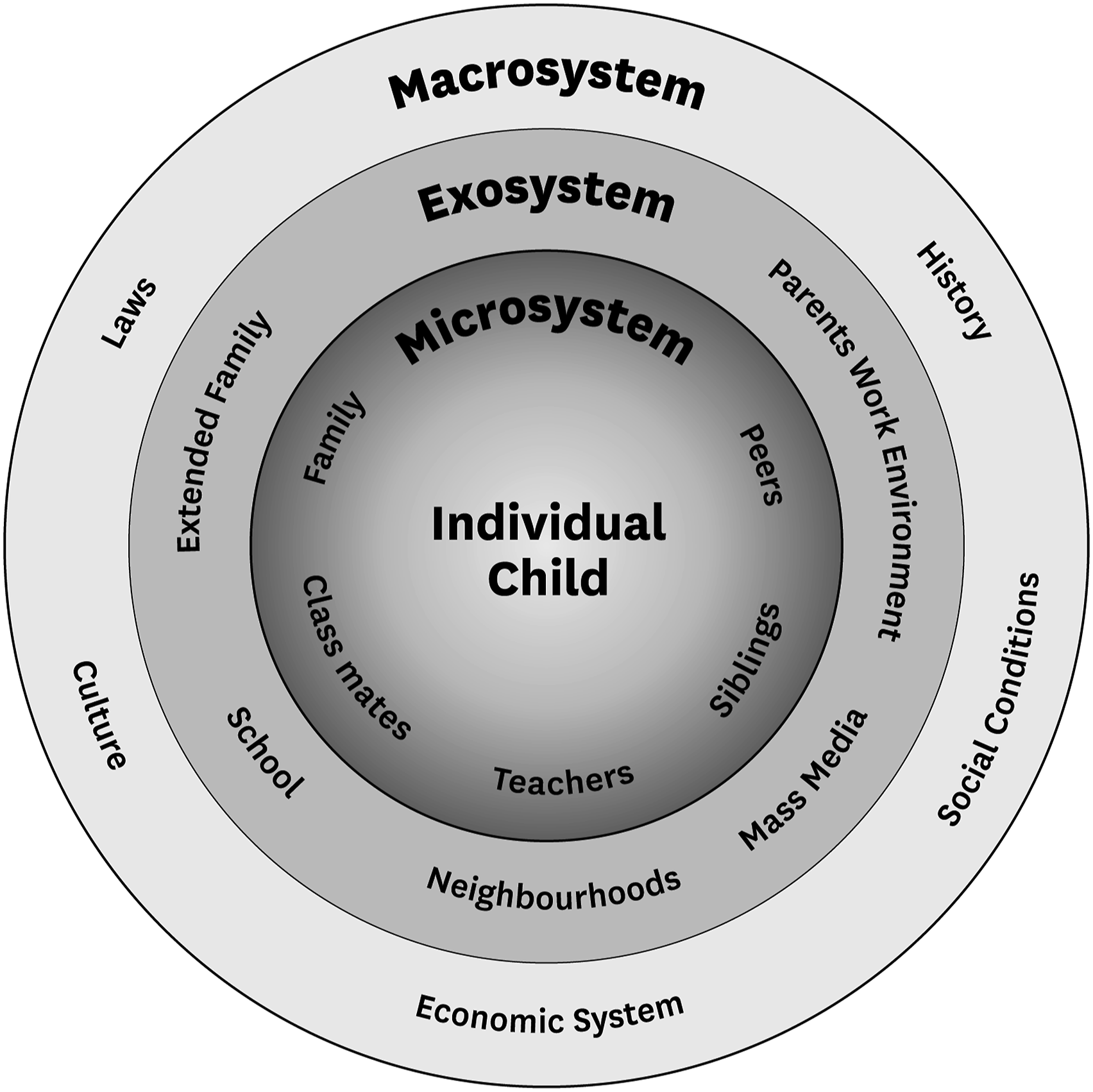
Beyond the mesosystem is the exosystem, which Bronfenbrenner defines as areas ‘in which the developing person is not himself (sic) involved, but in which things that affect what happens in their area of life, or that be influenced by it’ (1981, p. 42). In the school context, exosystem influences may include agencies responsible for regulations, policies and procedures, mandatory curricula, assessment, or allocation of funding and other resourcing. In some contexts, exosystem influences may at times extend into more day-to-day school operational matters, such as the appointment of staff or compulsory professional learning.
Finally, the outer ring of the model Bronfenbrenner labels as the macrosystem. Rosa and Tudge (2013) describe this as ‘embracing the institutional systems of a culture or subculture, such as the economic, social, education, political and legal systems’ (p. 247). Macrosystems fundamentally influence activities occurring in the exosystem and, to a lesser extent, in the nested meso and micro systems. Macrosystems are strongly influenced by dominant beliefs or ideologies, and in education, often reflect global trends or imperatives associated with education’s role in delivering economic or social objectives. Macrosystem influences are particularly relevant to STEM education, which discourse worldwide frequently associates with the development of new innovations of economic benefit (e.g. Zollman, 2012). Macrosystem ideologies and beliefs can have a substantial impact on, amongst other things, school curriculum, assessment, and accountability requirements, the ‘trickle-down’ effect of which is experienced across other system levels.
Bronfenbrenner’s (2000) most recent revision of the theory was used for this analysis, as it better acknowledged the role and influence of individuals within a system to affect ‘his or her own development by means of a mechanism termed proximal processes’ (Rosa & Tudge, 2013, p. 252). Proximal processes reflect the personal characteristics, actions, relations and resources of individuals that can exert influence in, and across levels of a system. Proximal processes acknowledge the capacity of individuals to assume a more active and formative role in their own development and influence activities within systems. Using the later revision of the theory helped build understanding of how individuals and groups in schools, by exercising proximal processes within and between the micro and meso systems, exerted personal and collective agency to shape local STEM curricula, within the constraints and affordances of macro and exo system requirements, policies and agencies.
In this study, the macrosystem was characterised by the activities of government and industry bodies promoting, through polices and initiatives, the importance of STEM education for building future workforce capabilities and a broadly-based STEM literacy. Globally, these are communicated by a range of international policy organisations such as the Organisation for Economic Cooperation and Development (OECD), and influential think tanks including America’s National Academy of Sciences, Engineering and Medicine, and National Science Foundation. In Australia, these reflect in national political discourse and manifest in a STEM agenda for schools, generally associated with their role in producing STEM-focused future innovators and employees, capable of adding economic value (the ‘pipeline’ argument). These macrosystem drivers exert direct influence on the exosystem, through their effect on shaping (in this case) Australian education priorities, policies, authorities, curriculum and assessment.
The mesosystem comprises schools and their local communities. Activities within the mesosystem are somewhat influenced by exosystem policies and official documents such as national or state curricula, funding mechanisms, and assessment, reporting and compliance requirements. In certain jurisdictions, exosystem influences on the mesosystem may extend more deeply to include activities such as appointing staff, or compulsory provision of teacher professional learning.
Finally, at the centre resides students as individuals or groups, who are principally located in classroom microsystems. They are directly influenced by the activities of others in the micro and meso systems (e.g. teachers, other students, school leadership, parents) but in turn are able to affect those activities through proximal processes, as they transition within and between systems. In schools, this is illustrated by teachers and students engaging in activities occurring both within classrooms, and in the wider school and community. Bronfenbrenner and Morris (2006) comment that the effectiveness of this engagement depends upon the characteristics, dispositions and resources of individuals, and their subsequent ability to sustain generative proximal processes.
Research questions
Participant interview responses were analysed to answer these questions: 1. How do macro, exo and meso system activities and outputs influence STEM curriculum in Australian schools? 2. How do the proximal processes exercised by individuals within schools and their communities, shape local STEM curriculum? 3. What factors facilitate or moderate STEM curriculum and practice in Australian schools?
Methods
Participants and data collection
Participants self-enrolled in the PASL programme following invitations sent to schools by state and territory coordinators and, in some jurisdictions, education system authorities. Participation in semi-structured pre/post-professional learning interviews was an integral requirement of PASL. In total, 449 principal and teacher interviews were completed. During the professional learning phase, it became apparent that schools were at very different stages in the development of their STEM programmes. Participants ranged from those working in schools in the very early stages of transitioning to interdisciplinary methods, to others who had well-developed project-based programmes, frequently involving external enterprises or education institutions. A common criticism of self-enrolment is the potential for participants to be non-representative due to their existing motivation to participate (Olsen, 2008, p. 808). Whilst acknowledging their shared interest in improving STEM education, interview responses suggested the programme attracted participants with diverse experience and knowledge of interdisciplinary approaches to STEM.
Primary data comprised 192 principal interviews and 257 teacher interviews. In total, principals and teachers from 58 primary, 17 secondary and 18 combined schools participated in PASL and were interviewed. All interviewees were involved in leading or teaching STEM and were from schools in city, regional, and rural and remote locations across six of Australia’s eight states and territories. Schools ranged in size from student populations of less than 20, through to more than 2000. The interviews were semi-structured, with the principal interview focussing on school STEM-related reforms, teaching pedagogy, assessment and reporting, curriculum, equity, environment (e.g. STEM professional development, leadership and decision-making) and system level influences. The teacher interview concentrated on classroom implementation of STEM, including planning, pedagogy, assessment, and the impact of curriculum and policy on practice. Interviews collected information profiling the schools, and personal details such as length of service, position within the school, and current STEM leadership or teaching responsibilities. All interviews were verbatim transcribed and analysed using a combination of NVivo 12 (QSR, 2018) and manual inductive thematic methods. Complying with ethics requirements, during transcription any information that could identify the state, school or individual principals or teachers, was removed.
Data coding
Sample first order search terms and initial alignment with ecosystem levels.
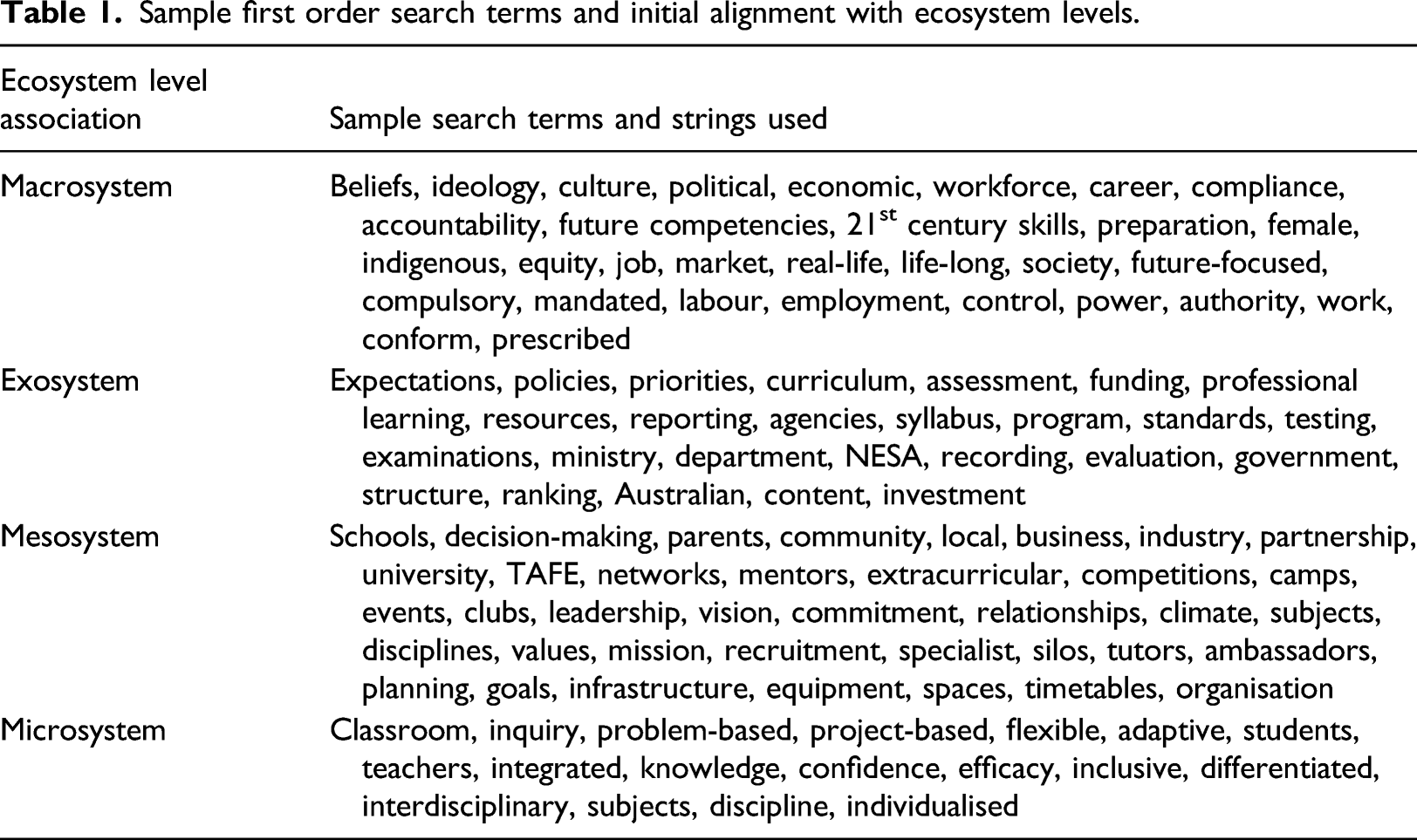
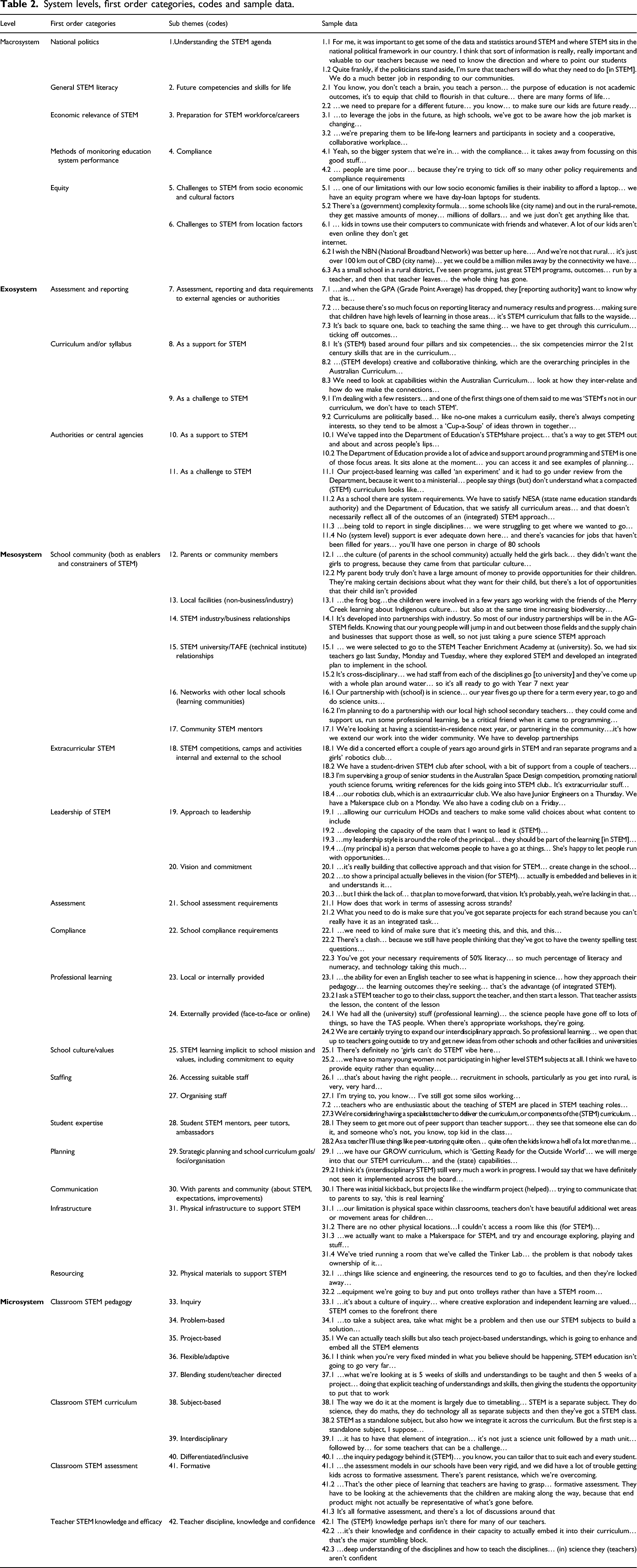
Once this was completed, results were collectively reviewed by the first and second authors, and first order categories generated that reflected broad and agreed-to themes in data. Of note is that data associated with some categories were apparent across system levels, reflecting a trickle-down effect from mostly macro and exo system policies and activities into the meso and micro systems. This particularly related to factors such as equity, education system performance monitoring/reporting, curriculum and assessment. In these cases, data were manually coded according to the system level to which they were most relevant. For example, if data specifically detailed an observable influence of national curriculum on STEM education in classrooms, it was coded under classroom STEM curriculum in the microsystem. Conversely, if it was more general and, for example, referred to underpinning principles that the interviewee considered shaped the content and structure of the national curriculum, it was coded in the exosystem, under curriculum/syllabus (as a support or challenge to STEM). Although in most cases these activities were related, they manifested in different ways at different system levels.
System levels, first order categories, codes and sample data.
Results
Table 2 aligns system levels with the first order categories and subthemes (codes) and provides illustrative data samples that were coded against these. Given all states and territories are required to follow the aims, objectives and learning areas of the Australian National Curriculum, aside from nuanced differences through their reinterpretation by some states into local syllabi or curricula, it was unsurprising that there was much consistency in responses. The analysis revealed facilitators and moderators of STEM curriculum and practice originating from different system levels, across all schools. It also identified challenges to STEM, particularly from curriculum, assessment and reporting requirements, the design of which some interviewees believed more reflected political or ideological views about general education system performance monitoring and compliance, than understandings about STEM education. The following summarises the main findings of this study arranged according to system levels. Related interview excerpts are identified by their code reference numbers in Table 2 (e.g. 7.1, 7.2). However, where particularly illustrative, additional excerpts have been included in text.
Macrosystem influences
Responses indicated macrosystem influences on STEM education in schools included national imperatives or drivers for STEM, related beliefs about economic and general STEM literacy benefits from improved STEM education, and approaches to national curriculum and assessment. On the first of these, evidence existed that teachers and principals understood and accepted the importance of STEM knowledge and skills for their students’ future career opportunities, and as a vehicle for developing general capabilities (see 2.2, 3.1, 3.2). However, many also commented that national education policies and their underpinning ideologies presented challenges that moderated STEM in their schools, such as their effect on curriculum design, compliance and reporting requirements, school funding and major STEM-supportive infrastructure initiatives. Some interviewees considered ideologically driven assessment, compliance and reporting policies filtered down to exosystem curriculum and school monitoring requirements, and eventually to meso and microsystem mandates. These were perceived as moderators of school STEM, with both principals and teachers commenting that compliance requirements consumed much time and effort, detracting from their core business of quality STEM teaching and learning (see 4.1, 4.2). Several interviewees also communicated uncertainty about expectations for teaching and learning in STEM, considering clearer indications were needed from authorities about how they expected STEM to be taught, learnt and assessed. As one teacher commented, ‘I’d say (the) curriculum’s probably one of the biggest blockers to being successful with integrated STEM, because, I think, it doesn’t promote integration anymore’ (Teacher interview, April 2020). Some interviewees indicated this lack of clarity was used by resistant teachers as an excuse to not engage in school STEM reforms (see 9.1).
Many participants pointed to national infrastructure and school funding policy as sources of inequity in STEM opportunities for their students. Specifically, they mentioned no, poor quality or unaffordable access to the National Broadband Network (NBN) both in their schools and students’ homes, and that socio-economic (SES) factors negatively impacted upon their ability to provide STEM learning opportunities that may be available to students in cities or wealthier areas. Socio-economic factors affected STEM resourcing, with some schools needing to fund equity programmes from their operating budget to ensure their students had access to basic technology (see 5.1) while others in rural regions struggled to find and retain suitably qualified teachers for STEM courses (see 6.3, 26.1). Those who raised these issues considered government policies failed to adequately address SES-related school funding difficulties or provide sufficient incentives to attract and retain qualified STEM staff in rural areas. These responses suggest an emerging divide between rural and urban schools and according to socio-economic factors in terms of access to advice, resources and infrastructure to support all forms of STEM education, that macrosystem policies were only partially addressing.
Exosystem influences
Interviewees reported similar exosystem influences on STEM education, although how these manifested varied between schools. Differences principally concerned the effects of state education authorities such as Departments of Education or education standards monitoring authorities, on curriculum design, content, and assessment and reporting. Some interviewees voiced frustration that monitoring, compliance and state-mandated emphasis on core numeracy and literacy learning or needing to teach to and report on content-heavy, separate subject syllabus outcomes, meant limited time and resource could be given to developing more interdisciplinary approaches (see 4.2, 7.2, 7.3). However, participants who reported following the Australian Curriculum considered its general capabilities supported the flexibility needed to develop innovative, interdisciplinary local STEM curricula (see 8.1, 8.2, 8.3).
The broader orientation of the Australian Curriculum was viewed as a facilitator of STEM by some, one of whom commented: …it’s (about) working from the Capabilities, from the Australian Curriculum… looking at the General Capabilities and how we apply those through use of a tool such as robotics for problem solving and maths… looking at generalised thinking and problem solving (Principal interview, July 2019).
Countering this, others viewed the Australian Curriculum’s lack of specificity about STEM as an impediment to transitioning towards interdisciplinary approaches, and a source of resistance from some staff (see 9.1). Their comments suggested incompatibility existed between interdisciplinary models and how STEM was represented in the curriculum, citing the absence of a separate STEM learning area and difficulties meeting individual subject outcomes through interdisciplinary approaches: Well, STEM is interesting because there’s no curriculum per se. There’s not a STEM curriculum… and it’s really difficult to try to find something necessarily in science that might fit with the STEM project that you want to do, or the mathematics… (Teacher interview, October 2019)
A number of those interviewed also considered some state Education Department officials did not fully understand interdisciplinary STEM or how to deliver it in schools, and apart from being able to provide equipment (see 10.1), were of limited value for guiding schools’ efforts towards more interdisciplinary methods (see 11.1, 11.3). They claimed this reflected in compliance and reporting systems that required schools to account for student progress solely against knowledge outcomes aligned with the separate STEM disciplines, which, as one principal pointed out, ‘doesn’t necessarily reflect all of the outcomes from an (integrated) STEM approach’ (Principal interview, May, 2019).
Although similar exosystem influences were present in most responses, their effect on local STEM curricula varied. Much of this variation related to how schools reinterpreted or adapted the Australian Curriculum, and correspondingly, how they were expected to report on the outcomes of learning in STEM. The separate subject, content-laden approach mandated to some schools by external authorities presented challenges to meaningful integration, and while the flexibility inherent in the Australian Curriculum was welcomed by many, others viewed it as offering little direction about preferred STEM curriculum design.
Mesosystem influences
School and community
Mesosystem actions and activities were frequently mentioned by participants as highly influential to STEM education in classrooms. Leadership of STEM and schools’ abilities to forge parental, community, education institution and business relationships were important shapers of local STEM curricula. Responses highlighted that parents and school communities served as both facilitators and constrainers of STEM (see 12.1, 12.2, 14.1, 15.2). Many interviewees commented that their school’s geographic or community’s socio-economic background were influential in their ability to leverage parental and community resources to support STEM, ranging from programmes involving universities and technical colleges (see 15.1), to bespoke relationships with local industries or community mentors (see 14.1). Schools near tertiary education institutions reported regular STEM-related interactions to support staff professional learning (see 15.2), while others directly involved students working alongside university researchers or engaging in engineering programmes at technical institutes.
Contrasting this, other responses signalled challenges experienced by schools in lower socio-economic areas in making connections with their communities, which often did not have the economic or business profile upon which to build STEM-supportive relationships, or parental incomes to fund expanded STEM learning opportunities (see 12.2). However, some innovative rural schools were quick to recognise the value for STEM of working with local agricultural and related businesses. One rural principal commented that ‘we’re working with industry as well to try and have it so that the projects that we’re developing in our (STEM) curriculum are relevant and current to what the industry needs, particularly in the agricultural space’ (Principal interview, April 2020). Learning from these relationships which often involved students experiencing first-hand the day-to-day operation of businesses and industries, extended beyond learning STEM knowledge, to include transferable skills and capabilities of value in different careers and scenarios (see 3.1, 3.2). To further diminish isolation barriers, several rural schools also established STEM networks, where resources were shared between schools and curriculum sequences and staff professional learning coordinated across campuses. In the absence of sufficient system level support, rural schools saw working together as essential for ensuring their students had access to the best possible resources and programmes: We need to build on the network. We’ve come up with a scope and sequence now, of the same projects. So, every two years we’ve got a similar thing (across network schools)…we’ve now got, essentially, a two-year programme, which will be a four-year scope and sequence. And the idea is the programmes will get better (Rural principal interview, May 2019).
Leadership of STEM
Leadership was a commonly cited mesosystem influence on local STEM curricula. Central to this was the principal and their approach to leadership, and the extent to which they understood and were able to communicate a vision and purpose for STEM to staff, students and the community (see 20.1, 20.2). While responses indicated most principals adopted distributed approaches to leadership of STEM through engaging the expertise of staff to lead programmes and allowing teachers considerable autonomy over classroom curriculum decisions, they also indicated principals understood the importance of more direct, ‘hands on’ input. This particularly concerned promoting a vision and purpose for STEM, ensuring STEM was prioritised in budget decision-making, and leading organisational changes they viewed necessary to evolve STEM curriculum and practice (see 19.1–19.4). Several teachers indicated direct principal engagement in driving STEM in their school was crucial for its success, and that this helped form a STEM-enhancing culture that enabled staff to collectively solve problems and meet challenges associated with what, for some, involved major school reform as they transitioned towards more interdisciplinary teaching approaches. As one teacher commented: …you know, we deal with those challenges on the way through and find out ways to deal with it. It’s not always - we don’t make decisions because they’re the easiest decision. I think for me it’s because it’s the right decision that sits philosophically with us and the sort of environment and social world that we want to create in our school… (Teacher interview, October 2019).
Reinforcing this, teachers also reported the absence of leadership understanding of where and how STEM aligned with curriculum, negatively impacted upon school programmes (see 20.3). While a broader vision for STEM may have been articulated, some teachers commented on difficulties when leadership struggled to understand how this could be enacted in their school: … I’m not sure how well the leadership team understands, or myself for that matter, really deeply understands what STEM really is. I think we all understand it’s important for preparing young people for, you know, the world that they’re going to be operating in, but I don’t know if everyone has a shared vision of how it looks in our school… (Teacher interview, October 2019).
Frustrations also surfaced about staff resistance to interdisciplinary STEM, linked to historically embedded views on what constituted effective teaching in the disciplines, and challenges interdisciplinary methods presented to existing school structures and forms of curriculum (see 21.2, 22.2, 22.3, 27.1). Strategic staff organisation and careful recruitment, using internal mentoring or STEM ‘buddy systems’, and allocating release time for staff to engage in targeted professional learning or work alongside colleagues or visit other schools, were effective ways interviewees identified to facilitate a whole-of-school STEM culture (see 23, 24). However, many reported this transition was a continual work in progress, and that while some innovative teachers led effective interdisciplinary initiatives or coordinated within-school or extra-curricular STEM clubs or programmes (see 18.1–18.4), they also suggested these may not be widespread or necessarily integrated with general school programming (see 29.2).
Finally, leadership was also influential over STEM resourcing and infrastructure, especially the provision of teaching spaces considered important for specialised STEM learning such as robotics, or exploration and construction in Makerspaces (see 31.3, 31.4). In the absence of funding to create specialised spaces, several principals concentrated on mobile resource solutions that could be moved around the school and used a booking system so all teachers had equal opportunity to access what they needed (see 32.2). One commented that decentralising resources in this way helped ensure all teachers had equitable access, rather than materials ‘going to the faculties, and then they’re locked away’ (Principal interview, April 2020). Across all schools, responses highlighted the crucial role leadership played in orchestrating STEM. Principals’ understanding of, and commitment to a vision and purpose for evolving STEM curricula towards interdisciplinary designs of more interest and relevance to students, and their direct involvement in this process, was a common element driving activities within the mesosystem. This in turn had a direct impact in classrooms, often manifesting in a locally relevant STEM curriculum supported by interdisciplinary pedagogies.
STEM in the microsystem
In participating schools, STEM education in classrooms was shaped by various combinations of school culture, leadership, resourcing, and curriculum and assessment factors. However, most responses indicated movement towards interdisciplinary and problem and project-based learning designs, delivered through more student-focused pedagogies somewhat aligned with inquiry approaches (see 33–37; 39–40). Analysis indicated schools were at different stages in this transition (see 34.1, 35.1, 37.1; 38), but principals and teachers overwhelmingly understood the importance of adopting interdisciplinary approaches to promote engagement in STEM, and for building what they viewed as valued life skills and competencies. Challenges to this transition included levels of teacher knowledge (see 42), historical, discipline-specific school structures and systems (see 38), and evolving assessment and reporting processes towards more formative approaches (see 41). Due to their generalist nature, in some primary schools, deficits in teacher discipline knowledge – especially in science, was seen as a significant impediment to STEM (see 42.3). However, while this issue was not so apparent in secondary schools, effective mechanisms through which these knowledges could be combined in interdisciplinary project-based curricula, appeared difficult to establish (see 38.1, 38.2). To deal with this, one school reported running interdisciplinary project-based STEM courses alongside separate discipline programmes, although according to the teacher, ‘the assessment part of that is tricky… I’m not quite sure how to do that because they are getting assessed in other areas as well’ (Teacher interview, July 2019).
Interestingly, some principals reported student and parent resistance to more formative assessment practices associated with project-based interdisciplinary STEM, suggesting they saw these as incompatible with ‘high stakes’ national summative testing. As one commented: … we did have a lot of trouble getting kids across to formative assessment. There’s parent resistance, which we’re overcoming… so to show them how they learn, rather, or value how learning is, rather than the mark… it’s been a very difficult process… the parents still want the mark for the ATAR… they just want the highest mark or the best rank, or whatever. (Principal interview, April 2020).
Others reported teachers also struggled with assessment of interdisciplinary STEM, commenting on difficulties some experienced transitioning from reliance on summative measures, to formative strategies that recognised both the end product and the learning that went in to creating it (see 41.2). Notwithstanding these challenges, analysis across schools indicated principals and teachers generally held sound understandings of the benefits of interdisciplinary STEM and were working hard to shape their classroom curriculum towards this through change-oriented activities in both the micro and meso systems.
Discussion
Bronfenbrenner’s original Ecological Systems model was developed as a theoretical construct to explain the influences on development of interactions and activities occurring within broader environments within which individuals live and work (Rosa & Tudge, 2013). In later revisions of the theory, Bronfenbrenner highlighted the importance of proximal processes (face-to-face interactions) and the characteristics of individuals – such as personal beliefs, opinions, dispositions and resources, in shaping activities within and across system levels. This acknowledged the capacity of individuals to exercise agency and more formatively influence activities and outcomes, or as Rosa and Tudge (2013) describe, to act as ‘not only the product, but the producers of their own development’ (p. 254).
Figure 2 depicts key activities and influences on the microsystem originating at different system levels. In this study, it was apparent that while macrosystem drivers for STEM education as reflected in exosystem-generated priorities, policies, and assessment and curricula were somewhat influential in the meso and micro systems, teachers and principals, through strategic exercise of proximal processes, still held considerable autonomy over the design of their local STEM curriculum. While the Australian Curriculum and national assessment policies were mandated across states, their direct influence faded towards the microsystem as teachers and principals, to varying degrees, reconfigured or adapted them to meet local student needs, available staffing, and community and other resources. Although similarities existed – such as the intent to evolve STEM towards interdisciplinary methods, schools reported quite different approaches to achieving this. This variation resulted from the exercise of individuals’ proximal processes within and between the meso and microsystems, as the face-to-face interactions of students, teachers, principals and members of school communities, shaped STEM programmes to suit local contexts. This process was enhanced by robust principal and teacher understanding of knowledge and skill benefits from community-based, interdisciplinary STEM education, and often a willingness to push back against what they viewed as constraining exosystem mandates. In Figure 2, the diminishing influence of exosystem activities and outputs is depicted by the gradually narrowing shaded arrows towards the microsystem. Related to this, although principals and teachers reported some opportunities to influence exosystem decisions and directions for STEM, these were limited to submitting feedback on infrequent revisions of (separate subject) curricula or syllabi, or generic professional learning programmes provided by state education authorities. Some expressed frustration at their limited influence, citing the contradictory messages represented in official documents about what STEM is and how it should be taught and assessed, as confusing and unhelpful. These tensions and frustrations are represented in Figure 2 by the jagged return arrows between the meso and exo systems, indicating schools’ limited influence on exosystem-generated policies, curriculum and assessment. System level influences on STEM education in Australian classrooms.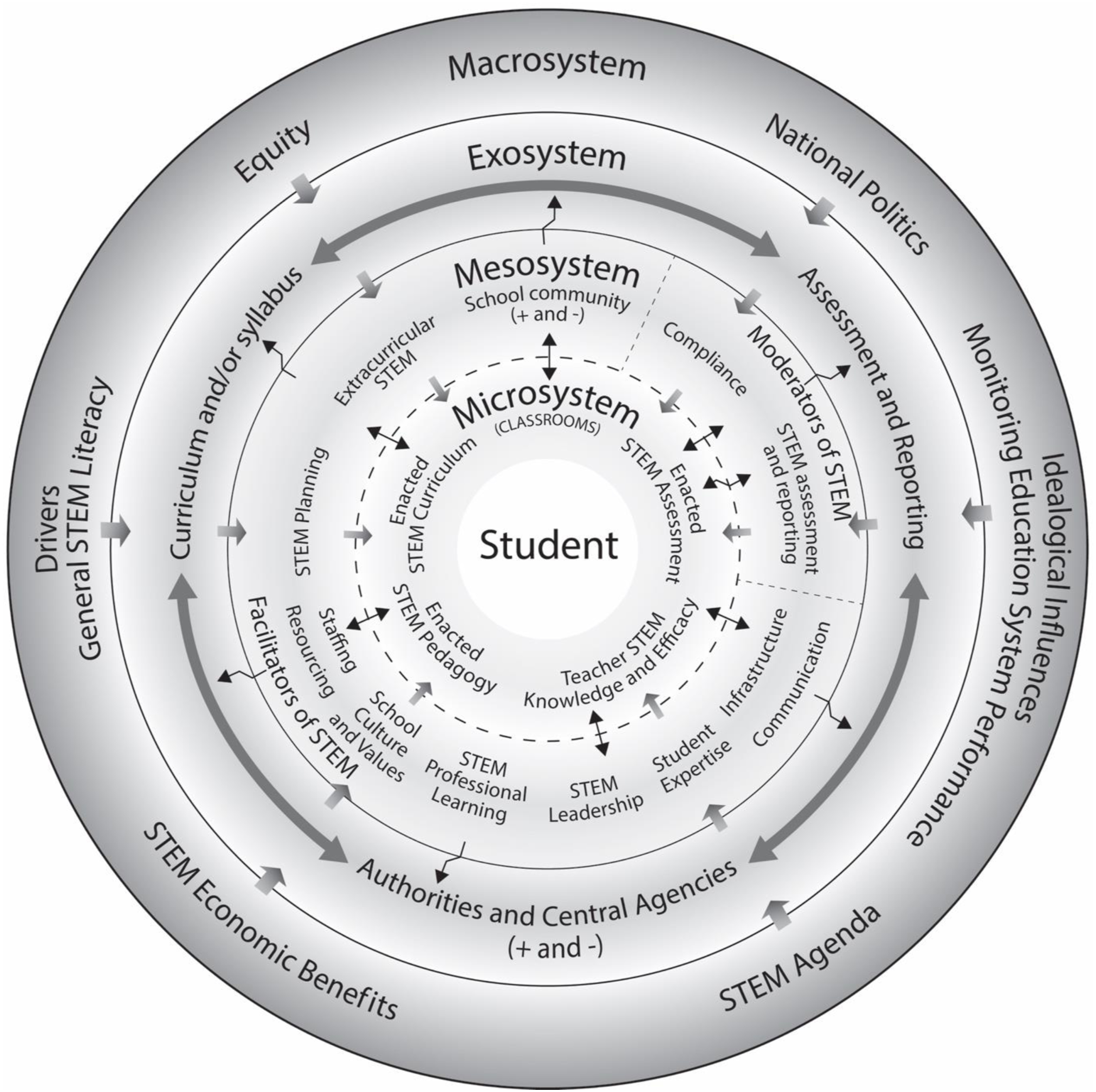
An important influence on schools’ STEM curricula and at the core of the ecosystem, were the proximal processes exercised between teachers, principals, students and members of local school communities. In Figure 2, these interactions are indicated by the double-headed arrows and dashed boundary between the micro and meso systems, signalling the porous nature of the divide, which was regularly crossed by individuals, as they formulated their school’s programme. Bronfenbrenner described proximal processes as the ‘driving force of human development’ (2005, p. xix), and in this study these face-to-face interactions between individuals across and within the meso and micro systems, had a fundamental impact on enacted STEM curricula. According to Bronfenbrenner and Ceci (1993), a key attribute of effective proximal processes is that ‘interaction must occur on a fairly regular basis over extended periods of time… (and that it) is a joint function of the characteristics of the developing person and the environment’ (p. 317). Data from this study strongly affirmed Bronfenbrenner’s perspective, as some teachers and principals - over time and through strategic exercise of proximal processes as they worked within and between systems, were able to shape effective STEM curricula that operationalised local resources to meet student learning needs. The focus of these proximal processes was generally on planning, resourcing, assessment and professional learning decision-making, as well as negotiating with community organisations and businesses to establish STEM-supportive relationships. These are recorded in the mesosystem in Figure 2.
However, as Merçon-Vargas et al. (2020) noted, the effectiveness of proximal processes relies heavily upon the dispositional and personal characteristics of individuals within systems, and they do not always lead to progress. In some schools this certainly applied, as resistant teachers who viewed changes towards interdisciplinary STEM as disruptive or ‘dumbing down’ discipline rigour, or were being asked to upskill in new areas, sought and found refuge in the confused messages about STEM communicated in official documents, and narrow interpretations of how to meet national assessment requirements. The doubled-headed jagged arrow indicates the tension generated by resistant teachers in some schools, that acted as a moderator or drag on progress.
Limitations
A number of limitations to this study are acknowledged. First, while the volume of data analysed was substantial, reliance on interviews alone meant responses were not verified using other methods. In stating this, findings of an earlier more detailed study of selected PASL schools were broadly consistent with the results of this study, providing some support for its conclusions (Falloon et al., 2021). Second, potential exists for participant bias in studies like this that use self-enrolment methods. This results from participants’ existing motivation to engage in PASL possibly affecting the representativeness of the sample. Whilst acknowledging the common motivation of improving STEM education, the range of responses suggested participating principals and teachers were from schools at very different stages in their development of interdisciplinary STEM curricula. Although this does not necessarily imply a representative sample, it does suggest interviewees possessed very different levels of knowledge and experience with interdisciplinary approaches to STEM and were working in schools with varying needs and resources. Finally, as with all studies of this nature, alternative interpretations of data are possible. Although coding followed a robust inductive procedure where classifications were finalised through an iterative negotiation and confirmation process involving the first and second authors, it is acknowledged that alternative interpretations and explanations are still possible.
Conclusion
The results of this study drew on a large dataset of 449 interviews with school principals and teachers from six of Australia’s eight states and territories. The responses provided an overview of factors and activities occurring at different levels of Australia’s education system that influenced STEM curricula in the nation’s schools. Regardless of schools’ geographical location or socio-economic background, the proximal processes exercised between teachers, principals and members of their school communities were fundamental to establishing unique interdisciplinary STEM curricula designed around local opportunities and resources. Central to this process was school leadership that demonstrated enhanced understanding of broad benefits from interdisciplinary STEM that engaged the community as active participants, and the potential of STEM to develop lifelong skills and competencies relevant to all students. The proximal processes exercised by principals brokered STEM learning opportunities through facilitating relationships with community businesses and organisations, while also prioritising funding, staff development and supporting infrastructure. School leadership also acted as a buffer between the exo and micro systems, giving licence to innovative teachers’ efforts to reconfigure the curriculum into interdisciplinary designs, despite resistance from some teachers and constraining curriculum and assessment requirements.
As Marynowski et al. (2019) in their discussion of proximal processes in school change argued, the personal characteristics, dispositions and developmental assets of individuals interacting within systems is critical to their effectiveness. In this study, these assets took the form of leadership knowledge of, and commitment to, a whole-of-school vision for STEM; robust awareness of future-focused skills and competencies interdisciplinary STEM can develop; willingness to support innovative, risk-taking teachers; and ‘hands-on’ engagement in STEM-related change processes. Under these conditions, teachers felt empowered to innovate and investigate different approaches to STEM, in the knowledge that leadership had confidence in their ability and were prepared to support them to move curricula in new directions. Notably, while principals and teachers were cognisant of ensuring STEM programmes met exosystem policy and compliance requirements, their sound understanding and general acceptance of macrosystem (and global) drivers for STEM education provided a strong foundation upon which to build engaging local interdisciplinary STEM curricula, that in some ways bypassed more direct exosystem influences. This suggests that even in the presence of exosystem ambiguity, constraints imposed by education system authorities and incompatible assessment and reporting requirements, with the exercise of effective proximal processes and a solid base of leadership developmental assets reflecting deep understanding of broader purposes and outcomes from STEM education, it is still possible to forge innovative, interdisciplinary STEM learning programmes.
Footnotes
Authors’ contributions
All authors who have contributed to this manuscript are acknowledged.
Declaration of conflicting interests
The author(s) declared no potential conflicts of interest with respect to the research, authorship, and/or publication of this article.
Funding
The author(s) disclosed receipt of the following financial support for the research, authorship, and/or publication of this article: This study was part of the larger professional learning, curriculum development and research project, Principals as STEM Leaders (PASL), funded by the Australian Department of Education, Skills and Employment (project: ED17/045432).
Research ethics
The Principals as STEM Leaders project was granted ethics approval from the University of Tasmania Human Ethics Research Committee Network (approval #H0017470).
Data availability
Supporting data are included in Tables.
