




Abstract
For young people, the end of secondary school represents a critical transition point. This article aims at understanding how schools support a particular group of disadvantaged students to transition into education, training, or employment. Drawing on a life-course perspective and with refugee-background African students as an empirical focus, this qualitative case study documents career support practices in nine government schools in the State of Victoria. The findings show that schools provide transition opportunities that support African students to envision their post-school educational and career trajectories. The arrangements include career planning, alternative pathways, and employment of community engagement officers. However, there are persisting challenges that impede this group of students from fully benefiting from these arrangements. The main barriers identified here are academic disengagement, doxic aspirations, misconceptions about qualifications, and low self-efficacy. The article also argues that the persistence of these challenges is attributable at least in part to such overlooked factors of engagement as institutional practices, student agency, and home environment.
Keywords
Introduction
In Australia, the issue of transition from school to further education, training, or work has been a focus of academic analysis starting from at least four decades ago (see, for example, a sample of articles published in this Journal: Carpenter & Western, 1984; Elsworth & Day, 1983; Powell, 1979). Currently, preparing school students for transition to education, training, or work is high on the policy agenda (Coalition of Australian Government, 2019; O’Connell et al., 2019; Shergold et al., 2020; Victorian Government, 2018b). With the changing world of work as a backdrop, the Victorian Government recently commissioned two major reviews of career education in schools. In the first review, the dandolopartners documented how career advice activities in Victorian schools compare with best practices in career education and identified areas for improvement. One of the key recommendations was that career education should be a priority in schools because it “helps students understand themselves, the opportunities they have, and what they need to do to realise them” (dandolopartners, 2017, p. 3). The second review by the Economic, Education, Jobs and Skills Committee (EEJSC) of the Parliament of Victoria found that career education in the State’s schools did not meet the needs of students (EEJSC, 2018).
In its response to the reviews, the Government introduced key initiatives (Victorian Government, 2018a, 2018b, 2018c). The Careers Development and Youth Transition policy (Victorian Government, 2018a) aims at guiding schools to run effective career advice activities. Likewise, the Career Education Funding allows schools to provide additional support to students at risk of disengaging so that they can make a successful transition to further education (university), training (vocational education and training), or employment. The Government has also organized an online resource, Engaging Parents in Career Conversations, to facilitate parental engagement in student career development. In addition to the formal funding allocation, the Student Resource Package, schools with students from socio-economic disadvantaged backgrounds—including refugee status—receive Equity (Social Disadvantage) Funding from the State Government. Equity Funding aims at raising the educational outcomes of disadvantaged students by allocating additional resources that schools can use “to deliver tailored educational programs that meet the needs of this cohort of students.” The funding is weighted according to the number of disadvantaged students in a school. Further, the Department of Education and Training has put in place a range of programs and services that support students from refugee backgrounds. 1
In this article, the key measure of disadvantage is refugee status and associated socio-economic and cultural challenges. For students from disadvantaged backgrounds, career guidance plays an important role in enhancing transitions to work (Ranasinghe et al., 2019), vocational training (Lamb et al., 2018), or university participation (Tomaszewski et al., 2017). In this regard, the Victorian Government specifically recognizes that refugee-background Africans “have experienced significant trauma, may not have finished school or had disrupted education. This has affected their settlement outcomes, leading to higher unemployment, lower participation, and lower-income” (Victorian Government, 2018d, p. 10). Against this backdrop, one of the objectives of the Victorian African Communities Action Plan, 2018–2028 (Victorian Government, 2018d) is to improve the educational outcomes for this group. Through this Action Plan, the State Government aims to ensure that young Africans “stay in education and reach their potential” (p. 27) and expresses its commitment to widening the group’s access to career education and thereby supporting their successful transition to further education or employment. However, the extent to which the career education programs have benefited refugee-background African students has not been critically examined yet. To address this knowledge gap, and against the backdrop of the above initiatives, the article explores the extent to which African students with refugee backgrounds in Victorian government schools are being prepared for transitions. Hence, this article is guided by the following research question:
How are secondary schools in Victoria preparing refugee-background African students for transition to further education, training, or work?
The article is structured in three major sections. The first section briefly outlines the analytical framework and method. The second and core section presents key findings of the research under three themes, namely transition opportunities, persisting challenges, and overlooked factors of engagement. Finally, the concluding section summarizes the findings and outlines the implications of the findings for policy and practice.
Analytical framework, method, and data
Analytical framework: A sociological life-course perspective
The future is uncertain. It holds opportunities and risks. Schools play a critical role in equipping young people with adaptive strategies that enable them to maximize gains and minimize pitfalls. In preparing students for transitions to work, training, or education, one needs to consider factors beyond the school compound. A sociological life-course perspective highlights the relationship between personal adjustment and socio-historical environments (Elder & Giele, 2009; Mayer, 2005; Schoon, 2006). Personal trajectories are shaped by structural opportunities, institutional practices, historical trajectories, and familial contexts. The analytical implication in this article is that educational and career trajectories of students from disadvantaged backgrounds should not be studied in isolation from events in other domains of life across their lifespans (Blossfeld & von Maurice, 2019). It is imperative to recognize that transition decisions and destinations of students are shaped by life chances and opportunities, which are not equally distributed in society. For example, for refugee-background students who grew up in camps with little or no educational opportunities, educational adjustment and engagement at a later stage could be a concern.
Guided by a sociological life-course perspective, this article explores institutional practices associated with preparing refugee-background African students for transitions. Here transition entails moving from one level of the education system to the next or to another domain of life such as career. Transition is an outcome of “personal characteristics and individual action as well as of cultural frames and institutional and structural conditions” (Mayer, 2009, p. 414). Life-course researchers are interested in understanding the timing, sequencing, and duration of transitions as well as patterns, enablers, constraints, and interactions of transitions across a range of life domains (Crosnoe & Benner, 2016; Mayer, 2005). In light of such analytical commitments, one can argue that educational life courses of refugee-background African refugees—their academic engagement and outcomes, curricular trajectories, and transition—are mediated by interpersonal, social, and institutional factors. Following existing sociological studies (e.g. Bozick & DeLuca, 2005; Crosnoe & Benner, 2016; Elder & Giele, 2009; Mayer, 2009; Schoon, 2006), I argue that supporting refugee-background African students to navigate effective pathways to future work, training or education needs to consider two key issues: past trajectories and existing contexts of opportunities, challenges, and social ties.
Past trajectories
While transitions are about changes in state or status, trajectories refer to “cumulations of experience stretching over the life course” (Schoon, 2006, p. 26). At the core of the life-course analysis is the assumption that “prior life history has strong impacts on later life outcomes” (Mayer, 2009). A temporal view of life courses is critical to understand the causes, processes, and consequences of forced migration. Major life events, or what Thomson et al. (2002) refer to as “critical moments,” play key roles in shaping young people’s choice of specific transitions and pathways. The argument is that exposure to adverse environmental and socio-economic conditions accumulate over time, and those with disadvantaged biography tend to experience subsequent disadvantageous life-course trajectories. For refugee-background Africans, forced displacement represents a moment of great change, uncertainty, and vulnerability. African refugees have arrived with a level of disadvantage not previously experienced by other cohorts of refugees. Before they settled in Australia, most of them had spent years in temporary refugee camps and arrived in Australia with disrupted educational trajectories as well as experiences of trauma and isolation (Molla, 2019, 2020b). Accounting for life-course trajectories means appreciating the cumulative educational disadvantage of the refugee youth. Schools prepare young people for transition to change the course of their lives toward a better future. Doing so requires acknowledging and responding to educational biographies of disadvantaged students such as African students. The timing of risk experiences equally matters (Schoon, 2006). Experience of early educational disadvantage can give rise to disengagement and poor learning outcomes at a later stage. For example, most African refugee-background students grew up in refugee camps with little or no education. This disadvantage at a critical period of their development reproduces disadvantages in the post-resettlement period.
Existing contexts
Life courses are contextually embedded. Our preferences, decisions, and opportunities are intrinsically influenced by social contexts in which we are located. The processes shaping young people’s transition from school to work, further training or university education are multifaceted, including socioeconomic status, cultural background, and personal aspirations and effort (Schoon & Silbereisen, 2009). The notion of context covers the opportunities and navigational capacities of the African refugee youth. What refugee-background African students aspire for and which life course they take are in part mediated by their life chances made possible through existing socioeconomic position, social arrangements, and social networks (Kenway & Hickey-Moody, 2011; Mayer, 2005). In other words, opportunity travels through social networks. While African refugee youth may have the capacity to make rational choices for themselves, these choices are framed by their familial and cultural contexts. Be it in educational or occupational preferences, individuals make “structurally contingent” choices and operate according to a “pragmatic rationality” (Reay et al., 2001, p. 864). In other words, we live “linked lives,” expressed in our interdependence and relationships with others (Crosnoe & Benner, 2016; Mayer, 2009). Family members and communities more broadly can provide cultural and social resources that support learning and transition. Relatedly, changes in one social institution (e.g. families) influence children’s engagement in other institutions (e.g. schools). That is, what is happening at home (including family expectations and parental employment status) influences what happens at school in terms of student aspirations, engagement, and outcome. By meaningfully engaging parents in career advice activities, schools can harness the resources found within the African community. Substantive opportunities manifest in policy provisions, institutional practices, and social ties.
Method and data
The study from which this article is derived aimed at investigating the extent to which African students with refugee backgrounds have benefited from career advice activities in Victorian public secondary schools. The study drew on a qualitative case study approach (Yin, 2018).
The nine secondary schools that participated in this study are located in five suburbs of Melbourne where most African communities live. The nine public secondary schools are pseudonymously referred to as Wemas P-12 College, Daca Colleges, Nonis Secondary School, Dadas High School, Sucos College, Nomacs College, Locos College, Lomas Secondary College, and Wecos College. With a score lower than 1000 in the median Index of Community Socio-educational Advantage (ICSEA), six out of nine schools are considered disadvantaged. The three schools with a relatively high ICSEA value are Locos (1011), Lomas (1029), and Nomacs (1030). The schools have also a diverse student population, for example, the proportion of students from non-English backgrounds ranges from 91% at Dadas to 33% at Lomas. 2 In underscoring the level of cultural diversity at her school, the career advisor in Dadas High School said, “I would say we could count how many Aussies as opposed to the rest of the group of students” (Dafa). In light of government policies and programs, all the nine schools had put in place career advice activities. The interviews with career and pathways coordinators aimed at exploring the extent to which career advice activities of schools prepare refugee-background African students for transitions to work, training, and education.
The study aimed to shed light on what those schools are doing to prepare African refugee youth for transitions. As Fay (1975) notes, “human actions and systems of actions are rooted in the self-understandings, perceptions, and intentions of the actors involved, so that it is in terms of these—though not these exclusively—that one must understand human actions” (p. 96). Qualitative data were generated through semi-structured interviews with nine career and pathway coordinators from the nine public secondary schools. Ethics approval was gained from the University’s Human Research Ethics Committee as well as the Victorian Department of Education and Training prior to fieldwork. Written informed consent was sought from interview participants in secondary schools. The interviews lasted between 45 and 70 minutes and were conducted between April and September 2019. The career advisors from the respective schools are anonymously named as Wetra, Daky, Nofra, Dafa, Suca, Noye, Lofa, Loah, and Wesan. The interview data were complemented by a review of the policy documents from the Victorian Government, namely Inquiry into career advice activities in Victorian schools (EEJSC, 2018), government response to the Parliamentary Inquiry into career advice activities in Victorian schools (Victorian Government, 2018b), and Victorian African Communities Action Plan: working together now and over the long term, 2018–2018 (Victorian Government, 2018d).
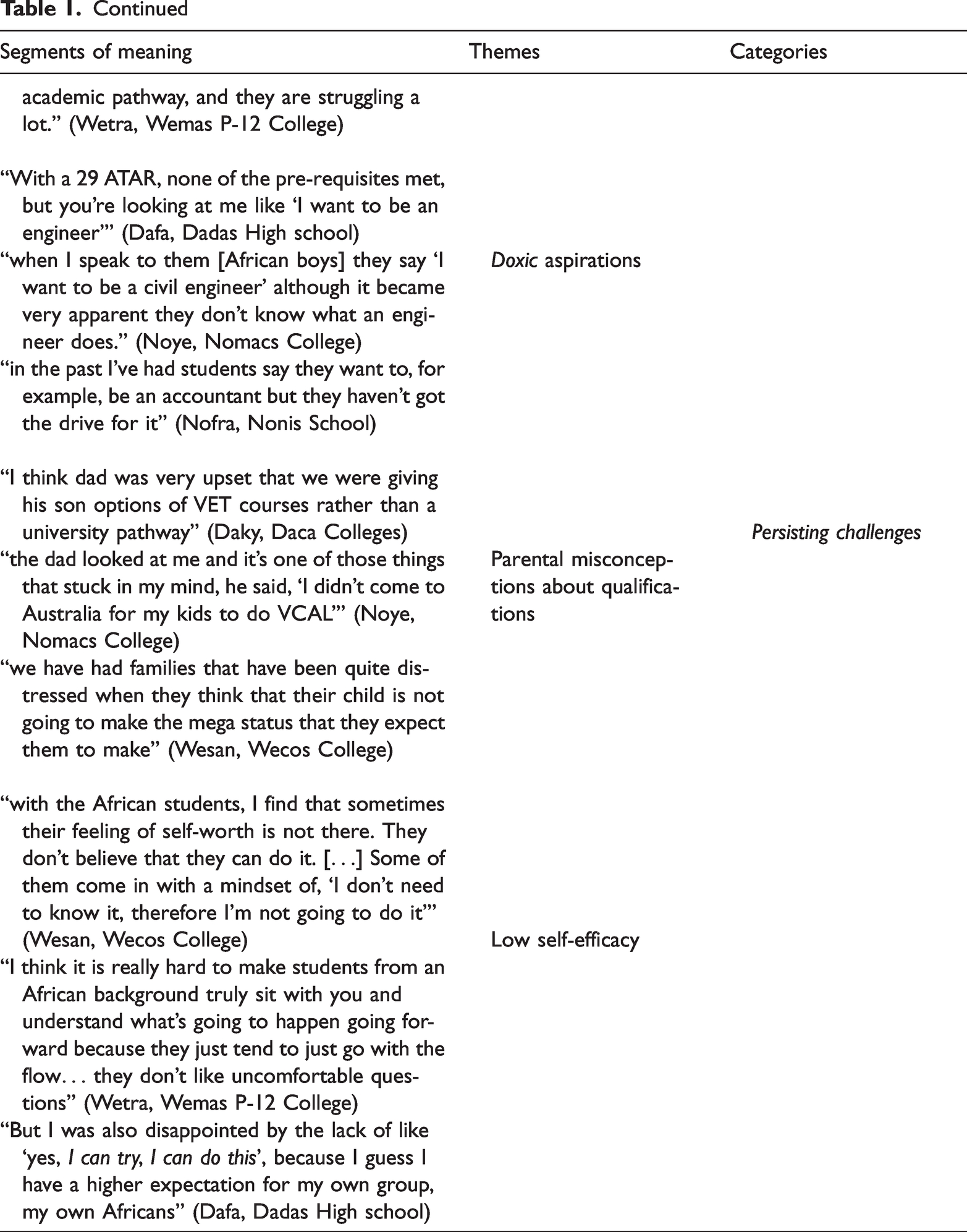
The career officers manage partnerships with universities and other organizations; organize career-themed events at school; and advise students on pathways, courses, and equity scholarship opportunities. The interviews focused on how schools are preparing refugee-background African students for transitions to employment, training, or higher education. The interview participants were asked to elaborate on specific support mechanisms, challenges, and outcomes. The article applied inductive analysis. Each interview was transcribed and de-identified to ensure anonymity. Then the transcripts were read and coded line by line. Drawing on the colour-coded transcript, I identified meaningful segments, mapped out emerging patterns, and constructed themes that capture essential elements of the participants’ accounts. Although most themes emerged empirically (in the data), others were developed conceptually. In developing the narrative account, I collapsed the themes to form key categories: transition opportunities, persisting challenge, and silences and issue omissions (see Table 1 for a snapshot of the thematic coding). Then the themes under each category were theoretically re-described, that is, empirical accounts of the career educators were placed in the context of ideas and concepts drawn from the literature. Applying theory to empirical data enables a social researcher to detect “meanings and connections that are not given in our habitual way of perceiving the world” (Danermark et al., 2002, p. 94). To substantiate the arguments and to make sure that the participants’ voices are heard, I used direct quotes extensively.
A snapshot of the thematic analysis used in the study.
Findings: Facilitating transition
This section presents the key findings of the study. The findings of the study which build on and expand earlier research on the topic (e.g. Kjeldsen & Ley, 2015; Crosnoe & Benner, 2016; Vernon et al., 2019) are discussed under three headings, namely transition opportunities, persisting challenges, and overlooked factors of engagement.
Transition opportunities
As noted earlier, career development is a core policy element in the Victorian school sector. Schools play critical roles in facilitating student transition through establishing partnerships with higher education institutions and employers, familiarizing students with academic experiences, integrating work placement with the curricula, and widening access to career planning and support services.
A recent Australian study shows that school-based academic support is instrumental in facilitating the transition of students from disadvantage backgrounds (Vernon et al., 2019). This section foregrounds institutional practices aimed at supporting student transitions to work, education, and training. Specifically, the discussion is about what schools are doing to prepare refugee-background African students for transitions to work, training, and higher education. The main interventions of the schools can be summarized under three themes: career planning, alternative pathways, and African liaison (community engagement) officers.
Career planning
The career planning in schools entails showing students which Victorian Certificate of Education (VCE) subjects lead to which university and technical and further education (TAFE) courses, and which the Australian tertiary admissions rank (ATAR) score takes them to where or as Suca at Sucos College put it “you can start to break that reality to them.” Schools also establish a partnership with universities. The partnership enables them to benefit from university-specific equity programs as well as the Victorian Tertiary Admission Centre (VTAC)-run special consideration programs. Schools support students in their VTAC application for special entry access scheme consideration. As Wesan at Wecos College underscores, the purpose of the career plan is to “allow them to see that that [university degree] is not the only thing in the world.” At the end of year 10 and the beginning of year 12, coordinators discuss with students about career options and pathways. The career plan aims at balancing student interest and available options. Regarding the sorts of advice students get, one career advisor offered an example: If you’re trying to seek an occupation like that, like a lawyer, you should probably work hard, like really work hard; and spend more time reading and doing homework, asking teachers questions, following up on all the homework. (Loah, Lomas Secondary College)
Alternative pathways
Starting from 2010, through the Higher Education Participation and Partnerships Program (HEPPP), the Australian Government has encouraged universities to establish partnerships with schools and undertake activities that improve access to undergraduate courses for people from low SES backgrounds. Although refugee-background students are not specifically targeted in the policy (Molla, 2020c), the HEPPP covers three broad areas: (a) raising aspirations for higher education, (b) widening pathways to university education, and (c) improving engagement and attainment of equity groups (Australian Government, 2012). As a result, students who miss direct entry to a university degree (even with adjustment points) can still enroll in bridging programs as a pathway to destination courses. In bridging programs, students commonly study first-year university degree subjects, along with courses designed to prepare them in academic writing and research skills. The programs are characterized by intensive learning support. On completion of the pathway courses (Diploma or Associate Degrees), students can get up to one-year credit towards a range of undergraduate degree programs. In explaining why many African students might benefit from alternative pathways to university, a career practitioner noted: Getting to university is difficult unless the student is very, very dedicated, and prepared almost to work twice as hard as the other students in the class because they’ve got to make up twice the lost ground. If they’re not prepared to do that, they’re not going to be given that ticket into the university straight away. They’ll have to go through a pathway, through a TAFE pathway or something like that. (Wetra, Wemas P-12 College)
African liaison (community engagement) officers
As part of the State Government’s initiative to ensure student access to Multicultural Education Aides (Department of Education and Training, the State of Victoria, 2015; Victorian Government, 2018d), five out of the nine schools included in this study had employed African liaison (community engagement) officers. The schools use equity funding and other sources to employ liaison officers. African parents tend to have limited contact with schools. One career advisor noted: “what we find is that often with African parents, we don’t see them until there’s a problem” (Wesan, Wecos College). Hence, one of the responsibilities of the African liaison officers is to support families to understand the education system and connect with schools. The officers play critical roles in facilitating smooth communication with parents and students. One career coordinator noted that parental engagement improved after the school employed a Sudanese social worker: “I’m having a lot more success in having the family understand that there are other options” (Wetra, Wemas P-12 College). Further, often there exist cultural barriers between career practitioners and refugee-background students (EEJSC, 2018). As such, for African students, the presence of those officers in the schools creates a sense of relatability. In the words of the liaison officers: You should have seen the first day when they [African students] saw us here, they were so shocked to see us and happy at the same time, and then you can just see the whole mood changing. They feel uplifted. And from the first day until now, it’s different. The whole energy is different. (Lofa, Locos College) […] they felt like we care because they can relate to us. They were happy to see people that look like them and who can relate to them. There’s a lot of things they shy away and there’s a lot of cultural parameters and stuff. They can ask us anything they want without us judging them. (Loah, Lomas Secondary College)
Persisting challenges
Transition experiences are influenced by the interplay of subjective conditions (e.g. personal experiences, dispositions, priorities, and choice) and objective structures (e.g. socio-economic status, cultural background, policy provisions, and institutional practices). Career and pathways coordinators speak of many challenges they face in preparing refugee-background African students for transitions to work, training, and education. I condensed the challenges into four themes: limited academic engagement, doxic aspirations, parental misconceptions about courses/qualifications, and low self-efficacy. These are discussed in turn here.
Academic disengagement
As the life-course perspective suggests, transition patterns of students are aligned with “cumulative experiences” such as academic achievement and socialization (Schoon & Silbereisen, 2009). Low academic engagement and under-preparation result in a significant deflection in behavioral trajectories or a heightened transitional barrier. Academic competence is a key condition for successful student transition. The end of school education represents a stage of educational life course where “cognitive and academic skills are translated into academic credentials that then become the most visible markers inside and outside of schools of the preparation and suitability of young people for future educational and occupational endeavours” (Crosnoe & Benner, 2016, p. 183). In the last two levels of secondary school education (year 11 and year 12), many refugee-background African students academically struggle. The educators underscored that, with the end of automatic progression at Year 10, African students “struggle to cope with academic rigour and specialization”. Wetra from Wemas P-12 College stressed: “We are finding our students from African refugee backgrounds really struggling with the rigour, and the content knowledge is just at times beyond them.” Another careers and pathways coordinator recounted: So, when I work with them sometimes I ask, ‘Well can you open emails. Can you write an email to an employer’ for example? And then they open the email and I think the highest of unread emails are somewhere in the thousands on their school email account. And I said, ‘Are you not checking what your teachers are sending?’ ‘Oh, it’s too many emails so I won’t look’. So, they don’t engage with assignments, projects, etc. (Noye, Nomacs College)
Doxic aspirations
Disadvantaged people do not necessarily hold low educational and career aspirations (Gore et al., 2015; Molla, 2019; Zipin et al., 2015). But it is often the case that aspirations of the disadvantaged may not be formulated on the basis of a genuine assessment of viable opportunities and preparedness to take advantage of future possibilities. What people see as attainable possibilities can in part be informed by internalized dominant assumptions and views in society. Drawing on Bourdieu’s theory of social practice, Zipin et al. (2015) coined the concept of doxic aspirations to refer to the tendency of the disadvantaged to spontaneously internalize “the realizable achievements of those with more powerful inheritances of accumulated capitals” (p. 232). During the interviews, career practitioners highlighted aspects of doxic aspirations as barriers that inhibit African youth from taking advantage of more realistic options. Accounts of the careers and pathways coordinators interviewed for this research (e.g. Nofra, Dafa, Suca, Noye, Lofa, and Wesan) confirm that many African-background students hold high (and often unrealistic) educational and career aspirations. As one career practitioner put it: “they [African-background students] are a little bit unrealistic, so in the past, I’ve had students say they want to, for example, be an accountant but they haven’t got the drive for it” (Nofra, Nonis School). Doxic aspirations are expressed in “impulses to pursue out-of-reach dreams” (Zipin et al., 2015). Many also aspire to be engineers without understanding what an engineer does, without having the required level of academic preparedness, or without taking the required sequences of subjects. One career educator reported her conversation with an African-background student as follows: With a 29 ATAR, none of the pre-requisites met, but you’re looking at me like ‘I want to be an engineer’; I’m going to look at you like – ‘I want to be the miracle worker who’s going to find you an advanced diploma at RMIT’. (Dafa, Dadas High school)
Parental misconceptions about qualifications
Parental engagement and expectations play significant roles in raising young people’s aspirations for higher education. The Longitudinal Surveys of Australian Youth (LSAY) report concludes: “Students whose parents want them to attend university are 11 times more likely to plan to attend university, and four times more likely to plan to complete Year 12” (Forrest & Scobie, 2019, p. iii). Conversely, when parents hold strong misconceptions about qualifications and jobs, it can have detrimental effects on what students can aspire for and work towards. In Australia, there is a misconception about specific post-secondary courses and qualifications. A recent Inquiry into career advice activities of Victorian schools noted, “Many schools, parents and students have an unwarranted poor perception of vocational education and training and consider it inferior to university study” (EEJSC, 2018, p. 97). The problem is pronounced among African parents. From Nomacs College, Noye stressed: “I think there’s often a misconception within the African community about the value of doing VCAL or VET studies at TAFE.” Daky from Daca College spoke of an African father who got upset because TAFE options were offered to his son. Another career educator explained the extent to which African families resist non-academic options: The father […] probably wants his kid to achieve what he couldn’t. And then the kid rejects what the father wanted. And the kid’s like, “Dad, I can’t be a doctor.” Then the father pretty much says “I didn’t come to Australia so my son can be something other than a doctor or engineer”. (Lofa, Locos College, emphasis added)
Low self-efficacy
Bandura defines self-efficacy as “beliefs in one’s capabilities to organize and execute the courses of action required to manage prospective situations” (1995, p. 2). Self-efficacy constitutes personal agency and confidence, and it influences “how people think, feel, motivate themselves, and act” (p. 2). In his social cognitive theory, Bandura (1997) outlines four sources of self-efficacy beliefs: mastery experiences, vicarious experience, social persuasion, and psychological arousal. Individuals develop self-efficacy when they have experiences that are successful for them, applying their knowledge and skills acquired through reflective engagement in their experiences. The notion of vicarious experiences highlights how students can grow in confidence through observing others in practice and learn from the success of others who serve as models for them. Social persuasion entails parental and peer influence in what students choose to do and can offer constructive feedback for a future course of action. Lack of personal efficacy was one of the recurring themes during the interviews. Wesan from Wecos College emphasized: “with the African students, I find that sometimes their feeling of self-worth is not there. They don’t believe that they can do it.” Another career educator elaborated the problem in the following terms: So, these kids come from probably the most horrifying situations. They come here and I think they deserve all the help they can get because the trauma these kids have gone through to come here is beyond most people’s imagination. But I’m having to think because they get so much help I think the kids – some have developed this concept of learned helplessness. They’re very, very capable kids but they’re just used to, someone will do it for me. […] I had many, many meetings and they have no idea what they want to do. They are very open about the fact that they don’t really want to do anything. (Noye, Nomacs College)
Overlooked factors of engagement
Student engagement is expressed in active participation in academic and non-academic activities as well as a sense of belonging to the school community. For personal, institutional, or familial reasons, African students from refugee backgrounds may be at risk of disengagement, and early events have the potential to influence academic engagement and career trajectories. The life-course perspective underscores the role of biographies, social forces, and institutional practices in shaping one’s current position, alternative pathways, and future destination (Crysdale et al., 1999; Schoon & Silbereisen, 2009). Whether refugee-background African students envision university education or TAFE training as part of their future depends on a range of factors, including their past educational trajectories, current academic engagement, parental expectation, school support, and home environment. In this regard, the core argument of this section is that, in preparing refugee-background African students for transitions to higher education and work, schools neglect at least three critical elements: institutional factors, student agency, and home environment. I elaborate on those points in turn.
Institutional factors
School attributes play critical roles in mediating student transition (Gemici et al., 2013). However, schools included in this study appear to lack systematic self-reflexivity—institutional constraints such as racial bias and low expectations remain unscrutinized. Racial bias is a serious problem in Australian schools (Halse, 2017; Windle, 2008). At a policy level, the Victorian African Communities Action Plan (2018–2028) acknowledges, “Discrimination and racism, perceived or actual, is impacting on the connection of families and students to education” (Victorian Government, 2018d, p. 49). An African liaison officer recounted cases whereby students use the “N” word to refer to Black students without facing disciplinary consequences. In one specific instance, a White student asked a Black student: “it is my birthday; can I call you nigger today?” (Lofa, Locos College). Such direct exposure to racism has serious academic consequences. Research in social psychology (Levy et al., 2016; Sue, 2010) and behavioural biology (Sapolsky, 2004) shows that the stress of racism inhibits learning. Even so, the majority of interviewed career educators failed to acknowledge that racism was an issue in their schools. This position contradicts empirical accounts reported here and evidence presented in official documents (e.g. Victorian Government, 2018d). Pretending that racism does not exist is counterproductive—it inhibits timely interventions and may even “imply institutional complicity in producing students with polarized racial or ethnic attitudes, values, and beliefs” (Kennedy, 2013, p. 107). In working with African students in predominantly White societies, as Gorski (2019) argues, we should not allow “racism-infused misconceptions of their cultures to justify our failure to create racially just schools” (p. 58, emphasis in original).
Low expectations towards African students constitute another institutional barrier that diminishes the academic engagement of African students. Community feedback suggests that teachers maintain low expectations towards African students who, as a result, do not “feel understood by teachers in class” and are often “forced to choose subjects that do not align with their career aspirations” (Victorian Government, 2018d, p. 50). Such practices have significant implications for the academic engagement and outcomes of the students. Low expectations and constant pressure to take the vocational pathway may result in what Bandura (1995) refers to as “scholastic anxiety,” a condition whereby negative feedback weakens one’s efficacy and leads to anxiousness about the demands of academic subjects. Even though going to university might not be a desired future of all refugee-background African students, secondary schools need to make sure that (a) they fully understand the value of university qualification, (b) they are aware that higher education opportunities are available for them, (c) they can effectively navigate alternative pathways to higher education, and (d) they are fully informed that they are responsible for the results they realize through the opportunities available to them. Options without relevant information are of little value. In this respect, schools must be reflexive about their practices (e.g. career advice activities) and how that affects different social groups.
Student agency
Deprivation of agency constitutes disadvantage. In destination societies, refugees are commonly seen as dependent and problematic (Ong, 2003). What is concealed by such negative stereotypical images is the resourcefulness and agency of displaced people. Refugees are resilient—they overcame loss and adversity. They bring cultural resources that help them adjust to the expectations of the destination society. Most of them hold high aspirations for education, career, and a good life. One of the key principles of the life-course perspective is that “individuals construct their own life course through the choices and actions they take within the opportunities and constraints of history and social circumstances” (Blossfeld & von Maurice, 2019, p. 23). Career educators need to recognize that refugee-background African students from refugee backgrounds have agency; they are not passive recipients of structural and institutional influence. They can envision their futures, take advantage of opportunities to achieve their goals, and overcome obstacles. Recognizing student agency has an empowering effect; it raises students’ beliefs in their efficacy. Equity is also linked with the extent to which student agency is recognized in school practices. In the context of the present discussion, the notion of agency implies that the freedom to choose work one has a reason to value has not been constrained.
Career advice activities that recognize the importance of agency freedom foreground what can be referred to as “a just negotiation” of transition trajectories and pathways, maintaining a balance between school expectations and student aspirations and choice. According to Kjeldsen and Ley (2015), “Just negotiation with exit options would imply that a young person is not forced to adapt their choices to the counsellors’ or families’ idea of ‘realistic perspectives’ in relation to the labour market situation at the present” (p. 345). Further, without intervention to disrupt adaptive preferences, deprived people are more likely to develop a sense of “putting up with fate” and conform to conditions of unjust inequality. The key question that needs to be kept in mind is: in making decisions about their future career or educational trajectories, do the refugee youth have agency freedom? Career advice activities can be instrumental in unleashing the agency of African students from refugee backgrounds. Refugee-background students can be confronted with real-life problems that create disjuncture between position and disposition and trigger reflexivity, leading to “awakening of consciousness” (Bourdieu, 1990) in the form of questioning assumptions and beliefs underpinning one’s choice and action. The aim is to help the youth problematize conditioned perceptions and develop responsive aspirations.
Home environment
The life-course perspective holds that developmental life trajectories of the individual are intimately linked to the sociocultural context in which they find themselves immersed at home and in the community. Agency is socially mediated (Bandura, 1997; Bourdieu, 1990), that is, transitional decisions and destinations of students can in part be a function of the mediative efforts of others, including parents and members of extended families. Specifically, academic engagement and outcomes at school are closely linked with educational capital and scholarly habitus at home (Watkins & Noble, 2013). However, low educational attainment of parents (Department of Social Services, 2013) coupled with negative effects of forced displacement (e.g. psychological stress, social dislocation, and financial hardship) diminish educational resources of African students from refugee backgrounds. Low educational capital at home represents a significant disadvantage. Refugee-background African students are educationally disadvantaged partly because, unlike their peers from dominant social groups, the values they receive at home may not be congruent with school practices and expectations (Molla, 2019, 2020a). As a result, they may not develop a “feel for the game” (Bourdieu, 1990, p. 9) of academic engagement. Nevertheless, some career practitioners appeared to be somehow oblivious of the academic consequences of differences in the home environment. At Wemas P-12 College, Wetra commented that among refugee-background African students “there is not that sense of urgency to be getting a wage” compared to “some of the real true-blue Aussies.”
Another aspect of the overlooked home environment is how unrealistic parental expectations might influence student choices for pathways to higher education. African parents are often “headstrong about the career paths the young person should take” (Victorian Government, 2018d, p. 51). However, there is often a significant gap between parental expectations and student academic engagement and outcome (Molla, 2020a). When parents come to realize that their children are unable to meet their expectations or when the children reject the imposed aspirations, the outcome is discord at home and disengagement at school. One career advisor has summarized the predicament in this way: If they have the expectation at home that you have to get a ninety-eight to become a doctor or lawyer and the kids know that they’re not getting there, they know they’re not getting there, so they have to—they just start playing up, start being disengaged. (Noye, Nomacs College)
Conclusion
In the age of fast-paced technological changes, economic success and meaningful social participation necessitate an advanced level of knowledge and skills. Against this backdrop, in Australia, the role of schools in preparing students for transitions has become increasingly critical. The article set out to understand what schools are doing to prepare refugee-background African students for transition to work or higher education. The article has documented transition opportunities, persisting challenges, and overlooked factors of student engagement. Using a sociological life-course perspective, it has been argued that transition outcomes have to be conceptualized as cumulative experiences. Further, African-background liaison officers in the five schools consistently reported successful engagement with African students. This implies that schools with a significant number of African-background students might benefit from employing community engagement officers from the same cultural group. However, we should be cautious not to fall into the trap of attributing educational outcomes of refugees to cultural and racial differences. The focus should be on what life courses the youth had and what life chances they currently have.
In preparing African students from refugee backgrounds for transition, schools need to understand how their life-course trajectories and socio-cultural backgrounds may affect their engagement, decision, and outcomes. In other words, if transition to and progression through higher education necessitates substantive freedom to be and do what one has reason to value, it is imperative to understand personal characteristics, social conditions, and historical experiences that inform what one has reason to value (Sen, 2003). In order to have a complete view of transition patterns and experiences of refugee-background African students, there is a need for further study that involves young people, their parents, and teachers. Career advisors and community engagement officers interviewed for this research also noted a gap between parental expectations and student preferences and preparedness regarding post-school destination. As such, it is timely and important to raise African parents’ awareness about the Australian labor market and values of vocational qualifications. In its African Communities Action Plan, the Government of Victoria rightly stresses, “Young people should not be subjected to feeling the need to fulfil their parents’ goals in terms of career progression” (2018d, p. 51). Finally, schools should be supported to promote positive cultural identities of African students, build personal efficacy of the youth, and meaningfully tackle the problem of racism.
Footnotes
Declaration of Conflicting Interests
The author(s) declared no potential conflicts of interest with respect to the research, authorship, and/or publication of this article.
Funding
The author(s) disclosed receipt of the following financial support for the research, authorship, and/or publication of this article: The work was supported by the Australian Research Council (project number: DE190100193).
