




Abstract
The present study was conducted to explore how the relationships between reading comprehension constructs change according to word reading accuracy, as measured in a large convenience sample (n = 857) of school-aged students (Years 3–6) with reading difficulties. Multiple regression analyses containing interaction variables were conducted, to determine whether word reading accuracy moderated the relationships between the dependent variable (i.e. reading comprehension) and independent variables (i.e. each of vocabulary and nonword reading accuracy). The interaction variable between word reading accuracy and receptive vocabulary was significant, with steeper slopes evident among more skilled readers compared to less skilled readers. Conversely, the interaction variable between word reading accuracy and nonword reading accuracy was also significant, but with steeper slopes evident among the less skilled reader groups. These patterns align with what has been found in typically developing children: as word reading ability improves, reading comprehension depends more so on language comprehension skills than lower-level decoding skills.
Introduction
The importance of being able to read cannot be understated. As with spoken language, written language provides a medium through which users have the power to engage with new knowledge, ideas, perspectives and stories. By the same token, individuals with spoken and written language difficulties are more likely to experience psychosocial problems, as well as negative academic and vocational outcomes (Snow, 2016; Cherry & Vignoles, 2020). Written information differs most obviously from spoken information because it is coded in printed symbols. Thus, while the ultimate purpose of reading is to comprehend the meaning of a given text, the ability to decode that text is foundational. Indeed, there are numerous interactive skills that differentially – depending on the reader’s age and ability – contribute to reading comprehension.
The actual process of comprehending written text is complex and dynamic. It involves readers drawing on their existing knowledge to infer meaning from the text and build mental representations as they read (Kintsch, 2018; Rapp & van den Broek, 2005). Those inferences are then applied to the reader’s interpretations of subsequent text in the passage, and so the feedback loop continues. Assuming a reader is attentive and cooperative, their comprehension of the given text is something that develops on a moment-by-moment basis, rather than something they achieve upon finishing. Nevertheless, the state of the reader at the finish is critical: the whole purpose of reading a text is to have comprehended it to such a degree that, by the end, the meaning therein may be integrated with whatever background knowledge already exists (Kintsch, 2018).
The question is: How do we measure such a dynamic, intangible set of skills? In clinical and educational settings, the most straightforward way is to use behavioural measures of reading comprehension, wherein the reader responds to questions about a text they have just read. Many such tools exist, although they vary from one another in important ways. According to a meta-analysis by García and Cain (2014), reading comprehension is more closely aligned with a reader’s word recognition skills if the text is narrative (rather than expository), if the required knowledge is literal (rather than inferential), and if the text-reading period is timed (rather than untimed). The key point here is that reading comprehension, as measured by a single behavioural assessment measure, is inherently influenced by the characteristics of that measure.
The Simple View of Reading
For clarity, reading comprehension is defined in this paper as, ‘the ability to extract and construct literal and inferred meaning from linguistic discourse represented in print’ (Hoover & Tunmer, 2018, p. 304). Accordingly, reading comprehension may reasonably be described as the product of written word recognition and language comprehension, if only to the extent that the latter component is defined as the ability to extract and construct literal and inferred meaning from linguistic discourse represented in speech (Hoover & Tunmer). The relationships between reading comprehension, word recognition and language comprehension are captured by a theoretical model known as the ‘Simple View of Reading’ (SVR) (Gough & Tunmer, 1986; Hoover & Gough, 1990).
A Developmental View of Reading Comprehension
Although the SVR was originally posited based on research involving children, it is not intended to explain how reading comprehension develops with age and reading experience. Rather, it describes the extent to which word recognition and language comprehension contribute to reading comprehension at any one particular time-point (Nation, 2019). Since the publication of the original SVR theory, a substantial amount of empirical evidence has been generated in support of it (e.g. Hjetland et al., 2019; Kirby & Savage, 2008; Language and Reading Research Consortium [LARRC], 2015; LARRC & Chiu, 2018; Lonigan et al., 2018). Moreover, research has also been devoted to establishing how the relative importance of reading comprehension components (i.e. word recognition and language comprehension) change over time. In typically developing children, the role of word recognition skill – where this is defined as both word and nonword reading proficiency – is consistently found to be most significant in beginning readers, relative to experienced readers (Aaron et al., 1999; Catts et al., 2015; Florit & Cain, 2011; García & Cain, 2014; LARRC, 2015; Lonigan & Burgess, 2017). This finding may be viewed in the context of evolving written language demands, since the types of text to which students are exposed become longer and more complex over time, with higher demands placed on word and world knowledge (Cervetti et al., 2020).
Text characteristics aside, the developmental shift in the roles of underlying reading comprehension skills may also represent children’s mastery of the more basic literacy skills. For unskilled readers, attentional resources and literacy instruction are largely devoted to decoding single words, which reduces the degree to which tests of reading comprehension can actually measure comprehension-specific processes (LARRC, 2015). As these readers master word-level decoding abilities, test performance may be expected to rely increasingly on the same spoken language skills required for tests of general language comprehension.
Critically, the above explanation for the shift in reading comprehension profiles has so far been founded only on age-based comparisons. That is, older readers have better word-level accuracy and automaticity than younger readers, which is assumed to be why reading comprehension is less reliant on those word-level skills over time. This is a perfectly reasonable assumption to make in relation to typically developing readers, but it is an assumption that has so far not been verified. In addition, the interaction between age and word-level reading ability may not be so straightforward in the context of researching struggling readers, since for them to be defined as such, they need to be performing below chronological age-based expectations.
To illustrate, Savage (2018) found that, in a cohort of 13- to 16-year-olds whose reading skills were at least 3 years delayed, reading comprehension was moderately and equivalently correlated with both nonword decoding skills and spoken language comprehension. This pattern would not have been predicted based solely on chronological age, because decoding skills are ordinarily quite automatic by that point in development and, thus, only somewhat related to reading comprehension. However, given the significant reading delays exhibited by Savage’s sample, it may be reasoned that these students have not reached a threshold of decoding automaticity whereby comprehending text draws on the same skills as comprehending speech. This was the theory tested in the present study. Here, the relationships between reading comprehension and underlying skills were examined to determine whether they appeared to depend on the reader’s word reading proficiency, as opposed to their chronological age.
Word Recognition and Reading Comprehension
According to the SVR, one of the two main areas contributing variance to reading comprehension is word recognition. This term captures the sometimes-effortful decoding process whereby a reader applies their knowledge of grapheme-phoneme correspondences to ‘sound out’ a word, as well as their rapid identification of a word that is retrieved as if ‘by sight’. Combined, these skills represent word recognition as a whole, although they may be assessed as partially separable constructs.
A study by Berninger et al. (2006), which involved a cohort of 8-year-old struggling readers, examined the separate contributions of word decoding and recognition skills to overall reading comprehension. According to their results, decoding skill (as measured by nonword reading proficiency) was consistently, across five different outcome measures and two time points, less correlated with reading comprehension, compared with real-word reading proficiency. The authors described decoding skill as a stepping stone to acquiring real-word reading skills, and thus an important but indirect contributor to overall reading comprehension.
Vocabulary and Reading Comprehension
Berninger et al. (2006) also found that students who received a 6 month structured reading program showed improved reading comprehension, relative to a control group who did not receive the program. Critically, however, this intervention effect was eliminated when one of either decoding or vocabulary scores was entered as a covariate. Hence, these skills were key underlying factors influencing overall reading comprehension success – a finding which aligns well with the SVR model, even though vocabulary is not exactly equivalent to the component of ‘language comprehension’.
Nevertheless, a reader’s ability to understand word meaning may be expected to influence their ability to understand text more broadly, and indeed there is a large body of evidence to demonstrate the significant role of vocabulary in reading comprehension development (Muter et al., 2004; Peng et al., 2018; Perfetti, 2007; Spencer et al., 2019; Torppa et al., 2016). There is also evidence that, in the context of the SVR model, vocabulary does not contribute to reading comprehension beyond what is contributed by the broader construct of language comprehension (Braze et al., 2016; Protopapas et al., 2013; Tunmer & Chapman, 2012). Accordingly, it is no surprise that vocabulary and language comprehension measures tend to correlate strongly with one another (Braze et al., 2016; Tunmer & Chapman, 2012; Vellutino et al., 2007), and that they load onto the same latent variable construct (Aaron et al., 1999; Braze et al., 2016; Tunmer & Chapman, 2012). Given the robustness of this relationship, assessments of vocabulary may provide a reasonable, though imperfect, approximation of a reader’s more general language comprehension.
Current Study
Our current understanding of the nuanced relationships between reading comprehension components is primarily based on studies with typically developing children. Within this population, the relative weightings of reading comprehension subskills are seen to shift with increasing age, presumably as a consequence of readers reaching a point of automatic (or near-automatic) word recognition. In the present study, the same reasoning was applied to a cohort of low-progress readers, who were beyond the level of schooling at which it is common to receive whole-class reading instruction, although most had nevertheless not yet progressed to a stage of accurate and effortless word reading ability. Within such a population, chronological age may not be well aligned with actual reading ability. Hence, we aimed to examine the relationships embedded in the SVR framework using word reading accuracy as the main controlling factor, rather than age.
The specific research question under investigation in this study was: In older primary school-aged students with reading difficulties, how does real-word reading ability moderate the relationships between reading comprehension and underlying skills (i.e. decoding ability and vocabulary)? We hypothesised that, as word reading accuracy increased, the degree to which decoding contributed to reading comprehension would decrease, and the degree to which vocabulary contributed to reading comprehension would increase.
Methods
Participants
Between 2003 and 2016, 39 intakes of students were assessed on their reading and spelling skills, as part of their participation in a small-group reading intervention program developed by MultiLit. This convenience sample comprised 900 individual students, who were initially referred for intervention after being identified by their respective schools as low-progress readers. Given that the research questions for this study pertained only to struggling readers in primary school, those in Years 7 through 9 (n = 23), and those who performed above the bottom quartile on reading comprehension (n = 20), were excluded. Thus, 857 students (42.31% female) remained and were included in all analyses.
Of the 857 students, 812 students attended schools in and around Sydney, Australia; the remaining 33 students attended schools in and around Darwin, Australia. Information about socio-economic status and language background was not recorded for individual students. However, these values can be estimated with reference to publicly available information on each child’s school (ACARA, 2022). See Appendix A for details about each school’s level of socio-educational advantage, proportion of students with a language background other than English, and proportion of students with an Indigenous background.
The cohort comprised students from Year 3 (n = 54), Year 4 (n = 91), Year 5 (n = 385), and Year 6 (n = 327). The difference in numbers between year levels can be attributed to a focus on students in Years 5 and 6 as the target population in the earlier years of the program (2003–2006). In later years, access was also opened up to students in Years 3 and 4, although students in Years 5 and 6 remained the target population for the intervention. The mean age of students at the time of the testing described in this study was 8 years, 5 months (i.e. 8; 5y, SD = 6 months) for Year 3 students, 9; 7y (SD = 7 months) for Year 4 students, 10; 7y (SD = 6 months) 1 for Year 5 students, and 11; 5y (SD = 6 months) 2 for Year 6 students.
Students’ literacy skills were assessed before and after receiving two terms of reading intervention, for the purpose of reporting back to the charitable trust funding the program’s implementation. The data were also collected for research purposes, as per ethics approval obtained by Macquarie University Human Research Ethics Committee. Parents of children identified as needing reading intervention were provided with written information and consent forms via their children’s schools. Those children whose parents returned consent forms participated in the assessment sessions. Only the assessment results collected prior to students’ participation in the intervention were accessed for inclusion in the present study. None of the students had attended the MultiLit program prior to being assessed.
Measures
Word Reading. Word reading was assessed using the Burt Word Reading Test (Gilmore et al., 1981). To complete this task, examinees must read aloud 110 words of increasing difficulty that are presented on a laminated card. After making 10 consecutive errors, the student is invited to attempt any other words remaining on the card. The raw score on this measure is the number of words read correctly and as a whole. The Burt Word Reading Test has New Zealand norms available for children between 6 and 12; 6 years. It has high test-retest reliability (r > .95), internal consistency reliability (r > .96) and criterion validity (Gilmore et al., 1981).
Nonword Reading. Nonword reading skills were assessed using the Martin and Pratt Nonword Reading Test (Martin & Pratt, 2001). Performance on this measure represents how accurately a student can read unfamiliar words, by applying knowledge of letter-sound relationships. The examinee is asked to read aloud a series of 54 nonwords, presented in sets of six per page. The test is discontinued when the student fails eight consecutive items. The number of nonwords read accurately represents the raw score, which can be converted to a standard score. Standardised norms for the Martin and Pratt Nonword Reading Test are available for children between 6 and 17 years. Form A of the test, which was used in the present study, has high test-retest reliability (r = .96), internal consistency reliability (r = .96), and criterion validity (Martin & Pratt, 2001).
Vocabulary. Vocabulary was assessed using the Peabody Picture Vocabulary Test (PPVT). Form A of the PPVT 3rd ed. (Dunn & Dunn, 1997) was employed between 2003–2008, while Form A of the PPVT 4th ed. (Dunn & Dunn, 2007) was employed between 2009–2016. In all editions of the test, examinees are presented with four-line drawings and are asked to identify which picture corresponds with a spoken word. The PPVT-3 (Form A) comprises 204 graded test items (divided into 17 sets of 12), and is discontinued when eight or more errors are produced in one set. The PPVT-4 (Form A) comprises 228 graded test items (divided into 19 sets of 12), and is discontinued when eight or more errors are produced in one set. For simplicity, and given the high correlation between the two editions (r = .84) (Dunn & Dunn, 2007), PPVT outcomes from 2003–2016 were analysed together in the present study. Using standardised norms for the test, which were collected in the United States, raw scores can be converted to standard scores for examinees aged 2.5 to 90+ years. Both editions have high criterion validity, alternate forms reliability (r - .87–.93), test-retest reliability (r = .87–.93), and internal consistency reliability for age-based Form A norms (r = .89–.97) (Dunn & Dunn, 1997, 2007).
Reading Comprehension. Reading comprehension was assessed in the present study with the Neale Analysis of Reading Ability – 3rd edition (NARA-3) (Neale, 1999). On this measure, examinees are asked to read aloud between one and six written passages of increasing length and complexity. After reading each passage, they are asked a series of literal and inferential comprehension questions about the passage content. The exact number of passages read by the child is dictated by the point at which they reach the discontinuation point; if they make 16 or more errors on Level 1–5 (or 20 or more errors on Level 6), they do not proceed to the passage comprehension questions or any higher-level passages. Raw scores for comprehension are based on the total number of correct question responses. Comprehension scores on the NARA-3 have moderate-to-high internal consistency (r = .71–.96) and criterion validity (Neale, 1999).
Procedure
The above measures were administered by assessors employed and trained by MultiLit. Assessors were not involved in the implementation of the intervention, so did not have any established relationship with the students. All participants were individually administered the assessments in a quiet room. On average, testing took place over the course of approximately 60 minutes. Where appropriate, given time constraints or participants’ fatigue, the assessments were divided across two or three separate sessions. In addition to the measures described above, the participants were also assessed on other areas of literacy development (e.g. phonological awareness, spelling), again for the purpose of reporting back to parents and program funders. The assessments were scored during the testing session or shortly thereafter. Based on the written scoring information, the tests were scored again by a second trained assessor.
Data Analysis
Two moderated multiple regression analyses, both with reading comprehension (i.e. NARA-3 raw scores) as the outcome variable, were conducted to address the research question under investigation in this study. At the first step of the first analysis, word reading accuracy (i.e. Burt Word Reading Test raw scores) and vocabulary (i.e. PPVT raw scores) were entered as predictor variables. At the second step, an interaction variable calculated as the product of word reading accuracy and vocabulary scores was added. The scores used to derive the interaction variable were centred to reduce non-essential collinearity between predictor variables (Aiken et al., 2012). The second regression analysis was conducted to examine nonword reading accuracy as an underlying skill contributing to reading comprehension. Martin and Pratt Nonword Reading Test raw scores were included alongside word reading accuracy at the first step. The interaction variable between nonword and word reading accuracy was added at the second step. To account for the multiple analyses performed on the one set of data, the alpha level was set at α < .01.
Summary of moderated multiple regression results.
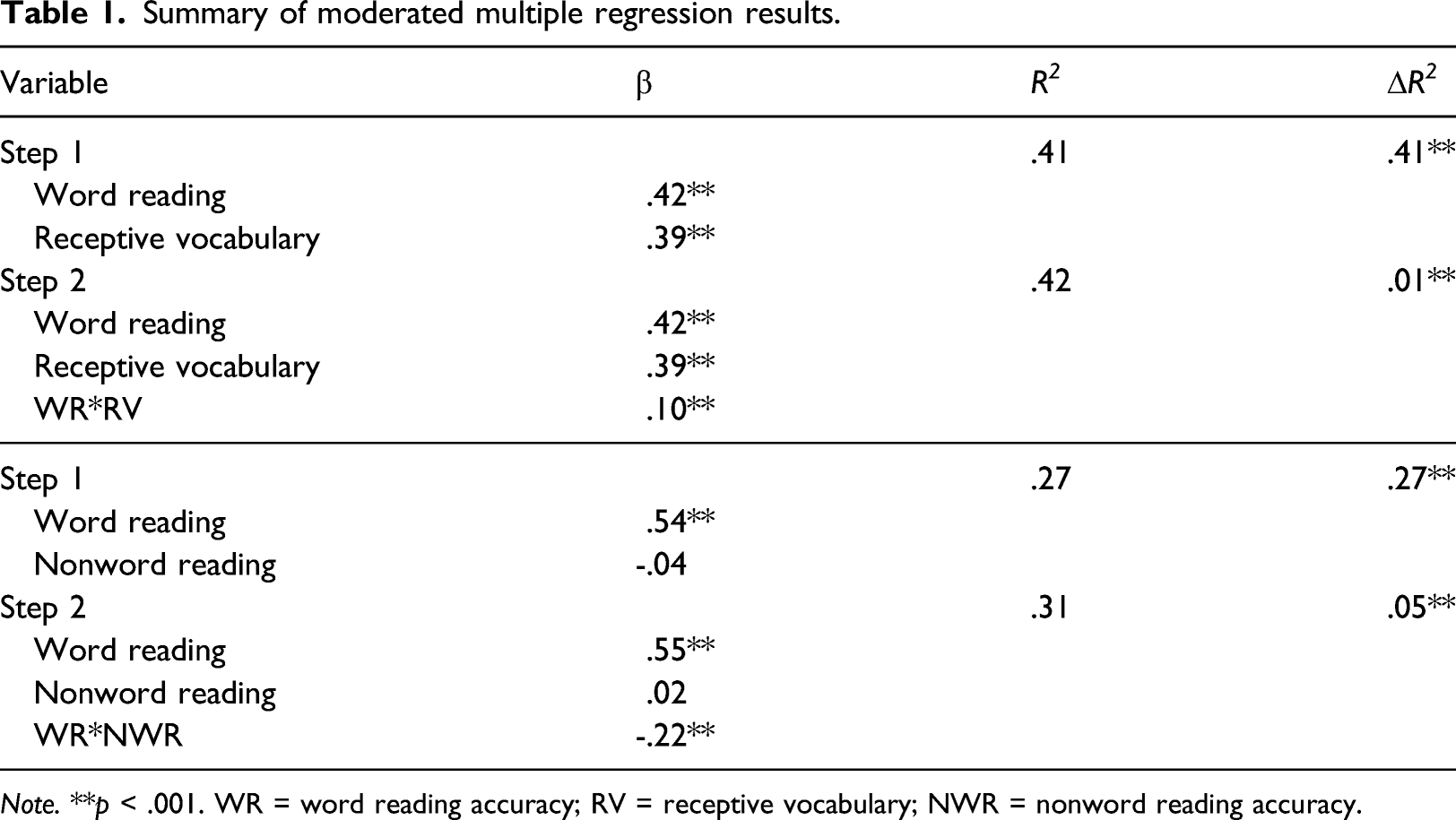
Note. **p < .001. WR = word reading accuracy; RV = receptive vocabulary; NWR = nonword reading accuracy.
Results
Relationships Between Reading Comprehension Skills
Mean score on each assessment measure for all participants (n = 857).
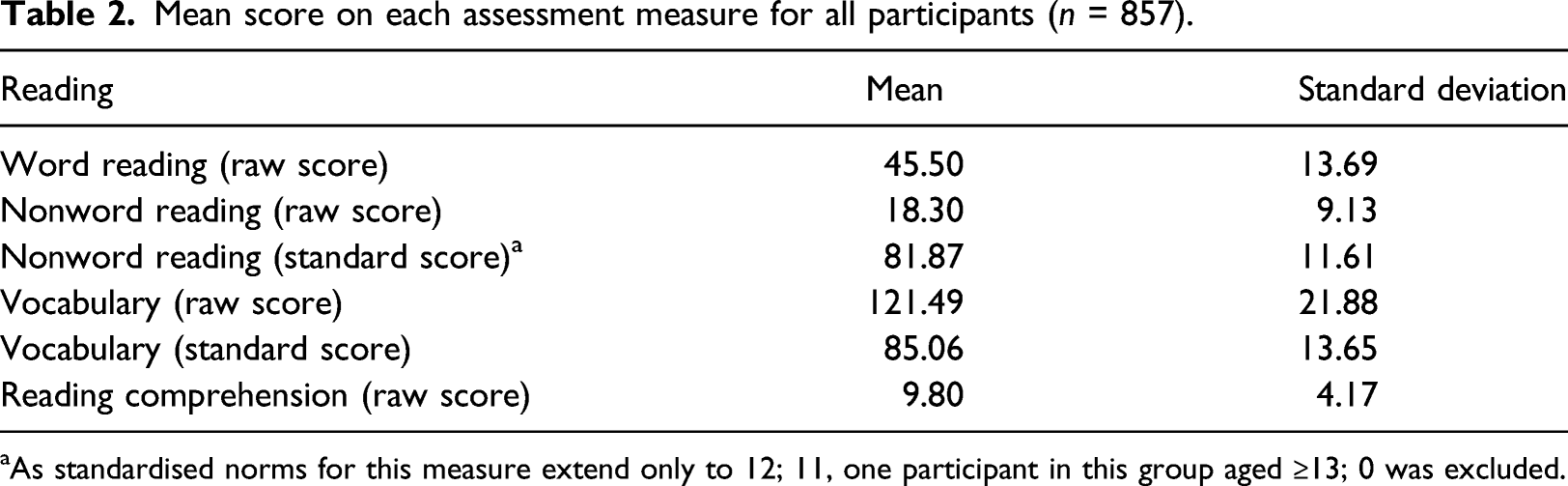
aAs standardised norms for this measure extend only to 12; 11, one participant in this group aged ≥13; 0 was excluded.
Correlational analyses were first conducted to establish the presence of significant relationships between reading comprehension and the other reading skills. These results indicated that reading comprehension was significantly correlated with nonword reading (r = .36, p < .001), real-word reading (r = .51, p < .001), and receptive vocabulary (r = .49, p < .001).
Having confirmed that the relationships between SVR constructs existed, we sought to explore, using moderated multiple regression analyses, whether they depended on students’ word reading proficiency. The results of these multiple regression analyses are summarised in Table 1 and described in detail in Appendix B.
As seen in the first row of Table 1, word reading and vocabulary by themselves contributed to 41% of the variance in reading comprehension. The interaction variable was added to the regression model at Step 2, resulting in a small but significant increase in explained reading comprehension variance (∆R 2 = .01, p < .001). Critically, the interaction variable (WR*RV) was significant (β = .10, p < .001), indicating that word reading did moderate the relationship between vocabulary and reading comprehension (and, equivalently, that vocabulary moderated the relationship between word reading and reading comprehension).
Pearson’s correlations between reading skills.
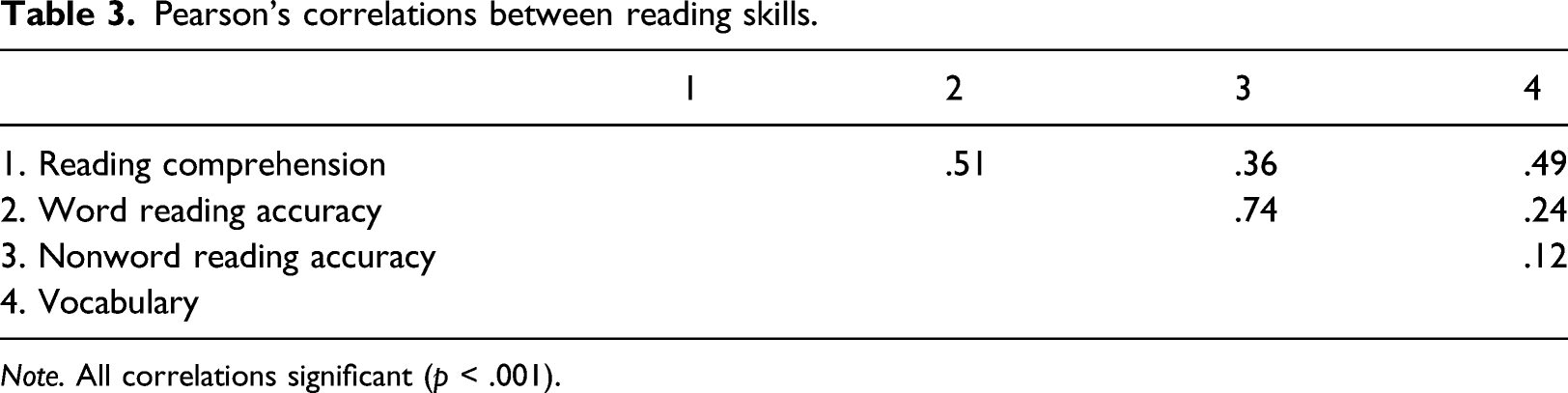
Note. All correlations significant (p < .001).
Reading comprehension relationships according to (word) reading age
Results from the regression analyses provided evidence that word reading ability interacted significantly with the relationships between (a) children’s receptive vocabulary and reading comprehension, and between; (b) children’s nonword reading and reading comprehension. We sought to explore these interactions further by discretising word reading raw scores into ‘reading age’ groups, and then examining the correlational slopes between (a) and between (b), within each discrete group.
Figure 1 depicts the linear relationships between receptive vocabulary and reading comprehension within each separate reading age group. Based on the regression analyses, in which the interaction variable WR*RV was a positive and significant (though small) predictor variable, the expectation is that receptive vocabulary will become more strongly correlated with reading comprehension as word reading (i.e. ‘reading age’) increases. Indeed, Figure 1 shows that the regression slopes for students in high reading age groups tend to be steeper than the slopes among lower reading age groups. Scatterplot showing relationship between reading comprehension and receptive vocabulary for each reading age group.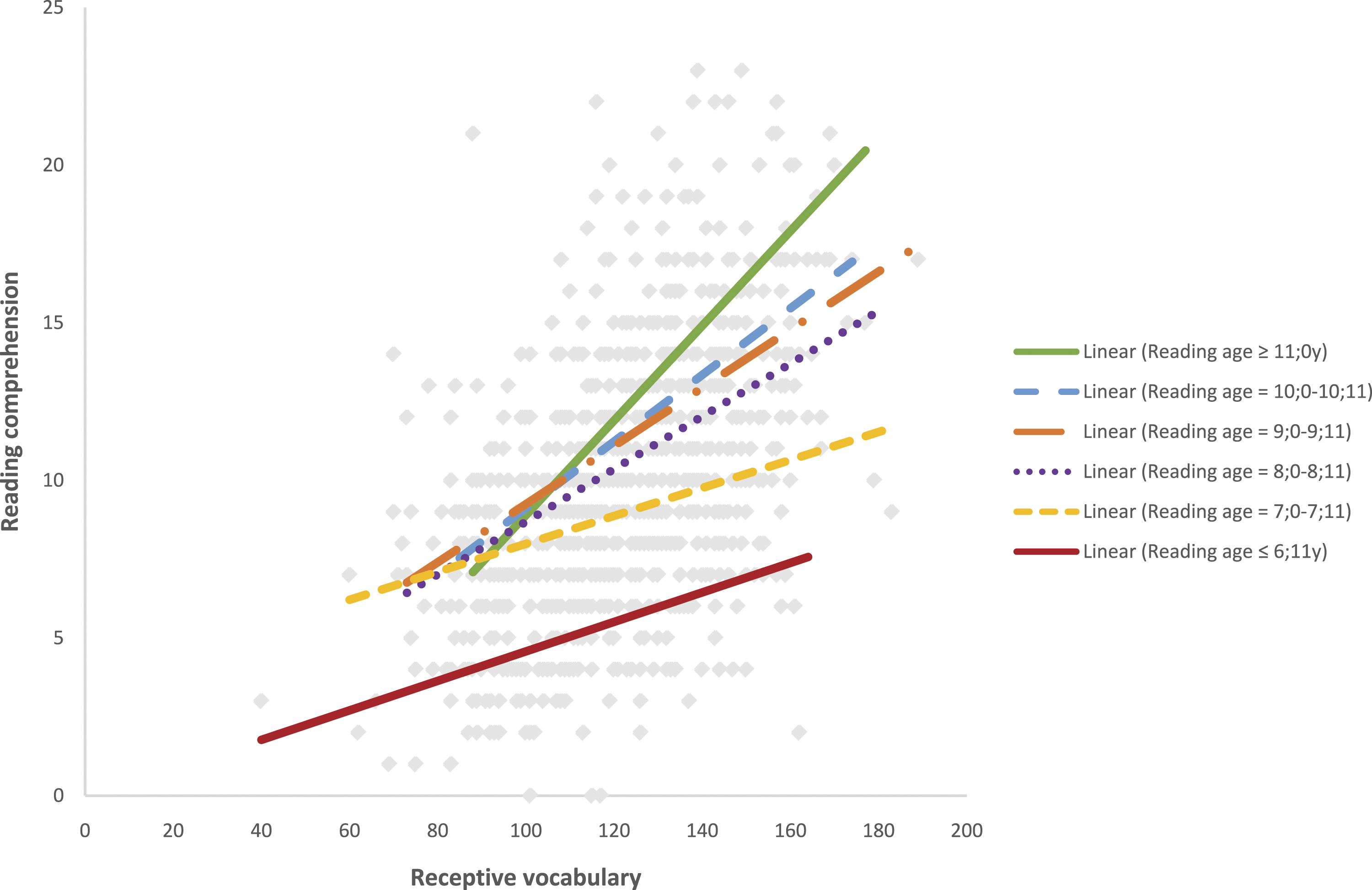
Figure 2 depicts the linear relationships between nonword reading accuracy and reading comprehension within each separate reading age group. For the weakest word readers, the regression line is positive. For increasingly skilled word reading groups, the regression lines plateau and then become slightly negative. In line with the regression analysis findings, word reading appears to act as a negative moderator in the relationship between nonword reading and reading comprehension; that is, as it increases, the relationship between nonword reading and reading comprehension decreases. Scatterplot showing relationship between reading comprehension and nonword reading for each reading age group.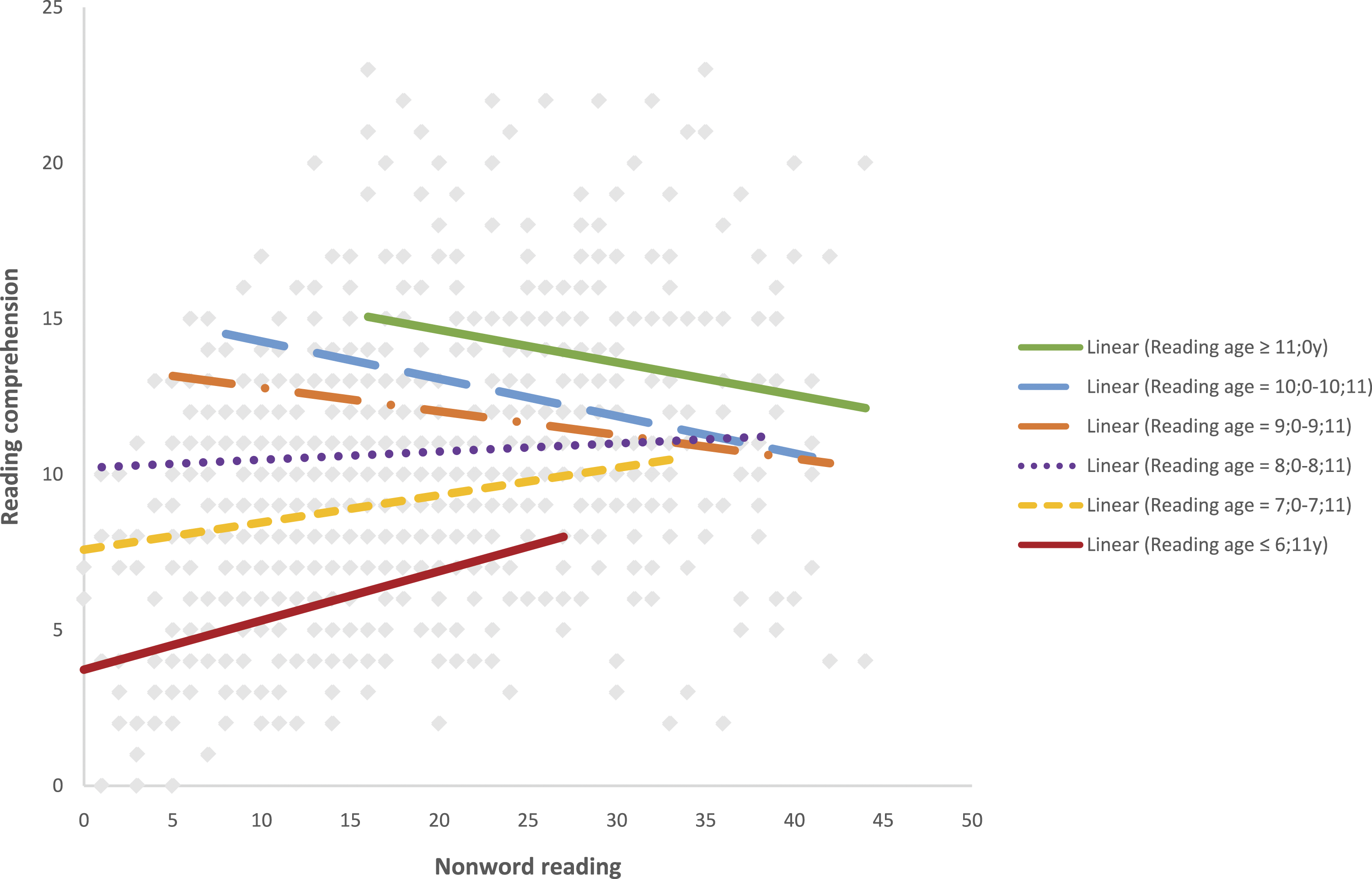
Discussion
Using a large convenience sample of primary school-aged children with reading difficulties, the present cross-sectional study was conducted to explore how relationships between reading skills may evolve as word reading accuracy increases. It was hypothesised that, for students with better word reading skills, decoding ability (i.e. nonword reading) would contribute less to reading comprehension variance, while vocabulary would contribute more to reading comprehension variance. Such is the general pattern observed in typically reading children. The present study is unique in its inclusion of such a large sample of children with reading difficulties, and the consequent focus on increasingly skilled word reading ability, rather than increasing grade or chronological age.
The findings supported our hypothesis. Firstly, word reading had a small but significant negative moderating effect on the relationship between decoding and reading comprehension. That is, in students with progressively better word reading proficiency, the relationship between decoding and reading comprehension declined. This aligns with Berninger et al.’s (2006) characterisation of decoding as a ‘bridging’ skill that enables real-word reading, which in turn enables reading comprehension. The decreasing reliance on isolated decoding skill in better word readers also aligns with Share’s (1995) self-teaching hypothesis, in which beginning readers learn the orthographic representations of most real words not as the result of direct instruction, but as the result of using their existing grapheme-phoneme knowledge to decode unfamiliar items they encounter in text (see also Ehri, 2020).
In the context of word reading’s negative moderating effect on the relationship between reading comprehension and nonword reading, word reading also had a small but significant positive moderating effect on the relationship between reading comprehension and vocabulary. Overall, then, the results support those from existing studies with typically developing children wherein reading comprehension is more strongly related to decoding (or broader word recognition) in younger versus older readers (Aaron et al., 1999; Catts et al., 2015; Florit & Cain, 2011; García & Cain, 2014; LARRC, 2015; Lonigan & Burgess, 2017). One reason for this pattern is that readers rely decreasingly on word-level decoding skills to understand written text, as their word reading becomes more automatic with age and experience (Catts et al., 2015; LARRC, 2015). The present study provides evidence in favour of this assumption, and contributes to the existing research because of the application to struggling readers, and because of how clearly Figures 1 and 2 represent the evolving contributions of reading comprehension subskills as a function of word reading ability.
Given that the present study used a single assessment of reading comprehension, rather than a latent measure comprising multiple reading comprehension assessments, it is worth considering the text and test features that may have influenced the results obtained. The NARA-3 requires examinees to read progressively longer and more complex prose passages, thereby reflecting the language requirements of texts consumed by readers in increasing grade levels (Cervetti et al., 2020). The test is discontinued (and no higher-level passages administered) when a reader errs on 16 words in a single passage (or 20 words in the final passage). As a combined consequence of these test characteristics, the passages of text whose comprehension rely more so on knowledge of word meaning can be accessed only by those with better reading accuracy. A plausible alternative explanation for the results obtained in the present study is, therefore, that vocabulary and reading comprehension are more strongly related for the better word readers (relative to the poor word readers), simply because the test’s discontinuation rule enables only them to read the passages with higher vocabulary demands.
In apparent support of this explanation, Colenbrander et al. (2017) found that word-level skills appeared to contribute more to NARA-3 reading comprehension scores than to scores on a similar index of reading comprehension. Nevertheless, the authors argued that this may be attributed to the test’s decoding demands, rather than the discontinuation rule. Pragmatically speaking, too, while poor decoders do not get the opportunity to answer as many comprehension questions as do good decoders, it is also reasonable to suspect that they may not be able to if probed. The inherent assumption on which the test’s discontinuation rule is based is that a reader who makes 16 or more errors on a short passage of text will be unlikely to have accessed the text content to such a degree that they can answer the comprehension questions. To the authors’ knowledge, there is no empirical evidence to negate this assumption.
Limitations and future directions
The NARA-3 is commonly used in Australian clinical, educational and research settings (e.g. Blick et al., 2017; Hatcher & Hulme, 1999; Kyle & Cain, 2015; Savage, 2006). By discussing its features, we are not intending to offer any particular critique of its value as an index of reading comprehension ability. Instead, our aim is to explicitly constrain the degree to which our results (and those of other single-measure studies) can be confidently interpreted. In other words, we acknowledge that our hypothesis has been supported only to the extent that the NARA-3 and other single measures we used approximate the skills they were constructed to capture. A significant limitation of the study is that we could not combine results from multiple reading comprehension measures to form a more robust latent variable (e.g. Foorman et al., 2020; Hjetland et al., 2019; LARRC & Chiu, 2018). In addition, without having followed the students longitudinally, our interpretations about how relationships between SVR constructs evolved as word reading accuracy improved are only speculative. Future longitudinal studies involving latent measures of each variable construct would be very useful to confirm and expand on the findings reported here.
It is also worth noting that there was a substantial amount of unexplained variance in the regression models produced, for which cognitive-linguistic skills not measured in the present study (morphological awareness, syntactic knowledge, understanding of narrative structure, memory, background knowledge, etc.) likely accounted. Given that the study was designed based on data collected retrospectively, it was not possible to dictate which measures were used. However, it would have been especially useful to include a measure of broader language comprehension, in addition to vocabulary.
Finally, it is worth highlighting that, according to schoolwide population data, the average proportion of students with a language background other than English (LBOTE) was 57.76%. This figure is higher than the state-wide average (36.9%) for New South Wales (Australia), where most of the students in this study attended school (NSW Department of Education, 2020). As such, it is possible that the results reported here may not apply to the broader population. That said, the schools ranged widely in the proportion of LBOTE students (3–98%), which lends support to the claim that the findings are generalisable.
Conclusions
The present study provided insight into the degree to which decoding and vocabulary skills contributed to struggling readers’ comprehension of written text, as a function of increasing word reading accuracy. As is found with typically reading children, the more skilled word readers appeared to rely more on vocabulary and less on decoding, in order to achieve reading comprehension. The results serve to highlight the small proportion of older primary school-aged children whose word-level literacy weaknesses limit the success with which they can readily comprehend written text.
Footnotes
Declaration of conflicting interests
The author(s) declared the following potential conflicts of interest with respect to the research, authorship, and/or publication of this article: Author 1 works for MultiLit Pty Ltd and Author 2 is Director of MultiLit Pty Ltd. MultiLit developed the intervention program to which the participants in this study were entered after being assessed (although this study does not look at the outcomes of that intervention). The association with MultiLit was made clear in the Ethics application for the project and in the consent forms signed by school principals and parents.
Funding
The author(s) received no financial support for the research, authorship, and/or publication of this article.

Notes
Information about schools attended by study participants.
Note. This information was obtained via the My School website (https://www.myschool.edu.au/). Values were rounded to the nearest 5 to preserve school anonymity. Where possible, values match the year in which the participant was assessed. 2014 school information is given for participants tested before 2014, as the data from earlier years were not available. Two participants were excluded due to missing school name data. Value based on Australian state of New South Wales, where most students attended school; NSW Department of Education. (2020). Schools: Language diversity in NSW, 2020. https://data.nsw.gov.au/data/dataset/-schools-language-diversity-in-nsw Australian Bureau of Statistics. (2021, February 19). Aboriginal and Torres Strait Islander Students. https://www.abs.gov.au/statistics/people/education/schools/latest-release#aboriginal-and-torres-strait-islander-students
School
ICSEA
%LBOTE
%Indigenous
n
1
1125
40
0
13
2
1030
75
15
23
3
1145
25
5
4
4
1025
75
0
1
5
1060
80
0
20
6
1115
75
0
1
7
1185
35
0
4
8
970
95
0
12
9
955
90
0
10
10
980
85
0
3
11
1095
65
0
1
12
1090
40
0
1
13
1090
95
0
1
14
905
65
10
40
15
1080
35
5
19
16
1015
95
0
24
17
1065
55
5
13
18
980
20
25
8
19
1050
80
0
5
20
1065
60
0
1
21
1120
65
0
6
22
1145
25
0
1
23
1095
55
0
4
24
1050
70
5
9
25
1135
60
0
11
26
1070
30
15
34
27
830
25
45
20
28
1030
5
20
7
29
980
10
20
6
30
1145
25
5
6
31
1140
45
0
7
32
1105
40
5
47
33
1060
65
0
14
34
1155
35
5
6
35
1095
45
0
26
36
1160
35
0
21
37
1015
70
5
1
38
985
40
20
18
39
960
95
0
9
40
1130
60
0
11
41
1005
100
0
4
42
925
75
5
8
43
1030
95
0
9
44
1085
95
0
13
45
1060
95
0
6
46
1115
35
5
6
47
1010
75
5
1
48
765
10
75
5
49
1005
95
0
13
50
1140
30
5
4
51
1100
40
5
5
52
1040
45
5
34
53
1035
75
0
1
54
1010
85
0
7
55
995
80
0
1
56
1100
50
0
2
57
1000
70
5
6
58
1130
15
5
7
59
1145
20
0
1
60
1175
30
0
3
61
1110
15
0
7
62
820
60
70
14
63
1160
40
0
1
64
1135
30
0
6
65
875
40
35
3
66
955
95
0
46
67
1140
15
5
6
68
980
35
20
7
69
1070
25
10
2
70
1095
65
0
18
71
1150
35
0
1
72
1145
30
5
1
73
1140
30
0
1
74
1145
25
0
13
75
1115
65
0
47
76
1170
50
0
3
77
1045
50
5
2
78
1045
65
5
16
79
1055
60
5
4
80
1125
40
0
1
81
970
100
0
12
82
1125
45
0
40
Population average
1000
36.9
a
6.0
b
-
Expanded view of moderated multiple regression analyses
**p < .001.
Variable
B
95% CI for B
SE B
β
R
2
∆R
2
LL
UL
Step 1
.41
.41**
Constant
−5.02
−6.31
−3.72
0.66
Word reading
0.13
0.11
0.15
0.01
.42**
Receptive vocabulary
0.07
0.06
0.08
0.01
.39**
Step 2
.42
.01**
Constant
−5.18
−6.47
−3.90
0.66
Word reading
0.13
0.11
0.15
0.01
42**
Receptive vocabulary
0.07
0.06
0.08
0.01
.39**
WR*RV
0.00
0.00
0.00
0.00
.10**
Step 1
.27
.27**
Constant
2.60
1.75
3.45
0.43
Word reading
0.17
0.14
0.19
0.01
.54**
Nonword reading
−0.02
−0.06
0.02
0.02
-.04
Step 2
.31
.05**
Constant
2.55
1.73
3.37
0.42
Word reading
0.17
0.14
0.19
0.01
.55**
Nonword reading
0.01
−0.03
0.05
0.02
-.02
WR*NWR
−0.01
−0.01
−0.01
0.00
-.22**
Linear mixed effects model analyses
Note. The first four rows show values for analysis with fixed effects of word recognition (WR), receptive vocabulary (RV) and the interaction term WR*RV; the last four rows show values for analysis with fixed effects of WR, nonword reading (NWR) and the interaction term WR*NWR. Participant (nested within School) was included as a random effect for both analyses. All predictor values were centred prior to input into analyses.
Parameter
Estimate
95% CI for Estimate
Test (df)
F
p
LL
UL
Intercept
9.698
9.479
9.917
853
7529.988
<.001
WR
0.129
0.113
0.145
853
248.037
<.001
RV
0.074
0.064
0.084
853
208.051
<.001
WR*RV
0.001
0.001
0.002
853
15.729
<.001
Intercept
10.365
10.089
10.642
853
5420.627
<.001
WR
0.169
0.143
0.194
853
172.441
<.001
NWR
0.008
−0.030
0.046
853
0.176
.675
WR*NWR
−0.006
−0.008
−0.005
853
56.123
<.001