



Abstract
Few would argue the value of learning progressions in providing useful structures for selecting and sequencing in a developmental manner the key components of an ‘intended curriculum’. Yet, there are pervading issues around what is meant by a developmental sequence, along with how they are used to assess what learners know, understand and can do. One key oversight in Science is recognising the role of technical and non-technical language in student conceptual development. This article reports on the construction of a hypothesised learning progression that identifies students’ progress in understanding essential concepts in the Chemical Sciences from Foundation to Year 6. It is based upon an extensive analysis of the technical and non-technical language of the Australian Curriculum: Science. The progression was constructed by focusing upon learner-appropriate language and scientific understanding with the Structure of the Observed Learning Outcome model (Pegg, 2018) providing the theoretical basis for ensuring systematic and objective rigour in the resultant developmental progression.
Introduction
Learning progressions emerged as part of the standards-based reform movement in the United States of America in the early 2000s (Organisation for Economic Cooperation and Development [OECD], 2019a). Considered by some educators as ‘new ideas’, learning progressions build upon the research of developmental psychologists focusing on how conceptual understanding develops with experience (Confrey et al., 2019). Until recently, learning progressions were not prioritised in Australia. This situation changed when reports by the Australian Department of Education and Training [DET] (2018) and Masters (2019) suggested the need for learning progressions in order to move away from a year-based curriculum. At the time of writing, learning progressions for the Literacy and Numeracy general capabilities have been introduced in the Australian Curriculum (ACARA, nd) with the potential for including progressions for other general capabilities during future curriculum review cycles.
Learning progressions are defined in Science as ‘descriptions of successively more sophisticated ways of reasoning within a content domain based on research syntheses and conceptual analyses’ (Smith et al., 2006, p. 1). They seem useful structures in selecting and sequencing key components of an ‘intended curriculum’ (Confrey et al., 2014). Nevertheless, important questions remain: (i) What is meant by ‘more sophisticated ways of reasoning’? (ii) How should such a sequence be determined? (iii) How do learning progressions link to assessing what learners know and can do in a subject discipline, topic or concept?
For Science, what is usually missing in any discussion of learning progressions is consideration of the role of technical and non-technical language. Yet, the use of language is central to students’ conceptual development, scientific thinking, school achievement and performance in scientific practices (Song & Carheden, 2014).
This article explores how language aspects were considered in developing a hypothesised learning progression to assess students’ understanding of Chemical Science from Foundation (students aged around 5 years) to Year 6 (students aged around 12 years). Using the cognitive-based, evidenced-informed Structure of the Observed Learning Outcome (SOLO) model as an over-riding framework, scientific ideas drawn from the Australian Curriculum: Science (AC: S) were structured to produce a developmental progression of learning. Importantly, this process focused upon the language expectations within the curriculum regarding technical and non-technical terms. The emergent progression deliberately highlights what students ‘know, understand and do’ in developing concepts around Chemical Science. Importantly, the approach adopted is around monitoring student progress, which is very different to providing a teaching sequence and strategies for implementation with students.
Australian context and Science curricula
ACARA was charged with the development of a national curriculum for Science and seven other learning areas. For Science, there is a separate curriculum for Foundation to Year 10 students and four Senior secondary subjects (Years 11 and 12): Biology, Chemistry, Earth and Environmental Science, and Physics. What is consistent across these curricula is the structure that includes three strands: (i) Science understanding (SU); (ii) Science as a human endeavour (SHE); and (iii) Science inquiry skills (SIS). For each content description comprising these strands, elaborations are provided giving practical examples of ideas that might be used in teaching.
Within each of the eight learning areas, it is expected that teachers embed seven general capabilities (e.g. literacy and numeracy) and three cross-curriculum priorities (e.g. Aboriginal and Torres Strait Islander Histories and Cultures) into their teaching. These are dealt with separately, and not incorporated into any of the learning area curricula.
Adding to the complexity in Australia is that individual states and territories retain authority over educational policies in their jurisdiction, with the result that even though the AC: S exists, so too do variations of this curriculum in different states (e.g. Victoria and New South Wales). Other jurisdictions, such as South Australia, have adopted the AC: S without modification.
Learning progressions in primary and secondary Science
Much of the research around learning progressions in Science emerges from the United States where they were viewed as mechanisms for aligning standards, curriculum, instruction and assessment (National Research Council [NRC], 2006). Importantly, learning progressions provided a means for reducing the breadth of content in the Science curriculum by concentrating on core ideas and practices that are to be developed over time (Duncan & Hmelo-Silver, 2009). Structured around the ‘big ideas’ or key concepts in Science, the development of learning progressions was based heavily on the findings from conceptual change research (Duncan et al., 2009). As such, in Science, ‘learning progressions by their very nature are hypothetical; they are conjectural models of learning over time that need to be empirically validated’ (Duncan & Hmelo-Silver, 2009, p. 607). Validation occurs through repetitive cycles of testing, revision and refinement (Duncan et al., 2009).
Recent research undertaken in the area reports the positive educational outcomes derived from learning progressions in the United States (Morrell et al., 2017) and the potential more globally (OECD, 2019a). Of interest is the diversity of learning progressions that have emerged. Lobato and Walters (2017) identified seven categories of learning progressions in the Science and Mathematics educational research literature, depending upon their focus. These included: (i) cognitive levels; (ii) levels of discourse; (iii) schemes and operations; (iv) hypothetical learning trajectories; (v) collective mathematical practices; (vi) disciplinary logic and curricular coherence; and (vii) observable strategies and learning performances. (p. 75)
Further evidence of its applicability in Science is that SOLO has been used from 2004 to the present by the NSW Department of Education to design multiple-choice and free-response items for the Validation of Assessment for Learning and Individual Development [VALID] programme involving Years 6, 8 and 10 students in Science (expanded from the former Essential Secondary Science Assessment [ESSA] programme for Year 8 students). Psychometric analyses are undertaken each year to ensure that tests are fair and equitable for all learners, i.e. gifted students, those with Aboriginal and Torres Strait Islander or other cultural backgrounds (Panizzon et al., 2010). Both the longevity of the test and the testing methodology over nearly two decades, with SOLO as the framework for VALID and ESSA, suggest that the model is inclusive, allowing all students the opportunity to demonstrate their understanding of the NSW Science curriculum.
Language supports conceptual understanding in Science
In reviewing the research for learning progressions in Science, there is a clear connection to scientific literacy. The OECD (2019b) defined scientific literacy ‘by the three components of: (i) explaining phenomena scientifically; (ii) evaluating and designing scientific enquiry; and (iii) interpreting data and evidence scientifically’ (p. 99).
While important, this definition is far removed from focusing on the actual language demands embedded in the development of concepts in Science. Yet, the link between language and learner understanding in Science has been recognised as problematic historically, with Song and Carheden (2014) reasserting the importance of both technical and non-technical language to learner conceptual development, scientific thinking, school achievement and performance in scientific practices.
Earlier research in the area of language in Science by Gardner (1972), Cassels and Johnstone (1985) and Tao (1994) explored the technical words of Science (e.g. force, molecule, organism) as well as non-technical words that have a specialised meaning in Science (e.g. diversity, system, reaction). These authors found that while teachers helped students build their understanding of technical words to some degree, little regard was given to the non-technical words – the assumption being that everyday words were already familiar to students so overlooking their meaning in Science.
Findings from these studies demonstrated that misinterpretation of the meaning of non-technical words within the scientific context resulted in lower student achievement in tests (Tao, 1994). Extending this work further, other researchers highlighted that both technical and non-technical language was central to students’ concept development, with inaccurate conceptions and understandings resulting when such language was not taught explicitly by teachers of Science (Fang, 2005). While much of this earlier work was explored with primary and secondary students, similar results were found with university students undertaking chemistry programmes (Pyburn et al., 2013). Additional challenges are more likely for students from Aboriginal and Torres Strait Islander and cultural backgrounds where English is not the first language, given that their early learning and English language experiences may vary considerably.
This research evidence justifies the importance of language in the teaching of Science but extends the ideas beyond merely focusing on students understanding the meaning of words. Hand et al. (2015) explained how an emphasis on language goes to the heart of understanding the nature of Science as a discipline, and the way in which core ideas are communicated. They explained that argumentation is at the core of what it means to be able to think scientifically. Logical arguments require links to be made between claims and evidence; the formation and use of propositions to relate key ideas; and an ability to think inductively and deductively. Underpinning all these is an ability to retrieve, use and construct ways of thinking and communicating that rely heavily on language proficiency. As such, a learning progression in Science must ensure adequate attention to the way in which language is introduced and developed given its intricate relationship in supporting conceptual development in learners.
Theoretical framework
Construction of a hypothesised learning progression required the utilisation of empirical research on student thinking and learning in Science (Duncan & Hmelo-Silver, 2009). The conceptual change research available in the areas of matter, materials and substances pertaining to the early years through to secondary years of schooling is of particular relevance to this study.
Framing the development of the learning progression for Chemical Science was the SOLO model of Biggs and Collis (1982). Conceptualised in the late 1970s, SOLO shares commonalities with neo-Piagetian frameworks of Case (1992), Fischer and Knight (1990) and many others. SOLO is relevant to, and compatible with, the context of learning in schools. Underlying the model is the assumption that cognitive understanding does not equate to a stable cognitive construct as with Piaget (1954), but involves individual characteristics that are content and context dependent. The important variables determining development include: the working memory available; the amount of information that can be retained by the learner; and features specific to the learning task (Biggs & Collis, 1991).
Two key aspects comprise the SOLO model. The first concerns the type of intellectual functioning required to address a particular stimulus. The nature of the abstractness is referred to as the mode of thinking, of which five are discernible: sensori-motor, ikonic, concrete symbolic, formal and post formal. The first three of these modes have particular relevance to this article and are described briefly below: Sensori-motor where a person reacts to the physical environment. For the very young child it is the mode in which motor skills are acquired. In adult life, this mode is utilised as skills associated with sports and other physical activities that develop and evolve. Ikonic when a person is able to internalise actions in the form of images. It is in this mode that the young child develops words and images that represent objects and events. For the adult, this mode of functioning assists in the appreciation of art and music and leads to a form of knowledge referred to as intuitive. Concrete symbolic when a person thinks through the use of a symbol system such as written language and number systems. Thinking in this mode is reliant on a ‘real-world’ referent. This is the most common mode addressed in learning in the upper primary and secondary school (Biggs & Collis, 1982).
The five modes are progressively relevant to different abstract possibilities across the curriculum. Each of these modes has its own identity, its own specific idiosyncratic character. Modes accrue over time, with later acquired modes existing along with earlier acquired modes leading to the possibility of uni-modal and multi-modal functioning.
Uni-modal learning offers the occurrence of eliciting a ‘target mode’ for particular learning/teaching areas. However, target modes can be supported by earlier or later acquired modes of development, resulting in multi-modal considerations. This is particularly relevant in the case of skill and content understanding development in the concrete symbolic or formal modes, as content areas have links to natural pre-requisites (especially in terms of motor skills use and language) in the sensori-motor and ikonic modes, respectively.
The second feature of SOLO concerns levels that provide a hierarchical description of the nature of the structure of learning, i.e. a learner’s ability to handle, with increased sophistication, relevant information. Three levels of response make up a cycle of learning within a particular mode. These levels are: Unistructural (U) where the individual focuses on the domain/problem, but uses only one piece of relevant data so the response may be inconsistent. Multistructural (M) where two or more pieces of data are identified as independent units. No integration is demonstrated among the data with inconsistencies often evident in the response. Relational (R) where all data are now available, with each piece woven into an overall mosaic of relationships culminating in a logical endpoint. The whole has become a coherent structure that lacks inconsistencies within the given context.
The levels offer descriptions of increasing complex structures of thinking in which higher levels are directly built upon preceding levels. The same broad level descriptors re-occur within each mode, and the specific nature of these levels is dependent on the particular mode targeted and the content and context of the stimulus item.
This study adopted a two-cycle per mode SOLO model (Campbell et al., 1992; Panizzon, 2003; Pegg, 2003; Watson et al., 1995) with a two-cycle unistructural–multistructural–relational cycle (i.e. U1–M1–R1 and U2–M2–R2) found in each mode. The general development pattern expected involves moving from U1 to M1 to R1 in the first cycle and then completing a similar pattern of development in the second cycle. The result offers an improved and more detailed account of the development of a concept/topic over a longer developmental time frame.
Research design
The study involved two key phases conducted over the course of three years. The AC: S from Foundation to Year 6 was used to inform the learning progression for Chemical Science given that it is the responsibility of all teachers of Science to teach this curriculum or a state-derived equivalent.
The decision to focus on matter as part of Chemical Science derived from the knowledge that, before children enter school, they have developed early representations of the attributes and properties of matter in their everyday lives. These conceptions are subsequently built up with an increasing focus on the complex structures of matter during junior secondary years of schooling (Duschl et al., 2011). Evidence of the importance of these concepts is demonstrated by the inclusion of items related to the categorisation of matter and changes of state in the National Assessment Program-Scientific Literacy (NAP-SL) test completed in 2018 by Year 6 students across Australia. Equally relevant is that these same concepts were assessed in the Trends in International Mathematics and Science Study (TIMSS) 2019 with Year 4 students. According to the assessment framework for TIMSS 2019, 35% of items focused on addressing: (i) classification, i.e. sorting of objects and materials based upon physical attributes; (ii) properties of matter and changes of matter; and (iii) forms of energy and energy transfer (Mullis & Martin, 2017).
Phase 1: Mapping language expectations
A content analysis was undertaken to identify the location and frequency of technical and non-technical terms used in the Content descriptions and Elaborations across all areas of the Science curriculum. These data were summarised in an Excel spreadsheet so that filtering particular areas of the curriculum (e.g. Chemical Sciences, Aboriginal and Torres Strait Islander perspectives) or year levels was possible.
For the analysis, technical scientific language referred to terms that either have a: Specific or particular meaning in Science, e.g. solid/liquid/gas, non-living; or Scientific meaning due to their use in Science curriculum, e.g. food, water, materials, matter, particles, properties.
Non-technical language identified words that would not normally hold scientific meaning in isolation, e.g. common, local, global. In Science, these words assist in important processes like describing, explaining or contextualising scientific ideas or phenomena.
Phase 2: Mapping learner progress in Chemical Science
In attempting to construct and then validate a hypothesised learning progression, Duschl et al. (2011) identified two possible methods. First, was a ‘bottom-up’ approach with the intention of building upon a learner’s initial conceptions. Second, was a ‘top-down’ approach aimed at restructuring existing initial and alternative conceptions held by learners. Key to these approaches is constructivism that emphasised building conceptual growth through experiences in Science.
Both of these approaches were used in the current study in a deliberate attempt to provide granularity and specificity in the descriptors comprising the learning progression (Lehrer & Schauble, 2015). The content in the progression was derived from SU, SHE and SIS strands within the Chemical Sciences sub-strand of the curriculum. Ultimately, seven broad constructs for Chemical Science were identified: properties of materials (SU); observing/measuring/interpreting (SIS); nature/states of matter (SU); energy (heat) (SU); investigating/data handling/analysing (SIS); mass/volume/density (SU links to physics); particulate nature of matter (SU) (Morrell et al., 2017).
Development of the learning progression involved continual discussion and argumentation regarding the application of the SOLO model, along with continual reference to the conceptual change literature. In the case of SOLO, the focus was on uni- and multi-modal functioning most relevant to students in Foundation to Year 6, as well as the progression of growth within modes as determined by consistent sequences of levels within a relevant cycle. This latter point highlighted how far the learner had progressed as well as the potential next steps for development.
The language used within the progression introduced technical terms, including those specified by the AC: S. While these terms were linked intrinsically to concept development, care was taken to ensure clarity of meaning for non-technical words.
Results and discussion
Findings from both phases are discussed in detail with an emphasis on Foundation to Year 6.
Phase 1: Language mapping of Science curriculum
A count of the technical and non-technical scientific terms used in the Science curriculum for Foundation to Year 6 amounted to just over 480 separate words. This does not include the forms of a term (e.g. the count of a term such as Move does not include separate counts for Moves, Moving, Movement or Motion). If all the multiple uses of the technical and non-technical terms that we identified across strands were included, the count was over 3,150 terms. Table 1 summarises the most frequently occurring terms in the Science curriculum. Terms with similar frequencies are grouped. Also identified is the location of each term across the SU, SHE and/or SIS sub-strands of the curriculum. The frequency of term usage within each stand is represented in brackets. The table highlights that a small number of terms are used substantially more often than others with considerable diversity evident, ranging from 186 mentions for ‘living things’ through to 20 for data, evidence and sources. Of particular importance is that very few of these high frequency terms have unique scientific meanings for students. Some, such as Source, have a non-scientific and a scientific meaning in the context of learning of the curriculum, e.g. source of information, water source, and energy source.
Frequency (f) and location of scientific terms in the Science curriculum F–6.
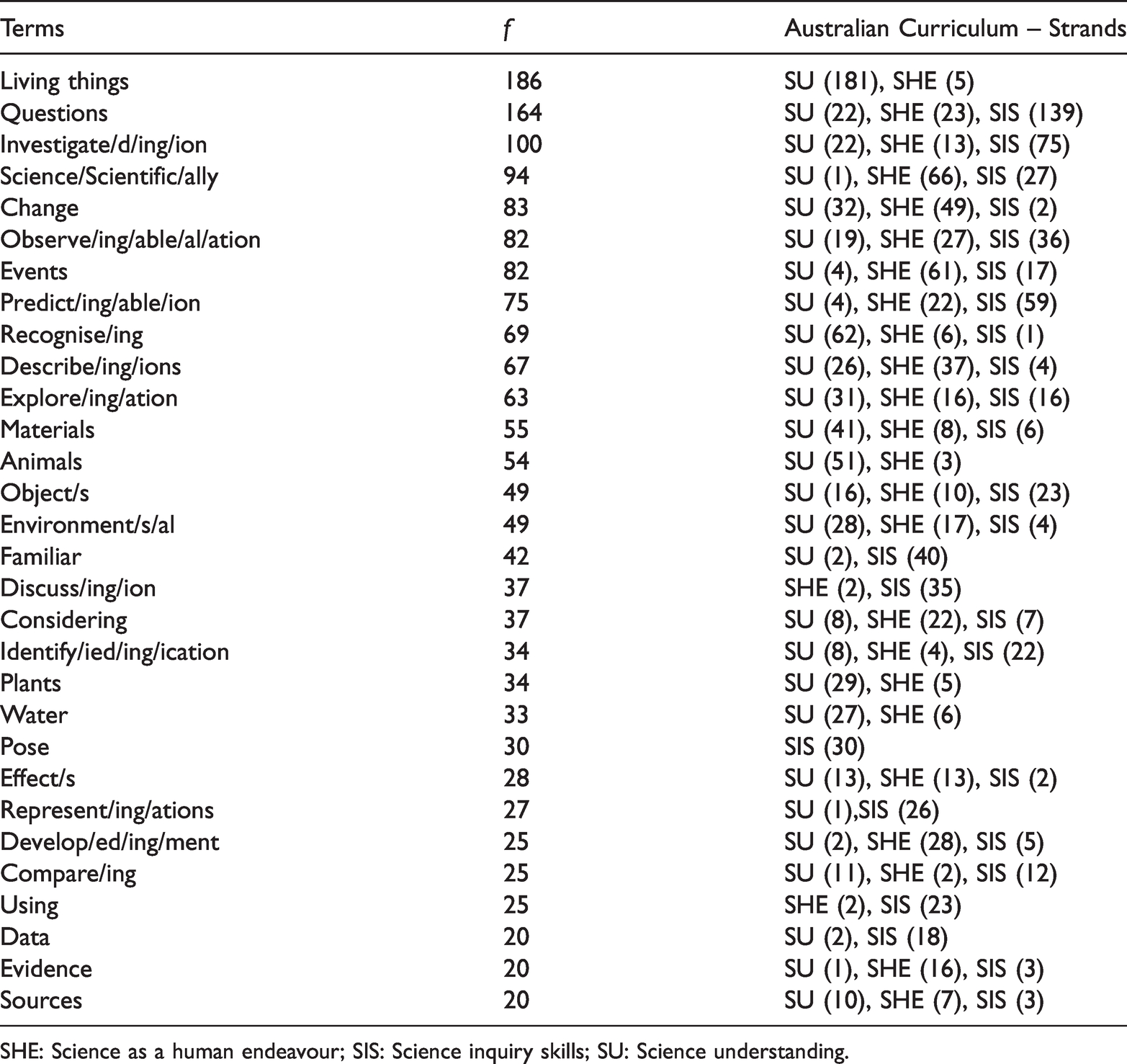
SHE: Science as a human endeavour; SIS: Science inquiry skills; SU: Science understanding.
At the other extreme, 320 terms were used only once or twice across Foundation to Year 6. This group encompassed Science technical terms, such as adaptations, electric circuits, and predator-prey that would be easily recognised by teachers.
In addition to introducing students to a broad array of words, instances were found where students required different levels of understanding for the same technical term. One example is water, which had a frequency of 53. The levels of understanding that might be expected to Year 6, would include: Liquid from the tap that we drink. A clear colourless liquid. A liquid that dissolves some things. A substance that exists in three states and cycles through nature. Composed of particles that move past one another to flow.
The mapping of curriculum for Foundation to Year 6 highlighted that the terms are not used in ways that support developing students’ conceptual understandings, nor necessarily respond to their cultural backgrounds and experiences. Technical terms are applied without sufficient recognition of the support and time needed by students to move from an understanding using the non-technical terms that are likely to be already familiar to them. Teachers with substantive Science backgrounds may be able to recognise this and respond by providing developmental experiences towards more complex and abstract concepts. However, this may not be the case for primary teachers who do not have the necessary subject discipline and pedagogical content knowledge to address this in their teaching.
Phase 2: Constructing a developmental sequence
A section of the hypothesised learning progression is presented in Table 2. Column one comprises criteria in seven item sets from the progression with technical terms shaded in grey. Column two provides student examples of actions or verbal/written responses identified by the researchers from earlier work (Panizzon et al., 2006) while column three codes the developmental progression according to SOLO modes/levels.
Sample of a Chemical Science assessment progression.
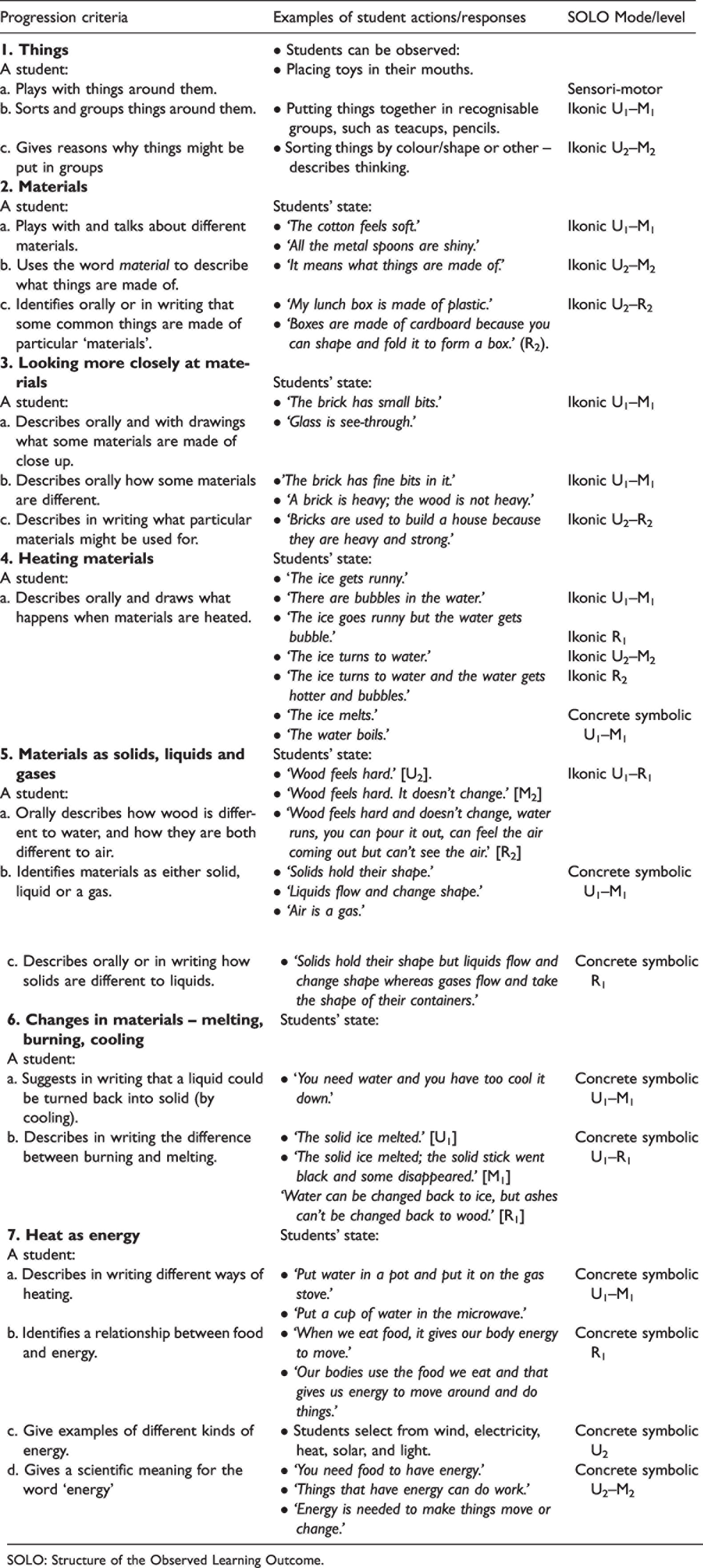
SOLO: Structure of the Observed Learning Outcome.
The section of learning progression displayed in Table 2 begins with an item set that explores the concept of things, moving onto materials, states of matter and heat as energy. In the remaining item sets of the progression not presented in Table 2 (i.e. 8–32) the conceptual sequence covered: particles; separation of solids, liquids and gases; reversible and irreversible changes; changing the states of matter; forms of energy; particle model of matter; elements, compounds and mixtures; the atomic model and chemical reactions.
In explaining the developmental sequence, Item set 1 begins with students’ initial ideas about the world around them and is cognisant of working in the sensori-motor mode. The mode is related to actions involving the immediate physical environment, and the cognitive processes concerned with the student’s management and coordination of objects. This form of knowledge is described as ‘tacit’ because it concerns carrying out an act (or knowing how to carry out an act) without necessarily being able to describe or explain it.
The sensori-motor mode is most evident in dealing with young students, especially when involved in various forms of play. Without direction, young children will group things using their own criterion simply by observing particular characteristics of these objects. These are often the most obvious features of the object.
Initially, when students are provided with particular objects, they can be asked to group according to various characteristics, such as colour or shape. This is indicative of working in the ikonic mode where the beginnings of formal language are evident. In terms of language, things is a non-technical word but as viewed here takes on a very specific meaning. It is a word that students already know so allows them to engage in the activity, gaining confidence while communicating their ideas about the things.
Item set 2 explores students’ understanding of the term materials. This has a more specific meaning than things, and students should think beyond the obvious characteristics of colour and shape to the nature of the substance comprising the object. Students are able to communicate the characteristics they observe using words, images and signs, which is demonstrative of the ikonic mode. This is where the actions in the sensori-motor mode become explicit through language. This form of knowledge is described as ‘intuitive’ as judgements are based qualitatively on decisions formed by internal pictures (representations), emotions or a mixture of both. This mode is most evident with young students, especially as they build/develop oral language skills. It is also evident in providing a grounding of linking student language meaning to more sophisticated technical and non-technical terminology of the concrete-symbolic mode, such as when a student describes the material an object is made from, e.g. my lunch box is made of plastic.
Item set 3, Looking more closely at materials, is where the properties of materials are explored further, where students look for how materials are structured, e.g. A brick has got fine bits in it. Having developed an understanding of the properties of materials, Item set 4, Heating materials, identifies students developing these ideas further by exploring the impact of heat on materials. Item sets 5 and 6 further develop and extend ideas of materials by considering different states of matter (solid, liquid and gas), and the impact on states of matter of melting, burning and cooling, respectively. This leads, in Item set 7, Heat as Energy, to the introduction of ideas about the meaning of energy through first considering heating.
In terms of Item sets 3 to 7, the target mode is the concrete-symbolic mode. However, the sensori-motor and ikonic modes remain available and able to serve a useful purpose. Activities in these earlier acquired modes can assist students’ skill use with kinaesthetic activities involving Science materials and their deeper understanding of new ideas through the use of more scientific language, respectively.
For these item sets the concrete-symbolic mode is required, as the focus is tied directly to information that is verifiable by observation or experience rather than by either intuition or, alternatively, theory. This mode represents a significant shift in abstraction from the earlier acquired modes. Understandings are verified or rejected through observation or experiments within a real-world context familiar to the student. This form of knowledge is described as ‘declarative’ and encompasses the ability to take concepts and ideas and manipulate them directly by referencing them to some concrete experience and known referent.
Working with two cycles of levels in the concrete-symbolic mode offers the potential to tease out important differences in student cognitive growth. In both cycles of the concrete-symbolic mode, the movement from the unistructural level to the multistuctural level represents a ‘quantitative’ approach to cognitive development where the focus is on students learning more aspects about a concept. The focus is on building descriptions of reality in terms of student experiences and practice activities. The teaching focus has moved beyond exploration into the phase where the teacher directs learning in identified ways to broaden student knowledge, understanding and skill levels.
Key to the two cycles of the concrete-symbolic mode is the movement of student understanding from a ‘big picture’ overview of scientific phenomena to explanations of observations that address ‘why’ these occurred, i.e. they focus on the cause and effect. This first cycle is describing energy is evident in Item set 7, e.g. Put water in a pot and put it on the gas stove. In the second cycle, in Item set 7, students’ explanations focus on explaining the effect of energy on materials or objects, e.g. Energy is needed to make things move or change.
Finally, the focus on both technical and relevant non-technical terms becomes a key factor in helping students consolidate their understanding through peer and teacher conversations. Importantly, students are using the language they understand to recognise that materials can change and to describe how a material changes. Students who use more scientifically technical language may be operating in the second cycle.
Conclusions and future directions
The section of learning progression presented here recognises the need for students to communicate in order to demonstrate their knowledge, skills and understandings of central scientific concepts. It seeks to help operationalise what it means to develop student knowledge by deepening teacher knowledge through assessing student development in learning as well as the power of language linked to Science technical and non-technical terms.
Focusing on content and language development related to various Science topics through a SOLO model lens helps identify what students might demonstrate, articulate and do and where they might proceed. Benefits of this approach are many and include: the use of uni- and multi-modal foci; the importance of the an early cycle of development in each mode that sets the basis for learning within a mode; the clear hierarchical differences as students develop through a learning cycle; the relational level in cycle that shows that data have been meaningfully integrated within that cycle; and the difference of quality in responses within a mode between examples of unistructural, multistructural and relational levels associated with different cycles.
Future directions are to apply the learning progression to collect field-based data by working with teachers in a variety of contexts and their students. The researchers are developing assessment items for each item set of the progression. This process will provide an opportunity for the developers to address a broader range of curriculum content as well as draw attention to cultural relevance, such as Aboriginal and Torres Strait Islander ways of knowing and learning. Use of the SOLO model will facilitate the use of the Rasch partial-credit model to help identify internal construct validity, progression reliability and internal consistency of the developmental nature of the learning progression.
Footnotes
Declaration of Conflicting Interests
The author(s) declared no potential conflicts of interest with respect to the research, authorship, and/or publication of this article.
Funding
The author(s) received no financial support for the research, authorship, and/or publication of this article.
