




Abstract
Many Australian young people experience mental health concerns, academic and study-related stresses, and socio-economic pressures. Phenomenological research conducted among primary and secondary schoolteachers in four Australian states investigated how teachers manage student wellbeing concerns and academic pressures and stresses. Findings identify key stresses that affect students’ performance and how teachers respond to these stresses to progress student learning. Creating space, finding margin, mitigating and reducing pressures and stresses, while upholding academic rigour, are the salient capabilities described by teachers in this study for simultaneously managing student wellbeing concerns and academic performance.
Keywords
Introduction and background literature
This article presents findings from a recent study that investigated how teachers manage student wellbeing concerns and academic pressures and stresses. The study investigated teachers’ experiences and perspectives of the pressures and stresses students encounter, with a specific focus on how teachers mitigate student stress for the purpose of mediating learning. The concept of mediation – teachers’ active interpreting, organising, and deciphering learning experiences to progress student learning (Feuerstein et al., 2010; Feuerstein & Lewin-Benham, 2012) – is key to this study as it relates to student–teacher interactions that progress learning. The study draws on data from semi-structured interviews with 22 Australian teachers. The findings of this study have significant implications for in-service and pre-service teacher professional education. Although the role of quality teaching for student learning is well established in literature (e.g. Cozolino, 2013; McGrath & Van Bergen, 2019), what is not yet established is how teachers mitigate increasing stresses experienced by school students to preserve and progress (mediate) student learning.
In this article, the term ‘pressure’ is distinguished from the term ‘stress’: whilst all students experience pressures (social, emotional, economic, academic) not all students experience these pressures as stresses. The term ‘stress’ refers to stimulus–response transactions between a situational pressure and an individual that threatens that individual’s wellbeing (Gadzella, 1994). We acknowledge that not all stresses have negative outcomes, for example, stress can positively motivate us. However, this article uses the term stress in a negative frame referring to threats to wellbeing.
The terms ‘wellbeing’ and ‘welfare’ are distinguished. We draw upon the Australian Institute of Health and Welfare (AIHW) definitions: ‘Wellbeing’ is a broad term used to describe human flourishing and refers to health, contentment, security and functioning (AIHW, 2019). ‘Welfare’ refers to social, economic, physical and cultural supports that affect one’s sense of wellbeing (AIHW, 2019). The interrelated nature of wellbeing, welfare, and physical and mental health are acknowledged (AIHW, 2020; World Health Organisation, 2020). According to the World Health Organisation (WHO), mental health is a state of wellbeing and is manifest in individual and collective abilities to cope, think, emote, interact, work and enjoy life (WHO, 2020). The terms ‘mental health’ and ‘mental health issues’ are often synonymous with mental ill-health. In this article, the term mental health is used to describe psychological wellbeing issues.
Pressures and stresses
Australian school students experience a range of mental health issues, academic pressures and stresses, and socio-economic stresses. Teachers work with these issues daily, although many of the presenting issues are outside the professional expertise of a teacher. The following sections provide an overview of issues faced by young people in Australia, derived from statistical reports.
Mental health issues
Teachers work directly with student mental health issues and wellbeing concerns in the provision of education (McGrath & Van Bergen, 2015; Willis et al., 2019). A report for the Australian Government Department of Education and Training that used data from the Young Minds Matter survey, showed one in seven school students in Australia (approximate ages 5–18 years) lives with a mental health disorder (Goodsell et al., 2017). Attention deficit hyperactivity disorder (ADHD) is the most common mental health disorder affecting Australian school students, followed by anxiety and oppositional disorders. Goodsell et al. (2017) also reported that students with mental disorders have poorer academic performance results, more absences from school, poor social connectedness and low engagement. Similarly, Bowman et al. (2017) reported anxiety and depression as the ‘leading contributors to the burden of disease for young Australians’ (p. 278), with social anxiety disorder and post-traumatic stress disorder being the most common.
Academic pressures and stresses
The 2019 Mission Australia Youth Survey (Carlisle et al., 2019) showed young people aged between 15 and 19 years in Australia ranked coping with stress (44.7%), school or study problems (34.3%) and mental health issues (33.2%) as their top three concerns. According to analysis of data from the Program for International Student Assessment, Australian students reported higher levels of schoolwork-related anxiety than the OECD average (Schmid, 2018). Academic pressures are often fuelled by data-driven practices and performativity agendas (Ball, 2003). For example, Australian students’ individual literacy and numeracy scores are compared to national averages in Years 3, 5, 7 and 9 in NAPLAN testing (National Assessment Program Literacy and Numeracy, 2016) and school NAPLAN scores are ranked on the My School® website (ACARA, n.d.). Teachers cite the stresses of performativity as negatively affecting student wellbeing (Willis et al., 2019). For some students, these pressures convert to negative stress. There is an evident need to consider the pressures and stresses that impact student performance and the roles teachers play in managing student stresses – including educating students about coping strategies, and buffering students from systemic pressures (e.g. comparative performance agendas). Methods of managing stresses and pressures are expounded in the findings of the current study below.
Socio-economic pressures and stresses
Poverty affects children’s cognitive, social and health outcomes, according to longitudinal research reported in the Low Income and Poverty Dynamics Social Policy Research Paper produced by the Australian Department of Social Services (Warren, 2017). Whether children experience episodic or persistent poverty, it is generally associated with decreased parental investment in child development (Warren, 2017). According to the Australian Bureau of Statistics (2019), the proportion of people who were classified as ‘homeless’ who were aged 12–24 years in 2016 ranged between 21% and 26% across the states and territories. In 2018, Foodbank Australia reported more than one in five Australian children lived in households that experienced food insecurity (Foodbank, 2018). On average, children living in food insecure households go hungry once a month (Foodbank, 2018). The final report of the Australian Child Wellbeing Project indicated that the majority of Australian children who go to bed or school hungry are from marginalised groups, including students living with disability or material disadvantage (Redmond et al., 2016). Although hunger is under researched in Australia (Redmond et al., 2016), data presented in the current study’s findings (pressures and stresses students bring with them to school – socio-economic challenges) show that teachers make arrangements for students to be fed at school.
The report of the 2019 Mission Australia Youth Survey indicates nearly half (48.9%) of Australian young people aged 15 to 19 years feel there are barriers to achieving their post-school study/work goals (Carlisle et al., 2019). Among the barriers identified were financial difficulty (12.4%) and family responsibilities (8.4%). The report also identified issues of concern amongst Australian young people. Nearly one in five Australian young people identified financial security (17.8%), family conflict (18.2%) or safety (17.8%) as issues of concern (Carlisle et al., 2019). These statistics indicate school students face socio-economic and socio-cultural issues that are outside the immediate control of teachers.
Inadequate sleep
It is estimated a quarter of Australian pre-/teenagers aged 12 to 15 years, and half of teenagers aged 16 to 17 years, are not getting enough sleep on school nights (Evans-Whipp & Gasser, 2018). Poor sleep is associated with poor mental health (particularly anxiety and depression), poorer physical health, less physical activity, internet access in bedrooms and longer time spent on homework (Evans-Whipp & Gasser, 2018). Moreover, it is a pressure often associated with low socio-economic households (Warren, 2017).
Teachers as mitigators of student stress
Recent research shows teachers actively mitigate student stress for the sake of academic performance (Willis et al., 2019) and play important roles in facilitating functional neural programming for students who have experienced stress and/or trauma (Cozolino, 2013; Willis & Nagel, 2015). Teachers often adapt their practices to help students reach performativity targets (Ball, 2003; Day & Gu, 2007; Edmondson et al., 2016). Performativity targets in Australia might include individual student grades or school rankings in national testing (e.g. NAPLAN) or exit scores (e.g. ATAR). They also extend help toward students with mental health issues or wellbeing concerns but often feel ill-equipped to do so (e.g. Ekornes, 2017). This raises concerns for teacher wellbeing and whether systems are relying on their personal resilience in difficult circumstances (e.g. Sullivan & Johnson, 2012).
Teachers as mediators of student learning
This study draws upon Feuerstein et al.’s (2010) concept of mediation where the teacher actively works to interpret, organise and decipher learning experiences to progress student learning. The theory of mediated learning experiences (MLE; Feuerstein et al., 2010, 2015) challenges the assumption that exposure to stimulus alone will spark higher order thinking (e.g. a student will gain insights into history by visiting a museum), as not all knowledge is immediately apparent and a student often needs a teacher to explain underlying stories, principles or contexts. The theory of MLE debunks the myth that trial and error results in deep discovery, explaining that learning should not be left to random chance (Feuerstein & Lewin-Benham, 2012). Indeed, students need teachers to mediate learning experiences to expedite learning: experience and exposure are not synonyms for learning. The theory of MLE (Feuerstein et al., 2010, 2015) accords with the role of the more-knowledgeable-other in Vygotsky’s zone of proximal development theory. However, MLE is more concerned with the dynamics of the interaction between the student and teacher, and the intervention that aids neurological development and progresses learning (Feuerstein & Lewin-Benham, 2012).
The concept of mediation is also prominent in business learning models where the mediator between contextual antecedents and productive learning behaviours in teams is psychological safety (Edmondson, 1999; Edmondson & Lei, 2014). Psychological safety is an enabler of engagement and interpersonal risks as it is undergirded by beliefs that others have your best interests in mind (Edmondson & Lei, 2014). Given the salient role of teachers in creating learning environments and class cultures that enable learning and risk taking (Gholami, 2011), it could be argued teachers are mediators of learning by creating psychologically safe conditions for student engagement.
Mediating behaviours include storytelling, showing compassion and sharing wisdom (Cozolino, 2013). In his book The Social Neuroscience of Education, Cozolino (2013) explains the powerful roles of teachers in activating or de-activating students’ brains. Teachers create holding environments for students where they can self-regulate their behaviours and emotions, through the provision of empathy and care. Acts of listening and sharing build trust and rapport with students enabling mediated learning to occur (Cozolino, 2013).
Two hats: Mitigator and mediator
Teachers are often motivated by the outcomes of mediation and the underlying beliefs that a student can learn, change and grow (Feuerstein & Lewin-Benham, 2012). They are also motivated by an imperative of care (Gholami, 2011). These motivations can be likened to pull factors, as teachers feel drawn to care for and help students learn. Conversely, teachers are also subject to the push factors of student stress and the pressures of performativity (Ball, 2003; Edmondson et al., 2016). That is, they feel pushed by the pressures of academic performance. To this end, the roles of mitigator and mediator can be likened to push and pull factors as outlined in Table 1.
. Push and pull factors affecting teachers.


We still do not have a good understanding of how teachers manage academic pressures, stresses and student wellbeing. Specifically, how they mitigate student stress to mediate and progress student learning. This research seeks to make this contribution.
Research design
Designed around the critical issues identified in the above literature, the overarching research question was formulated: How do teachers work with students in schools to manage wellbeing concerns and academic pressures and stresses? Subsequent guiding questions were also developed: (1) What causes stress amongst school students? and (2) What support is available to teachers and students?
Methodology
A phenomenological methodology (Vagle, 2018) was employed to study the perspectives and experiences of teachers. This qualitative methodology was chosen for the purpose of generating meaning around the phenomenon of simultaneously managing wellbeing concerns and academic pressures and stresses. Semi-structured interviews were conducted, recorded and transcribed, and data were analysed within an interpretivist paradigm with the intention of understanding participants’ lived experiences.
The research team
The role of the researchers in data collection and analysis is acknowledged. The researchers are all teacher educators working in an Australian university who are also registered teachers. Although they have insider (emic) knowledge of working with school students in previous roles, they are acting as outsider researchers (etic) in this project. It is acknowledged that professional experiences may affect the interpretation of data; however, every effort has been made to foreground participant voices in this project.
Participant recruitment
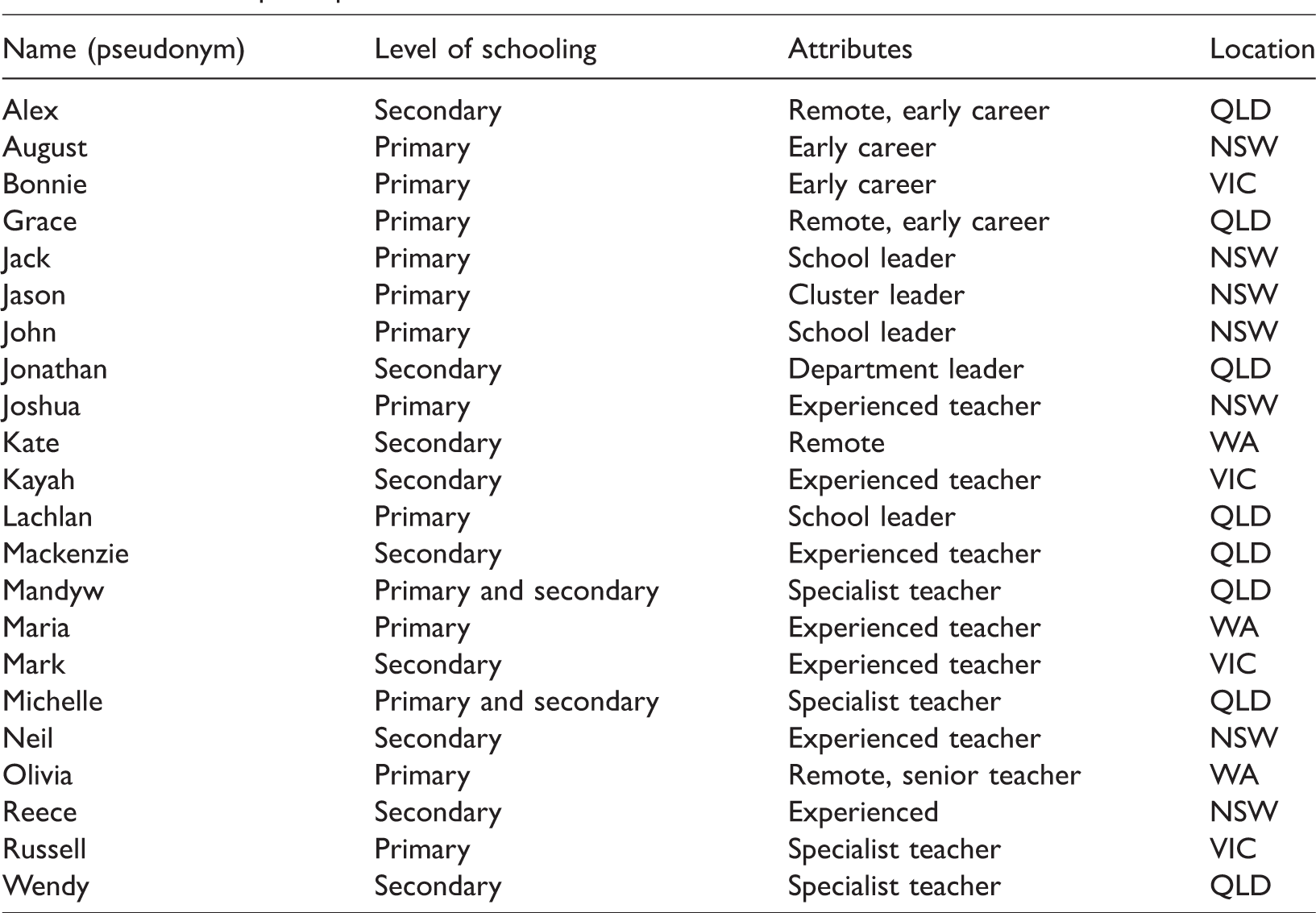
Invitations to participate in research were extended to teachers through active social media groups, and participants were directed to a Survey Monkey™ platform where they opted in to participate in semi-structured interviews. Within Survey Monkey™, participants provided their contact details and basic attributes of their employment positions (Table 2). Ten participants worked in secondary schools, 10 in primary schools and 2 specialist teachers worked across primary and secondary contexts. Four teachers had fewer than five years’ experience (early career), but all others had been teaching for more than five years and had a range of leadership experiences and specialisations. Participants originated from four Australian states: New South Wales (NSW; 7), Queensland (QLD; 8), Western Australia (WA; 3) and Victoria (VIC; 4). This geographical distribution likely represents the location of the research team in Queensland, Australia, and the convenience and snowball sampling techniques. Participants were working in both government and non-government school systems, with a majority working in government schools. Participants are not aligned with schooling systems in Table 2 for the purpose of anonymity.
. Research participants.
Data collection
The online invitation to participate in the research was open for nine months. Twenty-two teachers choose to participate in semi-structured interviews, which took between 20 min and 1 h. Interviews were conducted via video or telephone conferencing (19 participants), face to face (one participant) or via written email responses (two participants), according to participant preferences. There were no word limits for email responses. Interviews were recorded and transcribed verbatim. Data saturation was achieved at 22 interviews, signalled by repetition of themes and ideas.
Instrument
The interview schedule (see Supplementary Appendix 1) was developed collaboratively and underwent peer review and institutional ethics approval processes (approval number A181174). Seven prompting questions were used to guide the semi-structured interviews. The participants were asked to describe how they managed academic performance agendas and student wellbeing needs, the support structures available and the causes of stress in school contexts. Conversations unfolded according to researchers’ probing and participants’ interests.
Data analysis
Data were manually and digitally analysed. Manual analysis was conducted on hard copy transcripts in three rounds by three different research team members. First, a preliminary holistic reading of the transcripts with a focus on intentionality was conducted (Vagle, 2018). The researcher crafted holistic descriptions and interpretations of the data (Vagle, 2018). Second, detailed descriptive coding incorporating content, causation, attribute and in vivo coding was conducted (Miles et al., 2020), resulting in 132 codes and sub-codes. Third, a priori coding was conducted using the interview questions (Supplementary Appendix 1) as a framework, resulting in 67 a priori codes and 22 emergent codes.
Data were uploaded into NVivo 12™ software for digital analysis. The three rounds of manual coding were amalgamated during digital analysis. Codes were expanded into sub-codes, condensed if there were fewer than three references to preserve trustworthiness (because triangulation could not be achieved), and clustered into themes to build conceptual coherence between and within the codes (Miles & Huberman, 1994). Digital analysis produced 86 codes and sub-codes.
To address the research questions, the teacher role had to be salient in the data. Therefore, themes were further analysed with the purpose of generating meaning around how teachers manage academic pressures and student wellbeing concerns. To do this the researchers used conceptually clustered matrices (Miles et al., 2020) to bring together the themes and the critical actions taken by schools and teachers. Consequently, the findings presented in this article are a combination of identified pressures and stresses students experience and how teachers mitigate these to mediate and progress learning. This analysis is displayed in clustered matrices in Supplementary Appendices 2 and 3.
Study limitations
The data collection methods are reflective of the time, financial and geographic constraints of the researchers. Nevertheless, participants’ responses helped the researchers better understand teachers’ perspectives and experiences of managing student wellbeing concerns and academic pressures and stresses, and the findings from this study deepen previous research findings (Willis et al., 2019).
Findings
Three main phenomenological constructs were developed from qualitative data analysis: pressures and stresses students bring with them to school, academic pressures and stresses encountered at school, and the role of teachers as mitigators and mediators. The themes within these three constructs are respectively discussed below. These three constructs demonstrate the salient role of the teachers as mitigators of student pressures and stresses for the purpose of mediating learning. The connections between the three constructs are illustrated in Figure 1.
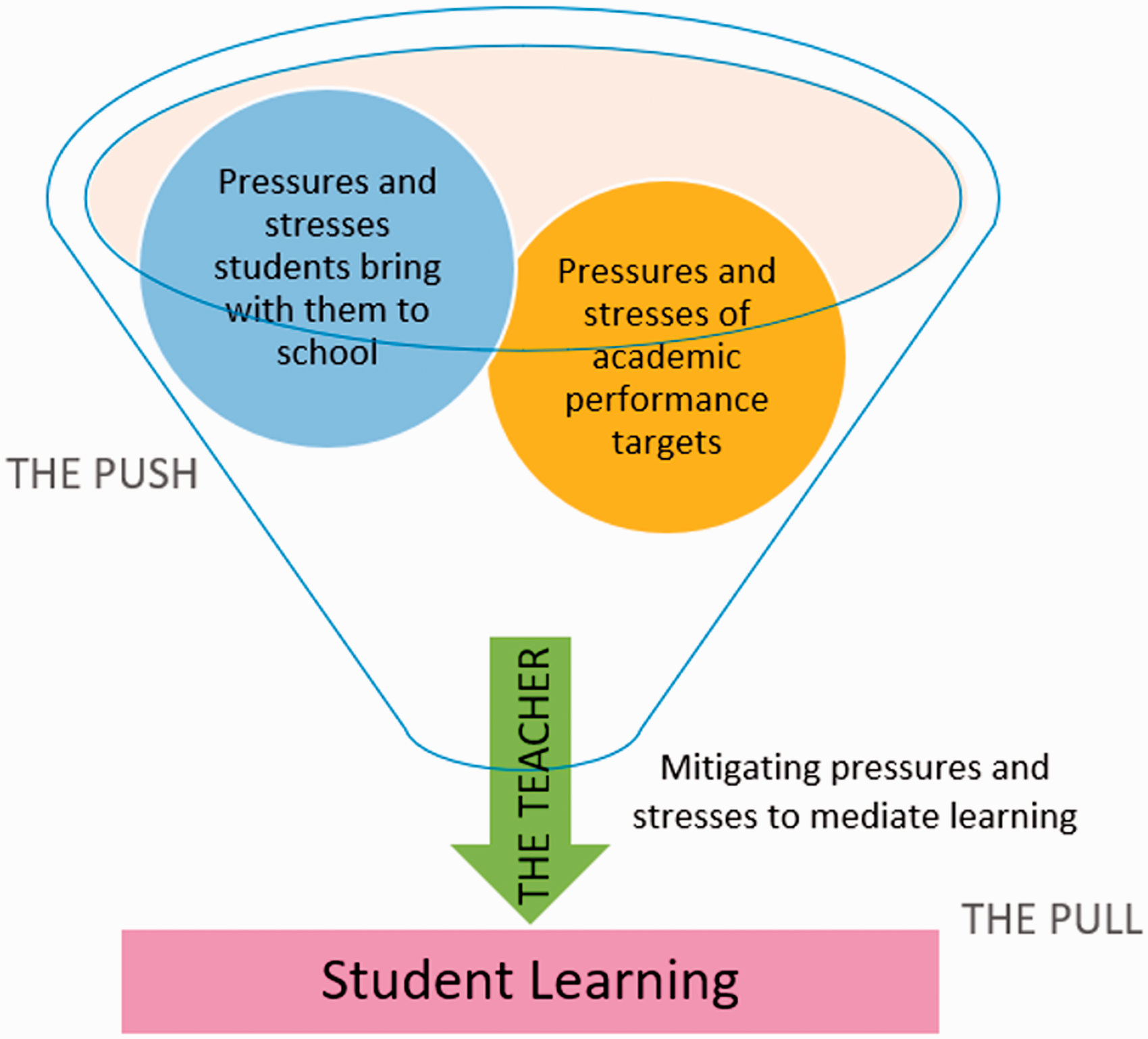
The role of the teacher as a mediator of student learning by mitigating pressures and stresses.
Pressures and stresses students bring with them to school
The construct pressures and stresses students bring with them to school comprises the themes: anxiety (sources: 7; references: 14), parental expectations (sources: 6; references: 8), academic challenges (sources: 4; references: 7), physical needs (sources: 10; references: 15), socio-economic and socio-cultural challenges (sources: 8; references: 17), and trauma (sources: 4; references: 7). Supplementary Appendix 2 provides positive and negative forms of data for each code.
In relation to anxiety, a number of schools recognised this increasing phenomenon and some schools released teachers from their regular duties to assist students with anxiety. Anxious students included those students who were high achievers. Teachers identified a need for teaching coping strategies, as indicated in the following comments: We had so many kids that were anxious and struggling at school but had no strategies and coping mechanisms to know how to handle their anxiety. (Jack). … the focus is on uplifting messages, providing more support for students who do experience anxiety and a sense of not coping. They’re given extra tuition and time to do things and support. (Neil)
Within the construct of external pressures and stresses, parental expectations also emerged as a theme. There are links between this theme and anxiety felt by high performing students from high socio-economic backgrounds. Teachers noted that many of these students were perfectionists driven by ‘professional’ parents with high expectations of their children to be high achieving, like them. They [parents] are willing to push, push, push and slot their kids into the biggest timetable they can … and what I see is that [the students] disengage … “I’m going to take this class time to just look out the window and have a breather.” … They will be more experienced, they will have more knowledge under their belts; but at the same time, you’re going to break them (August) In terms of wellbeing it is more like giving them [the students] mindful time before and after their assessment to get them to be calm, relaxed and balanced people rather than overly focused on their score or their mark or their assessment (Mark)
We had this one kid in grade six, we got so excited when he moved from a Prep reading level up to a Grade Two reading level! (Michelle)
Typical strategies adopted by teachers included the use of volunteers to assist students during school time and the employment of dedicated school personnel such as a Literacy Coach. However, not all teachers had access to support personnel.
In addition, some teachers noted the amount of time spent with those students who had physical needs and diagnoses caused by various illnesses, such as diabetes. They explained that students with physical needs were often looked after by multiple staff members, for example, multiple people had the diabetes apps installed on their phones. However, not all schools have the human resources to sufficiently meet student needs.
Socio economic challenges is another theme of this construct. This theme is well reported in the literature (e.g. Warren, 2017) and typically identifies endemic welfare, lack of food, lack of sleep and lack of parental responsibility as pressures experienced by students who are affected by low-income and poverty dynamics. Teachers often discussed socio-economic challenges in tandem with socio-cultural challenges.
If you’re in a low SES school the wellbeing issues are engrained in that cycle of family … I wouldn’t call it pressure; I would call it significant mental health problems that are undiagnosed and unrecognised by family members (Reece)
You’re having to make sure that you support the kids because they haven’t eaten that morning, or they haven’t had enough sleep. A lot of the responsibility of the wellbeing of the child falls on the teacher nowadays (Grace)
Strategies adopted by teachers focused on tending to their immediate welfare needs, for example, food and sleep, building relationships with students, consistency, recognition of readiness to learn, and a variety of school-based support programmes, as revealed in the following comment: Our school is from a low socio-economic area and welfare is a daily issue at classroom, stage and whole school level. We are forever refining, evaluating and expanding social skills programs, lunch time structured activities, PBL [Positive Behaviour for Learning] and other classroom initiatives and programs to support our staff and students with their ongoing welfare needs (John) I have a little poppet who doesn’t know where he belongs in life. Socially, culturally, he’s very much at the bottom of the food chain. The only way he can get acknowledged is through his behaviours … he gets the negative response through the negative behaviours – so that’s the way he approaches his life daily. So, this morning he rocked up to school, and I had a look at him and went I can tell you haven’t slept, you’re not ready to learn (Olivia) … they’re all trauma kids, they’re all rough kids, they’re all bush kids, their lives are really horrible really. Low, low, low socio-economic. So, it’s important to have relationship and consistency (Kate)
In this setting everything has to be done differently because of the trauma … so you’re asking kids to do things, but they just can’t … (Kate) The reality of their life is dealing with that trauma. Whether it’s in a physical way or if it’s having a complete breakdown in your classroom and saying, “this is it I’m done, I’m going to kill myself, I just can’t deal with this,” it’s that cycle of life that those children have had. (Reece) These kids come to school with bare feet and hygiene isn’t the best. We give out toothbrushes and lots of things. We have to do it because it’s essential, but probably it’s showing them that you care and that they can trust you, and that you are who you say you are, and that’s when you go from relationships to wellbeing to academics. (Kate)
In summary, within this construct critical actions taken by schools and teachers to respond to these external pressures and stresses include releasing teachers from classroom teaching to work with students at risk, providing social, emotional and academic support for students, sending uplifting messages, finding physical outlets for traumatised or stressed students, giving students mindful time so they can calm themselves, providing social skills programmes, and checking in with students.
Academic pressures and stresses encountered at school (internal)
The following themes belong to the construct academic pressures and stresses encountered at school: assessment (sources: 8; references: 11), NAPLAN (sources: 10; references: 14), curriculum demands (sources: 5; references: 7), and data-driven practices (sources: 6; references: 11). Supplementary Appendix 3 provides positive and negative forms of data for each code.
Assessment pressures and stresses on students is the first theme in this construct as teachers described the intensity of school systems and hierarchies in bombarding students with the importance of assessment tasks, even on the first day of school. They described the necessity to teach to the test as a result of these systemic pressures, with little regard for any other learning. System pressures filter down and manifest in student stresses. The following comments showcase these concerns: They’re told about the importance of the assessment tasks at the beginning of term as soon as you get in the door and how to do this, and everything’s down to the micro minute (Mackenzie) … at my last school, it was just teaching to assessment. Like, this is all we are going to teach, you’re not studying anything in depth, you’re just ticking boxes (Kayah) I just found with my kids as soon as we say “test” or “we’ve got an assessment” it’s like a meltdown moment like “oh my gosh, what if I get one wrong?” (Jack) We are forever pressured to be improving NAPLAN results and other data, but our staff's first priority is the welfare of our students and then get onto the task of teaching (John) I think NAPLAN is always a big one where there’s a disconnect … But being able to go, “yep, we’re doing this this morning but next we’re going to go and do something else that’s completely non related, we’re going to let the calm come back in.” (Mackenzie) … we can’t just keep piling more and more onto our kids and expecting them to make these meaningful connections; but yet, we feel like we have to do that because there are so many changes going on. (Jason) We seem to be documenting so much more because I think parents are being a lot more knowledgeable on where their rights are or what their expectation is and so you just need to have the documents so when they come in a fit of rage (Maria) It’s funny because we’re being pushed so much to assess and track data, but it’s actually having a negative effect on students because they’ve got this fear of feeling the pressure of always having to perform (Jack) I find that data and all that sort of stuff is really, really pushed and sometimes it’s at the expense of actually teaching things that are important or interesting … this pressure for information and data that we are entering, and I just don’t know what is being done with it. It’s not improving what I am doing (Kayah)
Teachers: Mitigators of pressures and stresses and mediators of student learning
This third construct exemplifies ways teachers mitigate pressures and stresses for the purpose of mediating learning. The researchers identified two themes within this construct: wellbeing comes first (sources: 12; references: 21) and the roles of teachers as perspective-givers and story tellers (sources: 8; references: 12). Overwhelmingly, teachers identified wellbeing as a priority over academic pressures. Trust emerged as the significant strategy teachers adopt to assist their students. … it’s a hard choice, but I always choose to foster the wellbeing before pushing the academics in a situation where I have to make a choice. Because I want the kids to trust me and be able to work with me, and I want to get the best out of them (Jack) Wellbeing needs to come first. It’s a priority. It’s like I say to everyone, it’s Maslow’s Hierarchy of Needs. If you haven’t got 1, 2, 3, and 4 sorted then how can you get to academics? (Kate) I am always prioritizing well‐being, academics can come later … The performance is obviously important, but you can’t put it before well-being because you’re not going to have much success. (Lachlan) Get to know the students first and then choose the goals that are appropriate for the work we are doing. (Wendy)
You know what, you try your best, but NAPLAN doesn’t test whether you’re happy at school, whether you’re good at music, whether you’re going to make friends here, that’s the stuff that actually matters. (Kayah) … at the moment I work with Year 10 girls who are very keen on pursuing a STEM career pathway, so for me it’s about putting them in contact with people who have been down the path before and saying there’s no right or wrong but if you don’t get the OP5 you drastically want, then there are still other ways for you to go, and that you learn more from the journey along the way than you do from anything else (Mackenzie) … telling our stories about how we have been affected by mental illness, how students are affected by it, how families are affected by it … we need to open the dialogue (Reece) I think one of the great things about being a teacher is you get to be a storyteller, and if the narrative with a curriculum which weaves both what they are supposed to learn as a student, what they need to learn with success in life, then you’re doing a really good job. (Russell)
Discussion
Findings are discussed here in light of the overarching research question: How do teachers work with students in schools to manage wellbeing concerns and academic pressures and stresses? A close study of the critical actions taken by teachers to respond to student stress shows there is considerable evidence within the interviews to suggest that teachers prioritise student welfare and wellbeing over academic agendas. With regards to teachers’ priorities, the data show a clear flow: taking care of student welfare (social, emotional, physical and cultural supports) so trustful relationships can be built, so wellbeing (health, contentment, security and functioning) can be tended to, so academic development can occur. This flow of priorities is depicted in Figure 2. It ought to be noted that this flow of priorities is not necessarily unidirectional but may occur in any direction or simultaneously.
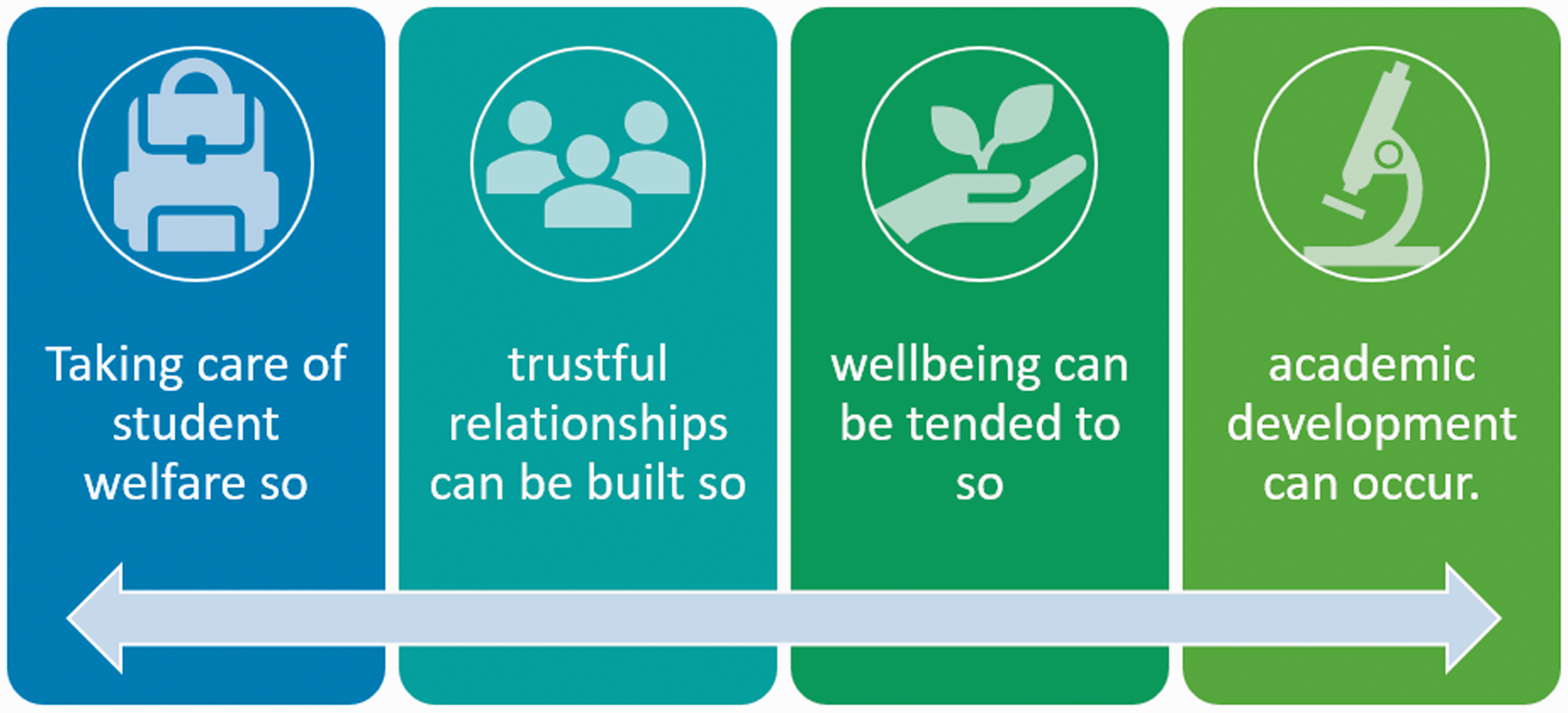
The flow of teachers’ priorities when mitigating student stresses and mediating learning.
Teachers in the current study worked hard to wind back stress and ‘let the calm come back in’ to their classrooms, especially in schools that were subject to external regulation and performativity measures. This is topical for Australian contexts given the higher than average levels of school-work related anxiety amongst Australian students (Schmid, 2018). Teachers proactively sought ways to create margins of time and space (mental and physical) for their students, whether by buffering the pressures of an overcrowded curriculum and data-driven audit cultures, finding physical outlets for stressed and traumatised students, or providing mental breaks and mindful time for overwhelmed students. Teachers actively made space – physically, emotionally and academically – to support student learning. Data from this study accord with literature that asserts teachers adapt their practices to meet student needs and mediate learning (e.g. Edmondson et al., 2016; Feuerstein & Lewin-Benham, 2012), take initiative to check in with students of concern (e.g. Willis et al., 2019), and develop special programmes to respond to presenting needs (i.e. social skills or anxiety). There is a palpable need for systems administrators and school leaders to find ways to provide teachers with time and flexibility to reflexively meet student needs to progress their learning. This may include releasing them from teaching to tend to the waves of presenting needs amongst their student body, such as anxiety or trauma, questioning the sustainability of data-driven practices, and finding ways to manage the volume of curriculum yet uphold academic rigour. Policy and practice need to be undergirded with the knowledge and belief that academic performance is indelibly linked to student welfare and wellbeing.
Key strategies used by teachers when mitigating student stresses and mediating learning include perspective-giving and storytelling. Storytelling is a powerful tool for neural networking and organisation (Cozolino, 2013). Teachers take time to express to students what really matters, both in study and in life. Data in the current study show teachers believe friendship skills, opening dialogue about mental health, and resilience really matter. They make efforts to locate assessment within the time and place it exists and remind students there is a much bigger world beyond the immediate assessment task they are facing. Teachers work to encourage character traits in their students that will serve them well into the future. They tell stories about their own experiences hoping they might be a sample of living proof that challenges can be overcome. Teachers conduct such mediation to keep students learning, working hard and achieving.
Conclusions
Simultaneously managing wellbeing concerns and academic objectives is a professional capability. Creating space, finding margin, mitigating and reducing pressures and stresses, while upholding academic rigour, are the salient capabilities described by teachers in this study for simultaneously managing student wellbeing and academics. Systems authorities and teacher education providers cannot assume that such skills develop naturally, nor should they overly rely on teachers’ resilience (c.f. Sullivan & Johnson, 2012) to cope in high stakes performativity environments (Edmondson et al., 2016). Teachers need resources (both human and material) and professional development to cultivate the skills and knowledge they need to progress learning while simultaneously tending to wellbeing concerns. Both imperatives need to be upheld, and teachers need support to do so.
Data from this study show perspective-giving and storytelling are strategies that teachers use to mitigate stress and progress student learning; therefore, these critical strategies ought to be prioritised in teacher education and professional development. Teachers need to be taught how to use perspective and story as mediation techniques to promote student engagement and learning. There is a clear opportunity to conduct further research into perspective-giving and storytelling as pedagogical tools.
Finally, instead of treating academic performance and student wellbeing as two separate issues or profiles within a system or school, typically assigning separate duties to different staff members, education leaders need to view academics and wellbeing as inseparable. In this way, we acknowledge that academic performance is subject to student wellbeing, and that student wellbeing is affected by academic stresses. Evidently, teachers need the skills of mitigation and mediation. Again, these skills cannot be assumed, nor should there be over-reliance on teachers’ self-efficacy or resilience for these skills to come forward.
Supplemental Material
sj-pdf-1-aed-10.1177_0004944120982756 - Supplemental material for The role of teachers in mitigating student stress to progress learning
Supplemental material, sj-pdf-1-aed-10.1177_0004944120982756 for The role of teachers in mitigating student stress to progress learning by Alison Willis, Peter Grainger, Stephanie Menzies, Rachael Dwyer, Sue Simon and Catherine Thiele in Australian Journal of Education
Supplemental Material
sj-pdf-2-aed-10.1177_0004944120982756 - Supplemental material for The role of teachers in mitigating student stress to progress learning
Supplemental material, sj-pdf-2-aed-10.1177_0004944120982756 for The role of teachers in mitigating student stress to progress learning by Alison Willis, Peter Grainger, Stephanie Menzies, Rachael Dwyer, Sue Simon and Catherine Thiele in Australian Journal of Education
Supplemental Material
sj-pdf-3-aed-10.1177_0004944120982756 - Supplemental material for The role of teachers in mitigating student stress to progress learning
Supplemental material, sj-pdf-3-aed-10.1177_0004944120982756 for The role of teachers in mitigating student stress to progress learning by Alison Willis, Peter Grainger, Stephanie Menzies, Rachael Dwyer, Sue Simon and Catherine Thiele in Australian Journal of Education
Footnotes
Acknowledgements
The authors wish to thank the School of Education for their financial and administrative support for this project.
Declaration of Conflicting Interests
The author(s) declared no potential conflicts of interest with respect to the research, authorship, and/or publication of this article.
Funding
The author(s) received no financial support for the research, authorship, and/or publication of this article.

Supplemental material
Supplemental material for this article is available online.
References
Supplementary Material
Please find the following supplemental material available below.
For Open Access articles published under a Creative Commons License, all supplemental material carries the same license as the article it is associated with.
For non-Open Access articles published, all supplemental material carries a non-exclusive license, and permission requests for re-use of supplemental material or any part of supplemental material shall be sent directly to the copyright owner as specified in the copyright notice associated with the article.
