



Abstract
Objective
Sport may promote academic performance through physiological and psychosocial mechanisms. We aimed to examine the association between sports participation and academic performance in Aboriginal and Torres Strait Islander children.
Methods
Participants were from four successive waves of Australia’s Longitudinal Study of Indigenous Children (n = 303, baseline age 5–6 y). Cumulative sports participation was regressed against academic performance from two standardised tests.
Results
Children participating in sport at all four waves performed significantly better than children participating in sport in 0, 2 or 3 waves in Progressive Achievement Test (PAT) Maths (110 vs. 103, 105 and 105, p = 0.007, 0.02 and 0.02, respectively), and better than children participating at two waves in National Assessment Program – Literacy and Numeracy (NAPLAN) numeracy (438 vs. 409, p = 0.006). There were no significant differences in PAT reading or NAPLAN literacy.
Conclusion
Sports participation appears to be associated with subsequent better numeracy (2–7 months of learning) in a sample of Australian indigenous children. Fostering sports participation among indigenous children may be an avenue for reducing disadvantage.
Introduction
The Aboriginal and Torres Strait Islander peoples constitute approximately 3% of the total Australian population, and represent diverse cultures, histories, social activities and spiritual mores (Walter et al., 2017). They are Australia’s original inhabitants, but generally have poorer living conditions and lower household incomes relative to non-Indigenous Australians (Carson et al., 2007; Marmot, 2011). These structural barriers, together with language difficulties, low expectations, geographical displacement and the disintegration of traditional social bonds – often the legacy of colonisation – contribute to disadvantages in educational outcomes (Boughton, 2000; Carson et al., 2007; Zubrick & Silburn, 2006). In 2017, percentages of Indigenous vs. non-Indigenous Australian children meeting national minimum standards for Year 5 on standardised testing were 76% compared with 95% for reading, and 80% compared with 96% for numeracy (Commonwealth of Australia, 2018). The year-level-equivalent learning gap between Indigenous and non-Indigenous Year 5 children was 1.6 years in numeracy and 2.1 years in literacy (Goss, 2018).
Sports participation has been touted as a potential strategy for improving children’s educational outcomes (Bird et al., 2013; Sævarsson et al., 2017). Cross-sectional and longitudinal studies have repeatedly linked children’s participation in sport with better academic outcomes (Donnelly et al., 2016; Fox et al., 2010; Sævarsson et al., 2017; Trudeau & Shephard, 2008). The physiological effects of sports-associated physical activity are thought to underpin this beneficial relationship (Singh et al., 2019). For example, EEG studies have found that, compared with children of lower aerobic fitness, children with higher aerobic fitness have greater neuroplasticity (Hillman et al., 2011), while neuroimaging studies have found structural advantages such as greater volumes of the hippocampus (involved in memory) and basal ganglia (cognitive control) in children with aerobic higher fitness (Chaddock, Erickson, Prakash, Kim, et al., 2010; Chaddock, Erickson, Prakash, VanPatter, et al., 2010). In addition, sports participation may improve academic performance through psychosocial mechanisms such as increased confidence and self-esteem (Eime et al., 2013) and improved executive function (Chen et al., 2014; Verburgh et al., 2014).
It is unknown whether the beneficial relationships between children’s sports participation and academic performance observed in national and international studies are also observed among Australian Indigenous children. Sport may be of particular significance in Australian Aboriginal and Torres Strait Islander communities, where it both has cultural importance and is a major mode of accumulating physical activity (Beresford et al., 2012; Dalton et al., 2015; Rossi, 2015). Data from 2014 and 2015 suggest 47% of Aboriginal and Torres Strait Islander children played sport in the previous 12 months (Hume & May, 2019). It is possible that increased sports participation may improve educational outcomes, as well as health outcomes, and contribute to the reduction in social disadvantage experienced by these communities. More research is needed to guide policy development and program implementation (Commonwealth of Australia, 2018).
Data on Aboriginal and Torres Strait Islander populations are very sparse, however the Longitudinal Study of Indigenous Children (LSIC, also known as Footprints in Time) is a long-running cohort study of Aboriginal and Torres Strait Islander children which has been a rich source of information on lifestyle habits (Walter et al., 2017). This study aimed to explore the relationship between organised sports participation across four waves of the LSIC study and subsequent academic achievement in Aboriginal and Torres Strait Islander children.
Methods
This study is part of a larger project known as the Foundation of Sport in Indigenous Communities to examine the place of sport in Aboriginal and Torres Strait Islander communities. The data for this study were taken from LSIC, a dual-cohort panel study started across 11 sites in 2008 (Thurber et al., 2015). Although not a random sample, LSIC participant locations are generally representative of the population distribution of Aboriginal and Torres Strait Islander children. Participants (n = 1671 in Wave 1) have been followed up in yearly waves, with a retention rate from Wave 1 to Wave 6 of 75%. There are two cohorts in LSIC, a Birth (B) cohort (who were 6–18 months at Wave 1) and a Kinder (K) cohort (who were 3.5–5 years at Wave 1). Data for this study relate to the K cohort, and to Waves 3 to 6 (2010 to 2013), when the children were four to nine years old, as data on sports participation were collected at these time points. Ethical approval for the LSIC study was obtained from the Australian Government Department of Health and Ageing Departmental Ethics Committee. In addition, state/region specific ethical approvals were obtained from local Human Research Ethics Committees (or their equivalents), and state or territory Departments of Education and Catholic dioceses (Thurber et al., 2015). Parents consented to involvement on behalf of the study child. Data were collected during face-to-face interviews with the children’s parents and caregivers.
Measurements
Exposure. Organised sports participation was reported by the parent of the study child at Waves 3, 4, 5 and 6 (2010 to 2013, mean child ages 6, 7, 8 and 9 years, respectively). A limitation was that the question about sports participation was not worded consistently across the waves. In Waves 4 and 5, the question asked whether the child had participated in organised sport in the last week, whereas the question related to the past month in Waves 3 and 6. Sports participation at each wave was coded 0/1 for No/Yes. These were summed together to form a Cumulative Sports Participation variable ranging from 0 (no sports participation at any wave) to 4 (sports participation at every wave).
Outcome. Academic performance was quantified using data from the National Assessment Program – Literacy and Numeracy (NAPLAN) and Progressive Achievement Tests (PAT), obtained from schools by data linkage. NAPLAN consists of a series of standardised tests focused on basic skills that are administered annually to all Australian students (Hardy, 2014). These tests assess students’ numeracy and literacy whereby the latter is a composite score from reading, writing, spelling and grammar tests. Year 5 data were referenced, with 90 students’ tests (37% of analytical sample) being from 2014 and 155 (63% of analytical sample) from 2015. On average, NAPLAN scores ranged from 130 to 620, with a SD of 68. PAT tests provide age-appropriate, objective, norm-referenced measures of achievement (Anderson et al., 2017; Holzinger & Biddle, 2015) and are widely used in Australian schools. In this study PAT Reading tests were available from Wave 8 (2015, mean age = 11 years), and PAT Maths tests were available from Wave 7 (2014, mean age = 10 years). PAT Reading scores ranged between 67 and 150 (SD = 18) and PAT Maths scores ranged between 60 and 145 (SD = 14).
Covariates. Covariates included the age and sex of the child, socio-economic status (SES) and remoteness. SES was defined as the highest education level of the respondent parent. Responses were collapsed into three categories: (1) ≤ Year 10: Never attended school, Year 8 or below, Year 9 or equivalent, Year 10 or equivalent; (2) Year 11/12 or Certificate I/II: Year 11 or equivalent, Year 12 or equivalent, Other non-school qualification, Certificate of completion, Certificate I/II; and (3) University or Certificate III/IV (including trade certificate): Advanced diploma/diploma, Bachelor degree (with or without honours). Remoteness of residence was characterised using the ARIA+ system, and was collapsed into three categories: (1) Urban: Major Cities of Australia; (2) Regional Inner Regional Australia, Outer Regional Australia; and (3) Remote: Remote Australia, Very Remote Australia, Migratory.
Data analysis. Linear models (McCullagh & Neldeb, 1983) were used to examine the association of the categorical cumulative sports participation variable as explanatory, and academic performance in mathematics and reading as the dependent variables, adjusted for covariates. The case of sports participation at all waves (cumulative sport = 4) was used as the reference category in post-hoc pairwise comparisons (Beasley & Schumacker, 1995). With a sample size of 303, an alpha of 0.05 and 80% power, this design is capable of detecting effect sizes (f2) of ≥0.20.
Participant characteristics
From a total of 370 children participating at each wave across Waves 3 to 6, complete sports participation, sociodemographic data and PAT scores were obtained from 303 (82%; PAT Maths) and 277 (75%; PAT Reading) participants. A total of 245 (66%) provided complete sports participation, sociodemographic and NAPLAN data (Figure 1).
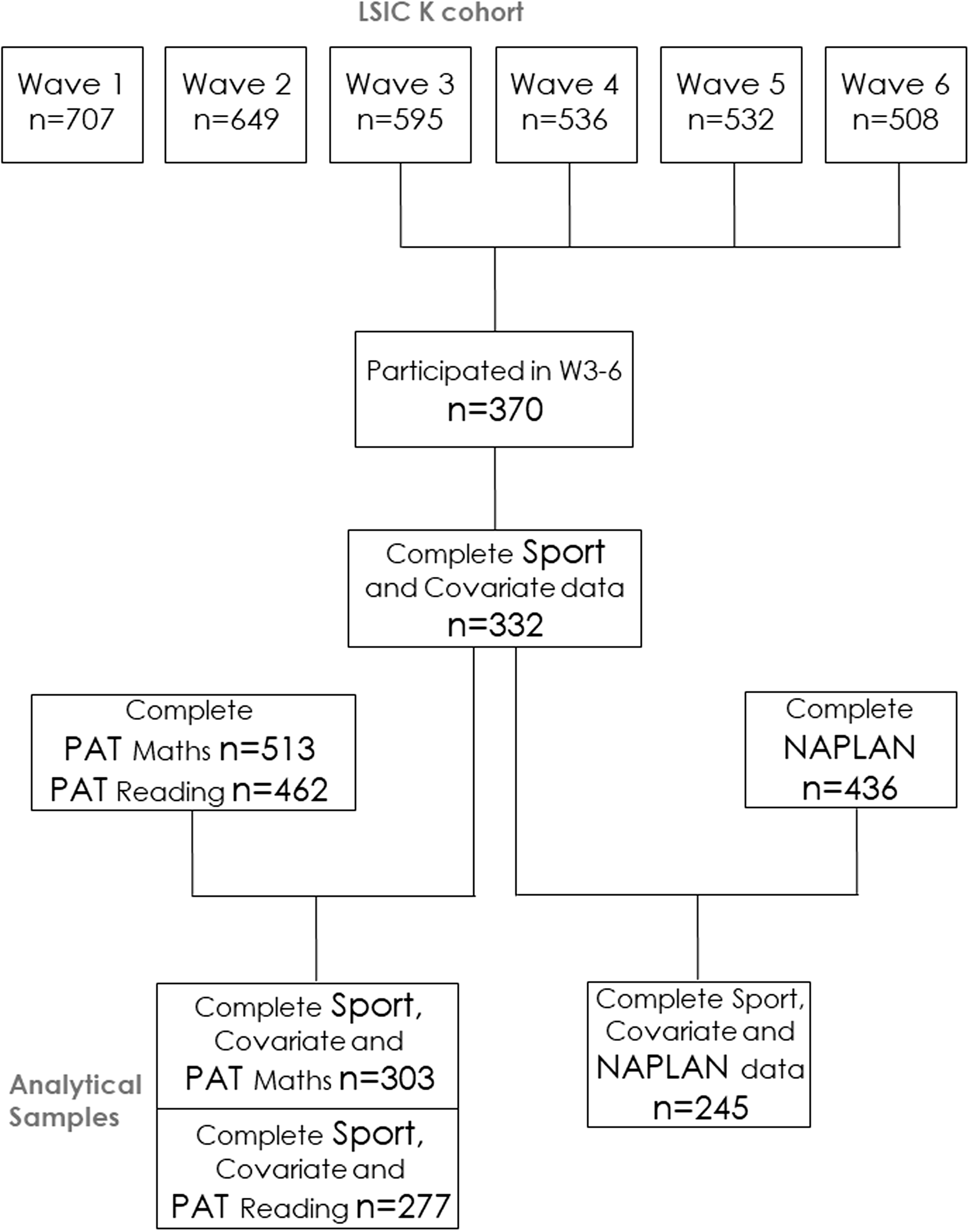
Study design and participant flow. LSIC: Longitudinal Study of Indigenous Children; PAT: Progressive Achievement Tests; NAPLAN: National Assessment Program – Literacy and Numeracy.
The descriptive characteristics of the study children, and of all eligible children, are shown in Table 1. The analytical samples did not differ from the overall sample except in Remoteness (p < 0.05) and higher PAT Maths (p = 0.04) and NAPLAN Numeracy (p = 0.03) scores.
Characteristics of the analytical and overall samples.
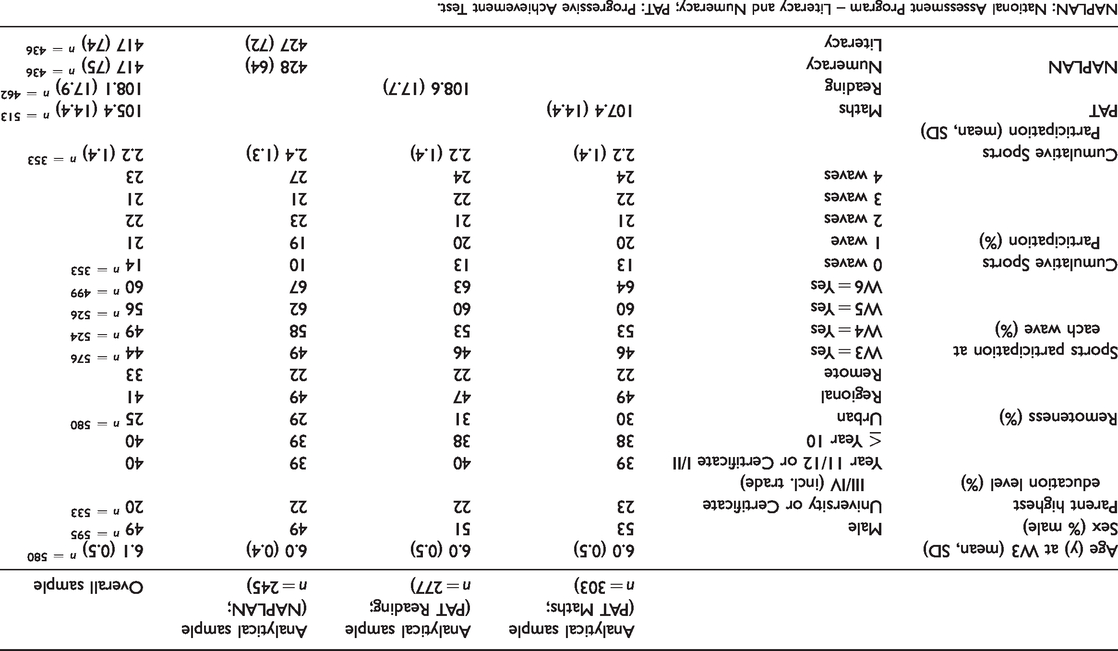
NAPLAN: National Assessment Program – Literacy and Numeracy; PAT: Progressive Achievement Test.
Results
Associations between sports participation and academic performance
Table 2 shows the sociodemographic characteristics of each of the five Cumulative Sports Participation groups. In general, sociodemographic characteristics were different across cumulative sports participation. Compared with those with no reported sports participation at any wave, those with reported participation at all four waves were older (6.1 y vs. 5.8 y), more likely to be male (61% vs. 45%), had higher socioeconomic position (30% vs. 11% completed university/trade certificate) and were more likely to live in urban areas (33% vs. 21%).
Sociodemographic characteristics of the five Cumulative Sports Participation groups.
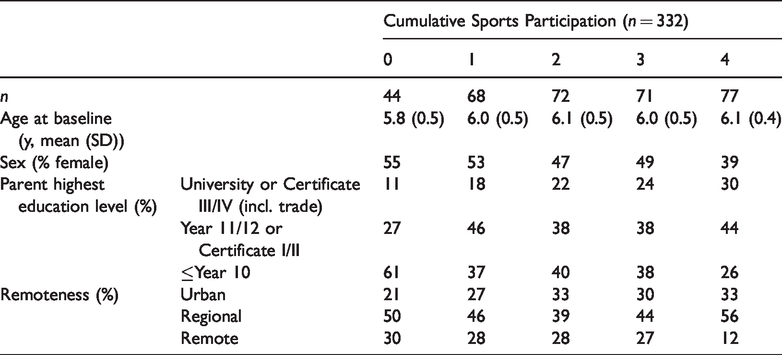
Table 3 shows the fully adjusted mean values for each test according to sports participation score. In all test scores, children who participated in sport at all four waves did as well or better than children with lower levels of participation. These differences equate to effect sizes in terms of standardised mean differences relative to the entire sample of 0.13–0.53 for mathematics and numeracy, and 0.03–0.22 for literacy. Their performance was significantly higher in PAT Maths than the performance of children participating in sport in 0 (p = 0.007), 2 (p = 0.02) and 3 (p= 0.02) waves, and better in NAPLAN Numeracy than children participating in sport at 2 waves (p = 0.006).
Fully adjusted mean values for each test according to sport participation score.
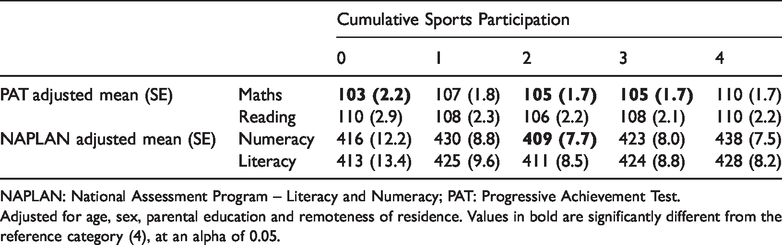
NAPLAN: National Assessment Program – Literacy and Numeracy; PAT: Progressive Achievement Test.
Adjusted for age, sex, parental education and remoteness of residence. Values in bold are significantly different from the reference category (4), at an alpha of 0.05.
Figure 2 shows the contrasts between participation at all four waves compared with participation at 0, 1, 2 and 3 waves, and covariate-adjusted performance on PAT and NAPLAN tests, expressed as standardised mean differences relative to the entire sample.
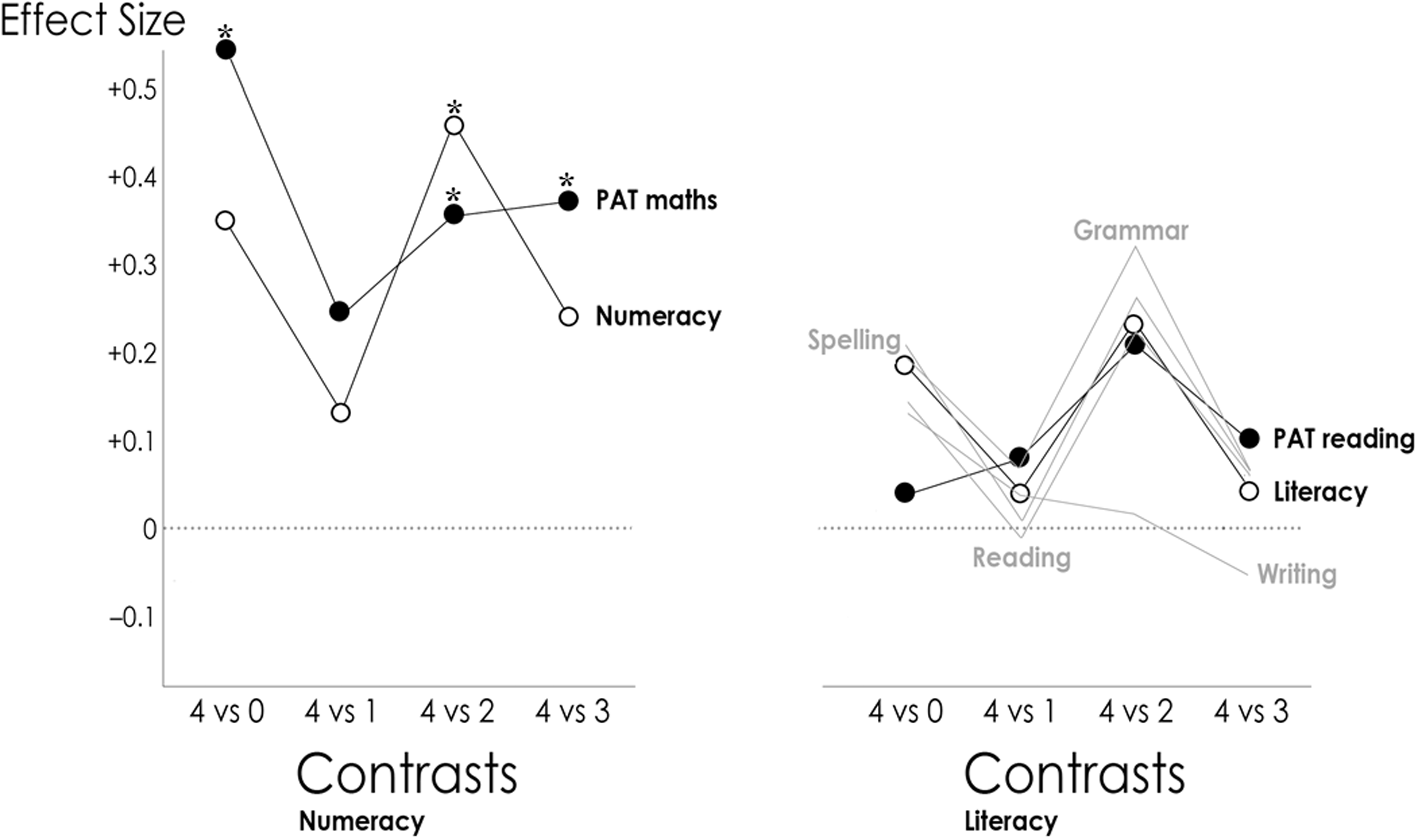
Associations between sport participation (X-axis, expressed as contrasts between participation at all 4 waves vs participation at 0, 1, 2 and 3 waves), and performance on standardised tests of academic achievement (Y-axis, expressed as standardised mean differences relative to the entire sample). Asterisks denote significant contrasts at an alpha of 0.05. Data are shown for numeracy (left panel) and literacy (right panel), for both the Progressive Achievement Tests (PAT) and National Assessment Program - Literacy and Numeracy (NAPLAN), and are adjusted for age, sex, parental education and remoteness of residence. Data on NAPLAN component scores (reading, writing, spelling and grammar) are also shown.
Discussion
Main findings
This study found that participation in organised sport was associated with higher academic performance in numeracy among a sample of Australian Aboriginal and Torres Strait Islander school-aged children. Children with reported organised sports participation in four consecutive years achieved higher numeracy scores than those with less organised sports participation.
Our findings are consistent with previous cross-sectional and longitudinal studies reporting beneficial relationships between organised sports participation and cognitive outcomes in children (Bird et al., 2013; Fox et al., 2010). We are unaware of studies that have explored these relationships among Australian Aboriginal and Torres Strait Islander children. To our best knowledge, our study is the first to confirm the beneficial relationships between cumulative sports participation and numeracy aspects of academic performance among Aboriginal and Torres Strait Islander children.
Academic benefits of organised sport participation may be attributed to physical mechanisms. Organised sport is likely to involve exercise, although participation does not necessarily directly translate into higher overall physical activity levels. It has been estimated that for every hour of sports practice (soccer, netball, Australian football), children accumulate approximately 40 to 50 min of exercise at moderate-to-vigorous intensities (Ridley et al., 2018). Our analyses of data from 11- to 12-year-old Australian children (CheckPoint module of the LSIC; Clifford et al., 2019) show a correlation of 0.62 between minutes spent in sport and minutes of moderate-to-vigorous physical activity, meaning approximately one-third of the variance in moderate-to-vigorous physical activity is explained by sports participation – and vice-versa. Moderate-to-vigorous physical activity, in particular aerobic exercise, has been shown to enhance brain structure and function in children (Chaddock, Erickson, Prakash, Kim, et al., 2010). This may be due to exercise-induced production of neurotrophic factors (e.g., insulin-like growth factor 1 and brain-derived neurotrophic factor) as observed in animal models (Archer & Garcia, 2014). These factors regulate brain network configuration and blood vessel formation, potentially mediating improvement of cognitive function and memory. In addition, exercise increases oxygenation of the brain in children, both by increasing circulation and levels of oxyhaemoglobin (Lambrick et al., 2016).
The academic benefits of organised sport participation may also be explained by psychosocial mechanisms. Playing sport requires cognitive effort; children learn to work within rules, to devise strategies for success and how to focus their attention. Intervention trials have shown that even small bouts (as little as 12 min) of physical activity improve attention in children (Tine & Butler, 2012). The training of cognitive skills through sport may translate to improved learning and better academic performance. A systematic review of 19 intervention studies (n = 5038) concluded that sports participation improved executive function in children aged 6 to 12 years (standardised mean difference = 0.21, 95% CI 0.12 to 0.31, p < 0.05; Xue et al., 2019).
In addition, sport participation has been associated with increased confidence, self-esteem and wellbeing (Eime et al., 2013). Children learn teamwork, self-discipline and negotiation skills. They develop a sense of belonging and learn the etiquette of a social system outside of their everyday home and school environments. Participation in organised sports may indirectly facilitate academic performance by reducing time spent in less beneficial, less structured activities. For example, Felfe et al. (2016) found that involvement with a sports club once or twice a week displaced 28 min of television watching per week. Belonging to a sporting club may be a point of difference for Indigenous children in rural and remote communities, where opportunities for structured extra-curricular activities and social interaction can be limited. Sporting clubs are critical social hubs in Australia’s rural and remote settings (Townsend et al., 2002; Ware & Meredith, 2013). Thus, participation may be even more impactful on the psychosocial wellbeing of Indigenous children’s in rural and remote areas.
Our findings suggest participation in organised sport at four consecutive years is associated with better academic performance than less participation. Although intervention studies have reported improved executive function after just one session of aerobic exercise (Chen et al., 2014), there is little indication that this improvement is sustained over time (Verburgh et al., 2014) and translated to better academic performance. Davis et al. (2011) reported increased brain activity on neuroanatomical images among children who participated consistently in aerobic exercise over 13 weeks indicating ongoing stimulus may be required for physical mechanisms to mediate academic performance. The proposed psychosocial mechanisms underpinning improved academic performance may develop and strengthen over time.
We found associations between organised sport participation and numeracy outcomes only. On average, children with reported sports participation at all waves had 7% higher PAT Maths and 5% higher NAPLAN numeracy scores following adjustment for sociodemographic confounders. These differences concur with conclusions from a systematic review suggesting that organised sports participation may increase children’s numeracy performance by 8% (Bird et al., 2013). A recent 12-month intervention study of Grade 3 children in the Netherlands found that children in the physical activity intervention group achieved greater improvements in mathematics than children in the control group (Mullender-Wijnsma et al., 2015). Similarly, among Australian Grade 5 children, Maher et al. (2016) reported better numeracy and writing, but not grammar, reading or spelling performance among Australia children with high moderate-to-vigorous physical activity. It has been shown that aerobic exercise selectively activates the left frontoparietal cortex (Colcombe et al., 2006; Marks et al., 2007), a region of the brain involved in mathematical operations in children (Göbel et al., 2004; Rivera et al., 2005), potentially facilitating improved numeracy skills.
In addition, because sport requires children to apply mathematical concepts to real-life situations, this may enhance transferability to numeracy skills (Bird et al., 2013). When playing sports, children practice computations such as “how much time is left in the game?” or “how many more points do we need to win?”. It is possible that sport may not afford the same applied literacy-based learning opportunities.
Strengths and limitations
The LSIC is a well-established robust dataset and has been adopted across a range of academic disciplines. The strengths of this study include its longitudinal design, a relatively large sample size and objective measures of academic performance via a nationally administered instrument (NAPLAN). We controlled directionality of association by using exposures that were measured prior to outcomes. However, the findings must be considered in the context of certain limitations. First, the organised sport questionnaire item was subjective, did not distinguish between types of sport and the wording of the question differed across the waves, referring to different periods of time (last week vs. last month). It was not possible to determine the validity of this question, or whether sports participation reflected higher physical activity levels. Second, the cumulative sports participation score used in analyses weighted sports participation at each wave equally – this means that participation in an early wave is assumed to have the same association with academic performance than participation at a later wave. It is possible that sport participation at a more proximal time point has a stronger association with outcomes. Third, we adjusted for a range of potential confounders, but it is possible that residual confounding exists due to other factors (e.g., family chaos, parenting style, mobility, household finances, genetics, child/parent health, teaching style, school attended, absenteeism). Lastly, the academic performance measures, particularly nationally administered NAPLAN scores, are controversial as they have a narrow view of academic attainment in subject areas (Dulfer et al., 2013) and may not accurately reflect the educational outcomes of Indigenous children. Measures of cognitive ability such as matrix reasoning (e.g., Wechsler Intelligence Scale for Children (Wechsler, 2003)) may provide a more comprehensive insight.
Questions for further research
It would be of interest for future research to explore whether the kind of sport a child plays (team/individual, indoor/outdoor, active/inactive) matters to academic performance. Future studies would be strengthened by using objective measures of sports involvement over time, for example, by accessing attendance records from sporting clubs linked to academic performance/health data. Our study suggests it would be useful for future work to describe the characteristics of community settings that foster sports and physical activity participation and adherence. Further research exploring enablers and barriers to organised sports participation in vulnerable populations (e.g., remote and rural areas) is warranted.
Implications for policy and practice
The differences in NAPLAN numeracy scores across the cumulative sports participation variable (8–29 points) equate to two to seven months of learning (Goss et al., 2016). The possibility that sports participation throughout childhood may boost learning by two to seven months raises questions about the role of sport in community and school settings. Without positioning sport as a panacea, its utility in younger and developing populations has emerged not just as an important consideration for improved health and wellbeing, but for improving education. A recent systematic scoping review suggests that programs to encourage sport participation among Aboriginal and Torres Strait Islander people have resulted in increased school attendance and self-esteem (Macniven et al., 2019). From a social determinants perspective, sport should be viewed along with other in situ factors as an avenue to reduce disadvantage. In doing so, it contributes to closing the gap.
The challenge for public health promotion is how to support and enable Aboriginal and Torres Strait Islander children’s continued participation in organised sport. We know little about barriers and facilitators among children in rural and remote areas, as research has been largely carried out in regional cities and urban areas. First steps may involve addressing known barriers to participation, which include financial cost, time management and environmental constraints (e.g., fears for safety, lack of facilities; Péloquin et al., 2017). Culturally sensitive programs promoting identified facilitators to sports participation, such as social support, intrinsic motivation and role modelling, may be indicated (Péloquin et al., 2017).
Conclusion
The research indicates that sports participation appears to be associated with subsequent better academic achievement in numeracy among a sample of Australian Aboriginal and Torres Strait Islander children. The differences equate to two to seven months of learning at Year 5. Improvements in literacy were not statistically significant. The association between sport and academic performance raises questions about how sport is considered within the broader policy contexts aimed at closing the education gap in Aboriginal and Torres Strait Islander communities.
Footnotes
Acknowledgements
We gratefully acknowledge the generosity of the Aboriginal and Torres Strait Islander families who participated in the LSIC study, and the Australian Government Department of Social Services for the provision of the LSIC data.
This paper uses unit record data from LSIC, initiated, funded and managed by the Australian Government. The findings and views reported in this paper, however, are those of the authors and should not be attributed to DSS or the Indigenous people and their communities involved in the study. D.D. is not Indigenous and is employed by the University of South Australia. She aims to ensure that her research remains in line with the wishes of participating communities and families, and strives to disseminate strength-based findings to families and communities whenever possible. R.W. is not Indigenous and is employed by the University of Sydney, T.O is not Indigenous and is employed by the University of South Australia. J.R.E is from Wiradjuri country and is head of the Indigenous Heath Discipline in the Faculty of Health at the University of Technology Sydney.
Declaration of Conflicting Interests
The author(s) declared no potential conflicts of interest with respect to the research, authorship, and/or publication of this article.
Funding
The author(s) disclosed receipt of the following financial support for the research, authorship, and/or publication of this article: This study was funded by an ARC Indigenous Discovery Grant IN160100035. DD is funded by the Australian National Health and Medical Research Council (APP1162166) and the Heart Foundation (102084). Footprints in Time – the Longitudinal Study of Indigenous Children was initiated and is funded by the Australian Government Department of Social Services (DSS).
Ethical approval
The LSIC has received ethical approval from the Departmental Ethics Committee of the Australian Government Department of Health. Additional approval at the State, Territory or regional level was obtained from the relevant bodies, in line with the guidelines of the National Health and Medical Research Council and the Australian Institute of Aboriginal and Torres Strait Islander Studies.
