




Abstract
India has the mission to ensure that every child attains foundational literacy and numeracy (FLN) skills by the end of grade three. The National Initiatives for Proficiency in Reading with Understanding and Numeracy (NIPUN Bharat) is entrusted to monitor this target. However, the specific factors of the home environment, which vary among Indian children, can explain the low performance in literacy and numeracy. Therefore, this systematic review aimed to comprehensively identify the home environment factors that affect literacy and numeracy learning. Studies published between 2013 and 2022 were searched in the ERIC database. From 383 potentially relevant articles, the researchers included 38 primary studies. Systematic reviews and meta-analytic studies were excluded. The results showed that home learning environment factors do affect numeracy and literacy learning. Prominent factors were family learning background, reading and numerical activities and home resources. Other factors, such as the reading and numeracy interests of children and the parent-child relationship, also play an important role in the acquisition of foundational numeracy and literacy skills.
Introduction
The National Mission on Foundational Literacy and Numeracy (FLN) works under the remit of the Ministry of Education (MoE) to attain universal FLN in all primary schools. The MoE has identified stage-wise targets and goals to be achieved by 2025. The National Initiatives for Proficiency in Reading with Understanding and Numeracy (NIPUN Bharat; MoE, 2020b) closely track and monitor the same progress to ensure that every child in the country attains FLN by the end of grade three by 2026–2027. The focus is based on competency-based learning and the universal acquisition of FLN skills.
When we talk about FLN, we mainly discuss the identification of the priority of education at an early age. It is a mandatory prerequisite for learning. FLN is necessary for three major reasons: students’ low learning levels, an increase in drop-out rates, and inadequate mathematical and language skills. Therefore, the objectives of FLN are
Instilling language and mathematics competency in learners; and Developing students’ basic skills and understanding.
FLN is all about listening, speaking, reading, and writing comprehensively. Foundational numeracy includes developing mathematical thinking and understanding of numbers, whereas foundational literacy involves promoting the use of language. Thus, numeracy and literacy are the integrated bases of foundational learning.
Conceptual framework
The 2021 National Achievement Survey (NAS) of India reported learning gaps between the current status of learning outcomes and what is needed (MoE, 2021). The survey showed that the levels of learning in language and mathematics among grade three school children are substantially below the national average in 18 of the 29 states studied. NAS findings directed researchers to uncover why these learning gaps in numeracy and literacy exist.
Numeracy skills
Numeracy is mathematical literacy and is quantitative in nature. That is why it is called quantitative literacy. Although numeracy is the mirror image of literacy, it involves quantitative thinking. Numeracy as quantitative literacy can be defined as “An individual's capacity to formulate, employ and interpret mathematics in a variety of contexts” (OECD, 2013, p. 33). It involves the use of mathematical concepts, procedures, facts, and tools to describe, explain, and predict phenomena, which helps an individual to make sound judgments and decisions. Additionally, this conceptualization is understood as mathematical literacy under the Program for International Student Assessment (PISA).
Numeracy also refers to a set of abilities ranging from fundamental arithmetic and logical thinking to complex mathematics and interpretive communication skills (Ball et al., 2014). The capacity to identify and apply mathematical principles in many aspects of life is known as numeracy. Numeracy as a skill involves carrying out a given task with predictable results and good execution, usually in a limited period of time. Thus, numeracy is the capacity to deal with numbers, including the use of mathematical formulas, such as multiplication, division, ratios, and percentages. Examples of numeracy skills include interpreting figures, calculating, resolving numerical problems, measuring, estimating, sorting, finding patterns, adding and subtracting numbers, and so on. The earliest years of a child's life are a period of rapid development and learning. Numbers, patterns, and forms are all recognized during this time. Children use mathematical ideas to make sense of their surroundings and to apply these concepts to their daily activities. While playing, for example, youngsters may select or choose objects based on size, shape, weight, or color.
Foundational numeracy
The ability to recognize and identify numbers, discern relations between numbers, and complete fundamental mathematical calculations is known as foundational numeracy (Ghosh, 2021; MoE, 2020a). Examples of foundational numeracy include understanding numbers and performing basic operations, such as addition and subtraction. One of the NEP's (2020) key goals is to achieve universal foundational numeracy among grade three students by 2025. Students have to master foundational numeracy before beginning number topics; thus, they must understand the concept of numbers during the third grade of schooling.
Early numeracy skills
The foundations of numeracy skills are arithmetic operations, counting, quantifying ideas, and doing numerical relations. Quantifying data involves knowledge of counting and cardinality. Numeric relation skills include the capacity to compare sets of amounts and understand the rules of addition and subtraction. These skills are required to learn advanced mathematical skills. Early numeracy refers to the collecting of certain skills, including vocal counting, understanding number symbols, recognizing quantities, comparing numerical magnitudes, and distinguishing number patterns (Raghubar & Barnes, 2016). There is evidence that children can develop numeracy comprehension at a young age and should be introduced to numeracy ideas early in life. These abilities progress in a logical order and more straightforward concepts must be grasped before more advanced mathematical skills may be mastered (Napoli & Purpura, 2018).
Recent analyses of data from large national longitudinal databases have revealed that a child's mathematical knowledge at the start of school is the strongest predictor of later mathematics success as well as success in other academic domains (Duncan et al., 2007). Similar results have been found regarding the probability of developing a mathematics learning disability. Morgan et al. (2009) found that 70% of children who started kindergarten and scored below the tenth percentile in mathematics were again below the tenth percentile in fifth grade, highlighting the relevance of early mathematical understanding for subsequent mathematical achievement. These findings cumulatively show that early numeracy is vital for subsequent mathematical development (Aunola et al., 2004; Duncan et al., 2007; Raghubar & Barnes, 2016).
Early numeracy skills involve understanding and manipulating symbolic and non-symbolic numbers. Learning the count sequence and comprehending the numerical meaning of number words (e.g., three) and Arabic numerals (e.g., three) are among the early symbolic number skills. Children are able to understand the meaning of symbols when they grasp the cardinality principle, which is the understanding that the last number word used while counting a set specifies the number of objects in the set. Symbolic number understanding in the early years has been linked to subsequent mathematics proficiency with high reliability (Raghubar & Barnes, 2016).
Similarly, non-symbolic number skills and representations are methods of representing numbers without the use of symbols. They typically involve numerical manipulations or the transformation of objects as well as comparisons between object sets in terms of magnitude. Simple addition and subtraction can be performed by young toddlers using non-symbolic numerical representations (e.g., pictures of objects) (Raghubar & Barnes, 2016).
As generally understood, numeracy is mathematics, and, similarly, mathematics is a discipline that underpins numeracy. A context given to calculate is central to any form of numeracy. Numeracy capability in subjects has great potential to empower students. Therefore, numeracy should be integrated into school subjects.
Literacy skills
Literacy is a prerequisite to schooling and leads to a better life. United Nations Sustainable Development Goal 4 strives to ensure inclusive and equitable quality education and has set a goal to achieve foundational literacy for all students by 2030. In India, the recently released National Education Policy (MoE, 2020a) has accorded the highest priority to building literacy skills. Literacy is a basic field of activity that assumes children's holistic development beyond foundational reading and writing skills. Literacy is the ability to comprehend, apply, and comment on literary documents (Ball et al., 2014). It helps students to read, write, and speak fluently (Ghosh, 2021).
Foundational literacy
Foundational literacy is understanding and identifying letters, reading familiar words, and creating various forms of communication. It provides a student variety of backgrounds with the greatest opportunity to learn and read proficiently (Torgesen et al., 2001). This skill is required to achieve one's objectives, expand one's learning capabilities, and contribute toward society. A person's literacy skills can be tailored to one's life and job demands. Students’ literacy learning helps them to become independent readers and writers because each student has a different idea of what being literate entails and signifies.
Early literacy skills
Early literacy skills are the foundational skills and knowledge that pre-readers need in order to develop the ability to read and write. Many researchers view these early skills on a developmental continuum that starts early in life and continues as children enter a school setting (Napoli & Purpura, 2018). Literacy components are related to students’ reading abilities, which are based on print knowledge, oral language, and phonological awareness. Print knowledge includes alphabet knowledge and print recognition. Oral language includes vocabulary, grammar, and comprehension. Phonological awareness consists of the detection and manipulation of different language parts, such as words and syllables.
Early literacy skills are related to reading. These develop long before formal schooling with the increase in students’ chronological age (Whitehurst & Lonigan, 1998). Rhyming, vocabulary, letter naming, and word manipulation are literacy skills. Early literacy is the current and dominant perspective on literacy development before formal reading instruction (Missall et al., 2006).
Foundational literacy and numeracy
The National Education Policy has prioritized universal FLN in primary school. The purpose is to meet the basic learning requirements of reading, writing, and arithmetic at the foundational level. As stated earlier, foundational numeracy is understanding numbers, discriminating between numbers, and performing basic mathematical calculations, such as addition or subtraction (MoE, 2020a). Numeracy encompasses a range of basic arithmetic and logical reasoning skills, including advanced mathematics and interpretative communication skills (Ball et al., 2014).
Foundational literacy is the ability to understand and identify letters, read familiar words, and create various forms of communication. Literacy helps students to read, write, and speak fluently (Ghosh, 2021). Literacy is the capacity to understand, use, and reflect on written texts in order to achieve one's goals, develop one's knowledge and potential, and participate in society (Ball et al., 2014).
Building adequate literacy and numeracy skills at the foundational age between three and seven years is crucial because over 85% of a child's cumulative brain development occurs at six. The ability to read and write and perform basic numerical operations at the foundational level is a prerequisite for future schooling and lifelong learning. These skills empower the children to think critically and creatively, which ultimately helps the nation progress (MoE, 2020a).
Literacy and numeracy and the home environment
The home literacy environment has been broadly defined as the characteristics of the home setting that are thought to contribute to the development of children's reading skills. These characteristics include literacy materials at the home, frequency of storybook reading, parents’ literary enjoyment and practices, maternal engagement, enrichment activities, parents’ literacy beliefs and abilities, etc. Similarly, the home numeracy environment contributes to children's acquiring the requisite knowledge, skills, and values required for a productive life. Operational numeracy activities at home result in the better arithmetic performance of students. International studies demonstrate that the home learning environment provided by parents is closely associated with children's cognitive outcomes (Niklas et al., 2016). Thus, whether or not literacy and numeracy activities are performed at home is likely to predict children's literacy and numeracy abilities.
Trend of related studies
Home literacy and numeracy environments are related to children's foundational learning. Asian studies on the home learning environment of primary school identified numerous family factors for literacy and numeracy learning (Karali et al., 2022; Li, 2007; Ren & Hu, 2013; Seo, 2021). These include the following: parental language ideologies; home learning practices and resources; parents’ socio-economic status, educational attainment, and relationship with their children; parents’ beliefs about the importance of language; family capital in supporting language use at home; parents’ language proficiency; and parents’ consistency in parenting and the use of multiple languages at home as the medium of communication. These studies’ results also resonate with the factors influencing numeracy learning, which include resources for arithmetic learning, income levels of parents, children's preferences for numeracy learning, and the use of instructional resources at home. Most of the studies have identified that home activities play an important role in numeracy and literacy learning. The numeracy activities include mental arithmetic and mental calculations, and the meaning-related activities comprise literacy activities.
In summary, great variation exists in the home literacy and numeracy environment of Indian children. These differences are associated with socio-demographic factors. But the specific home environment factors that vary among Indian children remain unexplored. Hence, the reasons behind the low performance in the language and mathematics of school children are unknown. This study tried to identify the specific home environment factors that explain this low performance.
Rationale of the study
It is vital to ensure children's basic literacy and numeracy skills for better learning in school and throughout life. Not only are reading, writing, and mathematics essential learning skills, but they are also linked to a higher quality of life, personal happiness, national stability, and wealth. In India, children's academic growth is hampered by a lack of learning opportunities throughout the early stages of learning reading and numeracy. The Indian government has failed to assist the development of reading and numeracy, despite the enormous expansion of school infrastructure and enrolment of students in recent years. Too many children drop out of school before finishing their studies, and many of those who do complete their studies lack FLN skills (Ball et al., 2014).
Literacy learning is one of the important developmental tasks in the language learning process. How children learn vocabulary, narrative skills, and print knowledge is affected by home environmental factors (Van-Bergen et al., 2017). Children receive early literacy skills at home before entering primary school (Liu et al., 2018), which significantly affects their later reading development (Leppanen et al., 2006).
The ability to read and write as well as to do fundamental mathematical operations is necessary for lifelong learning. Governmental and non-governmental surveys indicate that India is presently in a learning crisis. A large proportion of students in elementary school (estimated to be over five crores) have not achieved FLN. They cannot read or perform basic addition and subtraction with numerals. Several studies on children's academic achievement indicate that home resources for learning are linked to early numeracy, mathematics interest, and later mathematics achievement (Byrnes & Wasik, 2009).
Anders et al. (2012) found that the quality of the home learning environment matters. A supportive climate, the structure of the home as well as better cognitive stimulation at home all influence literacy and numeracy learning. Moreover, children's cognitive and emotional development are also influenced by the characteristics of the preschool environment but to a smaller extent than the home environment (Belsky et al., 2007; Gorey, 2001). Hence, the influence of the home needs to be analyzed, which this study attempts to do.
Review guiding research questions
The systematic review was focused on the following research questions:
RQ1. What home environment factors can affect literacy learning? RQ2. What home environment factors can affect numeracy learning?
Methodology
A systematic review was employed based on the model of Daniel and Harland (2017). In the first stage, an area of investigation was found, and the researcher established the context and purpose of the review. The researcher developed criteria for the article search. The article's relevant abstract was confirmed, and the full article was compiled accordingly. A systematic review was done by presenting a descriptive summary of each article's critical points. These critical points were checked in response to the research questions. Then, a systematic synthesis was completed while discussing the relationships among the various articles. The synthesis focused on the different points, issues, and ideas presented among the articles. The researcher reflected on the synthesis of the main ideas identified and took a critical view based on the evidence available in the work. The schematic representation of the systematic review is given in Figure 1.
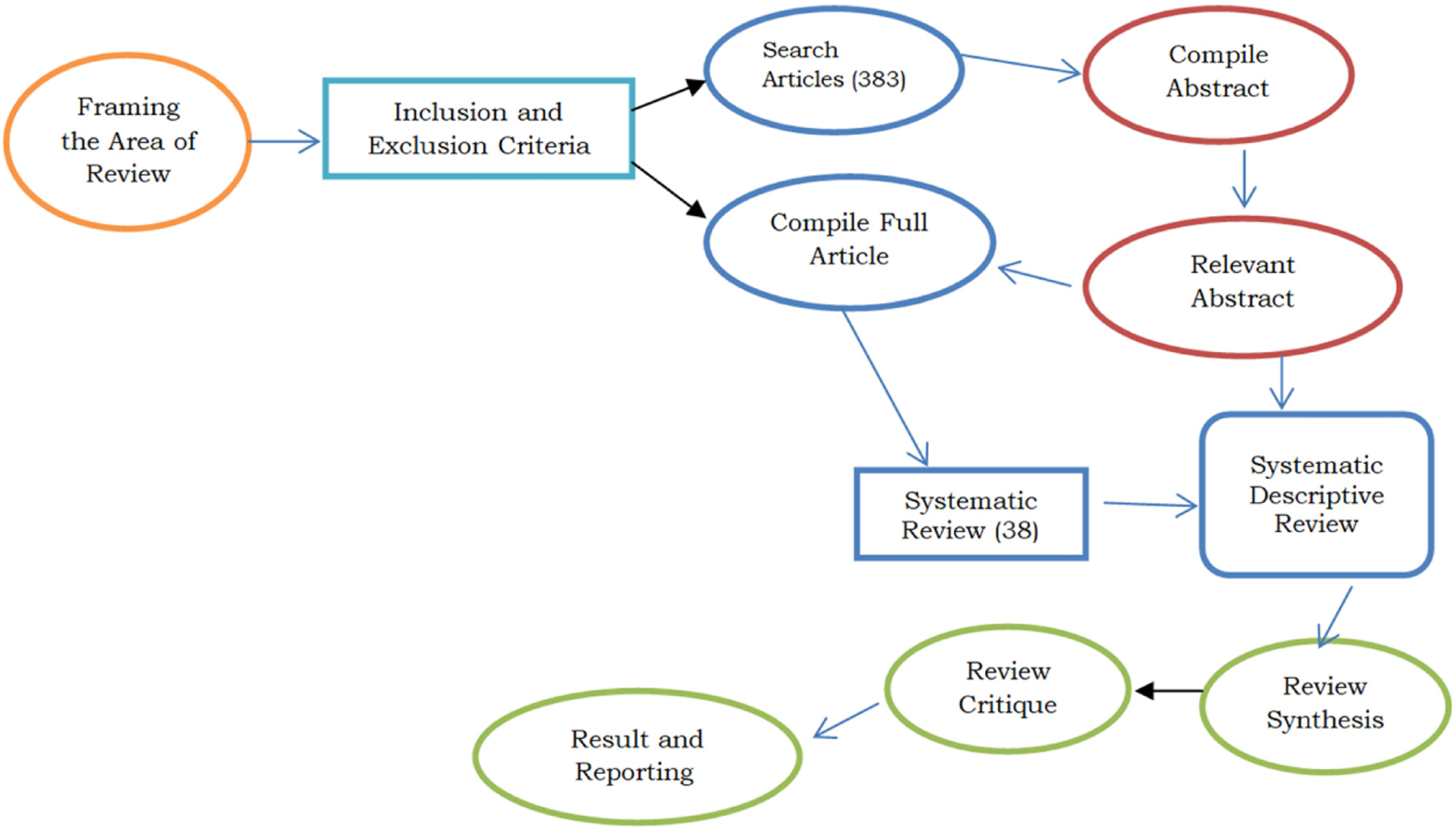
Systematic review model (adopted from Daniel & Harland, 2017).
A search was performed to answer the following research questions: What factors can affect home environment literacy and numeracy learning? To do so, the following search string was used: “Literacy,” “Literacy Education,” “Literacy Learning,” “Home Literacy Learning,” “Informal Classroom Environment,” “Educational Environment,” “Home Literacy Environment,” “Numeracy,” “Mathematics Skills,” “Numeracy Learning,” “Numeracy Learning Environment,” “Home Environment,” “Home Environment and Learning,” and “Home Numeracy Environment.” This search was conducted in the ERIC database. The relevance of articles was judged by reading out the abstract page. A total of 383 results were found fit for review (Table 1).
Search results.

Search results.
The review included studies published between 2013 and June 2022 (i.e., the previous last 10 years). Peer-reviewed papers were included in the review. Included studies explored factors of home environment influencing literacy and numeracy learning of students. Studies that were not relevant to the research questions were excluded, and the studies presenting empirical results were included.
Including relevant reviews
After running the search strings, the abstracts of all papers were identified and examined by the researcher to determine its eligibility. The full articles were then compiled; a systematic analysis was followed, consisting of an analysis of the entire article as well as its relationship to the other articles. The researcher identified the similarities and dissimilarities of the key findings from the other articles (Daniel & Harland, 2017). The final results were summarized based on the review of 38 relevant articles, which are given in Table 2.
Summary of the number of identified papers.

Summary of the number of identified papers.
The results of the review are used to answer each research question. The descriptions of the review of studies are summarized, synthesized, and critiqued in the following manner.
Research question 1: Factors of home literacy environment
Home literacy environment: Description of reviews
The descriptions of studies on factors of home literacy environment are represented in Table 3.
Description of studies on home literacy environment.
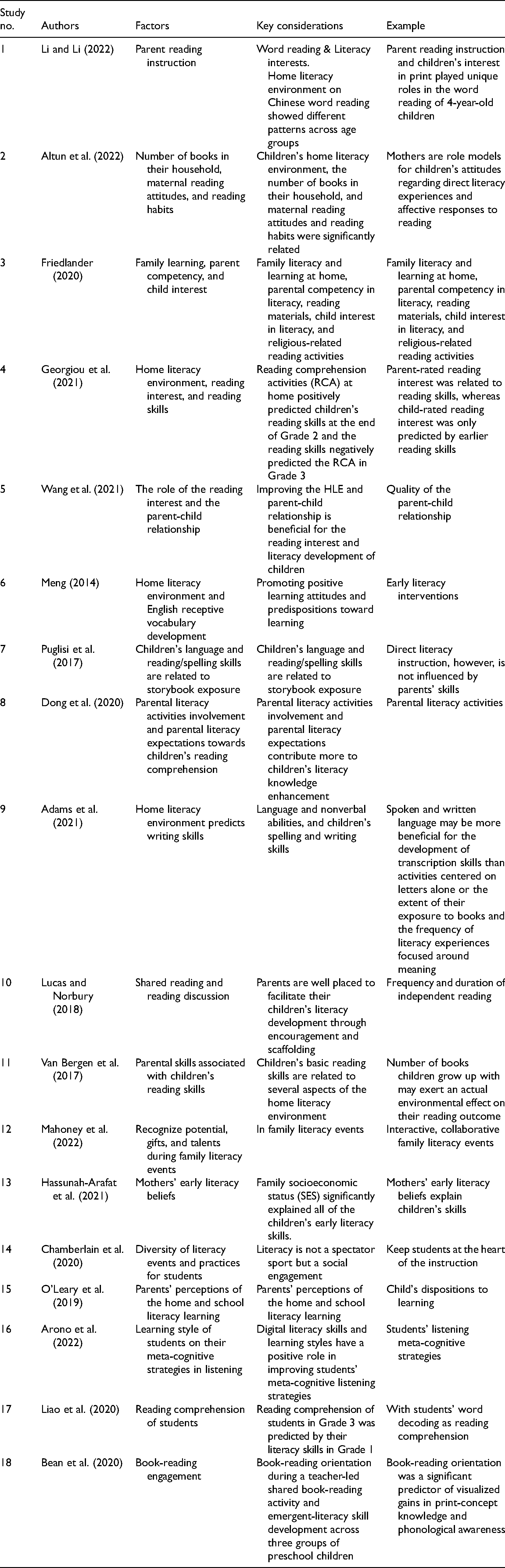
Description of studies on home literacy environment.
Eleven studies identified factors that can produce a good home–family learning environment. These features include the following: parents’ reading habits, attitudes, and skills; parents’ reading instruction to their kids; mother's literacy beliefs; the spoken and written language used by parents; book reading orientation; and reading discussions between parents and children. The most frequently reported element was parents’ vocabulary. Family learning toward literacy generally refers to parents’ attitudes and skills about providing the foundation for future reading, writing, and speaking abilities.
Seven studies also discussed the importance of reading activities, including the following: religious-related reading activities, reading comprehension activities, storybook exposure, parental activities on reading comprehension, family literacy events to recognize a child's potential, social engagement, and book reading activities at home. These were collaborative activities of children with their parents. Similarly, five other studies found that the more interest children had in reading practice, the more they developed literacy skills. In particular, children's reading interests, dispositions, independent reading habits, and the use of metacognitive strategies in listening and word decoding were the factors influencing the home literacy environment. Regarding the home environment, two studies highlighted that the availability of books in the home as well as other reading materials were also significant factors in enhancing children's literacy learning performance.
Home literacy environment: Critique of reviews
These results explicitly showed that positive parent-children relationships helped to create an interest in reading among children. Eighteen studies identified four main factors that contributed to the home literacy environment: family learning, reading activities, reading interest, and parent-children relationships. Furthermore, each factor was found frequently in the above reviews, as shown in the pi-diagram (Figure 2). The contents of relevant articles were analyzed. One researcher could generate 27 codes to describe the factors of the home numeracy environment and 25 codes for the home literacy environment. Another researcher interpreted the codes to narrow them down into seven categories of terms. Both researchers reconstructed the distinctions between codes to transcribe these in conceptual themes. Keeping in view of units of analysis, the coding represented four themes under each type of learning. The researchers rely on known interpretations by common agreements. It was found that the number of factors related to family learning, reading activities, reading interest, and parent-children relationships were 11 (44%), 7 (28%), 5 (20%), and 2 (8%), respectively. There is a dearth of studies on home reading activities with respect to parent-child interaction and relationships. Daily life situations need to be integrated into deciding the reading activities. Therefore, family learning factors in deciding the activities need to be investigated.
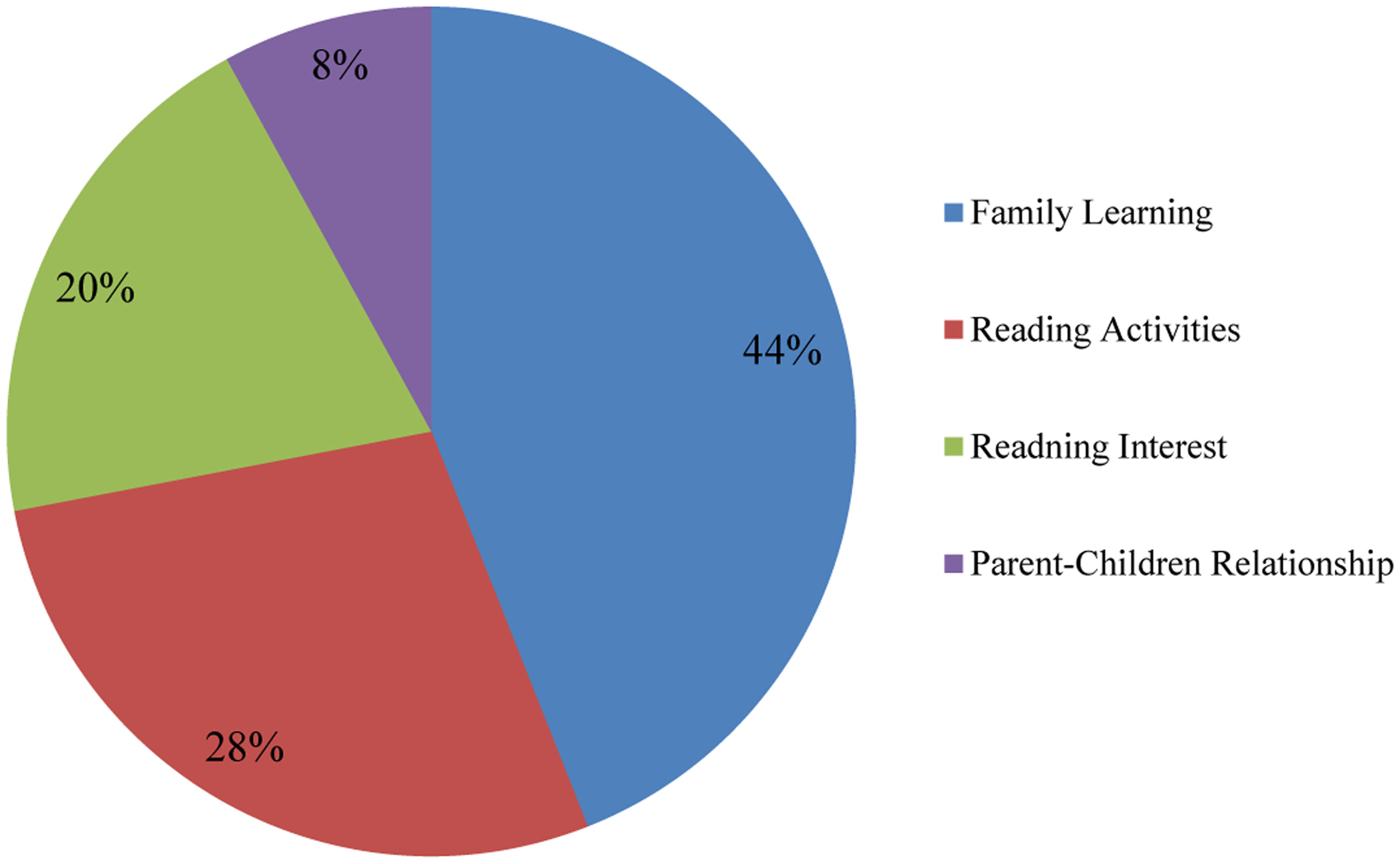
Frequent key factors found in literacy studies.
Home numeracy environment: Description of reviews
The descriptions of the studies on the factors influencing the home numeracy environment are represented in Table 4.
Description of studies on home numeracy environment.
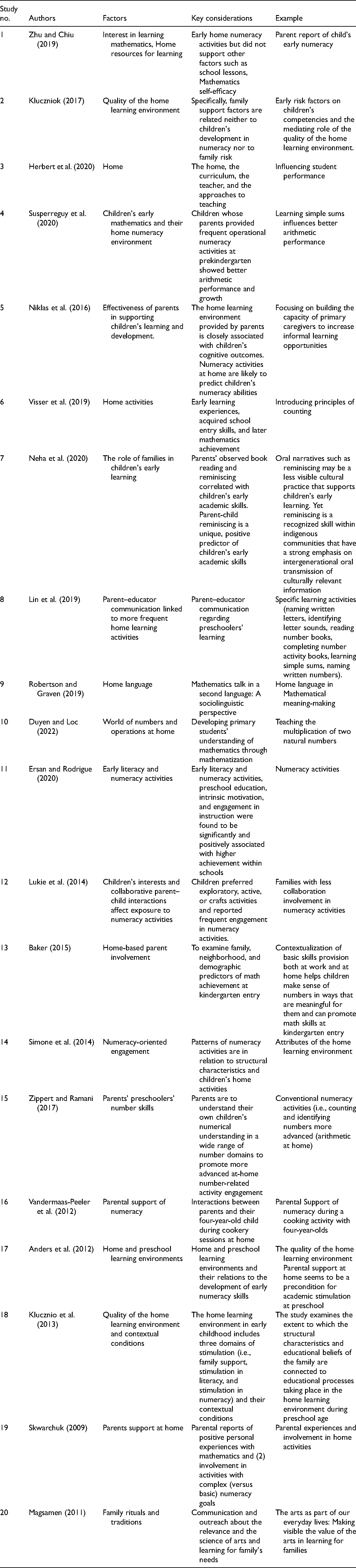
Description of studies on home numeracy environment.
The above description of reviews revealed that numeracy is affected by the home context. Ten studies looked at children's numerical activities done with their parents. These activities were based on the following principles: counting; number operations; home number-related nativities; conventional numeracy activities, such as counting and identifying numbers; finding number patterns; craft activities; and doing arithmetic at home. Children's capacity to employ mathematics in a variety of contexts indicates their numeracy learning. Hence, it can be conceptualized that home life affects numeracy learning. Family support plays an important role in numeracy learning. Seven studies explained that parental support during book reading, oral narration, mathematics dialogue in the second language, collaborative sharing and interaction, and even cooking activities at home had an influence on numeracy learning. Studies have also related how numeracy-oriented engagement influences students’ numeracy and literacy learning. Ample home resources and informal learning activities lead to sustained interest in mathematics. Five studies related to the utilization of home resources have reported that parental communication, home language, the context of basic mathematics skills at home as well as family rituals and traditions are attributes of the home learning environment. Therefore, operational numerical activities conducted at home with family support and the use of home resources are congenial factors for home numeracy learning.
Home numeracy environment: Critique of reviews
The studies investigated different areas of factors, influencing numeracy. For example, mathematical literacy through operating numeracy activities at home is needed. Developing primary students’ understanding of mathematics through mathematization has been suggested by researchers (Duyen & Loc, 2022). Policy documents, such as the National Curriculum Framework (NCERT, 2005), have argued favorably. The descriptions of reviews revealed that certain factors mainly influence children's numeracy learning at home, such as numerical activities, home resources interest in mathematics, and family support. Each factor was repeatedly found by the researchers in some studies. The study frequency of these factors is represented through a pi-diagram (Figure 3).
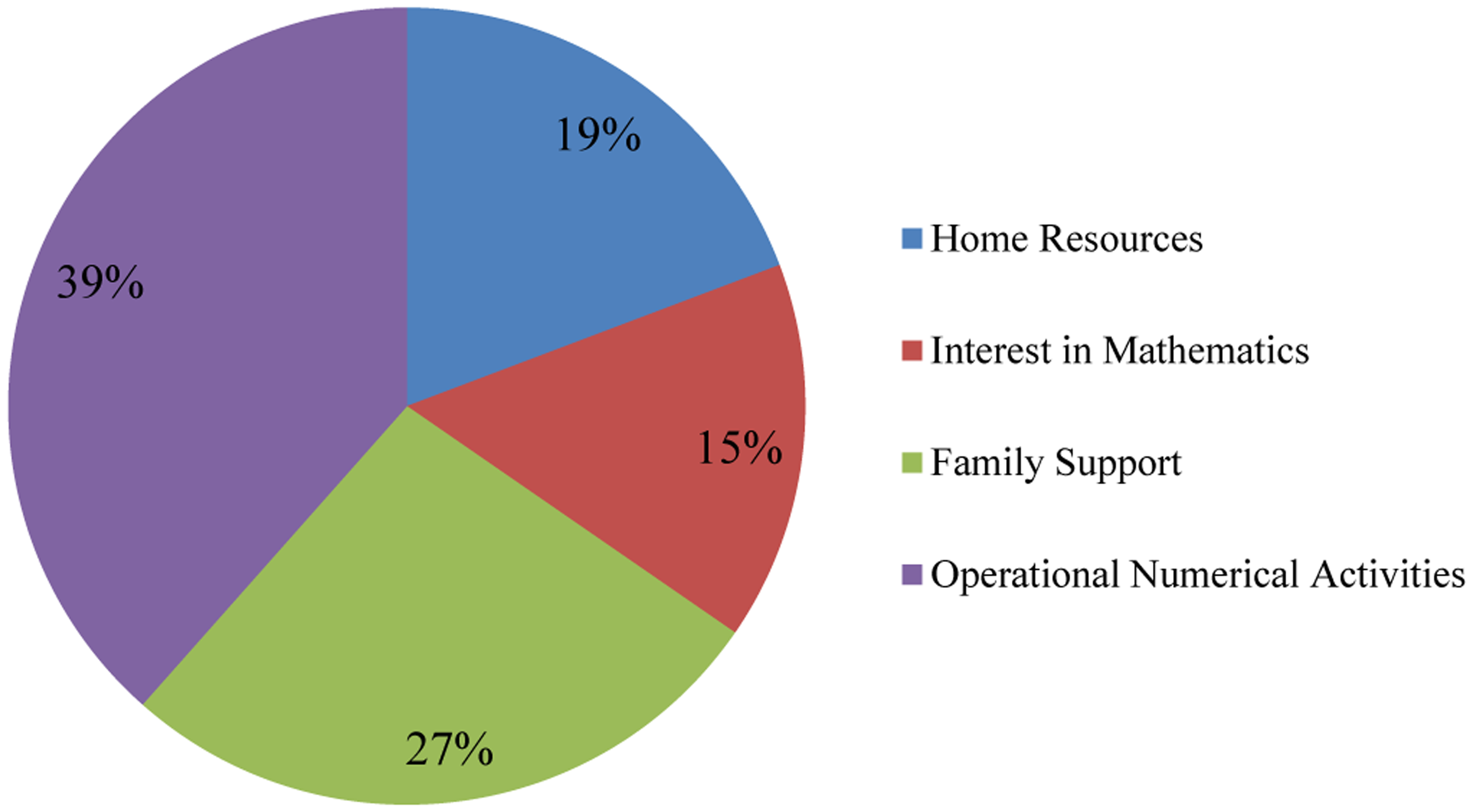
Frequent key factors found in numeracy studies.
There is little research on how family support enhances basic numeracy learning among children. Therefore, a considerable research for numeracy learning is not apparent. Information on how the home environment can facilitate various elements of children's literacy and numeracy engagement is scarce. Therefore, research on literacy and numeracy can be undertaken based on antecedents of home environment. These antecedents of home learning and numeracy learning are shown in Figure 4.
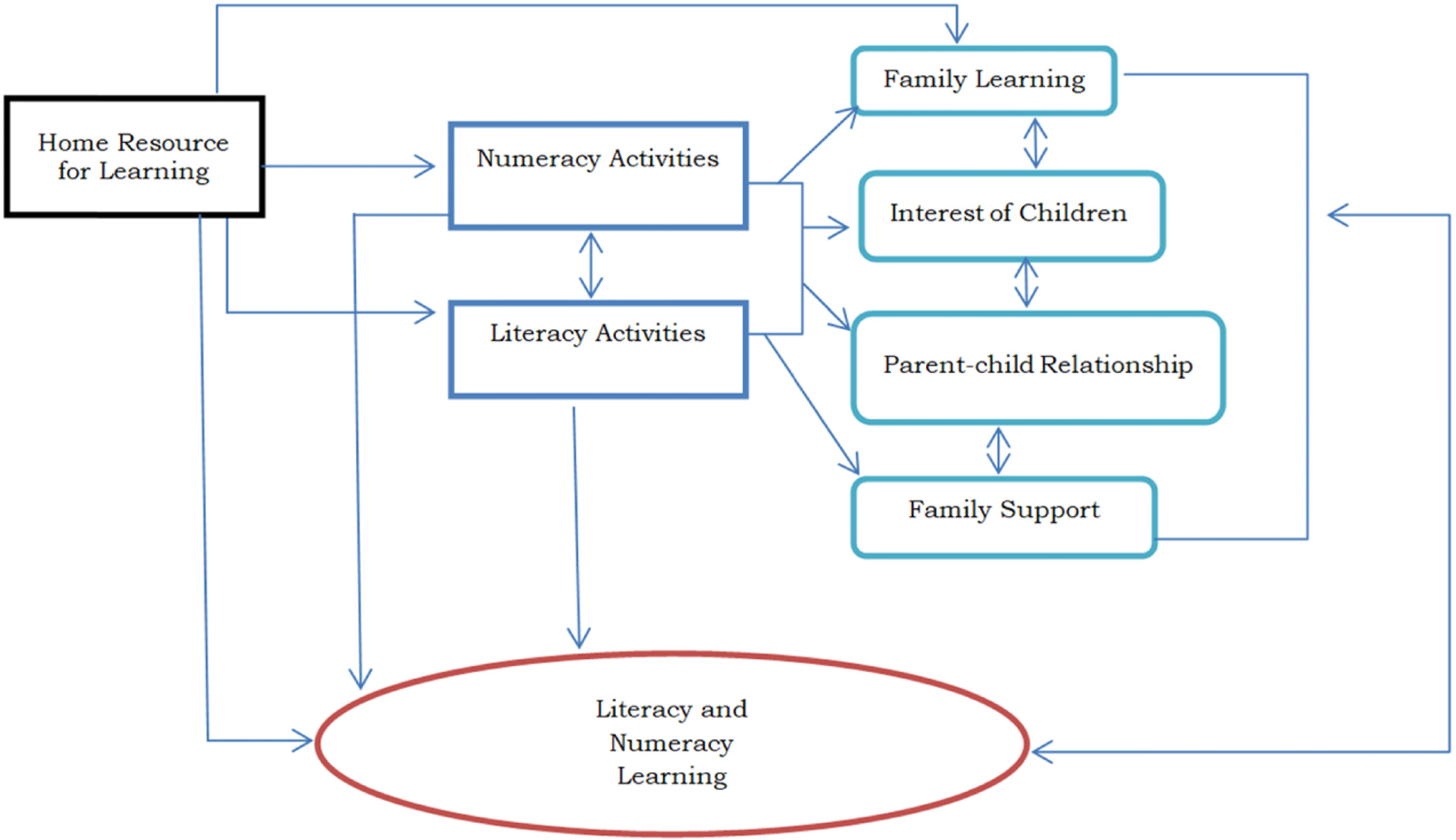
Antecedents of home literacy and numeracy environment (HLNE) influencing learning.
This review study was based on searching various home factors that influence numeracy and literacy learning. The related studies were selected following the steps for conducting a systematic review. The selected studies were evaluated to synthesize the factors affecting the home learning environment and uncover research gaps. Based on the studies reviewed, numeracy and literacy learning is affected by home environment factors. The family's learning background, reading and numerical activities, and home resources were prominent factors among the studies examined.
Family background characteristics explain literacy and numeracy learning differences. Fewer studies found that there are learning differences between children from less-advantaged households and those from more-advantaged households (Jones & Schipper, 2015). Similarly, the World Bank (2018) reported that low-income countries have poor learning outcomes, indicating that a majority of children do not meet the minimum threshold for mathematics and reading proficiency. Communities living in low and middle-income countries, which cover the majority of the world, can have a greater influence on children's outcomes in terms of the home language and literacy environment. Gruijters and Behrman (2020) explored the association between family socio-economic status (SES) and learning outcomes using data from a standardized assessment of pupils’ mathematics and reading competencies. They found three main SES factors contributing to learning: educational resources at home, health and well-being, and school quality. Further research should therefore consider the complexities of literacy and the numeracy learning environments with special reference to differences in literacy and numerical activities, SES, and learning outcomes of children.
Other factors, such as reading, the numeracy interests of children, and parent-child relationship, play an important role in basic learning. The use of home learning techniques improves children's literacy attainment. Snow (1991) mentioned that children growing up in literate families have larger vocabularies and read and write more regularly. Research shows that home language advantage is seen as foundational for learning literacy skills (Karlsen et al., 2017). Future studies should consider other variables, such as the reading interests of children that may contribute to literacy learning.
Similarly, a growing number of studies on home numeracy environments suggest a broad array of numerical activities. These activities include number facts, real-life activities, counting, experimenting with objects, learning through patterns, building block towers, connecting the dots, playing board games, playing card games, shopping and role-playing in cooking. Past empirical research suggests that parents’ home enrichment activities influence literacy and numeracy learning. To complement these studies, future research should examine the link between home learning numeracy and children's reading and numeracy skills and interests.
International studies (e.g., from Costa Rica, Liberia, and India) on home language and literacy environments have addressed pedagogical interventions. These include home-based components of literacy and numeracy, such as the supply of materials, home tutoring, shared book readings, and parent–teacher meetings. Future research should target these above components to have more promising results in literacy and numeracy learning. In relation to this, some of the pedagogical implications are as follows. The home situation can foster FLN. Thus, the curriculum framers and teachers have to emphasize the importance of parenting for literacy and numeracy learning among children. It is certain that key components of acquiring literacy skills must be focused on. Children should be helped to read the text with comprehension, but parents have major concerns about using activity-based home resources, communicating with children in the home language, and providing resources that create interest in learning numbers. Hence, as priority areas of home learning factors, more research can be undertaken on children's numerical activities, home resources, interest in mathematics, family learning, reading and numeracy activities, reading interest, and parent-children relationships.
Limitations
Studies on home literacy and numeracy learning (HLNL) and children's interests in these activities are not consistently documented. Other dimensions of HLNL have been researched, but most of the studies examined, could not give concurrent results in these dimensions. Very few and almost no studies have examined socio-demographic, psycho-social, and socio-economical aspects of the home environment that influence literacy and numeracy learning. Students’ literacy and numeracy activities at home can work as scaffolding for obtaining competencies. These dimensions of research could not be explored in this review.
Footnotes
Contributorship
Dr. Biswajit Behera framed the conceptualization and design of the study. Mr. Mukesh Kumar carried out the reviews of related literature and analyze the studies. Both authors interpreted the results, revised critically, and approved the final manuscript.
Declaration of conflicting interests
The author(s) declared no potential conflicts of interest with respect to the research, authorship, and/or publication of this article.
Funding
The author(s) received no financial support for the research, authorship, and/or publication of this article.
