




Abstract
This article explains Presentation Feedback as a potential Indigenous methodology realised during a research study. Presentation Feedback methodology involves a three-step method and is considered complementary to other methodologies such as Indigenous women’s standpoint theory and shared epistemology and is explained in this article as culture-specific, adding to the existing knowledge in the field of Indigenous ways of knowing. The Presentation Feedback methodology emerging from the research study helped the Indigenous researcher to utilise an Indigenous lens for more effective communication in the presentation of research concepts and themes at different stages of the research process. The researcher used the feedback from Indigenous audience members to reflect on concepts in and progression of the research. The impact was positive and helped the project gain momentum through Indigenous community support.
Keywords
Introduction
My name is Tracy Woodroffe. I was born in Darwin in the Northern Territory; however, my Indigenous family heritage is from Tennant Creek and Finke River in central Australia. I am a Warumungu Luritja woman. I am an educator with many years of teaching experience spanning Early Childhood, Primary, Secondary and Tertiary education contexts. My career began as a primary-trained teacher and changed track after 23 years in mainstream classrooms and office-based positions within the Northern Territory Department of Education, to the tertiary sector where I have continued to use my experience as an educator to teach adults about the skills, knowledge and joy of teaching.
This move to the tertiary sector was a hard decision to make because so much of my professional reputation and identity was defined as being an educator within the Department. The change reinforced for me that aspects of identity are transient, but that the core of who we are stays the same. My strength, and the strength of Indigenous people, is in who we are at the core. The core is our Indigenous knowledge. It is the foundation for our strength of character and our Indigenous perspectives are a uniting force.
Negotiating the expectations of an active research lecturer in higher education has been both interesting and challenging. It has been interesting because I have had the opportunity to research and lecture about my passion of teaching. It has been challenging because I have used my time to address Indigenous educational inequities that I first observed and perceived in my many years as an educator. Indigenous knowledge, teaching skills and experience, as well as a change in career all created the perfect storm which was the impetus to enrol in Doctor of Philosophy studies.
My PhD thesis was titled The importance of including Indigenous knowledge in pre-service teacher education. The study addressed the following research questions – Is it important to include Indigenous knowledge in pre-service teacher education? If so, why? What should be included? During the study, a potential Indigenous methodology was revealed.
Background
The methodology included a combination of aspects of Indigenous women’s standpoint theory (Moreton-Robinson, 2013) and shared epistemology (Dunbar & Christie, 2013) in relation to researching with Indigenous people. Data were collected from Indigenous educators in urban classrooms through semi-structured interviews and participant journaling. Data were analysed using coding, thematic analysis and standpoint theory to shift the focus away from Indigenous people and specifically back onto the Australian education system as it is implemented in the Northern Territory. The study was Indigenous – Indigenous researcher, Indigenous participants and Indigenous methodology. The results comprised the Indigenous educators’ opinions about the inclusion of Indigenous knowledge in teacher education and specifically its relevance to Indigenous teachers, students and compulsory educational contexts.
Power relationships
Discussion of power imbalance in research, and methodological reform to redistribute power in a more equitable way, is important. The Presentation Feedback methodology provides further potential for Indigenous researchers to own Indigenous research. Presenting a piece of work that you know well, in a way that provides the human face and associated emotions, is powerful and provides an image of strength and confidence. Indigenous people are the custodians of Indigenous knowledge. Indigenous researchers know about Indigenous culture and are the experts in this space. Indigenous researchers delivering presentations on Indigenous research topics are often presenting something that has a cultural and personal impact.
Indigenous research
Indigenous research is ‘research through culture’: it ‘requires considerable commitment on the part of the researcher to figure out how to put this abstract [Indigenous research] agenda into practice in relation to a particular research project’ (Porsanger, 2004, p. 113). Indigenous methodology and methods are tools of empowerment to showcase Indigenous strengths through research.
Indigenous research can take several forms: it may also mean a non-Indigenous researcher working with an Indigenous community to address an issue, or a non-Indigenous researcher studying aspects of Indigenous society and culture.
The main differences are ones of standpoint and interpretation. The Indigenous researcher can identify with and understand an issue or Indigenous research participants from a common position, an Indigenous standpoint. This impacts on the design, methodology and analysis of a study resulting in a presentation of the research where the Indigenous voice is foundational and explicit. Findings are presented through an Indigenous lens, creating an environment where the Indigenous researcher and Indigenous participants can imagine a different future for Indigenous people (Smith, 2012). Porsanger explains, ‘“Our purposes” are those of indigenous peoples, and “our own perspectives” are the indigenous approaches’ (Porsanger, 2004, p. 107). Indigenous people operate in a way that is representative of Indigenous values and Indigenous priorities. The fact that Indigenous culture is represented in research is important (Kovach, 2009) because there is not just one way of thinking and knowing.
PhD study: reflective
Reflective practice is a major aspect of the PhD process and noting the shifts in one’s thinking throughout the process adds to the richness of the findings. The experiential nature of qualitative research means that it reveals newness, which should be embraced. The opportunities that are revealed present themselves as further information to be explored. The learning then forms a basis for future research, just as Rigney’s (2006) work about Indigenist research contributed to knowledge in the field, paving the way for other Indigenous researchers.
Ethics
It is very important to emphasise that Presentation Feedback was not employed as a methodology within the PhD research study described. The potential of the approach was only recognised after the fact and described as an emerging finding. Elements of the Presentation Feedback approach were manifested only incidentally, as steps that seemed appropriate and necessary for an Indigenous researcher. No recordings were made of the presentations conducted or the collection of materials or data. The Presentation Feedback methodology is presented in this article as a potential research methodology to be used in future research, as a formalised process for data collection. Choosing this methodology as an approach in a research study would require ethical approval.
The Australian Institute of Aboriginal and Torres Strait Islander Studies (AIATSIS) 2019 Revision of the AIATSIS Guidelines for Ethical Research in Australian Indigenous Studies outlines the need for researchers to consider the principles of Indigenous self-determination, Indigenous leadership, impact and value, sustainability and accountability. These principles have ‘integrity’ as their core ethical value.
Context and method
Throughout the research process, the researcher presented key concepts, developments and findings in various presentations at conferences or symposia, a number of which had an Indigenous focus or were organised under the auspices of Indigenous specialist groups or organisations in which Indigenous people participate. For example, in the case of the WIPCE conference, this is an international gathering of World Indigenous People’s Conference on Education. It is organised by Indigenous people, with Indigenous topics shaping the conference program. Indigenous people lead presentations. Both Indigenous and non-Indigenous people attend. The many Indigenous people in the audience are very interested to hear other Indigenous people present their work. My reflection of being a presenter at a WIPCE conference is that the Indigenous audience are very receptive and supportive, creating a space that feels culturally safe. This is like although not the same as presenting at a conference such as the annual AARE conference where the Indigenous presentations are managed by the Indigenous education Special Interest Group. The focus of the conference is not Indigenous. Both contexts provided me with opportunities to express myself as an Indigenous researcher and to infuse my Indigeneity into presentation platforms.
Indigenous research methodologies are a growing field, as more Indigenous people succeed in their educational aspirations and then explore and explain this process. This input is valuable because it increases the Indigenous presence in higher education and reshapes or challenges Western norms in research methods. Indigenous research increases potential for Indigenous engagement (Ford et al., 2018) through research principles, such as those listed below applicable to Presentation Feedback, which can guide the researcher.
Recognition and respect – Indigenous knowledge and culture is respected and recognised as relevant and part of the guidance or support offered by the Indigenous community for the research being conducted. Indigenous peoples have a right to participate in research significant to or impacting on them. Informed consent – the audience must be informed about the scope of the research and implications of participation, including their possible role in assisting the researcher to progress their work. Potential participants need to be given the opportunity to exclude themselves. Indigenous-led research – the research methodology is ideal for Indigenous-led research due to the sociocultural nature of the data collection. Community support for the presentation and audience interest could bolster Indigenous-led research. Indigenous perspectives and participation – Indigenous people have Indigenous perspectives. The Presentation Feedback methodology could provide an opportunity for Indigenous perspectives to be presented and discussed, perhaps encouraging, and showcasing further Indigenous participation.
Presentation Feedback as a process enabled me, as an Indigenous researcher, to make an Indigenous interpretation, adding to the strength of the Indigenous voice in the PhD research study in question. The focus on the Indigenous voice regarding education in Australia and the place of Indigenous knowledge in education was a priority in the research.
Presentation Feedback
Presentation Feedback methodology will incorporate support from the Indigenous community during presentations, to guide the development of thoughts and concepts. This will create a framework of deep listening to accommodate Indigenous knowledge through relationality, to complete a cycle of effective communication which emphasises Indigenous ways of thinking, understanding and knowing. The implementation of this methodology, or the method, can best be explained in three steps embedded within different stages of research.
Writing (Indigenous epistemology) – primarily about Indigenous epistemology and connections with the topic of study. In this case with research question 1, to do with Indigenous knowledge and the importance of its inclusion in Australian teacher training.
The research study highlighted in this article began with the writing of an initial literature review in the context of a PhD proposal. This proposal was developed further and shaped into a document that could be read and understood by both an Indigenous and a non-Indigenous audience, taking on a transdisciplinary aspect as information crosses between knowledge systems: Indigenous and non-Indigenous (Christie, 2006). The writing maintained an Indigenous viewpoint throughout. It was significant in conveying Indigenous views, experience and knowledge about education and utilised Indigenous women’s standpoint theory while focusing on the Australian education system.
2. Talking and observing (oral traditions of knowledge transmission) – about knowledge known and expressed as an oral presentation. Oral communication requires both expressive and receptive skills. So, while you present, you are observing how the audience is receiving and reacting to your words. Non-verbal cues are fundamental. This stage can be connected with gauging the audience opinion or reaction to the topic’s importance and then judgement needed for research questions 2 and 3 – why is the inclusion of Indigenous knowledge important and which knowledge are we talking about in links with education?
The literature review was developed into a conference paper presentation. During the presentation, I engaged with the audience, which included other Indigenous educators, and invited further feedback and discussion after the session had finished. The method engaged a process of thinking and explaining the research to others through verbalisation.
While conversational method is seen in Western qualitative research, it changes with the addition of an Indigenous framework. Kovach (2019) describes this as a) it is linked to a particular tribal epistemology (or knowledge) and situated within an Indigenous paradigm; b) it is relational; c) it is purposeful (most often involving a decolonising aim); d) it involves particular protocol as determined by the epistemology and/or place; e) it involves an informality and flexibility; f) it is collaborative and dialogic, and g) it is reflexive, (p. 128)
The main skill required in talking was observation. Observing while talking is of paramount importance to the engagement with the audience. The presenter scans the audience and notes their understanding and reactions. This reading of physical and non-verbal responses will be very important to a Presentation Feedback methodology and could be considered a culture-specific skill in its inclusion of non-verbal communication.
There is cultural significance in the way the non-verbal responses from Indigenous members of the audience are interpreted and understood in particular ways by the Indigenous presenter: ‘Some non-verbal communication cues (hand gestures, facial expressions etc.) used by Aboriginal and Torres Strait Islander people have different meanings in the Western context’ (Cultural Capability Team, Queensland Health, 2015, p. 1). This leads us to the next step in the process.
3. Listening (Indigenous feedback – relational ethic and sensibility) – an informal noting or collection of feedback from the Indigenous audience. This stage is about interpreting and understanding the Indigenous meanings conveyed. It requires an Indigenous perspective. In the PhD research study, I listened to feedback from various members of the audience, but the priority was to listen to the Indigenous voices. This was the purpose of the research project. The process involved a deeper listening by connecting through cultural understandings of what the research topic means to Indigenous Australians, similar to deep listening or Dadirri as described by Ungunmerr- Baumann (1988).
At each stage, the feedback contributed to self-reflection and to the deeper investigation of concepts and theories, bringing a sense of achievement and of being on the right path to answer the research questions to the satisfaction and benefit of the wider Indigenous community. The process was also relevant to the international Indigenous context. This became evident in the way that international Indigenous audience members engaged with me on different occasions. Ober (2017) summed this up best when she stated that ‘there are alternative research methodologies that are a better fit for Aboriginal and Torres Strait Islander people rather than following a strictly western academic approach’ (p. 9).
Overall (the diagram)
The segments in Figure 1 represent the respective steps in the method, as labelled. The outside arrow emphasises the circular nature of the repeated process. What is also highlighted is the importance of Indigenous voice being interpreted and explained during the Writing phase by an Indigenous researcher rather than an Indigenous standpoint being reinterpreted through a non-Indigenous researcher lens.
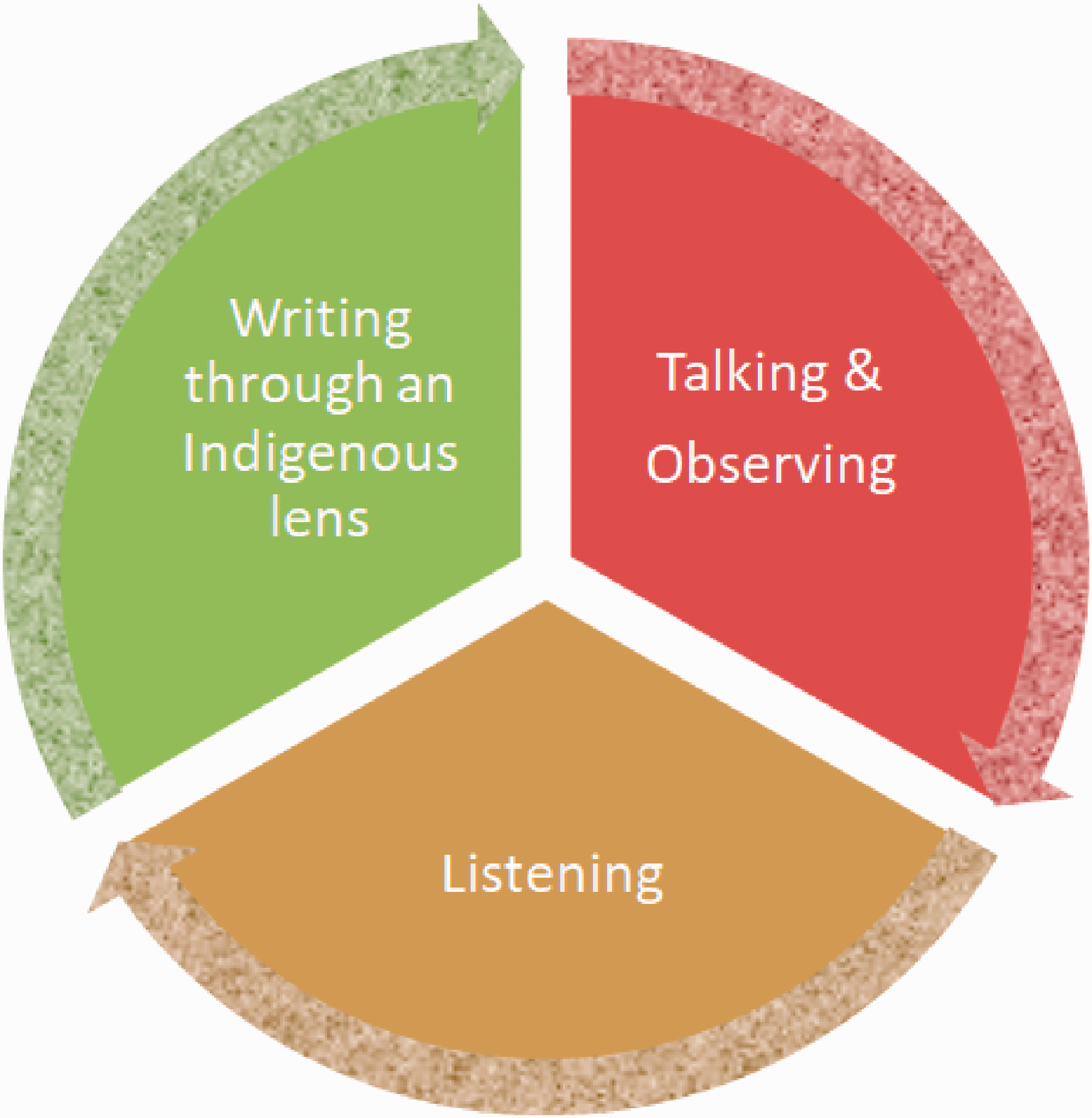
Presentation Feedback steps.
Limitations and assumptions
What is significant in the Presentation Feedback methodology is the common or shared understanding of the research topic from an Indigenous standpoint. Speaking and explaining something orally is a skill, but the ability to do so to the benefit of community discourse is invaluable (Rogers, 2018).
The question of identity is fundamental to the communication of the research study and to the reception of the information by the audience. The communication loop was completed as I observed and listened to audience response and feedback, filtering these to focus on the Indigenous voice.
Assumption of audience and Indigeneity
The proposed methodology has implications in terms of identity. The researcher is Indigenous and declares this at the beginning of the presentation for purposes of relationality, making connections with other Indigenous peoples in the audience. This effort to connect is inherent to Indigenous knowledges and cultural expectations. The presenter reveals something of themselves and requires or expects reciprocity, either in connection with members of the audience or in a generosity of spirit by which Indigenous peoples might encourage each other. Thus, the presenter introduces themselves, but the audience members do not necessarily get the same opportunity. The presenter may be left making assumptions about audience members’ identity.
Making assumptions about audience Indigeneity could detract from the credibility of the methodology. Obtaining informed consent and following cultural protocols may mitigate this risk. It is necessary to consider issues of assumption related to identity. Identity is complex and Indigenous peoples have been defined by others as part of colonisation. Audience members should be given the opportunity to self-identify.
Potential of missing of non-verbal cues
The methodology was enhanced during discussion after each presentation, particularly when questions were posed by non-Indigenous audience members. In answering these questions, I continued to observe non-verbal indications of Indigenous agreement or approval. At times, Indigenous members of the audience showed further support for and engagement with the topic by adding to answers given or even by answering a question for me infused with their own Indigenous understanding and framing. In these instances, the audience comments added to the Indigenous interpretation of the research questions. One of these instances was about Indigenous educational leadership and the conversation included highlighting the cultural obligation embedded in this specific type of leadership. The Indigenous members of the audience were united with me as Indigenous community members. ‘Successful communication unites people in that it creates for them a sense of inhabiting a shared world of meaning’ (Klapproth, 2009, p. 324).
How to deal with non-motivating or negative feedback
The findings based on the Presentation Feedback methodology were positive. The methodology added to the sense of Indigenous community and the common goal of improving the Australian education system. This helped the research study to reach completion in half the time expected – four years part-time, rather than eight by providing a type of momentum to continue and added to the sense of importance of the research.
While it was not my experience, there is the possibility of negative audience responses. In this case, it would be up to the researcher to then decide what to make of the response and in what way was it negative. If the negativity was purely a misunderstanding or misinterpretation of what the Indigenous researcher was saying, then some clarification would be required. Prior to that though, the first consideration would be whether the presenter’s Indigenous standpoint or perspective was understood by the audience. This may not always be the case.
Conclusions and Indigenous significance
Indigenous significance
The potential of Presentation Feedback as a methodology lies in the connections forged with Indigenous knowledges. Indigenous knowledge links epistemology (Knowing) and ontology (Being) via relationality. Through relationality, our epistemology contains our ontology. That means our connections to community and each other inform our knowledge, including of how to be Indigenous (Martin, 2003). Continuing with this line of thinking, relatedness theory is applied differently depending on the ontology of the researcher shaping and interpreting the research (Rogers, 2017). Similarly, further deconstructing Indigenous knowledge, Doing describes how a researcher conducts the research. For Indigenous researchers, the wider Indigenous community is very important in providing guidance (Rogers, 2017).
The social interaction in the presentation of the research is important. The informal presentation of research might be considered in terms of narrative; for example, an Indigenous researcher might present qualitative research with a focus on individual stories. Oral traditions in Aboriginal culture and the cultural distinctions of the narrative format and purpose have been discussed by Klapproth (2009). Accordingly, the presentation of research by an Indigenous researcher may be understood and interpreted by Indigenous audience members in a culturally specific way. The same could be said about the interpretation of feedback given to the researcher by such audiences.
Presenting research in a format based on Indigenous emphasis on narrative and orality enables the Indigenous researcher to communicate their work effectively, making use of the skills and strengths of these types of communication to interpret feedback.
Conclusions
The methodology described in this article benefits the person presenting, given the combined support of other Indigenous people in the audience. Moreton-Robinson states that, ‘We are involved in a constant battle to authorise Indigenous knowledges and methodologies as legitimate and valued components of research’ (2013, p. 31). That is, we as Indigenous people are in a constant battle to change the power relations which place us at a disadvantage.
It is important for Indigenous researchers to explain their research processes if other potential Indigenous researchers are to see themselves represented in academia. Such representation often takes the form of participation in research. It is important for Indigenous people to become researchers and analyse their results through an Indigenous lens, if Indigenous voices are to be truly represented without any filter.
Existing Indigenous methodologies, such as Indigenous standpoint theory (Foley, 2006; Nakata, 2007; Porsanger, 2004), Indigenous women’s standpoint theory (Moreton-Robinson, 2013), photostory (Rogers, 2018) and yarning (Bessarab & Ng’andu, 2010), have added to the rich fabric of cultural identity that is explored and represented in research. Additionally, Porsanger (2004) reminds us that Indigenous research and research methodologies strengthen our identity as Indigenous peoples.
Presentation Feedback methodology was used unconsciously but in a culturally specific way to progress Indigenous research. The realisation of the methodology required self-reflection on the process of verbalising and explaining the research project to an audience, as well as a consideration of how the creation of new knowledge had progressed in the project with regard to key concepts and themes across the various stages of the research. The Presentation Feedback methodology provided a new opportunity to deepen understandings about the research questions and to go beyond Western research methods to incorporate a three-step process integrating Indigenous perspectives and analysis. Presentation Feedback is another option for an Indigenous researcher to enact an Indigenous method within an overarching Indigenous methodology.
Footnotes
Declaration of Conflicting Interests
The author(s) declared no potential conflicts of interest with respect to the research, authorship, and/or publication of this article.
Funding
The author(s) received no financial support for the research, authorship, and/or publication of this article.
