




Abstract
Subjects such as Health and Physical Education (HPE) can be marginalised in schools because they are construed as less academically rigorous and less important to the primary mission of education. Teachers of all subjects face challenges, yet, teaching a marginalised subject can result in additional challenges for HPE teachers. Previous research has noted these challenges; however, less is known about how these challenges vary according to student age and teacher experience. This study used quantitative survey methods to ascertain which challenges are the most difficult for Australian HPE teachers, and whether this difficulty varies according to their teaching experience and the ages of their students. Findings indicated that the year level of students taught by HPE teachers was significantly associated with student engagement and isolation within their schools. Years of teaching experience was significantly associated with challenges in teaching students with special needs, with more experienced teachers rating this area as less of a challenge than less experienced teachers.
Keywords
Introduction
School subjects receive differing levels of priority and status. Research (Gaudreault et al., 2018; Richards et al., 2014) has noted education stakeholders ascribe higher status to subjects such as maths and science which are considered more academically rigorous and more centrally aligned to the academic priorities of the school. The hierarchical nature of the Australian Curriculum has been reinforced by Australia’s National Assessment Program for Literacy and Numeracy which requires all Year 3, 5, 7 and 9 students to undertake annual standardised tests in literacy and numeracy (Bleazby, 2015; Thomas, 2019). This heavy emphasis placed on improving numeracy and literacy has narrowed the curriculum to focus on testable content (Bleazby, 2015). The narrowing of the curriculum has also marginalised other, traditionally lower status, curriculum content such as Health and Physical Education (HPE) and the Arts which are often not afforded the time allocation they require (Bleazby, 2015; Curry, 2012). Numerous researchers (e.g. Armour, 1999; Kougioumtzis et al., 2011; Lux & McCullick, 2011) have noted the historically low status of HPE, with Paul (1996) concluding that it “has never been accepted in the same vein as other educational subjects” (p. 541) and Sparks et al. (1993) stating that HPE is “peripheral to the central functions of the school” and “a marginal subject” (p. 387).
Teachers can be considered less important, or of less status, because of the subject they teach (Richards et al., 2014). HPE teachers may receive both explicit and implicit messages their subject is of less importance than others (Richards et al., 2014), which can lead to feelings of isolation and marginalisation within their schools. HPE teachers can be affected by the perception that they teach a subject that is less critical to students’ education, with some education stakeholders viewing HPE as nothing more than a break in the academic day for classroom teachers to plan (Gaudreault et al., 2018; Richards et al., 2014). Global media reporting can often focus on the physical crisis with HPE (e.g. limited physical activity (PA) or obesity discourses), rather than celebrating achievements (Hyndman et al., 2020). Other unhelpful discourses which influence public perceptions and learning exposures (Wrench & Garrett, 2018) toward the marginalisation of HPE include HPE practical classes being depicted as bullying hubs within numerous movie scenes (Walton-Fisette et al., 2017). Yet there are numerous, holistic, well-documented and researched benefits of participation in HPE that include lifestyle, affective, social and cognitive enhancements (Bailey et al., 2009). Despite the holistic outcomes associated with HPE, it can be extremely difficult to provide quality HPE experiences in schools if the subject is afforded lower priority according to status, resources and time allocation. Globally, HPE teachers continue to refer to themselves as marginalised professionals in a constant struggle for the legitimacy of their subject (Gaudreault et al., 2018; Lux & McCullick, 2011; Whipp et al., 2007). Moreover, the marginalisation of HPE is not assisted by many Australian generalist primary school teachers having to deliver the subject with little HPE training experience, qualification or self-confidence (DeCorby et al., 2005; Lynch, 2013; Morgan & Bourke, 2005). It has been recognised that almost one in four that are teaching HPE in Australian primary schools does not have a HPE-specific qualification, yet they could be given responsibility for the entire HPE learning area (Lynch, 2013). This may be one reason HPE (or elements of the learning area) in primary schools are increasingly being outsourced to a range of providers that offer curriculum resources and/or delivery to schools (Hogan & Stylianou, 2018; Stylianou et al., 2019).
Health and Physical Education in Australian schools
The period between the late 1980s and early 1990s did not help the cause of HPE’s presence in Australian schools. Many experienced scholars have described this period as a crisis for Australia’s HPE school curricula (Dinan-Thompson, 2009; Tinning et al., 1994). A senate investigation into the state of HPE within Australian education systems concluded that there were (a) declining opportunities for school children to experience quality HPE; (b) limited resources to deliver HPE and (c) declines in children’s fitness and physical skill levels (Dinan-Thompson, 2009; Tinning et al., 1994). These and other scholars (e.g. Cruickshank & Swabey, 2013; Richards et al., 2014) have referred to how the traditional, ‘common PE method’ of HPE pedagogy, utilising a direct style, repetitive drills and practice, have led to the marginalisation of HPE. This pedagogical approach has also been described as a ‘demonstrate-explain-practice’ method of teaching (Tinning, 2010). Moreover, there has been confusion across Australia and worldwide regarding the momentum toward replacing the terminology of ‘physical education’ with ‘physical literacy’ (Hyndman & Pill, 2018). Scholars describe such a conceptual move as creating unhelpful confusion toward an already confused discipline (Corbin, 2016; Lounsbery & McKenzie, 2015; Lynch & Soukup, 2016).
Historically, the PE component of HPE had been based on a philosophy singularly focusing on the body (e.g. considering the body as a ‘thing’ or ‘object’; Lynch & Soukup, 2016). A perceived separate focus on the body (without considering the mind) has rendered PE to be considered the ‘non thinking thing’ and given less educational status (Dodd, 2015). This perception has been in contrast to modern, sociocultural philosophies of HPE which encompass a holistic discourse considering the ‘entire person’ (e.g. body, spirit, mind and well-being). Lynch and Soukup (2016) believe the earlier bodily emphases stem from the military, scientific and sporting underpinnings that set initial foundations for HPE. Yet, they describe such discourses as being accompanied by harmful ideologies of elitism, sexism, healthism and individualism.
Further to this, Health Education (HE) in Australia was amalgamated with Physical Education in the first national curriculum document in the mid-1990s to form the Learning Area: Health and Physical Education (Curriculum Corporation, 1994; Pill, 2012). The development of the Australian Curriculum: Health and Physical Education cemented the subject association between HE and PE (Fane et al., 2019), and Australian schools are now required to teach HE as part of HPE via the content strand ‘Personal, social and community health’ (Australian Curriculum and Assessment Authority (ACARA, 2020). However, there is inequity in the division of curriculum time allocated to HE compared to PE, with HE representing only one-third of the available HPE curriculum time (Barwood et al., 2017). There are also inconsistencies in the qualifications and training of the teachers delivering HE in both primary schools and secondary schools (Barwood et al., 2017) which often leads to health education being outsourced (Macdonald, 2015; Penney & Mitchell, 2017; Whipp et al., 2011).
The challenges of marginalisation
Despite mounting research demonstrating (a) the significant impact HE has on supporting and strengthening the physical and mental health and well-being of young people, (b) the positive impacts from PA participation on cognitive development and (c) the global momentum for more student-centred HPE pedagogies to promote school students’ engagement, HPE remains marginalised. Research has revealed that the effects of this marginalisation is felt by HPE teachers in their daily work-lives (e.g. Blankenship & Coleman, 2009; Henninger, 2007; Mäkelä et al., 2015), and that it can have a negative influence on their mental well-being, sense of worth, resilience to burnout, motivation to teach and the quality of their programmes.
Occupying a position of marginality can result in a number of challenges for HPE teachers. Teachers of all subjects face challenges, including curriculum planning (Henson, 2015), professional development (Girvan et al., 2016), a crowded curriculum (Paynter, 2018), technology integration (Keane & Keane, 2017), student diversity (Westwood, 2018), student engagement (Strati et al., 2017) and a lack of time due to workload intensification (Schuck et al., 2018). Yet, HPE teachers across the globe can also face unique challenges specific to their discipline, such as physical isolation within the school, a lack of appropriate resources and specialist-teaching facilities, student self-consciousness related to puberty and self-image, and expectations to be an exemplar of fitness and a healthy lifestyle (Blankenship & Coleman, 2009; Davis, Zhu & Haegele, 2018; González-Calvo et al., 2019; Mitchell et al., 2015; Usher, Edwards, et al., 2016; Whipp et al., 2007). Australian research conducted by Morgan and Hansen (2008) classified the challenges faced by HPE teachers as being either institutional (outside the teachers’ control) or teacher-related (arising from the teachers’ behaviour). Many of these challenges and concerns toward HPE teaching start to surface during teacher training (Hyndman, 2017), with some Australian pre-service teachers having concerns as to whether HPE will be “taken seriously” during their future teaching practices. Despite being part of the Foundation to Year 10 curriculum in Australia, HPE is yet to be part of the national senior secondary focuses (Hyndman & Pill, 2017), which focuses on English, Science, Mathematics and the Humanities (ACARA, 2020). Hyndman and Pill (2017) also describe a lack of continuity and consistency from Australia’s foundation HPE curriculum into senior secondary HPE across states as being problematic, resulting in differences between the states in the focus placed on practical, theoretical and content areas.
Developing insight into the challenges HPE practitioners experience can help ensure future professional development or training programmes can better cater for teachers’ needs (Hyndman, 2017; Hyndman & Pill, 2016). Designing professional development opportunities to address and align with the challenges faced by HPE teachers can ensure the delivery of school HPE opportunities are able to be enhanced to benefit the next generations (Hyndman, 2014). For instance, Wiegand et al. (2004, p. 7) state the quality of future HPE teaching will ‘depend on the insights and commitments of the professionals responsible for future curriculum decisions’. Unpacking and exploring these HPE teaching challenges can also promote reflective practices among teachers, and help evaluate their practices and fine-tune their pedagogies (Brookfield, 1995).
The current study
Although previous research has indicated HPE teachers face a multitude of challenges and many of these challenges are related to the marginalisation of their subject, less is known about how these challenges vary according to the year level of students within HPE teachers’ classes and their years of teaching experience. Therefore, this study aims to ascertain which challenges are the most difficult for Australian HPE teachers, and whether this difficulty varies according to their level of teaching experience and the ages of students within their classrooms.
Method
Information focused on the challenges faced by Australian HPE teachers was sought through collaboration with the Australian Council for Health, Physical Education and Recreation (ACHPER), who is the leading professional body for Australian HPE teachers. To better cater for the needs of their members and stakeholders, many ACHPER state branches regularly ask for anonymous feedback from their professional learning event participants to determine the success of their events and inform the planning of future events. Identifying the key challenges faced by their stakeholders is a crucial element of this process as it allows branches to plan future professional learning sessions focused on assisting HPE teachers develop the capacity to better cope with these challenges. Through collaboration with ACHPER, the research team developed an online survey tool based on the recommendations of Senocak (2009). This process allowed for the validity and reliability of our survey to be tested through four stages: item formulation derived from an initial qualitative phase, content validation through an expert panel, reliability analysis and construct validation of the survey items.
Item formulation
In 2016, prior to the present study, ACHPER Victoria included an open-ended question in their anonymous conference feedback forms which asked participants “What is the biggest challenge you face as a HPE teacher?” Two ACHPER Victoria staff members independently coded these responses (N = 1305) into themes before sharing their coding with each other. All minor disagreements were discussed before the final coding was agreed upon. Twelve separate challenge themes were classified, all of which had been identified by previous research with HPE teachers (e.g. Gaudreault et al., 2018; Jenkinson & Benson, 2010). ACHPER Tasmania then replicated this approach at a professional learning event later in 2016. All responses (N = 36) gathered by ACHPER Tasmania were coded utilising the same procedure and classification as previously identified by ACHPER Victoria.
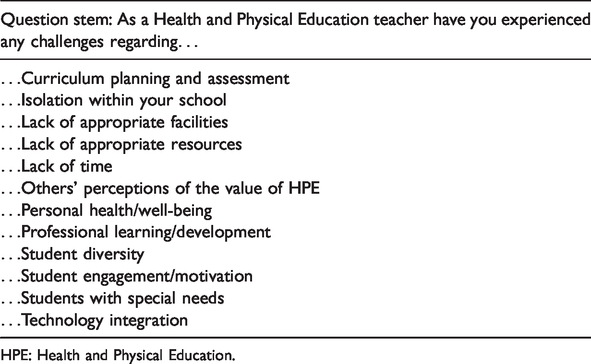
In 2017 the research team, in collaboration with ACHPER Tasmania, expanded on this process by using these challenges to formulate survey items (Table 1). Participants at the state conference were asked to rate these 12 challenges on a 7-point Likert-type scale that extended from 1 ‘not a challenge’ to 7 ‘critical challenge’. Consistent with relevant broader focused educational scales (Andersen & Pickeral, 2000; Cruickshank et al., 2015), all statements were worded in a positive direction. Participants were also given the opportunity to provide qualitative responses detailing their three most difficult challenges and the strategies they used to cope with them.
Survey items.
HPE: Health and Physical Education.
Content validity
To establish content validity, the items were reviewed by an expert panel consisting of two university lecturers in HPE, one female primary school principal and HPE teacher, one male college HPE teacher, three female high school HPE teachers, two male high school HPE teachers, one male primary school HPE teacher and one female primary school HPE teacher. This panel was chosen to ensure a wide range of teaching experiences in a variety of contexts were considered during the validation process. The panel was informed of the purpose of the scale and what it was intended to measure (namely the challenges faced by HPE teachers, as perceived by practicing HPE teachers). Panel members were then asked to provide feedback and propose suggestions for improvement. The panel proposed a variety of minor changes, including edits to the information contained in the introduction to the scale to increase clarity, and rewording of the open-ended questions surrounding coping strategies. Once these changes had been implemented, the expert panel concluded that the 12-item scale had sufficient content validity because it adequately covered the intended construct.
Participants
One hundred and twenty-seven HPE teachers who attended the 2017 ACHPER Tasmania state conference were invited to complete the survey. A total of 88 HPE teachers completed the survey, which represents a 69% response rate. Demographic data were collected around the key variables of interest – the year level of the students they taught (primary, secondary and senior secondary) and the years of teaching experience they had. These demographic characteristics were used as the independent variable levels for the inferential analysis described below. Participant demographic data are presented in Table 3.
Procedures
The study was approved by the Tasmanian Human Research Ethics Committee (No. H0016885) and all participants provided informed consent prior to beginning the online scale. ACHPER Tasmania emailed the survey link to participants via the email they provided during their conference registration. Once participants accessed the online scale and provided their consent, they were able to complete the demographic questions and respond to the 12 items regarding the challenges they faced as HPE teachers. All responses were anonymous.
Data analysis
The reliability and construct validity of the survey were analysed using Cronbach’s alpha (α) reliability coefficient (Cronbach, 1951) and Rasch (1960) analysis, respectively. Cronbach’s α coefficient is a specific measure of the degree to which items within the survey measure the same construct as other items in the survey. This measure of reliability was used in this study because it provides a good estimate of reliability in most situations (Nunnally, 1978).
Within Rasch modelling, construct validity is determined by considering the fit to the model of the scale items and the participants (Wright & Masters, 1982). The first assumption of the Rasch model is that the items measure a single, unidimensional construct – in this case, the challenges faced by HPE teachers. Results of a Rasch analysis can be used to assess construct validity. More specifically, infit and outfit values that examine the fit of the data to the Rasch model and variable maps indicating item difficulty. Mean infit and outfit scores show the amount of distortion in the measurement system and whether the items and participant responses fit the model (Cruickshank et al., 2018). This measurement of fit for items and persons is shown in mean square values (MNSQs) and standardised z-score values (ZSTDs). MNSQs between 0.6 and 1.4 are generally deemed to be acceptable for Likert-scale items (Bond & Fox, 2007), with acceptable ZSTD values falling between ± 2.
The second aspect of construct validity is that the survey items measure what they intend to measure. This relies on a qualitative assessment of the variable maps which depict construct output derived through the Rasch model analysis (Cruickshank et al., 2018). Rasch measurement provides a means of applying a criterion-referenced approach to this interpretation (Griffin, 2007). Items are distributed along the scale in order of difficulty, and the groupings of items at different points indicate similar levels of difficulty. We utilised this profile to group perceptions of the challenges measured in our survey. The relative difficulty of the items is shown in logits, which is a basic unit of Rasch measurement. Logit values are distributed around a mean of 0 logits.
Medians and inter-quartile ranges (IQR) were used to report central tendency and dispersion for each challenge by total sample, the year level (e.g. grade) of students within teachers’ classes and years of teaching experience. To determine the association between each of the 12 challenges (dependent variables) and the 2 independent demographic variables (year level of students within teachers’ classes and years of teaching experience), a series of Kruskal–Wallis equality-of-populations rank tests were performed. An alpha level of 0.05 was used to test for any significant differences. Where a Kruskal–Wallis test showed a significant difference, the Dunn’s post-hoc multiple-comparison test (with a Hochberg correction) was used to identify which of the groups differed from each other. Only significant findings are interpreted in the ‘Discussion’ section. All analyses were conducted using STATA software (version 16.0, Statacorp, College Station, TX, USA).
Results
Reliability
The 12-item challenges scale showed a relatively high Cronbach’s α level of 0.88. This result indicates that survey items had a high level of internal consistency (Cruickshank et al., 2018).
Construct validity
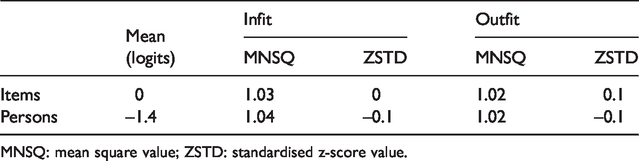
Infit and outfit scores for items and persons all fell within the required 0.6–1.4 MNSQ and ± 2 ZSTD ranges (see Table 2) indicating a good fit of the data to the Rasch model and therefore strong construct validity.
Mean Infit and Outfit scores for items and persons.
MNSQ: mean square value; ZSTD: standardised z-score value.
Figure 1 demonstrates the relationship between participants, items and the construct of challenges faced by HPE teachers, and their alignment on a single measurement scale. Analysis of this variable map indicates distinct ‘steps’ (Cruickshank et al., 2018) between items or groups of items. The data appear to be inverted because it uses a scale of difficulty, and the term ‘challenge’ is generally perceived as a negative emotion. Consequently, the positioning of the items involving time, curriculum and others’ perceptions of HPE at the bottom of the scale indicates participants perceived these items as the most difficult challenges they faced. This is in line with the descriptive findings in Table 3, in which these challenges were assigned higher scores, on average, than other challenges. Thus, the Rasch analysis indicated that the survey exhibited high internal reliability and construct validity.
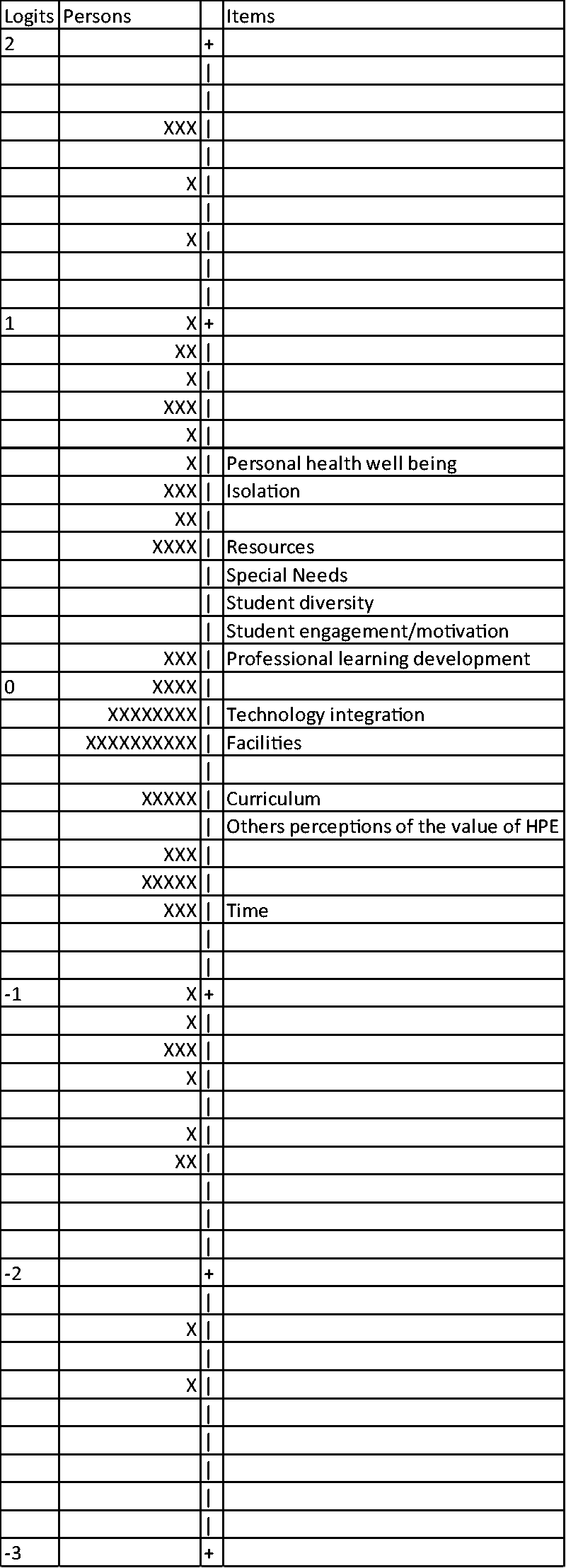
Variable map showing item difficulty and participants’ perceptions of these items.
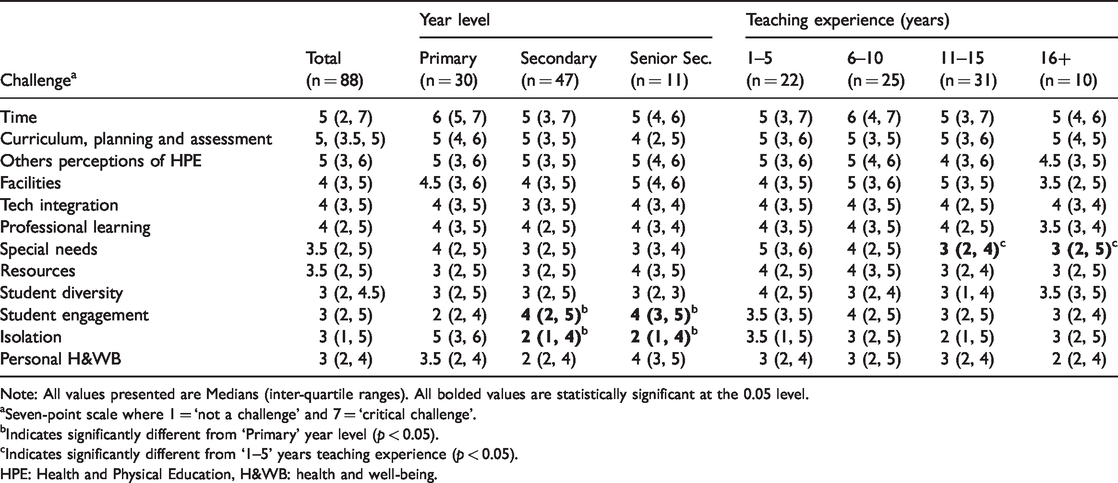
Median and inter-quartile ranges of survey responses by total sample, year level and years of teaching experience.
Note: All values presented are Medians (inter-quartile ranges). All bolded values are statistically significant at the 0.05 level.
aSeven-point scale where 1 = ‘not a challenge’ and 7 = ‘critical challenge’.
bIndicates significantly different from ‘Primary’ year level (p < 0.05).
cIndicates significantly different from ‘1–5’ years teaching experience (p < 0.05).
HPE: Health and Physical Education, H&WB: health and well-being.
Descriptive statistics
Medians and IQR of the scores assigned by the respondents for each of the 12 challenge variables, by the total sample, year level of students within teachers’ classes and years of teaching experience are shown in Table 3. These data indicated that the challenges concerning time (Median = 5, IQR = 2, 7)), curriculum, planning and assessment (Median = 5, IQR = 3.5, 5), and others’ perceptions of HPE (Median = 5, IQR = 3, 6)) were the most difficult for participants overall to deal with. These areas remained the most highly ranked challenges when responses were compared across primary, secondary and senior secondary classes, and across teachers’ years of experience.
Inferential
A series of Kruskal–Wallis equality-of-populations rank tests found three significant associations (p < 0.05) between the independent demographic variables (student year level and years of teaching experience) and the dependent variables (HPE teaching challenges). Student year level was significantly associated with ‘student engagement’ and ‘isolation within the school’ (p = 0.006 and p = 0.001, respectively), while years of teaching experience was significantly associated with ‘special needs’ (p = 0.01). For these three significant associations, the Dunn’s post hoc test (with a Hochberg correction) was applied to identify which of the groups differed significantly from each other (Table 3). Primary school HPE teachers ranked isolation within their school as a significantly greater challenge than did secondary or senior secondary HPE teachers. In contrast, senior secondary and secondary HPE teachers ranked student engagement/motivation as a significantly greater challenge than primary school HPE teachers. The more experienced HPE teachers (11+ years of teaching experience) ranked ‘students with special needs’ as a significantly lower challenge, compared to those with less teaching experience.
Discussion
Participants indicated that the challenges concerning time, curriculum, planning and assessment, and others’ perceptions of HPE were the most difficult they faced in their schools. These challenges have been identified by previous research with HPE teachers (e.g. Gaudreault et al., 2018; Jenkinson & Benson, 2010). Interestingly, these challenges appeared to be difficult for all participants regardless of their teaching experience and the year level they taught. Despite these areas of commonality, the inferential data analysis revealed that some challenges were perceived differently when responses were compared across student year level, and across teachers’ years of experience.
Student year level was significantly associated with ‘student engagement’ and ‘isolation within the school’, while years of teaching experience was significantly associated with ‘special needs’. Student year level was the most significant influence on the perceptions of participants in this study. Finding a decline in student engagement in HPE as student year level increases is consistent with previous literature (e.g. Jacobs et al., 2002; Subramaniam & Silverman, 2007). Usher, Keegan, et al. (2016) noted that primary school students ‘overwhelmingly indicated’ (p. 12) HPE was their favourite subject. Similarly, Coulter and Woods (2011) found HPE received the highest ranking in terms of the favourite subject of their primary school aged participants. While previous studies such as Wikeley and Stables (1999) found that HPE was a favourite subject of male and female high school students, more recent research focused on secondary school students and HPE (e.g. Davis, Zhu & Haegele, 2018; Tischler & McCaughtry, 2011; Usher, Keegan, et al., 2016) has indicated increasing disengagement, particularly among female students.
High school student disengagement with HPE appears to correlate with age-related declines in PA participation during adolescence (Mitchell et al., 2015), with the World Health Organisation (2018) stating that approximately 81% of adolescents aged 11–17 years are insufficiently physically active. Adolescent girls were less active than adolescent boys, with 84% compared to 78% not meeting WHO recommendations. Mitchell et al. (2015) noted that this PA decline is most evident across the transition from primary to secondary school. The resources in secondary school to encourage physical activities can be scarcer (Marks et al., 2015), as students can have reduced access to spaces conducive for HPE activities and hence spend larger amounts of time sitting or standing around (Morton et al., 2016).
There are numerous factors that may contribute to the lower engagement of secondary school students in HPE. These include a combination of biological, social and psychological factors such as puberty-related body changes, negative experiences, low levels of perceived competence, changing interests, and for some students, a preference for academic subjects more related to their future profession, further driving the marginalisation of HPE (Davis, Zhu & Haegele, 2018; Usher, Keegan, et al., 2016). Female students have also reported feelings of embarrassment around showering and changing, inappropriate sports uniforms, low interest in class activities and the dominance of boys in class as affecting their involvement in HPE (Davis, Zhu & Haegele, 2018; Mitchell et al., 2015). Some schools have seen engagement improve through specific interventions focused on engaging students in choosing activities (Mitchell et al., 2015) and commencing Physical Activity Leader programmes (Morgan et al., 2012), yet, engagement remains a substantial challenge for many secondary school HPE teachers. If curriculum time and school resources allow, these HPE teachers might consider instigating similar interventions to build positive rapport and encourage engagement of all students in their HPE classes.
A subsequent related finding of this study was the impact of student year level on HPE teacher perceptions of isolation, with primary school HPE teachers reporting isolation within their school as a greater challenge than secondary or senior secondary HPE teachers. This finding is likely to be influenced more by the differences between primary and secondary school environments than by differences in the student populations themselves. Finding increased perceptions of isolation among primary school HPE teachers is congruent with relevant HPE literature (e.g. Gaudreault et al., 2018; Richards et al., 2014). Not all Australian primary schools have a HPE specialist, and those that do usually have only one HPE teacher who is often part time (Curry, 2012; Dinan-Thompson, 2009; Shoval et al., 2010). Additionally, these teachers are often geographically isolated as their teaching space is physically separate from the rest of the school, and intellectually isolated because they often do not participate in discussions around curriculum and class resources (Richards et al., 2014; Whipp et al., 2007). This situation can result in reduced interaction with other teaching colleagues and result in some HPE teachers describing themselves as being like “Robinson Crusoe alone on the island, where nobody understands their language” (Mäkelä et al., 2015, p. 681). The perception that HPE is just ‘playing games’ so classroom teachers can have a planning break (Gaudreault et al., 2018; Richards et al., 2014) also contributes to the isolation and marginalisation of primary school HPE teachers.
Analysis of results from this study also indicates that more experienced HPE teachers found it less challenging to integrate students with special needs into their classrooms. This finding is consistent with previous research, such as Melnick and Meister (2008) who reported that beginning teachers felt less able to deal with students with special needs than their more experienced colleagues. Also, Beamer and Yun (2014) stated that teacher experience predicted a teacher’s ability to successfully include students with special needs in their general HPE classes. It has been found that those with more HPE teaching experiences possess a broader range of teaching beliefs, intentions and perspectives (Hyndman, 2014). Teachers with more professional experience are likely to have had more involvement teaching students with special needs and therefore have more knowledge of strategies for inclusion, how to adjust activities for inclusion and where to find additional support when required (Solmon & Lee, 1991). Regardless of the extent of experience teaching students with special needs, and teaching more generally, teachers need support to cater for the diverse range of learners in their class. The marginalisation of HPE in some schools could result in less resource allocation (e.g. staff, equipment, funding), and increased difficulty for HPE teachers to cater for all students. Researchers such as Beamer and Yun (2014) and Block et al. (2013) have noted that inadequate in-school supports can hinder the ability of HPE teachers to effectively teach students with disabilities. If teachers, particularly less experienced teachers, are to develop the confidence and ability to successfully cater for students with special needs, then schools need to ensure suitable support is available when required.
Limitations of this study
Some caution should be employed when considering these findings as data collection was from a relatively small sample in one Australian state. Generalising beyond the sample is difficult, with the organisation of Australian schools, their staff and their curriculum being the responsibility of the Departments of Education in each state. Different states may have different priorities which could affect staff arrangements and curriculum delivery. This study could be replicated on a much larger scale to collect more representative data that can be used to make inferences about HPE and the issues teachers face in positioning the subject and themselves within specific school environments. Similarly, while the responses yielded a broad insight into the challenges of teaching a marginalised subject such as HPE, it should also be acknowledged that the integration of further study methods (e.g. interviews and focus groups) may have generated further insights into those gained in the current study.
Conclusion
The findings of this study have indicated that HPE teachers face a variety of institutional and teacher-related challenges, and that these can be attributed to the marginalisation of their subject. Future research needs to place more focus on the strategies that HPE teachers can use to deal with these challenges. Strategies for developing more positive professional relationships with students, parents and work colleagues might be one avenue for research. These relationships could allow HPE teachers to facilitate higher student engagement, reduce their perceived isolation and ensure they receive adequate support to cater for all students in their classes.
Footnotes
Acknowledgements
The authors would like to thank the staff of ACHPER Victoria and ACHPER Tasmania for their assistance with this research.
Declaration of Conflicting Interests
The author(s) declared no potential conflicts of interest with respect to the research, authorship, and/or publication of this article.
Funding
The author(s) received no financial support for the research, authorship, and/or publication of this article.
