




Abstract
The Thesis by Publication is garnering increasing interest across nations and disciplines. However, more needs to be learned about institutional and supervisory support for this thesis mode to ensure that doctoral candidates pursuing this approach enjoy the best possible outcomes. This paper draws on data from 246 recent successful doctoral candidates who took part in the 2018–2019 PhD candidates’ motivations, experiences, and opinions of the thesis by/with publications study. Findings suggest that perceived institutional support may be more common than supervisory support, and initial institutional support may be eclipsed by ongoing support. Findings suggest that more can be done to support students intending to embark on Thesis by Publication at induction, and that high quality supervisory support can be perceived as integral to candidate success in most cases. However, high dependence on supervisory support paired with comparatively limited institutional support can place workload pressure and increased accountability on supervisors, and may raise ethical implications that require close consideration.
Introduction
In our post-industrial, knowledge-based society, doctoral research makes an important contribution to the social, economic, and cultural development of individuals, institutions, and nations. As the pinnacle of education around the world, those who enrol in doctoral programmes ‘typically represent a highly educated group of students that have demonstrated the academic aptitude to successfully complete multiple degrees’ (Gittings et al., 2018, p. 3). However, the notoriously high rates of attrition and lengthy candidature periods are evidence of the many challenges faced by doctoral students across the world (Council of Graduate Schools, 2015; Lovitts, 2001). Non-completions and delays in completion are key concerns for universities, although much of the focus is on undergraduate and Masters-level students, and much less attention is given to doctoral students, perhaps due to the aforementioned assumption that doctoral students already possess the requisite skills and because they already have high level qualifications (Litalien & Guay, 2015). For universities, the attrition of doctoral students represents missed opportunities for knowledge development and innovation, as well as the loss of potential contributions to research outputs – studies in a number of countries have found that doctoral students make a considerable contribution to institutional research outputs (Group of Eight, 2013; Kwon et al., 2015; Larivière, 2012). Non-completions may also contribute to missed professional and personal development opportunities for candidates themselves who may make a substantial financial and emotional investment when entering a doctoral programme (Lovitts, 2001). For these reasons, research and policy attention has been increasingly, albeit slowly, turning its focus to supporting postgraduate students in their pursuit of doctoral education.
A range of challenges have been identified in the research literature as impacting on doctoral students in terms of their completion of the degree and their personal well-being, with doctoral students more likely than the general population to experience mental health problems (Beiter et al., 2015). Lovitts (2001) suggests that ‘it is not the background characteristics students bring with them to the university that affect their persistence outcomes; it is what happens to them after they arrive’ (p. 2). Some students are negatively impacted by the stress and pressure of doctoral research and its heavy workloads (Metcalfe, 2006). Others struggle with isolation and an inability to feel a sense of belonging in the academic community (Ali & Kohun, 2007; Mantai, 2019). Central to the doctoral experience is the relationship between the candidate and their supervisor/s, largely recognised as one of the most important factors in positive outcomes for doctoral students (Wao & Onwuegbuzie, 2011; Zhao et al., 2007). This relationship, however, is sensitive to power dynamics (Bartlett & Mercer, 2000); ethical dilemmas (Löfström & Pyhältö, 2017); and differences in personality, skills, attitudes, and expectations about the role that the other should play (Orellana et al., 2016; Pyhältö et al., 2015). Considering that most doctoral candidates are well into adulthood, they are often balancing their role as doctoral researcher with other personal and family commitments (Martinez et al., 2013; Mirick & Wladkowski, 2018), while the growing number of students who move to another country for their doctoral training means that they may be also negotiating language and cultural differences (A. Mason & Hickman, 2019; Son & Park, 2014).
There is no single answer to address the multitude of interrelated challenges that may affect doctoral students. Nevertheless, one area in which universities can have a direct impact is in their support structures. Drawing on the Salzburg Principles and Recommendations, the European University Association (EUA, 2016) suggests that universities establish organisational frameworks ‘to ensure excellent, open and inclusive research environments, transparent rules and procedures, as well as support for the professional development of both supervisors and doctoral candidates’ (p. 3). While the EUA suggests that institutions across Europe have improved their support structures, there is still room for improvement, a reality that holds applicability beyond the European Union (Duke & Denicolo, 2017; Merga, Mason, & Morris, 2019b).
With a growing diversity in pedagogical approaches to doctoral education (Poyatos Matas, 2012), there is a need to understand the support relevant to and effective for these different approaches, in order to align infrastructure with the needs of candidates adopting various approaches. One approach that is gaining increased traction in a wider variety of fields and countries is the Thesis by Publication (TBP), which ‘sees candidates publishing their work throughout their candidature and including their research outputs within their final thesis submission’ (S. Mason & Merga, 2018b, p. 1454). The approach is becoming an attractive option for candidates looking to build their research portfolio and publication skills during their candidature (Lee, 2018; Merga, Mason, & Morris, 2019a, 2019b). However, the TBP is not without challenges, and policies and infrastructure to support candidates adopting this approach are still being refined (Jackson, 2013; S. Mason & Merga, 2018a).
This paper reports on the common practices of support for candidates adopting a TBP, which is one aspect of the TBP that was investigated in the ethics-approved study, PhD candidates’ motivations, experiences, and opinions of the thesis by/with publications, which explored an array of aspects of the TBP, from the perspective of those who have experienced successful completion (S. Mason, Merga, & Morris, 2020). The study was positioned in Australia, which has a relatively high rate of training doctoral researchers, both domestic candidates and those from abroad (Organisation for Economic Co-operation and Development, 2019), and where the TBP is increasing in popularity, but where policies and guidelines are still in development in many universities (Jackson, 2013). Specifically, the current study aimed to address the following research questions:
1. What types of support do TBP candidates receive? 2. How do TBP candidates perceive the adequacy of the support they receive… a. at the time of their initial enrolment? b. during their candidature i. from their institution? ii. from their supervisor/s?
The answers to these questions can help highlight the possibilities in doctoral education support across the country, as well as potential areas where support could be further enhanced. The findings would be of interest to institutions looking to improve their support structures, particularly where the TBP is in its infancy. Understanding strengths and weaknesses of support as perceived by those who have successfully completed a TBP may place supervisors, administrators, and institutions in a better position to provide relevant support to candidates and give them the best possible chance of successful and timely completion of their degree.
Materials and methods
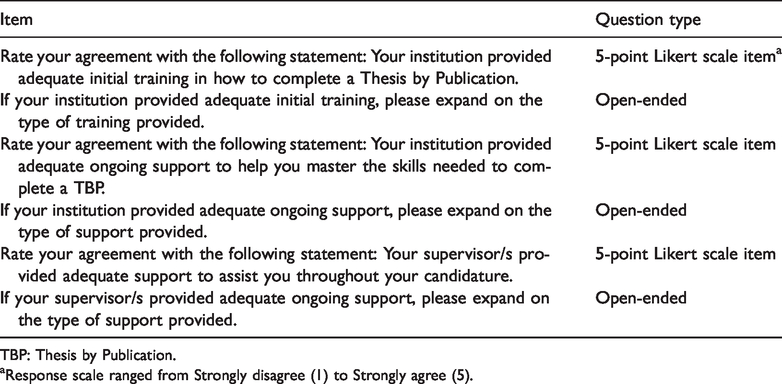
The study adopted a mixed-methods survey approach, with data collected at a single stage (Johnson & Onwuegbuzie, 2004).The survey used was developed specifically for the study using the free Google Forms platform, adopted due to its ease of use and wide availability (Rayhan et al., 2013). This allowed the authors to gather data from a computer literate population of Australian doctoral graduates that is spread not only across the span of Australia, but around the world. The survey platform allowed for self-pacing, with participants able to save incomplete surveys and continue at a later time, and the uniform delivery ensured that ‘differences in responses to questions can be interpreted as reflecting differences among respondents, rather than differences in the processes that produced the answers’ (Siniscalco & Auriat, 2005, p. 3). The survey instrument consisted of a variety of items covering many aspects of the TBP experience, beginning with the collection of demographic, enrolment, and employment characteristics of each participant. The focus of this paper is the types of support received by recent doctoral graduates who undertook a TBP and their perceived adequacy of that support. Six items in the instrument relate to this aim and are listed in Table 1.
Items from the questionnaire related to support for the TBP.
TBP: Thesis by Publication.
aResponse scale ranged from Strongly disagree (1) to Strongly agree (5).
Doctoral graduates who completed a TBP (or otherwise named doctoral programme) in the past five years (2014–2018) at an Australian university were recruited for this study. These inclusion criteria were established to optimise validity (Leighton, 2010), and graduates from all research fields were included in order to build a holistic view of the TBP, while at the same time allowing for the investigation of contextually-bound trends.Without a national database of doctoral completions, and with limited access to university repositories, the authors engaged in an extensive period of participant identification and recruitment which included both active measures (including searches of Trove and ProQuest Dissertations and Theses databases; searches of university databases; email contacts with graduate schools of all Australian universities) and passive measures (including posting information on relevant sections of social media platforms ResearchGate, Twitter, Academia, and Facebook; inclusion of a snowball sample question within the instrument).
The recruitment procedures resulted in the recruitment of 246 participants who volunteered to be part of the study. The average participant in this study identified as a female (70%), full-time (67%), domestic student (78%), and aged 39 years old (ranging from 25 to 67 years of age) at the completion of their doctorate. The participants came from a broad range of research fields in 35 of Australia’s 41 universities that ran doctoral programmes at the time of the study. While the authors acknowledge the heterogeneous nature of the doctoral experience for each candidate, and the role that disciplinary and institutional factors will have on that experience, it is also important to understand commonalities in the experience of candidates who adopt a similar thesis approach.
At the conclusion of the four-month data collection period in January 2019, the responses were downloaded into an excel spreadsheet, cleaned, and anonymised using computer-generated pseudonyms. Beginning with the quantitative data, descriptive analyses were conducted on each of the three items, and a Cronbach’s α was calculated to measure the reliability of the items as a measure of a single construct of ‘support’. The results showed that while the scale was acceptable as a measure of overall support (α = .678) based on common interpretations of α scores in education papers as examined by Taber (2017), reliability was improved by removing the item related to supervisory support (.814), indicating that supervisory support is considered to be a separate construct by the participants. As a result, analyses were conducted for each of the items separately. Tests of difference between groups were conducted, with Mann–Whitney U used to test against binary groups (male/female, domestic/international, broad research field (HASS/STEM), and scholarship holder yes/no), and Kruskal–Wallis used in cases of more than two groups (age bracket, research field, workload (part-time, full-time, or mixed), institution, and length of candidature). Both of these tests are commonly used together in education research (Mat Roni et al., 2020). In total, 27 analyses were conducted (three Likert items across nine within-sample groups as described above), although in reporting our findings, we only report those results for which significance was determined at p < .05.
Next, qualitative data elicited from the three open-ended questions were analysed using an iterative Content Analysis process which involved the reduction of the text through the identification and categorisation of recurring concepts related to types of support and the related discourse offered by the participants (Forman & Damschroder, 2007). In this case, the researchers took a manifest analysis approach, where ‘the researcher describes what the informants actually say [or in this case, write], stays very close to the text, uses the words themselves, and describes the visible and obvious in the text’ (Bengtsson, 2016, p. 10). We present counts of the identified supports, but unlike a quantitative Content Analysis approach, these counts are seen as the beginnings of the interpretive phase of the analysis, where questions shift from what and how many to questions of why and how that require a view of the data through a qualitative lens (Morgan, 1993).
Results
This section provides a quantitative summary of responses in the three areas of inquiry – initial institutional support, ongoing institutional support, and supervisory support – which are complemented with verbatim quotes to provide illustrations of the discourse surrounding particular types of support as raised by the participant, ensuring that they are given a voice (Corden & Sainsbury, 2006).
Initial institutional support
Candidates in this sample were spread across the spectrum in terms of the adequacy of the initial training they received from their institutions. Around 30% of participants gave a positive response and just under 40% gave a negative response, with one-third of candidates remaining neutral (Figure 1). Across the tests of difference between groups, it was found that international students had a significantly higher mean rank than domestic students (U = 3724, p = .003) meaning that they report higher agreement. Further, there was a significant difference in responses according to the participants’ institution (H(34) = 53.865, p = .016).
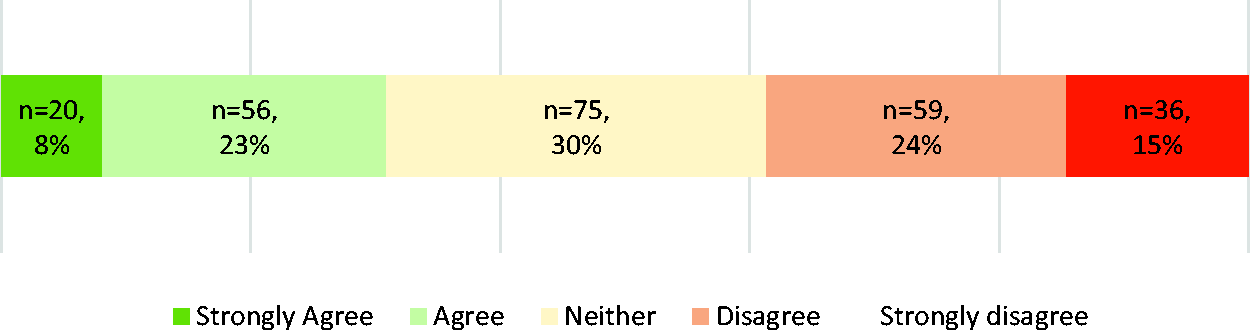
Candidates’ responses regarding the provision of adequate initial TBP training at an institutional level.
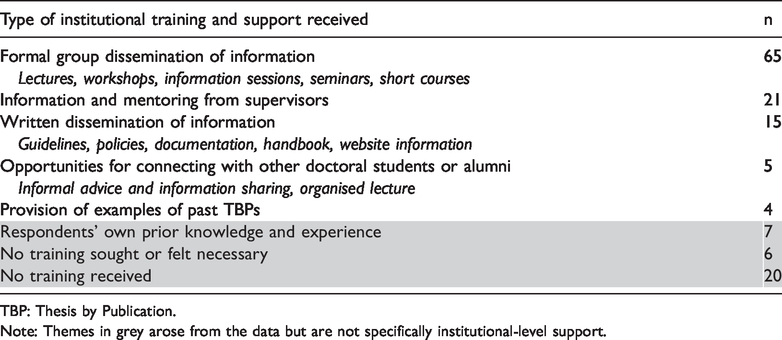
Participants reported a range of different types of training and support, as outlined in Table 2.
Initial training and information received by participants, n = 110.
TBP: Thesis by Publication.
Note: Themes in grey arose from the data but are not specifically institutional-level support.
The most commonly available source of initial training for participants in this study included different modes of group dissemination of information, such as lectures and workshops, mostly provided through the university or faculty, although in two cases were reported to be provided by the institution’s library. The open-ended responses reveal that there is variety in the level of initial support, in one case described as ‘comprehensive training about the traditional thesis and TBP. It includes the whole idea, advantages, and disadvantages over TT [Traditional thesis] & TBP with the whole process of TBP’ (Abdullah). On the other hand, there were descriptions of limited support: There was only an informal information session which basically went along the lines of ‘there are no rules, it’s too new to have guidelines, there’s so many kinds of publications and the length of thesis varies greatly dependent on the type and quality of the publications. (Fred)
There was variation in the level of detail provided through written documentation, ranging from ‘a few paragraphs’ (Jenna) or ‘1–2 pages’ (Cheglei) to a ‘doctoral thesis handbook [that was] very clear about the requirements and processes’ (Jacob). The accessibility of information also varied, and it was not always the case that written information was made readily available to candidates, ‘there was a university guideline only, which was hard to find and did not specify the requirements for each school… I found it hard to find out how many publications I needed!’ (Jordana).
A number of participants noted that their own prior knowledge and/or their previous experience in writing and publishing journal articles provided initial support, as in one participant who explained that ‘I entered my PhD journey with an existing track record (peer-review publications and grants) in different fields of research, so I had experience with the peer-review and publication process’ (Constance).
Where participants felt they already possessed the requisite skills and knowledge, or when it was provided elsewhere (typically by the supervisor), participants noted that they didn’t seek institutional training or support. In this vein, it was noted that ‘my supervisor was able to commit many hours to teaching me and guiding me through my first publication. The institution ostensibly had resources available if I wanted them, but I never found it necessary to seek them out’ (Shane).
Five participants were supported by other candidates and recent graduates who adopted a TBP, including Ruby who described the collegial and supportive climate this created in her lab group: The training was informal, but I was part of a lab group made up from PhD Candidates, Post-docs and other ECRs [Early Career Researchers] who were all completing or had completed TBPs. The knowledge sharing was continuous and we were all familiar with each other’s theses. (Ruby)
While only participants who had received training were asked to provide further details, more than 20 participants made an additional comment to the effect that no (adequate) training was received. In some cases, candidates complained about the lack of consistency in policy guidelines, with there being ‘no training and [the university] didn’t even have a policy (initially) or consistent guidelines for Thesis with Publications during my candidature – lots of changes, very little communicated’ (Ying). This was particularly the case for candidates in fields or departments where the TBP was not the common approach, ‘I was the first in my field to do a thesis by publication and very, very few other students wanted to undertake the thesis by publication. Therefore there was very little resources or demand to provide training’ (Delta).
Ongoing institutional support
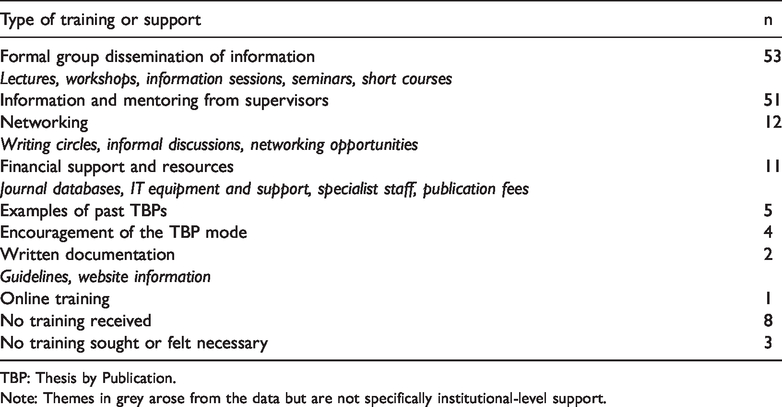
In response to the second question regarding the adequacy of ongoing institutional support, more participants reported satisfaction (Figure 2), compared to their initial training (Figure 1), and a wider range of supports were received during this later period (Table 3). Again, international students had a significantly higher mean rank (U = 3153, p = .000). No other groups were found to differ significantly in their responses.
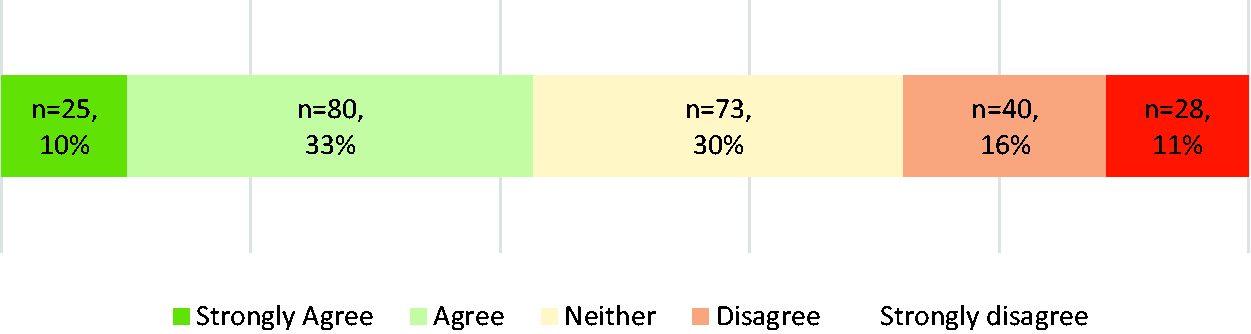
Candidates’ responses regarding the provision of adequate ongoing TBP training at an institutional level.
Ongoing institutional training and support received by participants, n = 124.
TBP: Thesis by Publication.
Note: Themes in grey arose from the data but are not specifically institutional-level support.
Once again, group dissemination of information was the most common institutional support provided to respondents during their candidature. Specifically, respondents reported that training was provided in generic research skills such as research methods, data analysis, software, and time management. Specific to the TBP, many of the sessions detailed revolved around academic writing and manuscript writing, although some candidates received training in the journal submission and peer-review process, and responding to reviewers. As in the previous section, while the question focused on institutional support, 51 participants commented on the role of their supervisor in providing ongoing support, including 36 (70%) who listed only their supervisor as their source of training. Once again, supervisors played an important role in providing ongoing support, particularly when institutional support was perceived to be lacking, as in ‘my supervisors were a fantastic pillar of support for my PhD, the institution as a whole wasn’t as much’ (Delta). Engagement with other doctoral students completing a TBP increased as participants continued on their doctoral journey, and these included informal discussion groups as well as support groups and writing circles, sometimes organised by the supervisor. One such programme involved ‘a writing/support group with other students working under the same supervisor who were also completing TBP in which we could discuss approaches and challenges. This was incredibly valuable’ (Niamh).
Institutions were reported as providing candidates with resources and financial support in some cases. This included access to journal databases, computer hardware and software, and specialist staff, such as statisticians, to assist with knowledge of data analysis and interpretation. Two respondents noted that support was available for journal article publication fees and four participants reported that their institution provided ‘encouragement’ to complete a TBP. However, some candidates’ experiences show that encouragement does not always translate to institutional support or supervisory knowledge of the TBP: Although as an institution TBP is strongly encouraged, there is very little support or information about expectations about this mode. My supervisors were also not familiar with this mode and I spent a lot of time seeking information and educating my supervision team. (Frances)
Supervisory support
In regards to supervisory support, participants showed the highest levels of positivity among the three areas of investigation, with few participants dissatisfied with the supervisory support they received (Figure 3). Only one comparison reached statistical significance, in this case those who were recipients of a scholarship responded more positively than those who did not receive a scholarship (U = 3982, p = .018).
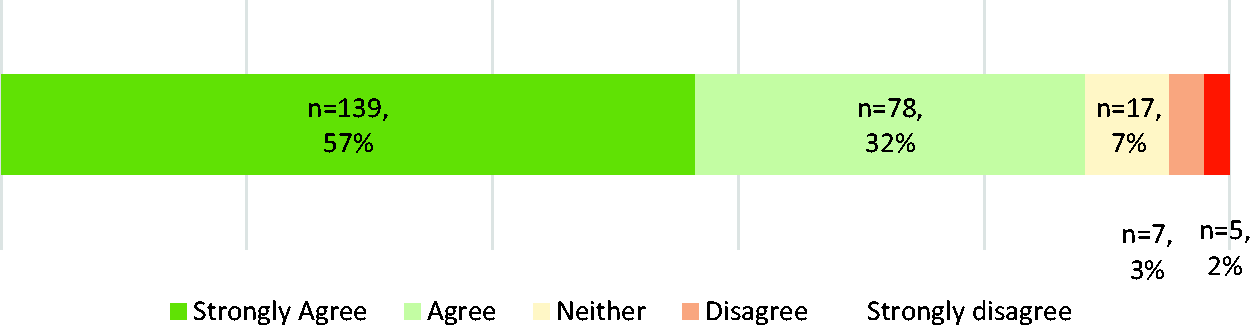
Candidates’ responses regarding the provision of adequate supervisory support.
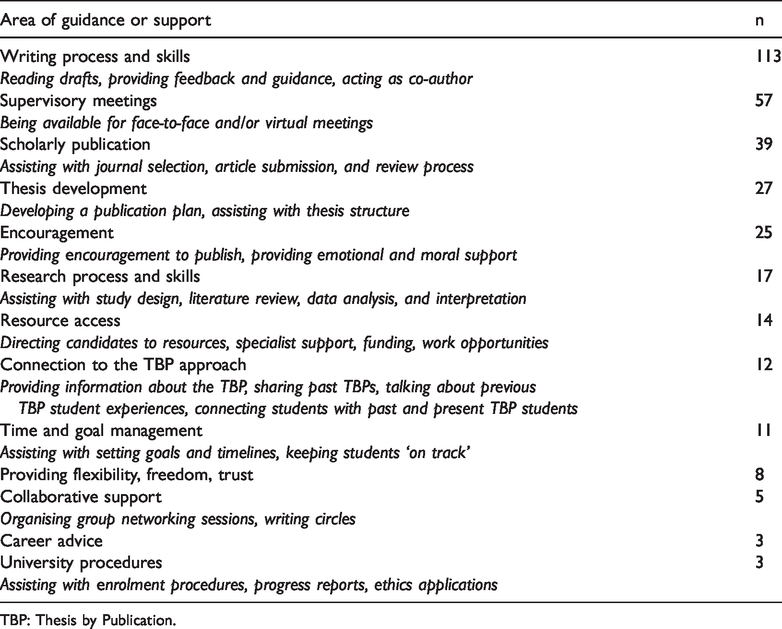
In analysing the responses in this section, a number of areas of supervisory support were identified, with candidates often providing multiple responses (Table 4). Not all candidates gave specific examples of support in their responses, but generally felt supported by their supervisory team, including Delta who shared that her supervisors ‘were fantastic and wholly supported me throughout the entire process’ (Delta). A number of participants noted the support of regular meetings where they were given guidance and advice, and praise was given to ‘approachable’ (Karen, Mitchell) and ‘present’ (Anita) supervisors who place trust in the candidates (Amy, Daisy), with 12 participants using the term ‘available’ to describe their supervisors. Some candidates reported that these meetings provided an opportunity to receive support in other specific areas that were raised, as well as receiving encouragement and emotional support.
Supervisory support received by participants, n = 197.
TBP: Thesis by Publication.
Most commonly reported was support around the writing process, which in a small number of cases included conference abstracts, thesis chapter, or exegesis writing, but for the most part referred to manuscript writing for scholarly journal articles. Specifically, supervisors provided editorial support by reading and providing feedback on drafts of manuscripts and engaging in discussions about the content and structure of academic papers. For instance, ‘I benefited from exceptional, experienced supervisors who dedicated their time to myself and their other students focusing on our writing skills, including scale/topic of publications, [and] clear and succinct writing’ (Annette).
Respondents were also provided with support in one or more of the various stages of scholarly publishing, drawing on their supervisors’ knowledge and experience. These stages included selecting an appropriate journal, responding to reviewer comments, revising papers, and dealing with rejection. One participant described such support: ‘…beside the usual and normal supervision support, my principal supervisor supported me with choosing the right journal and addressing review comments. He [my supervisor] also directed the style of writing to suit the journal we were aiming to submit’ (Debbie).
A number of respondents connected the provision of assistance with the publication process to their supervisors’ experience and track record of publishing: Since she herself has well over 500 publications she was able to give excellent advice on which journal would be the most appropriate. She talked me through the initial process of submitting and was always on hand when I was submitting additional papers. (Mary)
A challenge raised by TBP students was the development of the final thesis and how to integrate their multiple papers. Some students received explicit support in this area: We sketched out the format my thesis and chapters would take and then it felt broken down into manageable chunks as I mentioned before and I worked on them in turn. My supervisor was also great at reminding me that I needed a thread running through all the chapters so that the whole thesis was more than the sum of its parts (I tended to get stuck into one chapter at a time without thinking of the whole). (Ruby) I felt that occasionally their ambition to get Nature and Science papers actually hindered my ability to progress with my publishing – they guided me to aim for journals that were at the time out of my league, which resulted in years of rejections and associated emotional trauma. This almost cost me my academic career. (Saffi)
Discussion
The aim of this study was to identify common forms of support for doctoral researchers adopting a TBP approach, and the adequacy of those supports as perceived by a sample of 246 doctoral graduates in Australia. Although the TBP is comparatively newer in HASS fields compared to STEM fields (S. Mason & Merga, 2018a) and we would thus expect support structures to be better established in STEM fields, it was surprising to note no significant differences in the adequacy reported by participants across the two broad fields. Our findings suggest that while some institutions may provide strong support for candidates at enrolment, as well as support specifically tailored to international students and scholarship holders, for the most part support was not largely influenced by the institution or other demographic characteristics, suggesting that the experience for candidates is highly personalised and contextual. However, there is merit in further investigation of the support provided in different research contexts across a broader range of participants, once national baseline data are available to support such research.
Before discussing the findings further, it is important to acknowledge the limitations of this study. The sampling procedures, along with the lack of baseline data on TBP graduates in Australia, mean that the representativeness of the sample cannot be determined. The open-ended nature of the questions regarding the types of support means that the responses may not be reflective of all of the options available to participants, but skewed to those that they are aware of and remember most clearly. Further, our sample is limited to those who have successfully completed a TBP, and it is likely that those who did not complete their programme, or who changed their thesis approach away from the TBP, would report different experiences related to support. Studies that include the perspectives of those individuals, as well as supervisors and administrators, are areas of potential future research. In the case of supervisors, future research proposed by the authors should examine their familiarity with the TBP and the support they receive in terms of supervising in this mode.
The findings show evidence of a clear disparity between the support and training available at the institutional level compared to that at the supervisory level. This opens up a deeper conversation about the role and position of institutions and supervisors in supporting doctoral candidates across all fields. It may be that doctoral candidates perceive greater supervisory support because of a lack of institutional support, but it may alternatively be an indication that supervisors may be better positioned to provide the necessary support for TBP candidates. While further research could illuminate these concerns, we were interested to note that the responsibility of supporting successful TBP candidates appears to sit strongly with the supervisory team.
We also note that while there was high agreement with adequacy of supervisory support, there were cases of disagreement where a TBP was still successfully obtained. This suggests that in some cases, factors beyond supervisory support may enable those on a TBP trajectory to achieve their goal despite poor supervisory support, and further research should focus on these intriguing factors.
Consistent with the literature, supervisors were a key factor shaping doctoral candidates’ experiences (Wao & Onwuegbuzie, 2011; Zhao et al., 2007). With the strong influence that supervisors play in providing support to TBP candidates, it is vital that they are given the necessary training in this space. Doctoral candidates in this study frequently described educating their supervisors about the institutional processes and policies regarding the TBP. This indicates that there is scope for additional professional learning and ongoing development. For example, it is worrying that so few supervisors talk about or share examples of TBP approaches with their candidates. It is possible that the relative newness of the approach could mean there are fewer supervisors who have experienced this approach and that many are thus unfamiliar with the process and the types of support that are required or desired. Supervisors may benefit from institutions knowing and understanding the different types of supervisory supports favoured by TBP candidates and providing supervisor training that aligns with the specific needs of the TBP candidate.
While there were a wide range of supports available, many involved the development of generic skills that are vital for all doctoral candidates, such as academic writing. Teaching candidates to write for academic audiences is a common role undertaken by supervisors, that Lee (2018) describes as enculturation, the assistance supervisors give to induct doctoral candidates into academia. While this is an important skill for TBP candidates, there are a range of skills that are specific to their chosen approach that also need to be addressed, such as selecting an appropriate journal, submitting an article for review, responding to reviewers’ comments, and dealing with rejection (S. Mason, 2018; Merga, 2015). There are also other challenges not related directly to the publishing process, such as developing a cohesive narrative through the TBP thesis (S. Mason & Merga, 2018b; Moodie & Hopgood, 2012). Thus, there is a need for support mechanisms to be responsive not only to the needs of doctoral researchers, but also to the specific challenges of the TBP, as these can place considerable pressure on the progress of doctoral candidates (Merga, Mason, & Morris, 2019a, 2019b).
Supervisors provided ongoing support throughout candidature for the majority of participants in this study, aligning with previous research that suggests that the quality of this relationship can be crucial for success in the TBP approach (Nethsinghe & Southcott, 2015). While this appears to be positive for the candidates, it also raises concerns about supervisor workloads and high supervisor accountability for student success (Pretorius, 2017). Supervisor workload has been an issue for many years, with Green and Usher (2003) citing the challenges of supervisors who ‘juggle complex and heavy workloads, whilst supervising across a growing diversity of degrees, at the same time being placed under growing pressure to focus more strategically on their supervisory obligations’ (p. 44). Calls have been made to provide supervisors with adequate time to ‘allow them to be able to contribute actively to the education of effective doctoral graduates’ (Poyatos Matas, 2012, p. 174). In the case of the TBP, there are potentially extra time demands placed on supervisors around manuscript development, submissions, revisions, and re-submissions (Robins & Kanowski, 2008). Thus, defining an adequate supervisory time allocation needs to take into consideration the specific doctoral approach taken by each candidate.
The nature of the TBP means that the time invested by supervisors and institutions in this approach, ‘can potentially lead to higher rates of retention of doctoral students and increased number of research outputs’, including for the supervisor themselves if they take on a co-author role (S. Mason, 2018, p. 6). While the opportunity to build a combined track for the benefit of both supervisors and candidates offers value, the TBP candidate may be positioned as a vehicle for securing the successes or promotional opportunities of the supervisor, and further institutional oversight is necessary to avoid placing candidates in a vulnerable position due to their limited experience in publication and the inherent power imbalance in the supervisor/candidate relationship. While power dynamics (Bartlett & Mercer, 2000) and ethical issues (Löfström & Pyhältö, 2017) between supervisors and doctoral candidates are present in all supervisory models, there are further potential complications in the TBP journey when supervisors and candidates co-author, and support may be needed to assist TBP candidates to avoid the potential risks.
Löfström and Pyhältö (2017) found that supervisors do not raise doctoral candidate well-being as an ethical concern, yet learning to publish in academia comes with challenges such as managing expectations, publication timelines and reviewer feedback, all of which can cause anxiety and frustration for doctoral candidates who are new to publishing (Merga, Mason, & Morris, 2019a). Participants in this study shared the importance of non-specific moral support and encouragement, and while these are nebulous concepts, ‘understanding of similar experiences provides appreciation and solidarity’ that allows doctoral candidates to continue along their journey ‘at a level they otherwise (might) not believe possible’ (Wilson & Cutri, 2019, p. 59). Because the TBP doctoral journey is potentially hazardous for doctoral students’ well-being (Lovitts, 2001), institutions have an obligation to ensure that candidates have access to personal support, which should ideally complement knowledge and skill development (Mantai, 2019). While supervisors play an important role in supporting doctoral students, as a relatively new addition to the doctoral education landscape, many supervisors would not have completed their own doctoral training through this mode. The current study found that, despite being limited in some cases, candidates appreciate the support of other TBP students and alumni. Thus, institutions may find that programmes that bring together current and former TBP candidates are an effective means of support, and this is an area of investigation that deserves further attention.
The TBP graduates in this study reported higher levels of satisfaction with their ongoing support when compared to the initial support provided by their institution, suggesting that universities could benefit from revisiting TBP support and information at student induction. It is possible that the lack of guidelines around TBP makes it difficult for candidates to understand the requirements of this approach early in their candidature. On the other hand, it is possible that ongoing support is deemed more valuable beyond induction as many candidates opt into the TBP approach after enrolment in their doctoral course (S. Mason, Merga, & Morris, 2019). There are many reasons candidates choose a TBP approach and it is essential that institutions provide support and information to candidates when deciding which doctoral approach to take, as not all students may be suited to this mode (Pretorius, 2017). Candidates may be better suited to make a decision about TBP later in their candidature, once they have a better command of basic research skills, and expectations tempered by some degree of experience. The authors recommend that the suitability of the TBP for each candidate be reviewed throughout the doctoral journey to support candidates to adopt the best option for their needs.
In light of the findings of this study, the authors advocate strong support mechanisms for doctoral candidates that are reflective of the unique challenges of the TBP. Clear guidelines are needed to help candidates, and supervisors, to understand the expectations of the TBP but which are also flexible enough to allow for the diverse and nuanced needs of each individual candidate and their research. Institutional training is needed so that potential for ethical dilemmas is understood by both candidates and supervisors, and institutional oversight is necessary so that these issues can be circumvented. Professional skill development should also be complemented with personal support for doctoral candidates, including the scope for institutions to expand their support offerings in this area to relieve some of the pressures placed on supervisors. Supervisors often have many competing priorities and to provide effective support they must have access to appropriate training, as well as adequate time allocated to their supervisory role.
Footnotes
Acknowledgements
The authors wish to thank the participants of this study for sharing their experiences and opinions with us.
Declaration of Conflicting Interests
The author(s) declared no potential conflicts of interest with respect to the research, authorship, and/or publication of this article.
Funding
The author(s) received no financial support for the research, authorship, and/or publication of this article.
