




Abstract
Volunteering is perceived as benefiting youth by facilitating university entry and access to better employment. However, little empirical evidence exists to show whether such perceptions are justified. Therefore, this article presents data on volunteering and attainment from a representative sample of Australians who were born around 1990 and participated in the Longitudinal Survey of Australian Youth between 2006 and 2016. Supplementing results of two-level hierarchical models involving person-year data with insights from several in-depth interviews, we argue that Bourdieu’s theory of social practice is a fruitful framework for understanding how volunteering affects university participation and occupational status of young people. Volunteering provides gains, but they are not large enough to view it as an instrumental means which young people use to advance their educational and employment prospects. Rather, volunteering can be considered as a form of cultural capital which is beneficial but enacted for reasons other than extrinsic rewards.
Keywords
Introduction
While research on volunteering has grown in volume in Australia (for a review of over 150 studies, see Kragt & Holtrop, 2019; Lyons et al., 2006), little attention has been devoted to young volunteers who are in their teens and early twenties (but see Hyde & Knowles, 2013; McCabe et al., 2007). Educational literature positions volunteering as a means through which students contribute to their community but also gain soft skills related to interpersonal communication, organisation and teamwork (Heath, 2007). These skills are seen to provide a competitive edge for entry into university education and graduate labour markets (Brown, 1995).
Research consistently reveals that middle-class youth 1 are more likely to volunteer than other young people. This suggests that volunteering is used for the ‘construction of a value-added curriculum vitae’ (Brown, 1995, p. 42; Heath, 2007; Wilson, 2000). Such strategies are viewed as necessary in an era when education credentials no longer suffice on their own to guarantee subsequent educational or occupational success. Therefore, middle-class parents and youth seek ways of documenting students’ drive, interpersonal skills and commitment to civic society in order to secure best chances of future success.
Despite this perception, no study in Australia has attempted to assess empirically the extent to which volunteering has a tangible impact on educational and occupational attainment before the age of 25. Therefore, we analyse longitudinal data on volunteering activities pursued by a representative sample of Australian youth born around 1990. We supplement these data with several in-depth interviews with university students to assess whether a history of volunteering gives young people a tangible advantage in entering and completing university or securing high status employment early in adult life.
Theory and prior research on volunteering
Volunteering receives considerable attention in psychology, sociology and related disciplines with every area offering its own theoretical insights and foci of attention (Kragt & Holtrop, 2019; Wilson, 2000). In this article, which assesses whether volunteering has long-term effects on educational and occupational attainments, the focus is on the contrast between cultural capital and rational choice theories.
Definitions of volunteering
Frequently, the concept of volunteering is used in the literature without a specific definition. However, as Kragt and Holtrop (2019, p. 2) point out, in Australian research, volunteering involves the gifting of time and effort to service others in the community out of free will and without payment.
Volunteering has been predominantly defined as occurring in organisational contexts (Borgonovi, 2008; Moffatt, 2011; Rochester et al., 2010; Walsh & Black, 2015). More recently, however, in line with the changes to the definition of volunteering adopted by the Australian Bureau of Statistics (2018), the understanding of volunteering has broadened to include a range of unstructured and unmanaged activities that contribute to the community. Specifically, it can include social activism, spontaneous community response to an emergency, online activities or social enterprising. In this article, volunteering involves, but is not limited to, activities undertaken in a structured context, as the emphasis on organisational setting is evident in the Longitudinal Survey of Australian Youth (LSAY) questions.
Where school students are concerned, free will as a characteristic of volunteering needs to be carefully considered, as it is not obvious in ‘compulsory’ volunteering (Kim & Morgül, 2017; Yang, 2013). Although seemingly a contradiction of terms, volunteering can be mandated, or strongly encouraged, by educational institutions (e.g. programs such as International Baccalaureate (Dean, 2014)). While few studies looked at the difference in the long-term effects of ‘non-compulsory’ and ‘compulsory’ volunteering, some evidence from the USA suggests that both might generate similar benefits later in life (Kim & Morgül, 2017).
As the LSAY questions refer to activities ‘outside of study’, we assume that respondents report only non-compulsory volunteering. Future research will hopefully investigate this distinction and its implications in more detail. We follow prior research and conceptualise volunteering as giving the time and effort to service others in the community out of free will and without concern for financial reward. Nevertheless, we refer readers to the questionnaire questions in the section on measurement in this article for more precise information. Below, we introduce two theories, which explain reasons for volunteering, explored by the analyses in this article.
Volunteering as cultural capital: Bourdieu’s theory of practice
Cultural reproduction arguments (Bourdieu, 1984; Bourdieu & Passeron, 1990) focus on how social stratification is reinforced through transfers of cultural capital, i.e. internalised behaviours, attitudes, preferences, knowledge and values (Collins & Thompson, 1997). Cultural markers facilitate the reproduction of existing social divides. Volunteering from this perspective is seen as a form of cultural capital legitimated by the middle classes and other elite groups.
The key premise of this theory is that cultural markers are not indicators of actual productivity or academic excellence but facilitators of reproducing social inequality. Bourdieu’s class refers to ‘individuals who occupy similar positions in social space, who experience similar conditions and conditioning, and who are likely to have similar practices and stances’ (France & Threadgold, 2016, p. 616). These similarities are considered to entail cultural capital in its diverse forms, i.e. the embodied capital which reflects legitimate preferences and activities, the objectified capital which comprises material artefacts and the institutionalised capital which reflects educational credentials and other indicators of class (Lamont & Lareau, 1988). This emphasis on the cultural dimension of class invites the question as to whether economic capital, i.e. the material resources at the disposal of young people, matters for volunteering. This perspective suggests that cultural dimensions of class will weigh in more on who volunteers and benefits as a result.
Valorisation of volunteering in this perspective comes as part of socialisation in the primary habitus, e.g. family of origin or secondary habitus, e.g. the schooling environment. Habitus here refers to ‘durable schemes of perception and action (i.e., permanent dispositions)’ (Saha, 2015, p. 767). Hence, volunteering is an embodiment of a particular cultural taste in line with identity theory, ‘when people believe that others who are important to them want and expect them to engage in a certain behaviour, they will develop a particular personal identity relevant to that behaviour’ (Snyder & Maki, 2015, p. 270).
Bourdieu’s theory, moreover, suggests that, if volunteering is valued as a strategy for improving one's résumé by cultural elites, young volunteers will originate predominantly from middle classes that can be identified through their cultural rather than economic markers. Moreover, volunteers should be more likely to come from schools that cater to middle-class children. In Australia, these are predominantly Independent and Catholic schools that usually charge tuition fees and include few disadvantaged young people among their students.
Instrumental value of volunteering: Rational choice
Rational choice theory views young people as rational actors who systematically weigh the costs and benefits of volunteering (Hyde & Knowles, 2013). While many different motivational schemas can inspire young people to volunteer, we follow Hyde and Knowles (2013) and focus on rational choice when the primary motivation is the development of career-related skills and networks. In such a case, the theory stipulates that young people are aware that volunteering is a source of experience which can provide them with advantages in education and the labour market. In other words, we should find that volunteers have an advantage over non-volunteers in their educational and occupational outcomes and youth are aware that this is generally the case. This advantage should be unrelated to students’ economic, social or cultural status. Thus, if it can be empirically established that young people view volunteering as an activity that provides them with job-related skills and networks and, moreover, that these perceptions can be observed irrespective of social class, then the rational choice framework might be useful for understanding who volunteers and why.
Prior research on students and volunteering in Australia and overseas
Prior research on student volunteering has found that young females are more likely to volunteer than young males, although this pattern varies from country to country (Wilson, 2000). While the reasons for that are not fully understood, it has been suggested that women are socialised to feel more altruism and empathy (Wilson, 2000). Another reason is that some volunteering activities involve caring for others and care is stereotyped as a feminine activity. However, in Australia, the most frequent context for volunteering is not caring but sport and physical recreation groups (Gray et al., 2012).
Ethnicity has also been found to matter as a predictor of volunteering. English speakers were found to be overrepresented among Australian volunteers (Gray et al., 2012). However, this could be different in the subpopulation of LSAY respondents, which, by definition, excludes youth who are not fluent in English. Therefore, LSAY participants who speak a language other than English at home are bilingual or multilingual. This group of students is not hindered by a language barrier and could be culturally strongly motivated to excel not only in their academic but also community service endeavours. Australia is a country with long-standing skilled migration programs (Hugo, 2014) where many migrants do not lag behind but often academically surpass their non-migrant peers. With respect to Aboriginal and Torres Strait Islander youth, Kerr et al. (2001) note that this group engages in many unstructured and informal helping activities. Consequently, where volunteering is operationalised in terms of organised activities, as is the case in LSAY questions, these respondents might underreport.
Research has highlighted three other factors that are associated with volunteering (Wilson, 2000). The first factor is place of residence as people in smaller communities, outside of metropolitan areas, have been found to be more likely to volunteer than others (Kragt & Holtrop, 2019). The second factor, discussed above, is socio-economic background, with students from more privileged backgrounds (Wilson, 2000) more likely to volunteer than students from lower socio-economic backgrounds. The third factor, religiosity, has been shown to be positively associated with volunteering as students from religious and private elite schools are more likely to give back to the community without expectation of payment (Wilson, 2000). Yet, little is known about over-time continuity of volunteering in the lives of Australian youth as no prior longitudinal studies examined data in formative years at multiple time points. This is one of the unique contributions of the current study.
Research questions
In light of the discussion above, the research questions addressed in this study are as follows:
Is there continuity in youth volunteering between the ages of 17 and 25? Which youth are most likely to engage in volunteering? Do the cultural attributes of family of origin predict the likelihood of volunteering, in line with cultural capital theory? Do youth see volunteering as a potentially career-enhancing activity, as stipulated by rational choice theory? Do youth report getting jobs as a result of their volunteering, as stipulated by rational choice theory? Does volunteering help youth enter and complete university? Do youth who volunteer secure higher status jobs than their non-volunteering peers?
Data, measurement and method
To answer these research questions, we use data from the 2006 cohort of the LSAY known as Y06 (NCVER, 2017). This longitudinal survey started with the 2006 Program for International Student Assessment (PISA) sample of students who, by definition of the PISA target population, are between 15 years and 3 months and 16 years and 2 months of age at the time. These students were re-surveyed every year until 2016. Questions about volunteering were asked between 2007 and 2015. We complement the LSAY data with eight in-depth interviews.
In-depth interviews
Between May and July 2016, we conducted eight in-depth interviews with university students engaged in volunteering, who were in in their early twenties, like the Y06 respondents. This research was approved by the university’s Ethics Committee.
Recruitment was undertaken online through publicly available contact details for student groups. The invitation to participate called for ‘people who engage in volunteering, extracurricular and community engagement activities’. We selected eight individuals to interview based upon the order in which they contacted us. The activities in which participants engaged fit the definition of volunteering used within this article and by Y06.
We asked interview participants questions adopted from LSAY. Interviews, which lasted from 40 minutes to 1 hour, were otherwise only semi-structured and directed by the participants themselves (see Supplementary Appendix 1 for the interview schedule). We personally conducted and transcribed each interview. Information about students who were interviewed for this project is provided in Supplementary Appendix 2.
Y06: Dependent variables
Volunteering history
Our first variable of interest in Y06 is respondents’ history of volunteering. This was created from two questions. The first asked, in 2007, 2008, 2011 and 2014, about the frequency of volunteering: ‘Outside study or work, how often do you do voluntary work?’ The second question asked, in 2009, 2012 and 2015: Thinking now about volunteer activities. That is, activities you may have undertaken for others, for which you were not paid, in the last twelve months did you do any of the following: Canvassing, campaigning, or fundraising as a volunteer? Been an unpaid member of a board or committee? Provided information, or helped to educate or influence public opinion? Helped organise activities or events for an organisation? Taught or coached on an unpaid basis? Collected, served, or delivered food or other goods as a volunteer? Provided voluntary health care or support, including counselling and friendly visiting? Volunteered time to a group or other organisation (in some other way not previously mentioned)? (Yes, No).
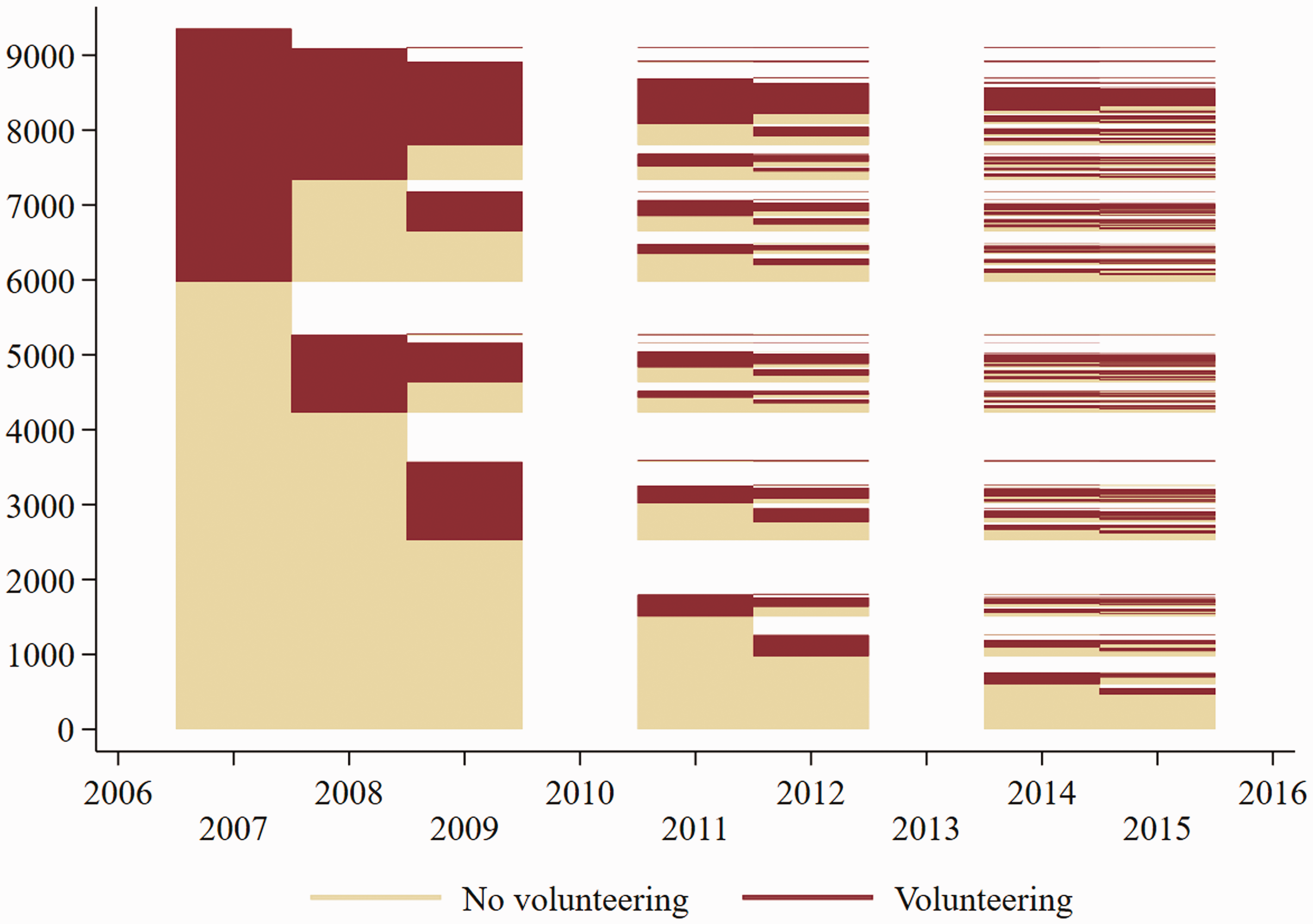
Volunteering histories of 9353 respondents from 2007 until 2015. Data: Y06.
Stacks of horizontal lines in Figure 1 represent volunteering histories of 9353 respondents in the time period between 2007 and 2015. Lighter horizontal lines in the lower section on the left-hand side show that, in 2007, 5986 adolescents said they did not volunteer. This contrasted with 3367 respondents who did, as shown by the darker lines above. In 2008, 2763 adolescents reported engaging in volunteering while 5615 said they did not. As 973 students had dropped out of the survey by then, white areas in 2008 reflect this attrition. Moving to the right, Figure 1 shows who continued volunteering over time and who entered and left at different times. All lines for 2010 and 2013 are white because on these occasions neither question was asked. In contrast to research based only on data from respondents who participated in all survey waves, the approach illustrated in Figure 1 makes optimal use of all Y06 information.
Perceptions that volunteering gives job-related skills and facilitates access to jobs
In 2009, 2012 and 2015, the Y06 respondents who volunteered were asked ‘Have your volunteer activities given you new skills that you could apply directly to a job or business?’ The answer categories were: Not at all, Very little, A fair amount, A lot.
In the same years another question asked: ‘Have your volunteer activities ever helped you get a job?’ (Yes, No). We use these indicators to assess if most volunteers view their activities as career-enhancing experiences.
Educational attainment – Study or completion of university
A binary indicator of status in a bachelor’s degree study in each reference year was created from a NCVER-derived variable (NCVER, 2017). The following categories: “Currently undertaking”, “Completed”, “Completed and undertaking another degree” were coded 1 to signify university students and graduates while the other two categories: “Never completed” and “Commenced but did not complete” were coded as 0.
Occupational attainment – Status scores
Occupational attainment was measured for working respondents in each reference year by the Australian Socioeconomic Index 2006 (AUSEI06) which ranges from 0 to 100 and denotes the status of occupational titles listed in the Australian and New Zealand Standard Classification of Education (ANZSCO) (Australian Bureau of Statistics, 2006). ANZSCO titles available in Y06 were converted to AUSEI06 using the table provided by McMillan et al. (2009). The continuum covers all occupations ranging from a value of 0 to denote low status jobs, such as unskilled farm labourers, to a value of 100 for high status jobs, e.g. surgeons. Conceptually, occupational status reflects the link between educational credentials required for entry into a given job and the associated income.
Y06: Independent variables
Apart from volunteering, our key variable of interest is family cultural and economic capital which, in Y06, is captured by the PISA’s economic and cultural status of family (ESCS). ESCS comprises six components that correspond to two types of Bourdieu’s capitals. Institutionalised capital is indicated by parents’ years of education, parental occupational status and household wealth. The objectified capital is denoted by the number of books at home, the index of cultural possessions and the index of educational resources in the home. Details regarding the measurement of this comprehensive index are provided in OECD (2007). We use the six components separately when modelling volunteering to assess whether it depends more on cultural or on economic capital. We use the overall index when we assess the impact of volunteering on educational and occupational attainment. The index and its components are standardised to a mean of 0 and a standard deviation of 1.
Based on prior research, we also control for gender (females = 1, males = 0), English as the only language spoken at home (Only English spoken = 1, Another language spoken = 0) and academic performance indicated by one of by PISA’s plausible values for science literacy 2 (OECD, 2009).
Adjusting for attrition and sample design
We also control for the variables which were used in the construction of the LSAY weights to adjust for attrition and sample design (Lim, 2011).This is necessary to ensure that our estimates are as unbiased. We cannot use weights provided in the LSAY database because they are wave-specific (Lim, 2011). Some of the variables used in the construction of weights are also of substantive interest as prior research has identified school sector or residence areas as important predictors of volunteering. The weight variables are school sector, state or territory of residence, Aboriginal and Torres Strait Islander self-identification, school location in metropolitan, provincial or remote areas and migration status. The final weight variable is an indicator whether a student scored in the top quarter on their PISA mathematics test (Lim, 2011).
Method
We use the Y06 data structure to estimate two-level hierarchical models in which person-year observations (level 1) are clustered within persons (level 2). This enables the optimal use of available information (Singer et al., 2003). For dichotomous variables, we use models for binary outcomes and the xtlogit procedure in Stata (Rabe-Hesketh & Skrondal, 2012). For occupational status, which is a continuous variable, we use a linear model and the xtreg procedure. These models are suitable for unbalanced data, which means that not all respondents need to have observations in all years. Moreover, we can include time as one of the model coefficients, which is an additional advantage.
It should be noted that our analytical methods reveal correlations between predictors that occur earlier than their hypothesised outcomes, but this does not prove causality. Rather, we present patterns of correlations between chronologically ordered variables which support our theoretical argument about a causal relationship that we consider most plausible.
Results
The discussion of results begins by considering the first research question: Is there continuity in young people’s volunteering between the ages of 17 and 25? As evident from Figure 1, many young people engage in volunteering at different stages in their adolescence and young adulthood, so the pattern of continuous involvement characterises only a small group in this cohort.
Continuity in youth volunteering between the ages of 17 and 25
In 2007, 36% of respondents were involved in some form of volunteering with the proportion becoming higher in subsequent surveys (44%, as indicated by horizontal dark lines in Figure 1). Only 10% of respondents who indicated that they volunteered (not shown in Figure 1) reported volunteering on every occasion they were asked. By comparison, 22% of these respondents said on all occasions that they did not volunteer. As these data are affected by attrition, these proportions might have been different if all respondents participated in all waves of Y06. Nevertheless, the Y06 data constitute the best available longitudinal information on youth volunteering in Australia. Thus, we answer our first research question by noting that volunteering over time tends to be fragmented for most respondents, but overall, the proportion of regular volunteers increases from adolescence to adulthood.
This corresponds to in-depth interviews in which university students reflected on their motivations to volunteer. Interviewees often described their reasons for volunteering in terms of individual character traits, noting that they were ‘someone who always says “yes”’, or someone who is always busy (e.g. ‘I feel a bit unsettled if I don’t have lots of things on’). Some of the students felt they had always been so, but others described becoming more so as they moved from high school to university. Moreover, they reported difficulties with passing up opportunities to volunteer which indicates that they were in environments, i.e. schools and universities, in which such opportunities were plentiful. As one interviewee remarked: I notice that there’s a very strange culture where the students are incredibly involved to the point [where people I know, including myself] dropped courses so I could do my extracurriculars [sic] … I think everyone encourages you. In the end, it is almost like this university’s culture is to be involved in these activities.
Who volunteers? Does the cultural capital in the family of origin foster volunteering?
Next, we consider the second set of research questions: (2) Which youth are more likely than their peers to engage in volunteering? Do the cultural attributes of family of origin predict the likelihood of volunteering in line with cultural capital theory? Table 1 reports a two-level logit regression model of volunteering between 2007 and 2015. Odds ratios greater than 1 denote a higher probability of volunteering for respondents with a given characteristic, while odds ratios less than 1 denote lower probability.
Two-level logit model predicting volunteering between 2007 and 2015 (1 Volunteered, 0 Did not volunteer).
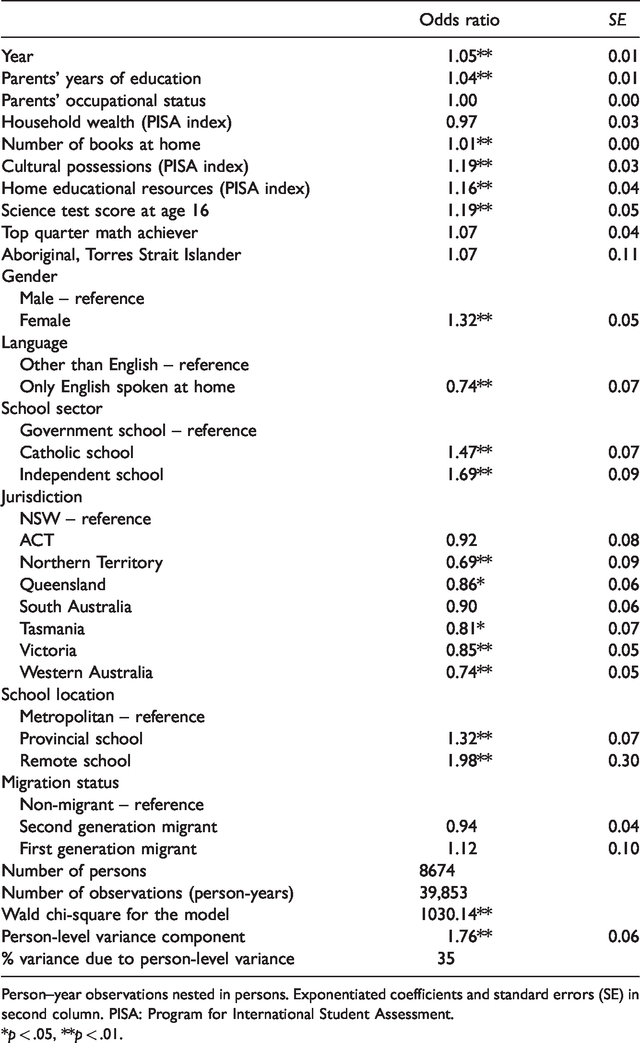
Person–year observations nested in persons. Exponentiated coefficients and standard errors (SE) in second column. PISA: Program for International Student Assessment.
*p < .05, **p < .01.
As respondents get older, they are more likely to volunteer. Bourdieu’s cultural markers of class, that is, higher parental education, more cultural possessions and educational resources, including home libraries, increase the chances of volunteering. Economic capital, i.e. family wealth or parental occupational status, which implies higher income, have no significant impact. These effects of Bourdieu’s primary habitus, i.e. family background, align with our conceptualisation of volunteering as cultural capital and run counter to rational choice theory. Furthermore, secondary habitus is also in operation, as students from Independent and Catholic schools are more likely to volunteer than students from government schools who are the benchmark for comparison (i.e. the reference category).
Young women are more likely to volunteer than young men and so are students from provincial and remote locations, compared to those in metropolitan areas. It is important to bear in mind that the effects presented here extend beyond years of school attendance. They represent the long-term impact of youth 2006 characteristics that apply to the time period between 2007 and 2015. Youth who went to school in New South Wales were a little more likely to volunteer than their peers in other states and territories, a finding which has not been reported before and will require verification in future studies.
The conjecture that volunteering depends on cultural markers of students' primary and secondary habitus is also backed up by in-depth interviews, in which some university students directly pointed to their home environments and educational institutions as motivators to volunteer: ‘When I was brought up, both mum and dad [did] different types of volunteering and were always helping people. So yeah, I think growing up with it has definitely [had an effect].’ Later years of high school were remembered as times when interviewees became more heavily involved. Looking back, one participant recalled that their high school community was a primary source of exposure to volunteering: ‘Yeah, … lots of volunteering opportunities, it was something that was always presented, it was something that we did’.
Do youth see volunteering as a potentially career-enhancing activity that gets them jobs?
It has been suggested that students are aware of the benefits that volunteering can generate for their careers (Dean, 2014). Therefore, we next consider our Research Question 3 about the extent to which this was the case among the Y06 cohort (Table 2).
Does volunteering give new jobs skills or helped in getting a job?
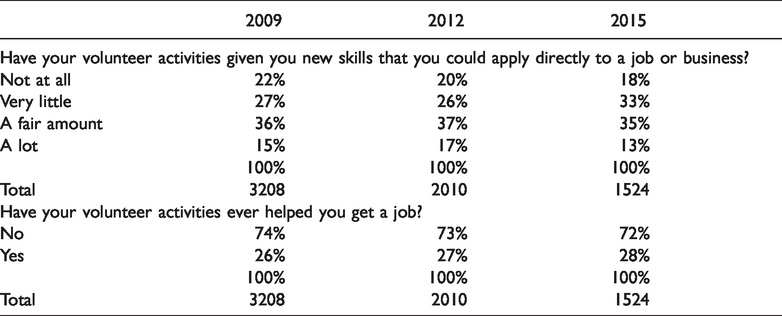
As questions on this issue were only asked on three occasions, the data are sparse. Therefore, this information is presented not as individual histories but as cohort distributions at three points of time (Table 2). Among volunteers, views that volunteering provides new skills which are directly applicable in paid employment or business were evenly split (Table 2). About half of the respondents thought that a lot or a fair amount of such skills could be acquired, while the other half thought the exact opposite, namely, that they gained little or no such skills.
Not even one third of volunteers said that they were offered a job as a result of volunteering, which answers Research Question 4. In-depth interviews reveal, however, that even respondents who have not been offered a job firmly believed that volunteering would be valuable for their future labour force entry. They commented at length on a range of soft skills they developed and noted that volunteering was valuable in itself in the sense that it ‘looks good on your resume’ or ‘people just think you’re a good person’, and ‘it is something that might be appealing to potential employers’. Often, interviewees noted that It’s a really good way to … kind of mirror or shadow experiences of what it will be like when you get into the workplace and that’s really important’. ‘I think the skills that you learn are really valuable in the sense that … they’re not really skills that you can study for.
Does volunteering help young people enter and complete university?
In response to Research Question 5, we note that volunteering increases the probability of studying for or completing a university degree (Table 3 and Research Question 5).
Two-level logit model predicting university study or completion (1 University student or graduate, 0 Never studied or finished).
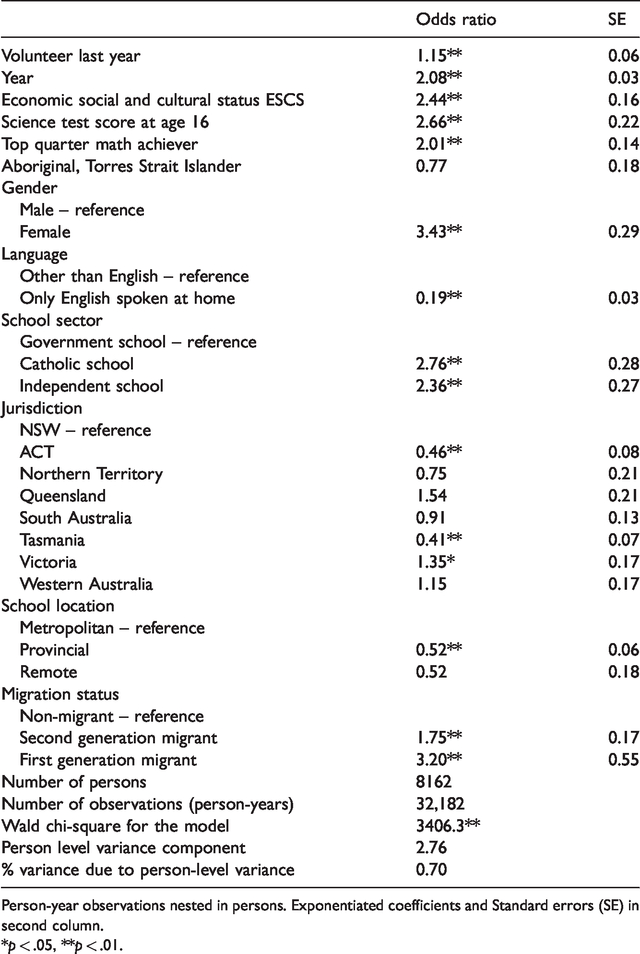
Person-year observations nested in persons. Exponentiated coefficients and Standard errors (SE) in second column.
*p < .05, **p < .01.
As we model the impact of volunteering on university study, and not the reverse, the logic of our reasoning implies the use of a lagged volunteering variable. This means that the information about volunteering is from the year preceding the year in which the dependent variable refers to university study or graduation. 3 Youth who volunteer are more likely than their peers to go to university. However, the positive effect of volunteering translates into just a 1% increase in the chances of university study or graduation. This is what the model in Table 3 returns when the probability of university study or completion is computed for individuals as a partial marginal effect (Williams, 2012). In other words, although the effect is statistically significant, it is very small in substantive terms. This 1% gain due to volunteering contrasts with a 10% boost in the chances of university study for women compared to men, a 9% boost for one extra standard deviation in academic achievement in science or an 8% boost when the family economic, cultural and social status rises by 1 standard deviation (not shown in Table 3). Thus, while volunteering helps students to enter and complete university, it does not make enough of a difference to be one of the key predictors.
The effects of the remaining predictors of university study in Table 3 are as suggested by prior research. Students from non-metropolitan areas were less likely to go to university, while migrants were more likely to do so.
To answer our final question, we now turn to the effects of volunteering on occupational status.
Does volunteering facilitate entry into higher status jobs?
Results of the analyses in Table 4, which examined the same set of predictors as those in Table 3, answer Research Question 6 by revealing that volunteering had a positive effect on the chances of securing higher status employment.
Two-level linear regression model predicting occupational status (AUSEI scores 0–100) of respondents’ jobs.
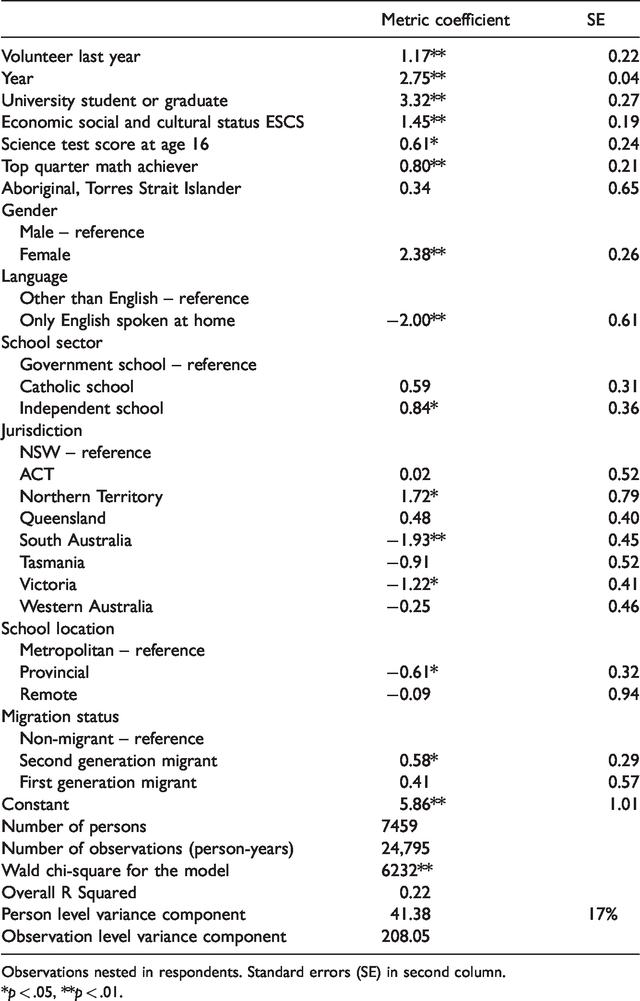
Observations nested in respondents. Standard errors (SE) in second column.
*p < .05, **p < .01.
On a scale ranging from 0 which denotes unskilled work to 100 which refers to high-status professions, having a history of volunteering adds an extra 1.17 occupational status point. Although, this is a statistically significant effect, on the one hand, it could be seen as negligible because 1 AUSEI point amounts to the status gain that medical professionals have over, e.g. actuaries, mathematicians and statisticians. On the other hand, university graduation leads to employment in jobs which have, on average, 4 extra AUSEI points. Thus, the effect of volunteering equals to a quarter of the effect of university completion and this could be seen as non-trivial.
Results also show that females entered jobs that were 2.38 AUSEI points higher in status than those of their male peers. This runs counter to the pattern for the entire labour force, but the data analysed here are collected from a cohort of young people at the beginning of their labour market experiences.
Monolingual students had jobs of lower status by about two points compared to bilingual students. Young people from families of higher economic, social and cultural status had higher status jobs (1.45 extra points per one standard deviation) compared with other young people. Older respondents entered jobs which had higher occupational status by a 2.75 extra points for each year. Differences by location and state also emerged but, overall, these effects reinforced the conclusion that while volunteering leads to higher status employment, the average gain is moderate.
Conclusion and discussion
Our examination of volunteering histories among young Australians born around 1990 shows that only small groups volunteer either continuously or never between the ages of 17 and 25. Most young people take up volunteering and then opt out of it at various points in time.
Results of the analyses show that young people who volunteer are more likely to enter and complete university and secure higher status jobs. However, these advantages could be regarded as very small. Volunteering raises the likelihood of such outcomes by a fraction of what strong academic performance or other factors contribute. Thus, it is important that the image of volunteering presented by volunteering organisations and educational institutions, while remaining positive, is not exaggerated by fostering perceptions that volunteering secures a substantial edge in entry to prestigious educational institutions and most coveted jobs. Volunteering increases the chances of university entry by about 1%, whereas scoring one extra standard deviation in a science test at age 16 raises these chances by 9% when other factors, such as gender, family background or school sector are taken into account. Giving time to community helps secure jobs in young adulthood that have status higher by one status point, while university completion helps by adding extra 4 occupational status points, all other things being equal.
Furthermore, no evidence has emerged from the analyses of survey and interview data that young people engage in volunteering primarily in the hope of raising their educational and occupational attainment. While the view of volunteering is positive, about 50% of young volunteers see no job-related benefits and report having never secured any employment because of their activities. This suggests that it is not viable to construe young people’s motivation to volunteer as primarily instrumental.
Young people from middle-class families, particularly families with more cultural capital, are more likely to volunteer, which conforms to the notion that this activity might be a form of embodied capital as per Bourdieu’s theory of social practice. In addition, attending schools known for catering to middle class students in the Independent and Catholic sectors raises the likelihood of volunteering. Importantly, cultural markers of class position, i.e. the institutionalised capital in the form of parental educational credentials and the objectified capital measured by cultural possessions and home library size are better predictors of volunteering than the economic capital, indicated by parental wealth or occupational status of parents. These results support Bourdieu’s theory more than rational choice arguments which hinge on the notion of instrumental motivation. Finally, evidence from our in-depth interviews implies that youth do not consciously attribute their volunteering involvement to their habitus, viewing it instead as stemming from their personality traits. Still, other parts of the interview and survey data show that students’ families of origin and school environments play a key role in fostering a longer term engagement in volunteering.
It is important to remember that our conclusions are limited to the types of volunteering covered by the LSAY questions which refer primarily to organised activities in formal settings, including campaigning, fundraising, coaching, teaching, serving on committees, organizing events, distributing food, goods or health-related information (see Table A3.3). Other types, such as spontaneous and mostly informal activities, social activism or online volunteering, will need to be examined in future research. For now, we find that volunteering leads to attainment gains, which are tangible albeit inconspicuous.
Supplemental Material
AED910813 Supplemental Material1 - Supplemental material for Gifts as gains? The impact of volunteering on young people’s educational and occupational attainment in Australia
Supplemental material, AED910813 Supplemental Material1 for Gifts as gains? The impact of volunteering on young people’s educational and occupational attainment in Australia by Joanna Sikora and Jennifer Green in Australian Journal of Education
Supplemental Material
AED910813 Supplemental Material2 - Supplemental material for Gifts as gains? The impact of volunteering on young people’s educational and occupational attainment in Australia
Supplemental material, AED910813 Supplemental Material2 for Gifts as gains? The impact of volunteering on young people’s educational and occupational attainment in Australia by Joanna Sikora and Jennifer Green in Australian Journal of Education
Supplemental Material
AED910813 Supplemental Material3 - Supplemental material for Gifts as gains? The impact of volunteering on young people’s educational and occupational attainment in Australia
Supplemental material, AED910813 Supplemental Material3 for Gifts as gains? The impact of volunteering on young people’s educational and occupational attainment in Australia by Joanna Sikora and Jennifer Green in Australian Journal of Education
Footnotes
Declaration of Conflicting Interests
The author(s) declared no potential conflicts of interest with respect to the research, authorship, and/or publication of this article.
Funding
The author(s) received no financial support for the research, authorship, and/or publication of this article.

Notes
Supplementary Material
Supplemental material for this article is available online.
References
Supplementary Material
Please find the following supplemental material available below.
For Open Access articles published under a Creative Commons License, all supplemental material carries the same license as the article it is associated with.
For non-Open Access articles published, all supplemental material carries a non-exclusive license, and permission requests for re-use of supplemental material or any part of supplemental material shall be sent directly to the copyright owner as specified in the copyright notice associated with the article.
