




Abstract
Bullying in schools, defined as a systematic abuse of power in interpersonal relations, may be undertaken individually and/or by groups. The extent to which schoolchildren report that they are bullied by their peers in each of these ways was examined in a survey of Australian schoolchildren (N = 1688) in Years 5–10 attending 36 coeducational primary or secondary schools. Being bullied by an individual student was reported by both males and females as occurring significantly more often than being bullied by groups. Applying multiple regression analysis, the reported frequency of individual and group bullying, after controlling for age and gender, independently predicted the severity of negative outcomes as assessed by measures of negative emotional impact, such as feeling unsafe from bullying, absenteeism due to bullying and reported negative impact on school work. Although group bullying was less commonly reported, its negative effects on student well-being were generally more severe. Implications are examined for student education about bullying and addressing individual and group-based bullying in appropriate ways.
Introduction
Bullying in schools is now recognized as a serious problem confronting schools. Following the lead of Olweus (1993), bullying is commonly conceived as aggressive or negative behaviour directed repeatedly over time, towards a person or persons who are unable to offer an adequate defence. Essentially, it involves a systematic abuse of power in interpersonal relations and may be undertaken by individuals and/or groups (Rigby, 2008). In recent years, there has been a tendency to move away from focusing primarily on bullying as exclusively dyadic interactions and to view bullying as occurring in a social context influenced by others. This has been described broadly as the socio-cultural view of bullying (Maunders & Crafter, 2018). Consistent with this view, Monks et al. (2009) opine, ‘bullying rarely takes place between two individuals in isolation’ (p.154). The behaviour and attitudes of other members of the community are seen as invariably contributing to its initiation and continuation.
Following the widespread adoption of the socio-cultural perspective, increasing attention has been given to the influence of peer groups in giving rise to bullying, either through collective action, as in ‘mobbing’ when the target of bullying is selected by a group rather than by an individual (Elliott, 2003), or through the actions of individual group members with the support of their peer or friendship group (Salmivalli, 2010). It is unclear, however, whether students who are being bullied tend to see it that way, that is, attributable to peer group pressure. This study focuses on judgements of schoolchildren attending schools in Australia regarding the source of the bullying to which they have been subjected, that is by an individual and/or by a group.
Whether a student is being bullied by an individual or by a group may appear clear to the target on some occasions but not others. Bullying may take place in a dyadic relationship in which the influence of a group of peers is seemingly absent or negligible; in that case the bullying is likely to be attributed to an individual. On other occasions a group may be seen as responsible, as in mobbing, and even when the actions that constitute bullying are carried in the victim’s judgement by a single individual on behalf of the group, sometimes referred to as a ‘henchman’ (Olweus, 2001). However, there can be more ambiguous situations in which a judgement about the identified source of the bullying is highly subjective and dependent on the attribution process employed by the victim (Danielson & Emmers-Sommer, 2016; Heider, 1958). Currently, there is relatively little evidence as to whether bullied students tend to see individuals and/or groups responsible for bullying them.
Knowing what students tend to believe about the source of the bullying they may experience is relevant to educational initiatives to counter bullying. There is a potential conflict between the attributions educators make about who or what is responsible for a student being bullied and the perceptions or attributions that students themselves tend to make. If being bullied is attributable to group processes, as is commonly theorized, education provided to students about bullying should take into account what students tend to believe based on their personal experiences.
Studies of the student perceptions of bullying perpetrators
In Australia, some relevant data are available from a study of adults who reported that they had been bullied at school (The Wesley Mission, 2009). Among respondents aged 18–29 years (N = 512), some 50% of those bullied indicated that they had been bullied by an individual student and 50% by a group of students. In an older set of respondents aged 30–44 years (N = 688), 42% of those bullied reported that they had been bullied by an individual and 58% by a group. These findings suggest that Australian adults looking back on their school days are somewhat more likely to report that they were bullied at school by a group of students, particularly so as they, as adults, became older. A limitation of this study is that no data were reported on how often respondents recall having been bullied and how often they were bullied by individuals or by groups.
Some relevant findings regarding the mode of victimization among students have been reported from a study conducted among adolescent schoolchildren in Sweden by Thornberg and Knutsen (2011). Respondents were asked about their experiences of bullying at their school and classified as victims (having been bullied at least once) or non-victims. They were also asked to provide their explanation of why bullying took place at school. A qualitative analysis of the explanations given by 44 victims indicated that a large majority (N = 37) attributed bullying to the individual bully; a minority (N = 11) attributed bullying to the peer group. (Several – unreported – evidently made attributions to both). This study suggests that in Sweden victimized students tend to attribute bullying to individuals. It should be noted that in this study respondents were not asked to draw upon their personal experiences of being bullied, but rather to provide general explanations for bullying.
In summary, these studies suggest that schoolchildren may be more inclined than adults to attribute bullying behaviour to individuals rather than to groups. However, previous studies have been limited, especially in either basing findings on retrospective data only from adults rather than more direct reports from students, or in eliciting judgements of students about the behaviour of bullies generally rather than based on their personal experiences.
The effect of peer victimization by individuals and by groups on student well-being
As well as estimating the frequency with which students perceive being bullied by individuals and by groups, this study sought to determine whether the judgements made by students about who had bullied them could have implications for the severity or seriousness of the bullying they have experienced.
The research evidence is replete with numerous studies supporting the view that being victimized at school has serious consequences for the well-being of students. They include studies of the harmful psychological effects of being bullied, both short term and long term (Ford, King, Priest, & Kavanagh, 2017; Malecki et al., 2015; Rigby, 2003; Thomas et al., 2016; Walters & Espelage, 2018). Some studies have reported on the negative effects of bullying on feeling safe at school (Baams, Talmage, & Russell, 2017; Berkowitz & Benbenishty, 2012; Rigby, Haroun, & Ali, 2019). Being repeatedly absent from school has been reported as a consequence of bullying at school (Goldweber, Wassdorp, & Bradshaw, 2013; Steiner & Rasberry, 2015; Tremlow, Fonagy, & Sacco, 2010). Finally, it has been reported that the inability of some students to succeed academically is related to frequently being bullied at school (Grinshteyn & Yang, 2017; Nakamoto & Schwartz, 2009).
There were then strong grounds for expecting that being bullied at school would be related to such negative outcomes for those victimized. However, research seeking to differentiate between the possible effects of being bullied predominantly by individuals or by groups is sparse and appears to be limited to that described in the Wesley report. In that study, the adult respondents were asked to complete a multi-item measure of self-esteem published by Rosenberg (1986), adapted for use in retrospective studies to describe how they felt about themselves when they attended school. Used in this way, the scale has been shown to have an acceptable level of reliability as indicated by a test–retest correlation for adults of over 0.8 (Marino, 2000). Those respondents who reported having been bullied by groups were significantly more likely to score below average on self-esteem than those bullied by individuals. Again one should note the limitations of this research in that it is based on retrospective accounts of how adults felt as schoolchildren, rather than data supplied by students currently attending school.
In the comparative absence of studies comparing the possible effects on victims of group and individual bullying, one may consider reasons for expecting a difference. Arguably, when a group is involved in bullying someone, the potential for that person to be bullied on numerous occasions is relatively high. Avoiding members of a group who are predisposed to engage in bullying is clearly more difficult than avoiding a single person. Further, being the repeated victim of group bullying is likely to create the impression that one is perhaps deservedly unpopular – for many students a depressing prospect. Some forms of bullying such as ostracism and rumour spreading may be more likely to occur, given the greater number of people involved. Ostracism has been shown to have highly pernicious effects on the well-being of those continually excluded (Williams & Nida, 2011). Overall, it appears that being bullied by a group as distinct from an individual is likely to have a more severe impact on the well-being of a student.
Gender and age as potential factors in determining victimization outcomes
Studies of the overall frequency of peer victimization experienced by males and females have produced inconsistent results across countries (Smith, Lopez-Castro, Robinson, & Goerzig, 2018), with males reporting being bullied more often than females, as for example in the United Arab Emirates (Rigby et al., 2019), and females reporting being bullied more often than males in some other countries, for example, the USA (Finkelhor, Turner, Shattock, & Hamby, 2015). Although there is a consensus that males are generally bullied more often in physical ways and that it is sometimes claimed that females are more likely to be exposed to relational bullying (Orpinas, McNicholas, & Nahapeyam, 2015), statistical evidence of an overall difference between males and females in the prevalence of bullying attributed by students to groups or to individuals is lacking. Given the possible influence of gender differences in determining the research outcomes, it was considered appropriate to examine whether there were gender differences in the way students reported being bullied and also to include gender as a control factor in examining the effects of the two forms of bullying on student-reported well-being.
The relationship between the age of students and the impact of being bullied on emotional well-being has hitherto received little attention, apart from a study conducted in Taiwan in which it was reported that younger students display a higher level of anxiety when they are subjected to verbal and relational bullying at school (Yen et al., 2013). Whether this finding can be replicated in a different cultural environment was unclear.
Hypotheses
Hypothesis A: It was hypothesized that students would report being bullied at school more frequently by individuals than by groups
Hypothesis B: It was hypothesized that the negative effects on wellbeing would be greater in the case of reported group bullying compared with reported bullying by individuals. Specifically, group bullying would have a greater negative effect, as indicated by student self-reports of (i) emotional impact; (ii) feeling unsafe at school; (iii) being absent from school; and (iv) school work being affected
In addition to testing the above hypotheses, the aim was to determine gender differences in the extent to which bullying by individuals and by groups is reported, and also whether the gender and age of the students were associated with reported negative well-being.
Method
Data obtained for the research reported in this article were derived from an Australian government funded survey of the prevalence and effectiveness of anti-bullying strategies employed in Australian government schools (see Rigby & Johnson, 2016). Approval to conduct the research was obtained from the Ethics Committee of the University of South Australia and from each of the six educational jurisdictions in which the research was conducted. Students completed a questionnaire anonymously online at their school during the final term of school in 2015.
Sample
This was a convenience sample of students in Years 5–10 attending mainstream coeducational government schools in Australia. In total, 1688 students participated in the study, of whom 775 were males and 913 females. They were drawn from 36 schools in six state/territory educational jurisdictions. Twenty-five schools were primary, seven secondary and four combined primary and secondary (i.e. attended by students of all year levels). Ages ranged from 8 to 16 years. The mean age was 12.25 years with an SD of 1.66. The age distribution was skewed, with more than half (60.5%) under the age of 13 years. No further data were collected about the school such as its student enrolment, numbers of staff or the socio-economic status of the school’s catchment area.
Measures
The questionnaire included the following items of relevance to this study:
All students were asked to answer these questions:
How often have you been bullied THIS YEAR by a group or by one person? To answer this question two items were provided:
By one person bullying you By a group bullying you.
Respondents could indicate for each item (i) never, (ii) sometimes, (iii) often or (iv) very often.
B. How safe have you felt from being bullied this year? This question was asked in relation to (i) when you were at school (ii) on the way to and from school and (iii) being cyber bullied. The response categories were (i) I always felt safe; (ii) I usually felt safe; (iii) I felt safe about half the time; (iv) I hardly ever felt safe or (v) I never felt safe. These responses were scored 1–5 and summed for each of the three items. The alpha coefficient was 0.74 (N = 645).
2. Students who reported that they had been bullied either by ‘one person’ or by a ‘group’ answered questions regarding the emotional impact of the bullying, absenteeism due to bullying and negative effect on school work.
Emotional impact. Students were asked (i) how angry, (ii) how upset, (iii) how sad and (iv) how frightened they were at the time they were being bullied. The response categories for each question were ‘not’, ‘a bit’, ‘quite’ and ‘very’. These responses were coded 1 to 4 to form a four-point scale. The reliability of this measure, as assessed by alpha, was 0.80 (N = 645). Absenteeism. This was assessed by asking ‘Have you stayed away from school this year because of bullying?’ The response categories were (i) No, I never thought of doing so; (ii) No, but I thought of doing so; (iii) Yes, I stayed away once or twice; (iv) Yes, I stayed away, more than twice. Responses (i) and (ii) were combined and scored as 1, (iii) was scored as 2 and (iv) as 3. Negative effect on school work. Students were asked to answer this question: Do you think the bullying made it hard for you to do your school work? Response categories were ‘No’ (scored as 1); ‘Unsure (scored as 2) and ’Yes’ (scored as 3). 2. In addition students were asked to indicate their age (in years) and gender (male, coded as 1 or female, coded as 2).
Results
Student perceptions of individual and group bullying
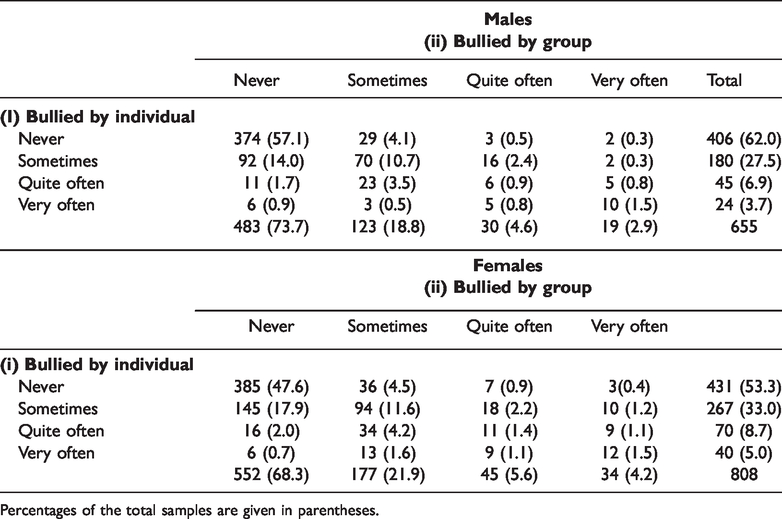
Table 1 provides numbers and percentages of males and females who reported levels of frequency in describing how often they had been bullied at school in the current year by an individual and/or by a group of students.
Reported frequencies of being bullied by (i) an individual student and (ii) by a group, according to gender of respondent.
Percentages of the total samples are given in parentheses.
Approximately half the respondents indicated that they had not been bullied at all: 57.1% of males and 47.6% of females. As shown in Figure 1, for both genders the next most common response was that they had been bullied ‘both individually and by a group’; next in order, by ‘individuals only’ and lastly by ‘groups only’.
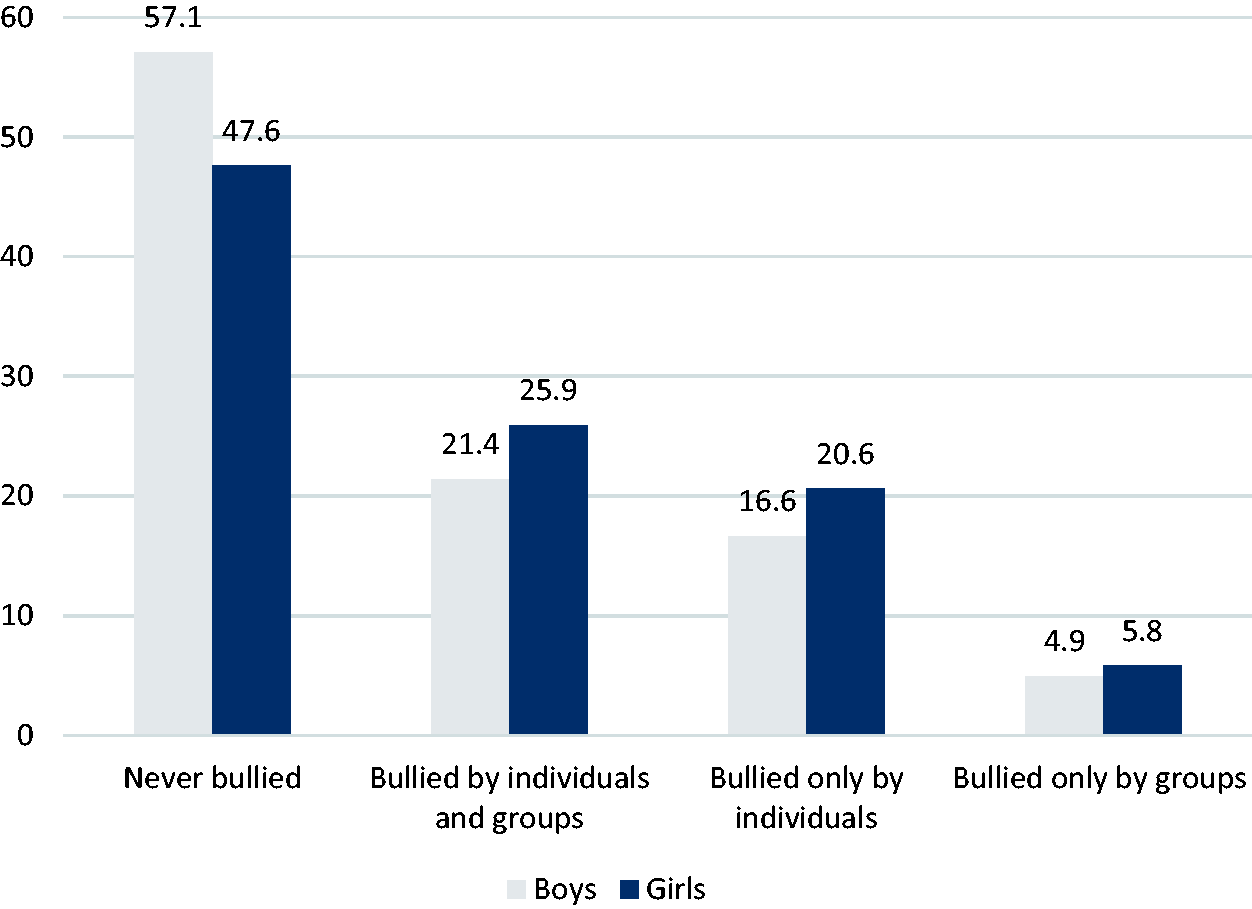
Percentages of boys and girls reporting being bullied (or not bullied) in different ways.
The distributions of responses (as shown in Figure 1) were significantly different for males and females: χ2 = 13.00, df = 3, p < 0.01. Examination of the distributions suggests a tendency for males to report that they had never been bullied and for females to report being bullied slightly more often in each of the three ways shown in the Figure 1.
Comparing the frequency with which bullying of both kinds was reported was also undertaken using scores of males and females who had been bullied on the measures of individual and group bullying, each on a 1–4 scale, from ‘never’ to ‘very often’. The mean frequency score for males who reported having been bullied by an individual was 2.13, SD = 0.84, N = 228; for females the mean frequency score was 2.15, SD = 0.87, N = 384; with no difference between the groups: t = 0.278, df = 610, p > 0.05. The mean score on the measure of bullying frequency related to groups for males was 1.83, SD = 0.90, N = 228; for females, the mean was 1.85, SD = 0.94, N = 384; again, with no difference between the groups: t = 0.259, df = 610, p > 0.05. This result suggests that overall females and males who reported being bullied were bullied about equally often, whether by individuals or by groups.
Finally, comparisons were made between the frequencies with which students reported being bullied by (i) an individual and (ii) by a group, using a paired sample t-test. This sample included students who reported that they had never been bullied. The mean score for group bullying was 1.42, SD = 0.75; for individual bullying, the mean was 1.59, SD = 0.81. The differences were significant: t = 9.27, df = 1462, p < 0.001. As predicted, students generally report being bullied more frequently by individuals rather than by groups.
Relationships between study variables
Correlations between the study variables are given in Table 2. These indicate low to moderate significant correlations (p < 0.001) among the measures of bullying frequencies and the measures of reported negative impact. In each case, the obtained correlation with the measure of group bullying was higher than with the measure of individual bullying frequency, significantly so for the measure of feeling unsafe: r = 0.468 > r = 0.353; z = 3.79, p < 0.001 (Soper, 2019). Correlations involving age and gender were non-significant, apart from a low but significant positive correlation between emotional impact and gender (r = 0.145, p ≤ 0.01), with females reporting a greater negative emotional response to bullying than males. For this relationship, Cohen’s D was 0.35, which may be interpreted as representing an effect size of between small and medium (Cohen, 1969).
Intercorrelations between the study variables.
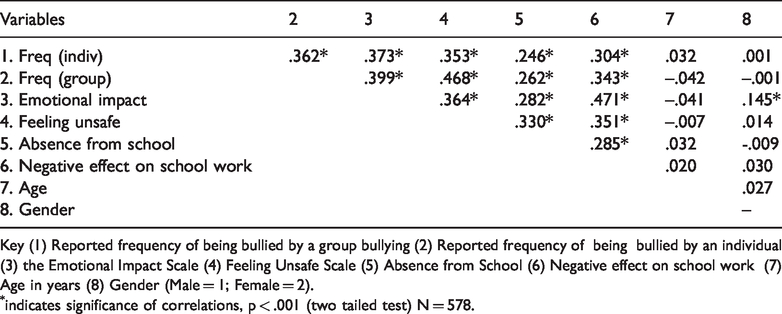
Key (1) Reported frequency of being bullied by a group bullying (2) Reported frequency of being bullied by an individual (3) the Emotional Impact Scale (4) Feeling Unsafe Scale (5) Absence from School (6) Negative effect on school work (7) Age in years (8) Gender (Male = 1; Female = 2).
indicates significance of correlations, p < .001 (two tailed test) N = 578.
To examine the relationship between each of the two measures of bullying frequency, and each of the four dependent variables, after controlling for age and gender, a series of multiple regression analyses was conducted. Given the moderate size of the correlations between the measured variables reported above, it was considered appropriate in conducting the following multiple regression analyses to test for multicollinearity by computing a Variance Inflation Factor (VIF) provided in SPSS for each relationship.
Regression analyses
Regression analyses were conducted employing the following as predictor variables: (i) reported frequency of being bullied by an individual, (ii) reported frequency of being bullied by a group, (iii) age (in years) and (iv) gender (1 = male and 2 = female). Dependent variables were as follows: (i) reported emotional impact, (ii) absences from school, (iii) negative effect on school work and (iv) feeling unsafe. This analysis was repeated for each of the dependent variables. Results are summarized in Table 3.
Summary of results from regression analyses predicting negative outcomes from being bullied.
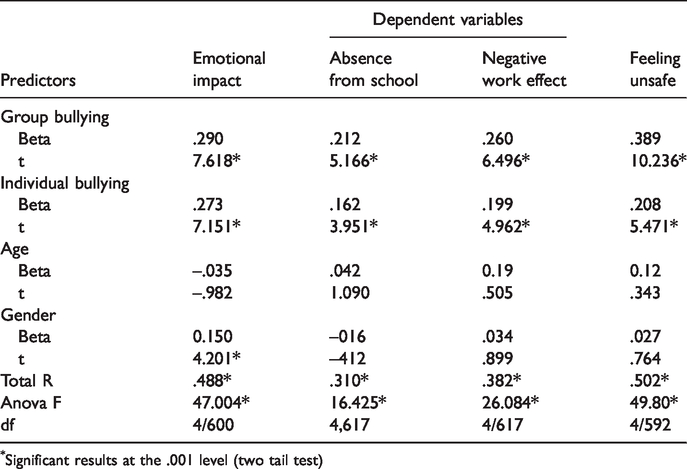
Significant results at the .001 level (two tail test)
VIF values associated with Group bullying ranged from 1.45 to 1.50; with individual bullying, they ranged from 1.14 to 1.48. VIF values associated with age and gender ranged from 1.00 to 1.01. These results imply that collinearity could have only minimal effects on the magnitude of the reported beta coefficient (Hair, Tatham, & Anderson, 1998).
The main finding from the regression analyses is that the frequency of being bullied, whether perceived as individually or group based, was independently predictive of reported negative emotional impact, absenteeism, feeling unsafe and being negatively affected in school work. This was the case after controlling for age and gender. Further, for each of these dependent variables, beta coefficients were consistently higher when the frequency of group bullying was the predictor. Gender was unrelated to the impact of bullying, except for ‘feeling upset’, which was greater for females. The age of the student was unrelated to any of the dependent variables.
In interpreting these results it should be noted that with respect to emotional impact, absenteeism and effect on school work, the students were asked to say how they personally thought the bullying had affected each of these possible outcomes. For ‘feeling unsafe’ no such stipulation was made; students reported on their current state of mind regardless of whether they thought that being bullied was responsible.
Discussion
Student perceptions of bullying
This study suggests that students of both genders who report being bullied at school are most likely to say that they experienced bullying from both individuals and groups. However, as hypothesized, they report being bullied more frequently by an individual than by a group at school. This conclusion may appear to conflict with the prevailing view that bullying is generally the outcome of influence from a network of interpersonal relations and from social pressures and is not attributable to the personal characteristics of individuals in dyadic encounters. It should be emphasized, however, that the evidence from this study relates to the reported perceptions of students, while the other view pertains to a general theoretical perspective. In their judgements of who is responsible for them being bullied, students tend to identify individuals rather than groups, possibly unaware of the social and cultural influences that have led to the bullying taking place.
An alternative explanation is that in taking a broad ecologically based view of bullying, there may be a tendency to underestimate the extent to which bullying involves dyads of students who are largely unaffected by group influence and normative pressures. For instance, in a study of students (N = 918) attending school in the Netherlands, Veenstra et al. (2007) gathered data from children (mean age 11 years) relating to 13,606 dyadic relations. When bullying occurred, both dyad members generally attributed the bullying to the personal characteristics of the perpetrator, describing the bully as aggressive and domineering and the victim unassertive and personally vulnerable.
Whether bullying is attributable to individuals, as in dyadic relationships, or to groups may depend on the culture in which an investigation is conducted. It has been suggested that in collectivist countries, such as South Korea and Japan, bullying is conducted largely or entirely by peer groups (Bax, 2016; Smith & Robinson, 2019). By contrast, a more individualistic culture prevails in Australia and in the USA (Hofstede, Hofstede, & Minkov, 2010). Replication of a study such as this in collectivist and individualistic countries is needed to confirm this possibility.
Reported effects of bullying
Consistent with numerous studies, as reviewed earlier, is the finding that reports of being bullied at school, regardless of whether by individuals or by groups, are related to reports of negative outcomes with respect to emotional effects, feeling unsafe at school, absenteeism and negative effects on school work. The present study suggests further that these effects can be predicted by students’ reports of the frequency with which they have been bullied either by an individual or by a group.
The hypothesis that the perception of being bullied by groups has a stronger negative effect than the perception of being bullied by individuals received qualified support. For each of the four dependent variables – negative emotional effects, feeling unsafe at school, absenteeism and negative effects on school work – correlations with reported group bullying were significantly larger for feeling unsafe from bullying at school only.
In the regression analyses, beta coefficients relating to group bullying were consistently higher for each measured outcome. These results suggest that being bullied by groups, or the perception of this happening, may have particularly serious consequences for student well-being. As in the Wesley Mission Report (2009) discussed earlier, the perception of being bullied by groups may constitute a more serious threat to student well-being than the perception of being bullied by an individual.
Gender and age
As noted earlier, gender correlates with aspects of bullying have differed markedly in studies reported in different parts of the world, suggesting significant cultural influences. In this study conducted in Australia, gender differences were in fact few. One concerned the higher proportion of males who reported they had never been bullied at school, an outcome that may be due to a male tendency to assert stereotypical masculine values and deny vulnerability (Yubero, Laranaga, & Del Rio, 2012). Another was that females in general reported stronger negative emotional reactions, as in feeling more upset after being bullied, an outcome reported in a meta-evaluation of relevant studies reported by Chaplin and Aldao (2012). Unlike the study conducted in Taiwan by Yen et al. (2013), age was not found to be related to the reported outcomes of bullying in the current study. Possible explanations may lie in the cultural differences and/or in the nature of the bullying experienced by victims of bullying in the two countries.
Implications for practice
One relevant question is whether students should be encouraged to take a broad socio-cultural approach to understanding bullying as distinct from one that sees bullying as due to the propensities of particular individuals. The findings from this study suggest that students may be more inclined to attribute responsibility for bullying to individuals rather than recognize the broader social factors that may contribute. It may therefore be suggested that students be advised on how group membership may incline some people to follow group norms rather than act independently. At the same time, in doing so it may be unwise to discourage a belief in individual accountability for bullying. Research reported by Baumeister (2008) supports the view that belief that individuals are responsible for their behaviour promotes helpfulness and reduces aggression and that disbelief encourages automatic impulses that are socially undesirable. A balance is needed between helping students to recognize how social and cultural factors may combine to promote bullying in a school and recognition of the part that may be played by individual volition.
Although it is unclear whether the judgements of victimized students about the source of the bullying are veridical, student attributions as indicators of what is happening to them and the differential impact of individual and group bullying cannot be dismissed. Those who intervene in cases of bullying may need to select and apply methods of intervention that are most relevant to particular cases of bullying, that is, whether by individuals or by groups. Currently, most forms of intervention in cases of bullying focus upon the individual seen as responsible for the bullying and/or the target of the bullying (Rigby & Johnson, 2016; Thompson & Smith, 2011). In view of the finding that according to students the severity of the consequences of being bullied, at least as far as feeling safe at school is concerned, tends to be greater when students are bullied by groups, greater use of intervention methods that are appropriate for addressing group bullying is justified. These methods of intervention involve working with groups of students who are involved in bullying, as perpetrators and/or victims (see Bauman & Del Rio, 2005; Rigby, 2012, 2017). Their application in schools is in fact relatively rare, according to teacher reports summarised by Thompson and Smith (2011) in England and Rigby and Johnson (2016) in Australia. Hence training in the use of methods designed to address group bullying, such as the Support Group Method (Robinson & Maines, 2008) and the Method of Shared Concern (Pikas, 2002; Rigby & Griffiths, 2011), is needed in teacher education, at least in Australia judging from teacher reports (see Rigby, 2017).
Further studies
Relatively new ventures, such as this, into the somewhat neglected area of whether bullying is perceived by students as perpetrated by individuals and/or groups, raises questions that need to be addressed by further studies. These include how students actually decide whether responsibility for bullying they have experienced lies with an individual or with a group. This could depend in part on the developmental stage of the victim. In this study, some of the respondents were pre-adolescent and, unlike older students, more likely to think in concrete ways rather than abstractly (Sanders, 2013). How a victim’s level of cognitive development affects their judgements of who the perpetrator(s) are could usefully be examined. Of further interest is whether the reported bullying is directed towards people within or outside the group of which they see themselves as being a member, and how perceptions of teachers differ (if at all) from students in their attribution of responsibility for bullying. Finally, it may be asked whether the relative frequency of perceived individual and group bullying varies cross-culturally, especially in relation to whether the society or culture in which it occurs is identified as individualistic or collectivist.
Strengths and limitations of the research
The major strength of this study lies in examining an issue that has significant implications for appreciating how students view the sources of bullying. It shows for the first time that students in an individualistic culture such as Australia perceive being bullied more often by individuals than by groups, and, moreover, it is group bullying, as students perceive it, may have more negative effect on student well-being. This finding has important practical implications for both educating students about bullying and the choice of methods in addressing cases of group bullying.
The study’s limitations lie first in not exploring how victimized students decided whether they were being bullied by an individual or by a group or by both, and, further, how closely their judgements accord with ones made by independent, well-informed observers. Conclusions at this stage must rest upon attributions, as distinct from more objective assessments of actual bullying behaviours for which responsibility can be reliably ascribed to individuals or groups. Secondly, as in data from cross-sectional surveys, support for a causal explanation of effects is lacking. Finally, it should be noted that the study is based on a convenience sample of Australian students in an individualistic culture and have limited generalizability.
Conclusion
Briefly, it is concluded that students attending schools in Australia are more likely to report that they have been bullied by individuals than by groups. This conclusion is important for educators seeking to promote better understanding of how bullying is perceived by students. The findings suggest that group bullying, as distinct from individual bullying, as perceived by students, may have more severe consequences for student well-being and require appropriate group focused interventions.
Footnotes
Declaration of Conflicting Interests
The author(s) declared no potential conflicts of interest with respect to the research, authorship, and/or publication of this article.
Funding
The author(s) disclosed receipt of the following financial support for the research, authorship, and/or publication of this article: Financial support was received from the Australian Department of Education and Training to undertake research from which relevant data were extracted and analysed.
