



Abstract
A policy problem is a discursive construction, and the way in which the problem is framed determines both the nature of the policy responses and the possibility of resolving it. In this paper, drawing on critical frame analysis, we examined three major equity policies in the Australian early childhood education and care (ECEC) sector. In mapping out framing and reasoning devices of the policies, our analytical interest is to highlight the representation of inequality as a problem and unmask underlying assumptions of the equity responses. The findings show that disadvantage in Australia’s ECEC sector has been framed as a lack of access, limited navigational capacity and cultural exclusion; and the framings are underpinned by economic, educational and social rationales. The analysis also reveals problematic categories, issue-omissions and conceptual shifts within the texts. The paper draws practical implications of the frame contradictions and silences.
Introduction
In the last 10 years, strong evidence emerged related to the major challenges faced by early childhood education and care (ECEC) services and policy in Australia. Thematic and sector reviews showed that children from disadvantaged backgrounds lacked access to quality ECEC services (Press & Hayes, 2001), that policy and governance of the nation’s ECEC sector was highly ‘fragmented’ (OECD Review Team, 2001 – emphasis added), and that Australia’s public spending on pre-school education was one of the lowest among the OECD member countries (OECD, 2001, 2006). In response, in the second half of the 2000s, the Commonwealth, State and Territory Governments of Australia embarked on a reform process to improve issues related to governance, quality and equity in the ECEC sector (COAG, 2008, 2009a, 2009b, 2009c; Tayler, 2016).
The reforms aimed at ensuring affordability, streamlining regulations, and promoting workforce productivity. Specifically, among other things, the governments agreed on (a) Closing the Gap that centred on participation of Indigenous children in early childhood services (COAG, 2009a), and (b) Universal Access to quality ECEC aiming for all children to experience 15 hours of a quality early childhood programme per week in the year before they entered primary school (COAG, 2008). Following a concerted campaign against Indigenous disadvantage in the first half of the 2000s, the Council of Australian Governments (COAG) pledged to close key gaps in health, education, economic participation and housing (COAG, 2008). To help achieve these goals, the COAG approved a number of Indigenous-specific National Partnerships, including Closing the Gap: National Partnership Agreement on Indigenous Early Childhood Development. One of the six Closing the Gap targets was: ‘ensuring all Indigenous four-year olds in remote communities have access to early childhood education within five years’ (p. 8). At the same time, the Commonwealth, State and Territory Governments endorsed the National Partnership Agreement on Early Childhood Education, and pledged to achieve Universal Access to quality early childhood education (COAG, 2008). In 2013, the Governments reaffirmed their commitments to the same goal (COAG, 2013). It is imperative to note that the Universal Access initiative in Australia reflects a policy moment in other comparable economies as represented by the OECD’s(2001, 2006) call for ‘universal approach to access’ in ECEC, and the European Commission’s (2011) notion of ‘universal and inclusive ECEC’.
Generally speaking, the quality discourse in the ECEC sector focuses on workforce development, quality assurance and child-centred curriculum. Key elements of quality ECEC services include the availability of adequately qualified EC professionals, the provision of stimulating learning experiences for children, lower child-to-staff ratios and active parental engagement (COAG, 2009b, pp. 8–9). In this respect, tackling inequality or widening access to quality ECEC services means ensuring that every child has access to qualified educators, stimulating pedagogical practice, and culturally responsive and inclusive learning experiences. The performance indicators of the Universal Access policy include teacher qualification, programme availability, access and attendance (i.e. the number of hours each child attends early childhood programmes) (COAG, 2013).
Notwithstanding these measures, inequality in early childhood education remains a persisting challenge in the sector (AEDC, 2016; Fenech, 2013; Productivity Commission, 2014; Tayler, Peachey, & Healey, 2018). With the gap between policy intents and policy outcomes as a background, we set out to understand how the problem of inequality is understood or framed in the first place. Our point of departure is that we draw on policy frame analysis (Bacchi, 2009; Rein & Schön, 1996; Wagenaar, 2015) to make sense of the representation of the problem, and to unmask assumptions and rationales underpinning equity provisions in Australia’s ECEC sector. If politics is ‘an authoritative allocation of values’ (Easton, 1953, p. 3), policy is an instrument of value allocation. It defines who gets what in society. A critical frame analysis aims at revealing whose values are authoritatively allocated, and whose interests are excluded in the plan of action. With a focus on tracing contradictions and issue-omissions, we also assess if the policy framing renders the problem of inequality in the sector difficult to tackle.
The paper proceeds in five main sections. The first section briefly presents the analytical framework and methodological orientation of the paper. The second section deals with the framing of the problem of inequality in Australia’s ECEC sector; followed by a section on assumptions and rationales underpinning the issue-framing. The fourth section deals with issue omissions and problematic categories that characterise the framing of inequality. By way of conclusion, the last section reiterates emerging themes, and highlights implications for transforming the problem for future research.
Analytical framework, methodology and data
Policymaking is an act of framing – a way of setting frames around issues that deserve public action. In his classic work, Frame Analysis (Goffman, 1974), sociologist Erving Goffman defines frames as schemata of interpretation that guide perception and the representation of reality. Framing on the other hand involves performance – it entails selection, emphasis and exclusion. Fairhurst’s (2010) distinction is useful: ‘a frame is that mental picture, and framing is the process of communicating that picture to others’ (p. 4). Like boundaries of a painting, frames supply the context for selection, and highlight what is considered relevant that deserves attention. The concepts of frame and framing are regularly invoked in the analysis of social interaction (Goffman, 1974), social movements (Snow & Benford, 1988), gender (Verloo, 2005), pedagogy (Hesford, 1999), media (Entman, 1993), politics (Lakoff, 2004), and policy (Bacchi, 2009, 2012; Cuthbert & Molla, 2015; Fischer, 2003; Molla, 2013; Rein & Schön, 1996).
Following van Gorp (2001), Verloo (2005) defines a policy frame as ‘an organizing principle that transforms fragmentary or incidental information into a structured and meaningful policy problem, in which a solution is implicitly or explicitly enclosed’ (p. 20). She adds: ‘policy frames are not descriptions of reality, but specific constructions that give meaning to reality, and shape the understanding of reality’ (Verloo, 2005, p. 20). They are critical elements of policymaking because they carry shared meanings and values and provide a coherent way of accounting for social reality, which, in turn, make it easier for actors to process information and commit to translating the policy into action. Frames supply the context and highlight what is considered a relevant issue worthy of public attention; and framing involves marking off what is seen as important from the rest. Without a framing that sets the context, we encounter ambiguity of meaning. For Rein and Schön, the naming and framing of problems is a necessary condition in a policy process mainly because: Real situations are complex, vague, ambiguous and indeterminate. In order to make sense of any situation one must select out certain features and relations which are taken to be the most relevant characteristics of that situation. These features allow one to create a story which explains the situation. (1996, p. 26)
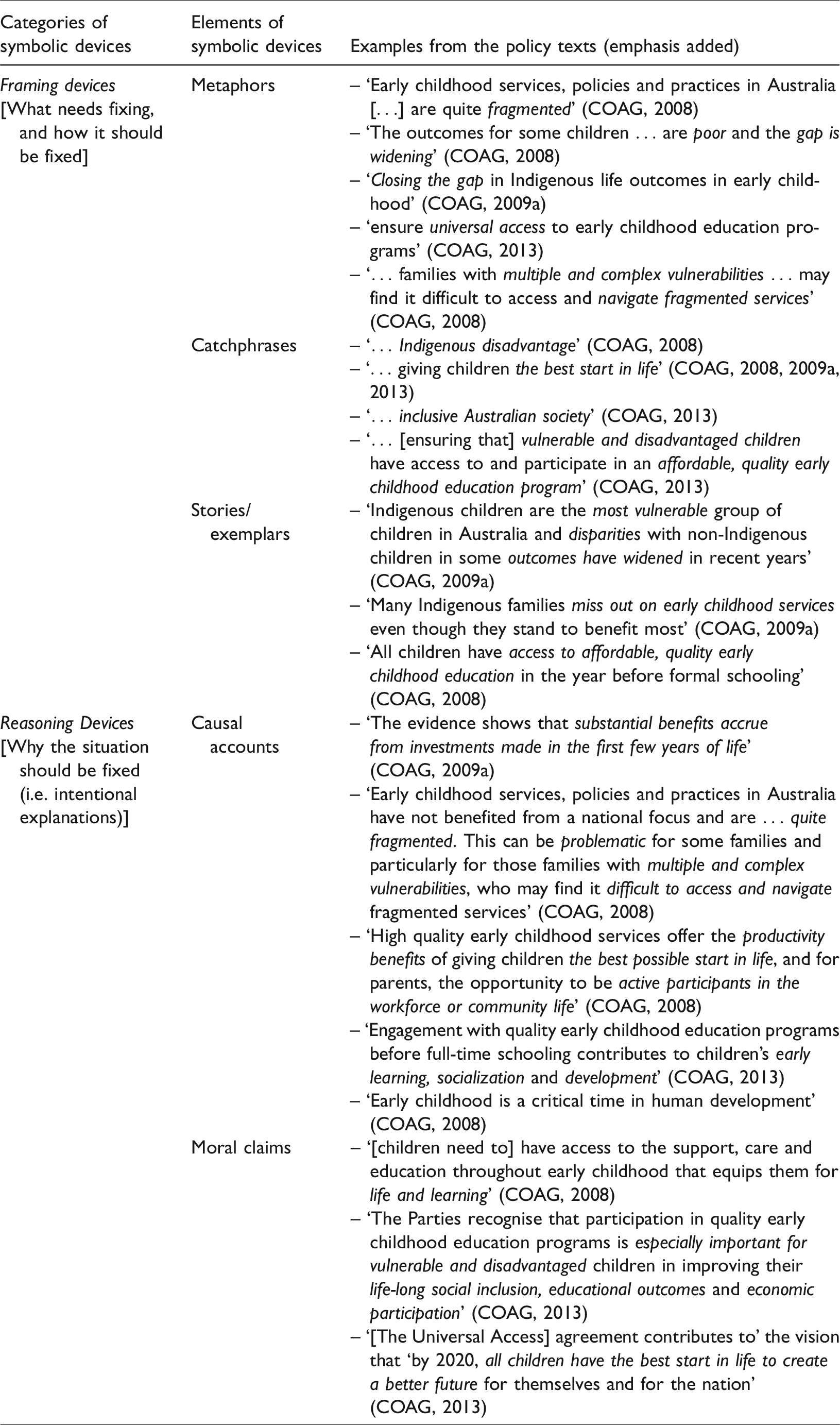
Policy frame analysis entails identifying and problematizing ‘symbolic devices’ (Stone, 2011) that policymakers apply to name and frame policy issues in ways that resonate with priorities and aspirations of the public. Gamson and Modigliani (1989) distinguish two forms of symbolic devices, namely ‘framing devices’ that highlight what is the issue defined as a policy problem (e.g. metaphors, catchphrases, exemplars, stories, depictions, and visual images), and ‘reasoning devices’ that justify why it should be dealt with (e.g. causal analysis, and moral claims). While policy framing devices tell us ‘what needs fixing and how it might be fixed’, reasoning devices direct our attention to why it should be fixed (Rein & Schön, 1996, p. 89). In other words, to study the framing of policy agendas is to interpret ‘condensing symbols’ such as ‘the metaphors, symbols, imagery, catchwords and historical examples through which a position is elaborated to convince the public or interested organizations, to mobilize political action, or to create consensus’ (Larsson, 2005, p. 129, emphasis added). In so doing, our assumption is that as principles of selection, frames are often informed by unquestioned beliefs that we may hold toward certain categories of people, issues, and/or solutions. As Fairhurst (2010) argues, ‘When we hold firmly to stereotypes, we deemphasize or ignore information’ (p. 48).
Frames do not just describe the world for a policy intervention, they also deeply shape our view of the world itself (Wagenaar, 2015). In using policy frame analysis, we aim to get behind surface features of policies in order to understand assumptions and logics underpinning the Universal Access to quality ECE agenda in Australia, and to contribute to knowledge in education policy research. We seek to identify what instruments are put in place to address the problem of inequality in the ECEC sector, understand the rationales informing equity policy pronouncements, unmask conflicting positions and inconsistencies, and problematize the socio-economic and political contexts that sustain these assumptions (Gamson & Modigliani, 1989). As our primary interest was to understand how the problem of inequality in ECEC was framed in equity policies, we purposefully selected three policy documents that solely focus on the problem of inequality. These are the National Partnership Agreement on Early Childhood Education (COAG, 2008); Closing the Gap: National Partnership Agreement on Indigenous Early Childhood (COAG, 2009a); and the National Partnership Agreement on Universal Access to Early Childhood Education (COAG, 2013). In these agreements, the Commonwealth and the State and Territory governments expressed their collective commitment to (a) ensuring ‘universal access’ to ECEC (COAG, 2008, 2013) and (b) improving the early childhood outcomes of Indigenous children (COAG, 2009a). Recent National Partnership Agreements on Universal Access to early childhood education are simply extensions of the agreement signed in 2013; there is no substantial difference in terms of scope or focus.
At the analysis stage, after closely reading the selected policy texts, we identified emerging patterns within the data corpus, refined and named key themes in light of the analytical framework, and developed storylines through collating relevant data extracts under each of the five themes discussed. The goal was to understand the framing of inequality as a policy problem and highlight contradictions and omissions in the issue-framings. Framing is a way of transforming cognitive structures (personal frames) into public discourses (textual frames). Policymaking is a ‘framing work’ in the sense that policymakers give their frames public meaning ‘by embedding them in networks of other more or less widely shared and practically relevant meanings’ (Ferree, 2009, p. 89). To frame an issue is to understand it, and to have control over it. In defining which aspects of inequality need to be addressed, and the rationale for selecting and addressing an issue as a policy problem, policymakers use two categories of symbolic devices: framing devices (e.g. metaphors, catchphrases and stories) and reasoning devices (e.g. causal analysis and moral claims) (see Table 1). In light of these symbolic policy devices, in the following three sections, we present our analysis respectively under three categories: what is framed as the problem of inequity, what rationales underpin the framing, and problematization of the issue-framing.
A snapshot of policy frame analysis as applied in this paper (based on Entman, 1993; Gamson & Modigliani, 1989; Rein & Schön, 1996; Wagenaar, 2015).
What is the problem of inequality framed to be?
A policy framing describes a problem, justifies why the problem is worthy of public attention, and specifies strategies and instruments for effecting the necessary change. A frame analysis of equity provisions traces a variety of language forms applied in representing the problem and policy responses. Values and priorities of policy actors are often condensed through symbolic devices that they use to lend form to an amorphous mass of social issues – to select and highlight what they think are worthy of public action, and to represent their messages as necessary, objective and legitimate. To understand what is framed as the problem of inequality in Australia’s ECEC sector, we closely analysed the ‘Closing the Gap’ and ‘Universal Access’ agendas endorsed by the Commonwealth, State and Territory Governments of Australia. As noted above, we inferred the framing of the problem from framing and reasoning devices underpinning equity objectives, rationales as stated in the three policy documents we selected for review. Our analysis shows that the problem of inequality in Australia’s ECEC sector is framed to be associated with: (a) lack of access to quality ECE, (b) difficulty in navigating the services and (c) availability of culturally inclusive services. In what follows, we discuss these three themes.
Lack of access to quality ECE
Framing devices such as ‘universal access’, ‘qualified early childhood teacher’, ‘all children’, ‘cost’, and ‘barrier’ suggest that the governments recognize that there is a lack of access to quality ECE. In Australia, childcare was predominantly a community-based, non-profit service (Brennan, 1998). However, the ECEC sector has witnessed intensive marketization over the last 30 years – expressed mainly in the expansion of for-profit provision and subsequent increase in service fees (Newberry & Brennan, 2013; Meagher & Wilson, 2015; Woodrow & Press, 2018). Against this backdrop, the National Partnership Agreement on Universal Access in Early Childhood Education aims at ensuring that Indigenous children and vulnerable and disadvantaged children ‘have access to and participate in an affordable, quality early childhood education program’ (COAG, 2013, p. 4). Likewise, under the Universal Access agenda, the Commonwealth, State and Territory Governments agreed to make available: … quality early childhood education program(s) for all children in the year before full-time school for 600 hours per year, delivered by a degree qualified early childhood teacher who meets the National Quality Framework requirements with a focus on participation by vulnerable and disadvantaged children. (COAG, 2013, pp. 2–3) … Universal Access to quality early childhood education program(s), with a focus on improved participation of vulnerable and disadvantaged children, and in a manner that meets the needs of children, parents and communities and ensures that cost is not a barrier to participation. (COAG, 2013, p. 4)
Unequal navigational capacities of parents
Despite widely held assumptions about socio-economic values of education, people of disadvantaged background differ in their capabilities to achieve what they see as valuable in their lives. Translating aspirations into achievements necessitates substantive opportunities and navigational capacity (Appadurai, 2004). For Appadurai, navigational capacity (the ability to plan and explore pathways to opportunities) relies on resources – economic, social and cultural – including knowledge and previous experiences of successful navigation (i.e. one’s own knowledge and experiences as well as the knowledge and experiences of one’s sociocultural group).
Services in Australia’s ECEC sector are characterised by overlap, inconsistencies and incoherent policies and programmes (Molla & Nolan, 2019). Further, scattered services mean that parents of disadvantaged background (e.g. Indigenous communities in remote areas and recent refugees) found it difficult to navigate and compare ECEC services. The reform moment in Australia’s ECEC sector was initiated in part to ‘fix’ the problem of service fragmentation that made comprehensive planning and nationally comparable data almost impossible (COAG, 2008). The Government’s effort toward streamlined, integrated and coherent services in the sector was guided by goals of efficiency, quality and equity. In the National Partnership Agreement on Early Childhood Education (COAG, 2008), the Governments stressed the urgency of tackling inequality in the sector by using such metaphors as ‘poor’ outcomes, widening ‘gap’, ‘fragmented’ services and difficulty to ‘navigate’: On average, children in Australia have good outcomes overall. The outcomes for some children however are poor and the gap is widening. Early childhood services, policies and practices in Australia have not benefited from a national focus and are therefore quite fragmented. This can be problematic for some families and particularly for those families with multiple and complex vulnerabilities, who may find it difficult to access and navigate fragmented services. (pp. 3–4)
Cultural exclusion
Frames such as ‘cultural safety’, ‘culturally inclusive’, and ‘culturally appropriate’ presuppose a problem associated with cultural exclusion or domination. Historically, Indigenous people’s knowledge and culture remained ‘invisible’, or were misrepresented, in Australian curricula and educational experiences (Wilson, 2016). Against this backdrop, the Government’s Universal Access and Closing the Gap policies emphasize the importance of creating culturally inclusive learning environments for Indigenous children: … Indigenous families have ready access to suitable and culturally inclusive early childhood and family support services. (COAG, 2009a, p. 5). … children’s environments are nurturing, culturally appropriate and safe. (COAG, 2013, p. 3)
Rationales underpinning the framing of the problem of inequality
A critical approach to policy issue framing assumes that no conceptualization is normatively and politically neutral. As such a critical policy analyst needs to shed light on competing interests in policy processes, relative positions of agents within the field, and what social issues are excluded by the specific framing of the agendas. Following, Gamson and Modigliani (1989), and Rein and Schön (1996), we identified two reasoning devices that informed equity policy provisions in Australia’s ECEC sector: causal accounts and moral claims. We discuss these points in turn.
Causal accounts: Educational and economic outcomes
The Universal Access and Closing the Gap documents contain a number of causal framings such as providing the ‘best possible start in life’, ‘benefits accrue from investment’, ‘human capital’ and ‘productivity’. In our analysis of equity provisions in the ECEC sector, a causal argument has two distinct dimensions: (a) the role of early access to quality early childhood education in enhancing learning outcomes in schools and beyond; and (b) economic returns on quality EC at individual and national levels.
The Universal Access agenda draws on the assumption that the achievement gaps at school level stem in part from disadvantages in access to early childhood education; and it is critical that equity instruments are put in place to broaden access and improve learning experiences of children experiencing vulnerability and disadvantaged. As stated in the National Early Childhood Development Strategy and echoed in other polices in the sector (e.g. COAG, 2013, 2016), the vision that guides the Universal Access agenda is that: … by 2020, all children have the best start in life to create a better future for themselves and for the nation. (COAG, 2009b, p. 4) … recognise that participation in quality early childhood education programs is especially important for vulnerable and disadvantaged children in improving their lifelong social inclusion, educational outcomes and economic participation. (COAG, 2013)
Hence the policy focus on improving learning outcomes, supporting transition to school, and developing positive social behaviour is well justified by empirical studies nationally and internationally. Access to and experiences in quality ECE is especially important for children experiencing vulnerability and disadvantage (Heckman, 2011). Drawing on the latest findings of studies in neuroscience and other fields, the OECD (2015) argues that quality ECE ‘provides a crucial foundation for future learning by fostering the development of cognitive and non-cognitive skills that matter for success later in life’ (p. 3). Likewise, from a human development perspective, access to quality ECE contributes to lifetime improvements in health, economic productivity, and active civic participation. As philosopher and economist Amartya Sen argues, real opportunities (or capabilities) ‘that adults enjoy are deeply conditional on their experiences as children’ (1999, p. 5, emphasis added). Our ability to live ‘a good life’ – to earn a decent living, exercise our agency, make informed decisions, and live and work with others – depends to a large extent on the quality of education and care we received as children, and subsequent skills and capabilities we developed. Put differently, access to quality ECEC and subsequent cognitive and social development help tackle a range of social ills, including poverty, domestic and social violence, juvenile delinquency, teenage pregnancy, and unemployment (Sen, 1999).
As Hunkin (2016) has documented, recent policy initiatives towards widening access to quality ECE are primarily guided by a human capital development agenda. There is now a wider consensus that providing quality education at the early stage of a child’s life is instrumental in building the capacity of individuals to become part of a productive workforce in their adult life. As Gibson, McArdle and Hatcher (2015) argued, the neoliberal policy discourse in the ECEC sector frames the education of children as an ‘investment’; and the key responsibility of the EC educator is ‘ensuring that young children are worth the investment’ (p. 322). In the early childhood education reform, the Australian Government cited international evidence to highlight ‘the returns on investment in early childhood services for children from disadvantaged backgrounds’ (COAG, 2008, p. 3). The economic rationale is strong. Spending in the ECEC sector is viewed as an investment on human capital. In Closing the Gap, the Universal Access agenda and the National Strategy, the Government stressed: The evidence shows that substantial benefits accrue from investments made in the first few years of life and this is even more so for children from disadvantaged backgrounds. (COAG, 2009a, p. 3) National effort to improve child outcomes will in turn contribute to increased social inclusion, human capital and productivity in Australia. It will help ensure Australia is well placed to meet social and economic challenges in the future and remain internationally competitive. (COAG, 2009b, p. 4) There is also compelling international evidence about the returns on investment in early childhood services for children from disadvantaged backgrounds. (COAG, 2008, p. 3)
Moral claims: Social justice rationales
Policy frames also express priorities and deeper assumptions and values of a particular political regime: ‘what counts as a problem depends on assumptions about the nature of society and the proper role of government’ (Klein & Marmor, 2006, p. 893). Seen from a social justice perspective (Sen, 2009), equity policies represent a moral choice because fairness of opportunities requires a reasonable adjustment to address inequalities through providing differential treatment in accordance with the conditions and needs of the target groups. But not all forms of inequality require a policy response. Depending on its moral values, society acts to tackle what it views as unjust inequality. As American philosopher TM Scanlon (2018) argues, one of the reasons why inequality is morally and politically objectionable is that ‘it results from violations of a requirement of equal concern for the interests of those to whom the government is obliged to provide some benefit’ (p. 9). In our case, offering equitable (not necessarily equal) access to education for disadvantaged children is the government’s responsibility as per the social contract. The moral and political justification for equity policies is that a shift in a social position for disadvantaged groups requires unequal but equivalent treatment that targets redressing past injustice and existing disadvantages (Young, 2008).
In the policy texts, moral framings such as ‘fair and just society’, ‘Indigenous disadvantage’, ‘social inclusion’ and ‘inclusive Australian society’ suggest social rationales of the ECEC reform. Social inclusion necessitates proactive policy arrangements that provide opportunities and remove barriers at the early stage in life. If children are given the opportunity to grow in knowledge, skills and capabilities, the argument goes, they are more likely not only to become active and productive citizens but also to form an inclusive society (Heckman, 2008; O’Connell, Fox, Hinz, & Cole, 2016). In the Australian ECE policy space, there is a wider consensus that equitable access to quality education at an early stage in life could contribute to reducing the negative effects of disadvantage in adult life. By providing nurturing environments and supportive relationships with educators and other staff, ECEC services and programmes are expected to ensure that each child is valued for who they are and has opportunities to reach their full potential. The COAG maintains: In a fair and just society the intrinsic worth of all children and their families, their strengths and their right to equitable access and participation in the community is clearly visible in all aspects of service delivery. Programs for the care, education and recreation of children have a unique opportunity to include children from all family circumstances, cultural backgrounds and levels of ability. (2009b, p. 10) … addressing the issue of social inclusion, including responding to Indigenous disadvantage. (COAG, 2008, p. 2) … supporting the vision of the [National Disability] Strategy for an inclusive Australian society that enables people with disability to fulfil their potential as equal citizens … (COAG, 2013, pp. 2–3)
Problematizing the issue-framing
Starting from the early 2000s, access and equity in early childhood education and care has been on the global agenda. In this respect, Australia’s Universal Access initiative reflects a policy moment in other comparable economies as represented by the OECD’s (2001, 2006) ‘universal approach to access’ and the European Commission’s (2011) ‘universal and inclusive ECEC’. More recently, in their Framework for Action that translates Sustainable Development Goal 4 (inclusive and equitable quality education), leading United Nations (UN) agencies called for national governments to commit to the provision of at least one year of free and compulsory pre-primary education (UNESCO, 2015). In 2016, the World Bank hosted the Human Capital Summit: Investing in the Early Years for Growth and Productivity. In his opening remarks at the Summit, then World Bank President Jim Yong Kim pronounced, ‘Providing early childhood development is both morally right and economically smart’ (World Bank, 2016). In the global policy space, the issue-framing is underpinned by economic rationales. Investment in quality and equitable early childhood education is seen as ‘economically smart’ because it supports human development and interrupts the cycle of poverty.
As is noted in the Analytical Framework of this paper, every way of defining an issue as a public problem is also a way of excluding other issues, positioning them as irrelevant. Problematizing policy framing pays attention to not only what is defined as a problem but also what lies outside the frame. To quote a line from Kenneth Burke's Permanence and Change, ‘A way of seeing is also a way of not seeing—a focus upon object A involves a neglect of object B’ (Burke, 1984, p. 49). The problem of inequality in the Australian ECEC sector is represented in terms of lack of access, cultural exclusion, and unequal navigational capacities. In this section, we briefly reflect on problematic categories, issue-omissions and conceptual shifts associated with this representation.
The first point of reflection is concerned with problematic categories. For example, at the centre of the Universal Access agenda is ensuring ‘vulnerable and disadvantaged children have access to and participate in an affordable, quality early childhood education programme’ (COAG, 2013, p. 4). The Government seeks to generate comparable data on ECEC nation-wide, focusing on measurable outcomes of the implementation. In the Universal Access to ECE initiatives, children experiencing vulnerability and disadvantage are defined as those who are (i) from Indigenous backgrounds, (ii) with disability, (iii) in low socio-economic communities, (iv) in communities identified as having significant vulnerabilities, (v) at risk of being placed in child protection or already in the child protection system, (vi) who are refugees, and (vii) from culturally and linguistically diverse backgrounds (COAG, 2013). However, definitions of categories such as ‘vulnerability’ and ‘disadvantage’ lack consistency across the States and Territories. At the national level, there is no consensus regarding who qualifies as vulnerable and disadvantaged. A national definition of children experiencing vulnerability and disadvantage as an equity group is expected to be developed only ‘over time’ (COAG, 2009b, p. 27). A review of the National Early Childhood Education and Care (ECEC) Collection, a government agency that provides jurisdictionally comparable data on the achievement of goals and benchmarks set out in the ECEC policies and programmes, concludes that as States and Territories use different classification tools to measure disadvantage, there is ‘uncertainty on what constitutes “disadvantage”’ (Deloitte Access Economics, 2015, p. 9).
At present, while some States draw on the Australian Early Development Census (AEDC, formerly known as the Australian Early Development Index, which collects national data on children’s development), others measure disadvantage based on the Australian Bureau of Statistics (ABS) Index of Relative Socio-economic Disadvantage (IRSD) which comprises such variables as low income, no qualifications, low educational attainment, unemployment, overcrowded housing, disability, dwellings without motor vehicles, and the Indigenous status of parents. Beyond a lack of nationally defined indicators of ‘disadvantage’ in ECE, inconsistency of classification tools can in part be a reflection of differences in the ‘historical development of the sector’ across jurisdictions and the ‘ideological basis of each [State and Territory] government’ (Press & Hayes, 2001, p. 23). Frames have performative functions – they define actors and courses of action. The way an issue is framed in the policy process has direct implications for what strategies are put in place to transform the problem. However, the persuasive success of a specific policy frame largely depends on the extent to which the framing devices resonate with patterns of thinking accessible to people and prevailing narratives in the public sphere in general. As Sears (1993) observes, ‘the information environment in mass politics is heavily biased toward widely understood and shared categories’ (p. 144).
The second point is related to policy issue-omissions. At the core of frame analysis is the recognition that an event can be framed in many possible ways, and frames guide policy readers ‘toward the kinds of matters worth attention and away from those that will distract’ (Gusfield, 2000, p. 71). In this regard, both the Universal Access and the Closing the Gap arguments presuppose that financial barriers are a key factor in unequal participation in early childhood education. The problem of inequality is framed in terms of affordability of services due to fee increases. Under clause 7 of the National Partnership Agreement on Early Childhood, the Governments aimed to ensure that preschool programmes will be ‘accessible across a diversity of settings, in a form that meets the needs of parents and in a manner that ensures cost does not present a barrier to access’ (COAG, 2008, p. 5). However, it is critical to recognise that barriers to participation in ECE are not limited to costs. That is, financial constraints alone may not explain why some parents do not send their children to preschool programmes. Unequal participation in ECE can be an outcome of a range of characteristics, including local area variation (remoteness and socio-economic disadvantage of regions), socio-economic characteristics of families (parental income, employment, single versus couple-parent families, parental education), Indigenous background of families, non–English speaking background (NESB) of families, and children with special health needs (Baxter & Hand, 2013). For instance, cultural values and expectations of families can be a major hurdle of ‘universalizing’ access to EC education. According to the OECD, ‘deprived families, despite the fact that their children need high-quality ECEC the most, often have lower interest, lack of knowledge and lack of time to be engaged in ECEC’ (OECD, 2012, p. 260). Relatedly, although Australia is the most diverse society, with over one fourth of its population born overseas (ABS, 2017), in these equity policies, the notion of ‘culturally responsive’ ECE mainly refers to Indigenous people.
Finally, we noted a shift in the framing of policy goals over time: from widening ‘access’ (COAG, 2008, 2009b) to improving ‘participation’ (COAG, 2013, 2016). The equity framing has widened to include attendance as a key indicator. Specifically, in 2008, the Government stated that the Universal Access agenda would aim at ‘ensuring cost is not a barrier to access’; and in 2013, the aim became to ensure ‘that cost is not a barrier to participation’. The shift from ‘access’ to ‘participation’ signals a political will to move beyond quantitative measures of equity – to account for actual learning rather than mere enrolment. Deeper understanding of the framing shift necessitates analysis of contexts of the change, including socio-economic and political settings that give rise to a particular issue framing. For instance, for children from low SES communities, access to quality ECE might mean improved school-readiness and positive transition to school, which in turn, pave the way for them to be contributing and valued members of society.
Conclusion
In this paper, we set out to highlight the framing of inequality in Australia’s early childhood education and care sector – to show what is seen as a problem and why. A closer look at the framing devices of the Universal Access and the Closing the Gap policy texts reveals that disadvantage in Australia’s ECEC sector has been framed as a lack of access, limited navigational capacity and cultural exclusion. The reasoning devices employed in these policies show economic, educational and social justice rationales of equity provision in the sector. It is imperative to note that educational and social justice goals in the ECEC sector are strategically framed to resonate with the hegemonic economic discourse that has pervaded the education system in general. Further, notwithstanding the equity provisions put in place, inequality in early childhood education has continued along the lines of low SES, Indigenous status, and non-English language backgrounds (AEDC, 2016; Molla & Nolan, 2019; Productivity Commission, 2014). The persistence of inequality in the sector suggests, with the prevalence of marketization in Australia’s ECEC sector, the challenge of maintaining a balance between social justice goals with the demands of efficiency and productivity is difficult.
Policy enactment is also mediated by position and positionality of the actors involved (Molla & Gale, 2018). For instance, a contradiction of frames of those who construct the policy agenda and those who enact the agenda has considerable implications for the transformation of the problem. As Wagenaar (2015) notes, policy frames are often institutionalized in the sense that ‘they are collective, have owners who jealously guard them’; the owners are disposed to reject evidence that do not fit with their frames – ‘their only device with which to act upon the world’ (p. 85). Hence the question is, what happens when there is a misalignment between frames of actors in the contexts of policy issue-framing and those in the context of policy implementation? Furthermore, actors in the two settings can subscribe to same discursive accounts without necessarily sharing deeper assumptions and rationales about the problem in question and appropriate instruments. This divergence can explain the gap between policy intents and policy outcomes in such areas as equity in education. Policy actors may hold conflicting values; that means, beyond policy text analysis, it is important to understand how frames are interpreted and enacted in the field of practice – to make situated actions of agents intelligible. Through examining the framing of inequality in early learning, and how such a framing has come into existence, further research can shed some light on what kind of politics operates behind specific policy pronouncements and implications for transforming the problem.
Effective policy enactment in the ECEC sector necessitates shared policy frames and conceptual clarity across jurisdictions. For instance, there is a need for policymakers to define what ‘disadvantage’ entails in the context of early childhood education. Relatedly, it is important to recognise non-economic factors that limit participation in ECEC, especially for children from non-English speaking backgrounds and geographically remote locations.
Footnotes
Declaration of Conflicting Interests
The author(s) declared the following potential conflicts of interest with respect to the research, authorship, and/or publication of this article:
Funding
The author(s) disclosed receipt of the following financial support for the research, authorship, and/or publication of this article