




Abstract
Wellbeing is an emerging priority that poses a “wicked” problem. Current directives from policy makers are that schools address student wellbeing. However, the lack of a clear definition, simple solution or process for ensuring wellbeing creates a difficult task for schools. This article seeks to add to the current understanding of wellbeing in schools by drawing on the findings of a systematic literature review to investigate the characteristics and outcomes of school-based wellbeing interventions. Four databases were searched to identify relevant peer-reviewed articles published in English. The background discussion is set in the Australian context; however, the geographic scope of the literature review is international. Findings of the study align with previous research that views definitions of wellbeing as problematic. The broad range of wellbeing interventions found in the literature highlights a lack of consensus around best practice for wellbeing in schools. Despite evidence showing the benefits of a whole school approach, the majority of articles describe programmes and strategies targeted at small groups of students. The outcomes of the interventions are difficult to compare because they do not necessarily relate directly to wellbeing. This article raises questions about the evidence base to support the validity and trustworthiness of the interventions. Further research is necessary to consolidate understandings of wellbeing and to provide solid research evidence to inform further development of school wellbeing practices.
Keywords
Introduction
Mental health difficulties have detrimental effects on the wellbeing of young people (Dodge, Daly, Huyton, & Sanders, 2012; Mission Australia, 2017). The most recent Mission Australia Youth Mental Health Report documents an alarming increase in the number of young people aged 15 to 19 years who meet the criteria for “having a probable serious mental illness … from 18.7% in 2012 to 22.8% in 2016” (2017, p. 5). Such statistics provide a compelling argument for policy and research aimed at improving youth mental health. Increasingly, in Australia, departmental imperatives for schools prioritise student mental health and, more broadly, wellbeing. For example, the Australian Government, Department of Education and Training provides wellbeing support through interventions such as whole-of-school safety and wellbeing policies, the Safe Schools Framework, the Safe Schools Coalition Australia Programme, and the Student Wellbeing Hub (Commonwealth of Australia, 2018).
The terms mental health and wellbeing are often used interchangeably and, unsurprisingly, are also interlinked in research (Anderson, 2005; Carta, Di Fiandra, Rampazzo, Contu, & Preti, 2015; Cefai & Camilleri, 2015; Erhart et al., 2009; Graetz et al., 2008; Hall, 2010). For example, the World Health Organization (WHO) defines mental health as “a state of well-being in which every individual realises his or her own potential, can cope with the normal stresses of life, can work productively and fruitfully, and is able to make a contribution to her or his community” (2014, para 1). The term mental health stems from the medical field and, as per WHO’s definition, is seen as being more than simply the absence of mental illness (Seligman, 2012). Wellbeing stems from the philosophical field and has been traced back to the works of two competing Greek philosophers, Aristippus of Cyrene and Aristotle. For Smith and Reid (2017) the dichotomy that we find in today’s abundant research into wellbeing represents Aristippus’ concept of hedonic happiness and Aristotle’s eudaimonic approach. The hedonic view is commonly understood as subjective wellbeing composed of having a positive mood and life satisfaction, and the absence of negative mood (Smith & Reid, 2017). The eudaimonic approach involves living well and finding meaning in life and also encompasses a deeper sense of developing a moralistic and ethical character (Deci & Ryan, 2008; McMahan & Estes, 2011; Smith & Reid, 2017).
Indeed, wellbeing is considered a “wicked problem” because it is a complex and contested concept (Bache, Reardon, & Anand, 2016). If we consider that, as Bache et al. (2016) explain, a “wicked problem” is a problem that lacks definition and a definitive or objective answer, then wellbeing fits the definition. The more wicked a problem is, the more it requires higher levels of awareness, higher ambitions to solve it and shrewder approaches that involve combinations of rational thinking (Young et al., 2015). As argued in this article, wellbeing is particularly wicked because definitions are multidimensional and, hence, not easily teased out and clarified (Bache et al., 2016). Wellbeing definitions capture concepts of “health, contentment and flourishing” (Vernon, 2008, p. 45), refer to personal and communal aspects and to having the “psychological, social and physical resources” needed to meet life challenges (Dodge et al., 2012, p. 230). According to Dodge et al. (2012), wellbeing is the point of balance between the resources one has and the challenges one faces. Wellbeing is used in everyday formal and informal conversations, regularly appears in government reports and the media, but explanations about exactly what wellbeing looks, feels or sounds like are elusive (Slee & Skrzypiec, 2016). It is proposed that this complexity creates difficulty in the selection and implementation of wellbeing approaches (Slee & Skrzypiec, 2016). Matters are further complicated by unclear spelling (wellbeing, well-being and well being) and word associations such as emotional wellbeing, social wellbeing, psychological wellbeing and mental health and wellbeing.
A further complication is that wellbeing is a multidisciplinary concept, applied across the varied fields of economics, politics, psychology, philosophy, counselling and education. In economics and politics, wellbeing is narrowly conceptualised as a measurement tool to, for instance, measure national happiness, satisfaction or success (Rath & Harter, 2010; La Placa, McNaught, & Knight, 2013). Economists conceive wellbeing as a quantifiable good with elements that can be separated, operationalised and measured (see, for instance, Rath & Harter, 2010). Psychologists take a more subjective, broader and holistic interpretation captured through words like contentment, satisfaction, quality of life and flourishing (Huppert, 2009; Gillett-Swan & Sargeant, 2015; Dodge et al., 2012). In philosophy, wellbeing is most often used to describe what makes life good or worth living and has been conceptualised through two approaches: the hedonic and the eudaimonic (Smith & Reid, 2017), as described above. In education, wellbeing has been conceptualised from five different disciplines (Spratt, 2016), namely medicine, psychology, social work, counselling and philosophy. Through the 1980s and 1990s, schools drew from the field of medicine for programmes such as “Health Promoting Schools” which encouraged wellbeing through health promotion. The 2000s saw a shift to a psychology, counselling and social work perspective of wellbeing with the introduction of social–emotional learning programmes (Cohen, 2006) like “Bounce Back” (McGrath & Noble, 2003) and “You can do it” (Bernard & Walton, 2011). Following this, schools continued to draw on psychology, counselling and social work to conceptualise wellbeing as a remedy to pervasive mental illness conditions in young people through programmes like MindMatters (Wyn, Cahill, Holdsworth, Rowling, & Carson, 2000) and KidsMatter (Graetz et al., 2008). More recently, Positive Education, emerged from the field of Positive Psychology, has drawn from the discipline of philosophy’s eudaimonic wellbeing (Norrish, Williams, O’Connor, & Robinson, 2013).
Wellbeing in schools is often seen from a deficit perspective, with interventions implemented in a spurious manner in an attempt to fix a perceived problem (Fattore, Mason, & Watson, 2007). Discrete educational areas that are addressed under the banner of wellbeing include health, sexual health, drugs and alcohol, anti-bullying, social skills, friendship skills, mindfulness and mental health education (Spratt, 2017). This deficit approach leads to schools implementing interventions in a reactive manner, often to identified groups of students, which, in turn, results in a disjointed and piecemeal approach to wellbeing (Powell & Graham, 2017). Emerging, however, is the development of a more holistic approach by teachers and principals that involves creating a positive school culture. This is evident by recent increases in schools embracing approaches that take a holistic whole school perspective of wellbeing, such as the Positive Education framework (Adler, 2017; Chodkiewicz & Boyle, 2017; Elfrink, Goldberg, Schreurs, Bohlmeijer, & Clarke, 2017), KidsMatter Primary (Graetz et al., 2008), MindMatters (Wyn et al., 2000) and the most recent whole school approach, Be You (Beyond Blue, 2018).
Mental health and wellbeing are particularly important concepts for school educators. Wellbeing is considered an essential component of education in response to research findings linking wellbeing and learning. Students experience more success in learning when wellbeing is optimised (Department of Education and Training Queensland, 2018; Graetz et al., 2008; Gray & Hackling, 2009; Miller, Connolly, & Maguire, 2013; Roffey, 2009; Seligman, Ernst, Gillham, Reivich, & Linkins, 2009; Suldo, Thalji, & Ferron, 2011). Wellbeing mediates young people’s cognitive and emotional engagement with school and impacts on educational achievement (Pietarinen, Soini, & Pyhältö, 2014). The important link between wellbeing and education is even more significant if we consider that levels of wellbeing at school impact on an individual’s health, relationships, employment and potential earning, well into adulthood (Waters, 2017). This extends to the next generation. When young people who are disengaged from education have families of their own, they may be less able to support their children to engage meaningfully in education (Hancock & Zubrick, 2015).
In Australia, support for student wellbeing is provided through broad policy at the national level that provides “Australian schools with a vision and a set of guiding principles to support school communities to build positive learning environments” (Department of Education and Training, 2018). This policy is further supported at the state and regional levels by a range of frameworks and recommended programmes (Department of Education and Training Queensland, 2018). Examples of wellbeing frameworks are the Learning and Wellbeing Framework from Queensland (Department of Education and Training Queensland, 2018), the Wellbeing Practice Guide from Victoria (Victorian Curriculum and Assessment Authority, 2016) and the Wellbeing Framework for Schools from New South Wales (New South Wales Department of Education and Communities, 2015). Because young people in Australia attend school for some 11–13 years, schools provide an ideal site for implementing preventative mental health and wellbeing strategies (Carta et al., 2015; Dix, Slee, Lawson, & Keeves, 2012; Wolpert, Humphrey, Belsky, & Deighton, 2013). As education researchers and practitioners, we note an escalating focus on wellbeing in schools; however, little guidance appears to be provided for building understanding about how to embed wellbeing into existing school policies, culture and practices (Powell & Graham, 2017). Our own research and experiences in schools indicates little understanding by school educators about the most effective approach to wellbeing. There is also a lack of clarity or understanding of what exactly wellbeing entails.
This lack of clarity is reflected in the variety of definitions used by Australian education authorities. The Victorian Curriculum and Assessment Authority (2016) defines wellbeing as having “good mental and physical health, including attachment, positive affect and self-regulation, being able to manage emotions productively and build resilience and persistence, being adaptable and confident and experiencing feelings of satisfaction and happiness” (p. 4). The New South Wales Department of Education and Communities (2015) embraces two definitions of wellbeing, both the hedonic – experiencing positive emotions – and the eudaimonic – flourishing and functioning well – and recommends the combining of both definitions as the best approach to wellbeing in schools. The Department of Education and Training Queensland (2018) utilises the previously cited WHO’s definition. The South Australian Department for Education (2016) alternatively uses a more hedonic definition, “Wellbeing means having good or satisfactory conditions of existence – in health, happiness and prosperity” (p. 2). The Commonwealth Government of Australia’s Australian Student Wellbeing Framework (Education Council, 2018) takes a more eudaimonic view of wellbeing without explicitly defining wellbeing. Without consistency from the education authorities, schools will struggle to develop a clear, consistent approach to wellbeing.
Researchers (e.g. Dix et al., 2012; Slee, Dix, & Askell-Williams, 2011) recommend that full development of wellbeing within a school community requires adoption of a universal, whole school approach. A whole school approach involves all members of the school community, including staff, parents and carers, students and the broader community in the building of a positive culture across all the years and areas of schooling (KidsMatter, 2013; Slee et al., 2011; Waters, 2011). It encompasses evidence-based practices that promote wellbeing, prevent problems and adopt early interventions when problems do arise. The whole school approach leads to more sustainable and positive outcomes for students than isolated classroom interventions because students are immersed in a sense of wellbeing embedded across the school community (Hall, 2010; Slee et al., 2011). Many schools simply take a hit and miss approach to wellbeing, implementing short-term interventions that have no long-term benefits for students (Durlak & DuPre, 2008; Konu & Rimpelä, 2002; Slee et al., 2011). Further inhibiting development is little or no program evaluation (Allen et al., 2017; McLellan & Steward, 2015), which, in turn, compromises developing an understanding of effective strategies for strengthening wellbeing in schools.
This review aims to explore what schools are currently doing to positively affect student wellbeing. It aims to bring some clarity to understandings of wellbeing and interventions in schools by investigating systematically how school educators understand wellbeing and the range, characteristics and outcomes of wellbeing interventions currently in use. With the complexity and diversity represented in current wellbeing literature, a review of research findings can play an important role in the development and implementation of wellbeing interventions in schools. With this in mind, we outline our methodology before providing results in response to the study’s three questions:
How is wellbeing defined in educational research? What wellbeing interventions are currently implemented in K–12 school settings from around the world, published in English and what are their characteristics? Which outcomes can be attributed to school-based wellbeing interventions?
Method
Systematic literature reviews provide a reliable method for analysing literature published on a given topic by providing replicable processes and help to identify gaps in research by exploring and understanding an existing literature base (Dietrich, Rundle-Thiele, Schuster, & Connor, 2016; Moher, Liberati, Tetzlaff, Altman, & The, 2009; Pickering & Byrne, 2014). The method is also very useful for defining boundaries and identifying generalisations (Moher et al., 2009; Welsh et al., 2015). Of the various approaches for systematically reviewing the literature this study applied the 15 prescriptive steps recommended by Pickering and Byrne (2014).
The research process began by defining the topic of the review, formulating the research purpose, identifying keywords and selecting the databases to be searched. Databases searched to locate wellbeing publications included A+ Education via Informit, ERIC via Proquest, Scopus and Psych Info. Abstracts were analysed to select publications that included the following terms in the title: school AND “well being” OR well-being OR wellbeing. Limiting the search to title ensured the search was limited to journal articles that met the inclusion and exclusion criteria.
Inclusion and exclusion criteria were then defined for this study. Citations were included if they were related to wellbeing practices in the K to Year 12 school context, written in English and published in peer-reviewed academic journals (see Step 1, Figure 1). Citations were excluded if they focused on wellbeing outside the primary or secondary context or examined wellbeing in small discrete school populations such as students with special needs or male Year 9 students. No limitation on date was used in order to provide an overview of the research on student wellbeing undertaken over time.
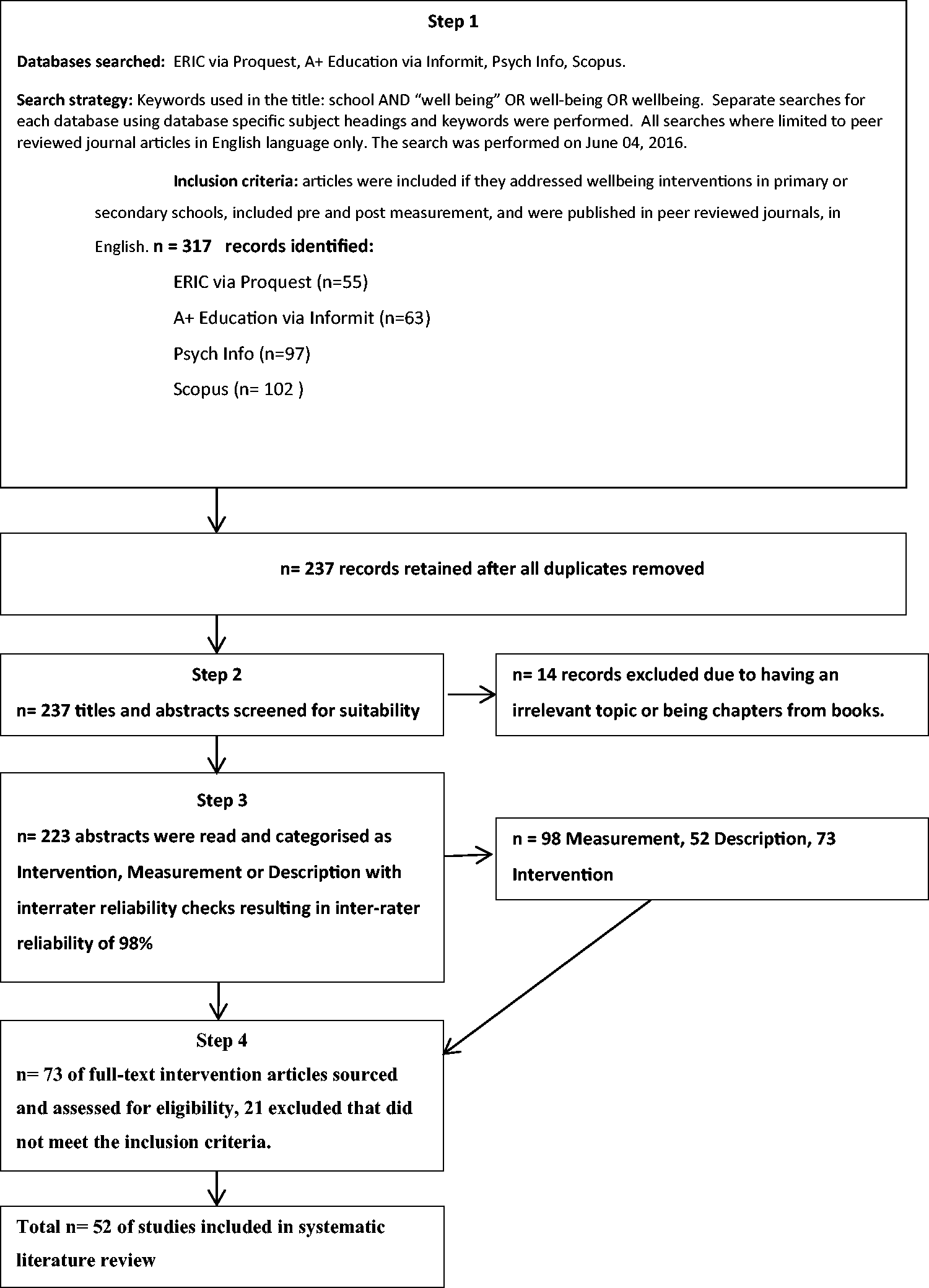
Process followed for literature selection.
At this point, the abstracts of the articles were read online to determine inclusion or exclusion and those deemed to meet the inclusion criteria were exported to the reference management system EndNote (a total of 317 articles – see Step 1, Figure 1). After removing duplicates, a total of 237 titles and abstracts were screened for study suitability. Following the exclusion of a further 14 articles (Step 2, Figure 1), a total of 223 publications were retained for classification as intervention, measurement or descriptive articles. Inter-rater reliability was assured through a process of discussions between the first two authors. Disagreements were mediated by the third author. Categorisation of articles involved the first author independently categorising the 223 included articles into intervention, measurement or descriptive articles (see Step 3, Figure 1). The second author then categorised 10% of the articles to ensure inter-rater reliability. In the first instance, inter-rater reliability was 70%. To further strengthen reliability, the first two authors met several more times to discuss and align definitions and understandings of the categories. Following further classification, the second author categorised a further 10% of articles resulting in the final inter-rater reliability of 98%. This process resulted in 98 measurement, 52 descriptive and 73 intervention studies (Step 3, Figure 1).
We were interested in the intervention articles as these studied “in school” practices which may have a direct benefit to students’ wellbeing. Hence, a total of 73 articles reporting on a school-based wellbeing intervention were downloaded (Step 4, Figure 1). For this review, an intervention study was required to involve a wellbeing programme, intervention or approach implemented in a school context with data collected before and after the intervention. Notable is that regardless of following Pickering and Byrne’s (2014) detailed approach, the process necessitated constant discussion between the three authors to clarify and align interpretations of intervention articles. As a result, a further 21 articles were excluded in Step 4, due to determining that they did not meet the inclusion criteria. This final screening resulted in 52 papers identified as intervention articles which were retained for the literature review (Step 4, Figure 1).
The 52 retained intervention articles were entered into a spreadsheet using Microsoft Excel to aid the process of examining and analysing the articles. The matrix included the following key features: title, author(s), country of study, year of publication, journal name, keywords, methods, data analysis method, subjects, definition of “well-being”, type of intervention, domain of wellbeing addressed, measures used, main findings, theory (if included) and recommendations for further research. This spreadsheet simplified the process of writing this literature review by making the key features of the journal articles more apparent.
Findings
How is wellbeing defined in educational research?
Results of the systematic literature review find definitions of wellbeing to be numerous and varied. Out of 52 articles reviewed, only 17 explicitly define wellbeing (marked with * in Appendix 1). The definitions of wellbeing in nine articles align with the hedonic view of wellbeing, with students having high levels of positive emotions, low levels of negative emotions and high life satisfaction (Besançon, Fenouillet, & Shankland, 2015). Four articles define wellbeing using a combination of hedonic and eudaimonic wellbeing, in most cases including self-actualisation (Galton & Page, 2015). The final four articles define wellbeing differently. Duckett, Sixsmith, and Kagan (2008) define wellbeing as involving a complex interaction between individuals and their environments. Alternatively, Frydenberg (2009) define wellbeing as an accumulation of resources to help the individual face challenges. Maller (2005) uses additional terms such as social, emotional and spiritual wellbeing to highlight that wellbeing is not simply the absence of mental illness symptoms. Finally, Atkinson and Rubidge (2013) explain wellbeing as being situational and relational. Whilst not explicitly defining wellbeing, seven articles equate wellbeing with the absence of mental health symptoms while two articles focus on the presence of symptoms as indicators of poor wellbeing (Appendix 1). It is interesting to note that many articles attempt to clarify their meaning of wellbeing using additional terms before the word wellbeing (final column in Appendix 1), for example, social wellbeing, psychological wellbeing and emotional wellbeing.
Further insight is provided by exploring how the 52 articles align with the conceptualisations of wellbeing in education. Similar to the discipline of medicine, three articles adopt a health promotion approach (Levin, Inchley, Currie, & Currie, 2012; Lee, Cheng, Fung, & St Leger, 2006; Thomas, 2008). A further 12 articles report a social emotional learning approach, which aligns with the conceptualisation of wellbeing by psychology and social work (Anderson, 2005; Barrett, Antichich, & Spencer, 2007; Beem & Brugman, 1986; Bernard & Walton, 2011; Bond et al., 2004; Clarke, Bunting, & Barry, 2014; Clarke, Sixsmith, & Barry, 2015; Frydenberg, 2009; Hallam, 2009; Leary, 2000; Patton et al., 2006; Veltro, Ialenti, Iannone, Bonanni, & García, 2015). A further eight articles (Anderson & Doyle, 2005; Wyn et al., 2000; Duckett et al., 2008; Vranda, 2015; Puolakka, Haapasalo-Pesu, Konu, Åstedt-Kurki, & Paavilainen, 2014; Tomba et al., 2010; Kendal, Callery, & Keeley, 2011; Vostanis, Humphrey, Fitzgerald, Deighton, & Wolpert, 2013) highlight the influx of mental health promotion approaches conceptualised by psychology and social work. The influence of philosophy is evident in the seven articles reporting on positive psychology interventions (Boniwell, Osin, & Martinez, 2016; Bowser, 2012; Ruini, Belaise, Brombin, Caffo, & Fava, 2006; Ruini et al., 2009; Shoshani & Steinmetz, 2014; Standage, Cumming, & Gillison, 2013; Suldo et al., 2015). Regardless of the term used to describe wellbeing, the conceptualisation of wellbeing or the definition offered, the interventions used to enhance wellbeing within the literature sample provide an insight into how schools are addressing wellbeing. This is explored in our response to the second research question.
What wellbeing interventions are currently implemented in K–12 school settings and what are their characteristics?
The second research question explores the type and scope of school-based wellbeing interventions currently researched in education. A total of 16 different types of wellbeing interventions emerge from the 52 articles in this study (see Appendix 1). The most numerous are social emotional learning interventions (12 articles), with a focus on improving children’s social and emotional skills to improve wellbeing. Next are positive psychology interventions (seven articles), designed to improve wellbeing using positive psychological activities such as gratitude, increasing positive emotions and improving relationships. Arts-based interventions based on visual arts and music are the next largest group (five articles). Of equal numbers are interventions based around alternative (non-medical) therapies (five articles), including yoga, mindfulness, massage and meditation. Symptom-based interventions (three articles) also feature, where the intervention is designed to reduce existing mental health symptoms. Community mental health interventions (three articles) focus on relationships within the school community. Health-based interventions (three articles) include interventions based on the health promoting school framework and a unique approach to health promotion based on seven natural physicians. Mental health promotion interventions (two articles) report on interventions to address student mental health needs. Interventions based on the school context (two articles) explored the effects of the school environment. Transition interventions (two articles) study students transitioning from primary to high school. The nature-based interventions (two articles) examine the effects of hands-on gardening activities. Parent education programmes (two articles) and a school-based mentoring intervention (one article) are also included. A cognitive training intervention (one article) studies the effect of explanatory style, conflict resolution and exercise. A mindset intervention (one article) is designed to encourage students to have a growth mindset and a peer support intervention (one article) explores the effects of this program.
We are also interested in the characteristics of the interventions, including the targeted group, timeframe, school/year level, number of participants and country (see Appendix 1). The targeted group varies from whole school implementation (13 articles) to small selected groups of students (nine articles). The reporting of participants varies between articles, some identify the number of students, others the number of schools. The timeframes of the interventions vary from one or two days through to three years. Two of the articles provide no implementation period (Duckett et al., 2008; Puolakka et al., 2014). The most common year levels studied are Years 7 and 8. The smallest number of participants include 12 students from one Year 4 class (Suldo et al., 2015). The largest group of participants consists of three cohorts of Year 8 students: 2545 students in 1997, 2586 students in 1999 and 2463 students in 2001 (Patton et al., 2006). Maller’s (2005) study of 500 schools represents the whole of school age bracket from 5 to 18 years old. The most common geographic location for the research studies is Australia (18), followed by the United Kingdom (11) (see Appendix 1 for more details).
What types of outcomes can be attributed to school-based wellbeing interventions?
Researchers provide a range of outcomes resulting from the various interventions, but we find many do not directly relate to wellbeing. Often, the research reports on stress or tension, depressive symptoms, life satisfaction, mood disturbance, resilience or reduction in disruptive behaviours as an indicator that the intervention influences wellbeing. For example, Shoshani and Steinmetz (2014) report on a school-wide positive psychology intervention resulting in reductions in anxiety and depression, and increased self-efficacy, self-esteem and optimism. Three high school-based articles report on reductions in risk-taking behaviours (Bond et al., 2004; Lee et al., 2006; Levin et al., 2012; Patton et al., 2006). Taylor, Gillies, and Ashman (2009) study three interventions: cognitive training, conflict resolution and exercise, all three interventions lead to a reduction of internalising behaviours such as depressive symptoms and withdrawal.
Several articles report explicit improvements in wellbeing measures. Two articles describe a school-based wellbeing therapy intervention that positively influences wellbeing (Ruini et al., 2006; Ruini et al., 2009). Lau and Hue (2011) report on a pilot study of a mindfulness intervention that shows the intervention leads to a reduction of depression symptoms and an increase in wellbeing. Wellbeing programmes for high school students that report effective strategies include MindMatters and the Change program (Anderson, 2005; Anderson & Doyle, 2005; Kendal et al., 2011; Wyn et al., 2000). Other high school wellbeing interventions narrate improvements in student voice, agency and happiness as well as wellbeing (Boniwell et al., 2016; Carmen, Waycott, & Smith, 2011; Damon, 2015).
Articles that present notably different approaches to wellbeing include arts-based articles, nature-based articles, articles based on alternative therapies and family-based interventions. Arts-based wellbeing interventions demonstrate positive effects of alternative social and physical spaces for learning and on children’s wellbeing in schools (Atkinson & Robson, 2012; Atkinson & Rubidge, 2013). Nature-based interventions show improvements in student self-concept and self-esteem (Chen, Lou, Tsai, & Tsai, 2014; Maller, 2005). A Music program, DRUMBEAT finds a 16% increase in students’ self-esteem and an overall decrease in classroom behavioural incidents (Faulkner, Wood, Ivery, & Donovan, 2012). Massage, mindfulness, yoga and quiet time interventions all report positive outcomes for students’ wellbeing (Haraldsson et al., 2008; Huppert & Johnson, 2010; Noggle, Steiner, Minami, & Khalsa, 2012; Wendt et al., 2015). Family-based interventions also show evidence of positive results, improving children’s wellbeing (Harrison & van Vliet, 2013; Sar & Wulff, 2003).
Discussion
This study set out to answer three questions on wellbeing in schools. First, how is wellbeing defined in educational research? Second, what wellbeing interventions are currently implemented in K–12 school settings and what are their characteristics? And finally, which outcomes can be attributed to school-based wellbeing interventions? In considering the first question, we agree with Bache et al. (2016) that defining wellbeing is a wicked problem due to the multidimensional nature of the term, and the many different definitions discovered in the research. The articles in this review draw on four conceptualisations of wellbeing in education from the disciplines of medicine, psychology, social work and philosophy, with psychology being the most prevalent. We are not able to derive a clear definition because the articles reviewed demonstrate a lack of consistent or detailed explanations of wellbeing. This finding is in accordance with other research (e.g. Bache et al., 2016) and is reflected in the array of differing definitions of wellbeing provided in the frameworks of Australian education authorities (Department for Education, 2016; Department of Education and Training Queensland, 2018; Department of Education and Community Development, 2018; Education Council, 2018; Victorian Curriculum and Assessment Authority, 2016). We do identify 17 articles that explicitly define wellbeing; however, within these 17, six different definitions are provided, namely (a) hedonic wellbeing involving high levels of positive affect, low levels of negative affect and high life satisfaction, (b) combinations of hedonic and eudaimonic wellbeing including self-actualisation, (c) interaction between the individual and environment, (d) having social, emotional, spiritual wellbeing including an absence of mental illness symptoms, (e) wellbeing as situational and relational and (f) wellbeing as an accumulation of resources to face challenges. The rest of the articles expect readers to draw on their own understanding of wellbeing. While there is nothing wrong per se with any of the definitions, lack of consistency makes it hard to compare studies. This, in turn, impacts trustworthiness, validity and reduces transferability of the findings. Such practices do not demonstrate a logical progression whereby a clear definition of a construct precedes research design which is then capable of leading to outcome measures or a clearly understood problem.
The above findings have two implications for schools. Firstly, the lack of definition raises concerns about the quality of the evidence on which schools rely. While schools are encouraged to adopt evidence-based programmes and practices to address wellbeing, the lack of a clear definition compromises the validity and trustworthiness of the research currently used by schools. Secondly, enabling schools to successfully address wellbeing requires a definition which is shared across the whole school community. School communities cannot be expected to address a problem which lacks a shared definition. Only five articles address the need for a shared definition or language to define wellbeing. We take this to mean that development of a shared definition, and thus a shared understanding, is not a focus for the majority of researchers in the studies reviewed in this study.
In answer to our second question, investigating wellbeing interventions currently implemented in K to 12 schools, results show many and varied types of interventions delivered across a range of targeted groups. Out of 52 studies, we distinguish 16 different types of wellbeing interventions. This is a positive finding in so far as it reflects concern and attention paid to wellbeing by governments who fund these initiatives. However, such a large number of intervention types (16) within a relatively small number of studies (52) does not indicate a maturing of the field, where interventions are evaluated, and the evaluations used to further develop understanding. We propose that over time a mature field would generate a smaller number of robust, research-based interventions.
Further, our findings reveal that interventions are targeted at a range of groups over widely varying timeframes. Of interest to us is that only 13 out of 52 interventions are working with the whole school. The majority of interventions target a class or particular group of students. The studies do not consistently report on participants. While some report numbers of students, others report numbers of schools, others still describe numbers of parents or families. This inconsistency is interesting to note and adds complexity when attempting to compare findings across studies. Further, overall, only 20 of the interventions had an implementation time of one year or more. The remainder (32 interventions) ran for under one year to as little as four or five sessions. The dominance of small group, short-term interventions is disturbing. From a practitioner perspective, to derive successful outcomes from a wellbeing intervention, it is essential to build a whole school shared definition and understanding of the wellbeing construct, before moving to the implementation stage. This shared understanding leads to a culture of wellbeing in a school community capable of strengthening intervention outcomes. Such development takes time. While recognising that activity in a field of research is positive, we consider that it is important to reflect on progress to date so that further development can be based on evidence-based practice. It is important to understand that for schools to address wellbeing in a meaningful, sustainable way, time needs to be allocated for the whole school community to work together to develop their understanding of research-based characteristics and components of wellbeing. This shared understanding is foundational to embedding wellbeing in pedagogy and enacting school wide wellbeing practices and programmes; however, the studies examined for this review do not report on such practices.
Lastly, in considering the types of outcomes that can be attributed to school-based wellbeing interventions, these are difficult to compare, similar to comparing apples with oranges. Our findings reveal that many of the studies are designed to impact single, study attributed components of wellbeing such as resilience, life satisfaction, self-efficacy, depression or stress. It is important to understand that, based on a holistic understanding of wellbeing, the components or characteristics of wellbeing are complex and often intertwined. From a research perspective, it is not possible to build strong research-based evidence from studies that measure different components based on varied understandings. For research to have a strong impact on further development of wellbeing, there is a need to clearly define wellbeing and/or the wellbeing component of interest, before designing, implementing and evaluating the study. The absence of a robust sequence compromises the reliability of the findings of the research. In the absence of a clear definition and research sequence, how can we be assured that, for example, increased self-efficacy equals increased wellbeing (Shoshani & Steinmetz, 2014).
In summary, all schools are encouraged to address wellbeing through evidence-based wellbeing interventions. This review highlights that the evidence to support current wellbeing interventions in schools is not as robust as assumed by schools. Instead, we find the interventions offer wide variations in definitions, are not based on valid and trustworthy evidence and outcomes. The consequence is that such variations compromise development of wellbeing understanding and school-based interventions that can have a positive long-term impact. This highlights the need for further research to consolidate understanding of wellbeing and provide solid research evidence to inform further development of school wellbeing interventions.
Limitations of the research
The 52 journal articles included in this study represent a limited sample of the literature published on wellbeing interventions in schools. The inclusion and exclusion criteria used were chosen to ensure this review provided a useful overview of interventions being used in schools to enhance student wellbeing but limited the sample to a manageable size. The need for continuous conversations between the authors to clarify the categorisation of articles and identify intervention articles will have an impact on the replicability of the review. The authors chose to exclude grey literature to ensure that the articles only included reports of original research projects. Keeping the literature sample to a manageable size also influenced this decision. Although the systematic literature review method provides consistency and reliability, author preconceptions may still be relevant. In this study, the first author’s possible bias was mitigated by questioning by the second and third authors as per the PRISMA guidelines (Pickering & Byrne, 2014).
Conclusion
The findings of this literature review raise many questions about the implementation of wellbeing interventions in schools. In the literature presented, there is no agreed definition or understanding of wellbeing, despite its popularity in research and schools today. The broad range of interventions being researched demonstrates a lack of maturity in the field. The variety of intervention outcomes further confuses the topic, making it difficult to compare studies. Moving forward, there is a need for further research to develop clearer definitions, more robust interventions and measuring methods for interventions aimed at improving school community wellbeing. The authors of this article have highlighted a rhetoric–reality gap between evidence-based practice and the reality of interventions currently implemented in schools with the aim to provide a conduit for further research that will support the mental health and wellbeing of Australian youth.
Footnotes
Declaration of Conflicting Interests
The author(s) declared no potential conflicts of interest with respect to the research, authorship, and/or publication of this article.
Funding
The author(s) received no financial support for the research, authorship, and/or publication of this article.
Characteristics of interventions as reported by authors (* indicates articles that include explicit definitions of wellbeing).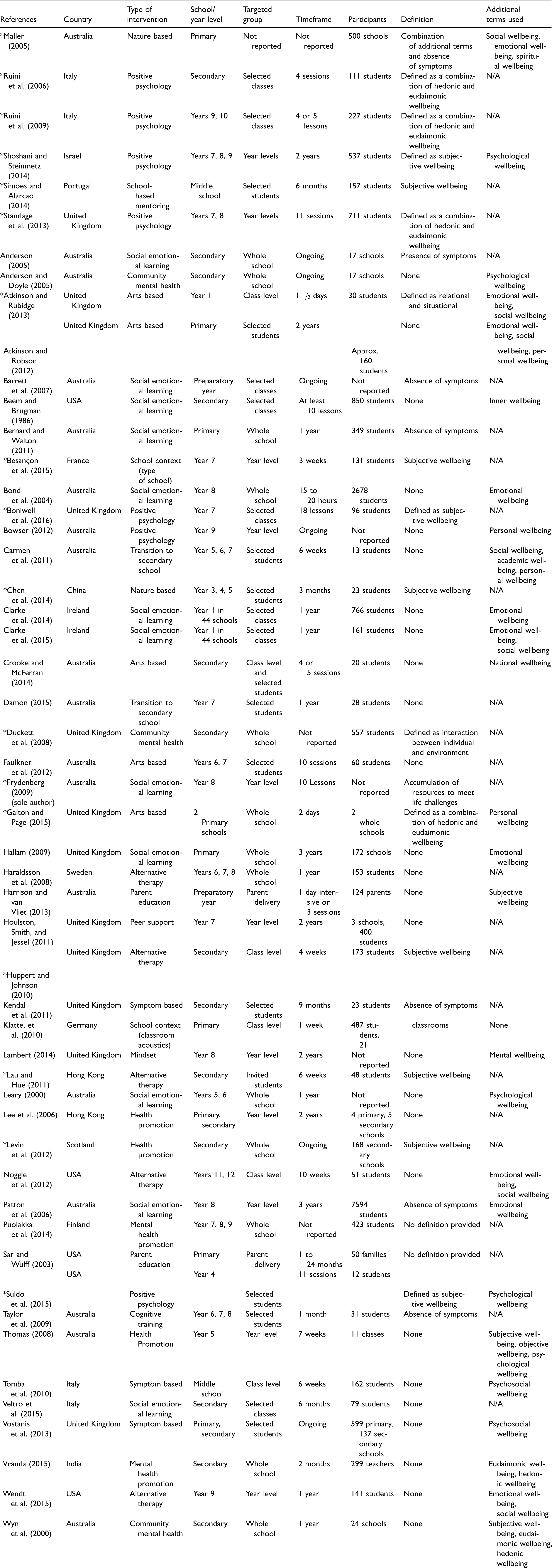
References
Country
Type of intervention
School/year level
Targeted group
Timeframe
Participants
Definition
Additional terms used
*Maller (2005)
Australia
Nature based
Primary
Not reported
Not reported
500 schools
Combination of additional terms and absence of symptoms
Social wellbeing, emotional wellbeing, spiritual wellbeing
*Ruini et al. (2006)
Italy
Positive psychology
Secondary
Selected classes
4 sessions
111 students
Defined as a combination of hedonic and eudaimonic wellbeing
N/A
*Ruini et al. (2009)
Italy
Positive psychology
Years 9, 10
Selected classes
4 or 5 lessons
227 students
Defined as a combination of hedonic and eudaimonic wellbeing
N/A
*Shoshani and Steinmetz (2014)
Israel
Positive psychology
Years 7, 8, 9
Year levels
2 years
537 students
Defined as subjective wellbeing
Psychological wellbeing
*Simões and Alarcão (2014)
Portugal
School-based mentoring
Middle school
Selected students
6 months
157 students
Subjective wellbeing
N/A
*Standage et al. (2013)
United Kingdom
Positive psychology
Years 7, 8
Year levels
11 sessions
711 students
Defined as a combination of hedonic and eudaimonic wellbeing
N/A
Anderson (2005)
Australia
Social emotional learning
Secondary
Whole school
Ongoing
17 schools
Presence of symptoms
N/A
Anderson and Doyle (2005)
Australia
Community mental health
Secondary
Whole school
Ongoing
17 schools
None
Psychological wellbeing
*Atkinson and Rubidge (2013)
United Kingdom
Arts based
Year 1
Class level
1 ½ days
30 students
Defined as relational and situational
Emotional wellbeing, social wellbeing
Atkinson and Robson (2012)
United Kingdom
Arts based
Primary
Selected students
2 years
Approx. 160 students
None
Emotional wellbeing, social wellbeing, personal wellbeing
Barrett et al. (2007)
Australia
Social emotional learning
Preparatory year
Selected classes
Ongoing
Not reported
Absence of symptoms
N/A
Beem and Brugman (1986)
USA
Social emotional learning
Secondary
Selected classes
At least 10 lessons
850 students
None
Inner wellbeing
Bernard and Walton (2011)
Australia
Social emotional learning
Primary
Whole school
1 year
349 students
Absence of symptoms
N/A
*Besançon et al. (2015)
France
School context (type of school)
Year 7
Year level
3 weeks
131 students
Subjective wellbeing
N/A
Bond et al. (2004)
Australia
Social emotional learning
Year 8
Whole school
15 to 20 hours
2678 students
None
Emotional wellbeing
*Boniwell et al. (2016)
United Kingdom
Positive psychology
Year 7
Selected classes
18 lessons
96 students
Defined as subjective wellbeing
N/A
Bowser (2012)
Australia
Positive psychology
Year 9
Year level
Ongoing
Not reported
None
Personal wellbeing
Carmen et al. (2011)
Australia
Transition to secondary school
Year 5, 6, 7
Selected students
6 weeks
13 students
None
Social wellbeing, academic wellbeing, personal wellbeing
*Chen et al. (2014)
China
Nature based
Year 3, 4, 5
Selected students
3 months
23 students
Subjective wellbeing
N/A
Clarke et al. (2014)
Ireland
Social emotional learning
Year 1 in 44 schools
Selected classes
1 year
766 students
None
Emotional wellbeing
Clarke et al. (2015)
Ireland
Social emotional learning
Year 1 in 44 schools
Selected classes
1 year
161 students
None
Emotional wellbeing, social wellbeing
Crooke and McFerran (2014)
Australia
Arts based
Secondary
Class level and selected students
4 or 5 sessions
20 students
None
National wellbeing
Damon (2015)
Australia
Transition to secondary school
Year 7
Selected students
1 year
28 students
None
N/A
*Duckett et al. (2008)
United Kingdom
Community mental health
Secondary
Whole school
Not reported
557 students
Defined as interaction between individual and environment
N/A
Faulkner et al. (2012)
Australia
Arts based
Years 6, 7
Selected students
10 sessions
60 students
None
N/A
*Frydenberg (2009) (sole author)
Australia
Social emotional learning
Year 8
Year level
10 Lessons
Not reported
Accumulation of resources to meet life challenges
N/A
*Galton and Page (2015)
United Kingdom
Arts based
2 Primary schools
Whole school
2 days
2 whole schools
Defined as a combination of hedonic and eudaimonic wellbeing
Personal wellbeing
Hallam (2009)
United Kingdom
Social emotional learning
Primary
Whole school
3 years
172 schools
None
Emotional wellbeing
Haraldsson et al. (2008)
Sweden
Alternative therapy
Years 6, 7, 8
Whole school
1 year
153 students
None
N/A
Harrison and van Vliet (2013)
Australia
Parent education
Preparatory year
Parent delivery
1 day intensive or 3 sessions
124 parents
None
Subjective wellbeing
Houlston, Smith, and Jessel (2011)
United Kingdom
Peer support
Year 7
Year level
2 years
3 schools, 400 students
None
N/A
*Huppert and Johnson (2010)
United Kingdom
Alternative therapy
Secondary
Class level
4 weeks
173 students
Subjective wellbeing
N/A
Kendal et al. (2011)
United Kingdom
Symptom based
Secondary
Selected students
9 months
23 students
Absence of symptoms
N/A
Klatte, et al. (2010)
Germany
School context (classroom acoustics)
Primary
Class level
1 week
487 students, 21 classrooms
None
Lambert (2014)
United Kingdom
Mindset
Year 8
Year level
2 years
Not reported
None
Mental wellbeing
*Lau and Hue (2011)
Hong Kong
Alternative therapy
Secondary
Invited students
6 weeks
48 students
Subjective wellbeing
N/A
Leary (2000)
Australia
Social emotional learning
Years 5, 6
Whole school
1 year
Not reported
None
Psychological wellbeing
Lee et al. (2006)
Hong Kong
Health promotion
Primary, secondary
Year level
2 years
4 primary, 5 secondary schools
None
N/A
*Levin et al. (2012)
Scotland
Health promotion
Secondary
Whole school
Ongoing
168 secondary schools
Subjective wellbeing
N/A
Noggle et al. (2012)
USA
Alternative therapy
Years 11, 12
Class level
10 weeks
51 students
None
Emotional wellbeing, social wellbeing
Patton et al. (2006)
Australia
Social emotional learning
Year 8
Year level
3 years
7594 students
Absence of symptoms
Emotional wellbeing
Puolakka et al. (2014)
Finland
Mental health promotion
Year 7, 8, 9
Whole school
Not reported
423 students
No definition provided
N/A
Sar and Wulff (2003)
USA
Parent education
Primary
Parent delivery
1 to 24 months
50 families
No definition provided
N/A
*Suldo et al. (2015)
USA
Positive psychology
Year 4
Selected students
11 sessions
12 students
Defined as subjective wellbeing
Psychological wellbeing
Taylor et al. (2009)
Australia
Cognitive training
Year 6, 7, 8
Selected students
1 month
31 students
Absence of symptoms
N/A
Thomas (2008)
Australia
Health Promotion
Year 5
Year level
7 weeks
11 classes
None
Subjective wellbeing, objective wellbeing, psychological wellbeing
Tomba et al. (2010)
Italy
Symptom based
Middle school
Class level
6 weeks
162 students
None
Psychosocial wellbeing
Veltro et al. (2015)
Italy
Social emotional learning
Secondary
Selected classes
6 months
79 students
None
N/A
Vostanis et al. (2013)
United Kingdom
Symptom based
Primary, secondary
Selected students
Ongoing
599 primary, 137 secondary schools
None
Psychosocial wellbeing
Vranda (2015)
India
Mental health promotion
Secondary
Whole school
2 months
299 teachers
None
Eudaimonic wellbeing, hedonic wellbeing
Wendt et al. (2015)
USA
Alternative therapy
Year 9
Year level
1 year
141 students
None
Emotional wellbeing, social wellbeing
Wyn et al. (2000)
Australia
Community mental health
Secondary
Whole school
1 year
24 schools
None
Subjective wellbeing, eudaimonic wellbeing, hedonic wellbeing