




Abstract
Many noncognitive constructs affect mathematical problem-solving performance. The aim of the present study is to investigate the direct and indirect effects of a number noncognitive constructs such as mathematics self-efficacy, mathematics anxiety, and metacognitive experience on the mathematical problem solving of middle-school students. The sample consisted of 517 seventh-grade Turkish students of whom 252 were male (49%) and 265 were females (51%). The instruments used in this study were a mathematical problem-solving performance test, a mathematics self-efficacy scale, a mathematics anxiety scale, a metacognitive experience scale, and a mathematics motivation scale. Two-stage structural equation modeling was used to examine the relationships between the noncognitive contructs and problem solving. Metacognitive experience was the only noncognitive construct, which had a direct effect on mathematical problem-solving performance; it also mediated the effects of self-efficacy, motivation, and mathematics anxiety on performance. Motivation and mathematics anxiety had an indirect effect on mathematical problem-solving performance through self-efficacy.
Keywords
Introduction
Students’ utilization of mathematical knowledge in their daily lives, ability to think mathematically, comprehension of problem-solving strategies as well as utilization of these strategies are emphasized in curricula in many countries (Australian Education Council, 1991; National Council of Teacher of Mathematics, 2000; Turkey’s Ministry of National Education (MONE), 2016; Victorian Curriculum Assessment Authority, 2016). Despite this emphasis on mathematical problem solving in learning and instruction curricula, student performance in this area is declining in a number of countries (Organization for Economic Co-operation and Development (OECD), 2016). International assessments place Turkish students at the end of compulsory education (age 15–16) below the average for students across OECD countries (OECD, 2016). Furthermore, Turkish students’ mathematics performance in the Program of International Student Assessment (PISA) 2015 was inferior to that in PISA 2009 and 2012 (Taş, Arıcı, Ozarkan, & Özgürlük, 2016). Concerns about mathematics performance are not restricted to developing countries, however; mathematics performance is widely considered a major problem even in developed countries such as Australia and the United States of America (Lamb & Fullarton, 2002; OECD, 2016; Thomson, De Bortoli, & Underwood, 2017). Understanding what cognitive and noncognitive constructs underly mathematical problem solving may provide further opportunities for intervention to support improved performance in mathematical problem solving.
Problem-solving performance is affected by both cognitive and noncognitive contructs (Lester, 1983). The research results reporting that cognitive and noncognitive (sometimes referred to as “affective” constructs in the literature) processes influence each other in the learning process also put forward that noncognitive constructs significantly influence learning (Rodríguez, Plax, & Kearney, 1996; Uzun, Gelbal, & Ogretmen, 2010). 1 Noncognitive constructs are believed to help realize learning within the cognitive domain and have a considerable effect on learning attainment (Bloom, 1979). Of the leading noncognitive constructs related to mathematical problem solving in existing literature, mathematics self-concept, self-efficacy, and anxiety, as well as motivation and metacognition, are among those that are given the greatest emphasis and importance. When we look at studies investigating the relationships between these constructs, the existence of the relationship between mathematical problem solving and mathematics self-efficacy has been frequently shown (Karakolidis, Pitsia, & Emvalotis, 2016; Lee & Stankov, 2013), while other studies highlight relationships between metacognition (Jaafar & Ayub, 2010; Ozsoy, 2011), mathematics anxiety (Pitsia, Biggard, & Karakolidis, 2017) and motivation (Ozcan, 2016). Although it is often noted that self-efficacy has the central role among these constructs (Karakolidis et al., 2016; Lee & Stankov, 2013; Morony, Kleitman, Lee, & Stankov, 2013), other literature suggests that metacognition may also play this role (Holton & Clarke, 2015; Jaafar & Ayub, 2010; Kleitman & Gibson, 2011).
Literature review
The relationships between a number of noncognitive factors and their relationships with mathematical problem solving are discussed in the literature review below.
Self-efficacy
Self-efficacy, defined as a judgement or assessment of one’s capabilities to successfully perform a particular given task (Bandura, 1977, 1997), has been highlighted as an important predictor of academic performance in general (Braten, Samuelstuen, & Stromso, 2004; Ferla, Valcke, & Cai, 2009; Liu & Koirala, 2009) and of mathematics achievement specifically (Ferla, Valcke & Cai, 2009; Pajares & Graham, 1999; Pajares & Miller, 1995). Self-efficacy is thought to influence behavior through motivational, cognitive, and affective processes. In the research literature, self-efficacy and self-concept have been presented as being interrelated. Mathematics self-concept reflects more general beliefs about competence (i.e., “I’m good at mathematics”) whereas, mathematics self-efficacy refers to much more specific and situational judgments of capabilities (i.e. “I’m confident I can solve this type of two-digit subtraction problem”) (Linnenbrink & Pintrich, 2003). Although it is difficult to find empirical evidence for the existence of obvious differences between these two constructs, some research (Bong & Skaalvik, 2003; Ferla et al., 2009; Lee, 2009) has highlighted the importance of self-efficacy on mathematics performance. Students with higher mathematics self-efficacy feel confident about being able to cope with difficult mathematical problems and are more accurate in mathematical computations (Collins, 1982; Hoffman & Schraw, 2009). Students with high mathematics self-efficacy levels were more resilient and patient in the face of adversity, invested more effort and time in order to achieve, and participated more effectively in class (Pajares, 2002). Previous research has reported that mathematics self-efficacy is positively related to mathematical problem solving (Kramarski, 2004; Kramarski, Mevarech, & Arami, 2002) and mathematics performance (Hoffman & Spatariu, 2008; Kabiri & Kiamanesh, 2004; Liu & Koirala, 2009; Pajares & Graham, 1999). Pajares and Miller (1995) pointed out that mathematics self-efficacy was a stronger predictor of success in solving specific mathematical problems than of total mathematics performance.
Metacognition
Metacognition, which is a significant predictor of general achievement and especially mathematics performance (Desoete & Veenman, 2006), can be defined as being aware of one’s cognitive process and managing it when necessary (Flavell, 1976). Metacognition is considered in terms of two parts: metacognitive knowledge and metacognitive experiences (Efklides, 2008; Flavell, 1981). Metacognitive knowledge includes knowledge of oneself, the task at hand, and the strategy for successfully completing the required task (Flavell, 1979, 1987). Metacognitive experience is “what a person is aware of and what she or he feels when coming across a task and processing the information related to it” (Efklides, 2008, p. 279). Metacognitive experiences provide feedback to the behavioral control process by monitoring the implemented strategy, determining whether it is being successful, and assessing the outcomes (Moores, Chang, & Smith, 2006).
When students are engaged in challenging tasks like mathematical problem solving, metacognition becomes more important (Holton & Clarke, 2015). Studies report that there is a high relationship between metacognitive skills and problem-solving skills (e.g., Jaafar & Ayub, 2010; Ozsoy, 2011). Metacognition has a complicated relationship not only with performance, but also with behavior, in that it triggers the problem-solving behavior, monitors performance, and changes behavior if things are not going as expected. There is a strong positive relationship between self-efficacy and metacognition (Cera, Mancini, & Antonietti, 2013; Hoffman & Spatariu, 2008), both of which are closely related to mathematics performance and share certain properties (Moores et al., 2006).
Mathematics anxiety
Mathematics anxiety is defined as feelings of tension and discomfort that might prevent someone from carrying out his or her actual capability in mathematical problems (Ashcraft, 2002) and can lead to the development of negative attitudes toward mathematics (Tooke & Leonard, 1998). These negative attitudes can prevent students from reaching their potential in terms of mathematical capability (Hannula, 2005). Pajares (1997) indicated that when people experience negative thoughts and fears about their capabilities, these negative affective reactions can further lower perceptions of that capability and result in stress, thereby potentially exacerbating poor performance and fear. The results of those studies underlining the negative effect of mathematics anxiety on mathematics achievement (e.g., Alexander & Cobb, 1984; Hackett, 1985; Hamid, Shahrill, Matzin, Mahalle, & Mundia, 2013; Jain & Dowson, 2009; Karakolidis, Pitsia, & Emvalotis, 2016; Lee, 2009; Lee & Stankov, 2013; Pitsia et al., 2017) agree that anxiety is a crucial barrier to teaching mathematics and equipping students with problem-solving skills. Sociocognitive theory suggests that individuals who do not perceive themselves to be capable of coping with threats become stressed and experience anxiety in similar or comparable circumstances (Bandura, 1977). Consequently, their functional levels become limited. Under the exact opposite circumstances as highlighted by Bandura (1989) and Lent, Lopez, Brown, and Gore (1996) the anxiety level is diminished and the individual experiences strong self-efficacy beliefs.
Motivation
Motivation, which is a tendency to behave in a specific direction, has two main dimensions: intrinsic and extrinsic. Extrinsically motivated students seek out external rewards for their behavior in the shape of high grades, academic honors, scores on tests, and awards from parents or teachers. Intrinsically motivated students engage in learning activities to satisfy their interest or curiosity. This type of motivation reflects students’ intrinsic interest in the content, materials, or task. Extrinsically motivated students also engage in learning to satisfy their needs, but their needs are for something different. Studies that investigate motivation’s association with negative or positive impacts on mathematical problem solving (Alcı, Erden, & Baykal, 2008; Ozcan, 2016) report that individuals with enough intrinsic motivation are not affected by negative external factors before the learning takes place. In the research literature, motivation and self-efficacy are regarded as nested constructs (Zimmerman, 2008) and self-efficacy is seen as a motivational measure in conjunction with internal and external motivational measures (Vollmeyer & Rheinberg, 1999). Higher self-efficacy expectations can lead to an increase in motivation (Bandura, 1986; Braten et al., 2004; Liu & Koirala, 2009).
Theoretical background for the model
While the predictive relationships between the noncognitive constructs discussed above (mathematics self-efficacy, metacognition, mathematics anxiety, and motivation) and mathematical problem solving have been supported in research literature, how these constructs might work together in a model with hypothesized directional effects on one another alongside indirect effects (i.e., causal effects of prior variables through other variables) is less clear. Consequently, the aim of the present study is to build on the existing research literature on relationships between mathematics self-efficacy, mathematics anxiety, metacognitive experience, and mathematical problem solving by including both direct and indirect (mediated) influences in the hypothesized models. Based on the results of some studies, when it is desired to create a model in which these variables are considered together, it is hypothesized that mathematics self-efficacy has a direct effect on mathematical problem solving (e.g., Braten et al., 2004; Liu & Koirala, 2009; Pajares & Miller, 1995; Yıldırım, 2011). Moreover, self-efficacy can act as a mediating variable between noncognitive constructs and problem-solving performance (Randhawa, Beamer, & Lundberg, 1993; Zarch & Kadivar, 2006). Self-efficacy can also mediate motivation, to which it is closely related (Linnenbrink & Pintrich, 2003; Yıldırım, 2011). Therefore, in a structural path model—which represents hypotheses about the ordering of effects (Kline, 2016)—it can be proposed that motivation can have an indirect effect on mathematical problem-solving through self-efficacy (Skaalvik, Federici, & Klassen, 2015). At the same time, it is also seen that motivation has a direct effect (Alcı et al., 2008; Ozcan, 2016) on mathematical problem-solving performance.
Mathematics anxiety has a direct effect on motivation (e.g., Hancock, 2001), mathematics self-efficacy (e.g. Bandura, Barbaranelli, Caprara, & Pastorelli, 1996; Pintrich, Roeser, & De Groot, 1994), and mathematical problem-solving performance (Hamid et al., 2013). Mathematics anxiety also has indirect effects via mathematics self-efficacy (Pajares, 1997) and via motivation (Linnenbrink & Pintrich, 2003) on mathematical problem-solving performance. Lai, Zhu, Chen and Li's (2015) study indicated that mathematics anxiety has an influence on mathematical problem solving through metacognition. Metacognitive experience also has a direct effect on mathematical problem-solving performance (e.g., Jaafar & Ayub, 2010; Ozcan, 2016) and has a highly positive relationship with self-efficacy (Cera et al., 2013; Hoffman & Spatariu, 2008). Combining the findings of these studies results in the hypothesized model of the direct and indirect effects on mathematical problem-solving shown in Figure 1.
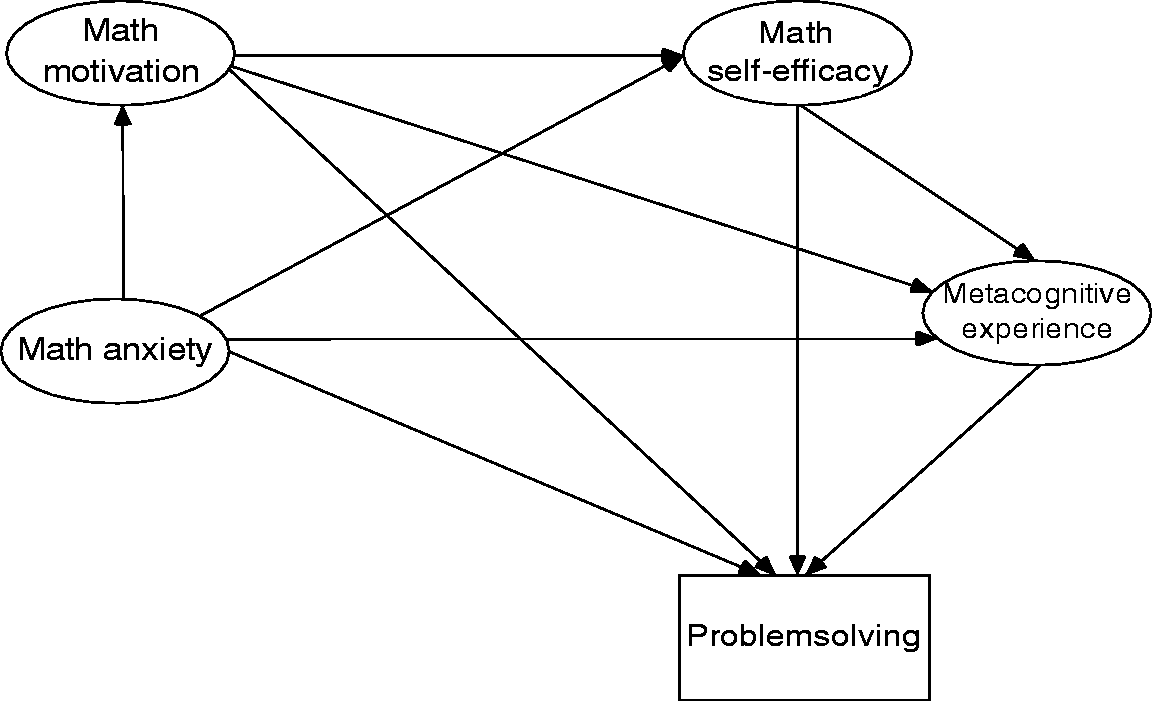
A model showing the hypothesized direct and indirect effects of noncognitive constructs on mathematical problem solving.
Method
Sample
The study sample consisted of 517 seventh-grade students—252 males (49%) and 265 females (51%)—from two state schools in Istanbul (the most densely populated city in Turkey).
Instruments
The measurement tools used in this study were the mathematical problem-solving performance test, the mathematics self-efficacy scale, the mathematics anxiety scale, the metacognitive experience scale, and the mathematics motivation scale. In this study, domain-specific (mathematics) instruments were used to evaluate these constructs. As Lee and Stankov (2013) pointed out, using domain-specific instruments is important for predicting relative domain performance (in this study, mathematics performance).
Mathematical problem-solving performance
Mathematical problem-solving performance of participants was measured using four mathematics problems that were to be solved with linear equations. These questions were taken from the seventh grade course book, published by the Turkish Ministry of National Education. The objective of these questions was that “students are able to solve mathematics problems that require using linear equations with one unknown” (MoNE, 2013). It took approximately 55 minutes to complete the test. Each question was scored taking into account the holistic scoring rubric. In this rubric, students’ performances were scored on a scale ranging from 0 to 4 for each question, where 0 = totally wrong or no answer at all; 1 = incomplete and/or incorrect solution providing evidence of an attempt to solve the problem; 2 = incorrect solution by selecting appropriate strategies; 3 = selecting appropriate procedures/strategies to solve the problem, but solution not entirely correct; 4 = totally correct solution.
An example from these problems is given below. Barıs wants to buy a bicycle with his money. A bicycle costs 150 TL. If he doubles his saved money and adds 30 TL, he will be able to buy a bicycle. (a) How much money has Barıs saved? (b) If he adds 2.5 TL each day to his saved money, how many days will it be before he is able to buy the bicycle?
Mathematics self-efficacy scale
The mathematics self-efficacy scale was based on the scale used in the PISA 2003 student survey. The item stem of “How confident do you feel about having to do the following mathematics tasks?” was followed by six specific types of mathematics activity: calculating the number of square feet of tiles needed to cover a floor; calculating how much cheaper a TV would be after a 30% discount; using a train timetable to work out how long it would take to get from one place to another; understanding graphs presented in newspapers; finding the actual distance between two places on a map with a 1:100 scale; and calculating the fuel mileage of a car. Responses to the items consisted of a four-point Likert-type scale ranging from 1 (“I am not at all confident”) to 4 (“I am totally confident”). Validity of the scale was investigated by Lee (2009) by using PISA 2003 data with 41 countries, including Turkey in a factor analysis. In this study, Lee (2009) concluded that the items of this scale constituted an independent construct. Based on the data from the current study, the scale is valid for Turkey as well, the internal consistency coefficient was 0.81 for the whole scale and confirmatory factor analysis (CFA) results indicated that it also had acceptable fit indices (χ2/SD = 1.20, Goodness of Fit Index (GFI) = 0.99, Adjusted Goodness of Fit Index (AGFI) = 0.98, Root Mean Square Residual (RMR) = 0.03, Root Mean Square Error of Approximation (RMSEA) = 0.03, and Comparative Fit Index (CFI) = 0.99).
Mathematics anxiety scale
Five items used in the PISA 2003 student survey were administered in this study to form a mathematics anxiety scale. Five mathematics anxiety items were presented with responses of a four-point scale (strongly agree; agree; disagree; strongly disagree): “I get very nervous doing mathematics problems”; “I get very tense when I have to do mathematics homework”; “I often worry that it will be difficult for me in mathematics classes”; “I feel helpless when doing a mathematics problem”; and “I worry that I will get poor grades in mathematics.” The results of Lee’s (2009) study showed that the items of this scale constituted an independent construct and this result is valid for Turkey. Based on the data from this study, the internal consistency coefficient was 0.84 for the whole scale and CFA results indicated that it also had acceptable fit indices (χ2/SD = 1.93, GFI = 0.98, AGFI = 0.95, RMR = 0.03, RMSEA = 0.06, and CFI = 0.99).
Metacognitive experience scale
The metacognitive experience scale developed by Efklides, Kiorpelidou, and Kiosseglou (2006) was used in this study. This scale used in a prospective (before solving a presented problem) and retrospective (after solving a presented problem) manner: the retrospective part was used in this study. As soon as the problem was solved, the following questions were answered by participants: How familiar were you with the problem? How well did you understand what is required by you to do? How difficult did you feel the problem was? How much effort do you think you had to exert in order to solve the problem? How correctly did you think you could solve the problem? Answers were given on a four-point scale: 1 = not at all; 2 = a little; 3 = quite a lot; 4 = very. The internal consistency coefficient of these questions was found to be 0.84 within the context of this study and CFA results indicated that it also had acceptable fit indices (χ2/SD = 1.93, GFI = 0.98, AGFI = 0.95, RMR = 0.03, RMSEA = 0.06, and CFI = 0.99).
Mathematics motivation scale
The mathematics motivation scale used in the PISA 2003 student survey was administered in this study. This scale includes eight items, four each on internal and external motivations. A sample item is “I enjoy reading materials on mathematics” (Association of Educational Research and Development, 2005). Explanatory and CFAs of this scale were conducted; the internal consistency coefficient was 0.89 for intrinsic motivation, 0.87 for extrinsic motivation, and 0.91 for the combined scale. CFA results for the combined scale indicated that it also had acceptable fit indices (χ2 = 2.89, GFI = 0.97, AGFI = 0.96, RMR = 0.05, RMSEA = 0.08, and CFI = 0.97).
Procedure
The permission of school principals and teachers was sought and granted prior to data collection; the students participated in the study on a voluntary basis. In the first part of the data collection, students completed the measures of mathematics anxiety, mathematics self-efficacy, and motivation. Students then completed one mathematical problem-solving task, followed by the metacognition experience scale after they solved a problem. An additional three problem-solving questions were then presented in order to acquire a problem-solving performance score. The participants completed the data collection instruments across two class periods (80 minutes) without a break. Mathematical problem-solving performance was evaluated separately by two researchers using a holistic scoring rubric, as explained previously. Cohen’s kappa coefficient was calculated as 0.96 (mean proportion for four mathematics problems) to test interscorer reliability. The data were entered into SPSS 22 and prepared for analysis.
Data analysis
After the data had been prepared for analysis, the mean, standard deviation, skewness, and kurtosis values were calculated and the normality of distribution of the data was tested. Pearson correlation coefficients were calculated in order to examine relationships between variables. The hypothesized relationships between contructs, as illustrated in Figure 1, were tested with two-stage structural equation modeling (SEM), as suggested by Anderson and Gerbing (1988). In two-stage SEM, the model is first tested to ascertain whether it produces acceptable fit indices. In the second stage, the hypothesized model, including the direction of effects is analyzed using AMOS.18 (Arbuckle, 2009). In this stage of modeling, the significance of the hypothesized paths is tested to examine the hypothesized causal relationships. In addition, a parsimonious model with the least number of paths was sought. Following suggestions of Kline (2016) and Simsek (2007), Chi-squared/degree of freedom, GFI, AGFI, RMR, CFI, and RMSEA were used to evaluate the hypothesized model.
Results
Preliminary analysis
Pearson correlation coefficients of the latent variables, presented in Table 1, showed that all variables had significant relationships with each other at the 0.01 level, as expected theoretically, with all coefficients considered to be medium (i.e., r > 0.3) or large (i.e., r > 0.5) in line with Cohen (1988). Skewness and kurtosis values were between −1 and 1, which showed that the variables were normally distributed.
Correlation matrix and descriptive data (mean, standard deviation, kurtosis, and skewness) of latent variables included in the structural model.
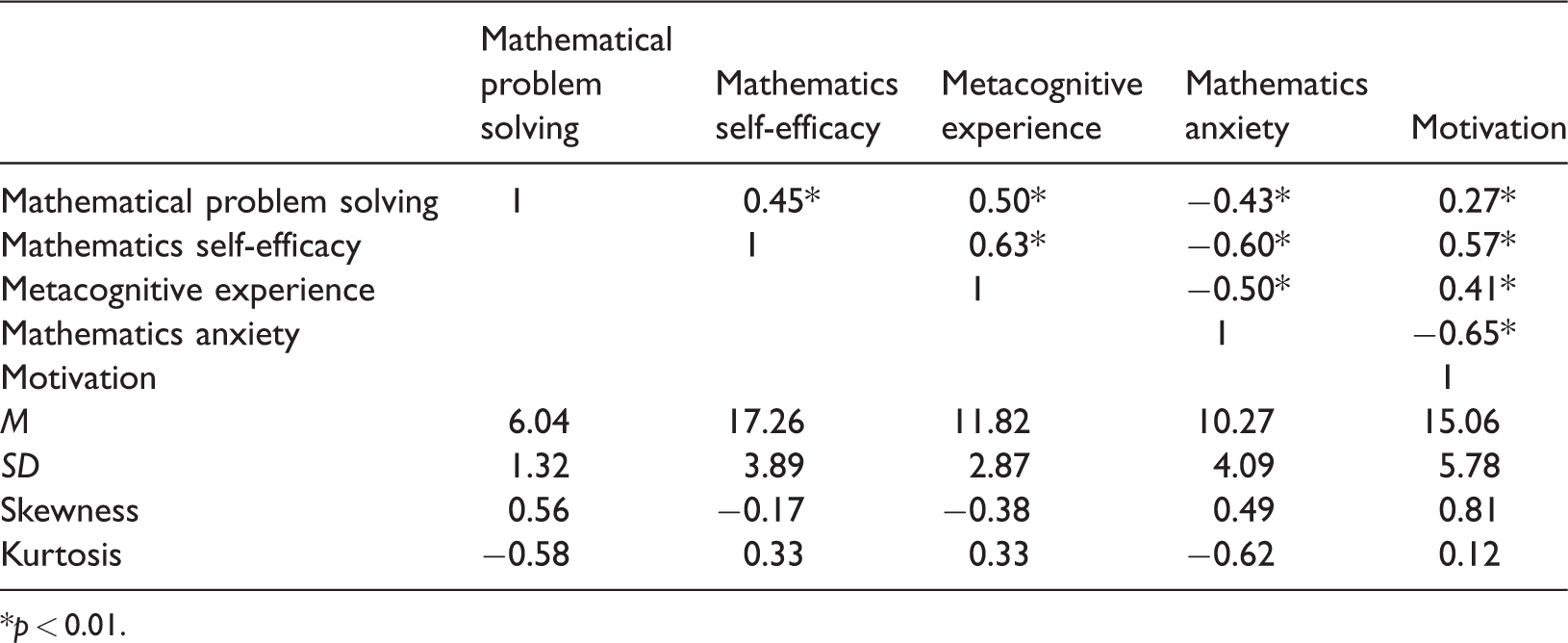
*p < 0.01.
As seen in Table 1, mathematical problem solving had medium to large positive relationships with self-efficacy (r = 0.45, p < 0.00), metacognition (r = 0.5, p < 0.00), and motivation (r = 0.27, p < 0.00). Self-efficacy had a large positive relationship with metacognition (r = 0.65, p < 0.00) and with motivation (r = 0.57, p < 0.00), and had a large negative relationship with mathematics anxiety (r = −0.60, p < 0.00). There was a negative relationship between mathematical problem solving and mathematics anxiety (r = −0.43, p < 0.00). Metacognition had a large negative relationship with mathematics anxiety (r = −0.50, p < 0.00, and a medium positive relationship with motivation (r = 0.41, p < 0.00). Lastly, mathematics anxiety had a large negative relationship with motivation (r = −0.65, p < 0.00).
Measurement model
The measurement model consisted of 25 observed variables which formed five latent variables (i.e., the scales of mathematics anxiety, intrinsic motivation, extrinsic motivation, mathematics self-efficacy, and metacognitive experience). At the beginning, we had separated motivation into two latent variables, namely intrinsic and extrinsic motivation. However, some of the fit indexes of both the measurement model (GFI = 0.80, AGFI = 0.81, CFI = 0.89) and the estimated structural model (GFI = 0.80, AGFI = 0.80, CFI = 0.88) were not acceptable. Given these poor fit indices and considering the higher internal consistency when the two scales were combined, a decision was made to combine the eight items previously considered to represent external and internal motivation into one latent variable “motivation.” As a consequence of this change, the fit indexes of the model became acceptable. Table 2 presents the model fit indices of the two-stage measurement model that was tested regarding the observed variables; all were within the acceptable range (Hayduk, 1987).
The model fit indices of two-stage measurement model.
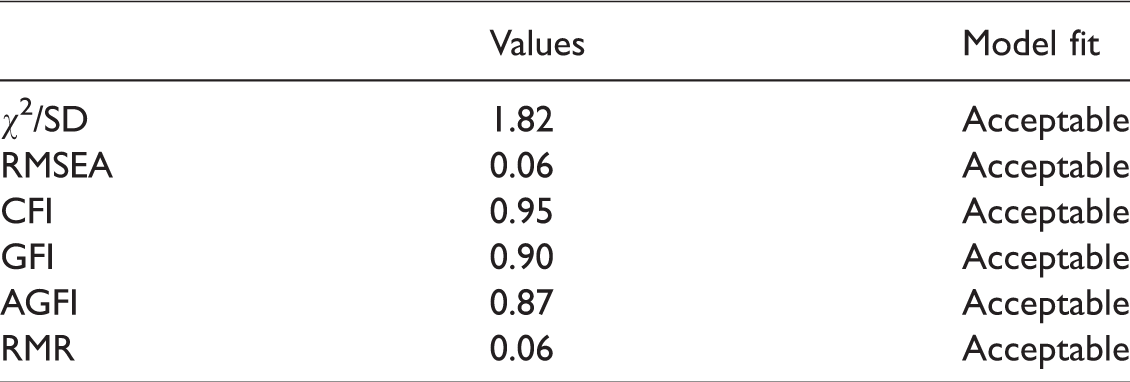
The estimated model was tested (see Figure 2) and, as shown in Table 3, acceptable fit indices obtained (χ2/SD = 1.82, GFI = 0.90, RMSEA = 0.06, CFI = 0.94, AGFI = 0.87, and RMR = 0.07) (Hayduk, 1987; McDonald & Moon-Ho, 2002). As some of the path estimates in Figure 2 did not reach significance (from mathematics anxiety to metacognition; from motivation to metacognition; from mathematics self-efficacy to mathematical problem-solving; from motivation to mathematical problem solving), they were removed from the model and the modified model was tested again (see Figure 3). The modified model also had acceptable fit indices (χ2/SD = 1.80, GFI = 0.90, RMSEA = 0.06, CFI = 0.94, AGFI = 0.87, and RMR = 0.07).
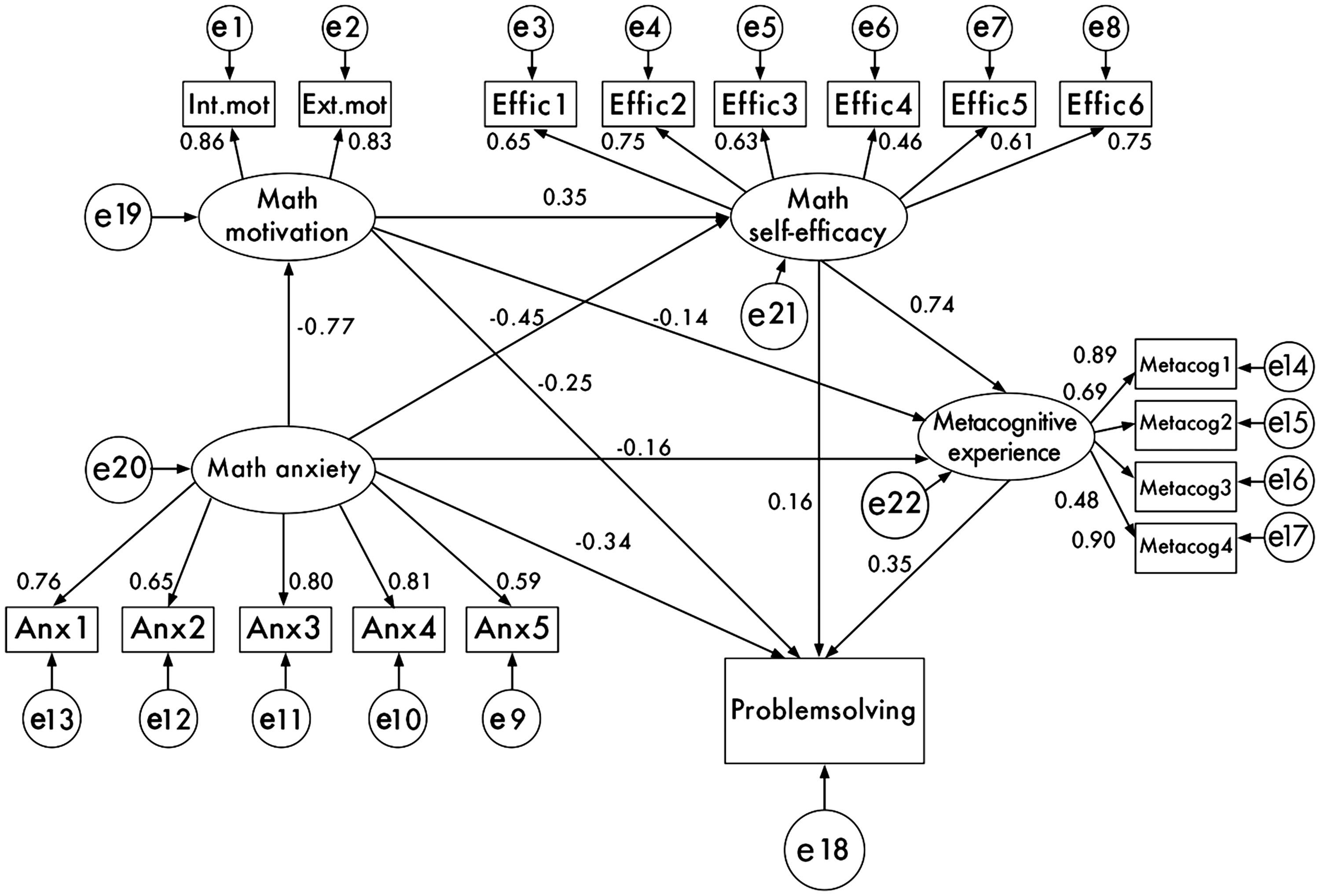
Standardized parameter estimates for the estimated structural model of mathematical problem solving.
Goodness of fit indices of estimated, modified, and simplified models.

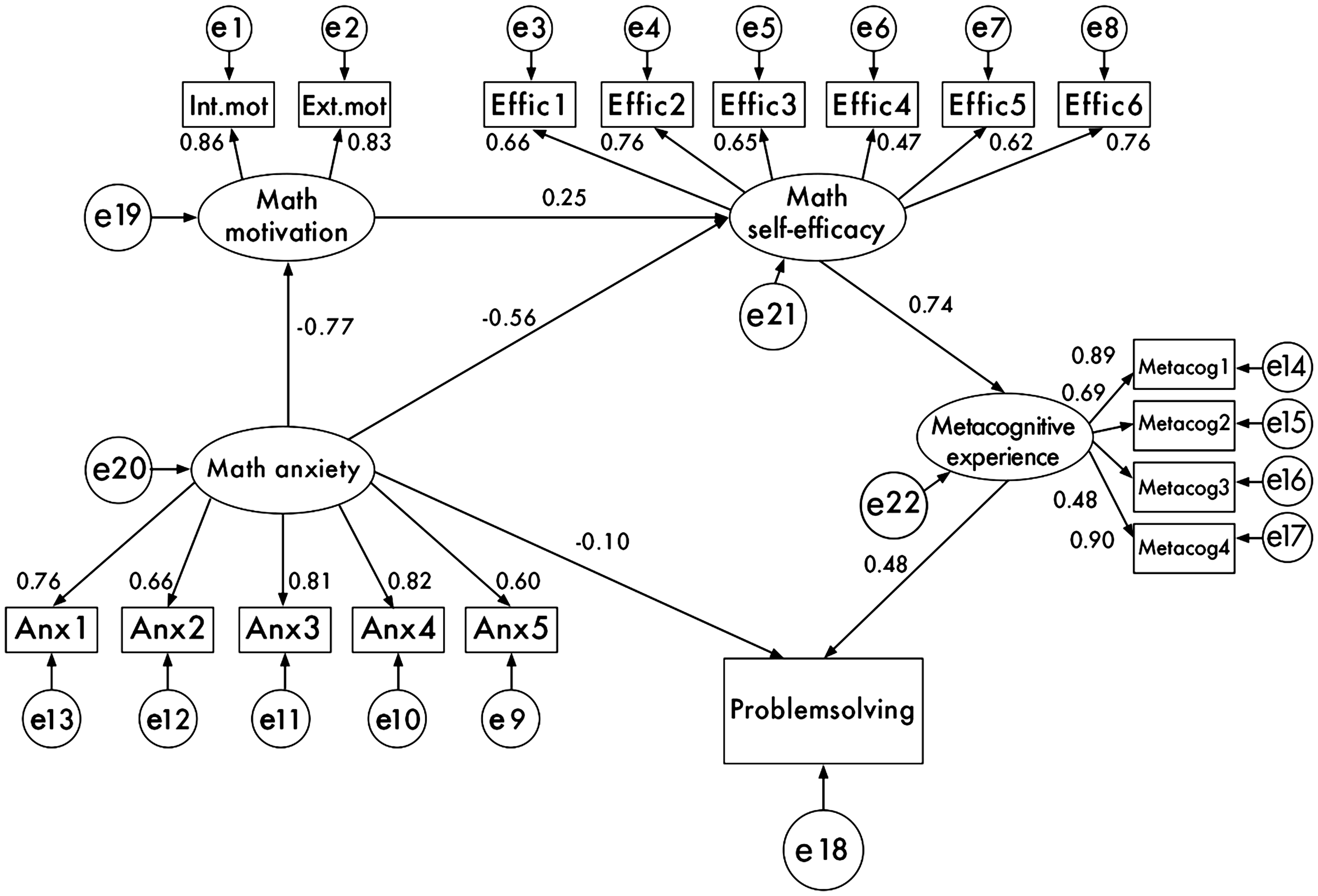
Standardized parameter estimates for the modified model of mathematical problem solving.
In the interests of parsimony, models with fewer parameters or pathways are generally preferred, and so the pathways from mathematics anxiety to mathematics self-efficacy and from mathematics anxiety to mathematical problem-solving were eliminated and the model retested. The fit indices (χ2/SD = 1.82, GFI = 0.90, RMSEA = 0.06, CFI = 0.94, AGFI = 0.86, and RMR = 0.08) of the final, simplified model showed that this model produced the same fit indices as the modified model, except for a slight increase in the chi squared. This final model (the simplified model in Table 3) indicates that mathematics anxiety has a direct effect on mathematics motivation (β = −0.82), mathematics motivation has a direct effect on mathematics self-efficacy (β = 0.72), mathematics self-efficacy has a direct effect on metacognition (β = 0.76), and metacognition has a direct effect on mathematical problem-solving (β = 0.59) (see Figure 4).
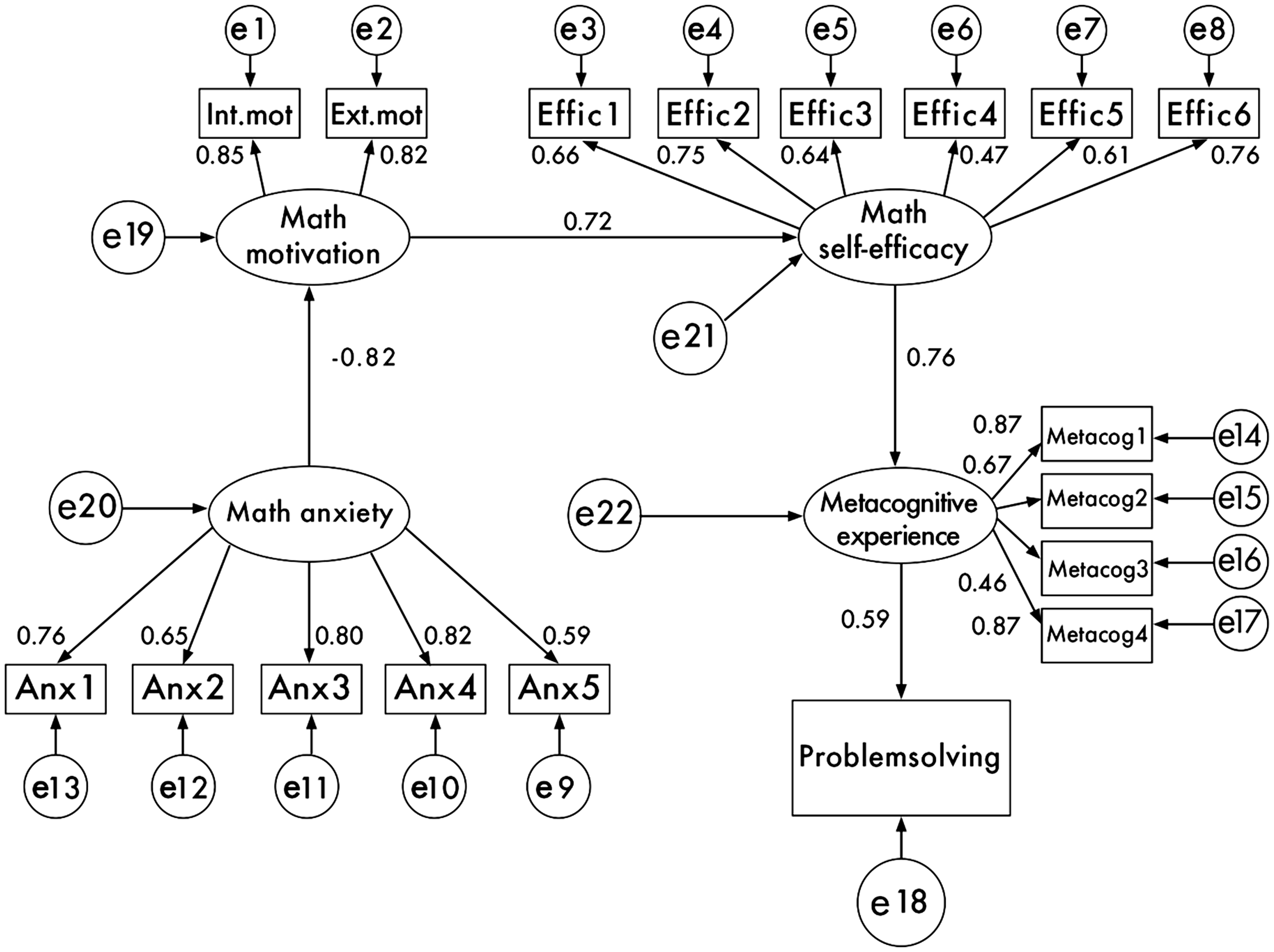
Standardized parameter estimates for the simplfied model of mathematical problem solving.
Discussion
According to the final, simplified model, metacognitive experience was the only variable that directly affected mathematical problem-solving performance, as well as serving as a mediator of the effects of mathematics self-efficacy, mathematics motivation, and mathematics anxiety. This result suggests that, among the noncognitive constructs affecting mathematical problem-solving performance, metacognition is the most significant variable. However, it is of critical importance to mention that the metacognition investigated here was that of retrospective metacognition—that is, metacognition in which an individual evaluates his or her metacognitive skills after the problem-solving stage is complete. Metacognition measurements obtained by prospective methods—either online or offline—reflect students’ perceptions more and move away from reality, particularly for non-adult individuals (Desoete, Roeyers, & Buysee, 2001). Existing literature generally highlights the impact of metacognition on mathematical problem solving using retrospective or prospective methods (Holton & Clarke, 2015; Jaafar & Ayub, 2010); however, investigating the effect of retrospective metacognition on mathematical problem solving has made more sense to researchers in recent years (Ozcan, 2016).
While the existing literature also frequently emphasizes and highlights the predictor effect of metacognition regarding mathematics achievement, the number of studies examining the overall mediating role of metacognition is quite limited. Lai et al.’s (2015) study indicated that metacognition mediated the effect of mathematics anxiety on mathematical problem solving. However, in Randhawa et al. (1993), the mediation analysis revealed that mathematics self-efficacy fully mediated the effect of metacognition on mathematics achievement. In fact, this result suggests that metacognition becomes more important when encountering a challenging task such as a mathematical problem (Holton & Clarke, 2015; Jaafar & Ayub, 2010; Ozsoy, 2011), while also suggesting that metacognition influences performance by controlling behavior using feedback gathered from student experiences (Moores et al., 2006). Metacognition, considered by some researchers as the central factor of self-regulative learning (Kleitman & Gibson, 2011; Schraw, Crippen, & Hartley, 2006), is expected to serve as a mediator for the non-cognitive constructs affecting performance and achievement. Stankov and Kleitman (2014) also asserted that some noncognitive constructs with a relatively low effect on learning may trigger and evoke metacognition and indicate the mediating role of metacognition.
Although the most powerful predictors of mathematics achievement were mathematics self-constructs, and self-efficacy was the most important among these self-constructs (Karakolidis et al., 2016; Lee & Stankov, 2013; Morony, Kleitman, Lee, & Stankov, 2013), the current study revealed that self-efficacy affected mathematical problem-solving performance indirectly, through metacognition. However, no other study could be found to corroborate this, and it remains the second most important result herein. The study conducted by Zarch and Kadivar (2006) underlines the central role of self-efficacy based on its mediating role on mathematics anxiety and mathematics motivation. Caroll and others (2009) have also found similar results in Australia with self-efficacy having an indirect effect on academic achievement. Even so, strong research-based evidence of the indirect impact of self-efficacy or the variables mediating it was not found in the literature and warrants further research attention. The literature does provide clear evidence regarding the relationship between self-efficacy and metacognition (Cera et al., 2013; Hoffman & Spatariu, 2008; Moores et al., 2006). This can be understood from the definitions of self-efficacy and metacognition: self-efficacy indicating the judgment of one’s capabilities to successfully perform a particular given task (Bandura, 1977, 1997), and metacognition including a review of what is known and how to utilize it within the process itself while simultaneously performing these capabilities and impacting performance. Stankov and Kleitman (2014) described self-efficacy and metacognition as excellent predictors of achievement, supporting the idea that metacognition works with self-efficacy in the available models, including those concerning non-cognitive variables.
The SEM indicated that motivation did not have a direct effect on mathematical problem solving, instead its impact was mediated by self-efficacy and metacognition. At the same time, mathematics anxiety was mediated by mathematics motivation. While there is much research on the influence of student motivation on performance, both in mathematical problem solving and in other areas, research that focuses on the mediating role of motivation and the variables that mediate it is more limited. Indeed, the literature suggests that motivation is less predictive of mathematics achievement when compared to other self-constructs (Lee & Stankov, 2013) and, furthermore, there exists a significant and positive relationship between motivation measurements and self-efficacy (Skaalvik et al., 2015). Yıldırım (2011) found a positive significant relationship between the two variables, but pointed out that the effect of internal motivation was not significant regarding mathematics achievement; indeed, it is almost nonexistent when self-efficacy beliefs are considered at the same time and controlled for. As seen in the structural model of this study, the effect of motivation on mathematical problem solving takes place through the mediation of self-efficacy. Considering the vast number of motivational sources, both internal and external, it follows that motivation developed through various means only gradually affects self-efficacy while triggering metacognitive processes. In a Turkish study by Ocak and Yamaç (2013), internal motivation and self-efficacy regarding mathematics were reported to significantly predict metacognitive skills, results that partially support those in the current study.
Mathematics anxiety was defined as the single exogenous variable within the simplified model, and found to be the sole construct that had an impact—either direct or indirect—on mathematical problem solving in the modified model. However, since the direct effect of mathematics anxiety presented a low correlation in the modified model, the model fit indices remained the same when it was removed. This indicates that the effect of mathematics anxiety on mathematical problem solving took place largely through mediations of motivation, self-efficacy, and metacognition. Researchers have repeatedly validated the significant and inverse relationship between mathematical academic achievement and mathematics anxiety, pointing out that this relationship is more complicated than it seems (Ashcraft & Moore, 2009). This result underlines the importance of investigating variables that mediate the impact of mathematics anxiety as an indirect predictor in those models in which mathematical problem-solving performance is a dependent variable. Mathematics anxiety as the single external variable within this model indicates that mathematics anxiety itself provides important clues about integration into a model alongside noncognitive constructs. The cause-and-effect relationship of the model wherein decreasing anxiety increases motivation and increased motivation positively affects self-efficacy and, therefore, metacognition is a reasonable relationship network. The study by Yıldırım (2011), which investigated the effect of anxiety and motivation scores of students from Turkey, Fınland, and Japan through self-efficacy on their mathematics achievement using the PISA 2003 data, corroborates the aforementioned scenario.
Limitations
The results of this study, which involved Turkish students, are not necessarily generalizable to students of other cultures and other languages. In a research article critique as highlighted by Byrnes (2003), testing relationships that have been identified using data gathered from individuals of a common demographic background is insufficient when making decisions regarding the validity of those relationships. Therefore, there is a need for the relationships indicated in our model to be tested and replicated in further research with larger, and more diverse, samples.
Conclusion
To conclude, despite the need for this study to be replicated, it nevertheless contributes to the development of more comprehensive theories emphasizing how metacognition and self-efficacy work together when predicting mathematical problem-solving abilities and how, within this process, metacognition plays the most central role. When this model is considered alongside noncognitive constructs related to mathematical problem-solving, it highlights those paths that are most important to test and thus those paths that may prove useful in informing teaching practices and learning interventions. Constructs previously rejected as avenues for intervention based on research focusing only on direct relationships with mathematical problem-solving and performance may be redefined as useful levers and points for intervention for students who need assistance when indirect relationships are tested and found to be adequate. Further studies can contribute to enriching evidence-based literature, serving as an informative source regarding the prospective design of educational environments that are most appropriate for the development of effective metacognitive skills and self-efficacy, assuming that the key roles of metacognition and self-efficacy are supported therein.
The key role of metacognition in the current model is an important consideration for those involved in designing and implementing interventions for mathematics. Attempts to improve mathematical problem-solving skills via mathematics anxiety reduction programs, motivation, and mathematics self-efficacy enhancement programs would do well to include metacognitive skills also. In addition, metacognition can be enhanced by decontextualized metacognitive training or embedded in lesson plans, which would provide realistic and low-cost proposals to increase mathematics success of students at all socioeconomic levels.
Footnotes
Declaration of conflicting interests
The author(s) declared no potential conflicts of interest with respect to the research, authorship, and/or publication of this article.
Funding
The author(s) received no financial support for the research, authorship, and/or publication of this article.