




Abstract
Abstract
Although Bandura had proposed that self-efficacy once established is relatively stable, it remains a topic of debate, as empirical evidence has shown different patterns of changes in self-efficacy across different career stages. The current study presents longitudinal data from 74 beginning school teachers in Victoria, Australia to discern changes during their first five years. Their increase in self-efficacy is discussed with reference to existing (primarily cross-sectional) studies, and policy implications for supporting early career teachers.
Keywords
Teachers’ self-efficacy is considered one of the key motivational beliefs influencing professional behaviors including persistence in the career, job satisfaction, as well as student engagement, and achievement. Despite the large number of students entering teacher education programs in recent years, teacher shortages are still a concern in specific geographic contexts and subject areas (UNESCO, 2015). A pressing issue worldwide is teacher attrition, especially among beginning teachers. In the USA, based on analysis of two large datasets (the Schools and Staffing Survey, SASS, and Teacher Follow-up Survey, TFS), 1 it is reported that 46% of beginning teachers leave the profession during their first 5 years (Ingersoll, 2003). The situation is not so different in Australia, with nearly 40% of teachers estimated to leave within 5 years (Milburn, 2011). It is reported that novice teachers who are at risk of leaving the profession express strong dissatisfaction with their job and work environment (Gaikhorst, Beishuizen, Korstjens, & Volman, 2014). Existing research evidence supports the importance of teachers’ self-efficacy for their job satisfaction (Collie, Shapka, & Perry, 2012; Klassen & Chiu, 2010; von der Embse, Sandilos, Pendergast, & Mankin, 2016; Woolfolk Hoy & Burke-Spero, 2005), suggesting that this is implicated in their decision to leave or stay in the profession.
Teachers’ early career experiences
Based on a review of studies from various countries regarding why early career teachers leave the profession, Veenman (1984) had earlier highlighted the “reality shock” they may experience when facing the real challenges and demands of classroom teaching for the first time. It may not be surprising that conflicts between an idealistic classroom teaching-learning concept developed before and during teacher education, and actual subsequent classroom teaching, could provoke confronting dilemmas and confusions, and changes in confidence to undertake the tasks required of teachers. Common problems reported by early career teachers included classroom management, student motivation, classroom resources, curriculum changes, organization of classwork, and excessive work demands (e.g., Buchanan, 2010).
In the USA, 42% of 3,390 teachers who left their career reported dissatisfaction with their job, desire for a better job, or to improve their career (Ingersoll, 2001). Reasons for career dissatisfaction in that study included lack of school support, student discipline issues, and low salary. Even among future teachers, negative experiences during teacher education and practicum experiences were identified as one of the reasons for a group identified as “lower engaged desisters” in an Australian study, who were already planning to leave the profession (Watt & Richardson, 2008a). Another qualitative study of 14 early career teachers from Australia reported their difficulties regarding student disengagement, behavior management, excessive workloads, and lack of collegiality and support (Buchanan, Prescott, Schuck, Aubusson, & Louviere, 2013), similar to the findings summarized by Veenman more than three decades ago. Collectively, these findings suggest that an insufficient sense of preparedness and self-efficacy to effectively deal with the demands of daily classroom teaching may contribute to a reality shock at the point of career entry. Weinstein (1988) suggested that reality shock stemmed from beginning teachers’ unrealistically positive expectations about their own ability to deal with the demands of classroom, and a “tendency to believe that the problems experienced by others won’t happen to me” (p. 33). She observed an impractical sense of optimism for tasks perceived to be under teachers’ control and for organizational and management tasks required early in the career.
The pioneering work of Fuller (1969) had proposed a developmental progression of concerns about teaching which identified teacher education students as “nonconcerned”, beginning teachers as “preoccupied with self or survival concerns”, and experienced teachers as “concerned about the teaching related tasks and their impact on students” (pp. 218–221).
A survey study of USA preservice teachers (N = 179) observed that they were less concerned than beginning teachers about classroom discipline, assessing students’ work, and relationships with parents (Evans & Tribble, 1986). This pattern was replicated in a later USA study of teachers’ self-efficacy by Woolfolk Hoy and Burke Spero (2005), whose longitudinal study was conducted among a group of 29 beginning teachers, investigating changes in self-efficacy at three timepoints: twice during a particular teacher education program (beginning and end), and again at the end of their first year of teaching. A significant increase in self-efficacy occurred during teacher education, followed by a decline through the first year of teaching, attributed to their lack of prior experience managing classrooms, implementing different instructional strategies, and engaging students in learning processes. Limited longitudinal information is available on subsequent changes in teachers’ self-efficacy during their initial years of teaching, which is the gap that the current study addresses.
Self-efficacy and teachers
Bandura defined self-efficacy as “people’s belief about their capabilities to produce designated levels of performance that exercise influence over events that affect their lives” (1994, p. 72). His key contention was that an individual’s behavior can be better predicted by the beliefs she/he holds about individual capabilities than by previous achievements, knowledge, or skills (Bandura, 1993). He acknowledged that beliefs and reality are seldom perfectly matched, and individuals are typically guided by their beliefs while they engage with the world.
Although research on teacher self-efficacy dates back to the studies carried out by the RAND organization in the 1970s, grounded in Rotter’s (1966) locus of control framework, it was Tschannen-Moran, Woolfolk Hoy, and Hoy (1998) who proposed the widely adopted integrated model of teachers’ self-efficacy in accordance with Bandura’s theory, based on the different aspects of teachers’ role in the classroom. Their model emphasizes the context-specific nature of teacher self-efficacy, proposing that teachers need not feel equally efficacious for all teaching dimensions. They identified two broad dimensions: teaching task and context, related to the available resources to facilitate the learning process; and, personal competence, which relates to the skills, knowledge, and personality traits of the individual (Tschannen-Moran et al., 1998). The interaction of these two dimensions results in one’s judgment of self-efficacy. The Teachers’ Sense of Efficacy Scale (TSES; Tschannen-Moran & Woolfolk Hoy, 2001) is the most widely used measure in the field, including three dimensions of teachers’ self-efficacy: for classroom management, student engagement, and instructional strategies, each of which was included in the present study.
Well-crafted, primarily cross-sectional studies, have been conducted in the field of teacher self-efficacy, demonstrating the association of teachers’ self-efficacy with important educational outcomes for students, such as achievement (Caprara, Barbaranelli, Steca, & Malone, 2006; Guo, Connor, Yang, Roehring, & Morrison, 2012; Klassen & Tze, 2014; Pajares, 1996a; Ross, 1992; Tournaki & Podell, 2005) and motivation (Ashton & Webb, 1986; Midgley, Feldlaufer, & Eccles, 1989; Pajares, 1996b; Schunk, 1991). Teachers who hold high self-efficacy are likely to adopt more student-centered than teacher-centered approaches in their teaching (Swars, 2005), to develop new approaches and strategies for teaching, promote student autonomy, and cater to students’ individual differences (Ross, 1998). Teachers’ self-efficacy associates with their instructional behaviors (Morris-Rothschild & Brassard, 2006; Wolters & Daugherty, 2007), own wellbeing (Betoret, 2006; Brouwers & Tomic, 2000), job satisfaction (Caprara, Barbaranelli, Borgogni, & Steca, 2003; Moè, Pazzaglia, & Ronconi, 2010; Skaalvik & Skaalvik, 2007), perception of positive school climate (Chong & Ong, 2016), decision to quit or stay in the profession (Hong, 2012), as well as students’ perceptions of teacher traits including teaching competence (Miller, Ramirez, & Murdock, 2017). Recent research with a large sample of 1,241 USA teachers observed significant protective mediation effects of teachers’ self-efficacies for student engagement and classroom management on the relationship between sources of stress and job satisfaction (von der Embse et al., 2016) further supporting the significant role of teacher self-efficacy. Consequently, teachers’ self-efficacy has received attention from teacher educators, policymakers, and administrators.
Stability and developmental change
Bandura proposed that self-efficacy, once established, is relatively stable (1997) with four main sources: mastery experiences, vicarious experiences, social persuasion, and emotional and physiological states. Refinement and expansion of theoretical understandings of these sources have been proposed by including additional sources for teachers’ self-efficacy and mediating effects of secondary appraisals such as knowledge of past success on the relationships between the sources and teachers’ self-efficacy (e.g., Morris, Usher, & Chen, 2017). An additional source of self-efficacy, attainment of knowledge, has been proposed for those teachers whose goals are to gain knowledge (Mishra & Koehler, 2006). Although mastery experiences are highlighted as the most significant source of self-efficacy (Bandura, 1997), the role of vicarious experiences and social persuasion as potentially strong sources should not be discounted especially during the initial years, when fewer mastery experiences may be available to novices (Tschannen-Moran & Woolfolk Hoy, 2007). Once teachers gain mastery experiences, other sources may become less important. For instance, when mentor teachers work closely with novices, providing them with new and authentic ideas about curriculum and teaching, it is likely this would foster a stronger sense of self-efficacy through vicarious experience of observing a model teacher. Similarly, social persuasion, constituted by the positive (or negative) verbal appraisals that beginning teachers receive from mentor teachers, school administration, or students’ parents, may boost or undermine their confidence (Tschannen-Moran & Woolfolk Hoy, 2007).
Although Bandura (1997) portrayed self-efficacy as a stable construct, he posited it could be pliable in the early years of learning, which, in the case of teachers, would pertain to learning to teach. However, the few longitudinal studies that have been conducted have yielded varied results showing both increases (Holzberger, Philipp, & Kunter, 2013), as well as decreases (Woolfolk Hoy & Burke Spero, 2005) in teachers’ self-efficacy. Klassen and his colleagues established that of the 167 quantitative self-efficacy studies conducted 1998–2009, only 19 were longitudinal (Klassen, Tze, Betts, & Gordon, 2011), whose major findings reported the influence of self-efficacy on teacher burnout (e.g., Brouwers & Tomic, 2000; Schwarzer & Hallum, 2008). Another longitudinal finding by Henson (2001) reported a significant increase of teacher self-efficacy (personal and general teaching efficacies) over time. Not many longitudinal studies have been added to the field in the last decade (Zee & Koomen, 2016), drawing attention to the need for more longitudinal studies on teachers’ self-efficacy.
Self-efficacy and behaviors are reciprocally entwined: when teachers gain more mastery experiences, they are more likely to experience success, which in turn increases their sense of self-efficacy (Holzberger et al., 2013). These authors’ longitudinal study of teachers having 3–42 years of teaching experience, analyzed reciprocal causation between teachers’ four dimensions of self-efficacy (job performance; skill development; social interaction with students, parents, and colleagues; and coping with job stress) and instructional quality (cognitive activation, classroom management, and individual learning support). The data were collected at two timepoints from the end of one school year until the end of the next. Teachers’ self-efficacy increased over the course of the school year, and high instructional quality as reported by both students and teachers led to increased teachers’ self-efficacy in the subsequent year. Analysis of teacher ratings revealed that teachers’ self-efficacy influenced instructional quality (β = .25, p < .05), and vice versa (β = .29, p < .05). Interestingly, analysis of student ratings revealed no significant influence of teachers’ self-efficacy on instructional quality but only the reverse effect, theoretically consistent with mastery experiences as a primary source of self-efficacy (Bandura, 1994). Longitudinal findings on the reciprocal relationship between teachers’ instructional quality and self-efficacy invite attention of self-efficacy researchers to be cautious when interpreting causal outcomes from cross-sectional correlates of teachers’ self-efficacy.
A longitudinal study from Australia tracked the self-efficacy of 96 beginning teachers (Watt & Richardson, 2010) on 10 dimensions, collected at two timepoints: at the end of teacher education, and again after approximately 5 years of teaching, using the Self-Efficacy for Teaching (SET) scale (Watt & Richardson, 2008b). Changes were analyzed for three types of teachers: (1) highly engaged persisters, who were highly invested in their professional development and wanted to teach for their whole career; (2) highly engaged switchers, who were similarly invested in their professional development but did not want to stay in the teaching profession their whole career; and, (3) lower engaged desisters, who were neither professionally engaged, nor planned to remain in the career. Changes in self-efficacies were significant only among the highly engaged persisters. Out of the 10 measured self-efficacy dimensions, significant declines were identified for six (community interactions, value cultural diversity, help failing students, enhance self-concept and interest, manage disruptive behavior, and critical reflection). The researchers attributed declines in self-efficacy to the high idealistic motivations this group of teachers held at the outset of their career, which might have been difficult to achieve during early years. Thus, self-efficacy may change differently for different kinds of beginning teachers.
The results from cross-sectional studies vary from no significant relationship between teachers’ self-efficacy and length of teaching experience (Ross, Cousins, & Gadalla, 1996), to a weak negative correlation (Ghaith & Yaghi, 1997), or a positive correlation (Klassen & Chiu, 2010; Wolters & Daugherty, 2007). These studies were conducted in different contexts, with measures that differently conceptualized self-efficacy, and included teachers with different lengths of teaching experience, which could help explain conflicting results. More longitudinal studies are needed especially with early career teachers, when their self-efficacies may be more pliable. It is against this background that the current study explores changes in self-efficacy of 74 early career teachers across their first 5 years.
Hypotheses
On the basis of the reviewed empirical evidence and self-efficacy theory (Bandura, 1997; Holzberger et al., 2013), it was hypothesized that early career teachers’ self-efficacy would change during their initial years of teaching (Hypothesis 1). It was expected that the three measured dimensions of teachers’ self-efficacy, namely classroom management, student engagement, and instructional strategies would increase (e.g., Klassen & Chiu, 2010) during their early years due to the accumulation of mastery experiences (Hypothesis 2).
Based on Bandura’s concept of context and task specificity of self-efficacy, as well as a trend for teachers of younger students to feel more efficacious than those teaching students in higher grades (Chester & Beaudin, 1996; Klassen & Chiu, 2010; Tschannen-Moran & Woolfolk Hoy, 2007; Wolters & Daugherty, 2007), it was expected that there could be different patterns of change of self-efficacy for primary versus secondary teachers (Hypothesis 2a). Given that some studies report the association of organizational climate and teachers’ self-efficacy (e.g., Hoy & Woolfolk, 1993) we additionally explored potentially differential changes between public and private sector school teachers due to typically better provisioning of private schools (Hypothesis 2b); full-time versus not full-time teachers due to different amounts of time undertaking teaching tasks (Hypothesis 2c); and men and women teachers (Hypothesis 2d) based on identified differences (e.g., Anderson, 2011; Klassen & Chiu, 2010).
Methodology
Participants
The study was conducted across two timepoints over a period of 5 years with 74 early career teachers. In compliance with ethics requirements, the study was approved by the University Human Research Ethics Committee, Catholic Education Office (CEO), and Department of Education and Early Childhood Development (DEECD). Time 1 took place in the first year of teaching when participants were attending information sessions run by the Victorian Institute of Teaching (VIT), the statutory authority for the regulation of the teaching profession in Victoria, Australia, established by the Victorian Institute of Teaching Act 2001. All participants were new to the profession and held provisional registration with the VIT. Before being granted their full registration to teach in the state of Victoria, teachers who are new to the profession or have not yet taught in an Australian or New Zealand school are granted provisional registration for up to 2 years to demonstrate that they meet the Australian Professional Standards for Teaching. Questionnaires and information forms were distributed to those interested in participating at the end of the information session. Time 2 occurred 5 years later using an online survey emailed to those participants who had expressed a willingness to be re-contacted and provided their email addresses at Time 1 for that purpose. All 74 participants completed the survey, and there were no missing data on measured items.
The participants included a mix of women and men primary and secondary school teachers who were working full-time or part-time in government or private schools. Approximately 70% of participants were teaching in the Government sector (n = 52), and due to the low numbers, teachers working in the Catholic and Independent sectors were combined into the “private sector” (n = 22). This composition represented the Victorian teacher population which comprises nearly two-thirds (61%) of teachers working in Government schools, followed by Catholic (21%) and Independent (18%) schools. The majority of participants were women (n = 63; 82.4%) reflecting the gender composition of the teacher population in Victoria, where women comprise 80% of primary teachers and 60% of secondary teachers (Australian Bureau of Statistics (ABS), 2017). The majority (n = 59; 79.7%) were full-time teachers; 15 (20.3%) worked as part-time or casual teachers, combined as “not full-time.” Most were primary school teachers (n = 45; 60.8%), followed by secondary (n = 25; 33.8%), and 4 (5.4%) were teaching in a P-10 (primary school until secondary grade 10) setting, which also reflected the Victorian teacher population which consists of 52% primary and 48% secondary school teachers (P-10 teachers were not separated out in the ABS reporting).
Instrumentation
Data were collected using the TSES (Tschannen-Moran & Woolfolk Hoy, 2001). This is the most widely used measure of teachers’ self-efficacy since it was published, and it has been identified as a superior measure compared to existing measures of teacher self-efficacy (Woolfolk Hoy & Burke Spero, 2005). Its selection allows for comparison with existing studies that have used it.
The TSES has three subscales which, in turn, consists of four items each. The subscale classroom management assesses teachers’ confidence in their ability to effectively manage student behavior in their classroom. The instructional strategies subscale reflects teachers’ confidence in their ability to use a variety of effective instructional and assessment strategies to cater to the needs of all students. The subscale labeled student engagement taps teachers’ confidence in their ability to engage students in learning activities. Subscale reliabilities have been previously reported for samples in five countries (Canada, Cyprus, Korea, Singapore, and the United States) which all were acceptable and ranged from .71 to .94 (Klassen et al., 2009).
The TSES original form used a 9-point Likert scale for each item with anchors at 1—nothing, 3—very little, 5—some influence, 7—quite a bit, and 9—a great deal. In the present study, only the endpoints were labeled, from 1 (not at all confident) to 9 (extremely confident). In addition, the wordings of items were slightly modified to enable presentation of a common stem for all items, namely “How confident are you that you have the ability to….” For example, the item “How much can you do to get children to follow classroom rules” was reworded as “… get children to follow classroom rules.”
Analyses
Confirmatory factor analysis (CFA) using Amos 20 (Arbuckle, 2011) was undertaken at each of Time 1 and Time 2 to assess the construct validity of the TSES in the present study, as the modest sample size (N = 74) disallowed a robust test of measurement invariance. Reported fit statistics included the root mean square error of approximation (RMSEA), comparative fit index (CFI), Tucker–Lewis index (TLI), goodness of fit index (GFI), and standardized root mean square residual (SRMR). The cut-off criteria suggested by Hu and Bentler (1999) as reflecting good models were adopted to interpret the fit indices with GFI, TLI, and CFI ≥ .95, RMSEA ≤ .08, and SRMR ≤ .06.
The three-factor maximum likelihood CFA model of teacher self-efficacy with 12 items revealed a good fit at Time 1: χ2 (51, N = 71) = 52.879, GFI = .900, CFI = .995, TLI = .994, RMSEA = .023, and SRMR = .05; as well as at Time 2: χ2 (50, N = 74) = 95.63, GFI = .928, CFI = .968, TLI = .956, RMSEA = .077, and SRMR = .045. Time 1 standardized item loadings for the four classroom management items ranged 0.76‒0.86, and measurement errors 0.56‒0.75 (α = .91); 0.73‒0.82 and 0.54‒0.68 for student engagement (α = .86); 0.43‒0.72 and 0.19‒0.52 for instructional strategies (α = .69). At Time 2, standardized item loadings for the four classroom management items ranged 0.74‒.86, and measurement errors 0.54‒0.74 (α = .88); 0.68‒0.85 and 0.46‒0.73 for student engagement (α = .88); 0.61‒0.88 and 0.38‒0.77 for instructional strategies (α = .86). Table 1 presents the standardized item loadings and measurement errors from the CFA at both timepoints along with Cronbach alpha measures of internal consistency. Latent correlations among the constructs were high: .71 at Time 1 and .74 at Time 2 between management and engagement self-efficacies, .63/.55 between management and instructional self-efficacies, and .69/.72 between engagement and instructional self-efficacies. The high correlations suggest that early career teachers do not greatly distinguish these constructs.
Teachers’ self-efficacies at Time 1 and Time 2: Factor loadings (LX), measurement errors (TD), and Cronbach's alphas (α).
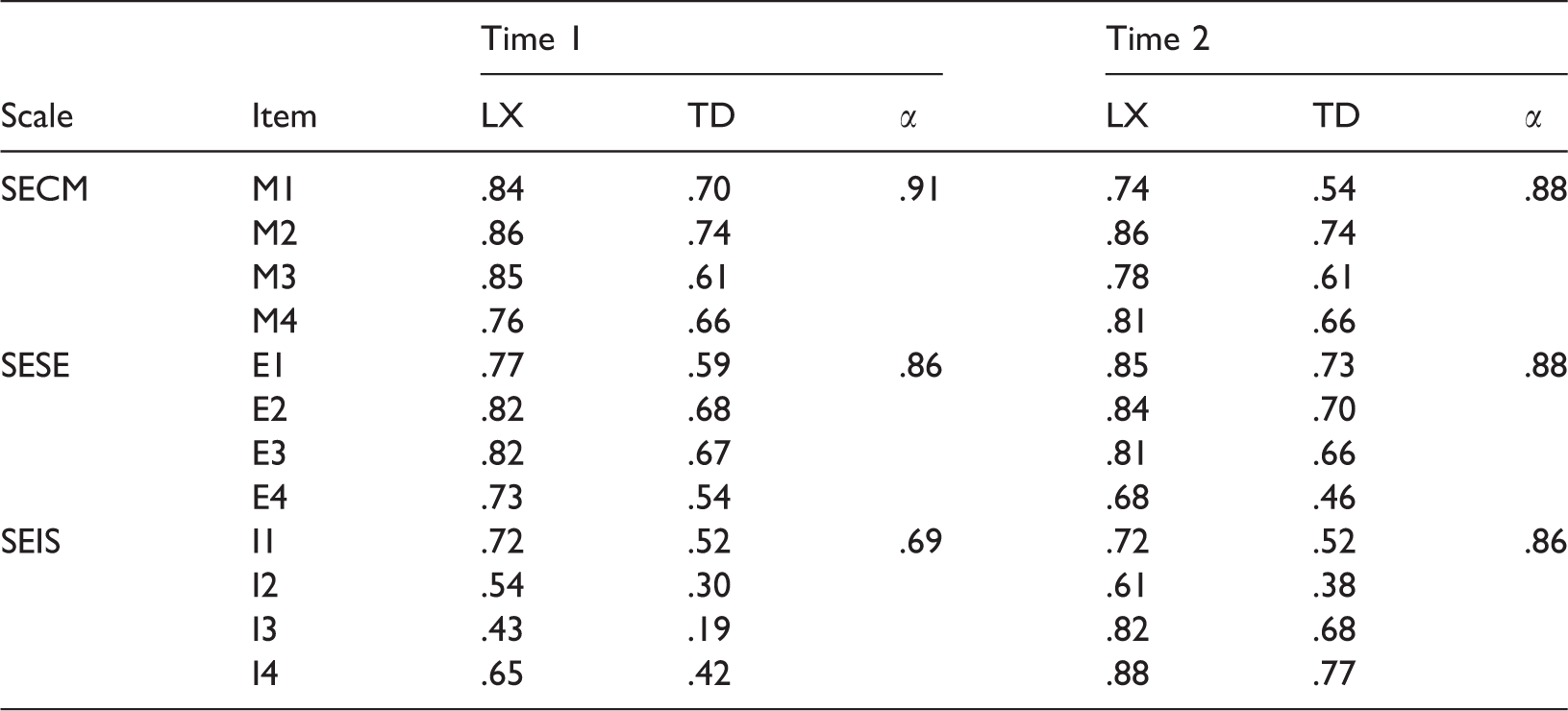
SECM: self-efficacy for classroom management; SESE: self-efficacy for student engagement; SEIS: self-efficacy for instructional strategies.
Repeated-measures MANOVA was used to analyze changes in mean scores for the three subscales, and the effects of school level, school sector, form of employment, and gender on teachers' self-efficacy. Preliminary assumption testing was conducted to check for multivariate normality, and homogeneity of variance–covariance matrices with no serious violations noted. Since 24 (3 subscales × 8 subsamples) comparisons were performed, and in view of the modest sample size, Bonferroni adjusted p-values were set at p < .02. Because of small cell sizes, four separate repeated-measures MANOVAs were conducted; the first had school level (primary and secondary) as a between-subjects factor, the second school sector (government and private), the third form of employment (full-time and not full-time), and the fourth gender. Effect sizes were interpreted in terms of partial η2; ≤0.01 is considered a small effect size, 0.09 moderate, and ≥0.25 large (Cohen, 1988). Pearson correlations identified interrelationships across timepoints.
Results
Early career teachers rated themselves high on each of the classroom management, student engagement, and instructional strategies self-efficacy subscales at both timepoints. Subscale means and standard deviations (Times 1 and 2) are reported in Table 2, along with latent correlations from CFAs.
Latent correlations, means, and standard deviations: Times 1 and 2 (N = 74).

SECM: self-efficacy for classroom management; SESE: self-efficacy for student engagement; SEIS: self-efficacy for instructional strategies.
As anticipated (Hypothesis 1), self-efficacies changed during the early years of teaching; the repeated-measures MANOVAs each showed a significant multivariate effect of time on the self-efficacy scores of participants. Consistent with Hypothesis 2 the direction of this change was upward, with descriptive statistics summarized in Table 3. Counter to expectation, there were no significantly different patterns of change for primary versus secondary teachers (Hypothesis 2a), public versus private school sectors (Hypothesis 2b), full-time versus not full-time employment (Hypothesis 2c), or men versus women (Hypothesis 2d). There were, however, some interesting between-group main effects for primary versus secondary teachers. Results per each are summarized below.
Descriptive statistics for the eight subsamples: Times 1 and 2 (N = 74).
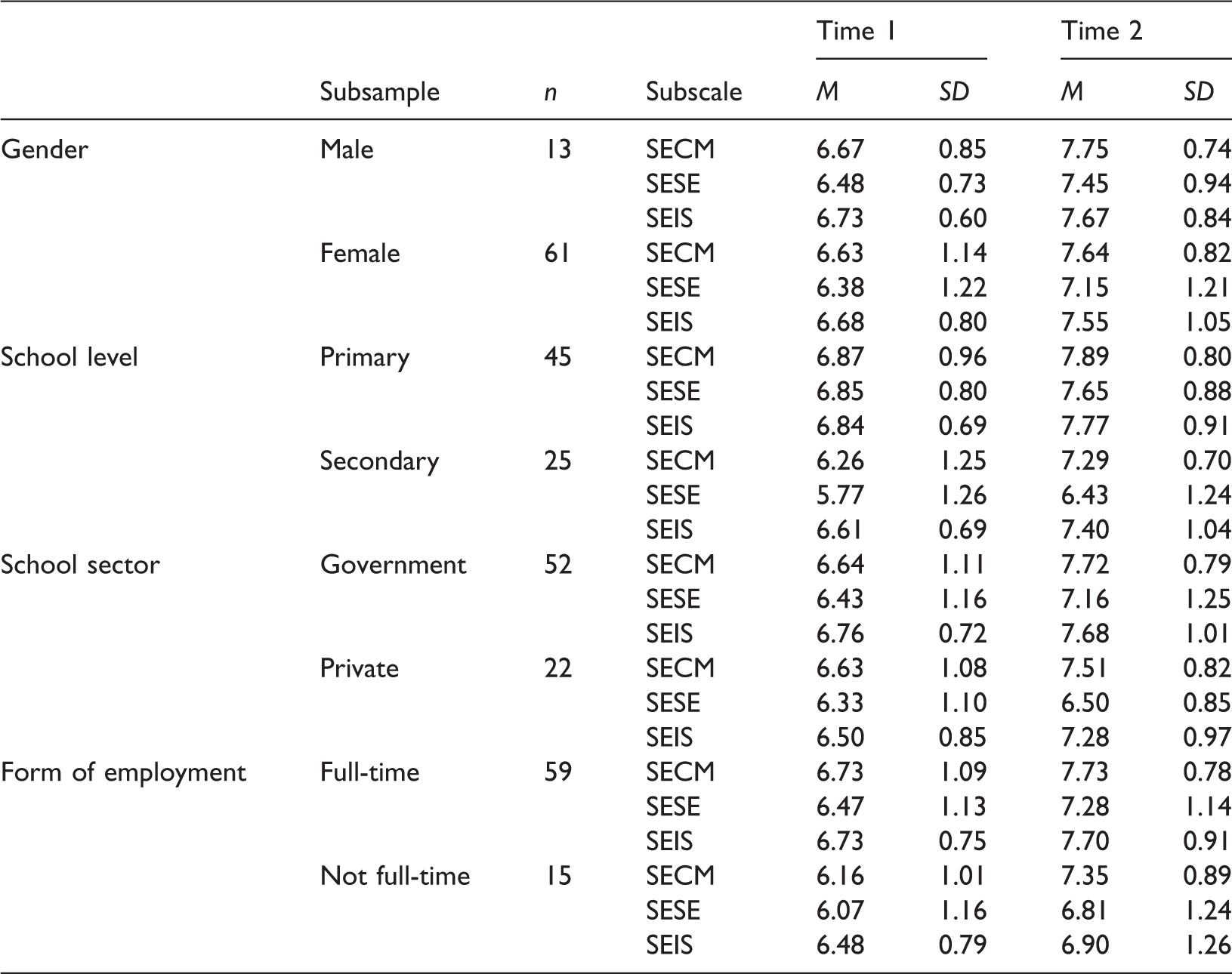
SECM: self-efficacy for classroom management; SESE: self-efficacy for student engagement; SEIS: self-efficacy for instructional strategies.
The first repeated-measures MANOVA (to test Hypothesis 2a) revealed two significant multivariate effects on the self-efficacy subscales: time (Wilks’ Λ = 0.40; F (3, 60) = 28.88, p < .001; partial η2 = .589) and school level (Wilks’ Λ = 0.66; F (3, 60) = 10.24, p < .001; partial η2 = .342). There were no significant interaction effects. Univariate results showed that participants’ scores on all self-efficacy subscales significantly increased with time: classroom management (F (1, 65) = 51.93, p < .001; partial η2 = .463), student engagement (F (1, 65) = 29.44, p < .001; partial η2 = .323), and instructional strategies (F (1, 65) = 51.32, p < .001; partial η2 = .453). Primary teachers were more self-efficacious in classroom management (F (1, 62) = 9.38, p = .003; partial η2 = .132) and student engagement (F (1, 62) = 26.15, p < .001; partial η2 = .304), whereas no significant differences were observed for instructional strategies.
The second repeated-measures MANOVA (testing Hypothesis 2b) repeated the significant multivariate effect of time on subscales (Wilks’ Λ = 0.44; F (3, 63) = 26.52, p < .001; partial η2 = .561), but no multivariate effect of public versus private sector (Wilks’ Λ = 0.93; F (3, 63) = 1.54, p = .214; partial η2 = .692) or interaction effect of time and sector (Wilks’ Λ = 0.94; F (3, 63) = 1.40, p = .252; partial η2 = .589). Univariate analyses again showed significant increases on all self-efficacy subscales: classroom management (F (1, 65) = 44.75, p < .001; partial η2 = .412), student engagement (F (1, 65) = 36.51, p < .001; partial η2 = .36), and instructional strategies (F (1, 65) = 45.98, p < .001; partial η2 = .413). There were no significant univariate effects of sector.
The third repeated-measures MANOVA (testing Hypothesis 2c) repeated the significant multivariate effect of time (Wilks’ Λ = 0.55; F (3, 63) = 17.50, p < .001; partial η2 = .978), but no significant multivariate effect for full-time versus not full-time form of employment (Wilks’ Λ = 0.92; F (3, 63) = 1.74, p = .169; partial η2 = .078), or interaction effect of time and form of employment (Wilks’ Λ = 0.94; F (3, 63) = 1.38, p = .257; partial η2 = .062). Univariate analyses repeated the significant increases on all self-efficacy subscales: classroom management (F (1, 65) = 38.59, p < .001; partial η2 = .372), student engagement (F (1, 65) = 20.43, p < .001; partial η2 = .241), and instructional strategies (F (1, 65) = 22.65, p < .001; partial η2 = .262). There were no significant univariate effects of form of employment.
The final repeated-measures MANOVA (testing Hypothesis 2d) repeated the significant main effect of time: (Wilks’ Λ = 0.47; F (3, 63) = 23.66, p < .001; partial η2 = .531), but no significant multivariate effect of gender (Wilks’ Λ = 0.99; F (3, 63) = 0.13, p = .943; partial η2 = .006), or interaction effect of time and gender (Wilks’ Λ = 0.99; F (3, 63) = 0.14, p = .938; partial η2 = .010). Univariate results again showed that scores on all three subscales significantly increased: classroom management (F (1, 65) = 40.21, p < .001; partial η2 = .382), student engagement (F (1, 65) = 28.76, p < .001; partial η2 = .314), and instructional strategies (F (1, 65) = 41.38, p < .001; partial η2 = .389).
Discussion
We are mindful of the modest sample size used in this study and the associated limitations. Findings were from survey self-reports, and additional qualitative data would have provided a more elaborate picture of teachers’ day-to-day workplace circumstances and impacts on their confidence in meeting the demands of teaching. The use of two measurement points over 5 years precluded exploration of potential changes within that period, which would require multiple intermediary timepoints of measurement. Further studies with larger sample sizes and multiple measurement points are required to chart trajectories of teachers’ self-efficacy and potentially different patterns of change within the initial years of the career for different types of beginning teachers. It may be that the 74 teachers who agreed to participate in both timepoints of the study were those who felt most efficacious. Also, rather than a description only of changes in teachers' self-efficacy, it would have been desirable to include explanatory sources of self-efficacy and their role in shaping development of self-efficacies. Despite these limitations, the study was able to answer the questions it set out to examine.
As hypothesized, changes occurred in teachers’ self-efficacy during their first 5 years of career that were positive in nature. These findings support existing theoretical and empirical research proposing the somewhat malleable nature of teachers’ self-efficacy during early career. Patterns of increase were similar for all three self-efficacy subscales and among all subsamples.
Although earlier studies reported a declining pattern of self-efficacies between teacher education and early career commencement (Watt & Richardson, 2010; Woolfolk Hoy & Burke Spero, 2005), sometimes attributed to “reality shock,” teachers in the present study were already in their first year of teaching (at Time 1) and then in their sixth year of teaching (Time 2), by when they may have reached a point of stabilization (Huberman, 1989). Cross-sectional studies (e.g., Klassen & Chiu, 2010; Wolters & Daugherty, 2007) reported higher self-efficacy for teachers with more experience, suggesting the accumulation of mastery experiences increased teachers’ feelings of self-efficacy relative to their very first year, as more experienced teachers are more likely to be successful on tasks, which in turn strengthens sense of self-efficacy (see Morris et al., 2017).
Inclusion of between-subject factors (school level, sector, form of employment, and gender) identified only a main effect of primary versus secondary school level, and no interaction effects with time. Primary teachers reported higher self-efficacy for classroom management and student engagement dimensions—feeling more confident in their abilities to manage the classroom and engage students—aligning with reported findings that teachers feel more self-efficacious in managing and engaging students in lower than higher grades (Chester & Beaudin, 1996; Klassen & Chiu, 2010; Wolters & Daugherty, 2007). This invites attention of schools and teacher education providers to develop, implement, and practice strategies among novice secondary teachers such as collaboration (Klassen et al., 2011) and the design of intellectually engaging activities for students in higher grades which may enhance secondary teachers’ confidence to manage and engage older students.
Interestingly, no significant moderation effects of time with school level were observed. In other words, primary teachers started out with, and maintained, higher self-efficacy for classroom management and student engagement than secondary teachers. Thus, as differences in primary compared with secondary school environments could not account for the differences, they may relate to selection or development during teacher education programs.
It was interesting to note that there was no significant difference between primary and secondary teachers in their self-efficacy for instructional strategies. Teachers’ confidence in implementing a variety of instructional strategies can be associated with their content knowledge which is a source of self-efficacy (e.g., Bautista & Boone, 2015; Garvis & Pendergast, 2011; Phan & Locke, 2015), in that teachers who have good content knowledge feel more self-efficacious in implementing different instructional strategies. This finding highlights the domain specificity of teachers’ self-efficacy (Tschannen-Moran & Woolfolk Hoy, 2001) and cautions against using global measures to categorize teachers as generally less or more self-efficacious.
Researchers had proposed that beginning teachers might overestimate their abilities to perform their various teaching-related tasks (e.g., Weinstein, 1988). In turn, it was suggested, such unrealistic optimism could lead to a discrepancy between their self-efficacies and complex reality of the classroom, and consequently declines in self-efficacy. Although our study did not include baseline data from these teachers before they entered the career to determine potential self-efficacy declines due to such reality shock, our findings of self-efficacy increases during early career are encouraging and suggest beginning teachers may recover from previously documented initial declines. Beginning teachers in the current study generally rated themselves high in self-efficacies for classroom management, student engagement, and instructional strategies at Time 1 and further increased in self-efficacies at Time 2.
While keeping in mind the mentioned limitations, we draw attention to substantive implications of this study. Meaningful and engaging professional development opportunities have been identified as the most effective strategy to enhance beginning teachers’ self-efficacy (Henson, 2002). However, efforts to increase teachers’ self-efficacy and to improve student achievement have yielded mixed results (e.g., Ross, 1995). Professional development programs designed to enhance teachers’ self-efficacy have proven less effective than expected. For instance, one intervention program identified a significant increase in self-efficacy for classroom management, but no changes in self-efficacies for student engagement or instructional strategies (Ross & Bruce, 2007), which was attributed to the priority given to classroom management in the professional development program.
Given that the initial years seem critical for the development of teachers’ self-efficacies, professional development programs need to be implemented early. Once self-efficacy is consolidated, it could be resistant to change, even if teachers are exposed to workshops and new teaching methods (Ross, 1995). Although previous researchers (Chester & Beaudin, 1996) have found that teacher collaboration promotes self-efficacy, it could also reduce self-efficacy if teachers receive negative feedback (Ashton, Webb, & Doda, 1983). Self-efficacy researchers (e.g., Klassen et al., 2011; Wheatley, 2005) have called for a collaborative approach involving expert teachers, novice teachers, teacher educators and researchers working together, to improve novice teachers’ awareness of issues related to managing and engaging students, to identify and enhance the kinds of skills needed. Our study provides evidence to support such calls.
Footnotes
Declaration of conflicting interests
The author(s) declared no potential conflicts of interest with respect to the research, authorship, and/or publication of this article.
Funding
The author(s) disclosed receipt of the following financial support for the research, authorship, and/or publication of this article: Data collections were supported by the FIT-Choice project ( ) funded by sequential Australian Research Council Discovery Projects DP140100402 (2014–2016; Richardson and Watt), DP0987614 (2009–2012; Watt and Richardson) and DP0666253 (2006–2009; Richardson, Watt, and Jacquelynne S. Eccles), and by the Victorian Institute of Teaching VIT-STC Project (Watt, Emma Richardson, and Paul W Richardson, 2007).