




Abstract
Over the past 10 years, great improvements have been observed in the Year 12 attainment rate of Indigenous Australians. This has been due, in part, to government funding of programmes aimed at improving education opportunity for Indigenous Australian students, including funding of scholarships for students from remote areas to attend boarding schools. The current qualitative study investigated the perspectives of school leaders and Indigenous secondary students across the Australian state of Western Australia, on the utility and impact of this boarding provision. Students identified that boarding education allowed them to achieve a dual goal of meaningful career pathways and improved health outcomes, although they faced challenges unique to the Indigenous boarding school experience in terms of student self-concept, racism, homesickness and post-school transitions.
Introduction
Note: The terms ‘Aboriginal’, ‘Aboriginal and Torres Strait Islander’ or ‘Indigenous’ are used in this article, dependent on the people groups being referred to, or the terminology used in the cited document.
Recent decades have witnessed many improvements in Indigenous education outcomes relative to non-Indigenous outcomes in Australia (Ainley, Buckley, Beavis, Rothman, & Tovey, 2011). The increase in the mandatory school leaving age, high levels of policy focus on Indigenous education outcomes through the National Indigenous Reform Agreements, the provision of Indigenous scholarships to high performing boarding schools and funding for public boarding to enable Indigenous students to attend large schools in regional centres, have all contributed to an increase in the Indigenous Year 12 completion rate from 46% in 2008 to 62% in 2015, and an increase in Indigenous tertiary enrolment of 93% between 2005 and 2015 (Australian Bureau of Statistics [ABS], 2012, 2013, 2015a; Department of Prime Minister and Cabinet, 2017). This has particularly been the case for those Indigenous students living in remote or very remote areas (COAG, 2013; Department of Prime Minister and Cabinet, 2017). In 2016, more than 5000 students in Australia received an Aboriginal and Torres Strait Islander Study Assistance Scheme (ABSTUDY) payment to assist with the cost of boarding related fees (Department of Social Services, 2017) and the Australian Government and philanthropic bodies have allocated significant sums of money to Indigenous boarding school provisions, with just one of these providers, the Australian Indigenous Education Fund [AIEF], reporting Commonwealth funding of more than $50 million in the decade to 2016 (AIEF, 2017).The Closing the Gap: Prime Minister’s Report, 2017 explains such payments are intended to increase Year 12 attainment for regional and remote students, and indicates that these payments have been a critical factor in the improvement of measures against this target in the last decade.
Yet, the literature is saturated with calls for high-quality research into the efficacy, and impact, of strategies intended to address Indigenous education disadvantage (Auditor General Western Australia, 2009; Epstein & Sheldon, 2002; Gillan, Mellor, & Krakouer, 2017; MCEEDYA, 2008; Purdie & Buckley, 2010; House of Representatives Standing Committee into Indigenous Affairs, 2017b; Zubrick et al., 2006). The current article joins recent research engaging qualitative methodology to understand the experiences of Aboriginal and Torres Strait Islander students and families within Australian boarding schools (Bobongie, 2017; Mander, 2015). This article presents student and school leader perceptions of the benefits as well as challenges of Indigenous boarding, and suggests improvements to ensure greater efficacy of services.
Background
Education provisions for remote indigenous students and the politics of boarding school
Many Indigenous students attending boarding school come from communities where remote location and socio-economic disadvantage reduce their chances of completing an academic qualification or obtaining meaningful employment (ABS, 2012; Biddle, 2007; Dusseldorp Skills Forum, 2009a). For the one third of Indigenous students in remote and very remote areas who are attending school more than 90% of the time, access to quality education opportunities with engaged peers and high academic expectations, can be a lifeline to future economic opportunity (Department of Prime Minister and Cabinet, 2017). Figures from the Closing the Gap Prime Minister’s Report, 2017 indicate that in 2015, more than 4000 students from Aboriginal or Torres Strait Islander families in remote or very remote areas received ABSTUDY Away from Home benefits to access a senior secondary education (Department of Prime Minister and Cabinet, 2017). Whilst many of these students attended boarding, others utilised hostels or private accommodation to support their schooling choices.
This being said, ‘the provision of boarding education and its outcomes’ was one of the Terms of Reference of the Inquiry into educational opportunities for Aboriginal and Torres Strait Islander students (House of Representatives Standing Committee on Indigenous Affairs, 2017a). The Inquiry identified a concern that ABSTUDY payments were not directly linked to student outcomes, and often were not sufficient for the costs associated with boarding (House of Representatives Standing Committee on Indigenous Affairs, 2017a, 2017b). Currently, there is no empirical data available on the unique contribution of boarding school provisions to the improvement in Year 12 completion rates amongst the Aboriginal and Torres Strait Islander populations in the last decade, nor to post-secondary education and employment outcomes (ABS, 2012, 2015a; Rogers & Biddle, 2015), but initial evidence is promising. The most recent annual report of the Australian Indigenous Education Foundation [AIEF], one of Australia’s largest funding providers for Indigenous boarding school and university scholarships, boasts a 94% Year 12 retention rate, compared with a national estimate of 60% Year 12 Indigenous retention (AIEF, 2017; Department of Prime Minister and Cabinet, 2017).
In her report for the United Nations Permanent Forum on Indigenous Issues, Smith (2009) notes that boarding school education for Indigenous peoples around the world have had a long history of assimilationist policy. It is understandable, then, that caution is applied to Indigenous boarding school provision in its most recent form. As authors, we argue that the present Indigenous boarding frameworks in Australia are vastly different to previous ones in three important ways.
First, Indigenous parents and families have a choice as to whether to seek out boarding school opportunities or to remain at school within their community or local region (ABC, 2013). The large numbers of families choosing to send their youth to boarding school indicates that this is a desired and appreciated education provision. Although remote schooling infrastructure and provision, like many other things, can be improved, many remote Indigenous parents want their children to experience the scale of academic opportunity and cross-cultural engagement available in large urban boarding schools (Bobongie, 2017; Mander, 2015). Previous education policies were created with little or no input from Indigenous communities as it was believed that these communities did not know what was best (Smith, 2009). To remove the opportunity for Indigenous students in remote areas to attend boarding school, or question its value, without listening to the families who have chosen boarding would be a repetition of patriarchal attitudes of the past (Gillan et al., 2017). Second, previous policies often had a disclosed intention of removing the Aboriginality of the student by de-culturing them (Smith, 2009). Although problems remain with institutionalised racism and cultural incompetence as reported recently (Bobongie, 2017; Mander, Cohen, & Pooley, 2015a), and further explored in the current article, these concerns are not unique to boarding schools (Bodkin-Andrews & Carlson, 2014; Smith, 2009). Furthermore, contemporary government policies such as the Melbourne Declaration on Educational Goals for Young Australians (MCEEDYA, 2008), the Aboriginal and Torres Strait Islander Education Action Plan 2010–2014 (MCEEDYA, 2010) and the Aboriginal Cultural Standards Framework (Department of Education, 2015) support Aboriginal and Torres Strait Islander cultural connectedness in a manner demonstrably different from the previous approaches. Third, a key aim of the current funding for Indigenous boarding provisions is to ensure education parity, thereby contributing to employment and political parity for both Indigenous and non-Indigenous peoples (AIEF, 2015; Department of Prime Minister and Cabinet, 2017). This is vastly different from earlier days when boarding education was often only intended to make Indigenous people fit for domestic service roles (Smith, 2009). Although some have argued against the ontological value of Human Capital Theory compared with cultural connectedness (Guenther, Disbray, Benveniste, & Osborne, 2017), there is a certain difficulty for remote schools to provide education services that allow social movement.
What is known about the experiences and beliefs of boarding school staff, and Indigenous parents and families?
In recent years, important ethnographic work has been published on the experiences of Aboriginal and Torres Strait Islander students and perceptions of families and staff regarding boarding school (Bobongie, 2017; Guenther et al., 2016; Mander, 2015; Mander, Cohen, & Pooley, 2015a, 2015b; O’Bryan, 2016). On the one hand, Bobongie’s research with Torres Strait Islander girls in three boarding schools in Eastern Australia (2017), Mander’s work with Aboriginal boys in five Perth boarding schools and O’Bryan’s work with Aboriginal and Torres Strait Islander boarding alumni, have highlighted the motivations which drive Indigenous families to seek out boarding school. On the other hand, this work has also pointed out the difficulties faced by students transitioning to and from boarding school, the prevalence of Eurocentric attitudes amongst staff, and experiences that result in culture shock and identity dissonance.
The current article expands the body of scholarly knowledge by extending this research to a sample of students and school leaders from a broader geographic region in order to contribute further to the evidence base for Indigenous boarding school policy. The large size of Western Australia results in some secondary students, particularly from the Northwest attending boarding schools who are thousands of kilometres from ‘country’ – that ‘place of heritage, belonging and spirituality’ (New South Wales Government, 2018) – which heightens the degree of cultural unfamiliarity which remote students may experience in urban schools.
While the factors that affect Indigenous school engagement more generally have long been known (Biddle, 2007; Gray & Beresford, 2002; Lamb, Walstab, Teese, Vickers, & Rumberger, 2004), the present study aims to:
Present a current snapshot of Aboriginal secondary students’ perspectives on how school and family experiences impact education engagement, and Compare and contrast these perspectives with those of the school leaders who guide learning at the grassroots level.
The study presented in this article is based on theoretical underpinnings that arose from a review of current literature and discourse surrounding Indigenous education outcomes in Australia. However, it utilises a different thematic framework from that presented by Mander et al. (2015a, 2015b), in light of the current study’s focus on questions regarding the utility of Indigenous boarding school.
Method
Theoretical framework
The use of in-depth qualitative interviews forming multiple case studies is a form of narrative enquiry grounded in an ethnomethodological tradition that allows individuals to explain their perceptions of the environment in which they find themselves. The researchers utilised an interpretative phenomenological analysis (IPA) characterised by an understanding that individuals make subjective interpretations of their experiences. Furthermore, personal anecdotes, or ‘yarning’, are an Indigenous discursive strategy to communicate personal truth, and should be an important part of academic discussion in Indigenous fields (Aveling, 2013; Nakata, 2006). The non-Indigenous authors in this study have benefited from the emic perspectives of the Aboriginal author (Ngarritjan-Kessaris) in interpreting the utility and impact on Aboriginal students of attending school in a Eurocentric system (Nakata, 2007).
By seeking out case studies across a diverse range of locations, the researchers were able to identify underlying phenomena common to the experiences of Indigenous boarding students. Furthermore, the decision to investigate students’ own perceptions of the cultural safety of school environments reflects the ontological framework of Indigenous Standpoint Theory (Ardill, 2014; Nakata, 2007) and scholarly calls for attention to Indigenous voice in education policy and research (Gillan et al., 2017). O’Bryan (2016) explains that whilst such evidence is not generalizable, it can be relatable.
Participants
The boarding schools approached for this study were selected through a snowballing technique. To be considered for inclusion in the study, schools had to have at least 10 Indigenous boarders (in urban schools) or had to be attached to a residential college (regional schools). The seven non-government, co-educational schools from Western Australia that participated in this study were part of a larger investigation into the perceived benefit of education for Indigenous secondary students in Western Australia.
As can be seen in Table 1, the seven schools represented a mix of school in terms of socio-economic status, location and set-up. The schools ranged from very low to very high on the Index of Community Socio-Educational Advantage (ICSEA) and serviced both day and residential Indigenous and non-Indigenous students. According to the Australian Bureau of Statistics’ Remoteness Structure categories (ABS, 2011), three schools were classified as urban, one as regional, two as remote, and one as very remote. Two schools were attached to a Residential College and five had their own boarding facilities for students. Each school provided both school leader and student participants for the study.
Participant information.
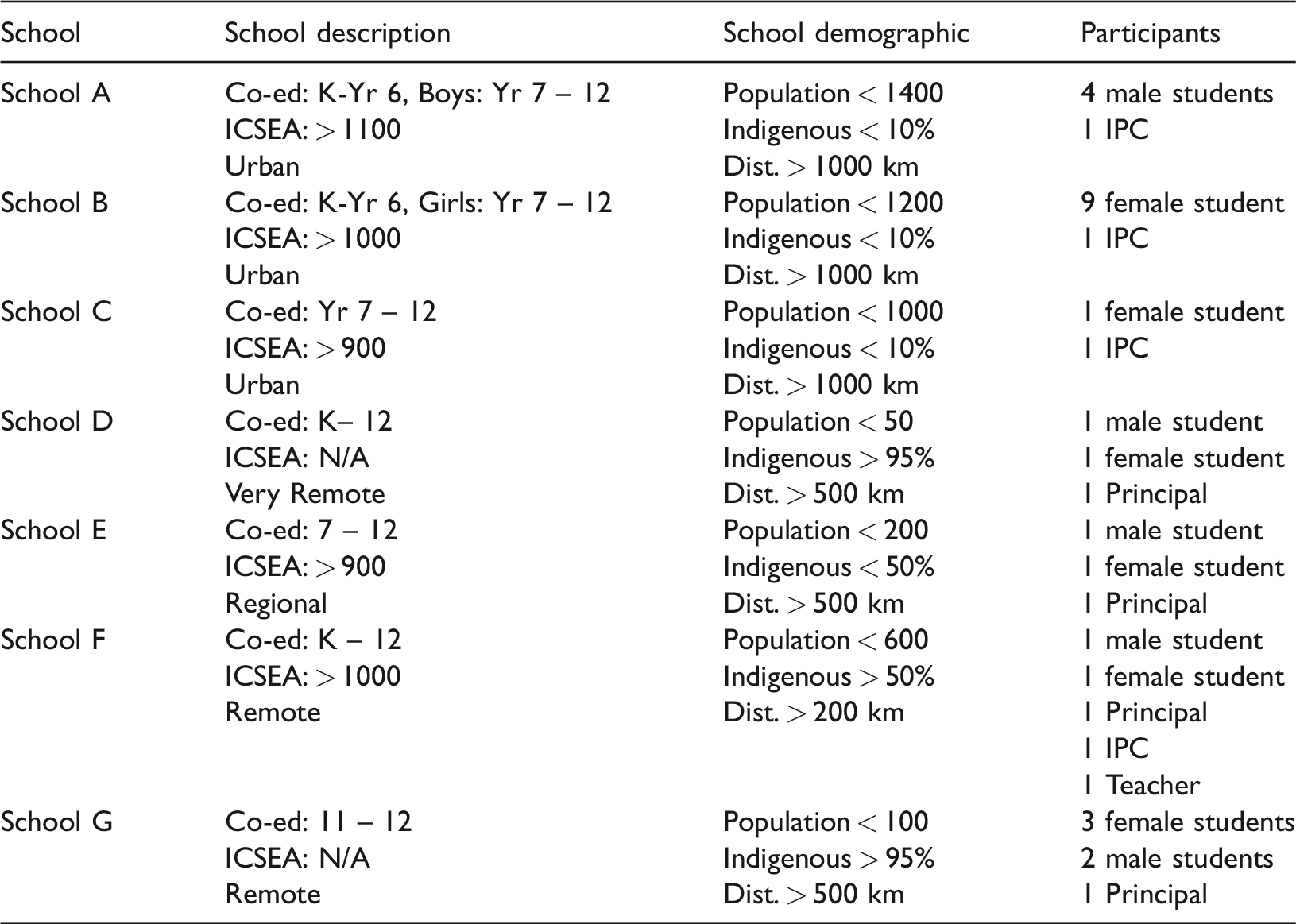
Dist.: average distance between school and home for Indigenous interviewees; ICSEA: the Index of Community Socio-Educational Advantage is a scale created by the Australian Curriculum, Assessment and Reporting Authority (ACARA) to enable comparison between schools of similar socio-economic and educational demographic. The scale follows a normal distribution with a mean of 1000 and a standard deviation of 100); IPC: Indigenous Program Coordinator.
At each school, an individual, in-depth, semi-structured interview of approximately 1 hour was conducted with school staff. The staff sample consisted of one or more school leaders involved in directing Indigenous programs in the school and included four Principals, four Indigenous Program Coordinators (IPC) and one teacher (see Table 1). The school staff self-selected to participate in the study resulting in interviews with seven male non-Indigenous staff and two female Indigenous staff being conducted and recorded.
In addition, 25 Indigenous boarding students were interviewed, 9 males and 16 females, from Year 8 through to Year 12 with the majority in their final 2 years of schooling (M = Yr 11, SD = 1.25). Students were interviewed individually, or with a peer at Schools A, B, and G, where multiple students of the same gender and age were interviewed. The students interviewed were selected to form a purposefully heterogeneous convenience sample reflecting a diverse range of geographic backgrounds, from remote communities and farms to regional towns and urban environments. All students had received an ABSTUDY boarding-related payment, a scholarship, or both.
Ethics approval for the study was obtained from the Edith Cowan University Human Research Ethics Committee, Catholic Education Office, and permission to access schools was obtained from the Association of Independent Schools Western Australia (AISWA). An information letter was sent to school principals, who identified an IPC for participation where appropriate. Parental consent was obtained through introductory letters sent out to students through their school, and informed active consent was provided by the participants themselves.
Analysis
Interviews were transcribed during and immediately after they were conducted, then de-identified. One principal researcher conducted both the field work and the primary thematic analysis to identify emergent themes and subthemes that were significant insights into the participants’ perspectives (Creswell, 2008). Atypically for an IPA analytical approach, a combination of inductive and a priori coding was used to analyse responses after the preliminary exploratory reading of the interview material (Johnson & Christensen, 2012). Where responses contained themes already mentioned in the literature, a priori coding was used to enable the linking of interview responses to previous data. Where respondents raised ideas that had not been identified in the initial literature review an inductive approach was used to generate new codes using emic terminology.
A data display matrix was used to track codes before a hierarchical classification system was applied to link together thematically similar categories of codes that arose across interviews (Creswell, 2008). The analysis followed an iterative process where possible themes were refined by continuous comparison with the full set of transcripts (inter-subject consensus), resulting in a final set of themes that were consistent across the sample. Other themes that emerged intermittently but not consistently across the sample were not included in the final analysis.
Recurring themes were elucidated, described and augmented by additional interpretation by the supervisory team and additional Indigenous academics with expertise in education. This allowed the primary interpretations to be challenged and reviewed. The process involved multiple returns to the interview data, annotation of responses and refinement of coding. The thematic analysis followed a manual coding process with transcripts read and re-read transcripts for common themes.
Limitations
The current study investigates only the immediate and possible future impacts of the boarding school experience on Aboriginal secondary students themselves. Further research could examine whether provision of boarding school scholarships to the most capable students creates ‘brain drain’ and reduced educational resourcing for students who remain in remote areas for their secondary schooling, creating a further social and economic gap within Aboriginal and Torres Strait Islander communities (Mander et al., 2015b). Furthermore, the effects on students’ home communities were outside the scope of the study presented here.
Results and interpretations
Data collection covered a range of topics, including students’ and staff perceptions of the utility of the boarding experience, and the particular factors that impacted students’ engagement and retention decisions. During data analysis, it became apparent that responses regarding the theme Educational Utility of Boarding addressed three subthemes, namely Developing Pathways to Employment, Improving Health Outcomes and Establishing Post-Secondary Transitions (see Table 2). The first and third subtheme were a priori constructs, apparent in the original interview questions. The second theme, Improving Health Outcomes, arose during data collection and analysis as an emergent theme.
Themes and subthemes.
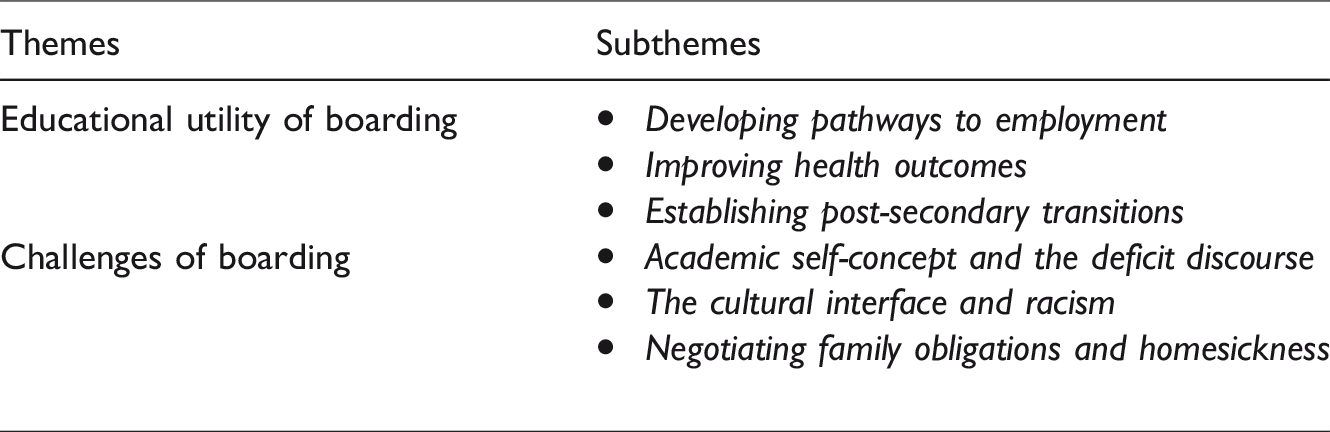
Student responses regarding factors affecting their decisions to remain in boarding education were more diverse. During analysis, it became apparent that Indigenous students faced particular Challenges of Boarding that were either due to, or heightened by, the unique nature of geographic distance and cultural difference. Within the theme Challenges of Boarding, students discussed experiences of Academic Self-Concept and the Deficit Discourse, The Cultural Interface and Racism, and Negotiating Family Obligations and Homesickness (see Table 2).
In the following sections, each theme and subtheme is described and discussed using quotes from participants for illustrative purposes and with reference to the literature.
Educational utility of boarding
The decision to send children for long periods of time to a school away from traditional homelands and often without strong awareness of Aboriginal or Torres Strait Islander culture requires a firm belief in the utility of such education (Bobongie, 2017; Mander, 2015). Students and school leaders expressed a similar hope for the utility of boarding school whereby it would result in positive futures for Aboriginal students from remote and disadvantaged communities. Most students expressed a hope that boarding school would provide opportunities that would allow them to obtain gainful employment. One student explained: I wanted to finish Year 12, make something good out of life… If I had stayed at [town name] I probably would not be at school at all. Yr 12 Indigenous female, School C
Developing pathways to employment
In comparison with smaller district high schools and remote community schools, large schools in urban and regional areas have access to a wide range of opportunities that increase educational utility for secondary students. These include international tours, trips to university campuses, guest speakers from industry, work experience programs, and career weeks that involved students visiting and networking with employers.
The first sub-theme that emerged as a benefit of and reason for choosing to attend boarding school, was access to improved education and career pathways, a finding that was consistent with other recent research (Mander, 2015; O’Bryan, 2016). Within this broad goal, students fell into two categories: those who intended to enter employment or vocational training upon completion of secondary school, and those who planned to go on to tertiary education. Students were asked to discuss the impact that boarding school had on their goals, and self-efficacy.
Creating access to employment and vocational training
Things they teach us here are better ‘cos they teach us about work and you get opportunity to go into town and work. This school they set you up for the future and they set you up with [drivers’] license. Yr 12 Indigenous male, School G
Some schools in this study worked primarily with students from remote communities or from backgrounds of extreme socio-economic disadvantage. Many of these students had peer networks that were not attending school, unemployed and caught up in substance use. In these environments, school leaders had spent time developing curricula and programs that facilitated students’ capacity to create meaningful goals and to be work ready. Typically, such programs included driving license acquisition, literacy and numeracy, computer literacy as well as job readiness ‘soft skills’ for example punctuality and workplace discipline.
The principal at School G, a rural senior secondary campus, had created a program providing all students with the opportunity to obtain a drivers’ license, engage in paid work experience and obtain basic qualifications (Certificate I and II), with the dual purpose of developing students’ self-confidence as well as their capacity to capitalise on work opportunities once they returned home. The school used government grants for scholarships and residential allowances to create a pay-scale for students as they developed work skills from on-site unskilled work through to off-site skilled work. The paid work experience program was intended to allow students to experience the economic value of higher qualifications.
As schools in remote communities are often limited in their ability to provide vocational qualifications students greatly valued the opportunity to attend schools where they could obtain skills that increased their employability. The other place [previous school] only taught about sport and you don’t get money from that. But here [I’m] Working on Business Cert II at the moment, will probably do one more Cert before leaving. Yr 12 Indigenous male, School G
Improving accessibility of further education
Many interviewees attending large urban private schools explained that they had chosen boarding school to obtain a tertiary-focused secondary education. For such students, the higher academic standards and levels of resourcing and support available provided new career aspirations. It was not uncommon for students in this study to state that either they – or a sibling or cousin – would be the first member of their family to complete Year 12. One senior student explained that if he had remained in his hometown he would have ‘dropped out already’, but that meeting successful Aboriginal mentors at his boarding school had led him to aspire to university study: [Because of] people I’ve met, who’ve gotten through universities, you know that you can do something after you finish school; that you’re not gonna be a dropkick for the rest of your life. Yr 12 Indigenous male, School A …as an Indigenous person to graduate, well not many Indigenous people get these opportunities. Yr 12 Indigenous male, School A
Improving health outcomes
During interviews, students emphasised that a second key reason that their parents had sent them to boarding school was to remove them from negative peer networks and potentially dangerous social environments. Statistics show that Indigenous communities experience higher rates of violence, unrest and incarceration than the wider Australian population (ABS, 2015b, 2016), factors which are known to be related to high levels of psychological distress (SCRGSP, 2014). The House of Representatives’ Inquiry into educational opportunities for Aboriginal and Torres Strait Islander Students supports this finding with evidence about the impact of exposure to high rates of anti-social behaviour in some Aboriginal and Torres Strait islander communities on school attendance and student behaviour (2017b).
Within this study, all school Principals and IPCs discussed at length the effect of social trauma on individual students’ mental health, their engagement with education, and their relationships with other students. Some of these students, although removed from previous ‘trouble’, were highly traumatised and now faced the added emotional strain of coping with separation from their family, country, and familiar support networks. All schools focused on developing students’ self-awareness regarding relationships, nutrition, sexual health and mental health. In this regard, there was a clear culture among school leaders of promoting student agency and ability to make healthy decisions, in recognition that students often came from environments where peers struggled with negative lifestyle choices.
In their discussion of Indigenous boarding school, Gillan et al. (2017) infer from a Canadian study on cultural continuity and suicide that the upheaval associated with boarding school puts Australian Indigenous students at ‘an increased risk of self-harm’ (p. 67). This assertion is not supported by formal evidence and does not account for the important role of boarding schools – identified by Indigenous respondents both in this study and that of Rogers (2017) – to provide a safe haven for youth whose family perceive them to be at risk if they remain in dysfunctional communities.
For example, one Aboriginal staff member stated: For some of my [students], I will consider myself a success if they complete Year 12 without getting pregnant, and know how to recognise and avoid bad relationships. Indigenous Program Co-ordinator, School B (School G) made me feel like a changed man, without (School G) I would be nothing. I want a good reputation and work experience. Yr 12 Indigenous male, School G I am happy to see the kids not graduate if it develops resilience and strength. It is frustrating to see kids expecting welfare and expecting tutors to do their work for them. In these kids’ lives, there is suicide and trauma. I want to build the resilience and independence; coping mechanisms. Indigenous Program Coordinator, School A
Establishing post-secondary transitions
Previous research has acknowledged the challenges posed by geographic distance and connection to country for Indigenous boarding students seeking post-secondary education and employment opportunities (COAG, 2013; Dusseldorp Skills Forum, 2009b). The AIEF Compendium of best practice for achieving successful outcomes with Indigenous students in Australian boarding schools noted that ‘almost no schools have a formalised, in-house, targeted program to assist Indigenous students after Year 12’ (AIEF, 2015, p.103).
At some schools, career counsellors had clearly worked with students to identify appropriate education pathways to enable them to transition to employment when they left the residential school environment. One Year 12 student from Kununurra had a keen interest in becoming an Indigenous Tour Guide at a Kimberley cattle station. The school had helped her arrange work experience there, and was guiding her education choices to enable her to meet her goals. I’ve been at [School G] for one and a half years. First I did Tourism Cert I and now I’m doing Cert II for Outdoor Recreation and Tourism… [This school] has saved my life, and given me an education. I would have had no life and didn’t know what to do… I wasn’t going to school hardly [before enrolling at this school]. Yr 12 Indigenous female, School G The difficulty is, we know once a student leaves [school], there may not be that person available in their new lives who will take a personal interest in mentoring them. That can be where it sometimes breaks down. Some come home to their communities and end up in their old lives, not employed, pregnant, or sometimes worse. Principal, School G
Challenges of boarding
The experience of boarding school is formative for teenagers, and particularly for Aboriginal or Torres Strait Islander students from remote and very remote areas, who typically experience new academic, cultural, social and economic norms (Bobongie, 2017; Mander et al., 2015a; O’Bryan, 2016). These experiences can create dissonance, frustration and culture shock, as well as the opportunity for growth and development. The following section explores these experiences as reported by Aboriginal students, and invites readers to consider possibilities for improvement within current boarding practice and policy.
Academic self-concept and the deficit discourse
Often school leaders in elite schools reported selecting students for scholarships in part because they were relatively academically successful in their home communities. Yet, these students found they were multiple academic years behind their age group benchmark at their new boarding school, a likely outcome of the lower Indigenous literacy and numeracy attainment rates that have been identified in successive Closing the Gap reports (Department of Prime Minister and Cabinet, 2017). During interviews, Indigenous students at ‘elite’ boarding schools spoke of believing a discourse that Indigenous people are unlikely to graduate and unlikely to succeed at tertiary education. My standards of where I wanna be has lowered since I’ve been here (at this boarding school) because of the workload and expectations. It hits you how hard it is to finish Year 12 so I can go to university. When I was in (my home town) and knew I was coming (here) I thought I could do it all. Yr 10 Indigenous female, School B
At three schools, IPCs spoke of their frustration that because of disadvantage in students’ backgrounds, teaching staff believed attendance and Year 12 retention to be sufficient goals for Aboriginal educational success. Such a low benchmark in the current knowledge economy would prevent many Aboriginal and Torres Strait Islander students from achieving financial independence, and likely contribute to generational economic and social disadvantage for Indigenous Australia (The Smith Family, 2014).
Whilst such experiences were commonly reported by students in this study, there were instances of students feeling academically supported, as explained by the following interviewees: The teachers here want you to pass and want to see you achieve your opportunities and they help you achieve your dreams. That is the biggest thing. Yr 12 Indigenous female, School E …they help you with your work and demonstrate what you got to do. They help you with your homework. There are lots of teachers to respect, which makes it a good school. Yr 12 Indigenous female, School F
The cultural interface and racism
Australian schools have come a long way forward in recognising their obligation to Indigenous students through culturally inclusive practices (Bodkin-Andrews & Carlson, 2014), however, contemporary literature reveals that racism and cultural discrimination remain a significant cause of disengagement for Indigenous students in Australian schools (Bobongie, 2017; Bodkin-Andrews & Carlson, 2014; Mander et al., 2015a, 2015b; O’Bryan, 2016).
For those students who have left the communities and towns of remote Western Australia, boarding school in Perth can be the first time they have experienced being an ethnic minority on a daily basis. Typically, urban boarding schools accessed cultural events and experiences such as dance workshops and Indigenous leadership programs to allow their Indigenous students to maintain cultural connection and pride. Certainly, such experiences are a crucial part of building wellbeing and engagement at school, however, they also reflect only the more ‘visible’ aspects of Indigenous culture. In this study, Indigenous students were asked: Do you think this school is a place that respects Indigenous culture? Can you give some examples to explain your thoughts? Appendix M – Student Interview Schedule I don’t think they do (respect Aboriginal culture) because they correct your English when you speak like where you’re from instead of White English. Yr 9 Indigenous female, School B Kids sometimes are not used to this type of school, trying to sit at the back of the class and work out how each classroom works and how people interact. But the teacher might pressure them to interact. Yr 8 Indigenous female, School B
Where Aboriginal students felt that their culture was respected in the school, they did not attribute this to cultural events such as Acknowledgment of Country or the celebration of NAIDOC and National Reconciliation Week, nor to specific curricula. Rather, Aboriginal students felt respected when teachers allowed them to think and act in Aboriginal ways without being penalised for their differences. This school gives proper respect for Aboriginal culture … ‘cos the teachers and the students understand what it means. Things like respect for elders, don’t talk about certain Aboriginal stuff. Yr 11 Indigenous female, School G
According to the ABS (2016), one third of all Aboriginal and Torres Strait Islander adults 15 years and older reported experiencing racial discrimination. Speaking about their experiences of discrimination and racism in boarding schools, one student had the following to say: I don’t think they know what it feels like to be an Aboriginal but they aren’t racist. Yr 12 Indigenous male, School A
Students also spoke of experiencing overt racism from other students, particularly when they attended schools where Indigenous students were an ethnic minority. Some of the day boys try to joke around but they take it too far sometimes… they do all the stereotype stuff, walk up to you asking for drugs, do accents. Yr 12 Indigenous male, School A Normally they’re like ‘youse get everything, youse don’t have to pay for everything, where we have to work hard’ and that happens quite a bit. Yr 12 Indigenous female, School F the first couple of times you explain it and then you just go yeah well I’m not going to explain if they’re not trying to understand. Yr 12 Indigenous female, School F
Even more disconcertingly, only one of the four school Principals interviewed for this study organically discussed racism as a source of student disenfranchisement with education. That non-Indigenous school leaders still identify socioeconomic and geographic factors affecting Indigenous engagement much more readily than they identify racism and discrimination in the curriculum, in expectations, in understanding of identity, and in student adaptability to school system requirements, highlights the very need for improved cultural competence of school staff that has been argued previously (de Plevitz, 2007; Macdonald, Gringart, & Gray, 2016; O’Bryan, 2016). Such issues are likely to be heightened in urban boarding schools, where the wider school community often has little interaction with Indigenous Australia, or with their Indigenous students’ families and communities (Rogers & Biddle, 2015).
If schools and policymakers believe that disengagement is only due to poverty and social issues in Aboriginal and Torres Strait Islander communities, they are far less likely to address historical abuses in the school curricula, or redress discrimination through deep engagement with Indigenous worldviews in true reconciliation. In this regard, school leaders mirrored an entrenched policy discourse that disregards the impact of past policies in creating Indigenous disadvantage and minimises the importance of culturally reflexive practice (Hogarth, 2017).
Negotiating family obligations and homesickness
A recurring topic in interviews was the contrast between Indigenous and non-Indigenous understandings of family and community. Many students attending boarding school perceived the cultural importance of fulfilling obligations to family not to be well understood or valued by school staff. Secondary students in this study explained that such obligations included funeral planning and attendance, caring for the sick, elderly or children, law business and solving feuds or conflicts.
Previous research has already identified that family obligations contribute to absence from school, or early school leaving, amongst Aboriginal students (Prout, 2009). Such obligations do not necessarily reduce students’ educational aspirations (House of Representatives Standing Committee on Indigenous Affairs, 2017b) but contribute to stress for Aboriginal and Torres Strait Islander boarders in a manner rarely experienced by non-Indigenous boarders (O’Bryan, 2016). One Year 11 student who had been through initiation stated that he would not finish Year 12 if his grandparents died, and was juggling pressure from school staff to engage at school with pressure to assist the family with issues they were facing. This student made a point of emphasising: …teachers just need to understand Aboriginals’ family are the most important people in our life. Yr 12 Indigenous male, School A
Homesickness is a well-documented phenomenon amongst boarding school students across many cultures and is known to be accompanied by greater risk of psychological stress and education disengagement (Fisher, Frazer, & Murray, 1986). In their exhaustive exploration of the predictors of homesickness, van Tilburg and Vingerhoets (2007) identified that linguistic and cultural differences between home and the new location were significant risk factors for increased homesickness, due to their isolating effect on an individual. Hence, homesickness is likely to occur more frequently, and to be more pronounced, for Indigenous boarders than non-Indigenous boarders, as well as for Indigenous boarders who travel to capital cities rather than remain within regional centres, due to the additional effect of absence from one’s country and language group (Bobongie, 2017; Mander et al., 2015b). Whilst this homesickness can increase the difficulty of attending boarding school, amongst the interview sample, Indigenous students reported high levels of in-principle support for education from key family members, even if these family members themselves had not completed schooling. Dad’s been hard on me, would have made sure I graduated. He went to Year 11 and has been employed since then. Yr 11 Indigenous male, School A Please just go back there and make me proud, because I didn’t finish Year 12. Yr 12 Indigenous female, School G Maybe tell them that if your child finishes school they can do a nursing course and be able to give more help when you’re sick than what they can now. Yr 12 Indigenous female, School G
Implications and conclusion
Both school leaders and students ascribed many benefits to the broader range of career development opportunities available at boarding schools. Such opportunities included role models, work experience, drivers’ license training, individualised post-secondary transition plans and university visits. These experiences had the potential to improve social capital for those who came from disadvantaged backgrounds, as well as to increase self-efficacy in students.
Certainly, not all remote Indigenous families wish to send their youth to boarding school and those who do are concerned about attrition (Guenther et al., 2017). Yet, the perception that boarding school has benefits, as evidenced by those Indigenous students and their families who are choosing and remaining within this pathway, should remain an integral consideration of policy discussion.
Students and school leaders in the current study displayed an understanding of the relationships between poverty, social disadvantage and future life outcomes, although this understanding was not necessarily comprehensively enacted by all school staff. School leaders spoke of attempting to improve educational utility through health programs, career education, cultural affirmation and other strategies that focused on student resilience and self-efficacy. Unfortunately, however, It was apparent that some school leaders relied on ‘events’ to promote Indigenous culture, yet remained unaware of institutionalised racism, and ‘white-washed’ curricula, within their schools.
True cultural inclusion needs to address discrimination in the education environment evidenced by low expectations from teachers, lack of respect for cultural protocols, and an epistemologically biased curriculum. Although recent policy documents such as the Western Australian Aboriginal Cultural Standards Framework (Department of Education, 2015) promote cultural competency, schools are not externally evaluated or measured against these competencies. This presents a disjuncture between policy intention and educational reality (Zubrick et al., 2006). Commitment to improving Indigenous education outcomes involves not only a financial obligation but also a willingness to challenge the beliefs at the heart of educator practice. To ensure this occurs, federal and state bodies responsible for boarding education could implement recommendations of the recent Inquiry, such as valuing Indigenous languages as highly as foreign languages within the Australian curriculum, requiring all teachers to receive professional development on the localised history, culture and language of their Indigenous students, and attendance policies that acknowledge the cultural importance of sorry business (House of Representatives Standing Committee into Indigenous Affairs, 2017b).
Few schools in this study had established effective transition strategies for students returning to remote areas upon completion of Year 12. It is recommended that a future focus of funding and policy may address this area to ensure that the benefit of Year 12 completion is not lost for those students who return home to their communities. Where education sectors have programs and policies in place for supporting Indigenous students towards Year 12 completion, but not towards post-secondary qualifications or employment, a significant gap will remain in terms of socioeconomic indicators for Indigenous Australians, and a self-fulfilling lack of aspiration to post-secondary education.
Indigenous students who obtained scholarships to academically ‘elite’ private schools often experienced a diminution of their self-concept and aspirations when they moved into the urban school system. The ability of boarding schools to support students within an academically confronting environment and to promote a positive academic self-concept for Indigenous students, should be explored further, not only as a possible factor in retention rates of Aboriginal and Torres Strait Islander students (Bobongie, 2017; Department of Prime Minister and Cabinet, 2017) but also as part of an evaluation framework to identify successful practice for Indigenous boarding students in secondary school.
It should be noted that two of the three subthemes under Challenges of Boarding addressed in this article, namely Academic Self-Concept and the Deficit Discourse and The Cultural Interface and Racism are not specific to the boarding school environment (Gillan et al., 2017) but are magnified by relocation from a mostly Indigenous, and low socioeconomic, home community to a mostly white and relatively high socioeconomic school. There is undoubted value in the continued provision of scholarships that provide remote Indigenous students access to high-performing urban schools. This is not least because, for some students, regional boarding would not remove them sufficiently far from negative social influences (O’Bryan, 2016), but also, because future social equity requires that high quality education is available to those who can utilise it. Yet, it may also be that some benefits of boarding, such as Developing Pathways to Employment and Improving Health Outcomes can be equally provided in regional centres that allow students to remain closer to family, country and cultural networks. Hence, any National Indigenous Boarding Strategy such as the one proposed by the House of Representatives Standing Committee on Indigenous Affairs (2017b) may do well to identify the resourcing and provisions that are required to promote successful outcomes for Indigenous students in urban, and majority non-Indigenous, boarding schools, separately to the resourcing and provisions required for students attending boarding in regional centres closer to their community.
The current study has shown that while the experience of boarding school contains unique challenges for Indigenous students, there is clear evidence that boarding schools also present valuable opportunities to students from remote towns and communities. The long-term benefits of such education goes beyond Year 12 completion to matters of agency, employability and leadership potential within the Aboriginal and Torres Strait Islander community. We, the educators and policymakers, owe these students the best education possible.
Footnotes
Declaration of conflicting interests
The author(s) declared no potential conflicts of interest with respect to the research, authorship, and/or publication of this article.
Funding
The author(s) received no financial support for the research, authorship, and/or publication of this article.