



Abstract
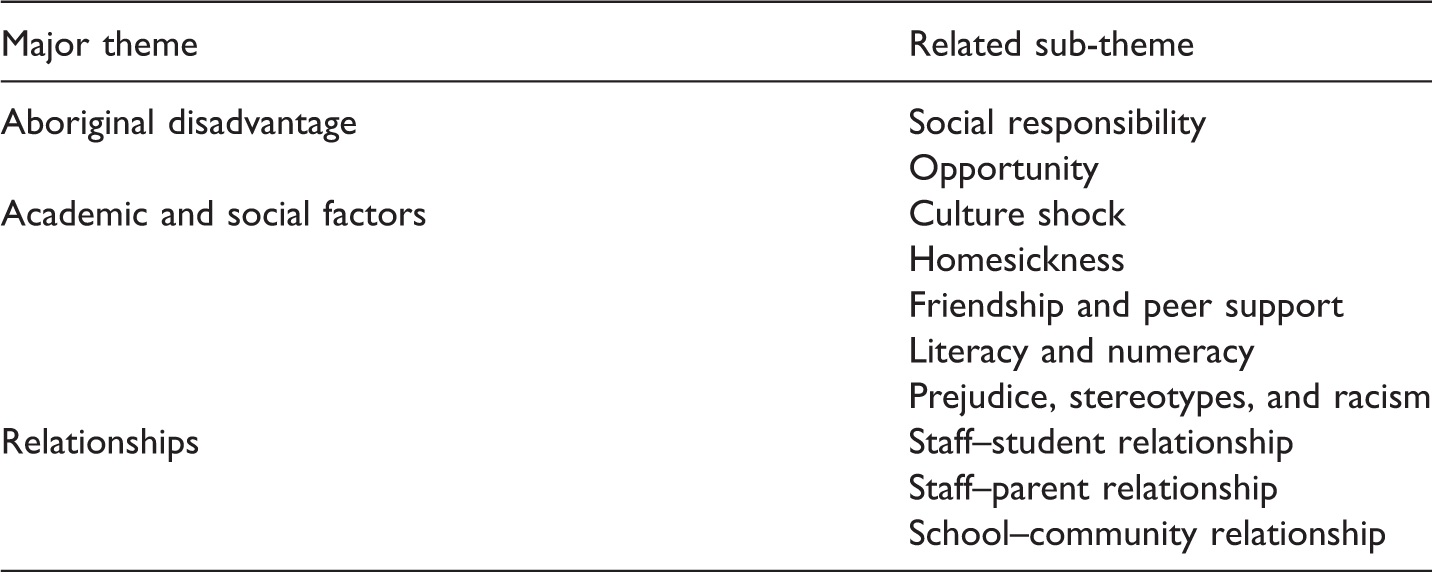
This exploratory study investigated how staff at four private boys’ boarding schools in Perth, Western Australia, constructed meaning and understanding around the experience of studying away from home and family for Aboriginal students from regional and remote communities. Interviews were conducted with 16 participants recruited from the four schools. Three major themes with corresponding sub-themes emerged from the data analysis: (1) Aboriginal Disadvantage and the sub-themes of Social Responsibility and Opportunity, (2) Academic and Social factors and the sub-themes of Culture Shock, Homesickness, Friendships and Peer Support, Literacy and Numeracy, Prejudice, Stereotypes, and Racism and (3) Relationships and the sub-themes of Staff-Student Relationship, Staff-Parent Relationship, and School-Community Relationship. The implications of these findings are discussed and implications for policy and practice are considered.
Introduction
It has been three decades since the 1984 Report of the Committee of Inquiry into Education in Western Australia reported that Aboriginal families across Western Australia (WA) were experiencing undue stress and hardship because of the necessity to send their children away to complete their secondary education elsewhere (Department of Education [DoE], 1984). The inquiry found that it was common for Aboriginal students to be confronted with discriminatory and racist attitudes and that the education system in WA was intolerant of diverse cultural values and ways of learning. Alarmingly, the committee overseeing the inquiry identified that the Department of Education in WA had no policy or public position towards Aboriginal education or a clear vision regarding how to build inclusive practices into schools (DoE, 1984).
Despite a plethora of State and Federal government pledges and departmental policy amendments since 1984, Aboriginal families living in remote communities across WA still have to contend with deteriorating schools and limited access to secondary education (Mander & Fieldhouse, 2009). A situation that has been described as, “a subject high on rhetoric and low on funding … [and that] there are many remote communities across Australia with no reasonable access to secondary education” (Human Rights and Equal Opportunity Commission [HREOC], 2009, p. 142–143). This circumstance has left many Aboriginal parents in WA believing that family relocation or boarding school are the only two viable options to ensure that their children will receive an optimal secondary education experience (Prout, 2008, 2009). Indeed, prominent Australians such as Noel Pearson (Pearson, 2009) and Andrew Forrest (Commonwealth of Australia, 2014) as well as organisations like the Australian Indigenous Education Foundation (AIEF, see http://www.aief.com.au), suggest that boarding schools offer an important and necessary secondary education pathway for Aboriginal families living in remote communities.
Yet, an evaluation of the Cape York Welfare Reform project in Queensland noted that a significant number of Aboriginal and Torres Strait Islander children do not complete successfully their first year of study at boarding school (Commonwealth of Australia, 2012). While it is difficult to extrapolate meaning from data without reference to particular indicators, geographic regions, or groups of people, the Cape York evaluation estimated that only 50% of the 78 high school students in the remote community of Aurukan, for example, were retained by their boarding school (Commonwealth of Australia, 2012).
Graduation from secondary school is an important predictor of future employment and income, health and wellbeing, and life expectancy for Aboriginal young people (Zubrick et al., 2006). The Australian Bureau of Statistics reported that the national retention rate of Aboriginal and Torres Strait Islander students in Grades 7/8 to Grade 12 was 55.1% compared with 82.9% for others students (ABS, 2013). Given this trend, it is not surprising that a substantial body of literature has examined different aspects of the school experience for Aboriginal students to better understand why they remain more likely to disengage with secondary education and leave school early. For example, attitude to school, relationships with teachers and peers, school culture and leadership, curriculum content and relevance, as well as teacher preparedness, expectations and pedagogy are habitual themes in this research (Beresford, Partington, & Gower, 2012). Parental employment and educational attainment (Zubrick et al., 2006), family mobility and wider community factors such as access to resources and services have also been investigated (Prout, 2008, 2009).
Still, these factors do not adequately explain why the 2015 Closing the Gap: Prime Minister’s Report shows that a steep divide remains in reading, writing and numeracy achievement rates for Aboriginal students, but is not evident for non-Aboriginal students, living in remote and very remote communities (Commonwealth of Australia, 2015). Or, why non-Aboriginal students living in remote and very remote communities are performing at a higher level than metropolitan Aboriginal students across Years 3, 5, 7, and 9 for writing and arithmetic. Rather, the 2015 Prime Minister’s report illustrates that no progress has been made between 2008 and 2014 in halving the gap in reading, writing and numeracy for Aboriginal students. Moreover, it concludes that, overall, “most Closing the Gap targets are not on track to be met” (Commonwealth of Australia, 2015, p.1) and acknowledges that these gaps are “much wider in very remote areas than in metropolitan areas” (Commonwealth of Australia, 2015, p. 14).
While not mentioned in the 2015 Prime Minister’s report, discrimination, racism and stereotyping remain as issues that influence Aboriginal students’ aspirations, dreams and goals for their future (Craven et al., 2005). Critical Indigenous theorists and researchers also contend that the ongoing hegemony of Western prejudices not only safeguard the legitimacy and sovereignty of the colonial mind-set (Nakata, Nakata, Keech, & Bolt, 2012), but continue to construct and then confine narratives about Aboriginal students to being the problematic other in a seemingly pragmatic and sensible education system (Nakata, 2011). It is argued that this historically layered practice is most clearly demonstrated by the continued lack of Indigenous agency in shaping teacher training programs and in the everyday use of exclusionary Western centric discourse to describe and evaluate the success or failure of Aboriginal students at school (Lea, Wegner, McRae-Williams, Chenhall, & Holmes, 2011). It is this context, which has enabled narratives about absenteeism, truancy and subsequent disengagement with secondary education to be wholly situated within the individual student, and family domain (Beresford, 2012), or – worse – linked these issues to Aboriginality, while insulating educators and schools (Beresford, Partington, & Gower, 2012).
The conscious deconstruction of negative attitudes and discourse in schools toward Aboriginal students as learners remains a contested space (Gollan & Malin, 2012). Whether intentional or not, many studies have reported how prejudice and racism in schools quickly marginalise and alienate Indigenous students (Beresford, 2012; Malin & Maidment, 2003). However, little research has explored this issue in terms of secondary boarding schools in Australia (Stewart, 2015). In 2010, Centrelink estimated that nationally 4165 students accessed the Schools Fees Allowance (Boarding) Supplement administered by the Aboriginal and Torres Strait Islander means-tested Student Assistance Scheme (ABSTUDY) and were completing their secondary education away from home at a boarding school (A. Davila, personal communication, October 11, 2010). Like all parents, Aboriginal parents place great importance on the education of their children (Lette, D’Espaignet, Slack-Smith, Hunt, & Nannup, 2009) and have high expectations of the boarding schools their children attend (Mander, in press). Yet, very little empirical research explores how teachers’ at boarding schools understand and construct meaning around the experiences by Aboriginal students of schooling away from home and family.
Purpose of the study
This study explores the perceptions of staff at four private boys’ boarding schools in Perth, Western Australia, about the transition experience to boarding school for Aboriginal students. The findings in this study are from a larger doctoral research project conducted by the principle author (Mander, 2012) and congruent with the National Health and Medical Research Council guidelines (NHMRC, 2003) it was undertaken in collaboration with an Aboriginal Advisory Group. The Advisory group emphasised that Aboriginal young people place a strong sense of importance on observing cultural gender roles and given the gender of the researcher being male, a consensus was reached that it was more suitable to focus on the experiences of male Aboriginal students.
Method
A phenomenological ontology (Liamputtong & Ezzy, 2005), social constructionist epistemology (Gergen, 2011) and narrative methodology (Riessman, 2008) were used to explore how participants constructed meaning and understanding about Aboriginal students experiences at boarding school.
Participants
Participant information.
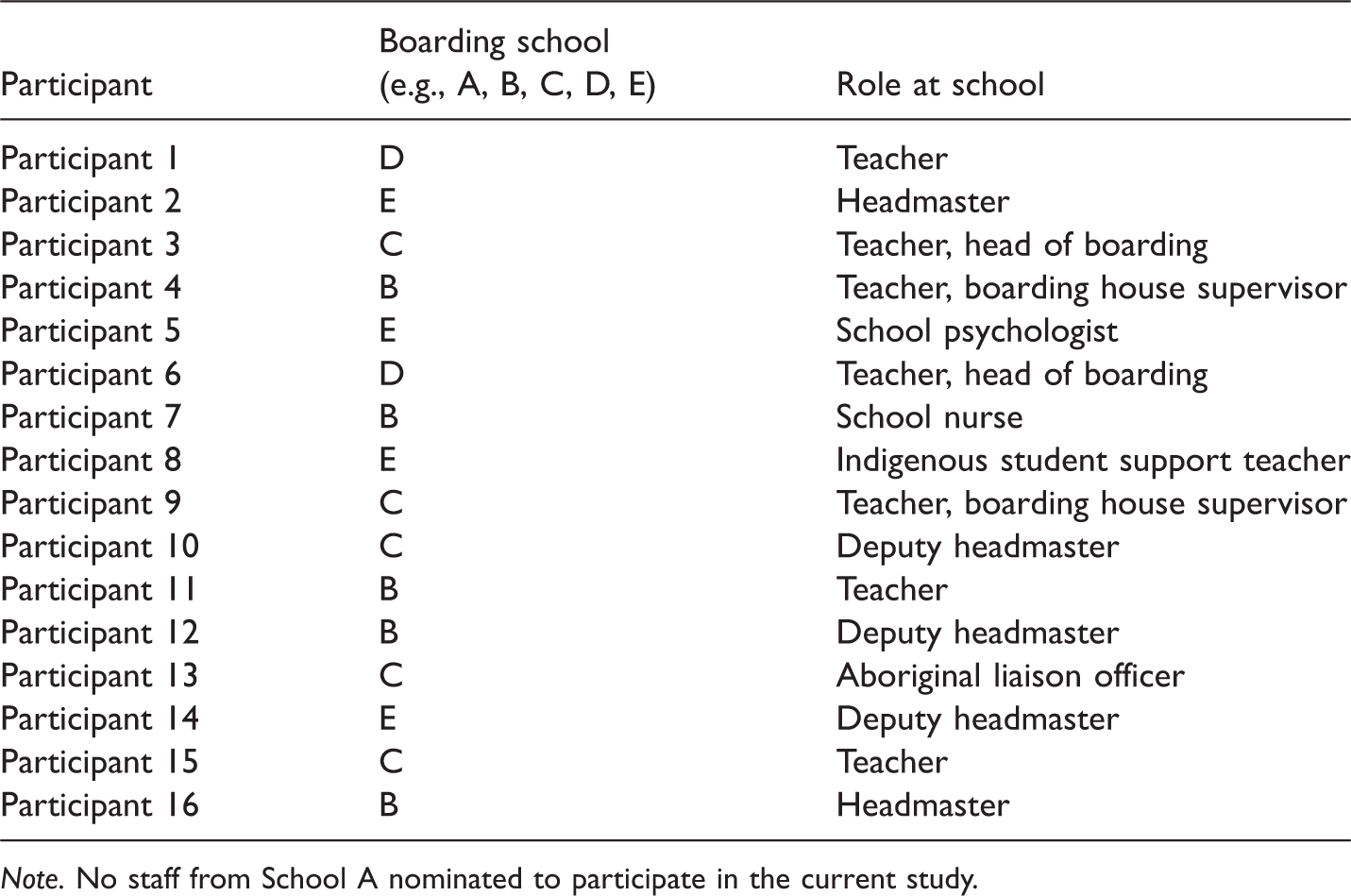
Note. No staff from School A nominated to participate in the current study.
Procedure
School information.
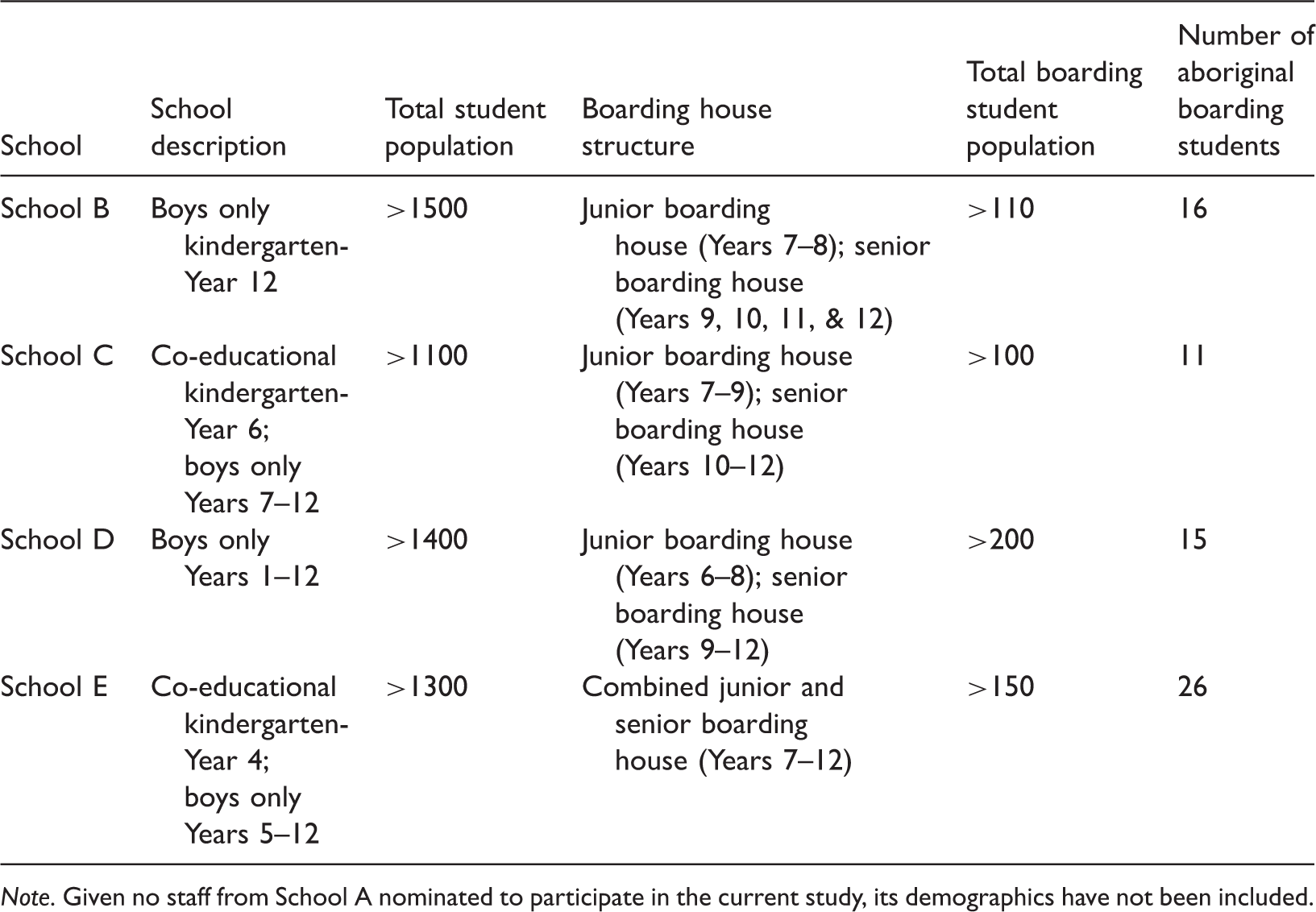
Note. Given no staff from School A nominated to participate in the current study, its demographics have not been included.
Participants were recruited via an information letter to all Indigenous boarding students in the five schools. The researcher only made contact with those participants who expressed an interest in contributing to the research and all interviewing took place on school grounds at a date, time, and location of their choice. Interviews ranged in length from 60 to 120 minutes in duration. Prior to commencing an interview, all participants signed a consent form. A narrative interviewing approach was used (Riessman, 2008). Social inquiry framed around predetermined checklists, forced-choice responses or closed-ended questioning, can sometimes only elicit superficial responses from individuals (Howitt, 2013), whereas narrative inquiry has been described as exploring social phenomena in terms of the experiences that hold meaning for individuals and help them to make sense of human behaviour (Mankowski & Rappaport, 2000). Narrative interviewing facilitated for participants control of the dialogic space shared with the researcher and provided the opportunity for them to make autonomous choices about the nature and type of knowledge they wished to share (Powell & Snow, 2007).
Limitations
The gender imbalance of the participants interviewed for this study (i.e. three females and 13 males) as well as the cross-sectional nature of data collection means certain limitations exist regarding the generalisability of the findings. In addition, the boarding schools involved were all high socio economic status schools and it is also possible that the participant sample was highly motivated as they had a vested interest in the research topic. Hence, it would be important for future research to consider the views and perceptions of others. To this end, future research could assess the applicability and utility of the current findings in terms of other boarding schools including boarding schools with female students and be considered in other State and Territory education systems across Australia.
Data analysis
Transcription was done as soon as practically possible after an interview was conducted. Interviews were transcribed verbatim and systematically de-identified. Thematic analysis was used to analyse the data collected. Thematic analysis is commonly used in conjunction with narrative inquiry (Riessman, 2008) and has been described as a systematic way to identify, order, and analyse patterns of meaning within qualitative datasets (Braun & Clarke, 2006). The researcher generated a list of possible major and sub-themes. Each emergent theme was reiteratively compared and contrasted across all transcripts. A description of each theme was generated and then exemplars from participant transcripts were selected to convey the meaning (Howitt, 2013). Participants used multiple terms to refer to Aboriginal people, including Indigenous and Aboriginal and Torres Strait Islander.
Results
Major themes and related sub-themes.
Aboriginal disadvantage
Participants perceived that Aboriginal students were linked with a wider context of disadvantage. They conveyed how Aboriginal communities in regional and remote areas struggled with a number of socio-economic problems such as poverty, unemployment, gambling, substance use and dependency, as well as with poor housing and overcrowded living conditions. For example, one participant described the sense of hopelessness he perceived when visiting the parents of one Aboriginal boarding student and likened it to, “a refugee situation where they [parents] were pleading with us, please take my boy out of here” (Participant 6). The extent of social-economic disadvantage that participants had witnessed in regional and remote communities of the State, reinforced to many that educational aspirations for Aboriginal students were lower than for non-Aboriginal students in Perth, as one explained: If you go to a town like [name of community] they’re proud of getting attendance rates for Aboriginal kids up to 70% and that sounds great. But when you think that through, that means every two weeks every kid misses three days of school. Here [School D] you cannot get somebody to graduate to Year 12 doing that. All the literature will tell you that those kids whose attendance is under 90% are at risk academically because of how much they simply miss. (Participant 1)
Social responsibility
Several participants reported worrying about the plight (Participant 2) and dilemma (Participant 10) of Indigenous education. Similarly, others described feeling anger (Participant 8) and frustration (Participant 3) at the circumstance whereby Aboriginal students continued to represent the most vulnerable group in the WA education system. Notwithstanding this, given the geographical size of WA, many perceived that boarding schools in Perth were uniquely placed to reach out to Aboriginal families living in regional and remote communities. As one emphasised, “schools like ours has an obligation to ensure we make an effort to engage disadvantaged populations” (Participant 12). These participants believed that boarding schools offered the benefits of well-established residential facilities for students, a diverse range of subjects and academic pathways to select from, as well as access to sporting programs and other co-curricular activities. Many also revealed how their sense of social responsibility embodied a fundamental belief in the benefits of education to empower Aboriginal young people and reported trying to cultivate a school experience that unmasked historical, political, and societal mechanisms of oppression for Aboriginal people. As one participant explained: We’re doing this because I want these boys [Aboriginal students] to go out there and rock the boat and really challenge their oppression. And bring forward the things that their forbearers were doing in the 1960s …I want them [Aboriginal students] to be leaders and be really literate and numerate and be able to speak in public so they can deal with the injustices. (Participant 8)
Opportunity
Participants viewed boarding school as extending an opportunity to Aboriginal students. For example, they asserted, “it’s about giving talented Indigenous boys the opportunity to become talented Indigenous community leaders” (Participant 2); “the family they want to see them take that opportunity and do something positive” (Participant 3); “we’re giving Indigenous boys real opportunities to become leaders not only within our society but also within their own society” (Participant 4); and that, “it’s knowing that these boys [Aboriginal students] have the opportunity to have a different life” (Participant 14). Similarly, the long-term benefits of attending boarding school were perceived as far outweighing the short-term adjustments that Aboriginal students had to make while they studied away from home and family. Notwithstanding this, a few also questioned the notion of opportunity and revealed that they were conflicted by a sense of discomfort with wealthy private boarding schools encouraging Aboriginal children to school away from home. These participants were particularly concerned about the lack of genuine partnership with Aboriginal communities and selective process that underpinned access to their boarding school, as one revealed: This prestigious White school sends people up to choose the best Aboriginal students and then says we will take you. It just seems a bit patronising to me. It should be more about the community choosing who should come down and that we are grateful they have sent us their boys. (Participant 11)
Academic and social factors
Boarding school was seen as presenting a number of academic and social challenges for Aboriginal students from regional and remote communities. Participants described how coping with the expectations and demands of a new boarding school environment, combined with trying to reconcile discrepancies between values and valued aspects of life at home with the operational practices that shape boarding school life, was highly confronting for many Aboriginal boarding students. Nevertheless, several believed that Aboriginal students just needed to learn, adjust and accept the expectations and value system of their respective boarding school. As one participant explained: Some of them [Aboriginal students] struggle with the expectations that we have of them, but it’s about being able to look at those values and say I’ve seen them, they’re real and I need to adjust and align myself with them. Not give up where I come from but just realise that I come from a different value system, into this value system and just switch into that. (Participant 3)
Culture shock
Participants were aware that boarding school involved Aboriginal students adjusting to “a school environment that has a very different value system to what they’re use to” (Participant 3) and negotiating “cultural differences” (Participant 15). Several described this experience as “a culture shock” (Participant 13) and reported how some Aboriginal students experienced a sense of longing for home and family; demonstrated a preoccupation with culture and country; and described how some felt lost, powerless, and isolated. While many were concerned about the impact that culture shock had on Aboriginal students sense of identity and wellbeing, others believed learning how to feel comfortable and negotiate different environments, cultural contexts and social settings was an important life skill offered by boarding schools to Aboriginal students.
Homesickness
Homesickness was perceived as closely linked with culture shock. According to participants, separation from family and extended dislocation from home underpinned the onset of homesickness. Many reported how homesickness was a difficult, hard, and stressful experience for Aboriginal students. Moreover, several indicated feeling surprised by the functional impact that homesickness had and how this in turn caused them to worry about the mental health and wellbeing of some Aboriginal students, as one participant reported: Just the intensity of homesickness; for all intents and purposes during the day [name of student] is achieving well in class, he actually likes it here, he loves the sport, but there is this element in him, that when he gets back to the boarding house he misses home so intensely that it was really quite disturbing at times. (Participant 10) When you take them in at Year 8 they’re all in the same boat and they are lead through the whole process of finding out how they fit in academically, socially, and how to live in boarding, whereas if they come in Years 10, 11 and 12, then it’s very, very difficult. (Participant 1)
Friendships and peer support
Forging strong friendships with same-aged peers was seen as critical to the overall success of Aboriginal boarding students, as one participant reported: The ability to make friends within either the Indigenous or the non-Indigenous boys helps a lot and makes them [Aboriginal boarding students] feel comfortable …If they become isolated or take a long time to come out of their shell, then I think it becomes quite a quick road to home. (Participant 4)
Literacy and numeracy
All participants believed that Aboriginal boarding students “struggled academically” (Participant 1) and “that causes a real dent in their confidence” (Participant 15). Gaps in literacy and numeracy fundamentals, as well as limited familiarity and understanding of key curriculum concepts, caused some to further report, “sometimes their literacy and numeracy is too far behind for them to catch up” (Participant 2). Participants were particularly concerned about the impact this had on how Aboriginal students’ internalised this experience as learners: Academically many of these boys [Aboriginal students] are coming from quite a low base point and if you’re putting them into a mainstream class and their realising they can’t do the work and then dropping them down, dropping them down, it’s not such a good thing for their self-esteem. (Participant 4) Typically with them [Aboriginal students] they will give it up completely. Reject it totally. Now that’s a thing in their culture, if you’re not going to be good at it, or able to do it well, then don’t do it at all. While in our culture most kids will keep on trying. (Participant 1)
Prejudice, stereotypes, and racism
It was evident that Aboriginal boarding students continued to encounter prejudice, stereotypes, and covert racism within their respective school communities. One participant disclosed, “I think there is a lot of covert racism at this school and it has really surprised me at times” (Participant 15). Several described how the individuality of Aboriginal students was often overlooked and how they reacted to ordinary school based events often got constructed instead, in terms of an issue linked with their Aboriginality. This perception was echoed in statements like, “One of the Indigenous boys was late or didn’t show up for an exam and this person was like, oh god these bloody Indigenous kids are not turning up for exams again” (Participant 11). Instances of prejudice, stereotyping, and covert racism were not only reported as discrete or isolated events, but also as stemming from a wider undercurrent of intolerance. This was particularly salient at School E, as at some point each participant either explicitly mentioned or alluded to their awareness of intolerance. For example, the Indigenous Student Support Teacher at School E reported: When [name of student] was abused racially by a teacher, he came to me and said a teacher had said something really inappropriate to him in front of the class and really shamed him out. It was the first time the school had told off a teacher …the teacher had to apologise. I mean racist staff, the ignorance ...that’s probably personally upset me the most. (Participant 8)
The School Psychologist at School E commented: I don’t think that [School E] is a blatantly racist environment but …in saying that, I still see [Aboriginal] students that are angry and aggressive about really explicit instances of racism. And there is still, I’m not sure what the word is for it, hidden, no not hidden, there is still a kind of passive racism that is kind of evident in some of the staff. (Participant 5) I think that we’ve got some older staff that have been here for a long time. They are fairly conservative and right wing you know, I guess they’d almost say why are they [Aboriginal students] getting special treatment? So that’s a challenge for us. (Participant 2)
Relationships
Notwithstanding this, participants emphasised the important role played by establishing positive relationships between staff and students, staff and parents, school and community, and how these are critical to Aboriginal students’ success at school. For example, one emphasised, “I guess what we’ve learnt is how important the family connection is to the success of a student” (Participant 2). In fact, dedicating time and effort to develop, consolidate and maintain relationships was frequently perceived by participants as synonymous with promoting the best possible outcomes for Aboriginal boarding students.
Teacher–student relationship
Participants indicated that it took time to foster a relationship with Aboriginal students, as one explained, “they do develop good relationships with our staff, but it takes time” (Participant 6). Nevertheless, investing time and creating opportunities to building positive relationships was a priority identified by all participants, as several asserted, “I think for Indigenous students they’re more interested in that you care about them as a person rather than their academic outcomes as a student” (Participant 3). While a number of participants explained how, “they’re [Aboriginal students] very shy boys, so getting a conversation happening can take a long time” (Participant 4), most believed that being able to laugh, joke, and “having a good sense of humour” (Participant 16) went a long way to overcoming this initial shyness. Moreover, those participants who demonstrated a respectful interest in culture, family and heritage reported feeling more secure about their relationship with Aboriginal students, as one participant explained: For me the starting point was to try and understand a little bit about who they are, where they come from and what it might be like for them to be in this environment These kids [Aboriginal students] are happy to give knowledge of who they are, where they’re from and a little bit about their culture. (Participant 7)
Teacher–parent relationship
Aboriginal students’ success and sense of wellbeing while at boarding school was seen as closely linked with parental support by participants, as one explained, “I believe with all our boys [Aboriginal students] that family is paramount. And what happens to family affects them” (Participant 13). In addition, all believed effective staff-parent relationships developed when congruency existed between the encouragement Aboriginal students received from home and the support provided at boarding schools. Notwithstanding this, a number of participants perceived that boarding school presented a significant adjustment for Aboriginal parents, as one participant explained, “it’s often a bigger cultural shift for the parents than it is for the students” (Participant 2). Similarly, several believed that navigating a large city-based school campus was a very daunting prospect for some Aboriginal parents. These participants conveyed how travelling to meet parents at home or in their community, was often received well and set the foundation for building a more meaningful connection with Aboriginal parents, emphasising, “you’ve got to go out to those families to say hello, so that parents know who is actually looking after their boy” (Participant 3).
School–community relationship
Participants saw being familiar with the home and community context, as enabling them to form a stronger understanding of the boarding school experience for both Aboriginal parents and students. Several reported that Aboriginal boarding students were seen as positive role models and potential future leaders by their family and in their home community. However, a few participants also believed that dislocation from community sometimes underpinned an element of social division at home for some Aboriginal boarding students. They revealed worrying about the impact this might have on students’ sense of belonging and connectedness with family and friends in their home community. One participant emphasised: They’re often in no-man’s-land these boys [Aboriginal students]. They get the opportunity to come down to the big flash school in Perth and they’ve got to fit in down here, and then go back home to be taunted by some of their peers. You know, oh here they come the boys from the big fancy private school in Perth …So they’re actually losing their connection with their own community. (Participant 7) I think we bring these kids [Aboriginal students] down here, we put them in this uniform, we give them the [name of school B] experience and give them the education, and at the end we say good-bye and push them out. And that’s it. They go home to what? (Participant 11)
Discussion
In many ways it was evident that participants recognised the importance of education to Aboriginal students and their families. They viewed socio-economic disadvantage in regional and remote communities as a complex and multidimensional problem, and emphasised the need for boarding schools to offer an alternative pathway and play a more central role in bridging the gap in educational outcomes for Aboriginal students. Participants were aware that Aboriginal students arrived at boarding school with a rich cultural and linguistic heritage. They also identified the influence of homesickness, culture shock, and low literacy and numeracy as key factors that made the transition to boarding school difficult for Aboriginal students. Similarly, rethinking how boarding schools supported Aboriginal students with the transition into post-school destinations, as well as formed relationships with parents and community, were perceived as areas that required further work.
Yet, despite the best interests of many participants, a highly Western centric view dominated their concerns about readiness for boarding school. Critically, this study also revealed that both overt and subtle incidences of prejudice, stereotypes, and racism were perceived as common. While contemporary research acknowledges the complexity of prejudice, stereotyping, and racism and their changing presentation (Augoustinos, 2013), the shift from overt to more covert forms in relation to Indigenous education has been described as the elephant in the room (Partington & Beresford, 2012). Covert racism bolsters cultural intolerance by perpetuating generalisations and taken-for-granted assumptions. Moreover, it propagates myths that are deeply rooted in social, historical and power inequalities (Dudgeon, Wright, Paradies, Garvey, & Walker, 2014). Complicity with everyday casual racism legitimises discriminatory practices and in the long-term structurally embeds covert racism (Kessaris, 2006). When this is combined with school culture of ambivalence, covert racism can diminish individual and community efforts to embrace diversity, and in turn enable harmful narratives to shape institutional practices, social attitudes and patterns of thinking, while adversely effecting those that are subjected to it (Nakata, 2001).
If boarding schools believe they have a social responsibility to offer an alternative secondary education pathway to families in regional and remote communities, then they must first ensure their schools are safe and inclusive places for Aboriginal students to inhabit. Research suggests that Aboriginal parents believe that sending their children to boarding school not only ensures access to high quality curricular and co-curricular opportunities, but equally that they perceive these schools are founded on strong values that guide behaviour and moral standards (Mander, in press). However, it is long recognised that awareness of discrimination and racism in schools does not necessarily translate into changes in professional practice (DoE, 1984) and having knowledge of Aboriginal cultures does not automatically equate to cultural competency (Gower & Byrne, 2012). Moreover, poor policy and weak leadership in this area will only perpetuate these issues while they continue to take a heavy toll those students that are exposed to them (Craven et al., 2005).
Implications for policy and practice
Aboriginal children have the right to live free from discrimination, to exercise their identity, and to access all forms of education (United Nations, 2008). Commonwealth policy provides a beginning point to reflect on the central role of school leaders in promoting a safe and inclusive school culture. The Aboriginal and Torres Strait Islander Education Action Plan 2010--2014, for example, asserts the importance of: Educational leadership by principals that acknowledge and embrace Aboriginal and Torres Strait Islander leadership is also central to establishing and maintaining cultures of learning that are inclusive of Aboriginal and Torres Strait Islander students and their families and enables and celebrates student achievement. (Ministerial Council for Education, Early Childhood Development and Youth Affairs, [MCEECDYA], 2011, p. 22).
Somewhat surprisingly, the recent compendium of best practice for achieving successful outcomes with Indigenous students in Australian boarding schools published by the AIEF, does not address racism at all (AIEF, 2015). Rather, it refers to challenges and isolated instances of misconceptions and intolerance from staff in boarding schools and suggests that these “generally involve a blurred line between prejudice and misunderstanding” (AIEF, 2015, p. 116). It then suggests, “cultural awareness and professional development can be effective strategies to address these misunderstandings” (AIEF, 2015, p. 116).
Nevertheless, several well-established initiatives can provide boarding schools with a good starting point (Purdie & Buckley, 2010). The Stronger Smarter Leadership Program (SSLP), for example, is an intensive 12-month training schedule that aims to equip both school leaders and teachers with strategies to challenge deficit assumptions about Indigenous students and to equip them with the skills to promote a positive sense of Indigenous identity in their school community (see http://strongersmarter.com.au). A recent evaluation of SSLP suggested that it was successful at increasing teachers’ and leaders’ awareness and knowledge of Indigenous cultures, and the need to embed this into teaching and learning practices (Luke et al., 2013). However, it also found that modes of pedagogy, curriculum program coherence and teacher knowledge remained major impediments (Luke et al., 2013).
The What Works Program offers a three-step model of building awareness, forming partnerships, and working systematically to help schools plan and action steps to improve educational outcomes for Indigenous students (see www.whatworks.edu.au). While What Works has been designed to provide schools with a plethora of case studies and resources, it has not yet been independently evaluated in terms of short or long-term outcomes or efficacy (Purdie & Buckley, 2010).
Lastly, the still to be evaluated Solid Kids, Solid Schools, Solid Families program, is a bullying prevention program that also affirms identity, builds school and teacher capacity to breakdown stereotypes, promotes acceptance of diversity, and highlights the power of school-community partnerships to develop, implement and evaluate efforts to forge better futures for Aboriginal students. At its core is a model of cultural security that asserts awareness and safety are crucial components in promoting a positive school environment with Aboriginal students and parents (see http://www.solidkids.net.au).
Supporting staff to feel confident and effective when engaging with Aboriginal students and parents is central to instilling pedagogical change, building cultural competency and creating a welcoming and inclusive school climate (Gower & Byrne, 2012). Active learning in empathy and reflective practice that is incremental and ongoing are particularly important elements of cultural competency and critical to overcoming ambivalence and resistance to change (Nakata, 2001). Moreover, the current study suggests that making provision for and encouraging staff to dedicate time in and outside of the classroom context to build trusting relationships with Aboriginal students, parents and communities is paramount. With this in mind, embracing policy and practices that strive to prioritise teacher-student, teacher-parent and home-school relationships will further enable staff to move beyond generalisations about Aboriginal students and families.
Footnotes
Declaration of conflicting interests
The author(s) declared no potential conflicts of interest with respect to the research, authorship, and/or publication of this article.
Funding
The author(s) received no financial support for the research, authorship, and/or publication of this article.