




Abstract
In Australia, many students, especially girls, choose not to study advanced mathematics in Year 12 even though their schools offer relevant subjects. Previous studies have rarely examined, using nationally representative samples of Australian students, the extent to which teenage educational experiences and occupational expectations influence gender differences in later pursuits of advanced mathematics subjects. To fill this gap, I use multilevel logistic regression models to analyse the data from the 2003 cohort of the Longitudinal Survey of Australian Youth. My results show that students’ mathematics achievement, occupational expectations and self-assessed mathematical competence are crucial in explaining why boys are considerably more likely than girls to enrol in advanced mathematics subjects. The gender gap would decrease greatly if girls were as likely as boys to perform well in mathematics, to aspire to mathematically intensive careers and to have more confidence in their mathematical abilities when they were 15 years old.
Keywords
Introduction
In Australia, the gender gap in education has reversed with women now outnumbering men in tertiary education (Marks & McMillan, 2007; Marks, McMillan, & Ainley, 2004), but Australian education continues to be strongly segregated by gender (Bell, 2010). For the past three decades, adolescent boys have been more likely than girls to enrol in the highest level of school mathematics that involves calculus (Kennedy, Lyons, & Quinn, 2014). Many universities in Australia do not require advanced mathematics subjects in Year 12 as a prerequisite for admission to mathematics-intensive programs, which encompass engineering, information technology and the physical sciences. However, advanced mathematics subjects act as a critical filter of intentions to study and engage with those degree programs (Ainley, Kos, & Nicholas, 2008; Varsavsky, 2010). They also provide students with sound preparation for tertiary education that involves calculus (Barrington & Brown, 2005; Fullarton, Walker, Ainley, & Hillman, 2003). Nevertheless, many high school students, especially girls, choose not to study advanced mathematics even though their schools offer relevant subjects. The questions that require answers are how and why gender continues to act as a catalyst for the engagement with or withdrawal from advanced mathematics.
Previous studies have rarely used nationally representative samples of Australian students to examine the extent to which early educational experiences and occupational expectations influence the decisions of adolescent boys and girls to engage in advanced high school mathematics. Previous Australian studies often analysed samples from specific cities and regions (Cox, Leder, & Forgasz, 2004; Lamb, 1996, 1997; Watt, 2005, 2006). Therefore, in the study reported in this article, nationwide data are used to examine how teenage educational experiences and occupational expectations shape the choice of advanced high school mathematics.
A comprehensive analysis of the factors that affect students’ engagement in advanced mathematics calls for high-quality data that do not only represent the entire cohort of young Australians but also account for the dynamics of their educational experiences and occupational expectations. To this end, data are analysed from the 2003 cohort of the nationally representative Longitudinal Survey of Australian Youth (LSAY), also known as Y03 (National Centre for Vocational Education Research [NCVER], 2011). This cohort reached age 15 around 2003 and entered the labour market in the decade that followed. Starting with observations of the young people from the age of 15 and describing their mathematics achievement, occupational expectations and self-assessed mathematical competence at that time, the current study seeks to explain the gender gap in advanced mathematics enrolment in Year 12.
Background
Stereotypical beliefs about innate gender differences and mathematics
Australian students’ decisions to study advanced mathematics are strongly affected by the gender essentialist ideology and self-expressive values, as suggested by the theory of gender essentialism (Charles & Bradley, 2009). The gender essentialist ideology involves the widely shared stereotypical beliefs that males and females are fundamentally and inherently different by nature. These stereotypes, subtly communicated and omnipresent, seep into the minds of young people to facilitate an acceptance of the beliefs that females are naturally good at care and inter-human communication while males excel at abstract problem solving and in technology (Barone, 2011). Meanwhile, mathematics is often viewed as abstract and technical in contrast to the feminine fields which are seen as concrete, social, people-oriented and self-expressive (Charles, Harr, Cech, & Hendley, 2014; Faulkner, 2000; Osborne, Simon, & Collins, 2003). These stereotypical beliefs are reinforced when the culture underscores and legitimises individual self-expression in making educational choices, and therefore adolescents can engage in school subjects that fit in with their gendered identities. Specifically, boys tend to dominate advanced mathematics because they construe advanced mathematics as a means of proving their masculine abilities (Mendick, 2003, 2005b). Girls must negotiate this cultural boundary which makes it harder for them to engage and remain engaged in advanced mathematics, as well as to feel competent and comfortable (Mendick, 2005a).
Recent Australian studies have provided evidence that the stereotypical belief which regards mathematics as a male domain may hinder some girls who are talented in mathematics from pursuing advanced mathematics. One of the studies has shown that over one third of the study participants consider that boys and girls are equally good at mathematics, but those who hold gendered views, which constitute almost half of the participants, tend to believe that boys are better at mathematics (Forgasz & Leder, 2017). Another study of 178 Australian women who graduated secondary school around 2010 or in the 1980s found that they were interested in but eschewed high school mathematics, particularly at the advanced level, because they were not recognised as good enough or appropriate enough to study the subject (Wolfe, in press). Some of them were discouraged by their peers who commented that advanced mathematics was not regarded as a girls’ subject and girls would not perform well.
Gender socialisation in the family
The expectancy value theory suggests, among other things, that gender socialisation in the family may encourage boys to participate in advanced mathematics (Eccles, 2011). Parents may tend to rate highly boys’ mathematical abilities and believe that the study of advanced mathematics is more important to boys than to girls (Eccles & Jacobs, 1986; Eccles, Jacobs, & Harold, 1990; Tiedemann, 2000). Girls are conscious of the lower expectations regarding mathematics learning from their parents and may thus reduce their efforts and aspirations in mathematics (Eccles & Jacobs, 1986; Jacobs & Eccles, 1992).
Earlier Australian studies have shown that students from privileged families, who are likely to attend schools in high socioeconomic communities, tend to enrol in advanced academic subjects which include advanced mathematics (Ainley et al., 2008; Lamb, Hogan, & Johnson, 2001; Teese, 2007). Specifically, the gender gap in advanced mathematics enrolment is possibly smaller among students from high-status families than others from disadvantaged backgrounds because gender socialisation practices in high status families may be more egalitarian. In families of high socioeconomic status, parents are likely to have participated in tertiary education and be employed in professional or managerial occupations. These families also tend to have more cultural resources and material home possessions than families of low socioeconomic status. In Australia, Lamb (1996, 1997) analysed data from a sample of students who attended Years 11 and 12 in four public secondary schools in the metropolitan area of Melbourne during the late 1980s. He found that nearly three decades ago girls were less likely than boys to engage in advanced mathematics. However, the odds of studying advanced mathematics for girls in privileged families were higher than the comparable odds for boys from lower status families. This finding implies that the girls’ disadvantage in advanced mathematics enrolment may differ by the family’s socioeconomic status.
Parental employment in science should be taken into consideration because it is a source of cultural capital that increases children’s engagement in science and possibly mathematics (Sikora, 2014; Sikora & Pokropek, 2012b). In this vein, the gender socialisation hypothesis (Marks, 2008a, 2008b) has been supported in Australia by the study of Sikora and Pokropek (2012b). They show that during the mid-2000s, adolescent children of parents employed in the physical and life sciences were more likely to expect similar careers for themselves. Specifically, boys tended to follow their fathers in aspiring to careers in the physical sciences, whereas girls tended to refer to their mothers in expecting occupations in the life sciences. Studies using the 2006 cohort of LSAY demonstrate that students whose parents were employed in science had a higher chance of taking physical science and life science subjects in Year 12 and engaging in tertiary studies in physical science (Sikora, 2014, 2015).
Gender-typed occupational expectations
Eccles (2011) suggests that one of the two main reasons why girls are less likely to engage in advanced mathematics is that they tend to place less subjective task values on high-level mathematics than they place on other disciplines. Students who place high subjective task values on advanced mathematics tend to show interest in the subject, believe that it is important for them to perform well in the subject, and perceive that the subject is useful for their future.
Subjective task values affect how students develop their occupational expectations which in turn may influence a student’s decision to study advanced mathematics in secondary school (Eccles, 2011). These expectations reflect students’ perceptions of stereotypes regarding mathematics and the gender roles expected of them, as well as opportunities and constraints, which are shaped by socialisation that takes place in the family, school and society.
The gender-typical occupational orientations boys and girls develop at the pre-adolescent stage channel them into different career expectations and preferences at a later stage of life (McMahon & Patton, 1997; Tai, Li, Maltese, & Fan, 2006). In Australia, by the time students reach the end of compulsory education, the gender gap in occupational expectations is strongly pronounced with boys much keener to pursue careers in the mathematics-intensive sciences, whereas girls are more inclined to expect careers in the life sciences (Jerrim & Schoon, 2014; Sikora & Pokropek, 2012a; Watt et al., 2017). The occupational expectations of young people are likely to change during adolescence and early adulthood (Rindfuss, Cooksey, & Sutterlin, 1999). Despite that, an early American study showed that in the long run adolescent boys were more likely than girls to persist in expecting science and engineering careers (Mau, 2003).
Although the gendered patterns of occupational expectations are known, much of the literature overlooked the role of adolescents’ career expectations in educational decisions until recent years. Relevant studies in Australia and the United States have demonstrated that occupational expectations of adolescents explain some of the gender differences in field of study choices at the post-secondary level (Legewie & DiPrete, 2014; Morgan, Gelbgiser, & Weeden, 2013; Sikora, 2014, 2015). Thus far, however, no study has addressed the specific question of how the occupational expectations of boys and girls may affect their decisions to engage in advanced high school mathematics in Australia.
Gender-biased self-assessment of mathematical competence
From a rational choice perspective, one may argue that boys are more likely to pursue high-level mathematics because they outperform girls in mathematics but lag behind girls in verbal skills (Jonsson, 1999; Van de Werfhorst, Sullivan, & Cheung, 2003). Previous research, however, has pointed out that students who perform well but perceive that they are incompetent in mathematics often opt out of mathematics in their educational careers (Correll, 2001).
Gender socialisation affects students’ perceptions of their own abilities in mathematics, which is also known as mathematics self-concept (Eccles, 2011). The stereotypical belief that mathematics is masculine and more appropriate for males may enhance the confidence of males while increasing females’ anxiety (Niederle & Vesterlund, 2010; Spencer, Steele, & Quinn, 1999; Steele, 1997). Even when boys and girls perform equally well in mathematics, boys tend to have higher self-concept in the subject (Wilkins, 2004). In Australia, the gender gap in mathematics self-concept has remained stable over the last two decades (Parker, Van Zanden, & Parker, 2018).
Eccles (2011) suggests that such a gender gap is another important reason why girls have a lower chance of engaging in advanced high school mathematics. When girls have lower self-concept in mathematics, they are more likely than boys to reduce their efforts and interests in high-level mathematics and associated fields of study and occupations (Correll, 2001). During the early 1990s in the United States, boys were more likely than girls to study calculus in high school partly because boys had higher self-concept in mathematics (Correll, 2001). The same was true during the mid-2000s in Australia where boys had a higher chance of enrolling in more complex mathematics subjects in Years 11 and 12 partially because they held higher self-concept in mathematics (Guo, Parker, Marsh, & Morin, 2015). These studies suggest that mathematics self-concept, rather than mathematics achievement, is the crucial factor that discourages girls from participating in advanced mathematics.
Research question
The research question addressed in this article seeks to understand the extent to which the gender gap in the choice of advanced high school mathematics is related to occupational expectations and mathematics self-concept discussed above:
To what extent do students’ career expectations contribute to explaining the gender gap in studying advanced mathematics in Year 12?
Data
The LSAY Y03 data set was built on the Australian sample from the Programme for International Student Assessment (PISA) 2003 of the Organisation for Economic Co-operation and Development (OECD, 2005). The primary focus of PISA 2003 was an assessment of mathematical literacy. A total of 10,370 Australian students who participated in the 2003 cycle of PISA were included in Y03.
While PISA contains contextual background information and educational achievement data from participating students and schools, Y03 extends the PISA survey among other things by collecting information about students’ educational and occupational experiences annually until 2013. Data from more recent cohorts of LSAY (2006, 2009 and 2015) do not provide as comprehensive information on students’ mathematics learning as the 2003 data because their foci were on science or reading. For PISA 2012, which did have a focus on mathematics, data could not be linked to an LSAY cohort as none was started that year.
The information about student subject choices in Y03 was collected between 2003 and 2006 when most participants were attending secondary school. Due to the PISA sample design, the Y03 sample is age-based and most 15-year-old students were attending Year 10 in 2003 while some were attending other grade levels. The information about actual subject choice in Year 12 was obtained from 14 students in 2003, 1446 students in 2004, 4814 students in 2005 and 486 students in 2006. Therefore, the resulting pooled sample for the analysis of mathematics subjects comprises 6760 Year 12 students. 1 This sample contains participants who reached Year 12 between 2003 and 2006 and therefore does not encompass participants who did not reach Year 12 in those years or who withdrew from Y03 before they reached Year 12. This sample is balanced in terms of gender with 51.8 per cent girls and 48.2 per cent boys which is comparable to the total Y03 sample which consisted of 50.8 per cent of girls and 49.2 per cent of boys in the 10,370 participants at the time of the 2003 PISA data collection albeit indicating a slightly greater attrition from the sample of boys than girls.
Method
Dependent variable: Advanced mathematics subjects in Year 12
The dependent variable refers to students’ enrolment in at least one advanced mathematics subject in Year 12. Every Australian state and territory adopts its own subject labels with different curriculum content (Ainley et al., 2008). Nevertheless, across all states and territories, advanced mathematics subjects contain significant calculus content which prepares Year 12 students for further education in the mathematics-intensive sciences (Barrington & Brown, 2005; Fullarton et al., 2003). Table 1 lists all the subjects which have been categorised by Ainley et al. (2008, pp. 26–28) as advanced mathematics between 2003 and 2006, that is, in the time period in which the Y03 cohort was attending Year 12.
Advanced mathematics subjects in Year 12 by state and territory (2003–2006).
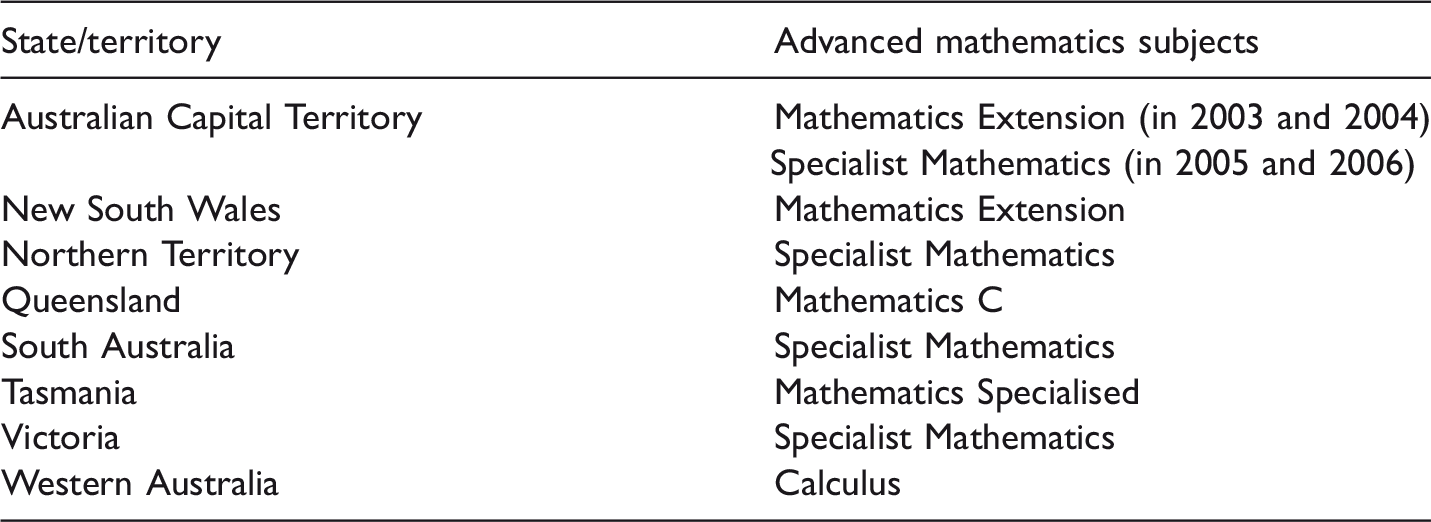
Note: This coding is based on the curriculum contents rather than the name of the subject.
Source: Ainley et al. (2008); Y03.
Key independent variables
The analysis focuses on examining how teenage occupational expectations and educational experiences may affect the decisions of boys and girls to enrol in high-level mathematics. To this end, the following student characteristics at age 15 were used as the independent variables:
Female
The focal independent variable is gender (female) where ‘1’ denotes females and ‘0’ denotes males.
Mathematics achievement
Australian research has demonstrated that students with higher levels of prior achievement in mathematics have a considerably greater chance of engaging in advanced mathematics (Fullarton et al., 2003; Watt, 2006). In addition, previous studies in Australia and many other countries have shown that boys have a greater advantage in mathematics performance at the high end of the achievement distribution than at the mean (Forgasz & Hill, 2013; Stoet & Geary, 2013; Wai, Cacchio, Putallaz, & Makel, 2010). Using the pooled sample, the relationship was explored between the five plausible values that capture students’ numeracy at age 15 provided by PISA 2003 (OECD, 2005) and students’ engagement in advanced mathematics by graphing the students’ predicted probabilities of choosing advanced mathematics across the achievement distribution (see Appendix 1). The graphs suggest that the probability of enrolling in advanced mathematics is non-linear with respect to achievement below approximately the 75th percentile of the distribution, but linear with respect to achievement above the 75th percentile. As a linear measure of mathematics achievement does not allow for different slopes across the distribution, a variable was created based on the achievement distribution with a ‘1’ indicating a student achieved the 75th percentile and a ‘0’ indicating a student scored below the 75th percentile.
Occupational expectations – Expected a mathematics-intensive career
In PISA 2003, students were asked what occupations they expected to have when they are about 30 years old (OECD, 2005). The responses were coded to four-digit International Standard Classification of Occupations (ISCO-88) codes (International Labour Office [ILO], 1990). For the purposes of the current analyses a variable was created based on these codes with a ‘1’ indicating a student expecting a mathematics-intensive occupation and a ‘0’ to other codes. Examples of such occupations include architects, computer programmers, engineers, mathematicians, physicists and statisticians (see Appendix 2).
Mathematics self-concept
In PISA 2003, students responded to five items on mathematics self-concept that were presented with a 4-point Likert-type response options of ‘(1) strongly agree’, ‘(2) agree’, ‘(3) disagree’ and ‘(4) strongly disagree’. The actual items were: ‘I am just not good at mathematics’, ‘I get good marks in mathematics’, ‘I learn mathematics quickly’, ‘I have always believed that mathematics is one of my best subjects’ and ‘In my mathematics class, I understand even the most difficult work’. Based on these items, the OECD constructed the PISA index of mathematics self-concept using item response theory (IRT) scaling and the last four items were inverted for scaling (OECD, 2005). Higher values indicate more positive self-concept in mathematics. In Australia, Cronbach’s alpha for this scale is 0.89 (OECD, 2005). The results of the factor analyses (see Appendix 3) suggested the unidimensionality of the items and hence supported the inclusion of the PISA index of mathematics self-concept instead of including the five items separately.
Key control variables
Family’s socioeconomic status
The socioeconomic status of a student’s family was controlled for in the analyses by including the PISA index of economic, social and cultural status (ESCS, OECD 2005). This index was derived from three variables related to students’ family background at age 15, namely the highest educational level of either parent, the highest occupational status of either parent and the number of home possessions consisting of cultural possessions, computer facilities and educational resources at home. The index was standardised to a mean of 0 and a standard deviation of 1 across the member countries of the OECD that participated in PISA 2003 with larger values indicating higher socioeconomic status. In Australia, Cronbach’s alpha for this index was 0.61 (OECD, 2005).
Parental employment in science
In PISA 2003, students labelled and described their parents’ occupations (OECD, 2005). The responses were coded to four-digit ISCO-88 codes (ILO, 1990). Appendix 2 lists the science occupations.
Use of weights to adjust for the sampling design of Y03
Applying appropriate weights when analysing Y03 data is necessary to account not only for the two-stage stratified sampling of PISA but also for the attrition of respondents in each subsequent follow-up survey of Y03 (Lim, 2011). As the PISA 2003 and Y03 samples are age-based, students of the same age attended different grade levels.
As the information about students’ enrolment in Year 12 advanced mathematics was obtained between 2003 and 2006, neither the PISA nor LSAY weights, which were wave-specific, were suitable for the analysis of the pooled sample. To obtain unbiased estimates, the best procedure was to follow the strategy suggested in the LSAY technical report (Lim, 2011). More specifically, this meant that in the descriptive statistics and in the multilevel analysis, all variables that were used to construct the LSAY weights were included as control variables. At the school level, these control variables were state or territory in which the schools were located and the school sector (Catholic, independent and government). At the student level, two control variables were included, namely family structure – denoted by an indicator of whether a family takes a nuclear one or some other form, such as a single-parent family – and students’ immigration status that distinguished between Australians born to Australian parents and those born to foreign parents.
Multilevel logistic regressions and predicted probabilities
The Y03 data are clustered by school and hence the correct procedure is to take this sampling design into account. One may draw incorrect conclusions from the results of analysis if the variability between schools is not distinguished in the analysis (Snijders & Bosker, 2012). Therefore, two-level logistic regression models were used in the analyses reported here with student- and school-level variables of the following form:

The odds ratios from logistic regression models were converted to the mean predicted probabilities of boys and girls studying advanced mathematics. Odds ratios are sensitive to differences in unobserved heterogeneity and they reflect not only the differences in effects but also the degree of unobserved heterogeneity in the model (Mood, 2010). 2 By contrast, the predicted probabilities derived from logistic regression models are not affected by omitted variables, and therefore the predicted probabilities can legitimately be compared between different models and conclusions be derived from them.
Results
The results section below is structured as follows. First, an overview of the gender gap in advanced mathematics enrolment across states and territories is presented. Then, descriptive statistics illustrated the gender differences of the variables in the analyses. These descriptive statistics reveal the extent to which adolescent boys and girls differ in their mathematics achievement, occupational expectations and self-concept in mathematics. Finally, results of the multilevel analysis of the relationships between all these factors and enrolment in mathematics-intensive courses at Year 12 are presented.
How many boys and girls study advanced mathematics in Year 12?
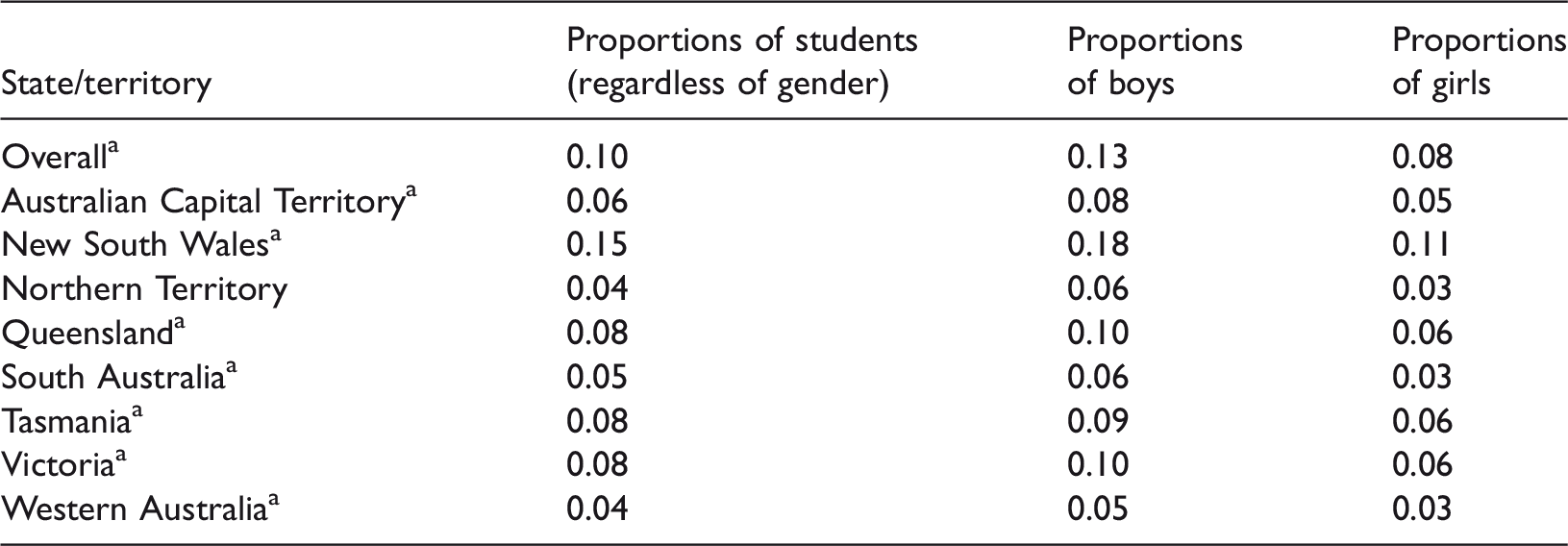
The second column of Table 2 shows the proportions of students enrolling in advanced mathematics between 2003 and 2006. Overall, 10 per cent of students took advanced mathematics. New South Wales recorded the highest enrolment rate (15 per cent). In Queensland, Tasmania and Victoria, about 8 per cent of students studied advanced mathematics with the corresponding proportions reported for the Australian Capital Territory, the Northern Territory and Western Australia, of about 4 to 6 per cent. These figures are comparable to, although in general slightly lower than, the percentage of Year 12 students participating in advanced mathematics between 2003 and 2006 reported by Ainley et al. (2008, p. 26). The lower percentages obtained from the pooled sample are possibly due to the attrition of participants from follow-up surveys of Y03.
Advanced mathematics enrolment in Year 12 by state and territory (2003–2006).
Note: This table contains weighted estimates. The sample for this analysis contains a total of 6760 students.
aIndicates that the difference between boys and girls in advanced mathematics enrolment is statistically significant at p < 0.05.
Source: Y03.
The last two columns of Table 2 present the gender gap in advanced mathematics enrolment. On the whole, while 13 per cent of boys study advanced mathematics, only 8 per cent of girls enrol in the subject. Such a gender gap appears to be small, but in fact the odds of taking up advanced mathematics for girls is only about 62 per cent for the comparable odds for boys. In other words, the girls’ relative disadvantage in advanced mathematics enrolment is large. The gender gap is smallest in Western Australia (2 per cent), whereas the gender gap is the largest in New South Wales (7 per cent). The gender gap is statistically significant in all states and territories except for the Northern Territory.
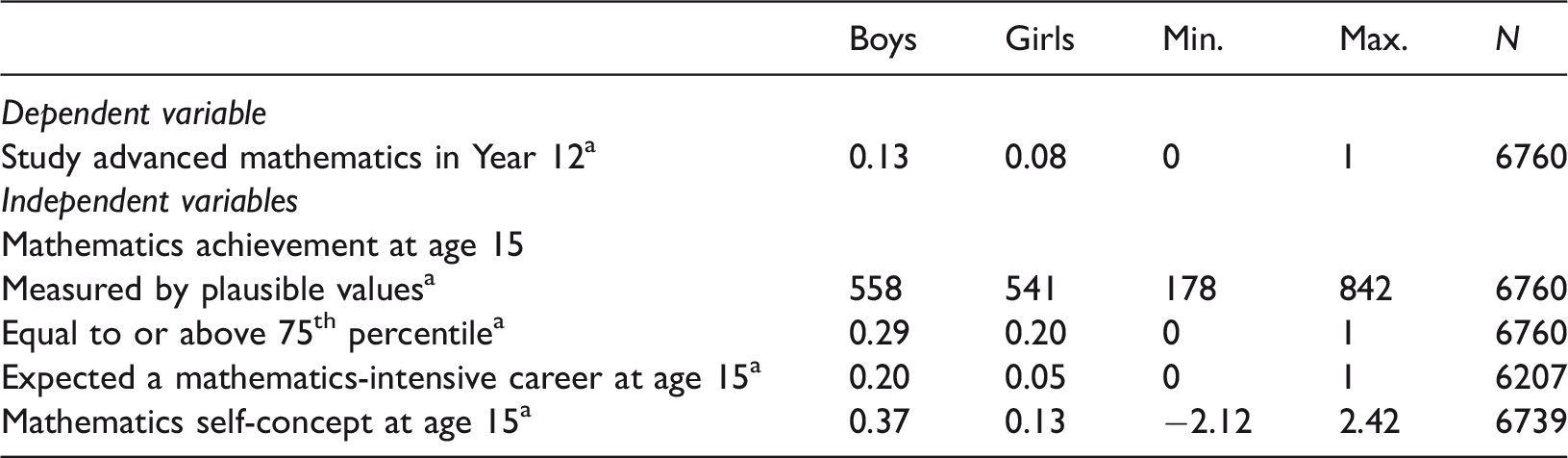
Table 3 shows that the gender gap in advanced mathematics enrolment may be associated with the differentials in prior mathematics achievement at age 15 as boys perform better than girls in mathematics, even if this advantage is small. While 29 per cent of boys reached the 75th percentile of the achievement distribution, only 20 per cent of girls reached the same level.
Student characteristics by gender: proportions and means.
Note: This table contains weighted estimates before multiple imputations of missing data.
aIndicates that the difference between boys and girls in that variable is statistically significant at p < 0.05.
Source: Y03.
In addition, a striking gender difference in occupational expectations can be noted: 20 per cent of boys expected a mathematics-intensive career when they were 15 years old, whereas only five per cent of girls expected such a career. Boys had considerably higher self-concept in mathematics than girls, which attests to the existence of gendered constraints affecting self-assessed mathematical abilities.
Multilevel models
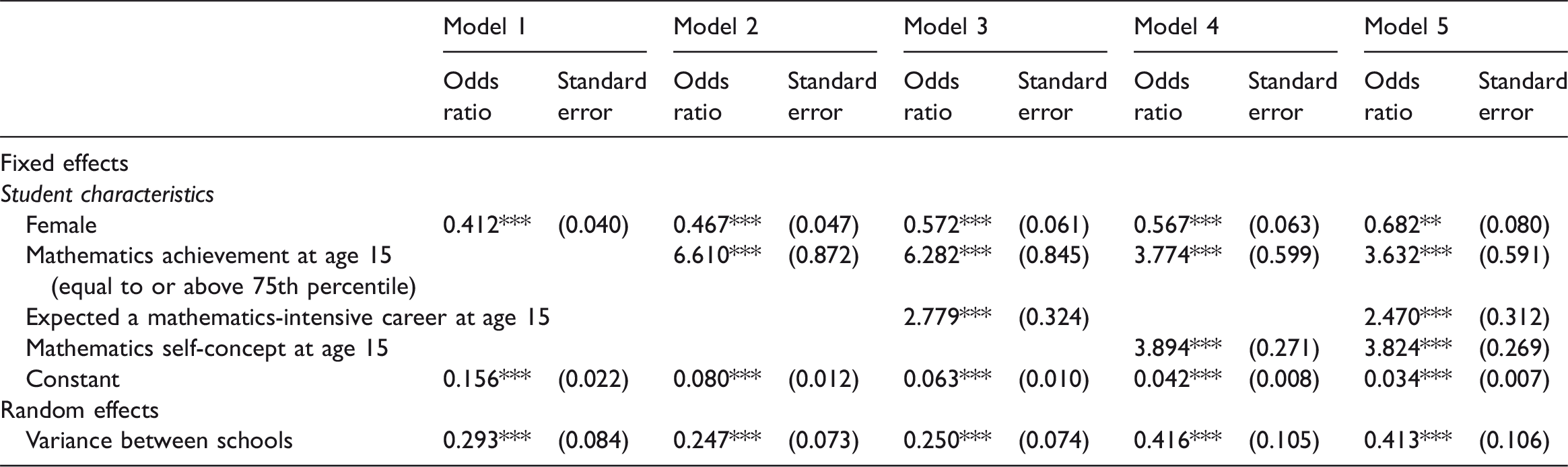
To examine the extent to which occupational expectations and educational experiences at age 15 affect the gender gap in advanced mathematics enrolment in Year 12, five models were estimated and results are presented in Table 4. All models were nested with a view to first considering the overall size of the gender gap controlling for students’ family socioeconomic status and parental employment in science (Model 1). The aim was to assess whether higher socioeconomic status and parental employment in science raised students’ likelihood of studying advanced mathematics. The same model, included all variables which were used to construct the LSAY weights as controls except for students’ mathematics achievement. Then students’ mathematics achievement was added to investigate its influence on the gender gap (Model 2). To examine the effect of occupational expectations and mathematics self-concept on the gender gap irrespective of mathematics achievement, students’ occupational expectations were added to Model 3 and mathematics self-concept to Model 4 respectively. Finally, students’ occupational expectations and mathematics self-concept together were added to Model 5.
Odds ratios from multilevel logit models for studying advanced mathematics in Year 12.
Note: The sample for this multilevel analysis contains 6760 students in 314 schools with multiple imputations of missing data.
**p < 0.01. ***p < 0.001.
Model 1: Female + Family’s socioeconomic status + Parental employment in science.
Model 2: Model 1 + Mathematics achievement at age 15.
Model 3: Model 2 + Expected a mathematics-intensive career at age 15.
Model 4: Model 2 + Mathematics self-concept at age 15.
Model 5: Model 2 + Expected a mathematics-intensive career at age 15 + Mathematics self-concept at age 15.
I do not present the odds ratios of students’ family socioeconomic status and parental employment in science because they are not the focus of this study. With the inclusion of these two predictors, in Model 1 students who come from high-status families and those who have parents employed in science fields have a higher chance of studying advanced mathematics. All analyses were undertaken using appropriate weights (as described in the main text in the methods section). The odds ratios of all independent variables are available upon request.
Source: Y03.
How do students’ mathematics achievement, occupational expectations and self-assessed competence in mathematics at age 15 affect the gender gap in advanced mathematics enrolment?
Figure 1 demonstrates that students’ prior mathematics achievement explains some of the gender gap in advanced mathematics enrolment. Compared to Model 1, adding students’ mathematics achievement at age 15 to Model 2 reduces the gender gap in advanced mathematics enrolment from 6.6 percentage points to 4.6 percentage points.
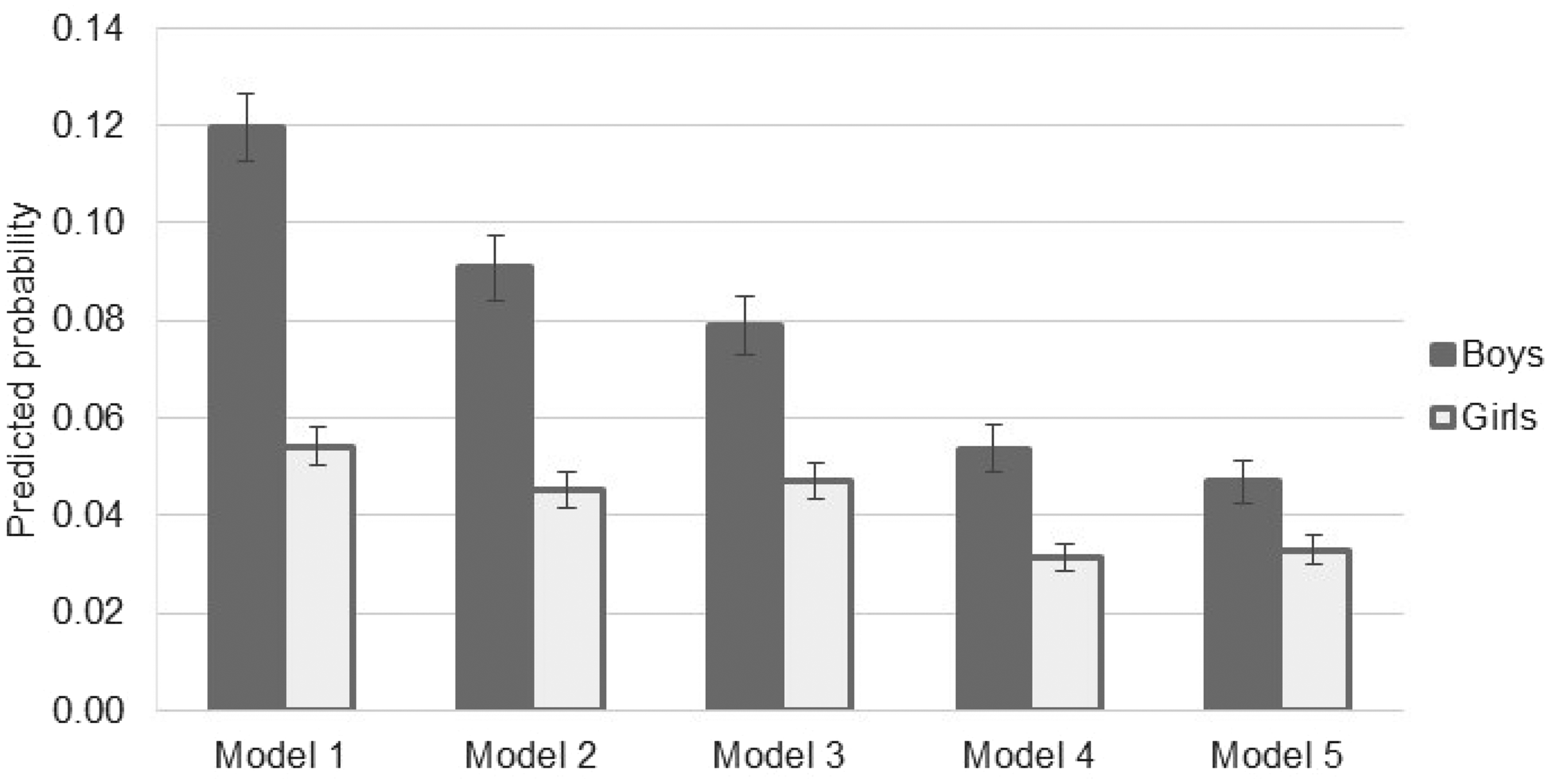
Mean predicted probabilities of boys and girls studying advanced mathematics in Year 12.
As previously presented in Table 3, substantially more boys than girls (20 per cent as opposed to 5 per cent) were expecting a mathematics-intensive career when they were 15 years old. Figure 1 shows that adding students’ occupational expectations to Model 3 further reduces the gender gap from 4.6 percentage points to 3.2 percentage points. In other words, taking students’ occupational expectations into account bridges some of the gender gap, but it does not close the gap entirely.
Based on Model 2 which contains students’ mathematics achievement, students’ self-concept in mathematics was added to Model 4. For a given level of mathematics achievement, when girls are less likely than boys to perceive that they are competent in mathematics (i.e. having lower self-concept), girls are more likely to reduce their efforts in mathematics learning, as discussed in the background. These girls are also more likely to lower their interests in mathematics, as well as in the disciplines and occupations that require intensive use of mathematics. As shown in Figure 1, the gender gap in advanced mathematics enrolment falls from 4.6 percentage points (Model 2) to 2.2 percentage points (Model 4). Compared to the reduction of the gender gap in Model 3, it appears that mathematics self-concept has a slightly greater influence on the gender gap than occupational expectations.
With the inclusion of mathematics achievement, occupational expectations and mathematics self-concept in Model 5 (Figure 1), the gender gap in advanced mathematics enrolment is reduced to merely 1.4 percentage point. In other words, the gender gap in would decrease greatly if boys and girls were assumed to have the same mathematics achievement, occupational expectations and mathematics self-concept.
Discussion and conclusion
This study examined the extent to which educational experiences and occupational expectations of 15-year-old students were related to the decisions of Australian boys and girls to pursue advanced mathematics in Year 12. Results show that students’ prior mathematics achievement, occupational expectations, and self-assessed mathematical competence are crucial in explaining why boys are considerably more likely than girls to study advanced mathematics. In addition, the analysis suggests that the gender gap could be reduced to almost 1 percentage point if 15-year-old girls showed the same levels of mathematics performance, mathematics-oriented career aspirations and confidence in their mathematical abilities as 15-year-old boys.
The finding that the effect of mathematics self-concept reduces the gender gap can be explained by the expectancy value theory. It suggests that one of the two important reasons that girls often opt out of advanced high school mathematics is that they have lower self-concept in mathematics than boys (Eccles, 2011). Girls are significantly less confident than boys in their mathematical abilities. This is most likely because girls internalise the widely shared gender stereotypical beliefs that males have more natural aptitude for mathematics, abstract thinking and technical problem solving, as argued by the theory of gender essentialism (Barone, 2011; Charles & Bradley, 2009). With less confidence in mathematical competence, girls have a higher chance of eschewing high-level mathematics. In confirming the centrality of this factor, findings of the current study align with prior research which concluded that in the 1990s, American girls were less likely to study calculus because they had lower mathematics self-concept even when they performed as well as their male peers in mathematics (Correll, 2001). Findings presented in this article also suggest that the problem of downward bias in self-evaluation adversely affects girls in a country other than the United States and more than a decade later.
Although the results of the current study are similar to the study conducted by Guo et al. (2015) which also shows that girls’ lower mathematics self-concept facilitates the gender gap in complex mathematics enrolment, the current results further demonstrate that occupational expectations contribute to the gender gap. Thus, seeking to reduce gender differences in occupational expectations and mathematics self-concept, as well as mathematics achievement as early as possible would seem to reduce considerably the gender gap in advanced mathematics enrolment.
The findings of the present study suggest that enhancing girls’ self-confidence in their mathematical abilities is one of the two essential means to bridge the gender gap in advanced high school mathematics enrolment. People who frequently interact with adolescents, particularly parents and secondary school teachers, can help girls to build up and maintain their self-confidence in mathematics. It is important for parents and secondary school teachers to be aware of their own gender bias, if any, in favour of boys regarding mathematical competence. It would be ideal if they could evaluate the mathematical abilities of boys and girls equally and have the same expectations for boys and girls in mathematics education. Secondary school teachers may further help girls to boost their self-confidence in mathematics by creating a ‘mistake friendly’ learning environment particularly for mathematics classes to encourage girls’ comfortable engagement with mathematics (Prinsley, Beavis, & Clifford-Hordacre, 2016).
Another important method to further narrow the gender gap in advanced mathematics enrolment in secondary school, as suggested by the findings of the current study, is to encourage more girls to aspire to mathematics-intensive careers. Boys and girls are not born with gender differences in occupational expectations, but through socialisation they develop those gendered patterns in response to the gendered opportunities and constraints of social structure and culture over their life course (Schoon & Eccles, 2014). To counteract gender stereotypical beliefs and to let boys and girls obtain accurate career information, career education at school should be strengthened. Adolescents often change their occupational expectations (Rindfuss et al., 1999), and therefore career education should be targeted in secondary school to foster girls’ understanding of and interest in mathematics-related careers before they decide on their educational specialisations in Year 12.
Various considerations should be kept in mind when interpreting the findings of the current study. First, the misalignment between age-based independent variables and a grade-based dependent variable raises the possibility of measurement error in mathematics achievement. In this study, mathematics achievement is derived from PISA’s plausible values that represent students’ numeracy at age 15. By contrast, the National Assessment Program – Literacy and Numeracy (NAPLAN), which includes numeracy tests, provides nationally comparable data on the performance of Australian students of the same grade. As the data linkage between LSAY and NAPLAN is possible (Lumsden, Semo, Blomberg, & Lim, 2015) and has been introduced in the 2015 cohort of LSAY, future studies may use the NAPLAN numeracy scores of LSAY participants in Year 7 or 9 to avoid the potential problem of increasing the measurement error in mathematics achievement.
Compared to prior Australian research, mathematics achievement appears to be more influential in explaining gendered enrolment in advanced mathematics in the present study. Studies based on a sample of students who attended Years 9 through 11 in the 1990s in metropolitan Sydney showed that boys and girls had similar mathematics achievement in Years 9 and 11 (Watt, 2005; Watt, Eccles, & Durik, 2006). They further demonstrated that the under-representation of girls in higher levels of school mathematics was not due to higher male achievement. In the current study, boys on average performed better than girls in the PISA mathematics assessment and boys were over-represented in the 75th percentile of the assessment. PISA aims to assess students’ capacities to apply their knowledge and skills to real-life problems and situations rather than how well they had learned a curriculum (Thomson, Cresswell, & De Bortoli, 2004). Therefore, as a measure of prior mathematics achievement, PISA’s plausible values may have more measurement error than the mathematics scores obtained from assessments aligned with the school curriculum.
Second, caution should be exercised in the definition of advanced mathematics that may not only differ among states but also change over time. In this study, advanced mathematics refers to the highest level of school mathematics that contains the assumed knowledge for mathematics-intensive university courses between 2003 and 2006. Changes to the mathematics curriculum in each state or territory may occur over time (Ainley et al., 2008), and therefore the definition of advanced mathematics in this study may not be applicable to other time periods. In addition, over the last two decades many Australian universities have changed their program prerequisites (Varsavsky, 2010). Today, not all mathematics-intensive programs across the country require advanced mathematics as some of them have changed the prerequisites from advanced to intermediate mathematics. As a result, the school mathematics subjects that Ainley and his colleagues classified as the intermediate level would be sufficient for admission to many mathematics-intensive programs. While the intermediate level courses introduce the fundamental calculus concepts, the advanced courses expand on the fundamental calculus concepts and provide students with the best start in tertiary studies that require more advanced knowledge in calculus than the introductory concepts (Barrington & Brown, 2005; Varsavsky, 2010). In this study, the definition of advanced mathematics was limited to the highest level of school mathematics that involves significant calculus content. The gender gap in the highest level of school mathematics has been larger than that in other levels over the last few decades (Kennedy et al., 2014), and therefore in this study the gender gap would become smaller if the definition of advanced mathematics had included the intermediate level courses.
Third, although Y03 provides a wealth of information about students’ educational experiences and subject choice, a drawback of using the Y03 data is attrition bias, which is a common issue in longitudinal surveys. As participants withdraw from Y03, the remaining sample becomes different from the one in the first wave. Statistical methods, such as the use of sampling weights and imputation, are helpful in resolving some of the attrition bias (Lim, 2011). If students who did not reach Year 12 and who withdrew from Y03 were counted as not choosing to specialise in advanced mathematics, the gender gap would become smaller with 8 per cent of boys and 5 per cent of girls enrolling in advanced mathematics, as compared to 13 per cent of boys and 8 per cent of girls among the 6760 students in the pooled sample. Nevertheless, given that assumption, the comparable odds of selecting advanced mathematics for girls remain about 63 per cent for the comparable odds for boys. This is similar to the comparable odds (62 per cent) obtained from the sample of 6760 students.
The policy suggestions for increasing girls’ engagement in advanced mathematics made here may not be novel and it is acknowledged that they alone will not bring about gender equality in Australian mathematics education. The under-representation of girls in advanced mathematic has deep societal and structural roots that will not be transformed by a few isolated policy interventions. To fully unleash the potential of girls in mathematics, ultimately the gender stereotypical beliefs and social barriers associated with mathematics learning and careers need to be alleviated.
Footnotes
Acknowledgements
The author acknowledges helpful comments by Joanna Sikora, the reviewers and the editor.
Declaration of conflicting interests
The author(s) declared no potential conflicts of interest with respect to the research, authorship, and/or publication of this article.
Funding
The author(s) disclosed receipt of the following financial support for the research, authorship, and/or publication of this article: The work was supported by a PhD top-up scholarship provided by the National Centre for Vocational Education Research (NCVER) through the National VET Research program, on behalf of the Australian Government Department of Education and Training. The views and opinions expressed in this article are those of the author and do not necessarily reflect the views of the Australian Government, State and Territory governments or NCVER.