




Abstract
This study evaluates the capacity of a school-based family referral service to support school personnel in connecting at-risk students with appropriate community agencies. Through a partnership between New South Wales government departments and a not-for-profit counselling organisation, the family referral service was piloted at four regional, government schools. In phase 1 of the mixed methods evaluation, 135 students completed an online version of the Student Engagement Instrument. In phase 2, 32 primary and secondary teachers participated in four focus groups. Four principals and 19 key stakeholders participated in individual, semi-structured interviews. Findings showed the service increased the schools’ capacity to manage students who were at risk of underachievement and poorer educational outcomes and reduced the workload of principals and teachers. While high Student Engagement Instrument subscale scores were obtained for extrinsic motivation and relationships with teachers, family support for learning received the lowest scores. Recommendations for the wider promotion of school–family partnerships focussing on locating flexible, family referral services within schools are discussed.
Keywords
Although the concept of parental involvement in students’ education has been defined and measured in different ways, family engagement with schools has been consistently linked to better academic performance. Kohl, Lengua, and McMahon (2000), for example, analysed data from a normative sample of 387 children in kindergarten and year 1 to examine possible relationships between previously identified risk factors for poor educational outcomes (such as low parental education levels) and six, well-evaluated dimensions of parental involvement. The authors found differential and significant relationships between risk factors and parental involvement. To improve family–school partnerships they recommend the use of whole-school approaches incorporating flexible, individualised family interventions.
Shute, Hansen, Underwood, and Razzouk (2011) found achievement was related to parent–student discussions about school, as well as to parents holding positive aspirations and expectations for their children’s learning. An authoritative style of parenting, which combines a warm relationship with children and reasonable levels of discipline, was also found to be positively related to academic achievement. In contrast, authoritarian or permissive parenting was linked to poorer academic progress. Academic achievement was enhanced when parents kept in contact with teachers and were involved in school activities. However, the influence of parental involvement on academic achievement was shown to decline as students progressed from lower to higher year levels.
Similar results were reported in a qualitative study that synthesised the findings of nine meta-analyses examining the relationship between parental involvement and academic achievement (Wilder, 2014). Parental influences were found to have more impact on academic achievement among students in lower grades as well as more saliency for students from certain ethnic backgrounds. High parental expectations were found to have the strongest influence on students’ academic achievement.
A recent review of research into the effect of collaborative partnerships between parents and schools in Queensland (Perkins, 2014) also concluded that students are more likely to be motivated to learn and achieve higher grades when their parents are actively involved in their learning. Students whose families have closer links with schools are less likely to display behaviour problems, substance abuse or to drop out of school. The effective schools literature further highlights that by strengthening positive family influences and buffering potentially negative family influences, schools can obtain better learning outcomes (Reynolds, Teddlie, Chapman, & Stringfield, 2016). Importantly, building parent and community engagement in schools has been identified as a priority by Australian teachers. In a national survey of, 4574 teachers, 82% of respondents agreed that they needed more professional development in this area (Doecke et al., 2008). Indeed, building parent and community involvement was the most frequently requested professional learning activity.
Students also recognise the overarching importance of family in their school learning and personal wellbeing. Results from a representative sample of years 4, 6 and 8 students who participated in the Australian Child Wellbeing Project showed students consistently ranked family above school, health, friends, neighbourhood and money/things as the most important factor in their wellbeing (Redmond et al., 2016). As noted by the authors, a direct policy implication is the need for increased coordination of services offered by schools, health authorities and family support organisations to ensure vulnerable families have sufficient resources to enable young people, particularly those who are marginalised, to experience success at school.
Educational disadvantage in Australia
Educational disadvantage that relates to socioeconomic and geographical location has been well documented within Australia. Lamb, Jackson, Walstab, and Huo (2015) found significant differences in academic performance at entry to school, in years 7 and 12 between the five socioeconomic groups they identified. By year 7, the difference in academic performance between the groups had widened. Only 61% of students from the lowest socioeconomic group completed year 12 compared to 85% of students from the highest group. Socioeconomically disadvantaged students were less likely to have access to early childhood education, had lower school attendance rates and were more likely to leave school early. At each of the three milestones, the academic performance of Indigenous students was below the national average. Only 56.8% of Indigenous children were ready to start school, 38.4% of Indigenous students met national standards for literacy and numeracy in year 7, and a lower proportion completed year 12 or an equivalent qualification.
Extensive analysis of Programme for International Student Assessment (PISA) and National Assessment Program—Literacy and Numeracy (NAPLAN) data (Marks, 2014; Perry & McConney, 2010; Sullivan, Perry, & McConney, 2013) also shows significant differences in academic achievement related to the socioeconomic status and the geographic location of Australian students.
Gray and Beresford (2008) have noted continuing and profound educational disadvantage for Indigenous Australian students. They attribute a plateauing of improvement to complex post-colonial influences, and acknowledge increased inter-agency coordination with fewer bureaucratic ‘silos’ as essential to sustaining reform. A recent Australian Institute of Health and Welfare report (2015) also found that Indigenous students had lower school attendance, NAPLAN scores and school retention rates, and were more likely to face barriers entering post-secondary education. Nationally, Indigenous Australians had higher rates of homelessness and Indigenous children were seven times more likely than non-Indigenous children to have received child protection services.
Considine and Zappala (2002) analysed data from an Australian sample of 3329 financially disadvantaged students who participated in a school family support programme. The results indicated the level of parental education was the strongest predictor of high academic performance. Girls, older students and students from a non-English speaking background (with the exception of students from the Middle East and Africa) were also more likely to achieve improved academic results. In contrast, students with unexplained absences from the programme, as well as students who lived in public housing, tended to have poorer academic results.
School connectedness and engagement
School connectedness refers to students’ sense of belonging to their school community (Sulkowski, Demaray, & Lazarus, 2012). Other terms used to describe this construct include school engagement, school attachment, school bonding and teacher support (Libbey, 2004). Students who experience this sense of connectedness are more likely to be engaged in their studies and achieve academic success. They are also less likely to display emotional distress, disruptive behaviour and substance abuse (Allen, Vella-Brodrick, & Waters, 2016; Blum & Libbey, 2004; McNeely, Nonnemaker, & Blum, 2002). Klem and Connell (2004) report that as many as 40–60% of high school students in both urban and rural schools may be disconnected. These students are more likely to display disruptive behaviour, be absent from class and drop out of school.
McNeely et al. (2002) analysed data from a representative sample of 75,515 US students in years 7–12 to examine the relationship between school connectedness and school environment. Connectedness was higher among schools with positive classroom management and tolerant discipline policies. It was also higher among students in smaller schools, although there was no association between school connectedness and class size. Students who took part in extracurricular activities, younger students and students who did not miss school were also more connected.
Klem and Connell (2004) showed that students who were highly engaged with school were more likely to perform well on reading and mathematics tests and to attend school regularly. They also found that students who reported high levels of teacher support were more likely to be highly engaged with school. Loukas, Roalson, and Herrera (2010) examined the effects of school connectedness, negative family relations and students’ levels of effortful control on conduct problems among 476 adolescents over 1 year. In their study, effortful control was measured in terms of the students’ ability to focus and shift attention (e.g. to concentrate on their homework), and their ability to carry out actions they would prefer to avoid (e.g. to complete an assignment). The results indicated that school connectedness contributed to a decrease in conduct problems over the year, and protected students from the detrimental effects of negative family relations on their behaviour. In advocating a socio-ecological framework to enhance school belonging, Allen et al. (2016) stressed the importance of school–family collaboration. They recommend schools maximise opportunities for family involvement by hosting family events, encouraging parental representation on committees, ensuring regular home-school communication, providing parental education programmes and utilising appropriate referral pathways when relationships break down.
Intervention programmes
While traditional school-based family interventions have tended to react to existing problems among students, more recent programmes emphasise early, multi-tier and multi-system interventions. Such programmes often focus on the wellbeing of the family and community, rather than simply the behaviour of the child (Kratochwill, McDonald, Levin, Scalia, & Coover, 2009). There is strong evidence that these school-based family intervention programmes can prevent the development of emotional and behavioural difficulties among children (Lane & Menzies, 2003).
Intervention programmes in schools can be classified into three categories, namely universal (tier 1), selective (tier 2) and indicated (tier 3) (Gordon, 1983). Tier 1 programmes are delivered to all students in a class or school and aim to promote students’ social and emotional development (Durlak, Weissberg, Dymnicki, Taylor, & Schellinger, 2011). Tier 2 interventions target students at risk of developing academic, emotional or social difficulties and may be provided for particular groups of students according to age, gender or cultural background. Tier 3 interventions are directed at students displaying emotional and social difficulties or behaviour that is disrupting their academic performance (Macklem, 2011; Wilson & Lipsey, 2007). Research on intervention programmes in schools has concentrated on universal programmes for students in primary school, and less research has been conducted with high school students (Macklem, 2011).
Kratochwill et al. (2009) conducted a randomised controlled trial of the impact of the Families and Schools Together (FAST) programme which aims to build family relationships and strengthen social networks. The intervention targeted a sample of 67 children in kindergarten to year 2, who displayed behavioural problems and were at risk of being referred to specialist education services. As such, the programme was designed as a multi-tiered, multi-system intervention. Students were randomly assigned to either the FAST intervention or a control group who relied on the usual school supports such as tier 3 special education services. At the end of the trial, greater improvement on measures of family flexibility and less aggressive behaviour were reported for the FAST group than for the control group. Jeynes (2012) used a meta-analysis of 51 studies to examine the efficacy of different types of school-parent partnership programmes. Practices that were most effective in improving learning outcomes were shared reading, parental monitoring of homework, parent–teacher communication and school–family partnerships. Other reviews of successful interventions targeting educational disadvantage associated with low SES have identified a clear need for a range of multi-tier, multi-system interventions that complement the use of evidence-based academic interventions. These reviews have also identified core attributes of multi-system school–family collaboration (Dietrichson, B⊘g, Filges, & Klint J⊘rgensen, 2017). Core attributes of successful interventions include: an emphasis on establishing continuity in schooling/service delivery, integrated delivery models, quality instruction and the use of family support services (e.g. welfare and health services) (Reynolds, Magnuson, & Ou, 2010).
The results from Wilson and Tanner-Smith’s (2013) systematic review of interventions to improve school retention rates also underscores the need for integrated school intervention models that incorporate family support services. For students at risk of drop-out, case management family support services that were provided in school settings or settings with both a school and community component were significantly more effective than programmes that were only delivered from community settings.
The aim of the current study is to evaluate the capacity of a school-based family referral service (FRS) to connect at risk students and their families, with appropriate community intervention agencies. In addition, the capacity of the FRS to provide support to school personnel was also evaluated. Through a partnership between government departments in the Australian state of New South Wales and a not-for-profit counselling organisation, the FRS in Schools was piloted as a ‘wraparound’ model (Burchard, Bruns, & Burchard, 2002) to case management. Wraparound models emphasise individualised, collaborative service delivery that include families as full, active partners. They make use of both formal (professional) and informal supports to develop multiple networks of support for vulnerable families. Wraparound models have emerged from social-ecological theories and stress the importance of integrated interventions covering the multiple systems or domains in which students are known to be disadvantaged.
It was hypothesised that students, teachers, school leaders and other key stakeholders would evaluate the service favourably. It was further hypothesised that students who are at risk of underachievement and poor developmental outcomes would be more effectively linked with appropriate support services and interventions. By locating Education Family Workers (EFWs) in schools traditional barriers that have been associated with access to services (such as low SES and ethnic minority status) may be more effectively addressed.
Method
The intervention
FRSs are government-funded not-for-profit organisations that link vulnerable children, young people and their families to local support services when the presenting problems do not meet statutory thresholds for child protection intervention. Family workers are professionally trained to connect families to culturally appropriate services including domestic violence support, housing, financial assistance, mediation, mental health supports, substance use treatment and parenting programmes. Within NSW, there are 11 providers operating under a state-wide model to deliver free referral services. Each service is responsible for ensuring they effectively respond to local needs. FRSs are community-based, however, the current initiative is unique because the service was located within four schools. EFWs were recruited directly by the FRS and were placed in schools 3 days a week through agreements with the school principals and the FRS.
Intervention data relating to the number of referrals received and the occasions of service were recorded by the FRS. Occasions of service represent discreet instances of client contact that are made by an EFW. Funding criteria stipulate that each occasion of service must be for the purpose of family support, documented and contact that is face-to-face or a substitute such as by telephone.
Design
The evaluation utilised an explanatory sequential mixed methods or two-phase design (Creswell, 2012). Initial quantitative data on school engagement were collected from students attending the four participating schools. As well as this, data were obtained from school and FRS records on the type of services that were accessed and the demographic backgrounds of clients who participated in the FRS. In phase 2, qualitative data from key FRS stakeholders were gathered using a small number of individual interviews with parents, students and principals. Four focus groups for teachers and other key stakeholders were also conducted in the second phase of the evaluation.
Participants
In phase 1, 135 students (100 high school and 35 primary school students) completed an online version of the Student Engagement Instrument (SEI). Student participants were recruited through invitations that were sent to all families who had students at the participating schools. Participants attended four state government schools, namely two primary schools and two secondary schools, which were located in a large regional centre in the Australian state of New South Wales.
In phase 2, 19 stakeholders participated in individual, semi-structured interviews that focused on their experiences of the FRS in Schools. Participants in the semi-structured interviews included six parents who had used the service, seven students who had been referred to the service and four school principals. Two local service managers also participated in a semi-structured interview.
Four focus groups captured the experiences of an additional 32 stakeholders. Participants in focus group 1 (n = 5) comprised EFWs and service managers. Focus group 2 (n = 8) was made up of school principals and student support officers. Participants in focus group 3 (n = 8) were primary school teachers or school learning support personnel who had knowledge or direct experience of the service. The focus group 4 (n = 11) contained high school teachers and learning support personnel.
Measures
Quantitative data in phase 1 were collected through the online administration of the SEI (Appleton, 2012; Appleton, Christenson, Kim, & Reschly, 2006), which measured student engagement in four areas: academic, behavioural, cognitive and affective. This 35-item instrument yields six subscale scores that measure teacher–student relationships, peer support, family support, control and relevance of school work, future aspirations and goals and extrinsic motivation. Each item was rated on a scale from strongly disagree (1) to strongly agree (4). The SEI has excellent reliability (Cronbach alpha 0.72–0.92) and validity has been established through correlations with predicted educational outcomes including GPA, maths scores, reading scores and school suspensions (Appleton et al., 2006; Betts, Appleton, Reschly, Christenson, & Huebner, 2010; Fredricks et al., 2011). Data relating to the number of referrals received, the occasions of service, and whether students identified as Indigenous or non-Indigenous, were provided by the FRS. School measures of absenteeism, attendance rates and academic achievement were provided for students who were interviewed in phase 2.
Data collection
University and Department of Education ethics approval, as well as parent/carer consents, and student assents were obtained before the research was undertaken. Multiple data sources were used to evaluate the capacity of the FRS to connect at risk students and their families with appropriate community intervention agencies and to examine the benefits and limitations of providing an in-school referral service. Qualitative data were collected using protocols for semi-structured interviews and focus groups. Protocols were developed and adapted for principals and other key stakeholders, teachers, students and parents using recommendations from Krueger and Casey (2015). Standard prompt questions included: ‘How did you hear about the program?’, ‘How do you feel about the program?’, ‘What was most helpful?’, ‘Were there things that you wished would happen that didn’t?’, ‘Would you use the FRS again?’ and ‘How could the program be improved?’. Interviews ranged from 15 minutes to 1 hour while focus group discussions lasted between 45 and 90 minutes. Responses were audio-recorded, transcribed and coded (Saldaña, 2015). The thematic analysis utilised Braun and Clarke’s (2006) guidelines. Semantic content was first identified and coded. Following coding, categorisation based on recurrent patterns was used to develop the final themes. Quantitative data were analysed using IBM SPSS Statistics 22 descriptive statistics.
Results
Firstly, aggregate data obtained from the FRS relating to actual referrals are analysed. Then, the results from the measure of student engagement in the participating schools are presented. The last two sections of the results summarise qualitative data obtained from key stakeholder interviews and focus groups.
Referrals
The FRS in Schools received 181 referrals and provided 2482 occasions of service. Eighty-six referrals were from high school 1, 25 from high school 2, 39 from primary school 1 and 31 from primary school 2. The primary and secondary schools both had the service for 3 days each week, and it was accessed the most in high school 1. A total of 70 students were referred from primary schools and 111 from high schools (referral rates were 15% higher in high schools). Approximately 918 hours of service provision were delivered over 1 year. The average time per occasion of service was 22 minutes. Table 1 presents the number of referrals and occasions of service.
Number of family referrals and occasions of service.
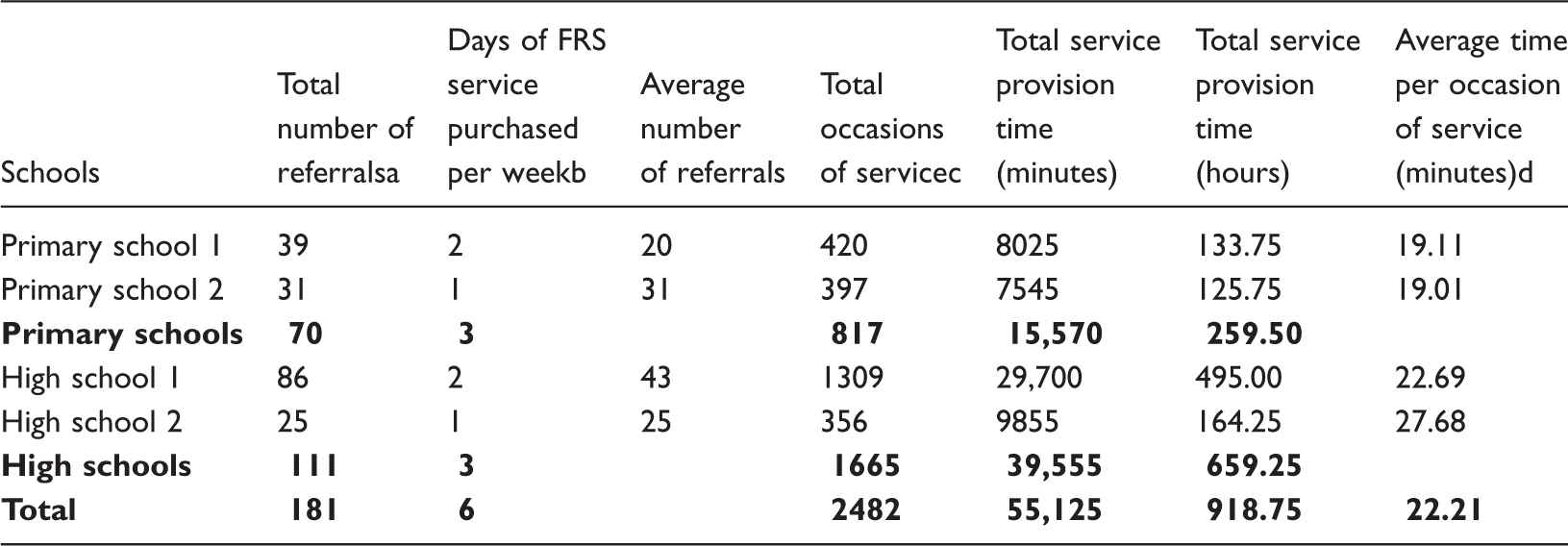
aThe actual number of family units referred by schools for intervention.
bThe number of days per week that an Education Family Worker (EFW) was allocated to the school.
cThe actual number of sessions provided by an EFW; each discrete session consists of one occasion of service.
dThe average time in minutes for the delivery of each occasion of service.
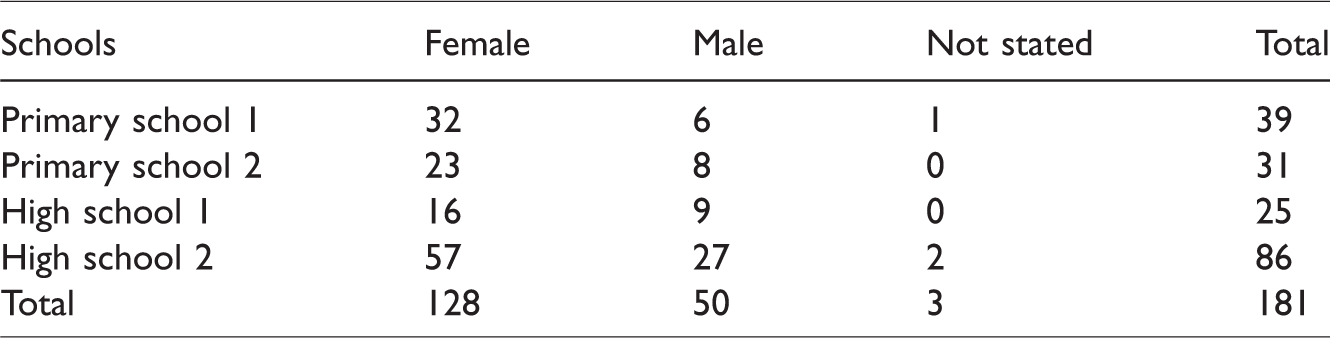
Referrals by gender.
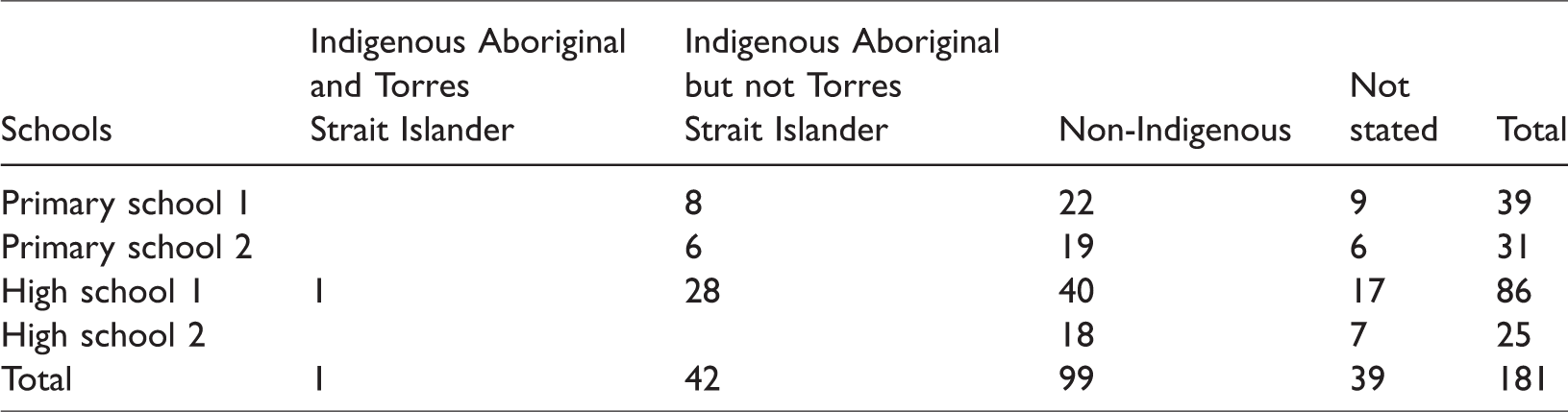
Referral by Indigenous identification.
Referral issues
An analysis of the top five presenting issues in both the overarching community-based FRS and the FRS in Schools revealed that family breakdown, mental health, parenting issues and financial stress were in the top five for both services. Domestic violence was in the top five issues presented at the FRS, 4% higher than presented via the FRS in Schools. Moreover, homelessness was in the top five issues presented via the FRS in Schools, 2% higher than presented at the FRS. Neglect represented 2% of presenting issues at both the FRS and the FRS in Schools. Additionally, relinquishing care represented less than 1% of presented issues at both the FRS and the FRS in Schools. Young parents were equally represented at 1% in both services. Further analysis showed that presenting issues relating to runaway children, emotional abuse of children, physical abuse of children, financial stress and family breakdown increased by a marginal 1% at the FRS in Schools. Parenting issues increased by 10% when the FRS in Schools referrals were compared to the community-based FRS referrals.
Student engagement
An analysis of the SEI data revealed teachers’ classroom behaviours were rated the highest for promoting student engagement. High ratings were obtained for the use of rewards and teachers utilising supportive relationships. The lowest mean subscale scores were obtained for family support for learning. As shown in Table 4, both primary and high school samples rated family support for learning at the bottom of the six dimensions of engagement.
Summary Student Engagement Instrument subscale scores for overall, primary and high school students.

Note: Response Scale: 1. strongly disagree, 2. disagree, 3. agree, 4. strongly agree.
Perceptions of teachers and principals
Teachers and principals’ perceptions of the FRS in Schools were generally positive. The qualities and expertise of the EFWs employed by the service and located in the schools were important to both principals and teachers. They stated that the service met most of their expectations and that it fostered better relationships between schools, families and communities, provided access to services for families and assisted teachers and principals by reducing the time they spent managing students and families who required extensive case management.
However, the perceptions of teachers and principals were not all positive. Some were concerned that it was not clear how the FRS in Schools would work or evolve. One participant stated that their school leaders expected a greater number of students and families in need of assistance to use the service. There was also the view that the model lacked structure, needed streamlining and might cause teachers to become confused about their reporting responsibilities. Educators also shared their views about the broader reporting process. They felt that more information should be shared when students are referred to Family and Community Services (FACS). One teacher said, ‘there’s not much connection, they say that they will contact you and it does not happen’. The educators particularly valued feedback from welfare organisations that were working with students.
Perceptions of students and parents
The views of students and parents who accessed the FRS in Schools were largely positive and were organised around three themes, namely acceptance, accessibility and agency partnerships.
Both students and parents appreciated the non-judgemental and accepting attitudes of the EFWs. Students said the EFWs helped them regain their confidence. They were described as ‘helpful’, ‘supportive’ and ‘someone to talk to’. Traits of the EFWs that appealed to parents included ‘genuine’, ‘a neutral person who was non-judgemental’ and ‘a pleasant person who was prepared to listen and provide reassurance’.
Discussion
Feedback from the principals, teachers and families that were interviewed generally supported the hypothesis that the FRS in Schools would be favourably received by key stakeholders. There is strong evidence that early intervention programmes in schools can prevent emotional and behavioural difficulties developing among children (Jeynes, 2012; Lane & Menzies, 2003). Programmes are more successful when they address the needs of the entire family and family engagement with schools is important for increasing academic outcomes. As students get older, the level of family involvement in schooling declines and reaches its lowest points during the senior years of high school (Wang & Sheikh‐Khalil, 2014). Nevertheless, highly effective schools, even at the high school level, continue to engage families and maintain strong collaborative relationships with their communities. As a result, intervention programmes which aim to address the needs of student who are at risk due to family breakdown and conflict are necessary.
The FRS in Schools is an example of a tier 3 (indicated) school-based family intervention programme. The overarching FRS was established as a government-funded organisation to address the needs of children, young people and families by connecting them to appropriate community services. Schools are complex environments where multiple demands are made on teachers and school leaders. There is an inherent tension between the need for teachers to teach and at the same time ensure the wellbeing and safety of students. The FRS in Schools is strategically placed to support families in an environment where student behavioural and socioemotional issues can be identified and interventions more readily provided.
Four specific findings in relation to the provision of the FRS in Schools are noteworthy. Firstly, the greatest number of referrals to the FRS came from the participating high schools. This is significant given the traditional reluctance of adolescents to engage with services and developmental imperatives for increased independence. Secondly, there were a disproportionate number of females in the referrals. Given that boys are more at risk of poor educational outcomes including higher suspensions, school dropout, behavioural and emotional disorders and underachievement (Boyle & Jenkins, 2012), continuing efforts to ensure male students also receive appropriate family interventions are warranted. Thirdly, the percentage of Indigenous students who accessed the service is proportional to the number of Indigenous students in the schools’ populations. Inequalities in the delivery of educational services to Indigenous students were outlined earlier and the FRS appears well placed to meet the needs of Indigenous students and their families. Finally, students rated teacher support for learning and relationships with teachers highly. Students’ lowest ratings were obtained for items about family support for learning highlighting the need for better family engagement with schools.
As hypothesised the findings indicate that the FRS increased schools’ capacity to handle challenging issues with at-risk students, and reduced the extra workload of principals and teaching staff. Parents and students appreciated having an EFW who provided a responsive and individualised service that complemented the roles of teachers and school leaders. Due to their ability to develop relationships with students and families, EFWs are well positioned to support families. Specifically, EFWs can locate and use strengths in family relationships to foster individual student learning, wellbeing and other positive outcomes. They can also identify barriers within the home that could prevent quality learning and optimum student engagement. An extensive knowledge of community networks allowed EFWs to connect families with services that assisted parents gain a better understanding of their child’s potential. Additionally, the FRS in Schools mobilised appropriate resources for vulnerable families.
As a result of the evaluation, the following recommendations are provided with the aim of improving the FRS in Schools model and ensuring its sustainability. To be most effective, the service should be located in schools with a clear need for tier 3 (indicated) family interventions for at-risk students. Delivery should be flexible to allow for the complexity of individual school structures and leadership configurations. While it is important to have several referral points, it is prudent to have one person or a highly organised team to coordinate the referral process and liaise between the EFW and school staff to complement existing roles within the school. Likewise, conducting professional development for school staff to address complex issues surrounding collaborating with families, confidentiality and managing referrals would underpin an ethos of school–family partnerships and enhance the uptake of the FRS in Schools.
To safeguard mandatory reporting responsibilities, it is recommended that both schools and EFWs execute their own existing processes. The FRS and FACS must also continue sharing pertinent information with schools relating to child protection matters. This allows schools to be aware of what individual interventions have been organised for students.
Both internal and external promotion of the FRS in Schools is equally important. The EFW should be placed in a visible location within the school that is easily accessible to staff, students and parents. Promotion strategies also need to consider the potential barriers for families and communities who may benefit most from the service such as accommodating their specific language and literacy needs.
This study also shows that students and families who initially declined a referral chose to use the service later in the year. In these cases, maintaining the offer of in-school support may strengthen school–family partnerships and allow for potential re-engagement with the family at a later, appropriate time. To ascertain the on-going benefits and sustainability of the FRS in schools, any future expansion of the programme should be accompanied by further evaluations.
Conclusion
This evaluation explored the perceptions of students, parents, teachers, principals and other key stakeholders of the FRS in School intervention. Based on the findings, the FRS in Schools was seen to be a viable option to address the needs of students and families who are at risk of poor educational outcomes. The FRS in Schools was most successful when a high need for tier 3 services for students displaying emotional and social difficulties was evident. A distinguishing feature of the FRS in Schools is its role in facilitating early interventions for vulnerable students, providing parent support and reducing the family casework responsibilities of school leaders and teachers.
Footnotes
Declaration of conflicting interests
The author(s) declared no potential conflicts of interest with respect to the research, authorship, and/or publication of this article.
Funding
The author(s) disclosed receipt of the following financial support for the research, authorship, and/or publication of this article: This work was supported by the New South Wales Department of Education participating schools.