




Abstract
Students who have parents deployed to a war zone are more vulnerable to an increased level of stress and anxiety, health problems, behavioural disorders and academic under-achievement. Yet, little is known about the processes employed by schools to support these students. This study investigated the deployment support work conducted by Defence School Transition Aides who are employed in some Australian schools to support students from Australian Defence Force families to manage the transitions associated with school mobility and parental absence for service reasons. Fifteen parents, 17 teachers and 15 Defence School Transition Aides were asked, in semi-structured interviews, to describe students’ responses to parental deployment, how their schools supported students and what specific processes were employed by Defence School Transition Aides to assist students’ coping during parental deployment. Findings from qualitative analyses, suggest that Defence School Transition Aides assist school communities to build their schools’ capacity to support students with deployed parents by raising the school communities’ awareness of these students’ specific needs.
Keywords
Introduction
Many Australian school students have experienced a parental deployment to a war zone as a consequence of extensive Australian Defence Force (ADF) involvement in areas of international conflict over the past 15 years. ADF deployments average 8 months in length and of the estimated 30,000 ADF members who deployed between 2001 and 2014 approximately 30 per cent were deployed multiple times. Deployment related changes to family roles and routines typically unsettle children and can interfere with their educational engagement and progress. Furthermore, students with parents who are deployed are more vulnerable to increased levels of stress and anxiety, health problems and behavioural disorders (McGuire et al., 2012; Siebler, 2009). The Defence School Transition Aide (DSTA) programme, which is designed to assist families in this situation, has been estimated to support over 11,000 students in 2015, many of whom had a parent on deployment at that time (Macdonald, 2016).
DSTAs have been employed in over 130 Australian schools (government, Catholic and independent) since 2001 to assist students from ADF families manage the school transitions associated with military life (DCO, 2007, 2011). DSTAs work as members of a school’s student services team, a multi-disciplinary team which can comprise of the school guidance officer, school chaplain, youth support coordinator and teachers with specific student welfare duties within the school. In particular, DSTAs support students who are transitioning between schools, and when military parents are absent from home for service reasons. Most DSTAs hold a certificate III in Education Support or have other relevant qualifications. As part of their duties, DSTAs assist schools with maintaining records of the enrolment of new ADF families, the departures of ADF families who are relocated to other geographic areas and parental absences. In addition, DSTAs deliver targeted programmes and implement supportive processes that assist students from ADF families manage the transitions associated with school mobility and parental absence.
The DSTA practice model includes school capacity building to encourage greater whole school awareness of, and support for, the social and emotional needs of students from ADF families. DSTAs support students to maintain communication with the parent who is deployed and to develop peer support networks with other students who also have parents who are deployed. In addition, DSTAs provide individual support to students, raise whole school awareness of the needs of students with a parent who is deployed, and liaise with the local ADF community.
The DSTA programme operates as a partnership between the Defence Community Organisation (DCO) and schools. The DSTA programme is overseen by the Regional Education Liaison Officer (REDLO), employed by DCO, in each state and territory. Each REDLO works with schools in their state or territory to assist them to identify and support the needs of students from ADF families. The DCO, a family support organisation within the Department of Defence, provides funding to interested schools that enrol large numbers of students from ADF families. This funding is used by schools to supplement the costs associated with implementing the programme. Schools employ a DSTA as a member of their staff to operate under the DSTA programme guidelines and funding agreement drawn up by DCO. The REDLO participates in the selection process and offers induction training for new DSTAs. In addition, the REDLO liaises closely with school principals and coordinates specific training and networking opportunities for DSTAs within their state or territory. The REDLO also offers training on request to other members of the school staff in relation to supporting students from ADF families.
DSTAs are integrated members of the school community and spend the majority of their time working face to face with students, parents and teachers both inside and outside classrooms. Working from a dedicated physical location in the school, called the Defence Room, ensures that DSTAs are easily accessible to students, parents and teachers. DSTAs maintain a flexible timetable which gives them the capacity to respond to situations at short notice. DSTAs are employed as members of their school staff and participate in mandatory staff training as well as specific ADF related training offered by DCO. School principals employing a DSTA report to DCO annually on DSTA programme outcomes such as supporting students as they transition in and out of the school and supporting students with parents absent from home for service reasons. The principal reports are collated each year by the REDLOs in each state and territory and forwarded to DCO headquarters in Canberra for planning purposes.
This article reports on one component of a larger Australian study into student support during parental deployment. While the larger study investigated the deployment support work of the DSTA programme in North Queensland (Macdonald, 2017), this article examines the methods used by the DSTAs that assist school communities build their capacity to support students during a parental deployment.
Literature review – School responses to support students with a parent who is deployed
School-based adults who are familiar with military lifestyles and are willing to spend time with students make a valuable contribution to the wellbeing of students with a parent who is deployed (Astor, De Pedro, Gilreath, Esquada, & Benbenishty, 2013; Mmari, Roche, Sudhinaraset, & Blum, 2009). Furthermore, Easterbrooks, Ginsburg, and Lerner (2013) suggested that for those children who have encountered adversity, the presence of a supportive and sensitive adult assisted the children to buffer their stress and foster their resilience. Supportive adults provide modelling and mentoring which, in turn, help students frame stressful circumstances within the context of values. These types of relationships were especially important for students who were experiencing overwhelming pressures in their lives, such as those associated with a parental deployment, because they were more vulnerable and likely to benefit from the understanding of adults and peers at school (Fitzsimons & Krause-Parello, 2009).
The majority of the studies reporting on school-based processes and programmes supporting students with a deployed parent focussed on work conducted with secondary school students, however a small number of studies focussing on primary school students were available. While students of all ages were shown to have specific needs the strategies employed by schools varied to cater for the developmental ages of the students. School-based programmes such as additional tutoring, the development of hero walls and friendship gardens (De Pedro, Esqueda, Cederbaum, & Astor, 2014), as well as individual counselling (Waliski, Bokony, Edlund, & Kirchner, 2012) have been found to be effective strategies for assisting primary school students in the United States to manage the stresses associated with parental deployments. Resilience and skill building programmes were found to benefit secondary school students (Friedberg & Brelsford, 2011; Garcia, De Pedro, Astor, Lester, & Benbenishty, 2015; Waliski, Kirchner, Shue, & Bokony, 2012). Chandra, Martin, Hawkins, and Richardson (2010) demonstrated that school-based activities which promote a sense of belonging offered support to those secondary school students who were experiencing psychological strain related to parental deployment. This finding was supported by Canadian research (Robson, Albanese, Harrison, & Sanders, 2013) demonstrating that the participation in peer support structures was associated with increased school engagement for secondary school students during parental deployment.
The experiences of 31 school community stakeholders (i.e. principals, military social workers, school liaison officers) with a professional interest in the education of students from military families were explored by De Pedro, Esqueda, et al. (2014). The participants identified that students from military families had unique needs that necessitated school intervention. The participants also described a number of ‘home grown school practices’ (De Pedro, Esqueda, et al., 2014, p. 12), such as lunchtime activities and a connection room, that had been implemented in some schools to facilitate positive emotional, psychological and academic outcomes for students during a parental deployment. Study findings suggested that these strategies were well supported by students and had the potential to contribute to a more positive school experience for students although the effectiveness of the strategies is yet to be ascertained.
At the same time, De Pedro, Esqueda et al. (2014) identified a number of barriers in schools for providing optimal support for the students with parents who are deployed. First, US students were not systematically identified within school processes and were therefore not recognised as a group of students who shared culturally based experiences and knowledge associated with their parents’ employment. Second, teachers and other school personnel had little awareness or sensibility of the military as an institution or as a way of life. Chandra et al. (2010) and Mmari et al. (2009) suggested that deployment related stresses could lead to a lack of both school engagement and a sense of school connectedness for students. Furthermore, De Pedro, Esqueda, et al. (2014) suggested that it would be possible for students from military families to perceive the school environment as hostile.
In 2014, three studies conducted concurrently in eight school districts in the United States explored the responses of teachers (Garner, Arnold, & Nunnery, 2014), school administrators (De Pedro, Atuel, et al., 2014) and parents (Berkowitz, De Pedro, Couture, Benbenishty, & Astor, 2014) to students’ deployment related support needs. De Pedro, Atuel, et al.’s (2014) study reported that school administrators had limited time to plan for the additional needs of military students. In addition, Garner et al. (2014) discovered that teachers had a limited understanding of deployment related stresses and required further information about the unique needs of students during a parental deployment. Also, military parents were found by Berkowitz et al. (2014) to rate school effectiveness more harshly than non-military parents. In summary, these studies identified a certain lack of awareness by their school communities of the potential impact of deployment related family stresses on students’ wellbeing and academic engagement.
A positive school climate buffers emotional and academic risk factors experienced by students with a parent who is deployed (De Pedro, Astor, Gilreath, Benbenishty, & Berkowitz, 2015). Using data from the Californian Healthy Kids Survey (CHKS), De Pedro et al. (2015) examined associations between school climate, military connection, deployment and mental health. This study found that students in military families experienced more depressive symptoms than non-military students, however, they were able to cope with deployment related stress when adults in their school provided them with emotional support and encouragement. These findings indicated that multiple components of a positive school climate, such as peer support and positive teacher–student relationships, were critical to the maintenance of students’ wellbeing during parental military deployment.
School climate and its underlying conditions are deeply interconnected and grow out of the shared experience of a dynamic ecological system (Bronfenbrenner & Morris, 2007). Schools can offer sources of resilience and protection for students particularly through the dynamic relationships that occur between students and the people and resources around them (Astor et al., 2013; De Pedro et al., 2011; Easterbrooks et al., 2013). The DCO provides indirect support to ADF families by offering teachers professional development opportunities and programmes, such as the DSTA programme, to raise teacher awareness of the pressures on ADF families during deployment (Rogers-Baber, 2017; Siebler, 2009).
De Pedro, Esqueda, et al. (2014) suggested that teachers’ awareness of the needs of students with a parent on deployment and their willingness to develop ‘home grown’ strategies to support these needs contributed to a positive school climate. This finding is supported by the work of Brown-Jeffy and Cooper (2011) who proposed that the legitimisation of cultural heritage helps students to feel validated by public acknowledgement of their background that in turn helps them to make sense of their world. Sensitivity to cultural nuances also helps teachers to integrate relevant references to students’ family backgrounds into their teaching and learning environment. Moreover, Brown-Jeffy and Cooper (2011) proposed that a culturally relevant curriculum demonstrates to students that teachers care about them and recognise their different ways of knowing thus encouraging a sense of connectedness with their school and peers (Brown-Jeffy & Cooper, 2011).
Aims of the study
Anecdotal evidence from DSTAs and parents suggested that many of the findings from American studies into the needs of students whose parents are deployed to a war zone were relevant to the Australian context. To investigate the validity of these anecdotal reports, the larger study on which this paper is based (Macdonald, 2017) used the DSTA programme as the unit of analysis to examine how Australian schools support students during parental deployment (Macdonald, 2017). The primary aim of the larger study was to gain an understanding of specific school-based processes and practices that offered support to Australian school students during a parental deployment. Furthermore, the study sought to identify those programmes and strategies that were employed by DSTAs and were identified by participants as contributing to a sense of student wellbeing during parental deployment.
Method
The study was conducted in Townsville, a regional city in Queensland, Australia, with a population of 180,000, that is home to a major Australian Army base and Air Force base. More than 6000 Townsville-based ADF members, along with their families and the Defence civilian workforce make up 12% of the city’s population (Welters & Delisle, 2009). The author of this study worked in Townsville as a REDLO with the DCO during the data collection phase of the study. Although, as part of her professional role, the researcher liaised with schools regarding the implementation of the DSTA programme guidelines, she did not supervise the DSTAs who are school employees. However as an ‘insider researcher’ the researcher took extreme care to consistently ground all findings within the data with a view to minimising the vulnerability of the findings to insider interpretation as cautioned by Costley, Elliot, and Gibbs (2010). This process was assisted by regular academic supervision throughout the study process.
Participants
Recruitment
This article is based on 47 semi-structured interviews, conducted in schools, with 15 parents, 17 teachers and 15 DSTAs. The principals of all Townsville schools who employed a DSTA were contacted by letter and invited to recruit members of their school communities to participate in the study. The principals of eight primary schools and five secondary schools accepted the invitation. Two of the primary schools each employed two DSTAs. Purposive sampling was used within the schools that had agreed to participate in the study to attract participants to the study.
Ethics approval for this study was obtained from James Cook University and the Department of Defence. Pseudonyms are used in the Results section to maintain anonymity of the participants.
Participant characteristics
In order to capture three different perspectives on the nature of support offered by schools to students with a deployed parent, interviews were conducted with parents, teachers and DSTAs. All 15 parent participants were the female partners of male ADF members and had 32 school-aged children between them. Eight teacher participants taught in secondary schools and nine teacher participants taught in primary schools. All teachers had at least 3 years teaching experience and all but one secondary teacher were female. Five DSTA participants worked in secondary schools and 10 DSTAs worked in primary schools. The 15 DSTA participants had at least 3 years of experience working in the DSTA role and all, except one secondary DSTA, were female.
Procedure
The original study was conducted as a naturalistic inquiry (Lincoln & Guba, 1985), using grounded theory methods (Birks & Mills, 2011; Charmaz, 2006; Denzin, 2001). Semi-structured interviews were chosen as a means of gathering data to enable the researcher to elicit local, subjective perspectives from ‘cultural insiders’ about school-based support offered to students with a deployed parent. Efforts were made to gain rapport with the participants prior to the beginning of the interview and professional support was offered in the event of participants becoming distressed during the interview. No additional support was requested either during or after the interviews.
The interviews were conducted as conversations that were guided by broad open-ended questions as outlined by Charmaz (2006). Parallel question guides were created for the parents, teachers and DSTAs and included questions that focussed on the primary aims of the study discussed at the end of the literature review:
Question 1: Describe how students respond to a parental deployment? Some of the sample questions are as follows: ‘How do your children respond to your partner being deployed?’ (parents). ‘How have your students responded to a parent’s deployment?’ (teachers). ‘How do the students in your school respond to a parent’s deployment?’ (DSTAs).
Question 2: Describe the efforts employed at school to assist students to manage a parental deployment? Here are some of the sample questions: ‘Was there anyone at your children’s school who was supportive to your children during your partner’s deployment? What did they do?’ (parents). ‘Are there programmes at your school to support students during a deployment?’ (teachers). ‘What strategies have you found supportive for students during a deployment?’ (DSTAs).
Questions 3: Identify aspects of the DSTA role that eased the transition process for students with a parent who is deployed? Sample questions are as follows: ‘What do you think schools could do to assist children when a parent’s deployed?’ (parents). ‘Are there things that schools should do or not do to assist children during a parent’s deployment?’ (teachers). ‘What things does your school do to assist students during their parents’ deployments?’ (DSTAs).
These questions were developed to map onto three of the four tenets of Bronfenbrenner’s theory of bioecological development (Bronfenbrenner & Morris, 2007; Tudge, Mokrova, Hatfield, & Karnik, 2009), the developing person, the environmental context and interpersonal processes connecting the developing person with their environment. Probes and other techniques were used to facilitate further discussion and encourage participants to elaborate on themes. All interviews were recorded and transcribed.
Data analysis
The data were coded using grounded theory methods (Birks & Mills, 2011; Charmaz, 2006) that were consistent with a naturalistic inquiry paradigm (Lincoln & Guba, 1985). The transcripts were initially coded within five participant groups: parents, primary teachers, secondary teachers, primary DSTAs and secondary DSTAs. Participants working in primary and secondary schools were initially coded separately as differences in practice were anticipated due to the differences in developmental needs of the students in their care. Initial codes identified actions and processes employed by DSTAs. Further analysis using Bohm’s theoretical coding methods (Bohm, 2004) developed themes within each data set. The five sets of codes were later combined and further analysed to develop analytical codes and themes (Birks & Mills, 2011; Charmaz, 2006). The resultant analytical codes identified four major role functions performed by the DSTAs, namely (1) reducing cultural barriers between schools and ADF families, (2) constructing cultural knowledge, (3) integrating knowledge and practice and (4) assisting schools to build their capacity to support students during parental deployment. Feedback from DSTAs was sought throughout the coding process for verification. Interim findings from the study were also provided to the principals of the schools involved in the study for their feedback on the relevance of the findings to their school community.
Results
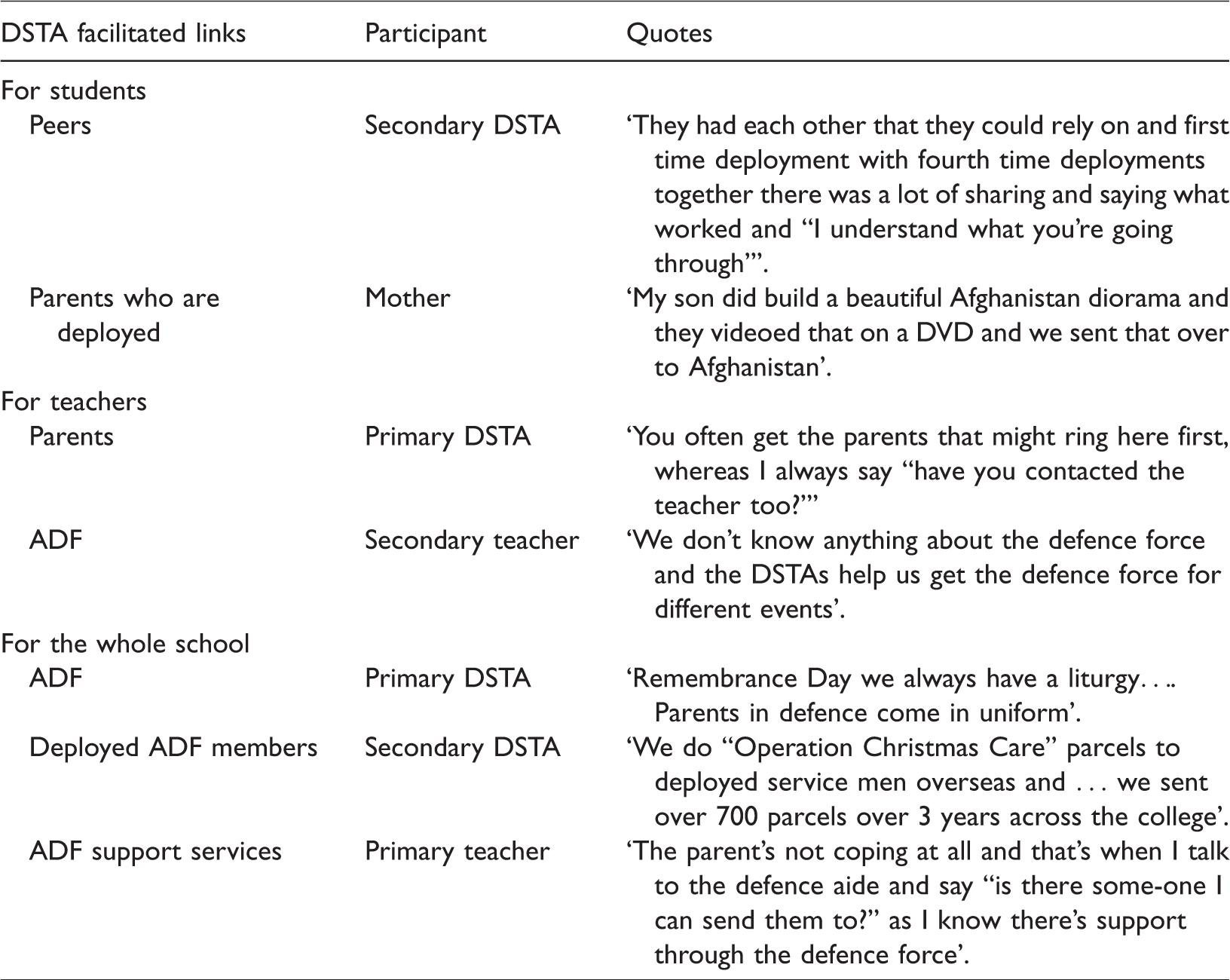
The data suggested that the parents, teachers and DSTAs participating in the study felt that their schools’ capacity to respond effectively to students’ needs during a parental deployment benefitted from the employment of a DSTA. The parent participants reported reassurance through the availability of an understanding and supportive adult who responded to their children’s specific needs at school. They were also appreciative of the DSTAs’ role in advocating for their children’s needs with their teachers. Teacher participants recognised the learning and wellbeing benefits of increased parent–school engagement and increased opportunities for students to participate in targeted activities outside the classroom. In addition, teacher participants appreciated the increased ADF involvement in their schools’ learning programmes. DSTAs recognised that their work with teachers and their engagement with parents and the ADF enhanced the capacity of the school community to respond effectively to students’ needs during a parental deployment. Table 1 outlines the school and community links that were facilitated by DSTAs, as reported by participants.
School and community links identified in the data.
Raising awareness of deployment demands on families
Teacher and DSTA participants reported that DSTAs advocated for students’ additional needs with the schools’ administration team when family circumstances interfered with students’ ability to meet school commitments, for example meeting assessment dates. Modifications to formal school policies such as assessment schedules and attendance requirements were made by principals in recognition of the significance to student wellbeing of mid-deployment family reunions and end of deployment family holidays. Thus, family stability was promoted by school principals who made appropriate allowances. With a greater understanding of deployment related students’ needs principals have built greater flexibility into school process as described by Kelly, a secondary school teacher: As long as we’re aware of what’s happening, there’s no problem with it…. Knowing the background info, Dad’s come home after eight months, ‘go on go and have a holiday or do what you need to do, get back together as a family’ … The principal is very adamant that parents being deployed is very important in our school and we need to look after those kids. He just wants kids to do the best that they can all the time. They had each other that they could rely on and first time deployment with fourth time deployments together there was a lot of sharing and saying what worked and ‘I understand what you’re going through’.
DSTA participants suggested that contributing to whole school projects built a sense of school connection for students. Students from both ADF and civilian families worked together to prepare Christmas care packs that were sent to ADF members overseas. The students wrote messages to accompany the boxes and many received replies. Replies from ADF members, sharing their thoughts and experiences with students in an age appropriate way, assisted students to grasp the significance of ADF work. Making such artefacts available to the broader school community communicated the schools’ commitment to ADF families. Jessica, a secondary school DSTA, described how the preparation of Christmas care packages engaged the student community with deployed ADF members. She shared return correspondence from the deployed ADF members with the whole school community by publishing them in a scrap book: We do ‘Operation Christmas Care’ parcels to deployed service men overseas and … we printed special school Christmas cards to put in the boxes that all the students wrote messages in and we also had stamped addressed envelopes for them to send responses back to the students…. When any student got a response we photocopied them and put them in big scrapbooks which sit in reception so all parents and visitors can see.
Generating school–family dialogue
All three groups of participants (mothers, teacher participants and DSTAs) recognised that the DSTAs’ work with parents and teachers contributed to a shared understanding of school based support that was available to students during a parental deployment. DSTAs also recognised how the support they offered to parents and teachers indirectly supported their students by promoting a shared adult understanding and a united response to students’ needs (Aaronson & Perkins, 2013). Catherine, a primary school DSTA, described how she maintained a dialogue with teachers and also encouraged parents to keep teachers informed: We like to keep a really good relationship with the teachers in all the classes here…. If they know that that parent’s deployed they will send us an email or even if they see us walking around the school, they’ll make the time to say, ‘oh so and so’s dad’s away, can you please pop in and see them they are not feeling well or they’re having a bad day. They’ve been a little sad’. So it’s just keeping in contact with that teacher after they make that first contact and touching base with them backwards and forwards … I really believe you need to keep the whole school in the loop. I can’t just do my little bit and not keep the teacher informed. I found working with the DSTA very, very helpful…. The student was very, very disruptive. He would not settle down, he wouldn’t sit still and because he was a defence child the DSTA had some background about him which was really helpful…. She told me things I might need to know to get things organised for him at school…. She was the one who suggested getting in contact with mum … and it was just a very good support network really. Sometimes when those parents are away on deployment for such a long time as well I guess sometimes they can isolate those fathers or mothers from the school because they’re not involved in the school community as such. But when these things are happening it helps them to feel that ‘yes there is a contribution and a little bit of acknowledgement’.
Building school–ADF links
Many students from civilian families have only a limited knowledge and experience of the ADF. Findings suggest that the inclusion of ADF presentations, displays and demonstrations into the school calendar built links between schools and the ADF community and raised students’ and teachers’ awareness to the role of the ADF and the presence of ADF families within their school community. DSTAs have created important links between the school and the ADF community and, through liaison with the local military base, provided students with a broad range of military related experiences. ADF representation in the school community provided students from ADF families with opportunities to express their pride and share their cultural knowledge with students from civilian families. Robyn, a primary school teacher, expressed her appreciation of ADF input into the school curriculum: We don’t know anything about the defence force and they help us get the defence force for different events…. So it shows students and it gets the defence families more involved and get to view their kid and the kid feels proud. ‘That’s my dad or my mum’. Networking and professional development opportunities and the coordination of them is very important and invaluable. It’s an opportunity to share and support each other. We take away a reinvigorated energy. More of that is needed.
Discussion
Findings suggest that the employment of DSTAs in Australian schools has assisted multiple levels of the school community to gain a greater appreciation of the pressures facing students and their families during a parental deployment. Whole school and classroom projects implemented by DSTAs have facilitated an increased whole school understanding of ADF culture. Furthermore, increased engagement between the school community and ADF families, the ADF, and Australian Defence Organisation (ADO) family support agencies, has enhanced school-based awareness and broadened school staff members’ understanding of increased student needs during parental deployment. In addition, an increased awareness of the ADF lifestyle enhanced the capacity of the whole school community to offer culturally relevant support to students and contribute to building a more responsive and supportive school environment for students with a parent who is deployed.
Findings suggest that the employment of DSTAs has facilitated increased levels of school–family interaction. The parents who participated in this study and other parents referred to by DSTA and teachers participants in their interviews were found to engage with the DSTAs as members of their known support group and when necessary DSTAs provided social-emotional support to parents and made appropriate parent referrals to the DCO. Findings suggest that increased engagement with the school community has increased parents’ sense of connectedness and participation in school activities (Huebner et al., 2009). Furthermore, increased dialogue between parents and teachers has facilitated a greater teacher appreciation of the ADF lifestyle and of students’ unique needs during parental deployment.
Consistent with Huebner et al.’s (2009) work on community capacity building DSTAs encouraged the integration of ADF families into the whole school community thus strengthening parents’ subjective as well as objective experiences of school engagement while increasing the opportunities for parents to contribute their cultural knowledge to the school community with DSTAs representing a key connection point between schools, DCO and ADF families. Huebner et al. (2009) proposed that informal relationships, such as those formed amongst parents at their children’s schools, linked with formal support structures such as schools and DCO, built goodwill and a desire for reciprocity.
Through the provision of practical support and collaboration, DSTAs were found to assist teachers to appreciate the pressures facing students and parents during a deployment. Equipped with greater knowledge teachers planned ahead and prepared to cater for students’ additional needs. Increased teacher knowledge was communicated to their students through classroom processes. Furthermore, practical support from DSTAs enabled teachers to facilitate additional activities to cater for the needs of students during a parent deployment.
An increased understanding of the challenges facing students during parental deployment was found to assist school administrators to exercise flexibility in school processes, such as those related to attendance and assessment requirements, and supported individual students and families during specific life circumstances. School responsiveness to students’ and families’ unique needs increased the level of mutual understanding, reciprocity and cooperation between ADF families and their schools. In turn, a whole school understanding of students’ needs promoted an integrated network of support for students during a parental deployment by bridging the cultural gap between ADF families and the school communities.
DSTAs’ work has generated many school–community links and provided opportunities for sharing knowledge about the ADF lifestyle. ADF commanders, ADF families and ADO family agencies recognise DSTAs as an initial point of entry into schools (DCO, 2007, 2011) thus breaking down previously perceived barriers (Hamilton, 1986). Through working collaboratively with both ADO community agencies and with all levels of the school community DSTAs have contributed towards a collective appreciation of the ADF lifestyle and the related pressures placed on children and their education. In turn, the findings suggest that DSTA work promotes, within the school, a shared sense of responsibility for supporting students from ADF families that in turn helps students to address their increased social, emotional and academic needs during parental deployment, thus, supporting Huebner et al.’s (2009) model of community capacity building. Community links between schools and DCO have raised school staff awareness of additional services available to families and has instigated family referral processes when appropriate.
Consistent with the tenets of Bronfenbrenner’s bioecological theory of human development (Bronfenbrenner & Morris, 2007) coping with deployment related life experiences has helped students to develop increased personal resources with which to approach future deployments and other environmental transitions. Furthermore, engagement in supportive school processes established important patterns of participation and interaction that placed students in good stead for positive community engagement throughout the remainder of their schooling and as future community-based adults. Moreover, DSTA employment contributed towards generating a more supportive school environment for students during a parental deployment thus reducing the likelihood of students and parents perceiving the school environment as hostile, a possibility suggested by De Pedro, Esqueda, et al. (2014).
Limitations and further research
There are limitations to consider when reviewing these findings. As a small study, the findings represent only the perspectives of the 47 participants. In addition, this study was conducted in one Australian regional city. ADF members reside in a diverse range of settings across Australia and the findings of this study may not represent the experiences of ADF families in other locations.
Females were over represented in the parents’ and secondary teachers’ participant groups. All parent participants were the female partners of male ADF members although an estimated 25 per cent of ADF members are female (DPG, 2016). Only one of the eight secondary school teacher participants was a male. This was disproportionate to the proportion of male teachers in the participating schools and potentially led to a response bias. In addition the parents’ and teachers’ participant groups were purposively sampled from participating schools. It became evident during the data collection that the sampling process had identified participants who uniformly supported the DSTA programme. Participants were provided with an opportunity to provide constructive criticism of the DSTA programme during the interviews but little of note was forthcoming. The only grievance noted by several participants was that in their view the DSTA programme needed to be expanded into more schools.
No students were interviewed for this study. Students’ voices could have added an additional perspective to the data. However, this was not possible for ethical reasons. Because of children and young people being considered a ‘special group’ a study including student interviews would require a separate study proposal for consideration by the Australian Defence Force Human Research Human Ethics Committee (ADHREC). A future national review of the DSTA programme could more readily ascertain whether the study’s findings are transferable across different aspects of DSTAs’ work, different military locations, and other students in Australian schools whose parents also work in dangerous occupations that require working away from home such as in mining, bush fire-fighting and offshore oil rigs.
Conclusion
This article has examined the processes employed by schools to support students with a deployed parent as perceived by parents, teachers and DSTAs. As school staff members with a knowledge of school operations and in-depth knowledge of the ADF lifestyle DSTAs accessed normal school processes to provide opportunities to advocate for students and their families and provided a school-based resource available to students, families and other staff members during the school day. As integrated members of the school staff DSTAs offered readily accessible support and expertise to the school community thus building school capacity to support students during parental deployment. Access to on-site expertise and practical supportassisted school administrators and teachers to in turn develop their professional knowledge of the military lifestyle. Facilitation of targeted projects and programmes both supported students with deployed parents and provided opportunities for the whole student body to increase their understanding of the challenges faced by their peers with deployed parents.
Footnotes
Declaration of conflicting interests
The author(s) declared no potential conflicts of interest with respect to the research, authorship, and/or publication of this article.
Funding
The author(s) received no financial support for the research, authorship, and/or publication of this article.