




Abstract
Debate about teacher gender balance in primary education is a constant. This debate is fuelled by recommendations to increase recruitment and retainment of males into primary education. In parallel, 10-year trend data indicate a continual decrease in male primary school teachers. Although many factors contribute to the decreasing percentage of male primary teachers, one factor is the gender-related challenges they face in their profession. Previous research has identified some of these challenges; however, a limitation of these claims is contextual and individually bound data derived from qualitative research methods. Large-scale interventions have not been realised as current trends are unable to be generalised to the wider population of male primary teachers. Thus, the aim of this paper is to expand upon previous literature through discussing the development and validation of a scale which quantifies the gender-related challenges faced by male primary teachers.
Introduction
Debate about teacher gender balance in primary education is fuelled by reports from statutory authorities in Australia that recommend to increase recruitment and retention of males into primary education (Weldon, 2015). In parallel, 10-year trend data indicate a continual decrease in male primary school teachers in Australian schools (Australian Bureau of Statistics, 2016). Although many factors contribute to the decreasing percentage of male primary teachers, one challenge is that primary teaching is widely perceived by society as a female occupation (Cushman, 2007). This perception is sustained by the societal held notion that roles which contain a caring aspect are a ‘natural job’ for females (Cameron & Moss, 1998). Crossing gender boundaries presents many challenges. Research related to male primary teachers suggests that many males are lacking the necessary personal resources to cope with these challenges and ultimately abandon teaching (Mills, Haase, & Charlton, 2008). Nonetheless, a limitation of these claims is the reliance on contextual and individually bound data derived from qualitative research methods. There is a paucity of large-scale research projects to support this generalisation. Thus, the aim of this article is to expand upon previous literature through discussing the development and validation of a survey tool which quantifies gender-related challenges faced by male primary teachers.
Male primary teachers face specific gender-related challenges after graduation. Previous qualitative studies have identified a range of challenges including dissatisfaction about salary (Cushman, 2007), increased workload due to expectations to perform masculine roles (Smith, 2008), negative perceptions in society and the media (Mistry & Sood, 2015), discouragement from family (Foster & Newman, 2005) and friends (Cushman, 2005a), social isolation (Ashcraft & Sevier, 2006), questions about their sexuality (Mills et al., 2008), uncertainty about role modelling (White, 2011), and uncertainty about making physical contact with students (Burn & Pratt-Adams, 2015). These challenges are moderated by demographic variables such as age, years of teaching experience, the number of male teachers at the school where they work, whether or not teaching was their first career, the gender of the principal at the school where they are employed, and whether or not they are a parent (Moyles & Cavendish, 2001; Smith, 2008; White, 2011).
There is considerable merit in the capacity of qualitative methods to delve into the lived experiences of male primary teachers, but the identification of common generalisable factors might be a better strategy to support the development of quality and comprehensive induction and/or professional learning and development programmes for male teachers.
In educational research, some areas of inquiry move from small sample qualitative research methods to more generalisable designs utilising surveys of larger samples (e.g. O’Connor, Penney, Alfrey, Phillipson, & Phillipson, 2016). In an effort to progress our understanding of the gender-related challenges faced by male primary teachers, we decided the design of a survey using four-point Likert scale items based on the challenges previously identified through qualitative research might be instructive. Hence, this article reports on such a study.
Method
Instrument development
As little was found in the literature with a specific focus on the gender-related challenges faced by male primary teachers, the research team developed an online survey tool to address this gap based on the recommendations of Senocak (2009). This process allowed the researchers to test the validity and reliability of the tool through four stages: item formulation derived from previous literature, content validation using an expert panel of researchers, reliability analysis, and construct validation of the survey items. Through the item formulation and content validation stages, nine statements were devised to address the individual challenges faced by male primary teachers to create the Male Primary Teacher Gender Challenge Inventory (MPTGCI) (Table 1). Consistent with relevant broader focused educational scales (Andersen & Pickeral, 2000; Cruickshank, Pedersen, Hill, & Callingham, 2015), all statements were worded in a positive direction and the following descriptors ‘1 = Not a challenge’, ‘2 = Slight challenge’, ‘3 = Moderate challenge’, and ‘4 = Critical challenge’ were used for the four-point Likert-scale items.
Male Primary Teacher Gender Challenge Inventory (MPTGCI).
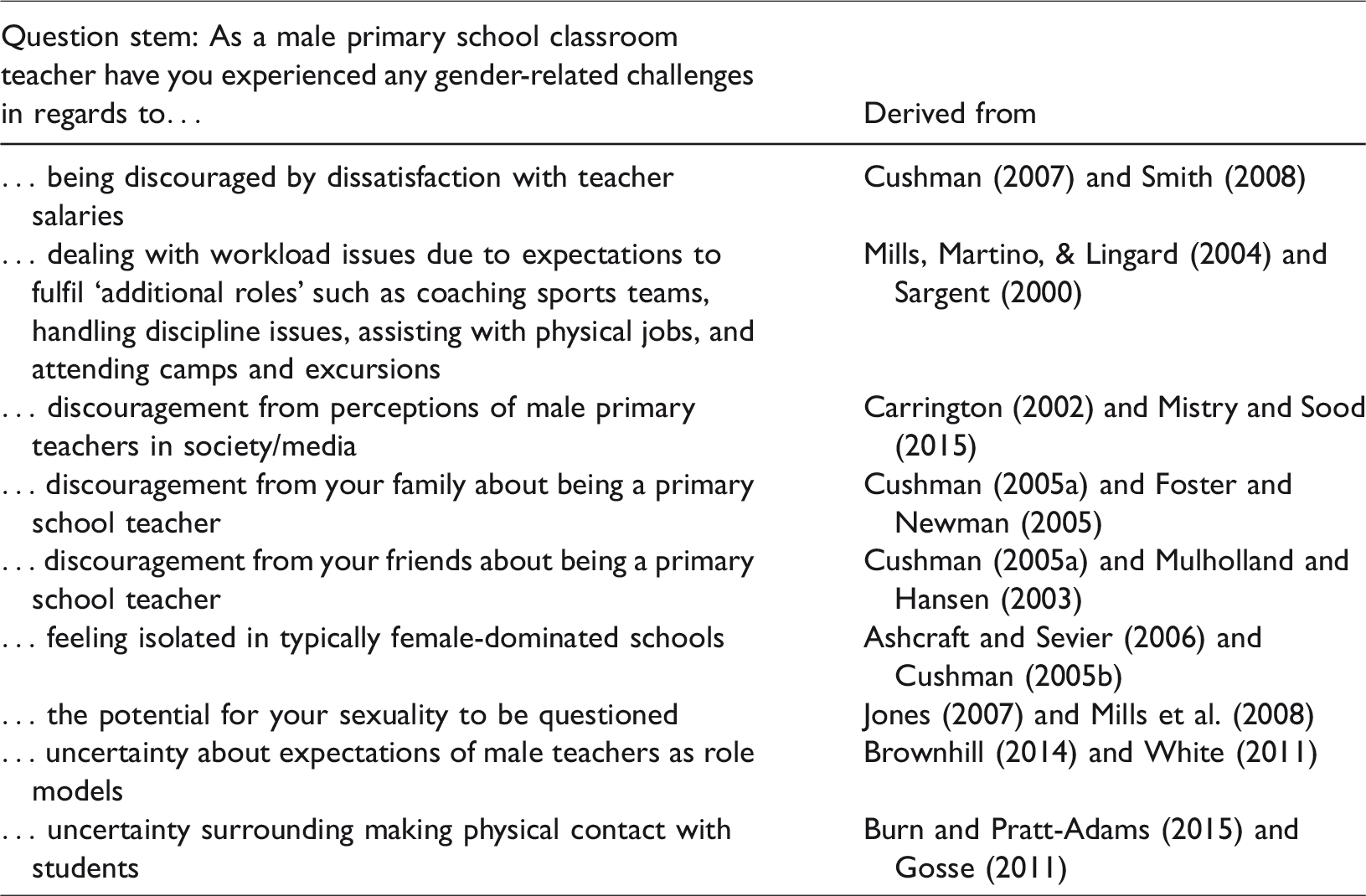
To establish content validity, the items were reviewed by an expert panel consisting of a male primary teacher, a male primary principal, a female English teacher, and three researchers within the Faculty of Education at an Australian-based university. The panel was informed of the purpose of the scale and what it was intended to measure, namely gender-related challenges experienced by male primary teachers as perceived by practicing male primary teachers. Panel members were then asked to provide feedback and propose suggestions for improvement. The panel proposed a variety of changes, including a reordering of the information contained in the introduction to the scale to increase clarity, and the addition of a back button so participants could return to previous questions. The wording of certain items was also changed to increase specificity and comprehension. For example, shortening the statement ‘uncertainty about what the potential expectations of male teachers being role models involves’ to ‘uncertainty about expectations of male teachers as role models’. Once these changes had been implemented the expert panel concluded that the nine-item scale had sufficient content validity because it adequately covered the intended construct.
Participants
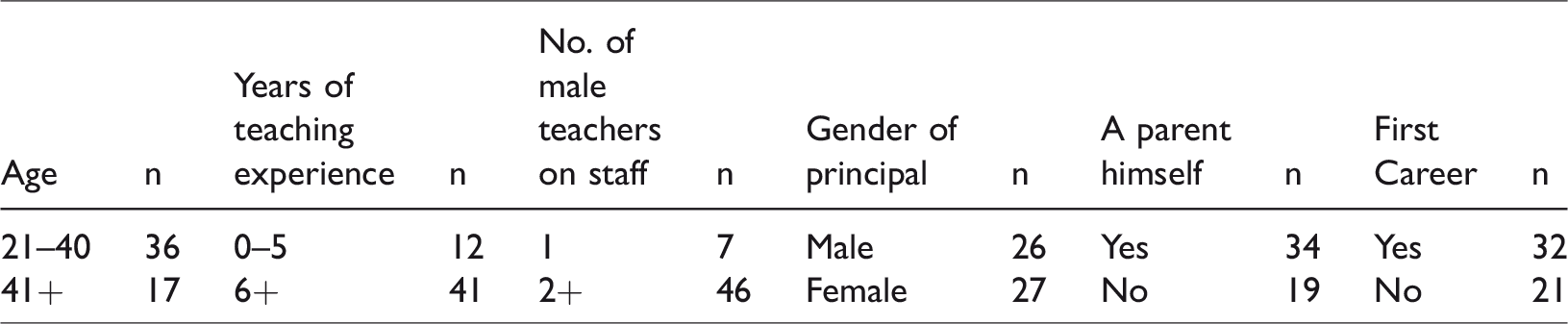
A total of 175 male primary teachers teaching in the Australian state of Tasmania were invited to complete the MPTGCI scale. Of the 57 who accessed the scale 53 (mean age = 37.82, SD = 10.44) completed it representing a 30.3% response rate. Table 2 provides sample demographic characteristics which were used as the dichotomous independent variable levels for the inferential analysis described below.
Participant demographic characteristics.
Procedures
The study was approved by the Tasmanian Human Research Ethics Committee (No. H12257) and all participants provided informed consent prior to beginning the online scale.
The scale link was emailed to participants via their school principal. This approach might have resulted in principals influencing participants and their access to the scale. However, it was a non-negotiable requirement in order to obtain ethical approval. Once participants accessed the online scale and indicated their consent they were able to anonymously complete the demographic questions and respond to the nine items regarding the gender-related challenges they faced as male primary teachers. On average, participants took 9.90 ± 3.34 minutes to complete the scale.
Data analysis
The reliability and construct validity of the MPTGCI scale instrument were analysed using Rasch (1960) analysis. Within Rasch modelling, construct validity is ascertained by considering the fit to the model of both the scale items and the participants (Wright & Masters, 1982). The first assumption of the Rasch model is that the items measure a single, unidimensional construct – in this case gender-related challenges for male primary teachers. Results of a Rasch analysis provide some information which can be used to assess construct validity, including infit and outfit values to examine the fit of the data to the Rasch model and variable maps indicating item difficulty. Mean infit and outfit scores show the amount of distortion in the measurement system and whether or not the items and participant responses actually fit the expectations of the Rasch model. This conjoint measurement of items and persons is measured in mean square values (MNSQs) and standardised z-score values (ZSTDs). MNSQs between 0.6 and 1.4 are generally deemed to be acceptable for Likert-scale items (Bond & Fox, 2007), with acceptable ZSTD values falling between ±2.
The second aspect of construct validity is that the MPTGCI scale items actually measure what they intend to measure. This relies on a qualitative assessment of the variable maps which depict construct output derived through the Rasch model analysis. Rasch measurement provides a means of applying a criterion-referenced approach to this interpretation (Griffin, 2007). Items are distributed along the scale in order of difficulty, and the groupings of items at different points indicate similar levels of difficulty. We utilised this profile to group perceptions of the gender-related challenges described in the MPTGCI scale. The relative difficulty of the items is shown in logits, which is a basic unit of Rasch measurement. Logit values are distributed around a mean of 0 logits.
Due to the skewed distribution of the Likert scale data, medians and semi-interquartile ranges were used to report central tendency and dispersion. Frequency counts are presented as both raw numbers and percentages. All data were tabulated and analysed using Microsoft Excel software.
For inferential analyses, the dependent variable Likert scale data were reduced to dichotomous nominal categories for each of the nine challenges. To this end, responses of 1 were categorised as not a challenge whereas ratings of 2, 3, or 4 were combined to indicate that the participant interpreted the statement as a challenge that he had experienced as a primary teacher. The six pertinent demographic variables identified in the literature were treated as independent variables with manipulated dichotomous levels as shown in Table 2. First, 54 2 × 2 contingency tables were created for the six independent variables and the nine dependent variables. A series of chi-square tests of independence with an alpha level of 0.05 (critical value = 3.84) was used to test for any significant differences. Chi-square values that exceeded this critical value were deemed as a statistically significant finding. While all chi-square values are reported in the ‘Results’ section (Table 5), only significant findings are interpreted in the ‘Discussion’ section.
Results
Descriptive statistics
Table 3 shows the frequencies and proportions of respondents selecting responses for each statement. These data indicated that the challenges concerning physical contact (median= 3 ± 0.5), workload (median = 2 ± 0.5), and isolation (median = 2 ± 1) were the most difficult for participants to deal with. Additionally, dividing responses into those that perceived an item was not a challenge (1) and those that perceived an item was a challenge, either slight, moderate, or critical (2, 3, 4) revealed that more than two-thirds of participants rated physical contact (70.2%), workload (70.2%), and isolation (66.7%) as being challenges. No other item was rated as a challenge by more than two-thirds of participants (range = 5.3–59.6%).
Summary of survey responses.
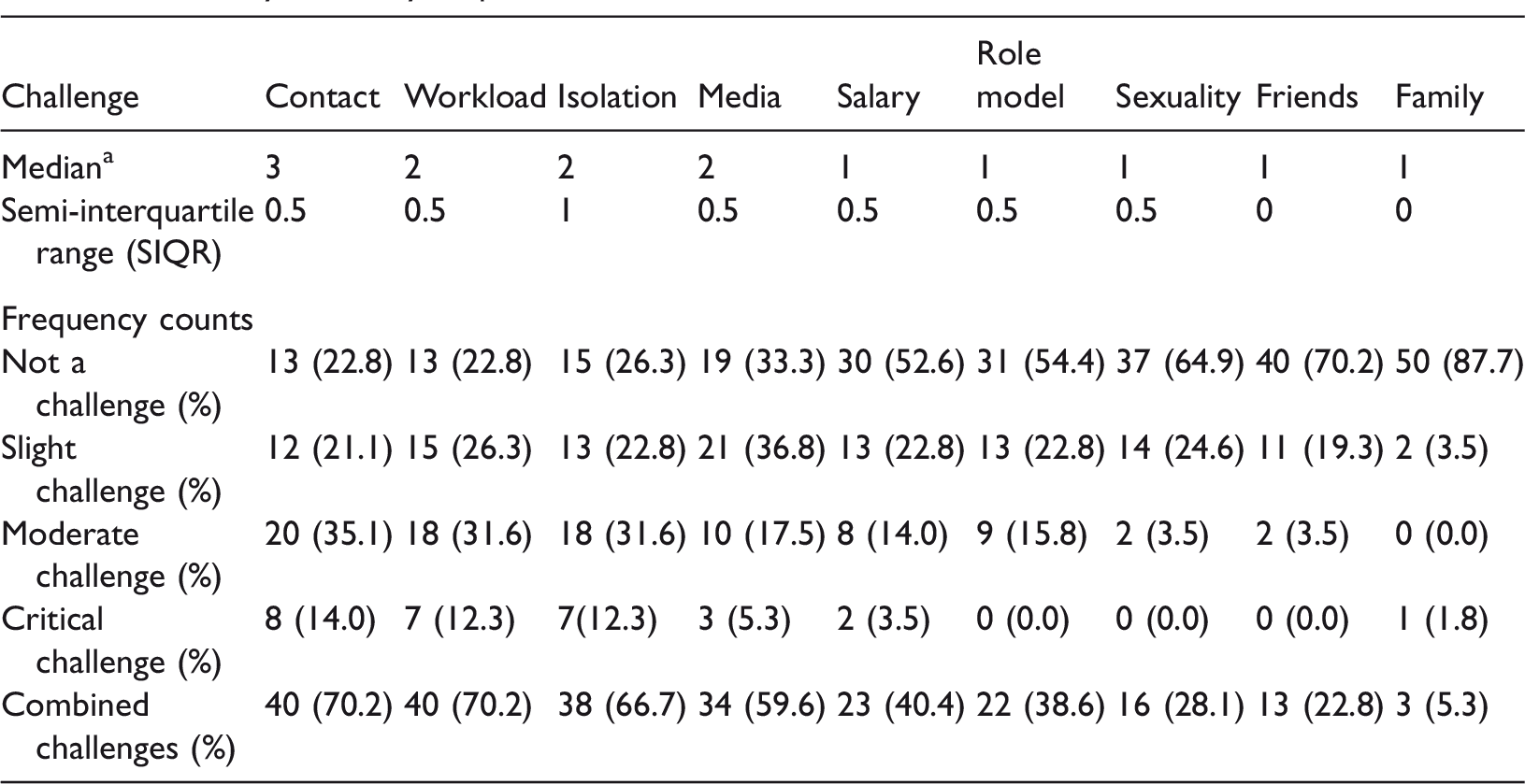
aFour-point scale with the following response options: ‘1 = Not a challenge’, ‘2 = Slight challenge’, ‘3 = Moderate challenge’, and ‘4 = Critical challenge’.
Reliability
Cronbach’s alpha (α) coefficient (Cronbach, 1951) is a specific measure of the degree to which items within the scale measure the same construct as other items in the scale. This is the most common measure of scale reliability in social science literature and was utilised in this study because it provides a good estimate of reliability in most situations (Nunnally, 1978). The nine-item MPTGCI scale showed a relatively high level of internal consistency with a Cronbach’s α of 0.82.
Construct validation
Infit and outfit scores for items and persons all fell within the required 0.6–1.4 MNSQ and ±2 ZSTD ranges (see Table 4) indicating a good fit of the data to the Rasch model and hence strong construct validity of the MPTGCI scale.
Mean infit and outfit scores for items and persons.

MNSQ: mean square value; ZSTD: z-score value.
Figure 1 demonstrates the relationship between participants, items, and the construct of gender-related challenges, and their alignment on a single measurement scale. Analysis of this variable map indicates distinct ‘steps’ between items or groups of items. The items involving fear and uncertainty surrounding physical contact, increased workload, and social isolation are grouped together at the bottom of the scale. This positioning indicates that participants found it easiest to agree that these items were real challenges for them to deal with at work. Increased participant numbers in future iterations of this scale might also allow for greater differentiation between these more difficult items. The data appear to be inverted because it uses a scale of difficulty, and the term ‘challenge’ is generally perceived as a negative emotion. The family and friends items are located at the top of the scale because participants find it more difficult to agree that these items are actual challenges. Taken together, the Rasch analysis indicated that the MPTGCI scale exhibited high internal reliability and construct validity.
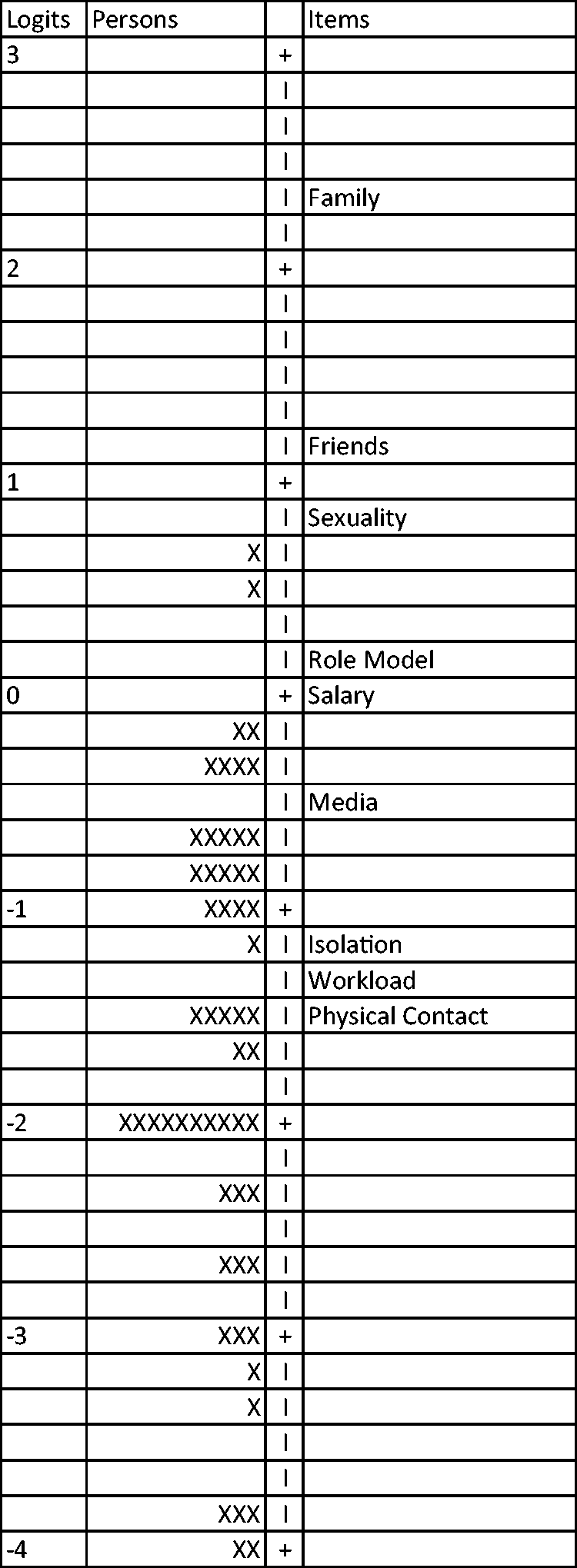
Variable map showing item difficulty and participants perceptions of these items.
Inferential statistics
The relevant literature did not contain any evidence of differences in responses between participants based on any of the six demographic variables. Hence, we did not test any directional hypotheses, for example that male teachers with more teaching experience perceived the workload to be less of a challenge than less experienced male teachers. Chi square values for the 54 2 × 2 contingency tables are shown in Table 5. This analysis revealed only three significant findings between the dichotomous levels of the independent variables when the dependent variables were reduced to participants either identifying the statement to being a challenge or not being a challenge. Participants with a female principal (challenge = 21, not a challenge = 6) felt significantly more discouraged by negative societal and media perceptions (χ2(1)=4.44, p < 0.05) than participants who had a male principal (challenge = 13, not a challenge = 13). Similarly, participants who had a female principal (challenge = 22, not a challenge = 5) felt significantly more isolated (χ2(1)=4.93, p < 0.05) than participants who had a male principal (challenge = 18, not a challenge = 8). Additionally, participants with no male teaching colleagues (challenge = 6, not a challenge = 1) found role modelling significantly more challenging (χ2(1)=6.49, p < 0.05) than participants with male teaching colleagues (challenge = 16, not a challenge = 30). Therefore, we rejected our null hypothesis for these three significant findings.
Our null hypotheses of no differences were supported for all other statements depending on age, years of teaching experience, the number of male teachers at the school where they work, whether or not teaching was their first career, the gender of the principal at the school where they are employed, and whether or not they are a parent.
Chi square values for challenges (DV) by demographic variables (IV).
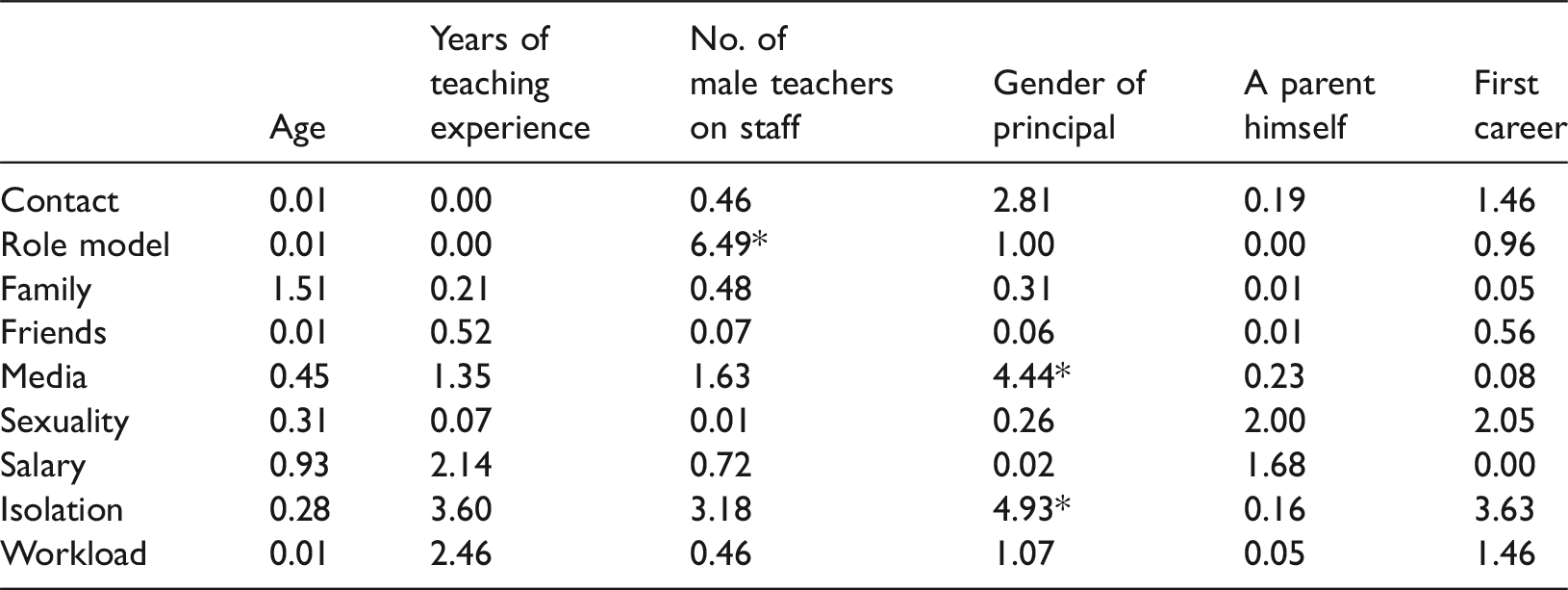
*Significant at p < 0.05.
Discussion
Self-completion questionnaires are a systematic method of collecting data from particular populations in a manner which reduces interviewer bias as well as time and monetary resources involved in administration and provides participant privacy in sensitive topic areas (Bruce, Pope, & Stanistreet, 2008). The investigation of gender-related challenges experienced by male primary teachers is an area that traditionally employed qualitative methods (e.g. Burn & Pratt-Adams, 2015; White, 2011). A clear gap in this area was an instrument that might be used to gather broader or systematic data from a larger sample of participants. Therefore, one of the aims of this research was to develop a valid and reliable scale for measuring these challenges. As such, a reliable scale would allow researchers to develop more generalised interventions to address any gender-related challenges faced by male primary teachers. The MPTGCI built upon previous qualitative research, and analysis showed strong content validity, reliability, and construct validity. The findings to date reveal that it will be a useful data collection tool for future research concerning male primary teachers.
The research team treated the data as nominal in order to address limitations due to having only one item per challenge. Treating the data as nominal rather than ordinal was a more conservative way of measuring whether or not these items were a challenge for participants in this study. Future research could consider the addition of more items to measure each challenge. Potential examples could include items about whether male teachers are expected to fulfil specific additional roles in their schools such as coaching sports teams, handling discipline issues, and assisting with physical jobs. Alternatively, researchers could consider grouping challenges into themes such as the influence of societal perceptions of male primary teachers, how schools perpetuate these gendered beliefs and roles, and the fear and uncertainty male primary teachers experience at an individual level because of these challenges.
Rewording some scale items to ensure they are specifically focussed on the gender-related challenge would make the gender focus more explicit. For example, in the item: ‘Dealing with workload issues due to expectations to fulfil additional roles such as coaching sports teams, handling discipline issues and assisting with physical jobs, attending camps and excursions’ gender is only implied. The item did not specifically make reference to an increased workload because of gender.
For future use of this scale the following alterations to the item are recommended: ‘Dealing with workload issues due to expectations for men to perform additional roles such as coaching sports teams, handling discipline issues and assisting with physical jobs’.
An outcome of the validation of the MPTGCI scale was a confident realisation that inferences drawn from the data were robust and sound. Further, the inferential data analysis revealed that the gender of the principal was the most significant influence on the perceptions of participants in this study. The influence of the principal’s gender on how male primary teachers cope within a female-dominated workplace is consistent with previous literature (e.g. Cushman, 2008). Male primary teachers have reported that dealing with the negative perceptions of being a male in a gendered workplace (Gosse, 2011; Mills et al., 2004; Smith, 2008) was harder if they were supervised by a female principal. There is a need for female principals to increase their awareness of how negative societal perceptions of male primary teachers affect their male staff and what they can do to support them (Cruickshank, 2016). Thus, it would appear that while principals cannot change negative societal perceptions, they can be instrumental in creating and promoting a supportive school culture that does not perpetuate traditional gendered work roles. Having a well-respected male primary school principal might in itself raise perceptions of male teachers within the local school community. This is an interesting anomaly, despite only 18% of Australian primary teachers being male, men hold 35% of the leadership positions in primary schools (Australian Bureau of Statistics, 2016; McKenzie, Weldon, Rowley, Murphy, & McMillan, 2014). This statistic could be an indication of positive discrimination favouring the promotion of male teachers to senior leadership roles within primary schools, thereby perpetuating traditional gendered work roles (Smith, 2008).
A subsequent related finding of this study was the impact of social isolation which was found to be greater for male teachers in schools where the principal is female. This was a new finding and thus further exploration is required to ascertain how isolation is connected to the gender of the principal. Perhaps the presence of a male principal, who might have experienced the same social isolation and developed coping strategies is better positioned to ensure similar cultures are not encouraged. Previous research (e.g. Ashcraft & Sevier, 2006; Cushman, 2005a) has argued for male primary teachers to become proactive in developing positive professional relationships with teaching colleagues and school leaders. This finding suggested that female principals might need greater awareness of how challenges such as social isolation can affect male teachers in their schools, and open professional dialogue with these men about how they can support them to enact successful coping strategies.
Finally, the results of this study indicated that male primary teachers’ perceived role modelling challenges were a significantly larger challenge if they did not have any male teaching colleagues in their school. This finding is congruent with previous research that noted challenges such as isolation (e.g. Ashcraft & Sevier, 2006; Smith, 2008) and the expectation to be a positive male role model (e.g. Brownhill, 2014; Cushman, 2005b) were more difficult for male primary teachers who had few or no male teaching colleagues.
The gender-related challenges male primary teachers face in their profession are not perceived equally. Descriptive data indicated that the challenges concerning physical contact, workload, and isolation were the most difficult for participants in this study to deal with. More than two-thirds of participants rated physical contact, workload, and isolation as being challenges.
A limitation of the study was that significant differences between only two levels of the previously identified demographic variables were identified. Physical contact was a difficult challenge for all participants. For this reason no significant differences were found between any of the dichotomous groups. Future research could consider treating the data as ordinal and using frequency counts (as we have demonstrated in Table 3) if statistically ranking challenges in order of difficulty is required. Increased participant numbers and greater focus on the more difficult items (physical contact, workload, isolation) might allow for greater differentiation between these items grouped closely together at the lower end of the scale.
Conclusion
The MPTGCI is the first scale to examine the gendered challenges faced by male primary teachers and the demographic variables that can influence their perceptions of these challenges. The instrument represents a step towards being able to generate generalisable data about the challenges faced by male primary teachers. As such, it provides a potential foundation for future work in this area. In this study data were treated as nominal, but ordinal frequency counts were also presented which indicated that the gender-related challenges concerning physical contact were rated as moderate or extreme by more than half of the participants in this study. These findings indicated that this challenge should be a key focus of future research on male primary teachers. The identification, development, and implementation of strategies and support mechanisms to assist men to cope with these gender-related challenges should also be a key focus of future research on male primary teachers. Caution should be employed when considering these findings because data collection was from a small convenience sample. This scale could be replicated on a larger cohort to collect more representative data that can be used to make inferences about male primary teachers.
Research has an important role in helping the education profession better understand the specific challenges male teachers face and, we expect, increase the number of males recruited and retained in primary teaching roles. It is anticipated that this instrument can assist in advancing this important task.
Footnotes
Declaration of conflicting interests
The author(s) declared no potential conflicts of interest with respect to the research, authorship, and/or publication of this article.
Funding
The author(s) received no financial support for the research, authorship, and/or publication of this article.