




Abstract
In this study, Indigenous children’s affective engagement with primary school is examined in terms of feelings of involvement and belonging at school and towards education as a worthwhile pursuit. Previous Australian research has concentrated on Indigenous children’s education through attendance and school performance. Data from wave 6 of the Longitudinal Study of Indigenous Children are used to investigate the socio-structural, subjective and relational factors which influence affective engagement with school. Results show that good relationships with peers and teachers are positively associated with Indigenous children’s affective engagement. Negative feelings about Indigenous identity are negatively associated with affective engagement. Socio-structural factors associated with higher affective engagement include being female, living in remote areas and being healthier. Results also show that parental education, employment, household income or area-level socio-economic circumstances are not associated with affective engagement. These results suggest that factors influencing Indigenous children’s affective engagement with school and towards education may differ from those affecting school attendance. They also emphasise the importance of subjective and relational influences on improving Indigenous children’s education outcomes.
Keywords
Introduction
Indigenous disadvantage in Australia is a major social and economic issue underpinned by persistent intergenerational social and economic inequalities (Hunter, 1999; Walter, 2007, 2009; Walter & Andersen, 2013). According to a cumulative disadvantage perspective, initial instances of comparative disadvantage systemically accumulate in successive increments over time (Dannefer, 2003; Merton, 1988). Prior research suggests that those with lower levels of education have significantly greater risk of low income, unemployment and poor health later in life (Dupre, 2008). Indigenous educational inequality in particular has long been recognised as a key contributing factor to the overall disadvantage experienced by Indigenous Australians (Gray & Beresford, 2008; Purdie & Buckley, 2010). Consequently, improving early educational outcomes has been identified as a priority for improving Indigenous Australians’ well-being (Steering Committee for the Review of Government Service Provision, 2014; Zubrick et al., 2006).
Engagement with school is viewed as essential to improving educational outcomes for Indigenous children. Broadly, school engagement refers to involvement in school and a commitment to learning (Appleton, Christenson, & Furlong, 2008; Fredricks, Blumenfeld, & Paris, 2004; Jimerson, Campos, & Greif, 2003; Wang, Willet, & Eccles, 2011). Specifically, it is identified as a multidimensional construct with three main dimensions: (1) behavioural (participation and attendance in school activities), (2) affective (liking, belonging at and identifying with school) and (3) cognitive (aptitude for and interest in learning) (Appleton et al., 2008; Fredricks et al., 2004; Jimerson et al., 2003; Lam et al., 2014; Wang et al., 2011). Each dimension comprises a set of attitudes and behaviours which delineate school engagement or disengagement. Where disengagement reduces the likelihood of school success, engagement protects against misbehaviour, school failure and drop out in the short and long term (Finn & Rock, 1997; Finn & Zimmer, 2012; Resnick et al., 1997; Rumberger, 2001; Steinberg & Avenevoli, 1998). While the engagement dimensions are interrelated, they also operate independently in influencing school outcomes (Finn & Zimmer, 2012). Most Australian research and policy on Indigenous engagement with primary school focuses on behavioural engagement, assessing school attendance (Department of the Prime Minister and Cabinet, 2016) or on cognitive engagement, assessing numeracy and literacy scores (Warren & deVries, 2009). In this article, however, we focus on affective engagement.
In the broader education literature, the importance of affective engagement for student outcomes has been widely recognised. Various studies show associations between elements of positive affective engagement and academic achievement, improved attendance rates and graduation prospects (Biddle, 2014; Finn & Zimmer, 2012; Goodenow, 1993). Despite evidence of these positive associations we know relatively little about the socio-structural, demographic and attitudinal factors that influence Indigenous children’s affective engagement. Using wave 6 of the Longitudinal Study of Indigenous Children (LSIC) panel survey we focus on affective engagement and examine socio-structural, subjective and relational factors that influence this important aspect of school engagement for Indigenous children. As one of the first studies to do so, this article contributes to our understanding of Indigenous educational pathways.
Factors influencing Indigenous children’s school engagement
The extant Australian research on the social and demographic factors associated with Indigenous school engagement has focussed on behavioural engagement (i.e. attendance). We use the findings of this research as the basis for identifying important socio-economic, subjective and relational factors that may influence affective engagement. We use Reid’s (2008) framework of the causes for non-attendance, which includes factors at the community, school, family and individual levels, to identify the factors associated with school engagement (Purdie & Buckley, 2010). At each of these levels research has identified socio-economic and geographic characteristics which we term socio-structural factors, as well as a range of attitudes, perceptions and support factors which we term subjective and relational factors, that are important for school attendance (Bourke, Rigby, & Burden, 2000; Zubrick et al., 2006).
Socio-structural factors
A sizeable body of research identifies a range of socio-structural factors that operate at the community, family/household, school or individual level that are associated with Indigenous children’s school attendance. Community-level factors such as living in isolated, remote or more traditionally oriented Indigenous communities are associated with lower rates of attendance, compared with Indigenous children living in metropolitan or regional areas (Biddle, Hunter, & Schwab, 2004; Bourke et al., 2000; Purdie & Buckley, 2010; Zubrick et al., 2006). School-level factors including schools where Aboriginal English is the classroom or playground language, where Aboriginal language is taught and the presence of an Aboriginal and Islander Education Officer are all associated with lower levels of school attendance (Zubrick et al., 2006). Many of these factors indicate significant social disadvantage in the school and feeder community and the need for Indigenous-specific support and education (Zubrick et al., 2006).
A range of family and household factors are associated with Indigenous children’s school attendance. Low parental socio-economic status in terms of education, employment and income are negatively associated with school attendance (Biddle, 2014; Gray & Partington, 2003; Zubrick et al., 2006). Comparatively, the impact of parental school failure on Indigenous students’ early exit from school is suggested to function through subjective and relational mechanisms, including parental aspirations (Ross, 2009). Living in a multi-family household (Biddle et al., 2004), and having a household member who was part of the stolen generation are also found to reduce the likelihood of school attendance (Zubrick et al., 2006).
At the individual level, poor health negatively impacts both school attendance (Biddle, 2014) and educational achievement and attainment (Schwab, 1999). The association between gender and attendance has also been extensively studied, though the evidence is mixed. National and state-wide statistical research shows no significant gender differences (Bourke et al., 2000; Zubrick et al., 2006). However, both case-study and statistical evidence indicate higher female non-attendance (Biddle, 2014; Gray & Beresford, 2002).
Subjective and relational factors
Fewer studies examine subjective (i.e. attitudes and perceptions) and relational influences (i.e. social support, networks) on Indigenous school engagement and most research is small scale and qualitative. This research suggests that community perceptions and attitudes can influence school attendance. For example, Gray and Partington’s (2003) review of Indigenous attendance studies repeatedly highlights that community approval and pride in local schools, as well as partnerships between the community and school on Indigenous culture and identity issues can increase attendance. Conversely, in their ethnography of inner-city primary school students, Munns and McFadden’s (2000) interviews with teachers and Indigenous community stakeholders indicate that early school leavers’ perceptions of school not being suitable for them was heavily influenced by community perceptions of whether or not they would eventually complete schooling.
At the school level, perceived support has been linked to attendance. First, a perceived lack of support from the school and teachers in addressing students’ unstable home lives, emotional needs and issues regarding their Indigenous status is associated with lower levels of attendance (Biddle et al., 2004; Gray & Beresford, 2001; Herbert, Anderson, Price, & Stehbens, 1999; Ross, 2009; Schwab, 2001). Conversely, good student–teacher relationships and teacher acknowledgement of the difficulty in the cultural, linguistic and social requirements of formal schooling are positively associated with school attendance (Gray & Partington, 2003). This is consistent with the argument that educational practices which rely on regular attendance and euro-centric teaching models sideline the experiences and cultures of Indigenous students and constitute systematic racism that negatively impacts on Indigenous school attendance (De Plevitz, 2007).
At the family level, a lack of help with students’ school work is negatively associated with attendance (Zubrick et al., 2006). Parents’ own negative experiences at school are negatively associated with their ability to aid their children or provide encouragement (De Plevitz, 2007). However, as noted earlier, parental support for their children’s education is intrinsically linked to their own level of education. Where their parents did not complete school, Indigenous children receive reduced parental support for their schooling (Ross, 2009). At the individual level, Indigenous children’s perceptions and attitudes have also been found to be important for school engagement. For example, Biddle (2014) finds that positive attitudes towards school, liking and wanting to go to school are positively associated with Indigenous school attendance.
Importance of affective engagement
Affective engagement has been defined as the emotional response to school, the feeling of involvement in school as a place and students’ feelings towards learning activities as a worthwhile pursuit (Finn & Zimmer, 2012; Lam et al., 2014). Capturing the expression of the social ties, sense of belonging and networks in schools (Lam et al., 2014), these emotional responses promote successful engagement both behaviourally and cognitively and provide a foundation to overall school engagement and success. A sense of belonging in relation to school has been positively linked to academic effort, grades and expectations of success (Goodenow, 1993). Identification with school has also been found to significantly improve grade scores for White primary school children in the US (Voelkl, 1997). Affective engagement has been linked to both short- and long-term outcomes in behavioural engagement (Finn & Zimmer, 2012). Low levels of identification with, and belonging at, school are associated with negative school behaviours including cheating (Voelkl Finn & Frone, 2004), and misbehaviour including failure to follow rules, fighting and suspension (Stewart, 2003). It can also have longer term implications. For example, stronger affective engagement in grade 8 has been shown to increase the likelihood of high school graduation in the U.S. (Finn & Zimmer, 2012). Using data from the LSIC, Biddle (2014) also demonstrates that Indigenous primary school children who have positive attitudes towards school, including liking school and wanting to go to school, are more likely to attend school compared to those with less positive attitudes. Together, this literature suggests that high levels of affective engagement can lead to improved educational outcomes in both Indigenous and non-Indigenous populations, but we know little about the factors that influence affective school engagement.
This article builds on existing research in two main ways. First, we focus on affective engagement as an outcome for Indigenous children at school. Second, we examine a broad range of covariates, including subjective assessments of community, school, family contexts and individual students’ experiences. These have largely been overlooked in previous research on school outcomes for Indigenous children, which has tended to focus primarily on socio-structural and economic factors.
Our broader research question asks about the factors influencing Indigenous children’s engagement with primary school. Specifically we assess the relative importance of socio-structural factors compared to subjective and relational factors in shaping children’s outcomes, and hypothesise that the subjective and relational factors will significantly influence affective engagement outcomes alongside socio-structural factors. Furthermore, we investigate the relative strengths of the associations of community, school, family and individual factors with Indigenous children’s affective engagement with primary school.
Methodology
Data and analytic sample
Our data come from the LSIC which is unique in that it is the first large-scale dataset with a focus on the development of Indigenous children (Biddle, 2011). The dataset is managed by the Department of Social Services under the guidance of a predominantly Indigenous expert steering committee. The first wave of data was collected in 2008 with subsequent waves conducted annually. Currently, six waves of data are available, with surveys completed with study children and their primary parent or carer (P1) at each wave. While surveys are also completed by the child’s second parent or carer (P2) and their teacher, these have lower participation rates. The survey utilises a cross-sequential design involving two cohorts of children at wave 1, namely one cohort aged from six months to two years (B cohort) and one cohort aged from three years and six months to five years (K cohort) (Bennetts, Kneebone, Christelow, Neuendorf, & Skelton, 2012). Initially, sampling was conducted in 11 areas using a snowball sampling method, with the wave 1 sample oversampled from remote areas. Therefore, the LSIC is not representative of Indigenous children nationally. Despite this, the LSIC provides the most in depth and appropriate data capturing Indigenous-specific measures in culturally appropriate ways for children living in areas with different levels of isolation across Australia. It is the only data source providing such measures on education nationally.
The sample analysed in the current study consists of n = 481 children involved in wave 6 of the LSIC, for which data were collected in 2013. 1 We limited our analysis to wave 6 data, as this wave included a more comprehensive range of items with improved measurement of affective engagement compared with previous waves which was essential for developing a robust dependent variable for our analyses. Further, the sample was restricted to children of the K cohort who were 8–9 years old in Grades 3 or 4 and of whom there were n = 507. In addition, children in the B cohort (n = 732) were too young (average age of six years) to respond to the items which measured affective engagement and were thus out of scope. We also excluded 3.6% of the original wave 6 K cohort which had three or more missing values out of the six items used to construct the dependent variable. Finally, we exclude a further 1.6% of the original sample which had missing values on control and independent variables such as age and the teacher–student relationship scale.
Measures
Dependent variable: Affective engagement. We measured children’s affective engagement using the following six self-report items: 1. ‘I find school fun’; 2. ‘I feel happy about going to school when I get up in the morning’; 3. ‘I wish I didn’t have to go to school’; 4. ‘I try to find ways of getting out of going to school’; 5. ‘I feel safe at school’ and 6. ‘I like all school lessons’. The response categories to each of these were ‘Yes: always’ (1), ‘Yes: little bit’ (2), ‘Sometimes: more yes’ (3), ‘Sometimes: more no’ (4), ‘No: Not much’ (5) and ‘No: never’ (6). To ensure the uniform direction of responses, items 1, 2, 5 and 6 were recoded so that higher values indicated higher affective engagement. As the next step, a scale was developed using the numerical average of responses from children who responded to four or more of the items. 2 The scale ranged from 0 (low engagement) to 20 (high engagement) for ease of analysis. The affective engagement scale has an appropriate internal consistency for analysis demonstrated by a Cronbach’s Alpha of 0.75.
The items used for the scale correspond closely to measures of affective engagement used in prior studies. The items were sourced from scales previously used to capture Indigenous children’s school engagement, early development and contributories to school success (Falster et al., 2015; Marsh, 1990; Munns, O’Rourke, & Bodkin-Andrews, 2013; Smith, 2011). Furthermore, the six items used are comparable with Lam et al.’s (2014) scale of affective engagement. Lam et al. (2014) international review of school engagement provides a 33-item cross-cultural instrument capturing each of the three components of the contemporary meta-construct of school engagement. Of these, nine measures capture affective engagement. We include all the available items from Wave 6 of the LSIC that were appropriate according to Lam et al. (2014) scale, of which there were six. To our knowledge, this is the first time this particular combination of items has been used to measure affective engagement.
Independent variables. The independent variables correspond to factors previously found to be associated with Indigenous children’s school engagement. We include a range of socio-structural variables across the community, school, family and individual levels. They are Index of Relative Indigenous Socioeconomic Outcomes (IRISEO), Level of Relative Isolation (LORI), weekly household income, parental employment, parental education and child health. Extending previous studies, we also include a number of subjective and relational factors covering community attitudes, school support, teacher–student relationships, parental support and peer relationships. Finally, we also include a set of key control variables which coincide with previous literature: household occupancy, child age and child gender. Table 1 presents the details of all the independent variables included in the analytic models.
Details of key independent variables.
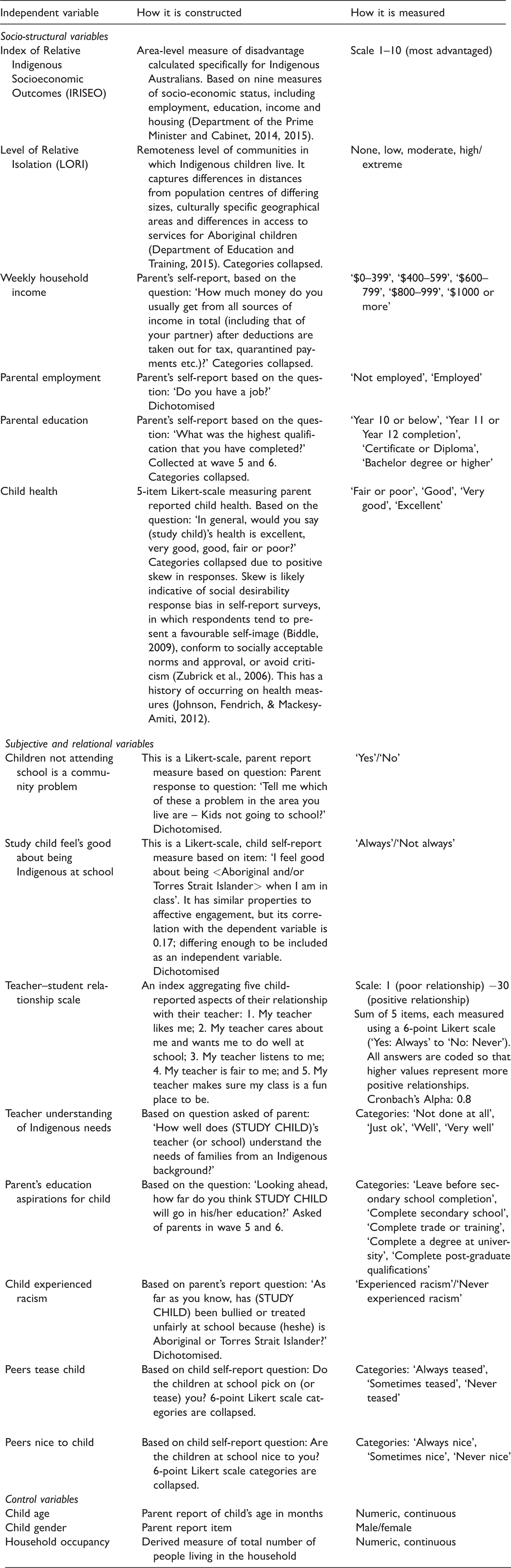
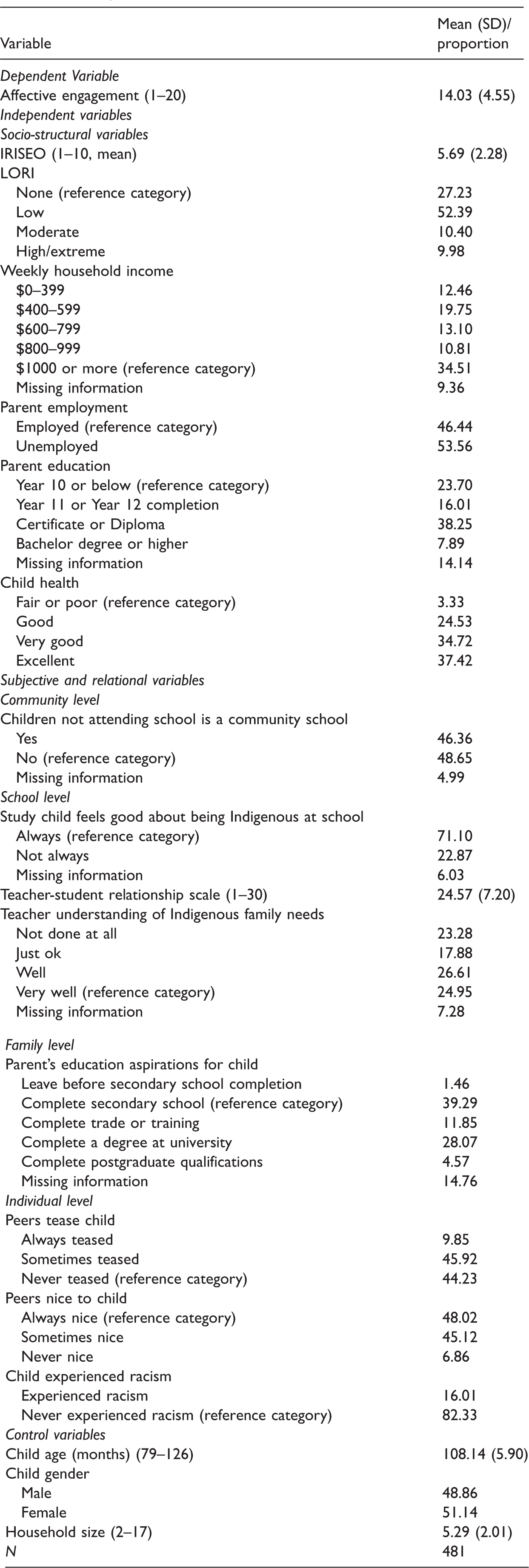
In cases where the distribution of the original variable in the LSIC data was irregular or bimodal, we collapsed the variables to create fewer categories or dichotomised variables. Additionally, where the number of missing cases on a given variable exceeded 3%, we created a ‘missing information’ category. Descriptive statistics for the response categories and the reference category (in parenthesis) of each variable are shown in Table 2.
Descriptive variable statistics.
Analytic strategy
As the dependent variable is approximately continuous we estimate a series of linear multi-level regression models adjusting for area-level clustering. We apply geographic clustering (according to Indigenous area) to account for the sample design. We also include a random effect on the outcome measure in our models which reduces the potential bias in results due to the dependency between cases sampled from the same area. This method is appropriate for use with the LSIC data (Hewitt, 2012).
We estimate five nested models to address the research questions. Model 1 tests the association between the well-researched socio-structural factors and affective engagement. Models 2–5 include the independent subjective and relational factors with each of the community, school, family and individual-level variables added successively in each subsequent model. The sequence of models analysed is illustrated in Figure 1.
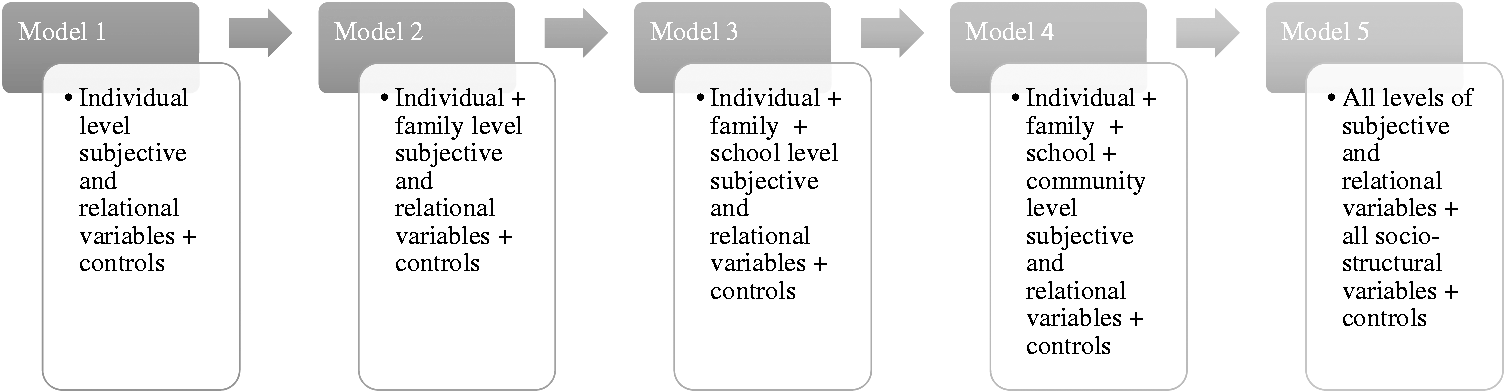
Regression models testing the impact on Indigenous children’s affective engagement.
This strategy follows our aim to uncover how the range of the factors previously found to impact Indigenous school engagement impact the affective dimension specifically. We hypothesise that multiple factors across the community, school, family and individual levels influence affective engagement, though we account lastly for the individual-level variables in our analytic strategy as we expect that the individual variables are most closely related to children’s subjective experiences and thus affective engagement. Control variables are included in all models, as are the ‘missing information’ variables and the dummy flag which denotes the cases for which the dependent variable was produced with only four or five of the six items. These indicators were not significant and are omitted from the tables. Due to the small sample (n = 481) the results in each model are reported to a significance level of 0.1.
Results
As hypothesised, the results show that a range of socio-structural and subjective and relational variables across the community, school, family and individual levels significantly impact affective engagement. The results confirm the prominent influence of subjective and relational factors despite their peripheral inclusion in the body of Indigenous engagement literature. The results are presented in Table 3.
Factors associated with Indigenous students’ affective engagement in school (regression results), LSIC wave 6 2013.

Standard errors in parentheses, +p < 0.10, *p < 0.05, **p < 0.01, ***p < 0.001.
Results of the analyses of model 1 indicate that despite the expected impact of socio-structural factors, parental education, parental employment, household income and area-level disadvantage (IRISEO) were not significantly associated with affective engagement. Better child health, however, was strongly associated with higher levels of affective engagement. Children who had very good health had an average affective engagement 2.83 points higher than those with poor health (p < 0.05), and those with excellent health had average scores 2.08 points higher (p < 0.1) compared with children with only fair or poor health. Additionally, with the inclusion of the school-level subjective factors in model 3, the magnitude of these relationships increases. Good child health also becomes significantly associated with higher levels of affective engagement compared with poor child health. This suppressor effect, in which the significance of the child health is increased by the addition of other independent variables (Chen & Krauss, 2004; Horst, 1941; Tzelgov & Henik, 1991), may be an artefact given the overall small sample size (n = 481) (Chen & Krauss, 2004; Conger, 1974). However, it likely speaks to the importance of school-level influences and the important correlations between positive school experiences and good child health for school engagement. With the affective engagement scale being 1–20, a 2- or 3-point increase is a significant change. This reaffirms the importance of health for Indigenous educational outcomes presented in the literature.
The remoteness level (LORI) also has an unexpected yet strong influence on outcomes, with students in more remote areas reporting a higher than average level of affective engagement. Compared with students living in non-isolated areas, those living in an area with moderate relative isolation (10.4% of the sample) report an average affective engagement, that is 2.94 points (p = 0.001) higher, whilst those with a high or extreme relative isolation (9.98% of the sample) comparatively have the highest levels of affective engagement (3.64 points higher than the reference category; p = 0.001). Again, a 3–4-point increase is a strong association. Though policy and previous literature suggest that students in more remote areas are more disadvantaged and tend to have poorer standard educational outcomes, particularly attendance, the results for affective engagement indicate a significant reversed relationship. Even though only two factors, child health and relative isolation were significant, the R-square coefficient for model 1 is relatively robust at 0.11. This indicates that socio-structural factors play a role in Indigenous engagement outcomes, and specifically affective engagement.
The results of models 2–5 provide clear evidence of the importance of subjective and relational influences for affective engagement outcomes, with the school- and individual-level variables being particularly influential. Overall, the school-level factors were strongly associated with Indigenous children’s affective engagement. A 1-point increase on the student–teacher relationship scale was associated with a significant increase in the average score on the affective engagement index by 0.15 points (p < 0.001). Additionally, children who reported that they did not always feel good about being Indigenous at school had significantly lower levels of affective engagement. On average, they scored 1.27 points lower than children who always felt good about being Indigenous at school. This is important as children who don’t always feel good about being Indigenous comprised 22.87% of the sample; a significant minority. Despite expectations, a teacher’s perceived understanding of the needs of Indigenous family had no influence on affective engagement. These relationships remain consistently significant with the addition of the parent’s educational aspirations (which have no significant impact in this analysis) and the individual-level factors in the modelling, though are slightly attenuated by the individual-level factors in model 5.
In terms of individual-level influences, children’s perceptions of peer relationships are important for affective school engagement. Compared to students whose peers ‘never’ tease them, students whose peers ‘sometimes’ tease them had, on average, lower affective engagement scores by −0.76 points (p < 0.1). ‘Always’ being teased was not significantly influential, though this may be due to the small number of cases that reported it (9.85%). Additionally, compared to students whose peers were ‘always’ nice to them, students whose peers were ‘sometimes’ nice to them had, on average, lower affective engagement scores by −0.95 points (p < 0.05), and students whose peers were ‘never’ nice to them had lower affective engagement scores by −2.8 points (p < 0.001) on average. These are a substantial point differences given the affective engagement scale’s average of 14 and upper limit of 20. Unexpectedly, parent reports of their child having experienced racism did not significantly impact their affective engagement. Under most circumstances, the experience of racism is expected to negatively impact other outcomes, including education. The inclusion of the individual-level variables also had a suppressor effect on parents’ aspirations for their child, with trade or postgraduate aspirations increasing affective engagement levels. Finally, female students had consistently higher affective engagement, though the other controls were non-significant. Overall, including subjective and relational variables into the model more than doubles the predictive power (R-sq) of model 5 to 24%. The R-square coefficients for models 3 and 5 further indicate that the school- and individual-level factors are the primary drivers for the additional 13% predictive power of the final model in explaining Indigenous children’s affective engagement.
Discussion
This article contributes to the research literature on Indigenous school engagement in two important ways. It is one of the first studies to focus specifically on affective school engagement. Second, it extends the current Indigenous school engagement literature by examining both the socio-structural and the subjective and relational factors that influence it. This differs from the primary examination of factors associated with attendance, of large scale quantitative data and of the impact of socio-structural factors that underpins the extant research (Biddle, 2014; Biddle et al., 2004; Bourke et al., 2000; Zubrick et al., 2006). Crucially, our approach establishes key differences between the factors that influence Indigenous children’s engagement outcomes and those which influence their attendance.
The LSIC’s provision of quality data capturing attitudes perceptions and support factors has enabled us to establish the critical impact of subjective and relational influences on Indigenous children’s engagement outcomes. Crucially, by following Reid’s multi-levelled framework we find that the school- and individual-level factors play most significant role in shaping affective engagement. This aligns with the suggestion that feelings of familiarity and comfort at school improve Indigenous students’ school engagement (Gray & Beresford, 2001; Gray & Partington, 2003). Specifically, we highlight the importance of positive peer relations in increasing affective engagement levels, found to also improve Indigenous children’s behavioural engagement (Biddle, 2014). It is likely that children who feel accepted or have strong ties within the school environment are more likely to want to engage in school than those that feel socially isolated or unwelcome amongst their peers. Given the additional association between Indigenous children’s affective engagement and increased attendance (Biddle, 2014), peer relations and support are a key target in ensuring positive school outcomes and experiences.
At the school level, a positive teacher relationship also increases affective engagement whilst not feeling good about being Indigenous at school detracts from it. As detailed above, if children feel comfortable, supported and welcome in the classroom or school yard environment, they will perceive themselves as ‘included’ at school and thus be inclined to affectively engage. These results support research highlighting the risk of educational disengagement when Indigenous students and their Indigenous support networks consider the school pathway as something ‘not for them’, or unachievable, unfamiliar or inappropriate (Gray & Beresford, 2001, 2008; Munns & McFadden, 2000; Ross, 2009). The results also support suggestions that the teacher plays a key role in managing and fostering the classroom environment (Gray & Partington, 2003); ensuring a broader sense of classroom belonging and support. The impact of positive peer, community and teacher relationships reflects the central importance of classroom environment in increasing affective engagement.
Our findings further demonstrate distinct differences in the way both subjective and relational and socio-structural factors influence Indigenous affective engagement compared with behavioural engagement. Previous research suggested that disillusionment with school and poor attendance was impacted by teachers’ poor understandings of the socio-economic circumstances and expectations of Indigenous families (Gray & Beresford, 2001), by community anticipation of school non-attendance (Munns & McFadden, 2000; Partington, Kickett-Tucker, & Mack, 1999), and by the experience of racism (De Plevitz, 2007). That these were not significantly associated with affective engagement supports our suggestion that the environment within schools may be more important than the environment outside of schools for affective engagement outcomes.
Further evidence sharpening the picture of this dynamic is the reduced and contrasting role played by socio-structural factors in shaping Indigenous children’s affective engagement compared with behavioural engagement. Whilst better child health and the level of geographical isolation are associated with affective engagement, the results overwhelmingly did not find that parental employment, household income or area-level socio-economic circumstances (IRISEO) were significantly associated with affective engagement. However, it is the evidence of these negative influences of poorer socio-economic circumstances on behavioural engagement that clearly underlines the Closing the Gap policy (see Biddle, 2014). Specifically, the policy targets low socio-economic and disadvantaged areas for extra school funding and teacher aids to improve attendance (Gray & Partington, 2003; Zubrick et al., 2006).
Another stark contrast is the positive influence of living in area of moderate or high/extreme level of remoteness on affective engagement. Though at odds with the results suggesting detrimental impacts of increased remoteness on Indigenous school attendance (Department of the Prime Minister and Cabinet, 2014), increased proportions of Indigenous students in more remote regions may presumably lead to increased familiarity and support in the school environment for Indigenous students. Additionally, with the primary goal of the ‘Closing the Gap’ policy being to improve attendance, policy strategies have been to increase school funding for disadvantaged schools, remote or isolated schools and schools with higher proportions of Indigenous students (Zubrick et al., 2006). Our results might suggest that the injection of funding and support has been successful in areas with increased isolation, and subsequently increased the support available at school for students. They may also be suggestive of selection mechanisms playing a role. Specifically, if attendance is lower in remote and isolated areas, those students who do turn up to school may be more likely to be the students with stronger affective engagement towards school. However, these results also indicate the potential need for greater support in urban areas and areas of low isolation targeted at increasing the affective components of school engagement. Overall, our findings speak to a more complex interplay of factors which uniquely shape Indigenous affective engagement, and their school engagement more broadly, than is currently explored in educational policy.
Improving educational outcomes is a key strategy of current policy to improve Indigenous children’s future opportunities and reduce the overall disadvantage experienced by Indigenous Australians (Department of the Prime Minister and Cabinet, 2014, 2015). Reducing educational disadvantage is likely to have a cumulative impact, improving socio-economic outcomes across the life course (Dupre, 2008). We argue that the diverse factors operating at different levels clash with the narrow focus on increased school funding, particularly in remote areas to promote improved Indigenous educational outcomes (Department of the Prime Minister and Cabinet, 2014, 2015), and calls for the adoption of a broader lens that goes beyond standard socio-demographics in future Indigenous education policy.
Finally, our findings should be viewed with some circumspection. The clustered study design of the LSIC and our use of the wave 6 data limit the generalisability of the findings. We did our best to account for this in the modelling approaches used by applying geographic clustering and a random effect to reduce potential bias and to ensure robust results. Despite this limitation, our results provide support for a multidimensional approach to school engagement. Given that affective engagement is important for positive behavioural and cognitive outcomes, and protects against school disengagement (Biddle, 2014; Finn & Zimmer 2012), our research establishes the importance of subjective and relational influences upon affective engagement at the school and individual levels. This provides important pointers for developing strategies to improve Indigenous children’s affective engagement outcomes specifically, and their educational outcomes more broadly. Applying strategies that acknowledge the differing antecedents of the various aspects of Indigenous children’s school engagement is crucial to improving their outcomes into the future.
Footnotes
Acknowledgements
The authors acknowledge all the traditional custodians of the lands and pay respect to Elders past, present and future. This paper uses unit record data from the LSIC. The findings and views reported in this article, however, are those of the author and should not be attributed to DSS or the Indigenous people and their communities involved in the study. The authors would also like to acknowledge the LSIC staff at the DSS for their support and guidance during the project.
Declaration of conflicting interests
The author(s) declared no potential conflicts of interest with respect to the research, authorship, and/or publication of this article.
Funding
The author(s) disclosed receipt of the following financial support for the research, authorship, and/or publication of this article: LSIC was initiated and is funded and managed by the Australian Government Department of Social Services (DSS).