




Abstract
Indigenous students remain vastly under-represented within higher education in Australia. While aspirations have been a key focus of the widening participation agenda, the aspirations of Indigenous students have largely been overlooked. Drawing on survey data collected as part of a mixed methods longitudinal study conducted with students in Years 3 to 12 (n = 6492) from New South Wales government schools, this study investigated the occupational and educational aspirations of 432 Indigenous school students. While we found that Indigenous and non-Indigenous students held similar occupational aspirations, Indigenous students were much less likely to aspire to attend university. Most starkly, high-achieving Indigenous students were significantly less likely to aspire to university than their high-achieving non-Indigenous peers. Given this evidence, we argue that both the possibility and desirability of higher education must be addressed if the widening participation agenda is to meet equity targets for Indigenous students.
Keywords
Introduction
The concept of ‘aspirations’ has become a prominent feature within Australian higher education policy and debate, most notably during the last decade. As part of the broader widening participation agenda, taking aspirations into consideration has shifted from being ‘not particularly amenable to policy decisions’ (Anderson, Boven, Fensham, & Powell, 1980, p. 5) to being a public issue at the forefront of government policy on higher education (Gale, 2015; Gale & Parker, 2015a; Sellar & Gale, 2011; Sellar, Gale, & Parker, 2011). While there has been extensive critique of both the neo-liberal underpinnings of this agenda and its framing of aspirations as individualised responsibility (Gale, 2015; Gale & Parker, 2015b; Sellar et al., 2011), aspirations have remained a key focus in the quest to increase the participation of ‘equity target groups’ and in the design of equity initiatives (Bennett et al., 2015). Despite Indigenous Australians being designated as one of these equity ‘groups’ (Naylor, Baik, & James, 2013), given their significant under-representation in higher education (Behrendt, Larkin, Griew, & Kelly, 2012; Bennett et al., 2015; Bradley, Noonan, Nugent, & Scales, 2008), scant attention has been paid to the specific aspirations of Indigenous students. As a result, the evidence base for equity initiatives targeting Indigenous students is weak. We argue that, as the starting point for greater equity, better evidence is needed about the higher education aspirations of Indigenous students, rather than unquestioning acceptance of the ‘aspiration raising’ discourse which has dominated recent government policy.
While there is a small body of research that specifically addresses the aspirations of Indigenous students, it mostly focuses on the secondary school level (Craven et al., 2005; Gool & Patton, 1999; Hossain, Gorman, Williams-Mozely, & Garvey, 2008; Senior & Chenhall, 2012; Sikora & Biddle, 2015). Moreover, although outreach initiatives between universities and schools (Bennett et al., 2015; Kinnane, Wilks, Wilson, Hughes, & Thomas, 2014; Shah & Widin, 2010) and mentoring programs such as the Australian Indigenous Mentoring Experience (Harwood, McMahon, O’Shea, Bodkin-Andrews, & Priestly, 2015; O’Shea, Harwood, Kervin, & Humphry, 2013) are critical mechanisms to inform and solidify aspirations as well as facilitate access to higher education for Indigenous students, a recent review of such initiatives found that these are often focused on students at the later stages of schooling (Bennett et al., 2015). There is growing evidence, however, that primary school-aged students are already positioning themselves in relation to occupational and educational pathways (Archer, DeWitt, & Wong, 2013). This paper makes a unique contribution to research on the aspirations of Indigenous students by drawing from a large-scale longitudinal study of students in Years 3 to 12 from New South Wales (NSW) government schools in the North Coast, Hunter, Central Coast, and North Sydney geographical areas.
Prior studies on the aspirations of Australian Indigenous school students
A small number of prior studies have shed light on the aspirations of Australian Indigenous school students. Indigenous students in senior secondary school have been found to be knowledgeable about university (Hossain et al., 2008) but, despite holding high expectations about their futures, do not expect to go there (Harwood et al., 2015). In one of the largest studies to date, significantly more Indigenous students aspired to leave school early and undertake Technical and Further Education (TAFE) than their non-Indigenous peers (Craven et al., 2005). Similarly, research conducted in relation to Vocational Education and Training in Schools (VETiS) found that Indigenous students were more likely to be enrolled in VETiS programs and to want to commence TAFE, an apprenticeship, or employment, directly from school (Helme et al., 2003).
A number of studies have drawn attention to the influence of family and community in relation to the aspirations of Indigenous students (Craven et al., 2005; Gool & Patton, 1999; Parkes, McRae-Williams, & Tedmanson, 2015). However, the importance of recognising heterogeneity within Indigeneity has also been emphasised. In relation to gender, both Craven et al. (2005) and Sikora and Biddle (2015) found that Indigenous males were more oriented to sports-based occupations than Indigenous females. In comparison, Indigenous females have been found to aspire towards more prestigious occupations, requiring higher-level educational qualifications, than male Indigenous students (Gale et al., 2013; Sikora & Biddle, 2015). The influence of location has also been noted, with a small ethnographic study of a remote Indigenous community finding that aspirations were limited by available life experiences (Senior & Chenhall, 2012). The aforementioned research by Craven et al. (2005) also revealed that some Indigenous students from rural settings perceived their access to university to be constrained by geographic distance.
Moving beyond ‘raising aspirations’: The possibility and desirability of higher education
A growing body of scholarship argues that aspirations are neither individualistic nor simplistic, as has often been portrayed within higher education policy (Bok, 2010; Prodonovich, Perry, & Taggart, 2014; Sellar & Gale, 2011). Social, historical and contextual issues often go unrecognised (Southgate & Bennett, 2014) when aspirations are simplistically seen as something that ‘one either has or does not have’ (Prodonovich et al., 2014, p. 178) and, subsequently, in need of ‘raising’.
In order to problematise aspirations and move beyond a focus on what Indigenous students ‘lack’ (Harwood et al., 2015; Jackson-Barret, 2011), we draw on the work of Appadurai (2004), who considers aspiration as a meta-capacity situated within the ‘thick of social life’ (p. 67). This perspective takes into account the cultural contexts that inform and influence one’s aspirations, as well as where, and how, these aspirations are positioned. For Appadurai (2004), the ‘capacity to aspire’ is likened to a navigational capacity; however, this capacity is not evenly distributed in society. Accordingly, merely having aspiration does not deliver one from a starting point to attainment (Prodonovich et al., 2014) because one must have access to the social, cultural and economic resources that are strategically valuable within a particular setting. These resources or ‘archives of experience’ that have been accrued from successfully navigating a similar pathway or gained through access to family and community with such experiences (Gale & Parker, 2015b), can strengthen the capacity to aspire and aid in navigating the aspirational ‘map’.
Arguably, many Indigenous students will have a ‘thinner, weaker sense of the pathways’ (Appadurai, 2004, p. 69) to university due to having both fewer ‘archives of experience’, as well as access to less valued cultural and material resources (Gale & Parker, 2015b) in relation to the field of higher education. Appadurai’s theory allows for consideration of how the social, cultural and economic inequalities that Indigenous Australians continue to face manifest in lower levels of participation in higher education, taking into account the historical exclusions placed on Indigenous Australians in relation to intergenerational and intragenerational experiences of schooling and access to Westernised education (Bin-Sallik, 2003; Doyle & Hill, 2008), as well as the enduring positioning of universities as ‘whitestream’ institutions (Bunda, Zipin, & Brennan, 2012). In the context of the current widening participation agenda, we use Appadurai’s (2004) framework to explore both the possibility and the desirability of higher education (Sellar & Gale, 2011) for Indigenous students.
Methodology
Taking into account Walter’s (2010) argument that the political and social reality of comparative data are ‘framed by how they are garnered and interpreted, by whom, and for what purposes’ (p. 53), all aspects of this study were guided by Indigenous and non-Indigenous researchers working collaboratively and attempting to make visible the racialised politics of the data (Walter, 2010). We have attempted to avoid pejorative, simplistic, and essentialising interpretations of the data, while mindful of our statistical use of the dichotomy Indigenous/non-Indigenous.
Data
We drew on data collected as part of a four-year (2012–2015) longitudinal study (Gore, Holmes, Smith, Southgate, & Albright, 2015). Primary (n = 46), secondary (n = 15) and central schools (n = 3) from North Sydney to the Queensland border were recruited with the assistance of the NSW Department of Education (DoE). All students enrolled in Years 3, 5, 7 and 9 in 2012 in the 64 participating schools were potential study participants. These cohorts were followed until they were in Years 6, 8, 10 and 12 in 2015. An annual student survey was administered online during class time. Survey questions were consistent across survey years in order to examine change over time, with a specific focus on educational and occupational aspirations.
In addition, results from the National Assessment Program Literacy and Numeracy (NAPLAN) and student demographic data were provided by the DoE. The Indigenous status of each student was determined through this demographic information. Of the 6492 students who completed the survey in one or more waves, 432 identified as Indigenous and 5526 identified as non-Indigenous. The Indigenous status was unknown/missing for 534 students.
Indigenous and non-Indigenous survey responses by student socio-demographic and school-related variables.

Based on the number of valid survey responses over the four waves of data collection.
Includes the total number of survey responses, including those students who did not have their Indigenous status recorded.
Measures
Occupational aspirations
Within the survey, an open-ended question asked students about their career plans: ‘what work would you like to do when you grow up?’ for primary school students, and ‘what kind of work would you like to be doing when you are 25 years old?’ for students in high school. If students did not provide an answer to this question, they were asked to provide up to three possible ‘career thoughts’. Utilising responses to these questions, the Australian and New Zealand Standard Classification of Occupations (ANZSCO) was used to code all named occupations (Australian Bureau of Statistics, 2013). The ANZSCO provides a standardised categorisation of occupations at varying levels of specificity. Our analysis uses the ‘minor group’ level, which has 97 occupational categories to compare popular occupational aspirations among Indigenous and non-Indigenous students.
Educational aspirations
In both the primary and high school survey students were asked the following question: ‘what is the highest level of education you plan to complete?’ Responses were categorised as follows: high school, TAFE, university and ‘I don’t know yet’. Our analysis compares these educational aspirations for Indigenous and non-Indigenous students, specifically focusing on aspirations for university.
Socio-demographic and school-related variables
Socio-demographic and school-related variables.

See: Australian Curriculum Assessment and Reporting Authority. (ACARA). (2012). My School fact sheet: Interpreting school profile date. Retrieved from www.acara.edu.au/_resources/interpreting_school_profile_data.pdf.
See http://myschool.edu.au for details.
Analyses
Logistic regression models were used to examine the independent variables in relation to the binary outcome of university aspirations (yes/no). In order to adjust for the nested nature of the data (with repeated measures for students who responded to the survey on more than one occasion), the logistic regression models were fitted within a Generalized Estimating Equation (GEE) framework, which is a method of analysis that is robust against mis-specification of the correlation structure (see Zeger, Liang, & Albert, 1988). The GEE model was compared to an equivalent random effects Generalized Linear Model employing the same data and variables, and both produced similar estimates and p-values. A univariate logistic regression was also undertaken, with results reported as odds ratios and associated p-values. In Model 1, the student socio-demographic variables were included as potential predictors of university aspirations, reported as adjusted odds ratios and adjusted p-values. A second regression model maintained the student socio-demographic variables and included the school-related variables, reported as adjusted odds ratios and adjusted p-values in Model 2.
Sub-group analyses were undertaken to explore variables included within the regression that were related to both Indigenous status and university aspirations, in order to identify differences within the sample by strata. Univariate regression models within each strata of prior academic achievement, self-perception of relative academic performance, and location were run separately to test factors mediating the relationship between Indigenous status and university aspirations.
Data were analysed using SAS software version 9.4. To guide the interpretation of results, statistical significance was set at p < .05. However, statistics with p-values in the range .05 > p < .005 should be viewed with a degree of caution, given the sample size and relatively large number of comparisons made. We have used Monson’s (1990) common language descriptors of odds ratios to illustrate effect sizes (weak, moderate, strong) and enable a more nuanced interpretation of significant predictors of university aspirations.
Results
Occupational aspirations
When a student listed more than one occupational choice in a single survey, all responses were included in this analysis. At the ANZSCO minor group level, this resulted in 588 valid responses from Indigenous students and 8291 valid responses from non-Indigenous students.
Ten most popular occupational aspirations by Indigenous status and sex.
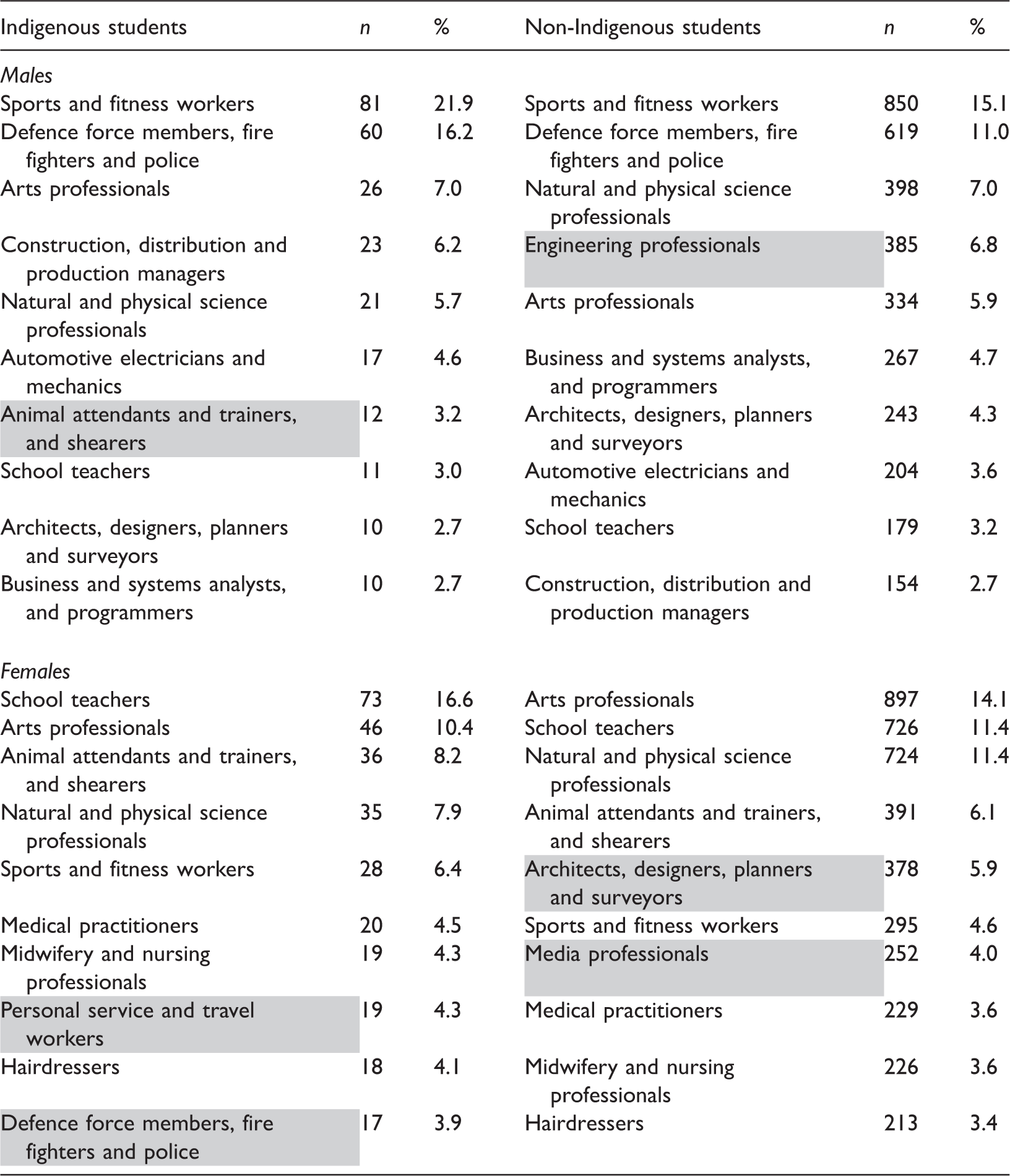
‘Sports and fitness workers’ was the most popular occupational aspiration for both Indigenous males (21.9%) and non-Indigenous males (15.1%). This was followed by ‘defence force members, fire fighters and police’ for both Indigenous males (16.2%) and non-Indigenous males (11%). For the other eight occupations in the top ten, ‘animal attendants and trainers, and shearers’ appeared for Indigenous males (3.2%) but did not feature for non-Indigenous males, as this category was mentioned only 1.8% of the time. On the other hand, ‘engineering professionals’ appeared for non-Indigenous males (6.8%), but was not within the ten most frequently named occupations for Indigenous males, as it was mentioned in only 0.8% of cases.
For females, the top four occupational aspirations for Indigenous and non-Indigenous students were similar. ‘School teachers’ was the most popular occupational aspiration for Indigenous females (16.6%) and was rated second by non-Indigenous females (11.4%). In comparison, ‘arts professionals’ was the most popular occupational aspiration for non-Indigenous females (14.1%) and was second for Indigenous females (10.4%). Additionally, ‘animal attendants and trainers, and shearers’ was third for Indigenous females (8.2%) followed by ‘natural and physical science professionals’ (7.9%), whereas ‘natural and physical science professionals’ was third for non-Indigenous females (11.4%) followed by ‘animal attendants and trainers, and shearers’ (6.1%). For the other six occupations in the top ten, two occupations differed between Indigenous and non-Indigenous female students. ‘Personal service and travel workers’ (4.3%) and ‘defence force members, fire fighters and police’ (3.9%) appeared for Indigenous females, but were not within the top ten for non-Indigenous females (3.2% and 3.1% respectively). ‘Architects, designers, planners and surveyors’ (5.9%) and ‘media professionals’ (4%) appeared for non-Indigenous females, but were not within the top ten for Indigenous females (1.6% and 1.8% respectively).
Educational aspirations
Educational aspirations were examined based on the four options of high school, TAFE, university and ‘I don’t know yet’ as the highest level of education students planned to complete. 646 valid survey responses were received from Indigenous students, and 9165 valid responses from non-Indigenous students. The most popular response for Indigenous students was university (39%), which was followed by ‘I don’t know yet’ (25%), high school (19%) and TAFE (18%). By comparison, the most popular response for non-Indigenous students was university (52%), followed by ‘I don’t know yet’ (23%), TAFE (14%) and high school (12%). In comparing the primary outcome of aspiration to attend university, a smaller proportion of Indigenous students than non-Indigenous students indicated that university was the highest level of education they planned to complete.
Logistic regression analysis
Logistic regression analyses.

Model 1 – student background variables only, Model 2 – all variables. OR = odds ratio; NAPLAN = National Assessment Program for Literacy and Numeracy; ICSEA = Index of Community Socio-Educational Advantage; SES = Socio-economic status; Quartile 1 is the lowest and Quartile 4 is the highest.
Description of effect size from Monson (1990).
Reference category.
p < .05.
p < .01.
p < .001.
The procedure of Baron and Kenny (1986) is appropriate in interpreting this finding, which assumes a three-variable system where two causal paths relate to the dependent variable. This approach confirms that viewing prior academic achievement as a mediator of the relationship between Indigenous status and university aspirations is an appropriate interpretation, based on the following three points:
Indigenous status must affect prior academic achievement. Analyses (not reported here) showed that, in our sample, non-Indigenous students scored, on average, 60 points higher in their NAPLAN results (p < .001) after taking account survey year and cohort; Indigenous status must affect university aspirations. Non-Indigenous students were significantly more likely to aspire to university (see univariate analysis and Model 1, Table 4); Prior academic achievement must affect university aspirations. After adjusting for Indigenous status, prior academic achievement is significantly and positively related to university aspirations (Model 2, Table 4).
Therefore, the reason why Indigenous students are less likely to hold university aspirations is explained, at least partly, by their prior academic achievement.
Subgroup analysis
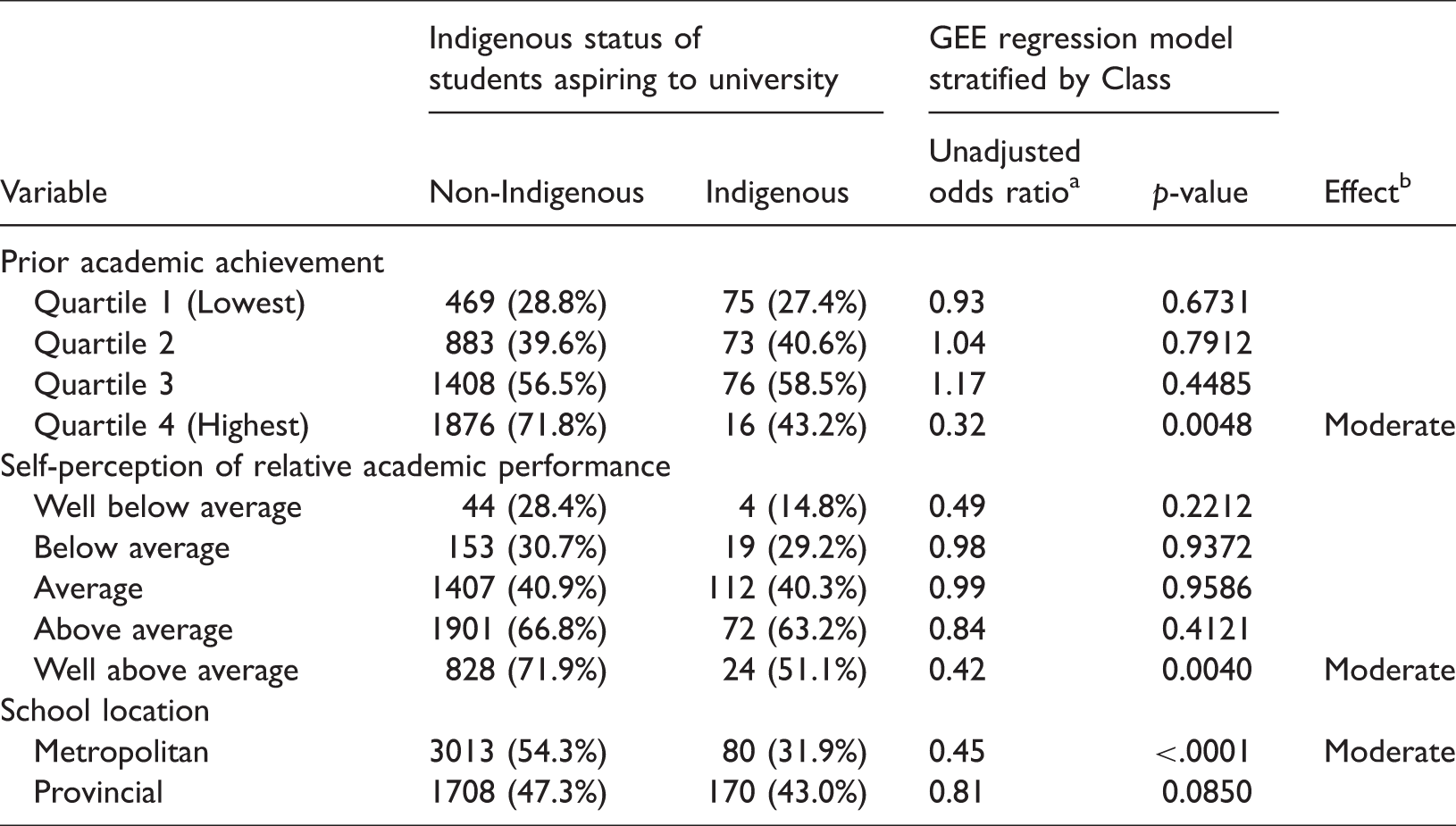
Given the difference in the adjusted odds ratio from Model 1 to Model 2 (see Table 4), sub-group analyses were conducted to examine the univariate association between Indigenous status and university aspirations separately within subgroups formed by the variables prior academic achievement, self-perception of relative academic performance, and location. Prior academic achievement and self-perception of relative academic performance were examined due to being the strongest predictors introduced in Model 2, while location was also examined due to the way in which the variable behaved between the models. The results of these analyses are presented in Table 5, with a description of the findings below.
Prior academic achievement. Univariate regression models within each NAPLAN strata were run separately to test the relationship between Indigenous status and university aspirations. An examination of Indigenous and non-Indigenous university aspirants within each NAPLAN quartile found similar percentages of students within Quartiles 1 to 3 and an increasing proportion of both Indigenous and non-Indigenous university aspirants for these three quartiles. However, for Quartile 4, a much higher proportion of high achieving non-Indigenous students aspired to university (71.8%) than high-achieving Indigenous students (43.2%). While there were no significant differences in university aspirations between Indigenous and non-Indigenous students within NAPLAN Quartiles 1 to 3, Indigenous students in Quartile 4 had significantly lower odds of aspiring to university than non-Indigenous students in the same quartile (OR = 0.32, p < .005). This is a moderate effect. Self-perception of relative academic performance. A similar result was seen when examining the relationship between Indigenous status and university aspirations within strata based on self-perception of relative academic performance. No significant differences were found in intention to attend university between Indigenous and non-Indigenous students who rated themselves as ‘well below average’, ‘below average’, ‘average’ and ‘above average’. However, for those students who considered themselves ‘well above average’, Indigenous students had significantly lower odds of aspiring to university than non-Indigenous students (OR = 0.42, p = .004). This is a moderate effect. Univariate sub-group analyses. Indigenous vs. Non-Indigenous. Description of effect size from Monson (1990).
Discussion
We have drawn on a longitudinal study conducted with a substantial sample of students across the primary and secondary school years to add to the relatively small body of empirical research on the aspirations of Australian Indigenous students. While a focus of the widening participation agenda has been on ‘raising’ the aspirations of under-represented groups, including those of Indigenous students, the analyses carried out for this paper highlight the need to move beyond this discourse.
Notably, the occupational aspirations of Indigenous and non-Indigenous students followed similar patterns, with the main differences relating to sex. While this result is not surprising, given previous findings in relation to the intersection of sex and Indigeneity (Craven et al., 2005; Sikora & Biddle, 2015), the similarity between Indigenous and non-Indigenous students is noteworthy, particularly given the differences found in educational aspirations. Appadurai (2004) argues that everyone aspires to their version of the ‘good life’. Individuals might have different ideas of what constitutes a ‘good life’, including desirable occupational futures. As our data show, and others have argued (Harwood et al., 2015), Indigenous young people are rich in aspiration, and recognising these aspirations is an important foundation in efforts to explore future pathways.
The similarity between Indigenous and non-Indigenous students in occupational aspirations was reinforced by the finding that, in the presence of socio-demographic and school-related variables, Indigenous status was not a significant predictor of the aspiration to attend university in the full regression model (Model 2). However, and despite this statistical finding, examining the univariate analysis showed that Indigenous students were significantly less likely than their non-Indigenous peers to hold university aspirations. The difference between Model 2 and the univariate analysis indicates that other factors interact to dilute the effects of Indigeneity. Specifically, it is likely that prior academic achievement introduced in Model 2 mediated the effect of Indigenous status. Thus, while occupational aspirations were similar between Indigenous and non-Indigenous students, educational aspirations differed, with this explained, in part, by achievement.
Yet in the univariate sub-group analyses, we found considerable differences within the sample by strata. Appadurai’s (2004) notion of the ‘capacity to aspire’ is helpful in making sense of this result, highlighting both the complexity of aspirations and that how one navigates from where one is to where one would like to be (Prodonovich et al., 2014) is not straightforward. While the possibility of higher education is clearly strong for high-achieving students, with the odds of aspiring towards university increasing as achievement increased, its desirability was significantly lower among high-achieving Indigenous students than it was among their high-achieving non-Indigenous peers. This result was repeated when we examined students’ self-perception of relative academic performance. However, consideration must be given to the relatively small number of Indigenous students in both of these strata. Nonetheless, these findings draw attention to the interaction between Indigeneity and other factors, which warrants further analysis.
Moreover, within the sub-group analysis examining location, we found that university aspirations among Indigenous and non-Indigenous students from provincial areas were similar, however Indigenous students from metropolitan areas were significantly less likely to hold aspirations for university than non-Indigenous students from metropolitan areas. Indigenous students within our sample were more likely to be located in provincial areas, with students located provincially less likely to aspire to university overall. Not only does this necessitate that further work needs to be done to explore the barriers perceived by Indigenous students from both metropolitan and provincial areas but it highlights the need for further work to be undertaken with students from more remote areas as well, given that most provincial schools in our sample were in larger regional centres. Furthermore, in stressing the importance of understanding Indigenous students as a ‘diverse cohort, with a range of individual interests, behaviours, approaches, capacities, skills and needs’ (Day, Nakata, Nakata, & Martin, 2015, pp. 505–506) rather than as a homogeneous group, focus group data from our larger Aspirations study, in combination with additional extended interviews with a sub-sample of Indigenous students, their parents and teachers, will be examined in a subsequent publication.
Conclusion
The main differences found in this study between Indigenous and non-Indigenous students – those at the high end of academic achievement and self-perception of academic performance – raise important questions about both the possibility and desirability of higher education for Indigenous students. Within the Australian context, an emerging body of research has utilised the ‘capacity to aspire’ (Appadurai, 2004) as a lens through which to understand differences in aspirations and participation relating to socioeconomic status. Few studies have considered its value in relation to understanding the aspirations of Indigenous students (see Harwood et al., 2015). If aspiration is thought of as a navigational capacity, influenced by social, cultural and economic resources as well as one’s ‘archives of experience’, we can see how similarities in occupational aspirations can exist for Indigenous and non-Indigenous students at the same time as there are significant differences in educational aspirations. While many Indigenous students will be the first in their families to pursue higher education, a key point here to also take into consideration is that some Indigenous students will be the first in their families to attend senior secondary school and be in a position to enrol in university (Behrendt et al., 2012, emphasis added).
Our analyses highlight that a focus on increasing the possibility of higher education for Indigenous students, in order to achieve greater parity in participation, will not automatically make higher education desirable. While our results underscore the importance of supporting educational achievement (Gore et al., 2015) as a key factor in keeping students’ higher education options open, this approach alone will not be enough.
For Indigenous students, aspiring to university is likely to require negotiation of race, class, and cultural divides in ways that are not shared by non-Indigenous students (Walter, 2015). In explaining social mobility in general, Walter (2015) outlines four specific issues that impinge on Aboriginal and Torres Strait Islanders which may clarify why higher education is less desirable among high-achieving Indigenous students. First, the lack of a sizeable Indigenous middle class means that socially mobile individuals are likely to be racially and culturally isolated. Second, the recency of an Aboriginal middle class means not only that socially mobile individuals are likely to be first generation and face a significant cultural capital divide, but their strong relationality, with ‘individuals, groups, community as well as country, culture, and ancestors’ (p. 74), is likely to carry significant financial support obligations. Third, limited social connections and ‘low levels of trust between Indigenous and non-Indigenous people and institutions’ (p. 81) have largely excluded Indigenous people ‘from mainstream networks of power and privilege’ (p. 81) with implications for both bridging and bonding social capital. Fourth, socially mobile Indigenous people ‘may become stranded in a racially bound social capital wasteland’ (p. 82) with gains in economic capital not necessarily transforming into the kinds of social and cultural capital that traditionally benefit non-Indigenous people. For Indigenous students to aspire to university, supporting intergenerational mobility underpinned by appropriate social infrastructure might be as important as supporting educational achievement (Walter, 2015).
While many equity initiatives targeting Indigenous students are making a difference (Bennett et al., 2015; Harwood et al., 2015; O’Shea et al., 2013), Indigenous students continue to experience significantly lower rates of participation, retention and completion in Australian higher education (Behrendt et al., 2012; Bennett et al., 2015). Craven et al. (2005) have previously argued for universities to reconceptualise their recruitment strategies targeting Indigenous students, and our findings both reinforce this argument as well as emphasise the need for a broader rethinking of access to higher education for Indigenous students. It is not just about making higher education possible, but rather, making university a place where Indigenous young people will want to pursue and attain their occupational aspirations. Higher education does not subsist in a vacuum (Behrendt et al., 2012) and there are many reasons why university might be less desirable for Indigenous students, not least the historical exclusions Indigenous Australians have faced in relation to schooling. As a starting point, further attention needs to be paid to recognising and understanding the aspirations of Indigenous students (Harwood et al., 2015) as they are formed in relation to existing social, cultural, economic, and racial divides. Moreover, a whole of university approach is needed (Behrendt et al., 2012) in considering how higher education can better serve these aspirations.
Footnotes
Declaration of conflicting interests
The author(s) declared no potential conflicts of interest with respect to the research, authorship, and/or publication of this article.
Funding
The author(s) disclosed receipt of the following financial support for the research, authorship, and/or publication of this article: The data for this analysis came from a linkage project funded by the Australian Research Council and the New South Wales Department of Education under Grant LP12100013. The study reported in this paper was funded by the Centre of Excellence for Equity in Higher Education at the University of Newcastle, Australia. The authors wish to acknowledge the support provided in the preparation of this manuscript by Le Hoang Le. We also value the input of anonymous reviewers. We are most grateful to the students and their parents, carers, and teachers for their participation in this project.
References
Supplementary Material
Please find the following supplemental material available below.
For Open Access articles published under a Creative Commons License, all supplemental material carries the same license as the article it is associated with.
For non-Open Access articles published, all supplemental material carries a non-exclusive license, and permission requests for re-use of supplemental material or any part of supplemental material shall be sent directly to the copyright owner as specified in the copyright notice associated with the article.
