




Abstract
The English and Chinese reading proficiency of 1376 Grade 4 students in 24 Hong Kong primary schools were assessed using measures developed for the Progress in International Reading Literacy Study. Students’ parents provided information about home reading activities (HRA) aimed at supporting their children’s reading prior to them entering school (“early home reading activities”, EHRA) and during Grade 4 (“home reading activities”). Results indicated that EHRA was a stronger predictor of reading performance in both Chinese and English than HRA. Moreover, ‘typical’ HRA such as reading books, telling stories and singing songs were found to be predictive of reading performance in both Chinese and English. In English, in addition, playing word games or character puzzles were also activities beneficial to reading performance. Together, these results provide evidence for the beneficial effects of traditional early childhood activities at home such as book reading, telling stories and singing songs for reading performance in later primary school in children’s first as well as second language.
Introduction
Hong Kong particularly attracted the attention of educators internationally due to the outstanding reading performance of its primary school pupils in the 2011 Progress in International Reading Literacy Study (PIRLS) undertaken by the International Association for the Evaluation of Educational Achievement (IEA). In the 2011 PIRLS survey, Hong Kong primary students ranked first of 48 education systems or countries in terms of reading achievement, an exceptional outcome given the very diverse multilingual profile of Hong Kong’s citizens and school population.
Large-scale assessments such as PIRLS, PISA and TIMSS provide reliable and objective data on children’s performance in reading, mathematics and science education across different stages of schooling (Breakspear, 2012; Robitaille, Beaton, & Plomp, 2000; Schwippert, 2007; Schwippert & Lenkeit, 2012; Tobin, Lietz, Nugroho, Vivekanandan, & Nyamkhuu, 2015; Topping, 2006). Along with other governments in the Asia-Pacific region, the government of Hong Kong has been using these international assessments to evaluate the quality of its education system as well as to identify factors contributing to literacy development, including the assistance provided by parents in support of their children’s reading development.
As is the case in other societies, school starters bring with them varying degrees of literacy experience in Hong Kong. Many early-years teachers deliberately address this diversity, aware that the preschool communicative competence of school entrants in the 21st century varies enormously from child to child and from educational system to educational system (McBride-Chang, 2004). In this context, it is noteworthy that few large-scale literacy studies have involved learners required to learn a first (L1) and a second language (L2) simultaneously, as is the case in Hong Kong. Although studies focusing on fostering children’s L2 ability vary in their findings, almost all conclude that the earlier that children begin to learn the L2, the better their learning of both languages (Birdsong, 2004; DeKeyser & Larson-Hall, 2005; Flege, Yeni-Komshian, & Liu, 1999).
Parents in countries all over the world have long been actively involved in promoting their children’s spoken language and reading skills before they begin formal schooling (Emerson, Fear, Fox, & Sanders, 2012; Landry, 2008; Central Advisory Council for Education (England), 1967; Sénéchal & LeFevre, 2002). Desforges and Abouchaar (2003) suggest a range of home activities for parents to help their children learn how to read to give them a head-start in learning how to read independently and cope with the literacy demands in the classroom.
Griva and Chouvarda (2012) emphasise the importance of parental involvement in advancing the children’s mother tongue and second language acquisition in countries where more than one language is commonly spoken. Their recommendations suggest that the L2 be taught in a playful way and that parental involvement is vital for their children’s L2 learning.
This certainly applies in Hong Kong where all secondary school graduates are expected to be proficient in both Chinese and English. Hence, it is of particular interest to examine whether there is evidence to support the hypothesis that these early reading activities at preschool ages at home positively relate to subsequent performance in reading.
The present study purposefully investigated the impact of parental involvement on the bilingual reading proficiency of Grade 4 students in Hong Kong both prior to children starting school (‘early home reading activities’ EHRA) as well as in Grade 4 (‘home reading activities’ HRA) while taking into account parental socio-economic status (SES) in terms of education, occupation and income.
Parental involvement in literacy development
Parents are children’s first teachers, providing an important language environment as they talk to children and answer their questions. Darling and Westberg (2004) as well as Griva and Chouvarda (2012) have confirmed that parental involvement has a positive effect on children’s reading acquisition. Consistent with Scarborough and Dobrich’s (1994) conclusions, Sonnenschein and Munsterman (2002) found that the frequency and incidence of storybook reading with children was the strongest correlate with young reader’s subsequent literacy-related skills. Similarly, according to Sénéchal (2006), early assistance from parents is a particularly strong predictor of vocabulary knowledge in children in kindergartens (age 3 to 5) and nursery schools (age 2 to 3) and a highly statistically significant predictor of children’s reading attainment at Grade 4 (age 9).
Parent SES and home support
A number of studies show that parents consider assisting their children with academic work as very important regardless of their financial background (Bradley & Corwyn, 2002; Calvo & Bialystok, 2014; Hoff-Ginsberg, 1991). In addition, parents on low incomes perceive helping their children with reading as more important than helping them with mathematics (Drummond & Stipek, 2004).
Zhan (2006) examined the relationship between parental assets, their expectations for their children’s future and their active involvement in their children’s literacy learning outside school and found that all these characteristics predicted their offspring’s literacy attainment two years later. Butler (2014) investigated the parental factors affecting children’s English language learning in China and found that Chinese parents’ SES had a significant impact on their children’s English speaking abilities at Grade 4.
Early years of parental involvement in literacy development
Park (2008) investigated the effect of early home literacy activities on children’s school performance from a cross-country perspective. An examination of PIRLS data from 25 countries revealed that early home literacy activities were significantly associated with children’s reading performance in all countries in the analysis. Thus, the more the parents engaged with the children in literacy activities, the greater was their influence on children’s reading progress, regardless of parental education background.
Lawson (2012) suggested parental involvement in reading aloud as a predictor of children’s academic achievement in later years. Children’s auditory awareness and prosodic sensitivity, both associated with academic success, can also be cultivated by listening to being read to aloud by parents. During their preschool years, many children learn how to identify print that they frequently encounter in their environment: for example, `stop’ and `exit’ signs, labels on food and magazines, and the names of frequently visited shops and restaurants. This acquisition of print-meaning connections represents an opportunity to learn graphic systems and develop an awareness of how to differentiate print and non-print cues. In fact, the reading aloud of labels and signs is instrumental in helping children develop print awareness. There is also evidence that preschool children who regularly see print in signs and advertisements spontaneously notice a relationship between the words they see in print and the words they speak and hear (Armbruster, Lehr, & Osborn, 2003; Ehri, 1987; Goodman & Altwerger, 1981; Goodman & Goodman, 1979).
Crook (1997) investigated cultural practices which affect Australian adolescents’ and adults’ outcomes in terms of social status. Crook reported that children whose parents read more frequently and provided a more nurturing home environment had a more successful education path than that of their peers. Such parental practices clearly seemed to enhance children’s linguistic and reading skills, which, in turn, helped them to excel significantly during their senior school years.
Based on a literature review Buckingham, Wheldall, and Beamen-Wheldall’s (2013) concluded that, in English-speaking countries such as the United Kingdom, the United States and Australia, the impact of SES on children’s later reading outcomes was most pertinent in determining their literacy proficiency before the start of formal schooling. Other studies have found that the various elements of SES, including family income, parents’ education level and parents’ occupation, are significant predictors of children’s reading performance (Bowey, 1995; Davis-Kean, 2005).
Much research has examined the relationship between parental involvement and children’s later reading achievement in western countries. In fact, the aforementioned researchers identify a list of reading practices which have been found to enhance students’ reading literacy. Others suggest that such a list should be passed on to parents by schools and teachers to facilitate parental involvement in home-reading tuition (Hoffman & McCarthey, 2000; Pang, Muaka, Bernhardt, & Kamil, 2003; Pressley, 2002; Teale & Yokata, 2000).
However, relatively less is known about whether the aforementioned relationships apply in equal strength in countries with a population and language environment other than English. A key purpose of the present research was to examine the relationship between different components of parental support and reading attainment in the bilingual context of Hong Kong.
In Hong Kong, a former British colony, most people speak Chinese as the mother tongue and English as their second language. Reading proficiency in both languages is very important in Hong Kong as a global centre of commerce and finance. Therefore, parents and education authorities expect teachers to ensure that school leavers are well versed in both Chinese and English in order to meet the demands of the 21st Century community (Koo, Kam, & Choi, 2003; Pierson, 1991, 1998; Tung, 1997). In fact, the Hong Kong Government and public alike take a very keen interest in students’ bilingual reading performance (Education Bureau, 2012).
In 2001, the IEA conducted the PIRLS in 35 countries and regions, including Hong Kong, to assess relative levels of attainment and the factors affecting reading proficiency. Hong Kong students’ performance was found to be “average”. They performed quite well in terms of comprehending informational articles but were relatively weak on understanding literary texts (Mullis, Martin, Gonzalez, & Kennedy, 2003). In the next iteration of the assessment, PIRLS 2006, the reading attainment of Hong Kong students was ranked second in the 46 participating countries (Mullis, Martin, Kennedy, & Foy, 2007).
The PIRLS reading literacy surveys provide quality instruments with both English and Chinese-translated versions to examine reading performance in Chinese and English as well as the relationship between parental factors and children’s bilingual literacy achievement. The study reported in this article adopted the conceptual framework and instruments used in PIRLS.
The authors of the present article are aware that many Hong Kong parents will do whatever they can to assist teachers. However, in the present climate where the number of immigrants from the Chinese Mainland is rising continuously, increasing numbers of parents will leave it to schools to advance children’s literacy standards, especially their reading attainment (Cheng, 1995; Dimmock & Walker, 2000; Wan, 1992).
This situation has been noted in many other countries (Cummins, 1984; Dufva & Voeten, 1999; Hdstijn & Bossers, 1992; Olshtain, Shohamy, Kemp, & Chatow, 1990). In fact, regardless of their own educational level, most Hong Kong parents are fairly confident about helping their children with reading in Chinese. They are less confident in helping their children to speak, read and write in English. However, knowing that English is a second language in Hong Kong, many parents are willing to spend money on help their children learn English by buying supplementary exercises, arranging private tutoring or asking their children to attend reinforcement courses (HSBC, 2015).
Recognising the somewhat conflicting findings of some previous studies of bilingual attainment and parental involvement in encouraging literacy, and Hong Kong parents’ less confident in engaging in their children’s L2 learning, the writers assessed the reading performance of Grade 4 students in Hong Kong and investigated what HRA that had been or were currently being carried out by parents to promote their children’s reading literacy attainment in both Chinese and English. Correlations were expected between students’ reading attainment and the degree and type of literacy support by their parents prior to starting school as well as at their current level of schooling (i.e., Grade 4).
In summary, this study set out to address the following questions:
What are the relative effects of EHRA and current HRA on the reading performance in Chinese and English of students in Grade 4? Which reading activities at home and out of school best predict Hong Kong Grade 4 students’ reading attainment in the primary school? Are these relationships affected by parental socioeconomic factors (i.e. level of education, family income)?
Method
Sample
The study adopted the sampling procedure used in PIRLS 2006, namely a two-stage stratified cluster approach (Foy & Joncas, 2003). In the first stage, 150 primary schools were randomly selected using `probability proportional to size’ sampling procedures (Rosén, 1997), with school type 1 (government, aided and direct subsidy scheme schools) and student gender (boys, girls and co-educational) used as broad stratification variables. At the second stage, one Grade 4 class was selected at random from each school. Out of the 150 schools, 24 of them were randomly selected to form the final sample.
The final sample consisted of 1,376 children in Grade 4 in 24 primary schools, 674 girls and 702 boys, on average aged 9.69 years. The medium of instruction in these 24 schools was Chinese (Cantonese, or Putonghua, or mixed mode) except for the English language classes.
Reading comprehension tests in Chinese and English
All students were given reading comprehension tests based on PIRLS materials in Chinese and in English. All students were asked to take two reading comprehension tests from a core collection of matched and standardized passages. The PIRLS reading achievement scale provides a common reference on which educators can compare their fourth graders’ progress in reading over time from assessment to assessment (Mullis, Martin, Kennedy, Trong, & Sainsbury, 2009). As in the PIRLS surveys, narrative and transactional text types were used to assess reading performance. Eight reading passages were selected, four for each text type. Students’ comprehension was assessed by a set of questions designed specifically for each type of text. The original texts in English were translated into Chinese for the Hong Kong element of PIRLS, and verified by language experts in the IEA to ensure that the translated texts matched the level of difficulty of original texts. All of the measures used in this study were derived from modified PIRLS instruments and translated into Chinese. A back-translation procedure was conducted to confirm the accuracy of the translation (Johansone, 2012) and comparability of instruments (Loh & Tse, 2009; Tse, Lam, Lam, Chan, & Loh, 2006).
Scoring procedures
The attainment scores were calculated using “plausible value” procedures suggested by Gonzalez and Kennedy (2003). Plausible values are estimates of how individuals would have performed on a test if it had included all possible items in the assessment battery. In line with PIRLS scaling procedures, the Chinese and English reading scores were standardized to a mean of 500 points and a standard deviation of 100 points. The mean reading comprehension score of the students on the Chinese test was 564.06 (SD = 69.21) and on the English test was 423.14 (SD = 95.53).
All participating students also completed a background questionnaire gathering pertinent demographic, home and school background data and their perception of influences that may have impacted on their literacy capability in both Chinese and English languages.
Early home reading activities
The measure of students’ pre-school home literacy activities is a modification of the PIRLS’s Index of Early Home Literacy Activities (Mullis et al., 2007) and has been validated in previous studies in Hong Kong (Tse et al., 2010; Tse, Lam, Loh, Hui, & Ng, 2013). The measure is based on parents’ responses to the frequency of the following activities they engage in with their child prior to entry into primary school: read books, tell stories, sing songs, read on computer, play with alphabet toys (e.g., blocks with letters of the alphabet), play word games, write words, watch TV programme about reading, watch TV programme or video with subtitles, read aloud signs and labels and play with compound character puzzle. Average is computed across all items based on a 3-point scale: Never or almost never = 1, Sometimes = 2, and Often = 3. An average score of 2.33 to 3 indicates a high level of EHRA, an average score of 1.67 to 2.33 indicates a medium level and a score of between 1 and 1.67 indicates a low level of EHRA.
Home reading activities
To obtain information regarding current literacy experiences of 4th graders’ at home, the researchers adopted PIRLS’s items to ask if parents engaged presently in a range of activities with their child (Mullis et al., 2007). The measure consisted of eight of these activities, namely reading aloud to child, listening to child reading aloud, talking with child about things his/her has done, talking with child about what he/she is reading on his/her own, discussing the child’s classroom reading work with him/her, going to the library or a bookstore with the child, playing or working on a computer with the child, and encouraging the child to write. An average was computed across the eight items which were measured on a 4-point scale: Never or almost never = 1, Once or twice a month = 2, Once or twice a week = 3, and Every day or almost every day = 4. An average score of 2.99 to 4 indicated a high level of home HRA, a score of 2 to less than 2.99 a medium level and an average score of 1 to less than 2 a low level of HRA.
Reading undertaken as part of students’ homework was not treated as a HRA in this study as it was not related specifically to parents.
Parental time
The measure of interaction time between parents and their child was based on parents’ responses to the following two items: the time the father (or male caregiver) spent with the child in a typical week and the time that the mother (or female caregiver) spent in a typical week. An average was calculated based on responses to the two items which had a 4-point response scale: Less than 7 hours = 1, 7 to less than 15 hours = 2, 15 to less than 21 hours = 3, and More than 21 hours = 4. The higher the average score, the more time parents spent with their child.
Parents’ education level, occupation category and family income
To obtain information on their SES, parents were asked to indicate their education level, their occupation and family income category in a separate questionnaire. For all scales used in this study, internal consistency checks were undertaken by calculating Cronbach’s alpha. Values ranged from 0.73 to 0.89, indicating satisfactory internal consistency of the attainment tests scales and questionnaires scales used in the study.
Analyses
Three types of analyses were conducted for this study, namely correlation analyses, simple linear regression analyses and multiple linear regression analyses. First, bivariate correlations were calculated between EHRA/HRA and students’ reading performance in Chinese and English to see whether there were significant associations between those variables. Second, simple linear regressions were calculated to examine whether EHRA and HRA were significant predictors of reading performance in Chinese and English. Third, multiple linear regression analyses using the stepwise method were conducted. These analyses were aimed at predicting reading performance in Chinese and English by subgroups of EHRA or HRA. If certain subgroups of EHRA or HRA were found valid predictors of reading scores, then perhaps parents as well as educational practitioners could direct more attention and resources to these predictors to enhance the efficacy of (early) HRA.
Chinese early home reading activities: rotated component matrix. a
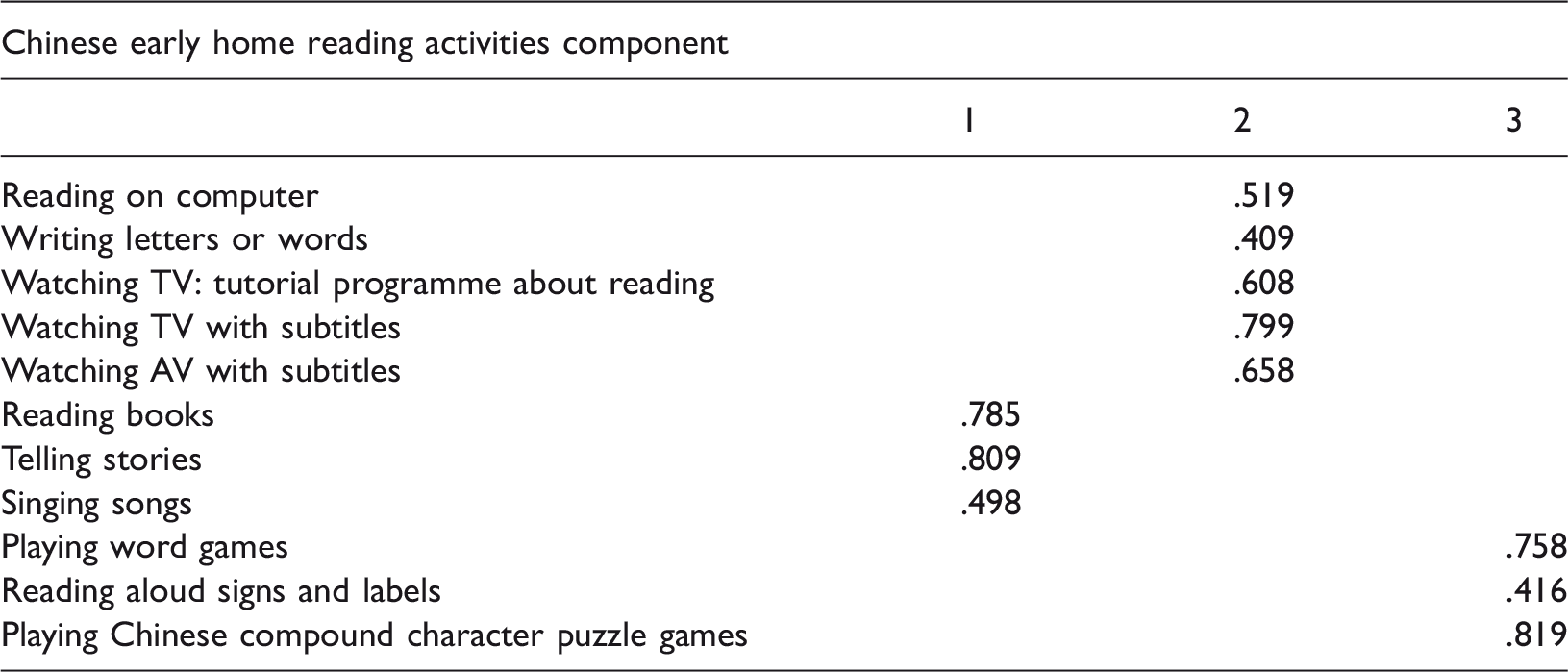
Rotation converged in five iterations.
English early home reading activities: rotated component matrix. a
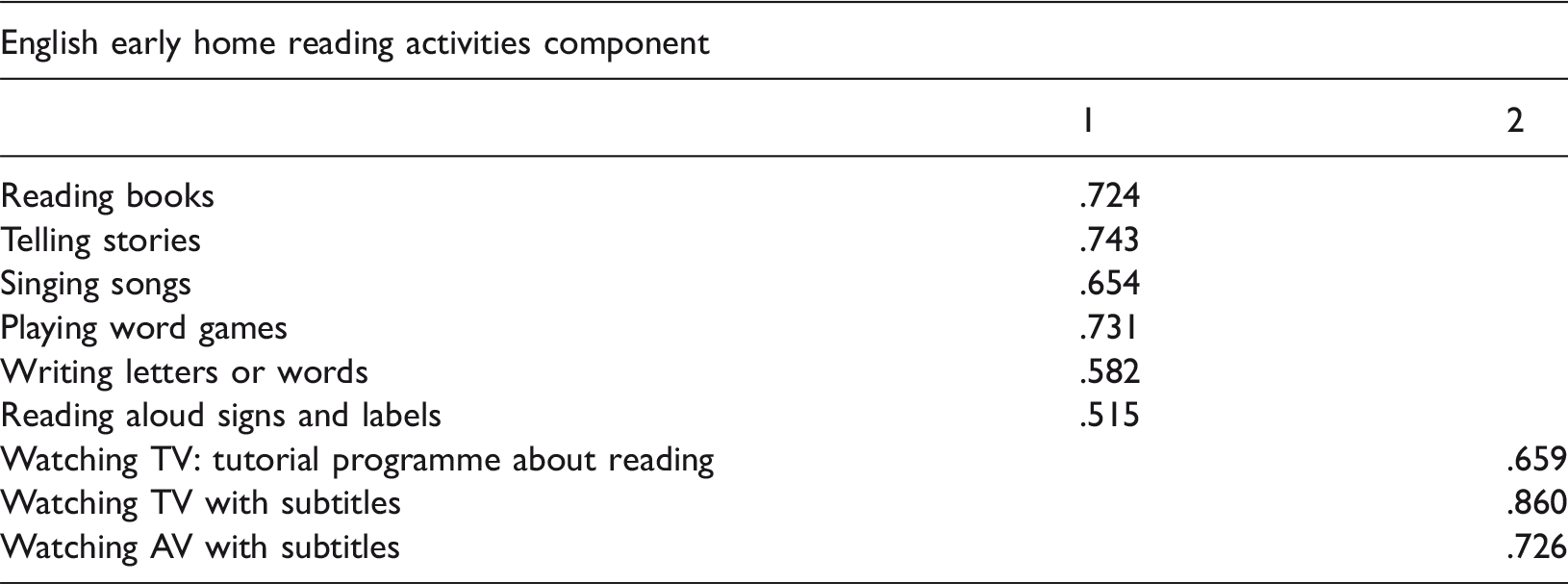
Rotation converged in three iterations.
Results
Below, frequencies of parents’ EHRA before their children’s school entry and HRA at students’ Grade 4 are reported first, followed by the results of the bivariate correlations. Results of the simple regression analyses and the multiple regression analyses are provided in the last part of this results section.
Frequency of parents’ EHRA and HRA
Frequency of Chinese/English early home reading activities (EHRA).

Note: Early home reading activities score is an average computed across the 3-point scale items in the questionnaire. Grouping is based on the following criteria: low = 1 to 1.66, medium = 1.67 to 2.33, high = 2.34 to 3.
Frequency of Chinese/English Grade 4 home reading activities (HRA).

Note: Grade 4 home reading activities score is an average computed across the eight 4-point scale items in the questionnaire. Grouping is based on the following criteria: low = 1 to 1.99, medium = 2 to 2.99, high = 3 to 4.
Results of the bivariate correlations
Correlation between students’ reading achievement and parents’ education level, occupation type, family income and parental time.
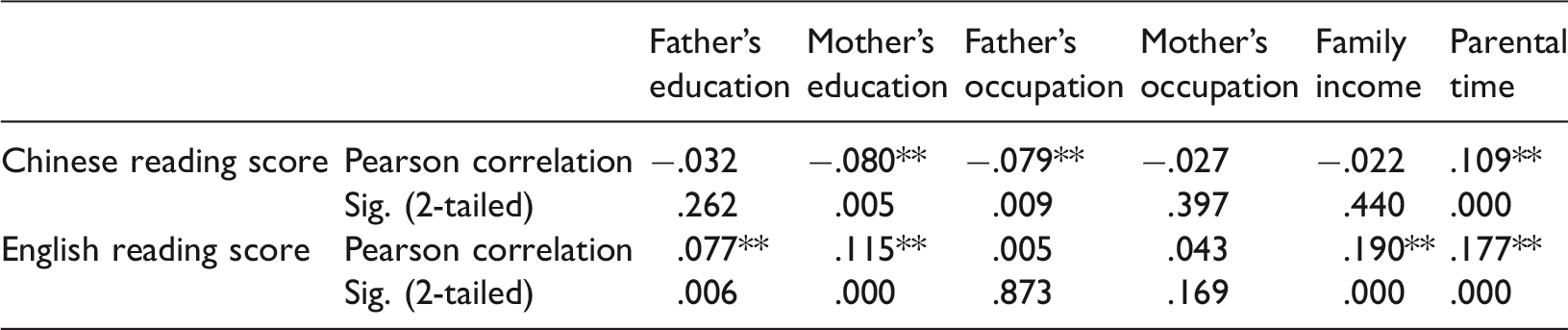
Indicates that correlation is significant at the 0.01 level (2-tailed).
The time parents reported to spend with their children each week and reading performance was found to be correlated significantly (0.11 for Chinese and 0.18 for English).
Results of simple regression analyses
Simple regression: Chinese early home reading activities on Grade 4 Chinese reading.

Note: The regression coefficients (B), standardized coefficients (β) and standard errors are in Fisher Z metric.
p < 0.01; effect size (r) = 0.107.
Simple regression: Chinese home reading activities on Grade 4 Chinese reading.

Note: The regression coefficients (B), standardized coefficients (β) and standard errors are in Fisher Z metric.
Simple regression: English early home reading activities on Grade 4 English reading.

Note: The regression coefficients (B), standardized coefficients (β) and standard errors are in Fisher Z metric.
p < 0.05.
Simple regression: English home reading activities on Grade 4 English reading.

Note: The regression coefficients (B), standardized coefficients (β) and standard errors are in Fisher Z metric.
Results of multiple regression analyses
Effect of ‘typical early home reading activities’ on Grade 4 reading in Chinese: Stepwise regression.

Note: The regression coefficients (B), standardized coefficients (β), and standard errors are in Fisher Z metric. ***p < 0.001.
Effect of ‘typical early home reading activities’ on Grade 4 reading in English: stepwise regression.

Note: The regression coefficients (B), standardized coefficients, and standard errors are in Fisher Z metric. *p < 0.05.
Discussion and conclusions
Prior research on the impact of parental involvement on the early literacy development of pre-school children has found positive effects on the reading attainment outcomes and benefits for primary school-age children (Baker, 2003; Burchinal et al, 2000; Law, 2008). However, most of these studies have been conducted in monolingual rather than bilingual contexts. The present study sought to provide insights into bilingual contexts by examining the effects of a range of HRA on the L1 and L2 language reading attainment of Grade 4 primary students in Hong Kong.
Consistent with Australian and international findings in PIRLS and TIMSS 2011 (Thomson et al., 2012), results of the analyses reported here showed the long-term impact of EHRA on students’ later reading attainment in the Hong Kong bilingual context. Parental involvement in EHRA clearly enhanced their children’s later reading attainment in both Chinese and English.
However, parental involvement once the child had entered school seemed to have a lesser effect on reading performance. This finding is partly in line with Park’s (2008) cross-country research into the effects of early home literacy activities and later attainment at primary school. Park found a positive correlation between the reading performance of Grade 4 children and the extent of parental involvement in literacy activities before the entered formal schooling but not after the children had settled into school.
In terms of bilingual reading performance, the present study found that the impact of EHRA on Chinese language reading attainment was greater than the effect on English language reading. Although many Hong Kong parents claimed to have supported the bilingual literacy development of their children, in reality, they habitually and almost exclusively tended to use a monolingual approach to communicate with their children at home and during HRA. In other words, evidence of the impact of coaching and tutoring at home aimed at boosting the children’s English language was by-and-large negligible.
Regarding the impact of different EHRA, analyses showed that a combination of reading books, singing songs and telling stories had a positive effect on Chinese reading attainment in Grade 4. In English, in addition, playing word games, writing letters and words, reading aloud signs and labels, and playing compound word puzzle games were also found to be beneficial, which is consistent with many findings reported in western countries (Lawson, 2012; Malkina, 1995; Scarborough & Dobrich, 1994; Sonnenschein & Munsterman, 2002). It is clearly apparent from the present results that reading books, telling stories and singing songs in the mother language are important activities to promote students’ mother-tongue language growth. Whereas young native readers of alphabetic English can correctly read English words they have never read or encountered before and the meaning of which they do not understand, the Chinese language is tonal and ideographic in nature, and learners have to learn both the spoken and written forms of Chinese when developing literacy prowess (Tse & Cheung, 2010).
Where parents provide EHRA in their L1, children have a chance to link spontaneously the new learning to previous knowledge (Malkina, 1995). When parents read Chinese books aloud to their children, they often rephrase stories to take account of their children’s comprehension level (Li & Fleer, 2015). Parents may embellish the story with vocal inflection and tone, point out illustrations, and invite their child to participate in the storytelling (Stanley & Dillingham, 2013). From looking at the book being read, their children have the opportunity to get a first impression of the written form of the Chinese language and lexical, phonological, orthographic and syntactic elements in new words (Feng, Miller, Shu, & Zhang, 2009). With such basic competency, they are expected to learn more easily when they enter primary school.
In contrast, EHRA conducted by parents to support reading development in English are quite different from those activities parents use when reading and teaching the Chinese language. Results of the present study show that, in addition to book reading, storytelling, and singing songs, other activities such as playing word games, writing letters to match sounds or words, using reading aloud signs and labels and playing puzzle compound word games, contributed to children’s English literacy development, although a sizeable number of parents indicated that they “never or almost never” conducted English EHRA and HRA (see Table 3 and Table 4). The significance of writing letters or words to match sounds aligned with results reported by Chua, Liow, and Yeong (2016), which suggest that writing letters and words can successfully predict English reading proficiency of bilingual kindergarten children in Australia. Playing word games may enhance motivation in vocabulary learning which is crucial for young learners of a second language (Moon & Reifel, 2008). These joint parent–child activities can evoke more utterances in English and native language, and may have positive effect on language use (Mushi, 2002). This particularly applies where the vocabulary threshold for being a proficient reader in the L2 is much higher than that in the L1, as is the case in Hong Kong. 2
Unlike previous studies in many western countries (Blanden & Gregg, 2004; Hartas, 2011; Melhuish et al., 2008; Myrberg & Rosén 2009; Pancsofar & Vernon-Feagans, 2006), the present study found no or weak correlations between Hong Kong young children’s reading attainment in Chinese and such SES factors as parental education and family income. For English, in contrast, these correlations were somewhat higher. This difference supports findings from numerous studies pointing out the influence SES has on foreign or second language acquisition (Kahn-Horwitz, Shimron, & Sparks; 2006, Olshtain et al., 1990; Skehan, 1986). Children from more advantaged backgrounds tend to have a stronger sense of the importance of English as a key language in society for international business and travel, and as a gate-opener to higher education and high-ranking jobs. In contrast, parents from lower socioeconomic backgrounds may not convey these values and expectations to their children and English may not be perceived as important as Chinese by those parents.
Hong Kong is a cosmopolitan city and the bilingual competence of its citizens is one of the most important contributors to a well-paid future life (Standing Committee on Language Education and Research (SCOLAR), 2003). Parents will deliberately seek to prepare their children for their schooling as early as possible (Epstein, 2002; Hoover-Dempsey et al., 2001). Furthermore, those who possess little English competence may also need to be shown how to assist their children constructively. However, society needs first to find ways to reach such parents and to make them comfortable in assisting schools to educate their offspring.
Publicity campaigns need to be mounted and schools and teachers might be recruited to help with this task. The present study revealed that some EHRA can have a profound impact on children’s learning of both Chinese and English. More research needs to be carried out in order to help parents and schools to apply the findings of studies in daily situations. Equally important, parent–teacher collaboration might be explored in later phases of education given the fact that “e-reading”, an important channel of learning in modern society, was not found to be a significant factor affecting reading proficiency in both Chinese and English. One possible reason is that e-reading is still not the dominant approach to reading for young children. Parents might need guidance from teachers and teachers could take advantage of collaborating with parents to make a much greater use of innovative electronic learning aids that can assist students to learn at home as they grow older.
In conclusion, findings of the current study emphasise the importance of parental involvement in their children’s home-reading prior to starting school for Hong Kong children’s reading attainment in both Chinese and English. Moreover, among the most common Chinese and English reading activities in the home, typical ones such as reading books, telling stories and singing songs were found to be most effective in predicting Hong Kong young readers’ reading attainment. In terms of learning to comprehend English text, playing word games, writing letters or words, reading aloud signs and labels, and playing compound word puzzle games were also found to be useful activities for nurturing students reading ability. The fact that Hong Kong students were ranked second in PIRLS 2006 and first in PIRLS 2011 among 46 countries is strong evidence that schools and parents in Hong Kong are effective in developing their children’s reading competence. Still, in the quest for continuous improvement, the current study has shown the importance of EHRA for reading performance in students’ first as well as second language.
Footnotes
Acknowledgement
The authors thank the children, their parents, teachers and school principals in the 66 primary schools in Hong Kong for their participation in the project. The authors would like to thank Dr Terry Dolan for his invaluable input into this paper.
Declaration of conflicting interests
The author(s) declared no potential conflicts of interest with respect to the research, authorship, and/or publication of this article.
Funding
The author(s) disclosed receipt of the following financial support for the research, authorship, and/or publication of this article: the General Research Fund grant numbers HKU 744906 & HKU 752209 of the Research Grant Council of Hong Kong SAR.