




Abstract
The internationalisation of research education witnesses a growing involvement of students from China in Australian universities. Although these students bring with them a repertoire of Chinese intellectual resources, in most cases, they are expected to learn “Western” knowledge and adapt to Australian academic culture. In this article I contend that the world’s knowledge production centre may not permanently be located in the West. Theories and concepts from Eastern countries such as China can be regarded as ‘alternative resources’ to the dominant Western academic culture. Informed by this concept, this study explores the possibility of using Chinese intellectual knowledge as alternative resources to assist Chinese students’ research in Australia and develops a Chinese educational triad: ‘teaching, learning and doing’, as pedagogical strategies to make such resources more comprehensible and engaging to the Western audience, many of whom do not understand Chinese language, so that they can join the academic conversation and contribute to the internationalisation of Australian research education.
Keywords
Introduction
Recent years have witnessed a rapid increase in the number of international students undertaking research studies in Anglophone universities such as Australia (Ryan, 2012). In 2012, over 90,000 Chinese students enrolled in Australian tertiary education, the largest among all countries exporting students to Australia (Organisation for Economic Co-operation and Development (OECD), 2012). These students bring with them a repertoire of intellectual resources from their own countries, but these resources are rarely considered valuable in the Australian higher education context. Grant (2010) reports that some western educators tend to treat non-Western knowledge as an object of study and refuse doctoral projects which propose to use non-Western theoretical frameworks. As a consequence, these intellectual resources are frequently ignored (Ryan, 2011, 2012; Singh, 2009, 2010; Singh & Meng, 2013) and the students are expected to conform to Western notions of scholarship and learning and are advised to adapt to the local academic community. In this way, research education in Western Anglophone countries such as Australia reinforces the teaching of Western knowledge to these international research students, who are mostly from Asian countries.
However, for the flow of theoretical knowledge to continue to be one-way is undesirable. Informed by the concept of “alternative resources” (Alatas, 2000, 2006), this study investigates the possibility of reconceptualising Australian international research education as a two-way, reciprocal process of transnational knowledge exchange through intellectual engagement. It reports on an investigation into what knowledge from China is used by Chinese research students studying in the social sciences in Australian universities. Moreover, the article explores the pedagogical strategies which could be developed to encourage the uses of such knowledge and make it more comprehensible and acceptable to a Western audience, so that it may function as an alternative resource and contribute to the genuine internationalisation of Australian research education.
Internationalisation of higher education
The internationalisation of higher education has meant an increasing number of international students from non-Western countries studying in Western countries (McGowan & Potter, 2008; OECD, 2012). Due to the cultural and language differences in most cases, these students encounter difficulties when they travel from home to a different cultural and academic site (Cemalcilar & Falbo, 2008; Ingleby & Chung, 2009). Factors that might be contributing to these difficulties include students’ personality, their sense of belonging, language difficulties, cultural differences, unfamiliar patterns of classroom interactions and learning difficulties (Campbell & Li, 2008; Ingleby & Chung, 2009; Kelo, 2007; Vita, 2007; Yang, Byers, Salazar, & Salas, 2009). To help these students adjust to the new culture, various types of support need to be provided, such as more emotional, practical and informational support (Ramsay, Jones, & Barker, 2007), assistance from the university student-support office (Yang et al., 2009), appropriate orientation and support programmes (Cemalcilar & Falbo, 2008) and financial support (Kelo, 2007).
These studies have focused on how international students were different from local students and how they could be assisted by improving certain skills. However, this perspective can be seriously misleading and ill-informed (Ryan & Louie, 2007) and gives ‘inaccurate information about international students especially in rapidly changing contexts such as China and India, the major source countries of international students for most Anglophone universities’ (Ryan, 2011, p. 638). It is argued (Han & Zhao, 2008; Singh, 2009) that this approach does not pay sufficient attention to the intellectual knowledge such as theories and concepts from the non-Western cultures from which most international research students come. In addition, it is argued that such knowledge has not been fully articulated in the academic conversation between the Western academic community and international students from non-Western academic traditions such as China.
In contrast to the focus on international students’ differences and adaptation to a new academic culture, another approach pays attention to international students’ own cultural capital in the communication between them and the Western academic community. Caruana (2010) contends that to understand the complexity of the internationalised curriculum and global citizenship, it is more helpful to adopt an approach that brings together faculty and students for communicative discussion in the spirit of collaboration rather than merely acculturating international students to the new academic culture. There is sufficient willingness to enable mutual adaptation and reciprocal engagement among different academic cultures. This is especially relevant when some of these students make every effort to use learning skills acquired in their own countries (Campbell & Li, 2008). Western internationalised research systems need to ‘engage with other educational systems and ideas … so that their knowledge and perspectives are available for debate and learning by both academics and students’ (Ryan, 2013, p. 282).
In this sense, internationalisation of higher education can be approached from a transformative perspective, which is concerned with knowledge sharing and cooperation and integrates ‘an international/intercultural dimension into the teaching, research, and service functions of academic institutions’ (Knight, 1999, p. 16). The intercultural experiences of international students require a holistic interpretation and engagement of their own cultural capital. Four levels of engagement were put forward by Caruana (2010) including understanding the influences of culture and nationality on attitudes and values, enabling cross-cultural interaction, understanding different cultural contexts, approaches and international standards and using cross-cultural interaction skills to make contributions to knowledge. These strategies can promote the bi-lateral engagement between international research students and local students and/or their Australian supervisors. At the same time, the drawing on different cultural epistemologies and intellectual traditions can broaden the scope and topics for international research education and provide opportunities for transcultural learning (Ryan, 2012, 2013).
However, to move beyond superficial inclusion of examples from other cultures and to engage such knowledge on a theoretical basis, the intellectual assets from different cultures need to be considered as ‘alternative resources’ to those of currently dominant Western academic traditions.
Alternative resources in the world’s knowledge production centres
The long-term history of transnational knowledge exchange shows that no party can hold superiority permanently, either economically or intellectually. This has been expressed by Tabulawa (2003) who states that ‘the privileged position in the world system of core states cannot be guaranteed, for their relations with periphery states are dynamic’ (p. 11). Similarly, Goody (2010) claims that sometimes ‘one society gained an advantage over the others, but this was only a temporary state of affairs since this position was characterised by the existence of alternation between the major societies’ (p. 108). Thus, one intellectual culture may lead the way for a certain period, but with continuous cultural communication and knowledge exchange, permanent intellectual supremacy is highly unlike. As discussed by Acharya and Buzan (2007), the world has moved from a period of Western colonialism into a period in which non-Western cultures are regaining their intellectual autonomy. Goody (2010) considers the re-emergence of China and India as global powers, a possible source of contemporary alternation, maintaining that ‘it is just such an alternation we are experiencing today, with China and India beginning to dominate the manufacturing economy and the search for new materials, and beginning too to influence the educational process’ (p. 110). The West’s dominance of the global knowledge economy is currently challenged by a new situation where Eastern nations such as China and India are playing greater roles in the world economy, politics and culture (Sharma, 2009). In the process, the Western domination of world knowledge is considered to be lessened (Goody, 2010).
Alatas (2000) used the term ‘alternative discourses’ as a collective term to refer to the ‘attempts at social science theorizing and conceptualization in Asia and elsewhere that emerged as a result of dissatisfaction with mainstream Euromerican-oriented models, research agendas, and priorities’ (p. 1). It refers to the set of discourses – in this case, Chinese intellectual assets – that had emerged as different resources to what is understood to be mainstream, Euromerican social science. These alternative resources could include ‘indigenous philosophies, epistemologies, histories, art and other modes of knowledge, which are all potential sources of social science theories and concepts’ (Alatas, 2000, p. 5).
Similarly, Ryan (2012) argues that the internationalization of higher education has enabled ‘deep conversation and debate and exploration of alternative paradigms to generate new knowledge and fashion new attitudes and perspectives that cross cultural boundaries’ (p. 56). The intellectual knowledge of international students could be considered as alternative resources and be positioned as ‘partners in the creation of new knowledge and practices amongst all stakeholders in higher education’ (Ryan, 2011, p. 633). This perspective on internationalisation of higher education opens new possibilities for knowledge from non-Western traditions to be articulated in the world social sciences and to be used ‘for the co-construction of new knowledge and more collaborative ways of working and thinking’ (Ryan, 2011, p. 642).
In this sense, ‘internationalization of higher education’ is more than the inclusion of an international ‘dimension’ into university operations (Knight, 2004) and the expectations for international students to learn about Western academic culture and adopt its ‘critical’ traditions (Ryan, 2013). The research students from ‘Eastern’ countries such as China have brought with them different academic cultures and intellectual traditions. However, there still appears to be ‘a lack of recognition of the potential to take advantage of these global flows of people, ideas and perspectives by engaging with the knowledge and academic values that international doctoral students bring’ (Ryan, 2012, p. 55). There is a need to ‘question the “universalism” of Western teaching and learning practices so that we can understand how to move beyond academic monoculturalism or interculturalism, and towards transculturalism’ (Ryan, 2011, p. 636). International research students from non-Western countries are located in different knowledge networks. Both the students and the university pedagogies could benefit from connecting the intellectual knowledge that the students have, or can access, with efforts to regard it as transnational researchers (Singh & Meng, 2011; Singh & Shrestha, 2008). One way to achieve this is to consider such knowledge as alternative resources that could contribute to the internationalisation of Western higher education.
The term ‘alternative resources’ draws attention to the engagement with local or indigenous theories and concepts, but it is not used to indicate that indigenous or local concepts are to replace Western ones. This concept is not to be understood in negative terms, that is, in terms of ‘a delinking from metropolitan, neo-colonialist control’ (Alatas, 2000, p. 5). On the contrary, it is meant to be understood ‘in a more positive way, in terms of the contribution of non-Western systems of thought to theories and ideas’ (Alatas, 2000, p. 5). It suggests the need for world social sciences to consider seriously non-Western sources of ideas and concepts, and to take a more cautious and critical attitude towards the adoption of Western theories and concepts. In other words, alternative theories do not go to the extreme of dismissing all knowledge from the West, but suggest the possibility for indigenous philosophies, epistemologies and histories to become sources of human knowledge. Local and indigenous sociologists can and should contribute ‘on an equal basis with their Western colleagues to international scholarship’ (Alatas, 2006, p. 87).
However, problems arise when engaging Chinese intellectual knowledge as alternative resources in that Chinese concepts such as chéngyŭ (Chinese idioms) cannot be fully accepted or valued by some Australian academics due to cultural and language differences. Therefore, pedagogical strategies need to be developed to make such resources comprehensible and acceptable to a Western audience, many of whom do not know Chinese, which is the goal of the current study.
Method
In order to understand the possibility of using Chinese intellectual knowledge as alternative resources in Australian research education, the study reported here investigates the Chinese intellectual resources which have been used in research students’ theses and the strategies which could be developed to make such resources more comprehensible and inviting to Australian academics, most of whom do not know the Chinese language.
Data
Documents
Evidence for this study, which followed a case study approach (Yin, 2009), was obtained through document analysis and interviews. Documents included 17 theses completed by Chinese international students who had undertaken research in Australia. Fifteen of these theses were retrieved through an online database, the Australasian Digital Theses programme. The other two theses were accessed as hardcopies from a university library and analysed separately given that their authors had been involved in a programme that takes the initiative to engage Chinese intellectual resources.
Interviews
This study also used interviews as a primary method of data collection. Through a snowball sampling procedure (Mason, 1996; Miles & Huberman, 1994; Patton, 2002), a sample of 22 Chinese international research students was obtained as the participants for interviews. All students were from Australian universities and had been studying in the field of social sciences for more than a year. All interviews were conducted in English given that all the interviewees had been studying English for over 15 years back in China and were fluent English speakers. Each interview was of 40 to 60 minutes in duration. The main interview questions were about participants’ opinions on the possibility of using Chinese intellectual knowledge in doing research in Australia. Appendix 1 contains a profile of the interviewees and the interview schedule. Appendix 2 contains the interview questions.
Analyses
Analyses of the 15 electronic theses were aimed at exploring any Chinese intellectual resources that were used in the students’ research. Even though China has many valuable intellectual resources, as a starting point, only two concepts which originated from Chinese ancient literature were used in this study, namely chéngyŭ (idioms) and súyŭ (axioms). These concepts still have profound influence on contemporary Chinese culture and are widely used in modern communication. Analyses of the two hardcopy theses were aimed at examining how Chinese concepts were used for theorising by their authors and how to make these concepts apprehensible to Australian academics.
Responses to interviews were recorded, transcribed and then analysed by the author using Nvivo 9. The analytical process was reverberative and cyclical in nature, which involved ‘comparing data to data, data to code, code to code, code to category, category to category, category back to data’ (Saldaña, 2009, p. 45). In this way, the data collected for this study were coded, categorised, recoded and recategorised to find useful and evocative connections.
Results
Using Chinese intellectual resources as alternative resources
Results of the analyses of the theses show that some Chinese international students use Chinese concepts while doing research in Australian universities. Most of these concepts are Chinese chéngyŭ (idioms) or súyŭ (axioms) which are from ancient Chinese classics and contain philosophical and historical meanings. The analysis showed that four of the 15 completed theses used Chinese concepts as illustrated in the example below: In Chinese culture, the relationship between teachers and students is traditionally seen to be similar to kinship with high power distance (Spencer-Oatey, 1997), as expressed in a well-known Chinese saying: Teacher and student are like father and son [shitu ru fuzi]. (Li, 2001, p. 42) The philosophy for this educational strategy is based on the ancient Chinese educational heritage, in particular the notion of “Yin & Yang” (Lao Zi, 1988). This concept provided a fundamental idea of related opposites within Chinese philosophy, which also holds that a person cannot choose one and abandon the other, either emotionally or in normal life. (p. 61, italics added)
Results of the analyses of the interviews also indicate that even though positioned in an academic environment mostly dominated by Western knowledge, some of these Chinese students seem to consider themselves as intellectual agents for the communication between the East and the West. For instance, a student said ‘I think maybe I could be a bridge in between Chinese scholars and Western scholars in the future’. Another student claimed: When Chinese students come to Australia, they are the academic ambassador of the two countries. They establish academic links between China and Australia so when they finish, they go back to China and they build up the academic collaborations between the two universities – in China and in Australia.
However, the uses of some Chinese concepts in Chinese students’ studies are limited. Not many of them have been used for theorisation. This is not surprising given that non-Western theoretical frameworks have not been fully accepted by many (but not all) Western educators (Grant, 2010). Under such circumstances, it seems necessary to develop pedagogical strategies that can encourage such uses and make those concepts more comprehensible and acceptable to the Western audience.
‘教学做合一’ ‘combining teaching, learning and doing’ as pedagogical strategies
The pedagogy developed in this study was informed by the Chinese concept of 教学做合一 (Fang, 2005; Tao, 2008), proposed by Tao Xingzhi (1891–1946), a Chinese scholar whose theories are deeply revered and widely implemented in China today. Tao’s educational philosophy has been greatly influenced by John Dewey’s concept of ‘learning by doing’. He even changed his original name Wenjun into Zhixing, which means ‘knowledge and action’, and then again to Xingzhi to place action before knowledge, emphasising the importance of practice. A disciple of Dewey, Tao worked hard to introduce Dewey’s theories into China, aiming to promote a new educational reform. But Tao soon found that the concept of learning by doing was not suitable for Chinese society, so he modified it and created a new concept 教学做合一. ‘教’ means teaching; ‘学’ means learning; ‘做’ means doing, and ‘合一’ means to combine. This concept means to combine teaching, learning and doing. Tao (Fang, 2005) argues that effective pedagogies entail the interactive efforts from both teacher and student. Teaching, learning and doing are ‘not three separate processes, but one combined process’ (Fang, 2005, p. 176), and ‘doing is the centre for teaching and learning’ (Tao, 2008, p. 91). Both teaching and learning could be developed and improved through doing, namely practices.
The creation of this concept demonstrates how intellectual resources from other cultures could be introduced and adapted to address local issues. It has become an axiom in Chinese educational culture and is widely accepted and implemented in all levels of teaching.
This section reports the results of the analyses of the two theses which have been involved in a programme that purposefully engages Chinese intellectual resources and develops the pedagogical triad: teaching, learning and doing in the context of Australian research education. The aim is to explore the possibility of using Chinese concepts as alternative resources to inform the internationalisation of Australian research education.
The first pedagogy is about teaching [教] non-Western students to be intellectual agents claiming the value of their own intellectual assets. Chinese international research students need to be considered as having access to a knowledge network which offers potential intellectual assets for theorisation while doing research in the West (Singh & Cui, 2011; Singh & Guo, 2008). Pedagogies for internationalising Australian research education need to teach students to be aware of their advantages in this respect rather than treating them as problematic. Evidence shows that these students could realise and articulate the value of their bilingual competence. Huang (2011) argues for this in more than one instance in her thesis: There are various forms of Chinese philosophical concepts which can be used in Australian educational research, such as 成语 chéngyuˇ, 俗语 súyuˇ, 歇后语 xiēhòuyuˇ or quotations from Chinese classical writings – 文言文 wényánwén. … They are highly refined phonologically and linguistically to represent key philosophical concepts, expressing ‘the essence of the language, adding to it [sic] beauty and colour by virtue of its richness and originality’ (Yang & Zhang, 2007, p. 10) … this Chinese intellectual heritage is applicable in modern society, and has high potential for contributing to global knowledge flows. (Huang, 2011, p. 72)
The second strategy is learning [学]. While Australian academics use the strategy of teaching to help Chinese international students realise the value of their own intellectual assets, this is not enough. Effective teaching pedagogy entails efforts from both teachers and students. These students themselves, accordingly, need to learn to use those assets to critique the hierarchical academic community and challenge the marginalisation of non-Western intellectual resources in Australian research education. They can explain their use of Chinese theoretical tools with respect to the dominance of Western knowledge in global intellectual spaces critically. Huang (2011) argues that they can speak historically to the impermanence of any intellectual order, including the mostly monolingual, English-only research environment and Western academics: … the direction of knowledge transfer today is mainly from Western countries to the rest of the world. Knowledge transfers in the other direction rarely happen. In other words, globally, universities and research are heavily centred on Western knowledge. The dominance of Western knowledge suggests an ignorance of knowledge from the non-Western world, such as China. (p. 75)
In this context, it needs to be emphasised that many (but not all) Chinese students might need further advice in terms of how to critique and challenge the Western ‘authority’ appropriately. It is likely that many Chinese students might not be as openly critical as Huang at the beginning of their studies in Australia. This could be attributed to the influence of traditional Chinese culture on Chinese students, specifically teacher-centred instruction, and might pose problems for the implementation of this new pedagogy. How could these students whose previous educational experience is not to question the authority of teachers learn to critique and challenge the Western academia from whom they are supposed and prepared to learn?
One way to cope with this issue is exemplification. The work of Huang in her thesis could be used as a good example to show how Chinese students could critique the dominance of Western knowledge and the marginalization of non-Western intellectual assets, and at the same time claim the value of their own intellectual heritage. For instance, Huang (2011) claims However, the direction of knowledge transfer today is mainly from Western countries to the rest of the world. Knowledge transfers in the other direction rarely happen. In other words, globally, universities and research are heavily centred on Western knowledge. The dominance of Western knowledge suggests an ignorance of knowledge from the non-Western world, such as China. In this thesis I demonstrate that China’s rich intellectual heritage could contribute to the world’s knowledge flows. By introducing concepts that are used in modern China into Western education I hope to stimulate a two-way intellectual conversation, otherwise called transnational knowledge exchange. (Huang, 2011, p. 75)
Another issue is how to use such resources as theoretical tools which are not comprehensible to the Western audience, many of whom do not know Chinese. What could be done in practice so as to solve the problem of linguistic and cultural difference between Western and non-Western (in this case Australian and Chinese) intellectual traditions? Informed by Tao’s concept, the pedagogy needs to focus on various ‘ways of doing’ [做], which might help engage Chinese intellectual resources in Australian research education. The first strategy is pronunciation.
Most (but certainly not all) Australian academics are monolingual, English-speakers. This poses problems for them to understand and engage with concepts from other cultures, including Chinese concepts. If Chinese concepts are only presented in the form of hanzi (Chinese characters), it would be quite difficult for Australian educational researchers, and Western readers more generally to engage them. So the first strategy is to give pinyin (sometimes with tonal markers) to show the pronunciation of the concept. For instance, Chinese educational philosopher Zhu Xi commented on Confucius’ idea with the chengyu 循序渐进 (xún xù jiàn jìn): 循 xún means ‘in accordance’, 序 xù means ‘order’, 渐 jiàn means ‘gradually’, 进 jìn means ‘progress or improve’. (Huang, 2011, p. 154)
In order to make Chinese intellectual resources comprehensible to Australian educational researchers and more generally Western audiences, a useful (but not unproblematic) strategy is to provide the English translation. For instance: There is a Chinese concept “双刃剑” /shuang ren jian/ that is useful for interpreting this claim. “双 /shuan/” means “double”, “刃 /ren/” means “blade” and “剑 /jian/” means “sword”. This concept means a sharp sword can help you to defeat your enemy, but if you use it incorrectly, you may hurt yourself with it. (Yuan, 2009, p. 133) Thus, even though new technology is beneficial for students’ learning and teachers’ teaching, television and the Internet may distract students from what teachers expect them to learn. … if these tools are used by students who are not informed about how to use them appropriately, they may distract students from their learning. Therefore, the key point is to be aware of the positive aspects of these audio-visual tools as well as their negative potential, and to find a balanced way to make the best result. (Yuan, 2009, pp. 133–134)
Many Chinese concepts come from ancient Chinese classics and thus have a story associated with them. Some of the connotations of these concepts have no equivalent in English. For such concepts, in addition to the original Chinese concept in hanzi, pinyin and a literal English translation, research students need to provide background information about the concepts’ origins and history in China as well as their current use in Chinese society. This process is called ‘contextualisation’. This additional information is supplement to overcome the limitations of any direct translation, and minimise the inevitable loss of meaning through translation by providing a multi-dimensional, multi-angled explanation. Meanwhile, many Chinese concepts which come from ancient classics – and in the following example a more recent text by a nineteenth century Chinese scholar – are widely used in modern, twenty-first century China. They are used in both written and spoken Chinese, functioning as moral guidelines and moral standards for Chinese people in certain fields in today’s society. Therefore, it is helpful not only to provide information about the concept’s origin and historical context, but also the current use of a concept in modern Chinese society. For instance, Huang (2011) uses the concept ‘师夷长技以制夷’ [shī yí chángjì yiˇ zhìyí ] to analyse her intention to investigate Australian educational culture. In addition to pinyin and its English translation, she gives the origin of this concept: As a developing country, China needs knowledge from a developed nation to make progress: “师夷长技以制夷” (shī yí chángjì yiˇ zhìyí). … Thus this sentence from Chinese literature, namely 海国图志 (Hai Guo Tu Zhi), means “to take [Western] foreign specialists as teachers, learn from them in order to compete with them.” This proposition was developed in 1842 (Qing dynasty) by Wei Yuan, when China was involved in the Sino-British Opium War and suffering from a recession. He argued for the importance of knowing the rest of the world rather than feeling self-fulfilled. China should send its officers overseas to learn, to open their mind. (Huang, 2011, p. 143) This idea of learning from Western societies becomes so important; it now influences people in modern China. Increasing numbers of Chinese students go overseas to be educated, as well as there being increasing numbers of English language learners in China. (Huang, 2011, pp. 143–144) The chengyu 失败乃成功之母 (shībài naˇi chénggōng zhīmuˇ) captures the significance of my failed experiences. 失败 (shībài) means ‘failure’; 乃 (naˇi) is an ancient form of the language and is equal to 是 (shi) in the modern Chinese language, which means ‘is’ or ‘are’. 成功 (chénggōng) means ‘success’. 之 (zhī) is also ancient language and的 (de) is the modern form of this word, which means ‘something/someone’s’. 母 (muˇ) means ‘female’, in this case, ‘mother’. This chengyu originated in a Chinese legend ‘山海经 Shan Hai Jing’. 鲧 (guˇn) tried to stop the flooding on Earth but he failed. His son 禹 (yuˇ) carried on his mission of fixing the flood. He learnt from his father’s lesson and finally he was successful. Nowadays, Chinese people use this chengyu to encourage those who have failed at one stage to persist, saying that, ‘Don’t worry, please carry on, success will be born out of this failure’. (Huang, 2011, p. 96)
As shown in each of the evidentiary excerpts given above, the concepts analysed in this section have all been used for theorisation through analysing, informing or critiquing evidence. In addition to these methods for using Chinese concepts as theoretical tools, the analysis of Chinese research students’ thesis shows another strategy – illustration.
The illustration here refers to using diagrams to display or represent a concept. Peirce (1958) argues that ‘diagrammatic reasoning is the only fertile reasoning’ (p. 112). Turner (2010) also holds that the use of diagrams can ‘give a theory a more accessible aesthetic form’ (p. 113). Yuan (2009) uses a Chinese concept ‘三驾马车 [san jia ma che]’ in her thesis. She first uses strategies of pronunciation, translation and contextualisation to make the concept meaningful and comprehensible to non-Chinese speakers: There is a Chinese concept “三驾马车” /san jia ma che/, which is useful for elaborating on this thesis. “三” /san/ is the Chinese number three; “驾” /jia/ is a quantifier; “马” /ma/ means horse; “车” /che/ means vehicle. This concept literally means “a gharry with three horses”. In ancient China, only the emperor or a superior general could sit on a gharry pulled by three horses. Now, this concept is used to describe three powerful forces that drive things forward. (Yuan, 2009, pp. 13–14) Yuan’s (2009, p. 14) illustration of a Chinese concept ‘三驾马车’ [san jia ma che].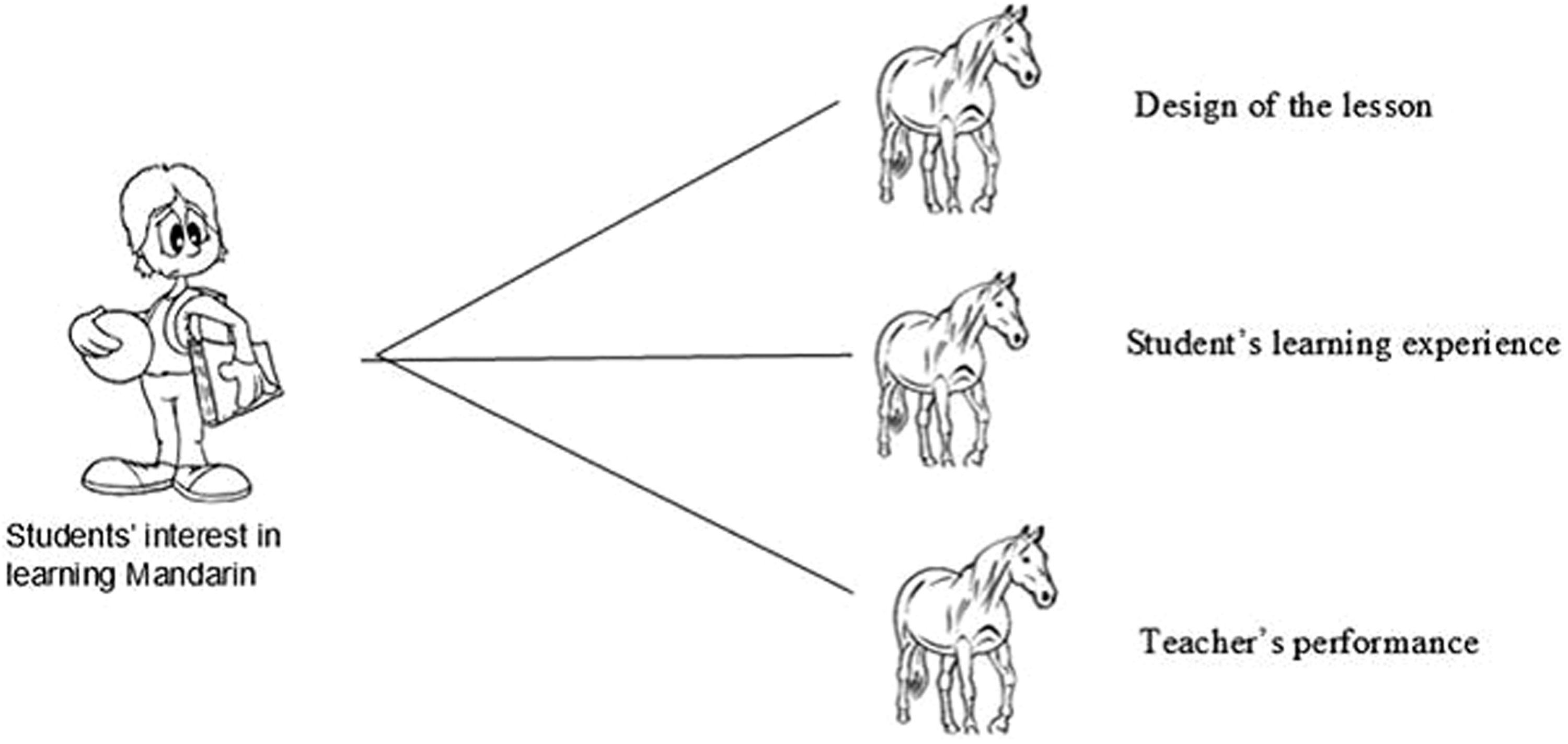
This diagram makes the connection between the concept and the research focus more vivid and interesting. It addresses the significance for Chinese students to improve their teaching practice through paying attention to the three elements shown in the diagram and becomes a theoretical framework for this thesis. Therefore, through four strategies of doing: pronunciation, translation, contextualisation and illustration, some Chinese concepts could be made comprehensible and meaningful and then used as alternative theoretical tools to analyse evidence in a thesis.
Conclusion
Global social sciences are currently largely dominated by Western academic traditions. Alatas (2000, 2006), Connell (2007) and Ryan (2011, 2012, 2013) critique the marginalisation of non-Western/Southern theories in this field and call for more engagement with those intellectual resources. The concept of alternative resources (Alatas, 2000, 2006), to some extent, provides a new perspective for encouraging the uses of non-Western theories and concepts by researchers from non-Western countries, such as China, and opens more opportunities for genuinely internationalising Australian research education.
It is acknowledged that the current study has limitations. For instance, the number of theses examined is limited and the effectiveness of the new pedagogy is yet to be tested, not only for teaching Chinese international students but also for the international research education as practiced in other Anglophone countries and for engaging intellectual knowledge of other forms and languages. However, results show that some research students use the outlined alternative resources in their theses and provide examples of how this has been done.
Still, for alternative resources to be successful, they need to be accompanied by specific strategies to turn them into useful pedagogy tools aimed at making the currently incomprehensible Chinese intellectual resources accessible and, hopefully, acceptable to the mostly monolingual Australian academic society. Through analysing theses from Chinese research students who have been encouraged to use their own intellectual assets as theoretical tools for researching in Australia, this study provides pedagogical strategies for Australian research educators.
Tao Xingzhi’s (Fang, 2005) education triad, namely teaching, learning and doing (教学做合一), was introduced as a framework for the development of practical pedagogies. Western educators could enable non-Western students to be intellectual agents who value and use their own intellectual assets. Considering that many (but not all) Chinese international students have been influenced by the teacher-centred teaching style in China, the strategy of exemplification could be used to assist and encourage these students to use their intellectual assets to critique the academics and their academic traditions in Australia. Practically, to overcome the language and cultural barriers, students could use the strategies of pronunciation, translation, contextualisation and illustration to make some Chinese concepts such as chéngyŭ (idioms) and súyŭ (axioms) more inviting to the Western audience, many (but not all) of whom do not know Chinese. Through such pedagogies, some Chinese intellectual resources could be brought to the international academic conversation as alternative resources and contribute to the genuine internationalisation of Australian research education.
Footnotes
Declaration of conflicting interests
The author(s) declared no potential conflicts of interest with respect to the research, authorship, and/or publication of this article.
Funding
The author(s) disclosed receipt of the following financial support for the research, authorship, and/or publication of this article: This project has been funded by the Australian Research Council (Discovery Project DP0988108).