




Abstract
Teaching students to use and interpret different representational tools is critically important if they are to be scientifically literate, to understand how scientific ideas and concepts are represented and to appreciate how scientists think and act. Moreover, students not only need to be competent at using and explaining representations and learning new representations quickly but they also need to have opportunities to work cooperatively with others as it is through interactions between learners, tools and the environment that learning occurs. The current case study (part of a larger study) aimed to: (a) identify the effects of different teacher-introduced representational tools on students’ conceptual understandings, dialogic processes, motivation and learning; (b) examine the representational tools used by students during their inquiry science; and (c) examine the physiological states indicative of engagement and cooperation during learning activities. Prior to and on completion of the curriculum unit, participants completed a series of measures to assess actual as well as self-perceived ability in science. Students also wore wireless wristbands to measure autonomic arousal level that were analysed to assess the level of synchrony in physiological states between children. The results showed that the teacher successfully used embodied representations to engage the students in the science unit and maintained their focus in the cooperative groups by using language that encouraged on-going participation in the task. In turn, the students remained on-task and the majority of the language they employed was used to construct and communicate their scientific understanding to others. This high-level common engagement during whole class activities and student-centred learning during the cooperative group activities were also reflected in the physiological measures of synchrony between students. By integrating the video and biometric data with the data from the individual assessments, we construct a rich picture of relationship between the teacher’s use of multimodal representations and cooperative small groups with the students’ use of scientific language, physiological engagement and their beliefs and attitudes towards science.
Keywords
Introduction
Teaching students to use and interpret multimodal representations in science is critically important if they are to become scientifically literate, to understand how scientific ideas and concepts are represented and to learn how to think and act like scientists (Tytler, 2007). Being scientifically literate includes being able to understand and integrate multiple representational modes including the interpretation and use of texts, tables, diagrams, graphs, models, drawings, portfolios, artifacts and embodied forms such as gesture, role play and exhibitions of performance (Lemke, 2004). Hubber, Tytler, and Haslam (2010) argue that there is a strong need for student agency in generating, negotiating and refining scientific representations, and that providing students with opportunities to work cooperatively with others in shared tasks is an important way in which student agency can be exercised. Indeed, there is considerable research (Johnson & Johnson, 2002; Roseth, Johnson, & Johnson, 2008) that indicates that students benefit academically and socially when they have opportunities to work cooperatively as opposed to working in competition or individually.
Cooperative behaviour
Cooperative discussion and interactions between students is crucial for students to fully grasp the meanings of different representations, which allow students to employ the necessary representational tools for constructing and communicating their understanding (diSessa, 2004; Kozma & Russell, 2005). It is through interactions between learners, tools and the environment that learning occurs (Prain & Tytler, 2012; Vygotsky, 1978). Howe et al. (2007), in a study of 24 classes of 11- to 12-year-old students engaged in learning about evaporation and condensation, and forces and motion, found that small group work where students proposed ideas and explained their reasoning played a critical role in the achievement gains obtained by the students. Slavin, Lake, Hanley, and Thurston (2014), in a best-evidence synthesis of achievement outcomes of elementary science programs, found that science teaching methods that focused on enhancing teachers’ classroom instruction such as cooperative learning and science-reading integration as well as approaches that provide teachers with the technological tools to enhance instruction, had a significant positive effect on students’ achievement. The construction of successful cooperative groups in a classroom involves teachers demonstrating positive helping behaviour and caring language, which is then emulated by children interacting in their cooperative group (Gillies, 2006).
Social synchrony and physiological arousal
Engaging socially requires that our brains become mutually adaptive to a shared environment (Konvalinka & Roepstorff, 2012). A recent line of neuroscience research has focussed on “mirroring” processes in the brain, by which interacting or cooperating partners are thought to emulate some of each other’s mental states as a form of shared experience (Gillies & Cunnington, 2014). Original research on mirroring processes has suggested that this shared or emulated neural representation allows us to understand the intentions behind others’ actions (Rizzolatti & Fogassi, 2014). Recent research has also shown that social relationships between individuals are crucial for mirroring processes that underlie empathy and our ability to share and understand others’ emotional and mental states (Bernhardt & Singer, 2012). Therefore, shared states at the level of the brain and mental processes that appear to be dependent on social relationships may be an important factor for interpersonal interactions in cooperative learning.
Psychological research shows that, during social interactions, a high degree of synchrony between individuals is a key indicator of cooperative engagement (Feldman, 2007; Levenson & Ruef, 1997). Synchrony can be defined as the coordination and modulation of behaviours and affective states between individuals interacting in a social setting (Hernandez, Riobo, Rozga, Abowd, & Picard, 2014). Importantly, this synchrony may also occur at the physiological level of autonomic responses, indicating physiological arousal level that is mediated by the brain (Levenson & Gottman, 1983; Levenson & Ruef, 1997; Marci, Ham, Moran, & Orr, 2007). In this way, examination of the level of synchrony between students’ physiological states during class lessons may indicate the level of common engagement of those students in the learning tasks.
Teacher’s role
Teachers are critically important in creating learning environments that motivate students to engage in learning. Moreover, the manner in which children see themselves and their abilities can also have an impact on the way they learn, and how they achieve (Lambert, 2014). Drawing on research across four decades, Bowman (2011) argues that exceptional teachers create academic environments that provide students with a contextual sense of their intrinsic worth. These environments, Bowman believes, are underpinned by three overarching human needs: autonomy or the freedom to make choices; mastery or the ability to learn and develop expertise; and purpose or the drive to find meaning in one’s life. Research by Deci (2009) and Deci and Ryan (2011) emphasises the importance of teachers creating environments that facilitate greater satisfaction of students’ basic psychological needs for autonomy, competence and relatedness. In effect, students are more likely to be motivated to learn when they believe these needs are being met.
Students’ psychological needs
Meeting students’ psychological needs for autonomy, competence and relatedness can be a challenge for many teachers as it requires them to be adept at recognising these needs in their students and then being able to create learning environments that enable these needs to be met. Learning in such environments includes enabling students to exercise autonomy or choice in regulating their learning behaviour, providing tasks that are academically challenging so students have a sense of achievement when mastered, and creating situations where students are encouraged to build caring and supportive relationships among and between teachers and students. Under these circumstances, it is reasonable to expect that such students would feel socially connected and valued by their teachers and peers and more likely to feel motivated to achieve, both academically and socially (Roseth et al., 2008).
Purpose of this study
Through cooperative work in small groups, students learn to successfully manipulate and understand novel scientific representations, building their scientific literacy. Given the importance of this skill, the purpose of this study was threefold. First, we report how one Year 6 teacher used different multimodal representations and cooperative groups to teach a science unit on Diseases. Second, we document the representational tools used by students during inquiry problem solving. Finally, we measured the effect this approach had on physiological states indicative of engagement and cooperation during learning activities and how these measures correspond with students’ beliefs and attitudes towards science.
Methodology
Background to the case study
The teacher who participated in this case study was part of a larger study (involving nine teachers and approximately 230 students aged 10–12 years from four low- to middle-class schools in Brisbane) where the teachers had agreed to teach two contemporary, inquiry-based science units based on the Australian Curriculum: Science. The units were developed from the Science Understandings content descriptors in the Biological Science and Earth and Space Science strands. The school in which this teacher taught had developed a new Biological Sciences unit looking at Infectious Diseases which built on a recent experience of a mini epidemic of flu-like illness within the school. This unit which is the focus of this case study was linked with literacy and the emphasis was on using correct terminology to describe causes, symptoms, transmission and control which assisted the students in taking on the role of “doctors” in diagnosing an illness based on a story from the teacher incorporating several “red herring” symptoms. The students had to justify both the decision they made as well as provide reasons to exclude other possibilities.
This unit on Diseases was written using the Primary Connections 5E model and content reflecting the interests of the students. The unit was augmented with a variety of multimedia resources that presented a range of current contemporary issues on infectious diseases that the students were encouraged to investigate, discuss and develop explanations in order to explain and justify their reasoning. During the course of the unit, students were supported to produce multimodal representations of their understandings of the concepts by using different visual (i.e., TWHL charts (what we think we know; what we want to learn; what we learned; how we know), story boards, pictures, plasticine models, tables), auditory (i.e., audio-stories, personal narratives) and kinaesthetic representations (i.e., embodied gestures, role plays, constructions). The inquiry process was facilitated through cooperative learning strategies where students were expected to work together on the group task fulfilling different roles and processes (Gillies, 2003).
Materials and procedures
Data for this case study were collected from both the Year 6 teacher and the 20 students in her class across a one-hour lesson where the teacher challenged the students to identify the “disease” presented in the role play scenario and justify their decision based upon their knowledge and understandings of infectious diseases. Data collected from the teacher included video data of the teacher’s use of multimodal representations and language. Data collected from the students included the Progressive Achievement Test (PAT) Science (Level 4), an attitudes and beliefs questionnaire, physiological data collected using wireless wristbands and video data of two groups of students’ behaviours and scientific language. All video data (i.e., teacher video and student videos) were synchronised and coded using Studiocode software which allows for moment-by-moment coding of all interactions occurring in the video. Observations were coded by research assistants after reliability checks were conducted to ensure inter-rater reliability >85%. The development of the coding schemes and their applications involved a series of iterations to ensure that what emerged was consistent with previous research on teacher and student discourses and reviews of current data.
Teacher measures
Multimodal representations
The observation schedule of the multimodal representations that the teacher taught was developed based upon research by Lemke (2004) and Tytler (2007) that proposed learning about science by integrating learning through text, spoken language, graphical images, animations, audio, video, simulations and three dimensional models and virtual worlds. The specific multimodal representations that were coded included both visual and embodied representations such as the use of the white board, power point, diagram, photographs, graphs, symbols and modelled representations including role plays, gestures, kinaesthetic manipulatives and verbal encourages. These representations were coded for frequency across the one hour duration of the lesson.
Teacher language
An observation schedule of the teacher’s language was developed specifically for this study based upon previous research on teachers’ discourse conducted by Gillies (2006, 2011). The five categories of teacher language that were identified and coded according to frequency included: Makes a basic statement (presents a specific point of view, makes statement, presents facts); asks a closed question (initiation–response–evaluation questions, questions requiring short unelaborated responses); asks an open question (questions designed to elicit information); mediates student’s learning (prompts, challenges, scaffolds student’s thinking); and encourages student’s ongoing engagement with the task (praises student, group or class efforts). Recorded frequencies of the language categories used were reported as percentages. A full transcript was also made of the teacher’s language across the duration of the lesson and used to check the different language categories as well as provide more detail on the type of language used.
Student measures
The PAT in Science
The PAT in Science (Martin, Urbach, Hudson, & Zoumboulis, 2009) is a standardised group test designed to provide teachers with information on the level of achievement attained by students in the concepts, skills and processes of science. The items that comprise the PAT Science Test have a curriculum focus, represent the key strands of science (living systems, physical systems, earth and space systems, and chemical/material systems), deal with knowledge and processes used in the acquisition of scientific knowledge and cover a range of difficulty suitable for different age and grouping levels. Students’ raw scores can be converted to Rasch-scaled scores, which place students’ numerical scores on a single scale of achievement, allowing for comparisons among different students. Percentile ranks and stanine scores allow for comparisons between students performances and a national Australian reference group. Students who participated in this case study completed the PAT Science Test twice, once before the larger study (mentioned previously) commenced (i.e., late in term one) and immediately after its completion (i.e., end of term three). For the present case study, we used the post-intervention PAT percentile test ranks and stanine scores to identify students’ science achievement performances as a consequence of having participated in the larger study (discussed previously).
Student behaviour states
Student behaviour states during their small group activities were coded according to a schedule developed by Gillies (2003) and included the following categories: on-task behaviour (task-oriented group, cooperative behaviour); off task (noncompliance with the group); and independent behaviour (on-task but working independently). Momentary time sampling was used to record the occurrence of behaviour within each category at 10-second intervals for group members over the period of the group activity. While each of these behaviours were coded at the individual level, scores were aggregated to give a group level measure as we believe interest lies in investigating the effects of the group experience on individuals. Group behaviour states were reported as percentages of the total group behaviour.
Student language
The five categories of student language that were coded during the group activity had been used previously by Gillies, Nichols, and Khan (2015) to identify the types of language students use during inquiry-based science activities and included:
Social language (i.e., directs actions of group, affirms or supports others, makes suggestions, negotiates with others about what needs to be done); Basic statement (i.e., makes basic statement or poses basic question, responds with brief statement based on everyday knowledge); Basic use of scientific language (i.e., uses scientific vocabulary correctly, requests explanation on topic by posing an open question, seeks clarification, contributes an idea supported by reason); Moderate use of scientific language (i.e., provides analogy, involved in sustained exchange, makes basic observation in response to representations, contributes evidence based on conceptual knowledge, suggests a strategy for verifying information); and, Advanced use of scientific language (i.e., speculates with evidence, reasoning linked to claim and evidence, challenges another’s claim, negotiates meaning through an exchange of ideas).
Student’s language categories were coded according to frequency of use with the group and represent 100% of students’ group discussions. In addition, the videotapes of the two student groups were fully transcribed to provide insights into the turn-taking behaviour and types of language the students used as they interacted together.
Student physiology
Recording – Measures of autonomic physiological arousal and engagement were recorded using wireless Empatica E3 wristbands that were placed on each of the student’s wrists. The wristbands recorded movement, temperature, electrodermal activity (EDA) and blood pulse volume (heart rate). The movement data were used to synchronise the wristbands with the video recording by all students quickly and simultaneously raising their hands in the air (a salient event detected in both the video recordings and the wristband accelerometer).
For this case study we particularly focused on EDA, which is related to psychological arousal and task engagement (Critchley, 2002; Hugdahl, 1996). The EDA signal was recorded (4 Hz sampling rate) using dry surface electrodes that were able to detect changes in skin conductivity (e.g., sweat) that is associated with changes in the autonomic nervous system (Hugdahl, 1996). Importantly, EDA measures are strongly linked to engagement or attentional processes within the brain.
Analysis – EDA recordings from each wristband were first synchronised to the start of the classroom video recordings. The EDA signal from each wristband was then preprocessed using a 1-Hz low-pass filter and a temporal smoothing window (200 sample moving window), and linear trends were then removed. The EDA signal was Z-score transformed to bring each student’s physiological recordings within the same recording range.
Using video information, EDA was divided into whole-class and small group cooperative learning time-bins. The EDA signal for each student was averaged within each of the time-bins to give a single EDA amplitude value for each student in each time-bin. EDA amplitude values for whole-class and cooperative small group time-bins was then used to compute a between student correlation matrix. Pearson correlation was used to compute the correlation coefficient between each student and every other student (i.e., every possible combination of student pairs) across whole-class and cooperative small group conditions. Positive statistically significant correlations (p < 0.05) from the correlation matrix were used to create separate connectivity networks, or graphs, for whole-class and cooperative small group instances.
Connectivity Network Analysis – In order to visualise and quantify the degree of EDA synchrony between the students during whole-class and the cooperative small groups we created connectivity or graphical networks. Connectivity network analysis has been widely used in human neuroscience to assess interactions and synchrony between brain regions (Sporns, 2011). Here we adapt this methodology to look at synchrony in physiological responses between students in a classroom.
For each social context, we created an unweighted and undirected network in which each student was represented as a “node” in the network and positive correlations between students were represented as the “edges” in the network (e.g., connections between nodes). Once these networks were constructed we were able to quantify and contrast the shared physiological states of the students during whole-class and small group instances using standard graph metrics as used in other fields of brain connectivity (Sporns, 2011) and social network analysis. Specifically, we focused on student-centred or “node-level” connectivity measures to make comparisons of students’ connections between whole-class and small group networks, and to relate connectivity measures to students’ beliefs, attitudes and abilities in science.
Specifically, for each student in the network analysis we computed:
Degree: The degree for a student in the network refers to the number of connections or edges that the student makes with other students. The higher the degree of the student, the more connected or synchronised that student is with other students. We would expect that students who are more engaged in the class, in either whole-class or small-group activities, would have greater synchrony with other students and hence more connections and a greater network degree. Participation index: The participation index is a measure of the number of connections a student has with other students within their neighbouring small group relative to the connections they have with all students in the whole class. We defined each students’ neighbouring small group according the tables at which they were seated and thus the students with whom they were engaged for cooperative small group learning activities. A participation index close to zero indicates students who are more connected with students within their cooperative small group but have few connections outside their group. Students with a high participation index are often considered “hubs” in a network as they have strong connections both within their group and with other students outside their immediate group. In small-group compared with whole-class activities, we would expect the participation index of students to decrease as the students become more engaged (and more connected) within their groups rather than between groups. Assortativity: Assortativity refers to the degree to which students connect with other similarly connected students; that is, high-connected students connecting with other high-connected students or low-connected students connecting with other low-connected students represent high assortativity. For example, assortativity will be high in dyadic pairs or triads in which each student is connected with the other students, as those students will all share the same number of connections. Conversely, assortativity will be low in “hub” networks in which one central highly connected person is connected to many low-connected people; both the high-connected person connecting with low-connected people, and the low-connected people connecting with a high-connected person would have low assortativity. Clustering coefficient: The clustering coefficient quantifies the degree to which students with whom a person is connected are also connected to each other, thus forming a fully inter-connected cluster. The higher the clustering coefficient for a student, the more connected that student’s connected partners are also connected to one another. In the classroom context, the clustering coefficient could be thought of as a measure of cohesion between connected students in a group.
Student Attitudes and Beliefs Questionnaire (SABQ)
The SABQ consisted of adaptations of the following four subscales: The Academic Self-Description Questionnaire (ASDQ–I); the Children’s Self-Efficacy Scale; the Motivated Strategies for Learning Questionnaire (MSLQ); and the Theory of Intelligence Scale. These subscales are described in more detail below.
ASDQ–I. The ASDQ–I (Marsh, 1990, 2005) measures multiple dimensions of self-concept for pre-adolescents, specifically how they perceive their academic competence across multiple subject areas. In the present study, Science self-concept (6 items; e.g., “I learn things quickly in Science”), self-concept related to School Subjects in general (6 items; e.g., “Work in most school Subjects is easy for me”) and a general measure of overall self-concept (8 items; e.g., “Overall, most things I do turn out well”) were used. For each item, participants rated how true the statement described their belief based on a 6-point scale ranging from 1 = Definitely False, to 6 = Definitely True. Psychometric properties of the instrument have been consistently sound (Marsh, 1990) and internal reliability for the present study was satisfactory, with Cronbach’s alpha for the subscales as follows: Science self-concept α = 0.88; School Subject self-concept α = 0.88; Overall self-concept α = 0.87.
Children’s Self-Efficacy Scale. Self-efficacy represents an individual’s belief in his/her level of capability to execute a designated activity. In the present study, children’s perceived capability to complete academic tasks in a self-regulatory manner was measured using the 10 items of the self-efficacy for self-regulated learning subscale of Bandura’s Children’s Self-Efficacy Scale (Bandura, 2006). A six-point response format, anchored with 1 “Cannot do it at all” to 6 “Highly certain I can do it” was used to gain participants’ perceived confidence in their ability to accomplish tasks, for example, “take note of what is happening during the lesson.” In the present study the Cronbach’s alpha for the subscale was reasonable at α = 0.88.
MSLQ. The MSLQ (Pintrich, Smith, Garcia & McKeachie, 1993) is a 44-item questionnaire composed of two major sections: Self-regulated learning strategies and Motivational beliefs. For the present study 12 self-regulated learning strategies and 12 motivational belief items were chosen based on the findings of previous studies (Artino, 2005; Pintrich & De Groot, 1990). Self-regulated learning strategies can be further divided into Cognitive Strategy Use items such as rehearsal, elaboration and organization and Self-Regulation items such as metacognitive strategies and effort management. The Motivational belief section is further divided into Confidence items regarding perceived competence and confidence in performance of class work, Intrinsic Value concerning intrinsic interest in and perceived importance of work and preference for challenging goals, and Test Anxiety concerning worry and intrusion of cognitive thoughts during test taking. Participants responded on a six-point scale ranging from 1 “Not at all true of me” to 6 “Very true of me”. This well-established scale has been found to be psychometrically sound (Artino, 2005; Pintrich et al., 1993) with Cronbach’s alpha for the subscales in the present study as follows: Cognitive Strategy Use α = 0.77; Self-regulation α = 0.66; Confidence α = 0.86; Intrinsic Value α = 0.72; Test Anxiety α = 0.76.
Theory of Intelligence Scale. The scale consists of eight items: four entity theory statements (e.g., “You have a certain amount of intelligence, and you really can’t do much to change it”); and four incremental theory statements (e.g., “You can always greatly change how intelligent you are” adapted from Blackwell, Trzesniewski, and Dweck (2007) to focus specifically on science ability. A mean theory of intelligence score was calculated for the eight items, with the low end (1) representing a pure entity theory or fixed mindset, and the high end (6) agreement with an incremental theory or growth mindset.
Results and discussion
The purpose of this case study was to provide a richer understanding of how the use of different multimodal representations and cooperative small groups by one Year 6 teacher influenced the students’ use of representations and their social interactions during a unit of science. To this aim we documented the teacher’s use of different multimodal representations, and the students’ language, behaviour and physiological responses. Changes in synchrony in physiological responses, together with assessments of the students’ beliefs and attitudes towards science, were integrated to further inform how multimodal representations and cooperative small group learning may promote science literacy.
Teacher’s use of multimodal representations
Helping students contextualize their science learning is critically important if they are to move beyond inert knowledge to an integrated, applicable understanding of the concepts they are learning (Giamellaro, 2014). In the present study, the teacher helped contextualize the unit on Disease by engaging in a role-play to act out the effects of a particular disease on the body and then used different hand and body gestures to emphasise the concepts she was highlighting for the students. An examination of the teacher’s use of multimodal representations showed that she used 110 representations across the one-hour lesson. Of these, 15 (13.63%) were visual representations where she used the smart board to draw students’ attention to key ideas and concepts and five were ones she modelled to facilitate students’ understanding. The majority of the representations, however, were embodied ones (77.27%). She did this is in a way that communicated her excitement for learning and in a manner that was socially and academically supportive of students’ needs to learn. Turner and Patrick (2008) noted when teachers express enthusiasm for learning, communicate a belief that all students can learn, and provide academic and emotional support for students’ understanding, students, in turn, are more likely to participate in classrooms and engage with learning.
Teacher language
The teacher’s language was another type of representation that was used to illustrate points or elicit ideas. An examination of the types of language the teacher used as she interacted with her students across the lesson showed that of the 209 recorded interactions, 74 (35.40%) involved making statements about the topic under discussion, 50 (23.92%) were closed questions often designed to elicit specific information, 26 (12.44%) were open questions where she sought to obtain additional information from her students, 31 (14.83%) challenged and scaffolded their thinking and 28 (13.39%) encouraged on-going participation in the task. In short, 28.22% of her total interactions were designed to mediate and encourage her students’ on-going engagement with the task; language that has been identified as having a positive effect on students’ learning (Webb, 2009; Webb et al., 2014).
Student behaviour
This case study also sought to gather information on the how the students responded to the “scenario” the teacher had presented that required them to work cooperatively to identify the symptoms, transmission and control procedures utilised with specific diseases. Because the students worked in small groups to discuss this problem-solving task, data were collected on their on-task, off-task and independent behaviours to determine how they were engaging with the task and the language they were using to manage their learning. An examination of the behaviour states data showed that both groups demonstrated very high levels of on-task behaviour (87% & 91%) and very low levels of off-task behaviour (5% & 6%), and independent behaviour (8% & 4%); a clear indication that they were working together on the task at hand.
Student language
The language the students used as they interacted cooperatively provided additional insights into how the students were interpreting the meanings of different representations to construct and communicate their understandings. An examination of the types of language the students used as they interacted together showed that approximately 50% of the total language recorded involved social language or language used to manage the learning process while the scientific language ranged from 33% to 38% of the total language used. In short, over 80% of the groups’ total language involved the students using language designed to facilitate their understandings of science.
Student engagement and physiological arousal
The cooperative group interactions for learning, as evident from the video analysis, are also reflected by the physiological measures of synchrony between students. Our connectivity analysis showed a clear difference in the interpersonal correlation between students’ physiological EDA taken during periods of cooperative group work and during periods of whole class participation both qualitatively and quantitatively (see Figure 1). Statistically, we found that students in the whole-class period had a significantly greater degree of connectivity (paired-samples t-test; mean difference = 1.35; t(19) = 2.80; p = 0.012) and significantly greater assortativity (mean difference = 0.21; t(11) = 2.51; p = 0.029) than during the small group activities, while there was no significant difference in participation index or clustering coefficient (t(19) = −1.20; p = 0.25 and t(11) = −1.73; p = 0.11 respectively). Overall, these quantitative measures of degree and assortativity indicate a high-level of synchrony between students during the whole class period. Importantly, EDA is particularly sensitive to attentional, motivational, emotional and social processes (Critchley, 2002), allowing us to better relate our connectivity measures to important social and affective states. As highlighted above, during the whole class activity, the teacher was using role-play to engage students in the science unit and we can see a high level of common engagement in the students, based on the higher degree of inter-personal synchrony in the connectivity analysis of the physiological data.
Connectivity analysis of interpersonal correlation between students’ physiological electrodermal activity (EDA) during periods of whole class participation (Whole-Class Connectivity) and during periods of cooperative group work (Small Group Connectivity). Each node represents a single student. The colour of the nodes reflects the grouping of students into cooperative small groups (i.e., same colour = same cooperative group). The lines connecting each node represent a significant interpersonal correlation (p < 0.05) in EDA response between two students.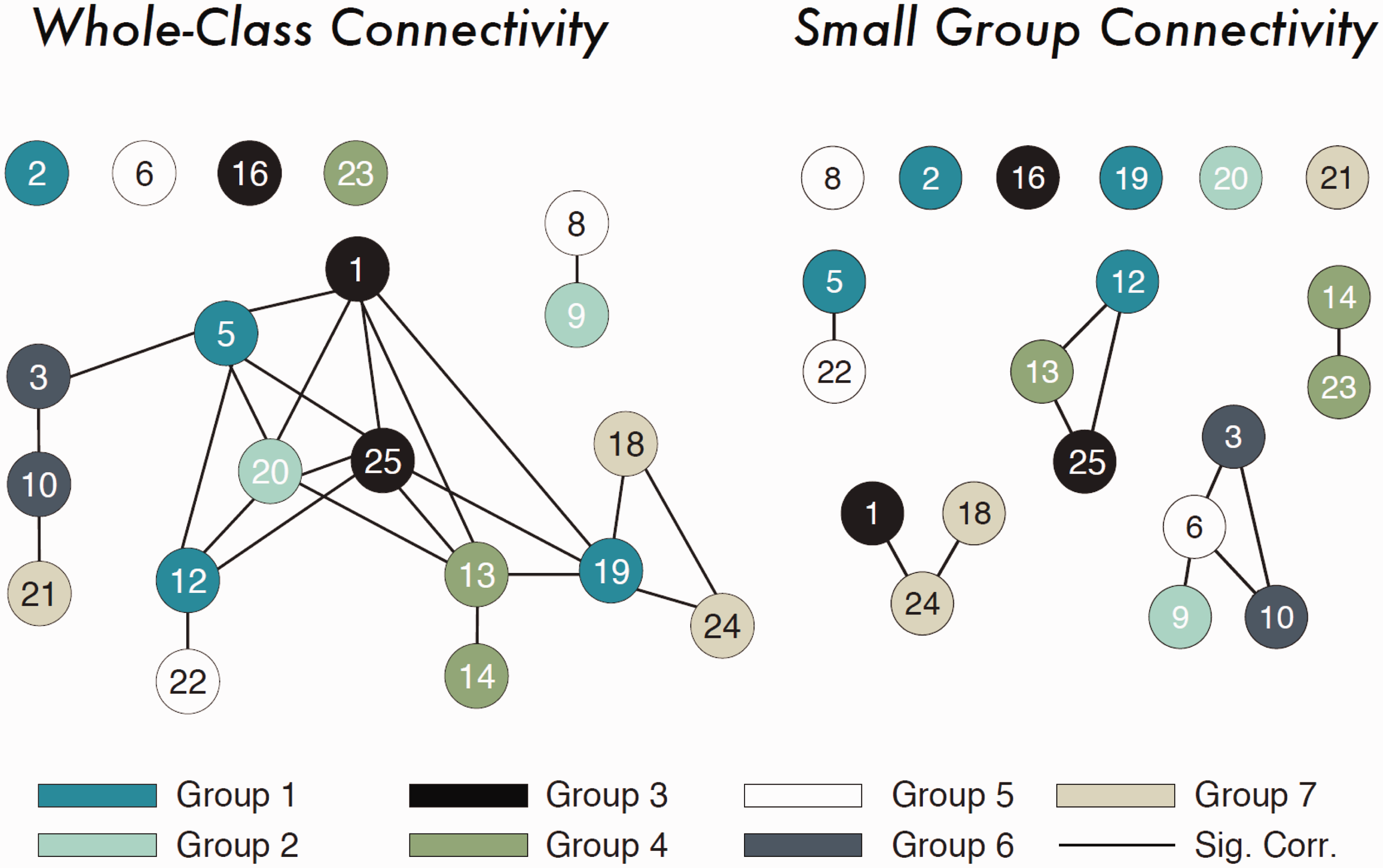
The overall level of synchrony between students across the whole class was reduced during the small group cooperative learning activities, which may reflect the independent nature of student driven discourse. Within each cooperative small group, discussions and interactions among students is likely driven by different factors across the groups, thereby decreasing the overall level of connectivity between students across the whole class. Interestingly, we did not see any difference in participation index or clustering, which means that synchrony between students within their small groups, compared with students across the whole class, was not particularly strengthened or changed during small group cooperative learning. Although the analysis of language use clearly showed that students were “on-task” and predominantly using language to facilitate the learning process or discuss scientific concepts, the nature of student-driven discourse and spontaneous interactions during small group cooperative learning may lead to more individual and therefore less “synchronous” physiological responses between the students. Therefore, it may be that measures of physiological synchrony, as reflecting common engagement of students during learning, may be more appropriate to describe whole-class teacher-led activity rather than more dynamic small group cooperative learning that facilitates greater self-agency in learning.
Student agency, as facilitated by small group cooperative learning, is nonetheless critically important for representational learning in science (Hubber et al., 2010). Representational skills, Kozma and Russell (2005) argue, are best developed within the context of student’s discourse and scientific investigations where students have opportunities to use a variety of representations to think about, communicate and successfully construct understanding and meaning to explain the phenomena they are investigating. Learning science within an authentic context, as occurred in the scenario presented by the teacher, can increase conceptual understanding and learning. Furthermore, Alozie, Moje, and Krajcik (2009) argue that students need to have opportunities to participate in rich and meaningful scientific discussions that not only encourage student understanding and synthesis but also help them to develop discursive discourse practices needed to enable them to ask questions, challenge the perspective of others, consider alternative propositions and hypotheses and engage in problem-solving practices together. While this case study reveals some interesting relationships between student interactions and discourse and the physiological measures of students’ synchrony in arousal level, and their differences during whole-class compared with small group cooperative learning, further research is needed to understand how these measures relate to learning outcomes for individual students.
Science attitudes and beliefs
Our survey data of science attitudes and beliefs and performance data on the PAT science provides some additional insights into how the group and social processes indexed by the connectivity measures from physiological synchrony between students might relate to individual students’ academic attitudes and learning in science. Our questionnaires assessed academic beliefs such as perceived academic competence in science and school subjects in general, general self-esteem, self-efficacy in academic performance, cognitive and self-regulated learning strategies and perceived confidence, intrinsic motivation and test anxiety. We performed Pearson’s correlations between these measures and the network connectivity measures derived from each student; that is, how “connected” they were with others in the class based on synchrony in their physiological responses. In the whole class context, the mean number of connections a student had with others in the class (or their network degree) was positively correlated with their self-reported test anxiety (r = 0.50; p = 0.029). Those students reporting greater test anxiety were also the students with greater synchrony in their physiological responses across the class, perhaps reflecting greater common engagement with the teacher during the teacher-led whole-class activities. Conversely, during cooperative group activities, the students’ network degree was negatively correlated with self-reported confidence (r = −0.57, p = 0.012), meaning that those students who rated high in confidence were less connected and perhaps acting more individually during group cooperative activities, while those students rating low in confidence showed physiological responses more synchronous with other students across the group.
Interestingly, the strongest correlations were found with assortativity in the cooperative group context. Assortativity represents the degree to which students make connections with similarly connected other students: that is, high assortativity for low-connected students who are connected with other low-connected students, as in dyadic pairs; and low assortativity for high-connected students who connect with low-connected students, as in “hubs” (or people in the centre who connected with many low connected people). In the cooperative group context, assortativity correlated negatively with confidence (r = −0.87; p < 0.001), intrinsic motivation (r = −0.70; p = 0.005), cognitive strategy use (r = −0.66; p = 0.10), self-regulation (r = −0.64; p = 0.013), school self-concept (r = −0.75; p = 0.002) and general self-esteem (r = −0.63; p = 0.016). This means that, during the small group activities, the students with low confidence, intrinsic motivation, self-regulation and general self-esteem tended to share connections with other similarly connected students, perhaps predominantly the dyadic pairs apparent in Figure 1. Students with low assortativity in the small group condition are most likely the independent nodes or students whose physiology was not significantly correlated with any other students. Given the significant negative correlations between assortativity and trait factors associated with confidence and motivation, as well as the negative correlation between overall number of connections (degree) and confidence, it would appear that the unconnected students in the small group setting are likely to be the independent and confident learners. This notion is supported by the fact that there was a significant correlation between PAT-Science test ranks and confidence (r = 0.55; p = 0.005), intrinsic motivation (r = 0.52; p = 0.009), science self-concept (r = 0.66; p = 0.000), school self-concept (r = 0.65; p = 0.001) and general self-esteem (r = 0.53; p = 0.008).
In the past most neural imaging studies of social processes were limited to presenting controlled stimuli to one individual, usually in a laboratory setting. Currently, there is a growing body of research imaging multiple interacting brains and quantifying ongoing social processes (Konvalinka & Roepstorff, 2012). There is now evidence that pairs engaged in cooperative tasks show neural coupling, or neural synchrony, both in turn-based and dynamic real-time interactions. This has been shown in situations of shared representation, information transfer, joint attention and joint action (Konvalinka & Roepstorff, 2012), all of which are important to cooperative group learning in the classroom. The logistical requirements of traditional neuroimaging techniques preclude their use in the classroom to probe these dynamic interactions. Here we demonstrate the use of more portable devices that measure autonomic physiology as an indirect proxy of gross changes in neural state during cooperative social interactions. This case study extends the previous use of physiological synchrony for quantifying shared biological states while engaging in social interactions (Chatel-Goldman, Congedo, Jutten, & Schwartz, 2014; Hernandez et al., 2014) during a unit of work on inquiry-based science.
Limitations of the study
The study reported here represents only a one-hour snapshot of a lesson on Infectious Diseases in which the students had to diagnose an illness based upon the narrative presented by the teacher. As there was only one data collection point rather than multiple data points where changes over time may have been more apparent, limitations must be placed on the interpretations of the results reported here.
Conclusions
We integrated the video and biometric data with the data from the individual assessments to construct a rich picture of relationship between the teacher’s use of multimodal representations and cooperative small groups with the students’ use of scientific language, physiological engagement and their beliefs and attitudes towards science. The teacher successfully used embodied representations to engage the students in the science unit and maintained their focus in the cooperative groups by using language that encouraged on-going participation in the task. In response, students remained on task and the majority of the language they employed was used to construct and communicate their scientific understanding to others. This high-level common engagement during whole class activities and student-centred learning during the cooperative group activities were also reflected in the physiological measures of synchrony between students. Furthermore, the survey data together with the connectivity analysis highlights key affective states and traits in students that demonstrate diversity in approaches to learning; information that is critically important to understanding how students attend and learn.
Footnotes
Declaration of Conflicting Interests
The author(s) declared no potential conflicts of interest with respect to the research, authorship, and/or publication of this article.
Funding
The author(s) disclosed receipt of the following financial support for the research, authorship, and/or publication of this article: Australian Research Council Grant: ARC-SRI: Science of Learning Research Centre (project number SR120300015).