




Abstract
This article reviews the international literature about streaming and the effects of this practice on the learning outcomes for secondary school students in Australia. Streaming in secondary schools across Australia has again increased in popularity after more than a century of literature that often discourages the practice. This article discusses the practice of streaming and its effect on students' academic, social and psychological learning outcomes and how teachers may mediate these effects. In addition, the article examines the extent to which the various outcomes of streaming align with the Australian National Curriculum and with the Organisation for Economic Cooperation and Development’s recommendations for promoting equity and quality in education. While research is contentious and often contested, the literature generally shows that streaming impacts negatively on student learning outcomes. The findings of this literature review suggest the need for more research within the Australian context about how teachers’ perspectives of streaming influence learning outcomes and how streaming influences minority and disadvantaged groups in Australia.
Keywords
Introduction
The streaming of students into “ability” based classes is one of the most researched topics in education. It involves heated debates and evokes powerful language such as ‘equity’, ‘social justice’ and ‘meritocracy’. The extent to which streaming is practiced in secondary schools is surprising given that research evidence about streaming is controversial and often contested. Some research concludes that streaming impacts positively on student learning outcomes, particularly for high ability students. However, more often, the research paints a negative picture of the practice, largely not only because streaming is claimed to be inequitable, but also because of a weak link between the practice and students’ learning outcomes. Hattie has quantified this insignificant effect on educational attainment as d = 0.11, but adds that “the effects (of streaming) on equity are profound and negative” (Hattie, 2009, p. 90).
Despite such frequently negative conclusions regarding streaming, results of the Organisation for Economic Cooperation and Development’s (OECD's) Programme for International Student Assessment (PISA), showed that 98 per cent of secondary school principals in Australia cited some use of across-class ability grouping at their schools in the subject of mathematics, which was significantly higher than the OECD average of 75 per cent (OECD, 2013). Streaming has become more accepted in Australia over time, resulting in an increase of this practice within schools (Plunkett, 2009). This, in turn, has rekindled an interest in research about streaming in Australia (for example, Gallagher, Smith, & Merrotsy, 2011; Kilgour, 2006; Kronborg & Plunkett, 2011; Macqueen, 2010, 2012, 2013; Plunkett, 2009).
This article reviews the research findings about streaming in four categories. These are the effects of streaming on student academic outcomes, the effects of streaming on student social outcomes, the effects of streaming on student psychological outcomes and how teachers mediate the effect of streaming on students. In this context, “academic outcomes” are defined as the learning results obtained by students as measured by internal and external school assessments. “Social outcomes” are discussed here in terms of social equity. “Psychological outcomes” are defined as the mental states of students, including their self-concepts, motivations and mental wellbeing. “Teachers mediate the effects of streaming” contains discussion about how teachers regulate the impact of streaming on students. These four categories are interrelated but provide a useful framework for understanding how streaming affects students in different ways. Questions are then posed regarding the extent to which academic, social and psychological outcomes align with the capabilities set out for students in the Australian National Curriculum and the recommendations for equity and quality in education from the OECD.
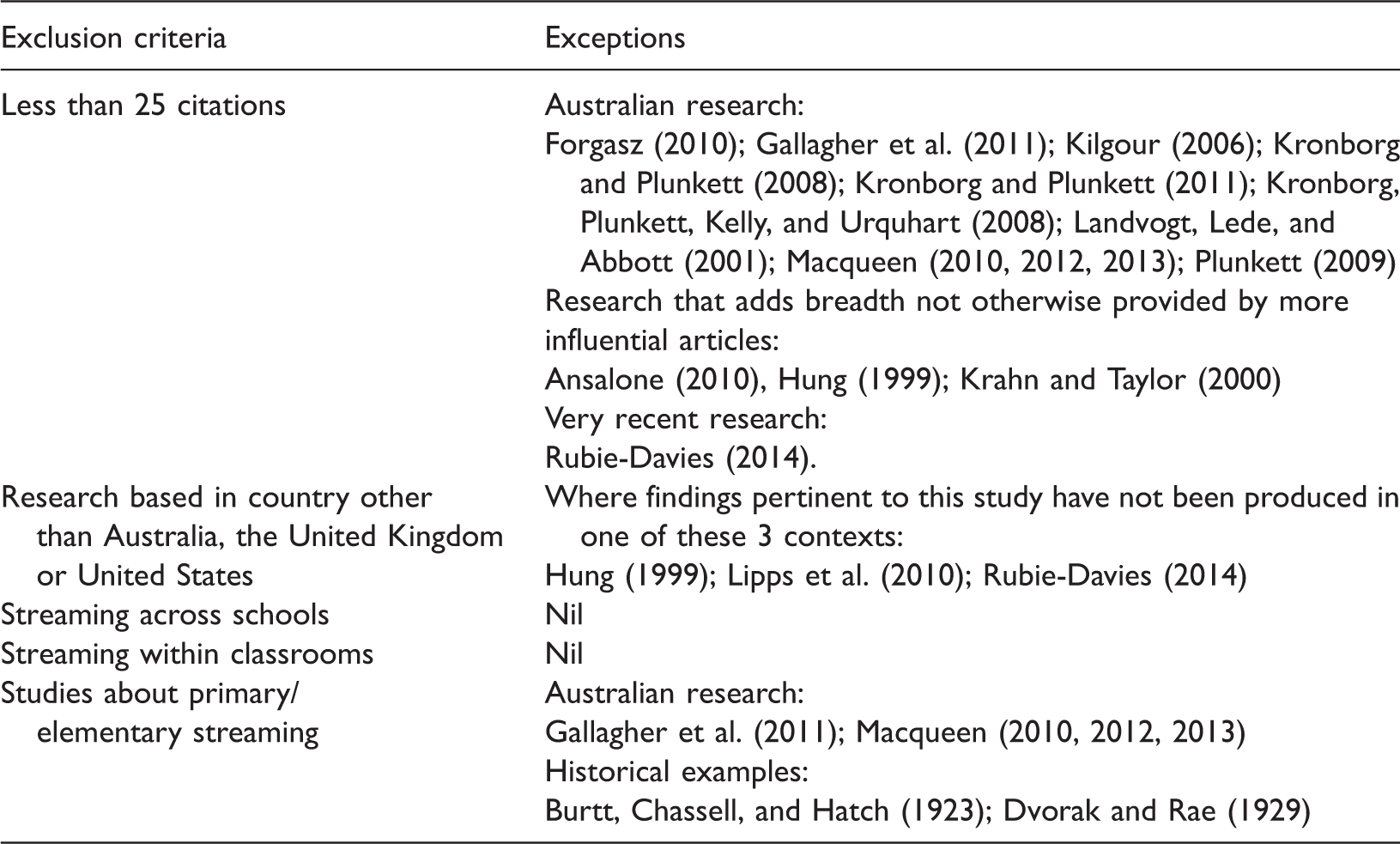
This literature review focuses on research from Australia, the United Kingdom and the United States. Studies from other countries have often been excluded from this review because (1) the focus of this article is on the Australian educational context, which is most comparable to that of the United Kingdom and the United States and (2) most of the research about streaming emanates from England and the United States. However, three international studies were included when they addressed pertinent aspects of the topic not discussed in research from Australia, the United Kingdom or the United States.
Seventy-one studies published in the English language are included here. Inclusion is further limited to studies that consider ‘streaming’ as a within-school mechanism for dividing students into ability based classes (Trautwein, Lüdtke, Marsh, Köller, & Baumert, 2006). Studies focussing on within-class streaming or across-school are not included.
It should also be noted that this literature review was interested in the effects of streaming on students in secondary school. Therefore, research about streaming in primary school was usually not relevant and excluded. Six articles about primary schools were included because they were examples of interest in streaming within Australia or examples of historic streaming research. These studies are listed in the table below.
Keyword searches of the literature included not only streaming, but also words with similar meanings such as setting, ability grouping, tracking, or homogeneous class grouping (see Appendix 1). Firstly, articles were critically appraised to ensure methodological reliability. Influential articles were identified as those which had been cited more than 600 times (see Appendix 2). From these key articles, ancestry-searches were used to add depth to ideas introduced. Secondary keywords such as “achievement” and “equality” were also developed from these influential articles to pursue a further breadth of research. The three themes of academic, social and psychological effects of streaming on students began to emerge from the literature, so more secondary keywords were added to search the databases to explore these themes (see Appendix 1 for list of databases). Thus, for example “social effects” was added as a secondary keyword. As it became clear from the research that teachers play a crucial role in the effect of streaming on students, this theme was pursued as a fourth category through adding more secondary keywords like “teacher perceptions”.
These exclusion criteria helped keep the focus of this paper on reviewing research relevant to the topic of streaming in Australian secondary schools. Studies identified as relevant to this literature review based on the inclusion and exclusion criteria were then categorised accordingly.
Practices of streaming vary, with some schools dividing students by subject, groups of subjects, or overall. Most of the literature about streaming relates to an increasing range of sub-topics within this research field, seldom clarifying how streaming affects the range of educational outcomes for secondary school students. More than 800 studies about streaming had been published by the end of the twentieth century (Rogers, 1991) and while syntheses of this research abound (Hanushek & Wobmann, 2006; Kulik & Kulik, 1982; Rogers, 1991; Slavin, 1990) they are often unclear about which educational outcomes are affected by streaming. Such an immense body of research with wide variation in focus and methodology makes it difficult to connect the outcomes of streaming with the goals of Australia’s National Curriculum. This article summarises this complex connection through a critical overview of research about streaming, including the explicit recommendation against streaming from the OECD.
The research about streaming originates mainly from the United States and the United Kingdom, but the differing histories and cultures of these two contexts have produced different literature. The research from the United States has been more vehemently opposed to streaming, focusing largely on the negative effects for ethnic minorities (Gamoran & Long, 2006; Letendre, Hofer, & Shimizu, 2003; Oakes & Welner, 1996; Seller & Weis, 1997). Studies from the United Kingdom have tended to focus more on the effects of streaming on learning and the relationship between stream and social class (Ansalone, 2010; Boaler, 1997; Ireson & Hallam, 2001). Research in these contexts has influenced how streaming has been researched in Australia.
Australian scholars have recently shown interest in how streaming affects students and the role of teachers within the streaming debate, particularly in how high ability students can benefit from gifted and talented grouping (Forgasz, 2010; Landvogt et al., 2001; Plunkett, 2009). Little consideration has been given to how streaming affects middle and lower streamed students, or minority groups. The majority of research has focused on the subject area of Mathematics, but the Mathematics Education Research Group of Australia “does not support ability grouping in the primary and middle years of schooling” (Human Capital Working Group, 2008). Until more research has been conducted about these aspects of streaming in an Australian context, international research can provide comparative contexts to inform Australian research. The practice and history of streaming in Australia are briefly outlined in the next section.
Why do Australian secondary schools stream students?
The practice of streaming is well established in Australian secondary schools, with some estimating that 98 percent of Australia’s schools use some form of streaming (OECD, 2012). Streaming is used by many schools across Australia to manage individual differences between students during the lower-secondary years (Plunkett, 2009).
There are no national or state-wide policies on streaming in Australia, and school leaders are left to make decisions about how to organise their students. Decisions have generally followed international leads, particularly that of Britain. For example, in Victoria, streaming was deemed unacceptable in the 1980s (Forgasz, 2010). In 2001, the Senate inquiry into the education of gifted and talented children agreed that streaming all students was detrimental to lower ability students. However, streaming for high ability students was advocated (Forgasz, 2010). Generally, the attitudes of educational authorities in Australia towards ability grouping have become more accepting over time, resulting in an increase in practice within schools (Plunkett, 2009).
Historical attitudes towards education have influenced how Australian schools use streaming to manage difference between students. Traditions and beliefs from various cultures influenced the adoption of streaming within formal education in Australia. These traditions held that diverse educational needs were reflective of biological or social differences between students (Oakes & Welner, 1996). The introduction of formal, mandatory education for all young people in Western countries raised questions about how to organise diverse students within the schools and school systems. Different countries developed various solutions. In accordance with traditional attitudes about varying abilities amongst students, many school systems across Western contexts, including Australia, decided to adopt some method of streaming students into ability based groups, particularly in secondary schools.
Criteria for streaming commonly included merit based selection such as intelligence. In France, Alfred Binnet was commissioned by the government in 1904 to develop a way of differentiating between more and less capable students (Oakes, Wells, & Jones, 1997). His solution was the Intelligence Quotient (IQ) test. The idea of determined, fixed intelligence became popular. Intellectual testing was widely used by the 1920s, and the influence of this concept was important in the move towards streaming (Oakes & Welner, 1996). With IQ came the belief that individual students had varying degrees of intellectual ability, a measure which was static and calculable (Ireson & Hallam, 2001). Students could be sorted into groups based on their intelligence scores.
Other forms of standardised testing became increasingly important in educational measurement and have continued to be used to determine stream placement in countries like Australia, the United Kingdom and the United States (Oakes et al., 1997). These tests have been developed primarily to gather data on the achievement of larger groups such as schools and districts. However, they also serve to ascertain the academic performance level of individual students and are now widely used in determining stream placement for students (Ireson & Hallam, 1999).
Both IQ tests and standardised tests have been criticised for their unreliability and cultural bias (Ireson & Hallam, 2001). While they have seldom been the sole determinant of stream placement, they have influenced thinking about student ability. Against this backdrop, streaming has continued to be used in Australia, where it has become commonplace in secondary schools over the last 50 years (Forgasz, 2010).
However, the OECD’s 2012 report entitled Equity and Quality in Education suggests that countries should use system-level measures to decrease the prominence of streaming before upper secondary school (OECD, 2012). The OECD makes a strong case that equity in education leads to quality and is economically beneficial to OECD countries, like Australia, because in more equitable systems, economically disadvantaged students will perform better, become more educated, and contribute more to society. Several measures of equity in education are provided by the OECD, and at first glance, Australia seems to offer a relatively equitable education, slightly better than the OECD average (OECD, 2012). However, the OECD report questions whether being comparatively equitable is good enough, calling for improvement across OECD countries. Further, Australia’s apparent relatively equitable performance is thwarted by figures pertaining to Australia’s high performing immigrant population (OECD, 2012). The PISA data upon which the OECD report is based (PISA, 2012) show a stronger correlation between socio-economic status and student attainment in Mathematics in Australia which is only slightly below the OECD average of 14.8 per cent. The PISA data also indicate greater socio-economic differences in Australia than for the OECD average, whereby the gap in mathematics performance for Australian students widens more quickly as socio-economic disparity increases (PISA, 2012). Such further scrutiny of the Australian data reveals that the OECD recommendations for improving equity in education are particularly relevant in the Australian context. Decreasing the use of streaming is one recommendation to decrease the socio-economic gap in performance (OECD, 2013).
The next section of this article presents the results of the literature review regarding how streaming effects students’ academic outcomes. Results are presented under four categories: a) the effects of streaming on student academic outcomes, b) the effects of streaming on student social outcomes, c) the effects of streaming on student psychological outcomes and d) how teachers mediate the effect of streaming on students. At the end of the results for each category a brief discussion is given of how well the practice of streaming aligns with the goals of Australia’s National Curriculum for which implementation started in 2013.
Results
The effects of streaming on student academic outcomes
Streaming is practised so that students of similar ability can learn at their own pace (Ansalone, 2010). The assumption is that sorting into ability groups improves academic results for students. However, the long history of research into streaming has shown consistently that streaming does not improve academic outcomes for most students.
Initial research about streaming focused on how streaming affects students’ academic achievements. Scholarly interest, and particularly statistical inquiry, into the academic effects of streaming began in the 1910s and surged in the 1920s. As early as 1930, a summary of the existing research included an examination of more than 30 studies of streaming (Otto & Miller, 1930). These were largely quantitative studies using statistically unrefined methods, where influential variables about students’ backgrounds, such as their socio-economic background or former achievement, were not considered. Even then, studies from the United States observed that streaming students resulted in negative or no observable academic improvement (Burtt et al., 1923; Dvorak & Rae, 1929).
The quantity of research relating streaming to academic outcomes of secondary education surged during the 1960s and 1970s. Rooted mostly in the United States and the United Kingdom, this research reflected the egalitarian ideology of the time, including social as well as academic impacts of streaming. Some results and reviews of research concluded that streaming academically benefited students in the higher streams but disadvantaged those in the lower streams (Esposito, 1973; Gamoran & Mare, 1989; Oakes, 1985; Rosenbaum, 1978).
Researchers in Australia have often focused on the benefits of streaming for high ability learners (Kronborg & Plunkett, 2008). Studies on how to meet the needs of gifted and talented students through curriculum differentiation have burgeoned in the twenty-first century, with recent research finding that streaming can benefit high ability learners because they can be extended and work with like-minded peers (Gross, 1999; Kronborg & Plunkett, 2011, Kronborg et al., 2008; Plunkett, 2009). These Australian studies focused on higher streamed students and did not often include the academic effects of streaming on lower streamed students. Students streamed into high ability classes are often from higher socio-economic backgrounds, and this group experiences clear academic advantages from streaming (Rogers, 1991).
International research indicates, however, that benefits for high ability streamed students can be at the expense of lower streamed students who do not experience the same level of academic achievement (Caro, 2009; Hanushek & Wobmann, 2006; Huang, 2009; Schutz, Ursprung, & Wobmann, 2008). Results of the analyses of large scale quantitative, longitudinal data and cross-country comparative data from these studies lead to the conclusion that streaming increases inequality in academic results between students from lower and higher socio-economic backgrounds without leading to significant improvement in overall average achievement (Hattie, 2009). The problem with such large-scale studies is the difficulty of developing measures of other possible socio-cultural reasons for the increasing gap. Despite this drawback, these studies provide convincing evidence that streaming increases the effect of socio-economic background on academic educational attainment.
While this research shows a clear link between streaming and educational outcomes for students, other research presents contradictory findings of streaming showing little to no effect on success at school (Ansalone, 2003; Hattie, 2009; Kulik & Kulik, 1982; Slavin, 1990). These differences in conclusions often reflect methodological differences, where little impact is found when academic outcomes for streamed classes are compared to non-streamed classes. However, more impact of streaming is found when high streamed classes are compared to lower streamed classes (Slavin, 1990). Such comparison across methodologies reveals that while streaming students does not influence average academic achievement, streaming does result in an increase in the gap between the academic performances of high and low streamed students (Caro, 2009; Hanushek & Wobmann, 2006; Huang, 2009; Schutz et al., 2008).
Students’ social backgrounds are linked to how their academic outcomes are affected by streaming. Research has found that streaming can exacerbate the effect of socio-economic background on educational achievement. Recent Canadian findings suggest that the gap in academic achievement between streamed students from high and low socio-economic backgrounds increases with age, with the achievement gap in Mathematics doubling from age 7–11 to 12–15 (Caro, 2009). Other international research has found that the earlier students are streamed, the more influence their family background has on their educational attainment (Schutz et al., 2008).
One major criticism of the research about the academic effects of streaming was that success at school was not measured in terms of what level of course the students chose to enrol in, but exclusively by grades (Slavin, 1990). More recent research from Canada has begun to address this limitation by comparing academic outcomes for students from secondary schools that use various degrees of streaming. Four provinces are compared, where different degrees of streaming are used. This study found that the provinces that used the least streaming in year 10 had a higher percentage of students with open post-secondary pathways (Krahn & Taylor, 2000). Furthermore, the impact of socio-economic background and parents’ educational background on post-secondary pathways was less in the provinces where students were streamed less. Krahn and Taylor used data taken from the comprehensive Youth in Transition Survey conducted by Statistics Canada. They did not, however, take the opportunity to examine data in more detail to compare within-school differences, choosing to compare school districts instead. They found that school districts that used less streaming had more graduating students who could choose between university, college or work options rather than being limited to work options or the choice between college and work.
If the Canadian finding would hold in the Australian context, Australian students would have more variety in post-secondary opportunities if the practice of streaming were not used. The National Curriculum in Australia acknowledges that the future faced by young Australians is constantly changing and difficult to predict, which creates a need for students leaving secondary school to have a “wide and adaptive set of knowledge” (Australian Curriculum, Assessment and Reporting Authority, 2012). Another goal of the Australian Curriculum is to set “consistent high standards for what all young Australians should be learning as they progress through schooling” (Australian Curriculum, Assessment and Reporting Authority, 2014). While conclusions have been contradictory, it is clear from international research that streaming can affect academic outcomes for secondary school students, with some students obtaining more academic advantage through streaming than others (Caro, 2009; Esposito, 1973; Gamoran & Mare, 1989; Hanushek & Wobmann, 2006; Huang, 2009; Oakes, 1985; Rosenbaum, 1978; Schutz et al., 2008). The following section considers the effects of streaming in secondary schools on students’ social outcomes of education, comparing these effects with the goals of the National Curriculum.
The effects of streaming on student social outcomes
The social implications of streaming have been widely researched, showing that streaming is related to social disadvantage and does not promote social integration. Initial stream placement is related to socio-economic background, where students from disadvantaged backgrounds tend to find themselves in the lower streams (Hallinan, 1996; Jackson, 1964; Oakes, 1990; Oakes & Welner, 1996). In this way, streaming would appear to reinforce already existing social disadvantage experienced by these groups of students (Caro, 2009; Schutz et al., 2008). Research also suggests that streaming is not an effective tool for engineering equality (Charlton, Mills, Martino, & Beckett, 2007).
After an exclusive focus on the academic impact of streaming on students, researchers began to consider the social implications of streaming towards the end of the twentieth century. A link between parents’ profession and stream placement in English schools had been suggested as early as 1964 (Jackson, 1964) but it was not empirically shown until the 1980s and 1990s (Oakes, 1990). In the 1980s, researchers characterised the students in the various streams of high school classes, focusing on how social and cultural background related to stream placement. Studies found that students from England and the United States who were placed in the lower streams were more likely to be from low socio-economic backgrounds and ethnic minorities (Hallinan, 1996; Oakes, 1990; Oakes & Welner, 1996). Amidst mounting evidence that streaming can negatively affect academic outcomes for lower streamed students, this research raised questions about how streaming affected already disadvantaged groups of secondary school students (Oakes, 1985; Wiliam & Bartholomew, 2004).
Researchers also investigated the way in which streaming may impact multi-racial harmony if students were separated into streams along the lines of race. Literature from England showed that streaming decreased student acceptance of racial difference and general positive interaction between racial groups (Hallinan, 1996; Hallinan & Williams, 1989). In the United States, researchers showed that socially disadvantaged groups such as African Americans and Mexican Americans find themselves in the lowest streams (Seller & Weis, 1997). Given the history of the Civil Rights Movement in the United States, concerns were raised about inherent inequalities involved with racial segregation in schools which in some cases led to legal action against schools that use streaming (Coleman, 1966; Letendre et al., 2003; Oakes & Welner, 1996).
Research about streaming has continued to question the meritocratic assumptions of streaming and evaluate whether or not it reinforces existing disadvantage (Gamoran & Long, 2006). Letendre, Hofer, and Shimizu (2003) describe views of streaming in American, German and Japanese schools, demonstrating the importance of cultural attitudes towards minority groups when considering the social effects of streaming. Countries like Germany and Japan do not generally have a culture of affirmative action for minority and disadvantaged groups like that of the United States. Australian educators could likewise consider the needs of their school communities and the extent to which their educational goals are to assist disadvantaged students. Studies show that streaming provides less opportunity for social integration and academic success across race and class (Caro, 2009; Hanushek & Wobmann, 2006; Huang, 2009; Schutz et al., 2008), reinforcing the view that streaming affects social outcomes as well as academic outcomes for students, but these studies assume social integration and educational equality to be a goal of secondary educators.
That streaming is not an effective tool for increasing equality has been shown (OECD, 2012). The OECD compared countries where students were streamed at the end of lower secondary school with countries where they were streamed earlier, For example, when boys were recognised as disadvantaged within a case-study Australian school, efforts to use streaming to increase the boys’ educational advantage resulted in new gender inequalities (Charlton et al., 2007).
Consideration might be given as to the extent to which the reported social outcomes of streaming are congruent with Australia’s social values including those expressed in the Australian National Curriculum. This review of the literature shows that streaming contributes to increased social inequality. Some suggest that Australian culture similarly accepts inequality more readily than countries like Sweden (Boaler, 2002).
Australia’s National Curriculum prioritises intercultural relationships and respect for minority cultures such as Aboriginal and Torres Strait Islander peoples (Australian Curriculum, Assessment and Reporting Authority, 2014). However, international research suggests that streaming does not promote relationships across cultures because students do not interact across racial groups (Hallinan, 1996; Hallinan & Williams, 1989). Overall goals in the Australian National Curriculum's general capabilities also include a social capability where students are to “develop empathy for others and understand relationships,” “establish and build positive relationships,” and “work effectively in teams” (Australian Curriculum, Standards and Reporting Authority, 2014). Such social development is inextricably related to academic success and the Australian Curriculum references the Melbourne Declaration on the Educational Goals for Young Australians (MYCEETYA, 2006) in stating that developing students’ social capabilities will not only assist them academically, but is part of the responsibility of education to prepare them for their future social lives as members of communities and the workforce. The widespread use of streaming in Australian schools seems contradictory to Australian social values including those of intercultural relationships and respect expressed in the Australian National Curriculum. The following section considers research about the how streaming affects students psychologically and whether or not these affects are congruent with the goals of the Australian National Curriculum.
The effects of streaming on student psychological outcomes
Psychological educational outcomes are not mutually exclusive of academic and social outcomes, and are affected by social environments, which, in turn, influence academic results. Social comparison theory indicates that streaming has psychological benefits for students in low ability streams (Liem et al., 2013; Wong & Watkins, 2001), and students’ perceptions of streaming may also reflect some positive psychological effects (Letendre et al., 2003). However, students in low ability streams can experience psychological suffering as a result of streaming (Ireson & Hallam, 2009; Mulkey et al., 2005). Students in low ability streams may have less access to positive role models and high achieving students have fewer leadership opportunities (Hallinan, 1996; Lazear, 2001).
The main psychological effect of streaming which is discussed in the existing research is on students’ academic self-concept. Academic self-concept has been identified as the most important predictor of academic success at school (Marsh, 2004; Marsh & O’Mara, 2008). Hattie (2009) likens self-concept to a rope, where the individual strands are varied but together make up the strength of the whole. His meta-analysis cites self-concept as having a significant size 0.43 effect, but is sceptical about exactly what is being measured by the construct of students’ self-concepts.
Research findings over the last 10 years indicate that students’ academic self-concepts are affected greatly by the peers with whom they compare themselves (Liem et al., 2013; Wong & Watkins, 2001). Usually “social comparison theory,” which was influenced by the discovery of the ‘big fish, little pond effect’ (Marsh, 1987), means that students' academic self-concept increases when they perform well in comparison to their peers. Students in lower streams may feel successful when they compare themselves to their immediate peers, while students in higher streams can feel discouraged amongst more fierce academic competition. This research indicates that the psychological effects of streaming work with an opposite effect to the academic effects, with streaming psychologically benefiting lower streamed students and having negative effects on higher ability students.
However, there is controversy around social comparison theory and how streaming influences students’ self-concepts. Researchers have found that streaming negatively influences the self-concepts of students at all levels (Hallam & Ireson, 2005; Mulkey et al., 2005). English and Australian students in higher streams have been found to have higher academic self-concepts and greater motivation to succeed in education than students in lower streams (Hargreaves, 1967; Oakes, 1985; Preckel, Gotz, & Frenzel, 2010). Students in the lower streams are sometimes found to be less motivated and have an even more negative self-concept than if they were not in a streamed setting (Lucas, 1999). One recent study in the Caribbean found a positive association between streaming and depression, with students in higher streams less depressed than their lower streamed peers (Lipps et al., 2010). These studies about the psychological effects of streaming do not provide enough depth and detail about individual circumstances to ascertain whether or not the school and cultural contexts affect psychological outcomes of streaming.
Another concern about streaming is the lack of high achieving role models for students placed in lower streams. Students have less opportunity in streamed settings to observe and interact with highly motivated, high-achieving students (Hallinan, 1996). Other research has emphasised the importance of the ratio of high to low achieving students (Lazear, 2001). Streaming may create less opportunity for peer role modelling. Lower ability streamed students have less opportunity to learn from their higher achieving peers when streamed, and conversely higher ability students have less opportunity to develop leadership skills through opportunities to mentor lower streamed students. However, higher ability students can feel less burdened by the poor behaviours associated with lower ability students when streaming is used (Letendre et al., 2003). International results show that the more stratified students are through grouping, the lower their motivation and the less value they attach to schooling (OECD, 2013).
The research is much divided in this area, suggesting that the psychological effects of streaming may be completely different depending on circumstances. The Australian Curriculum references the importance of developing the personal capability of students so that they are “creative and confident”, recognising this as vital for students’ academic success (Australian Curriculum, Assessment and Reporting Authority, 2014). Researchers might consider the circumstances in which streaming is congruent with the goals of the Australian National Curriculum that prioritise students’ psychological wellbeing. The following section discusses how the effects of streaming on many academic, social and psychological educational outcomes for students are largely dependent on teachers.
Teachers mediating the effects of streaming
How streaming is implemented is crucial, and the research described above shows that the effects of streaming on students’ educational outcomes can differ widely across school settings. It seems more likely that what happens within groups affects outcomes more than anything inherent about the practice (Rogers, 1991; Slavin, 1990). This area of streaming research was long neglected as researchers focused exclusively on students, but it has become increasingly researched over the last two decades.
As discrepancies in research results were identified, researchers began to examine what happens within streamed classes, and how teachers mediate the effects of streaming. Oakes’ original evidence in the United States was that students were being offered different experiences of education by their teachers (Oakes, 1985). That teachers work differently in high and low streams has been confirmed by research in different contexts such as Britain and Israel (Boaler, 1997; Dar, 1985). In particular, students in highly streamed classes tend to be assigned more homework, be expected to work faster, feel more positive towards their educational experience, experience more creative pedagogy, work on task more often, be given more difficult work, and to have higher academic and behavioural expectations from their teachers (Boaler, 1997; Dar, 1985; Hallam & Ireson, 2005). This research focuses on contrasting low and high ability streams, with no consideration of middle groups.
Teachers were found to be key mediators in the effects of streaming on educational outcomes for students. This new branch of inquiry into streaming revealed that how teachers think about ability grouping directly affects the practice (Carlgren et al., 1994; Kronborg & Plunkett, 2011). Teachers have been found to prefer teaching high ability groups, and to be more motivated when teaching these groups (Ireson & Hallam, 1999). Teachers conceptualise students in high streams more positively than those in lower streams, with teachers reporting consistent differences in perceptions of students’ ability, attitude, personality, behaviour, family background, relationships, and interests (Hung, 1999). Qualitative studies show that the negative effects of streaming on equity and the lack of effect on student achievement are because of the perspectives and approaches that teachers have to the different ability levels (Hattie, 2009). The key issue in improving educational outcomes for students is teaching quality – having high expectations and challenging all students, regardless of stream (Hattie, 2009).
Researchers caution that when streaming is used to meet the needs of low ability students, teachers develop lower expectancies of these students (Jussim & Kent, 2005; Rubie-Davies, 2010). This can result in students being offered less homework, a slower pace of instruction, and less difficult work (Boaler, 1997; Dar, 1985; Hallam & Ireson, 2005). When teachers adjust their demands for various students, students adopt ideas about themselves to fit the teachers’ ideas about them. These self-fulfilling prophecies are particularly likely to be fulfilled by students when the teachers’ expectations of students are operating at the class-level (Rubie-Davies, 2007, 2010). This means that if teachers have ideas that their classes are homogenous in ability, the expectations that they form for this ability level will affect student outcomes accordingly even more than any ideas they hold about the ability of individual students in the class. Further research may find that teachers adapt their practices for various streamed classes to suit their ideas about the students as a group. Students would then adapt their self-concepts to suit teachers’ expectations of the class as a whole, more often than the individual students in the class.
There is generally a preference for streaming amongst teachers because their perspective is that streaming narrows the range of students in classes and thus facilitates the appropriate targeting of their instruction (Ansalone & Biafora, 2004). Research emphasises the importance of teachers’ support in the continued use of streaming (Ansalone, 2010). However, teachers working in non-streamed contexts tend to be more supportive of mixed-ability grouping than teachers working in streamed contexts (Hallam & Ireson, 2005; Hallam et al., 2008). From this research, it is clear that an understanding of teachers’ perspectives is necessary to discover how and why streaming functions in our schools. Future studies will benefit from considering the contextual factors in which streaming takes place in depth, considering both teachers’ and students’ experiences. Studies such as those conducted by Boaler (2002) and Venkatakrishnan and Wiliam (2003) are detailed case studies, which provide a useful approach for future research about the effects of streaming on students’ outcomes.
Adapting teaching and learning to suit students’ needs is recognised as part of teachers’ work in the Australian National Curriculum. The Curriculum advises teachers on how to cater for student diversity, including a section acknowledging the varying learning needs of student with disabilities and gifted and talented students (Australian Curriculum, Assessment and Reporting Authority, 2014). While it is recognised that curriculum adaptation “can take many different forms,” the focus of the Australian Curriculum is on adapting curriculum to meet the “individual” and “personal” needs of students. The Curriculum Website gives some examples of “personalised learning,” where one includes adapting teaching content and pedagogy for a “group of students.” The expectation to adapt curriculum is one that teachers find demanding, and thus they often prefer to use streaming to implement curriculum adaptation in group settings (Ansalone, 2010; Ansalone & Biafora, 2004). The Australian Curriculum supports teachers in this endeavour, without explicitly mentioning streaming, but rather focusing on individualised learning that suits students’ needs.
Conclusion and future directions
Although streaming is often employed in Australian schools, few advantageous effects on students’ educational outcomes are cited in the literature. Streaming can increase academic disadvantage for students placed in lower streams. Streaming can segregate students along the lines of race and class, allowing for less cross-cultural interaction in classrooms. Conflicting research conclusions have been drawn regarding the psychological impact of streaming on students, suggesting that the effects of streaming on students’ personal development vary according to the context in which streaming is implemented and that teachers play a key role in mediating the adverse effects of streaming upon students.
Schools that prioritise enabling socio-economically disadvantaged students may consider that streaming is linked to low academic performance for students from poorer backgrounds. When the reported outcomes of streaming are compared with the goals of the Australian curriculum, some discrepancies arise. The Australian curriculum prioritises “consistent high standards for what all young Australians should be learning”, “intercultural relationships and respect”, “development of empathy for others and understanding relationships,” and the development of a personal capability where students are “creative and confident”. International research about the effect of streaming on student academic, social and psychological outcomes poses questions for researchers and educators in Australia about whether or not streaming is congruent with our explicitly stated national educational goals. While international evidence is readily available, more research is required about the effects of streaming in Australia. Educational researchers and policy makers might also consider whether or not streaming, in an Australian context, helps prepare young people for the fluctuant future described in the Australian National Curriculum.
The importance of how and where streaming is implemented is clear from the differences in research across educational contexts. Preliminary research might simply seek to ascertain the streaming methods used in various contexts across Australia. Future qualitative research into streaming that is contextually based in a case study approach will provide more detailed insights into how streaming affects students. Earlier research shows that teacher-expectations influence student results, particularly at the class level (Jussim & Kent, 2005; Rubie-Davies, 2007, 2010), but research has yet to explore this effect at the secondary level where students are often streamed across classes. Teachers’ perspectives of streaming can be researched further, inquiring into how these perspectives affect practice across streamed and un-streamed settings. Such studies might further consider how variations in practice related to streaming influence student outcomes.
Footnotes
Declaration of conflicting interests
The author(s) declared no potential conflicts of interest with respect to the research, authorship, and/or publication of this article.
Funding
The author(s) received no financial support for the research, authorship, and/or publication of this article.