




Abstract
It is important that educators understand learning styles as an evolving individual characteristic. We investigate the changes in learning styles and preferences of first-year undergraduate nursing/midwifery students after six months of preliminary testing. Curry’s ‘onion ring model’ proposes a stable inner ‘Information processing’ style (assessed by instruments such as Kolb Learning Style Inventory) compared to the outer ‘Instructional preference’ style (assessed by the VARK (Visual/Aural/Read–Write/Kinaesthetic) questionnaire), which is more easily influenced by external factors. Therefore, re-examining students after one semester of teaching should result in an increase in multimodal VARK learning with lesser changes to the LSI results. A cross-sectional survey with pre-post design (n = 96) showed 45% of students remaining in the same VARK mode, 30% becoming more multimodal and 25% showing changes. Surprisingly, the LSI questionnaire showed similar results with 45% of students remaining in the same learning modality and 55% of students changing. This research highlights the dynamic changes within students’ information processing and instructional preferences.
Keywords
Introduction
In Australia, nursing and midwifery student numbers are on the rise and students come from increasingly diverse backgrounds (Commonwealth of Australia, 2013). In the light of this growth, it is important to understand better this group of students and their learning. Hence, in this study, the information processing and instructional preferences of first-year nursing and midwifery students were investigated at the beginning and the end of a semester at the Victorian campuses of the Australian Catholic University to shed light on the potentially dynamic changes in learning styles and preferences in this cohort. Results showed that, contrary to expectations based on prior research, the students’ information processing styles changed to the same degree as their instructional preferences. This evidence of dynamic rather than static learning styles and preferences highlights the importance of lecturers varying their teaching styles and modalities.
Learning styles
Curry (1983) conceived the ‘onion ring model’ of Learning Styles to provide a framework to systematically organise the learning style constructs. This model consists of multiple concentric rings, with cognitive personality style in the innermost layer, followed by information processing style, then social interaction and finally instructional preference in the outermost layer (Cassidy, 2004; Curry, 1983). The innermost layer is considered to be the most stable of the learning styles as it is least influenced by external factors. The middle and the outermost layers are assumed to be less stable with the outermost layer most likely to be influenced by external factors (Curry, 1983).
VARK instrument
The VARK instrument assesses the outer ‘instructional preference’ ring of Curry’s onion model (Curry, 1983; Fleming, 2001). VARK is an acronym for the four sensory modalities used by an individual to perceive information. ‘V’ denotes visual (i.e. seeing information, such as flowcharts or graphics), ‘A’ denotes aural (i.e. hearing information from others), ‘R’ denotes read/write (i.e. reading information in written text or writing notes) and ‘K’ denotes kinaesthetic (i.e. gaining information from actively performing tasks).
The VARK survey identifies students as either unimodal (using only one of the four modes) or multimodal (bimodal, trimodal or quadmodal) in their instructional learning preference. There are 23 possible combinations of unimodal or multimodal learners (Fleming, 2009), as unimodal preferences may be mild (i.e. mild visual), strong or very strong. For example, those with very strong visual preference will choose the response that matches visual preference even when the situation in the question stem is not reflecting visual mode (Fleming, 2015). This could mean that these students have an undue dependence on their dominant mode, unlike those with mild preferences.
While the VARK questionnaire can be used with students from any discipline, it has been previously used with nursing students in various parts of the world (Alkhasawneh, Mrayyan, Docherty, Alashram, & Yousef, 2008; Boström & Hallin, 2013; Meehan-Andrews, 2008; Ponto, Ooms, & Cowieson, 2014). In Australia, a hands-on experiential approach, which is consistent with a kinaesthetic learning mode, was the preferred learning style of LaTrobe University nursing students (Meehan-Andrews, 2008) as well as occupational therapy, physiotherapy and speech pathology students at Monash University (Brown, Cosgriff, & French, 2008). In addition, results reported on the VARK website (Fleming, 2009) point to kinaesthetic as the dominant mode amongst nursing students which is in line with other studies (Alkhasawneh, 2013; Boström & Hallin, 2013). Our previous research (James, D’Amore, & Thomas, 2011) has shown diverse learning styles among undergraduate nursing and midwifery students with the majority of students preferring a multimodal (VARK) approach.
Kolb learning style inventory instrument
Kolb’s model of experiential learning (Kolb, 1984) included the development of the well-known Learning Style Inventory (LSI) instrument. This instrument tests the information processing style of an individual through assessing a person’s self-approach to assimilating information (Curry, 1983). Kolb LSI characterises individuals into one of four quadrants of a learning style type grid (Kolb, 2005b), namely converger, diverger, assimilator and accommodator.
A student with a learning style consistent with a converger combines abstract concepts (AC) with active experimentation (AE). They are deductive reasoners who have a strong ability to apply an idea practically and are good at problem-solving and decision-making tasks. Divergers combine concrete experiences (CE) with reflective observation (RO). They look at problems from all perspectives. Strong imagination and awareness of meanings and values characterise this type. An assimilator excels in reflective observation (RO) and abstract conceptualisation (AC). They have a strong ability to create theoretical ideas and plans. Finally, an accommodator excels in concrete experiences (CE) and active experimentation (AE). They engage effectively in new experiences and are interested in carrying out plans and getting the job done.
Kolb (1984) described three growth and development stages as people progress through life, with the majority of tertiary students falling into the middle ‘specialisation’ stage. The further through these stages an individual travels, the less reliant on one learning style the person becomes which eventually results in an ability to draw on all four learning styles (Coffield, Moseley, Hall, & Ecclestone, 2004; Kolb, 1984).
The four learning styles (quadrants) can be refined further by dividing individuals into nine distinctive styles. This includes the addition of five more learning style categories: northerner, easterner, southerner, westerner and balanced learning styles (Kolb, Boyatzis, & Mainemelis, 2001). This further distinction enables categorisation based on low versus high AC-CE and AE-RO scores and the integration of CE, RO, AC and AE. These distinctions allow a clear understanding of learning attributes.
Results of a baseline survey of nursing and midwifery students in their first year of university study showed ‘diverger’ as the dominant learning style (D’Amore, James, & Mitchell, 2012). It was the first publication to report learning styles of undergraduate nursing or midwifery students that used version 3.1 of Kolb LSI. This learning styles questionnaire has, however, been used in the United States to assess registered nurses, the majority of whom (31%) were ‘accommodators’ (Smith, 2010).
Longitudinal changes to learning styles
According to Kolb’s Experiential Learning Theory, learning is a process where knowledge is created due to experience (Kolb, 1984; Kolb & Kolb, 2006). Thus, learning is an adaptive process whereby the natural inclination of an individual is towards one of the two poles (thinking versus feeling and watching versus doing) which defines their preferred way of learning, known as their learning style (Kolb, 1984).
The majority of previous studies have found that the learning style of a student (middle layer of the onion ring) is a fairly fixed characteristic. Still, understanding the dynamic changes in learning styles is important for students and educators; however, very few studies have truly examined the longitudinal changes in learning styles experienced by a student throughout a course of study. Most research aimed at examining changes in nursing students’ learning styles have undertaken serial cross-sectional surveys of different cohorts of students (Alkhasawneh, 2013; Fleming, McKee, & Huntley-Moore, 2011; Wells & Higgs, 1990) rather than investigating the evolution of learning styles in the same student cohort. Therefore, this study aimed to examine the stability or changes in the learning styles of the same nursing and midwifery students over a single 12-week semester of university study, utilising both VARK and LSI. We hypothesised that examining students at the start and again at the end of a university teaching semester would show an increase in multimodal VARK learning with lesser changes to their LSI results.
Methodology
This study involved a survey questionnaire distributed by the researchers to all first-year nursing and midwifery students at the beginning of their second semester at one metropolitan (Melbourne) and one rural (Ballarat) campus of the Australian Catholic University. Approval to conduct this research was obtained from the Australian Catholic University Human Research Ethics Committee. Informed consent was obtained from all students who completed the questionnaires and participation in this research was voluntary. Students who had completed the first questionnaire at the beginning of their second semester were invited to complete the same questionnaire at the end of that same semester. Surveys were individually coded for the purposes of matching an individual’s pre- and post-survey data. Questionnaires were excluded if they were incomplete or had individual items within the questionnaire where rankings were incorrectly applied or where responses were missing or left blank.
The survey contained three parts: The first part was a demographic questionnaire, specifically designed for the survey. The second part was version 7 of the VARK questionnaire (Fleming, 2008; used with permission from the author). The VARK questionnaire contained 16 questions, where students selected the statement/s that best reflected their learning style preference (Fleming, 2008). The third part was Kolb LSI Version 3.1 – a 12-item questionnaire. Each item required the participants to rank their preference regarding the four options of thinking, feeling, watching and doing to be classified as convergers, divergers, assimilators or accommodators.
Data are presented as either total numbers or mean ± standard deviation. Statistical analysis of the data was carried out using a paired sample test using SPSS Statistics software (IBM, 2011). Results with p-values < 0.05 were considered statistically significant. Effect size was manually calculated by interpreting eta squared statistics, where 0.01 is a small effect; 0.06 is a moderate effect and 0.14 is a large effect.
Results
Of the 285 nursing and midwifery students who completed the pre-questionnaire, a total of 96 students completed the post-questionnaire (those with incomplete or incorrect responses were excluded). This constituted a 34% response rate.
Respondent characteristics
The majority of respondents were female (n = 89; 93%). In terms of age, 74 students (77%) were between 18 and 25 years old while 34 (35%) self-reported as mature age students (i.e. not school-leavers when entering this degree). Twenty-one students (22%) had previous healthcare experience with over 80% of this experience attributed to work as Licenced Practical Nurses/Enrolled Nurses. Most respondents (n = 77; 80%) were from an English-speaking background, were Australian citizens or permanent residents (n = 82; 85%) and were studying their nursing or midwifery degree full-time (n = 75; 78%). About a quarter of students (27%) were from a rural background.
VARK
VARK questionnaire results (Figure 1) showed that 22 (23%) students were classified as unimodal learners in the pre-survey; however, only 17 (18%) students were classified as unimodal in the post-survey. This suggested a shift towards more multimodal learning in the students. When examining those students who were trimodal or quadmodal, a total of 60 students reflected these categories in the pre-survey, which increased to 67 students in the post-survey. Statistical analysis of the four sensory modalities individually indicated that only one modality with a moderate decrease was noted in the Aural category (Figure 2).
VARK pre- and post-questionnaire data, highlighting the preferred learning modes for the students in each category. VARK and Kolb LSI pre- and post-questionnaire data, highlighting the preferred learning modes and modalities for the students in each category.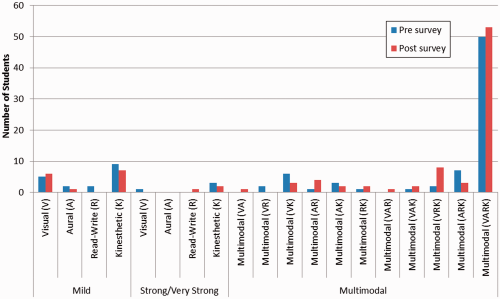
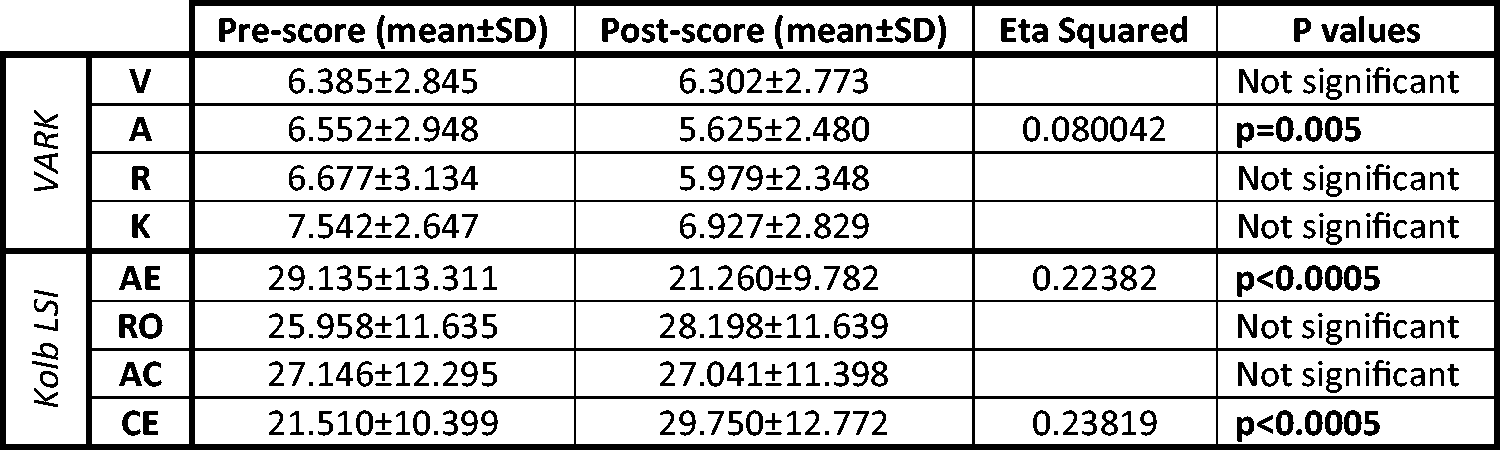
Overall, the VARK questionnaire results showed that 43 (45%) students remained in the same learning mode, 29 (30%) students became more multimodal, while 24 (25%) students either reduced their learning modalities (6%) or changed their learning preference completely (19%).
Kolb learning style inventory
For the Kolb LSI questionnaire, a similar yet more significant change than for the VARK questionnaire was observed. The number of students who were divergers increased by 40% (Figure 3). Divergers are noted for their ability to generate ideas, their imagination and their reflective learning ability. Concurrently, reductions in all other learning modes could be observed, with no student classified as converger in the post-survey. This is supported by the analysis of each individual category which showed a statistically significant, large effect for AE and CE. Of particular note was also the observation of fewer students in the balanced learner category than in the baseline data (pre-survey).
Kolb LSI pre- and post-questionnaire data, highlighting the preferred categories of learning modality of the students in each category.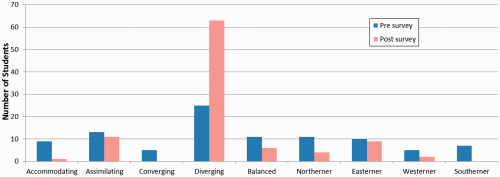
Overall, examination of the four quadrants, in terms of whether or not the students’ results remained in the same quadrant, revealed that 43% of students remained in the same learning modality quadrant, and 57% of students changed between quadrants (Figure 4). The figure clearly shows the shift of the pre-survey aggregate from the balanced learner cell in the middle (blue diamond with black circle) to the divergent quadrant (red square with black circle).
Kolb LSI pre- and post-questionnaire data, highlighting the overall shift in preferred learning modality of each student. Mean scores for pre- and post-surveys are highlighted as circles with black borders.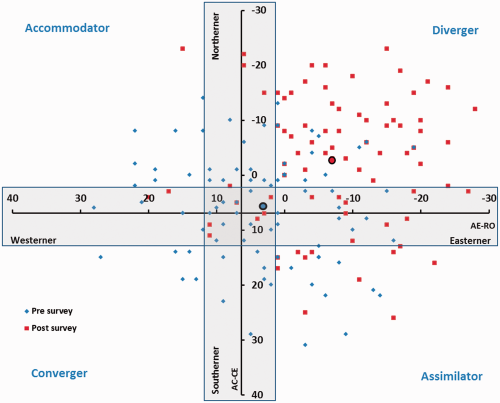
Discussion
The VARK results showed a shift towards more multimodal learning in the students, with 45% of students remaining in the same learning mode, 30% becoming more multimodal and 6% of students reducing their learning modalities. The remaining 19% of students changed their instructional preference completely. The increase in multimodality was expected given the variety of academics using multiple teaching modalities in lectures, laboratory classes and tutorials. The switching of preferences in the 19% most likely reflects an interim change as a step towards multimodality. This observation needs further investigation and evidence.
Surprisingly, the Kolb LSI questionnaire showed a 40% increase in the number of divergers and overall a similar degree of change with 57% of students changing their learning style. The increase in divergers is likely to be due to the effective use of concrete experiences and encouragement of reflective practices in the nursing and midwifery curricula. The reduction in balanced learners necessitates careful consideration in the planning and delivery of second and third (i.e. final) year curriculum, by considering providing more experiences in abstract conceptualisation and active experimentation to promote balanced learners.
Many previous studies of nursing students support the finding reported in this article that nursing students are mainly divergers (Baker, Pesut, McDaniel, & Fisher, 2007; Gyeong & Myung, 2008; L.C. Hodges, 1988; S.A. Hodges, 1988; Laschinger, 1992; Laschinger & Boss, 1984; Suliman, 2010). However, some studies have shown nursing students to be mainly accommodators (Gyeong & Myung, 2008; Hauer, Straub, & Wolf, 2005; Smith, 2010). Our previous research (D’Amore, James, & Mitchell, 2012; James, D’Amore, & Thomas, 2011) of undergraduate nursing and midwifery students supports the diverse distribution of information processing styles assessed in this study. The ‘diverger’ (Kolb LSI) learning style and multimodal (VARK) preference were previously shown to be dominant for students in these courses at the beginning of the semester (D’Amore, James, & Mitchell, 2012; James, D’Amore, & Thomas, 2011). The predominance of these learning styles continued as the preferred learning modes in the end of semester survey in this study. However, these findings are contrary to the theory by Curry (1983) where the ‘information processing’ style as assessed through the Kolb LSI questionnaire is expected to be more stable than the ‘instructional preference’ as assessed by the VARK questionnaire. Our results showed similar proportions of change with both of the learning style tools, indicating equal flexibility of information processing style and learning preference modalities.
Unlike our results, a longitudinal study of Irish pre-registration nursing students showed that most maintained a ‘reflector' learning style from their first until their final year (Fleming, McKee, & Huntley-Moore, 2011). Similarly, a three-year study of female nursing students using Kolb LSI showed little change in the learning styles of the nursing students throughout their course (Rakoczy & Money, 1995). Earlier studies of business majors showed no significant change in learning styles throughout the students’ three-year course (Geiger & Pinto, 1991; Pinto, Geiger, & Boyle, 1994). However, in support of our findings, Chilean medical student learning styles were shown to change during the course of their undergraduate program (Bitran, Zúñiga, Pedrals, Padilla, & Mena, 2012). This was assessed by administering the Kolb Learning Style Inventory to students as they entered the course, and then again at the third and seventh year of their course. Of the 104 medical students, many showed changes in their preferred way of learning, with an overall shift from predominantly assimilators at the start of the course to convergers by the seventh year of the course (Bitran, Zúñiga, Pedrals, Padilla, & Mena, 2012). Similarly, a cross-sectional study undertaken in Iran showed that final-year medical students were more active learners compared to freshmen (Meyari, Sabouri, Gharib, & Beiglarkhani, 2009). Other longitudinal studies in higher education have also shown that student learning styles are subject to change (Busato, Prins, Elshout, & Hamaker, 1998; Donche, Coertjens, & Van Petegem, 2010; Severiens, Ten Dam, & Van Hout Wolters, 2001; Vermetten, Lodewijks, & Vermunt, 1999; Vermunt & Minnaert, 2003).
Limitations
Firstly, results reported in this article for the nursing and midwifery students in this cohort may be an example of a general developmental change in this student cohort, such as maturation. Alternatively, they might be sample specific in that they relate to the unique experiences of higher education students in a particular discipline at one university. Another limitation is the possibility of respondent bias due to attrition as the post-survey was returned by fewer students than the pre-survey. However, unlike several other longitudinal studies, the shorter timeframe and design of this study prevents confounding elements such as poor reliability due to different instruments, utilisation of different student cohorts or simply maturation of students becoming causative factors for the reported changes.
Therefore, the adoption of teaching styles which support only the current learning styles of health and nursing students has been advocated widely by researchers (Alkhasawneh, 2013; Alkhasawneh, Mrayyan, Docherty, Alashram, & Yousef, 2008; Brown, Cosgriff, & French, 2008; Cavanagh, Hogan, & Ramgopal, 1995; Meehan-Andrews, 2008). However, such an approach is problematic given the dynamic changes in learning styles demonstrated within this group of undergraduate nursing and midwifery students. Ultimately, it is important that students utilise all learning styles, as opposed to solely relying on one, as this will help the students to be better and more adaptable life-long learners. Since the results of the study reported here suggest that student learning styles may not be as stable as previously suggested in the literature (Cassidy, 2004; Sadler-Smith, 1996; Smith & Dalton, 2005), it is possible that the lecturers’ teaching styles and modalities may influence student’s preferred learning style.
The notion that innovative curriculum implementation influences learning styles of students is supported by several studies including a longitudinal study which showed that the introduction of an integrated medical curriculum was linked to increased self-regulation strategies in medical students (Kumar, Kumar, & Smart, 2004; Van der Veken, Valcke, De Maeseneer, & Derese, 2009). Therefore, it is important for their learning that students are motivated to develop all learning styles. Educators should help students with this evolutionary process of adaptation to become independent, flexible, life-long learners.
Conclusions
Both learning style tools showed similar levels of change over a semester of undergraduate teaching. This was unexpected as the VARK tool measured instructional preferences that were expected to evolve faster than information processing styles as measured by Kolb LSI tool, which was supposed to be a more stable characteristic.
The Kolb LSI tool showed that, overall, the students became stronger ‘divergers’, while the VARK tool demonstrated increases in multimodality. This research highlights the dynamic changes within students’ learning styles and preferences and the need for educators to continue to assess information processing styles throughout the degree programme to plan specific educational experiences aimed at developing a balanced learner.