




Abstract
This article examines the current state of the transition process for students with developmental disabilities in New South Wales, Australia. Teachers from 75 schools were surveyed about current practices for students with developmental disabilities transitioning from primary to secondary school and from secondary school to post-school life. Teachers' responses to the open-ended survey questions were analysed using inductive content analysis. The results of the analysis revealed that although many schools had transition processes in place, such as school visits and orientation programs, many key evidence-based practices were missing. Key themes that emerged included school-specific transition practices at each level and the importance of home–school collaboration. Overall results indicated a need for a mandated, student-centred planning and support process, guided by evidence-based practice.
Keywords
Introduction
Transition can be defined in relation to education as moving from one position, stage, school or environment to another (Riches, 1996). The most common transitions faced by school-age students are from home to early schooling, from primary to secondary school, to and from specialist settings, from secondary school to work, and to post-secondary school/training (Perry & Dockett, 2006). Effective transitions are very important for the success of students, in particular those with developmental disabilities. (For the purpose of this article, the term developmental disabilities refers to intellectual disability and/or autism; Ashman & Elkins, 2009). Investigating these transitions can better inform schooling practices and assist students, families and educators to plan post-school options (Hanevald, 2013; Strnadová & Evans, 2013).
Bronfenbrenner’s ecological model (1994) is a suitable framework for examining the transitions that students with developmental disabilities encounter throughout their schooling and beyond. The model considers all of the relationships of the students (family, school, peers) to be microsystems, which, in turn, exist in broader systems, such as the community. The interactions of the various microsystems are known as mesosystems. Macrosystems are institutional patterns of culture, such as the economy, customs, and body of knowledge. When a student transitions, another environment is added, one which must exist and interact with the current systems while also presenting a whole new subsystem with its own requirements. Bronfenbrenner describes the chronosystem as change or consistency in the individual or the environment over time, and how this affects the development of the individual overall. An example of this regarding transition would be the way in which the global financial crisis affected funding and employment prospects for students with disabilities transitioning to post-school environments.
Milsom (2007) believes that in order to plan the successful transitions of students with developmental disabilities, the relationships that exist between and among these systems must be examined before the transition. For example, attitudes and expectations about transition held by individual parents and teachers need to be studied together with the communication between one school and another school as well as between the school and the home. It is also imperative that all stakeholders recognise the importance of these relationships through all phases of the transition process, as communication and collaboration is key to effective planning and implementation (Carter, Brock, & Trainor, 2014).
In addition to interventions that are recommended in line with the ecological model, an examination of the special education literature reveals a number of practices that are considered essential for successfully transitioning students with disabilities from one setting to another. The most essential of these practices is transition planning (Riches, 1996). Although transition planning is not federally mandated in Australia as it is in other countries, such as the United States (Individuals With Disabilities Education Act (IDEA), 2004), timely and careful planning of schooling transitions for students with disabilities is still considered to be the best practice (NSW Parliament, 2012).
The Standing Committee on Social Issues discussed the state of transitions between different stages of education for students with disabilities (NSW Parliament, 2012). One of the major recommendations in this report was “that legislation be introduced to mandate transition planning for students with additional or complex needs” (2011, p. xi). Further issues raised included problematic access to and transfer of information, funding related to educational transitions of students with disabilities, fragmented responsibility for these transitions across various specialised services that do not always communicate effectively with each other.
These issues are valid concerns, as both the ecological model and the literature recommend collaboration with all stakeholders to assess both students and environments. Then, a transition plan is designed with an individualised intervention, which targets the general skills, knowledge, and behaviours that are necessary for the student's successful transition to other environments (Milsom, 2007). A number of studies have identified “best practices” in transition planning that are linked to positive outcomes for students (Cobb & Alwell, 2009; Kohler & Field, 2003; Test et al., 2009). These include: (a) active student involvement in the transition planning process; (b) active family participation in transition planning; (c) vocational training; (d) career awareness activities; (e) paid employment or work experiences while still in high school; (f) interagency collaboration; (g) identification of and instruction in skills (vocational, academic, social, etc.) that the student will need; (h) specific instruction in self-determination and self-advocacy skills; (i) inclusion in regular classrooms; and (j) assistive technology assessment and implementation.
Communication and collaboration between stakeholders, particularly schools and parents, is of great importance when planning transitions (Carter et al., 2014). Carter, Brock, and Trainor (2014) assert that for a student with high support needs the perspectives of a number of people who know a student well and/or are familiar with the environment into which the student will transition are of even greater importance. These authors also recommend a holistic approach that takes into account the broad scope of domains (academic, social, vocational, medical), environments (school, home, community, work), and services (educational, agencies, families, community support). Carter et al. (2014) stress the need for more research in the area of perspectives and expectations of parents, teachers, and students towards transition for students with developmental disabilities in order to determine the ways to better include all stakeholders in the assessment and implementation processes. These recommendations integrate well with Brofenbrenner’s Ecological Model, as they suggest that an investigation of the different systems (micro-, meso- exo-, macro-, and chrono-) and their interrelation in terms of transitions for students with disabilities is necessary in order to provide effective transition services for students with developmental disabilities.
Against this background, the overarching aim of the study was to investigate the current state of transitions for students with developmental disabilities from government mainstream primary schools to secondary schools with a particular focus on home–school collaboration in the State of New South Wales (NSW) in Australia. The authors report the results of the analysis of the open-ended survey, which asked teachers about the transition practices of government mainstream primary and secondary schools’ for students with developmental disabilities.
The research questions leading this part of the study were:
What supports do teachers and schools provide to prepare students for transitions? What are teachers’ perceptions of the transition process for students with developmental disabilities? What are the teachers’ perceptions in regard to home–school collaboration?
Method
Research instrument
As highlighted by Fraenkel and Wallen (2006), and Hemmings and Woodcock (2011), open-ended questions are especially useful when investigating people’s attitudes and experiences. Therefore the authors developed and conducted a survey that consisted of eight demographic questions, and five open-ended questions that sought information to address the aforementioned research questions.
Four of the five questions aimed to gather teachers’ experiences with facilitating successful transitions from primary to secondary, and from secondary to post-school life. The fifth question focused on the cooperation between schools and parents to facilitate transitions from primary to secondary, and from secondary to post-school life. The questions as they appeared in the survey are given in Appendix 1.
The survey was sent by post to all schools, however after the initial low response rate to the paper-based mode, the authors developed the online version of the survey to solicit a greater response rate.
Participants
Ethics approval was granted from both the university that the authors are affiliated and the NSW Department of Education and Communities. The survey was distributed to the school principals of the 208 government primary schools and 84 government high schools in NSW that have dedicated special education units by post along with pre-paid return envelopes. School principals were asked to nominate a staff member to complete the survey. Initially surveys were returned from 11 primary schools and 33 high schools. After a reminder an additional 25 responses were received from primary schools and 9 from secondary schools. This resulted in total of 75 completed surveys from 37 primary schools and 38 high schools, which constitutes an 18% response rate at the primary school level and a 45% response rate at the high school level.
Teacher demographics.
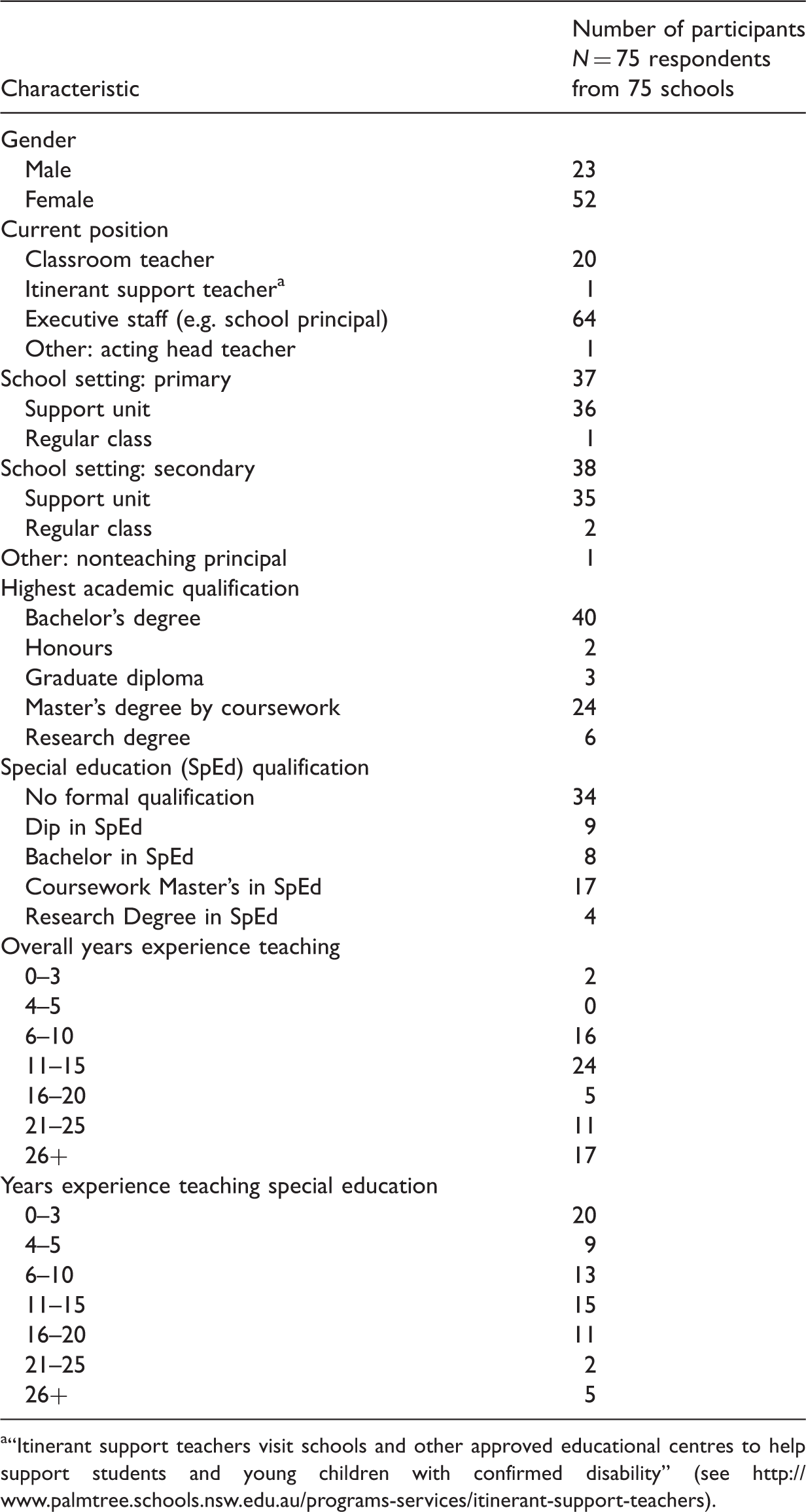
a“Itinerant support teachers visit schools and other approved educational centres to help support students and young children with confirmed disability” (see http://www.palmtree.schools.nsw.edu.au/programs-services/itinerant-support-teachers).
Data analysis
Survey responses were examined using content analysis (Elo & Kyngäs, 2008). In accordance with Graneheim and Lundman (2004), a coding unit consisted of words, sentences or paragraphs “containing aspects related to each other through their content and context” (p. 106). The authors analysed each of the five survey questions separately and derived the key sub-categories, which were then aggregated into exhaustive categories (Graneheim & Lundman, 2004). The validity of the data analysis process was ensured in a number of ways. Both authors analysed the responses to question 1 separately and compared the results of their coding. Once an agreement was reached, the first author analysed questions 2 and 4, and the second author questions 3 and 5. The next step was an exchange of the results of the coding and several meetings where the authors discussed the derived codes, sub-categories and categories. Once agreement was achieved, all categories and sub-categories were carefully compared for any overlaps.
Below, results are presented question by question, which is a common practice when using content analysis to examine open-ended questions (Hemmings & Woodcock, 2011).
Results
Current practices used during transition from primary to secondary schools
Question 1 in the survey investigated current practices used to support students with developmental disabilities during the transition from primary to secondary school. Five respondents from secondary schools indicated that this question was not applicable in their setting. The six categories derived from 70 responses to this question, discussed below, were – in order of frequency: (a) initiatives in the secondary school environment (n = 59; 84.3%), (b) collaboration among stakeholders (n = 31; 44.3%), (c) teaching students the skills required in secondary school (n = 26; 37.1%), (d) initiatives in the primary school environment (n = 15; 21.4%), (e) perceptions of transitions (n = 5; 7.1%), and (f) self-determination (n = 5; 7.1%).
The participants had diverse perceptions of the current state of transitions in their schools, ranging from satisfaction to statements like “Current transition is tokenism” (PRS18). Fifty-nine participants described initiatives that took place in secondary school environments to support successful transitions of students with developmental disabilities. One of the most common practices reported by primary and secondary school teachers was having the student with developmental disabilities and his/her support officer visit the future secondary school on one or more occasions. These visits usually consisted of a school tour and classroom observation and mostly took place in term four prior to transition. A few respondents from secondary schools reported organising a three to five day intensive orientation program specifically for students with disabilities, which included ‘taster lessons’. Only one secondary school teacher mentioned that “management plans & PLPs [personalised learning plans] are given to staff that will be teaching students” (SRS11). Similarly, only one secondary school teacher reported developing visual transition folders for commencing students with developmental disabilities. “Students are also given a visual transition folder with photos of … staff, Principal, O.P’s, H.T. [head teachers] support and Class teachers of unit. There are examples of a [secondary school] timetable and transition Yr.6 to 7 lessons that the students complete relating to subjects, codes, bell times, school map etc. The students take this folder home for the Christmas holidays and return on arrival first day back.” (SRS25)
A couple of respondents from secondary schools complained about the exchange of information among stakeholders being “either delayed or received in bits and pieces on demand” (SRS24). The need for furthering collaboration between primary and secondary schools was also highlighted: “More opportunities for the primary school and high school to liaise with each other. Learning support teams and both schools should be able to collaborate in developing and fine tuning the plans for the students” (SRS37)
The respondents from primary schools indicated that they used diverse ways to teach students the skills required in secondary school. These included developing social stories about the student’s new school and teachers and sharing these with parents, so this preparation would happen across the environments. Four primary schools respondents stated that they taught their students to read secondary schools’ timetables, move from one classroom to another, and that they made changes in students’ current primary timetables to match with the high school structure. Some secondary schools also ran peer support programs for newly enrolled students with disabilities. Three participants highlighted the importance of developing students’ independence: “Having taken on a role in a High School in 2013 I can now see how the transition programs implemented at a primary level are not adequate. There needs to be greater emphasis on long term programs that encourage independence. Focusing on timetabling for the last 2 terms of year 6 is simply not enough. If I could redo my time as a primary teacher I would have focused more on building independence.” (SRS23) “During my time as Assistant Principal (Special Ed) in a primary school I would ask parents to focus on basic literacy & numeracy outcomes. Now in a High School Role I can see life skills/independence skills are more important.” (SRS23)
Ways to improve transitions from primary to secondary schools
Question 2 of the survey asked respondents to discuss ways that transitions from primary to secondary schools could be improved for students with developmental disabilities. Not all of the participants answered this question, though for different reasons. Four primary school respondents who did not answer this question, and two indicated their satisfaction with their transition program (e.g. “No, we are quite proud of our Y6-high school transition program.” PRS7). Furthermore, one survey was completed by a commencing teacher at primary school, who commented: “This will be the first year that I will be transitioning students from primary to high school, so I am unable to comment on this matter at this stage.” (PRS9). In regards to secondary schools, eight respondents did not answer the question at all, and two respondents indicated that no improvement needed in this matter as their school “ … provides every support and accommodation possible in making this program a success.” (SRS22).
The survey responses to question 2 were categorised into the following seven categories (total number of responses to this question 63; categories listed in order of frequency): (a) systemic changes (n = 17; 27%), (b) recommended changes to transition programs (n = 16; 25.4%), (c) continuum of improvements related to students’ support needs (n = 6; 9.5%), (d) improving communication between stakeholders (n = 4; 6.3%), (e) developing parental roles in transitions (n = 4; 6.3%), (f) teaching specific skills (n = 2; 3.2%), (g) appreciation of special education (n = 2; 3.2%), and (h) lack of age-appropriate resources (n = 1; 1.6%).
The participants suggested a number of ways in which the transition of students with developmental disabilities from primary to secondary schools could be improved. Participants from primary and secondary schools highlighted a need for systemic changes. They particularly emphasized a need for funding, which would allow for more effective and comprehensive support for students with developmental disabilities during the transition process. Both primary and secondary teachers were aware that transition support from a primary to a secondary school could not be limited to a couple of visits to secondary schools. They discussed the importance of the student, accompanied by a support learning officer, and becoming familiar with the high school through a number of whole-day visits. However, 19% of respondents pointed out the lack of funding for this purpose.
Some participants believed that teacher and support staff workload issues needed to be addressed if students were to be effectively supported during the transition process. This was well illustrated by the statement of a secondary teacher: “One of the most frustrating aspects of transition for me is the increase in workload, particularly in Term 4, a time when we still have Year 12 students. In regular classes, the Year 12 teachers are freed up to prepare for the incoming Year 7's, but we don't have that because the Year 12's with disabilities stay on at school until December. Some recognition from the DEC that this occurs would be appreciated … ” (SRS36)
The recommendations for improvement also reflected a continuum of student support needs. One of the issues raised was the need of more complex transition program planning for students with intellectual disabilities, for whom one or two visits in their future secondary high school was insufficient.
Participants were in agreement on the importance of developing the roles of parents in transition planning and programming and called for schools to make a bigger effort to increase parental involvement. Respondents from two secondary schools pointed to the lack of age-appropriate resources for teenagers with developmental disabilities: “Also we want them to feel older but there are not many sp. ed. resources to suit high school student – more primary resources – baby pictures.” (SRS28)
Current practices used during transition from secondary schools to post-school life
Question 3 in the survey investigated current practices used to support students with developmental disabilities during the transition from secondary schools to post-school life. Counter to suggestions in the literature for transition planning, programming, and vocational/career education to begin in primary school (Milsom, 2007), 27 primary schools indicated that this question was not applicable to them. Furthermore one secondary school did not answer this question without providing any explanation.
The main categories raised from the participants’ responses were (total number of responses to this question 47; categories listed in order of frequency): (a) academic preparation (n = 25; 53.2%), (b) planning (n = 22; 46.8%), (c) student immersion into post-school setting (n = 26; 55.3%), (d) exploration of post-school settings (n = 14; 29.8%), (e) collaboration (n = 9; 19.1%), (f) staff (n = 7; 14.9%), (g) teacher experience and opinions (n = 3; 6.4%), (h) student self-determination (n = 2; 4.3%), (i) specialised post-school settings (n = 2; 4.3%), and (j) follow up in new setting (n = 1; 2.1%).
In terms of preparing students for the transition to post-school life, many of the respondents from participating schools highlighted the development of functional academic skills (such as handling money), social skills, practical skills (e.g. travel training, cooking), and work-related skills. Eleven secondary schools participants described how they incorporated these skills and planning for post-school life in general into curricula. Most of the secondary schools participants indicated that their year 11 and/or 12 students would attend a course of their choice at a Training and Further Education (TAFE) facility.
Twenty-two participants raised different aspects of planning for post-school life, such as exit transition meetings, eligibility assessment by ADHC employees for post-school funding (either for Community Participation (CP), or Transition to Work (TTW) programs). However, only nine respondents from secondary schools mentioned either development of ITPs or holding transition meetings. In terms of staff involvement in transition, the participating secondary school respondents discussed the role of transition teachers, school to work coordinators, career advisors, and Special Learning Support Officers (SLSO). Only one secondary school stated that they followed up on their graduated students either with parents or in their new settings.
Participating secondary school respondents mentioned students’ exploration of post-school settings beginning with attendance (usually with their parents) at expositions that showcased different forms of employment and services. Most of the secondary school respondents revealed that their transition focus was on getting as much work experience as possible for students prior to their transition to post-school life. According to a number of these respondents, “most students do at least one day per week in years 10, 11, 12.” (SRS8).
Participants mostly mentioned collaboration with parents during the transition process; and only two respondents listed collaboration with outside agencies: “When I worked in a high school, [I] worked closely with VET teacher, worked w/local employment agencies & SpEd support/advocacy groups to develop work/employment readiness programmes.” (PRS5)
One of the codes applied the least often was “student self-determination”. Only seven secondary school respondents mentioned any focus on supporting students’ self-determination and independence. For example, one respondent highlighted: “Focus on travel planning esp. use of travel info like, pre-purchasing ticket, orientation and map reading activities in the shopping centre.” (SRS32)
Ways to improve transitions from secondary schools to post-school life
Question 4 of the survey asked respondents to discuss ways that transitions from secondary schools to post-school life could be improved for students with developmental disabilities. Twenty-eight primary school respondents indicated that this question was not applicable for them. Five secondary school respondents did not answer this question, one stated that this question was not applicable, and seven indicated that nothing needed to be improved (e.g. “We have an excellent transition coordinator who ensures this is a very smooth process.” SRS34).
The main categories were (total number of responses to this question 41; categories listed in order of frequency): (a) systemic changes (n = 13; 31.7%), (b) placement needs (n = 9; 22%), (c) needs in the area of preparation (n = 7; 17.1%), (d) family challenges and needs (n = 5; 12.2%), (e) communication needs (n = 4; 9.8%), (f) staffing (n = 3; 7.3%), (g) student needs (n = 2; 4.9%), (h) post-school placement needs (n = 2; 4.9%), and (i) satisfaction (n = 1; 2.4%). In regards to the last category, only three of the participants who responded to this question indicated their satisfaction with a current state of transitions from secondary schools to post-school options.
The most frequently mentioned suggestion for improving transitions from secondary school to post-school life was making systemic changes, particularly funding for supporting teachers and support staff in the transitioning process. One participant from the secondary schools stated that there is “not enough funding to hire staff to support more students attending work experience programs outside of school” (SRS7). Another school suggested “more funding for facilities to be created within the school specifically for intellectually disabled students i.e., toilets, laundry, kitchens etc. (to assist with life skills developments).” (SRS26)
Nine participants also suggested increasing the availability of work placements for students with developmental disabilities. Two secondary schools respondents highlighted the need for better timetabling of students’ work experience, as demonstrated by the following quote: “Our students would benefit from a one to two day per week program/work experience rather than a ‘week block’. Not many places/companies support this, however, our students learn more as they have times to process new skills, environment, changes in routine and can transfer skills learnt at school in to the work environment if they visit weekly over a long period of time. This also helps them to build relationships in the work place for future opportunities, and networking.” (SRS25) “The stress/anxiety that the prospect of this change causes both to the students & their families, is often reflected in increasingly difficult behavior, as the end of their school career gets closer. So much change; so much uncertainty; such huge decisions.” (SRS12) “The one area that continues to let our students down is family support. If we had greater family support our employment rates would increase. We are attempting to increase/improve family understanding of the importance of work placement for our students. Due to demographic & socioeconomic factors this has continued to be a challenging task.” (SRS23)
Home–school collaboration
The last survey question was aimed at schools’ experiences with home–school collaboration and how this collaboration could be improved. Six primary schools and six secondary schools did not answer this question. The main categories derived from analysis were (total number of responses to this question 63; categories listed in order of frequency): (a) current status of home–school collaboration (n = 45; 71.4%), (b) ways to improve home–school collaboration (n = 29; 46%), (c) barriers to home–school collaboration (n = 17; 27%), and (d) teachers’ perceptions of parents (n = 8; 12.7%).
A number of participants highlighted the importance of home–school collaboration, and 20 of them (nine primary and 11 secondary schools respondents) indicated their satisfaction with current home–school collaboration in their schools. The participants described the ways they collaborate with families. These included IEP meetings, regular meetings in general, and phone calls or email contact.
The participants suggested a myriad of ways to improve home–school collaboration. These included (a) empowering parents, (b) making parents welcome and informed, (c) increasing parental involvement and improving parent–school communication, (d) developing parents’ training programs, and (e) becoming advocates for parents. The possible impact of developing mutual understanding between home and school, on students’ learning was described by one of the respondents from secondary school: “The more we encourage parents to visit school at social events the more understanding will grow. The level of disrespect for teachers would diminish if a working relationship was developed between parents & teachers. Students would then be more respectful and willing to learn, listen & behave.” (SRS27) “School personnel need to listen and try to understand the fears/concerns of parents. We need to remember that school & home are very different environments. Children’s behaviour can be very different in each – sometimes better/sometimes not. In the end we only work with the students for the school day – parents concerns and responsibility is 24/7.” (SRS12) “On the flip side, it is challenging dealing with parents who expect the school ‘to fix their child’s problems’ and do not see the important role they play in their child’s life.” (SRS8) “Many parents think that their child can be 'fixed' by being in a special class.” (PRS32) “Overall we want our students to be happy & productive members of society. Many of our families want these things for students too, but many families don’t believe its possible. Our biggest challenge is to change the mindset of families, who believe people with disabilities ‘need taking care of’ for their entire lives.” (SRS23)
Discussion
The study, its questions, and design were based on the ecological model (Brofenbrenner, 1989). When the transition process is examined using this framework, the importance of providing appropriate support for students with developmental disabilities cannot be overstated. Moving from one environment to another affects all proximal processes. The microsystem is affected, as is the immediate school environment, related activities, social roles, peer group, and teachers will all be different. In order to transition students smoothly, mesosystems become important, particularly those that involve school–home, school–school, school–post-school setting collaboration. The results of the survey illustrate that teachers recognise the importance of these micro- and mesosystems.
The settings that make up the exosystem in transition processes most likely involve larger organisations that the students will not be directly involved with but will affect them nonetheless, such as the Department of Education and Communities and other state services related to post-school transitions. Although it is yet another step removed from the individual student, the macrosystem also has great importance, as in this context it is the overarching system, consisting of society and its beliefs, which affect student's transition supports. Family culture can also influence expectations, level of student self-determination, and school-home collaboration. Lastly, the opportunity structures involved in post-school settings (TAFEs, universities, employers, and community organisations) are part of the macrosystem.
The results of the survey revealed a number of common practices used by mainstream primary and secondary schools in NSW to support students with developmental disabilities during transitions. The first research question guiding this study asked what supports teachers and schools provide for students to prepare them for transitions. The supports and practices during transitions from primary to secondary school that were identified as most common were school visits and orientation programs in term four prior to transition. While these visits are considered best practice (Carter et al., 2014), the execution of the practice appears to be flawed, according to participants. The reported visits varied in length from one to four half-days, and only a couple of schools described more intensive transition programs, including taster lessons. Teaching skills to students with developmental disabilities that are important for them to possess in the secondary school setting such as reading timetables, was also very common. Less common yet so crucial is the practice of secondary school teachers visiting primary schools to meet and observe a student in the class setting and to discuss the student’s support needs with a primary teacher and a SLSO. While most schools mentioned collaboration among stakeholders, there was also a critique raised regarding the exchange of information. The need to improve “the transfer of information about individual students” was also recommended by the Standing Committee for Social Issues (NSW Parliament, 2012), yet it seems that this recommendation waits to be addressed by the government.
The period of transition from secondary schools to post-school life was recognised by the Standing Committee on Social Issues “as a particularly vulnerable period” for young people with disabilities (NSW Parliament, 2012, p. 68). The presented study revealed that most common practices to support students in transition from secondary school to post-school life included supporting students in visiting work expositions, and arranging work experience for students with developmental disabilities in years 10–12. This is consistent with Davies and Beamish (2009), who found that most of the secondary school students with intellectual disability in Australia participated in work experience. Unfortunately only a few schools mentioned supporting students’ self-determination and independence, and developing ITPs. Yet the crucial role of developing and supporting students’ self-determination, especially in the context of transitions, was established more than a decade ago (Wehmeyer & Schwartz, 1997, 1998; Wehmeyer & Shalock, 2001).
Another research question in this study investigated how the transition process could be improved for students with developmental disabilities. Among the most common recommendations related to transitions from primary to secondary schools were increased funding and addressing workload issues to ensure that both primary and secondary teachers have more time to support students by visiting and collaborating with schools, working with parents and collaborating with any involved outside agencies. Low funding levels for students with disabilities were also acknowledged by the Standing Committee (NSW Parliament, 2012). While the Standing Committee expressed “being hopeful that the introduction of the National Disability Scheme will alleviate many funding concerns raised by inquiry participants” (p. xiv), the authors believe that much more needs to be done, including having federally acknowledged areas related to transitions financed by schools. These should include: (a) workload allocations for teachers to conduct transition-related activities; (b) budgets to fund transition specialists to liaise with schools, parents, students, and outside agencies/employers; and (c) support personnel to accompany students on site visits and work placements if necessary.
There was also a strong call from the respondents in the study for better collaboration between secondary schools and their feeder primary schools, not only prior to but also post-transition. Participating schools viewed the length and amount of students’ visits in their future secondary schools as insufficient and starting too late in the school year.
The participating schools called for more work placements to be available for their students with developmental disabilities, and for more plentiful and better structured work experiences, in order to provide students with more opportunities to become familiar with the work environment. This is strongly connected to funding, which was also perceived as insufficient.
The last research question in this study related to teachers’ perceptions regarding home–school collaboration and possible improvements for this collaboration. The participating primary and secondary schools viewed home–school collaboration as crucial for successful transitions. This is in line with Carter et al. (2014), who recommended strong cooperative collaboration among all stakeholders. Some barriers to this collaboration were mentioned, and the suggested improvements ranged from increasing parents’ involvement with their child’s school, empowering parents, and becoming their advocates.
It is noteworthy that none of the schools mentioned any kind of transition assessment, be it of the students’ strengths and needs or the environments the students will be transitioning to. Few participants mentioned any kind of structured planning process, particularly one that involved the collaboration of a team. Assessment and planning are the building blocks of any successful transition process (Cobb & Alwell, 2009; Kohler & Field, 2003; Milsom, 2007; Sax & Thoma, 2002; Test et al., 2009). They are also strongly aligned with the ecological model (Bronfenbrenner, 1994), which advocates that assessment and planning should be student-centered and holistic, encompassing all environments and relationships that student is involved with now and will be in the near future. These practices are the foundation of effective transition processes; therefore their omission is a very serious concern.
The most alarming finding of this survey was the lack of the students’ active and self-determined involvement in the transition process. While student involvement is widely recognised in the literature as best practice in successful transition planning (Hetherington et al., 2010; Morningstar, Turnbull, & Turnbull, 1996) none of the schools explicitly recognised students with developmental disabilities as primary stakeholders in the transition process. This confirms the findings of the World Report on Disability (2011) according to which “the voices of children with disabilities themselves must be heard, though they frequently are not” (p. 225).
Conclusion
Results of the study reported in this article show that only some of the best practices in transition planning are currently implemented to some extent in NSW government schools. These include vocational training, career awareness activities, and identification of and instruction in what the student will need after the transition has occurred. The study also revealed that some previously identified best practices are either not mentioned by respondents at all, or are mentioned on a very minimal level. These include active student involvement in the transition planning process, interagency collaboration, and specific instruction in self-determination. While active family participation was referred to by number of schools, none of the schools specifically mentioned family participation in transition planning. These deficits represent holes or weaknesses in the processes involved in transition planning and implementation. Of greatest concern is the lack of student participation in the planning process, especially since the ecological model places the student in the centre of the model with all of the systems revolving around the individual. The findings of the survey indicate that the student is placed more on the outside, someone who has things planned for them by others, with little or no input by him or herself.
For each of the different transition stages it is crucial to ensure the individual needs of students with disabilities are met. These needs include academic, social, vocational, community, and family goals (Strnadová & Evans, 2013). Each new environment brings a new set of challenges for all involved, thereby requiring different types of home–school collaboration, and because no two families are alike, professionals must take an individualised approach to collaboration and transition planning. This includes empowering an active role for parents (and child with a disability) in the decision-making process during the different transition stages (Gargiulo & Kilgo, 2005).
The survey study presented in this article adds to the knowledge of transitions experienced by students with developmental disabilities in NSW government mainstream schools. It also provides crucial knowledge about home–school collaboration and its role in supporting students with developmental disabilities.
The limitations of this study include the context, which was the state of NSW and limited to government schools. Therefore, the results may not be applicable to government schools outside NSW, or to Catholic and Independent schools within NSW. The sample size, although representative of teachers in NSW government schools, was small, due to low returns on requests to participate. Also, higher number of secondary than primary schools participated in the study. As this study was concerned with teacher perceptions of transition processes, their reported experiences may vary from what is actually occurring in practice. Future studies should endeavour to involve more participants and observe/explore actual transition practices as they occur in schools. To obtain a more complete picture of transition processes throughout Australia, studies on this issue in all jurisdictions would be desirable.
Footnotes
Declaration of conflicting interests
None declared.
Funding
This research received no specific grant from any funding agency in the public, commercial, or not-for-profit sectors.
Acknowledgements
This research received ethical approval from the University of New South Wales Human Research Ethics Committee (Approval #HC13021; SERAP Approval 2013076) within the UNSW research grant ‘Transitions of students with developmental disabilities: Fostering school–home partnerships’. We would like to express our sincere gratitude to all schools that participated in this study.