




Abstract
This study evaluated a bilingual intervention in the key learning area of mathematics. Nine typically developing Samoan–English students received math lessons in both Samoan and English. A control group of Samoan–English students received all lessons in English. The material covered and the amount of instruction was the same for each group. The only difference was in the language of instruction. Two assessments measured progress in early mathematical skills and concept development. Initial data from each test in isolation indicated no additional benefit for students who received bilingual intervention. Further analysis revealed two interesting patterns of learning between tests. First, all students more easily acquired rote mathematical skills and knowledge than conceptual knowledge and its associated vocabulary. Second, there were differences in patterns of learning between groups. The control group acquired mathematical skills but made limited progress acquiring conceptual knowledge. In contrast, the intervention group demonstrated more balanced learning: acquisition of core math skills was matched by gains in conceptual development. We propose that bilingual intervention facilitated English word learning, producing improved learning of core skills linked to underlying conceptual knowledge.
Keywords
Introduction
Australian census data reports that 21% of Australians use a language other than English at home. Over 400 languages are represented (Australian Bureau of Statistics, 2006a). Children in this situation are often early sequential bilinguals, for whom a minority language is the dominant and first language introduced to children at home (L1). Regular exposure to English (L2) generally occurs when the child starts childcare or school.
Once at school, early sequential bilingual (ESB) children must quickly acquire sufficient English to ‘survive’ interactions with staff, peers and the curriculum. These children face a two-fold challenge: first, learning the language and then using that language to learn. This process takes several years (Windsor & Kohnert, 2004). ESB children attain conversational skills at the level of monolingual peers after approximately two years of L2 exposure. However, it takes considerably longer to learn sufficient English to perform at the same level in academic tasks (Cummins, 1981, 2000; Hakuta, Butler, & Witt, 2000; Kohnert & Bates, 2002; Ramírez, 1992). For example, an Australian study found that the English language abilities of Year 6 ESB children (in their seventh year of consistent English exposure) remained significantly below that of monolingual peers (Hemsley, Holm, & Dodd, 2006).
As speech-language pathologists working in schools, we are only too aware that learning English sequentially can affect a child’s ability to interact with the curriculum. Different language experiences, fewer language opportunities as well as distribution of linguistic knowledge and exposure across two languages affect classroom performance. Windsor and Kohnert (2004) conclude that ESB children ‘face some of the same academic and social challenges as do monolingual children with language impairment’ (p. 878). The teachers we work with on a daily basis are well aware of these challenges. Considerable research exists into the pedagogy of educating bilingual children in an attempt to identify best practices for enhancing curriculum learning.
L1 development is a significant factor influencing L2 acquisition. It is well established that children with a strong L1 acquire L2 more effectively (Kohnert, Yim, Nett, Kan, & Duran, 2005; Restrepo et al., 2010; Rolstad, Mahoney, & Glass, 2005; Thordardottir, 2010; Tsybina & Eriks-Brophy, 2010). Time spent using L1 does not impede L2 language or academic development. In fact, promoting L1 development can significantly improve L2 language abilities and academic results as well as socio-emotional outcomes (Cummins, 1981; Kohnert, 2008; Portes & Hao, 2002). For this reason, bilingual education programs that provide education in both L1 and L2, generally, produce better L2 outcomes. A meta-analysis of 17 studies into the effectiveness of bilingual versus all-English educational approaches for English language learners concluded that bilingual education is ‘superior to English only approaches in increasing measures of students’ academic achievement in English and the native language’ (Rolstad et al., 2005, p. 590). Similarly, a review of 16 studies evaluating bilingual versus English-only reading instruction strongly favoured bilingual approaches (Slavin & Cheung, 2003).
The challenge of bilingual education in an Australian context
While bilingual language programs exist in the USA, Canada and Europe, their application in an Australian context is more challenging. One consequence of Australia’s strongly multicultural society is that several cultures and languages frequently co-exist in a single school. However, cultural clusters exist that could allow implementation of bilingual educational approaches. Unfortunately, no cost-benefit analysis of bilingual education has occurred in this context, even where bilingual staff members are available. Consequently, three factors remain unexplored:
Whether students would benefit from a bilingual program; How such a program would be presented; and How much bilingual input would be necessary to improve learning outcomes for ESB children.
With no empirical evidence to support claims to the contrary, Australian schools operate on an implicit assumption that immersion in English is the only feasible option for effective L2 acquisition by ESB children. Often first language abilities are disregarded, albeit in an attempt to help ESB children ‘catch up’ to their monolingual peers. Clarkson’s (2007) considerable research in the area of bilingual versus monolingual mathematics learning highlights this dilemma: Until recently, there was little recognition by teachers in Australian schools that language can influence the learning of mathematics, and even less thought given to the notion that a student’s non-English language may be important. If there was such recognition then the naive position was taken that the first language was somewhat irrelevant … Most teachers were also not aware that their bilingual students would switch languages while thinking about their class work … Of course when teaching children from such diverse backgrounds with the pressures of ‘keeping the classroom going’, it is not always easy to see such issues as important. (p. 192)
This study investigated whether bilingual instruction could enhance L2 acquisition in an Australian context. Specifically, a short period of bilingual mathematics instruction was trialled. This subject area is language rich: ‘learning mathematics also involves learning the language of mathematics’ (Monaghan, 2009, p. 14). In their first years at school, young students will initially develop mathematics-specific vocabulary and syntax. This process involves far more than learning words. Each word must be linked with the concepts and ideas which underpin its meaning (Lindsay & Gaskell, 2010). As students engage with the curriculum, they develop networks of conceptual knowledge that lead to the use of mathematical discourse: an ability to explain ideas, describe patterns and generalise conceptual knowledge across contexts (Moschkovich, 2005). The process of mapping language to underlying conceptual knowledge is now understood to be a ‘crucial issue in mathematics teaching’ (Clarkson, 2009). How to best approach this process when a student speaks two or more languages is still being explored (Barwell, Barton, & Setati, 2007).
In this study, mathematics instruction was provided equally in L1 and L2. It was hypothesised that children would use their knowledge of L1 mathematics concepts as a bridge to learn mathematics vocabulary and concepts in L2. Previous studies suggest bridging from L1 to L2 is a valid strategy for promoting L2 acquisition (e.g., Lindsay & Gaskell, 2010; Lugo-Neris, Jackson, & Goldstein, 2010; Ryan, 2005; Ulanoff & Pucci, 1999). We predicted that consolidation of knowledge across languages would produce better English learning outcomes for ESB children compared to ESB children receiving instruction in English alone.
Method
Participants
The study was conducted with children from a single suburban primary school. The Socio-Economic Indexes for Areas (index of relative socio-economic advantage and disadvantage) placed the suburb in the 49th percentile (Australian Bureau of Statistics, 2006b). This means the area was in the middle socio-economic range when considering factors such as income, education, qualifications and occupation.
The target school was selected for its cultural and linguistic diversity. A high proportion of sequentially bilingual students had an L1 of Samoan. The school reported that 30% of its students had a Samoan cultural background while 12% were Indigenous Australian and 8% were Vietnamese. A further 5% were from a range of other non-English-speaking backgrounds.
The school had 83 children in their second year of full-time education (Year One). These children were in four classrooms, each with a monolingual English-speaking teacher. Of the 83 children in Year One, the school identified 18 children as being eligible for participation in the study. These students came from families where Samoan was the primary language used in the home environment. No students with diagnosed disabilities or sensory impairments were included. All 18 students returned parent consent forms enabling their participation in the study.
Once parental permission was obtained, home language use was confirmed through parent interview. These were conducted in person or over the phone, using a Samoan interpreter if necessary. All parents reported that L1 continued to be the primary language spoken at home, although many noted that conversations with siblings and bilingual friends were spoken in a mix of L1 and L2.
The 18 Samoan–English participants were sorted randomly into two groups: intervention and control, with nine students in each group. The intervention group received mathematics instruction in Samoan and English during the study. The control group received all mathematics instruction in English. At initial assessment, the intervention group had a mean age of 69.2 months (range 65–73 months) and comprised six males and three females. The control group had a mean age of 67.2 months (range 57–72 months) and consisted of five males and four females.
A registered, bilingual teacher was recruited to teach mathematics to the intervention group for the duration of the study (nine weeks). The teacher had been working in the school district for several years and was actively engaged in Samoan cultural programs in her local school and community. She was employed to teach mathematics to the intervention group for 45 minutes twice weekly. Time was also allocated for planning and preparation of sessions, as well as regular collaboration with Year One teachers.
Assessments
We obtained baseline data using two standardised assessments: the Boehm Test of Basic Concepts-3 (Boehm) and the Test of Early Mathematics Ability-2 (TEMA). These were administered in the week prior to commencement of the intervention block. Standardised tests are by their very nature culturally and linguistically specific. Interpretation of results depends on the degree of similarity between the child being assessed and the standardisation group (Battle, 2002). Boehm and TEMA were designed for monolingual English children. Raw scores were not converted to standard scores/percentile ranks because of the limited relevance of the normative samples to the cultural background of the Samoan–English students in this study. Their limited exposure to English is likely to mean that much of their conceptual knowledge would remain tied to their first language (De Lamo White & Jin, 2011). For these reasons, analyses focused on raw score changes over time.
We administered the Boehm Test of Basic Concepts-3 (Boehm, 2001) individually. It tested comprehension of 50 basic concepts relating to qualities of objects or people, spatial relationships, time and quantity. This included concepts such as before; after; whole; half; second; last; some; few; beginning; between; different; forward; least and equal. These frequently occurring concepts are foundational knowledge for a student to ‘understand the lessons and instructions the teacher presents in the classroom’ (Boehm, 2001, p. 2). Boehm was selected for inclusion in the assessment battery as many of the concepts tested related directly to the mathematics curriculum taught during the study. When completing Boehm, students listened to a focus sentence (e.g., ‘Look at the children and the rope’) followed by a short instruction containing a key concept (e.g., ‘Circle the child who is going over the rope’). For each item, students made a choice from four options: three distractors and one correct choice.
The Test of Early Mathematics Ability-2 tests mathematical skills in children 3–8 years of age (Ginsburg & Baroody, 2003). This test was also administered individually. TEMA assesses informal and formal knowledge, including number awareness, number comparisons, numerical literacy, number facts, basic calculations and conceptual understanding (Ginsburg & Baroody, 2003). The 65-item assessment is hands on and interactive, although basal and ceiling rules mean that not all items need to be administered. Typical items for the children in this study included: finger displays up to 5; counting out loud; identifying which group had more/less objects; counting objects and giving a cardinal number; making groups of objects; reading or writing numerals; naming the number before/after X; and solving simple number stories (e.g., Joey has one dollar and he gets two more. How many does he have altogether?).
Intervention
In the Year One classrooms targeted for intervention, mathematics lessons took place four times a week. Each class followed the same program, with teachers collaboratively planning curriculum targets and activities for each week of the term. Some lessons included ‘paper and pen’ worksheets, although more frequently lessons involved demonstration of concepts and ‘hands on’ group activities. Appendix 1 contains an outline of weekly topics and key concepts targeted for the duration of the project. Regular liaison with class teachers throughout the term ensured that weekly activities remained in line with the written program.
Curriculum planning at grade level made consistency of program delivery between classrooms and the intervention group relatively easy to coordinate. The intervention group received the same instruction and participated in the same activities at the same time as their peers in the classroom. The only difference was that the intervention group participated in two lessons a week in Samoan rather than English. For the other two mathematics sessions each week, the intervention group stayed with their class and completed the lesson in English. As one topic was targeted for each week of term (see Appendix 1), the intervention group experienced activities relating to target concepts in both Samoan and English. The control group experienced activities only in their second language, English.
The intervention program commenced the week following baseline assessment and lasted for nine weeks. The bilingual teacher visited the school on Tuesdays and Fridays when all four Year One classes participated in mathematics lessons concurrently. The intervention group would withdraw to a room adjacent to the Year One classrooms to complete their lesson in Samoan. Each lesson lasted for 45 minutes. No child in the intervention or control groups missed more than two of the eighteen planned sessions.
One of the authors observed the Samoan sessions, and specifically, language use patterns between the teacher and students. The Samoan teacher spoke Samoan at all times: from the time they left their classrooms to their return 45 minutes later. It was the language of teaching as well as general conversation, e.g. discussing weekend activities on the way to intervention sessions; directing a student to turn on the fans or asking a student to obtain specific materials from the cupboard. English words were only used if there was no direct Samoan translation. Students were encouraged to speak in Samoan during the lessons, but this was not required. All verbal contributions were accepted regardless of whether they were given in Samoan, English or a mix of both. If a child answered a question or contributed to a discussion using English, the teacher at times repeated their response in Samoan, but then the lesson continued in Samoan.
Following the intervention period, all children were re-tested using Boehm and TEMA. To reduce the possibility of test–retest effects, post-intervention assessments were conducted six months following initial assessment (three months following the end of the intervention phase).
Results
Given the small sample size, this study should be seen as a trial. The results provide guidance on the worth of further research and the findings that one might anticipate. For this reason, we present descriptive statistics, illustrative charts, and some statistical tests.
Table 1 presents the statistics that summarise the results of the testing. Figure 1 portrays the pattern of results graphically.
Pre- and post-test raw scores (mean ± 1 SD) on TEMA and Boehm tests (graphical representation). Pre- and post-test raw scores (SD; range) on TEMA and Boehm tests.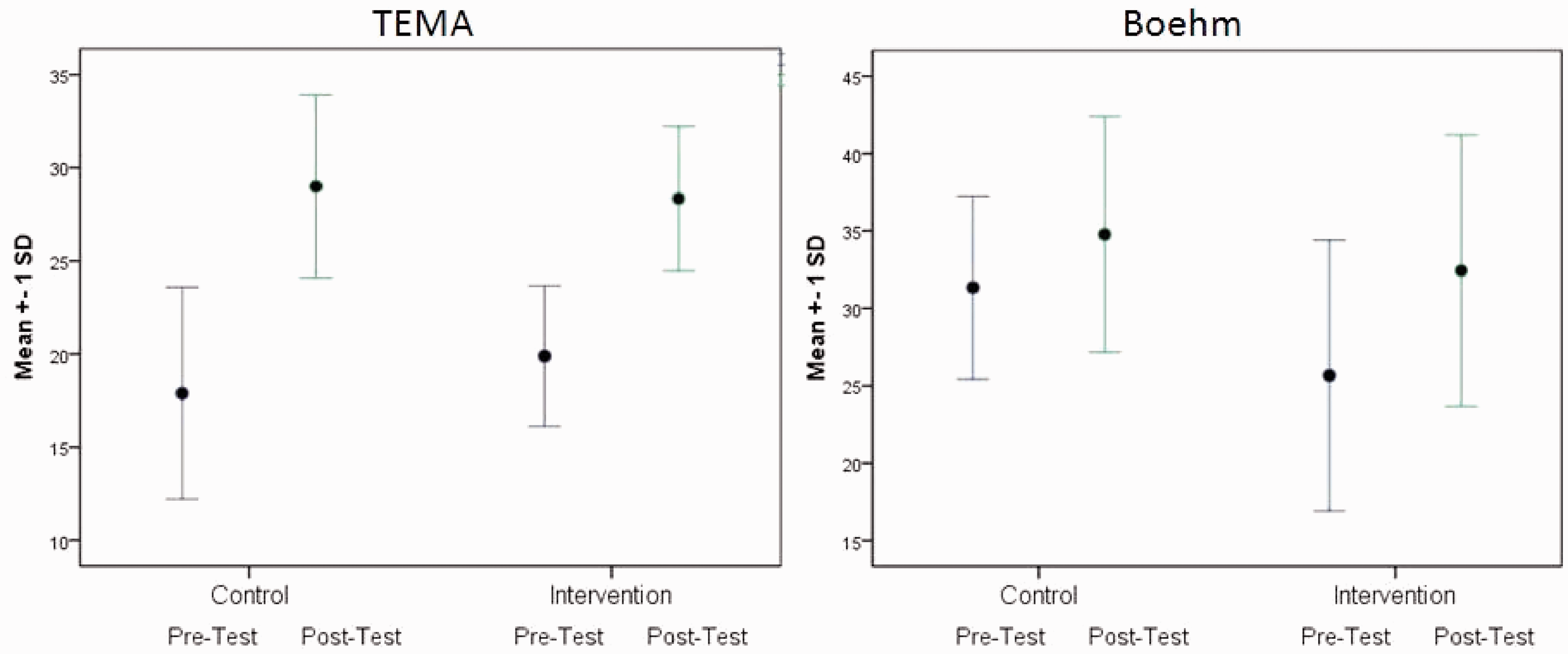
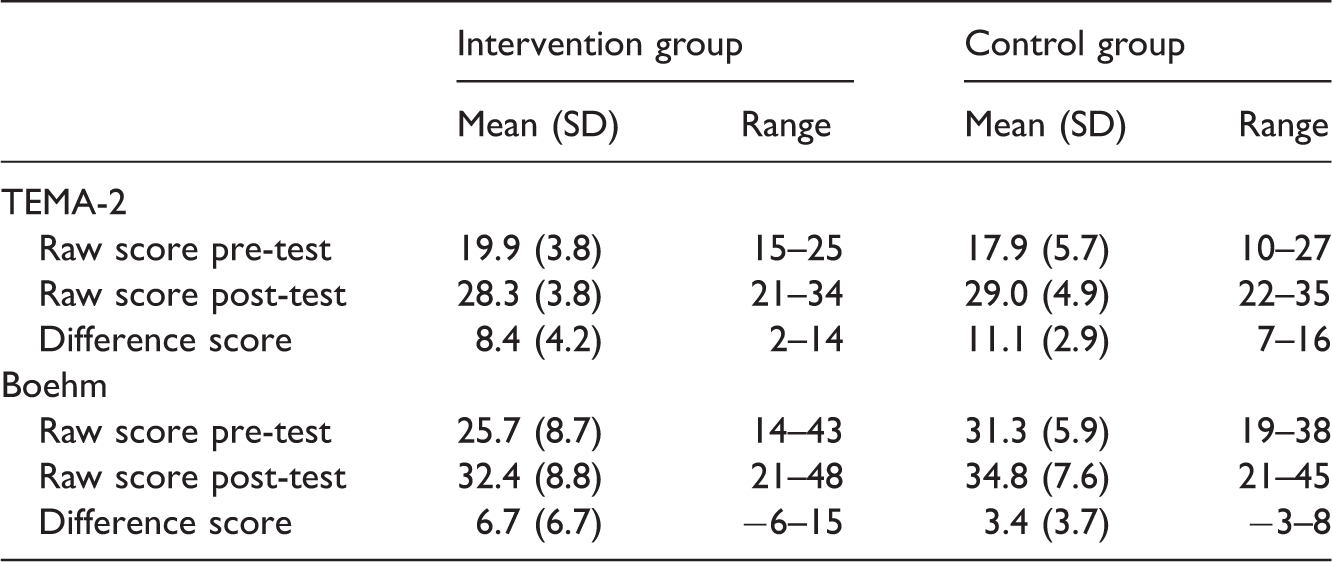
Table 1 and Figure 1 show that both the control and intervention groups increased their scores substantially from pre-test to post-test. This is confirmed by repeated measures analysis of variance on each of the two measures. 1 The use of parametric analyses of variance followed evidence that normality and homogeneity assumptions were not seriously violated. Kolmogorov–Smirmov tests revealed that the raw scores on TEMA and Boehm were approximately normally distributed (p > 0.05). Levene’s test revealed that raw scores on the TEMA and Boehm complied with the assumption of homogeneity of variance (p > 0.05).
Repeated measures analyses of TEMA and Boehm raw scores revealed a significant difference on each measure between pre- and post-test scores across the combined intervention and control groups (TEMA: F1,16 = 134.2; p < 0.001; Boehm: F1,16 = 16.29; p = 0.001). Across the two groups, there was a consistent pattern of score improvement from pre-test to post-test.
For TEMA scores; the interaction between group membership and time of testing was not statistically significant (F1,16 = 2.50; p = 0.13), indicating comparable change for each group over time. A similar result was obtained for the Boehm scores (F1,16 = 1.73; p = 0.21). From these data, the evidence is insufficient to support a claim that members of the intervention group improved their scores (on average) to a greater extent than members of the control group.
From Figure 1, it may be noted that there is almost no overlap between the TEMA pre-test and post-test score distributions, but substantial overlap between the Boehm pre-test and post-test score distributions. Although not statistically significant, these sample differences suggest that a measurable impact is possibly more likely to be achieved on TEMA scores than with Boehm scores. Whether TEMA is more sensitive to the type of teaching that took place in this study, or to teaching in general, warrants further investigation with larger samples, with a longer period of intervention, and/or with less delay between program completion and follow-up outcome measures.
Discussion
This study evaluated the effect of a nine-week bilingual intervention in the key learning area of mathematics. Nine Samoan–English students received mathematics lessons in Samoan and English. A control group of Samoan–English students received all lessons in English. The material covered and the amount of instruction was the same for each group. The only difference was in the language of instruction.
The school received this program well. Although no formal feedback was obtained, the authors and Samoan teacher noted that the children in the intervention group willingly attended and actively participated in the Samoan lessons. The staff and families involved in the program also provided informal positive feedback to the authors. They described the program as worthwhile and perceived that it had a positive impact in target areas. We attribute these observations to the willingness of the school to support students from culturally and linguistically diverse backgrounds; positive rapport between the Samoan community and the school as well as positive rapport built between the Samoan teacher and staff at the school.
Group results
Despite enthusiastic support at the school level, the intervention group showed no significant differences in gains to the control group on either Boehm or TEMA. Both the intervention and control groups made significant gains over the six months between initial and repeat testing. That is, all students showed gains on Boehm and TEMA regardless of whether they received instruction in English only, or the bilingual format.
Although TEMA and Boehm both improved over time, analysis of individual scores and means revealed significant differences between the two test formats. Figure 1 highlights the contrasting improvement across tasks. Scores on TEMA at post-testing indicated rapid progress in acquiring mathematical skills across a range of areas. The picture was less clear for their conceptual development, as measured by Boehm. We propose three reasons for the relatively slower growth in conceptual development over time: (1) differences in the skills assessed across tasks; (2) conceptual differences between L1 and L2; and (3) insufficient exposure for consolidation of word learning.
Differences in the skills assessed across tasks
TEMA and Boehm assess very different skills. While items in TEMA require some conceptual learning, the majority are rote tasks with finite application (e.g., rote counting, number facts, counting, providing a cardinal number and writing numerals). Once mastered, these skills would be applied across contexts with relative ease. The concepts tested by Boehm are less concrete. In particular, their application can change depending on context, e.g., making comparative judgments, comparisons to a standard, ordering, grouping or classifying (Boehm, 2001). It is logical that this task would be more challenging for ESB students, who have different language experiences, fewer English language learning opportunities and distribution of linguistic knowledge across two languages (Windsor & Kohnert, 2004).
Conceptual differences between L1 and L2
Learning a second language is highly influenced by the presence of a first language: it creates a lens through which the second language is considered (Kellerman, 1995). Conceptually similar words, which can be directly translated from L1 to L2, are easier for sequential bilinguals to learn. Conceptually different words, which cannot be easily translated, take longer to learn in L2 because of differences in conceptual schema/traits between languages (Carroll & Von Stutterheim, 1993; Gaskell & Dumay, 2003; Hemsley, Holm, & Dodd, 2012). For example, the learning of probability vocabulary in Chichewa–English students in Malawi was found to be influenced by the nature of Chichewan probability vocabulary and their differences to English (Kazima, 2007). In this study, conceptual differences between English and Samoan may have directly contributed to the relatively slower learning of English concepts. Many of the English concepts examined cannot be directly translated in Samoan: some are represented using several words together, while others have different conceptual traits and are therefore used in additional/different contexts (Hemsley et al., 2012). It is hypothesised that the conceptual distance between Samoan and English negatively influenced L2 concept acquisition for Samoan–English bilinguals. Further research is needed to confirm these findings.
Insufficient exposure for consolidated learning
The bilingual children in this study would have been exposed to many unfamiliar English words in this study. The process of learning new mathematical vocabulary in an unfamiliar language is complex. Each word must be linked with concepts and ideas which underpin its meaning. Links made over time eventually allow students to comprehend that word across a range of contexts (Lindsay & Gaskell, 2010; Moschkovich, 2005), although as concepts can be represented very differently across different languages, this process takes time. In the ‘fast mapping’ stage of learning, students link available conceptual and contextual information to the word they hear (Kan & Kohnert, 2008). The information can be used but is not yet part of their established vocabulary. Consolidated learning requires multiple exposures over several days. Once in the established lexicon, information is more enduring, accessible and networked to other information (Dumay & Gaskell, 2007; Gaskell & Dumay, 2003; Lindsay & Gaskell, 2010). In the current study, the amount or intensity of exposure to new concepts may have been insufficient to allow consolidated learning. A broad range of concepts from Boehm were covered in lessons but were taught in short bursts with limited revision, e.g., shape attributes; comparison attributes; whole and part concepts (see Appendix 1). This type of exposure would have facilitated fast mapping only.
Comparison of learning across tasks
Analysis of group differences between the two assessments revealed a further interesting result. Figure 1 shows that the control group made good progress on TEMA but limited progress on Boehm. In contrast, the intervention group made good progress on Boehm and TEMA. Learning was more balanced in the intervention group: acquisition of mathematical skills was matched by conceptual development, as assessed by Boehm. We propose that bilingual intervention facilitated consolidated L2 learning, enabling students to more easily link new English words to underlying conceptual knowledge in L1. If the length of the study had been longer, it is likely that:
The intervention group would have made greater overall gains than the control group, as learning would be underpinned by strong conceptual integration and links to relevant vocabulary in L1 and L2; and The control group’s learning would be limited by weaker conceptual integration and links to vocabulary in L1 and L2.
These hypotheses are consistent with suggestions that L1 knowledge facilitates L2 acquisition (Lindsay & Gaskell, 2010). We propose that bilingual instruction improved connections between new and existing knowledge in L1 and L2. Bridging knowledge between L1 and L2 established more elaborate representations, with stronger links to conceptual knowledge. This, in turn, facilitated consolidated learning. Further research to confirm this theory with larger group sizes over an extended timeline is necessary. An understanding of mechanisms that facilitate learning for ESB children would have obvious implications for pedagogical policy relating to this increasing population in Australia.
Samoan learning
Anecdotal reports from the Samoan teacher indicated that the intervention group improved their Samoan mathematical and conceptual awareness over time; however, this was not quantified. Although Samoan assessments would have added valuable information to the data collected, they were not included in this study. Administration of Boehm and TEMA in Samoan was not possible due to linguistic bias and difficulties with direct translation: concepts are represented very differently in Samoan and English.
Importantly, students received 50% of their mathematics education in L1 for a sustained period without any negative effect on English learning. This suggests that bilingual students in Australia may be able to continue to develop L1 at school without impacting on English acquisition. Future studies should include measures in both L1 and L2 to capture cross linguistic learning.
Limitations
This study evaluated learning of mathematical skills and concepts outside the teaching framework, using formal assessment tools. Home-made assessments of target vocabulary and concepts were not used. The selection of formal measures may explain differences between our study and others that evaluate bilingual versus monolingual intervention. Many studies evaluate word and concept learning using specially designed tests, assessing the specific vocabulary targeted in intervention (e.g., Justice, Meier, & Walpole, 2005; Lugo-Neris et al., 2010). While such tests are limited by their assessment of a narrowly defined skill set, their use has identified significantly greater language learning gains following intervention. A study by Tsybina and Eriks-Brophy (2010) bridges these two assessment approaches, looking at learning of target vocabulary as well as generalised learning. It identified that bilingual intervention facilitated learning in targeted areas but had no generalised effect on overall vocabulary acquisition. This model of assessment, evaluating acquisition of core skills in addition to generalised learning, should be an essential element of future studies.
The small sample size and length of study were further limitations in this project. The sample size was limited by the number of eligible students at the targeted school. A larger sample size would have been more sensitive to small differences in group performance and provided greater confidence in results. The timeframe for intervention was also dictated by practical factors including the length of the school term and availability of the bilingual teacher. Previous research shows that bilingual education is beneficial (Cummins, 1984; Kohnert et al., 2005; Thordardottir, 2010; Tsybina & Eriks-Brophy, 2010); however, in this study, the limited period of intervention might not have been sufficient to generate accelerated learning in the intervention group. A longer intervention block may have produced a different pattern of learning between the groups over time. Further research is required to establish how much of this potentially useful mode of educational delivery is necessary to obtain positive generalised learning outcomes. Trials involving short intensive blocks of intervention, as well as longer more dispersed L1 support would be worthwhile.
Conclusions
This study was received well by the school, parents and staff. The perceived benefit of the intervention was positive. Initial comparison of scores on individual tasks indicated differences in learning between the two assessment tasks. Over time, students more easily acquired core mathematical skills than the underlying conceptual skills tested by Boehm. This result emphasises the different types of learning typical ESB children encounter. They more easily acquire rote skills and knowledge than conceptual knowledge and its associated vocabulary. The primary challenge for ESB students appears to be integrating L2 concepts into a pre-existing conceptual schema. Acquiring concepts is not a matter of rote learning, rather, consolidation requires multiple exposures over time and cross linguistic transfer of knowledge between L1 and L2.
Initial analysis of tasks in isolation indicated no additional benefit for students who received bilingual intervention. However, unexpected differences in patterns of learning emerged between the intervention and control groups. The control group acquired core mathematical skills but made limited progress acquiring underlying conceptual knowledge. In contrast, the intervention group demonstrated more balanced learning: acquisition of core mathematics skills was matched by gains in underlying conceptual development. We propose that bilingual intervention facilitated L2 consolidated word learning, resulting in improved learning of core skills linked to underlying conceptual knowledge. Further evaluation of bilingual bridging interventions is necessary to confirm this pattern of learning in Australian ESB children.
Footnotes
Funding
This research was supported by the Department of Education and Training: Queensland and the University of Queensland. Additional funding was provided by the Speech Pathologists Board of Queensland.
Declaration of conflicting interests
None declared.
Acknowledgments
The authors wish to acknowledge the enthusiastic participation of the primary school involved in this study. The authors thank the class teachers who coordinated the program and its logistics, and Mabel Fa’ata’ape for her considerable time, effort and planning, as well as for providing lessons in Samoan, and liaising with the school.