




Abstract
This article examines what it means to ‘hang out with mates’ and the effect that ‘hanging out’ has on boys’ academic success and behaviours. The research was conducted in three geographic and socio-economic diverse secondary schools within New Zealand using 200 boys aged between 12 and 18 years both as participants and researchers. The research participants claimed that ‘hanging out with mates’ was a crucial activity during adolescence and an important reason for going to school. Adolescent boys who developed close male friendships perceived a variety of benefits that strengthened and protected them from the many social and academic pressures that arise during adolescence. ‘Hanging out with mates’ was perceived to have positive effects on school retention and achievement as boys moved into the upper levels of schooling. Boys claimed their mates acted as a buffer between peer group and academic stressors; as well as offering a secure environment from which to develop concepts of self.
You send your child to the schoolmaster, but ‘tis the schoolboys who educate him.
Ralph Waldo Emerson (1860, p. 123)
Introduction
Groupings of young males are often perceived as a threat or a problem for society. There is a lack of understanding of the importance of the group to an individual adolescent male’s development. Young adolescent males place great importance on daily contact with their mates and the opportunity to socialize and make new friends within the environs of school (Irwin, 2007, 2009). This regular contact with peers and mates can have a powerful effect on a boy’s psychological development; especially in terms of masculinity, self-identification and establishment of place within society (Brown & Klute, 2003; Head, 1999; Kroger, 2004; Way, 2011). Previous research has shown that school-aged boys socialize in a variety of group situations that often display a hegemonic mode of masculine behaviour (Mac an Ghaill, 1994; Martino, 1999; Rickard, 1998; Stoudt, 2006). In these groups boys often display stereotypical masculinity that follows a strict code of behaviour (Pollack, 2000). These groups regulate behaviours and can influence (positively and/or negatively) a boy’s attitudes, behaviours and academic success at school (Epstein, 1997; Jackson, 2006). In schools, boys identify with and ascribe to the social hierarchy and masculine archetypes found within (Mac an Ghaill, 1994; McCormack, 2011). In this article, it is argued that the close friendship offered by mates can protect and support boys as they are striving to develop self-identity and academic success.
Socialisation occurring at school was perceived as significant by the boys attending the three schools in this New Zealand study. It made no difference whether the boys were in early or late adolescence; they placed equal importance on daily contact with their mates and the opportunity to socialize. This contact with friends and mates can have a powerful effect on their psychological development; especially in terms of their self-identification and establishment of place in society (Brown & Klute, 2003; Head, 1999; Kroger, 2004). Boys often gather in groups as part of the socialisation process, these friendship groups have a critical role in a boy’s attitudes and engagement with school and learning. Ethnographic research has identified that within schools, there are diverse male groups with distinct attitudes that dictate their behaviour at school (Mac An Ghaill, 1994; Martino, 1999, 2001). These groups often have a hierarchical structure and complex dynamics that dictates the accepted masculine behaviours of boys within these groups towards school (Mac an Ghaill, 1994; McCormack, 2011; Rickard, 1998; Willis, 1997; Younniss, McCleelan, & Strouss, 1994). Male peer-group networks constituted the institutional infrastructure, within which a range of social and sexual identities were negotiated and ritualistically projected. They were a key feature of the student micro culture, providing a material and symbolic safe space within which to develop social and discursive practices that served to validate and amplify their masculine reputations. Here, young male students learnt the heterosexual codes that marked their rites of passage into manhood. (Mac an Ghaill, 1994, p. 53)
The school and the sports field are major sites where normalizing practices and processes of regulation and surveillance occur that have a major effect on a boy’s formation of a masculine identity. According to Martino and Pallotta-Chiarolli (2003, p. 9) “identities and community allegiances are not fixed and dichotomous. Rather, they are hierarchical, fluid, transitory, fragmented, and episodic”. A boy has to contend with many forces and stresses that attempt to locate him within or outside classifications of masculinity. By listening to the voices of boys, this study suggests that boys find less difficulty in negotiating and establishing a “self” within the normalizing practices of school and sports field if they have a group of mates. Masculinity has many dimensions and negotiating these dimensions is made easier if your development of self can be explored within a protective environment of good mates rather than alone.
Connell’s (1987, 1995) hegemonic masculinity theory is the dominant theory articulated in studies of boys and masculinity. This theory outlines the social processes by which a masculine hierarchy is established and upheld. Connell’s (1995) hegemonic masculinity theory describes two key mechanisms, domination and marginalisation. Domination signifies the material acts that subordinate specific groups of males, while marginalization denotes the challenging of the legitimacy of particular masculinities. These two mechanisms are used by males to maintain or improve their position within male hierarchies (Jackson, 2006). Males who perform and embody the dominant mode of masculinity have adopted policing behaviours such as homophobia, exclusion, bullying and violence to ensure that hegemonic masculine behaviours are predominant. Hegemonic masculinity theory is only one perspective through which masculinity hierarchies can be described.
Butler (1990, 1993) is one who contests the ontological status of identity and the gender categories of male or female. In her writings, she challenges hegemonic masculinity theory and the idea that actions can be attributed to either female or male classification. Butler (1990, p. 142) argues that “the doer is variably constructed in and through the deed”. This is in contrast to the hegemonic masculine theory which views males (or females) as producing the action, Butler reasons that it is the action that produces the male (or female). Gender identity is performatively constituted, according to Butler (1990). This notion opens identity up to greater multiplicities of gender.
The visibility of marginalized identities within gender has become more acceptable within schools and society and as a result cultural homophobia has lessened (Loftus, 2001). Anderson (2009) developed the inclusive masculinity theory which proposes that the masculine behaviours of boys and men can be drastically different in environments where homophobia is diminished or lacking. Anderson argues that when domination and marginalisation are no longer used as control or policing mechanisms, males have greater freedom to express and discuss feelings and provide emotional support for each other. McCormack (2010, 2011) in his studies has found that tactility and emotional intimacy are attributes of males in environments where homophobia is low.
Intimacy is an attribute which is very rarely associated with young adolescent males. The Boy Code, as identified by Pollack (2000), favours stoicism, with boys being seen as weak for expressing vulnerability or feelings. Pollack (2000) argues that males wear a mask which hides their true feelings and protects them from behaviours that shame and ostracize. However, a number of researchers have described intimacy as being a feature of adolescent friendship (Chu, 2005; Way, 1998, 2011). Intimacy has been described as closeness to another person and openness in sharing thoughts and feelings (Bauminger, Finzi-Dottan, Chason, & Har-Even, 2008). Irwin (2007) claims young males develop an intimacy with their close mates and this intimacy assists in the development of self and identity.
Many young males become acutely aware of identity and image during adolescence and are responsive to the many pressures that influence their identity development. The term adolescent male or youth in this study refers to an age range of 13 to 18 years; these were the ages of the participating boys within the secondary schools involved in this study. Family, school, peers, close friends, media and entertainment are all powerful influences during this time. The power and length of time of these influences vary between individuals. During adolescence, young males become more autonomous from parents, with peer friendships becoming more intimate and supportive (Furman & Buhrmester, 1992; Rubin, Bukowski, & Parker, 2006). Psychologist and pioneer adolescent expert Erikson (1968) referred to the adolescent period of development as the “crisis” or turning point of identity development. Adolescent identity develops in a complex cultural context; being shaped by both negative and positive forces. Nakkula (2008, p. 11) claims “identity is the embodiment of self-understanding. We are who we understand ourselves to be, as that understanding is shaped and lived out in every experience”.
Adolescent males’ friendships in New Zealand develop most often within the communities of sport, school or shared interest (Irwin, 2007). Friendships between males can develop a close bond of intimacy built on trust, sharing, acceptance and understanding. It is often within the intimacy of close friendship that self and identity are negotiated. Wenger (1998) describes identity development as occurring in a community of practice with a nexus of multi-membership. He states that identities are at the same time one and multiple. Identity formation develops through participation in the community of practice; a sense of belonging develops through the relationship established between new and old members. Wenger states that participating in a new community involves forming an identity in relation to our competence; “we know who we are by what is familiar, understandable, useable, negotiable” (1998, p. 153). Lave and Wenger (1991) developed the “theory of situated learning” to explain changes in learning practices when individuals become exposed to new influences and situations. The theory highlights the “inherently socially negotiated character of meaning” (Lave & Wenger, 1991, p. 50); learning viewed as participation in social practice. This article would argue that boys are within “situated learning” when with their mates.
Hanging out with mates, seeing friends and establishing new social contacts form a crucial part of a boy’s life at school (Chu, 2005; Irwin, 2009). Most boys’ friendships start at school and can involve varying degrees of closeness or intimacy. The establishment of a close, intimate circle of friends or mates can have a profound effect on identity development, academic success and much more (Cook, Deng, & Morgano, 2007; Crosnote, Cavanagh, & Elder, 2003; Irwin, 2007). In this article, mates are defined as a group of between three and five boys that have an intimate supportive relationship built on trust and loyalty. Hanging out with his mates a boy can share thoughts and feelings, talk, explore and create a self while growing and having fun. It further argues that having three or four good mates can protect a boy from some of the peer pressures and dominant heterosexual male behaviours found within school.
Participants
The data for this research were generated through narrative interview and focus group over the course of one calendar year with 211 boys from three New Zealand secondary schools. The boys were randomly selected by senior school staff and were in Years 9, 11 and 13 of their schooling. The year levels were specifically chosen because of their significance to the boys’ schooling. Year 9 is the start of secondary schooling in New Zealand, Year 11 is the commencement of formal examinations and qualifications for the National Certificate of Educational Achievement (N.C.E.A.) and Year 13 is the final year of secondary schooling before tertiary study or employment. A diverse and broadly representative sample of boys was selected to establish if a uniformity of viewpoint existed between boys across various year groups and schools.
Three secondary schools from geographically different locations and socio-economic backgrounds were used in the research. Each school had its own unique characteristics, organisation and culture. School K. is an independent co-educational decile 1 10 school based on strong Christian beliefs for 1600 students from Kindergarten to Year 13 situated in the greater Auckland region. The student ethnic composition of the school is predominantly European/Pākehā. 2 School M. is a large multicultural co-educational decile 5 state school situated in Auckland catering for 2000 students from diverse cultural and/or socio-economic backgrounds. The school’s student ethnic composition includes European/Pākehā 55%, Māori 20% and Pasifika 11%. School W is a traditional state boys’ school situated in a provincial city with a roll of 1100 boys. The school is decile 5 with an ethnicity composition of largely European/Pākehā (69%) and Māori (27%).
Procedure
This research used ethnological methodology with a triangulated approach of semi-structured interview, focus group and consultative group. In ethnographic research, the relationship between the researcher and participants can be significant. The role of the researcher in this study was of an outside expert with a social distance from the participants (Ruane, 2005). To minimize the influence of the researcher on participant’s responses, a boys-only focus group and a boy’s consultative group were developed to valid data and findings (Fielding & Bragg, 2005; Trent & Slade, 2001).
Semi-structured individual interviews were held with 135 boys, 15 boys from each year level; 45 boys per school. The participants reflected that of the school population. The interviews began with relatively unstructured, open-ended type questions and became more structured towards the end of the interview. The interview structure was used with flexibility; questions outside the initial interview structure were developed in response to answers and comments given by the participant. The data generated from the interviews was audio-taped for later transcription. The researcher also wrote key words and ideas expressed by the boys as the interview progressed to assist with transcribing and data analysis.
Boys-only focus groups were established with six boys per group at each year level. These groups meet once in the library meeting room for between 40 to 60 min. The focus groups were unique in that they were structured as boys-only groups with no adult present. The reason for establishing boys-only focus groups was to ascertain if data that emerged would confirm or conflict with individual interview findings and/or produce new understandings away from adult influence. The boys-only focus group was to triangulate the individual interview data. Two boys from Year 13 were trained for each group, one as focus group leader and the other as group recorder. The boys-only focus groups were developed on the assumption that the participants would express themselves more openly and freely without adults present. In using boys-only focus groups there is always the possibility of one or more boys dominating or policing responses. It was expected that the use of trained boys from the upper Year levels would reduce or prevent this from happening. The audio tapes of the discussions tend to suggest this was successful. The intrusion of human observers or moderators has been found to impact on the focus group participation and dynamics no matter how the groups are organized (Gamson, 1992; Morgan, 1997). The structures of the boys-only groups aimed to give the participants the opportunity to voice their ideas with greater freedom. The focus group discussions were audio-recorded and handed to the researcher at the end of each session.
The student research leaders were given two 40-min training sessions. The first session covered group management, managing a brainstorm session, asking open-ended questions and topics to develop. In the second session a focus group session was modelled and questions answered. The student leaders had the freedom and independence to initiate and develop lines of inquiry.
Interviews and focus groups were recorded, transcribed and coded using a constant-comparative method of emerging themes (Goetz & LeCompte, 1984). A consultative group was used to cross-check coding and reflect and comment on emerging themes. This group consisted of twelve boys selected from amongst the research leaders of the focus groups. The consultative group had the important role of ensuring boys’ voice and meaning was to the fore and not that of the researcher. The boys met on an irregular basis with the researcher in a school meeting room for up to an hour.
In preparing numerical data from individual interviews to construct tables, the process of quantitizing was applied. Quantitizing “refers to the process of assigning numerical values to data conceived as not numerical” (Sandelowski, Voils, & Knafl, 2009, p. 210). Tables were constructed from individual interviews where responses were identified, categorized, tabulated and ranked. The researcher identified the themes and tabulation, thus identifying what was deemed relevant data and what was not. The use of a boys’ consultative group assisted the researcher to review the data used in construction of tables; adding participant verification to the data. The symbol N used in the tables signifies the number of responses identified on a particular theme from the individual interviews.
This study found that there were no discernible differences in the boys’ perceptions, opinions or ideas among the three schools within this study. The school geographic location and decile did not appear to be related to the way that boys viewed their learning, their teachers or their friendships. There were some noticeable differences among the Year levels but not among schools.
This study in using the term “boys” means boys from the three schools held the same or similar views.
Findings
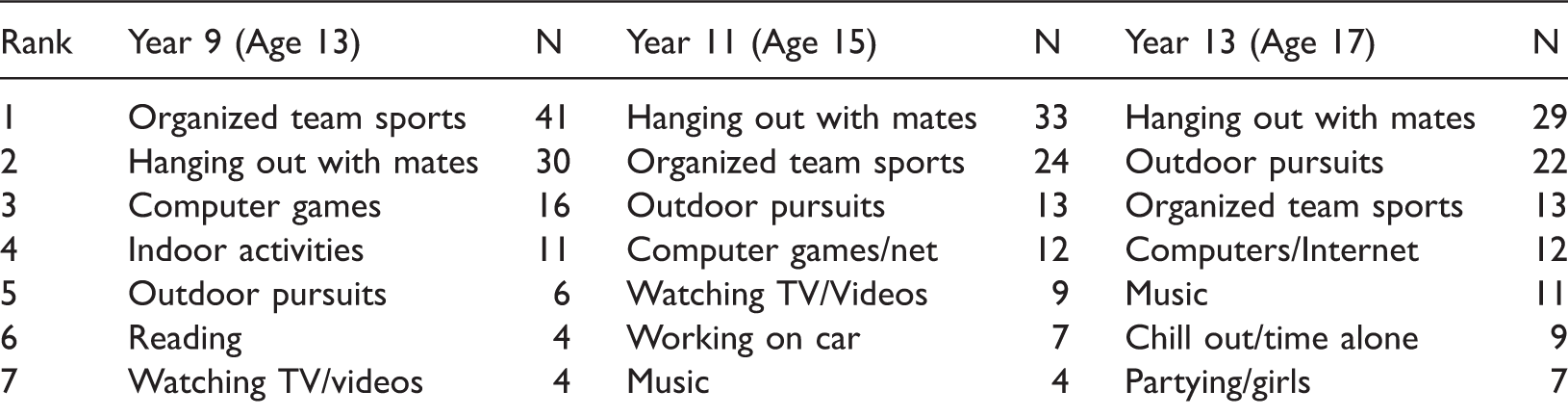
Preferred interests of boys by Year level (frequency of mention during interviews).
Mates or friends?
Many participants made a clear distinction between mates and friends. A Year 13 boy explained the differences in the following way “Mates are particularly close people. Friends are someone you can talk to, have fun, but not close”. There was a small minority of boys (16%) who commented that friends were closer than mates, but the majority used the term mates to describe that close friendship. Whether friends or mates were deemed closer; the explanation for this closeness was that they could be trusted. The huge majority (95%) of boys placed priority on having a small, trusted circle of friends/mates that you could hang out with on a daily basis at school and in the community. This article uses the term “mates” rather than friends; as ‘hanging-out-with-your-mates’ was the most significant phrase used when describing being with a group of male friends.
Characteristics of mates
Characteristics of a good mate (frequency of mention during interviews).
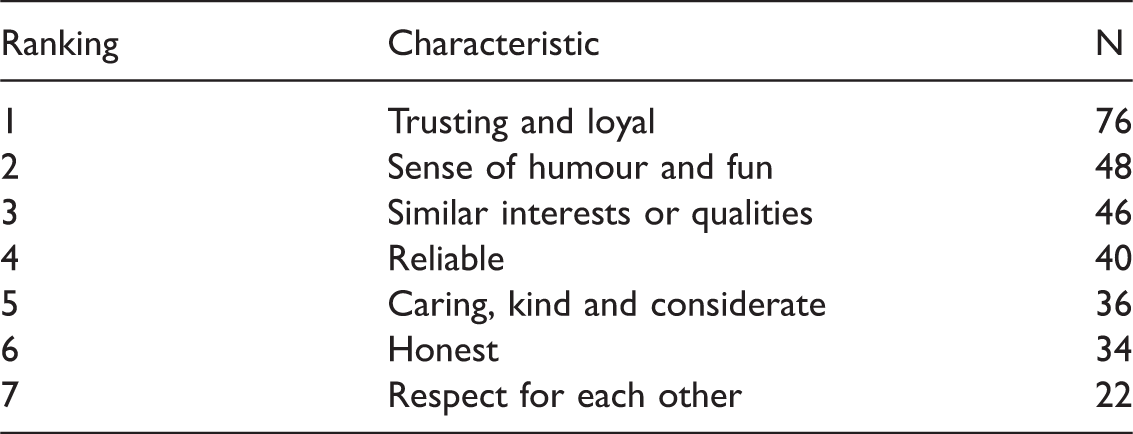
The above responses indicate that a mate must be someone who is dependable but also fun and enjoyable to be around. He is someone you can “muck around” with and feel at ease and safe within his company. The boys in this study defined “safe” as meaning emotionally safe rather than physically safe. In other words you are able to express your emotions and thoughts and know that your mates can be trusted not to divulge them to others. That was why a good mate is not “a back stabber,” he does not divulge confidences. Boys are emotionally hurt and lost when trust is broken. As this 13-year-old male described, “You can feel so lost and angry when a good mate back-stabs you. If you can’t trust a mate who can you trust?” The term back-stabber was used most frequently by younger boys or by older boys who had experienced back-stabbing when younger.
Benefit of mates
The participating boys could articulate clearly the numerous benefits of having a group of good mates. Boys do have strong emotional connections with their closest friends. This emotional connection is built on trust and acceptance as illustrated by this 17-year-old’s claim that “you can tell them everything and they won’t judge you on that. There is protection and you feel secure with mates”. A 14-year-old relied heavily on his mates to change his mood “If you’re feeling down they pick you up and make you feel good again,” while another used mates to reduce the stress of situations through talking and seeking advice. This Year 9 student stated that “mates take the stress out; you sit down and talk to them, getting different views.” These boys clearly had no hesitation in sharing feelings and expecting their mates to listen and give advice without judgement.
Benefits of mates (frequency of mention during interviews).
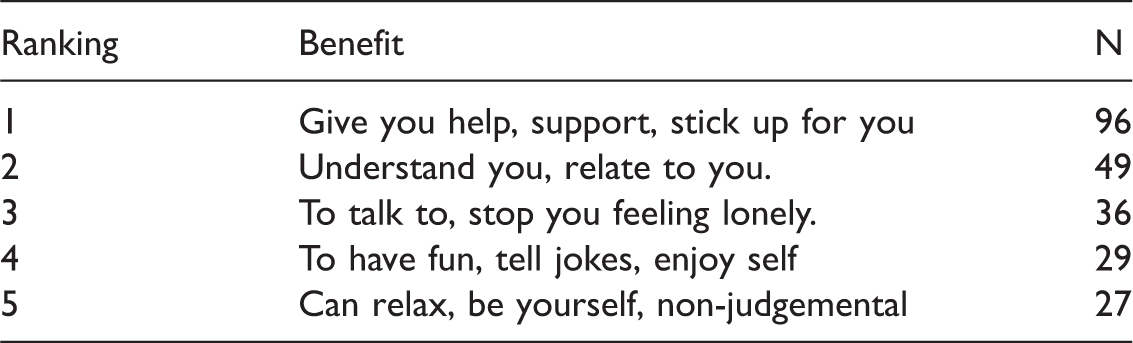
The first benefit category, a strong emotional bond, is an extremely important aspect of mate culture. Help, support, sharing, understanding and closeness are attributes as illustrated by the comments of this 17-year-old “I have four good mates, they’ve become like brothers. They challenge me, I challenge them and we help each other grow. They help to anchor you.” The second category of benefits is concerned with being in company where you feel you belong, can relax and have fun. As a 15-year-old explained, mates mean you “have a social life; it’s fun to be around friends you get along with, you can just talk about anything to them and feel good about yourself.” This research suggests that a boy with mates has a very strong, supportive network that assists him through the difficult developmental phase of adolescence. If a boy’s mates offer the behavioural features as described, it could be argued that his development through the turbulence of adolescences would be less stressful. This can be illustrated by the comment of this Year 11 boy’s relationship with his mates “unconditional friendship, if you screw up they’re still there.”
The boys in this study did not acknowledge peer pressure from mates as being a problem. The general consensus was that good mates do not pressure you into being what you are not, or to act in ways you do not want. One of the characteristic of a good mate was that he respects you and accepts you as you are; as the comments of this 17-year-old illustrates. “They are always going to be there for you. Good mates wouldn’t pressure you to do what you don’t want to.”
This would suggest that peer pressure does not appear to originate from your mates. Peer pressure is more likely to originate from that wider group of peers, friends and associates that a boy belongs to; whether it is within school, a sports team or other societal groups.
Hanging out with mates
A Year 9 boy from one of the co-educational schools referred to the “fellowship of hanging out”. This Year 11’s description was typical of many of the responses; “hanging out, means mucking around, telling jokes, talking; talk about anything we want to”. In this context, ‘hanging out with your mates’ could be deemed largely as a harmless social activity. According to this study’s participants, the activities they participate in for the majority of time are talking about “stuff,” playing both physical and electronic games, going to the movies, beach or mall, hanging out in each other’s homes, watching TV, DVDs, listening to music and just fooling around having a bit of fun. These activities with mates involves, for a large majority of the time, being sloth like; lying around in each other’s company, enjoying being together, sharing ideas, discussing stuff, watching or listening to electronic media and eating. Eating is involved in most of the activities adolescent males partake in. The word “stuff” is a dominant word in many young males’ vocabulary and is used right through school. Its meaning varies depending on the activities and context.
Mates and school
In this study a mate’s influence on schooling was perceived by the participants to be more positive than negative. A significant number of boys (76%) throughout the participating schools and year levels indicated that mates played a number of important roles within the life of a young male’s schooling. The boys described how some mates offered support, academic instruction, motivation, challenge and competition to improve standards. A Year 13 boy illustrates the feelings of many of the boys interviewed. “Mates, like, one of the most important parts of school. Mates will sometimes motivate you. Like in class, if you’ve missed a day, the teacher won’t give you the notes, but your mate will be there for you, if you need help he is always there”. Mates also played another important role of assisting in the release of pressures and stresses of school through after-school talk, “fooling around” and companionship.
A number of themes were identified from participant responses on the way mates assisted with school and learning. Mates being of similar age and with similar learning experiences were perceived to be good at explaining and assisting with learning difficulties encountered during the school day. As this Year 13 boy explains, “With my mates, well, if we find it difficult, we work together, we try and figure it out ourselves by helping each other and if my mate gets something and I don’t know what the hell to do, well, they’re going to help me get it right, even if they’ll probably laugh at me, but that’s just mates, but they do care and they’ll going to help you.” The laughing or joking that may be associated with asking for help did not harm if it was done in a climate of care. Mates were often the first person boys turned to for help, especially at the upper levels of secondary schooling. As this 18-year-old explains, “I usually go to a friend first. I’ve got a few smart friends; they usually have the answers to everything. May be it’s because they learn the same way you learn. They can explain it better because they know what you are like.” Mates can have a major influence on motivation to learn through “telling me how to do stuff” and using challenge and competition to inspire. As this 17-year-old in a single sex boys school explains, “Mates, we sort of have competitions to see who gets a better mark. Not really set competitions, just trying to get better than them and stuff like that. Keeps you going, something to strive for”. Goals, challenge and competition would appear to motivate boys, whether it is done officially or unofficially amongst boys in classrooms.
When a boy has a close, supportive environment and feels comfortable with his mates he is more likely to seek assistance with his learning from them. The key is the closeness of the relationship. In this study boys turned to mates for help with school work more often as they reached the upper years of schooling. As boys progress through school, they have the opportunity to develop a strong, trusting bond with their mates. In the earlier years that boys are in a new school environment, they are feeling their way and are initiating bonds of friendship. The same closeness of relationship with mates experienced at upper Year levels has not been established to the same extent.
During the earlier years of secondary schooling mates were more likely to be a distraction; a negative impact on learning. This negative aspect of mates within school was recognized by many of the boys (36%). Boys perceived this occurred on a more frequent basis in the early years of secondary schooling. The majority of concerns raised by boys regarded classroom distractions such as talking, “joking around” and disturbing off-task behaviour which occurred more often in Years 9 and 10. As this 15-Year-old explains, “Talking in class, talking about the weekend, you get right into that and next thing you know the period’s over.” Mates were alleged to be less of an academic distraction as the participants progressed through school and began preparing for external national qualifications or careers. The teacher was identified as an important factor in determining whether mates became a serious distraction. Boys in this study perceived that teachers who established positive student-teacher relationships, explained clearly, established consistent academic and behavioural boundaries and made learning relevant were more likely to engage the student. The boys (60%) indicated that in such a learning climate their mates were more supportive, collaborative and engaged in their learning.
Discussion
Mates have a substantial effect on boys’ attitude and success at school. These friendships become more supportive as the adolescent grows and develops (De Goede, Branje, & Meeus, 2009). Friendships can affect results of exams and assignments, as well as the determination to stay at school. A number of researchers have found that same sex friends can be both a strong pressure and a major support structure for both girls and boys (Brown & Gilligan, 1992; Chu, 2005; Jackson, 2006; Way, 1998, 2011). In this study, the boys perceived a close friendship to be one of great support. The majority of boys held the view that close friends do not pressure you into situations or try to change you. There were no concerns expressed that being in a close relationship with a group of male friends or mates lead to homophobic slurs. Chu (2005) also established similar findings that homophobia was not an issue.
There is a large body of research literature which shows a strong homophobic aspect within the boy culture of schools and beyond (Martino, 1999, 2001; Martino & Pallotta-Chiarolli, 2003; Pascoe, 2007). The participating boys in this study were either oblivious to homophobia within their schools environment or did not want to raise the issue. The individual interviews gave boys the opportunity to discuss school concerns and worries but questions were not specifically asked concerning homophobia or bullying. The boys in this study when asked of their major worries cited concerns over success in tests, obtaining qualifications and getting a job; because as a number stated, “they did not want to be a bum” on leaving school. The major concerns outside of school were to do with relationships with parents and family.
Trust and loyalty are the most important qualities that boys identified as important in establishing a close inner circle of mates. A number of researchers (Azymitia, Ittel, & Radmacher, 2005; Chu, 2005; Greif, 2009) have identified trust and loyalty as important attributes of adolescent friendships. Chu, 2005, p. 18) emphasized “that being able to trust their friends and also feeling trusted by their friends enabled them to confide in, be vulnerable with, and really take care of each other”. These studies support the findings of this study that loyalty and trust are the two most important virtues to have in a mate. As the participants stated, it was with your mates that you were open and at your most vulnerable, as you shared your ideas and feelings. The sentiment of many boys in this study was “mates don’t stab you in the back”. These sentiments were not related to physical action but emotional actions of divulging confidences to others. Great emotional hurt and anger was felt when trust was broken between friends. This appeared to happen more often in the earlier years of secondary school when relationships were new and more fluid. Boys were still adjusting to their place within the school new environment. These early breakdown in trusts could be explained by boys negotiating the hierarchical and fluid environment of school and their identity and place within this environ.
The findings indicate that the majority of boys in this study had a close circle of mates usually numbering between two and five. The majority of ‘hanging out with mates’ time involves physical inaction described in this study as sloth-like behaviours. There are two aspects of ‘Hanging out’ – the first social fun and the second personal development. It is within this comfortable, emotionally secure surrounding that boys talk most. Some of this is thoughtful talk where boys are testing their ideas, widening their views of their world; where an emerging adult identity is trialled. Bosacki (2005, p. 26) describes this as “co-construct their meaning of the world”. For a significant number of boys in this study, the reconstruction of identity occurred largely while the boy was hanging out with his mates; his mates’ influence was a critical factor in the development of self and future. Head (1999, p. 23) argues that “adults cannot force identity achievement on others. It is, after all, an activity process undertaken within the mind of the adolescent”. Many researchers have established the significance of friendship contexts for self-exploration and development (Bauminger et al., 2008; Call & Mortimer, 2001; Giordano, 2003; Way, 2011). The young males in this study saw their mates as providing the supportive environment where self-exploration and the development of future aspirations could occur.
In order to illustrate the various dimensions of relationships that a young male has with mates, friends, peers and acquaintances an Apex Model of Friendship (Figure 1) was created. At the apex is the boy with his 3 to 5 close mates in which he feels safe. At level 2 are friends who can number between 10 and 20 and are a group in which the boy feels comfortable and can joke and talk and fool around with. The biggest difference between friends and mates is the emotional closeness or intimacy of the relationship; mates are emotionally closer. Level 3 are peers, boys of a similar age group that the boy associates with through school, sports, work or other interests and activities within the community. There is no bond or closeness, just regular contact and acknowledgement of each other. Level 4 are contacts or acquaintances that the boy knows and has infrequent contact with; there is an awareness of each other but no common bond, activity or interest between the boy and this group. As the distance from the Apex increases, the relationship closeness or intimacy decreases along with trust, loyalty and the sharing of deeper thoughts and emotions.
This study’s findings would indicate that peer pressure, especially that which is seen as negative, comes from boys situated within Levels 2, 3 and 4 of this Apex Model of Friendship. Boys will mix with all levels of the Apex, but these findings would suggest if you are with a couple of mates from Level 1 you have greater protection and a buffer from some of the adolescent stresses and pressures. Hamm and Faircloth (2005) found similar findings of close friendships acting as a defence from the stresses and pressures generated by others. The influences that mates have on a boy were perceived by participants of this study to be mostly positive. The apparent benefits of mates (indicated in Table 2) could have considerable effect on their emotional and psychological wellbeing. The boys described how mates assisted them with terms like “you feel strong,” “grounded” “and secure,” and you “don’t have to be alone,” “you get picked up when feeling down”. These examples would indicate that the influence of mates supports psychological development and wellbeing. When the majority of the boys spoke of strength, it was inner strength not physical strength; when they spoke of help, it was emotional help not physical help. Chu (2005, p. 16) claimed a similar benefit with close friendships developing and fostering a “resilience as they come up against and tried to navigate around pressure that they encountered within peer group culture”.
This study’s findings suggest that mates have a significant influence on a boy’s educational journey. Peer acceptance and friendship have been identified as key experiences that support a students’ sense of belonging at school (Hamm & Faircloth, 2005; Osterman, 2000). A small number of boys (n10) in this study indicated how support and influence of their mates kept them at school to finish their education. Mates of long standing at school develop a sense of camaraderie built on support, success, challenge and competition. The research of Flutter and Rudduck (2004) and others within the ESRC Project, Consulting Pupils about Teaching and Learning gathered extensive data that showed: The positive dimension of friendships suggests that they are an important means of support, particularly for pupils who are experiencing difficulties with their learning. The influence of friendships seems to vary, however, from direct support with work to a more pastoral one. Direct learning support from friends was referred to by pupils across the school age range (Flutter & Rudduck, 2004, p. 103).
The findings from this present study would suggest that mates have an even stronger influence on boys than Flutter and Rudduck suggest as they progress through the school. The majority of Year 13 boys used their mates to assist with their schooling in a variety of ways; such as explaining, teaching, motivating, collaborating and challenging. By Year 13, these boys were not experiencing difficulty at school; they had achieved success in national examinations and were often leaders, mentors and prefects within their school. These boys had developed strategies that used mates in a positive way, as one of them explained, “we egg each on to achieve and stay at school”. A small number of boys through the Years 9 and 11 stages of school also used mates as advisers, instructors, supporters and motivators. However, at this age level, boys were more likely to be establishing the friendships which will develop into that supportive, trusted circle of mates.
Apex model of friendship.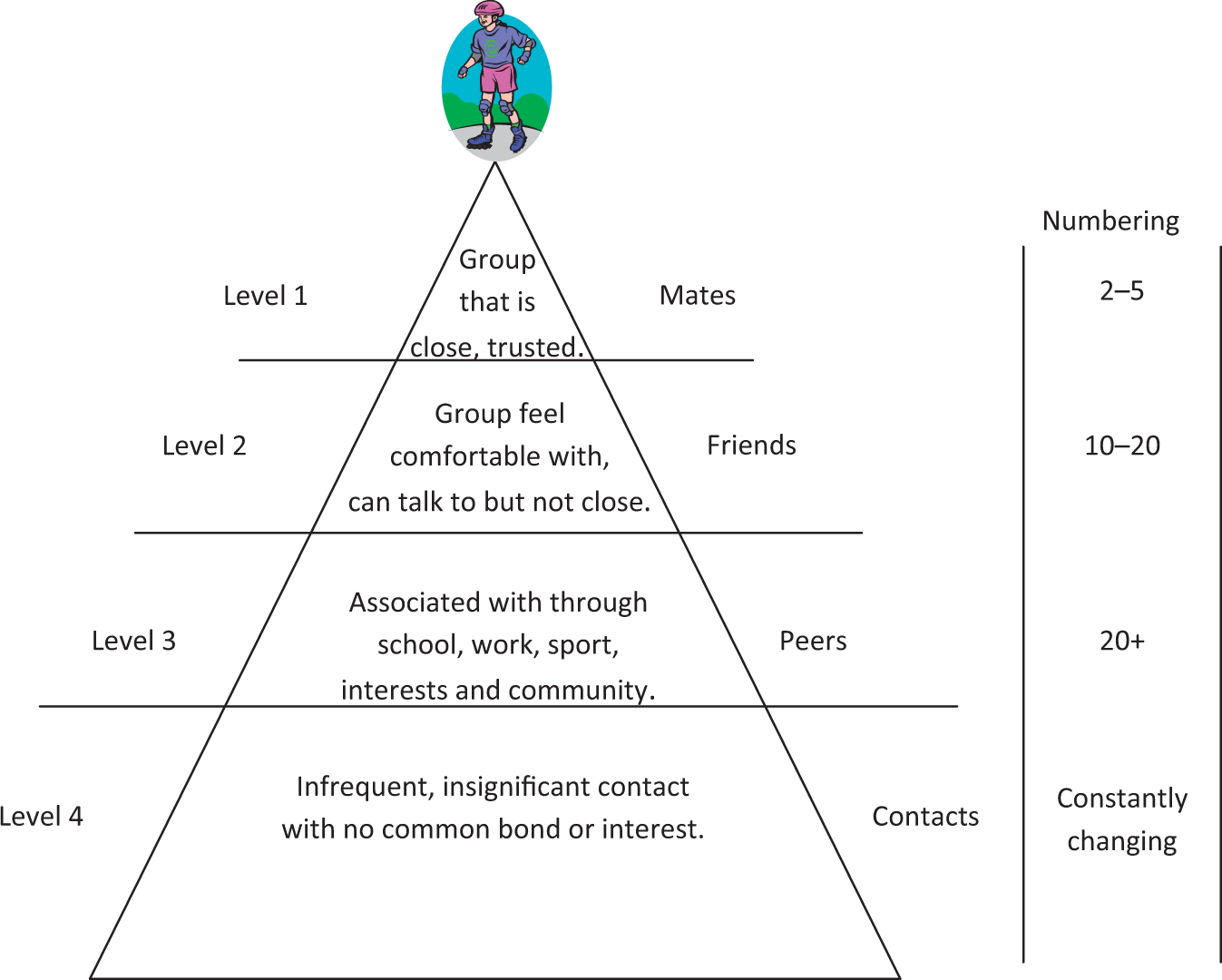
Conclusion
The results of this study indicate that the strongest preferred activity for adolescent boys attending school, no matter the age, is the social activity of ‘hanging out with his mates.’ It is argued that mates are the ultimate support network that offers a close relationship, where a boy can share, talk, explore and create a self-identity, while developing and having fun. A mate must be dependable and trustworthy but also fun to be around, someone you can “muck around with” and in whose company you can feel safe. These mates not only have an important role in the psychological development of a boy but an equally important role in the boys’ ability to function and achieve academic success at school. This research would suggest that boys often establish strong friendships while participating in a sports team that leads to the creation of that close bond of “matemanship”. A small group of mates can be the difference between success and failure at school, a positive influence that offers support, care and security that goes way beyond the school gate.
Footnotes
Notes
Declaration of conflicting interests
None declared.
Funding
This research received no specific grant from any funding agency in the public, commercial, or not-for-profit sectors.