




Abstract
Currently, Australian boarding schools undertake to provide a home away from home for around 20,000 adolescents. Research documenting the boarding school experience is scarce, and, with few exceptions, exists as a less significant aspect of more general research into private school education. Such school-based research focuses on the positive, character-building benefits of the boarding experience. However, case studies of former boarders paint quite a different picture. In order for boarding schools to best support boarders’ development, it is vital that adults who fulfil a parenting role undertake appropriate training. This paper draws together available information to present a comprehensive picture of boarding in Australian schools, with a focus on the challenges faced by the in loco parentis role of staff. It is apparent that more skills-based training is vital to better equip staff in this very important role.
Keywords
Introduction
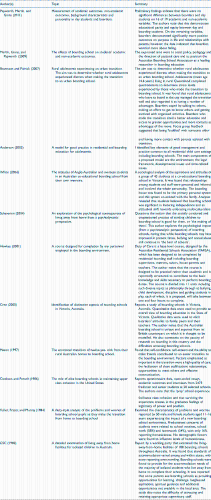
The purpose of this review is to assemble a current picture of boarding in Australian schools, with a specific focus on the challenges presented by the in loco parentis role of staff in their undertaking to create a home away from home for the young people in their care (boarders). Acting in loco parentis, or in the place of a parent, refers to the legal responsibility of a boarding school to undertake a number of the responsibilities of a parent. This role is pivotal to boarders’ developmental outcomes but is also a role that presents many challenges in an increasingly demanding and litigious world (Anderson, 2005; Hawkes, 2001). Available information and research on boarding schools is, in the main, of a theoretical, philosophical or a sociological nature (Anderson, 2005; Hawkes, 2001; White, 2004), with very few attempts (Bramston & Patrick, 2007; CSC, 1982; Cree, 2000; Papworth, Martin, & Ginns, 2011; Papworth, Martin, Ginns, & Liem, 2012) to quantify important aspects of this environment. There is a pressing need for data to inform the parenting role of boarding staff (Bramston & Patrick, 2007; Van Hoof & Holger, 1999), and this paper represents an initial investigation into the pastoral needs of adolescents who live in boarding school environments and the staff training required to respond to these needs. Information for the present review was gathered by searching catalogues and both education (ERIC) and psychology (psychinfo) databases, using the search words ‘boarding’, ‘boarding schools’, ‘residential schools’, ‘private schools’, ‘private education’, ‘isolated students’ and ‘boarders’.
Australian research on boarding schools.
Boarding in Australia—how does it compare?
Sociological studies of Australian boarding schools (Cree, 2000; White, 2004) have clearly differentiated these institutions from their British counterparts. While there is an assumption that Australian boarding schools are a colonial replication of those in the United Kingdom (UK), the dissimilarity of Australian boarding schools to their corresponding institutions, not only in the UK, but also in the United States (US), Europe and South Africa, has been highlighted (Cree, 2000; White, 2004). Overseas boarding schools cater primarily for boarding students rather than day students (Wakeford, 1969; Weinberg, 1967), such that, for an overseas school to be regarded as a boarding school, between 50% (Karlton, 1966) and 75% (Weinberg, 1967) of its enrolled students need to be boarders. Only 8 of a total of approximately 154 Australian boarding schools (Independent Schools Council Australia, 2010) met this definition (Cree, 2000; White, 2004). Australian boarding schools are more likely to be independent day schools with attached boarding houses, with only a small percentage of students defined as boarders (Cree, 2000; White, 2004). This renders research conducted on overseas boarding schools of limited relevance to the Australian context.
Australian research—what we know
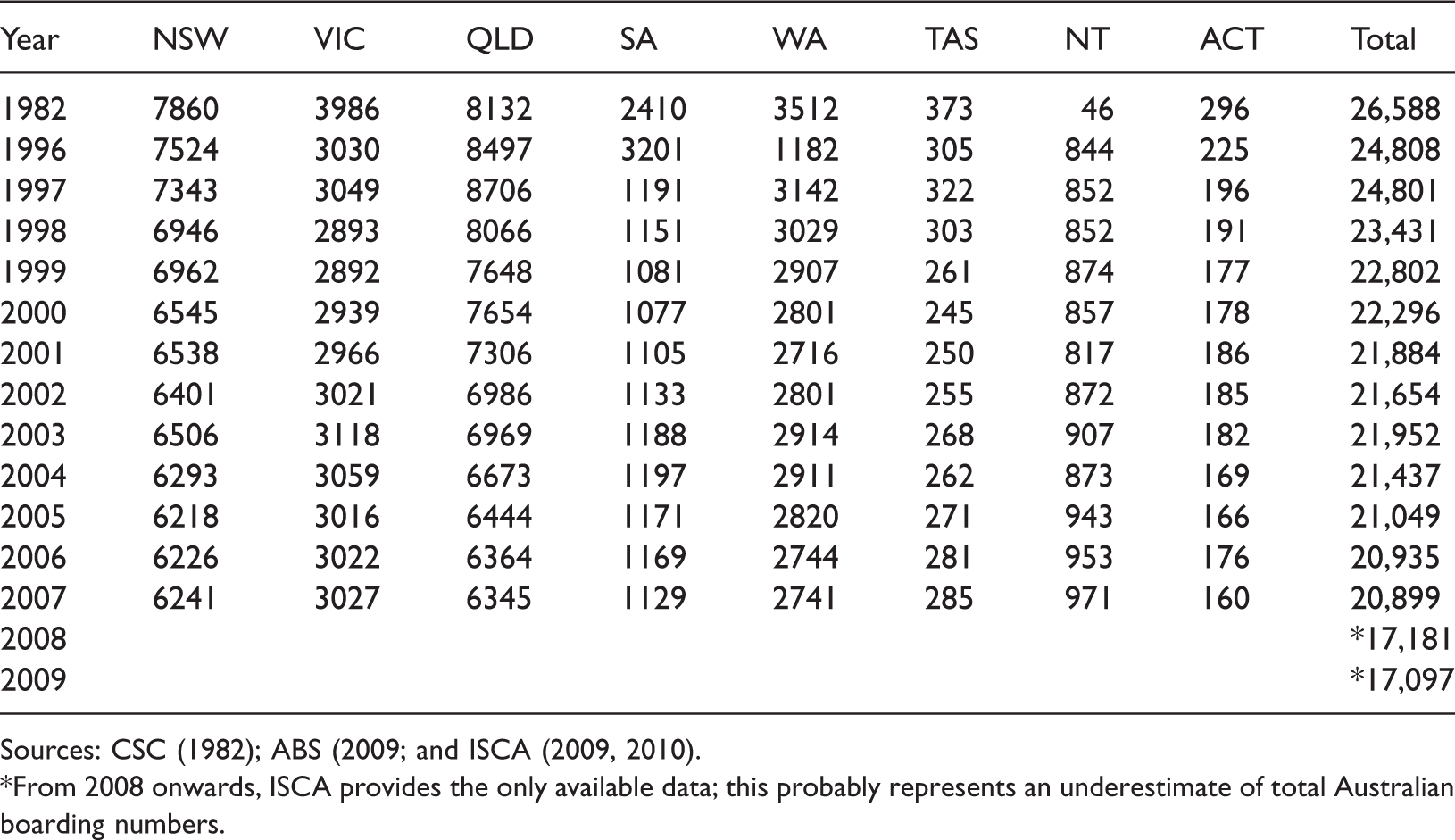
Research on Australian boarding schools is often a sub-focus of research into private education and data are often only accessible as part of larger studies of non-government schools (ABS, 2008; ABS, 2005). The exception is the Commonwealth Schools Commission (CSC, 1982) Study on Living Away From Home Facilities for Isolated Children; the only detailed quantitative study on Australian boarding that includes information from all states and territories. This study included a total of 26,588 boarders, a response rate of 95% (total of 28,133 boarders). The CSC study was commissioned due to an absence of national data for decision-making and, albeit dated, provides a benchmark for the current state of boarding in Australia. The paucity of current research in Australian boarding schools, particularly quantitative research, necessitated that data collection for the present paper be derived from a number of sources.
Boarding numbers 1982–2009
It is difficult to determine exactly how many boarders currently reside in Australian schools. Boarding school pupils have been excluded from the scope of the Australian Bureau of Statistics Schools Education and Work Study (SEW) since 2005; however, in May 2009, the ABS Labour Force Study (LFS) yielded an estimate of 19,200 boarding school pupils aged 15 years and over. Previous estimates of boarding numbers have included boarders younger than 15 years, rendering this recent figure an underestimate. The Independent Schools Council Australia (ISCA, 2008, 2010) recorded an increase in numbers of boarders between 2007 (16, 926) and 2009 (17, 097). These figures derive from 154 of the ISCA’s 1022-member schools and, based on the comparison with 20,899 boarders estimated by the ABS (2008) and ABS LFS figures, also appear to underestimate current boarding numbers. Recent Australian data do not provide a detailed breakdown as was available in the CSC study (1982) and the ABS (2008).
Fulltime boarding students at nongovernment schools by state.
Sources: CSC (1982); ABS (2009; and ISCA (2009, 2010).
From 2008 onwards, ISCA provides the only available data; this probably represents an underestimate of total Australian boarding numbers.
Reasons for boarding
Empirical research on reasons for boarding is scarce; the exception is a survey of 3100 families from 68 boarding schools conducted by the Independent Schools Council of Australia (2008). Based on this snapshot, which represents a response rate of 51%, the current profile of Australian boarding school students is a diverse group of young people from a range of backgrounds and countries (ISCA, 2008). Currently, boarders come from cities, regional and remote areas and may board because their parents are employed overseas, or may board on a weekly basis in order to cope with their own sporting and academic commitments or as a way of coping with changed family circumstances (ISCA, 2008). Fifty-five percent of families surveyed indicated that there was little choice but to board their children, (ISCA, 2008). Parents from rural communities noted that while they would rather not send their children away to school, the decision was necessary in order to access a high-quality education important for their children’s future success (Bramston & Patrick, 2007; ISCA, 2008). Mason’s (1997) Australian study on the transition to boarding school also found that parents sought the increased options and opportunities afforded by boarding but were also concerned about the additional influences on their children and the decreased ability to keep an eye on their progress. Most parents who responded to the Independent Schooling in Australia 2006–2008 survey (ISCA, 2008) identified that being a boarder led to becoming a well-rounded, well-balanced person who was independent, self-reliant, tolerant and compassionate, with 92% indicating that they would choose boarding if they had to make the decision again. However, this very positive appraisal of boarding school graduates might also represent a rationalisation by parents (Duffell, 2006; Poynting & Donaldson, 2005; Schaverien, 2004).
This information, while limited in scope, provides boarder demographics not notably different from those published in the more comprehensive CSC (1982) study. Consistent themes have emerged from research on recent and historical reasons for boarding, including boarders’ perceptions of the benefits of boarding (Bramston & Patrick, 2007; CSC, 1982; ISCA, 2008; White, 2004). These include geographical isolation, specialised courses, parents’ employment, family disruption, overseas students and character building. All are worthy of further exploration.
Geographical isolation and access to specialised courses
The major reason cited by CSC (1982) for students to board was geographic isolation. The CSC study noted that of geographically isolated parents who chose to send their adolescents to boarding schools, 19.5% cited access to specialist courses, staff and resources as a reason. Today, many rural students still do not have reasonable daily access to a school that can provide a variety of senior courses; indeed, many high schools in country areas can only offer specialised courses through distance education (Bramston & Patrick, 2007; McGibbon, 2011). Recent research suggests that the decision to send children to boarding schools is still motivated by a desire to access courses that are prerequisites to tertiary education (Bramston & Patrick, 2007; Fisher, Frazer, & Murray, 1984; ISCA, 2008; Mason, 1997; McGibbon, 2011; Stevens, 1995).
Parents’ employment
The globalisation of society has resulted in greater mobility of the work force in general; this, along with the continuing mobility of certain professions (e.g. armed forces), means that boarding is a feasible alternative for such families (Cree, 2000). When parents’ employment means that they spend periods of time away from the family home, or that they must live interstate or overseas, rather than cause disruption to their child’s education, boarding school is often a practical choice (McGibbon, 2011). This is particularly so if the young person is completing their senior schooling or the adolescent does not manage change well.
Disrupted family circumstances
Historically, relatively few students (9.9%) cited disrupted family circumstances as a reason for boarding (CSC, 1982). However, in more recent times divorce, separation and parental re-marriage are all reasons for choosing boarding as a substitute family (Anderson, 2005; Cree, 2000). While for many young people boarding is a carefully considered decision, lack of stability at home and exposure to traumatic and potentially damaging experiences motivated some families to seek a place in a well-ordered and secure environment (Anderson, 2005; Gerrard, 2001). The pressures of parenting may be enough to motivate parents to remove children from the confusion of a chaotic home and send them to a safe, controlled environment, where professionals can do the job instead (Cree, 2000; Gerrard, 2001; Hawkes, 2001). The social support, security and group standards of the boarding community may also be important during times of ill health or when families experience relationship breakdowns (Hawkes, 2001).
Overseas students
Most Australian boarding schools cater for some students from Malaysia, Singapore and Hong Kong (Cree, 2000). However, rather than the boarding system itself, access to the Australian tertiary education system, perceived as a cheaper alternative to university courses in the United Kingdom or the United States, is the proposed attraction for boarders (Cree, 2000; Han, Jamieson, & Young, 2000). ISCA (2010 ) data indicate that of the 483,330 students attending independent schools, 10,124 are from overseas. However, current data are unavailable for the proportion of overseas students who actually reside in Australian boarding schools.
Structure and character-building
Parents perceived boarding schools as desirable for building character and developing self-reliance (BSA, 2007; CSC, 1982; ISCA, 2008). In support of this perspective, students’ responses in White’s (2004) sociological study of an Australian co-educational boarding school also maintain a character-building perspective. Such self-reliance is promoted as one of the benefits of being a boarder but has also been interpreted as ruptured attachment or a boarder’s inability to rely on anyone but themselves (Duffell, 2006; Gerrard, 2001; Schaverien, 2004, 2011).
Options for boarding
Boarding schools offer a structured environment with controlled periods of private study, the constant presence and assistance of teachers and specialised staff, as well as use of the school’s facilities including libraries and computers outside school hours. This may be particularly important for those students who are heavily involved in academic commitments and extra-curricular commitments, including sport, music, debating and drama (Anderson, 2005; Hawkes, 2001; ISCA, 2008). While five-day (weekly) boarding numbers were included in the 1982 CSC study, only 3.9% of boys and 7.0% of girls who lived relatively close to school boarded. However, in more recent times, boarding has become an attractive option for families who live in close proximity to the school (Hawkes, 2001; McGibbon, 2011). Two boarder categories not included in the CSC study but incorporated in more recent boarding literature (Hawkes, 2001) are ‘occasional’ and ‘day boarders’. Occasional boarders are those who generally do not board but may require accommodation for short periods of time, for example, when academic and extra-curricular demands might be particularly high or during family crises. Day boarders are those who, perhaps due to parental commitments, use the boarding facilities during the day and early evening and then return home to sleep. Demand for these options is increasing (Hawkes, 2001), as is evidenced by the current marketing of prominent Australian boarding schools that note day boarding to be ‘the best of both worlds’ (Geelong Grammar School, 2011; The King’s School, 2011; The Southport School, 2011). Anderson (2005) concurs and in support notes that the number of schools that currently cater for only full (versus weekly) boarding is declining. Reasons mentioned for weekly boarding included the additional academic support offered by boarding staff and extra time available, which otherwise would have been spent commuting.
The aforementioned reasons for boarding highlight the importance of the in loco parentis role of boarding school staff. It should be noted that the available information generally represents parents’ opinions while the boarders’ perspectives on their own experiences are rarely represented.
Boarders’ perspectives
The literature on boarding presents a somewhat polarised view of the boarding experience, from a very positive, character-building perspective (BSA, 2007; Hawkes, 2001; ISCA, 2008) to one of socially condoned child abuse (Duffell, 2000, 2006; Poynting & Donaldson, 2005; Schaverien, 2004, 2011). Key themes that have emerged from boarders’ perspectives (Bramston & Patrick, 2007; Gerrard, 2001; White, 2004) include: the positive impact of boarding school on a student’s ability to ‘get ahead’; ‘independence’ from the primary social system of the home; tolerance of others and individuality, empowerment and opportunity. However, case studies of former male boarders paint a very different picture of the traumatised child who, while outwardly successful, struggled to reconcile the sacrifices made for him to attend the ‘best schools’, with his own experience of emotional deprivation, feeling abandoned and even being bullied or possibly abused (Duffell, 2006; Schaverien, 2004, 2011). This perspective is consistent with historical, biographical and anecdotal accounts of the boarding experience and raises questions about supervision in the boarding environment (Duffell, 2000; Lambert, 1968). Responsibility for the care of students 24 hours a day is a heavy responsibility and increased scrutiny and retrospective accounts of boarders’ experiences (Duffell, 2000; Lambert, 1968; Poynting & Donaldson, 2005; Schaverien, 2011) have highlighted the legal risk and duty of care in boarding schools (Anderson, 2005; Hawkes, 2001).
Changing responsibilities of Australian boarding schools
Boarding schools are busy and complex places, required by the courts to minimise risk and prevent reasonably foreseeable harm (Anderson, 2005; Boyd, 2000). The law is imposing increasingly higher standards of care on boarding institutions, which must demonstrate, to the satisfaction of the courts, appropriate handling of situations involving risk (Anderson, 2005; Hawkes, 2001). Boarding schools are also bound by child protection legislation to safeguard children from harm (Anderson, 2005; Boyd, 2000; Hawkes, 2001) and to prevent physical, emotional or psychological abuse (Hawkes, 2001). To this end, staff members who come into unsupervised contact with boarders are obliged to have criminal background clearance (Anderson, 2005). The risk of bullying is a constant challenge in a boarding environment, with harsh tales of overt bullying part of boarding’s historical inheritance (Duffell, 2000; Lambert, 1968; Poynting & Donaldson, 2005). While it is imperative that the day-to-day running of a boarding school is governed by clear policies and guidelines and informed by relevant laws, this can also be counterproductive to cultivating an environment that is nurturing, supportive, as well as safe and transparent (Anderson, 2005; Holgate, 2007; White, 2004). This conundrum presents a significant challenge for boarding staff who must walk the boundaries between the legal and parental responsibilities.
Staff roles and responsibilities
Boarding staff are not only facilitators and guarantors of security (Anderson, 2005; Hawkes, 2001), but just as importantly, they are in loco parentis models for young people. The literature is somewhat silent on the demographics of staff in boarding schools, however, given the diverse backgrounds of boarders, heterogeneity of life experiences and age is an advantage (Anderson, 2005). This is consistent with observations of many boarding establishments that yield a picture of staff across a continuum on age, experience and formal qualifications. The variety of experiences that staff bring to the boarding environment is important, but so is their ability to function as a team that is consistent and fair, and acts in the best interests of the young people in their care (Anderson, 2005; Cree, 2000; Hawkes, 2001; Holgate, 2007). Boarding schools generally employ teachers as part of their boarding staff. However, the number of teachers employed and their designated roles differ according to the school’s organisational structure. There are ample descriptions of the skills, qualities and knowledge that all staff should possess, including personal qualities such as kindness, empathy and respect, emotional regulation, communication and knowledge of first aid, crisis management and legal issues (Anderson, 2005; Hawkes, 2001, 2010; Turner, 2008). This mixture of skills and personal qualities required by staff who assume this important role would appear to require extensive preparation and training.
Regardless of the specific roles assumed by staff members, each person has the vital responsibility for the nurture and welfare of the boarders (Hawkes, 2001; Holgate, 2007). This is a difficult assignment for young boarding staff members who are, in some cases, not very far removed from being students in such establishments. Staff have an obligation to model the behaviours, values, skills and attitudes (Hawkes, 2008) young people require in order to lead meaningful lives and become productive members of society (Peterson, 1996; Sanders, 2004). The boarding environment, like the family environment, is an ideal setting for promoting the development of young people by teaching a range of skills including practical skills such as ironing a shirt, cooking and mending, to skills that focus on social and emotional competence such as communicating, controlling emotions and impulses and handling responsibilities (Anderson, 2005; Hawkes, 2001; Holgate, 2007; White, 2004).
Staff and student interactions in the boarding environment are an important part of the young person’s social and emotional development (Anderson, 2005; Hawkes, 2001; Holgate, 2007; Sanders, 2004). However, members of a boarding community occupy challenging boundaries between the need to develop empathetic relationships and the need to maintain an appropriate ‘distance’ befitting the power differential between students and teachers (Anderson, 2005: Hawkes, 2001; White, 2004). While the ideal age and qualifications of potential staff are not prescribed, numbers of staff required are usually expressed as a staffing ratio and included in the school’s legal documents, with ratios of 1 staff to 15 or more young people being common in a boarding environment (Anderson, 2005; Hawkes, 2001). This proposed ratio (Anderson, 2005) presents a significant challenge for staff who assume a parental role for boarders (Peterson, 1996; Sanders, 2004).
Staff training
In addition to their parenting role, the need for knowledge of occupational health and safety requirements, physical and mental health, first aid and child protection legislation make training and continuing professional development essential for boarding staff (Anderson, 2005; Hawkes, 2001). Duty of Care – A Certificate Course in Residential Care (Hawkes, 2001, 2010), the Australian Boarding Schools Association’s (ABSA) base-level training for all boarding staff, is promoted as the gold standard in staff training and is intended to contribute basic knowledge and skills for staff to perform their boarding duties (Hawkes, 2001, 2010). This course addresses topics such as: the philosophy of residential care; meeting boarders’ pastoral needs; occupational health and safety and emergency procedures based around written tasks that require staff to reflect on their own practice (Hawkes, 2001, 2010). In January 2013, 382 of the estimated 1500 boarding staff across all Australian states and territories had completed this course (Australian Boarding Schools Association [ABSA], personal communication, June 6, 2011).
An Associate Degree in Social Science (Residential Care) which was offered as a part-time option (2–4 years) through the Australian Catholic University (ACU) has more recently been discontinued. While staff training is available, it is currently not compulsory for employment in boarding schools.
Do boarding schools provide a home away from home?
Generally a young person’s social systems are divided into a primary personal system, represented by the home or family, and a secondary personal system, the school or university (White, 2004). Through analysis of boarders’ memoirs, White (2004) found that boarders formed not one but two kinds of primary bonds, one with their family and the other with their boarding house, and that boarders’ personal values were drawn from both the family and from the boarding house. This research provides significant support for the importance of the parenting role of boarding staff. There is also considerable theoretical support for the primary nature of the boarding house and its staff in the social, emotional and intellectual development of boarders (Anderson, 2005; Cree, 2000; Hawkes, 2001). Boarding staff, boarders and their parents all recognise that boarding institutions need to provide a home away from home (Anderson, 2005; Hawkes, 2001; Holgate, 2007; ISCA, 2008). The success of the boarding school depends on its capacity to fulfill this role (Anderson, 2005; Hawkes, 2001, 2008; Holgate, 2007; ISCA, 2008). There is no denying that for students who make boarding schools their home for more than 38 of 52 weeks each year, boarding staff acting in loco parentis must accept the vital responsibility of the nurture and welfare of the boarders.
The future of boarding
Due to the vast size of Australia, there will be an ongoing demand for places in boarding schools. However, the boarding schools that will endure are those that offer warmth, security and a strong sense of community and can cater for the physical, social, emotional, spiritual and academic needs of the adolescent (Hawkes, 2001; ISCA, 2008). Many parents indicated that boarding schools provided some sanctuary from outside influences and as such would increase in popularity (ISCA, 2008). However, what is not clear is the way forward to practical, empirically supported training that will empower staff to fulfil their brief to provide a safe, secure, positive learning environment where adolescents can develop not only in a physical and academic capacity but just as importantly, socially, emotionally and spiritually.
Conclusions and implications
As most boarding research is of a theoretical rather than empirical nature (Anderson, 2005; Bramston & Patrick, 2007; CSC, 1982; Cree, 2000; Hawkes, 2001; White, 2004), there is a pressing need for data to inform the in loco parentis role of staff in boarding schools (Bramston & Patrick, 2007; Van Hoof & Holger, 1999). The purpose of the current review was to draw together the available literature and to present a comprehensive picture of the Australian boarding situation with a specific focus on the challenges of the role of boarding school staff and their undertaking to create a home away from home for boarders. It is apparent that, while boarding numbers fluctuate, boarding schools are an important and, it appears, an enduring feature of Australia’s schooling landscape. It is also abundantly clear that the expectations of boarding schools are far in excess of the provision of a safe, secure environment, but extend to what are generally thought of as parental responsibilities; that is, the social, emotional and spiritual development of each child. Boarding staff vary greatly in age and level of experience, yet all have the responsibility for the nurture and welfare of the young people in their care. The implications of these expectations are that all boarding staff require a comprehensive range of skills, and training must not be limited to information or knowledge but also involve skill development.
In drawing together available information, this paper has exposed some shortcomings, the most important of which is that staff performing a parenting role in boarding schools do not have access to adequate skills-based training to support the developmental outcomes of the young people for whom boarding schools are a home away from home. Evidence-based parenting programs for adolescents are available and may represent a potential solution for the abovementioned problem. Modifications of existing parenting programs for adolescents may well provide a workable solution for improving the competence, confidence and self-efficacy of boarding staff in working with the young people in their care.
Footnotes
Funding
This research received no specific grant from any funding agency in the public, commercial, or not-for-profit sectors.
Declaration of conflicting interests
None declared.